This book must be a classic work on translating poetry. Readers of this blog will know that occasionally I nerd out about translation. Well, Eliot Weinberger does it in spades, only he’s wittier, more erudite and generally much more illuminating.
The book looks at nearly 30 attempts to translate one four-line poem by the classic Chinese poet Wang Wei (c 700–761 CE), mostly into English. The poem is generally but not always, such is the nature of translation, known as ‘The Deer Park’.
Before looking at any of the attempts, there are three short sections presenting and discussing: the original, in Chinese characters, just five on each line; a transliteration into modern pinyin; and a character-by-character translation onto English. To give you some idea of the challenge facing the translator, here is the first line of the character-by-character translation:
Empty_ mountain(s)/hill(s) (negative)_ to see _ person/people
You can see that the possibilities are vast – and in discussing the different solutions, Weinberger has a lot of fun and at the same time gives an impressionistic account of the influence of Chinese and Japanese poetry on English language poetry in the last 100 years. He doesn’t mind taking on the Chinese language specialists who may know about the language but have no ear for poetry, and he doesn’t hold back with either praise or displeasure.
I’d written to this point when I remembered that I blogged about J. P. Seaton’s Shambhala Anthology of Chinese Poetry almost exactly 16 years ago, and did my own timid, partial, uneducated attempt at comparing versions – of a slightly longer poem by Li Po (701–762). If you’re interested, it’s at this link.
In short, I loved this book, and if you’re interested in Chinese poetry and /or translation in general, you will too. I’m very grateful to John Levy for mentioning it in the comments (at this link).
I’ll give the last word to Weinberger. At the end of the original essay – before Octavio Paz had contributed his learned Afterword, and before Weinberger’s account of a Furious Professor’s response – he writes:
The point is that translation is more than a leap from dictionary to dictionary; it is a reimagining of the poem. As such, every reading of every poem, regardless of language, is an act of translation: translation into the reader’s intellectual and emotional life. As no individual reader remains the same, each reading becomes a different – not merely another – reading. The same poem cannot be read twice.
I am an Australian-born man of settler heritage. I wrote this blog post on the land of Gadigal and Wangal of the Eora Nationa. I gratefully acknowledge the Elders past and present who have cared for this beautiful country for millennia, and welcome any First Nations readers of this blog.
Before the meeting: I heard Ian McEwan talking about this novel on David Runciman’s Past Present Future podcast a while back (at this link). Well, not so much about this novel as about what it’s like to be contemplating one’s own death at a time when the future of the world as we know it is in doubt. How will the people of the future regard us who were alive at this critical moment in human history? That question, he said, was the genesis of the novel.
What We Can Know is set in Britain long after our time, which is known in that future as the Derangement. In 2042 there has been an Inundation caused by the melting ice caps, and a nuclear winter created by international war has put an end to global warming. Britain is now an archipelago. North America is the domain of lawless warlords. Nigeria has become the preserver of electronic connectivity. Life is simpler and more difficult, but there are still academics, and there is a vast trove of records preserved from our time.
The central characters of the novel specialise in the literature of a period that overlaps our present moment. Their students revolt, seeing such studies as irrelevant to the needs of the times, and regarding literature produced by the generations who allowed such catastrophic events as beneath contempt.
That all works well. The physical environment is always interesting, even for a reader like me who has little knowledge of British geography, and so can’t appreciate the specifics of boat trips from island to island. However, I was far from engrossed by the central narrative thread, which concerns the main character’s search for a long lost poem, written in 2014 but never published. He hunts through the vast reservoir of data, and pieces together a picture of the dinner party when a distinguished poet read the poem aloud and presented it to his wife on a vellum scroll tied up with a bow. The story is told and retold from many points of view, becoming in my experience increasingly tedious, until there is a final telling that may amount to a revelation, but by that time I was well beyond caring.
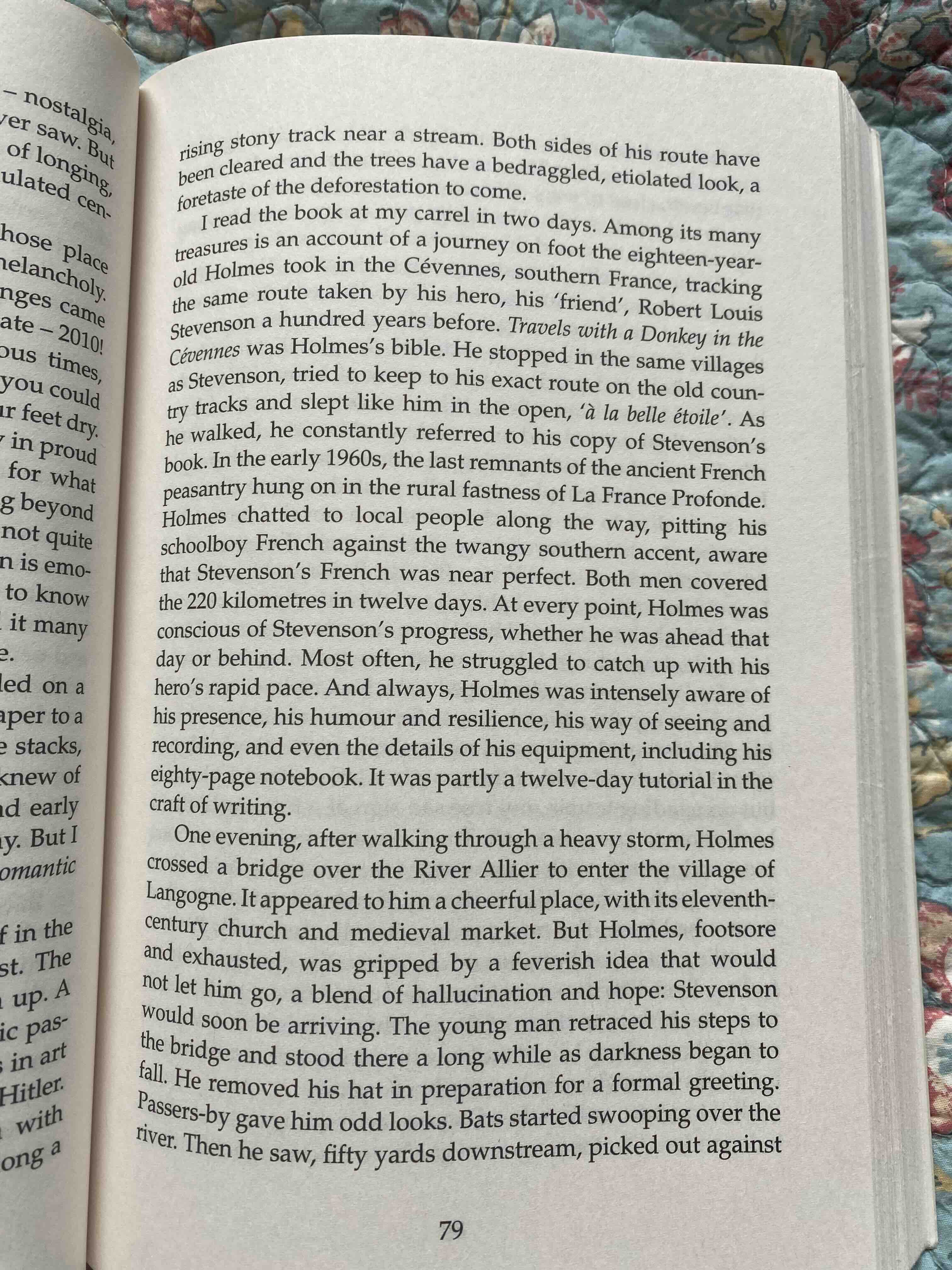
Page 79*, taken in isolation, isn’t much to write home about, though it’s a nice example of the novel’s intertextuality. It’s a summary of part of an actual book published in 1985, Footsteps: Adventures of a Romantic Biographer by Richard Holmes, which has a minimalist Wikipedia page at this link.
Among its many treasures is an account of a journey on foot the eighteen-year-old Holmes took in the Cévennes, southern France, tracking the same route taken by his hero, his ‘friend’, Robert Louis Stevenson a hundred years before. Travels with a Donkey in the Cévennes was Holmes’s bible. He stopped in the same villages as Stevenson, tried to keep to his exact route on the old country tracks and slept like him in the open, ‘à la belle étoile‘. As he walked, he constantly referred to his copy of Stevenson’s book. In the early 1960s, the last remnants of the ancient French peasantry hung on in the rural fastness of La France Profonde.
And so on. I was interested enough in the description of Holmes’s book because I’d enjoyed the 2020 film Antoinette dans les Cévennes, which also traces the route taken by the young Robert Louis Stevenson in the 1870s.
You won’t be surprised to learn that the passage’s context makes it something more than a schoolboy summary. The narrator had come across Holmes’s book when he was a 22 year old student who hadn’t yet settled on a subject for his doctorate. He had ‘eased the hundred-year-old hardback from its shelf’ as a delicate remnant from a past era, and tells us about it now because it contains one of the ‘most exquisitely evoked descriptions’ of a longing for ‘what was never known and is lost’ – the emotion that is the central driver of his academic research and of his quest as narrated in the first half of this book. The world before one was born in what was never known, and its loss is intensified for those who live after the Inundation
Most of page 79 leads up to that ‘exquisitely evoked description’. Then, at the bottom of the page, Holmes is standing at a bridge in the village of Langogne in a semi-hallucinatory state hoping that Stevenson, long dead, would soon be arriving:
Then he saw, fifty yards downstream, picked out against the fading gleam of the western sky, the old ruined bridge into town, the one his dear Stevenson would have crossed. Holmes was bereft, close to tears. ‘There was no way of following him, no way of meeting him. His bridge was down. It was beyond my reach over time, and this ruin was the true, sad sign.’
The narrator draws out the meaning of this:
The collapsed bridge downstream and the man crossing it a hundred years before represent the past from which I too am excluded, the past that from here seems whole and precious, when many of humanity’s problems could have been solved.
But, though Stevenson’s bridge was down, the country he had walked was substantially unchanged in Holmes’s time. In the narrator’s present time, all that land is lost, under water.
And that is the chord that vibrates through the novel. I the reader am living in the time that the character sees as ‘whole and precious’. Logically I can see that the book should have me on an edge – a prolonged moment of appreciating the world I live in, preemptively mourning its loss, and resolving to do what I can to protect and defend it. Whether the failure is mine or the novel’s, it didn’t have that effect on me.
When – spoiler alert – the second half of the novel has a different narrator, in a different time period, that driving emotion fades into a distant background, and the book, in my opinion, becomes a much more commonplace affair.
The meeting: We read What We Can Know in tandem with Carys Davies’s Clear. Like that book, it evoked widely divergent responses. In this case I was the Most Negative, and she who had been Most Negative for Clear enjoyed this one as a satisfying holiday read.
For some the world-building amounted to thinly disguised lecturing about climate change. Others felt there wasn’t enough of it – and I guess I’m in that camp: I would happily have stayed in that future, wandering beyond the confines of university scholarly life. Where my engagement as a reader was fading by the end of the first part and died irretrievably when the narrator and time frame changed, that was where others felt the book finally came alive. I think there were two people (out of five) who were there for both parts. (My interest had died to such an extent that I had to be reminded of the key revelation in the second part.)
I think the key thing that worked for others and not for me is announced in the book’s title. Appropriately enough, the title is hard to remember: I keep misremembering it as ‘All We Can Know’ or ‘All That You Know’ and I keep thinking of Keats – ‘That is all / Ye know on earth and all ye need to know.’ So What We Can Know: the book is about knowledge, specifically historical knowledge. The academics of the future can sift through the mountains of detailed electronic and other documentation of our times but what goes unrecorded will remain unknown, and if the records of significant truth aren’t found then that truth remains unknown.
I’m sailing very close to spoilerish now, but the book’s central search for a lost poem, reputedly a masterpiece, turns out to be wrong-headed. A different document, found thanks to ingenious deciphering of clues in the archive, transforms the meaning of events as they were known up to that point. For some readers, perhaps for most, this is deeply satisfying. It might, I concede ruefully, be a matter of attention span.
The Book Club’s five members are all of settler heritage. Our combined ages add up to many more years than have passed since Arthur Phillip claimed this continent for the British Crown. We met on Gadigal land, and I wrote this blog post on the land of Gadigal and Wangal of the Eora Nationa. I wrote the blog post on Wangal and Gadigal land. I gratefully acknowledge the Elders past and present who have cared for this beautiful country for millennia, and welcome any First Nations readers of this blog.
* My blogging practice is to focus on the page that coincides with my age, currently 79.
Before the meeting: On a remote island to the north of Scotland, the population has shrunk to just one man, plus a cow and a number of domestic animals. The man, Ivar, is the sole surviving speaker of the island’s language. The island is owned by a wealthy mainlander, and this is 1843, during the time of the Clearances, when tenants all over Scotland were evicted to make way for more profitable sheep. An idealistic clergyman, John Ferguson, an impoverished member of the newly formed Free Scottish Church, agrees to take on the errand of travelling to Ivar’s island to prepare him for his removal. The errand turns out not to be all that simple: John Ferguson (he is always referred to by both names) has a near-fatal fall, Ivar tends him, and as he recovers they learn to speak each other’s language.
I love this book. It’s a story well told, with genuine suspense (what will become of the gun that John Ferguson brings with him to the island?) and an implausible final twist that I found delightful. What I especially love is its resonance with Australian history. As the relationship between the two men develops and Ivar shares his knowledge of knowledge of language and place with John Ferguson, I am reminded insistently of the relationship in the early settlement of Sydney between Lieutenant Dawes and the young Cammeraygal women Patyegarang – as fictionalised by Kate Grenville in The Lieutenant and explored by Ross Gibson in 26 Views of the Starburst World (links are to my blog posts – if you’ve got time to spare I recommend the comments on the second one for some splendidly irrelevant Canadian humour). There is a similar sense of a small piece of light against the gathering gloom of genocide and language extinction.
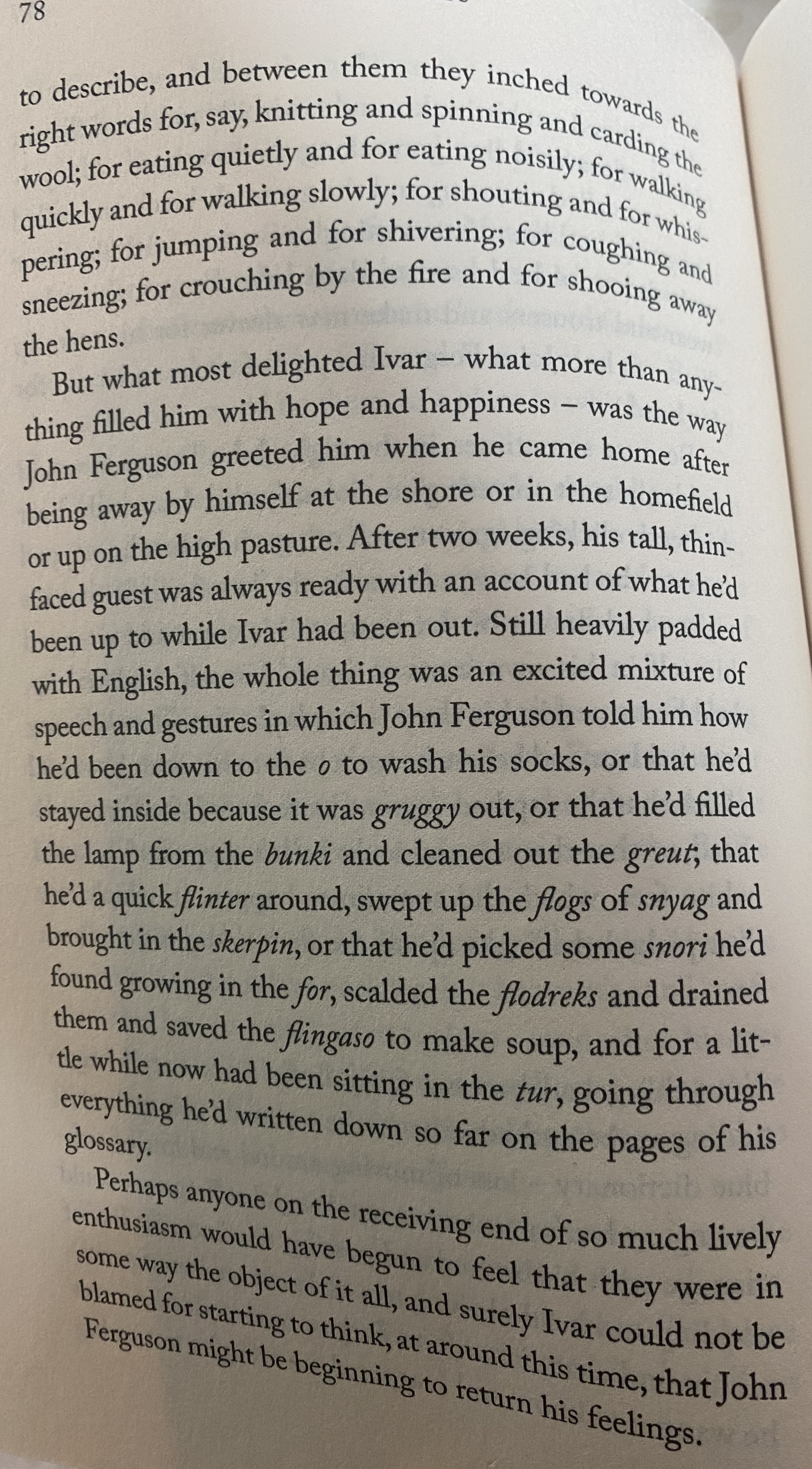
It’s a short novel, and page 78* comes just after the halfway mark. Perhaps it marks a turning point:
It’s two weeks since John Ferguson has been dropped off on the island and fallen from some rocks. He is recovering well in Ivar’s hut and the language lessons are well under way:
John Ferguson mimed what it was he wanted to know, and Ivar acted out what he was trying to describe, and between them they inched towards the right words for, say, knitting and spinning and carding the wool; for eating quietly and for eating noisily; for walking quickly and for walking slowly; for shouting and for whispering; for jumping and for shivering; for coughing and sneezing; for crouching by the fire and for shooing away the hens.
In the next paragraph, the reader is drawn into the process, as words from Ivar’s language are incorporated into the text:
Still heavily padded with English, the whole thing was an excited mixture of speech and gestures in which John Ferguson told him how he’d been down to the o to wash his socks, or that he’d stayed inside because it was gruggy out, or that he’d filled the lamp from the bunki and cleaned out the greut; that he’d a quick flinter around, swept up the flogs of snyag and brought in the skerpin, or that he’d picked some snori he’d found growing in the for, scalded the flodreks and drained them and saved the flingaso to make soup, and for a little while now had been sitting in the tur, going through everything he’d written down so far on the pages of his glossary.
I so appreciate Carys Davies’ good judgement in not giving us footnotes. They are absolutely not necessary – we are allowed to have a faint taste of learning the language by immersion. An interested reader, as I definitely am, can turn to the Author’s Note to find that, unsurprisingly, Ivar’s language is not Carys Davies’ invention. It is a version of Norn, now extinct but once spoken on the islands of Orkney and Shetland – and on Ivar’s fictional island which lies further north than either of those. The Author’s Note includes a glossary, including all the words in italics/purple on page 78 – flodreks, for example, are ‘limpets’ and flingaso is ‘water in which limpets have been scalded’.
Beneath this excited learning to communicate, and in the process learning about Ivar’s solitary way of life, there is a dark undercurrent. Over this idyllic scene there lies the shadow of John Ferguson’s mission. John Ferguson has allowed himself to forget about it for now, and Ivar is blissfully unaware of it. John Ferguson has been warned that Ivar, generally ‘placid and obedient’, was also large and strong and might not take kindly to being uprooted.
Perhaps anyone on the receiving end of so much lively enthusiasm would have begun to feel that they were in some way the object of it all, and surely Ivar could not be blamed for starting to think, at around this time, that John Ferguson might be beginning to return his feelings.
Just as, with genocide looming in Sydney, Lieutenant Dawes and Patyegarang developed an intimate relationship, so here Ivar has a growing emotional attachment to the messenger of his eviction. And at this point in the novel who can say if he’s right about John Ferguson returning his feelings? Certainly not the oblivious clergyman.
After the meeting: Astonishingly, while everyone agreed that the writing was excellent there were sharply divergent views about this book. The most negative version was that the book is completely silly. Nothing made sense: why did the owners need Ivar off the island, why had he stayed there in the first place, how unlikely is it that a clergyman would have taken on such an errand, how boring is all that stuff about language, how ho-hum is the inexorable movement towards the two men having sex, how implausible is the sex when it finally happens, and above all who would ever buy the final resolution? All of these questions could be answered satisfactorily by those of us who enjoyed the book, but our answers cut very little mustard. Mind you, I don’t think anyone saw the final resolution as completely realistic (see how careful I’m being about spoilers!): the difference is that some of us didn’t mind, and even enjoyed the improbability.
The Most Negative didn’t feel, as others of us did, an underlying dread: as the two men are building mutual trust and affection, we know that the moment will come when John Ferguson will have to reveal his true mission. And we know there is a concealed gun. Ivar has a secret ass well, so the elements were in place for an explosive climax. The book delivers that climax, but clearly not in ways that satisfied all readers.
I was pretty much alone in having loved the language lessons. But I think the world of the island felt real and substantial to us all, was in fact the book’s saving grace, even for the MN.
We read this book along with Ian MacEwan’s What We Can Know, which also prompted very different responses. Both books have islands and difficult sea voyages in small vessels.
I am a man of settler heritage who has been alive for almost a third of the time that has elapsed since Arthur Phillip claimed this continent for the British crown. The book club met on Gadigal land, and I wrote this blog post on the land of Gadigal and Wangal of the Eora Nation, where the nights are lasting longer and small lizards seem to be everywhere. I acknowledge the Elders past and present of all those clans and welcome any First Nations readers of the blog.
* My blogging practice is to focus on the page that coincides with my age, which was 78 when I wrote that part of this blog post.
According to the book’s extensive glossary of Māori terms, Auē means ‘to cry, howl, wail’. Alternatively it is an ‘interjection showing distress’. This novel can be read as one long cry of distress for people, both Māori and Pākehā, male and female, young and old, in marginalised communities in New Zealand/Aotearoa. It’s a cry that has been heard around the world. According to Wikipedia, the first edition, published by independent publisher Mākaro Press in 2019, had a print run of 500 copies. It went on to win a number of prizes, was a best seller in New Zealand, and has been translated into several languages. The 2022 Scribe edition, which is what I have read, is published in the UK, the US and Australia.
Like many contemporary novels, Auē has a number of story lines with no obvious connection. It begins with young Ārama (Ari), who has recently lost his parents in an event whose specifics are revealed only in the last pages. Abandoned by his older brother who sets off on a quest of his own, he is left in the care of an aunt and her violently abusive white husband. The glimmer of hope in his new life is the friendship of a girl neighbour, Beth, whose farmer father Tom Aitken is a benevolent adult presence.
In a separate narrative strand, in chapters mainly labelled ‘Jade and Toko’, two young adult Māori women are caught up with thuggish men. Under cover of attending family funeral commitments, they escape to have fun together and have moments of romance – Jade with Toko, a gorgeous, guitar-playing man who is courageous, kind and protective. Things go well for a time, but there’s a terrible violent turn.
As the relationship between the two narratives is revealed, a complex picture emerges of family tragedy. There’s something of the feel of a quality TV series to the book, though it is much better written than that might seem to imply.
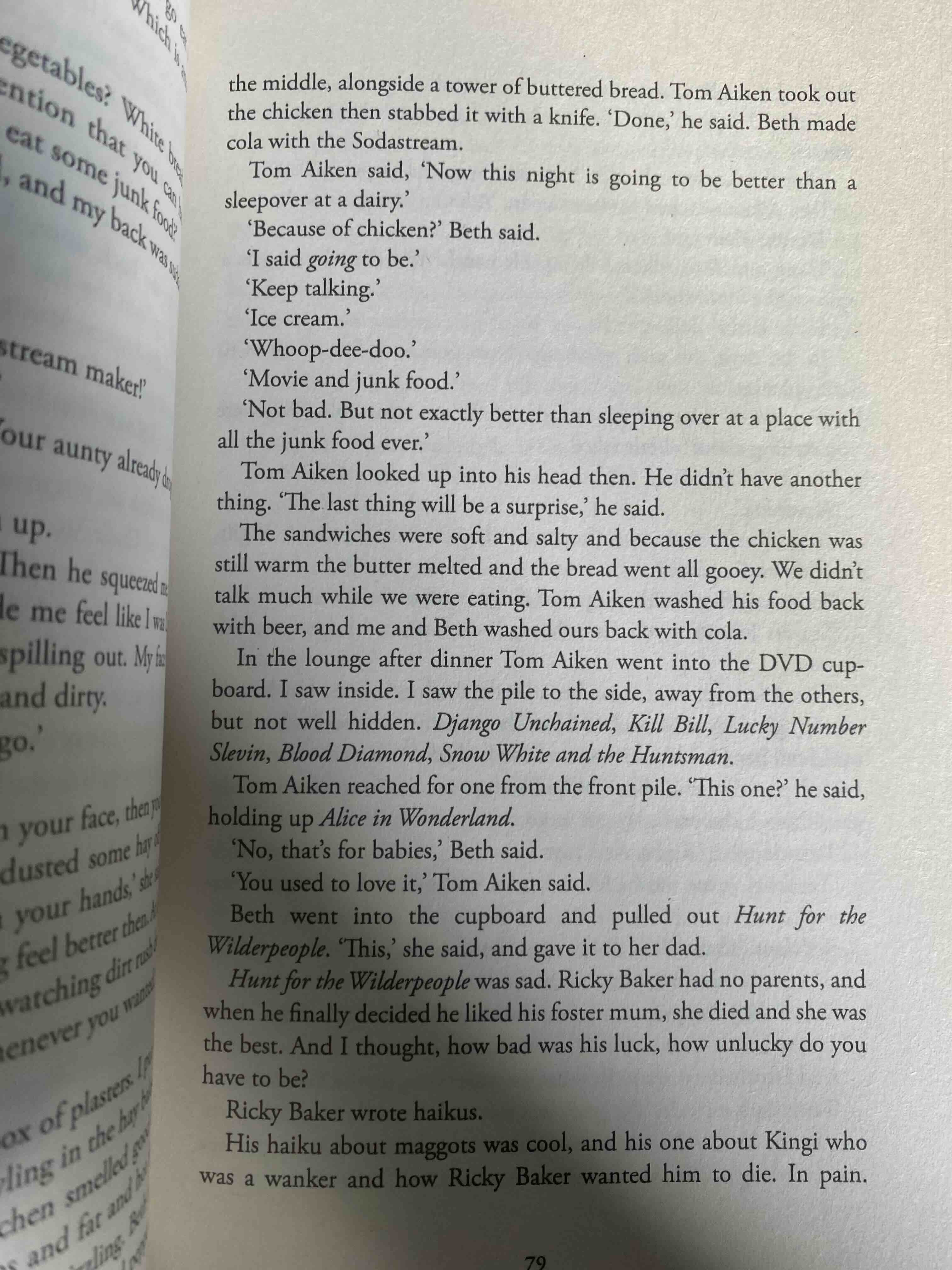
Page 79* is in one of Ārama’s chapters. A sleepover at the dairy has been planned.
[For those who don’t know, in New Zealand a dairy is what in Australia would be called a milk bar – a shop that sells sweets and ice creams among other things. Short rant: When I worked in children’s literature it was often remarked that US publishers of Australian and New Zealand books would routinely ask for terms to be Americanised, as if US children had to be protected from knowing that elsewhere people named the world differently. One of the charms of this book is that local idioms have not been removed. There are many Māori words, most of which are included in the glossary at the back of the book, but words like ‘dairy’ and ‘pottle’ are allowed to stand without explanation, and I rejoice. End of rant.]
Aunt Kath has cancelled the sleepover after being beaten by Uncle Stu, her husband. Ari has overheard the violence and is terrified. On page 79 Tom Aitken is stepping into the breach and having Ari at his place for the night.
Without my rule of 79, I wouldn’t have chosen this page to illustrate what is most compelling about the book. It’s an uneventful scene of a man and two children having a meal together. All the same it gives an idea of some of the qualities of the writing. In context it’s an oasis of normality, where Beth can be a little bit cheeky, and a little bit self-assertive without bringing disaster on themselves. The only violence here is against a cooked chicken:
Tom Aiken took out the chicken then stabbed it with a knife. ‘Done,’ he said. Beth made cola with the Sodastream. Tom Aiken said, ‘Now this night is going to be better than a sleepover at a dairy.’ ‘Because of chicken?’ Beth said. ‘I said going to be.’ ‘Keep talking’ ‘Ice cream.’ ‘Whoop-dee-doo.’ ‘Movie and junk food.’ ‘Not bad. But not exactly better than sleeping over at a place with all the junk food ever.’
The wider themes are suggested by what Ari glimpses in the DVD cupboard – perhaps, it’s subliminally suggested, this book has something in common with violent Hollywood.
In the lounge after dinner Tom Aiken went into the DVD cupboard. I saw inside. I saw the pile to the side, away from the others, but not well hidden. Django Unchained, Kill Bill, Lucky Number Slevin, Blood Diamond, Snow White and the Huntsman.
There’s a knowingness as if the author is talking to us over Ari’s shoulder. I confess that while reading this book I thought often about K, a member of my Book Group, who says he dislikes narratives that simulate a child’s voice. Auē is definitely not a book for child readers, but the Ārama chapters are narrated by the 11 years old boy at the heart of the story, and the faux-naïf voice had me understanding irritates K. (I’ve recently reread The God of Small Things, much of which is from the point of view of the girl Rahel, and the contrast couldn’t be starker: children aren’t just adults with less complex syntax.) Ari and Beth are wonderful characters, who play at being Django and Doc from the Tarantino movie. But their complexity doesn’t carry over to Ari’s narrative voice.
Beth went into the cupboard and pulled out Hunt for the Wilderpeople. ‘This,’ she said, and gave it to her dad. Hunt for the Wilderpeople was sad. Ricky Baker had no parents, and when he finally decided he liked his foster mum, she died and she was the best. And I thought, how bad was his luck, how unlucky do you have to be? Ricky Baker wrote haikus. His haiku about maggots was cool, and his one about Kingi who was a wanker and how Ricky Baker wanted him to die. In pain. Which I thought was a pretty bad thing to admit to.
Ari’s simple declarative statements about the movie are other examples of the kind of simplified language I mean. There’s a little more talking over Ari’s shoulder. Taika Waititi’s Hunt for the Wilderpeople isn’t a random choice of a movie for the three of them to watch. It has a slightly laborious meta function – the novel is naming a work that it can be linked to.
Ricky Baker’s haiku in the movie give rise to a nice moment on the next page where elements of the plot are condensed into two haiku. The first, by Beth:
Stu-art John-son you
are the ug-li-est farm-er
hope cows shit on you
After that has evoked pretend disapproval from her father, it’s Ari’s turn:
Tau-ki-ri wrote me
a let-ter and it said he's
on his way home-home.
At this point of the novel, about the one-quarter mark, that’s the two points of suspense: will the little family be reunited? and will violence against women and children be brought to an end? And you know, I wasn’t any doubt about the answers.
I am a man of settler heritage who has been alive for almost a third of the time that has elapsed since Arthur Phillip claimed this continent for the British crown. I wrote this blog post on the land of Gadigal and Wangal, where the nights are lating longer and small lizards seem to be everywhere. I acknowledge their Elders past and present and welcome any First Nations readers of the blog
* My blogging practice is to focus on the page that coincides with my age, currently 79.
I cancelled my subscription to Heat a while back (after Series 3 Number 12), mainly because the handful of journals I subscribe to was getting to be quite a handful. Last September I received a complimentary copy of Number 21 with a note from the new editor Anna Thwaites inviting me to resubscribe. I am grateful for the gift, but since Southerly has revived and Meanjin will soon come back from the dead, I’m unlikely to take up the offer.
Mind you, if you want a conveniently sized literary journal that will introduce you to a diverse range of writers from Australia and elsewhere, including some in translation, you won’t find anything that suits you better than Heat.
This issue has two piece in translation. There’s a fable by Swiss writer Peter Stamm, translated by US-based Michael Hofmann, and a chillingly dystopian short story by Hong Kong author Hon Lai Chu translated by Jacqueline Leung. Heat seems to have a policy of not naming the original language of translated pieces – I’m guessing that these pieces were originally in German and Cantonese respectively. Hon Lai Chu’s story ‘Scrap‘ is available on the Heat website.
There’s an essay by Heat‘s founder and national treasure Ivor Indyk. Always interesting, he offers insights into the writing of Les Murray, Gerald Murnane and Alexis Wright. There’s a short story by the late Elizabeth Harrower, possibly her ‘last “new” piece of fiction … to reach readers’, as her biographer Susan Wyndham says in a brief introduction. Alongside these venerable and renowned contributors, Catherine Kaixin Yu, who grew up in Shanghai, has her first published essay, a richly elegiac account of visiting the dying village of her ancestors.
All that, plus poems by Londoner Alex Wong makes a good reading experience. What gave me most pleasure was a pair of poems by Melburnian Amy Crutchfield. In the first, ‘Nausicaa’, the poem’s speaker is a traveller on Corfu and visits Palaiokastritsa, traditionally the place where Odysseus met the nymph Nausicaa. The poem, in five short parts, is full of good things. I smiled a lot.. I’ll just mention an example of how line breaks can be important in poetry.
Section 4, ‘Taverna’ is quoted n the back cover of Heat, just the first three lines:
In the taverna
we choose the wrong foods
and sweat
That makes sense as a traveller’s tale. We chose something too spicy for our tastebuds. But the poem itself continues after the line break and turns out to be saying something quite different:
In the taverna
we choose the wrong foods
and sweat
over our one chance
to be typical.
It’s not about physical discomfort after all, but about the travellers’ awkward sense of standing out as odd. Or both!
Thanks you, Anna Thwaites.
I am a man of settler heritage who has been alive for almost a third of the time that has elapsed since Arthur Phillip claimed this continent for the British crown. I wrote this blog post on the land of Gadigal and Wangal, and crows are kicking up a fuss outside my window. I acknowledge Elders past and present and welcome any First Nations readers of the blog
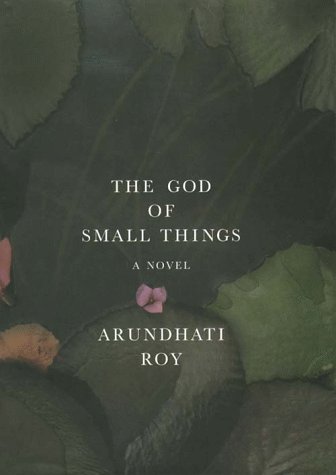
Arundhati Roy, The God of Small Things (Flamingo 1997)
Before the meeting: After Arundhati Roy’s memoir Mother Mary Comes to Me gave us so much pleasure last month, this month’s Chooser met with general approval when he picked the novel that made her famous.
I first read The God of Small Things before I started blogging. Apart from a general sense of having enjoyed it, I retained just one image, of a group of policemen marching in long grass. It turns out that the image comes towards the end of the book, on page 304:
A posse of Touchable Policemen crossed the Meenachal river, sluggish and swollen with recent rain, and picked their way through the wet undergrowth, the clink of handcuffs in someone’s heavy pocket. Their wide khaki shorts were rigid with starch, and bobbed over the tall grass like a row of stiff skirts, quite independent of the limbs that moved inside them.
There’s so much of the book in those two sentences. The starched shorts, so vividly present and so rich with metaphorical meaning; the initial capitals ‘Touchable Policemen’ marking a childlike personification of key concepts; the river, the undergrowth and the tall grass as part of the physical environment that is such a force in the book. Above all, the complex tone is characteristic: the soldiers are almost comic, puppet-like, yet the reader knows that they are about to do terrible things.
The rest of the book was fresh and new to me. It’s the story of twins Estha and Rahel, their mother Ammu (whose divorced status was scandalous in the mid 1960s, in the Syrian Christian community of their small village in Kerala), and their extended family: Ammu’s brother Chacko, her blind mother Mammachi, and Baby Kochamma. (The text is scattered with Malayalam words, only sometimes translated. I understood ‘Kochamma’ to mean ‘Auntie’, and a quick websearch just now gave ‘a woman who is to be respected like a mother’.) In spite of her cuddly name, Baby Kochamma is a nasty piece of work, disappointed in love by a priest when she was young, and now bitter, moralistic and vindictive. Chacko’s divorced wife, an Englishwoman, comes to visit with her daughter Sophie Mol (‘Mol’ means something like ‘daughter’), who is about the same age as Estha and Rahel.
We know from the beginning that there is to be a disaster. The narrative takes place in at least three time frames: before the disaster, the disaster, and a couple of decades after the disaster. We see Sophie Mol’s funeral before we know who she is, and there are plenty of hints of the other terrible incident – which isn’t revealed until the final pages, just after the scene with the starched shorts.
There’s another moment that has idiosyncratic resonance for me. There are a three or four guava trees on streets near my home. I recently went scrounging and picked from the trees and from the footpaths enough ripe and slightly bruised fruit to make a delicious jar of jam. The unusable fruit on the ground, and there was a lot of it, was a disgusting mess. So it was a personal pleasure when a day or so later, on page 205, Rahel and Estha approach the hut of Velutha, a servant whom they love:
Velutha wasn’t home. <snip> But someone was. A man’s voice floated out from inside and echoed around the clearing, making him sound lonely. The voice shouted the same thing, over and over again, and each time it climbed into a higher, more hysterical register. lt was an appeal to an over-ripe guava threatening to fall from its tree and make a mess on the ground.
Pa pera-pera-pera-perakka (Mr gugga-gug-gug-guava), Ende parambil thooralley (Don’t shit here in my compound). Chetende parambil thoorikko (You can shit next door in my brother’s compound), Pa pera-pera-pera-perakka (Mr gugga-gug-gug-guava.)
Exactly what I want to sing to the guavas of Enmore.
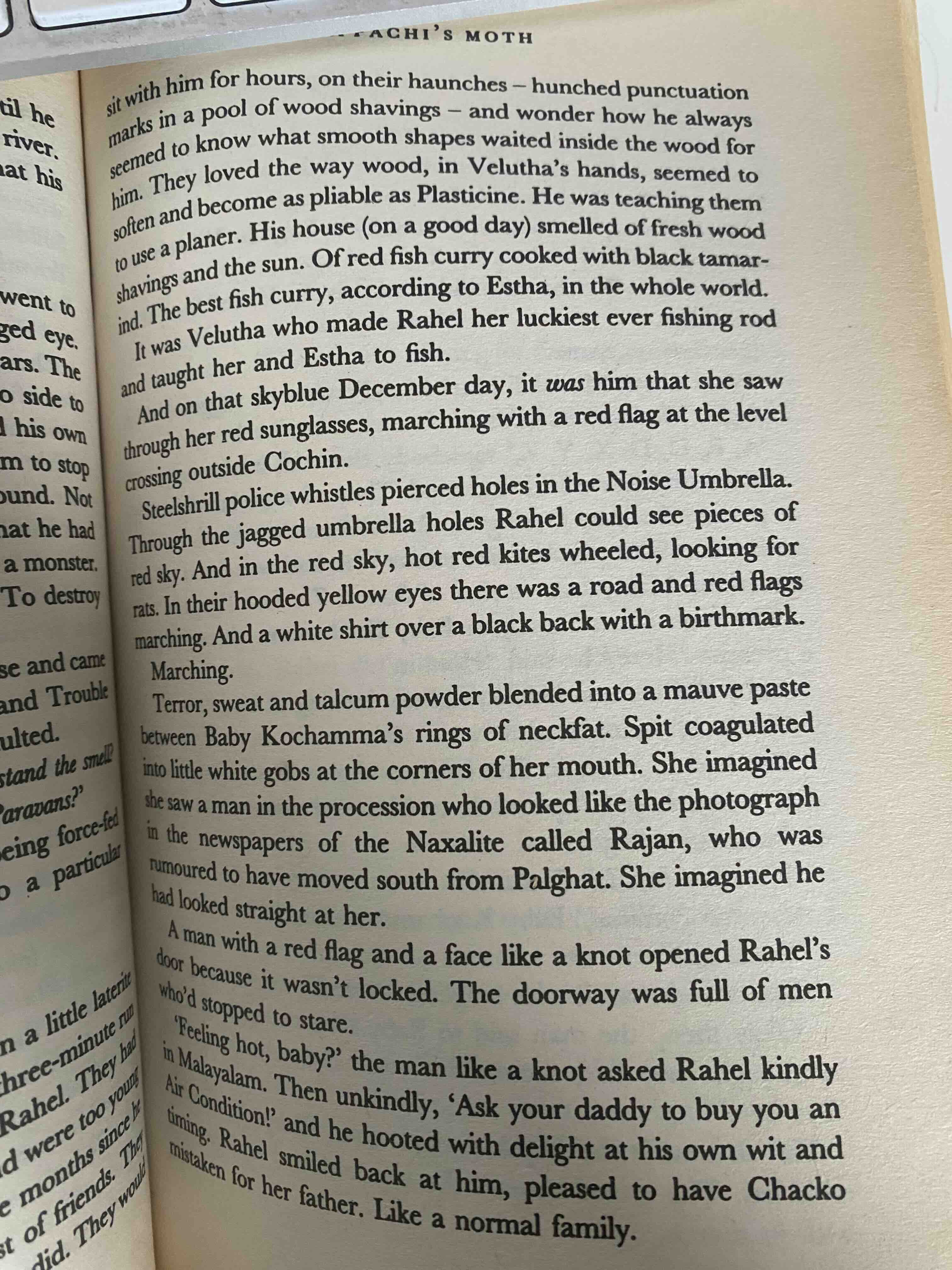
This is a book that cries out for quotation. You can feel Arundhati Roy’s glee as she comes up with similes, malapropisms and mondegreens, little asides, big digressions, wonderful descriptions of people. Page 79* is a good example. As it happens, it starts with Velutha and moves on to Baby Kochamma.
The family are driving to the nearest sizeable town, Cochin, to see The Sound of Music. It’s a long drive, interspersed with flashbacks, flashforwards and songs from the show. At page 78, already running late, they are held up by a demonstration – the street is full of workers, possibly including some Naxalites (the ‘extremists’ who Arundhati Roy was to spend time with in the jungle some decades later), carrying the red flag of Communism. The adults in the car have complex responses. Baby Kochamma is unequivocally on the side of capitalism; Chacko, though he effectively owns a pickle factory, identifies as a Marxist and theoretically is on the side of the workers; the twins’ mother says nothing, but later we realise that she has fellow feeling with the demonstrators. Rahel thinks she sees Velutha – as a former Untouchable, he usually goes shirtless, but the man Rahel sees is wearing a white shirt and waves a red flag.
Though we have met Velutha previously in stories of Ammu’s childhood, it’s here that we learn who he is from the twins’ point of view:
They would sit with him for hours, on their haunches – hunched punctuation marks in a pool of wood shavings – and wonder how he always seemed to know what smooth shapes waited inside the wood for him. They loved the way wood, in Velutha’s hands, seemed to soften and become as pliable as Plasticine. He was teaching them to use a planer. His house (on a good day) smelled of fresh wood shavings and the sun. Of red fish curry cooked with black tamarind. The best fish curry, according to Estha, in the whole world. It was Velutha who made Rahel her luckiest ever fishing rod and taught her and Estha to fish. And on that skyblue December day, it was him that she saw through her red sunglasses, marching with a red flag at the level crossing outside Cochin.
Then there’s a characteristic switch in perspective. The omniscient narrator steps in with a premonition. Rahel’s red-tinted glasses fill the world with the colour of danger. Birds of prey wheel above the demonstration, and Velutha’s black back with its distinctive leaf-shaped birthmark becomes a potential target:
Rahel could see pieces of red sky. And in the red sky, hot red kites wheeled, looking for rats. In their hooded yellow eyes there was a road and red flags marching. And a white shirt over a black back with a birthmark. Marching.
Then the point of view comes right down to a close-up, and some characteristically tactile description. Where Rahel sees a friendly figure in the crows, Baby sees a threat:
Terror, sweat and talcum powder blended into a mauve paste between Baby Kochamma’s rings of neckfat. Spit coagulated into little white gobs at the corners of her mouth. She imagined she saw a man in the procession who looked like the photograph in the newspapers of the Naxalite called Rajan, who was rumoured to have moved south from Palghat. She imagined he had looked straight at her.
I love the final paragraph on the page. Rahel the child is aware that the man with ‘a face like a knot’ means to be unkind, but her preoccupations seize on his unintended normalising of her family.
A man with a red flag and a face like a knot opened Rahel’s door because it wasn’t locked. The doorway was full of men who’d stopped to stare. ‘Feeling hot, baby?’ the man like a knot asked Rahel kindly in Malayalam. Then unkindly, ‘Ask your daddy to buy you an Air Condition!’ and he hooted with delight at his own wit and timing. Rahel smiled back at him, pleased to have Chacko mistaken for her father. Like a normal family
I can’t say I know a lot about India. I’ve never been to Kerala. But at a railway station in Rajasthan, men did stop to stare unblinkingly at the young women in our group. It didn’t feel particularly aggressive or even deliberately impolite. We put it down to cultural difference. That experience helps me to visualise what Arundhati Roy is describing here, and to understand why Rahel isn’t particularly disturbed.
On the next page, the man with the flag turns his attention to Baby Kochamma and speaks to her in English, justifying her terror. But that’s another story, of the many told in this marvellous book.
The meeting: There were seven of us and as always we ate well and enjoyed each other’s company. We spoke as little as possible about Donald Trump, Iran, Israel, fuel and the tendency among younger generations to identify with self-diagnosed mental illness or neurodivergence. We gave passing glances to recent theatre and film pleasures, and to bodily pains, including severe side effects from statins that two of us have experienced, and the satisfaction of a third who convinced his specialist not to prescribe them for him.
One person had said on the WhatsApp group that he’d reach the halfway point of the book and was going to give up. I replied on the group that I loved the book and was looking forward to an interesting conversation – but it turned out that he had read the wrong Arundhati Roy book, The Ministry of Utmost Happiness. He said at the meeting that there are some wonderful passages in it, but he found it very hard going.
Another person had read the right book in the 1990s and hadn’t been inclined to reread it. I don’t think this was from active dislike. As the single parent of a teenager, and the only one at the meeting still in full-time employment, I imagine he doesn’t have a lot of time for reading, let alone rereading.
One person was about halfway through the book, but intending to read the rest and not touchy about spoilers. I’m starting to think it would be good to have a designated non-finisher for every meeting. The non-finisher could then ask questions that lead the rest of the group to think about how things fit together. In this case, there’s a scene where Estha, the boy twin, is sexually molested. Our non-finisher wanted to know if this had a lasting effect on him as it seemed at the time that life just carried on. I replied blithely that it was a bit of a red herring – we were tempted to read this incident as explaining why the Estha we see many years later has become an alienated mute, but the real cause is the much worse incident that happens at the book’s climax. I was gently corrected: Estha’s terror of the incident being repeated set off a chain of events that leads to the climactic incident.
Of the other four, one had read the book reluctantly – feeling that he might have had enough Indian novels for a while (cue a brief digression as we enthused that Amitav Ghosh is scheduled to come to the Sydney Writers’ Festival in May), and it took a while but after the halfway point, once all the characters had been introduced and the plot got moving, the book won him over completely. We generally agreed that it was a bit of a struggle in the first half to keep track of the complex set of relationships. The time shifts, especially in the first half, were often confusing. It’s a book, someone said, that needs to be read in reasonably long sessions – not ten minutes at a time before you go to sleep at night. Nods all round.
Someone else said that when he was struggling with the language he read a passage out to his partner to see if she could make head or tail of it. When he heard the words aloud he realised they were crystal clear. From then on, he slowed down, letting the language play on his inner ear, and enjoyed the experience. (Sadly, he couldn’t find the passage to read it to us.) Conversation hovered around this: not universally seen as a virtue, the book is peppered with writerly quirks, turns of phrase or eccentric punctuation that draw attention to themselves and pull the reader out of the story for a moment. A young writer flexing her muscles, I think someone said. And why not? someone may have said back.
We left our host with the washing up and dispersed into a clear, warm, early Autumn night.
I am a man of settler heritage who has been alive for almost a third of the time that has elapsed since Arthur Phillip claimed this continent for the British crown. The Book Group met on Gadigal land. I wrote this blog post on the land of Gadigal and Wangal, where yesterday’s sudden downpours show no sign of recurring today. I acknowledge Elders past and present and welcome any First Nations readers of the blog.
* My blogging practice is to focus on the page that coincides with my age, currently 79.
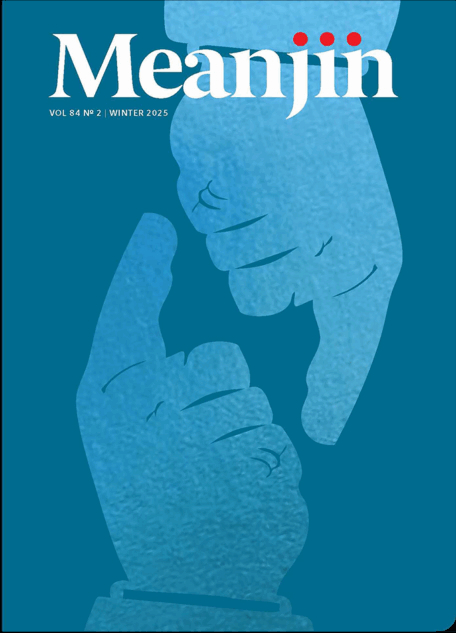
Esther Anatolitis (editor), Meanjin Vol 84 Nº 2 (Winter 2025) (links are to the Meanjin website: I believe that they are now all accessible to non-subscribers)
This is the antepenultimate issue of Meanjin as produced by Melbourne University Press and edited by Esther Anatolitis. Queensland University of Technology recently announced that they will bring about a resurrection, but who knows how much continuity there will be? So in spite of the good news, with this issue the journal is nearing an end.
However, though it encompasses plenty of gloom about the environment, democracy, world peace, the state of Australian literary culture and more, the journal itself shows no sign of imminent mortality.
As always it starts out with a piece by a First Nations person. This time it’s ‘I Am an Invisible Man’ by Djon Mundine OAM. Subtitled ‘This is how I became a curator’, this brief memoir acts as a brilliant summary of the rising awareness of Australian First Nations art over recent decades as seen through the lens of one person’s contribution.
I can’t be the only person who has a special place in his heart for Barry Jones, quiz champion in my childhood, then Labor Party eminence and parliamentarian, still going strong and writing with precision from a broad knowledge base. His article here about our dangerous times, ‘Courage, anyone?‘, ends with a call to arms that reads as a thinly-veiled reproach to our current Prime Minister:
In Australia, we have to be honest with ourselves about race, class, our history. As citizens we have to engage, engage, engage. The year 2025 is no time for deference and over-caution. More than fifty years ago, Gough Whitlam used heroic advocacy to change Australian society. We must follow his example. It’s time.
Alison Croggon is another commentator on Australian cultural life who is always worth reading. Her article, ‘Courage, imagination, understanding: Creative Australia in 2025‘, spells out the implications of Creative Australia’s ‘confounding decision’ to cancel the contract with Khaled Salsabi and Michael Dagostino to represent Australia at the Venice Biennale. She sings from the same sheet as Barry Jones:
At a time of mass species extinction, climate chaos, growing authoritarianism, economic inequity and war, the health of a culture may seem trivial. I persist in believing that it is far from triivial, that the insights and freedoms that art offers can not only help us recognise and combat the problems we have, but also survice them.
There’s an interview with Chinese-Australian poet Ouyang Yu, at his gloomy contrarian best. ‘In the future,’ he says, ‘the hope of mankind to defeat AI is its ability to err.’ And he means humankind’s ability to err, not AI’s. And later: ‘Posthumous existence is the only one that is tolerable and meaningfully available to a writer.’ His story of writing in both Chinese and English and the different relationships with his readers in those two language communities is fascinating.
Carl Sciberras, tasked with writing about ‘The Year in Dance‘, begins with – what I had completely forgotten, and which he claims not to have seen – Rachel Gunn’s breakdance at the 2024 Olympics. He does move on to less headline-grabbing, more excellent performances.
Australia has a particular agnotology, a culturally induced ignorance, that denies our nation is founded upon violence against First Nations peoples and their Country. (p. 71)
Harry Saddler, in ‘Australia in three books‘, uses his platform to preach to the choir about current political culture (not the subject of any of his chosen books). But I am grateful to him for adding another excellent word to my vocabulary, a word whose dictionary meaning isn’t as scatological as the word sounds:
It’s impossible not to think of the ways the worst trends of American politics and public life have been and continue to be taken up eagerly by the kakistocracy that makes up so much of federal parliament. (p. 123)
Of the four short stories, I resonated most with is ‘Open’ by Jo Langdon, in which a woman narrator, her mother and her young daughter deal with bereavement, estrangement and each other. The little girl in particular is wonderful.
Discovering a piece of my family’s history and going back to the places they once inhabited has been transformational, healing, life-affirming. I no longer flinch when someone asks if my family were boat people: it is a part of who I am. Their story is also my story.
Of this issue’s poems, I enjoyed ‘Listening in‘ an ekphrastic poem by Lachlan Brown that sent me googling for Vic McEwan’s work The Unravelling (there are two photos some way down on this lnk), which in turn sent me back to the poem for a greatly enriched second reading. I also enjoyed ‘The Anthropocene is a geological epoch‘ by Sophie Finlay and ‘Waves Poem‘ by Toby Fitch: these poems are on consecutive pages, the first belying its title’s academic abstraction, and both of them evoking planetary subjects through minutely observed detail – of a blue-ringed octopus and waves in a bathtub respectively.
I am a man of settler heritage who has been alive for almost a third of the time that has elapsed since Arthur Phillip claimed this continent for the British crown. I wrote this blog post on the land of Gadigal and Wangal, where the nights are lasting longer and small lizards seem to be everywhere. I acknowledge their Elders past and present and welcome any First Nations readers of the blog.
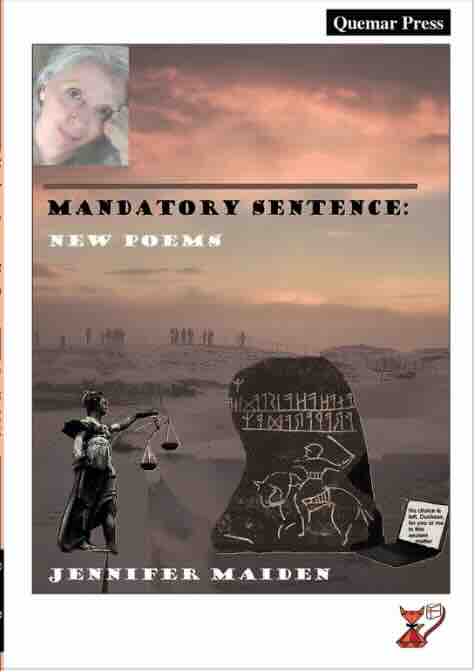
Mandatory Sentence is the latest in Jennifer Maiden’s continuing tightrope act of producing a book of poetry at the start of each year. As in previous years, most of its contents are in effect occasional poems, that is, poems written in response to breaking news – developments in the Gaza genocide, the demolition of the East Wing of the White House, Anthony Albanese’s visit to China, news about AI, and so on. Many of the poems feature fictional or historical characters responding to these events, sometimes in dialogue with current politicians.
If you’re new to Maiden’s poetry, you might need help with the characters who populate the book. George Jeffreys and Clare Collins, familiar from Maiden’s four novels and many poems, appear with their ever-increasing family that includes a son named Corbyn and a number of animals. There’s a weird, cuddly little creature named Brookings – named after the Brookings Institute and originally perhaps emblematic of what Maiden sees as that organisation’s deliberate naivety, but now taking on a life of its own. Dietrich Bonhoeffer, Eleanor Roosevelt and other make brief repeat appearances. Maiden’s daughter Katharine, has appeared in her mother’s poetry since The Winter Baby (1990) – as well as being the book’s publisher in real life.
I read Mandatory Sentence just after my first reading of Evelyn Araluen’s The Rot. They’re very different books, but they both respond with some immediacy to world events from a left / progressive perspective, so it’s not surprising that there are moments when they chime. One such moment is the opening of ‘Brooking Becomes a Bomb Bay Door’, which echoes that of Araluen’s ‘Uplock Actuator System’. For this blog post, I’ll stay there.
Both poems were evidently inspired by the same interview Richard Marles gave on the ABC in August last year – at this link – in which he asserted repeatedly that Australia does not supply weapons to Israel, but is ‘part of the F-35 process’. Neither poem is limited to satirising that assertion – the Shovel does that brilliantly, here. How they each make distinctive poetry from the material is interesting.
‘Uplock Actuator System’ begins:
We aren't sending weapons, they said,
just the only lock for the only door that
opens when they are fired from the air.
The poem progresses in nine three-line stanzas of almost intolerable intensity, evoking the suffering of Gaza and linking it to the ‘parallel occupation’ of Australia and the unwilling complicity of all of us. It ends with a call to engagement .
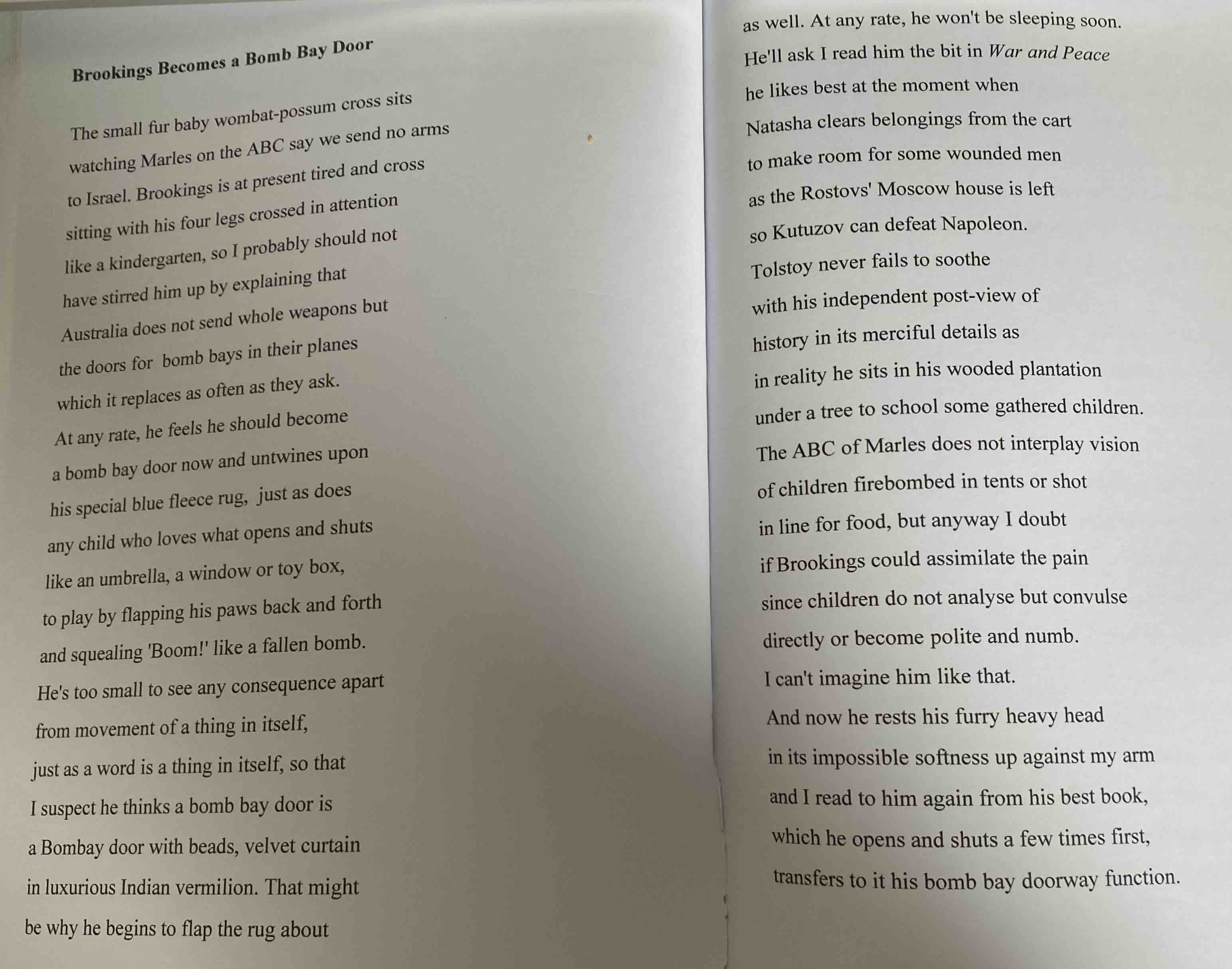
‘Brooking Becomes a Bomb Bay Door’ is by comparison laid-back and playful, adjectives I wouldn’t easily associate with Maiden’s political poems. You can hear her performing it, pretty much deadpan, at this link. Here’s how it appears in Mandatory Sentence:
It begins with the titular Brookings – a ‘small fur baby wombat-possum cross’ who could have come from a children’s cartoon – watching the television, cutely ‘like a kindergarten’. And there’s some almost silly play on words – the word ‘cross’ appears three times, each with a different meaning.
The small fur baby wombat-possum cross
sits watching Marles on the ABC say we send no arms
to Israel. Brookings is at present tired and cross
sitting with his four legs crossed in attention
like a kindergarten,
The adult shorthand – ‘Marles on the ABC’ – alerts us that this is not a cute and cuddly poem. Contemporary Australian readers will know that this is Richard Marles, Minister for Defence, and the context is Israel’s genocidal bombing of Gaza (the context has moved on since the book was published – but the poem’s concerns are still sharply relevant). The language of political denial-not-denial is skewered in just three lines.
like a kindergarten, so I probably should not
have stirred him up by explaining that
Australia does not send whole weapons but
the doors for bomb bays in their planes
which it replaces as often as they ask.
The poem’s central tension is set up: on one hand, there’s the innocent, naive, playful fantasy creature and on the other the poem’s speaker who is aware that the Australian government is complicit in terrible things.
For the next 14 lines, the rest of the first page, innocent Brookings plays. In the Brookings poems – this book also includes ‘Brookings Becomes a False Flag’ – it’s clear Maiden’s invented character is not simply a mouthpiece for the poet but has an independent imaginary existence. (This may not be obvious with other Maiden characters, but I think it’s always true – Maiden sets her imagined people/creatures up and is interested to see what they have to say – what, for instance, would Dietrich Bonhoeffer say to Kevin Rudd this time? Do I need to say that Bonhoeffer isn’t as cute as Brookings?)
Brookings’s metaphorical origins may be at work in the background, suggesting that liberal organisations like the Brookings Institution aren’t serious about addressing things like genocide. Nerdily, I went to the Institution’s website to see what it was up to at about the time this poem was published – and while it wasn’t playing at being a bomb bay door (or a Bombay door with beads and velvet curtain), it was hosting a discussion about the future of drone warfare (link here). Make of that what you will.
But the poem doesn’t mount an argument about the Brookings Institution. It just gives a picture of innocent, or at least oblivious, playfulness.
There’s a turn, and in the second part of the poem the narrative moves to bedtime, which is a pretext for introducing Tolstoy’s War and Peace. This might seem a bit forced, but if you can accept a ‘fur baby wombat-possum cross’ then why not also accept War and Peace as its ‘best book’?
Embarrassingly, I haven’t read War and Peace (though I saw the King Vidor movie on Super 8 in 1964 and fell in love with Audrey Hepburn). Other readers will know what specific bearing the scene from the novel has on the rest of the poem:
He’ll ask I read him the bit in War and Peace
he likes best at the moment when
Natasha clears belongings from the cart
to make room for some wounded men
as the Rostovs' Moscow house is left
so Kutuzov can defeat Napoleon.
But those of us who haven’t read the novel can still see/feel how it works in the poem.
The War and Peace moment is juxtaposed with the image of Tolstoy at the time when he wrote it:
Tolstoy never fails to soothe
with his independent post-view of
history in its merciful details as
in reality he sits in his wooded plantation
under a tree to school some gathered children.
As often happens with poems, it seems as if this one has gone wandering, from Marles to Brookings, to War and Peace, to Tolstoy sitting with children under a tree. Then the next couple of lines bring it home:
The ABC of Marles does not interplay vision
of children firebombed in tents or shot
in line for food
The poem has interplayed vision of Tolstoy schooling children in a safe ‘independent post-view of / history’ with a scene from his great novel. If tha ABC was to interplay vision of children with the Marles interview, those children would not be safely ‘post-history’ but concurrent with the interview, victims of atrocity. The tension in the opening lines between child-like naivety and a violent reality comes to a head here.
Incidentally, ‘the ABC of Marles’ seems at first to be a slightly odd way of saying ‘Marles on the Australian Broadcasting Corporation’, but it can also read, less oddly, as ‘the alphabet of Marles’ – that is, the evasive language Marles uses.
The poem doesn’t go to graphic description of the atrocities – it gives enough to let us know the heaviness that sits in the speaker.
But – and it’s an important question – what is a parent or quasi parent to do? The speaker allows Brookings to continue in ignorance, and the poem ends with the peaceful image of mother and not-quite-child at bedtime;
And now he rests his furry heavy head
in its impossible softness up against my arm
and I read to him again from his best book,
which he opens and shuts a few times first,
transfers to it his bomb bay doorway function
Just two things complicate the image and provoke further thought and feeling.
First, the word ‘impossible’ suggests that, just as any soothing Tolstoy has to offer is dubious because he was writing from a safe historical distance, so any comfort afforded by Brookings is illusory because he is after all an invention, an impossibility.
And second, the last line: what does it mean that the ‘bomb bay doorway function’ can be transferred to a book? What is released when a book ‘opens and shuts’? If you’ve read this far, you probably have as good an answer to that question as I have and together we could probably come up with better ones. I’m reminded of a long history of assertions of the power of the word. There’s the proverbial: ‘The Pen is Mightier than the Sword’, ‘You can kill a person but you can’t kill an idea,’ and so on. The idea seems to be everywhere just now that the narratives we tell are crucial: we can believe the story coming from the White House, or commit ouselves to a different story. That final image gestures towards this kind of thinking. Perhaps what is released in those last lines is the possibility of resistence.
It’s not a call to arms like Evelyn Araluen’s poem, but it is a call to think, to reject double-talk, maybe even to hope.
I am a man of settler heritage who has been alive for almost a third of the time that has elapsed since Arthur Phillip claimed this continent for the British crown. I wrote this blog post on the land of Gadigal and Wangal, where the nights are lating longer and small lizards seem to be everywhere. I acknowledge their Elders past and present and welcome any First Nations readers of the blog.
* When blogging about a book, I currently focus on page 79, which is my age. Mandatory Sentence has just 70 pages, so I gave myself permission to go with a whim.
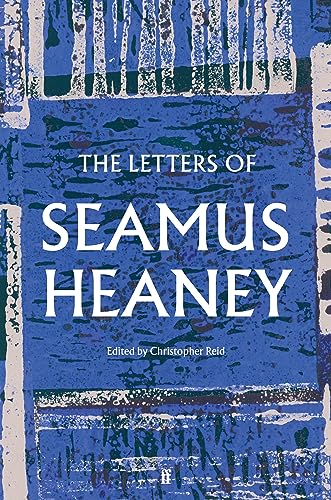
Over the month since my first progress report on reading Seamus Heaney’s collected letters, he has aged from 53 in 1992 to 64 in 2003. Among other things, he has translated Beowulf, written a couple of translations/versions of ancient Greek plays, won the Nobel Prize, had a number of friends die, become much in demand as a public person, travelled a lot including to Tasmania in 1994, and still managed to produce a number of books of poetry. Increasingly his personal letters (as opposed to ‘correspondence’) have been written in planes and airports. He uses a laptop and a fax machine but has stayed away from email for fear that he’d ‘be inundated entirely with queries from grad students and indeed grade schoolers doing their essays’. And always there’s a yearning for moments of solitude and recollection.
I’m enjoying hugely my morning read of seven or eight pages. Apart from anything else it’s a joy to pay attention to someone other than the Attention-Seeker-in-Chief at Mar-a-Lago. I can’t add much in general to what I said in my first progress report (at this link). Here are some snippets.
Heaney writes to his translators, clarifying meanings for them – and giving us fascinating insights into the poetry and the art of translation. Most recently in my reading is an explanation handwritten at the bottom of a fax from Jerzy Illg. Illg’s fax asks for an explanation of the phrase ‘the Bushmills killed’ in the poem ‘The Bookcase’. Heaney writes (page 593, probably 23 May 2003):
‘To kill the bottle’ means to finish off all the drink. So it’s late in the evening and the Bushmills bottle is empty … You know how it is – Best – Seamus
I’m sure I didn’t know what the phrase meant when I read the poem. So thank you, Jerzy Illg.
There’s a lot of verbal playfulness in many of Heaney’s letters. He’ll slip in a phrase from Wordsworth or Hopkins or a contemporary poet, and Christopher Reid the editor will usually add a helpful explanation of the reference. One that that I loved, that Reid didn’t explain: Heaney and his wife Marie are heading off for a brief holiday, and he describes it as a period of ‘silence, exile and sunning’ – a reference to a much quoted phrase from James Joyce, Portrait of the Artist as a Young Man, ‘silence, exile, and cunning’. I laughed out loud at Reid’s note at the end of a letter to fellow poet Derek Mahon in October 1997. Congratulating Mahon on a recently published book. The letter reads, in part:
I couldn’t place one [of your poems] above the other in my mind just now, just have this Baudelairean dusk-mood of gratitude. I see Milosz calls poetry a dividece from ourselves: high-yields, mon vieux.
After explaining the references, Reid writes: ‘Below the signature, in Mahon’s hand, on the actual letter in the Emory archive: “Pompous ass.”‘ Oh, I think, not everyone enjoys Heaney’s playfulness.
My pleasure in the third moment I’ll mention is less mean-spirited.
In January 2000 (page 519), in a letter to musician Liam O’Flynn, Heaney writes:
I’ve been fiddling with this Japanese form called the tanka – two lines longer than the haiku, and a development of it – consisting of five lines of five-seven-five-seven-seven syllables. It’s like a wee pastry cutter I nick into the ould dough inside the head, just to give it shape.
That is such a wonderful descritption of why I love the tight form of the Onegin stanza: it too is a ‘wee pastry cutter’ that can ‘nick into the ould dough inside the head, just to give it shape’.
I’m now reading letters Heaney wrote while working on books that I read soon after they were published, and evidently before I blogged about every book I read: Beowulf, Electric Light, District and Circle and Human Chain. I’m already sad that there are just 100 pages of the book, 10 years of letter-writing, and one month or reading to go.
I have written this blog post on the land of Gadigal and Wangal of the Eora nation, as the sun rises later and tiny lizards bask while they can. I acknowledge Elders past and present of those clans, and welcome any First Nations readers.
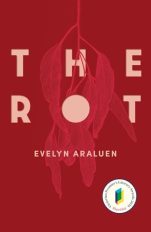
Evelyn Araluen, The Rot (University of Queensland Press 2025)
This is a brilliant follow-up to Evelyn Araluen’s first book, Dropbear. It’s passionately raw, intellectually challenging, and full of rabbit-holes. Araluen says in her acknowledgements, ‘In most ways this is a book for girls.’ She goes on to say, ‘A girl is so many things. Everything, really.’ It’s pretty safe to say that I’m not a girl. But as an oldish man of settler heritage I was swept away.
Alison Croggon in the Guardian (at this link) called it ‘a hurricane of a book’ and says (among other things):
The Rot is an experiential plunge into the nightmare of the present moment, as seen through two centuries of colonisation on this continent. Dark though it is – as dark as our times – it is not hopeless. The book is dedicated to ‘my girls, and the world you will make’: Araluen looks to the ‘Long Future’, a term coined by the Unangax̂ scholar Professor Eve Tuck, for what can be imagined for those who survive colonisation – contingent and elusive as that future might be. At the core of this collection’s bitter truths beats a sublime tenderness.
[In case you need a footnote: Unangax̂ are the Indigenous people of the Aleutian islands. Some of the most powerful moments in Rot come when Araluen wrestles with the implications of Eve Tuck’s thinking. You don’t have to go down this tempting rabbit-hole to feel the full force of the poems.]
Araluen was recently interviewed by Sian Cain for the Guardian (at this link) when she won the 2026 Victorian Premier’s Literary Awards. Here’s a snippet:
She worked on The Rot ‘after work, after dinner, in the bath’ for months, though she now admits that such prolonged focus on such a traumatic subject was ‘irresponsible of me’. ‘I do not recommend drinking wine in the bath and listening to Mitski and crying and calling that a writing practice,’ she added. The Rot reflects ‘a really panicked, distressed window of a time that I hope we all look back on with horror and despair and a real sense of regret,’ Araluen said.
[Mitski, another of the book’s many potential rabbit-holes, is a Japanese-American singer whose music has been described as a ‘wry running commentary on twentysomething angst, raw desire, and often unrequited love’ (link to Wikipedia article here).]
These quotes give an idea of the book’s tone and its scope, though there’s a lot that they don’t mention. For instance, the genocide in Gaza is a pervasive presence. I recommend that you read both the review and the article in full – and then I hope you’ll decide to read the book.
There’s so much to take in, so much to say, such complexity and intensity to untangle, so many rabbit-holes to be profitably explored. I’ll just offer a small note, keeping to my resolve to focus on one page.
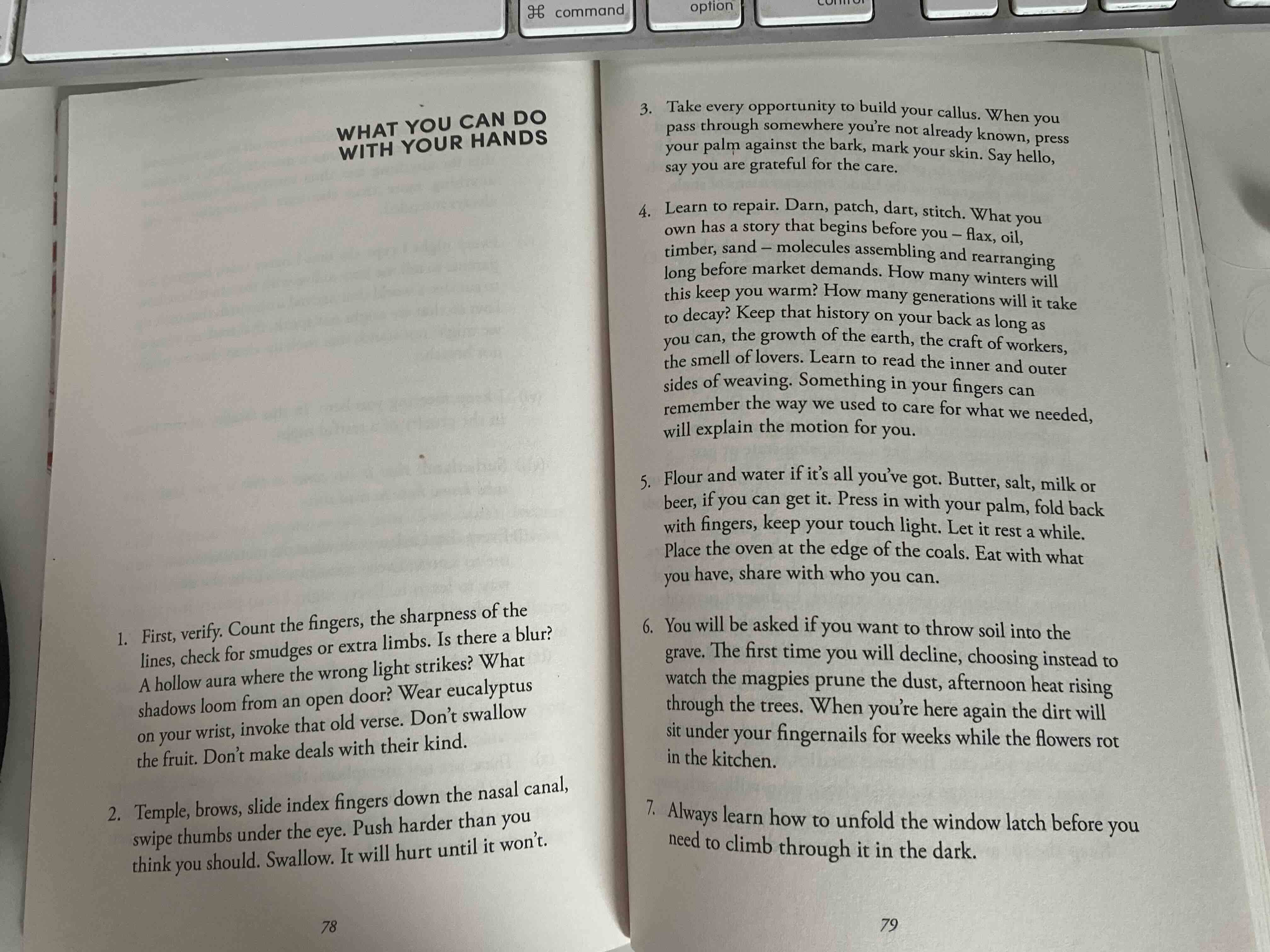
Page 78* is the beginning of ‘What You Can Do with Your Hands’:
Before looking at the poem itself, it’s worth considering it in context. It’s title suggests that it is a direct response to an earlier poem. ‘You’ (page 25) ends:
no less human than yourself. Around us the
world sways, sometimes crumbles. It's not that
you think you can change this, but you need
something to do with your hands.
The hands motif turns up again in ‘Analysis Act Three’ (page 76), which launches itself with a quote from J H Prynne (from his 2022 lecture ‘Mental Ears and Poetic Work‘, another potential rabbit-hole).
Prynne: no poet has or can have clean hands, because
clean hands are themselves a fundamental contradiction.
Clean hands do no worthwhile work.
Sections viii and ix have this: (Apologies, but my WordPress theme doesn’t allow me to include section numbers as they ought to appear.)
Every day I ask myself what the machine doesn't want
me to know. Every tomorrow will be the day I find a
way to learn it. Every night I read poetry just to give
my hands something to do.

Refusal, resistance, disavowal and survivance are
tenors of a liveable life. In action they are compromised,
bloody-handed, in the world and of it.
The book is full of theory, grief and rage. But the motif of hands beings it down to earth: thinking and feeling are not enough. We need to work, to engage. Reading poetry can be work. So are ‘refusal, resistance, disavowal and survivance’.
‘What You Can Do with Your Hands’ responds in the form of an instructional poem in 15 sections’. Page 78 has just the first two instructions:
First, verify. Count the fingers, the sharpness of the
lines, check for smudges or extra limbs. Is there a blur?
A hollow aura where the wrong light strikes? What
shadows loom from an open door? Wear eucalyptus
on your wrist, invoke that old verse. Don't swallow
the fruit. Don't make deals with their kind.

Temple, brows, slide index fingers down the nasal canal,
swipe thumbs under the eye. Push harder than you think you
should. Swallow. It will hurt until it won't.
A quick and dirty summary of these sections would be something like: first, pay attention to your actual hands, and second, use them to become aware of yourself as physically present.
But this is poetry. The words matter. And they introduce an element of the uncanny, something that disturbs the prose meaning. ‘Check for smudges,’ Ok. I can do that, and it is an injunction to self-reflection: smudges – of ink, dirt, foodstuff – will show what I’ve been doing. But ‘check for extra limbs’? The mind goes wandering, and who knows where? Then the questions about light and shade ask the reader to notice their actual context, recognise that they are in a place, in relationship to whatever creates a looming shadow. (In my case right now, the shadows on my hands are cast by light from an open window.)
‘Wear eucalyptus’: fair enough. But what is the old verse we are to invoke? I lay that aside as another of the book’s potential rabbit-holes. If you have an idea, please say in the comments.
‘Don’t swallow the fruit’: I read this as referring to the tale where a person taken to a fairy land must not eat anything if they want to avoid being trapped there forever. That and the final sentence, ‘Don’t make deals with their kind,’ are warnings to keep one’s own integrity against the tide of disinformation and distraction that we live in – ‘Don’t drink the kool aid.’ Already the poem has moved quite a way from literal hands.
The second section comes back to the literal. It insists that the reader notice they are a body: that they push hard to make contact with their own physical existence.
I won’t discuss the rest in detail – the remaining sections cover how to acknowledge place; how to repair; how to cook; how to throw soil into a grave. They cover self-defence, self-care, first-aid, violence, tenderness, and finally connection. Section by section, the instruction form opens up possibilities, creates small and large riddles, resonates. Even Section 12, the shortest, ‘Pick up your fucking litter,’ repays a moment’s attention: the tone shifts and the speaker of the poem becomes for a moment an irritable Auntie. But the comic irritation doesn’t detract from the importance of the advice. Section 14, the second shortest section, is, among other things, a gloss on Section 2: ‘Remove your grip from your own throat.’ It’s one thing to push hard with your thumbs under your eyes until it hurts; it’s a different thing altogether to do violence against yourself, to stifle your own voice. I love Section 15, but it’s against my religion to quote the final line of a poem.
Do read the book if you get a chance.
I wrote this blog post on the land of Gadigal and Wangal of the Eora Nation. I acknowledge Elders past and present, and welcome any First Nations readers.
* My blogging practice is to focus on the page that coincides with my age, currently 78.



 Me fail? I fly!