Category Archives: Around Annandale

Larry Niven’s World out of Time: page 76

Larry Niven, A World out of Time (©1976, Orbit 1977)
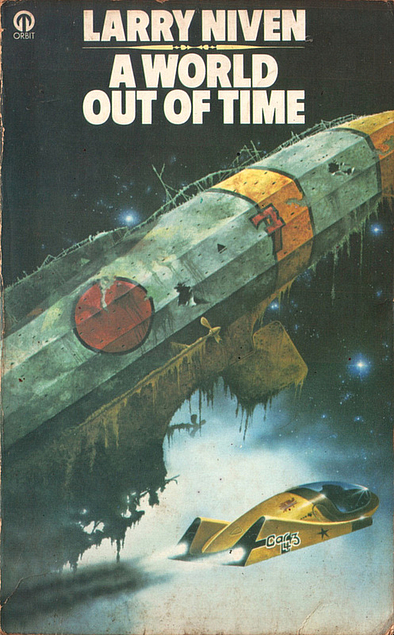
It had been a while since I read something that was just good fun, and I turned to my Spec Fic TBR shelf to fill the lack. This yellowing Bookmooched copy of A World out of Time reminded me of the pleasure of Larry Niven’s Ringworld books, of which pretty much the only thing I remember is that I enjoyed them. It practically leapt into my hands.

And now that I’ve read it I don’t have much to say beyond that it is indeed fun. There are whizz-bang planet-shifting fusion engines; there are sex scenes that would barely raise a vicar’s blush these days but were probably titillating for 14-year-old boy readers in 1977; there are chase scenes, theory about the nature of empires, cool improvised weapons, cute mutated animals, scary mind manipulation, and a plot that’s full of unexpected twists. It’s not ‘hard’ science fiction like Kim Stanley Robinson, or weird like China Miéville, or space opera like Star Wars, but it’s got elements of all of them, and it zips along.

It begins, ‘Once there was a dead man.’ People who opted for cryogenics in the 1970s (‘corpsicles’) are revived as slave labour a couple of centuries later; that is, their personalities are harvested and implanted in the bodies of condemned criminals whose brains have been wiped. Our hero, Corbell, is one of the revived corpsicles. The totalitarian government of the future (‘the State’) assigns him the task of piloting a spacecraft on a round mission that is planned to take hundreds, even thousands of years.

The RNA conditioning that enables him to learn his interstellar pilot craft in a matter of days also modifies his brain so he identifies as a servant of the State. But he manages to rebel and takes off instead to visit the black hole at the centre of the galaxy, where he will almost certainly die, again.

I don’t think it’s too much of a spoiler to tell you that, with the reluctant help of his State-loyalist computer Peerssa and the wonders of speed-of-light travel, Corbell survives. My arbitrary policy of focusing on page 76 once again bears fruit, as on that page he has just arrived back on a much-changed Earth not thousands of years but roughly three million years into the future. (Maybe one reason I found the book so refreshing is that though the Earth’s temperature is mostly unbearably hot in that distant future, the global heating didn’t happen in the 21st or even the 24th century and wasn’t brought about by anything as mundane as carbon emissions. Ah, the innocence of 1976 future-imaginings!)

On page 76, while Peerssa is orbiting the Earth in their interstellar spacecraft, Corbell has found what looks like a dwelling in a devastated landscape. It made me think of the house at the end of Antonioni’s 1970 movie Zabriskie Point, except this appears to be a single bedroom looking out over the desert. Corbell tells Peerssa that he can’t find a door, and after they decide that it’s unlikely that the roof is meant to lift off or that the entrance is underground:

‘I’ll have to break in,’ he said.
‘Wait. Might the house be equipped with a burglar alarm? I’m not familiar with the design concepts that govern private dwellings. The State built arcologies.’

I had to look up ‘arcology’. It’s a portmanteau word combining ‘architecture’ and ‘ecology’, meaning, according to my phone dictionary, a city built according to a system of architecture that integrates buildings with the natural environment. Peerssa means something slightly different: the State’s arcologies were integrated ecologies of their own, with little attention to the natural environment. I love a book that makes me learn about such concepts.

‘What if it does have a burglar alarm? I’m wearing a helmet. It’ll block most of the sound.’
‘There might be more than bells. Let me attack the house with my message laser.’
‘Will it–?’ Will it reach? Stupid, it was was designed to reach across tens of light-years. ‘Go ahead.’
‘I have the house in view. Firing.’
Looking down on the triangular roof from his post on the roadway, Corbell saw no beam from the sky; but he saw a spot the size of a manhole cover turn red-hot. A patch of earth below the house stirred uneasily; rested; stirred again. Then a ton or so of hillside rose up and spilled away, and a rusted metal object floated out on a whispering air cushion. It was the size of a dishwasher, with a head: a basketball with an eye in it. The head rolled, and a scarlet beam the thickness of Corbell’s arm pierced the clouds.
‘Peerssa, you’re being attacked.’

Peerssa doesn’t have much trouble repelling the attack, and Corbell gets into the house. Though the washing machine plays no further role, both it and the room’s doorlessness foreshadow the kind of challenges Corbell is to face.

This is now the world out of time of the title: apparently deserted, with faint signs of active energy that are almost certainly just machines that have somehow continued to be active long after their human creators and users have died out. The question I had at this point was: ‘If there are no humans left, and the remaining three quarters of the book is to be a Robinson-Crusoe story, how can it stay interesting; and if there are humans, how can they with any degree of plausibility have survived in the devastation that Earth has become?’ At page 76, the real subject of the book is about to become a little more visible: it takes its time showing itself, and when it does, well, it’s fun.

Page Nine

A young Tamil man who has been seeking asylum in Australia heard that he had been definitively been denied refugee protection. and on Wednesday night he doused himself with petrol in Balmain and set himself alight. He’s in hospital now, very badly burnt. Sarah Whyte had the story in today’s Sydney Morning Herald.

Minister Scott Morrison in partnership with the Sri Lankan High Commission have a focus ‘to ensure for the proper care and support of this young man’. And also the SMH cares, enough to carry it on page 9 of the hard copy edition.

This is already being spoken of as a ‘mental health’ issue. But it was also surely a political act. Martin Kovan had a challenging article about politically-motivated self-immolations in Overland a couple of years ago. Speaking in the Tibetan context, he wrote:

The immolations aren’t acts of terrorism, nor even of despairing disempowerment, even though it is clear that they emerge from decades of deep frustration. Their dramatic increase appears to demonstrate an absolute and unconditional commitment to freedom. All the existing written statements of the self-immolators make this clear. They are also a form of radical self-determination: no authority can take such sacrifices away from the community on whose behalf they were performed. They are what Oxford University sociologist Michael Biggs calls a legitimate part of the ‘global repertoire of contention’, a form of principled if morally painful action ‘intended to appeal to bystander publics or to exhort others to greater efforts on behalf of the cause’.

‘The immolations,’ he says later in the essay, ‘depend upon global real-time exposure for their influence to be felt; a purely domestic response remains all too vulnerable to internal silencing.’ The most obvious way to silence this young man, whose first name is Janarthanan, is to talk about it as a product of ‘mental illness’. No, it’s a statement about vicious cruelty in Sri Lanka and brutal indifference in Australia.

Goodbye Arthur Boothroyd

I posted about Arthur Boothroyd’s hundredth birthday last October. A lifelong friend of Arthur’s who lives in Switzerland just broke the news to me in a comment on that blog entry that Arthur has died. It happened on 10 February, and the funeral was last Tuesday, 15 February. I’m very sorry to have missed it. He was a gracious presence in Annandale, and created a good bit of the visual environment for generations of Australians.

In October I spent some hours in the State Library trying to get hold of some images of his work, and gave up in despair of ever mastering the necessary technology. This time, Google gave me this, from March 1950:

Described like this:

You heard about it here first

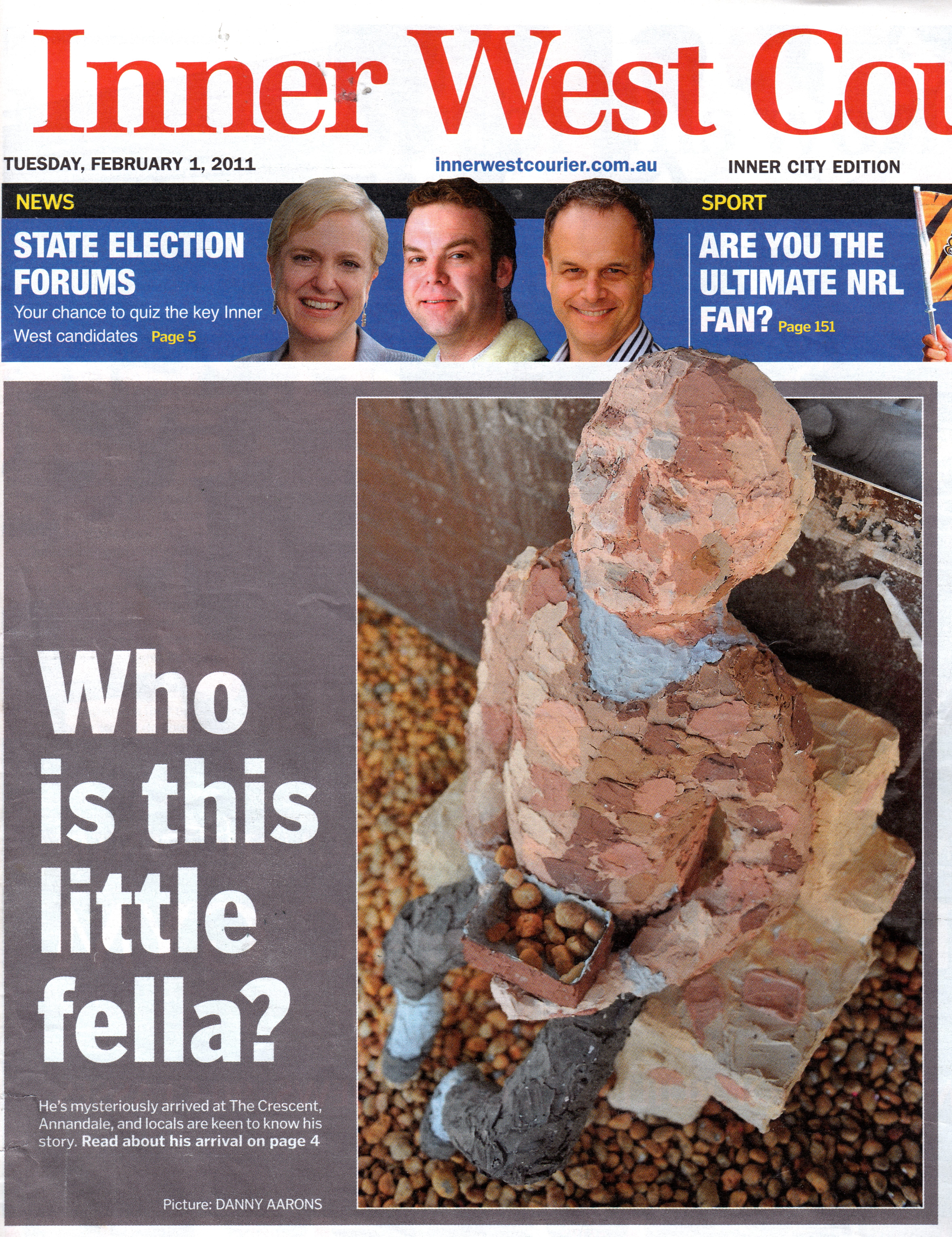
The Inner West Courier has noticed the little man:

Longtime resident David Lawrence tends to the roadside garden regularly and is mystified as to who placed the statue there.

‘It can be put down as a true Annandale mystery,’ Mr Lawrence said. ‘He seems to be collecting something, maybe it’s part of a bigger theme, who knows.

He said locals have largely welcomed the new addition, and would like to know who created the work of public art.

Well, as regular readers of this blog know, it’s an open secret. It’s nice to see it become a mystery.

Later addition: Two things have happened in the hours since I posted that.

The Art Student identified herself as the sculptor on the Inner West Courier site (over my objection that by doing so she was depriving the Inner West readers of the pleasure of a mystery).

We found a copy of the paper and discovered that the front page photo is much more impressive than the one reproduced on the web (both by Danny Aarons). Here’s part of the front page, for those unfortunate enough not to have the Inner West Courier delivered to their door.

LoSoRhyMo 13: A bus stop sonnet

I’m currently reading Sri Lankan Catholic theologian Tissa Balasuriya’s Mary and Human Liberation and will no doubt blog about it in the next few days. But I’ve got to write a sonnet today, and a striking conjunction of my reading with what was happening around me seemed a good subject.

Sonnet 13: Bus stop incident
Tertullian, father of the church,
said,’Woman, you’re the devil’s gate,’
thereby leaving in the lurch
these young ones with whom I wait
near A’dale North Hotel. They toss
their shampooed manes of subtle gloss
and tug (here I avert my eyes)
on skirts that barely reach their thighs,
a generation’s uniform.
One’s loud, annoying, on her phone.
A gust of wind, a change of tone.
She cries like one caught in a storm
but cheerful as a lion cub:
‘Oh Jesus, I’ve just flashed the pub!’

17 more syllables

The jacarandas
are all purple this morning
too late to start things

Another walk, another 17 syllables

Jacaranda’s green
Five bright flowers on the ground
Ten live in the leaves

I went for a two-hour walk …

… and all I got was 17 lousy syllables.

Footpaths stained purple
Jacarandas are still  green
Mulberries underfoot

At the checkout

At the  greengrocer’s today, one of the other checkout staff called to the young woman who was scanning my carrots, ‘Mercedes, what country do you come from?’ She called back, ‘Chile!’ My guess was that the exchange was drawing attention to her Latin American background, exotic in this context where most staff are Italian, Lebanese, or from a range of east or south-east Asian countries.

I looked over to where the question had been lobbed from, and recognised the customer. ‘The customer over there is a writer,’ I said. ‘Maybe he wants to give your name to a character in one of his stories.’

She looked interested at that possibility, but she didn’t ask the writer’s name.

Happy hundredth birthday, Arthur Boothroyd!

Today is Arthur Boothroyd’s hundredth birthday. Yesterday he came home from hospital, where he had been because of a chest infection. I posted about Arthur a couple of years ago. Here’s part of what I said then:

Yesterday afternoon Penny and I were walking the dog when we met Arthur coming the other way. Arthur lives three doors down from us. He’s in his early 90s and dealing with encroaching dementia and increasing frailty, but regularly walks to the park and back. When you encounter him on one of these walks he will make conversation from a small supply of stock phrases — about the weather, how lovely the park is, and not a lot else. Yesterday, his mode of progress along the footpath made me fear for his safety: he was tottering, as if the only thing that stopped him from falling forward with each step was act of putting out a foot for the next step. We stopped to say hello, and he put both hands on Penny’s shoulders, leaning in close to her. She asked if he needed help to get home, but he pooh-poohed the idea, even while prolonging the contact for the purpose, it seemed to me, of catching his breath and keeping his balance. After a little while, he asked, ‘Do I know you?’
…..
[Arthur] had been, in the 1950s and 60s, the main illustrator for The Australian Women’s Weekly: in those years, the AWW published short stories and historical features, and as often as not it was Arthur who provided the pictorial elements. He also illustrated a number of children’s books then and into the 90s. I googled him – “Arthur Boothroyd” minus everything that brings up a British audiologist of the same name — and discovered only a handful of references: the most common is to the booklet published to mark the opening of the Sydney Opera House, which he illustrated.

It’s not that Arthur is forgotten, or that he is without honour among the confraternity of illustrators. I mentioned him to a children’s illustrator the other day, just his first name, and she said, ‘Do you mean Arthur Boothroyd? I admired his work so much when I was starting out. He was what I wanted to be!’ He is known and loved by long-term Annandale dwellers. More than one person in our block cooks meals for him. But of all the people, both children and adults, whose visual imagining of Australian landscapes and histories were profoundly influenced by his Women’s Weekly work and his children’s books, how many have even heard of him? A select few artists become household names and get headlines when a work is sold for a million dollars. The great majority fade away, and their work too fades. I think the least we can do is let them lean on us in the street to keep their balance and regain their breath.

Happy birthday, Arthur!