Category Archives: Book Club

Thrity Umrigar’s Space Between Us

Thrity Umrigar, The Space Between Us (©2005, Harper Perennial 2007)

Bhima is a domestic servant in Mumbai – or Bombay, as she calls it. She has been with the same Parsi family for decades. She can’t sit on the family’s furniture, and physical contact is avoided, but she and the woman of the house – Sera, whom Bhima cannot think of without the respectful suffix ‘-bai’ – have formed close bonds. Bhima is the only person in whom Sera has been able to confide about her husband’s violence, and Sera has paid for the education of Bhima’s granddaughter, Maya.

When the novel opens, Bhima is living with teenage Maya in a hut in the slums. We gradually learn that Maya’s parents died of AIDS when she was seven years old, that Bhima’s husband left her decades ago in tragic circumstances, that Sera’s husband has recently died. In the present, Sera’s daughter is pregnant and her relationship with her charming husband is a bright spot in everyone’s lives. To Bhima’s shame and fury, Maya is also pregnant, and the action in the novel’s present revolves around the father’s identity.

It’s Thrity Umrigar’s tribute to ‘the real Bhima’, who was a servant in her wealthy Parsi childhood home in Mumbai. But having established the bonds of affection and mutuality between the two families, the book turns, and becomes a brilliant study of the way relationships can be close and strong but in the end tragically vulnerable to social norms and structures.

I read this book after The Secrets Between Us, a sequel published 13 years later. This isn’t something I’d recommend. On the one hand it was interesting to see passing mention of Parvati, a major character in the second book, to have the stories of Bhima’s husband and daughter dramatically realised, and to come to a fuller understanding of the ending of the second novel. But the major thunderclap reveal of the identity of the man who got Maya pregnant comes as no surprise, and it was odd to know better than all the characters when there was very little foreshadowing.

A strong point in both books is the way they enact the fine detail of changing culture. Sera, like Thrity Umrigar, is Parsi, and the book’s version of traditional Parsi culture probably didn’t win it any friends among older Parsis. In one of the book’s many flashbacks, soon after Sera marries, she and her new husband move in with his parents, and what follows is a classic mother-in-law nightmare. Banu Dubash, the mother-in-law, insists on traditional Parsi practices, specifically those built around the idea that a woman is impure when he has her periods. Reluctantly, Sera accepts that she must eat meals in her room until her periods are over. Although she is Parsi herself, she has no idea of the extent of her assumed impurity, and walks through the room where Banu is praying, provoking a deafening shriek and a torrent of abuse. Freddy, Sera’s kindly father-in-law, comes running in from the dining room. This is on page 76:

‘Oh, Freddy, thank God you are here,’ Banu said dramatically. ‘help me, darling, help me.’
Freddy looked distraught. ‘Banu, what is it, will you speak? Is it your heart?’
‘No, no, nothing like that. Just that this whole house will have to be purified now. Sera walked across the room while I was praying and she is having her monthly cycle, you see. Still, without any consideration, she interfered with my prayers.’
Sera blushed. Before she could speak, Freddy raised his voice. ‘You and your superstitious vhems and dhakharas. Crazy woman, you are. Harassing this poor child, scaring her for no good reason.’ He grew even more angry. ‘And worst of all, you’ve ruined my enjoyment of my music. A new Mozart record I’d just bought, and now your hysterical faras has made me miss the best part.’ He flung a sympathetic look at Sera and then stomped out of the room.
Banu narrowed her eyes and flashed Sera a look that made her heart stop. ‘See what you’ve done, getting my Freddy all upset?’ she said, careful to lower her voice so that it didn’t carry into the next room. ‘Is that why you entered my house, to create friction between my husband and me?’
Sera felt dizzy, as if she had drunk four beers one after the other. She took a step toward Banu and reached out to touch her hand. ‘Banu mamma, I don’t know what happened–’
‘She touched me,’ Banu screamed. ‘Deliberately, on purpose, she touched me with her impure hands. ‘Oh, God, what kind of daakan has entered my house, to make me miserable in my old age?’
This time, Gulab, the Dubashes’ servant, came into the living room. She took one look at the situation and pushed Sera toward her bedroom. ‘Baby, you go in your room for a while,’ she said authoritatively. ‘Go on, I will calm Mummy down.’

I love the way the non-English words are given without italics or explanation. I couldn’t find ‘vhem’, ‘dhakara’ or ‘faras’ with a quick web search, and I’m happy to have them be untranslatable – or rather to be left to make my own rough translations: ‘panics’, ‘idiocies’ and ‘ruckus’, perhaps? And I love the way that each of the four people in this scene are in a different relationship to traditional religious practice. The pragmatic Gulab is probably, like Bhima, Hindu. Freddy is European in his musical tastes. Sera is part of the modern world and completely unprepared for Banu’s fanatical attachment to – in her understanding – antiquated practices. But mostly what I love is the vividly realised drama of the moment, the brilliant use of dialogue.

I came across these books thanks to the Emerging Artist’s practice of plucking books with non-Anglo author names from the shelves of our local library. It’s a life-enriching practice
Thrity Umrigar’s Secrets Between Us and the Book Club

For years, I’ve been part of a Book Club where no one can spend more than 30 seconds talking about any book. We would eat, return books borrowed at previous meetings, each offer three books which we describe and score out of 10, then – in an order determined by a card draw – borrow up to three books each.

Over time, as most of the Club’s six members made the move to electronic books, the original idea of lending books we had enjoyed got muddied. We struggled on, meeting less frequently, two thirds of us buying books specifically so as to offer them at the Book Club.

At last we bit the bullet and agreed to try all reading the same book and discussing it. Our first title is:

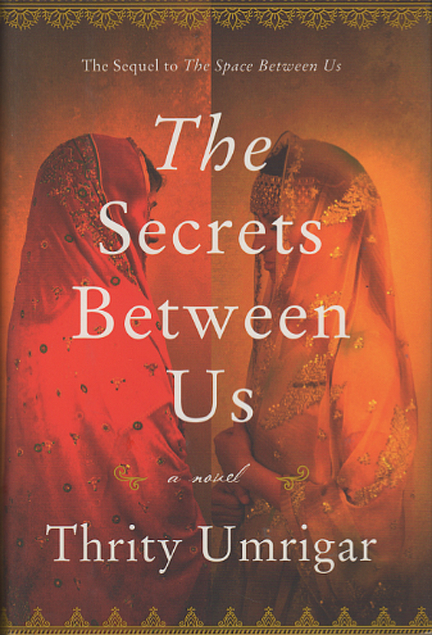
Thrity Umrigar, The Secrets Between Us (HarperCollins 2018)

Thrity Umrigar emigrated from India to the USA when she was 21 years old. Since then, among other things, she has written a number of novels in English. The Secrets Between Us revisits characters from her second novel, The Space Between Us, which was published 12 years earlier, in 2006. I’m writing this without having read more than a couple of pages of the earlier novel (I managed to get hold of a copy, but it arrived too late for the meeting). Though the second novel makes frequent reference to events from the first, I didn’t feel I was missing anything.

Before the meeting: Other demands on my time mean that this has to be brief.

It’s a terrific novel set mainly in the slums of Mumbai, featuring a brilliant gallery of women characters. It begins with Bhima, who is living with her granddaughter in a hovel in the slums. For many years she was employed in a Parsi household, virtually a member of the family, but expelled when she, correctly and necessarily, accused one of the family members of wrongdoing. She has been abandoned by her husband, and her daughter and son-in-law have died of AIDS. She makes a precarious living and enables her granddaughter to attend college by finding domestic work with a number of wealthy women.

In the course of the novel, Bhima’s life is transformed by two unlikely friendships. One is with Parvati, a woman who is even poorer than she is, who was sold into prostitution as a girl but now, as an old woman, is hideously disfigured by a growth under her chin and survives by buying and selling half a dozen shrivelled heads of cauliflower each day and sleeping on a mat outside a nephew’s apartment door, for which she pays rent. The other is with Chitra, a young Australian woman, the lover of one of Bhima’s employers, who was born in India but cheerfully disregards the rigid requirements class, caste and heteronormativity.

At the risk of reducing the book to a single paragraph, the significance of the title is spelled out in an exchange between Bhima and Pavarti. Bhima was initially shocked when she realised that Chitra and her lover aren’t just good friends, but as she comes to know them and appreciate Chitra’s generosity of spirit, she is then shocked when neighbours call them ‘a very bad name’. Here’s a quote from the conversation that happens after Bhima learns about Parvati’s background as a sexual slave, and meets her former employer who tells her how she suffers from lying about Bhima’s revelations. The lump that’s mentioned is the unsightly growth under Parvati’s chin:

‘Why do we aIl walk around like this, hiding from one another?’
Parvati’s thumb circles the lump in a fast motion as she ponders the question. ‘It isn’t the words we speak that make us who we are. Or even the deeds we do. It is the secrets buried in our hearts.’ She looks sharply at Bhima. ‘People think that the ocean is made up of waves and things that float on top. But they forget – the ocean is also what lies at the bottom, all the broken things stuck in the sand. That, too, is the ocean.’

(page 243)

The book’s story could be seen as a process of bringing those broken things to the light, and at least sometimes making them whole again.

After the meeting: We were a bit tentative about the Book Club’s new MO. We ate a pleasant dinner first, with barely a mention of the book until we moved to comfortable chairs. Conversation started out a little stiffly. Someone actually read out the questions for book groups at the back of her e-book, but we realised we absolutely didn’t want to go down that route.

The main question that got tossed around was how seriously to take the pair of books. The second book (which is the one I’ve read) has some extremely improbable benign elements, including – spoiler alert – a happy ending which may be the set-up for a third book, or not. The relative ease with which characters transcend the rigid barriers of class and custom, one person felt strongly, moves the book into the genre of fantasy, or perhaps mark it as prettified for the US mass market.

Not everyone agreed. Sure, things happen that are extremely unlikely, but they are within the realms of possibility, and the good fortune of the main characters allows the situation from which they (or at least some of them) escape to be seen more clearly by contrast. There’s no pretence, for example, that Lesbians are universally embraced by Hindu society, or that there is any kind of safety net for the poor.

Whether it’s an airport novel or a serious work of art, we all enjoyed it. All except me had read and enjoyed both books. I’m now well under way with the first one, and it’s a curious experience reading some of the harsh judgements expressed in its opening scenes, knowing that they’re based on wrong assumptions.

We agreed to carry on as a Book Discussion Club.

Ronnie Scott’s Shirley: page 76

Ronnie Scott, Shirley (Hamish Hamilton 2023)

Ronnie Scott has played an important role in Australian culture over some decades, not least as founder of the literary magazine The Lifted Brow. So it’s only fair that his novels (Shirley is his second) should be reviewed with respect. It’s not that I don’t respect the book, but I’m definitely not part of its intended readership, so I don’t know that anything I have to say will be of much use.

You can read thoughtful and mostly laudatory reviews in the Sydney Morning Herald (Giselle Au-Nhien Nguyen), the Guardian (Bec Kavanaugh), the Newtown Review of Books (Jessica Stewart) and Australian Book Review (Morgan Nunan), to give just a sample.

It’s a novel set firmly in Melbourne, Collingwood to be precise, mostly among people involved in the food industry, with unconventional familial and sexual relationships, as the bushfires of 2019–2020 are coming to an end and Covid-19 is taking hold. The unnamed female narrator (who is not the Shirley of the title – that’s a house) tells the story after Melbourne’s many Covid lockdowns. By about page 20 when the narrator does something of a sexual nature that seems to defy the laws of physics, I was reading without much pleasure. A passing, and to me incomprehensible, mention of people licking themselves, a few pages later left me pretty thoroughly alienated,. Nevertheless, I persisted. There’s a twist at the end that reveals a shape in what until then had seemed to be fairly pointless meanderings. For my taste that was far too little far too late, but my taste is evidently an outlier – see list of laudatory reviews above.

Currently when blogging about books I have a policy of taking a closer look at page 76, chosen for the arbitrary reason that it’s my age. On page 76 of Shirley, the narrator has answered a knock on her apartment door and opened it to her affluent downstairs neighbour Frankie, a ‘famous condiment maven’. After a little chat, she yields to unspoken pressure and invites her in. Then, on this page, the narrator resumes the scrambled tofu she was cooking when Frankie interrupted her, while Frankie asks about it: ‘Wait, what have you put in that? Why does it look so much like curds?’

It was just the Safeway brand of melty ‘mozzarella’, and I’d stolen Meera Sodha’s method of pouring a base of neutral oil, frying off some spices, mixing in the ingredients that had to be actually cooked, and then crushing some silken tofu in my hands – splatting it, really – along with the ‘final’ ingredients that just had to be wilted and warmed; when I’d read that recipe, in East, I’d scrambled tofu before, but somehow I hadn’t realised that the tofu didn’t need to be cooked, that it could be honoured as a soft, pillowy additive.

Today was a bit different, as Frankie had interrupted me just after I’d crushed in the tofu, but I supposed it was fine, as I’d decided on impulse to cook a hash brown in the same pan, and parts of it had broken up as I’d initially over-microwaved it from frozen. Coming back to the pan, I noticed these parts were blackening and sticking, and I chipped them off and incorporated them with a wooden spoon.

There’s quite a bit of vegan cooking in Shirley, mostly with meticulous acknowledgement of the source of the recipes. Meera Sodha’s East, acknowledged here, is subtitled ‘120 Vegetarian and Vegan Recipes from Bangalore to Beijing’.

There’s a school of thought that any passage of a novel needs to do one or preferably all of three things: move the plot forward, deepen our understanding of character, and develop theme or themes.

On first reading, nothing much happens on this page, but revisited when you’ve read the whole book, it astonishingly can be seen to do all three things.

In terms of plot, Frankie’s visit occurs almost exactly at the novel’s one-quarter mark. In conventional movie structure, this would be time for the second turning point, sometimes known as the Change of Plans. Indeed, Frankie’s moving into the narrator’s intimate space marks a major shift: Frankie is actively cultivating the narrator, for reasons that will be revealed much later. No doubt more sensitive readers pick up a weird vibe here that only gets weirder as the pages turn. (I was cleverly seduced into thinking it was all just part of a general weirdness.)

The narrator has already been established as a vegan foodie. This passage reinforces that aspect of her character, shows it in action. We learn more about Frankie too: this is the first time we see her outside of an environment where she is ‘the boss’. Here and on the next couple of pages, we see her as, well, a bit of a manipulator: praising, professing interest in what is after all pretty mundane, offering to help …

As far as thematic development goes, a key strand of the book is the narrator’s relationship with her mother, and her attention to the physical detail of food is in contrast to her celebrity-cook mother’s approach, which is mostly showbiz. Interestingly enough, the narrator silently judges Frankie a couple of pages later as ‘an entrepreneur by temperament but a cook only through opportunity and trade’. That is to say, bit the narrator’s mother and Frankie lack her authenticity around food.

The narrator’s veganism, made concrete here, has an important thematic value. I took it, disparagingly, to be part of the book’s inner-city cool vibe. But it’s more than that. It contrasts to a frequently mentioned photo, unexplained until the last pages, of the narrator’s mother holding a knife and spattered with blood. It’s a key piece of character rooted in plot.

So a lot is happening under the bland surface of page 76. For my taste, here and in the rest of the book, it’s all too far below the surface. Maybe on second reading I’d be alert to the subterranean shifts elements. But I don’t want to reread it. Its cultural terms of reference are largely alien to me. I know anything about vegan cookbooks. I don’t know any of the songs the characters listen to. I barely know West Brunswick from Fitzroy. I’ve never heard of Zachary Quinto. Celebrity cooks aren’t part of my internal pantheon, even ironically. Perhaps most importantly, it’s been a long time since I was dealing with the hopes, despairs and confusions of my 20s.

Your mileage may vary.

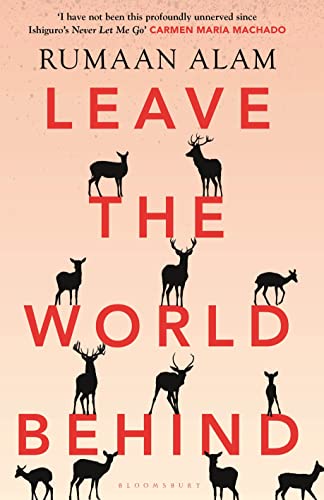
Rumaan Alam’s Leave the World Behind

Rumaan Alam, Leave the World Behind (Bloomsbury 2020)

Just a quick post about this one.

A white middle-class family from Brooklyn – father, mother, teenage boy and younger teenage girl – move into an isolated, luxurious AirBnB place on Long Island. (How do we know they’re white? There are a number of tells apart from their immersion in US materialism – they refer casually to slavery and the dispossession of Native Americans in ways that would be astonishing in the mouths of people of colour or Indigenous people.)

They stock up with luxury holiday supplies and are just settling in on the first night, revelling in the fantasy that this fancy place is theirs, enjoying the delicious discomfort of not being able to check work emails because they have no coverage or WiFi, and generally wallowing in the first night of their vacation while a storm rages outside, when a knock at the door strikes terror into their hearts.

Their visitors are an older African-American couple. We know they’re Black because we see them through the holidayers’ eyes, and that’s the first thing they see. Our heroes’ initial worry that this is some kind of home invasion are dispelled when they are told, and eventually believe, that the visitors are the respectable upper middle-class AirBnB hosts.

The terror never quite dissipates, but its focus shifts. The narrative proceeds painfully slowly. There are weird signs and omens – hundreds of deer in the woods, a dozen flamingoes in the swimming pool, an unexplained noise loud enough to crack the glass in windows. The characters spend most of the novel in various states of unknowing.

It’s like one of those horror movies where there’s a slow build-up until finally the horror is revealed – except in this case we don’t arrive at the inevitably disappointing moment where we see the horror face to face. It’s probably eccentric of me, but I think of Hart Crane’s novel The Red Badge of Courage, where the protagonist has no idea what’s going on in the war in general but can only see what’s going on in his immediate vicinity. In that case, the readers have a wider perspective because we know some of the history. In this one, the narrator breaks the fourth wall with increasing frequency to give broad-brushstroke information about what is happening back home in Brooklyn or somewhere in Florida. We still don’t know the exact nature of the disaster unfolding in the wider world, but we do know the cause of the mysterious noise and – the narrator seems to imply – if we’ve been paying attention to events in real life we should be able to guess what’s happening.

If The Red Badge of Courage is too far-fetched a comparison, how about Luis Buñuel’s The Exterminating Angel. In that movie, the guests can’t go home from a bourgeois dinner party. In this novel they could theoretically leave, and they make a number of sallies forth, but – no spoilers here – there’s an overwhelming sense that these six people are stuck with each other.

The opening pages moved almost unbearably slowly with their attention to the detail of the white mother’s shopping excursion. And once the full complement of characters is present, the conversation tends to repeat. But something in this obsessive listing of brand names and constant return to a handful of observations was generates a cumulative sense of dread, and for me at least it pays off brilliantly as things come closer to boiling point.

Once again, I’m grateful to our Book(-swapping) Club for taking me out of my comfort zone.

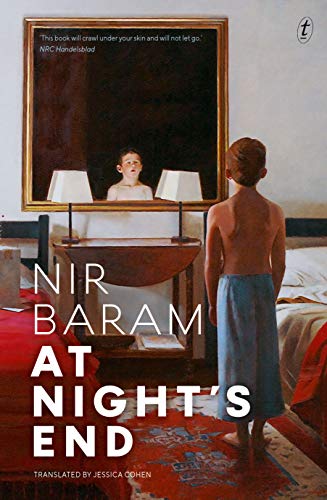
Nir Batram’s At Night’s End

Nir Baram, At Night’s End (2018, English translation by Jessica Cohen, Text Publishing 2021)

I may have missed the point of this book.

It begins with an Israeli novelist waking up in a hotel room in Mexico after appearing as a guest at a writers’ festival. He is disorientated, and decides to stay on in order to track down a young woman whom he blearily remembers saying something to him about the death of his best friend. The friend isn’t dead, or is he?

The following chapters take place by turns in three different time periods: the late 1980s, when the novelist and his friend are in elementary school, creating an elaborate fantasy world and dealing with a trio of bullies; the mid 1990s, when they are in their final year of school; and the present time, in Mexico. There are frequent flashbacks and forward projections in each of the time periods, complicated further by dream sequences, drugged states and possible psychotic episodes. The friendship hits on some hard times. The friend (I think) becomes deeply depressed and after being suicidal for years finally kills himself. The narrator does meet up with the young woman, but as far as I could tell he just gets very drunk and/or stoned with her and another poet. I don’t know if the friend dies before or after their meeting.

Though I spent most of the book in a state of disorientation, the problem wasn’t at the sentence level. The prose, in Jessica Cohen’s translation, is clear and flows easily. It’s just that I never did really get what happened between the two friends, either in the late 1980s, the mid 1990s, or whenever the friend finally died.

The back cover blurb quotes a review by in Haaretz: ‘One of the most intriguing writers in Israeli literature today.’ Yossi Sucary, the quoted reviewer, is probably more dependable than I am. I brought it home from the Book(-swapping) Club. I can’t say it was one of my more successful borrowings.

Zadie Smith’s Intimations

Zadie Smith, Intimations: Six Essays (Penguin 2020)

This tiny book was written in the first half of 2020, when Covid-19 was running wild in New York City, where Zadie Smith teaches creative writing. It comprises six personal essays, which their author describes in her foreword as ‘small by definition, short by necessity’. They are written in the spirit of what she learned from the stoic philosopher Marcus Aurelius: ‘Talking to yourself can be useful. And writing means being overheard.’

It’s a tiny book, but it’s not slight. As I read it, I could feel my personal understanding of the word ‘intimations’ changing to include an element of intimacy. These essays ruminate intimately on life, art and relationships in the middle of a pandemic. The first essay, ‘Peonies’, sets the tone:

Just before I left New York, I found myself in an unexpected position: clinging to the bars of the Jefferson Market Garden looking in. A moment before I’d been on the run as usual, intending to exploit two minutes of time I’d carved out of the forty-five-minute increments into which, back then, I divided my days.

She was transfixed by the sight of a bed of garish tulips, wishing they were peonies. That moment leads into reflections on the concept of a ‘natural woman’, the nature of creativity (‘Planting tulips is creative. … Writing is control’), the ‘global humbling’ that was to happen a few days later, on creativity and submission. She quotes a parable from Kierkegaard about the difference between how we actually are in the world and the stories we tell about ourselves in the world. You can make them peonies in a story, but they are still tulips in the real world. With the lightest of touches, the essay takes us into the deep challenge that April 2020 – ‘an unprecedented April’ – presents to our sense of ourselves.

The second essay ‘The American Exception’, also has a brilliantly enticing first line: ‘He speaks truth so rarely that when you hear it from his own mouth – 29 March 2020 – it has the force of revelation.’ We know exactly who she means. Paradoxically, the truth he spoke is that before that date ‘we didn’t have death’. The essay goes on to justify the paradox beautifully.

All the essays tackle big themes, and do it lightly. The longest, ‘Screengrabs (After Berger, before the virus)’ is the one where the author brings her gifts as a novelist most strongly to bear. I think the Berger in brackets is John Berger, and there may be a reference to his famous quote, in Understanding a Photograph: ‘I have decided that seeing this is worth recording.” The essay offers six portraits, mostly of people peripheral to Smith’s New York life, though one, subtitled ‘An Elder at the 98 Bus Stop’, is someone who has known her since childhood back in London. Each of the portraits has a twist at the end, as the pandemic leads the person to reveal something unexpected about themselves. After the portraits, there’s ‘Postscript: Contempt as a Virus’:

‘The virus doesn’t care about you.’ And likewise with contempt: in the eyes of contempt you don’t even truly rise to the level of the hated object – that would involve a full recognition for your existence.

The brief essay-within-an-essay ranges over racist micro-aggressions, Dominic Cummings’s cavalier violations of Covid restrictions, and, most compellingly, the look on Derek Chauvin’s face as he murdered George Floyd.

I haven’t read anything by Zadie Smith before this. I haven’t even seen White Teeth on TV. I’ve enjoyed her brother Ben Bailey Smith’s occasional stints on the Kermode and Mayo’s Film Review, but that’s as close as I’ve got. I brought this book home from the Book(-swapping) Club, and Im very glad to be introduced to this fine writer.

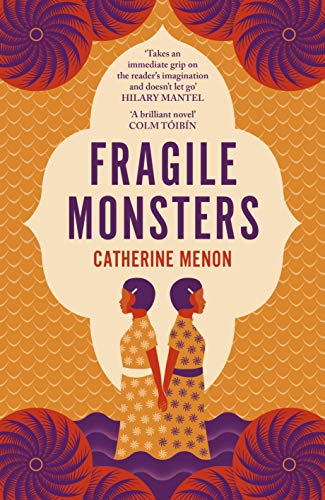
Catherine Menon’s Fragile Monsters

Catherine Menon, Fragile Monsters (Viking Penguin 2021)

It’s 1985. Durga’s relationship comes to an end when her lover returns to his wife. She leaves her job as a maths lecturer in a Canadian university and takes her wounded heart back to her native Malaysia where she gets a job at a university in Kuala Lumpur. When the novel opens she has left KL for Diwali to visit her cantankerous grandmother in the village of Kuala Lipis where she grew up. A gift of fireworks goes badly awry, the roads are shut by floods, she stays in the village much longer than expected, and while she’s there confronts the ghosts – fragile monsters – of her past.

In alternating chapters we read the story of Mary, Durga’s grandmother: her childhood, her experience of the Japanese occupation in the 1940s, the Malayan Emergency, her relationship with her daughter Francesca, who was Durga’s mother.

The two narratives come together in the climactic final chapters. Durga makes some deeply disturbing discoveries about her family history, and the great miasma of stories that she grew up with are resolved into some kind of reality.

Throughout, there’s a contrast between Durga’s world view and her grandmother’s. Durga is thoroughly westernised, and loves the world of mathematical exactness and consistency. Her grandmother is a wild woman who tells stories that differ with each telling. Durga finds herself being drawn back into her childhood world of ghosts and half-truths.

I’m glad I read this book. The characters, especially the grandmother in the present time, feel real, and there are rich insights into Malaysian traditional culture and history. (The university in Kuala Lumpur is an offstage presence that tries to pull Durga back to westernised, mathematical reality, but without a lot of success.) But it didn’t sweep me away. It was as if I could always feel the work that was going into the writing – a symptom of this is the occasional reflection on mathematical concepts. These feel like scaffolding the helped the writer create the work, but needed either to be more fully integrated or designated as darlings to be killed.

Growing up Aboriginal in Australia

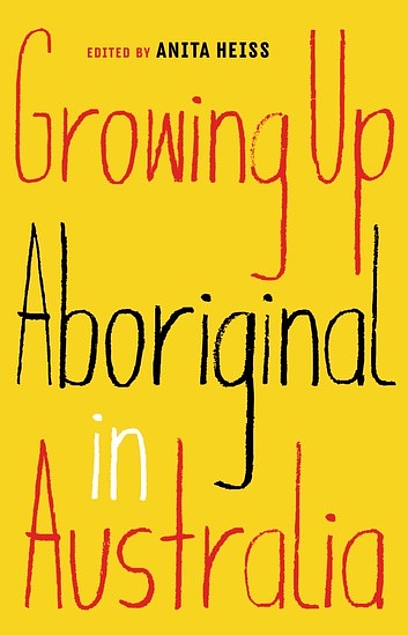
Anita Heiss (editor), Growing Up Aboriginal in Australia (Black Inc 2018)

I’m coming to this book late, but it’s a book that will remain fresh for a long time yet.

It contains 52 essays from First Nations people of Australia. The range of contributors is huge: people from all parts of Australia, urban and remote, from Cape York to the Western Australian wheat belt; some who are household names, some who should be, and some who live quiet lives far from the limelight; people who were strongly connected to culture and community as children and people who discovered they were Aboriginal only in adulthood; old (several contributors were born the same year as me, 1947) and young (one was 13 at the time of publication); sports stars, poets, novelists, classical musicians, prisoners.

Anita Heiss writes in her introduction:

There is no single or simple way to define what it means to grow up Aboriginal in Australia, but this anthology is an attempt to showcase as many of the diverse voices, experiences and stories together as possible.

The attempt succeeds admirably.

I was struck by the sheer number of almost identical incidents in which someone challenges a young person’s Aboriginal identity. Here’s one of them, as told by Keira Jenkins, a Gamilaroi woman from Moree in New South Wales:

I was six years old, sitting cross-legged on the floor in my checked dress, which was slightly too long for me, looking eagerly up at Miss Brown – at least I think that was her name – the first time I had a blow to my sense of identity. We were learning about Aboriginal people and I piped up very proudly.

‘I’m Aboriginal.’ I waved my hand in the air.

‘No, you’re not,’ my friend Alison said. ‘You’re too white to be Aboriginal.’

I don’t remember what happened after that; I just remember feeling ashamed.

(Pages 119–120)

The challenger isn’t always another child. Sometimes it’s an adult in authority, sometimes even another Aboriginal person, but the confident refusal to accept that a child with fair skin can be Aboriginal occurs again and again in almost exactly the same words, never without impact on the child. No wonder Andrew Bolt was taken to court over his 2009 slur against ‘light-skinned people who identified as Aboriginal’ (news story here if you don’t know about that): the people bringing the case must have been desperately sick of that pernicious stuff.

The sameness of attacks stands in striking contrast to the tremendous variety of the life stories. I loved reading how eleven-year-old Miranda Tapsell refused to go to an event as Scary Spice just because Scary Spice was brown like her, and risked the ire of her non-Indigenous friend by going as their shared favourite, Baby Spice; how Adam Goodes disobeyed a teacher on a zoo excursion and stared at a gorilla; how Karen Davis, a Mamu–Kuku Yalanji woman who grew up n Far North Queensland in the 1970s and 80s sang songs on long car trips with her family pretty much the way I did with mine in the 1950s.

Some of the stories defy belief. William Russell, who describes himself as ‘a black, fair ex-serviceman with PTSD, blind and with a severe hearing impediment, and a long list of other physical problems from military service’, is a case in point. He tells of a time when his mother, with a babe in arms and four-year-old WIlliam by her side, faced a crowd of drunk, angry white men in the tiny town in Victoria where they had just come to live as the only Aboriginal family. Her grandfather stepped out of the shadows to save the day, naked ‘as always’, painted up in ochre and kaolin, and discharging a shotgun. This was in the 1950s. Hm!

There are tragic stories of the damage done by of colonisation to individuals and communities,featuring alcoholism and addiction; diabetes and diagnoses of mental illness; family violence and dysfunction; premature death. And there are stories of heroic resilience. Tony Birch’s story of his father is a beautifully told study in reversing fortunes. After years of violence and anger, followed by years of medication, electric shock treatment and institutionalisation, he ‘is saved’:

The Aboriginal community of Fitzroy gather around and care for him: men and women who had known him when he was a kid, during the years before any of them were ravaged by the force of racism and exclusion. He moves to the countryside and begins working with young blackfellas in schools. The experience is life-changing, for both my father and his family. I discover, a little to my own surprise, that I love him.

(Page 35)

My copy of Growing Up Aboriginal in Australia is a loan from my Book(-lending) Club. I consider it belongs in the Australian Women Writers Challenge 2021: it’s edited by a woman, and more than half the contributors are also women. So I’m counting it as the eleventh book I’ve read for the challenge.

This blog post is also a contribution to Indigenous Literature Week hosted by Lisa at ANZ LitLovers blog.

Claire Messud’s Kant’s Little Prussian Head

Claire Messud, Kant’s Little Prussian Head & Other reasons why I write: An autobiography in essays (W W Norton & Co 2020)

Claire Messud (Wikipedia entry here; her own website here) is primarily a novelist. I haven’t read any of her novels, but this book – a collection of essays of which versions were published between 2002 and 2019 in journals ranging from Vogue to the Kenyon Review – was on offer at our book-swapping Book Club. I’m a bit of a sucker for writers’ writing about writing, and on top of that I was intrigued: Did Kant keep a tiny sculpture of a head on his shelf, and whose head was it?

It turns out this is the first book I’ve read that mentions Covid–19. The introduction, dated April 2020, strikes an optimistic note. Speaking of the climate emergency, life under late capitalism, and the way recent years have been ‘a dark maelstrom’ (which may be code for the Trump presidency), she continues:

This ominous hurtling, the relentless ouroboros that is social media, the destruction of ourselves and our environs – we had come to see it as inevitable, and ourselves as the passive and ineluctable victims of forces beyond our control. Humanity has risked collective despair, than which there is no more certain doom for our planet and ourselves. But even in the past two months, although at the mercy of a ravaging virus, we have discovered that in other ways we aren’t disempowered. Crisis and extremity are by no means to be desired; and their consequences – human and economic both – will be challenging for the foreseeable future. But these extraordinary times have also forced us to slow down, to think collectively, to seek hope, to value the truth, and to celebrate resilience and faith in our fellow human beings.

To find these resources, we may look to the past – to history and to literature – to the vast compendium of recorded human experience, from which we draw wisdom, solace, or, at the least, a sense of recognition.

It might have been harder to hit that note of optimism eight or ten months later in the USA, and harder to assume that the ‘we’ in that passage is universal, or even a majority, but it’s still saying something real.

The book is organised into three parts: ‘Reflections’, which comprises mostly family history, and the self-explanatory ‘Criticism: Books’ and ‘Criticism: Images’. The divide, while clear, isn’t absolute. As Messud says in her Acknowledgments, her ‘family is at the heart of it all’. The three essays on Albert Camus at the start of the second section – on respectively his ‘naive optimism’ during the Algerian War of Independence (1954–1962), a new translation of Camus’ L’Étranger, and Kamel Daoud’s Meursault, which is a response to L’Étranger – take on extra depth and resonance from Messud’s family history. Her father’s family were pied-noirs (Algerian-born French) like Camus, and the first Camus essay begins with a memory of her father as an old man grieving for the country he hadn’t seen since he was a teenager.

I approached the first part cautiously. Other people’s family history provoke one central question: Why should I be interested? Will this family be amusing? Will their stories shed light on my own? Will they open out to some broader understanding of the world? In this case the answer to all three questions is Yes. Claire Messud brings to her stories of her parents and grandparents not only the precise aura of childhood memory, but also an adult grasp of their contexts. She spent a large part of her childhood in the eastern suburbs of Sydney, then moved with her family to Toronto, and from there to the USA. Each move meant a cultural shift, and it’s Kambala Church of England School for Girls in Rose Bay, seen through Messud’s eyes and now ours, that is the weirdest of them:

We had uniforms for summer and for winter. The former was a grey-and-white checked shirtdress, belted, worn with a straw boater banded in grey, with the school crest upon it. The latter was a grey tunic, beneath which we wore white shirts (with Peter Pan collars while at [the junior school] Massie House) and grey-and-gold striped ties (bow ties, with the Peter Pans), and topped by a grey felt hat, again banded with the crest. Grey socks; black oxfords; grey jumpers; grey blazer (with gold piping); grey knickers; grey ribbons (compulsory if your hair touched your collar).

(‘Then’, page 8)

And there’s much more.

The dislocations in the early lives of Messud and her sisters, it turns out, are mild reprises of their parents’ lives. Her father was a pied-noir. His father, a patriotic Frenchman who also loved his native Algeria, took his family to Morocco in 1955. Messud’s father never returned to Algeria, but moved from country to country, and when his guard was down would grieve for the country and language of his childhood. A fierce atheist, when he was dying in a nursing home, he was bullied into taking Communion from a visiting priest, but as the priest was offering the host:

‘Isn’t there someone,’ my father asked me pleadingly, ‘who could do this in French?’

(‘Two Women’, p 45)

Her mother was ‘raised petit-bourgeois and socially aspirant in mid-century Toronto’. The parents met in Oxford, and their first date was at a picnic also attended by Gloria Steinem. Messud’s father’s younger sister, mentally unstable and zealously Catholic (she’s the one who pushed for the deathbed Communion) became part of their life from their marriage in 1957.

The family story is told with generosity to all parties, including the aunt, and extends to the tribulations of Messud’s teenage daughter as she deals with school-age bullying.

Inevitably, some of the essays are less interesting than others: ‘How to be a Better Woman in the Twenty-First Century’ is little more than a listicle, and an account of the author’s two dogs, though funny and heart-rending, is still an essay about dogs.

I’ve been reluctant to read review essays of books I haven’t read ever since Colm Toibìn’s review of On Chesil Beach essentially told the whole plot of that very short book in one full page of the London Review of Books. But I read all the critical essays here. I enjoyed and was enlightened by the one on a book I’ve read – Teju Cole’s Open City (link is to my blog post): I was surprised by a twist at the end; Messud doesn’t mention the twist, but discusses many moments along the way that would have made it less surprising if I’d been paying attention. I’ve seen the movie based on Kazuo Ishiguro’s Never Let Me Go, and her discussion of the book brought back the movie’s power. Essays on Jane Bowles, Italo Svevo, Magda Szabó, Rachel Cusk (this one especially), Saul Friendlander, Yaasmine El Rashidi and Valeria Luiselli are all enticing, giving enough information and context to make one want to rush out and get hold of a copy.

The third section comprises catalogue essays on painters Alice Neel and Marlene Dumas, a review of photographer Sally Mann’s Hold Still, and finally returns to family with a sweet essay on how she and her children love Boston’s Museum of Fine Arts. Living as I do with an Emerging Artist, I read the catalogue essays with relevant books open beside me, and could feel my capacity to appreciate art expanding as I read and looked. These essays are enriched by their inclusion in this book. When Messud writes that Marlene Dumas’ Amends, like each of her paintings, ‘has evolved out of a particular combination of autobiography, politics, culture, and the demands of the medium’, she could be describing the book as a whole or in its parts. In her essay on Sally Mann (which also, by the way, makes a telling contribution to current conversations about whether you can appreciate a work of art created by a person of vile character), she could likewise have been describing these essays, a good bit more accurately than the book’s subtitle, when she wrote:

… this memoir is notably neither confessional nor self regarding. Mann, ever the photographer, stays behind her lens, turning her ‘intensely seeing eye’ on the people and the natural world around her. […] We will know Mann by the outline that she leaves, by what touches her and how.

(‘Sally Mann’, p 287)

I didn’t get the writer-writing-about-writing hit I was expecting. The title essay is the only one that explicitly fits the bill – and the title, incidentally, refers to a line in a Thomas Bernhard novel that Kant’s monumental work shrivels down to a legacy of ‘Kant’s little East Prussian head and to a thoroughly amorphous world of night and fog’: to write is to aim to have at least that much legacy.

November Verse 5 and Ocean Vuong’s On Earth We’re Briefly Gorgeous

November verse 5: Letter to my Mother

Dear Mum, I won't write you a novel.
Barely fourteen rhyming lines
I'll manage. No space to unravel
the half a century that twined
our lives. Perhaps I know you better
now than when your weekly letters
filled me in on family news.
I wish that you could know me too,
that you could look down from some heaven,
hear the words I wish I'd said,
see the tears I should have shed
back then, take thanks for all you've given.
The grave is deaf and blind and still.
What we didn't say, we never will.

This is prompted by a marvellous book, a very different letter to a very different mother:

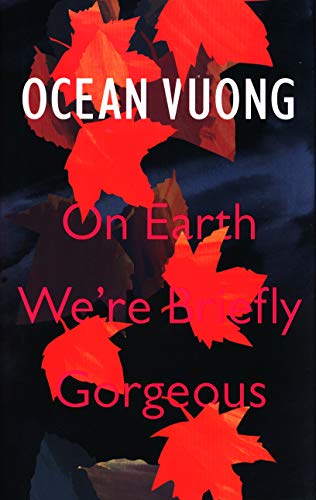
Ocean Vuong, On Earth We’re Briefly Gorgeous (Jonathan Cape 2019)

The protagonist narrator of this novel, known to his intimates as Little Dog, is a Vietnamese-American Gay man, and this is his portrait of the artist as a very young man. The text is cast as a letter addressed to his mother. He tells her the story of his childhood, including quite a bit of abuse he suffered at her hands and his understanding that that abuse was part of the aftermath of the US-Vietnam war. He tells of his relationship with his grandmother, her mother, and what he knows of her love story with a US serviceman. And he relates his teenage experiences of sex. Given the sometimes excruciating detail about young gay male sex (excruciating both physically and in its turbulent emotional ambivalence), clearly this is not a letter he really expects his mother to read.

Ocean Vuong has won big prizes for his poetry, and parts of this book read as prose poetry. I don’t mean that some parts of it defy any attempt to extract a simple prose meaning, though there are a couple of moments like that. I mean, among other things, some images, as of buffalo running over a cliff or monarch butterflies making their vast annual journeys or Tiger Woods putting in an appearance, do a lot of work. And there are rhapsodic sections that don’t bother with conventional sentence structures, but take the reader with them in not bothering. For example, there are six pages in which Little Dog, sings (that’s the only word for it) about Trevor, the first object of his troubled but reciprocated desire. Here’s a little of it:

Trevor going fifty through his daddy’s wheatfield. Who jams all his fries into a Whopper and chews with both feet on the gas. Your eyes closed, riding shotgun, the wheat a yellow confetti.

Three freckles on his nose.

Three periods to a boy-sentence.

Trevor Burger King over McDonald’s ’cause the smell of smoke on beef makes it real.

The Vietnam War, growing up Gay and Vietnamese in working-class Hartford, Connecticut, the ravages of the OxyContin epidemic, dementia: the book deals with difficult and sometimes tragic lives. But the writing is sharp and rich and, in the end, celebratory.

My favourite scene is the one where Little Dog comes out to his mother in a Dunkin’ Donuts: ‘I don’t like girls.’ The conversation that follows is not astonishingly original (‘Are you going to wear a dress now?’ ‘They’ll kill you, you know that.’ ‘When did all this start. I gave birth to a healthy, normal boy.’ But then:

When I thought it was over, that I’d done my unloading, you said, pushing your coffee aside, ‘Now I have something to tell you.’

My jaw clenched. This was not supposed to be an equal exchange, not a trade. I nodded as you spoke, feigning willingness.

‘You have an older brother.’ You swept your hair out of your eyes, unblinking. ‘But he’s dead.’

And a whole terrible part of his mother’s life is revealed to him. So I need to modify my description of the book as a portrait of the artist as a young man: it’s a portrait that includes an extraordinary openness to the generations that gave rise to the young man.