Category Archives: Book Group

Conrad’s Secret Agent and the Book Group

Joseph Conrad, The Secret Agent (1907; I read it in a Conrad omnibus from the library)

1conradBefore the meeting: I first read The Secret Agent 40 or so years ago, but all I remembered was a moment when a character hears a sound like a ticking clock and realises after a long paragraph that she is actually hearing blood dripping. That, a dark, clammy London, and a vague sense that the book’s anarchists were nasty, stupid  big-talkers who bore very little resemblance to the anarchists of my acquaintance (except perhaps for the capacity to talk theory).

Rereading it for the book group, I found all those elements still firmly in place. Soon after starting the book, I made the mistake of getting hold of Christopher Hampton’s 1995 film version. I switched off  about half way through the movie, but on the strength of what I saw I’m confident that the virtues of the book didn’t make their way onto the screen – with the exception of Robin Williams’s chilling, uncredited turn as a nihilistic bomb-maker. The Secret Agent is not a spy thriller; Joseph Conrad wasn’t a forerunner of John Le Carre.

The book proceeds largely by a series of conversations: Mr Verloc the eponymous secret agent meets Mr Vladimir of the Russian embassy; the largely self-deluding anarchists of 1880s London discuss political theory; an armchair radical has a beer with the nihilistic bomb-maker; the bomb-maker and a police inspector have a stand-off; the inspector and his superior jostle for the upper hand; the latter seeks the support of a Very Important Politician; Mr Verloc tries to calm his wife after her beloved brother dies dramatically; and so on. Most of the conversations are two-handers; in many of them one participant is virtually silent. The effect ranges from comic when the policemen are playing power games to almost intolerably suspenseful when Verloc is reassuring his wife, completely failing to grasp that her world has been shattered, and that she rightly holds him responsible. Every conversation goes on far longer than could be tolerated by any self-respecting filmmaker (with the possible exception of Louis Malle, who made the superbly garrulous My Dinner with André). Once I relinquished my cinema-trained desire for compression and speed, I was engrossed.

I don’t know that The Secret Agent has much of value to say about anarchism, beyond the observation that some anarchists tend to talk a lot and not do much. Terrorism at the end of the 19th century was a different beast from the terrorism of today, but the book’s central image resonates: when simple-minded Stevie is manipulated by a man he trusts to risk his life, his central motive is compassion for the suffering poor, but his act actually serves as fuel for repressive propaganda. It’s hard not to feel that the young men and women who strap explosives to themselves in the 21st century have a lot in common with him – just insert aggrieved religion in place of simple-mindedness.

The meeting: In the lead-up to the meeting, one chap emailed that if we ever made ‘another ill-thought out decision to read a book like The Secret Agent‘ he’d apply for a transfer to a women’s book group. It looked as if we were going to have a good old stoush. But it turned out that though some of us loved the book, some found it laugh-out-loud funny, and some would prefer to have spent their time on other things, we all at some level enjoyed it. (At this point I should say that I made a number of egregious errors of fact over dinner, and may be completely inaccurate on this matter as well.) There was some happy sharing of favourite sentences.

One guy read us a 2004 review from the New York Times, which made me think that our plan to read a book that dealt with terrorism might have been better served by Conrad’s Under Western Eyes. I guess we’ll save that for another day.
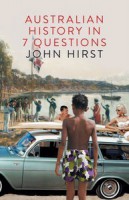
The Book Group and John Hirst’s Australian History in 7 Questions

John Hirst, Australian History in 7 Questions (Black Inc 2014)

9781863956703

Before the Book group meeting: ‘I know that many people find Australian history dull and predictable,’ John Hirst starts his introduction to this book. Invited to lecture on this potentially deadly topic at a branch of the University of the Third Age, he had the thought that if he framed the lectures as puzzling over genuine questions, they would cease to be predictable. I don’t know about the lectures, but this book is lively and has quite a few surprises.

Hirst’s seven questions, and severely truncated version of his answers, are:

  1. Why did Aborigines not become farmers? The real question is why did other hunter-gatherer peoples ever make the transition to farming, when its advantages are far from obvious? (He relies on Jared Diamond’s Guns, Germs and Steel a fair bit. It’s not part of his story that Aboriginal people did become farmers, but were ruthlessly driven off their land by the colonisers in the nineteenth and early twentieth century – as in Heather Goodall’s From Invasion to Embassy.)
  2. How did a penal colony change peacefully to a democracy? This question is based on a misapprehension: New South Wales was never a penal colony. It began as a colony of convicts: from the beginning the work of the colony was overseen by other convicts, and convicts had substantial rights. The penal reform movement in England led to a failed attempt to turn it into a penal colony in the 1820s and 1830s.
  3. Why was Australia so prosperous so early? The most interesting aspect of Hirst’s answer is that the colony was run by government employees. That is, the people in charge weren’t there to make profit for themselves or their company, but were public servants, and had the resources of the British government behind them.
  4. Why did the Australian colonies federate? This chapter is mainly a rebuttal of two common replies: that Federation happened because of business interests or because of racism. Business in fact opposed Federation until the eleventh hour, and while racism was big and ugly it wasn’t the motivator. You have to ignore the vast amount of bad poetry being published in the late 19th century not to realise that the move to Federation was driven by a deep yearning for independence, a powerful nationalistic sentiment.
  5. What effect did convict origins have on national character? Relying on a 1969 essay by Henry Reynolds, Hirst rebuts Russell Ward’s well-established story that our convict origins made us an irreverent lot, free-spirited and suspicious of authority. On the contrary, the ‘convict stain’ meant Australians felt the need to prove themselves among nations by, for example, sending off lots of young men to die in England’s wars. The need to transcend the ‘impure origins’ of the nation may have lain behind the racism of the White Australia policy – Australia would be ‘racially pure’.
  6. Why was the postwar migration program a success? Hirst points to the way the colonies dealt with cultural differences well before the 1950s. The conflicts that were left behind in Britain and Ireland were savage, and though prejudice and mutual unpleasantness continued, there was a general consensus that the old conflicts should not be imported into the new country.
  7. Why is Australia not a republic? The Australian colonies were too far away from England to feel safe if they cut ties, and much more recently John Howard played on people’s distrust of politicians to secure a defeat in the 1999 referendum.

That gives some idea of the book’s arguments. Of course, the story you tell depends on what questions you start from. Ask any Australian historian to come up with 7 questions, and you’ll get a different book. It’s hard to imagine an Aboriginal historian such as Vicki Grieves choosing Hirst’s first, even without the questionable term ‘Aborigines’, or James Boyce, author of Van Diemen’s Land, being so focussed on Sydney and Melbourne. I don’t remember any mention of the Chinese on the goldfields, or of the substantial non-Anglo immigrant communities that flourished before the Second World War – Germans in South Australia, and Southern Europeans in north Queensland, say.

I’m not a historian myself, but I enjoy reading history, and plan to keep my ears open for the discussion this book generates. Hirst has stuck a number of spanners in the well-oiled works of received versions of Australian history, and that can’t be bad.

The meeting: This was our last meeting for the year and was even more convivial than usual. The business of the evening began with ceremonial distribution of  books each of us had chosen from our shelves and wrapped in bright paper. I scored The Atlantic Ocean, a collection of essays by Andrew O’Hagan.

The book turned out to be a fabulous choice for the group. There was a lot of interesting discussion, which included quite a bit of holding personal histories up against Hirst’s generalisations. We are all white, almost all of Anglo heritage, but quite a few of us had our own experiences or those of people we’re close to that resonated with Hirst’s notion of conflicts being left in their place of origin, not dwelt on here. One guy started out saying that he didn’t care for the book much because the writing is pedestrian, giving information but no pleasure – but by the end of the evening, he said he had been converted. We laughed a lot, but I don’t remember what about.

Ruth Ozeki’s Tale for the Time Being with the Book Group

Ruth Ozeki, A Tale for the Time Being (Penguin 2013)

9781922079183

Before the meeting: I doubt if I would have persisted with this book if not for the Book Group. I can pinpoint the moment on page 97 when I would have given up:

The past is weird. I mean, does it really exist? It feels like it exists, but where is it? And if it did exist but doesn’t now, then where did it go?

At what possible level could this be interesting? Yes, it’s from the diary of Nao, a 14 year old girl, but this, a couple of pages later, is from Ruth, a mature woman:

What is the half-life of information? Does its rate of decay correlate with the medium that conveys it? Pixels need power. Paper is unstable in fire and flood. Letters carved in stone are more durable, although not so easily distributed, but inertia can be a good thing.

It’s not just the banality of such writing, it’s the ominous sense that the author is out to Communicate Something. And there’s a lot of it in this novel.

However, I did persevere, and I’m glad I did.

There are two interlinked stories. In the first, Nao, a Japanese teenager who spent most of her childhood in California but returned to Japan because her father lost his job when the dot com bubble burst. She is bullied at school with increasing viciousness, drops out and makes some unfortunate life choices, but finds strength and comfort with her great grandmother who is a very old Zen Buddhist nun. Her father has sunk into a deep depression and tried to kill himself a number of times. Nao likewise intends to kill herself once she finishes her project of writing her great grandmother’s life story. Bit by bit, she learns the story of her great uncle, a poet and dreamer who was conscripted to be a kamikaze pilot.

In the second story, Ruth (a novelist who shares a first name and many biographical details with the author) lives with her partner Oliver (same name as the author’s partner) on an island on the west coast of Canada (where the author lives). She finds a parcel containing, it turns out, Nao’s diary – the one that is intended to become the great grandmother’s life story – and a diary and some letters written by Nao’s great uncle.

So there you have a set-up for lots of cool intertextuality. We watch Ruth reading and responding while we are reading and responding. What is ‘now’ for Nao (they are pronounced the same), is past for Ruth. Ruth finds out things from the letters that the Nao of the diary doesn’t know, and desperately wants to intervene, convinced that this information would pull Nao and perhaps her father out of their downward trajectories.

Oliver and his friends occasionally lecture Ruth about scientific matters connected to climate change. Nao’s great grandmother lectures on zen themes, including a neat set of instructions on how do do zazen (zen mediation). Ruth ruminates a lot on time (in a garrulous way that feels very un-zen to me, but what would I know, Ruth Ozecki is a zen priest and it’s a long time since I read Allan Watts). There’s a crow that is in some way spiritually significant. At one stage an event disrupts the space-time continuum – which would have been fine in a fantasy novel, or as a Paul-Austerish bit of postmodern play, but the characters keep on trying to make sense of it in a way that seems to be claiming great spiritual significance for it, and ends up underlining its arbitrariness.

What the novel does brilliantly is cast a net over the idea of a Japanese identity that can include such great contradictions: militarism, suicide cults, zen wisdom, cosplay, origami, brutality and a deep honouring of persons. The sections about the young men conscripted to be kamikaze pilots is gruelling and convincing. The descriptions of schoolgirl bullying, which I would have been inclined to dismiss as whipped up for effect, gain plausibility from their juxtaposition with the earlier generation’s bullying.

There are other pleasures, such as the irresistible image of Oliver hiding in a refrigerator delivery crate in the cellar to avoid visitors who let themselves in and wait in the kitchen for someone to come home (it’s that kind of island). But on the whole this a literary novel that makes me wonder why I would ever bother to read another literary novel. No doubt I’ll come back to ‘mainstream’ fiction in good time, but the next book I read will have to be either honest non-fiction or honest fantasy.

The meeting: There were seven of us. We ate pizza. There was lots to talk about lots of subjects. We told travellers’ tales – from Florence, Manila, Shanghai, the York Peninsula and Gerroa. One chap had had a gruesome experience with warts on his index finger. Another had finally emerged from a winter of child-borne infections. Three of us had had deaths in the family since our last meeting. One of us had received an award or two in his professional life.

Three of us had finished the book. No one else disliked it as much as I did. One guy described how he kept seeing it as a different kind of novel as he progressed, and accepted the discontinuities cheerfully. He had laughed out loud when the fantasy element appeared, appreciating its – my word – impertinence. I got some glimmering of how the book could be enjoyed by many people. Sadly, I think I managed to convey eloquently how it might be disliked by at least one. Some of us found the title to be an uncomfortable mouthful, and we  all agreed that the cover design is terrible.

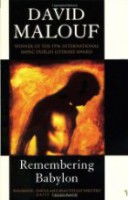
David Malouf’s Remembering Babylon and the Book Group

David Malouf, Remembering Babylon (©1993, Vintage 1994)

009930242X Remembering Babylon is an A-Stranger-Comes-to-Town story. The Stranger is Gemmy, who was thrown overboard as a boy from a ship somewhere off the Queensland coast in the first half of the 19th century. Already not quite the full quid after an impoverished early childhood in London, and traumatised further by his near death by drowning, he was taken in by a group of Aboriginal people. The Town is a tiny community of white settlers who arrive in the area some years later. As Gemmy observes them, his half-remembered previous life stirs in memory, and on encountering a group of children he stammers words David Malouf has appropriated from the historical Gemmy Morrell (or Morril), ‘Do not shoot. I am a B-b-british object!’

Although we have some access to Gemmy’s inner life, the book is mainly about the small settler community, about their range of responses to this part white, part Aboriginal man, and more broadly about the process of British settlers accommodating to the new Australian reality. Malouf would never put it this crudely, but it’s as if Gemmy, for all his addledness, has adapted to the new world more fully than any of them, so his presence becomes a catalyst for their differences and tensions to be exposed.

In Gemmy’s early days in the settlement, for example, a number of the men try to extract information from him about ‘the blacks’, but he resists:

And in fact a good deal of what they were after he could not have told, even if he had wanted to, for the simple reason that there were no words for it in their tongue; yet when, as sometimes happened, he fell back on the native word, the only one that could express it, their eyes went hard, as if the mere existence of a language they did not know was a provocation, a way of making them helpless. He did not intend it that way, but he too saw that it might be true. There was no way of existing in this land, or of making your way through it, unless you took into yourself, discovered on your breath, the sounds that linked up all the various parts of it and made it one.

Yet while this theme is being explored, the narrative adopts one character’s point of view after another – two of the three children who first meet Gemmy, their parents, the young school teacher, the minister – and each time on feels one is meeting a real person, someone Malouf knows well, perhaps even someone he in some way is or has been.

I read Remembering Babylon as part of a body of work by non-Indigenous writers, including Inga Clendinnen’s Dancing with Strangers (2005), Ross Gibson’s 26 Views of the Starburst World (2012) and David Brooks’ essay ‘Origins of Modernism in the Great Western Desert‘ (2008), which explore ways the encounter between these vastly different cultures plays out in non-Indigenous minds. It’s not really a historical novel: I doubt if any part of the Queensland coast was settled as peacefully as this fictional one apparently was, or if there would have been so little contact (ie, none apart from Gemmy) with the local Aboriginal people if it had. It’s surely symbolic rather than historical that an aristocratic woman lives in a beautiful Queenslander just a little way off in the bush from the rudimentary dwellings of the other settlers.

I’m sorry it’s taken me so long to read this book, but it’s interesting to see that some of the themes of Malouf’s recent poetry – particularly the idea of humans as creating a planet-wide garden – were being developed 20 years ago.

The group is meeting tonight. I can’t go because there are things happening in my family that have priority. It’s a pity, because there’s a lot to discuss.

John Williams’s Stoner and the Book Group

John Williams, Stoner (1965, NYRB 2006)

1590171993Published in 1965 and rediscovered by the New York Review of Books in 2006, this novel is currently having a big day in the sun, and our Book Group has its metaphor-mixing finger right on the pulse.
Before the group met: I loved this book, though I find it hard to say why with any confidence. William Stoner, born late in the 19th century into a grim farming community is sent to university at age 19 because his father grasps that education in agriculture will help the farm to survive. He has an epiphany part way through his second year of study when a lecturer recites a Shakespearean sonnet, and he changes course. He goes on to complete a PhD in literature and then to a life of teaching at that same university. He marries unhappily, has a daughter who doesn’t turn out well, makes powerful enemies in academia who stymie his career, endures a major heartbreak, lives on and finally dies. Grim, grim, grim, you might say.

What’s more, William Stoner is no man of action: he chooses not to enlist in the First World War, not to leave his intolerable marriage, not to challenge lies being circulated about him. There’s a moment near the end when he has a chance to speak in public, to communicate something of what matters to him: he says six words – words that are moving to the reader, but must sound almost completely inconsequential to his listeners. He is exactly not the ideal protagonist of a Hollywood movie.

Which may be his appeal. He isn’t noteworthy because of any great achievements, but he is a man who falls in love with a vocation – the vocation to teach – and is true to it for the rest of his life. Even though for long stretches he is a mediocre teacher, he finds a deep spiritual nourishment and meaning there, and at key moments chooses to sacrifice his chances for advancement or happiness in order pursue it.

The book is beautifully written. Every now and then, I’d forget that I’ve only got so many years left and so many books still to read, and just linger over a turn of phrase, a sentence, a paragraph. Like this:

In his extreme youth, Stoner had thought of love as an absolute state of being to which, if one were lucky, one might find access; in his maturity he had decided it was the heaven of a false religion, toward which one ought to gaze with an amused disbelief, a gently familiar contempt, and an embarrassed nostalgia. Now in his middle age he began to know that it was neither a state of grace nor an illusion; he saw it as a human act of becoming, a condition that was invented and modified moment by moment and day by day, by the will and the intelligence and the heart.

 After the meeting: It’s winter: one man was down with a heavy cold starting a second round of antibiotics, two were off in the European summer, a third had an early flight to Manila this morning, one who works for an environmental organisation had urgent work sprung on him (whether because of the good news from the State government or the continuing torrent of bad from Canberra he didn’t say), and yet another had been intending to come but mysteriously failed in the  attempt.

So four of us drank from crystal glasses and sat down to far too much food and a sustained and animated conversation about the book, which we had all read (a rare event) and were all enthusiastic about. I think everyone read something, each picking out a different bit to hold up for the collective enjoyment.

Someone said that he wept in public as he read it; that when Stoner found love in middle age it was as if the novel changed from black-and-white to colour, and then, wretchedly, back again.

One of the passages that was read out was the account of Stoner and his wife’s sex life in the early years of their marriage. Be warned this might trigger sexual abuse memories:

Out of an unspoken stubbornness they both had, they shared the same bed; sometimes at night, in her sleep, she unknowingly moved against him. And sometimes, then, his resolve and knowledge crumbled before his love, and he moved upon her. If she was sufficiently roused from her sleep, she tensed and stiffened, turning her head sideways in a familiar gesture and burying it in her pillow, enduring violation; at such times Stoner performed his love as quickly as he could, hating himself for his haste and regretting his passion. Less frequently she remained half numbed by sleep; then she was passive, and she murmured drowsily, whether in protest or surprise he did not know. He came to look forward to those rare and unpredictable moments, for in that sleep-drugged acquiescence he could pretend to himself that he found a kind of response.

Williams doesn’t shy away from the word ‘violation’, but ‘love’ isn’t just a euphemism either. As someone in the group said, your heart breaks for both of them.

The Book Group go to the theatre and read the news

This was an unusual meeting of the Book Group, an excursion to see a play in which one of us was performing – The Young Tycoons by C J Johnson, about the heirs apparent to two media empires. In deference to our nominal reason for meeting, we agreed to have a look at a book that’s at least tangentially related to the play. (We also read a fascinating piece of journalistic gossip for which, in lieu of further discussion, here is a link).

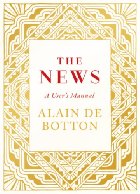
Alain de Botton, The News: A User’s Manual  (Hamish Hamilton 2014)

024114647X

Before the meeting: This is a high-grade self-help book. If there’s an overall thesis, it’s this:

News stories tend to frame issues in such a way as to reduce our will or even capacity to imagine them in profoundly other ways. Through its intimidating power, news numbs. Without anyone particularly rooting for this outcome, more tentative but potentially important private thoughts get crushed.

‘The news’ is discussed in six main categories: politics, world news, economics, celebrity, disaster and consumption. In each category, de Botton discusses the way the news cycle  and the currently widespread addiction to it mitigate against thinking. There are plenty of interesting observations and insights, many of them obvious on reflection, though when dealing with addictions there’s no harm in stating the bleeding obvious. I had an uneasy feeling that ‘I’ the reader was being invited to feel superior to the ‘we’ that de Botton describes as manipulated by the news media. Maybe that, and a tendency to glibness, is something that comes with the territory.

After the meeting: It turned out, unsurprisingly, that I was the only one in the group, apart from the actor, who had read the book. We weren’t going to have much of a discussion in the foyer of the Eternity Theatre anyhow. But the conjunction of the play and the book prompted at least one interesting reflection. In the chapter on disaster, de Botton compares the way heinous behaviour is typically described in the press with its treatment in ancient Greek tragedy:

The plot lines of [ancient tragedies] were unmitigatingly macabre, easily matching anything our own news could provide … But … in order for a horror (a meaningless narration of revolting events) to turn into what Aristotle called a tragedy (an educative tale fashioned from abominations), the philosopher thought it was vital that the plot should be well arranged and the motives and the personalities of the characters properly outlined to us. Extreme dramatic skill would be required in order for the audience to spontaneously reach a point at which it recognised that the apparently unhinged protagonist of the story, who had acted impetuously, arrogantly and blindly, who had perhaps killed others and destroyed his own reputation and life, the person in whom one might at first (had one come across the story in the news) have dismissed as a maniac, was, in the final analysis, rather like us in certain key ways.

C J Johnson is no Sophocles, at least not yet, and The Young Tycoons is a chronicle play rather than a tragedy, but it illustrates the point. The younger generation of the Murdoch and Packer families appear in the news as glossy celebrities, fair game when brawling with old comrades in a Bondi Street or being patted on the hand by a distraught patriarch before a Parliamentary Enquiry. In this play, stylishly delivered by a cast that has no weak links, we catch at least a whiff of just how appallingly constricted their lives are, and how callous they have been shoe-horned into becoming. I was reminded of Jamie Johnson’s extraordinary documentary, Born Rich, made a couple of years before this play was first staged in 2005.

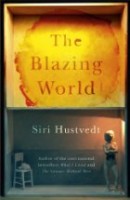
The Book Group and Siri Hustvedt’s Blazing World

Siri Hustvedt, The Blazing World (Sceptre 2014)

144477963X

Before the meeting: I’d missed a number of book group meetings – travelling, and then other evening commitments had got in the way. Alice Munro, The Red Badge of Courage, some Hemingway, The Dinner by Herman Koch – all were discussed without me. I thought I was going to miss out on the Siri Hustvedt dinner as well until Friday, when I realised the evening was wide open. I dashed into Gleebooks on Saturday morning and bought a copy, not actually intending to read the whole thing – I had a lot on my plate and the group’s emails that been less than enticing: ‘I am only up to page 32 and struggling with it!’ ‘I think page 32 is a mammoth effort.’ I planned to read to page 40 or so, enough to have some hope of following the talk when we met.

It was not to be.

The book is presented as a collection of documents – journal entries, art reviews, interviews, transcripts of statements, scholarly essays – by and about a New York artist Harriet Burden, edited by a scholar named I V Hess, whose ponderous introduction accounts for the first 12 pages and no doubt led to the book’s lack of appeal in some quarters. But Harry, as she is known to her friends, transcends the ponderousness. Having been the wife of a successful art dealer, she embarks after his death on a new artistic trajectory. Her work and she herself have been largely ignored or discounted by the art scene, and she comes up with a project to present new works as the creations of a series of three male artists. She’s tackling gender issues with passion born of a lifetime’s struggle, and at the same time exploring questions about the role of the creator’s reputation in how a work of art is seen, and deeper philosophical and psychological issues of identity, creativity, intersubjectivity, perception. I was hooked.

Other pressing demands on my time fell by the wayside and I read the book in three days. I rationalised that it was relevant to the online writing course I’m doing: this was a chance to see if in spite of its fragmentary appearance the book had something like the classic three-act structure. And behold, it does have the nine plot points we have been learning to identify, pretty much where they are suppose to fall. As a result, at any point in the novel you can feel it moving in a clear direction: the scholarly citations, the dissertations on hoaxes (mainly gender based ones such as James Tiptree Jr, but Ern Malley is mentioned in passing), the intellectual arguments, the meta moments such as the reference to ‘an obscure novelist and essayist, Siri Hustvedt’, the detailed descriptions of artworks, the ruminations on art history, the quotes from Whitman, Milton and Emily Dickinson, are all borne on a current leading inexorably towards what we know from near the start is a conclusion with more than one dead body. Novels, of course, don’t have to be tied to the classic three-act structure as tightly as we’re told films do, but I was gobsmacked to see how closely this novel, apparently so all over the place, sticks to the shape. It’s hard to talk about without spoilers, but here – perhaps of interest only to me – are the 9 points (there are 380 pages in the novel):

  1. set-up: We meet all the characters, or at least learn their names; Harry is widowed and in upheaval; she dreams up the Maskings project
  2. inciting incident (10%): page 39–40, she chooses her first ‘mask’
  3. change of plans: page 41–58, three new, widely divergent perspectives are introduced
  4. significant setback (25%): page 117, Harry’s first ‘mask’ having told her he was damaged by the project, she tells her friend Rachel: ‘There’s something in me, Rachel, something I don’t understand. … It’s something horrible inside me.’
  5. midpoint – sometimes called the point of no return (50%): page 213, ‘We have made the pact’
  6. darkest hour (75%): page 301, ‘He said, You look dead, Harry. She said, I feel dead.’
  7. glimmer of hope: page 314 ‘And then I said the right thing for once.’
  8. climax (90%+): Depending on how you read it, the climax is either page 322–324, a description of an artwork (he said, tactfully avoiding any spoliation), or page 351–361, which I don’t know how to characterise without giving too much away
  9. resolution: the very last page, the description of another artwork.

As I drove to the meeting I was prepared to be alone in having been completely absorbed, completely satisfied by the book.

The meeting: There were six of us, of whom two had read the whole book and one other was intending to finish it. A key thing that made the difference seemed to be that the three finishers had an interest in some kind in the art world: thanks to the Art Student, I’ve picked up a smattering over the last few years so I knew of many of the women artists named in the text, and found something almost uncannily familiar some of Harry’s observations about being an older woman in a scene that privileges youth and masculinity; another finisher has recently been an art student at TAFE; and the third has some wonderful art on his walls and is generally interested in it. Without some kind of prior interest, the device of multiple narrators and the general sense of contrivance seem to have stopped people from engaging.

There’s not much more to be said about the discussion of the book: conversation ranged instead over Pesach (last night was the second night), walking out of the theatre, a risqué witticism that Governor Marie Bashir once made to one of our number, the excellent seafood pie we ate, the inequity of raising the pension age, the difference between our current way of taking in most information through seeing and earlier times when it was mainly through hearing. The book, wonderful though it is, was a bit of a fizzer, but the dinner was a great success.

PS added later: I forgot to mention that one of us had started reading the book on his Kindle and found it very frustrating. When he shifted to a hard copy it became a much more manageable and pleasant experience. The difficulty seemed to have something to do with the way footnotes are treated in the ebook. They work better on the page.

What Maisie and the Book Group Knew

What Maisie Knew, Henry James (1897, this Kindle edition based on Echo Library Large Print Edition 2006)

1_wmkBefore the meeting: When I read Henry James at university (Portrait of a Lady in first year and What Maisie Knew some time later), quite a bit of it went right over my head. I loved the prose, but the worlds of his novels were a long way from the North Queensland pragmatism and Catholic piety that I had been brought up with. Perhaps now, more than forty years of secular urban life under my belt, I’d have more luck. After all, Scott McGehee and David Siegel’s movie adaptation just about tore my heart out a few weeks ago, and Kate Lilley’s poem ‘Maisily’ moved me simply by listing the adverbs from the book.

The Kindle edition gets right down to business – cover, title page, table of contents, and then, without so much as a chapter heading:

The litigation seemed interminable and had in fact been complicated; but by the decision on the appeal the judgement of the divorce-court was confirmed as to the assignment of the child. The father, who, though bespattered from head to foot, had made good his case, was, in pursuance of this triumph, appointed to keep her: it was not so much that the mother’s character had been more absolutely damaged as that the brilliancy of a lady’s complexion (and this lady’s, in court, was immensely remarked) might be more regarded as showing the spots.

We’re thrown right into the middle of a story, everything in plain sight, embedded in metaphor and sarcasm. This can’t be read fast, and once you know that by this stage of his life James dictated his novels, it can’t be read without the mental image of a portly gentleman pacing the room enjoying the sound of the sentences as they roll out from his mouth.

And it continues as it has begun: rich, sonorous, intricate sentences that tell a story of child neglect from the point of view of the child, but with no attempt to tell it as a child would: instead, we are asked to explore the great complexity of this little girl’s perceptions of the adult world and her strategies for dealing with it, in language that is at times as baffling to the reader as that world is to her.

I enjoyed the book, but I can’t pretend that I always understood what was going on in that adult world. Specifically, in the last movement Maisie – now well past the age of six that she remains in the movie – has to make a decision about her living arrangements in a context where the adults clearly share an understanding of the issues and believe incorrectly that Maisie does too. James seems to expect his readers to have the insider’s view as well. But times have changed, and the reference point of the culture have shifted so much that I at least could only follow the broadest outlines of what F R Leavis calls the ‘moral squalor’ of the adult world. The governess Mrs Wix, who is possibly meant to be a kind of moral centre of gravity (and who is not there in the movie) wins out in the end, and I think we’re meant to see this as a triumph of good over evil, but I completely couldn’t see why Maisie’s rejection of Mrs Beale, who has always defended and loved her, should be seen as a good thing (though who can tell when the air is so thick with irony?).

By telling the story from Maisie’s point of view, the novel throws into question the whole concept of moral squalor, if that refers primarily to sexual behaviour: what Maisie doesn’t get is all the sexual stuff, so being a kept man or a loose woman or a gold-digger or someone who pays for sex, as various characters appear to be, matters not at all, whereas loyalty, patience, kindness, generosity and their absence are what count.

F R Leavis thought very highly of this novel, which is probably why it was set for us to study at Sydney University in the 1970s. I don’t know that it’s a book I’ll be in a hurry to reread, though many of James’s sentences merit many re-readings.

After the meeting: Words like ‘loathing’ kept cropping in emails leading up to last night’s dinner. However, it was hard to feel loathing for anything much, as we sat outside eating barbecued chicken and sausages on a balmy, mosquito-free Sydney spring evening, as darkness brought an end to a day that had been predicted to be full of bushfire horror but had instead been one where the volunteer rural fire service could be justifiably proud of having averted disaster by strategic backburning the day before.

There were six of us. A couple had been travelling, and shared travellers’ tales. One had been living in Darwin and told spectacular yarns of Territory life. Some of us had been to the theatre and had stories to tell from there as well – one involving a smart phone that played Beatles tunes as background to the drama until an actor politely asked the blithely unaware owner of said phone to turn it off. It was a warm, convivial evening.

We did talk about the book, happily and with minimal rancour. Only one of us – me – had read the whole thing. Only one of the others said he planned to finish it. I may have been the only one who found the sentences fascinating rather than perversely complex. As we were going home, we clapped eyes on the paperback that one chap was holding, and several of us had difficulty reconciling the slimness of the paperback with the size of the book we felt we had read on our various electronic devices.

Edmund White Flâneur and the Book Group

Edmund White, The Flâneur: A stroll through the paradoxes of Paris (Bloomsbury 2001)

1582341354 Before the meeting: I was very happy when this book was suggested as our next title. I’d come across the idea of the flâneur, the aimless wanderer through an urban environment, as an artist archetype (I think it was at the launch of Michael Sharkey’s The Sweeping Plain in 2007), and had somehow got the idea that Baudelaire and Edmund White were the go-to writers for anyone wanting to understand the archetype.

I was misled, at least about Edmund White. That is, I thought he was going to turn out to be a flâneur like the protagonist of Teju Cole’s Open City (which I suggested as a supplementary title), and that’s not how this book works at all.

It’s a short book, part of Bloomsbury’s The Writer and the City series, in which, according to the back cover blurb here, ‘some of the finest writers of our time reveal the secrets of the city they know best’. Peter Carey’s self-indulgent and forgettable 30 Days in Sydney was part of the series, and New South’s generally excellent Cities series may have been inspired by it.

There are six chapters: a general introduction to the idea of the flâneur and the general complexity of Paris is followed by essays about French (and mostly Parisian) attitudes on race, Jews and homosexuality, with an inserted chapter on eccentric and little known museums, and a final chapter on the weirdness that is the French monarchist and royalist movements. In other words, the bulk of the book is taken up with considerations of French culture through the lens of US-style identity politics, in particular through the lens of US gay culture.  There’s very little wandering the streets, though as the text wanders through its chosen themes it sometimes creates an illusion of appropriate lack of discipline.

I enjoyed White’s mini-essays on Colette, Sidney Bechet and Josephine Baker. He gives a fascinating account of the Club des Hachichins (frequented by Baudelaire, Balzac and Théophile Gautier, if you can frequent something that only happened half a dozen times). His discussion of why AIDS had so much higher an incidence in Paris than in London raises interesting questions about identity politics (big in the US, sneered at in Paris – guess which attitude turns out to be superior!). The stories of a number of individual 19th century Jews are strikingly similar to the story of Charles Ephrussi in The Hare with Amber Eyes – in a good way.

There is all that, and much more that’s enjoyable and illuminating, but more often than not I was irritated. I grew tired of the name dropping (he once dined with Foucault, but that’s only the high point), the preening (his Parisian dinner-party comrades hadn’t noticed until he mentioned it that Paris is no longer a predominantly white city), the false modesty (he once gave a talk on Genet to a Palestinian audience, who surprised him by loving it even though he is white and Western), the persistent essentialising of ‘the French’ and ‘Parisians’, the titillatory titbits (wife-swapping clubs, cruising by the Seine) and the unremitting gay perspective (the most emphatic detail in his description of a mosque is that the Gay men who cruise its hammam on Sundays don’t touch each other out of respect for the religious environment).

After the meeting: It’s Rosh Hashanah, so attendance at the Book Group was down last night. (Memo to selves: Must keep a sharper eye out for High Holidays in future.) The five of us ate a hearty French meal, gossiped, engaged with the problem of an iPhone whose screen had gone blank, and discussed the book.

One man had really loved it. He’d read it when in the south of France, just before going to Paris, and so was much more attuned to its sense of place than I certainly was. He enjoyed the way the text moved between tiny details and broad perspectives. He found himself stopping to re-read paragraphs just for the pleasure of them. Interestingly enough, he loved the first sentence for its elegance and its cheeky wit, while I was irritated by its Americo-Eurocentrism and its snobbish smart-aleckery:

Paris is a big city, in the sense that London and New York are big cities and that Rome is a village, Los Angeles a collection of villages and Zürich a backwater.

One man had surrendered his copy when the library insisted he return it (probably because I was asking for it), but he hadn’t been unhappy about that as he’d had three attempts at the first chapter and been unengaged – because as far as he could tell, all White was doing was quoting a lot of other people about Paris, which is less true of later chapters. One had read it overnight (I’d dropped off that same library copy to him on Tuesday afternoon) and had a similar mix of enjoyment and irritation to mine, though I think with more pleasure and less irritation. Perhaps part of the problem is that we had all read the entry on ‘flâneur‘ in Wikipedia, and then approached the book expecting it to be an example of flâneurism, which it really isn’t.

The Book Group goes up Amitav Ghosh’s River of Smoke

Amitav Ghosh, River of Smoke (John Murray 2011)

0719568986 Before the meeting: After Karl Ove Knausgaard’s mountains of mundane detail, we wanted our next book to be one that spins a great yarn. Someone proposed the sequel to Amitav Ghosh’s Sea of Poppies, which we’d all enjoyed. There were no dissenting voices, so River of Smoke it was.

We’d forgotten that in his own way Ghosh is just as given to piling on the detail as Knausgaard. Especially in the first half of River of Smoke, hardly a paragraph is without its cluster of glittering facts or shiny words. A glossary would have to define a seemingly endless variety of boats, buildings, functionaries, items of clothing, financial processes, scientific equipment, dubious activities, plants, religious rituals and so on as they are named in Bengali and other Indian languages, Cantonese, Portuguese, Farsi, regional Englishes, Cantonese pidgin, Mauritian Kreol, and so on. And then there’s a wealth of historical anecdote: we see Napoleon at Longwood on St Helena; we hear of escaped slaves on Mauritius who committed mass suicide when they saw troops approaching their hiding place, unaware that the troops were coming to tell them that slavery had long since been abolished; we learn the origins of chai, and much much more. The effect isn’t intimidating: Amitav Ghosh is like a child let loose in a linguistic and historical lolly shop, and wants us to share his delight. The writer he most resembles in this love of the source material is Neal Stephenson.

As you would expect, River of Smoke starts out putting us back in touch with the main characters from Sea of Poppies. But pretty much as soon as they’ve been reintroduced most of them drop out of the picture, some never to be mentioned again, and those who remain gradually withdraw from centre stage to become relatively minor figures – the munshi (secretary cum newsgatherer) to a major character, the recipient of letters from another. The characters we engage with most strongly are new: Bahram Modi, a Parsi opium trader, and Robin Chinnery, artist, homosexual romantic and writer of long, flamboyant letters. Possibly the main character is fanqui-town, the brilliantly evoked, exhilaratingly diverse Babel on the edge of Canton where foreign traders were allowed to live and work in the 18th and early 19th centuries. The opium trade, whose viciousness was graphically evoked in the first book, is the most profitable activity of the fanquis, and the novel traces events leading up to the First Opium War in 1939: the Emperor is no longer turning a blind eye and a new, incorruptible man arrives in Canton to take definitive, dramatic action. According to Google the historical war didn’t turn out well for the Chinese and the trade continued for decades, but River of Smoke ends just before the war proper begins and that outcome isn’t at all obvious.

At the group meeting about Sea of Poppies, someone said he enjoyed the ripping yarn and learned a lot of history but wasn’t engaged in the way he wanted to be by a novel. For all its delights, River of Smoke was like that for me. The tension is real, the stakes are high, and I trust that I’m being told a true story – but sometimes it’s as if the novelist was swamped by his research and forgot that he cared about his characters. There are longish extracts from actual documents issued by the Chinese authorities and the fanqui opium traders, for example, which are fabulous to read, but leave our characters with little to do but react or comment from the sidelines.

Maybe the book suffers from the Middle Book Syndrome – in the first book the world and characters were new. In the third book we’ll find out how everything is resolved. In this one, we just have to get from Book One to Book Three. It’s a bridge rather than a stand-alone, and so not completely satisfying.

After the meeting: There were seven of us, of whom five had read the book.

Two people reported being on holiday and experiencing a powerful resistance to submitting to the world of the book – one ploughed on despite the resistance, the other followed his bliss after 20 pages or so.

The man who liked the book most described it – accurately – as very visual. At a level of simple pleasure it was the linguistic fireworks that appealed most to me. Someone else was most moved by the painful sense of history.

None of us were wildly enthusiastic about the epistolary chapters, tending to find the flamboyant Robin Chinnery a bit on the tiresome side.

Someone arrived with multiple tabs open on his iPad web browser: paintings of Canton’s foreign factories in the 18th and early 19th century, maps of historic Canton, etc. It turned out that a number of us had been to Wikipedia to look up the Opium Wars, and to see if various characters were real (many were). Amitav Ghosh’s web site has the Chrestomathy, mentioned in passing in the book, which is an odd linguistic document compiled in old age by Neel, the zemindar turned munshi who may well turn out to be the central character of the trilogy.

Attitudes to the as yet non-existent third volume ranged from eager anticipation to ‘meh’. I’m close to the eager anticipation end of that continuum.

[As I was about to upload this, I checked and found that Amitav Ghosh is on Twitter, which prompts two remarks. First, I hope Twitter isn’t distracting him from his writing, and if it is I apologise for adding to the distraction. Second, I was delighted to see that someone on Twitter actually drew the world’s, and Ghosh’s, attention to something that I kept to myself all through our meeting – ‘fanqui-town’ sounds very like ‘Funky Town’. Ghosh’s response was three exclamation marks.]