Category Archives: Book Group

The Book Group and Book One of Karl Ove Knausgaard’s Struggle

Karl Ove Knausgaard, A Death in the Family (My Struggle: 1) (2009, translation by Don Bartlett 2012, Vintage 2013)

0099555166When we googled “My Struggle” at the Book Group last month, the top result was Hitler’s Mein Kampf. We were mildly amused by what we took to be a google oddity. But the Norwegian title of Karl Ove Knausgaard’s six-volume novel is Min Kamp – a similarity that could hardly be accidental. At the Sydney Writers’ Festival, the man himself told us that the sixth and final volume is a 400 page essay about Adolf Hitler. One has to wonder: if A Death in the Family is point A, how does he get from point A to point Way Off the Chart?

But since only two of the books are available in English so far, that’s a question for later.

Before the meeting: I finished reading A Death in the Family a couple of weeks ago, just after hearing Karl Ove speak at the SWF. I would have moved straight on to the second volume, A Man in Love, if I hadn’t had other more pressing demands on my imaginative faculties. The appeal, for me, is to do with shoe leather.

In the movie business shoe leather is the term for precious screen time wasted on actors walking from place to place. Knausgaard has elevated its written equivalent to a high art. It seems no one ever just gets in a car and drives somewhere: they always turn on the indicator, check the rear-vision mirror and pull out into the traffic, then follow a series of carefully named streets until they arrive at their destination. When a character cleans a book case, it goes like this:

I sprayed the glass door of the bookcase, crumpled up the newspaper and rubbed it over the runny liquid a few times until the glass was dry and shiny. Looked around for more to do while I had the spray in my hand, but saw nothing apart from the windows, which I had determined to save until later. Instead, I went on with the bookcase, tidied everything, starting with its contents.

That man be unremarkable, but so much of the book is taken up with similar attention to detail that how a reader responds to it will have a huge influence on their response to the book as a whole. Early on, there’s a passage about growing up that helps explain what’s happening, as I understand it:

As your perspective of the world increases not only is the pain it inflicts on you less but also its meaning. Understanding the world requires you to keep a certain distance from it. Things that are too small to see with the naked eye, such as molecules and atoms, we magnify. Things that are too large, such as cloud formations, river deltas, constellations, we reduce. At length we bring it within the scope of our senses and we stabilise it with fixer. When it has been fixed we call it knowledge. Throughout our childhood and teenage years we strive to attain the correct distance from objects and phenomena. We read, we learn, we experience, we make adjustments. Then one day we reach the point where all the necessary distances have been set, all the necessary systems have been put in place. That is when time begins to pick up speed. It no longer meets any obstacles, everything is set, time races through our lives, the days pass by in a flash and before we know what is happening we are forty, fifty, sixty.

I read the narrative’s wealth of undifferentiated detail as an attempt to reverse that process: to give priority to specific observations and experiences over any abstraction, to go for immediately apprehended ‘meaning’ over calm, generalisable ‘knowledge’, to avoid our habitual exclusion of some things from consideration. As well as the tiny acts, the brand names, the hyper-specifics, we are given the narrator’s play of mind, apparently unfiltered – memories and meditations that are jogged by the brand names on cleaning products, say, his adolescent worries about the shape of his penis when erect, or  the strange feeling he had as a boy about the gravel on the floor of the family garage. And, because nothing is being left out, he tells us things that are just not talked about: how he shakes his little girl when she irritates him, the extraordinarily squalid circumstances of his father’s death, his grandmother’s incontinence. These last things don’t feel deliberately shocking – more like the inevitable result of a  decision made at the beginning to put everything in.

Karl Ove has said that the overwhelming emotion he had while writing the novel was shame. He couldn’t believe anyone would read it, and now he is embarrassed to realise that roughly half a million people know all about his failures as a parent and his sexual inadequacies (those are yet to come, perhaps in the second book).

After the meeting:  This book provoked as much sustained conversation as any we’ve discussed in the group. One man who spent his childhood in Britain was most deeply struck by the way the weather was evoked: the grimness of the winter and the way spring came as a great relief. This struck a chord with others who had lived in northern Europe for any length of time. Another man, following his daughter’s lead, had been watching a lot of Simon Amstell‘s recent melancholy stand-up and found a striking resonance with this book. Another man was struck by the book’s failure to make him empathise with the narrator – at one stage he thought it might all be total fiction, that Knausgaard the author might be no more Karl Ove the character than Mark Haddon is Christopher in The Curious Incident of the Dog in the Night-time – and in that case it’s a brilliant creation. I don’t know that anyone liked it as much as I did.

As always, the conversation ranged widely, from the sexist bile being showered on Julia Gillard to details of our lives, all to the tune of excellent pasta, grilled zucchini and fennel and tomato salad.
Mercè Rodoreda’s In Diamond Square with the Book Group

Mercè Rodoreda, In Diamond Square (1962, Translation by Peter Bush, Virago 2013)

1ids

Before the meeting: I came to this book with inaccurate expectations. Gabriel Garcia Marquez describes it on the cover as ‘the most beautiful novel published in Spain since the Civil War’, which I misread, lazily, as ‘about the Spanish Civil War’. True, the action of the novel spans the years of the Civil War, which is a major element in the story, but it would be quite a stretch to say the novel is about the war. The novel tells the story of Natalia, a naive, uneducated young woman from Gracia, then a poor area of Barcelona rather than what the internet now calls ‘one of the city’s hippest areas’. She marries a volatile young man whose entrepreneurial ambition fills their apartment, bizarrely and malodorously, with pigeons. The Civil War disrupts their family life when her husband and their male friends joins the militia – we see none of the combat, and none of the reasons for the war are discussed or explained, but we stay within Natalia’s narrow horizons, following her through wretchedness, deprivation, despair and unexpected happiness (though, to save spoilers, not necessarily in that order).

It’s a gripping story, with some brilliant images, but the thing that struck me most strongly was the language. Natalia is the narrator, and her voice is what makes the novel what it is. She begins:

Julie came to the cake-shop just to tell me they would be raffling coffee pots before they got to the lucky posy; she’d seen them and they were lovely, an orange split in two, showing its pips, painted on a white background. I didn’t feel like going to the dance or even going out, after I’d spent the whole day selling cakes and my fingertips ached from tying all those gilded raffia knots and handles. And because I knew Julie could manage on as little as three hours’ sleep and didn’t mind whether she slept or not.

She begins as she plans to go on, with leaps in logic (from the coffee-pot design to the question of whether she will go out or not, omitting to mention that Julie had come to take her there), syntax that doesn’t quite cohere (‘And because’ – huh?), attention to details that lead nowhere (‘an orange split in two’ etc), lack of orientation (who is Julie?), unexplained cultural references (are we supposed to know what ‘the posy’ is?), and so on. Then it took me a moment to figure out that the third they was a different they from the first two, that Julie is talking about the coffee pots, not the people who were raffling them, and because that tiny awkwardness feels like the kind of thing that happens in translation, I lost confidence as a reader , and as I read on I couldn’t tell how much of the narrative voice was Natalia’s and how much was the sound of Peter Bush wrangling the transition from Catalan into English. I wasn’t necessarily critical of the translation: perhaps this is one of those books that defies translation – as I imagine Malcolm Knox’s The Life to be. (A literal translation of DK’s ‘Well yeah … but no’ would probably leave Catalan readers floundering, but how else do you translate it?)

I read on, enjoying the book, but my unease about the translation persisted, and about a hundred pages from the end I turned to the Internet for help. I don’t know what I expected, but I found an excellent article from the British journal The Translator,Language and Characterization in Mercè Rodoreda’s La Plaça del Diamant‘ by Helena Miguélez Carballeira, which discusses the language of the book in the context of two previous translations. According to Ms Carballeira, Natalia’s discourse is what the boffins call escriptura parlada – spoken writing. Mercè Rodoreda sets out to ‘trace the discursive peculiarities’ of the uneducated Catalan working-class. Her speech is also full of features that mark it as peculiar to Barcelona, and is full of the euphemism, attention to detail and diminutives that mark stereotypically feminine speech. More than that, Carballeira argues (and I’m persuaded) that

Natàlia is a woman who feels uneasy with the very act of speaking. … The characteristics of [her] conversational, unmediated speech as a discursive device in the novel are rather predictable: there is an extensive use of idioms and colloquialisms, interjections and onomatopoeias. This yields a constant, highly idiomatic, non-straightforward use of language.

That is to say, Natalia is at least as big a headache for a translator as Knox’s DK.

A gauge of the difficulty of the task is the differences between translations. Carballeira discusses a number of fascinating examples. Here’s just one, quoted in a discussion of Natalia’s use of euphemism:

The original Catalan (1962):

I mentre em dedicava a la gran revolució amb els coloms va venir el que va venir, com una cosa que havia de ser molt curta.

From Eda O’Shiel’s The Pigeon Girl (1967):

And while I devoted my energies to the grand revolt against the pigeons, there took place what had to take place, and it seemed as if it would be over quickly.

From David H Rosenthal’s The Time of the Doves (1986):

And while I was working on the great revolution with the doves the war started and everyone thought it was going to be over quickly.

From Peter Bush’s In Diamond Square (2013):

And while I was waging my big revolution against the pigeons, what was brewing came, that they said would be a two-day wonder.

Having read this article when I was struggling, part way through the book, I had a much better time with the rest. Some of Peter Bush’s decisions had confused me. For example, he names Natalia’s husband Joe, possibly as what Carballeira calls a domesticating strategy, but when I read that his name is Quimet in the original I realised that the discord between his English name and his Catalan context had niggled away at the edge of my mind, creating a sense of unreality like the one in some CGI movies, where figures don’t quite seem to touch the ground. And another example: Joe/Quimet refuses to call Natalia by her name but calls her Pidgie, without explanation of where the name comes from – to my ear that sounded a bit like Piggsy, and so vaguely insulting, and it was a long way into the story that I realised it was short for Pigeon, and that Joe/Quimet was obsessed with those birds; in the original he calls her Columeta, which my computer translates from the Catalan as, you guessed it, Pigeon. Maybe to a British ear ‘Pidgie’ sounds more affectionate than ‘Pigeon’, but ‘Pigeon’ would have worked fine for me.

This experience makes me suspect that if I’m going to read books in translation a little bit of research will make the whole experience go better. As it happens I’ve been to Barcelona, so quite a few of the local references – Tibidabo, Parc Güell, etc – made immediate sense to me. If I hadn’t been there, I doubt if I would have bothered to get out a map, but it wouldn’t have been a bad idea. (I do think I was right, though, not to read the author’s spoilerish 1982 ‘Prologue’ until after I’d read the book.)

The meeting: We were astonishingly unanimous in our responses to the book. We’d all enjoyed it; we’d all been at least mildly disconcerted by the language, though when someone read a short passage aloud, its ‘written speech’ qualities were obvious; we’d all engaged with Natalia and formed strong opinions about Joe/Quimet; and I think we’d all had our heartstrings / tear ducts activated. There was an attempt to get someone to read the last couple of pages, which are full of sweet, kind-of-sexual tenderness, but no one was up for the challenge. We enjoyed the book so much we contemplated staying with Catalonia for our next meeting, and reading The Sun Also Rises, Homage to Catalonia and perhaps something by Colm Toibín. (We decided against it, and will be heading off to Norway instead with Karl Ove Knausgaard.)

The Book Group on Karen Armstrong on the Bible

Karen Armstrong, On the Bible (Atlantic Books UK, Allen & Unwin 2007)

1ob Part of the function of a book group, or at least of mine, is to take you (me) out of your (my) comfort zone. So when On the Bible was proposed as the title for our March meeting, I resisted my urge to reach for a proverbial bargepole.

The urge didn’t come from a Dawkinsian disdain for religion. On the contrary, atheist though I am now, I was a member of the Marist Brothers in my teens and early 20s, and I treasure the memory of a series of lectures by nicotine-stained Brother Flavian, who was supposed to be teaching us Catechetics (whatever that is) but instead shared his passion for biblical studies an hour a week for a whole year. I wasn’t keen on revisiting the subject with what sounded like a dry introductory text.

But I’d seen Karen Armstrong’s TED Talk, Let’s Revive the Golden Rule, and the chap who proposed the book was very keen., so what the hell, archie, I thought, and happily supported the proposal..

It turns out that the stuff I remember from Brother Flavian’s lectures – the story of how the Bible was written and compiled, including the varied cultural and historical contexts – takes up just a fraction of the book. Karen Armstrong doesn’t linger on the poetry so much as sketch the politics, and though I miss the poetry, the politics is often fascinating, especially when there is an implied commentary on 21st century readings. For example, she describes P, the priestly strand of the Torah/Pentateuch, as proclaiming that ‘Israel was not a people because it dwelt in a particular country, but because it lived in the presence of God’; or, something that Brother Flavian could never have said but is glaringly obvious once articulated, ‘A thread of hatred runs through the New Testament.’ (Pharisee to Richard the Third: ‘You call that a hatchet job? This is a hatchet job.’)

The US title, The Bible: A Biography, is not only catchier, it also gives a better sense of what the book is: because once it has told the story of how the books of the Bible were written and assembled, it goes on with the process of canonisation (which happened over centuries, and was still being debated in Luther’s time), and then Armstrong’s real subject: how the way they were read changed over the centuries – by Jews, Catholics, Orthodox Christians and Protestants. The Midrash and Talmud, the Platonists, the early Christian Fathers up to St Augustine, the mediaeval exegetes and the Kabbalists all brought different understandings of what the Bible was, and how it should be read, and what one was to make of its many inconsistencies. Then came the Protestant Reformation and capitalism, and Lurianic Kabbalah and tikkun olam, followed by the Enlightenment, which brought Spinoza ‘who studied the historical background and literary genres of the Bible with unprecedented objectivity’ and was the forerunner of the German Higher Criticism. We arrive at last at the mystical reading of the Hasidim, and the extreme literalism of the fundamentalism that came into being in late 19th century USA:

This was an entirely new departure. In the past, some interpreters had favoured the study of the literal sense of the Bible but they had never believed that every single word of scripture was factually true. Many had admitted that, if we confined our attention to the letter, the Bible was an impossible text. The belief in biblical inerrancy … would, however, become crucial to Christian fundamentalism and would involve considerable denial. [The leaders of this approach] were responding to the challenge of modernity but in their desperation were distorting the scriptural tradition they were trying to defend.

And then there’s post-Holocaust Judaic literalism which adopted the until-then secular ideology of Zionism, and came up with a doctrine that was in fact completely novel even while claiming to be based in antiquity:

Unless Jews occupied the whole land of Israel, exactly as this was defined in the Bible, there could be no Redemption.

The blurb tells us Karen Armstrong was a religious sister briefly some decades ago. You can’t tell from this book whether she is still a Catholic or even a believer, but there’s no hostility to religion. What does come through loud and strong is her antagonism to movements that hijack the Bible for political purposes, while disregarding the extraordinary richness of its history.

There are dry stretches, where the treatment of various Kabbalists, say, or different strands of mediaeval Christian hermeneutics amount to little more than annotated lists, potentially useful if one were to go on to further study, but skippable for the drive-by reader. Perhaps, in fact, those dry patches make up most of the book, so that in effect it’s more successful as a reference book than as a narrative. I found the bits that transcended that dryness fascinating, among other things for the way they illustrate that reading, reading anything at all, is a tremendously complex act that can transform the text being read.

I was reminded of Constantine’s Sword, James Carroll’s powerful history of anti-Jewish oppression in Christianity, especially Catholicism, which could almost read as an elaboration of one thread of this book..

The meeting:
In the days leading up to the meeting there was a flurry of emails saying their writers had up after a hundred pages or less, and I wouldn’t have been surprised if the conversation last night had sputtered and died before moving on to the media’s nastiness about Julia Gillard. In fact, we stayed roughly on topic most of the evening – helped by a couple of the chaps having been to Seders the night before. Googling was banned for the evening, so there were interestingly speculative conversations about, among other things, the meaning of the orange on the Seder plate, and the colour and species of the animal that Jesus rode into Jerusalem.

Not many of us had read the whole thing. One had bought his copy of the US edition online from Able Books for 10 cents, no postage. The blurb on that edition referred to the book’s ‘cracking pace’, which we could all agree on, though it may have been precisely the ‘pace’ that made it hard going at times: the historical Jesus is dealt with in a single sentence, and I’m not sure if the historical books of the Hebrew Bible get even that. While a cracking pace is a good thing in a thriller, in an overview of a major element of western culture it tends to be either compacted or superficial. Still, I think there was a general respect for the book’s achievement in indicating the complexity of its subject without being impenetrable. Several of us remembered little, apparently casual observations that opened doors in our minds.

But there seemed to be a general thirst for some fiction as our next book

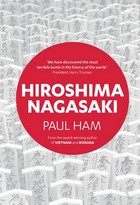
The Book Group, Paul Ham and Hiroshima Nagasaki

Paul Ham, Hiroshima Nagasaki (HaperCollins 2011)

1hnBefore the Group meeting: I heard Paul Ham speak about this book at Gleebooks early last year. He described it as narrative history, aiming to tell the story of what happened in the lead-up to dropping nuclear bombs on Hiroshima and Nagasaki, and in the aftermath, paying attention to what the various players knew and understood as events unfolded, as opposed to their later accounts. He focused on the phrase ‘the least abhorrent alternative’ used by the US leadership after the fact. It encapsulates the official version of events that is not borne out by the records: in fact, he said, no other alternative was ever seriously considered. And, he said at that Gleebooks event, the record puts the lie to received wisdom that the atomic bombs saved as many as a million lives by bringing about an immediate Japanese surrender: the Japanese leadership in fact barely discussed the bombs at all, but were despertely alarmed by Russia’s entry into the Pacific War. Yet Ham dissociated himself from ‘revisionist’ histories that saw the US use of the bombs as knowingly unnecessary. I bought a copy of the book and was looking forward to reading it, so I was very glad that someone proposed it for the book group.

I finished it with days to spare before the meeting, but other demands on my time meant I didn’t get to write anything. I found it completely gripping – one night in bed, reading accounts of Hiroshima just after the bomb was dropped, I gasped involuntarily at least three times, interrupting the Art Student’s beauty sleep.

The meeting: There were nine of us, including one of the Founding Fathers who had been away for more than a year while finishing a degree, and the other Founding Father who has more or less moved to Darwin, but managed to be in town that night. The book generated a lot of discussion over soup, salad and sausages, with a backyard pond full of frogs as background music. I think it made a deep impression on each of us: it confronted us with our ignorance /amnesia about the Allies’ ‘terror bombing’ of Hamburg and Dresden, and of 60 Japanese cities including Tokyo; one guy who always wants us, as an all-male group, to talk about masculinity, found plenty of grist for that mill; there was rumination on the ‘anything can happen’ theme. Basically, we reminded each other of what was in the book rather than getting into controversy. One of us confessed to having bashed people’s ears about it over Christmas meals. Another said that a friend who hadn’t read the book dismissed it as being akin to the sloppy macho war histories produced by a Household Name (unnamed here because I haven’t read any of his work) – but none of us felt it matched that description. We did discuss briefly the absence of any exploration of the US’s insulting treatment of Japan in the decades leading up to Pearl Harbor, and wondered if we would have responded any differently from the Japanese people who were in thrall to the propaganda urging mass honorable suicide, or from the US people who cheered with no misgivings the mass killing wrought in their name. Someone said that he enjoyed books that were beautifully written; I felt that this is such a book, but he meant something different.

It was one of the best nights we’ve had in the group.

After the meeting: Geoffrey McSkimming, creator of the much-loved Cairo Jim–Jocelyn Osgood books for young people, once told me he has a rule that there need to be three good gags a page (Geoffrey, if you read this, please correct me if I misremember). Hiroshima Nagasaki keeps this rule, except it does it with interesting/devastating details or revelatory flashes rather than gags.

When I mentioned the three-gag rule at the meeting, someone mistook me to mean I loved the accumulation of facts and statistics, which he said (and I agreed) did sometimes become onerous. I was thinking rather of the kind of moment that strikes a spark of emotion or insight, or sets you googling to find out more about someone or something mentioned in passing. I decided to do a little test. I chose a page at random by tossing coins: 2 heads, 6 heads, 3 heads – page 263.

263

This is a key point in the narrative. The Allies have issued the Potsdam Declaration demanding that Japan surrender unconditionally or face ruin and destruction. The Japanese leadership consider it, but the hawkish, ‘samurai’ side carries the day, and the Prime Minister reluctantly issues a statement saying they ignore the declaration as beneath consideration – the Japanese concept is mokusatsu. This is interpreted in the West as a rejection of the ultimatum, and plans to drop the new bomb are greenlighted. All that is interesting in itself: the page is a good example of how the book’s narrative drive. But how about he three-gag rule? I think it holds up.

One: It may be idiosyncratic of me, but I find that parenthesis at the top of the page riveting. Arguably the most important meeting of the Japanese leadership and one of the two men arguing against suicidal defiance just happened to be absent. Can history really turn on such tiny hinges?

Two: Though the linguistic/cultural titbit about mokusatsu has been introduced on the previous page (along with the equally interesting haragei or ‘stomach art’), here the ‘gag’ is the tragic lost-in-translation effect of those US headlines hot on the heels of t he various literal versions of Suzuki’s words.

Three: The aphoristic punch of ‘The Japanese resolve to continue fighting was a depressing example of the triumph of hope over experience.’

It may not be up there with the page that tells us what the Hiroshima bombing crew did on their return to base, but it fits the rule.

It’s a solid book, with a hideous subject, based on original research and painstaking trawling through archives, and managing at the same time to be a lively, at times appalling read. It sits happily on my mental book shelf with Marilyn Lake and Henry Reynolds’ Drawing the global Colour Line, which gives some perspective on the lead-up to Pearl Harbor; Robin Gerster’s Travels in Atomic Sunshine, about Australian occupying forces stationed near Hiroshima after the war; and The Boneman of Kokoda, an example of an extraordinary individual’s way of living honorably with his part in Japan’s war history..

The Book Group climbs Venero Armanno’s Black Mountain, plus sonnet #4

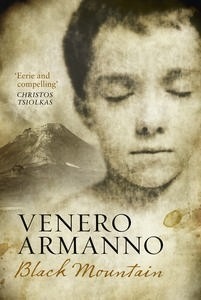
Venero Armanno, Black Mountain (UQP 2012)

Before the Book Group meeting:
A hasty read of this book’s cover blurb led me to expect a kind of fictionalised misery memoir cum migration tale, a book where a second or third generation Australian explores his European heritage:

Beginning in the sulphur mines of Sicily over a century ago … Based on factual events … Italy … rural fringes of coastal Australia … a haunting exploration of what it means to be human.

There are elements of misery memoir: in the most powerful and memorable part of the book the main character, Cesare Montenero, is sold as a child into virtual slavery to work in Sicily’s sulphur mines in the early 20th century. But Cesare’s story is told in the literary equivalent of found footage, and the sulphur mines account for only 40 of the 200 or so pages of the found manuscript. A 30-page prologue has already set some creepy, horror-genre expectations, so that one’s antennae are out for hints of the darker, weirder underlying story. It’s hard to say much more without giving stuff away, but there are plenty of pleasing twists and turns. I’m glad I didn’t read any reviews beforehand, as one of the book’s pleasures is in the way appearances turn out to be deceptive, the ground shifts constantly under your feet, you can’t really be sure what kind of book you’re reading.

I enjoyed it, but can’t say I found it satisfactory. Too often I became aware of the plot mechanics, that someone was making it all up. A gauge of my lack of engagement is that I kept wanting to have a conversation with the copy editor: ‘If we’re going to opt for the US practicing,’ I wanted to ask her/him, ‘why not consistently use US spelling, like sulfur?’ Or, ‘Are sure you shouldn’t have queried whether resiled to should have been resigned to?’ There are more such moments, and the fact that I noticed them may say more about me than the book, but it does indicate I was less than fully engrossed.

After the meeting:
This was an unusual meeting. The group had been going for exactly 10 years last night, so there was much taking stock and reminiscing, and passing on of lore to those of us, like me, who weren’t there at the start. But our in-house facilitator made sure we each had a moment to give our personal take on this book, and uncharacteristically a consensus emerged: the book was OK, no one hated it, but all but one of us found it fairly ho-hum. The sulphur mine section got a general thumbs up – one chap had read the book a while ago and had trouble remembering anything else about it. And, as someone said, we enjoyed the brothels of Paris. But, while I think we all read to the end, the overarching plot failed to impress. Most of us didn’t feel the sulphur mines and the brothels to be integrated, so when those parts came to an end, the wheels of the plot had to start from a virtual standstill. The one person who had a different reading argued for a deep thematic coherence, but I won’t say more because it really is a book that can be spoiled by too much being given away.

And the obligatory sonnet:

Sonnet 4:
Ten years and more than 60 books
discussed by us (and mostly read) –
by builders, architects, home cooks
and sundry ageing chaps, well fed
each time in mind and body. Park,
Malouf, McEwan, Stead, Houellebecq,
Coetzee (twice), White, Ghosh (a naval
title), Falconer, Miéville:
We all loved Tolstoy. Tsiolkas split us.
Tonight: Armanno, reminiscence,
but mostly – here’s the Book Group’s essence –
not so much a tute on lit as
time for sharing – hip, hooray-able –
lives and minds around a table.

The Book Group reads Chekhov short stories

Anton Chekhov, The Lady with the Little Dog and other stories, 1896–1904 (translated by Ronald Wilks, Penguin 2002)

I was enthralled by The Brothers Karamazov when I was 16 – the Grand Inquisitor raised the hairs on the back of my Catholic neck – but have so far managed to read very little of other 19th century Russian writers. The Book Group made me read Anna Karenina a while back, and now it’s Chekhov.

Before the meeting:
Knowing that Chekhov is one of the masters of the short story, I was vaguely expecting a display of virtuosity – cleverly constructed mechanisms with twists in the tail, perhaps, like O Henry’s ‘The Gift of the Magi’ only profound. The stories in this late collection aren’t like that at all. (I don’t know about his earlier stories, and it would probably have been better to start with some of them.)

To generalise, the stories are studies in Russian provincial life at the turn of the twentieth century. It’s hard if not impossible to read them now without an awareness that the Communist revolution was on the horizon. Chekhov’s picture of the oppression of the peasants, the hand-wringing of liberal land-owners and the viciousness of others, the flailing about of the intellectuals, and the way the economic and social system stifles and corrupts everyone, clearly reflects a world ripe for revolution. Not that he calls for revolution, but he does lay out the inadequacy of anything else on offer. These are stories, not tracts. They contain a lot of argument, but they don’t push a line – or if they do, it’s in terms that have become impenetrable to this casual reader a century and a hemisphere away.

In ‘The House with the Mezzanine’, when a socially responsible woman chides the artist–narrator for having no interest in such matters as the creation of a clinic for peasants, he replies that on the contrary the question interests him a great deal, and in his opinion the peasants do not need a clinic:

‘To my mind, with things as they are, clinic, schools, libraries, dispensaries only serve to enslave people. The peasants are weighted down by a great chain and instead of breaking this chain you’re only adding new links … What matters is not Anna dying in childbirth, but that all these peasant Annas, Mavras and Pelageyas toil away from dawn to dusk and that this unremitting labour makes them ill. All their lives they go in fear and trembling for their sick and hungry children. … You come to their aid with hospitals and schools, but this doesn’t free them from their shackles.’

And he goes on. Up to the point where he starts talking about spirituality, he could be a hardline lefty of a couple of decades ago railing against reformism. In the story, the dilemma is not resolved. At the end the peasants are still suffering and the narrator, without explanation and perhaps symbolically, fails to find true love. (A while after I’d written that, I came across this quote from Chekhov’s correspondence:: ‘You … are confusing two concepts: the solution of a problem and the correct formulation of a problem. Only the second is required of the artist.’)

Or take this rant in ‘Gooseberries’, in which a character is talking about his brother, who chose to live a contented life on a small farm. It could be 21st century polemic against the self-help industry:

It’s obvious that the happy man feels contented only because the unhappy ones bear their burden without saying a word: if it weren’t for their silence, happiness would be quite impossible. It’s a kind of mass hypnosis. Someone ought to stand with a hammer at the door of every happy contented man, continually banging on it to remind him that there are unhappy people around and that however happy he may be at the time, sooner or later life will show him its claws and disaster will overtake him in the form of illness, poverty, bereavement and there will be no one to hear or see him. But there isn’t anyone holding a hammer, so our happy man goes his own sweet way and is only gently ruffled by life’s trivial cares, as an aspen is ruffled by the breeze. All’s well as far as he’s concerned.

There’s a lot of grim humour. The wedding celebration in ‘In the Ravine’ could have been the inspiration for Jack Hibberd’s Dimboola – but audiences laugh at the latter, while any laughs at the former are tinged with despair and disgust. And the stakes are raised by the peasants outside, one of whom shouts, ‘You’ve sucked us dry, you rotten bastards. You can all go to hell!’ That moment, of course, quickly passes as the peasants too join the celebratory mood. But the reader has been warned.

Chekhov isn’t one of those writers who ties everything up in a neat little bow. In ‘In the Ravine’ when a baby is murdered, his mother is blamed and the murderer goes free – but we are given no explanation for the mother’s failure to defend herself or other people’s silence about the cruel injustice. ‘The Lady with the Little Dog’ is a love story. Instead of ‘happily ever after’, it ends, ‘ And both of them clearly realised that the end was far, far away and that the most complicated and difficult part was only just beginning.’ Which is my sense of what all the stories are saying, about everything.

I’ve seen Eudora Welty quoted on the Internet as saying, ‘Reading Chekhov was just like the angels singing to me.’ That transforms my sense of what an angel can be.

The meeting: This meeting was postponed a number of times because I was hosting it and I was down with a heavy cold. As a result, most people’s recollection of the stories wasn’t very precise, but we’d had time to absorb them – in particular I had read some new Australian short stories (about which I’ll post separately), and my appreciation of the Chekhov had grown with the comparison. A big impediment to our discussion was that, as it turned out, we’d read different books: three of us had read The Lady with the Little Dog and other stories, 1896–1904. Others had read Lady with Lapdog and other stories, translated by David Magarshack, which contains a different set of stories (damn you, Penguin, for giving different books almost identical names!). The only stories in both books are ‘The House with an Attic’ aka ‘The House with the Mezzanine’, ‘Ionych’, and ‘Lady with Lapdog’ aka ‘The Lady with the Little Dog’.

We had a lively discussion. I think Chekhov was a bit of a surprise for everyone – not enough story for one chap (who thought the title of ‘A Boring Story’ said everything that needed to be said about it), a bit on the grim side for another, surprisingly modern in his discontinuities and sexual morality, surprisingly not, or not always, about the sufferings of the peasants.  At one stage, for the benefit of someone who hadn’t read it, I gave a synopsis of ‘The House with the Mezzanine’. It seemed a bit on the incoherent side, and then someone realised that I’d thrown in a key scene from another story altogether. Will I ever be trusted again?

Since the meeting, I found ‘A Dreary Story‘ on the internet in Constance Garnett’s translation (I think). There’s a wonderful passage near the beginning that could have been about me:

 I write poorly. That bit of my brain which presides over the faculty of authorship refuses to work. My memory has grown weak; there is a lack of sequence in my ideas, and when I put them on paper it always seems to me that I have lost the instinct for their organic connection; my construction is monotonous; my language is poor and timid. Often I write what I do not mean; I have forgotten the beginning when I am writing the end. Often I forget ordinary words, and I always have to waste a great deal of energy in avoiding superfluous phrases and unnecessary parentheses in my letters, both unmistakable proofs of a decline in mental activity. And it is noteworthy that the simpler the letter the more painful the effort to write it.

The Book Group and Edmund de Waal’s Hare with Amber Eyes

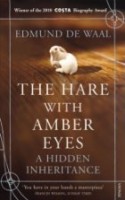
Edmund de Waal, The Hare with Amber Eyes: A Hidden Inheritance (©2010, Vintage 2011)

The Art Student read this a while back, and did a real-life approximation of live-tweeting it to me. That, plus hearing Edmund de Waal on a couple of podcasts, meant I felt no real need to read it for myself. When the Book Group chose it as our next title, though, I was happy enough, and took a paperback in my luggage to Turkey. Even when it went missing when left in a hotel holding room, I remained undeterred, but didn’t get a replacement copy until we were back in Sydney, and was only a third of the way into it when the Group met.

The meeting:
The Hare with Amber Eyes is the story of a collection of 264 netsuke (small Japanese carvings) that had been in the author’s family for 130 or so years – and it’s a partial history of the family itself, the Ephrussis, wealthy Jewish bankers of Paris and Vienna. At the meeting, I was still mixing with the Impressionists in Paris with the Dreyfuss affair looming, while the rest of the chaps had already dealt with the Nazis in Austria, moved on to post Hiroshima Japan and followed the netsuke to their current resting place. No one was particularly careful about spoilers, and I got the impression that the Parisian section, which I was enjoying, was comparatively forgettable.

In general our wives and female partners had been more taken with the book than we were, but along with our usual conversation about recent trips, family weddings, changes of employment, Abbotophobia and so on, we had some animated book talk.  Were the netsuke just a device to hang a family history on? Is the project overwhelmed by the seriousness of the Nazi episode, so that we lose interest in the netsuke? Is the final third of the book a bit rushed as if, one chap said, the author’s wife said, ‘OK, Edmund, that’s enough. Time to wrap it up’? I was curious to know if the potter’s sensibility – the alertness to the feel and heft of things – that is such a strong feature of the first third persists all the way (and got a definite no).

At least two people said that the family story, especially the part to do with the Nazis, was uncannily close to their own, or their partner’s, including the survival of some small object as a link with the past, and details like the image of entwined initials in architectural ornamentation. I recognise from my own experience some of the thrill of finding records of one’s forebears in contemporary sources, though in comparison to de Waal’s great-great-uncle being a model for Proust’s Swann or appearing in Renoir’s Luncheon of the Boating Party, a paragraph in the weekly Queenslander in 1881 (the same year as the Renoir painting) praising my great grandfather’s turnip crop is pretty tame.

A number of the finishers commented on the devastating reversals of fortune suffered by the family – a dramatic reminder that the comfortable middle-class Australian assumption that we determine our own lives is a delusion.

After the meeting:
The ‘spoilers’ didn’t spoil anything for me. On the contrary, they gave me some propositions to test against my own reading. For instance, the netsuke didn’t fade from my mind during the account of the Anschluss (the German annexation of Austria in 1938): all through the Nazi juggernaut, the tiny but momentous betrayals, the opportunism of non-Jewish neighbours, scholars, curators and art collectors, the cruel humiliations and the resonant use of the single word ‘Dachau’, the author’s silence about the tiny, much-loved netsuke worked for me like a solemn background hum or a detail, relatively insignificant in itself, that acted as a point of reference within the horrific bigger picture – a little like the red dress in Spielberg’s Schindler’s List. De Waal tells us that when he was researching the Nazi part of the story he didn’t weep until he saw the documents where his grandparents’ first names had been overstamped with the generic names given to all Jews by the Nazis. I didn’t weep until the netsuke reappeared. I certainly didn’t agree they were purely a literary device.

Anything after the graphic horrors of the Anschluss was going to seem anticlimactic, but I didn’t find the final third rushed. The book follows the netsuke from the aftermath of the war against the Nazis to the aftermath of the bombing of Tokyo. De Waal’s great-uncle Iggy, now the custodian of the netsuke, is neither part of the occupying army nor one of the derided visitors in search of ‘authentic’ keepsakes. He goes to Japan partly to take the netsuke home and lives there the rest of his life with his Japanese partner. It is here that de Waal first sees them and hears the family story about them. It is here that the book – at last – tells us a little of their history before they were bought by Charles Ephrussi, connoisseur, during the 19th century Parisian craze for all things Japanese. And even though they have been named and described repeatedly throughout the book, it is in this final section that they become most palpable though, frustratingly, never pictured. (I recommend the illustrated edition to anyone who hasn’t yet read the book. It costs a bit more but this is a text that cries out for illustrations, and not just of the netsuke.)

I still think the Paris section, with its glimpses of the art scene as a scarily familiar terrain of jealousies, dependencies, malice, fickleness and anti-Semitism along with all its brilliance, is among the book’s most interesting.

Incidentally, I happened to be reading the Anschluss section the evening I went to see The Dark Knight Rises: it made the comic-book seduction of Gotham City’s poor by Bane’s rhetoric seem shockingly plausible.

The Book Group on Amitav Ghosh’s Sea of Poppies

The Group’s December meeting picked Frank Moorhouse’s Cold Light for the next title, but word of that decision didn’t go out until a week before the February meeting, so those who, like me, had missed December had no chance of reading it. Instead, in February we each brought along a selection of our summer reading and had fun comparing and contrasting, recommending and lending. Those who had read or partly read the Moorhouse were having second thoughts, someone had an alternative in his briefcase, and the coup was complete.

Amitav Ghosh, Sea of Poppies (John Murray 2008)

Before the meeting: While waiting for my library copy I asked another Grouper how he was enjoying the book. ‘A lot,’ he said, ‘and I’ve stopped looking up the meanings of words.’ That remark is a lot funnier than you might think. There could be very few readers of this book who wouldn’t stop looking up unfamiliar words – unless you’re extraordinarily knowledgeable, you either ride the language like unruly surf or give up the book altogether.

It’s a wonderful book. I came across a tweet that said it well:Brian Minter: Just finished 'Sea of Poppies by Amitav Ghosh - super good. Serious Literature + Adventure Story + Dickensian Saga.It’s the first instalment in a trilogy, of which the second – River of Smoke – was published last year. Set mainly in northern India, with the impending English-Chinese Opium War and the English outlawing of slavery as backdrop, it’s a riproaring adventure–romance with an extraordinarily diverse cast of characters: a peasant wife forced into dependency on the East India Company, a young Frenchwoman adopted by a wealthy English family after the death of her enlightened parents, a young Indian man who makes a living as a boatman on the Ganga and yearns to be a sailor on the open sea, a Hindu mystic who believes himself to be possessed by the spirit of his deceased female guru, a freeborn Black American sailor who passes for white, a rajah whose life is ruled by ceremony but who finds himself suddenly and humiliatingly deprived of his status, a ship’s crew of lascars. As the book progresses we realise that the disparate paths of all these characters are converging – from desire, necessity, ambition or coercion, they are all to board a former slave ship, the Ibis, which is to take a cargo of indentured workers to Mauritius. The first half is like a pool above a waterfall: it takes a while, but you realise that all the narratives are moving inexorably towards the same point, and they’re picking up speed. When the ship sails you can almost hear the roar of the falls in the trilingual prayers of those on board, and then there’s another hundred pages of churning and roiling, and just as you think perhaps it will all settle down (with a shipboard wedding here, a comic-mystic revelation there) we’re plunged into a new tumult – not so much a cliff-hanger as an over-a-new-cliff ending.

All that is marvellous, but it’s the language(s) that make the book sing: not just the sometimes familiar bits of Indian English like the dhoti, kameez and puja that occur on the first page, but the lascar lingo and the garbled slang of the English in India, the French- or Bengali-inflected dialogue of particular individuals, the technical terms of the opium and sailing trades, the traditional languages of Islamic, Hindu and Catholic prayer, botanical nomenclature … It’s a written equivalent of the spectacle that assails the senses in the streets of India. I’d love to quote lots, but will content myself with a scrap from an Englishman’s description of the hospitality of the Raja of Raskhali :

No fear of pishpash and cobbily-mash at the Rascally table. The dumbpokes and pillaus were good enough, but we old hands, we’d wait for the curry of cockup and the chitchky of pollock-saug. Oh he set a rankin table I can tell you – and mind you, supper was just the start: the real tumasher came later, in the nautch-connah. Now there was another chuckmuck sight for you! Rows of cursies for the sahibs and mems to sit on. Sittringies and tuckiers for the natives. The baboos puffing at their hubble-bubbles and the sahibs lighting their Sumatra buncuses. Cunchunees whirling and the ticky-taw boys beating their tobblers. Oh, that old loocher knew how to put on a nautch all right!

That tobbler, recognisably a bastardisation of tabla, makes me think that the more linguistically adept you are the more you will enjoy this and the book’s many other passages like it.

I happened to see The Best Exotic Marigold Hotel while I was reading Sea of Poppies. It’s not by any means a vicious film, but in part it presents modern Rajasthan as a kind of decayed remnant of the splendours of the Raj. Well, it will be hard ever again to think of the Raj as splendid after reading the account here of the East India Company: you’d be closer to the mark with vicious, hypocritical, callous, smug, treacherous. Another word whose meaning has been permanently deepened for me is indentured. The viciousness that lies beneath that economistic sounding word has been laid permanently bare. (My great-grandfather had indentured labourers from the Pacific Islands (Kanakas) on his Queensland farm.)

After the meeting: Our host for the evening hadn’t had time to make an Indian meal, though we did start out with bhajis. Not everyone was as enthusiastic as I was. One guy said that although he learned a lot of history and enjoyed the ripping yarn, he wasn’t swept away by the language. But we had all clearly read the same book, which isn’t always the case.

The book group, The Life and Malcolm Knox

Malcolm Knox, The Life (Allen & Unwin 2011)

Before the Book Group met: I knew The Life was about a surfer, based to some extent on a real person (as spelled out in an interesting article by Nick Carroll here). I knew that it also drew on Malcolm Knox’s own fairly recent experience as a surfer. Now, unless you count the pleasant and instructive experience of copy-editing a book of essays on surfing and surf culture a couple of years ago, the closest I’ve been to riding a surfboard is to have broken a wrist the first time I rode downhill on a skateboard. Oh, and Peter Drouyn was two years behind me at boarding school, and I once had a friend who said things were gnarly. So no matter how many people recommended The Life, I would have given it a miss, as I have Tim Winton’s Breath, if it wasn’t for the Book Group. And so but yeah I have yet another reason to be grateful to the group.

I’m writing this a day after finishing the book [and about a month before the twice postponed meeting], and the voice of Dennis Keith – DK, the narrator and main character, who occasionally starts a sentence with a string of conjunctions a bit like the last sentence in my first paragraph – is still echoing in my head. He’s a wonderful character, overweight, approaching 50, living with his mother, socially incompetent and suffering from some kind of mental chaos. But once he was the world champion surfer, a genius on the waves. A double tale unfolds – the story of events leading up to his mental implosion 30 years earlier, and what transpires after the arrival of a young woman he calls his BFO – short for Bi Fricken Ographer. There’s a central love story and a violent death, but the main power of the book for me is in the world created in its language, and though I gather there’s some controversy about the way DK is recognisable in the surfing community as a version of a still-living surfing legend, for outsiders like me there’s a feel of authenticity that probably has something to do with not having moved too far from actual history.

After the group: We met last night. Malcolm Knox is a friend of one of our members, and came to the meeting as a special guest.  As a result, we stayed pretty much on topic all night, even though two of us, who arrived late, had been to the annual opening to the public of the Egyptian Room of the Petersham Masonic Hall, which would usually have been a major distraction from the book of the night.

One of the guys has been a keen surfer all his life, and knows an awful lot about the parts of the real world that the novel relates to. Others have done some surfing. To most of us the surfing world was pretty much a closed book. We’d all enjoyed the book, and I think it’s true to say that we all loved the chance to talk about it with the author. He was completely useless when asked to clarify the ending – he’s written a version where the end was clear, but it didn’t work because DK could never have got things that clear in his head, so he had to rewrite it to its present opacity. Sadly, this means that he doesn’t know who dunnit any more than any careful reader. Apart from that, he seemed happy to be quizzed about the process of writing, and rewriting, about the thinking behind a number of key decisions, about anything at all really, and we were pretty happy to do the quizzing.

Even though I count a number of brilliant writers among my friends, I’m still a boy from North Queensland who didn’t meet a Published Writer until I was 20 years old (the poet R D Murphy, aka Brother Elgar FMS), and I was very impressed by Malcolm’s generosity in joining us like this. He said he feels a sense of responsibility – if people are prepared to read his books the least he can do is sit down and have a meal with them, and anyhow he’d rather talk to eight people who have actually read it than 300 who’ve come to his talk at a festival because they couldn’t get into the one they really wanted. I hope he enjoyed the evening as much as I did.

The Book Group and That Deadman Dance

Kim Scott, That Deadman Dance (Picador 2010)

Having enjoyed the movie Red Dog in spite of its near erasure of Aboriginal people from the Pilbara, I was glad to turn to the Book Group’s pick of the month for a bit of counterpoint. Sadly, I turned to it too late to finish it before the group met over soup, bread and cheese on 17 August. So here we are, reversing the usual order of my Book Group posts: first the meeting and then the book.

The meeting:
We had a good turn-up, and more than half had read the whole book. All but one of us were big fans, and the dissenter – who was about a third of the way through – was prepared to keep an open mind. I’d read only 110 pages or so myself, but at that point was finding it exhilarating. Discussion was animated, emphatic, mostly good humoured.  I won’t try to summarise beyond saying that there was a shared sense that the novel made us see the British settlement of Western Australia with fresh eyes. Also the whaling industry, but I hadn’t read to that point, so tried not to listen. I had read the short chapter where a convict who has been speared by Noongars in payback for wrongs done by someone else – though smarting with the injustice, he understands that it’s necessary for the whites to accept the payback without further retaliation if there is to be peace in the small settlement. In terms of the plot, he feels like a powder keg waiting to explode, but I love Kim Scott’s open hearted portrayal of him as a complex individual (as opposed, say, to the equivalent lower-class ‘bad whites’ of Kate Grenville’s The Secret River). No one would engage with me on this line of discussion because they didn’t want to give the plot away – true gentlemen every one.

The subject of Red Dog was raised, and those who’d seen it were even less impressed than I was, regarding the praise lavished on it by Margaret, David and Julie as symptomatic of misguided and misleading advocacy for the local product. We had brief but sharp differences of opinion about The Slap (Christos Tsiolkas) and The Riders (Tim Winton), and some disparagement of The Unknown Terrorist (Richard Flanagan) and the literal minded TV adaptation of Cloud Street (Winton again).

I came away looking forward to the rest of the book.

After the meeting:
I took nearly two more weeks to finish, but that’s no reflection on the book. (See previous post for partial explanation of my reduced reading time.) While I was reading it I  heard on a podcast of the Book Show that Melbourne University currently doesn’t offer a course in Australian literature – one enterprising student has organised monthly lectures by poets and others who are willing to talk for free (apparently without input of any kind from the academic staff!). One justification for this state of affairs is that students in general think Aus Lit is boring, conservative and ‘white’, so the course wouldn’t be popular enough to justify itself. I guess this is what happens when the profit motive holds sway in education. But, stepping down from my media-generated-outrage soapbox, I’d have to concede that That Deadman Dance does make some other much-praised Aust fic look fairly timid and vanilla. It tackles the same general area as Inga Clendinnen’s Dancing with Strangers: the first, hopeful contact between Aboriginal Australians and white invaders and the seeds of the subsequent tragic genocidal history. Where  Clendinnen wrote history, excavating the journals of early settlers in Sydney to reconstruct a hypothetical account from the point of view of the Indigenous Australians, Kim Scott tells what his narrator calls a ‘simple story of Bobby and his few friends’ about the settlement in south west Western Australia, confidently taking us into the minds of black and white, young and old, male and female. I’d be surprised if he hadn’t read the Clendinnen book, but it’s very much its own work: joyful, funny, superhumanly broad in its sympathies, challenging, vivid and in the end heartbreaking.

The central story tells of Wabalanginy/Bobby, a  Noongar man born after the arrival of  whites, who finds friendship among the new arrivals, studies them, at times acts as an intermediary, is virtually adopted into a white family but remains firmly connected with his Noongar community. He’s a brilliant character – admired as a clever mimic by the whites and held in awe for his artistry in song and dance by the Noongars. His engagement with both cultures is enacted beautifully: a number of times we’re taken inside his way of perceiving and responding to the world in wonderfully lyrical writing.

At one stage, the desecration of a grave is described as ‘deliberate and careless all at once’, a phrase that resonates like a gong through the last, darkening chapters, when the logic of capitalism and colonialism asserts itself, and we gradually lose any sense of the inner lives of the settlers as they become more completely incomprehensible to Bobby and appear to forget the almost reasonable relationships of the recent past: deliberate and careless, intentional and oblivious.

Maybe one day even the hallowed halls of Melbourne University will encourage its students to read this, and other books that will help them wrap their imaginations around the history they inherit.