Category Archives: Books

NSWPLA dinner

There’s a quote from James Tiptree Jr I’ve been wanting to sneak into my blog for some time. When an editor asked her to write an afterword to her short story, ‘The Milk of Paradise’ she wrote that some authors are ‘walkie-talkie writers … who are named Mailer and Wolfe when they are good’ and went on:

But the rest of us, poor carnivores whose innards meagrely condense into speech. Only at intervals when the moon, perhaps, opens our throats do we clamber up on the rocks and emit our peculiar streams of sound to the sky. Good, bad, we do not know. When it is over we are finished, our glands have changed. Push microphones at us and you get only grumbles about the prevalence of fleas and the scarcity of rabbits.1

That, in short, is why I’ve become a dedicated paying guest at the annual  NSW Premier’s Literary Awards Dinner. I love to see those poor carnivores clamber up onto the podium to be honoured, even the ones who can’t manage any more than ‘Thank you’.

I nearly didn’t go this year, fearing that the dreaded PowerPoint’s incursion, begun at the shortlist announcement, would continue. I was also trying to think like a grown-up about the expense, and then there was the Dîner des Refusés precipitated by the nul prize for a playscript. But here I am again, home from the Art Gallery, out of pocket but flush with the inside dope, even though the on-the-spot tweeters and newspapers (with self-promoting or surprise-upset hooks) have beaten me to publication.

It turned out, no surprise, to be a pleasant evening. The company was convivial, the setting brilliant, the food excellent. There was no PowerPoint as such, but sadly the dinner has become an Event, the creation of Events Organisers, with glossily impersonal results. There was a would-be witty typewriter centrepiece on each table. Two huge television screens told us who was talking to us at any given moment, threatening but thankfully not quite managing to distract us from the mere humans on the stage between them. And the pause between the announcement of each winner’s name and their arrival at the microphone – that is, the time it took them to reach the stage, be photographed kissing the Premier and cross to the mike – was now filled, not just with applause and a buzz of conversation, but with a blast of fanfare from the sound system. I hope someone whispers to the Organisers that this isn’t the Oscars, still less the Logies.

Auntie Sylvia Scott welcomed us to country. As last year, she told us she was an avid reader, and revealed that though Nathan Rees had promised her a pile of books, she never saw any. As she left the stage Carol Mills, Director General of Communities NSW and MC for the evening, promised her a pile this year. She was gracious enough not to look sceptical.

Richard Fidler gave the address. He was funny, and with enough meat to be satisfying, with quotes ranging from Neil Gaiman (about the joys of being a writer), by way of Stalin (writers are the ‘engineers of the soul’) to the unnamed Bush aide (‘probably Karl Rove’) who derided the ‘reality based community’. He advise women in quest of a man to look to their bookshelves – men don’t care so much about appearances, it’s the books that count: ‘Ladies, if we see a copy of a book by Deepak Chopra or Erich von Daniken, we’re out of there.’ He recommended The Moth podcast, and inveighed against Twitter as the ruination of literature – all those writers being witty in 140 characters instead of being at work: ‘Get back to your desks you Gen Y bastards!’ (At that point I saw my Baby Boomer friend misrule discreetly tweeting.)

On to the awards:

The UTS Glenda Adams Prize for new writing: Andrew Croome – Document Z
I started to read this a while back but couldn’t bear to read yet another book on the subject. Perhaps seduced by the sub-Oscaresque music that accompanied him to the mike, Andrew Croome gave a straightforward thank you speech, an example followed by most of the award recipients. In particular he acknowledged his debt to University creative writing courses. The book started out as a PhD – ‘But that doesn’t mean it’s boring.’

The Community Relations Commission Award: Abbas El Zein – Leave to Remain: A Memoir
A lovely book. He said, ‘I never thought I’d shake hands with the Premier and be paid for it,’ introducing another recurring motif of writers responding to Kristina Keneally’s physical presence.

The NSW Premier’s Prize for Literary Scholarship: Philip Mead – Networked Language: Culture and History in Australian Poetry
I hope to read this hefty volume some day. The very tall Philip Mead (nickname ‘Tiny’) commented that it was lovely to stand next to someone of normal height. The Premier leaned over to his mike and said it was lovely to stand next to someone who was taller than her. He went on to thank, among others, independent Australian publishers, who are like tussocks: ‘we do everything we can to destroy them and they keep coming back.’

The Play Award: Controversially not awarded

The Script Writing Award: shared by Jane Campion for Bright Star and Aviva Ziegler for Fairweather Man
Jane is abroad. In accepting the award for her, the film’s producer Jan Chapman threw us the pleasing tidbit that in the absence of any letters from Fanny Bryce to Keats, Jane looked for inspiration on her character to her own teenage daughter. Aviva spoke about the ways writing a documentary is of its nature so much more a collaboration than other forms of writing.

The Kenneth Slessor Prize for poetry: Jordie Albiston – The Sonnet According to ‘M’
I bought the last copy of this on my way home.

At this point in the evening, the main meal was served. I was the only one at my table vulgar enough to want to trade fish for meat. One of my fellow guests was gracious enough to do so. The steak and mushroom and mashed potato was delicious, though it didn’t look a bit like the way my mother used to do it. Then on with the show:

The Ethel Turner Prize for young people:Pamela Rushby – When the Hipchicks Went to War
Pamela Rushby wins the Me fail? I fly! award for the best acceptance speech. She may have been the only recipient who began with the formal ‘Distinguished guests’, but she recovered from that slightly distancing moment by telling us she had pitched the book to publishers as Apocalypse Now meets A Chorus Line. Apart from giving us some little known information about young women who went to the Vietnam War as entertainers, she thanked her family, ‘without whose support the book would have been finished in half the time’.

The Patricia Wrightson Prize for a children’s book: Allan Baillie – Krakatoa Lighthouse
Allan writes with remarkable precision, but he speaks with difficulty – so he can be difficult to follow. I thought he said that on this project his wife had to endure more than most writers’ wives because he’d been carrying on with an orang utan. I probably misheard, but he does have an unsettling sense of humour. He definitely did say that his wife climbed Son of Krakatoa with him.

The Douglas Stewart Prize for non-fiction: Paul McGeough – Kill Khalid: Mossad’s failed Hit … and the Rise of Hammas
‘Madame Premier, Ms Premier?’ ‘Kristine.’ He mainly thanked his editors, and said very little about the book.

The Christina Stead Prize for fiction: J.M. Coetzee – Summertime
Unsurprisingly JMC wasn’t there. Meredith Purnell (?) from Random House read a brief note: ‘Whether I deserve to hold my head up with the esteemed previous winners is something only time will tell.’ So Summertime!

The People’s Choice Award: Cate Kennedy – The World Beneath
‘I can’t believe my luck that all this has come about from just telling stories.’

Book of the Year: Paul McGeough – Kill Khalid
This time, without notes, he spoke about the vulnerability of writers in these late-capitalist times (my term), and daringly drew a parallel with the Taliban, a ragtag collection of warriors holding at bay the great technological firepower of the USA, the closest the evening came to ‘the prevalence of fleas and the scarcity of rabbits’.

The Special Award: The Macquarie PEN Anthology of Australian Literature
This may have been an inevitable award, but it was sad that we didn’t get to honour an ageing lion, who would have responded memorably.

I didn’t realise until this morning how many of the writers receiving awards were born and partly educated outside Australia: Abbas El Zein of course, but also Jane Campion, Aviva Ziegler (I’m guessing from her accent), Allan Baillie, Paul McGeough and J M Coetzee. That’s at least six out of eleven. Does this mean, as a friend of mine insists, that Australians can’t write? I don’t think so. Does it mean anything at all? I don’t know.

The main pleasure of the evening for me, and I suspect others, was catching up with friends. I was sitting with people I didn’t know well, and that was another pleasure, especially as the three people I could talk to most easily were judges who managed to be gloriously indiscreet about some of this year’s processes. It’s often said that literary awards are given to compromise candidates, books that are no one’s favourites but that no one objects to. It seems this was not the case with these awards. There were sharp divisions of opinion over a couple of them, and my impression is some of the uncontroversial decisions had their share of anguish.
——
1From the collection, Meet Me at Infinity, edited by Jeffrey D Smith, 2000, p 238
Jasper Jones at the Book Group

Craig Silvey, Jasper Jones (Allen & Unwin 2009)

The fourth paragraph of Jasper Jones begins:

This is the hottest summer I can remember and the thick heat seems to seep in and keep in my sleepout.

‘Keep in’? That’s awkward, I thought, and it chimes oddly with ‘seep in’ and ‘sleepout’. The paragraph continues:

It’s like the earth’s core in here. The only relief comes from the cooler air that creeps in between the slim slats of my single window. It’s near impossible to sleep …

Seep in, keep in, sleepout, creeps in and sleep, all in five lines: this is definitely odd, but – along with the heat, the relief and those slats, which are slim for no reason other than alliteration – it’s clearly deliberate.

Over the next pages, while the story had my attention from the word go – thirteen year old Charlie Bucktin, the narrator, is woken in the night by the town’s bad boy Jasper Jones and led to a secret place in the bush where he’s faced with a terrible spectacle and an equally terrible dilemma – I had a weather eye out to see if anything would come of this stylistic oddity. Nothing did, in the sense that if you didn’t notice it you weren’t missing a vital clue to the book’s meaning. But Charlie is in love with language, and bursts of assonance and alliteration for their own sake amount to something of a stylistic signature. I did a quick scan before returning the book to the library, and noted, from many examples, ‘a bundle of lonely bones tied to a stone’ (page 123), ‘Pored over it, taking little portions’ (page 128), and this, in one of Charlie’s reflective moments:

Sorry means you feel the pulse of other people’s pain, as well as your own, and saying it means you take a share of it. And so it binds us together, makes us as trodden and sodden as one another. Sorry is a lot of things. It’s a hole refilled. A debt repaid. Sorry is the wake of misdeed. It’s the crippling ripple of consequence. Sorry is sadness, just as knowing is sadness. Sorry is sometimes self-pity. But sorry, really, is not about you. It’s theirs to take or leave.

Like the frequent references to Charlie’s reading – To Kill a Mockingbird, Batman, Breakfast at Tiffany’s (which he hasn’t read, but Eiza, the love interest, has, and seen the film), Huckleberry Finn, The Wizard of Oz – this fascination with words is important in establishing Charlie’s character and the tone of the book. It’s been described as an Australian To Kill a Mocking Bird, but I doubt if Harper Lee’s book was anything like as intertextual as this. The description is OK as a sales pitch but I’m surprised that reviewers have echoed it.

Anyhow, it’s a terrific, fast moving, undemanding read: a coming-of-age romance cum mystery cum homage to Mark Twain cum historical drama (the Vietnam War is on, and the Beaumont children are mentioned towards the end) cum tale of pre-adolescent friendship (with a substantial nod towards the movie Stand By Me). There’s a beautiful description of a cricket match in which Charlie’s best friend, a very short Vietnamese boy (‘Jeffrey Lu on debut’) makes a splash, in a way that reminded me of Ruth Starke’s brilliant book for younger readers, Nips XI.

One thing I don’t understand is what makes the book ‘mainstream’ rather than ‘young adult’. There’s some pretty intense swearing, I guess, but sex is treated with great tact; even when sexual abuse is described explicitly in a letter that’s crucial to the plot, we don’t get to read the letter. The story is told from a thirteen-year-old’s point of view, and there’s no hint that he’s in any way an unreliable narrator: we don’t know any more than he does and we’re not invited to make judgments that differ from his – we learn about the world with him. In fact, Charlie’s angry mother is treated with less adult-sympathy than similar mothers in many a YA title. I’ve heard that the classification was a policy decision on the part of the publishers – that they were invited to submit the book for the Children’s Book Council Awards, but declined. The mainstream classification seems to have paid off in adult readership and award nominations – always assuming that a Miles Franklin shortlisting is more prestigious than one from the Children’s Book Council, and that being on the New South Wales Premier’s Literary Awards shortlist alongside David Malouf’s Ransom and Coetzee’s Summertime is more dignified than being named in the same breath as Justine Larbalestier’s Liar (not a view I share: I’m looking forward to Justine’s book as keenly as I am to David’s, and who in their right mind would want to compete for a prize against Malouf and Coetzee?). I hope this taxonomical decision hasn’t discouraged the young people who are the book’s natural readership. [Since writing that I’ve seen an online  trailer that is clearly aimed at teenagers, so it looks as if the pubisher is having two bob each way, and a good thing too.]

I wrote that much a number of weeks ago. The Book Group met last night.

With one exception, we were lukewarm. No one actively hated the book, but different people saw different things as gaping flaws. One man said he found Charlie’s decision at the very start to help conceal a crime highly implausible, and intolerably hackneyed – from then on he read with very little pleasure. Another was irritated by the banter between Charlie and Geoffrey (though one man said he thought that was the best thing in the book). Others found the narrative voice, and the characters’, wildly inconsistent – perhaps especially in beautifully written passages such as the aria on ‘sorry’ I quoted from above. I think we were unanimous in finding the characters’ emotional responses to crises (a grisly death, the acrimonious departure of a parent, the discovery of a grandparent) lamentably one-dimensional. I’m sorry to say that as we talked the book’s charms diminished. I proposed a reading that transcended these concerns for consistency, verisimilitude and psychological realism. Perhaps we ought to see the book as akin to the startlingly discontinuous novelitas of César Aira that I’ve just been reading about in the current Heat. But that didn’t wash. Its one defender said it reminded him vividly of things he had felt when he was an adolescent, and he wasn’t howled down.

Sorry, Craig.

Glebe Annandale Balmain elegies

David Brooks, Urban Elegies (Island Press 2007)

‘Ars Poetica’, the first poem in this lovely collection, begins

When I woke first I imagined it was starlings
mid-demonstration on the galvanised roof,
a thick forest of chirpings,
claws like the scratching
of a thousand sharp pencils

then, waking again, thought
swallows
perched for a briefing
before launching out over Annandale
like a hundred miniature scimitars

but of course it was the Rainbow Lorries
fresh over from Manly
unable to contain their Springfulness

He had me, as they say, at ‘Annandale’. After that he’d have had to do something terribly wrong for me not to love this book. He didn’t. I did.

Robert Adamson says in his intro that he read the book in one sitting. I almost read it in one dog walk. It’s not difficult poetry, but its appeal goes well beyond the pleasure of recognising places and events from Sydney’s inner west – the apartments built on the site of the old Children’s Hospital, street names, the two local giveaway newspapers, a rat in the compost, headlice in a child’s hair. The pieces that most hit home for me are those that touch on the numinous. ‘Flying Fox on Wire’, for example, begins:

A human poet, trying to remove
a fallen powerline from his roof, accidentally
touching the cable and surviving the
J-U-D-D-E-R-I-N-G shock of it
might think it is as if
he’s grasped a tendril of his Al-
mighty God

and draws a comparison to a flying fox on overhead wires

completing a
circuit it could
never have imagined – what
vast
grids and
networkings of night, what
chittering labyrinths of
tree and
air, what
soundless shrieks of
pain or
joy or
prophecy are
there?

Out of the Box

Michael Farrell and Jill Jones (editors), Out of the box: Contemporary Australian gay and lesbian poets (Puncher and Wattmann 2010)

I approached this anthology with suspicion. Does it really make sense, I wondered, to read David Malouf’s or Pam Brown’s poetry in a context that draws attention to the poet’s sexuality? Wouldn’t it skew, and narrow, the reading? My suspicion wasn’t allayed by having recently read editor Michael Farrell’s ultra-skewing assertion in Jacket Magazine 39 that he has ‘always read Judith Wright’s “Woman to Man” as referring to the experience of gender transfer’. But … well, once again the Book Club has dragged me from the path of least resistance.

Of Michael Farrell’s introduction and its use and abuse of the Concise Oxford Dictionary, I can reasonably say I didn’t find it congenial, and his readings of poems strayed too far into hip idiosyncrasy for my taste. Jill Jones, his co-editor, gives a nice potted history of identified gay and lesbian writing in Australia since the late 70s, and provides some useful orientation to the lesbian poems – I mean of course the poems written by identified lesbians, because as the book’s subtitle makes clear it’s the poets, not the poems, that have sexual identitites.

The poems are wonderfully diverse. They belong together not because of shared themes or concerns or formal qualities, but because their creators are contemporary (ie, alive?), Australian and gay or lesbian. A number of the poems are outed by the context – that is, poems I would elsewhere have read as heteroerotic I here read as homoerotic. That’s probably a good thing – my heteronormative mentality is being challenged. Others shrink: Pam Brown’s ’20th Century’ (‘And as we were the tootlers / we tootled along’) here tends to read as referring to the Gay and Lesbian Mardi Gras rather than something more global. I don’t know that that’s so good. At times I caught myself approximating a Beavis and Butthead snigger: ‘Hur hur! He said fist!’ Definitely not cool, though I plead in mitigation that Michael Farrell’s introduction does something of the sort more than once, and a handful of poems seem to be intent on a kind of high-culture gay Beavis-and-Buttheadism.

A good bit of the time while reading these pages, I got to feel very straight – not necessarily in the sexual sense, but in the sense that I prefer my language syntactical, don’t warm to commas at the start of sentences or parentheses that don’t close, and hate it when I can’t tell whether something is a typo or deliberate wordplay (when Javant Biarujia’s ‘MappleTROPE’ gives us Mapplethorpe’s deathbed utterance as, ‘I just hope I live long / enough to see the frame’ – has he inserted that r into the last word as a piece of witty surrealism or is it just bad proofreading? I genuinely don’t know, and it bothers me).

There are wonderful poems by David Malouf (‘A History Lesson’), Dorothy Porter (‘The Ninth Hour’), Pam Brown (‘Peel Me A Zibibo’), Martin Harrison (‘About the Self’), Peter Rose (‘Plague’), Kerry Leves (‘the escape’ – I’ve known Kerry mainly as a children’s writer, and he is definitely not that here) and joanne burns (‘aerial photography’), among others. I was delighted to be introduced to Stephen J Williams (‘Museums of beautiful art’), Andy Quan (‘Oath’, possibly the single poem that touched me most directly) and Tricia Dearborn (‘Life on the Run’) among others.

It probably doesn’t make sense to talk about a book of poetry without quoting any, but every poem I wanted to quote turns out to feel like an all or nothing proposition. I guess if you’re interested you’ll just have to find the book.

Bill Murray reads Emily Dickinson

Remember Paul Robeson singing to workers in the Sydney Opera House under construction? New York’s Poets’ House isn’t quite on that scale, but this coming together of Bill Murray, Emily Dickinson and a group of construction workers is beautiful to behold.

I usually tend not to like actors’ readings of poetry, but this is masterly, especially his apparently casual use of props and the way he modulates degrees of seriousness. Even the little bit of ‘New Yorkers are special’ rhetoric isn’t too vomitous.

Thanks to Harriet the Blog.

Ordinary Affects

Kathleen Stewart, Ordinary Affects (Duke University Press 2007)

This starts most inauspiciously:

Ordinary Affects is an experiment, not a judgement. Committed not to the demystification and uncovered truths that support a well-known picture of the world, but rather to speculation, curiosity and the concrete, it tries to provoke attention to the forces that come into view as habit or shock, resonance or impact. Something throws itself together in a moment as an event and a sensation; a something both animated and inhabitable.

Whooee! It’s going to be a rough ride, with tortured syntax, unconventional semicolons and words that don’t seem quite to mean what one would expect. It doesn’t get any more comfortable, but I persisted because it was a Book Club book, and Book Club books are meant to take me places I wouldn’t necessarily go if I just followed my nose.

A couple of pages in, I decided that even though this is a scholarly work, probably belonging to the discipline of postmodern anthropology, I lack the background to be able to read it in a scholarly manner. Instead, I let it kind of break over me. I read it as if it was poetry. And I enjoyed it. I can’t tell you what it’s about, mind you. It abounds in anecdotes, ranging from a pleasant but odd encounter in a check-out queue to horrific violence, bizarre plane travel incidents to odd things seen from the car. It offers fascinating reflections on public responses to big events – the OJ trials, the Columbine shootings, child care sex abuse scandals, nuclear waste disposal, 11 September 2001. It positively bristles with gnomic utterances that would make great epigraphs for poems (‘The ordinary can turn on you,’ or ‘Dream meets nightmare in the flick of an eye’) or citations in other scholarly works (‘Like a live wire, the subject [which I think here means a person] channels what’s going on around it in a the process of its own self-composition. Formed by the coagulation of intensities, surfaces, sensations, perceptions and expressions, it’s a thing composed of encounters and the spaces and events it traverses or inhabits’).

By chance, the first thing I read after finishing this book was Raewyn Connell’s characteristically incisive essay in the current issue of Overland, in which she says:

Any system of doctrine, any powerful concept, becomes in time an excuse for not thinking: Marxism, radical feminism, deconstructionism, post-colonialism, the lot. … We need harder thinking, not fluffier thinking, about social reality – and that includes rethinking the ideas earlier generations of socialists worked with.

I think Kathleen Stewart would agree with that (even while, being from the US, she might flinch at the word ‘socialists’), but Ordinary Affects deals in something that precedes thought: ‘The ordinary can happen before the mind can think.’ (Let me share with you the pleasure I felt in using that limp word ‘something’ here. It’s a word that Stewart uses often and interestingly, usually in the phrase ‘or something’, as if to insist on the provisional nature of her thinking.) Before we can rethink, we need to re-see, and re-feel, re-attend, and at least part of what Stewart means by ‘ordinary affect’ is what happens when we pay attention, how we integrate, or not, the many influences on our perception, our emotional responses, our unreflective thoughts.

I found myself remembering the only lines I know from the US poet Muriel Rukeyser:

PAY ATTENTION TO WHAT THEY TELL YOU TO FORGET

The capitals are hers.

If I get a chance I’ll re-read this book, though I expect it will be a matter of letting it break over my head again.

Open letter to Jennifer Maiden

I think this is a poem, but the chances of anyone else publishing it are very slim, so here it is, blogged.

Open letter to Jennifer Maiden
Dear Jennifer, please write about Kevin
and Julia. The best I could manage
was a clerihew when they won the election:
oooKevin Rudd
ooomay be a bit of a fuddy-dud
ooobut at least we’ll no longer be showered
ooowith the duplicitous spittle of Howard.
But now that he’s backed off
from tackling climate change
and Julia’s refusing
to talk to the teachers’ unions
we need something stronger
and wiser
than my easy rhymes  –
a muddy rabbit, mesmerised by moonlight,
a studied habit, of playing to the polls,
or bloody sabot-age.
Couldn’t you write us something
about the way his top lip tightens
or hers curls,
her pontifical drawl, his parsonical clip?
Something like your George’s
lethal little injections and your Condi’s
costume jewellery, to help us see them
as human?

Jennifer Maiden’s poems that this refers to explicitly are ‘Together We Will a Cheese Achieve‘ and ‘Costume Jewellery‘ both in Friendly Fire.

Philip Larkin, The Whitsun Weddings

Philip Larkin, The Whitsun Weddings (© 1964, Faber & Faber 1977)

This slim volume was published seven years before Philip Larkin’s most famous poem, ‘This Be the Verse‘, and a couple of years before I studied Eng Lit at university. It’s possible we read some of Philip Larkin’s poems in our eminently forgettable third year elective on Post War English Poetry. But in effect I’ve just met what Wikipedia says is one of Britain’s most popular poets for the first time.

According to Wikipedia again, Larkin said that deprivation was for him what daffodils were for Wordsworth. I found that comment illuminating – most of the poems here are performing a kind of wretched isolation, sometimes mocking people who are in relationships, at other times wistfully celebrating the possibilities, or the might-have-beens, of love. The quality of performance stops them from being just plain dispiriting. A paraphrase of ‘This Be the Verse’ would go something like, ‘Parents ruin their children’s lives so we might as well let the human race die out,’ but each time I read the poem it has a weirdly cheering effect, which I think is because its meticulous formality and obvious pleasure in language are so not gloomy. That poem isn’t in this book, but there are others just as gloomy and just as cheering, ‘Mr Bleaney’, say, or ‘Nothing to Be Said’, or … most of them.

Anyhow, I don’t have much to say, except that I enjoyed these poems a lot and expect to enjoy them many times – the sheer formal pleasure of them, but also the complex musings they embody.

The student who left her marks here (and I know it was she because her name, Allison XXXXX,  is on the fly leaf) was more attuned to the poetry than he who annotated my copy of Immigrant Chronicles. (Click the image for a bigger version.)

Mind you, her notes on ‘Afternoons’ seem almost completely wrongheaded: I don’t see why the recreation ground prompts the comment ‘consumerism’, where the idea comes from that the mothers who set their children free are ‘still trapped’, or why it is ‘bleak’ that the women have husbands behind them. But Allison’s pencil seems to grasp ‘An Arundel Tomb’ well enough. At least, I found the poem completely lovely, and felt quite companionable toward her as I read it: ‘Yes, Allison, it is nice the way the word link occurs at the start of the fifth stanza after that big enjambement,’ ‘But is the tomb undated, Allison, or just the snow?’

The final lines of the poem remind me of one of my favourite movie moments, the declaration of love at the end of Ingmar Bergman’s Scenes from a Marriage. I can’t find the Bergman line, but here’s the Larkin:

0000000The stone fidelity
they hardly meant has come to be
Their final blazon, and to prove
Our almost-instinct almost true:
What will survive of us is love.

Footnote on my blog note on Sacco’s Footnotes

I’ve just heard Chris Flynn’s excellent review of Footnotes in Gaza on the ABC’s Book Show of 21 April. It’s preceded by interesting discussions of European comics (‘graphic novels’) in translation and South Korean comics, in a refreshing antidote to the patronising treatment often handed out to comics in the mainstream media. Chris Flynn says in part:

Sacco tries his level best to build up an accurate picture of what might have happened. he comes at the massacres from all angles, presenting eyewitness accounts that sometimes correspond and sometimes conflict. Footnotes in Gaza is thus a fascinating document of ordinary people, but it is disappointing that it lacks an Israeli perspective on what happened. In his introduction  Sacco bemoans that he was stonewalled, and the limited access that he was granted to UN and Israeli Defence Force archives, and he puts out a plea for Israeli soldiers who were present on the days in question to come forward with their versions of events.

As an eye-opening piece of war reportage, Footnotes in Gaza succeeds largely thanks to Sacco’s innovative, fresh approach in presenting a forgotten moment in history in such a modern fashion. As a narrative piece of story-telling, it contains several moments that made me put the book down and hold my head in my hands. As illustrative journalism, it has a huge emotional impact, particularly during the grand vistas of destruction and the final, silent pages that transcend words. There are no answers here, just terribly sad questions.

You can download the whole thing or listen to it streamed.

Skrzynecki’s Immigrant Chronicle

Peter Skrzynecki, Immigrant Chronicle (UQP 1975, 2002)

This book boasts back-cover blurbs from an extraordinary bunch of Big Names: Kenneth Slessor, Randolph Stow, Rosemary Dobson. But it’s probably the least famous of the blurbers who nails the reason it has stayed in print for 35 years when, say, David Malouf’s or Les Murray’s first volumes are long out of print and fetching vast sums on e-Bay: Stephen Magee announces that ‘Immigrant Chronicles can fairly be claimed to be the best poetical treatment of the immigrant experience, in Australia, since the nineteenth century’. Ah, poetical treatment of a significant historical subject – perfect for study in high school.  And indeed, the book has been set in the Higher School Certificate. This is how Peter Skrzynecki, acknowledging reality, welcomes visitors to his web site:

On this site you will find information about my life which may help you understand some of my poems – especially those set down for study on the New South Wales HSC syllabus.

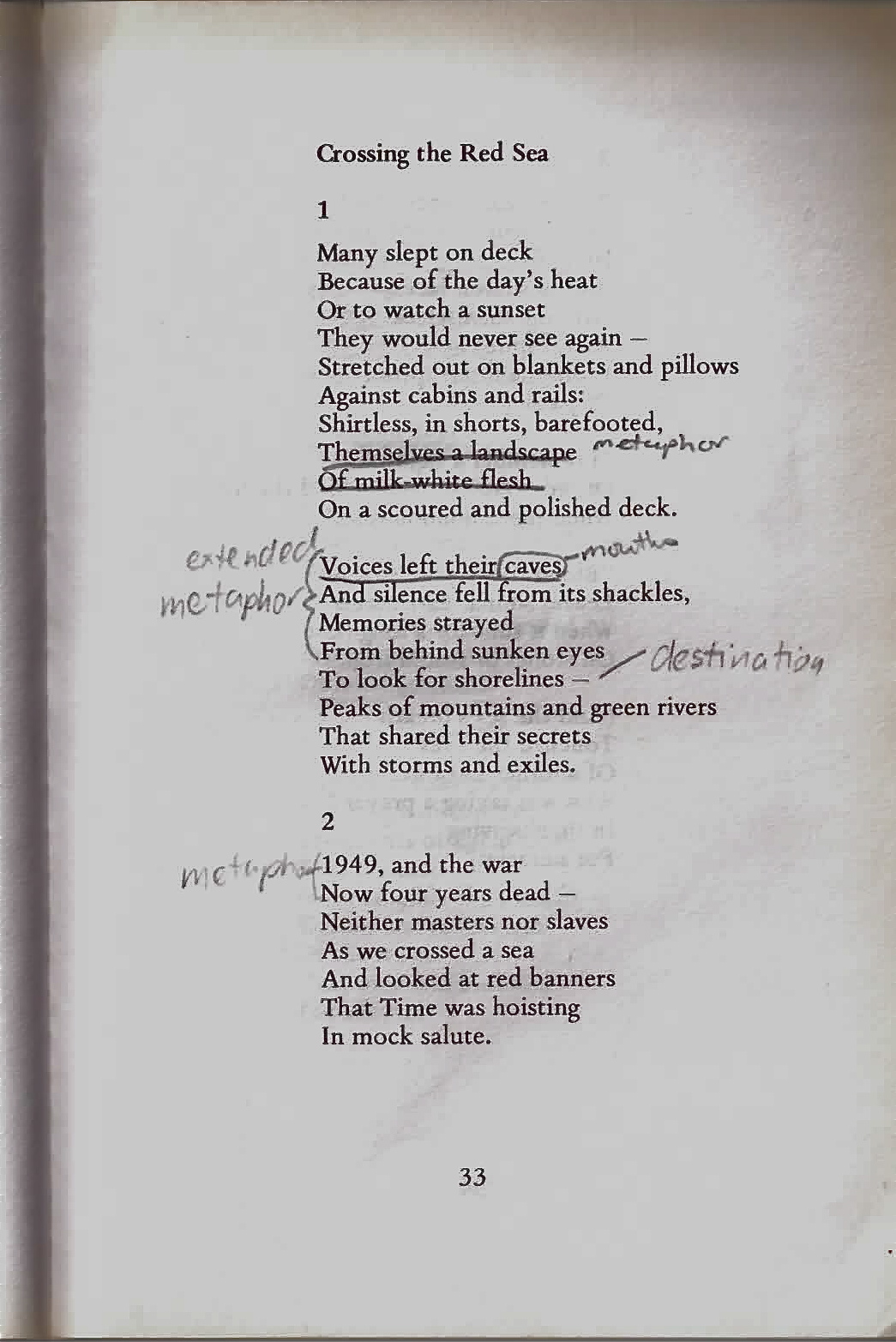
None of this should have anything to do with my reading the book, but the copy I bought bears the scars of having been ‘studied’, and they exerted a disproportionate influence on me:

This unhappy student’s search for metaphors succeeds in making the writing look awfully prosaic: for jus one example, if there’s a metaphor in ‘the war / Now four years dead’, it’s been dead a good bit longer than the war has. Yet the poem ‘Crossing the Red Sea’ (of which the above is the first of four pages) is a moving attempt to imagine the post-war emigrant experience.

The book isn’t a verse novel. There are poems about pelicans, a snake, Michael Dransfield, a death mask and so on. But it does encompass a narrative arc that justifies the Chronicle in the title. Apart from ‘Crossing the Red Sea’, there’s the much anthologised ‘Migrant Hostel: Parkes 1949–51‘ (if you click on the link, try to avoid the class notes at the end), and perhaps a dozen more, including some raw and melodramatic poems that seem to be about Skrzynecki’s mother’s experience of the ‘mental health’ system (though he explains on his web site that they are not to be taken as factual in every detail) and a number about becoming a father. A good part of the interest is documentary – that is, the poems are interesting because they inform us about ‘the immigrant experience’, or more accurately an immigrant experience.

Skrzynecki’s novel Boys of Summer was launched at Gleebooks last week – it deals with growing up Polish in Sydney suburbs in the 1950s. So he is still mining the same rich vein. But whereas now, according to the Gleebooks description, there’s a nostalgic flavour to the work, Immigrant Chronicle was written by the 20-something Skrzynecki, and there’s a pervasive, complex sense of the past’s insistent presence, memorably caught in the last lines of the final poem, ‘Post Card’ (which is also representative of what to me seems a peculiar flatness of the poetry). The speaker is looking at a ‘post card sent by a friend’ from Warsaw, his father’s lost home:

I stare
At the photograph
And refuse to answer
The voices
Of red gables
And a cloudless sky.

On the river’s bank
A lone tree
Whispers:
‘We will meet
Before you die.’