Category Archives: Books

Another fortuitous incident

From page 257 of Amy Wilentz’s book on Haiti, The Rainy Season (about which I’ll write more very soon):

When Duvalier fell, movements like Chavannes’, which had maintained a fairly low profile under Duvalier, burst out into the open and grew rapidly, only to discover that the network of power they thought had been undone by the Dechoukaj [literally ‘uprooting, as of a tree’, of the old regime] was still in place and ready to strike back at them when the time should prove fortuitous.

Amy Wilentz is no slouch as a writer. Her prose is finely tuned, her feel for language strong. The word as used here, as by any number of other thoughtful writers, just doesn’t mean – can’t mean – what the dictionary says it means: ‘happening by chance’. But I don’t recall seeing it used quite this way before, as a synonym for ‘opportune’.

This is why I’m fascinated by the word: it’s in such a state of flux that its meaning wanders all over the place: providential, lucky, opportune. It has an almost wild-card quality.

Love, Squalor and Seymour’s introductory exit

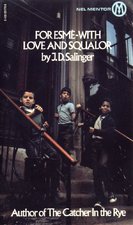
J D Salinger, For Esmé – With Love and Squalor (1953, New English Library 1978)

I read this at least partly because I wanted to learn more about the Glass family, particularly Seymour Glass’s suicide. The suicide is there, of course, in the first story in this collection, ‘A Perfect Day for Bananafish’, also Salinger’s first published story. It’s a good story, full of charm and then of shocking enigma, but there’s nothing to indicate that the author would still be probing the repercussions for the Glass family a decade later (not to mention possible further Glass Family fictions yet to be discovered … I live in hope). Boo Boo, the older of the two girls in the family, makes an appearance in ‘Down at the Dinghy’. And Buddy, the family’s self-appointed chronicler who is in danger of vanishing into his own parentheses in ‘Seymour: An Introduction’, plays a central role in the title story (at least, I assume Staff-Sergeant X is Buddy, even though I may be the only person in the world to have done so). In each of these stories, the adult Glass has a conversation with a child, and these playfully smart-alecky conversations are what lift the book above standard albeit ultra-sophisticated New Yorker fare. Boo Boo could be a forerunner of the mother in Maurice Sendak’s sublime The Sign on Rosie’s Door.  Buddy’s conversation with thirteen-year-old Esmé and her follow-up letter are surely meant to be read in counterpoint to Seymour’s chat with the little girl Sybil. The latter is either a farewell to all things lovely or a cryptic explanation of his suicide, while the former has a deeply healing effect: one brother dies, the other lives. (Incidentally, I doubt if either of these stories could have been written nowadays: in the late 40s the general reader wasn’t expected to see every man as a potential child-rapist.)

Two non-Glass stories stand out for me, both with child protagonists: ‘The Laughing Man’ and ‘Teddy’. ‘Teddy’ is genuinely shocking.

Incidentally, it occurs to me that my lack of enthusiasm for The Hurt Locker may have something to do with the fact that I saw it in the middle of reading this book. It was awfully hard to see the movie as anything other than an adrenaline pumper with pretensions when I had Staff-Sergeant (Buddy?) X’s shaking hands fresh in my mind.

American Rust

Philipp Meyer, American Rust (Allen & Unwin 2009)

This is another Book Club book I approached with caution. At last year’s Sydney Writers Festival, Philipp Meyer read from it  in a sleep-inducing incantatory manner that I think of as peculiarly US-literary and which made the book singularly unattractive – at least it did to me. But in the spirit of challenging my own prejudgments, I chose it as one of my take-homes at our last Book Club meeting, and eventually opened it up. (Can you tell the next meeting of the Book Club is approaching, when I’ll have to return these books, and that I’d be embarrassed to admit to not having read them?)

This one confounded my negativity. The book is beautifully written and has a plot that, thriller-like, gathers momentum to a nailbiting last 20 pages. It’s set in Buell, town in Pennsylvania, on the banks of the  Mon River, and the place is probably the single most strongly realised character of a strong cast. Factories have closed down years before the action of the book, and the town, like all its neighbouring towns, is in a bad way. There’s little to keep people there except loyalty to each other and to the place itself. The decaying buildings of the abandoned enterprises are in stark contrast to the natural beauty of the countryside.

The plot traces the repercussions of a killing: a young man kills a homeless man to save his best friend from serious harm, and the ripples spread from the two young men, the sister and father of one of them, the mother of the other and the local police chief, who is in love with the mother. Each of the six main characters sees himself or herself as in some way responsible for the death, and each of them has a point. This is deftly done: despite the terrible sense that these working-class communities have been abandoned by the forces of capitalism and government and left to increasing dysfunction, violence, drugs, despair, these are still deeply moral characters. Good people do terrible things in this book, and we come to realise that none of the people who do terrible things in it are simply evil.

There are some longueurs (it may have been one of them that Philipp Meyer chose to read at the SWF), and some darlings that perhaps should have been murdered, but the characters ring true and are never patronised, the many-stranded action makes the book hard to put down, and in the end some kind of dignity, if not happiness, is salvaged from the mess.

For Book Club purposes, I’m giving it 4 1/2 out of 5.

Wanting

Richard Flanagan, Wanting (Knopf 2008)

Even though I’m addicted to print, or perhaps because I am, I approach most books with a kind of resentful suspicion. It’s as if I’m projecting onto the book an anxious feeling that Schopenhauer might have been right when he said, in the essay ‘Thinking for Oneself’:

Reading is thinking with some one else’s head instead of one’s own. … Nothing is more harmful than, by dint of continual reading, to strengthen the current of other people’s thoughts. These thoughts, springing from different minds, belonging to different systems, bearing different colours, never flow together of themselves into a unity of thought, knowledge, insight, or conviction, but rather cram the head with a Babylonian confusion of tongues; consequently the mind becomes overcharged with them and is deprived of all clear insight and almost disorganised.

I came to Wanting with my normal ambivalence, plus an extra burden of suspicion, because the only other novel by Richard Flanagan to have entered the cram in my head was the abysmal Unknown Terrorist. I was willing to give this one a go because he writes compelling non-fiction, and the earlier, terrible novel was set a long way from his native Tasmania, in a place he clearly loathed and equally clearly didn’t know at all well, whereas this one is largely back in Van Diemen’s Land. Book Clubbers recommended it (that’s the Book Club, where we swap, not the Book Group, where we discuss). I took it home and eventually opened it up.

I wish I could say my suspicion evaporated within a couple of pages, but I can’t. A Protector of Aborigines, Charles Dickens, Lady Jane Franklin (widow of Sir John Franklin, Governor of Van Diemens Land and explorer) are introduced to us in a series of clunkily expository scenes. That would be all right, but the clunkiness comes with lashings of heavy irony – the narrative voice is unpleasantly insistent that it knows better than the Presbyterian Protector, and really really wants us to know it doesn’t share the genocidal racism of all the white characters. Maybe things would improve once the story got under way, I thought. But there were other discouraging signs. On page 14, to pick the most striking example, the Presbyterian Protector, in 1851, sings some lines from ‘Lead Kindly Light’. That’s unlikely, I thought, given that the hymn was written by high Anglican John Henry Newman, no friend of Presbyterians. Fifteen seconds with Google revealed that though Newman wrote the words of the hymn in 1833, it wasn’t until 1857 that someone put them to music. So it’s not only unlikely, it’s a straightforward anachronism. And I don’t think that’s just nitpicking. If the novel, having already repeatedly pronounced judgment on this character, doesn’t care enough about him to know what hymns he would or even could have sung, why should I trust anything it says about any of its characters?

I did read on. But by page 55 I realised I was motivated entirely by some weird sense of obligation. There was no pleasure. I didn’t believe a word. I put the book back on the shelf. It may be very good. It may fully deserve the awards and critical praise it has attracted. It may successfully mirror the terrible anguish that accompanied the belief that Tasmanian Aboriginal people were about to die out, as an author’s note says it aims to do. It probably is a moving meditation on the conflict between reason and desire or some other Significant Dichotomy. I’ll never know. And I probably won’t bore you ever again with blog entries on Richard Flanagan’s work.

More Glass family reading

J D Salinger, Raise High the Roofbeam, Carpenters & Seymour: An Introduction (1963, Bantam 1965)

What a rich vein the Glass family were for Salinger! I laughed out loud a lot during ‘Raise High the Roofbeam, Carpenters’, at one level a classic New Yorker comedy of manners, and I was hypnotised by the convolutions, involutions, circumvolutions of ‘Seymour: An Introduction’ as Buddy Glass is still coming to terms (coming to words?) with his relationship to his numinous elder brother a decade or so after his suicide.

Franny and Zooey revisited (not reviewed)

J D Salinger, Franny and Zooey (1961, Bantam 1964)
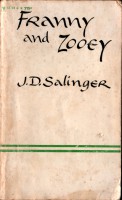
Franny_and_Zooey ImageAccording to the little red notebook I kept at the time, I read Franny and Zooey in 1962, when I was 15. My eldest brother, Michael, who was then 24, introduced us younger ones to much that was sophisticated, including classical music (played loud ‘so you can hear it properly’), rock and roll (danced with a slack-jawed deadpan expression I’ve seen nowhere else), Mad magazine, Jules Feiffer, sick jokes (‘Mummy, why do I keep walking in circles?’ ‘Shut up or I’ll nail your other foot to the floor’), and J D Salinger. So where other people found in Holden Caulfield a mouthpiece for their own teenage alienation, I read him dutifully in the footsteps of my luminous big brother. I moved on to Franny and Zooey in a similar mode, and what I remember is mainly that I was very pleased with myself for having read such a sophisticated book. Kerryn Goldsworthy blogged recently about how significant Franny and Zooey was to her as a 16 year old. The one moment that I retained, revelatory to me in its own way, was in ‘Franny’. Lane has been going on about his brilliant seminar paper. He pauses for Franny’s response. She says:

‘You going to eat your olive, or what?’
Lane gave his Martini glass a brief glance, then looked back at Franny. ‘No,’ he said coldly. ‘You want it?’

I couldn’t have told you why, but I felt I’d been allowed into a great secret at that moment. I had no idea what Lane was talking about – Flaubert, ‘capital-F Freudian’, the mot juste were droppings from the inscrutable world of adult discourse. But I understood that Franny found his olive more interesting than his monologue, and that his coldness was full of unspeakable emotion. The door to understanding the adult world was creaking open for me.

When I read it just now, I realised that the book had been much more influential than I realised. Everything I wrote from the age of 16 to 30, at least when I was trying to appear intelligent, aspired to sound like Buddy Glass (‘Zooey”s narrator) – the complex syntax, the self-deprecating hi-falutinness, the over-use of words like ‘rather’, and so on. Though I’d forgotten it, Zooey’s tirade about the importance of not moulding Jesus to fit one’s own psychological needs ranked with Dostoevsky’s Grand Inquisitor (I read The Brothers Karamazov two years later) as a major outside perspective on my intensely held Catholic faith.

As I started ‘Zooey’ this time, I doubted whether I’d actually ever read it. maybe I’d listed it in my notebook as a bit of wishful thinking. But from the scene where Zooey sits in the bath and first reads a very long letter from his brother  and then has a very very long, snitchy conversation with his mother, through the conversations with Franny who is in the middle of a nervous breakdown, I was amazed at how intensely personal it felt. It’s not as if I remembered individual passages –more like I was reopening old neural pathways, as if the book hadn’t been remembered in a normal way but somehow stored at a cellular level. That is to say, I have no idea what I’d have made of it if I’d read it for the first time today.

It’s embarrassing. I’d thought all those people who talked about how Salinger’s work had changed their lives were, um, a bit phoney. Now I discover that if I’d kept closer – or perhaps smarter – track on myself, I would have been one of them.

My Book Group Is Illuminated

Jonathan Safran Foer, Everything Is Illuminated (2002, Penguin Australia 2008)

I read five pages of this when it was freshly published, and decided it was not for me. It’s rare for me to dismiss a book like that, so I dipped ahead reading a page here, a page there, and found absolutely nothing to change my mind. Then at the December meeting of my Book Group, a number of people were keen to put it on our agenda, and they won the day. So, eventually, I bought a cheap copy (all the libraries’ copies were out) and set to work. By the time the group met last night, I’d finished it, though I did skim the last 20 pages so I’d have time to cook the dinner. There are some very strong bits, as it turns out to be a story of a small Ukrainian village whose entire Jewish population was murdered by German soldiers, counterpointed by a ludic tale of the Jonathan Safran Foer’s forebears’ lives in that village.  I can see why the book received such acclaim, but pretty much the first half is taken up with ha-ha-I’m-being-funny humour and an awful lot of the shtetl story that felt contrived, inconsistent and disrespectful, like Isaaac Bashevis Singer off the rails; the thesaurus-driven voice of the Ukrainian Alex, who narrates the modern-day quest for the village, eventually toned down as it got to the point, but by that time I had endured too much that was weary, stale, flat and unprofitable. My moment-by-moment irritation robbed the narrative of almost all momentum. In the hope that mine was a minority response, I came to the group resolved to listen and learn.

The book found no stout defenders among us. Roughly half hadn’t managed more than 20 pages or so. The man who’d liked it most – we think he was the one who proposed it – had seen and enjoyed the film, and admitted that when he read the book he skimmed the bits that weren’t in the film, which meant all the shtetl stories, all the clever literary bits (some would say these were darlings that should have been murdered), and the worst excesses of the mangled-English narration.

The reason we’d chosen this book is that we wanted to see how it went if we watched a movie of the book under discussion. So after dinner we watched Liev Schreiber’s Everything Is Illuminated. All O knew of the movie beforehand was from glimpses seen in Operation Filmmaker, the achingly funny documentary about an Iraqi intern on the shoot, in which Liev Shreiber and others came across as humane, generous and admirable people who clearly believed in their project. I don’t know that I liked the film all that much: the Elijah Wood character (‘Jonathan Safran Foer’) was too weird, and there were some awful saggy bits. It was fascinating to watch it so soon after reading the book. The ancestral story – roughly half the book – was sheared off. The second of the two revelations at the end was replaced with something much less interesting, less morally complex. A climactic action that almost made sense in the book made no sense at all in the film. And the upbeat ending was despair-inducing. Paradoxically, the film made me appreciate the book much more.

A pleasant evening was had by all, even the two dogs, who managed to bully someone into throwing a ball for them more than once. Next month, not Franny and Zooey or Arctic Dreams or The History of Knowledge or Wildlife, but Peter Temple’s Truth. We wanted a page-turner.

White Rabbit revisited

Yesterday we visited The Tao of Now, the new exhibition of contemporary Chinese art at the White Rabbit Gallery in Chippendale, and had a very good time. The wonderful bright red pig car whose tongue soars to the ceiling and has another, golden pig and two other figures hanging from its tip – that and other pieces that were in the foyer previously are still there, but the three upper floors have had a complete makeover and the works are as fresh and surprising as the last lot.

As we were chatting over a display catalogue of Qin Fengling’s work, a tall silverhaired woman with a chihuahua on her arm (‘He will bite,’ she said later) joined our conversation, saying, ‘We have her red piece, though not in this exhibition.’ She flipped through the pages and showed us the piece she meant, and then went on to say that the Guggenheim had been interested in it, but she’d beat them to it because she didn’t have to secure a committee’s approval.

Aware of my solemn responsibility as blogger cum citizen journalist, and sharp as a tack as always, I said, ‘You must be … the owner.’ Those three dots represent the moment in which the name ‘Judith Nielson’ didn’t get past the tip of my tongue. She didn’t seem to mind. ‘Not the building,’ she said. ‘That’s my husband. But yes, I own the artworks.’

We chatted for a couple of minutes (there were five or six of us in the room – that citizen journalist thing was definitely a joke), and she said something that explained part of the appeal of the gallery: ‘I never buy something because of the explanation. If I need to read about a work to be able to enjoy it I’m not interested in acquiring it. But once we’ve bought it and have it back here, we have a whole machinery that swings into action to fill in the background.’ and it’s true: whether it’s the motorbike and sidecar crocheted out of bright blue wire, the interactive screens based on classic Chinese watercolour scrolls, or the giant painting of a headless Mongol archer looking out over Tien an Minh square, the works in this exhibition grab the attention first, ask questions later. It’s a bonus that there are attendants on every floor who are keen to raise and answer the questions.

I don’t suppose Ms Neilson and her tiny, dangerous dog are always there, but clearly they sometimes are, as an extra special bonus.

Bloom & Blair’s Islam

Jonathan Bloom & Sheila Blair, Islam: A thousand years of faith and power (Yale Nota Bene 2002)

I bought this book some years ago in the hope of finding some insight into how a religion that has sustained so many people for so long over such a geographic and cultural range could be used to justify the barbarity of suicide bombings and videoed beheadings. Since I don’t have much insight into how Christianity or Judaism can be used to justify mass murder either, and I’m already reasonably familiar with at least some parts of the former, maybe I should have expected my hope to be dashed, but it springs eternal, and trust in book-learnin’ is hard to shake.

The authors’ expertise, and presumably their passion as well, lie in Islamic art. This book was written to accompany a US television series, and despite its self-described aim as ‘to help Americans – of whatever and even no religion – understand the religion and culture of another place and time’, what it actually does is to provide background, to tell the grand, sweeping narrative of the beginnings, growth and spread of Islam in its first thousand years, with an inevitable emphasis military conquests and defeats, political struggles and religious strife, with a couple of welcome chapters on the flourishing of science and poetry between 750 and 1200 CE. The succession of dynasties and ruling elites – Abbasids, Barmakids, Chaghatayids, Fatimids, Ilkhanids, Mamluks, Mughals, Ottomans, Seljuqs, Umayyads – is as bewildering and at times as dull as the begats of Genesis.

I’m not complaining. In fact I wish I’d read the book 50 years ago as a supplement and antidote to the Eurocentric version of world history I received in my schooling. It’s bracing to read the stories, even in broad outline as here, of people and places that I know mainly as elements of  Orientalist decor: Saladin of the curly-toed shoes becomes Salah al-Din ibn Ayyub; Suleyman (isn’t that the guy from Lord of the Rings? – yes, I’m that ignorant) ruled the Ottoman Empire for 46 years, Marlowe’s Tamberlaine the Great becomes Timur, a Great Mongol conqueror; Samarkand, Timbuktu, Xanadu all existed outside romantic poems and fantasy literature. Many things I have assumed to be creations of Western culture are in fact borrowed from the Islamic world: romantic love I already knew about, but x as a way of representing an unknown in maths was news to me; The Divine Comedy wouldn’t have existed if Dante hadn’t read in translation popular Arabic stories of Muhammad’s mystical journey to heaven.

I’d just finished the book when I heard Ramona Koval on The Book Show with James Delgado talking about his Khubilai Khan’s Lost Fleet. As Ramona, helping out her audience by displaying her own real or pretend ignorance, wrestled with the difference between Khubilai Khan and Genghis Khan, I realised how glad I am to have read Bloom and Blair’s book. If I had read it 50 years ago, when my memory was much more retentive,  I might have emerged from it knowing who all those people were. As it is, I can expect the names to ring some kind of bell, and I’ll know where to look for a quick rundown – and yes, as well as a list of further reading, this book is blessed with a substantial index.

A short walk

Philip M. Isaacson, A Short Walk Around the Pyramids & Through the World of Art (Knopf 1993)

I don’t do much re-reading of old favourites. Maybe I should. I first read this when it was new, with an eye to possibly publishing an excerpt in the School Magazine. (We had reviewed and excerpted Philip M Isaacson’s marvellous first book, Round Buildings, Square Buildings, & Buildings that Wiggle Like a Fish.) I picked it up again today because Penny had taken it to read to Mollie in the nursing home, and reported that it had been a great success – not just for the photographs of the pyramids, but also for the actual reading-aloud, at least of the first few pages.

It’s a minor miracle of a book. The author is an art critic, writing a general introduction to art for young readers, and he manages to do it without a whiff of the pedagogical. Hayao Myazaki’s motto, ‘Get lost along with us,’ seem to apply. We go from the Egyptian pyramids, by way of the Parthenon and African traditional art, to Jacques Lipchitz, Alexander Calder, painters including Vermeer, Monet and Gauguin, and then on to photography, industrial design, urban design, all at a leisurely stroll. It’s not a lesson, but a lively conversation, with at least colour illustrations.  The imagined reader / interlocutor may be a child, but I can’t see any upper age limit on those who might enjoy it.

One question: If the Step Pyramid, which dates from a little more than 4600 years ago, is ‘among the oldest works of art in the world’, what does that say about the rock paintings in Australia and elsewhere that are closer to 30 000 years old?