Category Archives: Books

Adamson’s best of 2009

Robert Adamson, The Best Australian Poems 2009 (Black Inc 2009)

This is an excellent anthology. In fact, in the context of previous years’ round-ups, both from Black Inc and UQP, it’s a strong contender for Best of the Best. It includes a wonderful range of poetic styles and modes and subjects – incomprehensible post-modern stuff, impassioned story-telling, linguistic virtuosity, delicate lyric. There’s Clive James‘s assured iambic pentameter, Pam Brown‘s asthmatically short lines, Ali Cobby Eckermann‘s lines you might need to know didgeridoo breathing to recite adequately. In the introduction, Robert Adamson talks about his solution to the difficulty of reducing his short list to fit the space available – he persuaded Black Inc to give him more space. I’m glad he did, and that he kept commentary, analysis and explanation to a bare minimum. He does offer this gem of commentary:

People ask me, why are so many bird poems being written and published? I have a theory: we miss having poets among us who can imagine that a soul can ‘clap its hands and sing, and louder sing’, that we need to acknowledge visitations by intense psychological presences, and that birds are the closes things we have, more or less, to angels.

Perhaps that’s mainly a clue as to how to read his own poems, but it’s an interesting general thought as well.

I’m not going to try to name the poems I liked best.  My copy has far too many page-corners turned down for that.

As I was reading this anthology, my Art-Student Companion, as part of her preparation for an assignment on Australian Federation, was reading The Sentimental Nation by John Hirst, and kept regaling me with interesting bits about the major role poetry played – poetry, he says, is ‘the best guide to the ideas and ideals that inspired the movement’ for Federation, and again: ‘The nation was born in a festival of poetry.’ Well, even though poetry festivals rarely make the news pages these days, to judge by this book poems are still looking for words for what inspires and ails us as a nation and a species. But now, instead of writing bush ballads or ponderous and forgettable sonnets, they tell about Iraq, global warming, the ills of capitalism, but they tell it slant. There are any number of examples, but I’ll just mention Luke Davies’ ‘Maldon, 991 AD’ which ends:

oooooooooooo I felt an outsider
to laughter. Out there the Vikings sang,
that was more like it, something eerie
to get spooked about, distracted by:
and the world so tenderly
unveiling its final unveiling.

I was also struck by the sense of community among the poets, particularly as shown in the number of poems honouring those who have died: Dorothy Porter (‘Word‘ by Martin Harrison), but also John Forbes (‘Letter to John Forbes‘ by Laurie Duggan, Jan McKemmish (Pam Brown’s ‘Blue Glow‘), Francis Webb (‘Reading Francis Webb‘, by Philip Salom [the link is to a PDF]) and Bruce Beaver (a couple of mentions, but mainly Peter Rose’s beautiful imitation, ‘Morbid Transfers‘).

Buying this book in March felt a little bit silly, like buying hot cross buns in July, but it turns out it’s not a seasonal thing at all. It’s an anthology that I’m sure I’ll go back to.

Footnote: One of my wise younger relatives recently chided me for reading while walking: ‘It’s as bad as walking around with those things in your ears, Jonathan,’ she said (by which you can she’s not so very young). ‘You have to let the world in.’ She may be right in general. But sometimes reading while walking is a way of letting in both world and poetry. The other morning I was throwing the ball for Nessie at the bottom of the hill and noticed that the longish grass was pearled with dew so that previous walkers both human and canine had left tracks of darker green, and the rosellas wouldn’t shut about something. I realised it must have rained quietly in the night. The next words I read were these, from Sarah Day’s ‘A Dry Winter: Some Observations About Rain‘:

… an elemental transition from dry to damp.
Listen, you can hardly hear its outward breath

on the tin roof. In the morning,
grass and earth are wet and everything

but the mercuric globe in the nasturtium leaf
is translucent.

I don’t know anything about nasturtiums, but the rest could have been a condensation from my surroundings. (The whole poem is lovely, by the way.)

Added later: Tara Mokhtari on the Overland blog has a completely different view. She does identify herself as a ‘shunned poet’.
Fun with the Crowds

We went this morning to what we’re told these days is even more popular with Australians than the beach or the footie – the art gallery. Specifically, we went to the Art Gallery of New South Wales for the equivalent of a Grand Final, The Archibald Prize. We bought our concession tickets (I’m a senior, my companion a student) and joined the milling crowd. I liked the winning portrait of Tim Minchin (Penny didn’t). I lay on the floor to get a proper look at the distorted figure in The Alternative Ambassadors (which really ought to have been hung at the top of a staircase, or at least had a comfortable cloth on the floor beside it): ‘It’s a baby,’ I said to those who were too restrained to emulate me, ‘or perhaps a foetus.’ ‘A foetus, definitely,’ said a young woman who was flexible enough to have had a proper look without actually lying down.

In the People’s Choice I voted for Apple Yin’s ‘Previous Life‘, a portrait of a Melbourne personality as a beggar on the Silk Road in a past life. I wondered how Robert Hannaford’s magisterial portrait of Malcolm Fraser would have turned out if give a past life treatment? A Renaissance cardinal, perhaps, or a noble prisoner in the Tower of London?

There were lots of lovely things in the Wynne, including some austere Aboriginal works. I liked the winner, and was glad that among all those huge canvases it was the three smallest works that won the Archibald, the Wynne and the watercolour prizes. The Sulman mostly left me bemused, as it often does. If a work of art is supposed to be something you can look at for a long time and over a long period and still find fresh (and I know that’s a big ‘if’), how come a one-note joke won the Sulman? (You understand I speak as one who knows very little about art, and would generally recommend you listen to the brilliant Imants Tillers, this year’s Sulman judge, rather than me, on such matters, but I really don’t get it.)

We walked the length of the city, chatting happily, arguing with John McDonald in his absence, to Haymarket where we had a most satisfactory yum cha in the vast Marigold, apparently in the company of everyone who wasn’t actually at an art gallery.

Easter, the festival of the changing season, and this year also of putting the clocks back, draws to a close. I hope you’ve had a good one too.

Patricia Wrightson and Chinese poetry

This blog post is the love child of two recent ones.

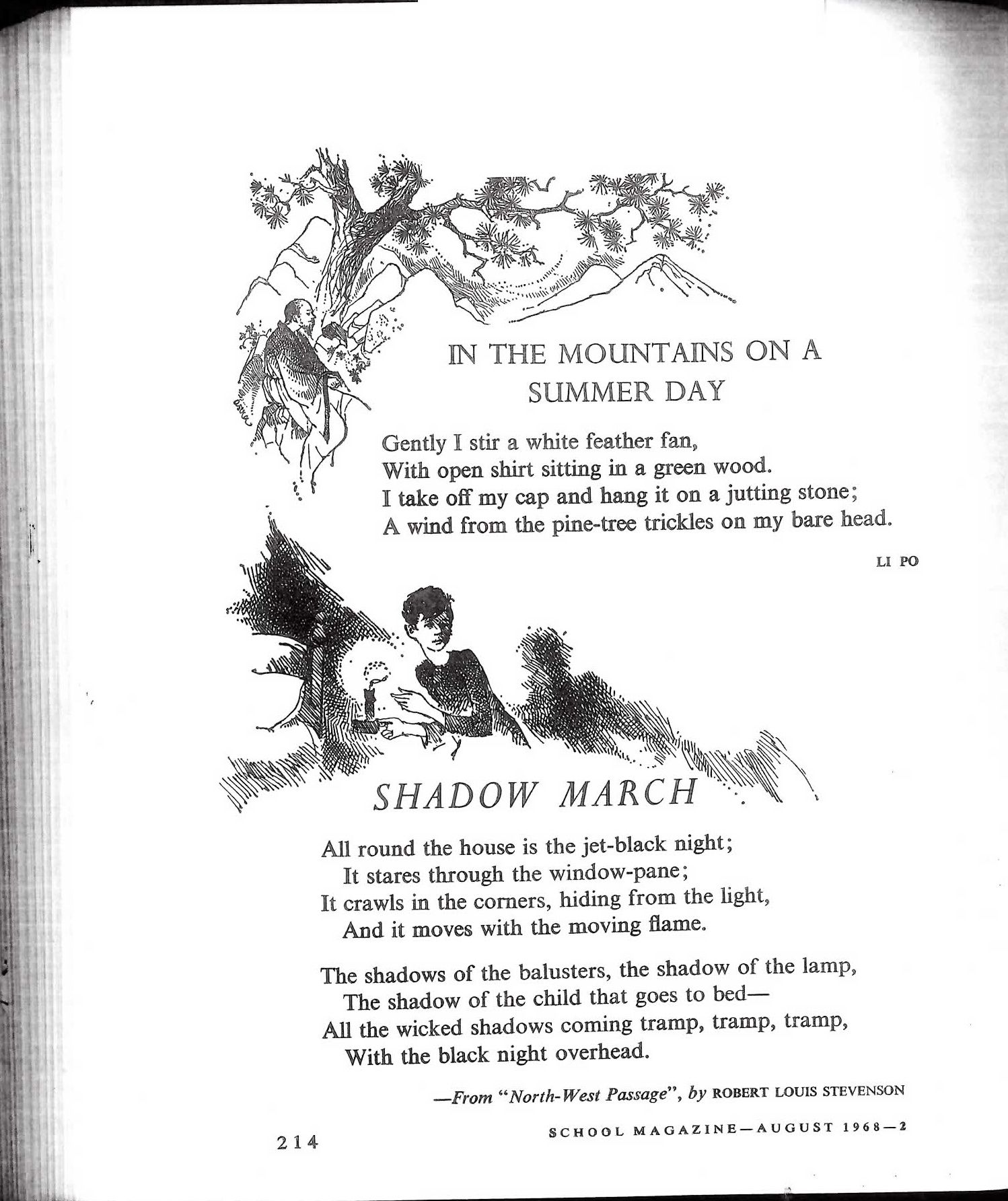
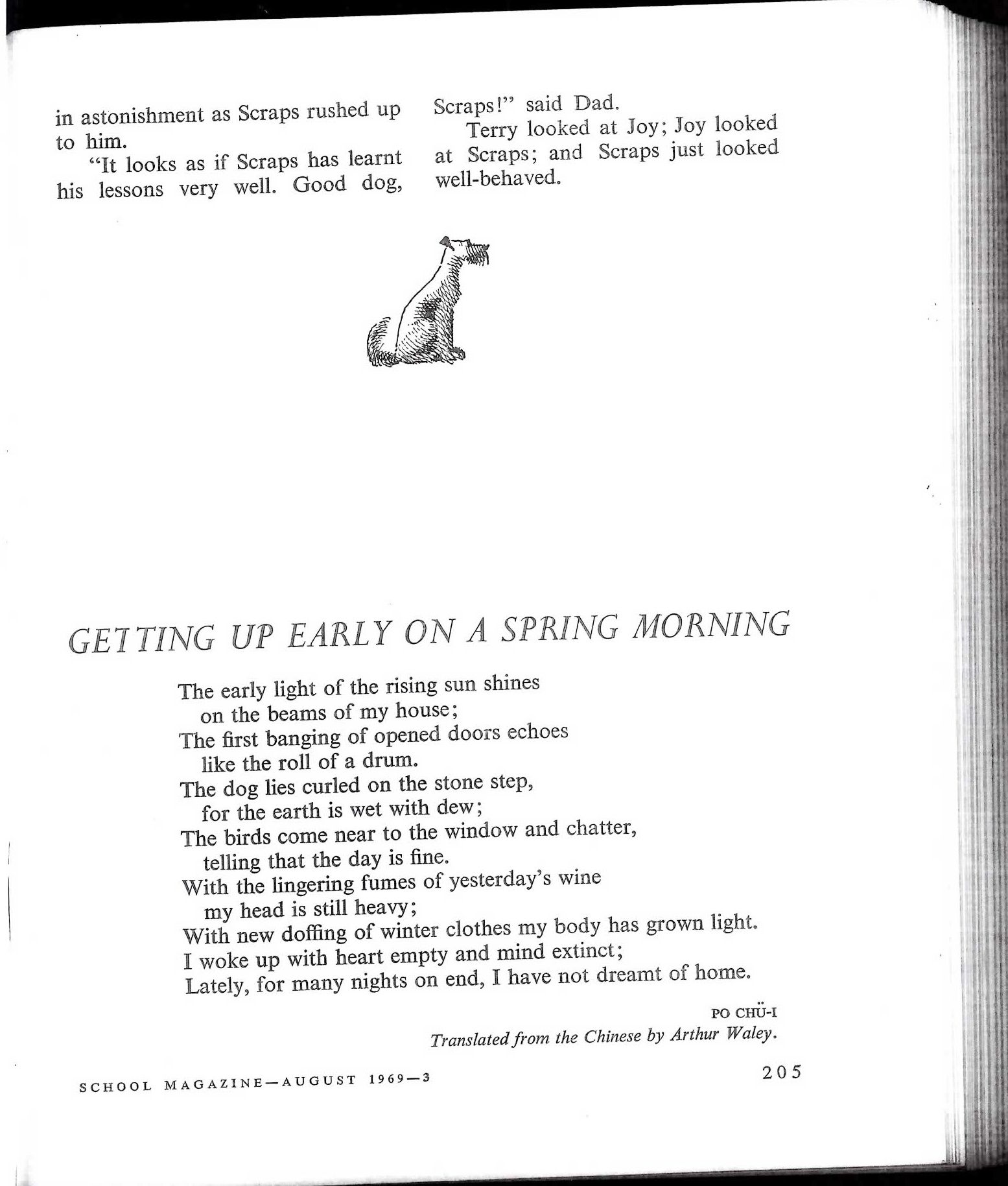
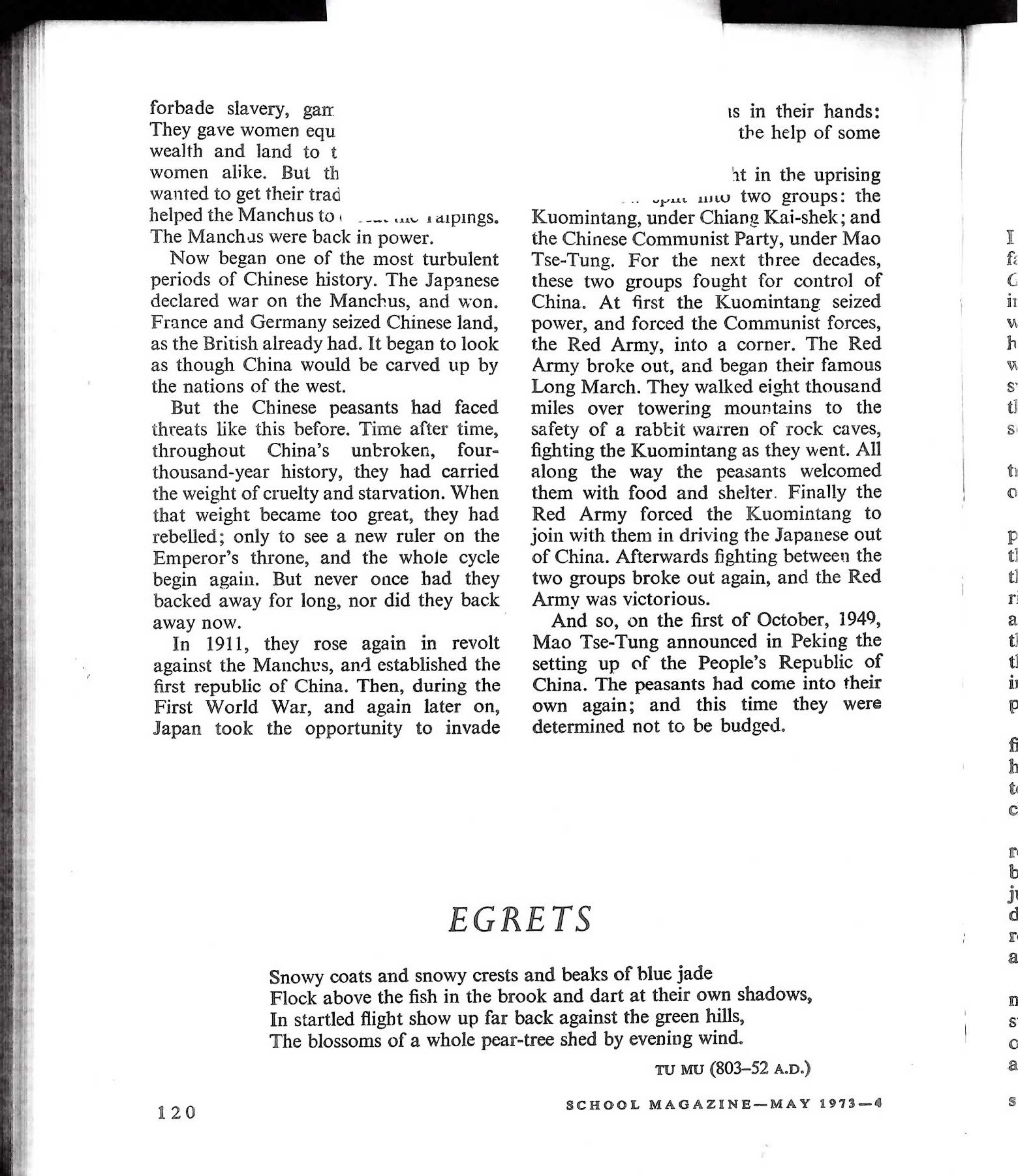
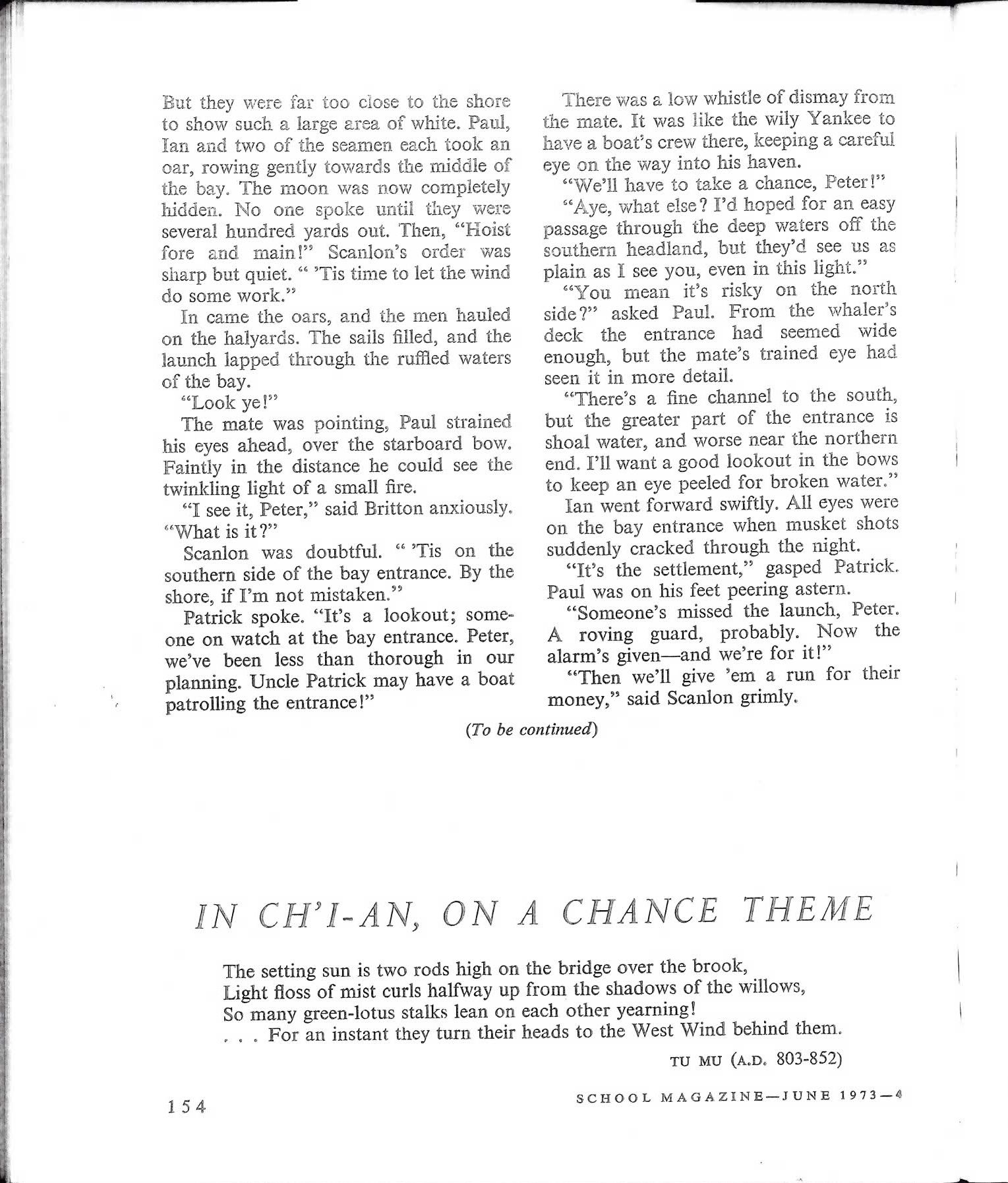
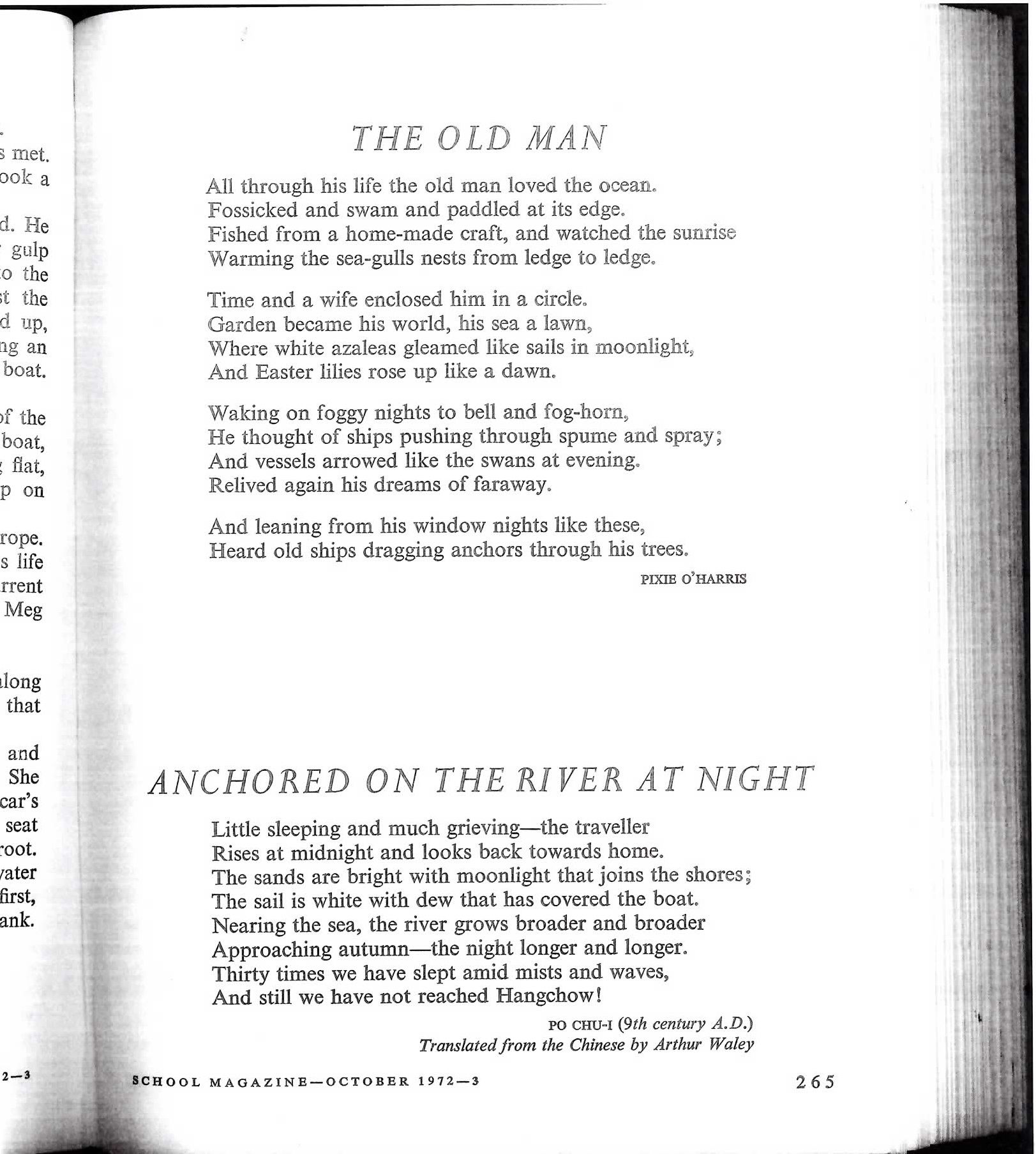
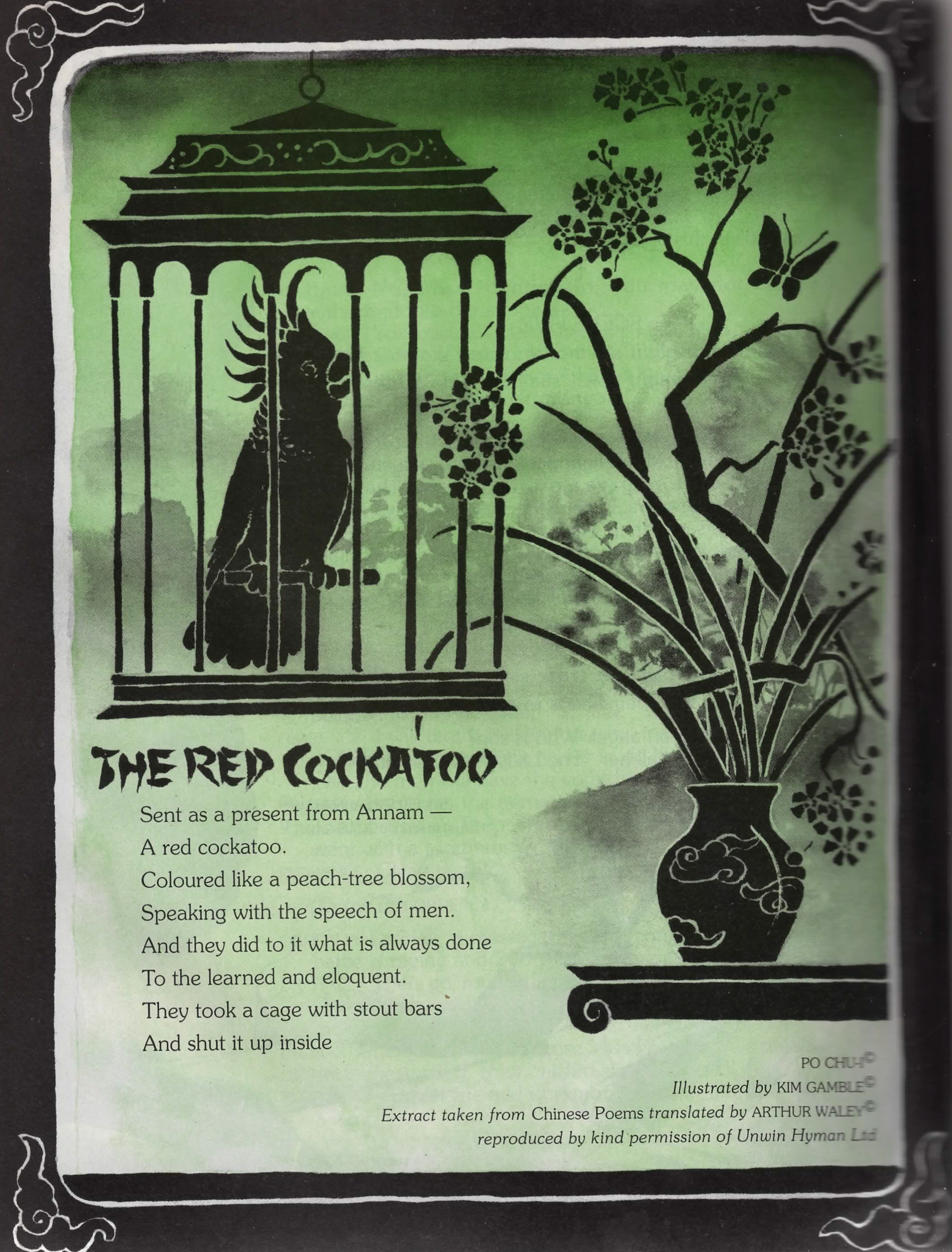
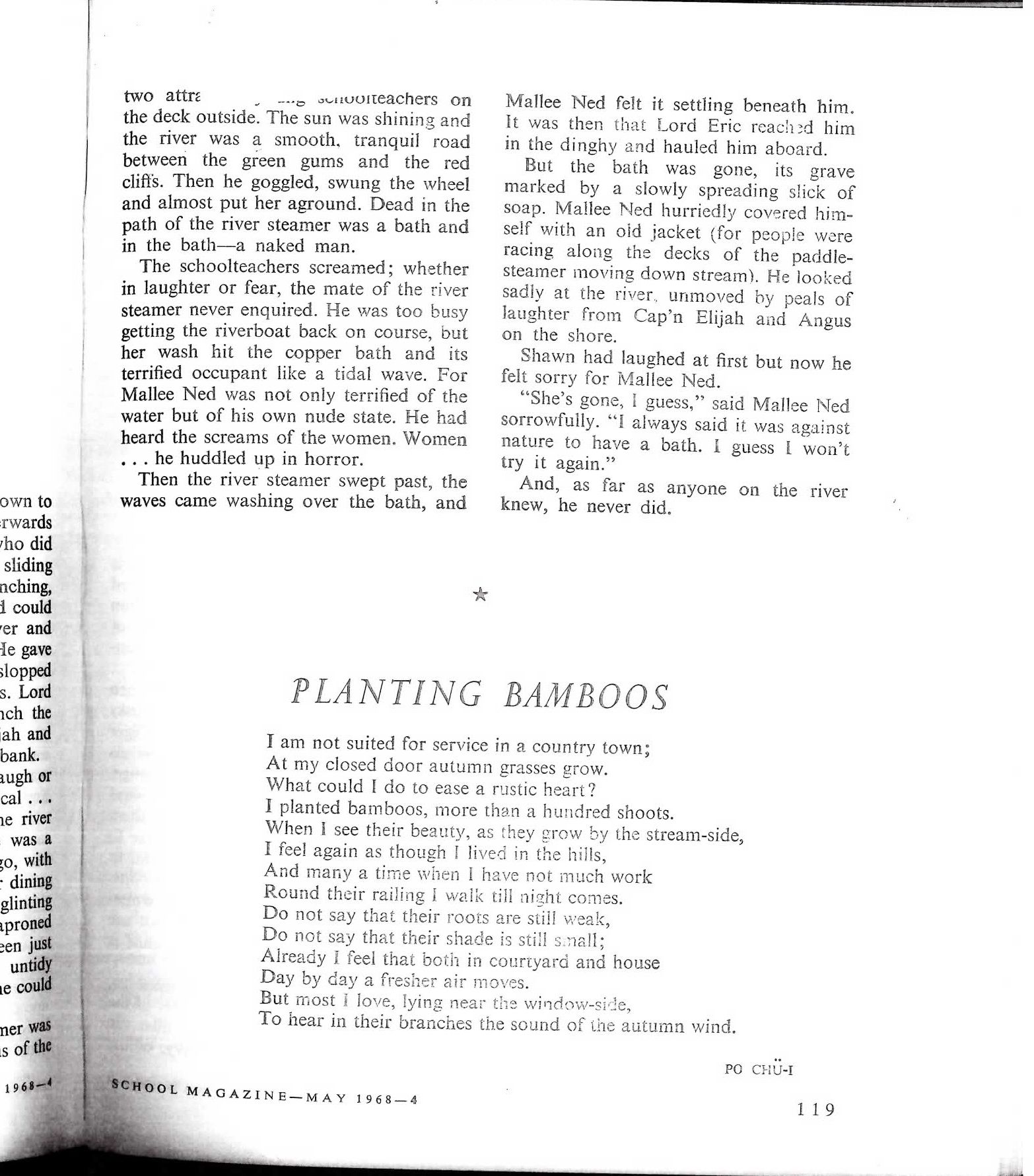
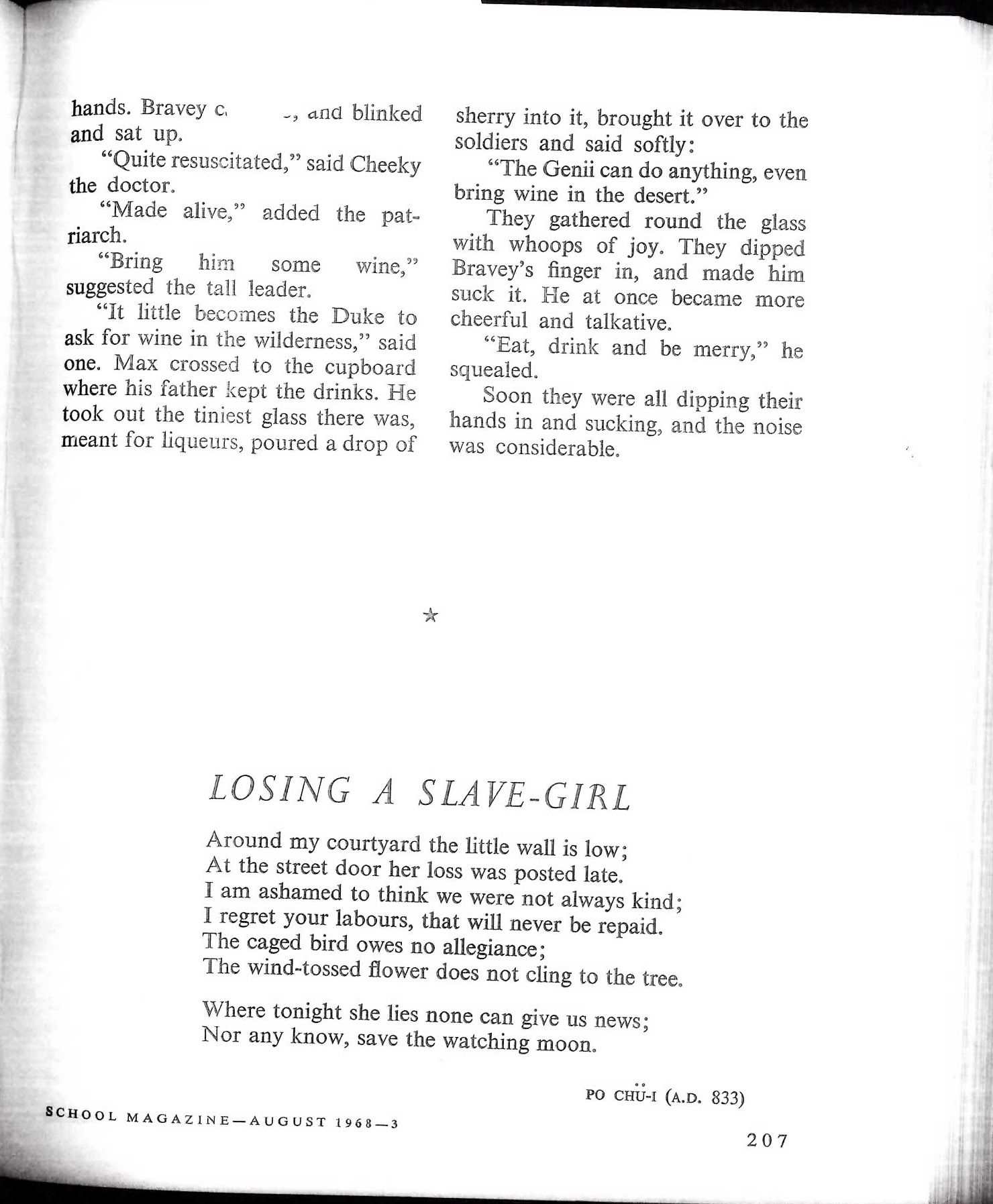
Patricia Wrightson was on the editorial staff of the School Magazine from the mid 1960s and was its editor for pretty much the whole 1970s. My acquaintance with Chinese poetry prior to reading J P Seaton’s anthology came largely from poems published in the magazine during those years. None of the poems I could lay hands on were published in the anthology. I think they are all translated by Arthur Waley. They all stand on their own merits, not sending the reader off in search of that which they have translated (not, as I was saying when blogging about the anthology, that there would be anything wrong with that – in fact, from some points of view, a translation should make a reader go searching for the original).

Click on the thumbnails to read the poems and see a little of their contexts in the magazine: Robert Louis Stevenson, Pixie O’Harris, a story about a dog, a Pauline Clarke serialisation, a historical article. The illustration of Li Po’ s ‘In the Mountains on a Summer’s Day’ is by the great Astra Lãcis. The last one, illustrated by Kim Gamble, was published in my day, but I found the poem in back copies from Patricia’s era.

Shambhala Chinese Poetry

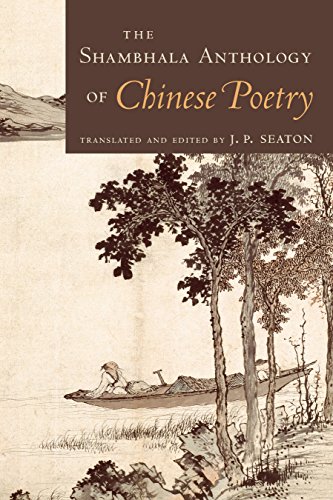
J P Seaton (editor, & translator of most poems), The Shambhala Anthology of Chinese Poetry (Shambhala 2006)

This was a present for my 60th birthday. I was delighted to receive it but obviously, given that I’m now 63, I was slow to actually read it. Seymour Glass’s passion for Chinese poetry and wisdom is what provided the necessary extra spur (I mean, who was that poet who wanted to be a dead cat? And why?).

The anthology opened a space in my head. It didn’t answer the question about the dead cat (the dead cat poem is absent), but it raised many more. It covers 3000 years of Chinese poetry in 246 pages, including notes. It would hardly be fair to expect more than a taster. What’s more, it would be unrealistic for someone as ignorant of Chinese history and culture as I am to expect more than broad-brush help with interpretation. Despite J P Seaton’s lucid introduction and notes, I confess that many if not most of the poems eluded my grasp – all those proper names and elliptical allusions to Taoist, Buddhist and Confucian traditions amounted to little more than mystifying clutter to my uneducated brain. I could appreciate some lines, like Li I’s wonderfully cinematic

Three hundred thousand men, among these rocks,
this once, as one, together turn: gaze on the moon.

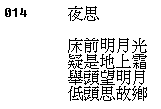
I was moved by some whole poems. But all too often I felt as if I was reading a coded message or a paraphrase, missing the actual poetry, roughly an equivalent of ‘Will I compare you to a day in summer? / You are prettier and cooler: / Strong winds rustle May’s lovely blossoms, etc). Once I caught myself thinking, ‘I hope I get to read that poem one day.’ It became obvious to me that if I am to understand and enjoy this poetry I need to devote a lot more time to it. And maybe I will one day. For now I’ve decided to play around in one poem, ‘Thoughts of a Quiet Night’ by Li Po (701–762). I went searching and found an image of the actual poem, on the China the Beautiful site:

That’s 20 characters. On the Poetry Kit site, Li Po’s biographer An-Lee Chang Williams gives a literal one-word-per-character version:

Bed  fore  bright  moon  light
Doubt  is  ground-on  frost
Raise(d)  head   gaze  clear  moon
Dropp(ed)  head  reminisce  home  country

It’s starkly obvious that a translation has to do more than give such a word-for-word rendering. (Incidentally, I notice that even here, if my copied image is correct, the same character has been rendered as ‘bright’ in line 1 and ‘clear’ in line 3.) In his introduction, J P Seaton discusses the visual qualities of the Chinese:  the first line ‘contains among its five characters a moon (the pictograph for moon) and two more moons, one in the compound ideograph bright and another shining dimly and insistently out of the character for the preposition before.’ He comments, ‘The writing system lets Li Po literally fill his little poem with moonlight.’ He doesn’t mention the difficulty of reproducing the musical effects of a tonal language, or the complexities of navigating the distance between the two grammar systems, or what to do about deeply ingrained terms of reference or understandings of poetic form (though he does discuss form elsewhere).

Translating  a poem from Chinese to English will probably never be straightforward. The sound and look of the words cannot be decanted unchanged from one language to the other. From one point of view all a reader can expect is an honest paraphrase. But when you paraphrase a poem, you’ve lost the poetry, so perhaps one ought to hope for a little more: perhaps a poem in English that corresponds as closely as possible to the original, which means taking liberties. On page 90 of this anthology, the poem becomes:

Before the bed, bright moonlight.
I took it for frost on the ground.
I raised my head to dream upon that moon,
then bowed my head, lost, in thoughts of home.

So much has, perhaps inevitably, been lost, and if An-Lee Chang Williams’s list of words is correct, so much has been added.

China the Beautiful and the An-Lee Chang interview give more than a dozen translations between them. And I just found more. Seeing all these attempts to translate 20 words gives a fascinating glimpse of the art of translation and the nature of poetic composition. It also allows for a deeper grasp of this particular poem, as one person after another tries to capture it in all its suggestive particularity. Here’s An-Lee Chang Williams, who inserts less than J P Seaton (she offers us no emotional guidance as Seaton does with ‘dream’ and ‘lost’, but interestingly changes tense from past to present) without being any more lossy (it’s interesting that both of them have avoided the repetition of ‘bright moon’ in line 3 of  the Chinese):

Bright moonlight by my bed:
First I thought it was ground frost.
I gaze up at the moon,
Bow my head, remembering my homeland.

And here, at the further extreme of adding stuff, is L Cranmer-Byng’s art song version from the early 20th century:

Athwart the bed
I watch the moonbeams cast a trail
So bright, so cold, so frail,
That for a space it gleams
Like hoarfrost on the margin of my dreams.
I raise my head,
The splendid moon I see;
Then droop my head,
And sink to dreams of thee –
My father land, of thee!

And how about this, by someone whose name I can’t read, which goes too far on its own merry way to be called a translation as such, but which brings out a meaning of that ‘dropped’ in line 4 that none of the others seemed to notice or even allow:

A splash of white on my bedroom floor. Hoarfrost?
I raise my eyes to the moon, the same moon.
As scenes long past come to mind, my eyes fall again
on the splash of white, and my heart aches for home.

The very first poem in the book is from at least the fourth century BCE. J P Seaton describes it as ‘certainly an honourable expression  of the ideals of democracy as well as a perennial feminist one’. I don’t read it that way at all, but I agree that it captures something profound:

The Peasant’s Song

Sunups, we get to work;
Sundowns, we get our rest.
Dig wells and drink,
plough fields, to eat:
what has some ’emperor’
to do with us?

Now that’s a poem I’d like to read when I have the time.

Fortuitously, this quote from Jorge Luis Borges turned up in my RSS reader while I was drafting this entry:

Not knowing Greek and Arabic allowed me to read, so to speak, the Odyssey and The Thousand and One Nights in many different versions, so that this poverty also brought me a kind of richness.

(From Fernando Sorrentino’s Seven Conversations with Jorge Luis Borges via The Literary Saloon)

Note: I’ve Australianised the spelling in the quoted passages.

Patricia Wrightson has died

There’s a tiny piece by Rosemary Sorenson in the Australian, but so far the death of Patricia Wrightson this week has gone unremarked in the media.

When I became editor of The School Magazine in the 1980s, I was awed by the knowledge that I was stepping into her shoes. As I understand her work, her central concern was with the disjunction for settler-society between on one hand the experience of living in Australia and on the other having a children’s fairy-tale heritage deeply rooted in European landscapes and histories. In books like The Nargun and the Stars and A Little Fear she set out to create fairy stories that were grounded in the Australian reality. She drew on Aboriginal motifs and, I heard her say in a lecture, was meticulous in consulting Aboriginal friends. I think most people these days would see the project as a noble dead end, smacking too much of appropriation. Certainly in my last months at the magazine, a reasonably ignorant education department functionary was at pains to explain to me that the Aboriginal stories of  ‘Judith Wrightson’ were not politically acceptable.

There will be much discussion of Patricia Wrightson and her work on the Internet over the next couple of weeks. ALA Connect, for example, is inviting people to post comments. I happen to have a photocopy of a wonderful letter she wrote in 1974 to a school principal, which I reproduce here for your pleasure and edification:

Dear Mr XXXXX

Thank you for your letter of July 11th regarding the phrase ‘wipe your bottom’ in the June issue of School Magazine Part 2.

I am sorry you found this homely phrase objectionable. It must be pointless to indicate that it was written by one of our leading poets and writers who is now Chairman of the Literature Board; or to ask whether ‘smack your bottom’ or ‘wipe your nose’ would have been so offensive; or to ask for a clear explanation of what is offensive in the phrase. I can only say that we cannot possibly undertake not to be offensive.

We continually offend. We offend by failing to keep in touch with the fast-moving world of young readers and by being too contemporary; by a rigid adherence to syntax and formal style, and by our disregard of them. Our verse is both too classic and too unclassic. We offend by speaking with respect of the church and the theory of evolution; the plight of captive nations and the achievements of communist countries; Anzac Day and the laws relating to Aborigines. We can only follow our usual policy of holding a balance between  these things while still aiming for honesty and life.

As to your use of School Magazine in the future, that is always a matter for your decision. Withholding the magazine from children is another matter. It is produced for the children, and those who wish to read it are entitled to receive it.

Yours faithfully

Mrs Patricia Wrightson
Editor
School Magazine

She was not a woman to mess with. At a children’s literature conference in the USA in the mid 1980s, a children’s librarian told me with awe about a lecture by Patricia: ‘She was a very wise and challenging lecturer, but at the same time as easy and comfortable as an old boot.’ As this letter demonstrates, she could also sink the boot when necessary. I never met her. I don’t know anything about the circumstances of her death. I mourn her passing.

The Alphabet of Light and Dark

Danielle Wood, The Alphabet of Light and Dark (Allen & Unwin 2006)

I’m sorry, this book and I just didn’t hit it off, though we both tried. At page 50, the thing that had most engaged my mind was worry over whether the verb ‘propelled’ can be used as a synonym of ‘towed’, or whether the thing propelling has to be pushing from behind. There’s also a use of ‘eke’ that stirred me emotionally. I did read on, but stopped at page 152, just short of half way. Perhaps I’ll come back to it when I’m in a different mood – a mood where I’m not wanting story. I’m not saying there’s anything wrong with the book, just that I wasn’t drawn to it. I’m not even close to the irritation inspired by the last Tasmanian novel I failed to finish.

For the record, here’s the last paragraph I read, not a straw that broke the camel’s back, just the innocent paragraph that happened to be there when the light rail pulled in to Rozelle Bay station:

But now the night is clear, and quiet again, and the only sound is the faint zinging of the fluorescent tube of light uncovered on the ceiling. Essie’s hands are hot and red in the suds of the dishwashing water, and she can feel the two glasses of red wine in her blood. The light inside the room makes the kitchen windowpane a black mirror. Essie’s face swims over the surface of it. But it is only a version of her face. There is no colour, no texture – it is simplified down to bone structure and smooth, unmarked planes of skin. It’s like a photographic negative. Not truly her face, just a blueprint for it. Invisible beyond the window is the cape, and beyond that, the ocean breathing out and in, out and in.

This really was the last paragraph I read, so in effect I’m quoting at random rather than because it’s a good example of something. Its inelegances are by no means typical, but it does happen to exemplify the way reflection (in this case literal) and beautiful but slightly dubious description constantly take precedence over story-telling. (Too often it’s too much like having a story teller interrupt herself to say, “Ohh look at that pretty thing!’ The thing may be pretty, but we want the story.) There’s no forward impetus. I’d enjoyed a lot of the book – Bruny Island is now permanently in my mind as a beautiful place –  but I felt no wrench when I closed it.

Waleed Aly on conservatism

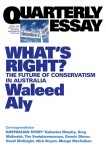
Waleed Aly, What’s Right: The future of conservatism in Australia (Quarterly Essay 37)

In the 1950s my parents subscribed to The Saturday Evening Post. I habitually started reading it from the back, because there were no cartoons in the front half. There are no cartoons at all in Quarterly Essay, but I usually start up the back here too, because that’s where I find responses to the previous issue, in this case 30 pages about Mungo MacCallum’s essay on Kevin Rudd, Australian Story. Katharine Murphy, national affairs correspondent for the Age, wins the Me Fail I Fly ‘I Wish I’d Said That’ Award for this:

The problem with Mungo is you can’t read anything he writes without feeling the need to agree with it on the spot, and wish you’d written it yourself. Reading Mungo is like resisting the pull of a great seducer.

That’s so much more grown-up and articulate than my own post-reading ‘Hmmm … But I enjoyed the ride.‘ Indeed the opening sentence of Mungo’s response to the correspondence does command assent:

The most interesting thing about all the correspondence my essay has provoked is the hugely different ways in which different people see Kevin Rudd.

[Editor Chris Feik and his Board apparently agree that the multiplicity of views on Kevin is interesting: QE 38 promises to give us yet another essay on the man, this time by David Marr.]

He then goes on to characterise each of the respondents: one ‘presents the standard view from the Right’, another is ‘a Labor insider’, a third speaks ‘from his position on the ideological Left’. This mode of analysis is fortuitously held up to a harsh light on page 1 of Waleed Aly’s essay, which of course I read after Mungo’s page 140. According to Aly, the terms Left and Right, ‘in spite of their ubiquity … are utterly meaningless and should be abandoned by anyone interested in having a substantial political conversation.’ The great seducer interrupted in flagrante?

Waleed Aly’s rejection of Left and Right as terms for political debate is not of course in response to Mungo MacCallum’s use of them. As he says:

For a long time I have been intrigued by the fact that I find myself in agreement with much conservative political philosophy, yet in consistent disagreement with politicians and commentators who call themselves conservatives.

The essay sets out to reclaim the ground currently occupied, one might say infested, though Waleed Ly is far too polite and reasonable to put it like that, by  neo-liberals and neo-conservatives. These politicians and commentators, he argues, have moved a long way from the conservative philosophy first articulated by Burke, and are in fact progressives in the sense that they are committed to moving towards an ideal world, albeit one from which most people who actually think of themselves as progressives would recoil in horror. I won’t try to summarise the argument. Much of it might be either glaringly obvious or obviously specious to anyone who has studied political philosophy, but to the general reader (that’s me!) it’s an education, and a pleasurable one.

Aly does a job in this essay that has needed doing for some time. He exposes the contradictions and fallacies in the utterances of the likes of John Howard, Tony Abbott, Nick Minchin or Kevin Andrews, but from a conservative perspective. He hoists them, as it were, on what they claim to be their own petard. ‘The conservative, ‘ he writes for example,

would certainly not run immigration at record levels (as the Howard government did) and then lecture its migrant population on what their values should be. That is especially true when it is done pursuant to a neo-liberal plan, where individuals are encouraged to use their mobility for entrepreneurial reasons, not cultural ones. The conservative takes the world as it is, not as she or he wishes it to be. And it is a world in which pluralisms in culture, politics and identity within a society are an inescapable and irreversible fact of life.

After taking his scalpel to the neo’s on multiculturalism, he moves on to the climate change ‘debate’, which he describes as ‘a fight to the political death’:

Of course, it is possible that climate-change activists are motivated more by their ideological commitments than by their trust in the scientific consensus. It is conceivable that staunch opponents of capitalism may leap on the opportunity climate change provides to argue for the destruction of the market’s political dominance. But it is also conceivable – and probably much more common – for climate-change believers to take their position based on trust in what they perceive to be conventional wisdom. Climate-change denialism on the part of non-scientists, by contrast, is always an ideological or an emotional process. The intellectual lengths required to sustain it are only feasible for those who have pre-existing reasons for wanting to deny it. That may be because its implications are devastating for one’s present livelihood – as might presently be true of certain farmers, or people working in high-emissions industries – in which case the response is probably emotional. Or it might be because it counters one’s deeply held views of the world, in which case the response is ideological.  … The simple fact is that neo-liberalism is incompatible with the politics of climate-change response. In order for neo-liberalism to be preserved, climate change must, in the first instance, be denied.

As you see, Waleed Aly is not a great seducer. He’s not out to win our assent by charm, or standover tactics, or appeals to team loyalty. On the contrary, he invites us to think with him.

It’s a quick read – just 105 pages. I recommend it.

Added on 30 March: Irfan Yusuf has an excellent review of this Quarterly Essay on New Matilda.

The Book Group and Peter Temple’s Truth

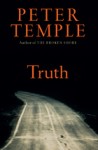
Peter Temple, Truth (Text Publishing 2009)

The Book Group decided we wanted a page turner for this meeting, and a couple of people were keen on Peter Temple’s Truth, the second of his detective novels. So Truth it was. Attempts to get it from the library made it pretty clear that other people were keen on it as well, and at least one of us, it turned out, had to go to the airport to buy a copy.

Here’s the first sentence:

On the Westgate Bridge, behind them a flat in Altona, a dead woman, a girl really, dirty hair, dyed red, pale roots, she was stabbed too many times to count, stomach, chest, back, face.

It takes a bit of work to figure out the internal relationships in this congeries of phrases. You may go down dead ends in which the flat in Altona is on the Westgate Bridge, or the girl was stabbed too many times to stomach, but once you’ve done the work the meaning is unambiguous:

[They were] on the Westgate Bridge. Behind them [in] a flat in Altona [was] a dead woman, a girl really, [her] dirty hair dyed red [with] pale roots[.] She was stabbed too many times to count, [in the] stomach, [the] chest, [the] back, [the] face.

In effect, then, the sentence gives fair warning that this won’t be a lazy read – there will be many sentences requiring at least a little backtracking if their meaning is to be extracted. But the difficulty is not arbitrary, representing as it does a particular laconic spoken English, the kind spoken by almost all the male characters and one or two of the females. The sentence also gives fair warning, amplified by the reference a couple of paragraphs later to the 1970 collapse of the Westgate bridge, that non-Melburnians and people who don’t know their Melbourne may have extra work to do in the comprehension stakes.

Having said that, Peter Temple’s Villani belongs to that distinguished international fraternity of ageing homicide detectives committed to bringing criminals to justice, at odds with their superiors, and in trouble with what’s left of their families: Rebus, Montalbano, Zen, Wallander, and now Villani, with his own distinctive line in introspective self-blame and self-criticism beneath a hardboiled surface, his own reluctant corruption. I enjoyed the book, much as I enjoy very good TV detective shows – I’d place it at the level of Silent Witness or NYPD Blue rather than up there with The Wire. On the whole, though, I think I prefer my television on the screen rather than in novel form, even when it’s as well written as this unarguably is.

My main difficulty was related to elliptical language. Not that it was difficult, because the difficulty, such as it was, was fun. But the speech patterns of most of the male characters tended to be indistinguishable from each other, so the characters themselves tended to blur. This didn’t matter very much until the perpetrators of the various crimes were revealed and the effect (for me at least) wasn’t much more specific than: ‘One of the characters did this crime, another did that one, and their reasons had to do with revenge or corruption or something of the sort.’ I’m happy to report that there was plenty to hold my interest on the way to that unsatisfactory destination: Villani’s relationships with his wife, his daughters, his father and brothers are as complex as anyone could wish – and if it wasn’t for the demands of the policier genre they might have been fleshed out to become fully three-dimensional; the language is full of delights as well as provocations; there are plenty of richly detailed observations of street life and the life of the mind (‘These thoughts had begun to come to Villani in the small moments of his life – at the traffic lights, in the haunted space before sleep, in the wet womb of the shower’ is a nice instance).

Just as I finished reading the book the long list for the Miles Franklin Award was announced. I’ll be surprised if Truth wins the award, but I haven’t read any of the other contenders.

I wrote the preceding paragraphs before the group met last night. There were only four of us. I don’t think it was lack of enthusiasm for the book that brought the numbers down – one man had a lecture, another’s plane from Brisbane was late, and so on. We had a pleasant discussion, mainly swapping Bits We’d Liked – one guy had jotted down clever bits of dialogue, and often as not someone else would be able to say what the next line was. We agreed there were longueurs. We agreed that it was a fine bit of genre writing (more confined by the requirements of genre than Shane Maloney’s novels, one guy thought). We reflected that none of us saw Melbourne as quite as grim as the book, though one guy told us of a Sydney experience involving four big policemen running onto the street in front of his car and pointing guns at the driver of the car next to him. We resonated with the awkwardness of the male characters in attempting to give and receive whatever it is one gives and receives in moments of great pain (though as I write that, I realise that I appreciated those moments cerebrally rather than responding to them emotionally).

And we talked about Djan Djan, Reinventing Knowledge, Mawson’s huts, the excellent food, how a career as an assistant director in the movies affects one’s reading habits, regulations for backyard ponds, etc etc etc.

The Happiness of Kati

Jane Vejjajiva, The Happiness of Kati (2003, translation by Prudence Borthwick, Atheneum 2006)

This book is a rarity: a children’s book written in Thai and translated into English. Perhaps that’s why it was recommended to me. It’s short, and I decided to read it as a gap-filler while waiting for another Book Group member to finish with my copy of Truth. This may not have been a mistake, but I do regret the disrespect: the book certainly wasn’t written to be a gap filler.

At the start of the book Kati is nine years old and living with her grandparents. Her parents are noticeably absent, and the absence of her mother is particularly stark because each of the first several short chapter headings has a subheading that mentions her. The first chapter, for instance, is ‘Pan and Spatula’ with a subheading, ‘Mother never promised to return.’ The chapter has quite a lot to say about the pan and spatula Grandmother uses to cook rice, but is silent about Mother. Just as one is beginning to think Mother must be dead, it turns out that she is very ill, and there’s the possibility of visiting her. It’s a very effective device – and the complete silence about Kati’s father, which lasts quite a bit longer, gains power from it.

I don’t think it’s too spoilerish to say that Kati’s mother has motor neurone disease (or amyotrophic lateral sclerosis, as it’s called in this US translation), and that she dies. I won’t go further into spoiler territory, except to say that if this were an Australian or US book, there would very probably be a big emotional death scene towards the end of the book, but here the death happens so quietly that I wasn’t sure it had happened until a couple of paragraphs later, and it comes at about two-thirds of the way through the book. This unexpected structure, as much as the unfamiliar food, plants and family relationships, made me aware I was engaging with a mind from a different culture. I enjoyed it and I’m glad it slipped through the net to reach English-speaking young people – though I notice that my copy was withdrawn from the Albany NY Public Library less than four years after publication without much wear and tear, suggesting that it didn’t reach very many of them.

Haiti After Duvalier

Amy Wilentz, The Rainy Season: Haiti Since Duvalier (Simon and Schuster 1989, 1994)

When the recent earthquake struck Haiti, I’m sure I wasn’t the only one who was dismayed by the spectacle of poor Black people, sometimes visibly despairing, sometimes raging, being helped out by calm, compassionate Europeans and USers, usually accompanied by a narrative about Haiti’s lack of infrastructure and the international community’s concern – that is to say, a spectacle that seemed to confirm racist stereotypes: African heritage people emotional, dangerous, incompetent etc; European heritage people efficient, kind, well organised etc. I realised my ignorance about Haiti was vast: from Jared Diamond’s Collapse I knew that its part of the island of Hispaniola was an ecological disaster resulting from poverty and political corruption; on a good day I could have told you that Papa Doc and Baby Doc were vicious dictators named Duvalier; I was dimly aware that it was the home of voodoo, about which my main source of information was the novels of William Gibson and the obviously misleading zombies of popular culture. It wasn’t going to help the earthquake survivors, but I felt the need to do them the basic honour of finding out about them. This book was recommended by a friend.

Amy Wilentz, a New Yorker, first went to Haiti in 1986, as a journalist covering the last days of Jean-Claude Duvalier (Baby Doc) and his wife Michèle. She returned a number of times in the next couple of years and then moved there to live. The book traces events from the ousting of Jean-Claude to just before the elections in 1989: military coups, violent popular actions and non-violent demonstrations, two bogus elections, army-backed massacres, arson, random killings. It’s quite a story, with a great cast of characters: a Well Placed US Embassy Official (who gives Wilentz transparent disinformation), a senatorial candidate, a dark haired photographer (eye witness and near casualty of one of the massacres), and a host of Haitians: politicians, well off mulattoes, shanty-town dwellers, voodoo celebrants, artists, street children, and – who becomes the main protagonist – Jean-Bertrand Aristide. Aristide is a priest, a member of the Salesian order, who speaks out against oppression, becomes a figurehead for the  popular resistance, and survives a number of attempts to kill him, discredit him or send him into exile.

The 1994 edition – which is what I have read – includes a foreword that briefly covers the intervening four or five years: Haiti had had its first genuinely democratic elections, in which Aristide was elected president by a huge majority. Aristide had been ousted by yet another military coup, US-backed like its predecessors, and was the subject of CIA-assisted smears.  A quick look at Wikipedia tells me that the turbulence has continued.

Haiti was founded at the turn of the nineteenth century, the only nation to be born of a slave revolt and the first Black republic. Haitians fought off an invasion by Napoleon’s forces, and in effect saved North America from invasion, paving the way for the Louisiana Purchase. Not that this kindness has been acknowledged by the US: Haiti  was invaded and occupied by US forces from 1915 to 1937, and continues to be dependent on US aid, which of course comes with strings attached. Reading this book makes the ‘donor nations’ look a lot less benign.

Because Wilentz actually lived in Haiti for some time, and developed relationships there, she can give a richly detailed account of life there. There’s a beautiful passage on Aristide’s theology, for instance (‘I believe the Resurrection is an ongoing process … In order to continue being a force, [the Apostles] had to believe that Jesus, their leader, was still a force. … In order to survive the shock of Jesus’ death, they imagined him coming and eating with them, the simplest thing, you know, the simplest human act, breaking bread together’). The narrative is sprinkled with linguistic pleasures in the form of frequent snippets of Haitian Creole: Aristide’s nickname was Titid, as in petit Aristide; I enjoyed teasing out the French connection in sentences such as, Se lè koulèv mouri, ou konn longé-l, which translates to English as ‘Only when the serpent dies can you take its measure’, and which I had fun figuring out would translate into French as something like C’est quand le coulèvre mourit, on connaît longer-le. The countryside, and the weather, come alive in frequent passages like this:

Smoke ascended from lean-to kitchens along the way. A truck piled high with charcoal bags rumbled by, stirring up dust. A peasant sat on top of the grey load, holding his machete; a piece of plastic was wrapped around his head against the approaching rains. The road twisted on; for all my travelling, I had not left Papaye far behind. I passed down a hill and through a small stream, where a great white pig was lounging on a rock, waiting for rain. Farther on, more people seemed to be about. Peasant men were standing at their doors, while the women made smoke in the kitchen. Two boys squatted in a yard, playing marbles.

She’s been there, and she does a good job of taking us with her. The book is firmly located in a particular moment in Haiti’s history, and the author’s understanding of the meaning of things has been challenged by subsequent events – in a recent op-ed in the New York Times, she herself refers to Aristide’s own ‘little-d Duvalierist tendencies’ as having contributed to the destruction of his presidency. But it’s not dated. Wilentz’s attention to detail, to the textures and smells and rhythms of daily life in Haiti make engrossing and illuminating reading. That post-earthquake New York Times op-ed piece concludes with a passage that possesses those same qualities:

This is what I saw as I travell00ed around the country on foot and on motorbike a week after the quake struck: families and neighbourhood groups putting up shelters; people cooperating with aid organisations to get food for their flattened neighbourhoods; teacher’s assistants hired by parents in the newly built shantytowns to teach and amuse children whose schools fell down (about 300 teachers at a conference died during the earthquake when their meeting hall collapsed). Men working in teams to remove reusable construction materials from the wreckage. Women sweeping debris from the roads with their graceful, primitive brooms. Young people caring for the wounded in makeshift clinics. Maybe utter destruction concentrates the mind. In these conditions, do-it-yourself democracy simply works best. The quiet president, operating behind the scenes with the international community, instead of strutting before the foreign press and claiming he’ll fix everything, is perhaps at this moment not such a bad leader for Haitian democracy, after all.

When you stand in the rubble of Port-au-Prince – so recently an affecting and even a heart-tugging city that functioned on a complicated, hypercharged fuel of chaos, exposed wiring, pig slop, smog, gingerbread turrets, hot cooking oil, rum, cockfights and bougainvillea – you begin to see that Haiti’s soul resides in its people. Out of this horror, maybe they will finally be released. That is, if the rains or another quake doesn’t stop them in their tracks.

‘Haiti’s soul resides in its people.’ That might look like easy rhetoric in the pages of a newspaper, but it’s not a bad six-word summary of what The Rainy Season carefully, passionately, intelligently ends up saying.

[Note: I’ve Australianised the spelling in the quotes.]