If I’d kept to my original plan of five pages a day, or even my second plan of three a day, I would have finished À la recherche du temps perdu by now. But I’ve slowed down and had a couple of gaps, so I’m only just entering the strait.
Not that the pace is picking up, but this last month’s reading has had a definite end-is-nigh feel. As I mentioned last month, a sequence of tiny experiences – standing on some uneven paving, hearing a spoon click against a plate, feeling a starched cloth against his lips – send the narrator into complex rumination about the nature of memory and art.
I won’t even try to summarise his reflections on art, but he has a lot to say about the importance of drawing on one’s own experience, and on paying attention to one’s own idiosyncratic (not his word) responses to the material experiences. The specifics of this, remembered, half-remembered, retained only in the unconscious, are what make a work of fiction live. ‘A book’, he says, ‘is a great cemetery where we can no longer read the eroded names on most of the tombs.’
Un livre est un grand cimetière où sur la plupart des tombes on ne peut plus lire les noms effacés
Having earlier given up on his pretensions to be a writer, he now decides to write a book based on his fresh understanding of a certain kind of memory as a way to transcend time. It’s fabulously self-referential, and it does make me want to start all over again to see how the book lives up to his stated intention.
All that thinking happens in the library of a house where he has turned up for a social event. The musical piece in the next room finishes and he goes into the salon, which is full of people he hasn’t seen for years while out of town at health establishments. And they’re all in fancy dress: the men have stuck white moustaches and beards on their faces and most people are wearing white wigs; one young man has put on ingenious fake wrinkles; a glamorous woman has made herself look overweight … which leads into reflections on old age. Just as he as decided to write a work about transcending time, he is confronted with evidence of time’s inexorable effects on human beings.
Individual humans age, some more devastatingly than others. Some people disappear from society altogether – they may have been the subject of scandal, or they may have been Germans. Some who were barely on the fringes of le monde now have great prestige. Others have swapped dubious reputations for status as men of high moral standing. The same title is now inhabited by a different person altogether. The young have no idea of the origins and history of the people who now shine on the social scene. And who but the old now remember that the still-beautiful Duchesse de Guermantes – Oriane – could once make or break a social occasion by deigning to appear for half an hour, or staying home.
Proust’s contrast between the virtues of solitude and the emptiness of social life is here the clearest it has ever been.
Through all this, there’s what amounts to a roll call of the novel’s characters alive and dead: the devious Morel now gives character references in court; Mme Verdurin is now the Princesse de Guermantes; Bloch is a prestigious man of letters; no one quite remembers how Gilberte became a Guermantes; Oriane is as commanding a presence as ever, but in a flash-forward of three years we see her in sad decline.
The loose ends are being tied up. I have 70 pages to go and am missing Proust already.
Before the Meeting: Lamorna Ash, a posh young Londoner fresh from university, decided to visit the part of Britain her mother came from, and from which she got her first name. She lived for two stints in the fishing village of Newlyn, just a couple of miles north of Lamorna in Cornwall, all her senses on the alert to see and understand everything about it, its people, and the life of fishermen (no fisherwomen during her time there) and their families. She went out on trawlers and smaller fishing boats. She drank with young and old. She formed solid friendships. She learned to gut fish and oscillated between horror and unholy glee as she graduated to stabbing rays in the heart – all part of a fisherman’s job. She talked and listened to everyone who would give her the time of day. And she wrote a lot of it down.
Meanwhile, she read or remembered writing by Elizabeth Bishop (whose poem ‘At the fishhouses‘ describes the sea as ‘Dark, salt, clear’), Barry Lopez, Walter Benjamin, Marianne Moore, Herman Melville, Antonia Barber (author of the picture book The Mousehole Cat, whose name doesn’t appear in the well-deserved praise of the book), W G Sebald, and other literary giants – and found ways they shed light on what she was discovering.
Then she made all that into this book. I enjoyed it. The author’s extreme youth gives rise to some embarrassing moments – as when she explains that ‘yarn’ is an old term meaning ‘story’, or when she reflects on how differently one sees the world when one is older, for values of older that are less than 25. The literary references sometimes feel forced. But by about page 100 these qualities had come to feel like part of the charm of the book. She’s capable of mocking herself, as when she writes of the walks she takes to stave off loneliness:
I often leave notes for myself on my phone when I go on these solitary walks, little inanities I wish I had someone else with me to whom I could say them out loud. This morning I wrote myself a particularly bold one. ‘For someone who gets lost a lot, coastal walks are a godsend. Only if the sound of the sea disappears from your left ear, can you have possibly gone wrong.’
Well yes, I guess it’s an inanity, but no more so than many of her observations, and this little moment of self-deprecation earned my forgiveness for a lot.
On the other hand, no forgiveness is required for her description of her week on board the trawler Filadelfia, which forms the book’s narrative backbone. Here’s her wonderful account of gutting a stingray:
I flip the ray over on to its back. Its stomach is a cadaverous grey and its almond-shaped mouth gapes open and shut like the puckering of a teenage kiss. The lips are so human I am momentarily dumbstruck. Open and shut, open and shut, its mouth sounds out a wordless plea.
I shake myself from my trance and hear Stevie prompting me to make an upside-down V incision along the translucent flap of skin that conceals its vital organs. Underneath is a mess of multi-coloured, pulsating guts – bright pinks, yellows and oranges. Over the roar of the engine, the men guide me to seize hold of a fistful of guts and pull them away from the ray’s body. But as I do so, the ray’s muscular wings start to close in upon my hand. In film footage of rays swimming, they use their wings, properly named pectoral fins, to propel themselves forward, gracefully rippling through the water like thin material animated by wind.
The ray’s last desperate bid to defend itself shocks me out of the automatic, mechanical state I usually induce in myself while gutting. In panic, I try to withdraw my arm, but its wings are still clutching me tightly. Beyond the boat, the waves have picked up and the boat slams down into the water. ‘You have to stab it!’ the men cry, goading me on as if we were outside the Swordy [hotel in Newlyn] preparing for a brawl. I let out a cry and stab the ray in the heart.
(page 256)
Her initial horror changes to murderous glee. The crew take to giving her all the rays to gut, and nickname her Raymundo.
After the meeting: For no particular reason we met in an Indian restaurant, the food was excellent, and the tragedy currently unfolding on the subcontinent had no obvious impact on the mood of our hosts, but there were nine of us at a long table. Conversation was animated and the book was discussed vigorously, but it was hard to manage a single shared for more than a very brief time. Next meeting’s host, who is responsible for summarising each meeting, put it well on WhatsApp: ‘
So yes, it was a excellent banquet last night where I got a week’s worth of meat, we agreed the book was somewhere between 2.5 & 4.5 stars, was either deeply revealing or a series of pleasant vignettes, … was in a place we should all visit and was generally an enjoyable read.
The 2.5 party hadn’t finished the book and didn’t intend to. He hadn’t read the fascinating historical account of how the town was saved from actual destruction in the 1930s at the hands of bureaucratic health and safety regulations, how a petition was taken to London on a small fishing vessel whose crew were astonished to see the banks of the Thames crowded with well wishers. He felt that the (to me fascinating) tidbits of Cornish language were mere padding.
The 4.5 party, just loved the book. He was completely charmed by the author’s voice. He described her quotes from other writers as smacking of undergraduate naivety and enthusiasm, but saw it as part of her youthful charm. (Given that our group is made up, all but one, of old farts gentlemen of a certain age, the youth of the writer was an issue for all of us one way or another.) He spoke eloquently of the way the narration would move from descriptions of social life in the pub to a deep dive into some aspect of the life of the town.
Whereas I, and others, found the description of life on fishing trips, of the way time at sea opens up spaces for communication and reflection, one man who has worked on boats said he found that fairly ordinary and wished there was a lot more about the women left ashore. Though the difficulties of the life were touched on, we were left feeling that a much darker story could have been told.
One chap had been to Cornwall a couple of years ago, and could show us photos of the town, including the very boat on which a pigeon dies in once of the book’s many atmospheric anecdotes. Actually he showed us these pics on WhatsApp before the meeting; he brought them to the dinner on a tablet, but couldn’t see a way to pass it around.
A couple of chaps drew comparisons between this book and James Rebanks’s A Shepherd’s Life. Each of them is an account of a community, a place, a working life that has endured for centuries and is under threat in the modern capitalist world. One is a passionate insider’s story, the other that of an interested visitor. It’s not that Lamorna Ash was trying to do do a James Rebanks: she’s completely upfront about her outsider, ‘posh’ status, her lack of skin in the game, but the book is still a serious piece of non-fiction, combining advocacy, memoir, linguistic sidelights, character studies, and adventure on the high seas.
Someone* said recently that the work of a poet isn’t just to write poetry. Poets also teach, mentor, encourage other poets, edit, proselytise for poetry … and the list went on. At the launch of A Thousand Crimson Blooms last month it was clear that by this criterion Eileen Chong is a real poet. I chatted with an emerging poet who has won prizes and attributes it to her inspiration and mentorship. Three other poets, all women of colour, read at the launch, and each testified to Eileen’s kindness, collegiality and solidarity.
The poems in A Thousand Crimson Blooms bear strong testimony to the poet as embedded in a community of poets and other artists. Many of the poems carry epigraphs, and we are given meticulous notes referring us to their sources – most of which are other poems, and at least one is a quote from a conversation with another poet. Sometimes the notes give us web addresses where we can see images of works that inspired a poem.
The sense of connectedness goes further. A central feature of this book, as in Eileen Chong’s previous collections, is the sense of living heritage, in birthplace (her own Singapore and her husband’s Scotland), in family (especially her mother and grandmother), in food (maybe not as much as in earlier books, but this is still poetry that makes you hungry), in language (a number of poems make play with the components of Chinese ideograms), and always in poetic tradition.
This connectedness and rootedness provide a sustaining background in poetry that mostly deals with personal pain: bereavement, sexual abuse, illness and surgery, involuntary childlessness, the challenges of migration.
This is a terrific book. I learned a lot, I cried, I laughed, I was confronted. Only a couple of times I was mystified. More than a couple of times I was surprised by the twist of a last line. I was sent down interesting rabbit holes, and found myself reflecting deeply on my own life. Eileen Chong reads her own work beautifully: you can hear her, among other places, when/if the Sydney Writers’ Festival release a podcast of the session that included her – The Unacknowledged Legislators.
There are so many poems I’d like to spend time with here. There are powerful poems about loss that it would feel almost indecent to write about in this necessarily abbreviated way. There’s ‘Making Sense’, whose beginning sheds light on the poems in general:
I tell my students:
poetry is a way to make sense
of what you fear.

I sing to them of
blackbirds. I read my poems
aloud
There’s ‘Spring Festival’, which includes similarly suggestive lines:
My husband reminds me I write poems
in threes: three lines, three pathways.
One for the old life, one for the new

and one for the hours
I do not notice as they pass.
There’s the ‘The Hymen Diaries’, each of whose four parts responds to a work of art (see mention of rabbit holes above). There’s ‘Child’, whose subtitle, After Andy Kissane’s ‘Joy and a Fibro Shack’, offers generous possibilities for a ‘compare and contrast’ kind of discussion – and many poems like that.
I’ve picked the title poem, ‘A Thousand Crimson Blooms’, mainly because before spending this time with it I didn’t understand how it hung together, starting with what feels like kindergarten innocence and ending with lacerating pain. You can see an earlier version of the poem with a slightly different title on the Peril magazine website (here). Here’s the poem as it appears in the book:
To start with the epigraph: I haven’t read the poem it comes from, ‘Don’t Trample This Flower’ by Bing Xin, but I have learned that Bing Xin was a prolific Chinese woman writer of the 20th century, many of whose works were written for young readers (Wikipedia entry here). These lines are a straightforward call to pay attention to something that is beautiful, easily overlooked and vulnerable.
There’s a smooth transition to the opening lines of the poem. Like the epigraph, they address children/little ones: having looked, now, let’s draw. We’re in a domestic or classroom setting; the voice is that of an adult – a teacher or parent? – addressing small children, possibly in a rural environment. The third line’s invocation of the daily cycle of time has a traditional Chinese feel. It reminds me of the ancient poem, ‘The Peasant’s Song’, that begins, ‘Sun up, work / sundown, rest.’ (That’s Ezra Pound’s translation, in his Canto XLIV.) It’s a benign opening, and my fridge door is covered with just the kind of artworks that the little ones might create. (I should mention to anyone who’s just visiting the blog that I have a three-year-old granddaughter who loves to put pencil/crayon/brush to paper.)
The next three lines could be summarised as detailing the process of drawing the dog and rooster, and the children’s focused, unblinking attention to the task. But the language alerts us that something may be slightly off. ‘Let’s shape their bodies with our hands’ may be just an odd way of describing the movement of hands holding pencils, but it feels a little more dominating. Maybe we’ve moved on from drawing to shaping in clay. The second line takes us a step further with the hint of violence in ‘gouge’. The adult speaker has taken us quite a way from paying close attention to something vulnerable to something on the edge of cruelty, even if it is only cruelty to the paper. In the third line, as I read it, the ‘little ones’ speak. The ‘lidless eyes’ suggests a kind of forced, sustained attention that is far from the relaxed, open regard of the epigraph. That there are a hundred eyes suggests that the context has moved from the intimate to the institutional. I have to admit that on first reading I resisted this darkening mood, but once seen I can’t unsee it, and it refers to a common phenomenon. The late artist Kim Gamble, for example, used to lament the way education put a damper on creativity: that children who draw and paint beautifully in Year 1 of school are generally creating cliché images with no spark of originality by the time they are in Year 3.
I’m generally sceptical of poets who talk about the crucial importance of punctuation and spacing, but I think it’s interesting that where the Peril version has a simple paragraph space before the next stanza, this version has an asterisk. The poet wants to be clear that there’s a substantial break. The stanzas change here too, from three-liners to four-liners, but it’s the asterisk that most clearly signals a gear-change.
Sure enough, there’s now a radical change in tone. The benign teacher/parent has been superseded by a harsh authoritarian voice. If the earlier stanzas were in a small, friendly kindergarten classroom, this is now a disciplined, bullying high-school class, perhaps a laboratory, where there is no room for emotion or vulnerability. Science experiments using test tubes and bunsen burners become metaphors, or maybe metonyms, for the harm done to people in such an impersonal environment. (I don’t think there’s an implication that science is necessarily that way, but the reference to glass and fire do conjure up a chemistry lab in my mind.)
The final stanza follows another leap – in time, in setting, in scale. The speakers are the bullied ones, and the 50 people of the second stanza have grown to be a thousand. Blue-and-white vases are traditional Chinese creations, vulnerable like the flower of the epigraph, emblematic of a long history of artisanal skill and creativity (of the kind that produces gasps on Antiques Roadshow). We have been prepared for their appearance by the echo of traditional Chinese poetry in the first stanza. They are broken, with violence that parallels the breaking of the benign teacher-child relationship of the earlier stanzas. ‘They’ is undefined. If I stick with the classroom reading, they are a particular kind of educator, and in making us do the kind of ‘creativity’ that the curriculum requires, they not only take us away from our innate creative impulses, they make us tread all over them.
The second last line takes us back to the flower of the epigraph, only now the flower is not ‘by your feet’, but part of oneself. It is our blood, our suffering, that now produces the flower, that becomes the subject of art. Creativity and pain are now closely linked.
The final line takes a step back. I can best say how I read it by attempting a paraphrase: In our present wounded condition, any attempt to make art must find a deep connection to tradition or some other form of community, if it is to have any vitality. Of course, it doesn’t refer only to the making of art: I think of the importance that First Nations elders place on connection to culture as a means to youth suicide prevention.
Now that I’ve understood how the poem coheres, it hasn’t quite finished with me (and perhaps never will have). The reading that I’ve sketched so far is loosely tethered to my own life experience. But that reading can expand. The poem could be read as a meditation on part of Bing Xin’s life story: I only know the Wikipedia version, and haven’t read any of her poetry, but she was denounced during the Cultural Revolution, a time when blue-and-white vases were quite literally being smashed.
The poem can be read as a response to a work of art: it was initially written on commission as a response to The Masks of Me, a mixed media installation by Vipoo Srivilasa consisting of ‘a group of small masks that celebrate cultural differences and diversity’. You can see the artwork and the artist’s statement on the Peril magazine site, at this link. Actually, I can’t see this reading at all.
Since it has given its title to this book, the poem can be read as referring to the collection of poems. Many of these poems are indeed filled with pain, unflinchingly named, but what makes them readable – more than just readable, deeply satisfying – is their rootedness. This poem itself is an example of that. The classical references, the restrained language, the way the images are allowed to do their own work on the reader, the formal neatness: all these are a kind of rootedness that let the poem flower.
* Sorry, I don’t remember who said it. I think it was on Al Filreis’s PoemTalk podcast.
Sunday was another beautiful late autumn day in Sydney, and another day of challenge and delight at the Sydney Writers’ Festival. Evidently one of our ideologically driven weeklies ran a piece online saying the Festival was extremely ‘woke’, which is apparently a bad thing. I don’t know about woke but, as someone who nods off whenever I’m in a dark room, I was kept awake almost without fail. (The one fail was inevitable, in the after-lunch slot when I would have slept through an announcement that I’d been granted the gifts of immortality and eternal youth.)
This panel addressed environmental issues about Australia from a range of perspectives. Philip Clark of ABC Radio’s Nightlife did a beautiful job as moderator, giving each of the panellists in turn a prompt or two to talk about their work, and managing some elegant segues. The panellists did their bit to make it all cohere by referring to one another’s work. (How much better these panels work when the panellists have read one another’s work!)
Rebecca Giggs, whose Fathoms sounds like a fascinating book about whales, said that whales are a Trojan horse for a conversation about other animals’ relationships to humans. She described a moment when she was close enough to a whale that she could see its eye focusing on her – and only to learn a little later that whales are extremely short-sighted and there as no way that that whale could have actually seen her. What is actually there isn’t what we want to think is there,
Bruce Pascoe, author of Dark Emuand co-author of Loving Country (about which more later) spoke about the difference between Indigenous and Western capitalist ways of relating to the land. Echoing Rebecca Giggs’s story of the whale’s eye, he said, ‘We look at animals and want to be friends with them, but as soon as a capitalist wants to be your friend …’ He begged us to take seriously the possibility of a reciprocal relationship with animals. Something terrible happened to humans, he said, when the combination of Christianity and capitalism happened. I think he has a book coming on the subject.
Victor Steffensen is a Tagalaka man from far north Queensland, author of Fire Country. Someone from my family had the privilege of doing some video work with Victor some years ago, and his stories from that time have given me a deep respect for Victor and his work in ‘using traditional knowledge for environmental wellbeing’, as the Festival site puts it. In this panel, he took off from Bruce Pascoe’s call for reciprocity with other animals, and spoke of relating to fire as a friend and not as something to fear. It’s about reading country, listening to landscape. His project of recording traditional knowledge that is in danger of being lost is not to archive it but to get it back into people, ‘to young fellas and then to the broader community’.
Richard Beasley, senior counsel assisting for the Murray-Darling Basin Royal Commission and author of Dead in the Water about that catastrophe, said that the situation in the Murray-darling Basin had got so bad that ‘even John Howard’ did something about it. Howard’s legislation included clauses to the effect that whatever was done needed to be science-based. But then the lobbyists went to town, and in response to their pressure, politicians insisted that reports from the CSIRO were altered to suit the big capitalists’ agenda. His lawyerly rage was palpable.
There was a good question (a rarity at this Festival), about grounds for hope:
Rebecca Giggs: Thee’s hope. But you don’t get to be hopeful until you make yourself useful in some way – whatever your situation and abilities allow.
Bruce Pascoe: I have to think we can do it differently. We have to give our grandchildren a chance, not treat them with contempt. We need love of country, not nationalism.
Victor Steffensen: Language is important. [Sadly what I wrote from the rest of what he said was illegible. I think it was an elegant version of ‘Action is also important.’]
Richard Beasley: I’m a lawyer. I don’t know how to challenge any of this by law.
We hadn’t booked this session in advance, but faced with a gap of a couple of hours, we spent one of our Covid Discover vouchers to buy rush tickets. Kaya Wilson, whose book As Beautiful As Any Other has the subtitle A memoir of my body, is a tsunami scientist and a trans man. Sarah Dingle, author of Brave New Humans: The Dirty Reality of Donor Conception is a donor-conceived person. Their conversation was aided and abetted by Maeve Marsden, host of Queerstories who was also donor conceived, though not anonymously through the fertility industry as Sarah was.
Sarah’s revelations about the fertility industry were nothing short of shocking. Not only is it monumentally unregulated, but records that might have allowed people to know what had happened to a particular donor’s sperm, even anonymously, have at least sometimes been deliberately destroyed. Couples using donated sperm have been systematically encouraged to lie to their children about their origins, leaving them unaware of any genetic predispositions to disease, let alone possible incest.
What Kaya told us about the systemic treatment of trans people was just as shocking. He said that he tended to keep his scientific life and his trans life separate. ‘In some ways they hate each other.’ But he has a chapter in his book that tries to reconcile them. The scientific literature, like legislation about, for instance, changing one’s ‘sex marker’ on a birth certificate, is shot through with assumptions that bear not relation to the reality of trans experience.
Both people spoke of the joy of finding themselves to be members of communities they weren’t aware of when young. When asked what they read for relief, both named writers I’ve loved: Sarah chose Terry Pratchett; Kaya chose Ocean Vuong, On Earth We Are Briefly Gorgeous.
Loving Country: A Guide to Sacred Australia was an initiative of Hardie Grant Publishers, who approached Bruce Pascoe suggesting a follow-up to Marcia Langton’s guide to Indigenous Australia, Welcome to Country. Pascoe joined forces with Vicky Shukuroglou, a non-Indigenous woman born in Cyprus, who took the photographs and also contributed to the writing. The Festival website says that the book ‘offers a new way to explore and fall in love with Australia by seeing it through an Indigenous lens’. Daniel Browning, host of ABC Radio National’s Awaye, chaired this conversation.
Again, we were called on to love this country. The thing I loved about the session was the way the two authors could disagree. Bruce Pascoe, speaking of the horrendous bushfires last year, said that the disrespect for Country shown by authorities afterwards was in some ways worse than the fires themselves. We meekly accept the terrible destruction of heritage in the Juukan Gorge. We have to rebel as a people, he said, meaning all of us, not just First Nations people. Vicky Shukuroglou argued against the idea of rebellion, and spoke of the importance of conversations and of love: ‘If we’re going to talk about marginalisation, we first need to look at our humanity.’ From where I was sitting it didn’t look as if the two things were incompatible, but I was struck by the way as a non-Indigenous woman she was secure enough in their friendship and working partnership to challenge an Indigenous man. I would have liked to know more about what she had done to achieve that confidence.
The book, Pascoe said, is about how to restrain human go and let Country have a voice, He got Vicky to tell a story about a sick echidna that, without her realising it, had come to know and trust her, as a result – she thinks – of her being still around it over time.
We don’t need a black armband. We just need to know the facts. This is the country that invented society, bread and the Richmond Football Club.
This was a great way to end my festival. (The Emerging Artist’s festival ended with the previous session: she thinks poetry and she don’t like each other.) Seven poets read to us, hosted elegantly by ‘writer, poet, essayist and proud descendant of the Yorta Yorta’, Declan Fry. Here they are, in order of appearance.
Eileen Chong, whose poetry my regular readers will know I adore. She read five poems from A Thousand Crimson Blooms, which I’ll be blogging about soon. I was glad to hear her read the three part poem, ‘The Hymen Diaries’ after I had spent some time with it and checked out the artworks it refers to.
Maxine Beneba Clarke, poet laureate of the Saturday Paper, read three poems. I won’t report what they were because i wasn’t sure I heard their names correctly. One of them began, ‘When I say I don’t want to become my mother,’ and went on brilliantly to challenge the internalised sexism of that sentiment.
Ellen van Neerven read three poems from Throat (my blog post here), including ‘Treaty of shared power’ and ‘Such a sad sight’. The first-named is a play on the relationship between the writer of a poem and its reader that worked beautifully in this context.
Erik Jensen, reading to an audience for the first time, read six short poems from his first book of poetry, I said the sea was folded, a book that, he told us, is about falling in love and learning to be in love. He then read a poem by Kate Jennings, who has just died (this was how I heard the news) – and wept as he read it. He wasn’t teh only one to shed a tear.
Felicity Plunkett followed that hard act, reading four short poems from her 2020 collection, A Kinder Sea. The first, ‘Trash Vortex’, whose name tells you a lot, may be the kind of poem that Evelyn Araluen had in mind when she said artists have a responsibility to address the world’s urgent issues.
Omar Sakr read three poems, ‘Birthday’, Self-portrait as poetry defending itself’ and ‘Every Day’. This is the first time I’ve heard or read any of his poetry. I hope it won’ be the last.
Alison Whittaker, Gomeroi woman and a crowd favourite, read a piece that depended on knowledge of and (I think) contempt for ASMR, not that there’s anything wrong with such poems. She reminded us of the tragic reality of Black Deaths in custody and read a poem consisting of anodyne found phrases from court proceedings.
And my 2021 Sydney Writers’ Festival was over. There were at least four moments when someone on stage paid tribute to a parent in the audience or, in one case, on stage with them (I’d left my run too late to see Norman and Jonathan Swan, and I probably missed other trans-generational moments). I didn’t see any of the international guests who attended on screen. It was a thrill to hear such a diversity of First Nations voices. I came home with a swag of books and a list for borrowing from the library. Hats off to Michael Williams and his team for making this happen in the flesh, and making sense of the slogan Within Reach: a living demonstration that the famous cultural cringe, while it may not be dead, has not much reason to live.
‘Your Favourites’ Favourites’ is series of events where an established writer interviews the author of their favourite Australian debut from the last year. This was the only one of the series that we attended. It’s a terrific idea, and this pairing must have delighted whoever thought of it.
Tony Birch is not only an established writer, he’s also a seasoned interviewer of other writers, and a passionate and articulate reader. Evelyn Araluen is not only a debutante poet, she’s also among many other things co-editor of Overland magazine. Tony Birch has not only read her poetry, he has been edited by her. They know each other well, and were radiantly at ease with each other in this session, their deep mutual respect not excluding some friendly teasing. After introducing Evelyn as a formidable presence in Australian literary circles and beyond, Tony asked her, ‘Have I pumped up your tyres enough?’ She said it was a bit embarrassing to be described like that when her parents were in the audience. He said her father had had a quiet word to him before the session.
This friendly banter provided a leaven for a weighty conversation. Tony quoted Evelyn as saying in another context, ‘We are reclaiming this place through poetry,’ and asked ‘How so?’
I recommend listening to the whole conversation when it comes out as a podcast. What I’ve managed here is a rough and partial account.
Australian national identity, she explained, is a literary construct. As scholar George Seddon said, ‘The English language is a filter over the Australian landscape.’ Evelyn said, ‘Whiteness does not understand itself in this landscape.’ Non Indigenous writers tend to go for the Gothic (Marcus Clarke comes to mind) or the cute (the work of May Gibbs features large in Evelyn’s poetry), both of which erase black presences. Both conservative and progressive white writers generally fail to get further past the erasure than shallow acknowledgement. Tony Birch quoted Anita Heiss: ‘You can’t just speak language. You have to think language.’ That is, Aboriginal people also have work to do to reclaim the place from colonising language.
Tony asked Evelyn what she had meant when she said on the festival’s opening night, ‘I’d like to write happier poems but there isn’t time.’ This prompted her to talk about the climate emergency and the responsibility of poets to address it. So most of her poems are angry and urgent (I think that’s what she said, and from what I’ve heard at readings I’d agree, but add ‘funny’). There is a place for poems, and art in general, that allows us to pause, to rest so we can go on facing our responsibilities, but for Aboriginal poets there is a need to be constantly asserting our existence, survival and resilience.
At Tony’s request, Evelyn read to us. ‘See You Tonight’ evokes an uneventful, peaceful moment of family life. It was written during Melbourne lockdown after eight months of not being able to see any of her own family. No one was surprised when, after the final words, ‘It’s all good. / I will. I will. I will,’ she raised her arms in triumph and said, ‘Got through it without crying!’ (I wiped a tear from my eye even though we hadn’t yet been told the circumstances of the poem’s composition.)
‘This is not a cancel culture book,’ she said.
There were two questions, one from another poet that moved the conversation into academic territory, with words like ‘liminality’ and ‘positionality’, and one from Evelyn’s father – we knew this because as he approached the microphone she shed at least 10 years and almost squealed, ‘Oh, Da-ad!’ He used his platform to draw our attention to all the powerful Black women who are central to First Nations life and activism – and didn’t embarrass his daughter at all.
Nayuka Gorrie is a Gunai/Kurnai, Gunditjmara, Wiradjuri and Yorta Yorta freelance and comedy television writer. This is one of the events she organised as Guest Curator at the Festival. She was in conversation with Melissa Lucashenko, author of Too Much Lip (my blog post here) among other books, and Nardi Simpson, author or Song of the Crocodile. (At one stage Tara June Winch was advertised as appearing zooming in from France for this session, but that wasn’t to be.) They were there to talk about the craft of writing Country.
As you’d expect, the conversation ranged widely. At the end of it I was keen to get hold of Nardi’s book, because a lot of what she said was tantalisingly hard to grasp. For example, ‘We inherit a never-ending process of belonging. Whose country? It depends on where you’re standing. You can create a relationship to a place that’s important to you, but it could be completely different for someone living 200 metres down the road.’
Melissa quoted Paul Kelly’ ‘Writers pay attention.’ She said there are two kinds of writers – the big, loud, macho writers (who can be women), and the quiet ones who pay attention. Her implication was that quiet attentiveness is the pathway to writing Country well. She talked about ‘extraction’ as key to the ‘western project’, and contrasted it to ‘reciprocity’.
Melissa again: It’s a writer’s responsibility to write the truth of violence without doing violence to the reader. There’s a place for writing that lashes out about injustice and cruelty, but we must write about life as much as death, otherwise we’re invading ourselves.
We did our Covid Check-out from Carriageworks to have lunch at a nearby pub (hamburgers with those horrible brioche buns), then back for our afternoon session.
This was a mother and son act: Senator Mehreen Faruqi and journalist Osman Faruqi. As with Tony Birch and Evelyn Araluen, there was a lot of good-natured teasing. “When I was in labour, I fervently hoped that I would have a girl.’ ‘We are a family of engineers. I so wanted him to be an engineer, and look what he’s become – a journalist!’
Sally Rugg as moderator didn’t have to do very much. She signalled at one point that it was Ok to broaden the conversation out by asking them about their theories of change. I don’t know that either of them directly addressed the question, but they took the hint and what followed was a very interesting conversation about the role of parliament and politicians in bringing about change – both of them agreed that real change came from the community and the political class played catch-up.
Both Faruqis have books coming out later this year. Mehreen’s is a memoir and manifesto, to be called Too Migrant, Too Muslim, Too Loud. Os is writing a book about racism in Australia. He would love to go back to writing music reviews, but has things he needs to get out there about racism. White friends say to him, ‘Why do you make everything about racism. When are you going to move on?’ He says, ‘You’re the ones who made everything about racism. I’ll move on when you do.’ (He probably said it better than that.)
Then we were off to the bookshop, to a number of catch-up conversations with friends we tend to see only at events like this, and to walk home on a beautiful Sydney autumn afternoon
The Sydney Writers’ Festival has come back from the virtual world, and though it hasn’t returned to the splendours of its old harbourside venue, the Carriageworks is an expansive site whose acoustic problems of past years are no longer an issue, and for me it has the advantage of being just a 40 minute walk from home. My festival this year got off to a slow start, with just two sessions on Friday.
The Unspeakable of the title didn’t refer to the Great Australian Silence about the massive wrongs of colonisation or other vast silences, but to personal unspeakables like depression, grief, trauma and addiction. Each of the panellists has written a memoir about that kind of unspeakable – and in some ways the session played out the implication of the session’s title: you’ve written about something that’s unspeakable, but maybe that doesn’t make it any more speakable?
I haven’t read any of the panellists’ books: Lech Blaine’s Car Crash, which tells the story of a car accident where three of his friends were killed but he and two others survived; Ashe Davenport’s Sad Mum Lady, about the difficulties of being a new mother that had its origins in a blog, ‘Sad Pregnant Lady’; and Fiona O’Loughlin’s Truths from an Unreliable Witness, which deals with her long struggle with alcoholism and addiction, often in the public eye as a successful stand-up comedian. Michaela Kalowski was the moderator.
Rather than start out with each panellist reading a short passage from their book – even, say, the opening paragraph – which would have grounded the conversation, MK opened with a question to each of them in turn, ‘Why are these subjects taboo?’ The panellists weren’t terribly cooperative, but the way each of them avoided answering the question, and pretty much every question after that, led to some entertaining and sometimes illuminating conversation. Here are some snippets that I have managed to decipher from notes I jotted in the dark.
Lech (I’m going to use first names) said that these subjects aren’t actually unspeakable. He spent his childhood in a pub and by the tenth or eleventh beer anything could be talked about, though not necessarily in a civil or constructive manner. Ashe told a horrific tale of her mother being groped when a child, in full view of a room full of people who pretended it hadn’t happened.
Fiona ventured to ask her mother if there was anything in the book that upset her. ‘Of course not,’ her mother said. ‘I haven’t even read it.’ This prompted Lech to tell us that he showed his brother a passage in manuscript where the brother is quoted as saying something profoundly offensive about Labor voters. His brother said, ‘That’s brilliant! You got that exactly right.’
Ashe described the process of making the transition from blog to book. In the blog she would work hard at creating amusing anecdotes out of her struggles. The book could still be funny, but she realised that she had to become less abstract: not so much, ‘It’s hard being a new mother,’ and more, ‘This is how I struggled as a new mother.’ At MK’s prompting she told the story of how she went to an anger management group for women, thinking it would make an amusing story for the blog – and she told it to us in a way that got laughs, until she got to the point where one of the group of older women asked her a question, she burst into sobs, and the other woman simply placed a supportive hand on her back until she was finished.
Fiona spoke beautifully about the shame of being an addict – and the importance of kindness. Tom Gleeson (the cheerfully cruel host of Hard Quiz) got a special mention as a kind person, but she said that the whole community of comedians is tremendously supportive.
Each of the panellists spoke about intensely personal difficulties. That they’ve written books about those difficulties didn’t make it any less easy to talk about them. Lech was often left staring blankly into his personal voice, and I felt that Ashe wasn’t quite ready to serve up her personal pain in person to a big audience. Fiona is a professional at airing her linen to live audiences, and did most of the work of keeping the conversation aerated by comic touches. At one stage Ashe turned to Fiona and said something like, ‘You know what it’s like to feel that you’re a bad mother.’ Fiona did a nice comic routine, turning away in mock denial. As Ashe continued with her point, it became clear that she was talking about something that was still raw. Fiona reached out and touched her on the forearm. A little later, doing her own bit of mock denial, Ashe waved her arms joyfully in the air and said, ‘And now I’m completely all right!’
Asked about how it felt writing this personal material for an audience, there were two very different, but equally memorable answers. Someone recalled the reassuring words of a wise editor: ‘Always bear in mind that no one is going to read every word you write.’ Fiona said that she wrote her book ‘for my children, to explain myself to them’.
Our only other event for the day was the Within Reach Gala at 8 o’clock. We managed to squeeze in a celebration dinner for a friend’s 70th birthday on our way to the Town Hall. Once there, we were taken back in time by the Town Hall’s insistence that masks were mandatory – though there was a lot more non-compliance than there was back in the day.
After a short introduction from Festival Director Michael Williams – in which he said among other things that Geoffrey Blainey’s concept of the Tyranny of Distance was regressive and idiotic but part of our culture – we were treated to a dozen writers speaking on the Festival’s theme, Within Reach, reflecting on the past year. Their interpretations of the brief ranged widely. Each speaker was identified simply by their name on a big screen, so that we were spared time-consuming introductions and appreciations by an MC, which made a huge difference to the pleasure of the evening.
Tony Birch told a beautiful story of how the gift of a stone at a wake made a huge difference to him when he was depressed and despairing from the death of a close relative and the lack of progress in action on climate change. He held up the stone.
Ceridwen Dovey said she has been working on space objects, and talked about the ‘golden records’ that have been sent out into space. There was a debate about whether those records should include material about the dark sides of humanity. In the end, the woman writer on the team managed to have the sound of a kiss included – and the actual kiss that was recorded was both an expression of tenderness and the beginning of a betrayal.
Sisonke Msimang spoke of the great movement of white women in response to allegations of sexual assault in Parliament. She was onside with the protests but couldn’t join them, knowing that she couldn’t ask her group netball mothers to join her on a BLM march. She spoke eloquently and generously about this impasse.
Ellen van Neerven started with the conviction of Derek Chauvin for the murder of George Floyd, and the question that resounded in her mind: ‘When will this country see as much justice?’ She said that like all First Nations people in Australia, deaths in custody was a family matter. She pledged to continue to tell the stories that need to be told.
Geraldine Brooks spoke from Martha’s Vineyard in the USA by video. I confess that the beauty of the country where she’s living largely overwhelmed my ability to take in what she was saying. I think that was her subject: missing home.
Trent Dalton, I think, meant to remind us of the importance of human contact and the pain of physical distance in pandemic times. He misjudged the moment by presenting himself as an indiscriminate hugger of strangers, telling a story in which he hugged woman after woman who were standing a in a queue for the toilet at a previous SWF. Sorry, Trent, but issues of consent are high on the agenda right now and the humour didn’t really work – but the crowd was forgiving.
Maria Tumarkin riffed on the question, ‘How close is too close?’ What she had to say was formidably complex and wide-ranging, and she spoke tantalisingly fast. I managed to jot down one sentence: ‘One person’s specific safety makes as much sense as one person’s piece of sky.’
Michael O’Loughlin, who came out as ‘not a writer’, told the story of his illustrious career as a footballer, from telling his mother when he was 11 that he would her a house to his final words, ‘I hope you’re enjoying the house, Mum.’ I’m appallingly ignorant about sport, so his story was a revelation to me in many ways, but especially about the significance professional sport can have for First nations players, and their families and their communities.
Adam Goodes, a footballer even I have heard of, did a brilliant, modest thing. He read to us the Uluru Statement from the Heart, and confined his own commentary to a single sentence: ‘That was 2017. It’s now 2021. We’re still waiting.’
Alison Lester told us a story of a medical crisis. As she was in hospital being wheeled into emergency she saw on a wall a clumsy copy of one of her illustrations. The orderly was unimpressed when she croaked, ‘That’s my picture.’ she described the experience of an induced coma as an awareness of darkness, cold and discomfort and nothing else, and the struggle to respond when at last she heard her daughter calling to her.
Fiona McGregor read what felt like a prose poem, ‘Eight scenes from a dancing life’: the profound joy of dancing as part of a community, witnessed and experienced
Christos Tsiolkas‘s opening words were, ‘I shouldn’t be here.’ It’s Orthodox Easter, and this present moment is one where the gap between the Julian and Gregorian calendars brings home for him the tension between his own life as a middle-class Australian writer and the life of his Greek migrant working-class parents, especially his much-loved mother.
Michel Williams then called all but Geraldine Brooks back onto the stage for a big round of applause and we all went home.
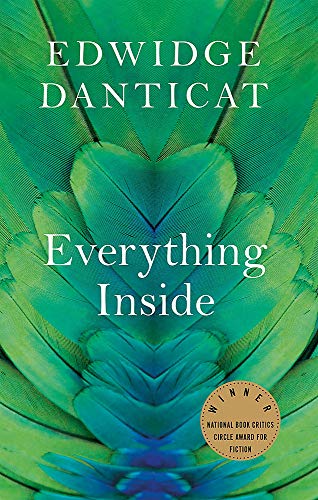
Edwidge Danticat (Haitian Creole pronunciation: ɛdwidʒ dãtika) is a Haitian-born writer whose first novel, Breath, Eyes, Memory, was published in 1994. Since then she has published other novels, short stories, children’s and Young Adult books, memoirs essays – a substantial body of work. Everything Inside, a collection of eight short stories, is the first of her books I’ve read, but I didn’t feel I was coming in late. Each of the stories is a fresh beginning, inviting the reader to enter into the lives, and in some cases deaths, of a newly-created group of characters.
Almost all the characters are Haitian immigrants to the US, or immigrants from other Caribbean nations. The stories mostly focus on relationships among women, often but not always with men in the mix – a dying father, one corner of a love triangle, an ex who has suffered a terrible loss, a sexual exploiter, the prime minister of a small Caribbean island nation. (The least successful story, ‘Without Inspection’, is the only one with a man at its centre.)The women’s relationships cross generational and class barriers, so that what emerges from the stories taken as a whole is a complex picture of Haitian diasporic life. In ‘Hot-Air Balloons’, for instance, a young woman’s college non-Haitian room-mate goes on a working trip to Haiti where she sees at first hand the terrible suffering of poor women at a rape recovery centre in a poor neighbourhood of Port-au-Prince. The room-mate decides at first to quit college in order to volunteer for the non-government organisation that arranged her trip. The young woman who stays behind does so because she wants her first experience of her parents’ home to be of its physical beauty, not of its suffering people. The story is told with deep sympathy for both points of view, but in the end we are left with an aching sense of the gulf between the hard-won privilege of the protagonist and those women at the rape centre.
The 2010 earthquake looms as a backdrop to some of the stories. Poverty and corruption in Haiti and Miami, and the US’s immigration regime have devastating effects on people’s lives, but complex human beings remain front and centre. As I read this book, I had at the back of my mind a quote from W E B Dubois in the ‘backmatter’ of the Afican-American comic series, Bitter Root (my blog post here):
All Art is propaganda and ever must be, despite the wailing of the purists. I stand in utter shamelessness and say that whatever art I have for writing has been used always for propaganda for gaining the right of black folk to love and enjoy. I do not care a damn for any art that is not used for propaganda.
(Criteria of Negro Art, 1926)
If this book is propaganda, it lacks the stridency or sense of hidden agendas usually associated with that term. But my guess is that W E B Dubois would approve of it as it asserts that ‘black folk’ do love and enjoy as well as laugh, weep, make music, form unbreakable childhood bonds, and face difficult moral dilemmas.
For the second year in a row, the NSW Premier’s Literary Awards Night has been an online event. I was one of 65 people watching it at the beginning, an audience that grew to 68 near the end. Not exactly the Oscars.
Here’s how it went:
After a number of introductory speeches – by State Librarian John Vallance who quoted Aristotle in the State Library’s Shakespeare Room, Wiradjuri woman Yvonne Weldon who welcomed us to Gadigal land, President of the Library Council of NSW George Souris, Minister for the Arts Don Harwin who promoted the government’s support for literature, Premier Gladys Berejiklian who came out as a passionate reader. We then went on to the winners, presented by John Vallance except where I note otherwise:
Multicultural NSW Award presented by Joseph La Posta, CEO of Multicultural NSW: Throat, Ellen van Neerven (UQP) – my blog post here. Ellen van Neerven skyped in. ‘This book has been more than just a book. It has been a chance to write alongside my mum among others …’
NSW Premier’s Translation Prize (awarded every second year) also presented by Joseph La Posta, to two winners: Imminence by Marian Dimópoulos, translated by Alice Whitmore (Giramondo) and Autumn Manuscripts, Tasos Leivaditis, translated by N. N. Trakakis (Smokestack Books). Both spoke beautifully; Nick quoted a poem.
Nick Enright Prize for Playwriting:Milk, Dylan van den Berg (The Street Theatre). In true theatre style, the winner thanked many many people, including ‘the Mob’ in the ACT.
Betty Roland Prize for Scriptwriting: Freeman, Laurence Billiet (General Strike and Matchbox Pictures). Laurence Billiet acknowledged her subject, Kathy Freeman. The novel was made during the Melbourne lockdown, ‘or should I say the Melbourne lockdowns’.
Patricia Wrightson Prize for Children’s Literature: The Grandest Bookshop in the World, Amelia Mellor (Affirm Press). ‘I was a broke student when I started writing this book.’ She thanked libraries for making the book possible.
Ethel Turner Prize for Young People’s Literature: The End of the World is Bigger than Love, Davina Bell (Text). ‘I am honoured and humbled and genuinely shocked.’ Among other people, she singled out her editor to thank.
Kenneth Slessor Prize for Poetry: Ellen van Neerven again.
Douglas Stewart Prize for Non-Fiction: The Warrior, the Voyager, and the Artist: Three Lives in an Age of Empire, Kate Fullagar (Yale University Press). Thanked the army of scholars who helped her write it. ‘I will donate some of the prize money to two scholarly organisations.’ One is a Cherokee organisation. The other is Pacifika Student Organisation.
UTS Glenda Adams Award for New Writing:Cherry Beach, Laura McPhee-Browne (Text). Interestingly, she thanked the judges by their first names. Her editor also got a big plug.
People’s Choice Award: The Dictionary of Lost Words, Pip Williams. when she has enjoyed a book she goes to the acknowledgements page and offers up a silent prayer of thanks to the author.
Christina Stead Prize forFiction: A Room Made of Leaves, Kate Grenville (Text Publishing). ‘There is no best book, but the judges had to pick one, so thank you.’ She thanked the descendants of John and Elizabeth Macarthur for their generosity in depositing papers in the State Library, and spoke of Elizabeth Macarthur as a foremother.
Book of the Year, presented by the senior judge, Jane McCredie: Throat, Ellen van Neerven (UQP). They were stuck for words on their second prize, and even more so here. [Added later: But they did manage one glowing sentence: ‘It gives me a boost to continue doing what I’m attempting to do, which is to write as gently and as considerately as possible.’]
The Special Award: Melina Marchetta. Wow, and also Yay! Usually this prize goes to someone who is nearing the end of a career, possibly with death around the corner. Hopefully, Melina Marchetta has many years of creativity and literacy activism ahead of her. She spoke of how stories came into her life around a table during meals, and she wishes she could be with us in person. ‘I feel so much pride that I wrote my first novel on Gadigal land.’ And she expressed gratitude to her family who allowed her – ‘I don’t know if they allowed me, but I did it anyhow’ – to use their stories. She dedicated the award to her daughter.
The central character of this book is the man who murdered 51 people in Christchurch mosques in March 2019. He is never referred to by name, but is called ‘Person X’ throughout. This is partly in deference to Jacinda Ahern Ardern’s plea, ‘Speak the names of those who were lost, rather than the name of the man who took them.’ But it is also a strategy to turn the reader’s attention away from the murderer’s personal psychology and towards his broader social and political context, to see him not as some kind of lone madman, but as part of a small but thriving fascist movement, ‘an anonymous young man who emerges from the shadows, gun in hand, already committed to an evil ideology.’ To use the terms of Jennifer Maiden’s The Cuckold and the Vampires (my blog post here), Jeff Sparrow is interested in the macrocosm rather than the microcosm.
Person X (as I will also call him) wrote a 74-page manifesto that was (and probably still is) available on the internet, linked to the video he made of his rampage. Journalists mostly dismissed this manifesto as unhinged ravings. Jeff Sparrow has read it, and argues that it expresses ‘with stark clarity’ a distinctive political platform. I don’t have even the slightest urge to read the manifesto; I’m grateful to Sparrow for reading it for us.
Sparrow argues that Person X’s manifesto wasn’t intended for a general audience, but was/is part of a conversation and a culture which this book sets out to explicate. Person X is a real fascist – not a generic right-wing extremist, but a follower of actual fascists, particularly Oswald Mosley, who unlike Hitler and Mussolini survived the Second World War and preached a Europe-first fascism for the post-war era.
One of the distinguishing features of fascism is the upholding of violence not just as an acceptable means to an end, but as a good thing in its own right. Sparrow gives a fascinating account of the repellent debates among the online fascist groups, mainly in the USA but also in Australia. After the Unite the Right rally in Charlottesville in August 2017 in which men with tiki torches chanted, ‘Jews will not replace us,’ and anti-racist Heather Heyer was killed, most of these groups decided that their movement wasn’t ready for mass action in the streets. Donald Trump’s famous ‘fine people on both sides’ comment wasn’t enough to fortify them – and Trump himself was no fascist, though he provided a favourable context for fascism to grow. Many of the keyboard warriors weren’t up to having their photos made public, and the sheer size and energy of counter-demonstrations whenever they planned a further demonstration made them look ridiculous.
So they generally withdrew to the internet, where they infiltrated – or rather coalesced with – troll culture and ‘shitposting’. They would post horrific things in a way that you couldn’t tell if they were serious or just joking, aiming to ‘own the libs’. They became expert in developing and circulating memes. This was Person X’s home ground, and – Sparrow argues – the stuff in his manifesto that some commentators took to be incoherent ravings was really in the vernacular of The Daily Stormer and 8chan. He wasn’t prominent in Australian fascist groups, but he was known as an active participant. (Sparrow’s account of Australian fascism should bring a blush to the cheeks of many journalists who have described key fascists as activists and given them a platform.)
Person X’s murderous spree was a deliberate intervention in the debates among fascists. Acknowledging that the time was not ripe for organised action, he offered a model of ‘lone wolf’ terrorism. He took the form of the ‘autogenic mass killing’ – a lone man with a gun who lashes out – and recast it as a political act. It’s not violence against significant political targets, like assassinations or even the 9/11 attacks, but it sets out to intensify the existing sense of crisis (including the climate emergency crisis), and push towards total destabilising of society and the recovery of some sort of ethnic purity:
Person X presents a systematised manifesto calling for racist terror in the name of a social disruption he thinks will culminate in ethnic cleansing and genocide.
It’s an evil program, the wickedness of which is not diminished by its self-evident impossibility. But impossible programs still attract followers, irrespective of their wickedness.
(page 92–93)
And already when Sparrow was writing this book there had been a number of imitators who explicitly mentioned Person X and his manifesto in their own utterances.
Fascists Among Us was written and published well before the events in Washington on 6 January this year. It seems that the strategy of organised street violence hasn’t been relinquished as thoroughly as Sparrow believed. But his warning that it’s important to understand people like Person X stands. This is a short book, a quick read, and though Person X has been tried and sentenced, Donald Trump is no longer President of the USA, and almost certainly the debates and practices of fascists in Australia and worldwide have moved on, it offers important insights into a clear and present danger.
Last night the Book Group had an extracurricular outing to see David Williamson’s play The Removalists at the New Theatre (which is about as new as the Pont Neuf in Paris).
Written before the outing: I have a soft spot for this play. I saw the first Sydney production at the Nimrod Theatre in 1971, an astonishing 50 years ago, as part of the exhilarating resurgence of Australian theatre at the time. In early 1973, the first copies of the book arrived in the Currency Press office soon after I started working there in my first real job – it was a big seller for them, and as far as I can tell is still selling well. I visited the set of Tom Jeffreys’ film in 1974, and was in awe of the intense inner focus of actor John Hargreaves as he waited for the cameras to roll.
Before our theatre outing I revisited the book – a first edition, stiff and yellowing on a shelf near Alex Buzo’s Macquarie and Dorothy Hewett’s The Chapel Perilous. In a successful bid for the educational market, Currency’s founders, theatre critic Katharine Brisbane and her scholar husband Philip Parsons, prefaced the text of the play with two essays, ‘Reflections on Violence’ by historian Ian Turner, and ‘Authority and Punishment’ by eminent defence lawyer Frank Galbally (who is mentioned in the play) and Kerry Milte (who was soon to become the subject of interesting dramas of his own). John Bell, who directed the Nimrod production, has an afterword, and the front and back covers fold out to reveal cartoons by Bruce Petty. I haven’t seen the current edition of the book, but the image of the cover on Currency’s web site mentions Galbally and Turner, but not Petty.
This prefatory material is all about violence and authority. Ian Turner sums it up well:
The Removalists raises three questions: one sociological (is Australian society violent of its essence?); one political (do the forces of ‘law and order’ rest on violence?’); one psychological (do all of us have the kinds of aggressive instincts or behaviour patterns which Williamson depicts?).
The essays talk about the streak of male violence in Australian culture (what would today be called toxic masculinity), and they talk about historic violence against First Nations peoples and Asians, especially the Chinese on the goldfields. The domestic violence at the heart of the play is barely mentioned. John Bell does offer an early version of what has become a common observation abut Williamson’s writing: strong women actors are necessary to stop the female characters from ‘degenerating into stilted, unconvincing types’. The edition of the book currently on sale may have been updated. Certainly, in 2014 Currency published ‘The Unexpected Feminist’, a feminist reading of the play by Van Badham (online here).
In case you don’t know the plot: two women, sisters, turn up at a two-man (sic) police station asking for a document establishing that the younger woman has been assaulted, in order to legitimise their plan to move her and her baby out of the marital home while her husband is out at the pub; the older policeman, with sleazy motivation, offers to come and help the move; the younger policeman, fresh out of training, goes along unwillingly; at the home, the husband comes home unexpectedly, and the situation escalates into lethal violence.
Reading the text, I imagine that a successful staging in 2021 would have to take into account our much better understanding of domestic abuse and violence, and our (I hope) intolerance of having it minimised. Though the play doesn’t endorse the way the sergeant and the husband make light of the DV, it isn’t much interested in it except as precipitating violence among the men. Some of the minimising language could have come from the pages of Jess Hill’s See What You Made Me Do (my review here). John Bell’s comment about how much depends on the women actors has become much weightier with age.
The outing: Nine of us, including two ring-ins, had a cheerful Thai dinner across the street from the theatre. When we crossed over 15 minutes or so before lights down, fate decreed that the third row from the front, in my opinion the best seats in the house, was empty. There was a sizeable audience, almost all of whom I’d guess were high school students who have the play as a set text. It was exhilarating to be in a big live audience full of youthful energy – for some of the Book Group it was the first time they’d sat shoulder-to-shoulder in a theatre since the beginning of Covid days.
I had been wondering how the play would deal with #MeToo. It turned out that Johann Walraven, the director, was more interested in how it relates to #BlackLivesMatter. This was announced in the first moments. As the lights come up, while the two policeman are seen in the shadowy police station on stage right, an Aboriginal man watches a flickering TV screen in his living room on stage left. He turns off the television and walks out of the room, the lights come up on the police station, and the play as written, in which all the other characters are white, begins. The production doesn’t take any liberties with the script, but the power plays of the other characters in relation to Kenny, the husband (Alfie Gledhill), are now seen through a racialised lens. In a climactic moment there’s a George Floyd reference that feels absolutely integral to the play, and is gutting.
The misogyny was still unsettling. It’s there from the opening scene in which the Sergeant gives voice to the myth of false rape claims, through Kenny’s minimising of his violence against Fiona (Eliza Nicholls), to a sleazy discussion of sex-workers towards the end. It’s meant to be unsettling: it’s the thing about the Sergeant that makes us realise he’s something much uglier than a harmless scallywag who plays the system. And Kenny’s talk of ‘love-taps’ is echoed by the Sergeant later in reference to his own ferocious assaults on Kenny – no minimising possible there, as we’re seeing it for ourselves. I imagine it would have to be written differently today, but the audience is left in no doubt that this is a scene that the two women are smart to be getting out of.
My abiding impression from the 1971 production at the Nimrod Street Theatre is of Max Phipps as Ross, the young constable. It was his transformation from gormless innocence to rage, violence and cunning that burned the play into my memory. Last night, the play belonged to Laurence Coy as the Sergeant. Lecherous, self-righteous, bullying, vicious, self-pitying, out of control, blustering, I’d thought of the character as little more than a crucible for Ross’s transformation, but in this production he’s a tortured human being, and Ross (Lloyd Allison-Young) is pretty much collateral damage. Possibly the most powerful moment last night wasn’t in the big, horrifying violence, but a small moment that almost didn’t happen. In the middle of a rant about self-control as the test of manhood, the Sergeant shouts that his wife had twenty-seven kidney fits after childbirth. Kate (Shannon Ryan), the obnoxious older sister, moves towards him, and says gently, ‘Twenty-seven kidney fits. That’s terrible.’ In a fleeting moment of humanity, the Sergeant says, ‘Yes. We gave her up at one stage.’ In classic David Williamson style, the moment is undercut with some rough humour, but the actors caught this tiny wisp of tenderness and vulnerability and made sure we saw it.
Full disclosure: Laurence Coy is a member of the Book Group – but he really is that good in this play.