Category Archives: Books

Peter Hartcher’s Red Flag

Peter Hartcher, Red Flag: Waking Up to China’s Challenge (Quarterly Essay 76, 2019) – and correspondence in Quarterly essay 77)

My usual practice is to delay reading each Quarterly Essay until the next one arrives in my letterbox. Peter Hartcher’s essay on Australia’s response to China’s growing economic strength and political influence, published at the end of 2019, in pre-rona days, feels as if it comes from a past era. Of course, that feeling doesn’t completely reflect the reality, but the essay is looking at the China–Australia connection through a different lens from the one that tends to obsess us at the moment.

In a prescient moment, arguing that it’s unwise for Australian businesses to put all their export eggs in the China basket, Hartcher writes, ‘The thermal coal market is highly diversified globally. Other industries would have a harder time. Universities come to mind.’ However, he’s not talking about a possible crisis in which the Australian government bans flights from China. His concern is with the risk of the risk of a Chinese economic slump or, more central to the argument of his essay, the risk of Beijing using the trade connection as an instrument of political coercion.

The essay’s argument is easily summarised. Under President Xi Jinping, the Chinese Communist Party is in effect on a war footing with the rest of the world, using economic leverage and cyber weapons rather than military means, and with motives that are seen in China as defensive but by the rest of the world as aggressive. Australia has become increasingly dependent on trade with China and is still largely complacent about any threat. It’s not a matter of choosing China over the increasingly unreliable USA. ‘Whenever Australia is asked to choose between China and America, the ultimate answer must be that we choose Australia.’

The red flag of the essay’s title is both the Chinese national flag and the red flag of warning that Hartcher is raising.

Hartcher tells of a number of Australians who have been hit by the realisation that the Chinese government and its representatives seek to influence politics in Australia. In six of his cases, five – Joe Hockey in 2013, Stephen Conroy in 2016, Penny Wong, Bill Shorten and Richard Marles in 2017, Professor Feng Chongyi in 2016, and journalist John Garnaut in 2009 – resisted the Chinese overtures. The sixth case is Sam Dastyari, who famously fell from grace by departing from party policy on China’s actions in the South China Sea. In his response to correcspondence in QE 77, Hartcher clarifies his point: we know about these cases because the Chinese attempts to influence Australian policy were unsuccessful: we just don’t know about the successful ones.

He lists cases when China has used economic heft to influence the policies of other countries. ‘In the past ten years,’ he writes (p 43), ‘Beijing has imposed economic punishment on at least eleven countries. for a wide range of perceived offences.’ The connection between the crime and the punishment is often not made explicit, but a pattern has emerged. He lists countries ranging from tiny Palau and Mongolia to Canada and, finally, Australia.

He makes a number of recommendations, on immigration, on vetting politicians, on diversifying our trade relations, on defending our democracy. I’m in no position to comment on the rightness or wrongness of his analysis or his proposals, but I can accept his general argument that it’s not a good idea to be complacent.

Sadly the 35 pages of correspondence published in Quarterly Essay 77, Margaret Simons’s Cry Me a River, also predate Covid, apart from Peter Hartcher’s response, and that was clearly written before the serious economic consequences were becoming clear.

The correspondents all take issue with Hartcher’s argument. He relies too heavily on the words of a previous head of ASIO; his proposal to have ASIO vet potential MPs and senators is terrible – Hartcher agreed, but argues for a new parliamentary body to vet candidates; he mistakes Xi Jinping’s statements of intentions for inevitable achievements; he doesn’t allow for the disruptions to China and the rest of the world that climate change will wreak; he underestimates the strength of resistance as it stands; he misunderstands the complexity and diversity of Chinese-heritage and Chinese-born Australian citizens. One response, by Caroline Rosenberg, is a personal testimony from someone who came to Australia from China in her teens: she wishes she had been given this essay as a teen (though if she had been she wouldn’t have read it), because she was totally unprepared for the way the West saw China, and her, and this would have helped. I think, but I can’t be positive, that that is an incredibly subtle and polite way of calling bullshit.
The Book Group and Trent Dalton’s Boy Swallows Universe

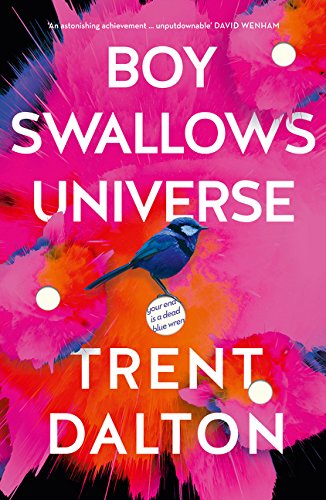
Trent Dalton, Boy Swallows Universe (Fourth Estate 2018)

Before the meeting: This was an unusual meeting of the Book Group, most obviously because it happened online, with participants spread from Bondi to Balmain, and less obviously because it’s the first time a book has been chosen that I’ve already read.

So for my pre-meeting take on the book, I’ll just point you to this link, and limit myself to saying that I enjoyed the book, and risked a visit to the supermarket to buy a bottle of sarsaparilla to flourish at the zoom screen.

After the meeting: As you would expect, we spent time checking how we were all going in our separate households. One of us reported the death of a friend in England. One made only a brief appearance because he is a health worker and exhausted, as well as putting himself at risk as an essential worker. Another has been working very long hours as his business adjusts to having most people working from home and he spends many hours every day in online meetings, which, he says, may actually be more productive than in-person meetings, but are exhausting. Several of us, me included, reported intergenerational tensions as people variously worried that others weren’t taking enough care or were annoyed by other people’s worry. A number spoke of the odd sense of having a relaxing time to do gardening and sit about and read, while outside – where you’re not allowed to go – terrible things are happening. I got the impression that many of us are addicted to Covid-19 news. There were no jokes.

We did get to the book. Without food to share or the possibility of fragmenting into small incidental conversations the whole thing was a lot less fun than we’re used to. It felt almost like an Eng Lit seminar – not that there’s anything terribly wrong with that. Most of us enjoyed the book. One chap said that generally if a book hasn’t grabbed him by page 72 he gives up on it; this book took until page 272, but then he decided to go with it and really had a good time. Some didn’t care much for the longish expository opening. (I think they were referring to the evocation of Brisbane suburbs, which I loved.) Another felt that the magic realism elements were the least successful, and I think we can look forward to an excellent film.

Lemire & Sorrentino’s Gideon Falls

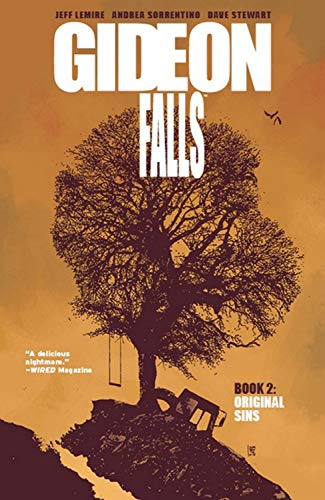
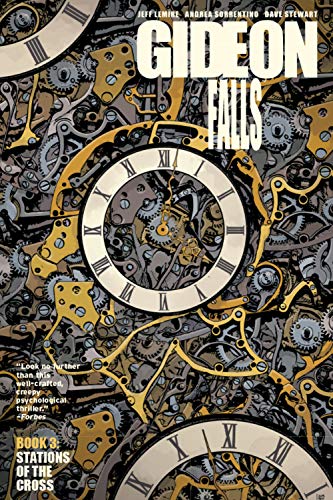
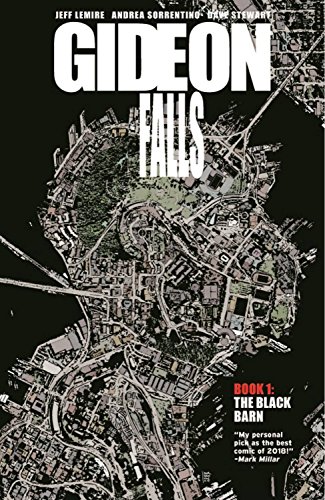
Jeff Lemire (writer), Andrea Sorrentino (artist) and Dave Stewart (colorist), Gideon Falls (Image Comics)
Volume 1: The Black Barn (2018, from issues 1–6 of the comic)
Volume 2: Original Sins (2019, from issues 7–11 of the comic)
Volume 3: Stations of the Cross (2019, from issues 12–16 of the comic)

These three books were a birthday present from my main comics supplier. I’m reading them promptly in order to lend them to him in this time of pestilence. It turns out this is a horror series, not something that appeals to me.

The first volume opens on an image of a young man in a surgical mask and rubber gloves looking at some roughly sketched garbage. Only a couple of months into the Covid–19 story, it takes an effort to realise that these accoutrements signify anything else besides sensible precautions against infection. But they do, though (not really a spoiler) we still don’t know what they do signify, beyond that the young man is a bit scary, by the end of the third volume.

Two story lines emerge in a fragmented and disorienting manner. A young man in psychotherapy for his obsession with garbage has troubling visions of a black barn that somehow embodies evil. A Catholic priest is sent by a bishop (whose face we don’t see) to a country town – Gideon Falls – to replace the parish priest who died recently, and behold he sees a black barn in gruesome circumstances on his first night there.

The stories progress in tandem, switching from one to the other without warning. There’s a section early on where the text bubbles and images belong to different stories. The effect is to unsettle the reader, slow him or her down, but also to suggest that the two plot lines are intimately interwoven, even though we don’t know how. In fact, even to the end of this first book, the two stories haven’t linked up. The young man’s therapist, who is a Buddhist and doesn’t believe in evil, comes to share his vision of the barn. The priest meets up with some locals who fill him in on the lore of the evil barn, and he finds himself inside the barn where his past wrongdoings come back to torment him. There is more death and bloodshed, though thankfully the artwork focuses more on the psychological fragmentation than the gore.

In the second volume the priest and the sheriff can’t remember their experiences in the barn, or even seeing the barn, but the aftertaste lingers on. Meanwhile, we learn more of the backstory of the young man, whose name is Norton – or is it? About the middle of this book the priest and Norton meet, inside the barn, which they have both separately reconstructed – either I didn’t read carefully enough or the impossible detail of how either of them did this was skipped. The intertwining images of them both at work are wonderful. The monster who inhabits the barn is revealed, up to a point, and we understand that the story is taking place in oddly dislocated time frames.

The third volume takes us into wild territory. There are crucifixions, visitors from the future, apparitions from the past, a gang of people wearing surgical masks, scary cockroaches, a satanic figure who is the heart of the book’s evil, something called the Pentoculus which suggests that there’s a sciency dimension to the horror … and a general sense that things are going to get a lot worse before they get better.

Because these books give no information about their creators apart from giving their names on the cover, I went to Wikipedia for the details at the top of this post. There I learned that a fourth volume, The Pentoculus, is due for publication in April, and a fifth, Wicked Worlds, in May. I may seek them out if my Supplier is interested, but otherwise, meh.

As a no-longer-practising Catholic I’m unimpressed by the use of Catholicism for horror purposes, but I guess it’s an established trope, dating back at least to The Exorcist. When I was young I believed in the devil as an evil force active in the world, and I remember moments of terror, mainly at night, related to that belief. But it was always completely outweighed by belief in the goodness of God. There were devils, sure, but there were also angels who were just as real. I guess in the 21st century it’s tempting for people who have lost any sense of a loving God to think there must be some diabolical force loose in the world. I prefer to look for more mundane explanations, even if sometimes – like when I see the President of the United States boasting abut the ratings he gets for his Covid-19 press conferences – there’s no explanation that will make the reality unscary.

Philip Pullman's Secret Commonwealth

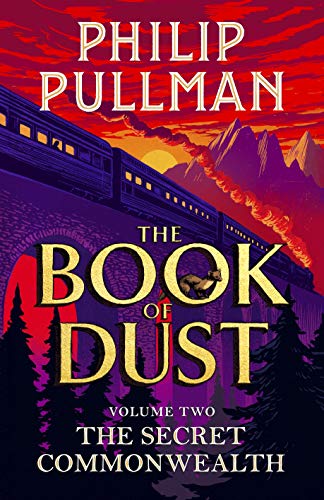
Philip Pullman, The Book of Dust Volume Two: The Secret Commonwealth (David Fickling Books 2019)

This is the fifth book featuring Philip Pullman’s wonderful Lyra Silvertongue (or Belacqua, take your pick). There was the His Dark Materials trilogy, which I loved to pieces, and which gave rise to a play, a movie and now, I’ve just discovered, a television series (click here for the IMDB entry). Then there was a small book, Lyra’s Oxford, which I missed. And now a second trilogy, The Book of Dust, of which the first book, La Belle Sauvage, was a prequel to the first trilogy and featured Lyla as a baby. The Secret Commonwealth leaps forward a couple of decades, and features events that take place some years after the end of the first trilogy, when Lyra is a twenty-year-old university student.

I wasn’t swept away by La Belle Sauvage (my blog post here). At least in the second part, it felt like a lot of colour and movement and not much interesting by way of plot or character development. The Secret Commonwealth is back on track. At the beginning, Lyla, now a student at Oxford, is at odds with her daemon Pantaleimon. For those who came in late (which I really don’t recommend: start with Northern Lights aka The Golden Compass), in this world a daemon is an animal who is somehow part of a human being. Daemons have names, they change shape frequently when their human is young but settle into a permanent creature around puberty. A daemon generally represents some essential element of its human’s character. To be separated from your daemon is extremely distressing, and most people don’t believe it is possible. To be quarrelling with him or her, as Lyla is when this book begins, is deeply disturbing.

So we’re off to a complex start. Lyla’s difficulty with Panteleimon is central to her personal life, but there are huge issues to deal with in the rest of the world. A version of the Catholic Church wields tremendous power, and though we are more or less in the present day it’s as if the Inquisition is alive and well. Organised religion, militant atheism, postmodern truthysim, religiously inspired terrorism all feature, in a plot of almost Le-Carré-esque complexity as we follow the separate adventures of Lyla, Pantaleimon and Malcolm Polstead, who is in undeclared love with Lyla, all of them being pursued by a fantasy version of the surveillance state.

Where His Dark Materials was intended primarily for a pre-teen or young teenage readership, this is definitely for older readers. I didn’t feel like an intruder as a 73 year old, but that’s not exactly what I mean. There’s some fruity swearing, and there’s one powerful scene of sexually-motivated violence that take it right out of the children’s section into the YA.

I remember how agonising it was to wait for the third book in the His Dark Materials trilogy – would Will really kill the Authority, and since the Authority seemed to be a name for the Judaeo-Christian God, what would that mean? The Secret Commonwealth, like all good second books in trilogies, also ends with a cliffhanger. Will the characters find each other, will they discover the secret behind the Men from the Mountains, fundamentalist terrorists, will Lyra escape the men who have tracked her down to the deserted village in southern Turkey, will the world be saved? But this time, without in any way implying that the book didn’t have me in its thrall the whole time, I can wait.

Proust Progress Report 7: more about the Guermantes

Marcel Proust, À la recherche du temps perdu (text established under the direction of Jean-Yves Tadié ©1987–1992): Le côté de Guermantes, seconde partie (originally published as a separate volume in 1921)

I’ve just realised with a shock that it’s time for my monthly Proust Progress Report.

A month ago I ended my post with the hope that the plot, such as it is, might move along soon. The opening page of the first chapter of Le côté de Guermantes Part Two offers hope, beginning with a plot summary:

Maladie de ma grand-mère. – Maladie de Bergotte.
Le duc et le médecin. – Déclin de ma grand-mère. – Sa mort.

In English:

My grandmother’s illness. – Bergotte’s illness.
The duke and the doctor. – My grandmother’s decline. – Her death.

What follows is a moving account of the final illness and death of the narrator’s beloved grandmother. Proust’s sharp, satirical edge is still there in his accounts of the various doctors and visitors of the sick. In particular, this intensely felt episode doesn’t overshadow completely the main concern of this book (or two books, depending on how you count them), which is the narrator’s relationships with the aristocratic Guermantes family and his acerbic commentary on them.

Albertine, with whom he fell into unrequited love in the second book but who no longer tugs at his heartstrings, turns up when he’s sick with grief and it seems she is now in love with him. I may have misinterpreted Proust’s opaque narrative at this point, but I think they have it off, and remain completely at cross purposes about what it means. The plot is definitely thickening.

But then we move on to the main game, and the forward impetus is lost. The duchess Mme de Guermantes, Oriane, with whom the narrator has also been in unrequited love and who also no longer pulls at his heartstrings – invites him to dinner. The plot of the next 100 pages or so can be summarised as: the narrator goes to dinner with a bunch of aristocrats.

The narrator is pretty much a fly on the wall. Every now and then someone speaks to him and he gets a word in edgewise, but he gives us a meticulous, detailed account of the witty, snarky conversation, so that the various personalities emerge sharply. Embedded in the narrative are essays on aspects of the culture and politics of the salons and of the aristocratic class.

When the narrator arrives at the Guermantes home – which is just across the courtyard from his own, though separated by a great social distance – he is greeted by the duke himself, who happily grants him his wish to be left alone in a room with some paintings by the great Elstir. When he tears himself away from the paintings (having given us a richly evocative analysis of them) he realises an hour has passed. A servant takes him to where the other guests are waiting to start dinner. The duke, aware as are all the guests that the narrator has the lowest status of anyone in the room, is at great pains not to make him feel he has inconvenienced anyone. So even though they have all been waiting to eat for at least forty minutes, he makes a point of introducing him to everyone individually, beginning with the Princess, the noblest person in the room. Only after a decent interval does he signal diffidently to the servants to announce dinner.

That tiny sequence is the occasion for a complex meditation on what you might call noblesse oblige, though that’s not a phrase Proust uses. These people who are in the highest social rank will never make a point of their status. In fact the way they demonstrate their superiority is by treating their inferiors (that is to say, just about everyone) with elaborate deference. It’s hard to explain the pleasure given by this essay – and a number of others, such as one on Oriane’s wit and social eminence. It’s something to do with paradox, and the tension between the infectious enthusiasm that Proust has for these people and his clear-eyed perception that they lead largely idle and trivial lives, and generally have appalling politics. And it’s laid out in sentences that you can get lost in, and then miraculously found again.

I’ve still got about a hundred pages of this book to go. The narrator has an appointment to meet the creepy M Charlus – Oriane’s brother – once he can make his excuses from the dinner, and that appointment hangs over the glittering dinner like a livid storm cloud. The title of next volume is Sodome et Gomorrhe, which raises the possibility that things are going to get a lot spicier.

Clive James’s Gate of Lilacs

Clive James, Gate of Lilacs: A Verse Commentary on Proust (Picador 2016)

The late Clive James took fifteen years to read À la recherche du temps perdu, teaching himself French as he went. Later, he read Scott Moncrieff’s translation, Remembrance of Things Past, ‘in order to see where I had been’. Though I’m just six months into Proust’s massive work, and just approaching the halfway mark. Unlike James, I’m not reading it ‘French dictionary in hand’, so I have even more reason to read something in order to see where I’ve been.

About half of this slim volume (48 pages) is devoted to the poem Gate of Lilacs. and almost as much again is given over to James’s explanation of the poem’s genesis, its form and notes on Proust and some of the poem’s more obscure references. The supplementary material doesn’t feel like scholarly apparatus or, even worse, study notes. It’s as if the publisher asked Clive for extra material to fill the book out to a decent size and Clive obliged with his usual combination of wit and extraordinary erudition. So we are treated to a brief treatise on the development of free verse in English, some splendid titbits of gossip about Proust the man, notes on Albert Speer, on the shameful relationship between the non-Jewish intelligentsia of Paris and the Nazi Occupation, on a range of artists, writers and performers, and enough suggested reading on a range of topics to keep a mere mortal busy for a year.

The poem itself is in lucid, elegant blank verse. I don’t know what a reader who hadn’t read any Proust would make of it, but it worked for me as a companion to my reading. As I’ve been reading Proust, it turns out that I’ve seized on comments made by friends who have read at least some of À la recherche. One said it was a LGBTQ+ epic; another reminded me of the description of Proust in The Hare with Amber Eyes as always the last to leave a social gathering. James’s poem corrected my misreading of moments because my French wasn’t up to it. It filled me in on the gossip about the connection between the fiction and Proust’s own life. It gave me flash-forwards to sensationalist moments that I haven’t reached yet. It reassured me that if I can’t see a structure I’m in good company. It sent me to the internet to look at images of the woman that Oriane de Guermantes was based on (and she’s every bit as impressive in her photos as Proust says she is).

Most interestingly, it explained why anyone would take seriously the extraordinary section I’m reading at present – the second part of the third novel, Le Coté de Guermantes – in describes in detail and analyses at great length the manners and mores of the very upper reaches of the French aristocracy, in particular the salons hosted by the women of that class. I’m engrossed by this description, but hadn’t realised until I read James that something serious is happening: Proust is recording a historical moment, the dying moment of those salons, which were to be completely replaced in the culture of France by friendships and connections among the creatives themselves, and any patronage was to come from the bourgeoisie, from business, from capitalism.

In James’s poem, Proust’s loving description of the death of the salon is linked to his chronic illness and sense of his own impending death. And James, in both poem and appendages, is explicit that he is writing under the shadow of his own death sentence. Always, he gestures away from himself, with shows of wit and erudition, with charm and careful exposition, but there’s a persistent undercurrent of grief at leaving all this that he loves.

I can see why this was on the remainder tables. It’s definitely for a niche within a niche market. But I loved it and will definitely read it again in six months or so when I’ve finished reading Proust for the first and probably only time.

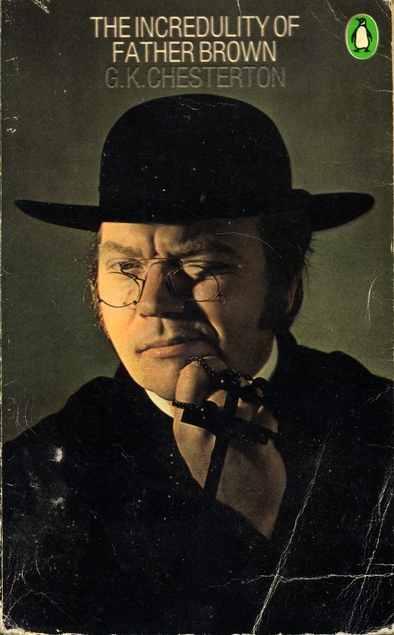
G K Chesterton’s Incredulity of Father Brown

G K Chesterton, The Incredulity of Father Brown (©1926, Penguin 1958, reprinted 1970)

On my eleventh or twelfth birthday, my parents gave me The Father Brown Omnibus, a doorstop of a book containing all 53 of G K Chesterton’s Father Brown stories. If they hoped it would break my addiction to Agatha Christie and Ngaio Marsh, they were to be disappointed, but I did love Father Brown, and once I’d read all his stories, I sought out everything I could find by Chesterton: the autobiography, essays (including ‘On chasing after one’s hat’), his books on Francis of Assisi and Thomas Aquinas, Orthodoxy, some poetry (‘I don’t care where the water goes/ If it doesn’t get into the wine’) and more. I loved his way with paradox. I thought his aphorisms, ‘Blessed is he who expecteth little, for he shall often be surprised,’ and ‘Anything worth doing is worth doing badly’ were words to live by.

Then, having not read anything by him for roughly half a century, I found this slim, yellowing paperback in a street library.

The Incredulity of Father Brown was the third of five collections, and contains eight stories. Father Brown’s nemesis Flambeau doesn’t appear, and more action takes place in the USA than I remember. Most of the stories are locked-room mysteries: someone was murdered in a room that no one else could have got into or out of. There’s an arrow, a sword-stick and a noose, all ingeniously deployed, and a couple of corpses that aren’t who or what they seem. All the elaborately conceived crimes are solved by the brilliantly pragmatic but unassuming little priest (the reader doesn’t have a fighting chance of figuring them out).

Not all the murderers are arrested, or even identified. These aren’t stories in which the detective reassuringly restores order by bringing criminals to justice. The interest lies elsewhere: first in the pleasure of the puzzle, and secondly in the platform they provide for Chesterton to preach his particular form of Catholicism. This collection (and possibly the whole Father Brown corpus – I can’t claim to remember) has at its heart a paradoxical assertion that a man of faith like Father Brown is less vulnerable to being hoodwinked by ‘spiritual’ claims than a modern ‘secular’ person. In these stories, God is real and There’s a Perfectly Natural Explanation for Everything Else. Father Brown himself, usually mild-mannered and Britishly polite, has occasional angry outbursts about ‘heathen humanitarians’. The polemic gets most explicit in ‘The Miracle of Moon Crescent’:

‘By the way,’ went on Father Brown, ‘don’t think I blame you for jumping to preternatural conclusions. The reason’s very simple, really. You all swore you were hard-shelled materialists; and as a matter of fact you were all balanced on the very edge of belief – of belief in almost anything. There are thousands balanced on it today; but it’s a sharp, uncomfortable edge to sit on. You won’t rest till you believe something; that’s why Mr Vandam went through new religions with a tooth-comb, and Mr Alboin quotes scripture for his religion of breathing exercises, and Mr Fenner grumbles at the very God he denies. That’s where you all split: it’s natural to believe in the supernatural. It never feels natural to accept only natural things. …’

That’s rubbish of course. But the underlying paradox of a man of religion who is more immune to oogy-booginess than a wide range of hardboiled types is fun to read

My only specific Father Brown memory from 60 years ago wasn’t of anything in this book. It’s an observation in ‘The Vanishing of Vaudrey’ in The Secret of Father Brown. It took some searching, because I didn’t hve the exact words, but I found it eventually:

… there are two types of men who can laugh when they are alone. One might almost say the man who does it is either very good or very bad. You see, he is either confiding the joke to God or confiding it to the Devil.

Again, that’s nonsense, but I can testify that it’s memorable nonsense, because it lodged in my memory. I loved it for its audacity, or maybe just for its cleverness. And it’s the kind of thing I still enjoy in Chesterton. I should mention that there’s plenty of colonialism, racism, antisemitism and sexism (women being mainly absent in this volume). It’s hard to be an unqualified fan, but I’m not sorry to have revisited these stories.

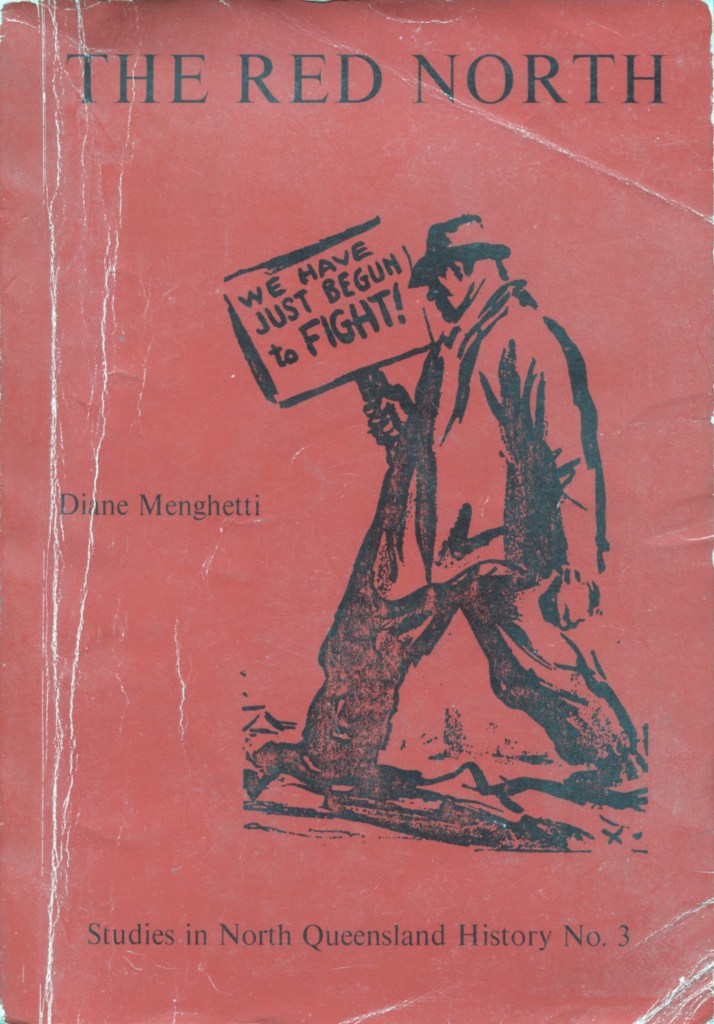
Diane Menghetti’s Red North

Diane Menghetti, The Red North (Studies in North Queensland History No 3, James Cook University of North Queensland 1981)

The student of North Queensland history frequently encounters evidence of widespread political radicalism which is difficult to reconcile with her personal experience of the district.

(The Red North, the beginning of the Introduction)

Indeed! Mention that the only member of the Communist Party of Australia ever to be elected to a parliament was in Queensland, where Fred Paterson was MLA for the seat of Bowen from 1944 to 1950, and the most common reaction is, ‘What happened?’ Diane Menghetti doesn’t set out to answer that question, but her book is a solid account of the second half of the 1930s when the CPA was more of a force in North Queensland than in any other part of Australia.

The Studies in North Queensland History series ran from 1978 to the mid 1990s.* I must have got hold of The Red North, No 3 in the series, soon after it was published and then been daunted by its non-commercial feel. It makes no pretence of being other than an MA thesis, set in courier with a foreword by a professor, footnotes and 60 pages of appendices.

But it turns out to be a fascinating read – for me, and I expect for many people like me who hail from that part of the world, as well as anyone interested in the history of the labour movement and Communism in Australia. With a wealth of detail, Menghetti describes how the CPA became an integral part of the social life of many North Queensland communities, supporting non-British labourers in the face of the British-preference policies of the Australian Workers Union, raising an extraordinary amount of money for the Spanish Civil War, organising social events, providing regular entertainment in the form of public meetings featuring gifted orators such as Fred Paterson.

We didn’t hear much of the history of the North in my childhood: snippets of family lore in a family that wasn’t much given to story-telling, and nothing at all at school that I can remember. When we were taught that Australia was settled in 1788, it wasn’t just tens of thousands of years of prior habitation that were ignored, but also the reality that settlement/ invasion occurred over decades – reaching north Queensland well into the nineteenth century. Even today, people talk as if Australian was mono-culturally Anglo-Celtic during the 1950s, erasing not just Indigenous peoples but also the large number of ethnic Chinese, Koreans, Italians, Maltese, Jugoslavs who I went to school with, many of whom had been around for generations.

So there’s a particular joy for me now to read a whole book about our history, about significant struggles that took place in places from my childhood: not just Innisfail, Cairns and Tully, but Mourilyan, Goondi, South Johnstone, El Arish, Flying Fish Point and Etty Bay. I especially love the moments where this narrative intersects with the little bits of history I had from my parents. I’ll give two examples.

First: in my childhood, the sugarcane was burned before it was harvested. We loved the spectacle of the cane-fires, and were told that their purpose was to kill the rats that infested the cane because the rats carried the deadly Weil’s disease. Burning the cane was necessary to save the lives of the canecutters.

That’s accurate. What it leaves out is one of the main episodes of this book, the bitterly-contested Weil’s disease strike by canecutters and mill hands from August to October 1935. Something of the flavour of the times, and of what we are deprived of when this history is erased, can be gleaned from events in Tully on 24 September 1935. The AWU, which generally opposed the strike, had called a meeting of all canecutters and millhands for that day:

During the previous night [the strike committee] had worked to turn the AWU meeting to the strikers’ advantage, and when the hour of the conference arrived, over a thousand strikers and sympathisers formed up at the top end of Tully’s main street. This street slopes fairly steeply down to where the Plaza Theatre is situated, almost at the end of the main town area. Thus the great procession, led by the Tully Pipe Band, marched right through the business area before the start of the conference. The AWU organiser opened the meeting with a call for nominations for the chair. Eric Driscoll, Communist mill representative, was duly elected and the executive of the strike committee took its place on the platform, reflecting its control over the total strike. The expressed purpose of the meeting was the election of delegates to represent the men at a compulsory conference of millers, farmers, strikers and the AWU. Towards the end of the meeting the ‘scabs’ from the mill arrived to cast their vote. They were escorted by police and their entry was considered by the strikers to be an act of provocation. Nevertheless, at [strike committee leader Jack] Henry’s urging, the election was concluded peacefully. The conference was never held.

(page 40)

Second: When I was in my 30s my mother astonished me by saying that the Depression didn’t happen in Innisfail, that out-of-work people from ‘down south’ used to come to our door asking for work or food. I knew there had been a large unemployed camp in the Cairns showground, so I put this down to my mother’s over-protected life at the time as the fiancee and then bride of a cane farmer.

Two short quotes from The Far North are relevant. First, confirming my view:

In the far north the Depression set in early with a slump in world sugar prices. With economic hardship came xenophobia.

(page 53)

But then this, offering some support to my mother’s account:

In the years preceding World War Two unemployment remained very high. The mildness of the northern climate may have reduced some of the distress among the local unemployed, but it also had the effect of attracting large numbers of men from the south, either looking for work or merely travelling to fulfil unemployment relief conditions. For many the journey terminated in Cairns where a large unemployed camp was established.

(page 109)

After I’d written most of this blog post I discovered that a new edition was published by Resistance Books in 2018 (details here). ‘The Red North,’ they write, ‘is a fascinating episode and one deserving of serious study by all those interested in seeing the development of a serious progressive force in Australian politics.’

The Red North is the fifth book I’ve read for the 2020 Australian Women Writers Challenge.


* Other titles in the series that I’ve been able to find are:

  • 2 Peter Bell, If anything, too safe: the Mount Mulligan disaster of 1921, 1978
  • 4 Christine Doran, Separatism in Townsville, 1884 to 1894: we should govern ourselves, 1984
  • 5 Dawn May, From bush to station: Aboriginal labour in the North Queensland pastoral industry, 1861–1897, c1985
  • 6 Cathie R. May, Topsawyers, the Chinese in Cairns, 1870–1920, c1984
  • 7 Dorothy Gibson–Wilde, Gateway to a golden land: Townsville to 1884, 1985
  • 8 Anne Smith, Roberts Leu and North: a centennial history, c1986
  • 9 Dorothy M. Gibson–Wilde and Bruce C. Gibson–Wilde, A pattern of pubs: hotels of Townsville 1864–1914, 1988
  • 10 Helen Brayshaw, Well beaten paths: Aborigines of the Herbert/Burdekin district, north Queensland: an ethnographic and archaeological study, c1990
  • 11 Marjorie Pagani, T.W. Crawford: politics and the Queensland sugar industry, 1989
  • 12 Bianka Vidonya Balanzategui, Gentlemen of the flashing blade, 1990
  • 13 Janice Wegner, The Etheridge, 1990
  • 14 Christine Doran, Partner in progress: a history of electricity supply in North Queensland from 1897 to 1987, 1990
  • 15 Todd Barr, No swank here? The development of the Whitsundays as a tourist destination to the early 1970s, 1990
  • 16 Ferrando (Freddie) Galassi, Sotto la Croce del Sud = Under the Southern Cross: the Jumna immigrants of 1891, 1991
  • 17 Dawn May, Arctic regions in a torrid zone: the history of the Ross River Meatworks, Townsville, 1892–1992, 1992
  • 18 Bruce Breslin, Exterminate with pride: Aboriginal–European relations in the Townsville–Bowen region to 1869, 1992.
  • 19 Eileen Hennessey, A cup of tea, a Bex and a good lie down, 1993
  • 20 Anne Smith, This El Dorado of Australia: a centennial history of Aramac Shire, 1994
  • 21 Patricia Mercer, White Australia defied: Pacific Islander settlement in North Queensland, 1995

Ruby Reads 18: buckets from the stream

Blogging about books read to Ruby could become a full time occupation. All I can do is dip my little bucket in the stream every now and then and show you what I caught in it. Here goes!

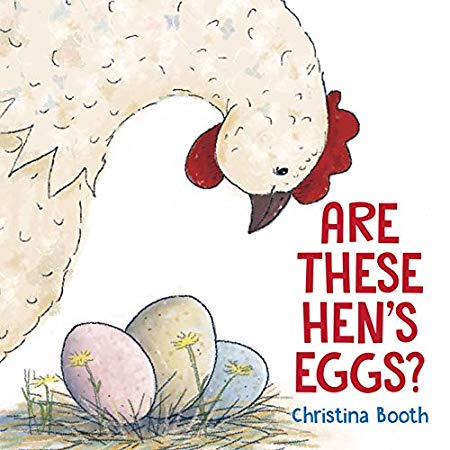
Christina Booth, Are These Hen’s Eggs? (Allen & Unwin 2020)

Mrs Roberta Kennedy, a retired school teacher, reads to children at Gleebooks in Dulwich Hill every Thursday morning. When we attended last week, the usual contingent from a nearby childcare centre didn’t arrive so Ruby made up half the young audience and this was a wonderfully intimate experience for her, especially as the other little one was sick and not that interested.

Are These Hen’s Eggs? is hot off the press, and though it’s the first book by Christina Booth that I’ve encountered, she has written and illustrated a lot (link to her website here). This one has a story of friendship and cooperation – the hen’s eggs are scattered in a storm and other animals help to retrieve them – and it slips in a sweetly amusing lesson, because as the eggs hatch we get to see a range of creatures that are born out of eggs, culminating in a very cute turtle (I was half expecting a snake, and was relieved that Christina Booth went for cute rather than scary).


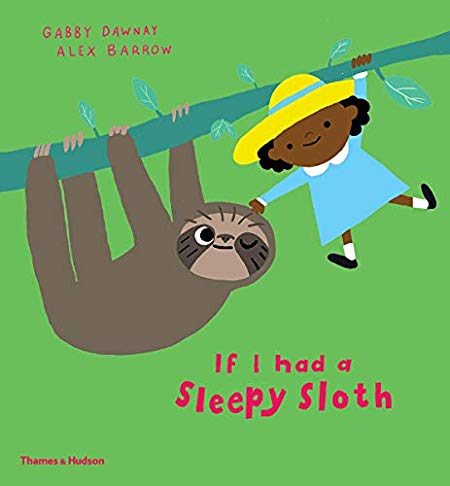
Alex Barrow, If I Had a Sleepy Sloth (Thames & Hudson 2020)

Also hot off the press (after all it’s a bookshop and the merchandise must be promoted), this is great fun. I must admit that what I remember is the incidental facts about sloths: moss grows in their fur and they have very long claws. I can’t tell you if these facts were in the text or in Mrs Kennedy’s asides. But the images are splendidly friendly.


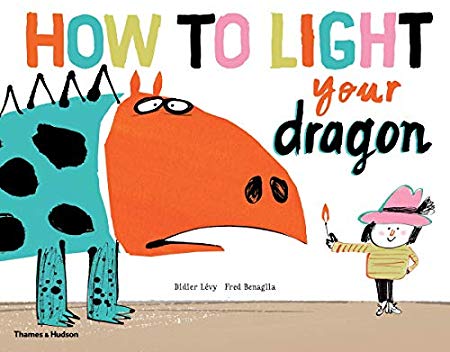
Didier Lévy (text) and Fred Benaglia (images), How to Light Your Dragon (Thames & Hudson 2020)

A child tries all sorts of tactics to rekindle his pet dragon’s fire. In the end, it’s his affection that does the trick. We’r never quite sure whether we’re on the child’s side or the dragons. Do we hope the fire will come or do we wish the child would just leave the poor fireless creature alone? Either way, we love the images.

This is translated from French, original title Comment rallumer un dragon éteint. I couldn’t find the translator’s name anywhere, sorry. Didier Lévy is a prolific creator of children’s books, and I hope this isn’t the only one that’s available to Anglophone children. many of them ringing the changes o fairytale themes. Fred Benaglia is similarly prolific in the Francophone world.


Chris McKimmie, I NEED a Parrot (Ford Street Publishing 2019)

Mrs Kennedy showed her virtuosity here. Realising that the books she had selected in advance weren’t appropriate for her audience of a solitary two year old (plus grandparents), she scrimmaged around on the shelves and chose this, and did a brilliant unrehearsed reading. The child narrator here wants a parrot and goes thought a list of the things she doesn’t want – the whale in the cover illustration is the most outlandish, but not by much.


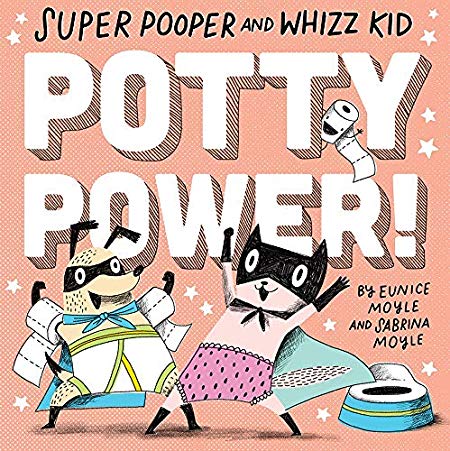
Eunice Moyle and Sabrina Moyle, Super Pooper and Whizz Kid: Potty Power! (Harry N Abrams 2018)

This wasn’t part of Robbie Kennedy’s repertoire. It was in the board book shelf at Marrickville Library, and some inner demon prompted me to pick it up and read it with appropriate gusto to Ruby. It’s a rude and irreverent explanation of the use of a potty with adventurous typography and wealth of synonyms for bodily functions. I don’t know that the synonyms did much for Ruby, but she stayed interested. The bit I liked best was where the child, once sitting on the potty, has to wait … and WAIT …and WAIT.


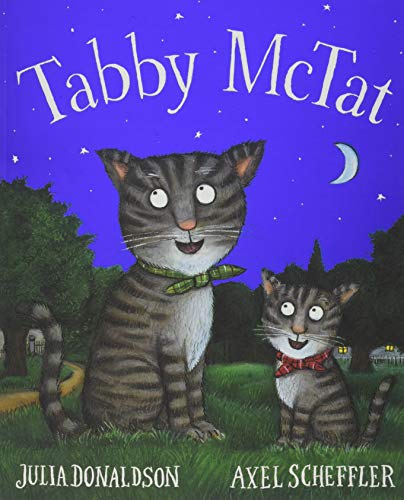
Julia Donaldson (words) and Axel Scheffler (images), Tabby McTat (Alison Green Books, Tenth Anniversary edition 2019)

This Tabby McTat is a busker’s dear friend. When Tabby is distractd by a beautiful female cat named Sox and the busker gets into serious trouble they are separated. It’s a book about love and loss and change and hope. Julia Donaldson and Axel Scheffler are one of the power partnerships of current children’s literature, and this is my favourite of their books. Donaldson makes rhyming look easy and her wit is brilliant as well as age-appropriate – Ruby loves the song that Tabby McTat sings with his human busker friend:

Me, you and the old guitar,
How perfectly, perfectly happy we are.
MEEE-EW and the old guitar.
How PURRRR-fectly happy we are!

Or at least, she quotes it when the book is picked up and has told me I can’t do the song: ‘No song, Poppa!’ I must be doing it differently from her father, who is a very good reader of children’s books.


Are These Hen’s Eggs? is the fourth book I’ve read for the 2020 Australian Women Writers Challenge.

Jeff Lemire and others’ Black Hammer vols 3 & 4

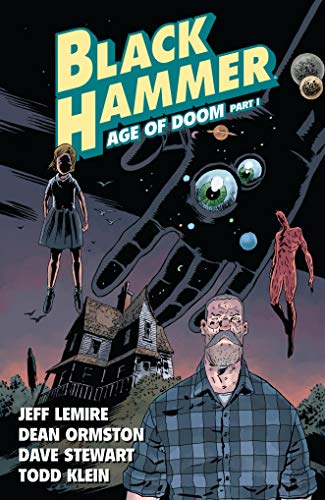
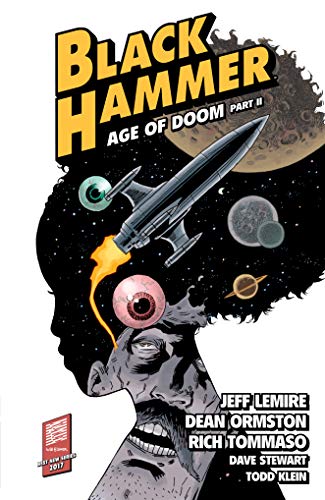
Jeff Lemire (writer), Dean Ormston (pencils), Dave Stewart (colorist) and Todd Klein (letterer), Black Hammer Volume 3: Age of Doom Part 1 (Dark Horse Books 2019)
Jeff Lemire (writer), Dean Ormston (pencils), Dave Stewart (colorist) and Todd Klein (letterer), except for 46 pages with art, colour and letters by Rich Tommaso, Black Hammer Volume 4: Age of Doom Part 2 (Dark Horse Books 2019)

Early last December I announced that I didn’t want any superhero comics for Christmas. My second son’s alarmed expression made me think I’d spoken too late. But it turns out that he correctly intuited that the Black Hammer series was an understood exception. He knew I’d enjoyed the first two volumes of this series (though I doubt he read my blog post, here, which ended. ‘I’m patiently awaiting Volume 3’). Vol 3 was a Christmas gift from him, and I bought Vol 4 hot off the press.

Black Hammer isn’t so much a superhero comic as a commentary on them. In the first two books a band of superannuated heroes is on a weirdly unreal farm somewhere in rural USA: the last thing any of them remember is defeating the ultimate comicbook villain, the Anti-God. Everything looks normal, they have relationships with people in the nearby town, but they can’t leave. Black Hammer, their former leader, did manage to escape, but is now almost certainly dead. In the second volume, Black Hammer’s daughter Lucy, an investigative reporter, turns up but can’t remember how she got there. She finds her father’s fabulous titular black hammer, she wields it and becomes the all-new Black Hammer. In the final frame of Vol 2, she announces that she remembers everything and knows where they are and then …

… at the start of Vol 3, which is the beginning of the Age of Doom sequence, she vanishes, SHRACK!!

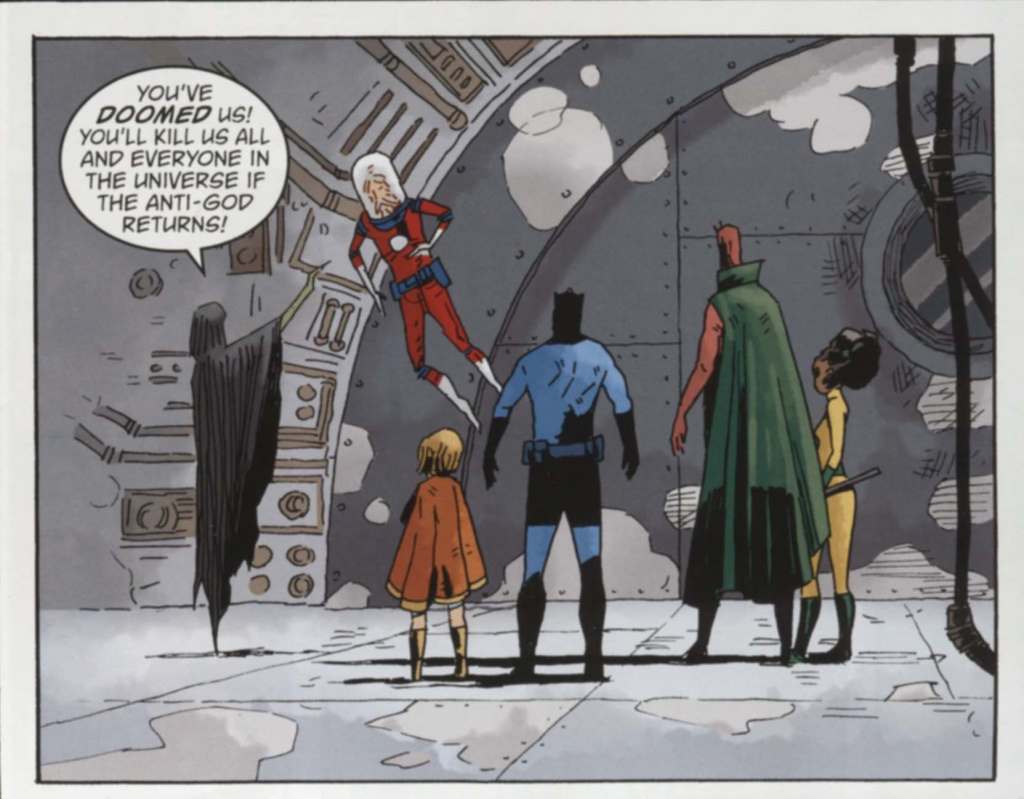
We follow Lucy/Black Hammer’s travels through weird meta-worlds incuding a version of hell and a mysterious castle called Storyland inhabited by characters who could be parodies of Neil Gaiman’s Endless. And we follow those left behind as they try to unravel the mystery. About halfway through this volume the bifurcated paths reunite and the mystery is solved. But the solution reveals that things are actually much worse than anyone imagined. At the end of this volume, a couple of frames after someone says:

without so much as a SHRACK!!, everything goes white.

[In case you’re interested, the characters in that frame are: Madame Dragonfly, mistress of the macabre; Golden Gail, a potty-mouthed adult frozen in an eleven-year-old’s body; Colonel Randall Weird, who knows past, present and future all at once and spends a lot of time on the Para-Zone (don’t ask); Abraham Slam, whose name says it all; Barbalien, Gay warlord from Mars; and Lucy/the new Black Hammer. Missing is Walky-Talky, the robot who intervenes at key moments.]

The next volume, the end of the Black Hammer series (apart from a number of spin-offs carefully adumbrated in this story, including Sherlock Frankenstein and the Legion of Evil), begins with 48 pages of art by Rich Tommaso, reminiscent of the comic book art of the 1950s and strikingly different from the moody heroic style of Dean Ormston in the rest. These pages follow the adventures of Colonel Weird in another unreal world, this one inhabited by ‘unrealised characters from never finished stories’. (You can tell the creators had a lot of fun with this story, and there’s potential here for any number of spin-offs.)

Meanwhile, the rest of the crew are back to normal life in Spiral City – a life where they have never been superheroes. One waits tables, one is a guard at the museum reading superhero comics, one is Gay in homophobic Martian society, and one is living with dementia in a nursing home. But thanks to the magic black hammer, a well-placed KRA-KOOM!!, and some intense recriminations, the original group is back together in time to face down one more threat to the entire universe.

I don’t think it’s a spoiler to say that it all works out in the end, in a ‘the end of all our exploring will be to arrive where we started’ kind of way, with a door left ajar for further adventures of Lucy/Black Hammer.

I enjoyed this a lot. It’s not part of the Marvel Universe or the DC Universe so you don’t have to be a cult insider to follow it and enjoy it. According to Wikipedia, Black Hammer’s crew are going to team up with DC’s Justice League heroes this year, and a film and or TV series is in development, but I’m happy to stick with this odd bunch as they are, in the page.)