Category Archives: Books

Annabel Crabb’s Men at Work

Annabel Crabb, Men at Work: Australia’s Parenthood Trap (Quarterly Essay 75, 2019) – and correspondence in Quarterly essay 76

Women’s surge into the workplace has been profound over the last century. But it hasn’t been matched by movement in the other direction: while the entrances have been opened to women, the exits are still significantly blocked to men. And if women have benefited from the sentiment that ‘girls can do anything’, then don’t we similarly owe it to the fathers, mothers and children of the future to ensure that ‘boys can do anything’ means everything from home to work?

Men at Work, page 65

In this Quarterly Essay Annabel Crabb addresses the ‘baked-on’ cultural assumption that mothers must be the ones who do the real parenting while fathers are meant to help and support, and the economic, political, social and industrial structures that hold that assumption in place, and to some extent enforce it. She points to a number of examples of departures from this norm, harbingers of change: apologising for the predictability, she describes parental leave regimes in Norse nations, but also to developing policies closer to home in For example, at Medibank, in the context of general flexible working provisions, the notion of primary and secondary parents has been shelved and parental leave and other possibilities have been implemented – and are turning out to be good business practice.

Like some of the correspondents published in the subsequent Quarterly Essay (Peter Hartcher’s Red Flag), the essay led me to reflect on my own experience as a parent. I’ve been a father for nearly 42 years and belong to what Annabel Crabb says – and I have no reason to doubt her – is a tiny minority of men who have spent time as ‘stay at home dads’. My sons were born in 1978 and 1983, and with the exception of the Maternity Leave (Australian Government Employees) Act passed by the Whitlam government in 1973, none of the legislation, policies or studies referred to in the essay existed yet. Because the ways the Emerging Artist (then the Community Worker) and I dealt with the challenges of parenthood differ so radically from the norm described by Annabel Crabb, I hope it will be OK to spend the rest of this blog post telling part of that story. (Some of my readers were there – please correct any errors and feel free to add to the story.)

The EA/CW was a feminist who had been in consciousness-raising groups, worn overalls, worked in women’s collectives and, significantly for this story, shared money and futures (that’s how they expressed it) with another woman. I’d been thrilled by the emergence of Women’s Liberation at Sydney University in the late 60s, and had taken to heart the words of a teacher of mine: ‘If as a man you want to counter domestic sexism you have to decide you’re going to do all the work in the home; that way you may end up doing a fair share.’ He’d also said, ‘Fathers can do everything that mothers can do except breast feed.’ So from the beginning we thought of ourselves as a parenting team – I got up when the baby cried in the night, and brought him to his mother. I was still at work in those first notoriously exhausting weeks, and I’d slip away to the toilet to snatch a couple of minutes sleep with my forehead resting on the roll of toilet paper.

The EA/CW had no maternity leave, so went back to work three months after the birth. My workplace – in the NSW public service – was flexible enough that I could take three days a week unpaid leave for an extended period to look after our baby. We lived a quarter of an hour from the EA/CW’s workplace; for the first couple of months when he gave signs of needing a feed I’d bundle him into the car and take him to the breast, usually arriving before he was desperate. While his mother fed him I’d sit on the verandah of the centre – often with a group of women talking animatedly in Italian at the other end. I was able to reassure them, ‘Non capisco niente.’

I looked after the baby three days a week. We weren’t well off, but the times and our circumstances (see mention above about sharing money and futures) were such that we could afford to pay friends the going rate to look after him the other two days. I don’t remember them doing the breast-feed dash, so some bottles of formula must have been involved.

As a man looking after a baby in public, I was a rarity. At the local playgroup I was treated as something rich and strange, and congratulated for looking after my own child. I don’t think I was ever rude in response, but I was nonplussed. Once, long haired and – I guess – not obviously male from behind, I was struggling with baby, stroller and nappy bag up a flight of stairs at a railway station. A burly chap helpfully grabbed the stroller, and was obviously a bit shocked to realise he was being gallant to a bloke.

As there was virtually no accessible childcare at the time, a number of parents in the inner west of Sydney banded together to form what we called the Kids Co-op. We took over an abandoned house with an empty lot next door belonging to the Princess Alexandra Children’s Hospital, and they were eventually happy to let us have it for a peppercorn rent. For every child, the ‘parental unit’ had to do two half-day shifts a week, and there was a very small fee. We were a mixed bunch, and men were well represented: a couple of tradies, a baker, a Qantas steward, a drop-out lawyer, a telephone exchange operator, an editor who managed some casual work (that’s me). The women were equally varied. What we had in common was an openness to finding collective solutions to the collective problem.

The Co-op was often chaotic. The weekly meetings ranged from tedious to hilarious. Some people would come to one meeting or do one shift and then never be seen again. The food was basic, and maybe that’s praising it too highly. But the young ones formed strong bonds: at the end of the day, our two-year-old son would plead to go home with one of his friends, or vice versa. And as the parents had generally worked with each other on shifts, their pleas were often enough successful. This little constellation of families meant there was rarely any difficulty finding babysitters.

As the young ones turned three and four, we started a ‘co-op preschool’. Here there was one paid early-childhood educator, and once again parents did shifts as assistants.

In later years, the EA/SW and I lived for a time with former Co-op members, and many friendships that began there – among both generations – are alive and thriving.

I don’t think the Co-op could happen today. Health and safety regulations would be an obstacle, and new parents are much more isolated. The pressure to work long hours is more intense, and the neo-liberal worldview’s emphasis on individualism is a powerful force in the culture.

Annabel Crabb gives a string of examples of men whose lives have been enriched by the opportunity to be actively engaged with their children, as full-time or part-time ‘stay-at-home dads’, sometimes sharing the joy with the ‘stay-at-home’ mum. She also writes of ‘a storm-cloud of resentment building among millennial men’, who see themselves as ‘lumped with the transgressions of an older generation, while missing out on entitlements that should reasonably be theirs’. The park playground near our flat is full of fathers and small children on sunny weekends, something that we just didn’t see 40 years ago: the men are willing, but the system, though it has softened, is tight.

Men at Work is the third book I’ve read for the 2020 Australian Women Writers Challenge.

Ruby Reads (17): Mardi Gras

I haven’t blogged about Ruby-related reading for a while. Many wonderful books have been read, but I wouldn’t dream of trying to catch you up on them all. The Sydney Mardi Gras is coming up, so here are a couple of LGBTQ+-related titles.

Maurice Sendak, Where the Wild Things Are (1963)

I’ve mentioned this a couple of times on this blog (as in this recently retrieved post). I first met it in the early 1970s when I gave it to my niece, and have loved it ever since. I even quite like the movie. The Emerging Artist, aka Nanna, read it to Ruby recently. I don’t think Ruby got it: What is this thing called mischief that Max makes? Come to think of it, maybe we should give it another go, because although R doesn’t wear a wolf suit, she often says, ‘I’m a doggo!’ and gets a mischievous/rascally look in her eye. But I don’t think she has any idea what’s going on when Max’s mother sends him to bed without eating anything: punishment isn’t yet part of her moral universe.

In case you don’t know, after Max makes mischief and is sent to bed supperless, a forest grows in his room, and an ocean tumbles by. Max sails to where the wild things are and though they threaten to eat him he becomes their king, tames them, has a rumpus with them, and sails home to his room where his supper is waiting for him, ”And it was still warm.’

I don’t know what else to say about Where the Wild Things Are beyond that it’s a work of poetic genius, and if you haven’t seen the images, or other images referring to them, you haven’t been paying attention.

And why blog about it in connection with Mardi Gras? I don’t think there’s anything particularly queer about the book itself, but Maurice Sendak came out as gay towards the end of his life.


The Family Book (Todd Parr 2003)

The next three books were read to us at rainbow-themed events in a nearby library.

The Family Book is a straightforward celebration of diversity in families: heterosexual parents, same-sex parents, single parents, mixed race, many children, single children, adoption, and so on. It culminates in the statement: ‘There are lots of different ways to be a family. Your family is special no matter what kind it is.’

Like Sophie Beer’s Love Makes a Family (my blog post here), it’s fine, would irritate some culture warriors on the right and its illuatrations are lively enough to hold a young audience’s interest


Lesléa Newman (words) and Laura Cornell (pictures), Heather Has Two Mummies (2001)

First published in the USA in 1989 with a different illustrator and mommies rather than mummies, this is regarded as a groundbreaking book about a non-heteronormative family. According to Wikipedia (here) it is one of the most often banned books in the USA.

It’s a baldly didactic book. Heather goes to school, or perhaps it’s daycare, and discovers that all the other children have a mother and a father. When the teacher realises Heather doesn’t have a father, she sets up a number of activities to teach the children – and the readers – that having two parents of the same gender is fine, that what matters in a family is that people love one another ‘very much’. Someone, in recommending this book for early-childhood educators, says that you can do the activities that come with the book without actually reading the book.

The illustrations bring a lightness of touch to a text that is resolutely didactic though not, to be fair, completely humourless.


Mel Elliott, The Girl with Two Dads (Egmont 2019)

Matilda is new at the school. Pearl is excited to have a new friend, and even more excited when she discovers that Matilda has two fathers. In her family, the mother is the disciplinarian, so a family with two fathers must be a lot of fun. It turns out that Matilda’s parents are just as boring and full of rules as Pearl’s own.

Unlike the story of Heather and her mummies from 30 years ago, this one allows room for the readers to have a range of responses: they may identify with Pearl in thinking it’s odd to have two fathers, they may think that Pearl is a bit silly to think that, or they may see the whole same-sex parents thing as peripheral to the main story of friendship. I don’t know how this went down with the two- and three-year-old audience, but I liked the passionate friendship between the two girls, and the humour of Pearl’s disappointment worked for me.


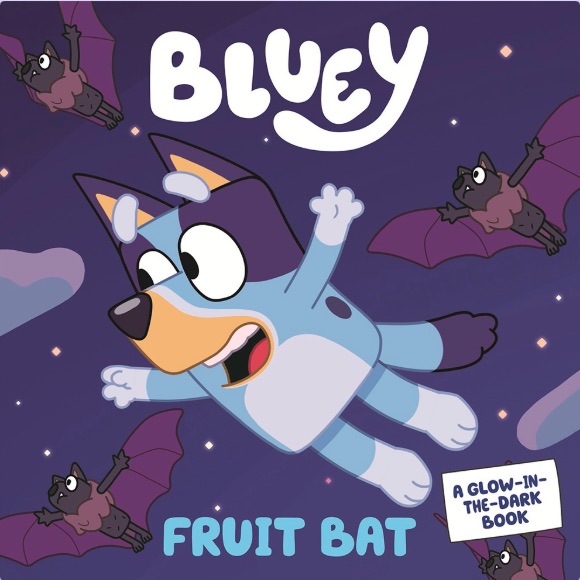
Joe Brumm (creator), Bluey: Fruit Bat (Penguin Australia, 2019)

This book has got nothing to do with Mardi Gras. I just love Bluey and wanted to mention her. The book is a glow-in-the-dark version of an episode of the Bluey TV animation series, which you can watch online here.

Bluey is a blue cattledog who lives with her father (Dad), her mother (Mum) and her little sister Bingo in a suburban home, probably in Brisbane. The adults know how to play with the children. The children, er, pups are clever, affectionate, cooperative (mostly), energetic. Since seeing a little of this show, Ruby has taken to spinning around on the spot, which Bluey can do without getting dizzy. She’s also requested drawings of Bluey (which are much harder than Peppa Pig) and occasionally announces that she herself is Bluey, or Bingo.

This and Bluey: The Beach may be the only spin-off books from a children’s television cartoon show that I’ve enjoyed.

(An apology: I don’t have the book with me, and can’t find name of the book’s – as opposed to the cartoon’s – author.)

Vicki Hastrich, Charlotte Wood, Night Fishing on the Weekend with the Book Group

Before the meeting: This month’s designated Book Chooser gave us two books to tide us over the summer break, a collection of memoir essays and a novel. The author of the novel makes a brief appearance in one of the essays, and it’s possible that the novel is set in a version of the locality that is the focus of many of the essays.


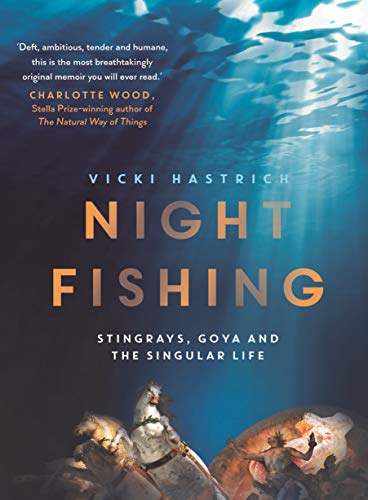
Vicki Hastrich, Night Fishing: Stingtrays, Goya and the Singular Life: A Memoir in Essays (Allen & Unwin 2019)

Before the Meeting: I reserved both books at each of the two libraries I belong to. Night Fishing became available within a day, though I was unable to renew my loan because seven people joined the queue while I was reading it. By contrast, there were 50 and 80 people respectively in the queues for The Weekend, but I was saved by the Emerging Artist, who bought it as a Christmas present to herself.

Night Fishing is a collection of thirteen essays that range from 4 to 34 pages in length. They don’t really amount to a memoir, as the title page claims, but they do have memoir elements. They are personal essays, most of which explore aspects of the waters near Woy Woy, where Vicky Hastrich’s family had a holiday house in her childhood and which she now visits often.

The first essay, ‘The Hole’, is filled with rich childhood memories of the place, and the excitement of rediscovering a favourite fishing spot with her brother. They go out in the author’s much-patched fibre-glass dinghy, the Squid, and are just about to pack up for the day, crowded out by half a dozen fancy, gizmo-laden boats, when she gets a bite:

The rod bent. I pulled the big, slow thing up and Rog got the net. It seesawed, it yawed, it took forever, but finally a dark shape materialised. Rog leant out and the shape nosed serenely into the net, though only its head seemed to fit; simultaneously Rog lifted and in a heavy, dripping arc in it came, landing thickly in the bottom of the boat. A huge flathead. Biggest one we’d ever seen – by a mile. Adrenaline pumping, we whooped and screamed.
 Suck eggs, you plastic heaps! Go the mighty Squid,’ I hollered.
We were grown-ups.

There are many moments like this in the essays. Hastrich’s deep love of that place is infectious, and it’s the best thing about the book – in ‘The Hole’ and ‘From the Deep, It Comes’ (in which Western writer and deep-sea fisher Zane Grey makes a guest appearance). She also writes engagingly about her writing life, including an unfinished colonial gothic novel that seems to haunt her, and about the way her past as a television camera operator affects her way of seeing (both in the same brilliant essay, ‘My Life and the Frame’). There’s a wonderful essay, ‘Amateur Hour at the Broken Heart Welding Shop’, about her grandfather, who was a ‘first-class amateur’ engineer – Hastrich describes herself as an amateur writer.

Less successful for me are the essays that are in effect reports on experiments: going fishing at night with only a non-directional lantern on the dinghy (‘Night Fishing’); taking the dinghy out at low tide to The Hole with a bathyscope (‘The Tomb of Human Curiosity’); filming herself as she sleeps two nights in a row and taking 112 selfies on the day in between (‘Self Portraits’). The contrived set-up of these pieces stops them from quite taking off.


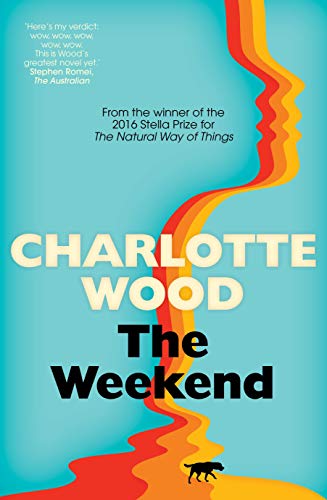
Charlotte Wood, The Weekend (Allen & Unwin 2019)

Three women in their seventies meet at a beach house for a weekend over Christmas, but not to celebrate the holiday. Christmas just seems to be a non-event. None of them has family to celebrate with: Wendy is a widow with alienated adult children, Jude is the long-term mistress (old-fashioned term, but accurate) of a wealthy man who spends the holiday with his family, Adele is a once-famous actress who has become increasingly unemployed, alone in the world, and on the brink of homelessness. Nor have they taken refuge with each other as Waifs and Strays. The beach house belonged to Sylvia, the fourth in their little group of friends, who has died recently. They are there to sort out her stuff and prepare the house for selling – for the benefit of Sylvia’s partner, who has left the country,

We are told that these women have been friends for forty years. We are told they are feminists. But as they arrive at the hut, separately, they barely greet each other. Each is allocated a section of the house to clean up, and they proceed to do it in isolation. No calling out from one room to another – ‘Oh my God, look what she kept!’ ‘What should we do with all these gorgeous clothes?’ ‘That’s my saucepan that she borrowed and never gave back!’ – let alone any shared whingeing about the partner who has skedaddled and left them to do what should be her work. They do think such thoughts, but there’s no commonalty in the task. No sense of solidarity in grief either. And only the sketchiest idea of who the recently deceased woman was apart from the her role in keeping the friendship group together. When the three go for a walk on the beach, no one waits for anyone else but each remains wrapped in her own thoughts.

Not a lot happens in the first two thirds of the book apart from reports on the internal monologues of each of the women, and descriptions of the undignified deterioration of Wendy’s deaf, arthritic, incontinent dog. Towards the end, each of the three is delivered a devastating blow, they stumble into a Christmas midnight mass, and they find some solace and forgiveness with each other, but though there’s a terrific evocation of a storm as the blows are delivered, by then I was past caring.

I was so looking forward to this book, because I loved Charlotte Wood’s The Natural Way of Things (my blog post here). It can’t just be the subject matter that led me not to like it – I’ve been known to be very interested in women aged 70 or thereabouts, and I was enthralled by Elizabeth Strout’s Olive, Again (blog post here). I think it’s something to do with the way the narrative generally works. To take a passage pretty much at random, here’s Jude after she’s realised that Adele has claimed the best bedroom without any discussion:

She didn’t care about the bedroom at all – she wasn’t fussed by trivia like that – but still, a fleck of disdain formed itself: how had Adele not, in all these years, developed a shred of restraint, of self-discipline? It was how and why she was an actress, Jude supposed. They were all children, the men too, as far as she could tell. She could see the appeal, when you were young, the liberation of it. But what did it mean when you were old? What were you left with, still a child at seventy-two?

(page 75)

This is the kind of writing I meant by ‘we are told’ in the earlier paragraph. It’s shaped as if it’s giving us Jude’s internal monologue. I don’t think I’m alone in believing that no one thinks like that. Take the generalisation about actors. It’s mean and judgmental, and absurd, but that’s not my problem with it: why shouldn’t Jude be meanly, absurdly judgemental? My problem is that the omniscient narrator is giving us a rundown, an abstract, as if the writer has figured out what Jude’s character is, and is giving us little snippets to illustrate it. We’re not inside Jude’s head, which is where we need to be if we’re to get lost in the story. Sadly, this is pretty much how the narrator’s voice works for most of the book. It feels as if these characters created no surprises for their creator. This reader remained generally disengaged.

Many people have said The Weekend was one of their favourite books of 2019: Sue at Whispering Gums and Lisa at ANZ Lit Lovers, for example, have both written elegant, well-argued, positive reviews of what’s recognisably the same book but seen through very different lenses from mine. I’m glad, because I don’t want any book to be unloved – well, hardly any book. I’m sorry this one isn’t loved by me.


After the meeting: We met in the carport of our host’s newly purchased and not yet completely habitable house in Balmain with a spectacular view of the Sydney skyline, and had pizza. Once we’d got over the splendour of the setting, and tales of cricket from this summer and summers long past, and one or two fabulous tales of adventure in the city involving weddings and mistaken identity (though not in the same tale), we had an animated discussion of the books.

My sense is that no one was as negative about The Weekend as I am. Where I missed the casual back and forth of old friends, the book’s main proponent said he had read that sort of thing as understood but not part of the book’s focus: that the narrative was interested in the characters’ internal lives. another chap said that the main thing the book did for him was to have him reflect on decades-old relationships that are full of obligation but not much else; in particular, there are people who are nominally his friends but are really his wife’s friends, and if she were to disappear he wold gladly never see them again. He wasn’t saying that the three women in this book were like that, but he certainly read their lack of mutual warmth as having a similar source: Sylvia was the glue that held the group together, and no one was sure it could continue to exist without her. Yet another said he wasn’t fazed by the lack of communal grieving: that had already happened, as he read it, and now each character was withdrawn into her own individual grief.

It’s interesting that my main misgivings – which I’m not sure I even articulated – were addressed from so many fronts.

Night Fishing provoked some interesting discussion. Notably, towards the end of the evening, one chap said he was embarrassed to realise that this was the first thing he’s ever read about a woman fishing. His embarrassment was widely shared, and led to some interesting surmise about fishing and gender: men often fish in order to indulge in reverie, that is to say, be alone and do nothing. Is it the same for women? Or does it tend to be a more practical task for women. Today someone sent us a link to Lyla Foggia’s 1997 book Reel Women: the world of women who fish (link here).

On a more general readerly level, while the word ‘patchy’ evoked some head-nodding, we liked the book. A couple of passages were read out to general approval. One of our younger members said the book tapped into a vein of nostalgia. He didn’t get to enlarge on that thought, and I didn’t get to reply, but I think it’s not exactly nostalgia in these essays: the author revisits a place she loved as a child and explores it in a number of ways as an adult, deepening and enriching her understanding of it, and so of herself.

Someone said that they felt that Night Fishing was written by a person, and The Weekend was written by a writer. Obviously Wood and Hastrich are both writers, but there’s something to what he said. Hastrich describes herself as an amateur, which is a different thing from a dabbler or a learner – it points to the elements of vulnerability and lack of subterfuge that make her writing so attractive. The Weekend is Wood’s sixth novel, and even though I was disappointed in it, I didn’t ever want to give up on it.

One last thing: Charlotte Wood has put up on her podcast The Writer’s Room a wonderful interview with Vikki Hastrich that provides fabulous insights into the kind of beast Night Fishing is. Here’s a link.


Night Fishing and The Weekend are the first two books I’ve read for the 2020 Australian Women Writers Challenge.

Journal Blitz 5

I guess I’ll never be up to date with the journals I subscribe to. This is my fifth catch-up blog post, and I’m still reading things about a year after publication. Here they are: one from a university, one from the left, one from an organisation of poets and one from an island.


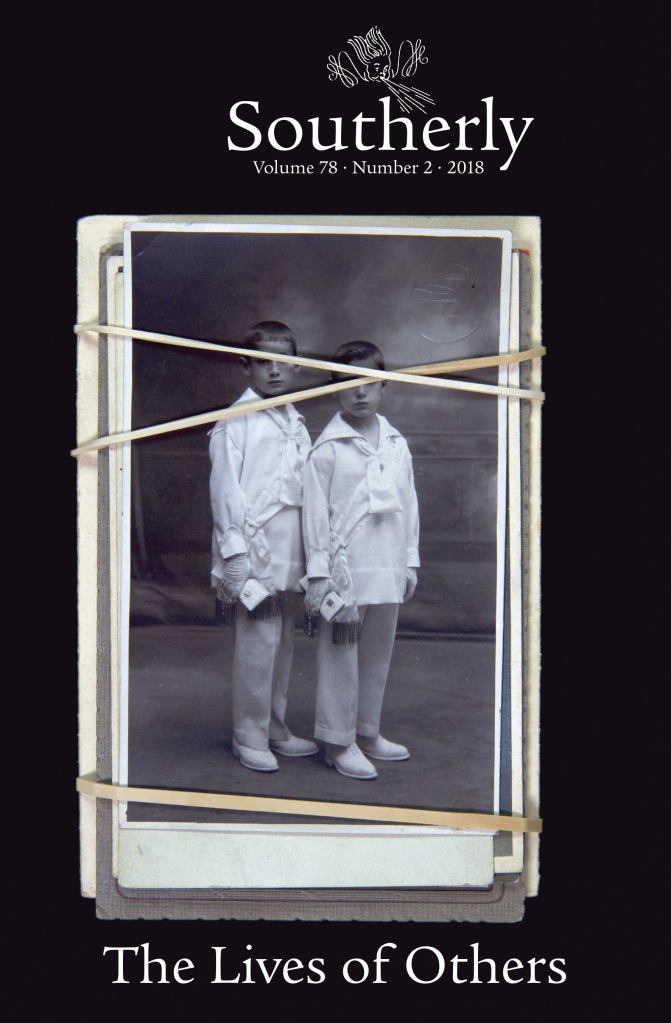
Elizabeth McMahon (editor) and George Kouvaros (guest editor), Southerly Vol 78 No 2 2018: The Lives of Others (2019)

This issue of Southerly, the back cover tells us, ‘is concerned with the debts and obligations that accompany the passing of the generations’, a way of saying that it has a theme of family – personal reminiscence, family history, lines of cultural genealogy.

Here are some of my highlights.

In ‘The Other Life’, guest editor George Kouvaros explores his childhood feelings about a photo of a cousin about his own age who stayed in Greece when Kouvaros’ family moved to Australia. He builds fascinatingly around the notion, borrowed from Marsha Gressen, that migrants are often haunted by a sense of a double life: the one they are living and the one they would have had if they stayed.

Brendan Ryan’s memoir ‘John Forbes in Carlton’ paints a vivid picture of Forbes (dobbed ‘God on a bicycle’ by a Melbourne wit ) as mentor, and is a sweet account of how the creative baton was passed down the generations. It would have gone well as a chapter in Homage to John Forbes, edited by Ken Bolton in 2002. I’m a fan of both Forbes and Ryan (blog posts, here, here, here and here), but I don’t think you’d need to be to find joy in the essay.

Maria Griffin’s ‘Benjamin’ is a poignant, elegiac meditation on death and extinction. Her immediate subjects are her younger brother, who died aged 32, and the Thylacine / Tasmanian tiger. With a light but dagger-sharp touch she allows the subject to broaden to include the climate emergency. (One small cavil: she imagines Australia during the last ice age as covered with sheets of ice, whereas – correct me if I’m wrong – the archaeological evidence suggests that, though bitterly cold, it was covered in dust.)

Meera Atkinson’s fiction ‘Necropolis Drive’ makes brilliant and powerful use of archival material – her protagonist is researching the history of women incarcerated as insane in colonial times, and correspondence from the NSW Government State Archives and Letters leap from her pages to grab the reader by the throat.

Sharryn Ryan’s memoir ‘The Miracle’ is as powerful a story of growing up with an emotionally unstable mother as you’re likely to read anywhere. Its story of wildness is told with extraordinary restraint, and all the more effective and affecting for it.

Katherine Maher’s ‘One of Your Family’ reads as a fragment from a much broader piece of research. It approaches the issue of the Stolen Generations with a narrow focus, discussing a four-minute video of one Thupi Warra man’s response to Kevin Rudd’s 2008 apology. Maher tells us that this is one of 25 videos of this nature held in the State Library of Queensland. ‘I’m not sure,’ her essay concludes, ‘how to truly hear the history he tells.’ Essays like hers help the rest of us clean out our ears.

Three reviews inspired me to do some rereading, and re-savouring: Naomi Riddle on Fiona Wright’s Domestic Interior (my blog post here; I think Wright is funnier than Naomi Riddle seems to); Peter Kirkpatrick on Martin Langford’s Neat Snakes (my post here) and Brigitta Olubas on Sarah Day’s Towards Light (my post here).


Jacinda Woodhead (editor), Overland 235 (Winter 2019)

This is the eighteenth and last issue of Overland edited by Jacinda Woodhead. The woman on the cover isn’t her, but a ‘friend and fellow anti-fascist organiser’ of the guest artist Tia Kass. Still, that woman’s confident fist isn’t a bad emblem for Woodhead’s – and Overland‘s – work.

I don’t usually read editorials, let alone quote from them, but as this was Jacinda Woodhead’s farewell, I made an exception (link here). She asks, ‘So what is a left-wing literary magazine today?’, and replies in part:

Now more than ever, we need projects like Overland: we may not always agree with the positions and experiments published in its pages, but it’s critical to build spaces where collective alternatives, where collective futures can be articulated.

I subscribe to Overland to support the building of such a space. Then I read it because it generally includes news and thinking that I don’t easily get elsewhere. Here’s how the journal starts (with links to the articles online):

In ‘La mina no se cierra’, Caitlin Doyle-Markwick walks one of the variants of the Camino de Santiago in Spain (definitely not the walk with guides advertised in today’s Sydney Morning Herald that costs $25 thousand a head). The essay’s title – Spanish for ‘The mine will not close’ – is from graffiti she saw in Asturias referring to a major struggle early last decade. The graffiti, and the history that gave rise to it, is a springboard to rich and complex reflections on the current move against coal mines in Australia and the need for a just transition to renewables.

In ‘On grief’, regular columnist Tony Birch, as always, avoids grand rhetorical statements and takes us briefly into his own recent experience of bereavement.

Restorying care’, a PEN essay by Ellen van Neerven writes about the struggle of many First Nations people to ‘feel heard or tell our story’ in the health system. A brief quote:

Data is used to build, and claim, story. Recently, the term ‘data sovereignty’ has been used to describe mob’s sovereign right to their own data: all data should be subject to the laws and governance structures within the Indigenous Nation where it is collected. This data should be accessible to the community. Unfortunately we are a long way from that.

Then there are nine pages of poetry, including ‘Report on Norman – after Vigan’ by Norman Erikson Pasaribu (the title is mysterious to me, but the poem itself is terrific), ‘Walis tingting’ by Ivy Alvarez (which finds poetry in a Philippine palm-leaf broom), and ‘The hymen diaries’ by Eileen Chong (a set of four short poems that stands up on its own, but becomes much richer when seen alongside the stunning works of art it references – by Katie Griesar, Annette Messager, Paul McCarthy and Juana Francés).

But I won’t go on listing the whole contents. Here are some of the rest:

  • The gunboat nation in a lifeboat world’, by Scott Robinson, subtitled ‘On the militarisation of climate change’, wins my prize for the most telling metaphor in a title
  • Alison Croggon ruminates ‘On art‘ in times of crisis like ours
  • Giacomo Lichtner celebrates Primo Levi’s hundredth birth year by singling out ten fragments of If This Is A Man, in ‘One hundred years of Primo Levi
  • There are five short stories, of which the one that stands out most for me is Jem Tyley-Miller’s ‘The island’, which imagines a surreal solution to the refugee crisis involving those vast collections of garbage in the ocean
  • The most natural thing’ by Natalie Kon-yu is a peer-reviewed personal essay that introduced me to the parthood model of pregnancy, as opposed to the container model
  • Enza Gandolfo’s ‘Making & shaping’. which would have fitted nicely into the Southerly‘s theme, is a moving meditation on her mother’s crocheting artistry and  her own changing understanding of it
  • and regular columnist Giovanni Tiso strikes an intimate note in ‘On not moving to Australia‘, linking his decision to stay in New Zealand because he has two children who live with autism with Australia harsh rules for New Zealanders who come here, and it’s even harsher treatment of some refugees.

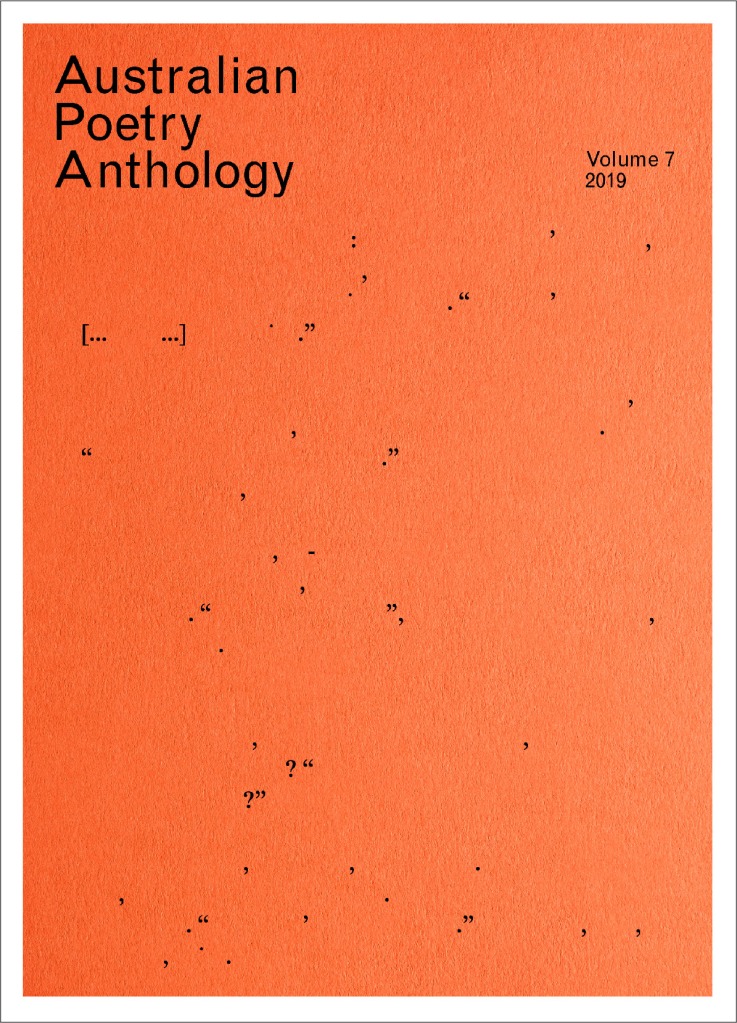
Yvette Holt and Magan Magan (editors), Australian Poetry Anthology Volume 7 (2019)

This is Australian Poetry Inc’s seventh annual anthology of members’ poetry. In the words of one of its editors, it hosts ‘a focus on poets heralding from the Northern Territory, from the Top End, Western Desert, Utopia, Barkly, and of course Central Australia’. Those poets aren’t corralled into a special section, but take their place alongside others, including some whose books have won prestigious prizes. There are plenty of First Nations voices, including some writing from in prison and some who are household names. A fair number of the poems come from the Spoken Word milieu. It’s a beautifully democratic, diverse collection.

Having said that, I’m reluctant to single any individuals out. I’ll just quote some lines from a handful of poems that deal with fire, drought and flood, perhaps surprisingly many given that this anthology was published well before the current bushfire season,.

Kaye Aldenhoven’s ‘Cleaning the Country – April in Kakadu’ is about fire as a benign tool for land management:

Cool Dry season wind shifts the wind chimes
sending clear bell sounds out over fire-cleared land.
On the tongue the metallic smell of yesterday's smoke.
In the burnt area
an invisible wind spirit
raises puffs of dust as she sweeps ashes of grass.

Kelly Lee Hickey, ‘Notes from a Heatwave’, captures the lassitude of hot dry weather in five short stanzas:

All the nests are abandoned.
The pea chick dies
in my hands.

Peter Mitchell, ‘Forgotten Sparks’, recalls a 1968 bushfire:

We were surrounded by tongues, the speech of flames: shouts,
clamour and argument. Their babble charged our homes.

Fiona Dorrell’s heartbreaking image from a drought, ‘Forty Horses at Santa  Teresa’:

One horse lies down
crosses and tucks its legs
up close to its body.
Others stretch heads back in dirt
almost smelling of algae
and sieve hot air through
yellow spade teeth.

Not quite on topic is Michele Seminara’s ‘Family Tree’, which laments the loss of a tree that has been part of her life since childhood:

They amputate the limbs
to make it easier to fell; 
I know that feeling.

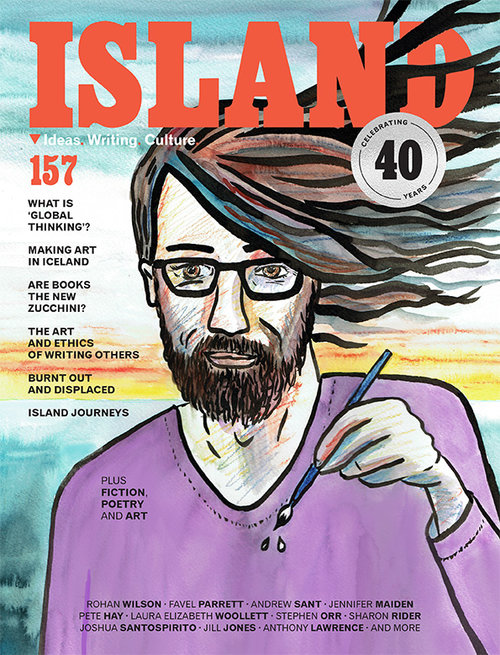
Vern Field (managing editor), Island 157 (2019)

I don’t have a subscription to Island, whose web site describes it as ‘celebrating ideas, writing and culture from our base in Hobart, Tasmania’ since 1979. I bought this issue because it features a poem by Jennifer Maiden (who isn’t from Tasmania).

Compared with the other journals in this post, Island is a lavish affair, with full page colour illustrations and advertisements for theatre events.

It’s a good read, with a preponderance of items that are excerpts from longer works (from Favel Parrett’s There was Still Love, which I intend to read; from a graphic novel, Islands and Ships by Joshua Santospirito, author of The Long Weekend in Alice Springs (my blog post here); from a lecture by Sharon Rider, which introduced me to some basics of Kant’s philosophy), and author’s notes on works in progress (Laura Elizabeth Woollett doing research on Norfolk Island; two separate accounts of artist and writer visits to Iceland; Rohan Wilson musing on the ethics of setting a climate-change (‘cli-fi’) novel in the Maldives).

Burnt Out’ by Liz Evans is a tale of not losing her home to bushfire in the 2018–2019 summer. Though the experience she describes is harrowing, it feels oddly tranquil when read in the aftermath of the recent mammoth fires, as it places the fire events in the context of the writer’s London background and is illustrated by gorgeously dramatic photographs.

There are short stories, of which Anne Casey’s comedy of teenage errors set in a cake shop, ‘What I’d Do If I Was in Charge’, stands out.

Jennifer Maiden’s ‘Pollock, Whiteley and the Critic: Seven Layers‘ isn’t the only poem, but it’s the one that spoke most strongly to me. (Perhaps I should have listed it as one of the excerpts above, as it’s included in Maiden’s The Espionage Act recently published by Quemar Press.) It’s one of her imaginary dialogues: the two painters of the title and an art critic stand in front of Jackson Pollock’s Blue Poles, and their conversation ranges over an early self portrait by Brett Whiteley (I looked it up, it’s real, there’s an article on it here), the CIA’s program to back abstract expressionism as a counter to social realism, the effect this had on Pollock’s art and life … As is generally the case with Jennifer Maiden’s dialogues, it works as a strangely surreal encounter among recognisable characters, with a strong undertow of not-quite-pindownable meaning.

Thanks for reading this far. It’s not the last of my journal catch-up posts …

Proust Progress Report 6: halfway through the third book

Marcel Proust, À la recherche du temps perdu (text established under the direction of Jean-Yves Tadié ©1987–1992): finished Le côté de Guermantes (1020–1921), première partie.

Exactly six months into reading À la recherche du temps perdu, and I’m halfway through the third volume. I have now finished the first part of Le côté de Guermantes, which was originally published separately.

If you’re looking for sizzling action, this book isn’t for you. The narrator has dinner with the military friends of his friend de Saint-Loup and is fascinated by military theory. He meets de Saint-Loup’s mistress, whom everyone except de Saint-Loup knows is a prostitute. He attends a salon where people are variously snobbish, uncouth, bien-pensant, antisemitic, evasively diplomatic and pretentious. He goes for a walk with the extremely creepy and probably predatory M de Charlus. At home, he finds his beloved grandmother is sick. He goes out for a walk with her and she has a heart attack.

Much of it is wryly funny, and there is one belly laugh. At least, I laughed out loud when after about twenty pages in which the narrator is a fly on the wall at the salon, the object of his infatuation who has not deigned to utter a single word to him when introduced, finally – after the narrator’s dear friend Robert de Saint-Loup whispers in her ear – turns to him and says, ‘Comment allez-vous?‘ Your mileage may vary.

I think of Proust as the Anti-Twitter: no proposition goes unquestioned, one’s immediate interpretation of a word or action is more likely than not to turn into its opposite when subjected to sustained, complex explication. No one ever gives a straight answer to a question. We know that Proust and his narrator are dreyfusards*, and the anti-dreyfusard characters are mocked mercilessly, but there’s no sign of Twitter’s door-slamming outrage. And yet Patrick Alexander, author of a guide to Proust, is rewriting In Search of Lost Time (in English) as a series of tweets. Sadly, my computer wouldn’t go far enough back in his Twitter timeline to give me his version of what I’ve just read, so I can’t tell whether he’s making a point of the impossibility of the project.

It turns out, though, that skimming @ProustTweet‘s timeline gave me hope that the endless conversations in this volume are about to give way to something a little more active. The account of grand-mère’s heart attack holds out that promise as well: it happens offstage while the narrator is paying attention to a silly conversation between the ‘marquise’ who attends the public toilets and a caretaker of the gardens they are visiting. The important things, it seems to be suggested, happen when the narrative is engaged elsewhere.


* Proust assumes that his readers are familiar with the Dreyfus Affair, which Wikipedia informs me divided the republic from 1894 to 1906. In essence a Jewish army officer was wrongly convicted and imprisoned for treason, and even when evidence of his innocence came to light the high-ranking office who had actually committed the treason was found not guilty and Dreyfus was again, against the evidence, and went to prison. In Proust, and I assume in the actual world, conservative, Catholic, antisemitic people of the upper classes tended to be antidreyfusards.

Jonas Hassen Khemiri, Everything I Don’t Remember

Jonas Hassen Khemiri, Everything I don’t remember(2015, translated by Rachel Willson-Broyles, audio book read by Jack Hawkins, Bolinda 2016)

I’d pretty much given up on audio books (see here and here), but the Emerging Artist is less prone to burning bridges than I am, and she borrowed two from the library for a longish drive on the weekend. We listened to Everything I Don’t Remember, all seven hours of it, and I’m once again open to the medium.

A young man named Samuel has died in a car crash, probably deliberately, and a writer is interviewing people who were close to him to find out how they make sense of his death. It settles down to three main interviewees: Samuel’s best friend Vandad, a woman not-quite-lover Panther, and Laide, the lover he broke up with a little before his death. Their narratives, sometimes expanded by scenes imagined by the writer, are interwoven, filling one another’s gaps, contradicting one another, commenting – often harshly and unfairly – on the others’ roles in Samuel’s life and death.

Samuel’s impending death provides a central narrative thread, but the book sends out tendrils into very interesting parts of Swedish society. There’s a brilliantly cinematic moment when a recorded tourist commentary on Stockholm plays on while the people hearing it are experiencing a very different version of that city – which is the version where the main action of the novel plays out, populated by artists, low-level public servants and community workers, struggling members of the gig economy, petty criminals, refugees, most of them, like Jonas Hassen Khemiri himself who has a Tunisian father, of African or West Asian heritage.

Some of the time as we listened we were driving through bush that is just beginning to put out new shoots of recovery from bushfire. In spite of the competition from the real world, the world of the novel kept us engaged (though we had to turn it off every so often to let the surrounding devastation sink in).

There are some meta elements. One of the interviewees tells the writer not to attempt to write Samuel in the first person because he can never know what was in Samuel’s mind. The reader (at least this reader) agrees, and the whole weight of the novel seems to lie behind the advice. Then, in the next section, Samuel’s internal monologue appears for the first time. And in the last ten minutes or so the writer explains to us why he undertook the project. These, and similar moments, may be just clever bits of mise-en-abîme (you know: the camera draws back and you realise you’re looking at a picture within a picture within a picture, ad infinitum), but I read them as moving the narrative beyond journalistic enquiry to something more emotionally engaged – and thereFore more emotionally engaging.

The Bolinda packaging doesn’t mention a translator. I found Rachel Willson-Broyles’s name online in connection with the English print edition, and assume that the smooth, elegant English on these discs is hers. And reader Jack Hawkins is a master at speaking to the microphone intimately, so that it almost feels as if the narrative is unfolding inside the listener’s head, while at the same time he manages the extraordinary feat of always, or almost always, being clear which of several voices is speaking at any given time.

Bernhard Schlink’s Weekend

Bernhard Schlink, The Weekend, translated by Shaun Whiteside (2008, Weidenfeld & Nicholson 2010)

A group of friends in their 50s meet for a weekend in a grand, but dilapidated house in the German countryside, the first time they’ve all been together in decades. The occasion for their reunion is Jörg’s release from gaol where he has been serving a sentence for acts of terrorism – including four murders – back in the 1970s. The others had been members or sympathisers of the leftist group he had belonged to, but hadn’t been part of the violence.

As well as Jörg, there are Henner, now a journalist, Ilse, a school teacher, Ulrich who owns a string of dental laboratories, and Karin, a bishop, plus Jörg’s protective older sister, Christiane. Ulrich and Karin’s spouses are also there, as well as Ulrich’s young-adult daughter. Margareta, Christiane’s friend who part-owns and lives in the house where they meet, Andreas, Jörg’s long-time lawyer, and Marko, a younger man Jörg has invited at the last minute complete the cast – until a surprise extra guest turns up on Saturday evening (about whom I won’t say anything).

This is a novel by Bernhard Schlink, who writes fine, complex essays on political-cultural issues (my blog post about his Guilt about the Past here), and as you’d expect these eleven, and then twelve, characters aren’t left to talk about the weather. Christiane has organised the weekend to help Jörg make the transition to civilian life. Marko, to the disapproval of everyone else, especially Andreas the lawyer, urgently wants Jörg to become a leader of the revived leftist group. Others, particularly Ulrich, want him to face the reality of his crimes. The conversation ranges – what happens to the dreams of youth, its ideals, loves and resentments? what has become of the leftist, political terrorism of the 70s, and how is it different from the terrorism of al-Qaeda? if you murdered bystanders ‘for the cause’, how do you see that thirty years later, especially if the cause has failed? (Since finishing the book I met the concept of moral injury, which is what happens when someone, usually a soldier, realises they have done terrible things towards what they thought were good ends, but the ends have been revealed as immoral: that concept looms large here, without the term.)

But the debating is rooted in the context of these real lives. There’s some tears, some sex, some humiliation, some wonderful intergenerational conflict, some sweet tenderness, and two surprises that I should have seen coming but didn’t. Ilse, the quiet one, has started writing a story that plays as a kind of counterpoint to the main narrative. In it, another member of their group, Jan, lives on after faking his own suicide to commit more terrorist acts; she has to imagine how to show the mental life of a man who – like Jörg – lives for decades in prison. In the end she decides to have him die, and does it in a way that I read as symbolising how that brand of leftist terrorism came to an end.

It’s a short book. I enjoyed it. It made me think.

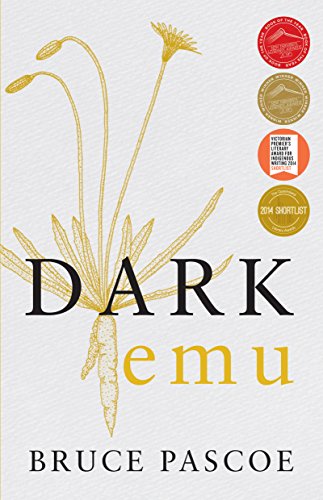
Bruce Pascoe’s Dark Emu

Bruce Pascoe, Dark Emu (©2014, Magabala Press 2018)

tl;dr: ‘We are at the beginning – not the end – of understanding pre-colonial history’ (Dark Emu, page 60)

I gather that this book has recently been attacked by one of those pretend journalists who like misrepresent people and arguments and then condemn them. I gather that there’s a mostly anonymous website devoted to pointing out the book’s errors (though there are also people with names who have checked all its references and found them accurate). I gather that Bruce Pascoe has been accused of pretending to be Aboriginal for monetary gain, an accusation that has been amplified by one of the very few members of the Australian Parliament who boycotted Kevin Rudd’s 2008 apology to the Stolen Generations (and that the Australian Federal Police have dismissed the accusation out of hand).

So I gathered the book itself from my To Be Read shelf, and having read it I can do no better to address the attackers than this recent tweet:

I’m grateful to Andrew Bolt and Co for spurring me to actually read the book. It had joined Eric Rolls’ A Million Wild Acres (1981) and Bill Gammage’s The Greatest Estate on Earth (2012) on my Should-Read list because – all three being books whose contents you think you know by osmosis – it offered a radically revised story of the Australian land before and after 1788. Rolls is a poet farmer whose book was hard to find when I was looking for it 30 years ago (it was republished in 2011), and I’d been told by someone that Gammage’s book is essential reading but ‘the most boring book I’ve ever read’. I expected Dark Emu to be like that: a pleasureless duty read. But The Australian and Andrew Bolt made me think there was probably more to it than that.

And there is.

It’s lively and accessible, full of astonishing facts and a scattering of beautiful and/or intriguing illustrations. Pascoe’s central thesis is that the observations of early European explorers and settlers, and more recently the findings of archaeologists, palaeontologists and so on, give a very different picture of pre-settlement Australia from the one that still prevails in our mainstream culture. This is partly because the assumptions and agendas of the early observers led them to interpret what they saw in ways that now seem bizarre, even laugh-out-loud funny if not for the devastating consequences; and partly because so little attention is paid to those accounts by historians, and the mainstream pays so little attention to recent research findings.

It’s also a shaming book. In my early 20s I read the journals of most of the explorers that Pascoe cites: Sturt, Mitchell, Giles, Grey. I must have read the descriptions of clay-roofed buildings big enough for 40 people, of fish traps and park-like landscapes, of cheerful gatherings of large numbers of people in places where the explorers could find no food to sustain them. But if these descriptions contradicted my received version of Aboriginal people as nomadic hunter-gatherers who lived in primitive humpies – and they did – I can’t say that I had any shock of recognition. When the explorers described these substantial dwellings as hovels, I didn’t recognise the dissonance. I wasn’t thick enough to miss the arrogance that drips from many of the explorers’ pages (Giles has a wonderfully poetic passage lamenting the way Aboriginal people will be replaced by a race more favoured by God – that is, his own race). But those aren’t generally the passages that Pascoe highlights: he’s much more generous than that, treating his sources with respect and sympathy, even as he challenges his readers to see past colonialist prejudices.

Pascoe gives example after example from the early observers to illustrate his argument that Aboriginal people all over this continent were more than ‘simple’ hunter-gatherers; that many of their practices on land and water amount to farming; that they had substantial dwellings, some of stone; that they had a sophisticated understanding of the natural world and skills and technology to make use of it, while ensuring its wellbeing. And he pulls off the small miracle of keeping it interesting. (I do confess that, having got my head around just some of the archaeological terms when I read Mike Smith’s The Archaeology of Australian Deserts – blog post here – I missed phrases like the Last Glacial Maximum.) And then there’s the reason that some people attack the book, mostly I suspect without reading it, and the reason that it’s more than just a fascinating piece of historical revisionism: it offers a broad swell of argument that it’s untenable to think of Australian history as having begun in 1788, or 1770, or 1606. This is how the book ends, and I’m happy to end this blog post this way too (note his use of ‘we’ in the first sentences):

It seems improbable that a country can continue to hide from the actuality of its history in order to validate the fact that having said sorry, we refuse to say thanks. Should we ever decide to say thanks, the next step on a moral nation’s agenda is to ensure that every Australian acknowledges the history and insists that, as we are all Australians, we should have the opportunity to share the education, health and employment of that country on equal terms. Many will say that equality is insufficient to account for the loss of the land, but in our current predicament it is not a bad place to start.

The start of that journey is to allow the knowledge that Aboriginal people did build houses, did cultivate and irrigate crops, did sew clothes, and were not hapless wanderers across the soil, mere hunter-gatherers. Aboriginal and Torres Strait Islander people were intervening in the productivity of this country, and what has been learnt during that process over many thousands of years will be useful to us today. To deny Aboriginal and Torres Strait Islander agricultural and spiritual achievement is the single greatest impediment to intercultural understanding and, perhaps, to Australian moral wellbeing and economic prosperity.

Added later (12 June 2021): The right wing culture warriors aren’t the only ones casting aspersions on Bruce Pascoe’s version of pre-1788 life in Australia. For a fascinating account of these challenges, see this lnk.

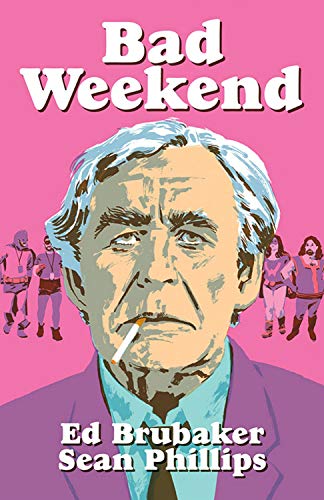
Ed Brubaker’s Bad Weekend etc

Ed Brubaker and Sean Phillips, with colours by Jacob Phillips, Bad Weekend  (Image 2019)
––––––, My Heroes Have Always Been Junkies (Image 2018)

Scanning my shelves after reading Charlotte Wood’s The Weekend (blog post to come when the Book Group meets), I decided to stick with the title and read a couple of the quality comics I was given for Christmas presents (Bernhard Schlink’s The Weekend possibly to come).

These two handsome stand-alone books (‘novellas’) are spin-offs from the Criminal series of comics created between 2006 and 2012 by Ed Brubaker (writer) and Sean Phillips (art). According to Wikipedia, ‘The series is a meditation on the clichés of the crime genre while remaining realistic and believable. That description is pretty accurate for these two books.

Bad Weekend is set in the world of comic artists. The narrator is charged with being the minder for a cantankerous, sexist, drunken old man who has been invited to a convention to receive a major award – because he is also an artist of genius. The narrator has been the old man’s assistant years earlier, and has been specifically asked for by him on this occasion. It turns out (of course) that the old man is completely uninterested in the award, but wants the young man’s help in finding some priceless original artwork that has been stolen from him. Set in the 1980s and 1990s, the art has a slightly surreal noir feel to it (surreal because of the costumed convention-goers, noir because of the dark world of art theft and intrigue). There’s a nice twist at the end, which probably would have been obvious to anyone who wasn’t, like me, just along for the ride. I should add that the ride involves genuine pathos as we discover the causes of the old man’s vileness.

My Heroes Have Always Been Junkies should surely win a Most Provocative Title award. It turns out that like Bad Weekend this novella has a fairly straightforward plot involving criminal intrigue. A young woman with a heavy drug habit is sent to an expensive rehab clinic, but has no intention of getting clean. She sets her sights on a handsome young man and persuades him to run away with her from the clinic and from the constraints of their lives. She is, as she says, a bad influence. But there are hints that she is much worse than that  – and these hints are realised. It’s pulp.

The present-time narrative, mostly in full colour, is intercut with the young woman’s back story in moody monochrome, in particular the way, after her mother died, possibly of an overdose, she became fascinated by singers and pop stars who were heroin users. For me, the effect was a reinstatement of parts of famous lives that have been quietly erased or glossed over (David Bowie, John Lennon, Jean-Paul Sartre), and an attention to details of lives I knew very little about (Billie Holliday, Gram Parsons). So it’s pulp, but there’s plenty of nutritious stuff there.

Proust Progress Report 5: Beginning the third volume

Marcel Proust, À la recherche du temps perdu (text established under the direction of Jean-Yves Tadié ©1987–1992): finished À l’ombre des jeunes filles en fleurs (1919), deuxième partie, ‘Nom de pays: le pays’; began Le côté de Guermantes (1020–1921), première partie.

As promised in my last report, I am now well under way in the third book, English title The Guermantes Way.

The last 60 pages of À l’ombre des jeunes filles en fleurs got quite sexy, with our poor narrator being sadly disappointed in what he had thought was going to be a long-yearned-for erotic rendezvous, in a way that not even his ingenious rationalisations could make less humiliating. But he bounced back and finished the book in good spirits.

There’s a scene in that book where an older man visits our narrator’s bedroom at night, lends him a book and paces about as if expecting something. The only way I can make sense of the scene is that the older man is hoping for a sexual encounter but goes away disappointed – to all of which the narrator is oblivious. Since absolutely no sexual overture is explicit it made me wonder how much I miss that goes unsaid elsewhere. And as I type those words I realise that the narrator’s disappointment in Albertine’s bedroom (mentioned in the previous paragraph) becomes even funnier in the light of his own unwitting rejection of the older gentleman. Incidentally, one of the common phrases in the book, is ‘à mon/son insu‘, which I guess translates as ‘unwittingly’.

I had thought that in this monthly report I’d write about whatever I happened to have just read. But what I’ve just read is two pages in which the narrator’s aristocratic army-officer friend Robert de Saint-Loup expands on the idea that there is an aesthetic side to the art of war, so maybe I’ll go back a bit.

On New Year’s Eve, in one of those conversations people who see each other once a year ask each other what we’ve been doing, I said I’m reading Proust. Behold, my interlocutor had read Swann’s Way with his book group, and has a friend who has read the whole of À la recherche in English and is now reading it in French. He quoted that friend as saying that in Proust what is not said matters more than what is said – a paradox, given that so much is said. There’s a marvellous moment in my reading since that conversation that exemplifies the point.

The narrator has gone to visit Robert de Saint-Loup at his garrison in the hope of procuring an introduction to Saint-Loup’s beautiful aunt, the object of the narrator’s stalkerish infatuation, the duchess de Guermantes. As it turns out, de Saint-Loup invites the narrator to stay with him in his quarters at the garrison. Over dinner, the narrator recognises a striking family likeness between his friend and his friend’s aunt. The emotional force of this recognition must have shown in his face because:

Robert, sans en connaître les causes, était touché de mon attendrissement.

https://ebooks-bnr.com/ebooks/html/proust_a_la_recherche_du_temps_perdu_3_cote_guermantes.htm

In English:

Robert, unaware of its cause, was touched by my show of affection.

From http://gutenberg.net.au/ebooks03/0300411h.html, modified by me.

Things move on from there:

Celui-ci d’ailleurs s’augmentait du bien-être causé par la chaleur du feu et par le vin de Champagne qui faisait perler en même temps des gouttes de sueur à mon front et des larmes à mes yeux ; il arrosait des perdreaux ; je les mangeais avec l’émerveillement d’un profane, de quelque sorte qu’il soit, quand il trouve dans une certaine vie qu’il ne connaissait pas ce qu’il avait cru qu’elle excluait (par exemple d’un libre penseur faisant un dîner exquis dans un presbytère).

In English:

My affection was moreover increased by the comfortable heat of the fire and by the champagne which at the same time brought beads of sweat to my brow and tears to my eyes; it washed down the partridges; I ate mine in a state of wonder like some sort of profane person who finds in a form of life with which he is not familiar what he has supposed that form of life to exclude—the wonder, for instance, of a free-thinker who sits down to an exquisitely cooked dinner in a presbytery.

So far so good: during an extended tête-à-tête in his friend’s room, the narrator looks at his friend with an expression that properly would be directed to the women he is infatuated with. He sees that his friend mistakenly thinks the tender look is meant for him. The narrator is filled with a sense of wellbeing, is experiencing delights such as he had never imagined. What could happen next? Well:

Et le lendemain matin en m’éveillant, j’allai jeter par la fenêtre de Saint-Loup qui, située fort haut, donnait sur tout le pays, un regard de curiosité pour faire la connaissance de ma voisine, la campagne, que je n’avais pas pu apercevoir la veille, parce que j’étais arrivé trop tard, à l’heure où elle dormait déjà dans la nuit. 

In English:

And next morning, when I awoke, I went to cast from Saint-Loup’s window, which being at a great height overlooked the whole countryside, a curious look to make the acquaintance of my new neighbour, the landscape which I had not been able to distinguish the day before, having arrived too late, at an hour when it was already sleeping in the night.

So we’ll never know what happened between all those feelings of growing intimacy and waking up next morning. I won’t quote any more of this passage, as there’s an extended description of the neighbouring hill. But the narrator is filled with a new joy as the day progresses, and begins to visit Saint-Loup in his room regularly, and when Saint-Loup and he dine with Saint-Loup’s friends, they hang on each other’s words shamelessly – and our weedy, literary narrator becomes fascinated with the world of military manoeuvres and military history, the world of Saint-Loup.

What would I have thought of all this if I hadn’t been told that what’s unsaid is more important that what is said, and that this book is a classic queer masterpiece? Pretty much what I make of it now, I expect.

In a month’s time I expect to have finished the première partie of Le côté de Guermantes, and I’ll tell you if our narrator ever does get to meet the duchess … and if he cares.