Category Archives: LoSoRhyMo

November verse 7: Removal day

This was yesterday:

Verse 7: Removal day
We rise at six. Van’s due at seven.
All 34 is boxed and stacked.
We’re bushy-tailed, all systems revving.
8.30, no van. Panic attack.
Six phone calls get the tragic story:
driver’s wife and something gory.
By 2 we’ve found another mob
from near Kashmir to do the job.
And so eight years accumulated
tables, books, beds, fridge, TV,
become backbreaking work for these
young men. By six, not quite elated
we’re sitting in our home-to-be,
all boxed and stacked at 43.

November verse 6:

Getting 14 stanzas done this November is going to be hard: moving house gets in the way of rhyme, and we’ve been very busy getting ready for the big move, which happens tomorrow. In the meantime, though, the corner of my brain that still can scan (almost) and rhyme (just) has managed this:

November verse 6:
My Twitter feed was full of Bunnings’
sausage sizzle safety scare,
of mock alarm and gleeful punning.
I’ve never bought a sausage there
or been assaulted by fried onions.
Bunnings is the place that summons
me when I need pipes or screws,
drill bits, mulch or kangaroos’
paws. Temple of the DIYers,
initiates there wear high viz
or paint-streaked shorts. The glad fact is
I don’t go there for silk-clad choirs
or poetry, or barbied snags,
Who asked Ikea for hot dogs?

November verse 5: To be done

Verse 5: To be done
Moving home’s no roller-coaster,
no painful climb up, screaming down,
just daily questions like ‘New toaster?’
(answered ‘Yes’, though with a frown)
and wrap the artwork up in bubbles,
smash failed ceramics into rubbles,
organise a picture rail,
fix a redirect for mail,
fill a box with medications,
give away our potted lime,
dump the clock that’s lost its chime,
breathe slow when there’s palpitations
and so nothing will be missed
sit and write a to-do list.

November verse 4: Our new home, soon

Verse 4: Our new home, soon
Friday: day to take possession
(under licence) of our flat.
We got the key and in procession
took two chairs there. That was that
or so we thought. About 12.30
emails from the lawyers curtly
told us that we had no right
unless we paid before that night
a thousand bucks, and emailed paper
work we simply didn’t know
we had to have. To and fro
the calls and emails flew all day for
Friday. Solved by five! On Sun-
day twenty-box transfer is done.

And if that verse seems tortured to you, then all I can say is it reflects the process at least a little. In case it’s not clear, twenty boxes is just a beginning.

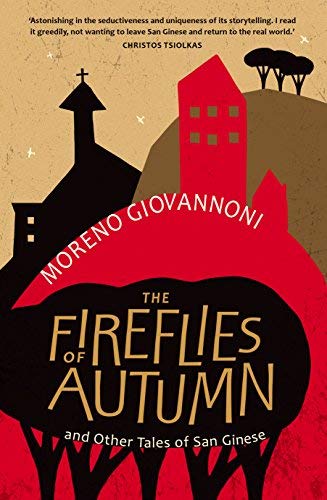
Moreno Giovannoni’s Fireflies of Autumn and November verse 3

Moreno Giovannoni, The Fireflies of Autumn and other tales of San Ginese (Black Inc 2018)

fireflies.jpg

The Fireflies of Autumn begins with a bang. To be more precise, one of its first stories is a tall tale involving a vast explosion and enormous quantities of excrement – the kind of story that you feel you ought to have heard a thousand times, but which is actually completely new to you, or at least to me.

The book announces itself as a collection of tales told by Ugo Giovannoni, who migrated to Australia in 1957 – stories about the tiny Tuscan village of San Ginese that he left behind. These tales include folk versions of the distant past (as in the explosive one already mentioned), lore about Ugo’s forebears and relatives (much of it scurrilous), tales of the village during the Fascist era and World War Two (including the marvellous title story, in which the whole village decamps to a forest glade to avoid being caught in the crossfire between the Americans and the retreating Germans), and a little historical documentation.

I was reminded often of Fellini’s masterpiece of nostalgia, Amacord. The celebration of community, the occasional bawdiness (see my versification below), the indignation at the repressive role of the Church, all feel a little Felliniesque. But these tellings differ from Fellini’s in being told, not just from a different time, but also from a different place, in the diaspora.

Migration to America, Australia and occasionally Argentina is a dominant theme. Over the decades, those who leave often return once they have earned enough money to buy some land, or perhaps when the longing for home becomes too much to bear. As well as the wonderful, possibly romanticised evocation of village life, there is some fine writing about the effects of dislocation from migration:

And they would go to America and become lost over there, and when they returned to San Ginese they would still be lost, as if they could not find the place they had left, but kept looking for it, anywhere, somewhere, but it was always elsewhere – on top of a hill, along the walking paths between the villages, in a field, inside a stable or a pig-sty, inside a woman, a wife, a neighbour’s wife. You could see the men wandering about in the courtyards and between the houses, aimlessly at first, and then slowly they would give the appearance of settling into their lives again, but remained as sad as trees that have had half their roots hacked off. Such trees can barely feed and water themselves and are in danger of toppling over in the gentlest breezes.

In a way this collection of stories is itself a symbolic return, as a telling and reclaiming of the stories that had to be left behind. Ugo’s introduction tells us that he wrote the tales in Italian and sought out ‘a translator expert in the writing of immigrants’ to render it into English. That translator is of course the actual author, Ugo’s son Moreno, who came to Australia as a child in 1957. Some of the later stories in particular make it clear that, though Ugo may be the source of many of the tales, Moreno has drained many other tongues and done his own wandering about. The painful melancholy that is never far beneath the surface of these tales is his as much as Ugo’s.

After reading excerpts in Southerly a couple of years back (blog entries here), I was looking forward to the book’s publication. I wasn’t disappointed. It’s never boring, I smiled constantly and laughed often. Then in the final chapters, possibly affected by Altitude Adjusted Lacrimosity Syndrome as I read them on a plane, I wept copiously.

I recommend Lisa Hill’s review for a beautiful account of the book.

Because it’s November, and my blog has to include 14 14-line poems in the month, here’s a versification of a tiny story in the brilliant long chapter about the villagers in wartime:

November verse 3: The widow Pasquina

No one noticed when Bucchione
vanished as the sun went down,
gone to visit la Pasquina,
wealthy widow of that town.
She'd come out, no need for knocking,
ask you in (now is this shocking?),
offer you a bowl of wine
and several more till, feeling fine,
you told your troubles, like confession,
she'd strip you, take you to her bed,
then later make sure you were fed
and bathed beside the fire, refreshing
limbs and mind. In those hard days
she did this service for no pay.

November verse 2: Time’s arrow

Inspired by a true and very recent event:

November poem 2: Time’s arrow
The unforgiving fourth dimension
points one way, no turning back.
A single moment’s inattention
cycling on the Riesling track
going 20 k or faster
courts an imminent disaster.
Do not gaze at grazing sheep
or rocks thrust up from ancient deep:
you’ll clip the wheel you follow after,
hit the ground hard, skin your knee,
be run over, then all three
lie about in helpless laughter,
bloodied, bruised and now quite sure
to feature large in family lore.

November Verse 1: The Second of November

It’s November already.

In the middle of moving house, I’m currently in South Australia to celebrate a sister’s 70th birthday and a niece’s 30th, with any number of other siren calls on my attention. But November is LoSoRhyMo (Local Sonnet Rhyming Month), and I am obliged to produce 14 x 14-line poems over these 30 days. Rhyming is essential and quantity matters more than quality. (The fact that I’m the sole LoSoRhyMo-ist doesn’t render the obligation any less binding.) So here goes:

The Second of November: Memories of a Catholic childhood
On All Souls’ Day, each church visit
sets a suffering sinner free
from Purgatory. How could we miss it?
Duck inside and bend a knee,
Our Father, then a Hail and Glory
Be, and out. Repeat the story.
Girls held hankies to their hair.
No time to sit and think and stare.
Yet this cuckoo-clock palaver
held coding from a long-gone day
like amber that traps DNA.
Now I learn from calaveras
that those acts then, inside my head,
built friendly shrines to all my dead.

November verse 14

November verse 14: Diary poem
We smear the dog with steroid ointment –
soothe her angry tummy rash.
Then off to Glebe for my appointment
after weeks of steroid flush
to tackle nasty nasal polyps
(fleshy, veiny, solid dollops
I’d seen gigantic on a screen
like solid snot, but pink not green).
The doctor’s waiting room is crowded
but soon: ‘Jonathan, welcome back!’
The flushing worked, I’m off the hook,
his mirror shows my nose unclouded.
Sing the praise of Andy Wills
E N T wizard, who bulk bills.

Jennifer Maiden has written a number of what she ironically calls Diary Poems. There’s no such irony in the title of this verse. I’m uploading it just after 9.30 on 30 November: I’ve met my goal of 14 14-line verses in the month. Normal blogging will resume shortly.


November verse 13

A lot of my reading recently has seemed to be about ways of being in a place: Journey to Horseshoe Bend is deeply place-specific;  peasants chose to return to their land near Chernobyl even though it had been poisoned by the nuclear accident; Adam Aitken’s Archipelago is largely about his connection to parts of France; James Rebanks’ The Shepherd’s Life (I’m still reading it) is, among other things, about belonging to the Lake District in England. Somewhere I read that Wendell Berry, poet–farmer from Kentucky, told Naomi Klein:

Stop somewhere and begin the thousand-year process of knowing that place.

Seems as good a place as any to start a 14 line rhyme:

November verse 13: In reply to Wendell Berry
A thousand years? Time’s wingèd chariot
hurrying near calls that one’s bluff.
To find a place and marry it
might last a lifetime, not enough.
So here’s the work of generations,
fifty by my calculations.
My grandfather managed three
in sugar country. Two for me
in the Inner West.
___________________But that’s assuming
we’re the starters. All around
are people who’ve lived on this ground
for sixty thousand years. A human
humbly learns from others’ stories,
humbly shines with others’ glories.


November verse 12: from Twitter

November verse 12: From my Twitter feed
Here a toxic timebomb leaking,
there the art of monstrous men.
The President’s no longer seeking
Time’s acclaim, hates CNN.
Tony tells us there’s dishonour
in the darkness. Mal’s a goner.
Evil Peter wields a stick
and won’t let doctors tend the sick
and injured. But there’s also blankies
worn by baby jumbos
. Kelp
is not a plant
, and this may help:
change socks at lunch. Sweet granny’s hankies!
So much noise. But then there’s news
direct from people like Behrouz.

Links are there if you need an explanation or, in a couple of cases, entertainment.