Category Archives: LoSoRhyMo

November verse 3: Woman with knife

The Emerging Artist and five others have a terrific exhibition currently at The Shop Gallery in Glebe.
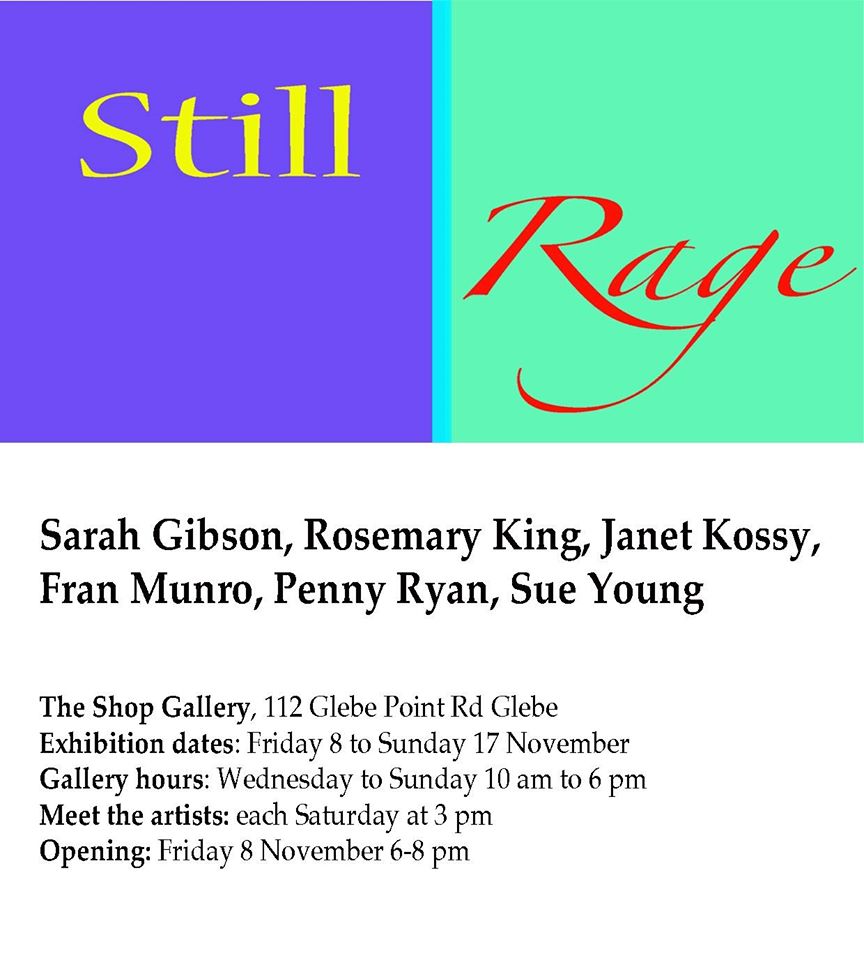
There are raging female monsters, exquisite still lives, images of brightly wrapped babies, orthodox Jews and patriots, a beatific Greta Thunberg, a powerful portrait of a Wiradjuri woman, ceramic cotton-reel pendants with unsettling inscriptions, and three images of a woman with a knife, including this one:
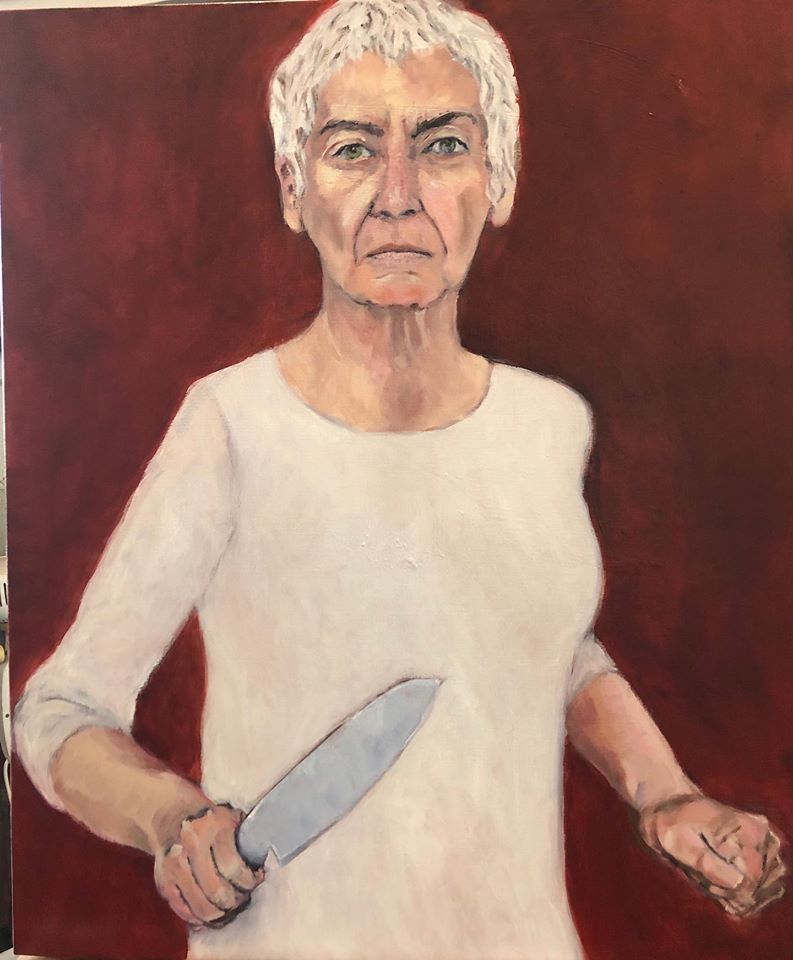
November verse 3: Woman with Knife – Red
She's got a knife and she will use it
if she must. Not so much rage
as weariness has made her lose it.
No choice but to turn the page
on compromise, compliance, meekness,
millennia of other-cheekness.
Her right hand's ready for the fight.
Her left holds hidden treasure tight.
No harpy, lamia, sphinx or gorgon,
no trained assassin, hired gun,
or martial artist out for fun:
a new sound blast, a whole new organ
shakes the floor. How good's that frown?
Good enough to bring you down.

November verse 2: Grandfatherhood

The Emerging Artist and I spend two days a week looking after our granddaughter. How could I not dedicate at least one November Verse to her?

November verse 2: Grandfatherhood
Someone said, 'A grandchild coming?
You'll turn into a love-sick dolt.
Like taxes, death and leaky plumbing,
you can't avoid this lightning bolt.'
I smiled politely, thinking, 'Maybe ...'
Then Rubes was born, a lovely baby
like all babies, sweet enough
but not to shake me by the scruff.
Until at her first birthday picnic
she crawled to me and turned around
and leaned into me.
______________________I was owned.
At two, no longer grand-love sceptic,
I'm Poppa, bound, besotted-wise
to snot nose, scraped knees, solemn eyes.

I didn’t manage to include how much said granddaughter enjoys my kookaburra imitation, and how I’ll do it on repeat demand well beyond hoarseness.

November Verse 1: Jacarandas

The jacarandas are in flower in Sydney. It must be November – though they’ve been out for a couple of weeks now, ominously early.

November is LoSoRhyMo, that is to say Local Sonnet Rhyming Month and I am obliged to produce 14 14-line poems over these 30 days. Rhyming is essential and quantity matters more than quality. The fact that I’m the sole LoSoRhyMo-ist doesn’t render the obligation any less binding. This is the tenth November I’ve taken this on. (If you want to buy previous years’ efforts, check out my publications page.)

So here goes, starting five late, but intending to fill the quota:

Verse 1:  The jacaranda have flowered early, again
Too late, they said, when jacaranda's
bright cloud lit the uni quad,
too late to start revising, and as
now Adani's got the nod
'too late' takes on a darker meaning:
year by year the parks are greening
earlier, the purple haze
of jacaranda too. Our days
are numbered, or at least they're hotter.
Lovely trees push flowers out
too early: bushfires, fish kills, drought
are part of that same picture. What a
great world! Please, no more debate.
If not now when? Next year's too late.

November verse 14:

Just squeezing in my last November poem before December is upon us, I’m starting from a paraphrase of the opening sentences of Edward Said’s On Late Style, which I’m reading for the Book Group. Here’s how Said’s posthumously finished book begins:

The relationship between bodily condition and aesthetic style seems at first to be a subject so irrelevant and perhaps even trivial by comparison with the momentousness of life, morality, medical science, and health, as to be quickly dismissed.

That gives you a taste. The New York Times website gives the whole first chapter, here, if you’re interested to read on. My little verse deals only with the first paragraph, and isn’t exactly a paraphrase of that.

November verse 14: Why the relationship between
bodily condition and aesthetic style is not a
trivial subject
You say: 'So trivial a subject,
the body and aesthetic style's
relationship! Why not reflect
on what's important in your files,
like life, and health, and science and morals
or medicine or the death of corals?'
I say: Of all of us it's true
because we're conscious, me and you,
we're constantly involved in making
something of our little lives, 
and this self-making builds archives,
a base of the great undertaking,
history, which sages tell,
at heart is made by human toil.

I don’t know yet where Said’s argument goes from there, and I apologise in advance for not trying to produce a verse version of the whole book.

November verse 13: To be read

Is it possible to make verse from the To-Be-Read pile? Let’s see.

November verse 13: To be read
I've counted ninety-six and growing,
lined neat on shelf and heaped by bed,
gifts, impulse buys, gateways to knowing,  
some I lust for, some I dread.
War, genocide, intrigue, corruption,
love, fantasy, delight, disruption:
you never know until you look
inside the covers of a book.
But if I read two hundred pages
(including pages filled with pics)
daily till I'm ninety-six,
obsessed but not, I hope, contagious
these unread piles would hardly shrink.
Oh well, it costs much less than drink.

November verse 12:

This one uses the rhyme words from David Malouf ‘s ‘La Belle Hélène’, which I wrote about yesterday. It’s not the Onegin stanza rhyme scheme – sorry! 

November verse 12:
It's been a while since we've seen midnight
or, naked-eyed, pushed thread through needle,
decades since you've been a girl
or I a boy. No half-sane poet
would write of us as bête and belle,
yet here we are, alive, awake,
no cancer, heart attack or stroke
to force the point we're not immortal.
Though, always seeming as innocuous
as phoenix embers in the hearth,
these fleeting memories of youth –
when I had painless knees, and you
no back complaining when you rose –
hint darkly at what looms tomorrow.

November verse 11: On fair dinkum politics

OK, I’m committed to a stanza a day for the rest of the month. Yesterday I built on end-rhymes from a stanza n Vikram Seth’s The Golden Gate. Today, back to the source of the Onegin stanza: Pushkin’s Eugene Onegin, as translated by James E Falen. The arbitrarily chosen stanza that supplied  the rhymes is in Chapter Two.

The verse picked up on my recent reading of some correspondence about Laura Tingle’s Quarterly Essay, Follow the Leader, and a conversation about the Extinction Rebellion in the UK.

November verse 11: On fair dinkum politics
The dream of being ruled by sages
is defunct. There on the crest
of Parliament Hill a wildfire rages.
No charm can soothe that savage breast
whose fuse is blown by power surges,
trust’s betrayed by carnal urges.
Far too many old white men
talk only to themselves and then
they watch Sky News. Is there a swelling
cloud to quench that toxic flame,
to make that coal-fired monster lame
and save our sweet blue planet-dwelling?
You want a hero? Save your breath!
It’s all together now – or death!

November verse 10: Advice to myself

I’m running against the calendar if I’m to meet my goal of 14 14-line stanzas this November. Moving home does get in the way of meeting deadlines.

Rather than offering yet another glimpse into my mundane life, I started out with the rhyme words and went wherever they took me, which turned out in the first line to be a paraphrase of G K Chesterton’s aphorism, ‘If a things’s worth doing, it’s worth doing badly,’ closely followed by Fred Brooks’s advice to software systems developers, ‘Plan to throw one away – you will anyway.’

The rhyme words are from stanza 5.10 of Vikram Seth’s verse novel The Golden Gate, the book that provoked my fascination with these Onegin stanzas.

November verse 10: Advice to myself
If it’s worth doing, do it badly
then make it good, or throw it away
and start again – not grimly, sadly:
ludic as a toddler, play
and laugh at failure. Hire a jester,
can the scripts that carp and pester.
Challenges aren’t meant for woe,
they’re the way we get to know
new skills. Scrupulous evasion
is no virtue. Be unclear,
but form rough words and plans, then steer
them on to clarity. Persuasion,
not coercion’s, how we’ve learned
to fan a dream until it burned.

November verse 9: In Newtown

November verse 9: In Newtown
Noon, Saturday. As I went walking
King Street South I met a flow,
a gaggle, not a troupe, of talking
mimes – youths dressed à la Marceau:
white face, striped shirt, a red carnation.
Cheerful, noisy desecration.
If mimes aren’t silent, what’s the point?
The times are clearly out of joint.
Then at the bus stop, here’s a scammer:
‘Hi,’ she says, ‘Long time no see!’ …
Then, ‘Would you like to come with me?’
She made no headway with her glamour.
‘Five dollars, then?’ I shook my head.
All when I went to buy some bread.

November verse 8: Moving out, moving in

Verse 8: Moving out, moving in
Sugar-soaping, mopping, sweeping,
drilling, screwing, bashing nails,
flattening used boxes, heaping
rubbish near the balcony rail,
fix the toilet seat (if able)
buy a longer TV cable,
screw in half a dozen hooks,
unpack and shelve a thousand books
(give some away), fix vacuum cleaner,
phone about the internet,
the Council pickup, don’t forget
the neighbours’ names (Regina, Tina?).
Too much to fit so little time,
too much to squeeze into a rhyme.