Category Archives: LoSoRhyMo

Sonnet 8: A prayer

I’m away from my computer and trying to catch up on my sonnet quota on the iPad far from home. The first eight lines of this got published prematurely some time yesterday. Here’s the whole thing, and the other six lines took less than 24 hours.

Sonnet 8: Prayer of a child of capitalism
Dear Absent Lord, Our Nobodaddy,
Dear Particle, or Gland, or Gene,
Who speak through prophet, saint and maddy
and have done since the Pleistocene,
accept my humble genuflection
in awe of natural selection.
Give us this day our daily bread
and roses, birdsong, sky’s vast spread.
Forgive – But I’ve no heart to ask it.
We’ve made a quarry of the Earth
and of its peoples. What’s it worth
when hell-bound in a plastic basket
to say we’re sorry? Don’t respond.
We’ve work to do. No magic wand.

Sonnet 8: A prayer

I’m away from my computer and trying to catch up on my sonnet quota on the iPad far from home. The first eight lines of this got published prematurely some time yesterday. Here’s the whole thing, and the other six lines took less than 24 hours.

Sonnet 8: Prayer of a child of capitalism
Dear Absent Lord, Our Nobodaddy,
Dear Particle, or Gland, or Gene,
Who speak through prophet, saint and maddy
and have done since the Pleistocene,
accept my humble genuflection
in awe of natural selection.
Give us this day our daily bread
and roses, birdsong, sky’s vast spread.
Forgive – But I’ve no heart to ask it.
We’ve made a quarry of the Earth
and of its peoples. What’s it worth
when hell-bound in a plastic basket
to say we’re sorry? Don’t respond.
We’ve work to do. No magic wand.

Sonnet 7: Demo

For those who didn’t receive any group emails, recorded phone messages, leaflets, facebook promptings or reminders from actual friends: yesterday was National Day of Climate Action.

Sonnet 7: Demo
Ten thousand had, today in Sydney,
enough sense to stand in the rain
and twirl umbrellas, not stay hid. We
rallied, one link in a chain
of rallies all around Australia
crying out against the failure
of governments who play the role
of sycophants to Old King Coal.
Ten thousand stood with rain god Hughie,
sixty thousand nationwide
who’ll vote, divest, protest, decide
to use renewables, get more cluey.
There’s climate change, heat’s on the rise.
It’s time to change, to organise.

Sonnet 6: Friday night TV

November is disappearing fast and the sonnets are coming slow, so a night on the couch in front of the box can’t go to waste.

Sonnet 6: Friday night on the box
Auction Room with Scottish Gordon
Juanita tells of child porn bust
and crooked Christmas Island warden,
and Tony still expecting trust.
After Sinabung’s eruption
Quentin shouts about corruption.
Stephen and his boys play bright.
Jack and Phryne put things right.
Serangoon Road has been too clunky
so we watch week-old New Tricks
for Sandra’s swan song – what a fix!
Ten-thirty – I’m no TV junky.
iView Luther? Nah! Instead
it’s time to read a book in bed.

Sonnet 5: An exhibition

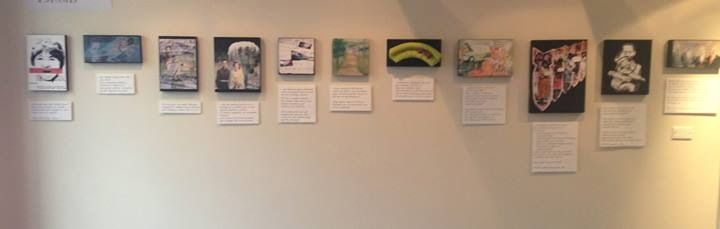
The opening on Wednesday night was fun, and the exhibition will be open for business at 51 Darling Street Balmain until 24 November, 11 to 6 Thursday to Sunday.

For those who came in late, the exhibition features work by three emerging older women artists: a narrative series by Penny Ryan about her mother and ASIO; exuberant work – mainly prints – by Janet Kossy that makes me think of Weimar art, only joyful; and delicate drawings by Charlie Aarons that reference Morandi‘s still lifes and traditional Kiribati designs.

Some men grow alarmingly sleazy moustaches in November. I do rhyme:

Sonnet 5: An exhibition
John Berger said, ‘Original paintings
are still and silent in a sense
that information [to explain things]
never is.’ Here’s my five cents:
that’s also true of prints and drawings,
whose lines are movement lashed to moorings.
Now frozen, mute, hung on the wall
of Darling Street’s Oddfellows Hall
are rage, desire, despair, compassion,
a mother’s joy, a daughter’s pain,
a moment freed from rat-race strain,
three days to hang, lifetimes to fashion.
We stroll around, we come, we go:
it’s just a little pop-up show.

IMG_0143

Photo by Penny Ryan

Sonnet 4: On Being Kept Awake by David Denholm

I’m falling behind on my sonnet quota – partly because I’ve had other things preoccupying me, but also because every time I sit down to write a paragraph from the David Denholm book comes into my head insisting that it be the subject. I’ll add the paragraph below, but first here is my Onegin stanza response to it (with a little input from Gitta Sereny’s The German Trauma, about which I expect to blog in good time.).

Sonnet 4: On being kept awake by David Denholm
Before we sang our soil as golden
before the settlers’ toil made wealth
long before the FJ Holden
this land was taken, not by stealth,
but violence and then watchful waiting,
armed and calm, anticipating,
one with musket, one with spear,
each the other’s direst fear.
We can’t claim Bach and not own Hitler,
a German lawyer said postwar:
we’re made of all that’s gone before.
The death toll here may have been littler
(I’ll write this, though my rhyme is weak)
If Anzac’s us, so’s Myall Creek.

From David Denholm, The Colonial Australians (Penguin 1979) page 40:

… the normal condition of inland life was an armed, watchful, wary, nervous calm. White and black spent months, even years simply watching one another, waiting for someone like Vincent James Dowling on the Paroo in Queensland in 1861 to drink at a lonely waterhole without first reconnoitring the vicinity, or like Paddy Finucane in 1853 to leave his musket in the hut while attending to a sick sheep, or like the Pinjarup in Western Australia in 1834 to camp the tribe down at night on a site familiar to white men. The victim had to deliver himself up. That is the whole point of the horror.

David Denholm’s Colonial Australians and 14 rhyming lines

David Denholm, The Colonial Australians (Penguin Books 1979)

ImageDavid Denholm (1924–1997) wrote fiction as David Forrest. One of the ‘living Australian authors’ profiled in John Hetherington’s 1962 collection, Forty-Two Faces, he is remembered mostly for two novels and a number of short stories. Under his own name, he had a second career as a historian, which, though productive in other ways, produced just this one book and a pamphlet on land use in New South Wales.

It’s a strange book, not – as the title might suggest – a survey of the population of the Australian colonies, but a series of enquiries into what Denholm describes as ‘odd trifles’ to see what general light they might shed on the those people. Many of the trifling questions are conveniently summarised in the Introduction:

How long would it have taken to reload a musket? What on earth possessed surveyors to divide up much of Australia with little regard for the shape of the land and its resources? Why does this brick wall not look like that brick wall? In a land of cheap horses, why did not everybody ride a horse? Why do some Presbyterian churches have steeples? Why is the Monaro in ‘Banjo’ Paterson’s ballads not the real Monaro? Why did some people stack their plates while others had them taken away one at a time?

He does indeed go on in great detail about how to load a musket, about three different bricklaying patterns, and about surveying practices, in each case using them as evidence for persuasive argument against received versions of our history. He also paints an idiosyncratic version of the kind of religion (ie, of Christianity) that dominated the first century and a half of settlement, what he calls determinism as opposed to free-will based orthodoxy – it’s idiosyncratic but rings true and has quite a bit of explanatory power when applied to the Pell and Jensen phenomena. He turns a bit of a blowtorch on romantic versions of ‘the bush’ and writes interestingly about what happened to the idea of a gentry – ‘an historically based manner in which power was projected upon society’ by a class of people possessed of wealth, education and leisure (hint: it was destroyed but lives on).

The chapter ‘Men Bearing Arms’ – about the ‘mutual impotence’ of Aboriginal Australians and their invaders, whose slow loading muskets were  far from making them invulnerable – is a revelation, especially in its discussion of the extent of ‘fraternisation and appeasement’ between the two populations, so that all too often brutal murders and massacres had an element of personal betrayal.

But it’s November, so I have to lapse into rhyme:

Sonnet 3: On reading David Denholm’s The Colonial Australians
How can we know what really happened
a week ago, two hundred years?
Vile things are misnamed on the map, and
victors’ tales besiege our ears.
Historians must play detective,
sniff ash trays, challenge the selective
versions, shift perspectives, ask
what hid behind the public mask.
We want to honour our ancestors:
with courage, ingenuity and toil
they named the land and turned the soil.
But there’s another truth that festers:
a brutal war of conquest here,
sword and musket, club and spear.

Sonnet 2: At the check-out

OK, I’m getting into the swing of 14 lines every couple of days. Here’s my second attempt for the month:

Sonnet 2: At the check-out
I know she has to smile and greet me.
I’ve seen the instructions on her till.
Still, rather that than have her beat me,
cheat me, treat me like a dill.
We meet each other almost daily,
greet each other almost gaily.
Who cares if warmth comes à la carte
from a Woolworths-managed heart?
I trailed along with Mummy shopping
in another world: ‘Hello,
Mr See Yick. How’s your toe?’
‘Oh Mrs Shaw, you’ve seen me hopping …’
Some days would not be nice, they knew,
but with some help they’d see them through.

Sonnet month again

It’s November, and once again, while all over the world people with stamina take on NaNoWriMo, I’m setting myself the modest goal of 14 sonnets in the month – LoSoRhyMo (Local Sonnet Rhyming Month). Actually, I’ve discovered that the 14-line form I’m enaoured of, the Onegin Stanza, isn’t a sonnet properly speaking, but I’ll keep the name for the project rather than opting for the even less euphonious LoSoOnStaMo. It’s my blog and words will mean whatever I want them to mean.

To kick off the month, here are some hasty lines about The Butler, Lee (‘Precious’) Daniels’ movie featuring Forest Whitaker (brilliant), Oprah Winfrey (also brilliant) and half a dozen big names in cameos (I especially liked Alan Rickman as Ronald Reagan):

Sonnet 1: A night at the movies
A tiny audience saw The Butler
screened at the Chauvel last night:
a history lesson – I’ve had subtler –
meant for us, as we are white.
Rape, murder, and a double lynching
in living memory, with no flinching
from those in power, and then the fights:
bombs, burning crosses – civil rights,
Panthers, afros, ‘Nam. The lazy
eye of Forest Whitaker, who serves
eight presidents deadpan, observes
with anguish. Though Miss Daisy
would have liked him, here’s the thing:
he wasn’t dissed by Doctor King.

A bit of Baudelaire

As my November sonnet binge approaches, I apparently feel the need to limber up.

Among our dog Nessie’s amusing quirks is her terror of holes covered by grids. A couple of years ago, I was delighted when she sniffed warily at such a hole and had her terror justified when the darkness just beneath the grid turned out into a hissing cat. That gave rise to this:

She looks down
Wherever Nessie goes she takes her fear
of what might lie beneath the solid ground.
She doesn’t shrink from cliffs, she’ll gladly bound
down hillsides, but she comes all over queer
when asked to walk on grids that cover holes –
no matter if mere centimetres deep.
She turns to stone, responds to no controls
as one afraid of dreams recoils from sleep.

At times, off leash, ears pointing, she will dare,
tout pleine de vague horreur, and so so slow,
creep to the edge and, fascinated, stare
at unseen demons, the nothing-space below.

Today, green eyes stared back from an abyss,
and scared her silly with a black cat’s hiss.

A special prize if you noticed the references to Baudelaire’s poem Le Gouffre, itself referring back to Blaise Pascal’s existential terror. Now it’s not as if I’ve been abyss-obsessed myself, but I was thinking about Baudelaire’s poem recently and spent a couple of hours doing a version of it. My reading of the last line seems to be the opposite of everyone else’s, but maybe I’m the only one in step. Here it is:

The abyss
Pascal travelled with his own abyss.
Poor Blaise! all’s horror: deeds, desires, dreams,
and words! My nape too feels the screams
of bristles at the breath of Fear’s soft kiss.
Above, below, all round, on banks, in streams,
in silence, in great captivating space …
my night’s a wall for God’s hand to deface
with take-no-prisoners spray, where nightmare teems.

I fear my sleep, a door that opens wide
to formless horror on who knows what tide.
Infinity is every window’s view.

My heart, forever dizzy for a fall,
yearns for a void, for numbness over all.
Ah! Not to leave what’s solid, two plus two.