Category Archives: LoSoRhyMo

David Denholm’s Colonial Australians and 14 rhyming lines

David Denholm, The Colonial Australians (Penguin Books 1979)

ImageDavid Denholm (1924–1997) wrote fiction as David Forrest. One of the ‘living Australian authors’ profiled in John Hetherington’s 1962 collection, Forty-Two Faces, he is remembered mostly for two novels and a number of short stories. Under his own name, he had a second career as a historian, which, though productive in other ways, produced just this one book and a pamphlet on land use in New South Wales.

It’s a strange book, not – as the title might suggest – a survey of the population of the Australian colonies, but a series of enquiries into what Denholm describes as ‘odd trifles’ to see what general light they might shed on the those people. Many of the trifling questions are conveniently summarised in the Introduction:

How long would it have taken to reload a musket? What on earth possessed surveyors to divide up much of Australia with little regard for the shape of the land and its resources? Why does this brick wall not look like that brick wall? In a land of cheap horses, why did not everybody ride a horse? Why do some Presbyterian churches have steeples? Why is the Monaro in ‘Banjo’ Paterson’s ballads not the real Monaro? Why did some people stack their plates while others had them taken away one at a time?

He does indeed go on in great detail about how to load a musket, about three different bricklaying patterns, and about surveying practices, in each case using them as evidence for persuasive argument against received versions of our history. He also paints an idiosyncratic version of the kind of religion (ie, of Christianity) that dominated the first century and a half of settlement, what he calls determinism as opposed to free-will based orthodoxy – it’s idiosyncratic but rings true and has quite a bit of explanatory power when applied to the Pell and Jensen phenomena. He turns a bit of a blowtorch on romantic versions of ‘the bush’ and writes interestingly about what happened to the idea of a gentry – ‘an historically based manner in which power was projected upon society’ by a class of people possessed of wealth, education and leisure (hint: it was destroyed but lives on).

The chapter ‘Men Bearing Arms’ – about the ‘mutual impotence’ of Aboriginal Australians and their invaders, whose slow loading muskets were  far from making them invulnerable – is a revelation, especially in its discussion of the extent of ‘fraternisation and appeasement’ between the two populations, so that all too often brutal murders and massacres had an element of personal betrayal.

But it’s November, so I have to lapse into rhyme:

Sonnet 3: On reading David Denholm’s The Colonial Australians
How can we know what really happened
a week ago, two hundred years?
Vile things are misnamed on the map, and
victors’ tales besiege our ears.
Historians must play detective,
sniff ash trays, challenge the selective
versions, shift perspectives, ask
what hid behind the public mask.
We want to honour our ancestors:
with courage, ingenuity and toil
they named the land and turned the soil.
But there’s another truth that festers:
a brutal war of conquest here,
sword and musket, club and spear.

Sonnet 2: At the check-out

OK, I’m getting into the swing of 14 lines every couple of days. Here’s my second attempt for the month:

Sonnet 2: At the check-out
I know she has to smile and greet me.
I’ve seen the instructions on her till.
Still, rather that than have her beat me,
cheat me, treat me like a dill.
We meet each other almost daily,
greet each other almost gaily.
Who cares if warmth comes à la carte
from a Woolworths-managed heart?
I trailed along with Mummy shopping
in another world: ‘Hello,
Mr See Yick. How’s your toe?’
‘Oh Mrs Shaw, you’ve seen me hopping …’
Some days would not be nice, they knew,
but with some help they’d see them through.

Sonnet month again

It’s November, and once again, while all over the world people with stamina take on NaNoWriMo, I’m setting myself the modest goal of 14 sonnets in the month – LoSoRhyMo (Local Sonnet Rhyming Month). Actually, I’ve discovered that the 14-line form I’m enaoured of, the Onegin Stanza, isn’t a sonnet properly speaking, but I’ll keep the name for the project rather than opting for the even less euphonious LoSoOnStaMo. It’s my blog and words will mean whatever I want them to mean.

To kick off the month, here are some hasty lines about The Butler, Lee (‘Precious’) Daniels’ movie featuring Forest Whitaker (brilliant), Oprah Winfrey (also brilliant) and half a dozen big names in cameos (I especially liked Alan Rickman as Ronald Reagan):

Sonnet 1: A night at the movies
A tiny audience saw The Butler
screened at the Chauvel last night:
a history lesson – I’ve had subtler –
meant for us, as we are white.
Rape, murder, and a double lynching
in living memory, with no flinching
from those in power, and then the fights:
bombs, burning crosses – civil rights,
Panthers, afros, ‘Nam. The lazy
eye of Forest Whitaker, who serves
eight presidents deadpan, observes
with anguish. Though Miss Daisy
would have liked him, here’s the thing:
he wasn’t dissed by Doctor King.

A bit of Baudelaire

As my November sonnet binge approaches, I apparently feel the need to limber up.

Among our dog Nessie’s amusing quirks is her terror of holes covered by grids. A couple of years ago, I was delighted when she sniffed warily at such a hole and had her terror justified when the darkness just beneath the grid turned out into a hissing cat. That gave rise to this:

She looks down
Wherever Nessie goes she takes her fear
of what might lie beneath the solid ground.
She doesn’t shrink from cliffs, she’ll gladly bound
down hillsides, but she comes all over queer
when asked to walk on grids that cover holes –
no matter if mere centimetres deep.
She turns to stone, responds to no controls
as one afraid of dreams recoils from sleep.

At times, off leash, ears pointing, she will dare,
tout pleine de vague horreur, and so so slow,
creep to the edge and, fascinated, stare
at unseen demons, the nothing-space below.

Today, green eyes stared back from an abyss,
and scared her silly with a black cat’s hiss.

A special prize if you noticed the references to Baudelaire’s poem Le Gouffre, itself referring back to Blaise Pascal’s existential terror. Now it’s not as if I’ve been abyss-obsessed myself, but I was thinking about Baudelaire’s poem recently and spent a couple of hours doing a version of it. My reading of the last line seems to be the opposite of everyone else’s, but maybe I’m the only one in step. Here it is:

The abyss
Pascal travelled with his own abyss.
Poor Blaise! all’s horror: deeds, desires, dreams,
and words! My nape too feels the screams
of bristles at the breath of Fear’s soft kiss.
Above, below, all round, on banks, in streams,
in silence, in great captivating space …
my night’s a wall for God’s hand to deface
with take-no-prisoners spray, where nightmare teems.

I fear my sleep, a door that opens wide
to formless horror on who knows what tide.
Infinity is every window’s view.

My heart, forever dizzy for a fall,
yearns for a void, for numbness over all.
Ah! Not to leave what’s solid, two plus two.

The sky today

Bushfires have been threatening, and worse than threatening, a number of rural communities in New South Wales. The sky over Sydney was grim, as the many photos posted on social media attested. Embers have been falling on the surf at Bondi and Narrabeen, and in our dog’s water bowl here in Marrickville. It’s only mid October.

If bush fires can start early, so can my sonnets.

Here in Sydney, mid October,
the sky is blanketed in smoke.
Springtime bush fires strike a sober
note – this climate change, no joke,
is promising a nasty summer.
It’s crap, says PM Abbott. Bummer!
Though left-wing Nature now attacks
he’ll still repeal the carbon tax.
A hundred homes and more are burning
but he has promises to keep
to Murdoch, Rinehart, Pell. The sleep
of Reason brings forth monsters. Turning
profits will decide our fate
unless … unless … it’s not too late

Sonnet for the doomed figs on the south-west corner of Enmore Park

November’s nearly here and with it my personal challenge of writing 14 sonnets in the month. Thanks to the rise in global temperature, Sydney’s jacarandas are flowering early: in a spirit of solidarity with them and other tress, here’s an early sonnet, inspired by a sign in Enmore Park:

construction

Improvement works are scheduled to commence
in our park soon, and if spring rains allow
will be complete by New Year’s Day. Immense
dark witness figs, gnarled amputees, are now
assessed as low performers or high risks
against criteria on Council’s disks.
They’re ugly, idle, falling bits could kill
a child or dog, and that’s a lawyer’s thrill.

This great construction project will proceed.
Remove, chop, mulch, rope off and rectify
by chainsaw, shredder, backhoe and the sigh
of paperwork. It’s progress. Figs don’t bleed.
Dear residents, though patience may be strained,
the park’s geometry must be maintained.

Sonnet #14: So many books

The best-of-2012 lists are starting to appear. The New York Times has published their 100 Notable Books. I’ve read only two of them, a novel and a memoir. So, for my 14th and last sonnet of the month:

Sonnet 14: So many books
So many books, so little life
still left. Some say they wake at three
and lose themselves in mental strife.
Not I. The darkest hours are free
from interruptions: time to read
a knotty verse, a learned screed,
a chapter that will make me weep.
Alas, I soon go back to sleep.
Too little life, too many pages:
War and Peace, The Iliad,
A la recherche, Upanishad.
I’ll have to suffer grief’s five stages:
though I clock fifty books a year
I still may never read Jane Eyre.

Sonnet #13: Daughter and mother cross the street

This happened outside my house today:

Sonnet 13: Daughter and mother cross the street
They stop the traffic. Big and small,
they stroll across the street with strollers,
no hand-holding, none of all
that worried care, those grinding molars.
Mother and her three year old
who pushes teddy, coolly bold,
sucking on her chup-a-chup,
mooch out and hold the traffic up,
though truth to tell it’s just one truck.
The driver waved them from the kerb
and watched with patience quite superb
a dreaming duckling and her duck
meander out. Ah, that’s the charm
to keep our young ones safe from harm.

I couldn’t fit everything into the 14 lines. I walked out of my door to see the woman and the little girl wandering across the road, with at least three metres between them – the little girl taking her own sweet time and completely out of reach in case a car came unexpectedly around a corner. I was amazed at the mother’s nonchalance. She mouthed ‘thank you’ to the truck driver. I took that as an opening , and when I caught up with her I said something like, ‘That was pretty amazing to watch.’ She explained that he had stopped for them even though there’s no pedestrian crossing.

The little girl pulled the lolly out of her mouth and waved at me with it. I said to her, ‘That would distract you from the road, wouldn’t it?’ Her mother explained that she had got the lolly from Woolworths where, in spite of her repeated complaints, they leave the sweets on a low shelf near the check-out: ‘I said, “I’m not paying for that. I don’t want it, but you’ve deliberately left it where my daughter can pick it up.” So we got it for free!’

We should all have had such mothers, to let us cross the street without fuss, to fight the wiles of capitalism, and to allow us an occasional sweet victory.

Robert Creeley 1950–1965 (and Sonnet #12)

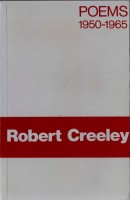
Robert Creeley, Poems 1950–1965 (Marion Boyars 1967)

First things first: If you’re a student looking for help with an essay or if you love Robert Creeley’s poetry and are looking for a like-minded spirit, stop, turn back, you are going the wrong way. I don’t pretend to have anything sensible to say. This is largely a blog post about my ignorance.

Robert Creeley is held in very high esteem by them that know about these things. I think he might be a poet’s poet. A quick google produces a number of learned and instructive articles, in which I learned much, including that this UK publication seems to be Creeley’s first US trade book, For Love, plus an extra five years worth of poems. Creeley makes a commanding appearance in Ron Mann’s 1982 movie Poetry in Motion. Robert Adamson lectured about him recently, and evidently he was a major influence on a generation of Australian poets. I know all this, because as I made my way through this book I felt at a loss, and was casting around for guidance. Sadly, asking for guidance on how to read a poet is like asking to have a joke explained. I could kind of see what people were saying but I was like the person who sort of understands the explanation but still doesn’t laugh at the joke.

I found a lot of mentions of Charles Olson (another gap in my general education), and when I looked Olson up on Wikipedia I found:

Olson called for a poetic meter [Wikipedia uses US spelling] based on the poet’s breathing and an open construction based on sound and the linking of perceptions rather than syntax and logic.

Ah, I was doing it wrong. I had to stop needing conventional syntax and use my ears more. In an excellent article in the London Review of Books, Stephen Burt says:

Creeley’s quiet poems demand that we read them slowly, even when they appear brief and simple. Taken too fast, or too many at a time, his poems … can sound cramped, monotonous and repetitive. Read at leisure, the best poems are subtle, musically gifted, memorably terse.

I had been finding the poems cramped, monotonous and repetitive, so clearly I was doing it wrong, again. I slowed right down, and read just a couple of poems at a time. That’s not to say I slavishly submitted my faculties to Burt. He describes ‘The Crisis’ as horrifying, and quotes its opening lines:

Let me say (in anger) that since the day we were married
we have never had a towel
where anyone could find it,
the fact.

Now this was one of the few poems that had actually spoken to me at the time I read Burt’s article, and I wasn’t horrified. Maybe it was possible to write those lines without self-mockery in the 1950s, but I read them as obviously ironic, an oblique apology from the poet for losing his temper.

Then there’s a Paris Review interview published in 1968, just a couple of years after this book:

INTERVIEWER: How long does the writing of a poem take for you?
CREELEY: For me, it’s literally the time it takes to type or otherwise write it – because I do work in this fashion of simply sitting down and writing, usually without any process of revision. So that if it goes – or, rather, comes – in an opening way, it continues until it closes, and that’s usually when I stop. […] I’ll come into the room and sit and begin working simply because I feel like it. I’ll start writing and fooling around, like they say, and something will start to cohere; I’ll begin following it as it occurs. It may lead to its own conclusion, complete its own entity.[…] Of course, I have no idea how much time it takes to write a poem in the sense of how much time it takes to accumulate the possibilities of which the poem is the articulation.

Another way I’d been doing it wrong! No wonder I was floundering. I tend to read poems as if they’re carefully wrought, deeply considered utterances, but according to the man himself his are something quite different, something much more risky and of the moment. I took this with a grain of salt, but I did take it.

I can’t say I’d come to love Creeley’s poetry in general by the end of the book. But it kept me reading to the end. Round about 1960, either he or I had a turning point, and I was enjoying a lot. Look at ‘Love Comes Quietly’:

Love comes quietly,
finally, drops
about me, on me,
in the old ways.

What did I know
thinking myself
able to go
alone all the way.

With this poem, I no longer felt that I was reading this collection because it was good for me. Creeley here seems to have a moment’s respite from the intense, punishing self-consciousness that characterises the poetry generally. But if something was different in the poetry, something had changed in me too. Suddenly I could hear the music: ‘quietly’ ‘finally’ ‘about me’ ‘on me’ / ‘know’ ‘go’ ‘alone’ / ‘old ways’ ‘alone all the way’. Such short lines and so much happening in the sound of them – as well as in the sense. Any number of other poems were singing to me from then on.

A handful of longer poems towards the end of the collection are just marvellous: ‘The World’, about a lover’s grief; ‘The Women’, an amazing attempt to articulate feelings about sex and the object of sexual desire; ‘Anger’, about anger;  ‘Something’, which starts – unpromisingly you might think – with a lover’s embarrassment at having a pee in his presence.

My warning at the start of this blog entry still stands, and I especially don’t get what’s going on in some of the poems with very short lines. But I’m glad to have made this poet’s acquaintance.

And now, because it’s November, a sonnet of sorts. This is not a parody of Creeley – in my wildest dreams I couldn’t bring off  his way with rhyme, so I’ve stuck to my usual rhyme scheme. But there are some quotations, and because his lines are characteristically very short, I’ve cut mine down:

Sonnet 12: Evening
I speak, I
think I think
it asks my-
self to drink.
Position is where you
put it. I care too
little, I smoke
no joke,
therefore I am not
in attitude perplexing
a man so vexing
to flex or rot.
Woman so addressed
is easily depressed.

Sonnet #11: For Naomi Grace

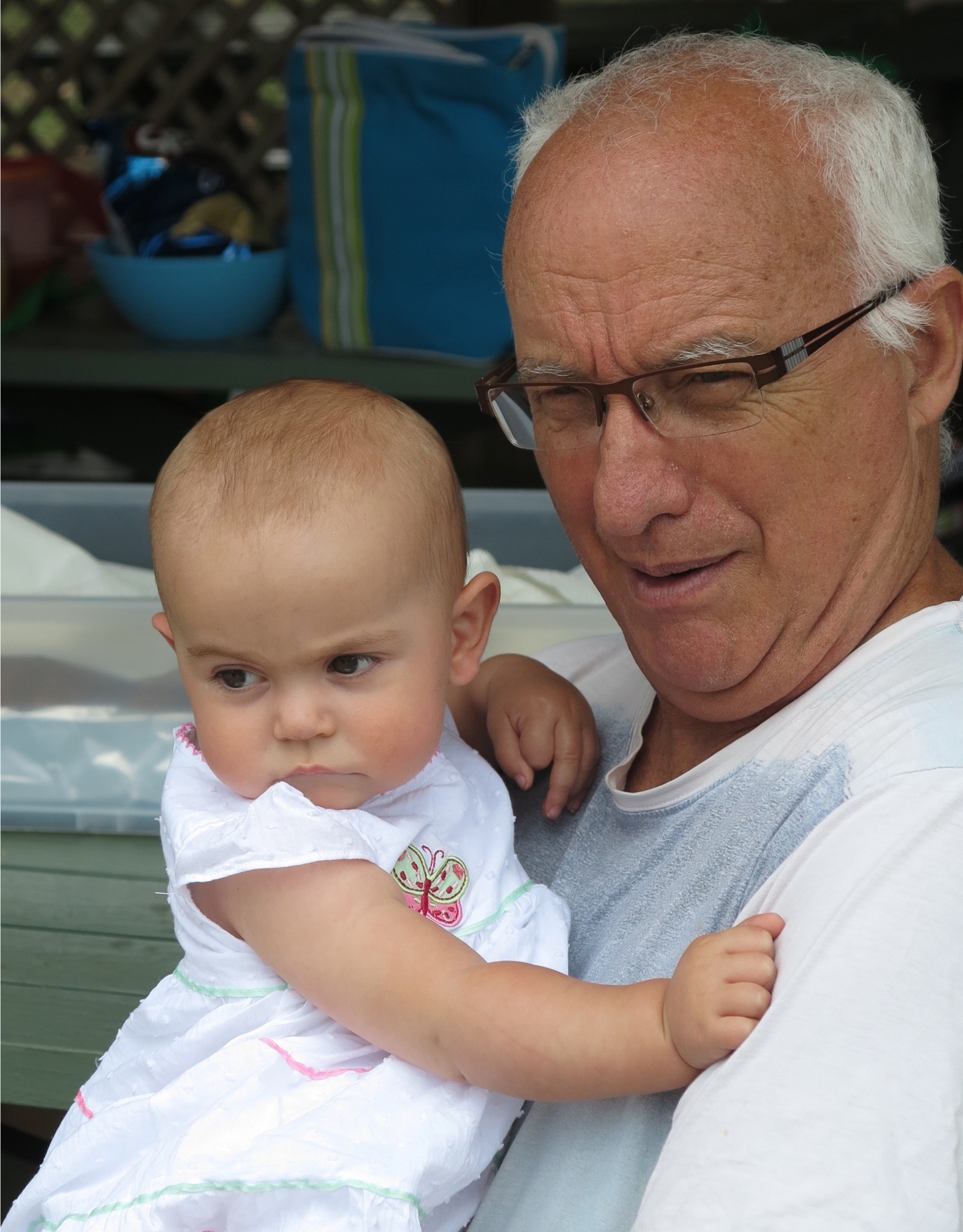
The Art Student and I have spent a long weekend away from activism and the desk respectively to help celebrate the first birthday of my great-niece Naomi. I didn’t manage a sonnet for the occasion, and that was just as well, as Naomi’s parents had devised a sweetly solemn naming and welcoming ceremony that was a complete thing in itself without any great-avuncular versifying. But November’s quota must be filled, so here’s one after the event:

Sonnet 11: For Naomi Grace
Naomi Grace has just turned one,
a girl who lives up to her name:
delightful, graceful – just as sun-
flowers the sun or moths the flame,
all faces follow where she goes
and stop when she’s in yoga pose.
Today at Cram’s Farm was her naming
ceremony: father Damon,
read aloud with mother Paula,
called on us to be her people
(rellies, friends, no church, no steeple),
and whatever might befall her
love her, back her each endeavour,
weep as needed, dance forever.

Which of these two looks more intelligent, would you say?