Russell McGregor’s Indifferent Inclusion

Russell McGregor, Indifferent Inclusion: Aboriginal people and the Australian nation (Aboriginal Studies Press 2011)

0855757795

On a recent edition of the ABC’s Q&A, Senator Nova Peris was discussing the proposed acknowledgement of Aboriginal and Torres Strait Islander peoples in the Australian Constitution. ‘As Aboriginal Australians,’ she said, ‘we are excluded. For such a long time we were regarded as flora and fauna. It’s about making a wrong right.’

Paradoxically, the 1967 removal of the Constitution’s two mentions of Aboriginal people (and, by implication, Torres Strait Islanders) was a significant step towards inclusion.

According to Russell McGregor, those two references resulted from indifference. He argues that the first, which prevented the federal government from making laws with respect to ‘the aboriginal race’, dates from the 1891 draft where it was inserted in order to protect the rights of Maori if, as then expected, New Zealand joined the new nation; when New Zealand withdrew, nobody cared enough to take the clause out. The other mention – ‘In reckoning the numbers of the people of the Commonwealth, or of a State or other part of the Commonwealth, aboriginal [sic] natives shall not be counted’ – rested on the assumption, he argues, that Aboriginal people counted for little. ‘Neither section,’ he continues, ‘formally excluded [Aboriginal and Torres Strait Islander peoples] from the legal rights and entitlements of Australian citizenship, but both implied that Aboriginal people were outside the community of the Australian nation.’

Indifferent Inclusion charts the decades of debate and changing attitudes among settler Australians, and activism and argument on the part of Indigenous Australians, that led up to the 1967 Referendum, in which an unprecedented 90 per cent of the electorate voted for change. It hardly needs saying that the Referendum was not the end of exclusion. Four years later, in what might have provided an epigraph for this book, a FCAATSI report described racism in Australia as mainly ‘cold, callous indifference to Aborigines, rather than intemperate hatred’. Punctuated by momentary expressions of good will such as the Walk Across the Bridge, the Sea of Hands and the Apology for the Stolen Generations, that indifference has persisted and non-Indigenous Australians have been largely silent in response to Aboriginal Deaths in Custody, the Northern Territory Intervention, and straws in the wind such as our Prime Minister’s recent description of the continent as ‘unsettled or, um, scarcely settled’ before 1788.

All the same, the story told here is one of progress. On one hand the voices of Aboriginal and Torres Strait Islander activists gain progressively more effective platforms, and the narrative introduces any number of passionate and eloquent individuals who ought to be household names: William Cooper, Jack Patten, Bill Ferguson, Stan Davey (author of a pamphlet on assimilation titled Genesis or Genocide?), Faith Bandler and more. On the other, settler Australia’s self image grows and develops, and with it the image it projects onto Indigenous Australians.

McGregor begins with the policy of ‘absorption’ which, though never official government policy, dominated the thinking of government departments charged with Aboriginal affairs in the 1930s, underpinned by what now looks like a bizarrely irrational emphasis on the importance of white skin to the Australian identity. This policy was a cold-blooded plan to control the relationships of people of part-Aboriginal heritage so that they had children only with white partners. This was called ‘breeding out the colour’: within a few generations, Australians would all have white complexions, and the treasured myth of ethnic homogeneity would prevail. ‘Full-blooded’ Aboriginal people would either die out or be kept cordoned off in the Western Desert, on tracts of lands to which the only non-Aboriginal people with access would be scientists. Most alarmingly, the dominant public opposition came from people who objected that the plan would corrupt the purity of the white race.

However, the self image of settler Australians did change, ‘blood’ (aka skin colour) giving way to ‘way of life’ as the main defining factor (as the White Australia Policy came to feel more anachronistic). In a number of ways, non-Indigenous people began to appreciate something of Indigenous culture: the Jindyworobaks had their doomed idea of finding a true Australian national identity by appropriating Aboriginal culture, but even kitsch tea-towels and wallpaper with ‘Aboriginal’ motifs reflected this growing appreciation. The voices of Aboriginal and Torres Strait Islander activists began to be more widely heard – the 1938 Day of Mourning was a landmark event; men served in World War 2 (though their enlisting had been resisted by conservatives who feared rightly that if they fought for Australia their claim to inclusion in the national community would be strengthened); Albert Namatjira and others demonstrated that artistic creativity wasn’t the sole preserve of non-Indigenous people; perhaps more influentially, Lionel Rose, Evonne Goolagong and others demonstrated that Aboriginal people could excel in sport.

‘Assimilation’ became the key policy word, which, although it has a bad odour these days, was supported in the 1940s and 50s by leading Aboriginal activists. According to McGregor, the assimilationist policies didn’t always, or even most of the time, entail the loss of Aboriginal identity and community: the distinction which came later, between assimilation and integration, was really an attempt to differentiate between two tendencies within the assimilationist movement. On the one side, for example, Paul Hasluck, who was Commonwealth Minister for Territories from 1951, proposed a version of assimilation in which

the Aboriginal cultural heritage would not disappear, but rather would dissipate into folkloric remnants, and Aboriginal identity would not be erased but privatised, contracting to little more than an individual’s sense of personal ancestry.

On the other side, anthropologist A P Elkin wrote:

The Aborigines are racially different from us, and recognizably so. In spite of the economic, religious, social and political assimilation at which we aim, they will be a distinct group, or series of groups, for generations to come. Indeed, they will develop pride in their own cultural background and distinctness while at the same time being loyal and useful citizens.

Elkin’s language was to change, but when he wrote this, he was using the language of assimilation. By 1961, most supporters of assimilation policies were towards Elkin’s end of the spectrum. It was generally understood that assimilation (or integration) did not mean the end to distinctive Aboriginal identity, culture and language. It was a question whether something was being done to Indigenous people, or with and by them.

I had vaguely supposed before this eminently readable book put me right that the 1967 Referendum gave Indigenous Australians the vote. But it turns out that the reading of the Constitution that led to their disenfranchisement had been successfully challenged before then. In spite of the rhetoric of the Yes campaign – ‘Right Wrongs, Vote YES for Aborigines on May 27’ – the Referendum didn’t change very much at all, and the federal government of the day under Harold Holt chose not to use their new powers, not to rock the boat. In the domain, its as if every change, seen to be huge as it approaches, turns out to be tiny.

These pages are full of odd and admirable characters, and any number of curious incidents. One truly odd moment was a piece of legislation ushered in by Paul Hasluck, the Northern Territory Welfare Ordinance 1953, subtitled An ordinance to provide for the care and assistance of certain persons. The striking thing about this legislation was that, while its concern was entirely with Aboriginal people, it never once used any version of the term ‘Aboriginal’, because Hasluck believed that no distinction should be made on the basis of race in legislation: it was easy enough to work out what distinct group was being declared wards of the state, of course, but somehow not using the name was meant to make it less discriminatory.

Many of the debates and attitudes covered here feel weirdly alien now but, as Nova Peris’s choice of language illustrates, the issue hasn’t gone away, and it’s sobering to reflect that what was once believed and spoken out loud is still lurking somewhere in our minds, unacknowledged even to ourselves. One one hand, The past is another country. They do things differently there. On the other: The past is never dead. It’s not even past.
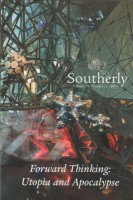
Southerly 74/1

Elizabeth McMahon and David Brooks (editors), Southerly Vol 74 No 1 2014: Forward Thinking: Utopia and Apocalypse

southerly741If I read  the editorials in journals at all, I generally leave them until last, so I read without regard for any theme. I did read enough of this Southerly‘s editorial to gather that it was anticipating the 500th anniversary of Thomas More’s Utopia, but in the rest of the journal I mostly registered mentions of Utopia or utopianism as peripheral to what I found interesting. Some of my highlights:

  • Rozanna Lilley’s memoir, ‘The Little Prince, and other vehicles’, would be wonderful reading whatever her parentage: it’s very funny on the subject of inter-generational bad driving and builds to bitter-sweet reflections on her relationship with her father. But as Lilley’s parents were Dorothy Hewett and Merv Lilley (a fact coyly avoided in the Editorial and Notes on Contributors, but explicit in the memoir itself), it makes a substantial addition to the lore about that magnificent couple. For example, the passing mention that Rozanna had hidden her father’s rifle away from him in his erratic old age is particularly chilling in the light of Merv’s book, Gatton Man, which argues plausibly that Merv’s father was a serial killer, and convincingly that he was capable of murder.
  •  ‘Exile on Uranium Street: The Australian Nuclear Blues’, by Robin Gerster, author of the brilliant Travels in Atomic Sunshine about the Australian occupying force in Hiroshima after the bomb, is a sprinting survey of Australian responses to the nuclear age. Wilfred Burchett’s famous report from Hiroshima, Neville Shute’s novel On the Beach and Stanley Kramer’s film of it have overshadowed other responses, from Helen Caldicott’s activism to protests about Maralinga’s murderous tests. This essay fills out the picture in a way that makes one hope there’s a book on the way. It has a disconcertingly jaunty self-deprecating tone, but occasionally moves in for the kill, as when it challenges our current complacency about nuclear weapons: ‘There is no cause for panic, then – unless one ponders the possibilities.’
  • ‘And in our room too’ by Liesl Nunns starts from the experience of being woken by an earthquake in the middle of a storm in Wellington, New Zealand, and ruminates interestingly about the unexpected, weaving together stories of Maori gods and taniwha, personal experience, and scientific data in true essayist style. I am uneasy about her telling Maori stories in a way that makes them sound like Greek myths, but they powerfully evoke the instability of that part of the world, as does her recurring phrase, It never occurred to me that this could happen.
  • A number of pieces deal with individual mortality. Nicolette Stasko’s poem ‘Circus Act’ deals with the stark unreality of death in a hospice. Susan Midalia’s short story ‘The hook’, in which a woman goes travelling alone two years after her partner’s death, captures the way grief persists but life eventually begins to reassert itself.
  • As always, there’s a satisfying range of poetry. Apart from ‘Circus Act’, I most enjoyed Andy Jackson’s pantoum ‘Double-helix’, Margaret Bradstock’s ‘The Marriage (1823–1850)’ (another of her fragments of colonial history) and Ben Walter’s ‘Joseph Hooker’s Hands’. Geoff Page’s review of books by Tim Thorne and Chris Wallace-Crabbe made me want to read them both.
  • I skipped much of the scholarly content (Southerly is, after all, a scholarly journal), but Jessica White’s ‘Fluid Worlds: Reflecting Climate Change in The Swan Book and The Sunlit Zone‘ was worth persevering with for its interesting insights about Alexis Wright’s work. Danny Anwar’s ‘The Island called Utopia in Patrick White’s The Tree of Man‘ may do the same for Patrick White, but the near-impenetrable technical language proved too daunting for me. My prize for impenetrability goes, though, to A J Carruthers’ review of Melinda Bufton’s Girlery, which isn’t so much densely technical as splendidly uncommunicative, not to mention disdainful of the need for consistent punctuation or the workings of the French language, as in this snippet (because I can’t make WordPress show non-itals in quotes, words that should be in italics appear here as red):

Think of Girlery as a sociostylistic and amorous liaison with girlish grammar. Around each coquine clause the female reader eyes the book, “Hitherto unwritten”, knowingly participating in a kind of ‘quixotica,’ an erotics of reading where “a little grin does that thing only read in books / Plays on our lips / Tout les deux” (27).

Someone in these pages talks about the role of the creative writer in helping us to bring our minds to bear on frightening or otherwise potentially numbing realities. It’s important work, and this Southerly is part of it.

Goodbye Mollie

In my early days of blogging I wrote quite a lot about my family, particularly about life with my mother-in-law Mollie, who had Alzheimer’s. For a number of reasons, including a growing awareness of privacy issues, the blog has become less personal, pretty much restricted to literary matters. But here is one more post about Mollie.

After some years of not leaving her bed, of not speaking, of not eating solid food or more recently being able to manipulate spoon or cup,  Mollie died last Wednesday, aged 92. The visiting palliative care nurse phoned Penny two weeks ago today to confirm – what Penny already thought – that death was imminent. For what turned out to be 10 days, someone from the family was by her bedside for several hours each day, and as the days went by, Penny was there most of the daylight hours. Although Mollie was shockingly wasted in body and mind, she responded to touch and to voices, and seemed to be conscious until the end. She died with Penny’s hand on her forehead and Penny’s voice in her ears.

All her grandchildren were able to say goodbye in those last days. Penny’s brother interrupted his work in London to fly home, and arrived just three hours after she died, so was able to say goodbye in the nursing home.

With just family present, we buried her on Saturday in the Katoomba Cemetery, in a bushland setting not far from where she spent formative childhood years and the last years before she decided she couldn’t live alone any more. We had readings – some of Mollie’s writing about her childhood and her activism, a blistering letter she wrote to the general manager of her husband’s firm criticising an unjust policy, a letter she wrote to her husband on their 25th anniversary. Each of us spoke. We read Marge Piercy’s poem ‘The Low Road‘ in honour of Mollie’s life as an activist.

Yesterday we had a small memorial gathering at our house, with scones and jam and cream, one of Mollie’s favourite treats. It was very good to come together with a small gathering of people, some of whom had come long distances, and remind each other of who Mollie was. My own mother said she didn’t want people to talk about her at her funeral, because if someone needed to be told about her then they had no business being there. We honoured her wishes, but she was wrong: any one life has so many aspects, and I think we all came away from yesterday’s gathering with a deepened and enriched sense of the person we have lost: a woman who had handed out how-to-vote cards when young for the Liberal Party (note to non-Australians: that means Conservatives), who educated herself about the world and became a tireless activist against wars, for Aboriginal issues, for the environment; who embraced new ideas and stayed curious and experimental well past the age when most people settle for the familiar; who stayed gracious to the end.

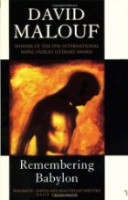
David Malouf’s Remembering Babylon and the Book Group

David Malouf, Remembering Babylon (©1993, Vintage 1994)

009930242X Remembering Babylon is an A-Stranger-Comes-to-Town story. The Stranger is Gemmy, who was thrown overboard as a boy from a ship somewhere off the Queensland coast in the first half of the 19th century. Already not quite the full quid after an impoverished early childhood in London, and traumatised further by his near death by drowning, he was taken in by a group of Aboriginal people. The Town is a tiny community of white settlers who arrive in the area some years later. As Gemmy observes them, his half-remembered previous life stirs in memory, and on encountering a group of children he stammers words David Malouf has appropriated from the historical Gemmy Morrell (or Morril), ‘Do not shoot. I am a B-b-british object!’

Although we have some access to Gemmy’s inner life, the book is mainly about the small settler community, about their range of responses to this part white, part Aboriginal man, and more broadly about the process of British settlers accommodating to the new Australian reality. Malouf would never put it this crudely, but it’s as if Gemmy, for all his addledness, has adapted to the new world more fully than any of them, so his presence becomes a catalyst for their differences and tensions to be exposed.

In Gemmy’s early days in the settlement, for example, a number of the men try to extract information from him about ‘the blacks’, but he resists:

And in fact a good deal of what they were after he could not have told, even if he had wanted to, for the simple reason that there were no words for it in their tongue; yet when, as sometimes happened, he fell back on the native word, the only one that could express it, their eyes went hard, as if the mere existence of a language they did not know was a provocation, a way of making them helpless. He did not intend it that way, but he too saw that it might be true. There was no way of existing in this land, or of making your way through it, unless you took into yourself, discovered on your breath, the sounds that linked up all the various parts of it and made it one.

Yet while this theme is being explored, the narrative adopts one character’s point of view after another – two of the three children who first meet Gemmy, their parents, the young school teacher, the minister – and each time on feels one is meeting a real person, someone Malouf knows well, perhaps even someone he in some way is or has been.

I read Remembering Babylon as part of a body of work by non-Indigenous writers, including Inga Clendinnen’s Dancing with Strangers (2005), Ross Gibson’s 26 Views of the Starburst World (2012) and David Brooks’ essay ‘Origins of Modernism in the Great Western Desert‘ (2008), which explore ways the encounter between these vastly different cultures plays out in non-Indigenous minds. It’s not really a historical novel: I doubt if any part of the Queensland coast was settled as peacefully as this fictional one apparently was, or if there would have been so little contact (ie, none apart from Gemmy) with the local Aboriginal people if it had. It’s surely symbolic rather than historical that an aristocratic woman lives in a beautiful Queenslander just a little way off in the bush from the rudimentary dwellings of the other settlers.

I’m sorry it’s taken me so long to read this book, but it’s interesting to see that some of the themes of Malouf’s recent poetry – particularly the idea of humans as creating a planet-wide garden – were being developed 20 years ago.

The group is meeting tonight. I can’t go because there are things happening in my family that have priority. It’s a pity, because there’s a lot to discuss.

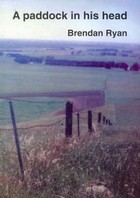
Brendan Ryan’s Paddock in His Head

Brendan Ryan, A Paddock in His Head (Five Islands Press 2007)

1pihhThe first poem in this collection, ‘I Know, I Know’ consists mainly of a list of moments from a dairy-farm childhood, benignly mundane moments with no obvious connecting logic and no obvious emotional significance: lights from the neighbour’s dairy seen at night, dogs dragging on their chains, ‘mum’ hurling tea leaves down a drain. Then the final line:

some days are rosaries that never end

For readers who might need a gloss on that, the next poem, ‘Catholic Daydreams’, has a large Catholic family saying the rosary, the kitchen ‘humming with Hail Marys’ and

My father’s dairy farming fingers
slip down the beads

as if each bead was a grip
on the Joyful Mystery
of ten children charging through

the Hail Holy Queen,
the tempo picking up
according to what was on T.V.

Most of the poems here are shot through with that kind of Catholic sensibility: a sense of the holy unceremoniously embedded in the mundane, messy, painful, occasionally joyful, often strenuous, mostly inarticulate everyday life on a small dairy farm in rural Victoria – and in the farm escaped from, remembered, missed, revisited. It’s sacramental but not at all solemn, in fact not at all pious. There are hints of the Benedictine motto laborare est orare, but without religion.

And many of the poems are like rosaries: lists of things observed like beads, evoking fragments of story associated with each one. Like this, from ‘Tower Hill’:

Driving into the crater
past shelves of basalt, clinker and limestone

I wait for my aunt’s stories.
She remembers a king tide claiming the paddocks

a house being lifted, then taken away by a river.

In the few poems of city or town life, the sense of place and the sense of community are just as strong. From ‘Summer Conversation’:

Three days of heat
and the lounge expels us to the backyard.
From over fences
an accordion being played
footsteps in the back lane,
neighbours on their front verandah
with Greek radio and a well-hosed footpath –
they watch everyone who passes.

In this and his previous book, Why I Am Not a Farmer (my blog post here), Brendan Ryan has maintained a remarkably tight focus on this one subject: the life of a small Catholic farming community and what it means  to leave  it for a town life.

In case I’m giving the impression that this poetry is naive or monotonously single-minded, I’ll mention ‘Naringal Landscape’, a conversation with a Clarice Beckett painting that seems to be called 7 Naringal, Landscape.

The bush we don’t see closes in like memory.
A clump of eucalypts floats above the horizon.
The silence of the paddocks creeps outside the canvas.
Late afternoon, smells of heat and rye grass thickening in your head.

I’ve just read that he has published two books since this one: A Tight Circle and Travelling through the Family. I’m glad to report that the latter book was shortlisted for the 2014 Victorian Premier’s Literary Awards, which seems to mean I’m in good company in wanting more of his work.

Andrew Charlton’s Dragon’s Tail

Andrew Charlton, Dragon’s Tail: The lucky country after the China boom (Quarterly Essay 54, Black Inc July 2014)

9781863956567As with every Quarterly Essay, I turned first to the back of this issue for correspondence on the previous one, Paul Toohey’s essay on asylum seekers, That Sinking Feeling (which I blogged about here). The correspondence is excellent, with contributions from asylum seeker advocates (a lawyer, the caseworker and adviser who was responsible for the TV show Go Back to Where You Came From, a Jesuit detention centre chaplain), a journalist and – the one I was particularly struck by – Neil James, executive director of the Australian Defence Association. I just looked up the Australian Defence Association, and see from their recent tweets that their military-focused point of view may be impervious to evidence on at least some issues, but here James puts his case in a way that invites reasoned debate rather than the flinging of books across rooms. As Toohey remarks in his ‘Response to Correspondence’, the discussion manages ‘a rare achievement in this particular debate: that those who took issue did so without hostility’. Partly this is because for once party politics is laid aside. That Rudd and Gillard stuffed up seems to be generally agreed, but no voice is raised in defence of Tony Abbott and Scott Morrison’s opportunistic and hypocritical cruelty.

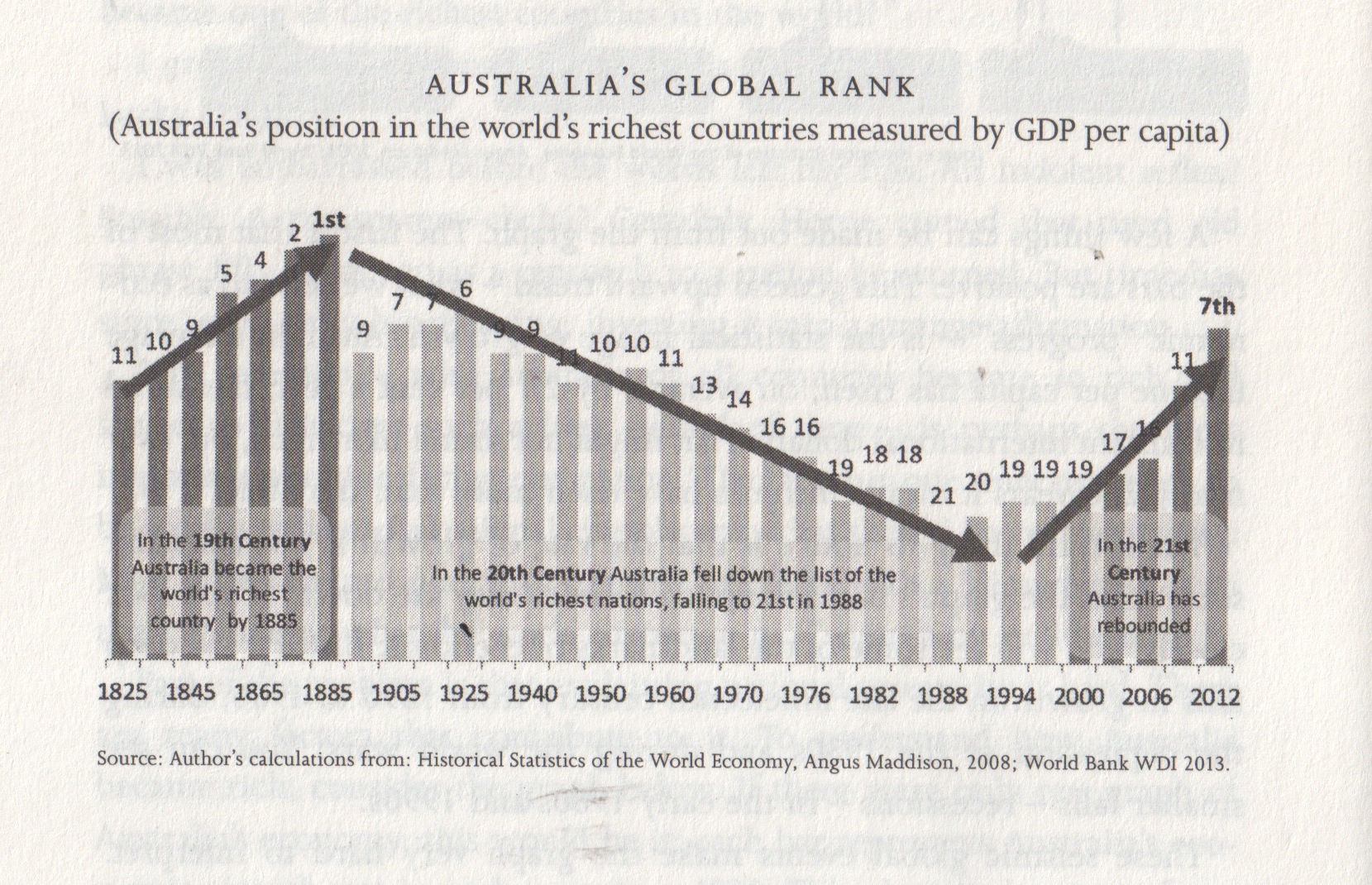
As for Andrew Charlton’s essay, which accounts for the previous 71 pages, I had to overcome a knee-jerk aversion to reading about economic matters to tackle it at all. But though it is indeed one more lecture on how important China is to the Australian economy, and although it does use words like leverage, distortion and correction in ways that have nothing to do with engineering, funhouse mirrors or blue pencils,  the essay is mostly very readable, with engaging anecdotes, carefully structured argument, and at least one arresting chart. Here’s the chart:

Charlton graph

In case that print is too hard to read:
‘In the 19th Century Australia was the world’s richest country by 1885.’
‘In the 20th Century Australia fell down the list of the world’s richest countries, falling to 21st in 1988.’
‘In the 21st Century Australia has rebounded.’

Australia’s prosperity in the 1880s came from its great success as a supplier of resources – wool and gold – to a leading economic power – England. It was followed by a devastating Depression in the 1890s. Our current prosperity, Charlton argues, has a similar genesis – vast amounts of Australian iron ore has fuelled China’s phenomenal growth over the last 20 years. China’s industrialisation, he writes,

is perhaps the most significant economic event since the Industrial Revolution that transformed Britain in the eighteenth century and laid the framework for the modern world. And China’s industrialisation has occurred 100 times more quickly and on a scale 1000 times larger than Britain’s Industrial Revolution.

The essay builds to a cogently argued warning: China’s growth, which has brought 100 million people out of poverty, is built on an unsustainable model, and the Chinese economy is heading for a crash unless the government’s current attempts to change course succeed. Either way, Australia risks being a goose laying golden eggs that no one wants – that is to say, just a goose. (Blame me for the goose metaphor: Charlton wouldn’t stop so low.)

The essay ranges back in time, travels to many parts of the globe, draws the connections between a café owner in Cairns and global economic abstractions. I look forward to the correspondence on this one, hoping we won’t be treated to someone dismissing it as Labor Party propaganda because a) Charlton used to work for Kevin Rudd, and b) it doesn’t praise the brilliance of John Howard (the Australian Spectator has indeed published such a piece).

What I particularly appreciate is the broader perspective the essay brings to Australian affairs, striking a blow against the resolute insularity of much discussion (about the economy, but also – shockingly – about asylum seekers and climate change). Here’s a paragraph from early in the essay:

Our national debates are frequently partisan and parochial. For example, if you are on the right, you know that the budget is now in deficit because Labor wasted money; if you are on the left, you know that a deficit was necessary to save hundreds of thousands of jobs. On the right, you know that Australian manufacturing jobs are disappearing because we are uncompetitive with our Asian neighbours; on the left, it’s because Australian industry doesn’t receive the same subsidies that those of other countries enjoy. On the left, you would argue that  the global financial crisis was caused by greed and lax regulation of financial markets; on the right, you might point the finger at excessive government debt. If you are on the right, you know that Australia pulled through the financial crisis because John Howard left Australia with a strong surplus; on the left, it was because of Kevin Rudd’s economic stimulus. On the right, you know that productivity growth is low because powerful unions disrupt workplace efficiency; on the left, it is because Australia hasn’t invested sufficiently in skills and infrastructure.
These positions are easily digestible and often self-serving, but they are all either wholly wrong or drastically incomplete because they overlook the events beyond our borders that have shaped us.

Charlton’s account of the global financial crisis refreshingly avoids the other pitfall of writing about these matters: he doesn’t go into the technicalities of dodgy financial instruments and manoeuvres, but sticks to the big picture, and as a result remains comprehensible.

P Craig Russell’s take on Neil Gaiman’s Graveyard Book

Neil Gaiman, The Graveyard Book, Volume 1, graphic adaptation by P Craig Russell (Bloomsbury 2014)

the-graveyard-book-graphic-novel

This is a wonderful translation of The Graveyard Book into comic form. Paradoxically, it’s for an older readership than the novel, though I suppose that’s only a paradox if you think comics are just for children, and no one except newspaper headline writers think that any more, surely.

The reason I say this is for an older readership is that the story begins with a multiple murder, which the novel describes, brilliantly, in almost completely abstract terms, conveying the horror but not creating any images to haunt the young potential reader, but which the comic, while not going all out for the horror, makes completely explicit.

It’s a glowing jewel of a book. The story is full of surprises, the fantasy world is charming and scary, and the artwork – by Russell along with Kevin Nowlan, Tony Harris, Scott Hampton, Galen Showman, Jill Thompson, and Stephen B. Scott – is gorgeous.

If I remember the novel correctly, the episodic nature of the first half gives way to a more plot-driven second half. It certainly feels at the close of this volume as if the overarching story is about to assert itself, as the killer from the opening pages comes back into the picture. I’m looking forward to Volume 2, due out later this year

Steven Herrick’s Caboolture

Steven Herrick, Caboolture (Five Islands Press 1990)

1cabooltureSteven Herrick has written a number of terrific verse novels for young readers, most recently Bleakboy and Hunter Stand Out in the Rain (UQP 2014). He’s kept busy performing from them in schools, he has won prizes for them, and more significantly he has attracted a keen readership. In a recent radio interview, asked about his beginnings as a writer, he acknowledged almost sheepishly that he used to perform ‘to lots of drunks in pubs’, that he started out writing about ‘inner-city life’.
It’s a neat bit of counterpoint: as the poet matured he progressed from grown-up venues to children’s and young people’s writing. I’ve enjoyed a number of his more mature works (that is, the verse novels for young readers), so it was only natural that, when a secondhand bookshop shelf offered me Caboolture, a book from his former incarnation, I snapped it up.

I enjoyed these poems, which mostly relate one way or another to masculinity: youthful escapades (not all of them legal) and relationships with women (not all of them Hallmark-worthy), father–son scenarios in which the speaker occupies both roles (in different poems), traveller’s tales, car lyricism. They range from swaggering fun to starkly elegiac, with an occasional foray into poet-identity (in one of several poems set in the US, the speaker has enough money for a book of Frank O’Hara poems or a pie – he can’t have both). They read well on the page, but cry out to be read aloud – or performed, the purpose for which they were originally written.

The only clue to the direction that Herrick’s work was going to take is in five poems featuring his infant son Joe. ‘Country Joe’, for example, takes us through the small hours:

Joe’s awake
it’s 2 am
I threaten Joe
with a song
he acts like he’s asleep
Joe’s awake
it’s 3 am

an so on. On that recent radio interview, when asked for something from his pub-reading days, he performed ‘To My Son, Joe’, a poem he said went down reasonably well in pubs, which begins:

for the first five years
you’ll be like your Dad
you’ll fall over a lot
always be on the bottle
& stay awake all night.

Here’s a YouTube of him performing it, in which he says it’s from his book Water Bombs, a book published five years after Caboolture, described on its cover as ‘a book of poems for teenagers’. I’d say the poem goes down pretty well in schools: a genuine crossover poem. Have a listen.

If you don’t know Steven Herrick’s work, I’d start with one of the verse novels rather than Caboolture. But if, like me, you love his later work, here’s something different.

Words of warning: If you’re younger than about 30 you may need help with some of the cultural references (as in ‘Brian Henderson Saw Us Make Love’, though the poem would still work if you didn’t know Brian Henderson was an iconic newsreader). If you’re from Goondiwindi you may object to having your town’s name consistently misspelled. If you’re from Caboolture, on the other hand, I imagine it will be good to see that someone knows how to say your town’s name right.

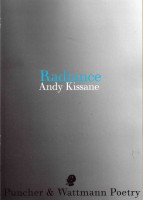
Andy Kissane’s Radiance

Andy Kissane, Radiance (Puncher & Wattmann 2014)

1radiance

Andy Kissane’s poetry is rooted in white, middle-class, heterosexual, inner-west Sydney. Among other things, it features memories of a Catholic childhood and celebrates non-dysfunctional domestic family life. And it’s terrific.

Maybe I think it’s terrific because all those descriptors apply to me as well. But the thing is, it’s a poetry that’s modest, witty, at times quietly ecstatic, and capable of looking well beyond the inner-city horizon.

As in Kissane’s earlier books, there are a number of dramatic monologues and other poems dealing with people suffering at the pointy end of capitalism – in Victorian London, on a Mexican street, at an airforce hangar, on a Cambodian garbage dump. Also as in earlier books, there are witty and poignant engagements with other writers – Keats, Shelley, Virginia Woolf (who criticises Kissane’s ‘infernal overwriting’), Dylan Thomas, Miklós Lorsi, Buddy Holly, Nick Hornby.

For me, it’s the more personal poems – poems of domesticity, if you like – that are the richest. I’ll try to articulate why by using the book’s title.

Forms of the word radiance occur in three poems. The first is ‘Trip to the Ice Rink’. The poem’s speaker performs ‘a role / crucial for adolescent wellbeing: efficient driving.’ In the opening lines his daughter gets into the car in a black mood, but:

By the time I pull up outside the Canterbury ice rink,
the thunder has blown away and the sky
is now a radiant, cloudless blue. ‘Thanks, Dad,’
she says, as she goes off to practise her Lutz.

The speaker’s focus shifts from wry acceptance of his utilitarian role:

I can see her as she concentrates on the long backward
glide, digs her toe pick down hard into the ice, lifts
and spins into the air, striving with her whole body
to land this difficult jump for the first time.

It’s a commonplace moment. But there’s a suggestion of the numinous in that father’s mental image of his daughter doing what is after all something fairly ordinary. The daughter’s smile is not the only radiance.

The second ‘radiance’ is in ‘Schooling the Heart’, whose three pages invoke scenes from Anna Karenina, kindergarten experiences with plasticine and cuisenaire rods, the self-immolation of Buddhist monk Thích Quảng Đức in Saigon in 1963, and Catholic iconography remembered from childhood: ‘the immaculate heart / of Mary radiating light, exploding like a penny bunger / wedged into a pine cone’. Despite the comical simile, that radiance is not to be discounted: the poem is suffused with a yearning – and the potential – to let one’s heart shine forth in spite of the rebuffs that have schooled it into caution.

Then there’s ‘Sea of Tranquillity’, the suite of nine poems that make up the fourth and final section of the book. The first, ‘Total Eclipse’, begins:

The Moon drinks tea from her favourite china cup,
decorated with the flowering tassels and green leaves
of a yellow gum.

The Moon turns out to do many things that a middle class woman in the inner west suburbs would do: she grows vegetables, argues violently about movies, serves up pizza, works with teenage drug abusers, goes to a poetry reading where she

________longs to read the book hidden
in her overcoat pocket, only she doesn’t want to appear
rude.

She’s clearly an ordinary woman, the speaker’s long term partner. ‘The Moon’ is not quite a metaphor, but it’s more than a nickname. Her pain – physical and emotional – is described as craters, and the poems are shot through with light imagery: at their first meeting (in ‘Total Eclipse’) she opens a door and he sees her lit from behind with ‘a fluttering corona pulsing around her outline’; elsewhere she sashays across the sky

with that long stride of hers, poised and frisky,
her radiant beauty set to shine all night long.

In another poem she is explicitly not ‘the celestial moon’. It’s playful, whimsical, and – though an epigraph from A Midsummer Night’s Dream warns against solemnity – lyrical. I read the sequence as a brilliant rebuttal of the truism that long term relationships by their nature become matters of habit, companionable maybe but pallid in comparison to the first flush of passion. This is completely convincing love poetry, and if I had to tie down the meaning of ‘radiance’ here I’d say it was the way the loved one (or the loved universe) appears to the lover.

One other thing: at a poetry reading in ‘Moon Rocks’, the speaker has an experience that would be familiar to many people who have attended such an event. The first reader’s words

______ collapse in on themselves
and I’m being sucked into the core of a black hole.

Not that there’s anything wrong with black-hole poetry, but Kissane doesn’t write it.

As I’ve mentioned before on this blog, I have co-written a short film script based on one of Andy Kissane’s poems. I received a complimentary copy of this book from the publisher.

John Williams’s Stoner and the Book Group

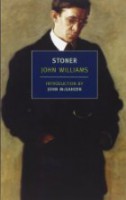
John Williams, Stoner (1965, NYRB 2006)

1590171993Published in 1965 and rediscovered by the New York Review of Books in 2006, this novel is currently having a big day in the sun, and our Book Group has its metaphor-mixing finger right on the pulse.

Before the group met: I loved this book, though I find it hard to say why with any confidence. William Stoner, born late in the 19th century into a grim farming community is sent to university at age 19 because his father grasps that education in agriculture will help the farm to survive. He has an epiphany part way through his second year of study when a lecturer recites a Shakespearean sonnet, and he changes course. He goes on to complete a PhD in literature and then to a life of teaching at that same university. He marries unhappily, has a daughter who doesn’t turn out well, makes powerful enemies in academia who stymie his career, endures a major heartbreak, lives on and finally dies. Grim, grim, grim, you might say.

What’s more, William Stoner is no man of action: he chooses not to enlist in the First World War, not to leave his intolerable marriage, not to challenge lies being circulated about him. There’s a moment near the end when he has a chance to speak in public, to communicate something of what matters to him: he says six words – words that are moving to the reader, but must sound almost completely inconsequential to his listeners. He is exactly not the ideal protagonist of a Hollywood movie.

Which may be his appeal. He isn’t noteworthy because of any great achievements, but he is a man who falls in love with a vocation – the vocation to teach – and is true to it for the rest of his life. Even though for long stretches he is a mediocre teacher, he finds a deep spiritual nourishment and meaning there, and at key moments chooses to sacrifice his chances for advancement or happiness in order pursue it.

The book is beautifully written. Every now and then, I’d forget that I’ve only got so many years left and so many books still to read, and just linger over a turn of phrase, a sentence, a paragraph. Like this:

In his extreme youth, Stoner had thought of love as an absolute state of being to which, if one were lucky, one might find access; in his maturity he had decided it was the heaven of a false religion, toward which one ought to gaze with an amused disbelief, a gently familiar contempt, and an embarrassed nostalgia. Now in his middle age he began to know that it was neither a state of grace nor an illusion; he saw it as a human act of becoming, a condition that was invented and modified moment by moment and day by day, by the will and the intelligence and the heart.

 After the meeting: It’s winter: one man was down with a heavy cold starting a second round of antibiotics, two were off in the European summer, a third had an early flight to Manila this morning, one who works for an environmental organisation had urgent work sprung on him (whether because of the good news from the State government or the continuing torrent of bad from Canberra he didn’t say), and yet another had been intending to come but mysteriously failed in the  attempt.

So four of us drank from crystal glasses and sat down to far too much food and a sustained and animated conversation about the book, which we had all read (a rare event) and were all enthusiastic about. I think everyone read something, each picking out a different bit to hold up for the collective enjoyment.

Someone said that he wept in public as he read it; that when Stoner found love in middle age it was as if the novel changed from black-and-white to colour, and then, wretchedly, back again.

One of the passages that was read out was the account of Stoner and his wife’s sex life in the early years of their marriage. Be warned this might trigger sexual abuse memories:

Out of an unspoken stubbornness they both had, they shared the same bed; sometimes at night, in her sleep, she unknowingly moved against him. And sometimes, then, his resolve and knowledge crumbled before his love, and he moved upon her. If she was sufficiently roused from her sleep, she tensed and stiffened, turning her head sideways in a familiar gesture and burying it in her pillow, enduring violation; at such times Stoner performed his love as quickly as he could, hating himself for his haste and regretting his passion. Less frequently she remained half numbed by sleep; then she was passive, and she murmured drowsily, whether in protest or surprise he did not know. He came to look forward to those rare and unpredictable moments, for in that sleep-drugged acquiescence he could pretend to himself that he found a kind of response.

Williams doesn’t shy away from the word ‘violation’, but ‘love’ isn’t just a euphemism either. As someone in the group said, your heart breaks for both of them.