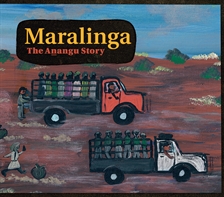
Maralinga, the book

Yalata and Oak Valley Communities with Christobel Mattingley, Maralinga, the Anangu Story (Allen & Unwin 2009)
Christobel Mattingley is well known in Australian children’s literature circles. Along with picture book creator Bob Graham she was nominated for the 2012 Hans Christian Andersen Award (aka the Little Nobel). The award went elsewhere, but these two national treasures were honoured by the NSW Branch of IBBY Australia (International Board on Books for Young People) at a Sydney event on International Children’s Book Day, 31 March. Both spoke wonderfully about their work. I learned that a whole generation of French people grew up thinking Bob Graham was French, and whatever his nationality he’s a modest miracle. But for me, Christobel Mattingley was the revelation.

Now in her early 80s, Christobel Mattingley has written an extraordinary body of work for young people and adults that deals with, for want of a better word, social justice issues. Two books in particular stand out: for something like eight years she laid her own writing aside in order to coordinate the landmark Survival in our Own Land—‘Aboriginal’ Experiences in ‘South Australia’ since 1836 (Australian Scholarly Publishing 1988, reprinted at least twice since), which incorporates oral history and archival material to tell the Nunga story of events that have otherwise been told almost universally from a settler perspective; and Maralinga, a smaller project, that looks at first blush like a children’s picture book and would certainly be accessible to most teenagers, but turns out to be a powerful, original and significant work of history. Both books leapt onto my To Be Read list. Marrickville Library had a copy of Maralinga.

As every schoolchild knows (or can look up on Wikipedia):

British nuclear tests at Maralinga occurred between 1955 and 1963 … A total of seven nuclear tests were performed, with approximate yields ranging from 1 to 27 kilotons of TNT equivalent …

The site was contaminated with radioactive materials and an initial cleanup was attempted in 1967. The McClelland Royal Commission, an examination of the effects of the tests, delivered its report in 1985, and found that significant radiation hazards still existed at many of the Maralinga test areas. It recommended another cleanup, which was completed in 2000 at a cost of $108 million. Debate continued over the safety of the site and the long-term health effects on the traditional Aboriginal owners of the land and former personnel. In 1994, the Australian Government paid compensation amounting to $13.5 million to the local Maralinga Tjarutja people.

Maralinga tells this story in some detail. As the subtitle – The Anangu Story – indicates, the point of view is not that of the scientists, the politicians, the bureaucrats or the journalists, but that of the affected Aboriginal people (for whose name I wouldn’t trust Wikipedia). It begins well before their country was deemed to be a good place to test nuclear devices (putting the lie to a rerun of terra nullius, you might say) and brings us up to the slow rebuilding of communities in the present. It begins:

Long time ago, before whitefellas came, Anangu lived on their lands for thousands and thousands of years.

There are old people at Oak Valley who can remember living a traditional life in the desert. But the book is not limited to oral history. It tells of the coming of whitefellas to Ooldea Soak: explorers including Eyre and Giles, then well-sinkers and surveyors, in 1912 the Transcontinental Railway, then Kabbarli (Daisy Bates), and the truly invasive United Aborigines’ Mission, whose abrupt departure in 1952 left the now-dependent local people distraught and at the mercy of the dreaded Aborigines Protection Board, to be forcibly removed to alien country at Yalata, on the coast.

While the dispossessed, disoriented desert people were grieving, spiritually lost in foreign country, rebuilding a few basic community structures from salvaged material twice recycled, a township for whitefellas was being constructed in their country … In 1953 the site … was named Maralinga by the whitefellas. This time they took the word from an Aboriginal language of northern Australia.

The power of the book’s text lies in the multiplicity of its voices. It’s one thing to describe the desert people as grieving and dispossessed. It’s quite another to read the words of Jack Baker and others to the 1985 Royal Commission:

We felt lonely about Ooldea, we were worrying for it. We tried to get back up there. Yes, we were worrying and … we were sad for all of the places that we were related to, and we were worried because these places had been spoiled … We were told we could not go back there.

And how telling it is to read first hand accounts like this from Kukika, who worked on Wallatinna Station homestead:

Smoke came from south, brought up by light wind. The sun became bad. People got sore eyes. We were weak in arms and legs, couldn’t get up and dig for rabbits. Blood came from people’s noses and mouths. My two grandmothers died, and my father and mother. Before the smoke we were all okay. We were without sickness. Tommy Cullinan [station manager] didn’t have a name for the sickness. Didn’t know what it was. I was burying people. Shifted camp again and again.

When this book was shortlisted for a number of awards in 2010, I don’t imagine I was alone in thinking of it as worthy, an excellent addition to a school library, but not exactly something to rush out and buy. But you know, it’s also a book that changes the way you see the world, and leaves you in awe of human beings, both the resilient ones who have come through a hundred years of brutal disregard, and the one who has sat down and listened deeply enough to bring their stories to us.

I saw Harry Bardwell’s Backs to the Blast: An Australian Nuclear Story when it came out in the early 80s, and it did include an interview with an unnamed Aboriginal woman. Here, the Aboriginal people are named, we have a sense of their personal and collective histories, and the vibrant illustrations throughout make it clear that they are not just informants, but they share the authorship of the book.
SWF: A C Grayling, curtain raiser

‘The Private, the Public and the Line Between’, a lecture by A C Grayling

This was the start of my 2012 Sydney Writers’ Festival. I’ve become accustomed to starting the Festival with the Premier’s Literary Awards dinner, which is always a good night out, though the last two had become a bit corporate. This year the awards evening has been moved to later in the year (not, as feared by some, cancelled altogether), so my Festival begins with this 90 minute event at the Angel Place Recital Centre a month or so ahead of the Opening Address. I’m calling it a curtain-raiser because that ‘s how Peter Shergold (from the SWF Board) described it when introducing the talk, but really it was more of an advance scatterling.

A C Grayling is the very picture of an urbane philosopher. He spoke lucidly for an hour without notes, and fielded questions deftly and courteously. Sadly I slept for maybe as much as half the talk, so I’m not a reliable reporter. But I quizzed my four companions over dinner at the nearby Wagamama and my impression is that I didn’t miss a lot by dozing off. Basically, Professor Grayling told us, we are being watched by Internet corporations who track our online activities for commercial purposes, by government for security purposes, and by journalists for partly public interest and partly commercial interests, and that this isn’t a good thing. I have listened to his interview with Richard Glover on the ABC, which is an excellent 18 minutes of radio and includes everything that the $25 lecture had to offer, including the teasing references to the Professor’s impressive hair. What we got for our money was the sense of occasion, a chance to play Spot the Famous Person (both the Art Student and I saw David Marr and Annette Shun Wah, but some of our other companions hadn’t heard of either of them, which rather spoiled the thrill).

If the purpose of a talk by a philosopher is to prompt one to think, then this one was a big success for me. During the question time, Professor Grayling talked about a village in southern Italy where, when a husband and wife have a quarrel the woman runs out into the street and the couple proceed to shout at each other, while all the neighbours come to their doors and windows to listen. These people, he said, live with a strong sense of community but at the cost of losing their privacy. That raises a much more interesting question about ‘The Private, the Public and the Line Between’ than the question of intrusion by the state, corporations and the press. I would have thought that that kind of intrusion is obviously a bad and dangerous thing – and of course that it’;s a good thing to have the dangers pointed out. But don’t we then need to think carefully and precisely about what it is that we’re protecting. Are we protecting our right to be isolated individuals, to have secrets and present a conforming face to the world? Sure, those young people who give out far too much information on facebook or twitter may be laying themselves open to attack, but isn’t also worth asking if there’s not something utopian about that rather than simply foolish? That’s what I’d have liked to hear him talk about.

(Re-)reading Kevin Gilbert’s poetry

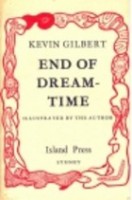
Kevin Gilbert, End of Dream-time (Island Press 1971)
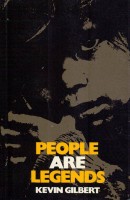
and People Are Legends (UQP 1978)

According to his Wikipedia entry, Kevin Gilbert (1933-1993) was an ‘Indigenous Australian activist, artist, poet, playwright and printmaker’. His first play, The Cherry Pickers, which he wrote when in prison. made a splash in 1970 or thereabouts. A Wiradjuri man, he played a role in setting up the Aboriginal Tent Embassy and was part of the Black Power group. He wrote a book for children, Child’s Dreaming (1992), from which we published a number of poems in The School Magazine, and a sweet memoir for child readers, Me and Mary Kangaroo (1994).

I own a copy of his first published book, End of Dream-time, number 104 of the edition of 200, and it’s sitting on my desk as I type. It’s a beautiful object, handset and printed on creamy, textured paper, with illustrations by the author in a range of single PMS colours. Phil Roberts, the poet founder of Island Press, treated his early books as labours of love. Of those on my bookshelves, this is the one most lovingly laboured over. The presentation is a clear message to anyone tempted to read the poems as sociological specimens (a book by an Aboriginal man was a rare thing in the early 1970s, and any spurious sociological appeal was made all the greater by its having been at least partly written when Gilbert was in prison for murder). These poems, the design announces emphatically, are to be read and respected as poems.

So I was shocked to learn, all these years later, that Kevin Gilbert ‘repeatedly and publicly’ disowned his poems as published in End of Dream-time. It seems that Roberts did substantial editing without his permission. He may have done no more than he would have done for any first book, and the poems may in some sense be the better for it, but Gilbert’s bitter complaint was about the lack of consultation. Adam Shoemaker tells the story, and reproduces the original and edited versions of the short poem ‘People Are Legends’, in ‘The Poetry of Politics‘, a chapter of his Black Words White Page: Aboriginal Literature 1929–1988. Go to the link, read it and cringe: Roberts’s good intentions are clear, but even a whitefella like me who’s been an arrogant enough editor in my time can see why Gilbert would consider it a betrayal of trust. His poems are full of rage and despair at the callous, complacent attitudes of whites toward Aboriginal peoples. Shoemaker quotes him as saying:

I’ve adopted writing as a means of voicing the Aboriginal situation … I try to present as truly as possible the Aboriginal situation and the Aboriginal response.

And:

There is the need to educate White Australians to the present situation of Aboriginal people … I’m presenting it as honestly as possible – it’s not a pretty picture.

What bitter irony, when struggling to find a voice in this way, to have one of those in need of education inject his voice into the mix! (I know Phil Roberts is Canadian, but in this context that’s a distinction without a difference.)

So I went out and bought a copy of People Are Legends, published seven years later by the University of Queensland Press. The back cover describes these poems as written ‘in the language used by living Aboriginals, without editing, without politeness or hypocrisy as practised in “cultured” verse’ (my bold).

Neither book is a comfortable read. Rather than emotion recollected in tranquillity, we get harangues that feel shot off in the heat of the moment. Many of the poems are dramatic monologues, spoken not so much by characters as by exemplars, either of the misery and debasement resulting from genocidal oppression, or of morally contemptible individual escape. There’s a bush ballad that doesn’t quite scan, and quite a lot of satire that has a bitterly intolerant edge, directed not only against whites but, almost, against any Aboriginal person who pursues a politics that’s neither despairingly passive nor holding out the option of retaliatory violence. Even the Gurindji’s heroic stand against Vesteys in 1970 gets the treatment. One of the two poems named for them begins:

They fast
They silently fast
Eloquently silent
In their thundering cry for Right

But by the end that silence has been found sadly, even culpably wanting:

They should remember
Back in time: throughout history
Justice, deprived of a strong voice slowly,
Inexorably dies
And the seeker of justice dies with it
Or silently becomes a slave.

But then, these poems aren’t aiming to give me a good time or lay out a workable political agenda. This was trail-making work: I don’t know that anyone would try to write poems about ‘the’ Aboriginal situation and response these days, and that’s due in part to Kevin Gilbert’s rising to the challenge to educate, to speak as a representative.

Since the thing that prompted me to read these books was the near absence of modern Aboriginal poets from Geoffrey Lehmann and Robert Gray’s Australian Poetry Since 1788, it’s probably worth remarking that there are quite a number of poems here that wouldn’t have looked odd in those pages. The other ‘The Gurindji’ brought a new music into Australian poetry:

Poor fellow
Simple fellow
Sweet fellow
00Strong
Sittin' in the desert
Singin'  desert song

And I’m no expert, but I think ‘Trying to Save Joan Ella’ not only stands up well as a bush ballad, but manages to hold out a significant challenge to the whole tradition. It tells of an Aboriginal woman’s arduous and terrifying ride to fetch a doctor for a dying white baby:

Quick she rode to Thiraweena
And she brought the doctor back
But the child died – and the father
Cursed the slowness of the black
....
If this cursed gin had ridden
Faster, harder through the night –
But the blacks are bad and useless –
Can't be trusted out of sight!'
Mary bowed her head in silence
Thought: 'I wishit me had died
Rode two horses an' it killed 'em
Never stop't though me dead tired
Frightened too of horse bin fallin'
When I passed the old ones' grave
Shut me eyes with courage 'gammon'
When the ghosts rise I ain't brave!
Couldn't do no more I tried but
Kill'd two horses; rode to death.
Didn't stop! I kept on runnin'!'
And she wept beneath her breath

Really, it’s a poem that cried out to be anthologised.

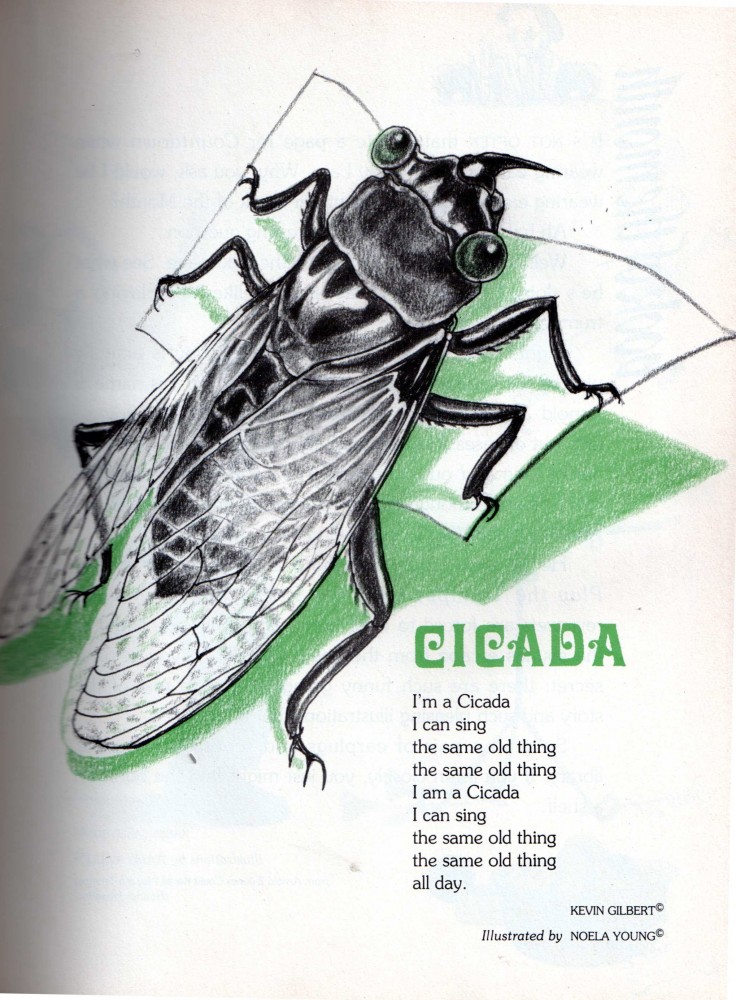
And one last note: in Child’s Dreaming, published a couple of years before his death, Gilbert showed that he could relax when the burden of being a representative was eased. There was still the element of protest, but without the same bitterness and despair (see ‘Emu and Koori’, as reprinted in The School Magazine  with an illustration by Arone Raymond Meeks, in the left-hand image below). ‘Cicada’ (image by Noela Young) may not be everyone’s cup of tea, but it’s given me much pleasure. ‘Eagle’ (illustration Aart Van Ewijk) is just plain genial.

A reason to read the European Journal of International Law

It’s published one of my poems, making me an Internationally Published Poet

At least for a short time, you can see the whole issue here and download the poem from here. And Oh my goodness, it even has a formula for citing it in learned journals: Eur J Int Law (2011) 22 (4): 1219. doi: 10.1093/ejil/chr097 .

Since my readers are unlikely to read the Editorial in its entirety, here’s a significant paragraph from it:

Poets of the World (of international law) Unite! Send us your poems; encourage others to do so.

Consider yourself encouraged. Poems are printed in a feature called The Last Page. You can contact the journal’s editors at ejil ät eui døt eu.

Later: Sorry, but I didn’t realise the poem is behind a pay wall, and I’ve agreed to their having exclusive electronic rights for 12 months. I guess you’ll either have to pay, or have access in some other way, or wait till November. Of course, you could google “he’d feel safer in a boat with refugees’.

Topical clerihews

On a recent election result:

Campbell Newman
Doesn’t look very human
But Queensland voters said bye bye
To Anna Bligh

On an article in the current Monthly:

Robert Mann
Thinks he can
Save us from choosing between Gillard and Abbott
By pulling Turnbull out of his hat like a rabbit.

That is all for today.

Julian Barnes’s Sense of an Ending

Julian Barnes, The Sense of an Ending (©2011, Vintage 2112)

This won the Booker Prize last year. I haven’t got anything sensible to add to the general discussion: it’s very good, what seems to me a very English story involving fine class distinctions, sexual awkwardness, failures to communicate and repeated attempts at mind-reading to compensate, missed opportunities, self-exoneration and -recrimination, competent women and hapless (though far from innocent) men.

The central action of the story happens offstage as it were, and is revealed only in the last couple of pages – though there have been plenty of clues throughout. I’m not absolutely sure but I think we never find out the motivations of the two principals, in fact never really know what actually happened. The story is told from the sidelines by someone whose slant on events left him – and therefore us – pretty much missing the interesting stuff.

Yet it works brilliantly. In particular there’s a letter that the narrator wrote which he tells us about fairly early in the piece. Toward the end, someone sends him a photocopy of the letter and we read it in its entirety. The difference is shocking. I can’t think of a more graphic dramatisation of the way we (well, at least the book’s protagonist and I, probably not you of course) tend to recall our personal histories in ways that avoid any squirming discomfort.

It’s very short.

Elisabeth Tova Bailey’s Sound of a Wild Snail Eating

Elisabeth Tova Bailey, The Sound of a Wild Snail Eating (Text 2010)

ImageFrom my hotel window I look over the deep glacial lake to the foothills and the Alps beyond.

Is it just me, or is that a really bad first sentence? That deep is surely doing nothing at all or far too much, and really, the Alps beyond? Things don’t improve in the second sentence, where the verbs are respectively mannered and cutely passive: Twilight vanishes the hills into the mountains; then all is lost to the dark. I read on with dread in my heart. But, marvellously, within two or three pages the book’s tiny hero had appeared, the prose stopped trying so hard and I was eating out of Ms Bailey’s hand.

The hero is a wild snail. Soon after leaving the hotel of the prologue, Elisabeth Tova Bailey was laid low by a mystery virus. For years afterwards she was so debilitated that it was a major undertaking to leave her bed, and even to sit up or turn over was a big deal. She couldn’t play with her dog, and even the most welcome of visitors left her feeling exhausted. While she was in this state of enforced passivity, a friend brought her a gift of a tiny snail she had found in the woods. The author initially responded unenthusiastically, but as time passed she found that the snail provided not only a distraction during her long stretches of solitude, but also a deeply comforting companionship.

The story is beautifully told. As the relationship with the snail develops, we follow the illness’s progress, share the writer’s reflections on her subjective experience of time, are treated to snail-related gleanings from literary greats and not-so-greats (Oliver Goldsmith, Kobayashi Issa, Elizabeth Bishop, Rainer Maria Rilke, Patricia Cornwall – the list goes on), and learn fascinating information about the anatomy, habits, defences and mating behaviour of snails, some observed directly by Ms Bailey and much garnered from the reference books that took up a lot of her bed time.

I would say the book is charming, and that would be true, especially perhaps of the marginal drawings by Kathy Bray. But it’s also much more than that. What emerges is a profound sense of respect for living things and for the connectedness between them. The chapter epigraphs include a number of marvellous haiku. Oddly, it strikes me that there’s something haiku-like about the book as a whole: where those tiny poems capture a moment, this book, really an extended personal essay, captures a much more substantial swathe of time, but because of the mental state induced by the author’s illness it has a haiku-ish sense of quiet discovery.

It’s all done, after that awkward opening, without straining for effect, without heavily emotive language or any whiff of religiosity. Richard Dawkins would be delighted. I was.

The Book Group on Amitav Ghosh’s Sea of Poppies

The Group’s December meeting picked Frank Moorhouse’s Cold Light for the next title, but word of that decision didn’t go out until a week before the February meeting, so those who, like me, had missed December had no chance of reading it. Instead, in February we each brought along a selection of our summer reading and had fun comparing and contrasting, recommending and lending. Those who had read or partly read the Moorhouse were having second thoughts, someone had an alternative in his briefcase, and the coup was complete.

Amitav Ghosh, Sea of Poppies (John Murray 2008)

Before the meeting: While waiting for my library copy I asked another Grouper how he was enjoying the book. ‘A lot,’ he said, ‘and I’ve stopped looking up the meanings of words.’ That remark is a lot funnier than you might think. There could be very few readers of this book who wouldn’t stop looking up unfamiliar words – unless you’re extraordinarily knowledgeable, you either ride the language like unruly surf or give up the book altogether.

It’s a wonderful book. I came across a tweet that said it well:Brian Minter: Just finished 'Sea of Poppies by Amitav Ghosh - super good. Serious Literature + Adventure Story + Dickensian Saga.It’s the first instalment in a trilogy, of which the second – River of Smoke – was published last year. Set mainly in northern India, with the impending English-Chinese Opium War and the English outlawing of slavery as backdrop, it’s a riproaring adventure–romance with an extraordinarily diverse cast of characters: a peasant wife forced into dependency on the East India Company, a young Frenchwoman adopted by a wealthy English family after the death of her enlightened parents, a young Indian man who makes a living as a boatman on the Ganga and yearns to be a sailor on the open sea, a Hindu mystic who believes himself to be possessed by the spirit of his deceased female guru, a freeborn Black American sailor who passes for white, a rajah whose life is ruled by ceremony but who finds himself suddenly and humiliatingly deprived of his status, a ship’s crew of lascars. As the book progresses we realise that the disparate paths of all these characters are converging – from desire, necessity, ambition or coercion, they are all to board a former slave ship, the Ibis, which is to take a cargo of indentured workers to Mauritius. The first half is like a pool above a waterfall: it takes a while, but you realise that all the narratives are moving inexorably towards the same point, and they’re picking up speed. When the ship sails you can almost hear the roar of the falls in the trilingual prayers of those on board, and then there’s another hundred pages of churning and roiling, and just as you think perhaps it will all settle down (with a shipboard wedding here, a comic-mystic revelation there) we’re plunged into a new tumult – not so much a cliff-hanger as an over-a-new-cliff ending.

All that is marvellous, but it’s the language(s) that make the book sing: not just the sometimes familiar bits of Indian English like the dhoti, kameez and puja that occur on the first page, but the lascar lingo and the garbled slang of the English in India, the French- or Bengali-inflected dialogue of particular individuals, the technical terms of the opium and sailing trades, the traditional languages of Islamic, Hindu and Catholic prayer, botanical nomenclature … It’s a written equivalent of the spectacle that assails the senses in the streets of India. I’d love to quote lots, but will content myself with a scrap from an Englishman’s description of the hospitality of the Raja of Raskhali :

No fear of pishpash and cobbily-mash at the Rascally table. The dumbpokes and pillaus were good enough, but we old hands, we’d wait for the curry of cockup and the chitchky of pollock-saug. Oh he set a rankin table I can tell you – and mind you, supper was just the start: the real tumasher came later, in the nautch-connah. Now there was another chuckmuck sight for you! Rows of cursies for the sahibs and mems to sit on. Sittringies and tuckiers for the natives. The baboos puffing at their hubble-bubbles and the sahibs lighting their Sumatra buncuses. Cunchunees whirling and the ticky-taw boys beating their tobblers. Oh, that old loocher knew how to put on a nautch all right!

That tobbler, recognisably a bastardisation of tabla, makes me think that the more linguistically adept you are the more you will enjoy this and the book’s many other passages like it.

I happened to see The Best Exotic Marigold Hotel while I was reading Sea of Poppies. It’s not by any means a vicious film, but in part it presents modern Rajasthan as a kind of decayed remnant of the splendours of the Raj. Well, it will be hard ever again to think of the Raj as splendid after reading the account here of the East India Company: you’d be closer to the mark with vicious, hypocritical, callous, smug, treacherous. Another word whose meaning has been permanently deepened for me is indentured. The viciousness that lies beneath that economistic sounding word has been laid permanently bare. (My great-grandfather had indentured labourers from the Pacific Islands (Kanakas) on his Queensland farm.)

After the meeting: Our host for the evening hadn’t had time to make an Indian meal, though we did start out with bhajis. Not everyone was as enthusiastic as I was. One guy said that although he learned a lot of history and enjoyed the ripping yarn, he wasn’t swept away by the language. But we had all clearly read the same book, which isn’t always the case.

Who are these people?

Fay Zwicky, one of the poets missing from the Gray and Lehmann anthology, has turned up on the Poetry Foundation podcast with ‘The Age of Aquarius’. Among other things, I loved this:
between the holocaust and the atom bomb
who are these people?
Between the deep and shallow end,
never say thank you or good morning.
Ooh, that’s me!
You can read it or listen to it here.

Lehmann & Gray’s Australian Poetry since 1788: A first post

Geoffrey Lehmann & Robert Gray, Australian Poetry Since 1788 (UNSW Press 2011)

This was a thoughtful and generous Christmas present, and it’s a daunting 1080 pages. After a bit of dipping and checking, I started at the beginning on Australia Day (after all, the title implies that in this book Australian poetry began on or after 26 January 1788), expecting to take a year or so to read it in bits here and there. Rather than wait till next January or thereabouts to blog about the book all in one go, I’ll post now and probably a couple more times over the coming months.

It’s the age of the interwebs, so naturally before I’d gone much past the Introduction I went looking to see what other people were saying. It was no surprise to come across snippets of ‘poetry-war’ conversation. John Tranter called the book the Death Star and blogged some inflammatory sarcasm. Someone on The Rereaders called it the Grey Lemon. So far so expected. I followed a trail of links to a video of a lecture given by Peter Minter at a seminar last October, and suddenly we were out of the poetry wars (in so far as that phrase implies squabbles among the marginalised) and into serious cultural issues. Minter starts out by saying that as a poet you don’t often have to take a stand, but this is one of those moments, and even though some of the lecture, particularly the discussion of the endpapers, is gleefully sarcastic, the over all feeling is a kind of passionate no pasaran. The anthology, he points out, includes only two modern Aboriginal poets. [Have a guess who they are, and if you’re at all familiar with Australian poetry you’ll probably get one right, but almost certainly your other name is one of the excluded. If ten of my readers did this in a room together we’d probably come up with ten names – that is to say, it’s an obviously significant exclusion.] This wouldn’t be such a big deal if it wasn’t being sold as a grand canonising statement rather than a selection of stuff that a couple of men happen to like. As it is, though, the omission, along with the ethnographic treatment of the traditional Aboriginal songs that are here, amounts to a ‘disappearing of modern Aboriginal poetry’ (Minter’s phrase), a contribution to this country’s continuing genocide (my phrase, and though it’s intemperate I’ll defend it if need be). Minter lists numerous omissions beyond the Aboriginal poets, and says there are many errors in the commentaries (the only one he specifies is the description of the 1967 referendum as giving Aboriginal people ‘special recognition’ in the Constitution, whereas in fact it removed ‘special’ provisions). The video is well worth watching, even though it misses a lot because it doesn’t show us Minter’s slides.

Poor old Geoffrey and Robert! I’d heard one of them on the ABC’s late lamented Book Show being quietly pleased with the representation of women among their poets. ‘Whew!’ you could almost hear him saying. ‘We dodged that bullet.’ One mitigating factor is that while the book is generally being touted as in some way definitive, the actual Introduction presents it pretty unambiguously as a product of the compilers’ idiosyncratic tastes and preferences.

All the same, I gave quiet thanks for Edward Said’s notion of counterpoint (that is, roughly, rather than boycotting a work of art that is, say, racist, it is preferable to read it along side of work by the people it has belittled or slandered or erased), and promised myself that I would dig out my books of poetry by Lionel Fogarty, Kevin Gilbert, Samuel Wagan Watson and read them and other Aboriginal (and non Anglo, and so on) poets in parallel with this anthology.

The two Aboriginal poets who made the cut are Odgeroo Noonuccal and Elizabeth Hodgson. There are quite a few versions of Aboriginal songs and stories ‘as recorded by’ white men, and in the case of those recorded by Roland Robinson, the storytellers’ names are given. This doesn’t negate Minter’s main point, but it does indicate that the editors were more aware of Aboriginal people as cultural creators than his lecture might seem to imply.