Tricia Dearborn’s Frankenstein’s Bathtub

Tricia Dearborn, Frankenstein’s Bathtub (Interactive Press 2001)

I read this book in Istanbul, mainly in brief snatches while waiting in queues or similarly engaged. To lift a phrase from one of its poems, (‘this book will change your life’) you could say it was ‘the necessary unwelcome weight in [my] backpack’, though as it’s a very slim volume it was hardly unwelcome.

As one of the striking features of Istanbul in this hot summer is the length to which some tourists go to conceal the female body, I was delighted by the sweet, witty female sensuality in the poems of the book’s first section, ‘Body Parts’. When I say sweet, I invite you to think of mangoes rather than sugar cubes or apple tea – ‘slicing slivers of yielding flesh / that fill my mouth with / lusciousness / and after-tang’, which of course is about actual mangoes. I would have liked ‘the white dress’, from a later section, anywhere, but its tale of childhood rebellion gained an extra poignancy from the proximity of so many young women sweltering obediently beneath layers of black cloth:

the white dress

I knelt with your sewing scissors
beside the towering wardrobe

carefully I snipped holes in
your authority

I would see my life
through those holes

creating them I rained to the red rug
triangles of fine corduroy

I would not wear that dress

There are poems about growing up female, having a female body, female friendships, mother–daughter relationships. And quite a bit that doesn’t fit easily into that field. The titles of the book’s other sections give an idea of its range:

laboratory days, which includes the magnificently named ‘the biosynthesis of 3-nitropdropanoic acid in penicillium atrovenetum’

the leaping spark, about books and sex

short-circuit, which includes ‘the white dress’ and other poems about childhood, reproduction, same-sex attraction and violence against women (yes, I’m not sure what the common thread is there either!)

the uncertain human, containing the title poem and eight other short, strong poems, in which again the body asserts itself:

I think, therefore I am
said Descartes, but

while he thrice denied
the body, his neurones

pulsed with electric
solutions
(from 'proof')

home, dealing with cockroaches, visitors, travel

I respond to these poems as if meeting an old friend for the first time. I have met Tricia Dearborn once or twice, but that’s not what I mean. I think it’s the way the poems refer back, fairly obliquely, to a Catholic childhood, and turn their back on it, joyfully asserting the materiality of humanness.

Edwina reads

My fabulous niece Edwina Shaw recently had a Sydney launch of her YA novel Thrill Seekers. Here’s a video of her reading a chapter – taken, she says on her blog, by her children:

[YouTube=”http://youtube/FY8o6OL2SVg”%5D

My trip to Turkey 12: Istanbul day 6

We’ve settled into a daily routine in Istanbul: after a hotel breakfast, we head out for the major excursion of the day. Then we’re back to the hotel for a couple of hours snoozing, reading, respectively drawing and blogging, with perhaps an excursion to the teras for a slice of cake proudly baked and offered for free by the young woman who sometimes helps at the front desk. We go out again for dinner some time between 7 and 9, which generally involves a lot of strolling, a little getting lost, continuous people and animal watching, intermittent admiration of antiquities (the aqueduct, Constantine’s column, the minarets of Sultanahbad), occasional recognition of another loan word in Turkish (like kuafor for hairdresser or tuvalet, pronounced toilette, for toilet), and all that. Then it’s back to the hotel for some TV, always looking for the moment in a dubbed US or UK show when a bright squiggle turns up to mask the presence of a cigarette.

Yesterday’s main excursion was to Dolmabahçe Sarayi, the palace that replaced Topkapi Sarayi as the residence of the Sultans and their wives in the 1850s, and the place where Kemal Ataturk died in 1938. We’d intended to visit it on Sunday but after standing in the queue for half an hour or so without making much progress we decided to come back when it was less crowded. Hah!

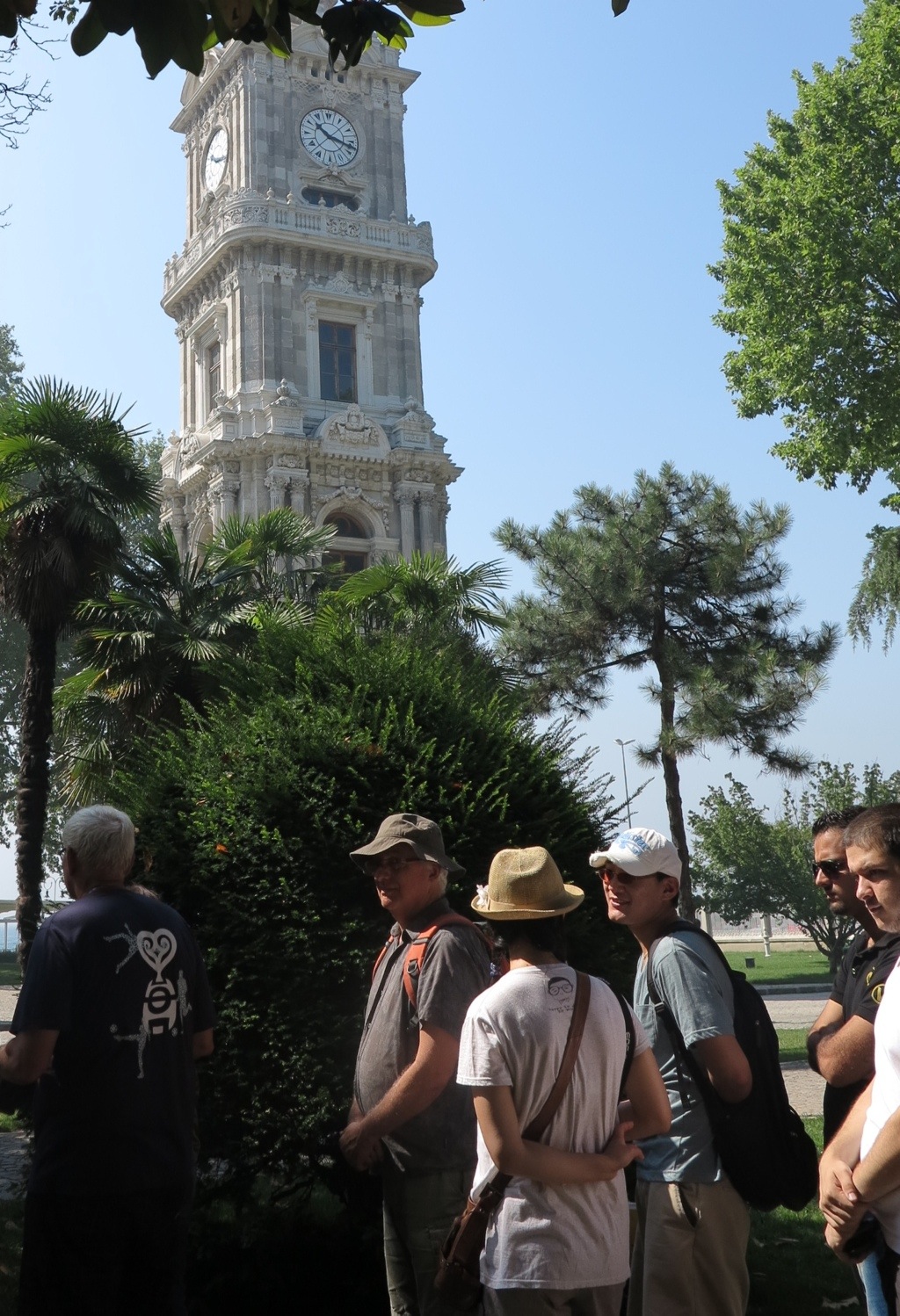
We arrived at 10 past 10 in the morning. Queue No 1, for the security check, was a non-event. Queue No 2, to buy tickets, was less than half the length of Sunday’s. But it moved just as slowly. Here I am soon after joining it.

20120711-223707.jpg

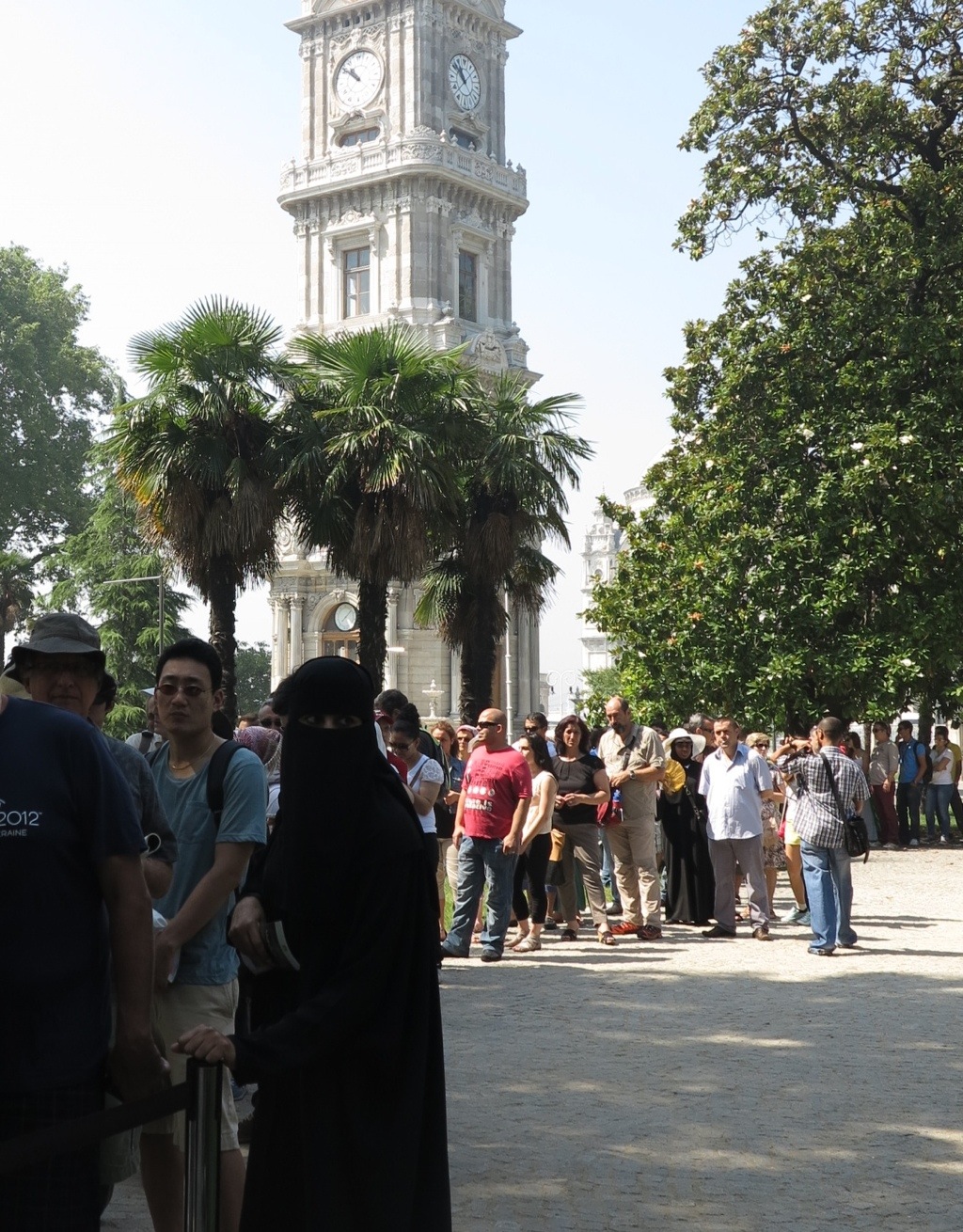
And here I am half an hour after that, with only ten minutes or so to go, just entering the roped section:

20120711-224242.jpg

Note the woman swathed in black with a hand resting on the bollardy thing. If you are ever in a queue and she turns up beside you, challenge her. If she says demurely, ‘My husband,’ pointing with her eyes toward the front of the queue, DO NOT accept the implication that her husband is up ahead between the ropes. DO NOT LET HER PASS. Her husband has sent her in to save them both the 50 minute wait. I suppose I should add that if you do courteously allow her past, and advise the people immediately ahead of you do do so as well, when you realise that despite her appearance of a pious Muslim woman she is actually a lying scumbag of a queue jumper, you probably shouldn’t shout after her, ‘Madam, you are a liar. You lied to me!’ even if you’ve observed on Tripadvisor that Saudi tourists call hotel staff they don’t like liars quite a lot, so you know the term has currency. Your companion is likely to find this behaviour embarrassing. But of course, you’d have no way of knowing if it was the same woman. I could recognise her by her large brown bag, and noted with grim satisfaction that her male companion was one of the many men accompanying women sweltering in black to the eyeballs who found the weather far too hot for long trousers.

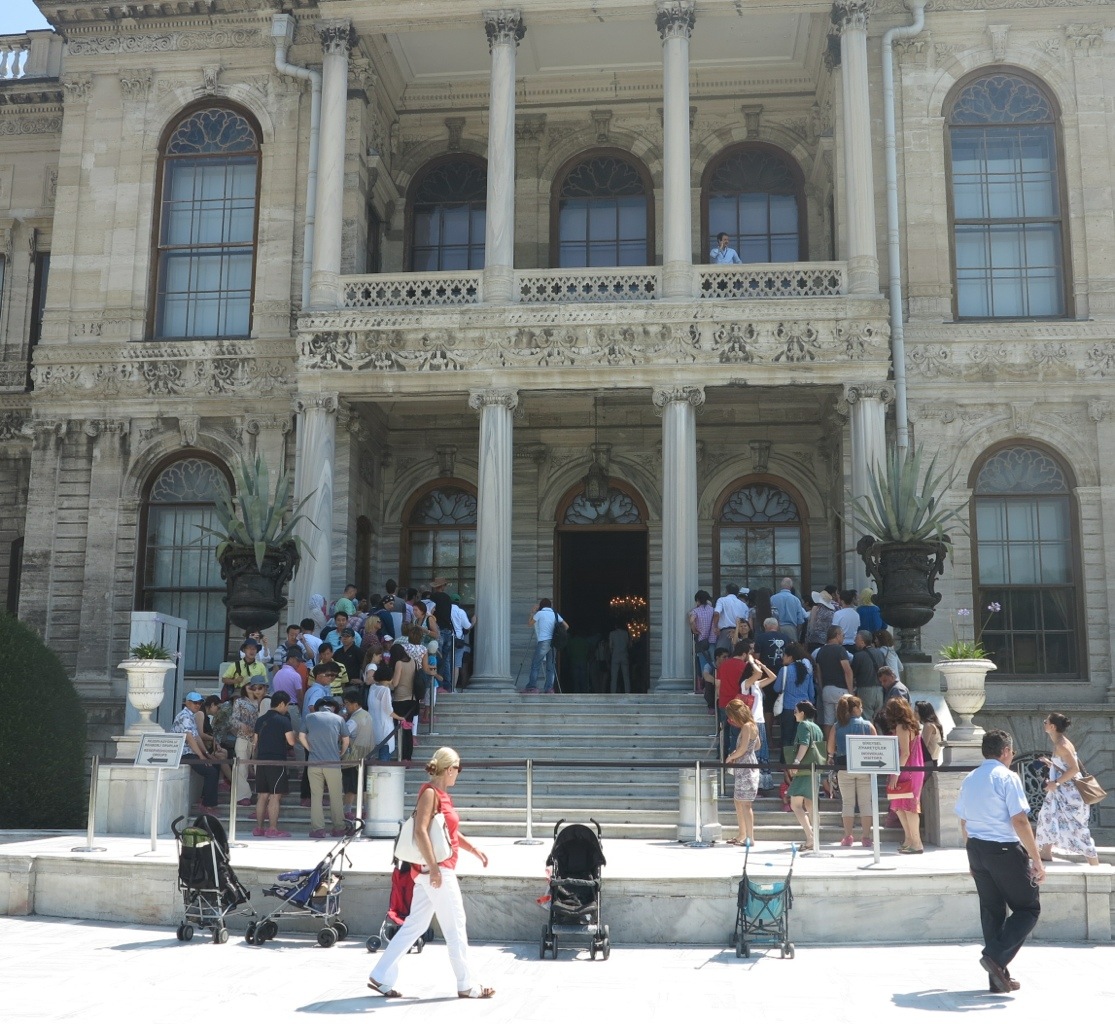
Queue No 3 turned out to be a pack:

20120711-230300.jpg

On the left, the sign said, were tour groups, on the right individual visitors. Another sign that was invisible until we reached the top of the stairs said that no individual visits were allowed: we weren’t queuing at all, we were waiting for the English-language tour at 11.35.

The tour turned out to be pretty much a moving queue, Queue No 4, as a hundred or so of us, many of whom spoke very little English, followed the guide, whose English was largely incomprehensible anyhow, through vast room after vast room, each furnished with great opulence.

Queues No 5 and 6, for the harem, were a repeat of Nos 3 and 4, though shorter and more comprehensible respectively.

Perhaps you’ll forgive me for going on so much about the queues if I quote a chap we’d met somewhere along the line: ‘After all that it was all the same, room after room of kitsch!’ I thought he put it well.

The man marshalling the harem queue ushered the Art Student and me to seats off to one side, probably out of consideration for our grey hair (have I mentioned that we’ve met with the most extraordinary generosity and kindness on this trip?), and said that audio guides were being developed and some year soon all this queuing and herding would come to an end. Compared to places like Iran, he said, Turkey is doing brilliantly, but it is still modernising, not there yet.

There was a weird pleasure in seeing how the other 0.1 percent lived, and it was eerie to peer into the queen mother’s room where Ataturk died, but really, I’d rather have the three hours of my life back and the 80 euro it cost for two of us. Your mileage may vary. If you do go, I strongly recommend you do it with a tour group.

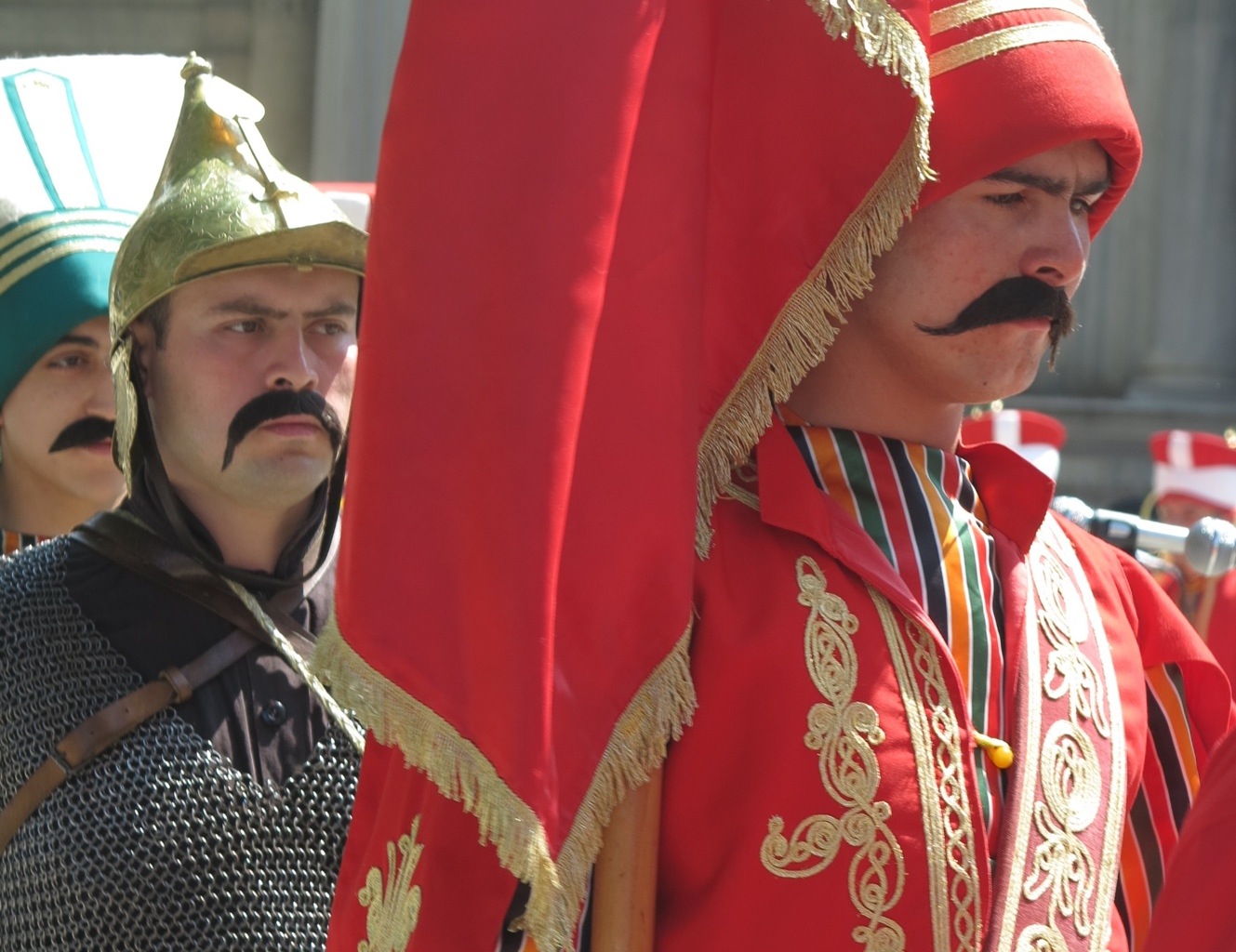
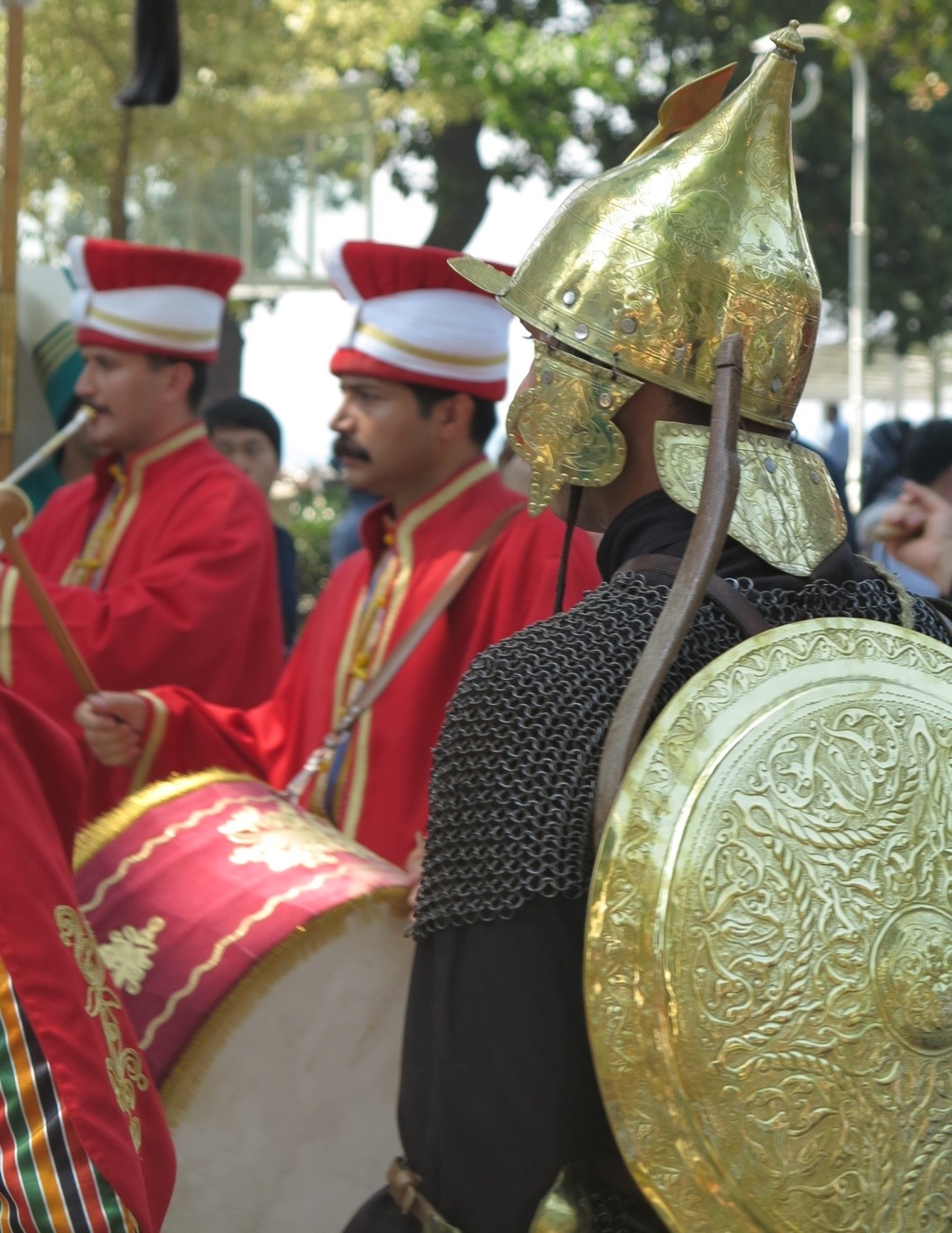
Oh, the best thing about the visit, apart from the drama with the lady in black, was a performance by a military band in full Ottoman drag and fierce Jannisery glares, which we could have seen for free.

20120711-232009.jpg

20120711-232118.jpg

Scar! The Movie

I’ve been sitting on this for weeks, but I can blog about it at last.

My son Alex and I have been working together on a short film project. I wrote the script, and after what we thought was a gruelling process of rewriting, to the extent that Alex is definitely co-writer, we submitted it for Metro Screen funding, and it was the successful contender. The script has gone through a number of drafts since then, a fascinating process that makes what we thought was gruelling look mild. And now, while I’m away in Turkey, Alex has been finding locations, casting (the actors look fabulously right), and – as of today – setting about raising extra funding through Pozible.

I can’t figure out how to make the Pozible widget in WordPress, so here’s the link: http://www.pozible.com/index.php/archive/index/7478/description/0/0. Have a look. Its a very exciting project.]

If you give a thousand dollars you get credit as Executive Producer, $5 will get you an onscreen thank you, and somewhere in between there are free DVDs on offer. No pressure, dear readers, but feel free to make a donation.

My trip to Turkey 11: Istanbul day 5

We debated back and forth whether to go on a cruise up the Bosphorus. There’s something offputting about the Offers on every street corner down at Eminömü, towards the Galata Bridge and the piers. Just 30 euro each for a six hour cruise, they say, and I don’t know which I’d miss, more the euro or the hours. We decided instead to spend 1.75 Turkish lira on a ferry ride to the Princes’ Islands/Adalar, a small archipelago in the Marmara Sea where members of various royal families who were out of favour over the millennia have lived and died in exile.

It was a bit more than an hour, across the mouth of the Bosphorus and then out into the Marmara. There are four inhabited islands, of which we went ashore on the second biggest, Heliabatsu. Fabulous views of Istambul’s minaret-ful skyline, of the Asian side, the still,sea and the cloudless sky, and once were ashore, we walked through picturesque narrow streets where the only motor vehicle allowed seemed to be the fire engine – tourists of every stripe rode past us on bikes and horsedrawn carriages. With the help of a complimentary map from one of the many kebab shops, we went in search of the synagogue and a famous old church. We had no success, but we did pass by a number of spectacular wooden houses:

house

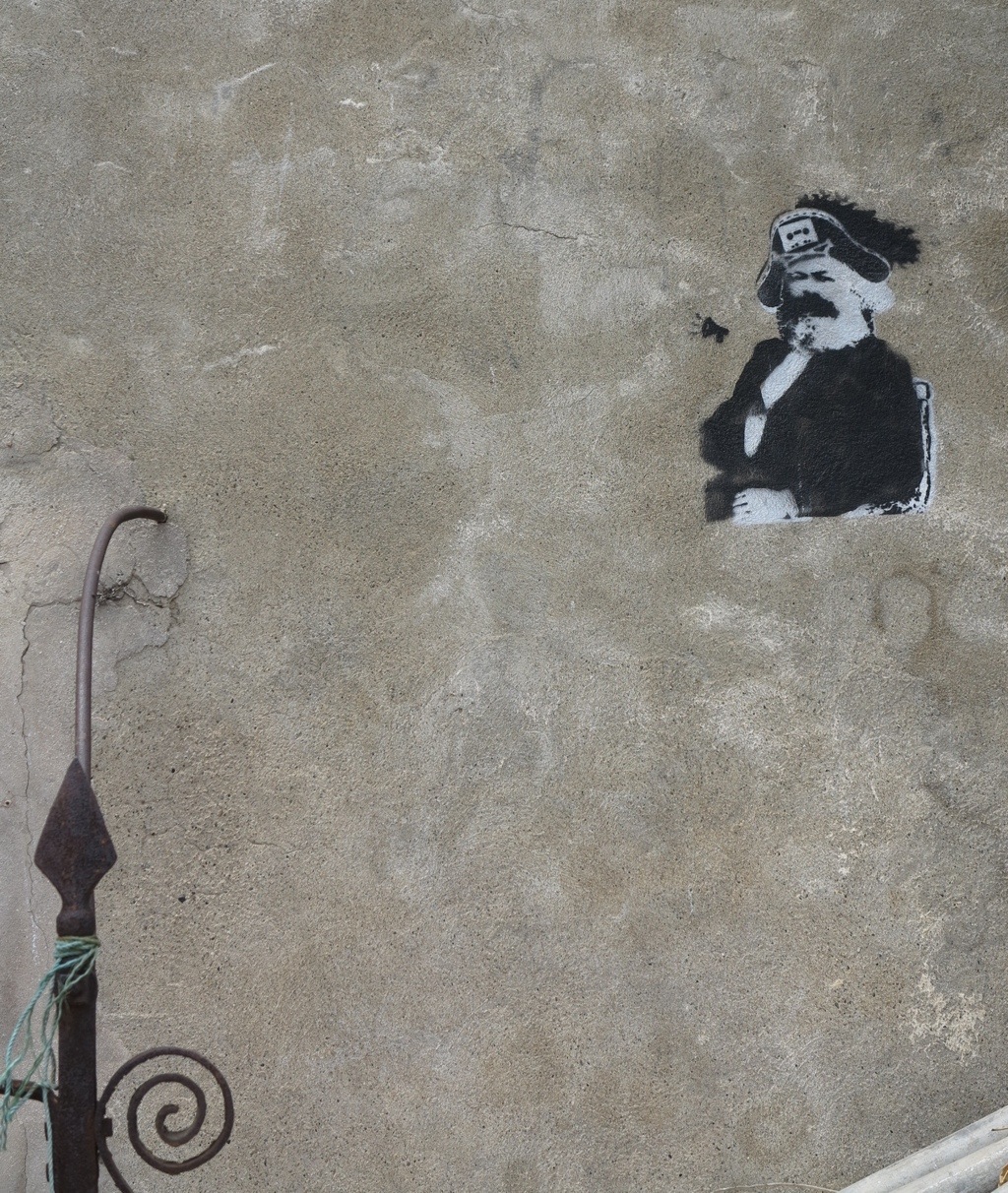
We saw Karl Marx as pirate on a wall:

Marx pirate

And there was quite a bit of stuff on sale. These floral crowns are everywhere, and that sign is pronounced tatch, not tack.

taç

Heliabatsu was home to two famous poets, who are commemorated by special benches along the waterfront:
front-of-chair

backofchair

And then there was this:

cat

Maybe this is the place for a paragraph about cats and dogs in Turkey. They are part of every streetscape, and don’t seem to belong to any particular human or household. Many of the dogs have plastic tags in their ears to indicate that they are participants in the canine population control program, and some have collars, but I’ve only seen one on a leash. Most of the cats seem to be well looked after. I’ve seen one of them on a leash too, tied up outside a baklava shop. I’ve seen three young men watching a fourth playing with a tabby with a foot. Tourists ooh and aah over them. One evening when we were eating dinner on a terrace we watched a man on a roof below us pursue a wild kitten, grab it, and place it on a high spot next to a bowl of food, then stalk its mother with similar intent. It’s one of the many unadvertised attractions of this country that it’s full of purposeful dogs and independent cats, living more or less harmoniously with humans.

We caught the fast ferry back to town – 6 Turkish lira each.

My trip to Turkey 10: Istanbul day 4

The thing is, once you start uploading photos, you realise you can save yourself thousands of words. Especially when the Art Student / Photographer is keen to have her work seen. So here goes, with Day 4’s dot points:

  • Breakfast at our new hotel was a bit of a people-watching moment. It may be that breakfast is in two sittings – an early one for guests whose womenfolk veil their faces in public, and a later one for the rest. We arrived at the very start of our allotted time to find meals well under way at two tables. The niqab must come off for breakfasting purposes, and one young woman in a hijab had a huge floppy hat on over it – in the street this would have looked like a slightly awkward way of shading one’s face, but indoors at breakfast it seemed to be more of an identity statement: I wear the hijab but it doesn’t define me.
  • We caught the tram. Each tram is three linked vehicles the size of a Melbourne tram, they come every five minutes or so and are always crowded. A phenomenal number of people are moved around this way. As we moved out of the old city, the demographic changed dramatically – the niqabs that are everywhere in Sultanahbad (the area around the Blue Mosque, Hagia Sophia and Topkapi) almost completely disappeared.
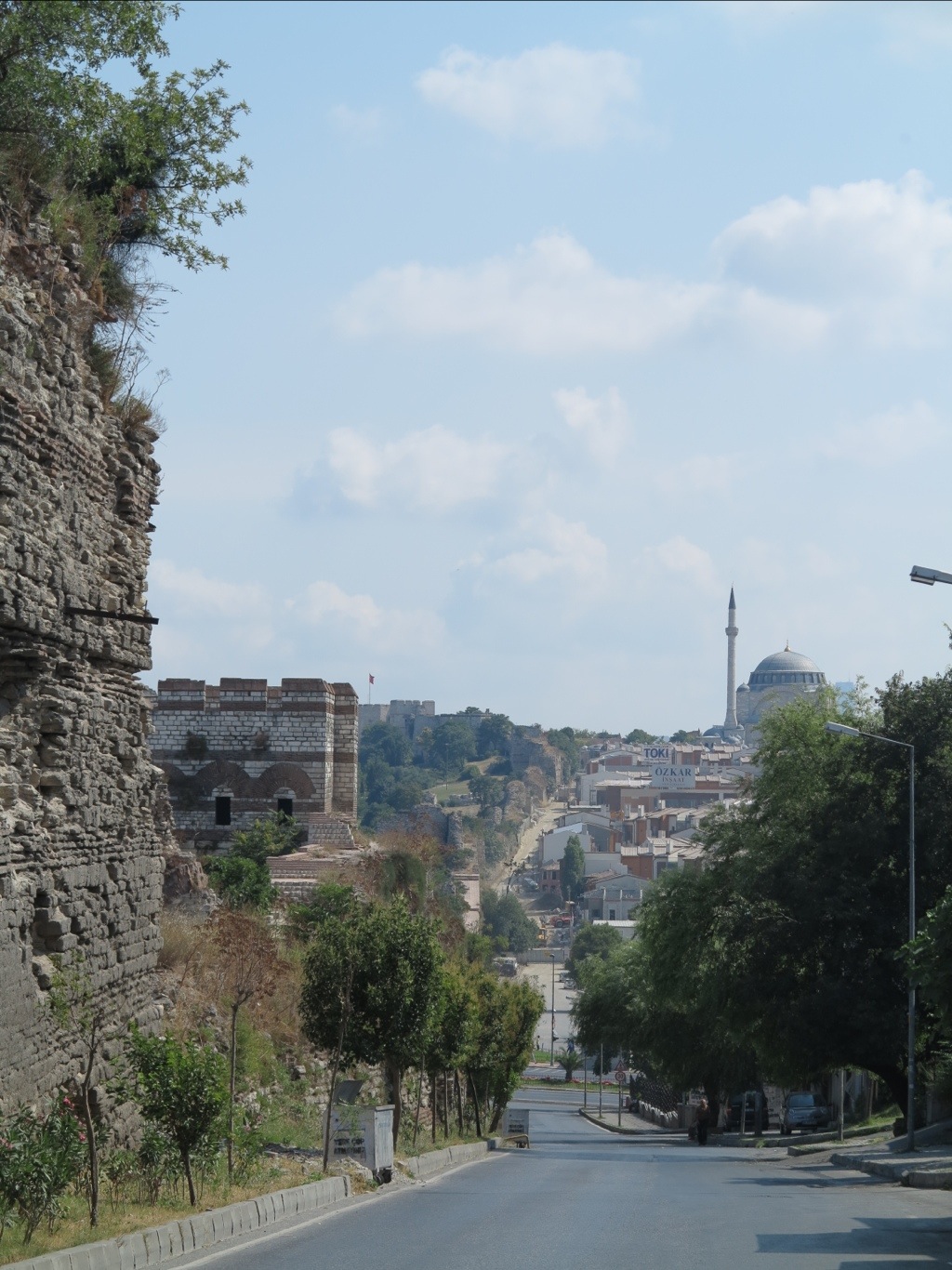
  • We walked the better part of a kilometre along along the Theodosian Walls, originally built at the command of Emperor Theodosius II in the fifth century CE, finally breached by Sultan Mehmet II, Fatih, in 1453, and a now standing reminder of that great triumph.
    the Theodosian walls
  • After bickering over the map and receiving helpful advice from a complete stranger who called out to us from 20 yards away, we reached the Church of St Saviour in Chora, aka the Kariye Camii. From the outside it could be any beautiful old Byzantine church of modest proportions that had been converted into a mosque:
    20120709-175845.jpg
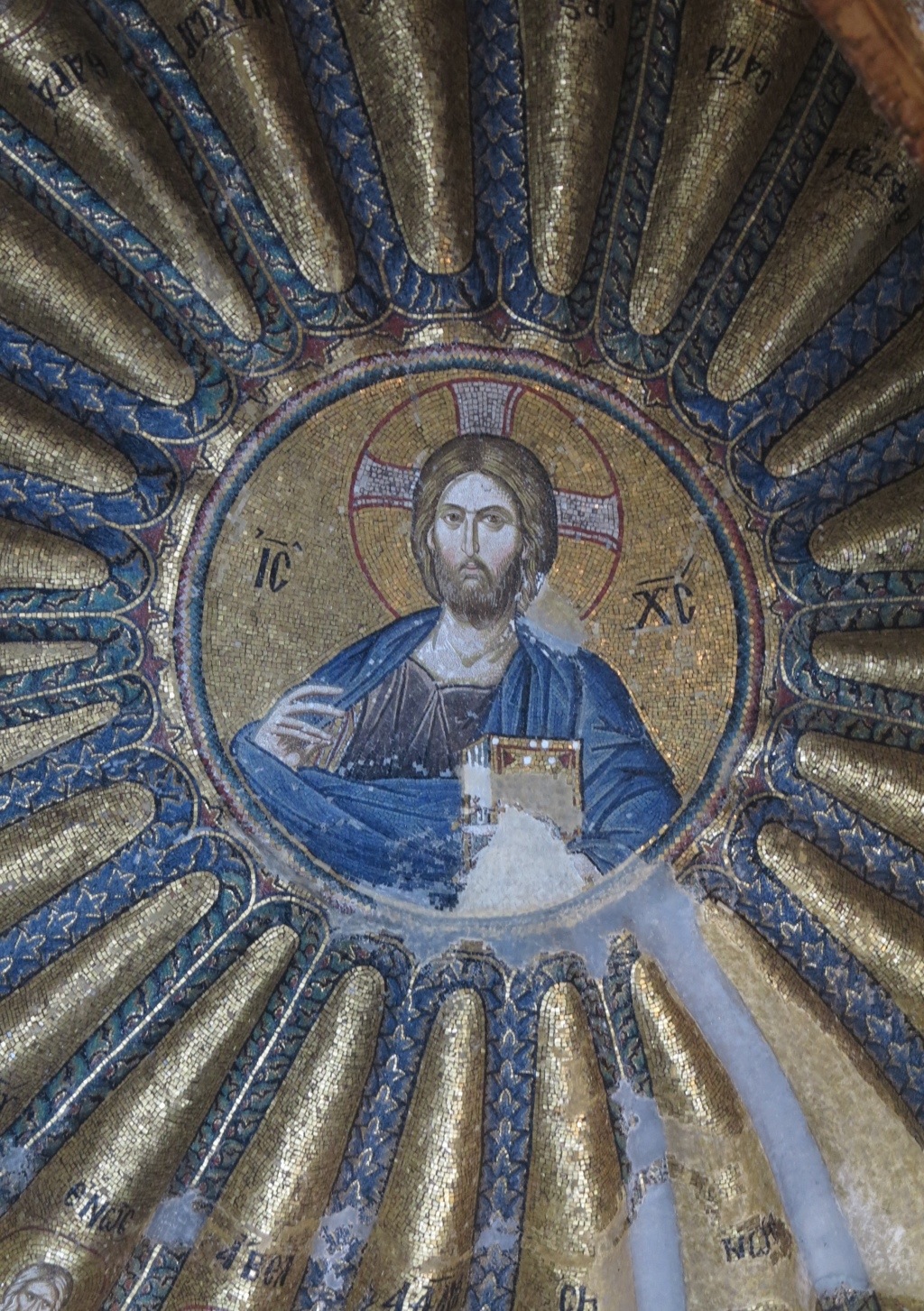
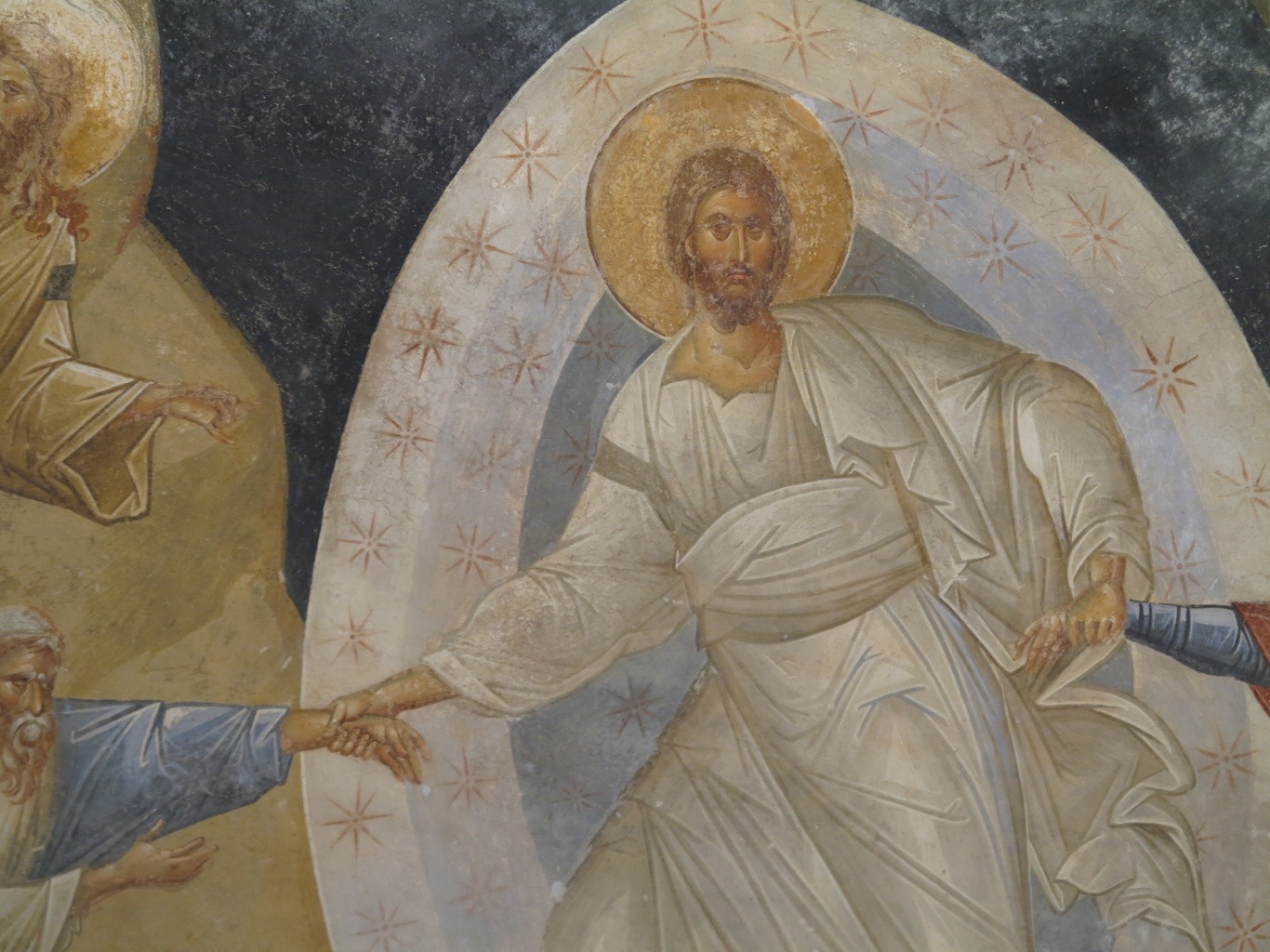
    We bought orange juices at the inevitable café cum souvenir shop, paying seven times as much as we had in Karaköy a couple of days before. Then we went inside to be blown away by what John Freely says are ‘the most important series of Byzantine paintings in the world’. I don’t know anything about important, but these frescoes and mosaics, executed in the 14th century, were covered by plaster rather than scratched out in Islamic times, and the ones that survived earthquakes and other disasters are, well, look:20120709-175631.jpg

    20120709-175659.jpg

    20120709-175750.jpg

    20120709-175816.jpg

    Just look at the tension in Christ’s body as he drags whoever that is out of the tomb.

  • Another long walk, a ferry that turned out to be non-existent, a cheerful scene of families picnicking (it was Sunday) beside the Golden Horn, evidently oblivious if the garbage littering their waterside park, a taksi ride (see how I’m picking up some Turkish vocab?) back to more familiar territory.
  • We tried for a second cultural outing, to the Dolmabahçe Sarayi, but we hadn’t reckoned on the Sunday crowds. The queue was possibly the biggest and slowest-moving I’ve ever seen. Rather than wait in line for at least two hours we caught the tram back to the air conditioning.

That was yesterday. I’ll post about today tomorrow.

My trip to Turkey 9: Istanbul again, days 1 to 3

Here we are back in wonderful Istanbul. No more long bus rides for a while, so I need a different strategy for maintaining what Richard called the travel–blogging balance. I’m giving dot points a go, with photos courtesy of the Art Student (unless otherwise stated).

Day 1:

  • The final, final farewell to our Intrepid group in the late morning soon after we arrived from the airport.
  • A walk in the old city, and a visit to the Basilica Cistern.
    20120708-181942.jpg

    You might think we’d have tired of wonders by now, but this had me in awe – though not so much that I couldn’t enjoy the misjudged name of the little cafe: even in that context, ‘The Cistern Cafe’ is too toiletish for comfort.

  • A quick look in the New Mosque, built in the 17th century, so not so new really. I know, I mustn’t go on and an about mosques, and the Art Student is now reluctant to go into any that are still places of worship because she’s uneasy about gawking where people are praying. But this one, built at the behest of a valide Sultan (the mother of a sultan’s premier wife), or rather a series of them, is sublime.

Day 2:

  • At breakfast, a squizz at the next Intrepid group, and oh they were a lacklustre crew (and yes, I do expect you to attribute that judgement to esprit de touriste corps
  • The purchase of Akbils (electronic public transport tickets) and a ferry trip to the Asian side of Istanbul, to the suburb of Kadiköy, site of ancient Chalcedon, where we enjoyed the view and travelled back from with a huge crowd of commuters (this was a happy mistake – we’d meant to go to Karaköy, a different place altogether).

We visited the Istanbul Modern. We thought we had visited it a fortnight earlier, but the real thing is on the other side of a busy street, and we’d missed its main entrance, which is through a car park. We spent a happy couple of hours there. The things that struck me most (no photographs allowed, but I’ve given links if I could find them) were:

  • Olafur Eliasson’s ‘Red Emotional Globe’, which casts complex shadows suggestive of mosque decorations
  • three projections of writhing trees by Jennifer Steinkamp that were first shown in the Basilica Cistern (what a brilliant space to show art in!)
  • ‘1+1=1’, a video piece by Kutluğ* Ataman in which a Cypriot woman, who is Turkish but living on the Greek part of the island, tells two stories in counterpoint from abutting screens, one of escaping Turkish nationalists and the other of escaping a massacre by the Greeks (it would have been wonderful not to depend on subtitles, but there you go!)
  • ‘Fifty Years of Urban Walls’, a huge exhibition of work by Burhan Doğançay, hundreds of paintings and collages, most simulating walls covered with graffiti, posters, notices, peeling paper, etc, some referring to Arabic calligraphy, some with extraordinary trompe l’oeil, some with passionate political intent, some bestowing a kind of immortality and gravitas on transient wall writings.

Elsewhere we:

  • spotted some transient, Newtown-worthy street art

    20120708-182629.jpg


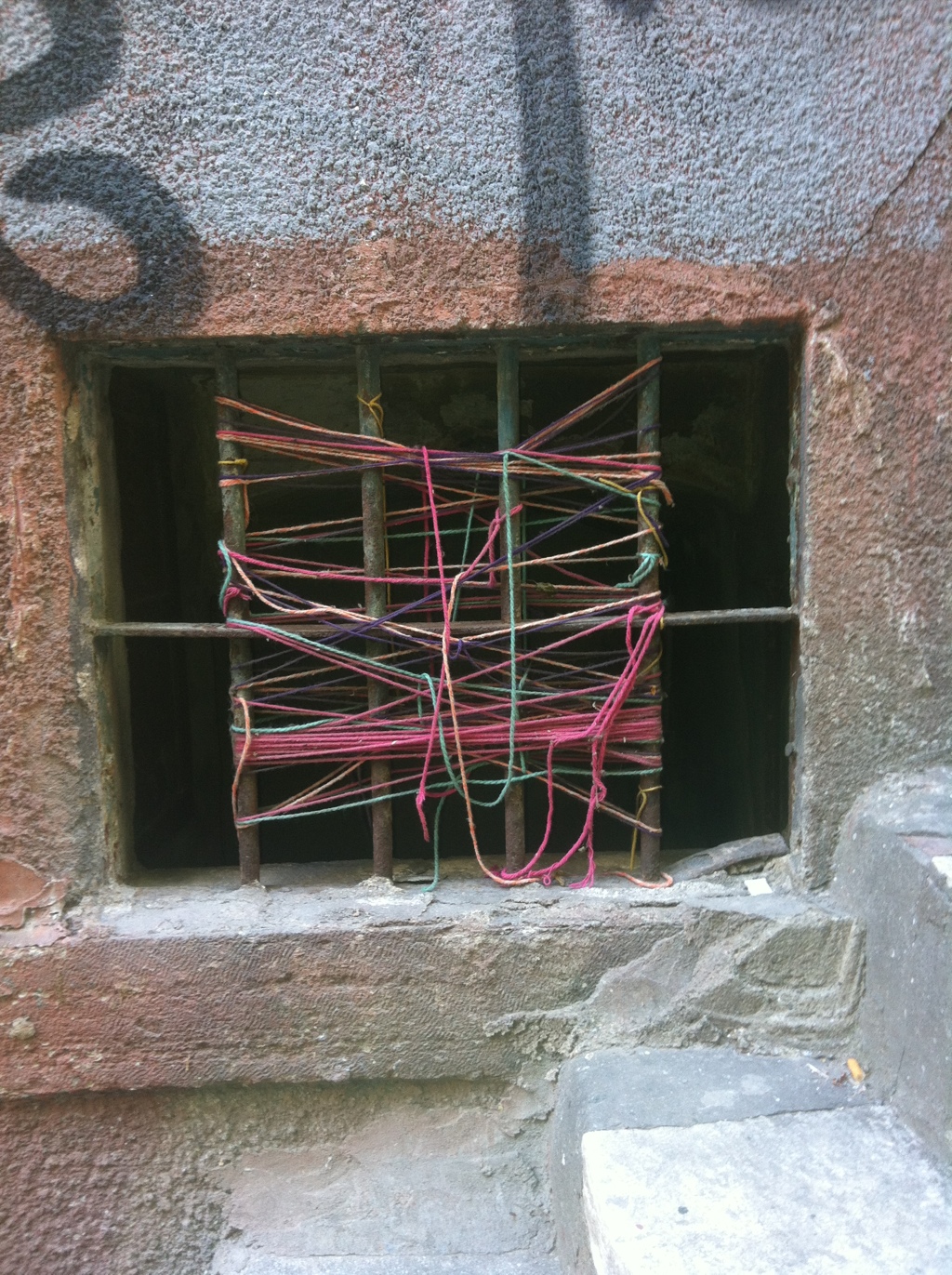
    and some guerrilla weaving (photo by me on my phone):

    20120707-172042.jpg
  • saw an exhibition of work by Sophia Pompéry, including a huge video of an iridescent, reflecting soap bubble being blown, and a fascinating piece where we see a brush dipping in a rectangular puddle of water on a table, creating the illusion that it is painting the images that are actually reflections – I’m not doing too bad, am I, for someone who just hangs around with an Art Student?
  • caught a taxi to our new hotel, discovered that our booking started the next night, but were kindly found a room at a nearby inn (the Lamp, and very nice it was)
  • paid far too much for a pleasant dinner then accidentally tipped the excellent musicians 20 Turkish lira
  • wandered about in Sultanahbad, near the Hippodrome, where a huge crowd was taking the night air – like Macquarie Street on opening night of the Sydney Festival, only not drunk or frenetic
  • had a brief glimpse of a dervish ‘performance’ and were once again grateful to Intrepid Travel for organising our attendance at a real sema ceremony in Bursa, complete with Very Long Incomprehensible Sermon

Day 3

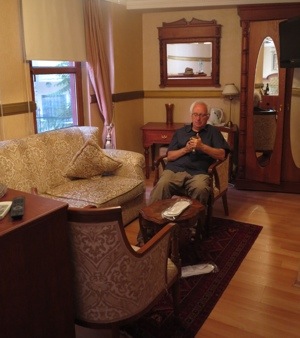
  • We lumped our bags back down the hill to the Aruna Hotel, our home till next Friday, where we’re paying more than we would if we’d known to book across the Golden Horn, but where our room is huge, with two handmade carpets and a spa bath.

    20120708-183311.jpg
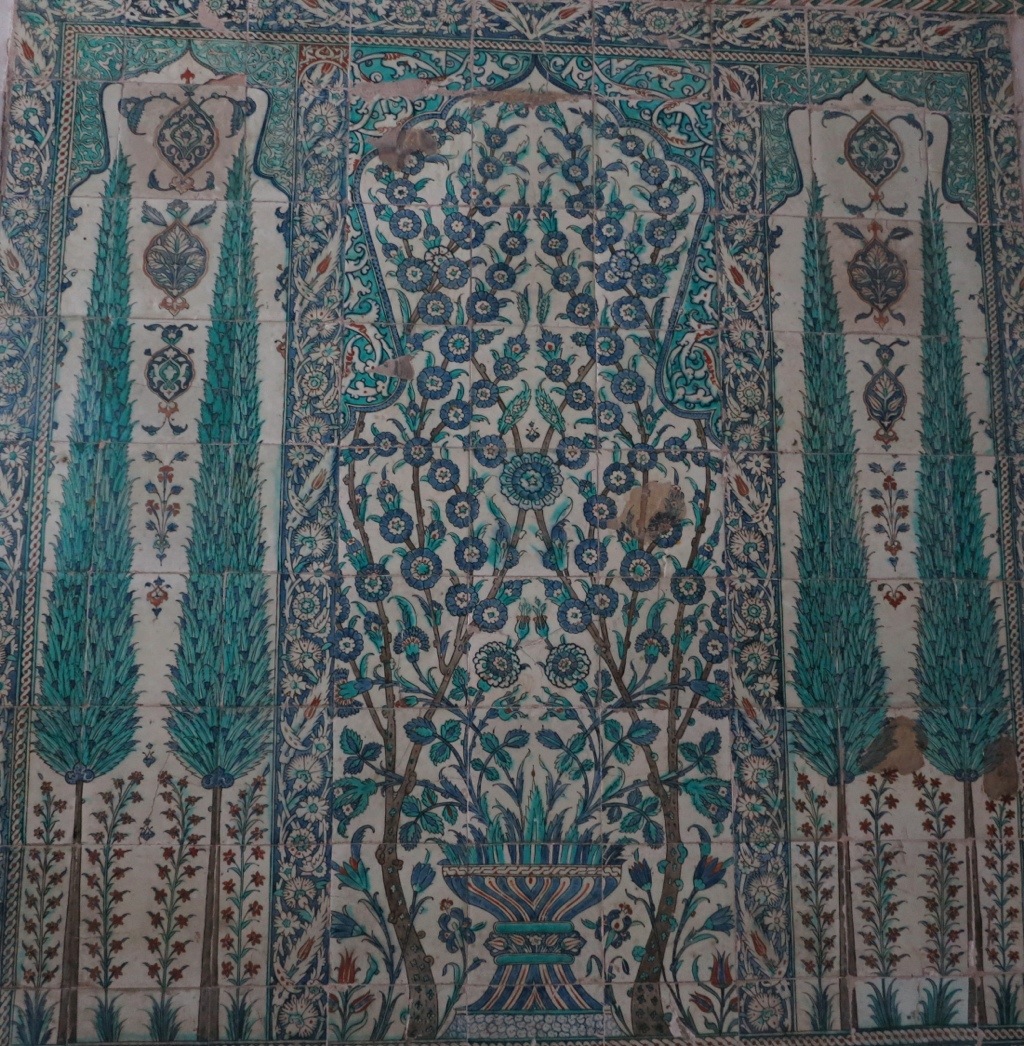
  • We bought a Museum Pass and visited Topkapi Museum, including the Seraglio – such tiling, such opulence, such craftsmanship. Here are some piccies. I cant show you the emeralds as big as eggs or the amazing diamond, because photographs weren’t allowed and the Art Student chose not to go into that section because the back story of oppression and male domination was getting to be a bit much for her. Still someone made these things:
    20120708-185854.jpg

    20120708-185928.jpg

    20120708-190000.jpg

    20120708-190025.jpg

    The last one is from a Sultan’s chamber. It makes our flash hotel room look quite pauperish.

  • We visited the Archaeological Museum: antiquities, antiquities, antiquities, including many beautiful things, such as this huge bust of Sappho, who would have fitted right in as a 1920s flapper, I thought:

    20120708-184934.jpg
  • We went to part of the Istanbul Jazz Festival where we enjoyed a US based combo as part of a huge crowd at the Galata Tower and a young Turkish group, with a much smaller crowd, then wandered home through dark and almost deserted streets, watched weird British television and went to bed after the nearby wedding went quiet.

* See how I managed to get the little diacritical crescent on the g without having to get Apple to provide it? I wish I could say it was by HTML skillful ness, but actually it happened accidentally when I copied and pasted Kutluğ Ataman’s name.

My trip to Turkey 8: Goreme, Cappadocia

Circumstances have conspired against my routine of blogging about one destination on the bus ride to the next. The scheduled bus trip from Goreme to Istanbul was a 12 hour ordeal, not in the original plan but made necessary because the Istanbul railway station burned down and the powers that be decided to replace it with a hotel. The Art Student and I, and two others of our little band, chose to spend a little extra and fly. So no overnight haul for this blogger, no blogging on the road! But here I am, a little late, still on the iPad, but this time in the spaces where the Art Student lingers longer than I do in Istanbul’s many galleries.

Taking up where I left off: a caravanserai is not, as you may think, a collection of ornate, tent-like structures. The one we stopped at, at least, is a fortress-like affair, with high solid walls, room for scores of camels inside its walls, a space for a substantial market, a mescit (a word used these days for the prayer room at an airport, but then for something much grander that served the same purpose). Two huge dogs lay about in the cool, dark rooms, but in response to our touristic invasion moved to the main entrance, where they took up the stance of lion guardians, languishing in the heat.

A little longer in the bus, passing gently undulating summer-golden grassland, and then almost without warning we were in Cappadocia.
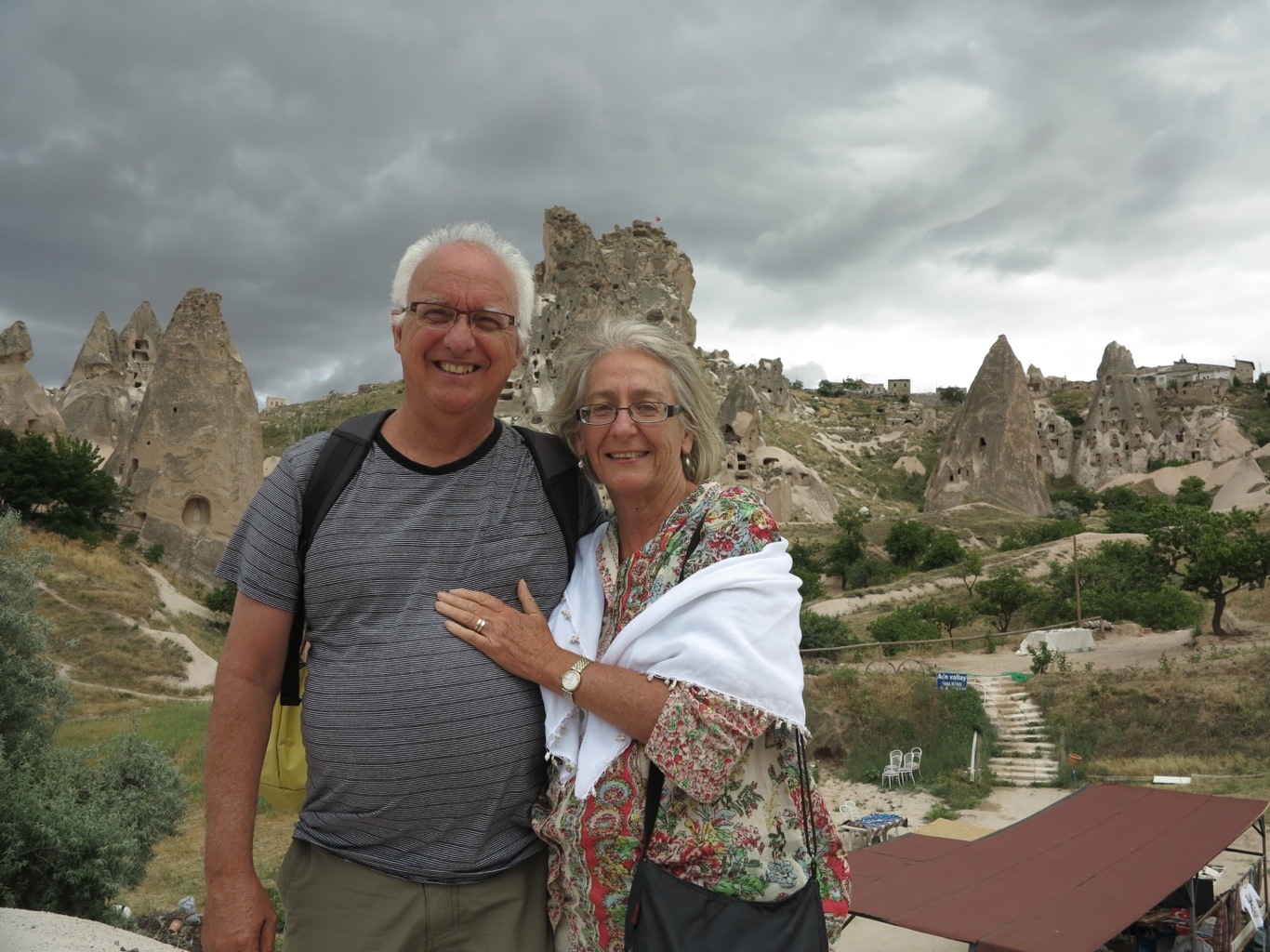
panorama

This has to be one of the weirdest places on earth, not just because of the rock formations – resulting, we were told, from three volcanoes filling the space they enclosed with different kinds of lava, so that as the softer rock was eroded, strange, layered cones of harder rock were exposed, to erode in their turn creating what the tourist trade calls ‘fairy chimneys’ and geologists call ‘hoodoos’ – but because of the way the human, built environment and the natural environment accommodate each other.

Sufi rock

We went for a long walk – the Rose Trail – among rocks that have doors and windows carved into them, and everywhere niches that may have held lamps or candles (our guide said not, and there was no sign of blackening, so if it happened it was long enough ago for all traces to have washed away, but what else could they have been for?). In the town of Goreme, where we stayed three nights, there are similar pre-ancient niches, and also some broken Greek pillars, some Ottoman script, and many hotels and restaurants wholly or partly carved out of the rock.

house

Near Goreme is the Open Air Museum, whose rocks contain Christian churches with wonderfully preserved frescoes from the tenth century CE, especially the ‘Dark Church’ which was discovered comparatively recently and so escaped the depredations of devout Muslim visitors who scratched out the faces in many of the other caves.
frescoes

It’s a mesmerising case of the natural environment and the built environment blending, and maintaining the blend over millennia of cultural and technological change.

As well as walking and gawking, which is what this place demands, all 13 of us had dinner in the home of a beaming woman in Turkish headscarf, named Fatma. The home had a blessing in Ottoman script over the main door, and its rooms reached back into the rock. The dinner was delicious home-cooked food, which I realised I had been craving. When Fatma produced a display board of jewellery she had crocheted, she didn’t have to do any hard selling to have a number of the women enjoying themselves thoroughly trying things on and buying.

In Cappadocia we also visited Derinkuyu, an underground city where early Christians and others before them hid from persecution and attack. We dined on our last evening, just the four of us who had taken the plane option, at the Top Deck Cave Restaurant, which is Trip Adviser’s top rated restaurant in Goreme. We could see why.

I didn’t go on a hot air balloon trip, partly because of the expense, partly because I was feeling a bit off and couldn’t face a 4 am rising, and partly, if truth be told because of Les Murray’s mean, class-envy poem about a hot air balloon accident (I don’t remember its name, and I’m embarrassed to be influenced by it). Those of our group who did go said it was marvellous and had spectacular video to show.

We said our final goodbyes in Goreme as the rest of them set off for the bus, then we saw most of them again when we arrived in Istanbul next morning, four hours after them, and said our final, final goodbyes. It was a lovely, exuberant group. Unlike other Intrepid groups I’ve travelled with, more than half were under 30. Of the over 30s, one was a Unitarian minister, who had a similar fascination with Christian theology to mine, though she was more learned than I am. And three of us – the Art Student and I and one other – were friends. One of the young adults was a blogger, though I think we both felt it would be weird to read each other’s blogs during the trip (his is at shootingtravellers.wordpress.com, and I plan to follow it now). It was a great mix. The Art Student and I had a great time, and now we’re on our own for another ten days or so.

(Three of the photos in this post were taken by the Art Student. The fourth was taken by a friend on the Art Student’s fabulous new camera.)

Death’s Directives to Bruce Beaver

Bruce Beaver, Death’s Directives (Prism Books 1978)

I love Bruce Beaver’s poetry, though I usually feel that I don’t really get it, and I hadn’t read this book, so I was delighted to find it on Sappho’s second-hand poetry shelves when I went in search of slim volumes to pack for Turkey. I read most of it on our overnight cruise from Kas, feeling just a bit self conscious about reading poetry, let alone poetry with such a grim title, in those hedonistic circumstances. But I’ve done odder things (embarrassingly, this morning I caught myself noting the typos in a menu in Turkish, a language I don’t know at all), and my life doesn’t seem to be any worse for it.

There are 20 poems in the book, ranging from 40 lines to about four time that long. In all of them the poet has some kind of dialogue with death. Death may be a personification of his sense of his own mortality, or of mortality in general, or something less easily defined, like an acceptance of things as they are. There is painful introspection, exploration of the poet’s less than admirable past, reflections on his experiences with sex and religion, meditations on art and ethics, one splendid love poem, three elegies of sorts (for Mao Zse Dong and the poets Neftali Reyes and Anne Sexton). As I’d expected, I was carried along and sometimes carried away by the way he imbues conversational language with a particular, personal music, and am aware that my enjoyment would be greater if I was better read. I’ve never heard of Neftali Reyes, and have read about two poems by Anne Sexton. I got a lot of pleasure from some references like the echo of Yeats’s ‘This is no country for old men. /The young in one another’s arms’ etc in the first poem’s

In another month it will be on
again, the girls will stop hugging their cold
tits, and the boys denim flies
will be bulging, the little kids
here and everywhere else
on the continent will be rolling
around in clover grass and on
the warming asphalt. Dogs, cats
and birds will go madder than usual
about their courting. Everything
and everyone will come alive

and I know there was much more to be had.

The youngest woman in our group asked on the boat to read some of the book. I recommended X and XI, about his mother and the love of his life respectively. She read them slowly, thoughtfully, exclaimed over the way her education had put her off poetry by wringing every drop of meaning out of it, read a phrase or two out loud. I don’t know if her life was any richer for her encounter with Bruce, but mine was. By my own encounter too. I’ll quote you two bits from XI. First a chatty abstraction:

And the best times together come back at moments
that catch me up in the embrace of a rare
music that at the time of making we must have
overlooked and failed to overhear
because of the noise of our hearts and our spontaneous cries.

And then the end of the poem, that gives an example of what he may have meant:

There was a tree, there was a road,
there was a woman with me. And for once
there was forever in an instant
so that I picked a fallen leaf from out
the scruffy grass, a skeletal leaf
and she said, how beautiful,
and made even death appear to smile.

My trip to Turkey 7: Konya

The Kas–Konya leg of our travels was an 11 hour haul. Three and a half hours in a dolmus took us to the Antalya bus station, a vast space where it cost half a Turkish lira for a bottle of water and a whole Turkish lira for a piss. We ate, and attended to other bodily needs. The Art Student, who was under the weather, ate carefully. Then we hopped on a proper bus for close to six hours, stopping a couple of times, one of them at a town famous for its roasted chickpeas. These are said to be good for an upset stomach, so I bought a small packet. The Art Student turned up her nose at them, and when I had a nibble I turned mine up too. Once we reached Konya – the first Selçuk Turk capital and the home of Celalleddin Rumi Mevlana (in Turkey Mevlana, in the West Rumi) – it was just a quick 20 minute ride in another dolmus and we were being greeted with glasses of Turkish fizzy drink at the Mevlana Hotel. (I’m typing this on the next leg of the journey: about 20 minutes on our way, one of us realised she had left her purse back at the hotel; we turned back, but for some reason couldn’t get through; in response to a phone call a man from the hotel brought the purse to us on his bicycle. This isn’t just good service, it’s a whole ethos of hospitality.)

On our first evening, we squeezed in a visit to a felt shop before dinner. Despite my impatient stomach, I was fascinated as the Argentinian owner of the shop demonstrated her techniques. Her Turkish husband had learned the craft from his grandfather, who had learned from his father, and back for generations. The craft had been close to dying out, but they are staging a revival, partly by introducing modern designs. All the same, the most interesting part of the show was the demonstration of how to make the hats worn by dervishes. Characteristically, there was no pressure to buy, though some of us did buy a hanging or a silk and wool scarf.

The fabulous Burak explained at dinner that there are two sides to Konya, the conservative side where women have to cover their shoulders and knees, and the other side. He called them the Allah side and the yalla side, a witticism he sadly had to explain to his ignorant charges (yalla in Arabic means lets go!). We had the option of exploring the yalla side after dinner, and I believe some did, especially as it was the night of the Euro Cup final – though I wouldn’t want to assert that the Allah side of town is indifferent to football. The Art Student and I took her queasy digestive system back to the hotel where we watched some Turkish TV, and an episode or two of things from home on the iPad, including Clarke and Daweon possible solutions to Australia’s asylum seekers stalemate.

Next morning, we visited the Mevlana Museum, which as far as I understand it is the original building where Rumi established the Mevlevi dervish sect. Maybe twenty tiny rooms, perhaps once cells if the Sufis, held objects connected to the sect’s history, but the main attraction was the building itself, which contains the tomb of Rumi and a number of other leaders of the sect. We had visited a Sufi museum in Istanbul and attended a whirling ceremony in Bursa, so we had some background. The tomb is gorgeous, but the room where they whirled is sublime, with a high decorated dome that could bear being looked at for hours. Most impressive of all, though, was the crowd: school holidays are just beginning, and we were there just as the museum opened, but the press of respectfully attentive people – old and young, traditionally dressed and scarved just for the occasion, an all-women coachload, a group of teenage boys and family groups, Turks, Arabs and us – was wondrous, all the more so when the bulk of the objects on display and most of the wall decorations consisted of calligraphy in Arabic, which I’m guessing most of the people there don’t read easily. Among the tiny and enormous illuminated Qurans in the final room, there were a number of poetry books from the seventeenth century, with delicate representational illustrations.

Then we just had time for lunch and we were on our way again. As I type this we are about to stop at a caravanserai – evidently there used to be one every 40 kilometers, because that’s how far a camel can travel in a day. I’ll post again after our adventures in Kapadokya, the land of well-bred horses and fairy chimneys.