Jennifer Maiden in the SMH

With some notable exceptions, the Art Student hates poetry. So this conversation that happened as I was cooking breakfast on Saturday morning was a moment to be savoured.

Art Student: There’s a poem by Jennifer Maiden in the Spectrum. [That’s a supplement to the Sydney Morning Herald.]
Me: Really! Read it to me.
Art Student: You know I can’t read poetry.
Me: (wheedlingly) Go on, please …

And she did. She read ‘My heart has an Embassy’. Beautifully. Whether it was the short lines, the brevity of the poem, or the way it makes metaphor out of a situation from the headlines – Julian Assange’s seeking asylum in the Ecuadoran Embassy in London – the poem slipped effortlessly past the poetry-hating guards.

I couldn’t find ‘My heart has an Embassy’ online. Sorry!

[Added later: In a Me Fail? I Fly! exclusive, Jennifer Maiden’s daughter Katharine has posted the poem in a comment!]

Fairy tales can come to U T S

My friend Sarah Gibson has asked me to mention this, and I’m happy to oblige:

20120907-231441.jpg

Fairy Tales Re-imagined: Enchantment, Beastly Tales and Dark Mothers

A symposium to be held on 13 October, at UTS, Sydney, exploring fairy tales and the cultural imagination. Writers, artists and academics speak about their fascination with fairy tales, their motifs, themes and layers of meaning. They discuss how old stories inspire and inhabit new forms.

Of the speakers listed, in my ignorance i only know three: Sarah, who is a bit of a fairy tale polymath, and Kate Forsyth and Margo Lanagan, both billed as novelists, though I passionately hope Margo hasn’t forsaken what some see as her true calling as a writer of short stories.

The symposium has been initiated by media artist Sarah Gibson, whose interactive online project ‘Re-enchantment’ can be found at http://www.abc.net.au/re-enchantment (link opens external site).

It sounds like a fun way to spend a windy October Saturday in Sydney. If you’re interested you can find information and register at http://fass.uts.edu.au/fairy tale-symposium.html, or email Sarah.

The Poetry Train

Australian Poetry Ltd, the recently formed peak industrial body for Australian poets, has declared this to be National Poetry Week. I’ve been too preoccupied with fighting off a virus and feeling sorry for myself to pay much attention, though my impression is that NPW hasn’t been quite as big as the State of Origin week. Some days have had a theme word – one day Read, another Write, and today Buy. I dutifully rose from my tissue-bedecked bed, caught the bus to Gleebooks and bought two slim volumes. But, I hear you protest, surely you could find something more interesting than a trip to a bookshop to get out of the house for? You’re right. There was also the Poets’ Train.

From the CountryLink website:

To celebrate National Poetry Week and the joys of train travel, a group of Canberra poets are catching the train to Sydney to join forces with like-minded bards for an exciting program of social and literary events.

Those events included composing poems during the train journey today for later publication in a chapbook, a dinner and a poetry slam. The thing that caught my attention was a poetry recital on arrival at Central Station this afternoon ‘with media attending’. Gleebooks was just a stop on the way.

The country trains concourse at Sydney’s Central is a lovely space, full of light and air. As I came through the main entrance the first thing I saw was a group of about twenty people, significantly more warmly dressed than called for by the Sydney spring weather, looking like a small choir with a conductor standing in front of them. It was Train Poets, and one of them was reading to the rest. A woman who turned out to be Poets Train Coordinator, Fiona McIlroy, gestured a welcome, and I became, as far as I could tell, the only member of the public to join the audience. There was a young man taking photos – presumably he was the attending media, and if I find any pics on line I’ll add a link to them.

And you know, it was fun. Poems were read that were variously witty, comic, fanciful, and elegant, and most hot from the oven. I chatted to the people closest to me, who said that the train poets had sat working away at their notebooks, taking a break every hour (it’s roughly a four hour trip) to read the work so far. As a result, at the reading I was privileged to attend, they had already established a palpable sense of communal bardship. Contemporary poetry is often criticised as being a matter of poets writing poetry that is read only by other poets. Even if that description were accurate, if it signified the kind of warmth, generosity, mutual appreciation that featured in this event it wouldn’t be an entirely bad thing. No one seemed disappointed at the absence of TV cameras. It was culture without commodification, and I look forward to the chapbook.

I doubt if I’ll get to the slam tomorrow night, as I’m not taking my germs out after dark, but if you’re in Sydney you could do a lot worse than head for The Friend in Hand Hotel, Glebe, at 7 pm.

To cap off my participation in National Poetry Week, there was an email waiting for me when I got home to say that my pre-ordered copy of Bob Dylan’s Tempest, official launch date Tuesday 11 September, was ready to be downloaded. So I’ve been typing this up, home alone on a Friday night, listening to croaky Bob, ‘It’s soon after midnight, and I don’t want no-body but you.’

Happy National Poetry Week!

Added on 1 October: Fiona McIlroy reports on the Poets’ Train at the Australian Poetry website, with photos and the text of one of the poems.

Overland 208

Jeff Sparrow (editor), Overland 208, Spring 2012

There’s a lovely interplay among articles in this issue of Overland: one voice picks up a theme introduced by another and amplifies it or does something unexpected with it, disagreements emerge and remain unresolved, odd harmonies and counterpoints pop up. It’s like ideas music.

Longtime working journalist Jonathan Green predicts the imminent death of the quality newspaper. Responding to the commonplace that newspapers have to develop a new business model in the age of the internet, he writes:

In truth there never has been a business model for quality journalism, only a happy coincidence in papers like the Sydney Morning Herald, the Age and the New York Times in which a successful platform for the publishing of classified advertising coincided with newspaper owners who saw advantage, influence, power – and perhaps even a public duty – in fostering serious, thoughtful journalism.

‘The sad truth for journalists in a commercial construct,’ he argues, ‘is that their department is exclusively a cost. It produces no revenue … In the commercial mind, journalistic content is either the plaster between the ads or something tailored specifically at attracting them. … No one ever valued serious journalism enough to pay for it.’ He doesn’t put it this way, but he’s describing the way contradictions work in capitalism – in order to make a profit, the enterprise has to provide people with something they need, and ever since the mid 18th century some for-profit newspapers have on the one hand served the ideological and commercial needs of capital but on the other provided their readers with a significant record of events and a forum for discussion,with a huge potential for fostering resistance to capitalism.

Alex Mitchell’s ‘Fatal Obsessions‘, about aspects of Rupert Murdoch’s early years, amplifies one element of that story. Murdoch as a newspaper owner has certainly fostered serious, thoughtful journalism, but Mitchell describes how, even his early years, he rubbed shoulders with ‘bent coppers, crooked politicians and illegal gamblers’, and put some of them on staff. It’s clearly a case where the ‘quality’ bit of quality journalism is there at the whim of the owner.

The veteran Green has no sooner lamented the passing of what quality newspapers have provided – ‘a mature, moderated conversation that was broadly shared and thus to be reckoned with’ – and shaken his head at ‘our more fragmented, shriller public life’, than young New Yorker Malcolm Harris pipes up with ‘Twitterland‘, describing Twitter as a terrain rather than a tool, and then, getting down to cases, telling us approvingly how Twitter can be used to lie on an industrial scale, to shout down ideological enemies, to hide from the consequences of your actions and to unleash mob actions against individuals. That these things are done, in his examples, for in order to draw a crowd to an Occupy event, counter corrupt but sophisticated arguments, evade malicious prosecution and ward off a harasser appears to render them unproblematic in his view. In the context of Green’s article, it’s hard to share his complacency.

The proximity of Harris’s article to Green’s raises another interesting question: if it is indeed, as Green says, a ‘happy little accident’, a ‘weird conjunction of advertising and reporting that has managed to maintain a healthy fourth estate’, isn’t it another happy little accident that makes commercial enterprises like Twitter available as places where progressive forces can organise?

Another set of resonances is kicked off by Anwen Crawford’s ‘Fat, Privilege and Resistance‘, a response to an article by Jennifer Lee in the previous issue. It’s brilliant, arguing that while Lee tellingly draws attention to fat oppression, she doesn’t take readers much beyond the act of recognition. In particular, Crawford introduces much-needed class analysis into the conversation. But it’s a different bit that fits my theme of serendipitous connections. Here’s Crawford taking issue with Lee’s argument that fat women should make themselves visible as a liberatory act:

Women – fat and thin – live with a particular kind of watchfulness, a sense of always being on display …

Perhaps we lack a word subtle enough for the condition that I described in [my essay ‘Permanent Daylight’, Overland 200] as ‘a deep and systemic psychic distress … of perpetual visibility’. If visibility is a condition of women’s oppression, then why should we keep demanding to be seen? If all the billboards across the world were replaced overnight, and fat women took the place of bone-thin models advertising underwear and perfume, would this constitute victory? I wouldn’t think so: I’m still being sold stuff, and someone else – another woman – is still being objectified for the purpose of selling it to me. To demand visibility is to submit to capitalism’s strictures: to accept that being an image is more important than being a subject; to accept representation in place of participation.

I’m sure there’s argument to be had there, but the phrase ‘representation in place of participation’ is cogent. And it casts a long shadow over the article ‘Outsider Porn‘, in which Matt Cornell argues, among other things, that ‘porn can be a powerful venue for self-expression, for asserting agency in a culture with narrow, constricting ideas of beauty, sexuality and gender expression’. If you are cut off from participation, then go for representation. I remain unconvinced of the liberatory value of porn. The connection to the debate about fat liberation becomes explicit:

One of the central critiques of pornography is that it objectifies women by reducing them to specific body parts. Yet this is what happens routinely to fat people who are photographed from the neck down for moralistic news stories on the obesity epidemic.

I’m sorry, this is just about as logical as the argument that feminists shouldn’t object to sexist abuse of women in public life if they don’t object with the same passion to male politicians being insulted: ‘You say this is oppressive. Well, that over there is oppressive too.’ I love it that Overland gives space for genuine, unresolved disagreement, publishing this porn-as-liberation article after issue 207’s ‘Porn and the misogyny emergency‘ debate, which was unanimous in seeing porn as degrading. I don’t know how the editorial team would feel about my quoting John Stuart Mill in support of their practice, but I dimly remembered a quote and found it by googling. It’s from On Freedom:

though the silenced opinion be an error, it may, and very commonly does, contain a portion of the truth; and since the general or prevailing opinion on any subject is rarely or never the whole truth, it is only by the collision of adverse opinions that the remainder of the truth has any chance of being supplied.

Then Juliana Qian’s personal essay ‘The Name and the Face‘ tackles the issue of visibility, objectification and agency from a whole other angle. She came to Australia from China as a child, one of a generation that ‘was promised equality after assimilation’. That promise was broken, and the essay ruminates on the kind of invisibility that comes from being stereotyped as an Asian/non-Indigenous person of colour, and the complexity that the stereotypes ignore:

I have a lot of stories. Most of them are not about tradition, nor about assimilation. Most of my life is not about tradition or assimilation. I grew up not between cultures, but within overlapping cultures that are themselves amorphous, contradictory and changeful.

The threads of connection reach into the fiction section, to Jannali Jones’s mock Kafkaesque ‘Blancamorphosis, in which cultures don’t so much overlap as weirdly implode: ‘Jon Dootson woke up in the morning to find he’d been transformed into a long, skinny white man.’

There’s more – it’s a bit of a bumper issue really, with a report on the Goulburn Valley Food Cooperative by Michael Green, a fable-ish (I’d say fabulous, but that means something different now) short story by Jennifer Mills, which has its own Kafkaesque quality, an elegant column on Jane Austen by Alison Croggon, and a swag of poems that, though they’re kept up the back on different coloured paper, do speak to the rest of the journal in many ways. This post has turned out to be far too long, so I’ll content myself with a couple of lines from Tim Thorne’s ‘Honesty‘ that touch on the theme of the quality newspaper:

When I was a teacher
the really smart kids saw through
‘Hard work brings rewards.’ But then,
I’ve always told lies for a living:
dole forms, poetry, I once wrote
a column for a Murdoch newspaper.

#destroythejoint

Just in case you haven’t been following the fabulous response to Alan Jones’s colourful pronouncement that women are destroying the joint, I recommend you have a look at the Twitter hashtags #destroythejoint and #destroyingthejoint. Oh how much better exuberant sarcasm and just plain fun and celebration is than outraged defensiveness!

There’s a great photo gallery at Daily Life. I particularly like the images of Marie Bashir, Eva Cox and Penny Wong.

Overland 207

Jeff Sparrow (editor), Overland 207, Winter 2012

The winter issue of Overland arrived here while I was summering in Turkey, and it was still in its plastic wrapper when spring arrived with a burst of grevillea flowers and the thud of issue 208 on the front step. The spring arrival looks great – it includes a comic – but it will have to wait. Winter is enough for now.

Fat people are oppressed, says Jennifer Lee in ‘A Big Fat Fight‘, and they’re organising on many fronts. It’s a pugnacious article, which seems to anticipate a hostile response, and indeed I found myself wanting to argue with it. Anwen Crawford responds in issue 208, and addresses the things I was uneasy about much better than I could. I recommend the articles as a diptych. It doesn’t help your argument to tell readers that if they disagree with you it’s a knee jerk reaction.

‘Porn and the misogyny emergency‘ is a debate between Gail Dines and Sharon Smith, which I’m happy to report doesn’t descend into name-calling, as feminist debates on this subject have been known to – as in a twitter storm around Gail Dines at a recent Sydney Writers Festival.

Jessica Whyte’s ‘“Intervene, I said”‘ addresses the vexed subject of how talk of human rights is used to rationalise imperialist aggression and other nastiness. It strikes me as a sober discussion, not looking for villains or getting lost in its own rhetoric as sometimes happens when mainstream discourses are being critiqued. I didn’t know that Médecins Sans Frontières, undoubtedly good guys in my book, played a major role in popularising the so-called ‘right to intervene’ on humanitarian grounds, which was used to justify the invasion of Iraq and other dubious military ventures.

Matthew Clayfield’s ‘Waiting on the Arriaga-Ixtepec‘ is a first-hand observer’s account of the ordeals of undocumented immigrants to the US from South and Central America. It’s powerful stuff. I could have done without the occasional literary flourish, especially the opening reference to Casablanca with its use of the manglish ‘torturous’ instead of the original’s perfectly sound ‘tortuous’.

Louis Proyect, in ‘Republican Democrats‘, offers an analysis of Obama’s policies that is a bracing contrast to what wishful thinking would have us believe. He argues that the time may soon be at hand when the USA’s rigid two party system yields to something closer to real democracy. In the meantime, he seems to be suggesting that African-Americans are mistaken to support Obama. Having just read Ta-Nehisi Coates’s brilliant ‘Fear of a Black President‘ in The Atlantic (if you haven’t read that article stop wasting your time here and click on the link now), I found Proyect’s argument thin and unconvincing on this point.

There are three pieces identified as fiction, though the most immediately touching of them, 19 year old Stephen Pham’s ‘Holiday in little Saigon‘, isn’t fiction at all, but a meditation on the changes he has seen in his suburb, Cabramatta, in the last ten years, as it has transformed from heroin capital of Australia to tourist destination.

Sequestered up the back on different colored paper is the poetry. I particularly liked Andy Quan’s ‘Islands‘, a cool despatch from a grieving family; Mark O’Flynn’s ‘Corydalis‘, a poignant glimpse of someone else’s homesickness; Fiona Yardley’s ‘Your Bath‘, an unlikely celebration of a long lived love, perhaps an elegy; and Alan Wearne’s ‘Also Starring …‘ poem as parlor game or vice versa, in which actors arecast as dozens of Australian poets living and dead, and a couple of politicians. The pairings that I recognised in that last poem ranged from the wittily spot on, through cheerfully insulting, to gloriously inspired. My favourite is George C. Scott as Francis Webb. It’s a poem that invites reader participation: I’d add Robert Morley as Les Murray and Katharine Hepburn as J S Harry.

Undoubtedly the serious reflections in this issue on all that’s amiss in the world and the possibilities for change will have lasting impact on how I am in the world, but right now my vote for the best thing in it goes to Alan Wearne’s utterly frivolous poem.

The latest from Scar

The first screening of Scar is months away but thanks to the wonders of the internet you can go to Vimeo, or click on the video here, for an update for the funding crowd, some behind the scenes shots and a moment from the movie:

As you’d expect a week or so after the shoot finished, the sound track for the tiny scene is incomplete. In fact, at this point of the film, a key narrative development is carried by sound that isn’t there yet. But doesn’t it look fine?

Last weekend

A quick update on last weekend:

1. Hungry for Art went very well. Hundreds of people attended the Open Day and DrawFest at The Gallery School. Here’s evidence:

Feeding the hunger. Photo by Kate Scott

2. The rushes for the film are looking good:

Photo by Jiao Chen, from http://t.co/M275N7nM

I wasn’t there for either event, and nor was the Industrial Designer. We’d both contributed, but were each busy with other, less bloggable, uncancellable things. All round, it was an excellent weekend for our family.

Busy busy busy

It’s all go chez Me Fail just now. Here’s a brief despatch from the fronts.

Shooting the movie soon to be known as the movie previously known as Scar finished yesterday. I managed to visit the location on Wednesday for a couple of hours. Contrary to all the stuff I’ve read about writers being without honour in the film industry, I found I was very welcome on set. More than one person congratulated me. This was a sweet reminder: because I’d been out of the country for a month during the pre-production period, I’d come to think of myself as Interested Party, Supportive Parent, and Believer in the Project, and effectively forgotten I was Part of It All. This in spite of the FM’s having scrupulously consulted me over proposed changes.

What I saw of the movie looks great, the wrap party is today, and I may have a chance to drop in – in spite of being roughly twice the average age of crew and cast (more than 30 of them, not counting the cow), I’m told I’ll be welcome.

Meanwhile the Art Student is up to pussy’s bow in Hungry for Art – a festival that centres on The Gallery School (as the art department of Meadowbank TAFE is known). Last night there was a pop-up art event at the Top Ryde City mall: people were invited to break out of the lockstep shopping experience to take in a huge video screening of Todd Fuller’s Summer’s End and three pieces of Will Coles‘s street-friendly sculpture (familiar to Newtown but new to Ryde), and many did. There was also a little theatre, some beatbox and an oil painting created before shoppers’ very eyes. The big events – DrawFest and Open Day at the Gallery School tomorrow and an Art Trail through the Ryde suburbs on Sunday – are yet to come. And the Art Student is in the thick of it – organising volunteers, making signs, standing guard over sculptures under threat from sugar-high young people. I’m off elsewhere for the weekend, but if you’re in the neighbourhood, drop in. There’s more, but time is short.

PS: When I went looking for links, I realised that I have a photo of one of Will Coles’s works, taken a couple of months back. The work, ‘Laissez-faire‘, had been overwritten by graffiti, to extraordinary effect. No wonder he was so calm last night when the speedy children were doing their best to damage his ‘Finite’.

Masculinities at Penrith

We drove out to Emu Plains yesterday to visit the Penrith Regional Gallery – the Art Student had had a lecture on Gerald Lewers and Margo Lewers, the sculptor and painter whose bequest formed the basis of the gallery, and as our friend Steven Vella was part of a show there, we decided to make the trek (all of 53 minutes, it turned out).

Curiouser & Curiouser, which includes work by James Blackwell and Peter Williamson as well as Steven Vella, is on display in the gallery that was the Lewers’ home. These three artists may not constitute a movement, but their work sits beautifully together. They all take objects from the natural world – feathers, seeds, leaves, twigs, bird bones, inflorescences – and make art from them. Peter Williamson has raised basket weaving to a high art. James Blackwell’s delicate, fragile lattices seem completely artificial until you look closely. And Steven Vella’s headdresses and bowls suggest ritual uses, and even though some have a funereal edge, they’re extraordinarily exuberant. The catalogue describes the work collectively as ‘detailed organic assemblages of remarkable beauty’.

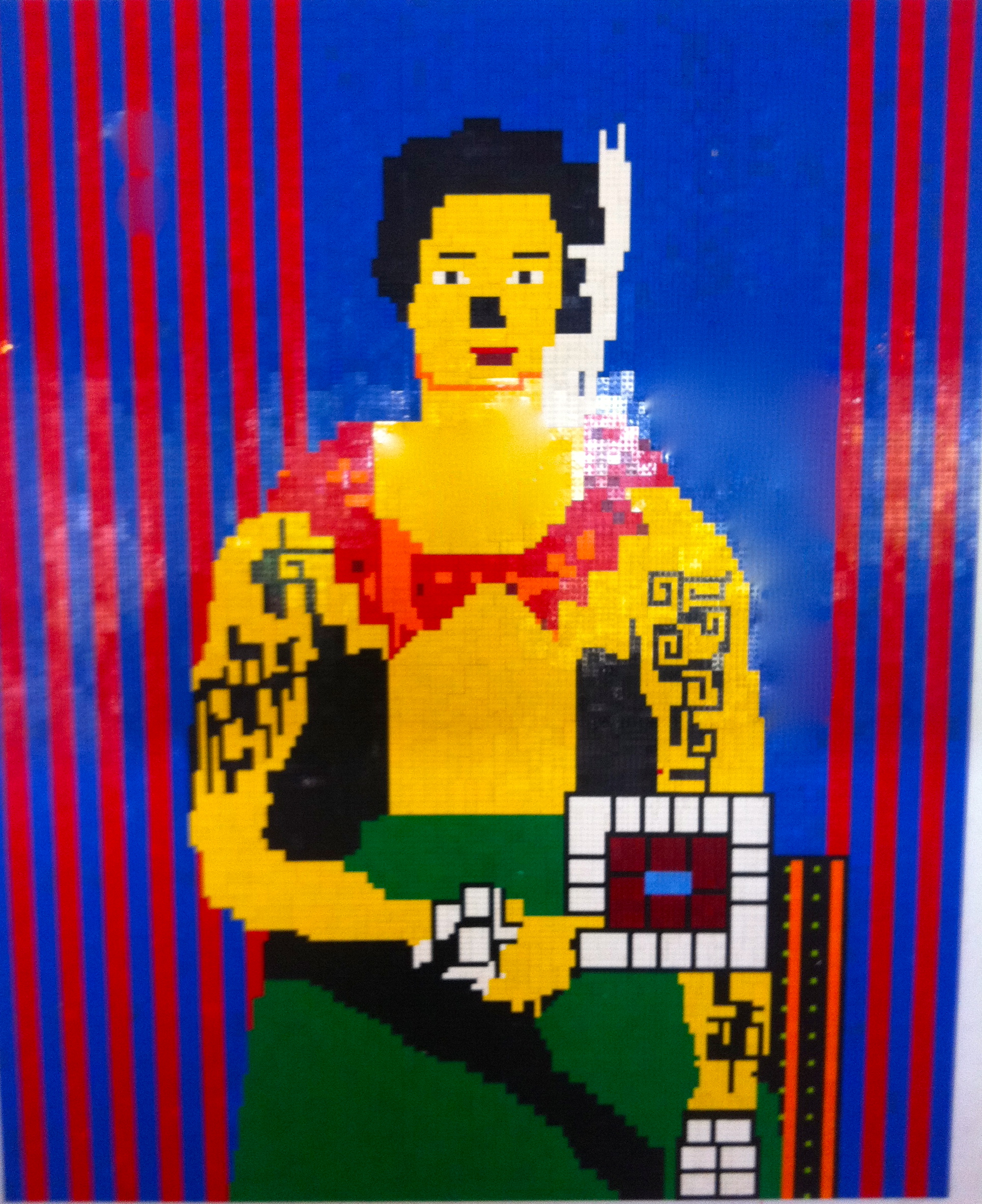
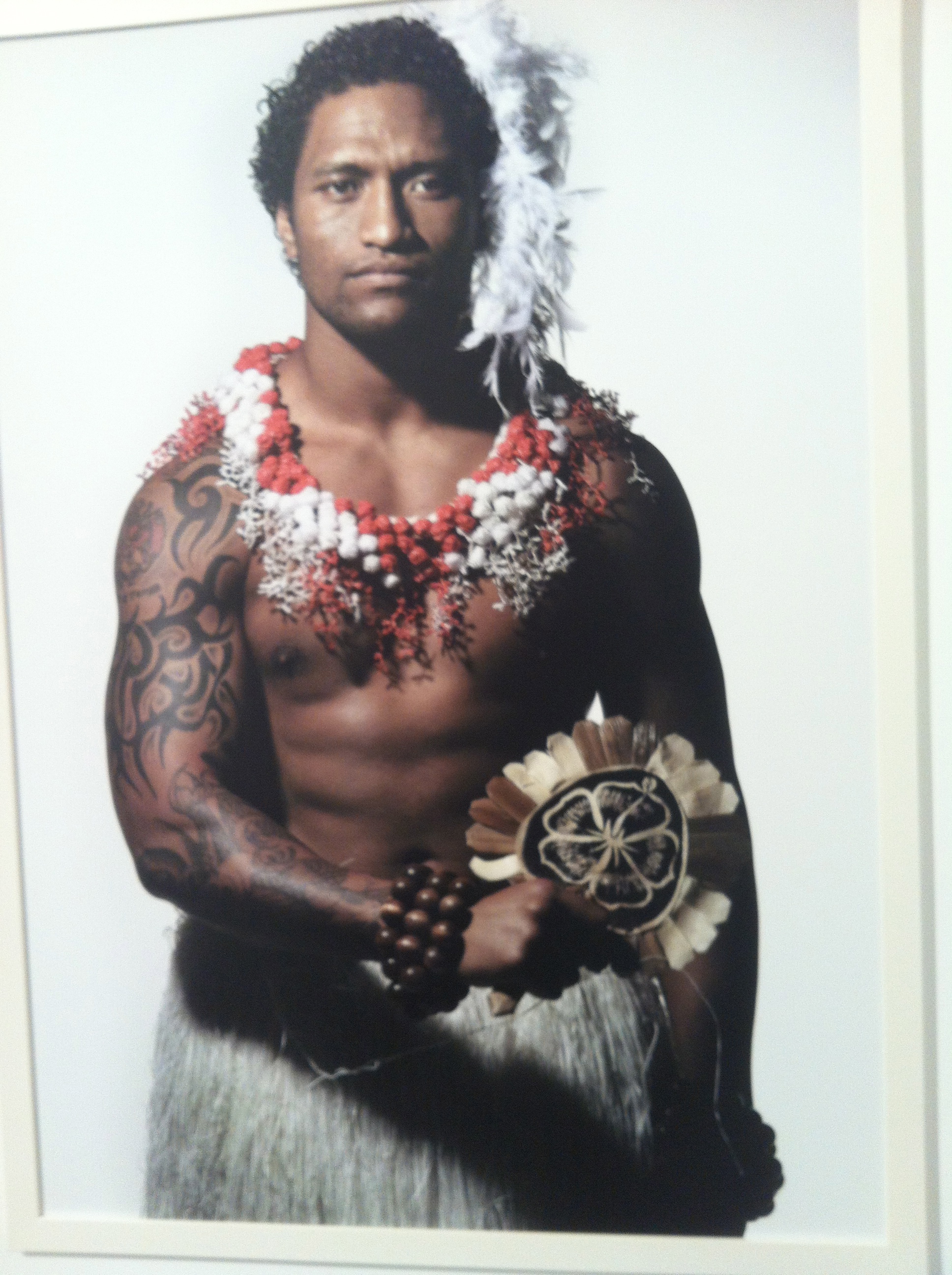
That would have been worth the trip. But there was more. A Lego corner for young patrons featured a substantial mural created by students from a nearby public school, a version of a photograph in the main gallery (both pics taken on my phone – but you get some idea):


The fabulous image on the right is William Booth’s photograph of Manu Vatuvei, a New Zealand Rugby League player, dressed as a traditional warrior from his native Tonga. It’s part of Body on the Line, photographs of 13 League players of Pacific Island heritage as cultural warriors. This, and Heads Up in the next room, ten huge close-ups of Penrith Panthers players and fans taken by Craig Walsh and Josh Raymond within minutes of losing a major match, bruised and gutted, gave me a new respect for the qualities of elite sportsmen.

Nowhere does the gallery try to draw a connection between the meticulous, fine-tuned contemplative aesthetic in the old house and the heroic muscularity of the main gallery, but I’d love to see the various makers and their subjects chatting over canapes at a joint opening.