The men who read The Man who Loved Children

Christina Stead, The Man Who Loved Children (©1940, Penguin Modern Classics 1970)
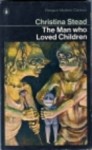
Someone on the Internet recently described The Man Who Loved Children as one of the greatest novels ever written. Jonathan Franzen has championed it, with the result that it has recently been republished. The copy I’ve just reread is the 1970 paperback of the edition resulting from the book’s being championed by another USian, poet Randal Jarrell. I ‘did’ Christina Stead’s For Love Alone at university, and remember it vividly, but this book, which I read independently of any study requirements, had faded from memory, leaving only a recollection of having loved the book and hated the eponymous Sam Pollitt. So I was glad when the Book Group picked it. Logically we should have picked Seven Poor Men of Sydney or For Love Alone because we were after something to follow on from Delia Falconer’s Sydney and Ruth Park’s Harp in the South, but evidently those of us who’d read this, combined with those who’d read of Franzen’s enthusiasm, swung the vote.

Before the meeting:
For the first 200 or so pages, as we are taken into the Pollitt family, the book is completely engrossing, though far from simply pleasurable. In fact, it’s a bit like being taken into the implacable embrace of a two-headed boa constrictor. Sam and Henny Pollitt must be among the awfullest parents in literature. Sam is a monumental monster, relentlessly garrulous, playing with the language in elaborate baby-talk with his children, lecturing them endlessly on his own peculiar and increasingly repulsive utopian socialism, turning them against each other by vicious teasing and, whenever anyone takes offence, whining that they have hurt his feelings or defied his authority. Manipulative, narcissistic, brutally sexist and convinced of his own goodness, he makes Henny’s life a misery and is surely giving his children material for decades in therapy. But though we feel for her, Henny is hardly an attractive character. Even when she’s not storming and threatening destruction all round in blind, operatic rage, hardly a word comes out of her mouth that isn’t tinged with venom – against Sam, the children, the world. It’s a horror story. In the first half, there’s little sense of movement or plot progression – just an appalling claustrophobic massing of incident. What makes it readable is the language: both Sam and Henny are intensely verbal, she with an embittered satirical phrase for everyone and everything, he with a pyrotechnicon of silly voices and accents, quotations, nicknames, puns.

As the halfway marks approaches, there’s a blessed reprieve when Sam goes off to Malaya for eight months and Sam and Henny are no longer under one roof. We see Sam’s ebullient, insensitive, visionary self-engrossment outside the claustrophobic confines of his family, and recognise in him a buffoonish version of the ‘obtuse and destructive American innocence and idealism’ (I’m quoting Wikipedia) of Graham Green’s The Quiet American. Then it’s back to the hothouse, and things get worse. But now at least there’s movement, downstream of course, to an overwrought climax. Astonishingly, for all its gut-wrenching quality, I didn’t remember how the book ended. Perhaps when I was 20 I read it completely as a fantasy construct, whereas now, sadly, I’m prepared to entertain the possibility that monsters such as Sam do exist in our world.

At the meeting:
There were seven of us. Only one had finished the book. I was 70 pages from the end (I hadn’t reached the aforementioned climax – I said I guessed that adolescent Louie left home and Henny either killed herself or didn’t, and the one who had finished said, ‘Worse,’ and was right). One who didn’t come, wrote to say he stopped caring about any of the characters when he heard someone on the Book Show talk about how Christina Stead rewrote the book from a Sydney to a DC and Maryland setting at the bidding of a US publisher (which, incidentally, she did with remarkable thoroughness). One had put the book down at page 72, too irritated with Sam and the language to contemplate going further. Others had struggled to return to it, and it’s very long.

We had a terrific discussion, interspersed with reflections on the negative aspects of ensuite bathrooms, the terrible prospects facing us at the State elections this weekend, initiatives for peace in the Middle East, quiche and ice cream. I think I liked the book more than anyone: what was the point of all this wretched misery, what insight did it offer, someone asked. I don’t have an answer to that question, but I do think that almost any paragraph picked at random offers up abundant riches. And it has to mean something that, as I read yesterday on Literati, the book has been included along with The Female Eunuch on at least one university course.

After the meeting:
Last night and today, I finished it. Let me finish by taking up the challenge implied in my comment about ‘any paragraph picked at random’. [Opens at random.] Here’s one. It’s not what I would have chosen, because it’s part of a scene that takes place away from the toxic Pollitt home, but I did say ‘random’. Henny is talking with her sister Hassie and their mother Old Ellen while Louie and Evie, Henny’s two daughters, eavesdrop. Henny has just delivered a self-pitying aria, concluding, ‘Why was I ever born?’

‘It’s too late to ask me that,’ said Old Ellen. ‘But you mightn’t have been.’ She began to laugh. ‘Your old man sent me anonymous letters himself to make me divorce him.’ She rippled with he-hes. ‘I hung on to spite him. I didn’t want him. It’s my only pleasure left.’ She laughed. ‘All I’ve got left is to sit in the sun and watch Barry booze and sometimes give him a kick in the pants. Sit in the sun and watch barflies, huh?’

(Barry is Henny’s alcoholic brother, and after her husband’s death, Old Ellen will indeed be left to look after him.) Out of context, I suppose the most striking thing about this paragraph is the disjunction between Old Ellen’s laughter and the terrible things she is saying. In context, it’s brilliant for what it does with point of view. We are  wrenched from Henny’s self-preoccupation  to the old woman’s misery, from which she has snatched a kind of bitter, self-destructive victory, and in the process Henny receives yet another blow to her sense of self. When you consider that the underlying point of view is that of the eavesdropping children, the paragraph takes on cataclysmic proportions – or would, except that we suspect they have been hearing things like this all their lives, that Old Ellen has been saying this kind of thing to her own daughters for most of theirs. The only person really appalled by her words is the reader – for everyone else it’s just renaming old pain, adding a further numbing twist to old confusion. Someone at the book group said he found it hard to get into the rhythm of the book; someone else said he thought that was because the point of view kept changing, and no one’s story had room to progress without interference. This little paragraph is a small example of that process at work.  And there’s that laughter. Hitler laughed when Ribbentrop gave him a birthday present of an ornate wooden box containing a copy of every treaty he had broken – Old Ellen’s laughter is about as cheering as Hitler’s. The book is full of  laughter and smiles that make the blood run cold.

No  wonder it’s a neglected classic!

happy birthday

Yesterday she who was formerly known as the Art Student but is still waiting for a new blogname turned 60. Nine of us are in Adelaide to celebrate- partly as a way for her to avoid having a party but mostly because she gets to take us with her visiting childhood sites, and we all get to WOMADelaide. At this morning’s birthday breakfast, I kept to my own precedent and read a sonnet. I wrote the last word just as the former Art Student came to collect me for breakfast, so it hasn’t exactly had time to ripen, but here it is:

For three score years you’ve been alive
and kicking up your heels, down doors,
my love and swive for thirty five,
co-parent, partner, joy’s main cause.
The psalmist gives you ten more years.
The Chinese give you rabbit ears:
wear red, a fresh start now, they tell us.
The Hindus say, Be forest dwellers:
reflect, find meaning now, make art.
There’s grimness, earthquakes, rising seas.
We know one day you’ll break my heart
or I yours by dying. Please,
though earth grows warmer by the hour
it’s still a garden. You’re still a flower.

[With acknowledgement of a line from Carolyn Kizer’s ‘Afternoon Happiness’]

The new Bond movie

The first Bond movie directed by a woman. Starring Daniel Craig and Judi Dench, directed by Sam (‘Nowhere Boy’) Taylor Woods, written by Jane (‘Kick Ass’) Goldman, it’s only 2 and a bit minutes long. Have a watch. And my belated wishes for a happy International Women’s Day.

I saw it on tor.com

Suddenly in the Depths of the Forest, Of Bees and Mist

Amos Oz, Suddenly in the Depths of the Forest (2005, translation from Hebrew by Sondra Silverston, Chatto & Windus 2010)
Erick Setiawan, Of Bees and Mist (Headline Review 2009)

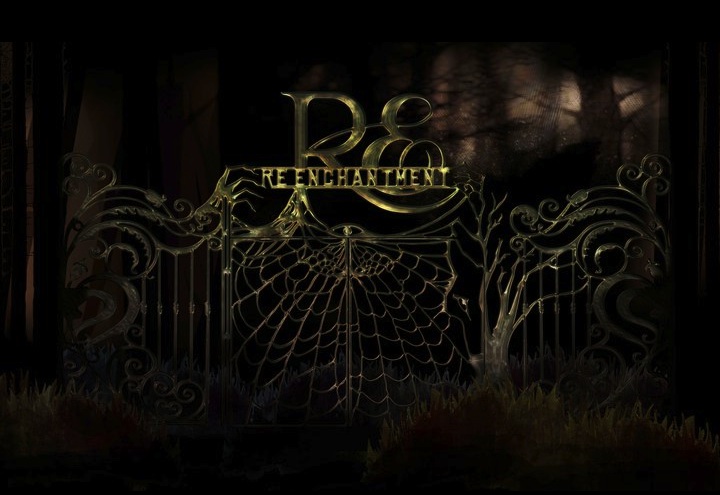
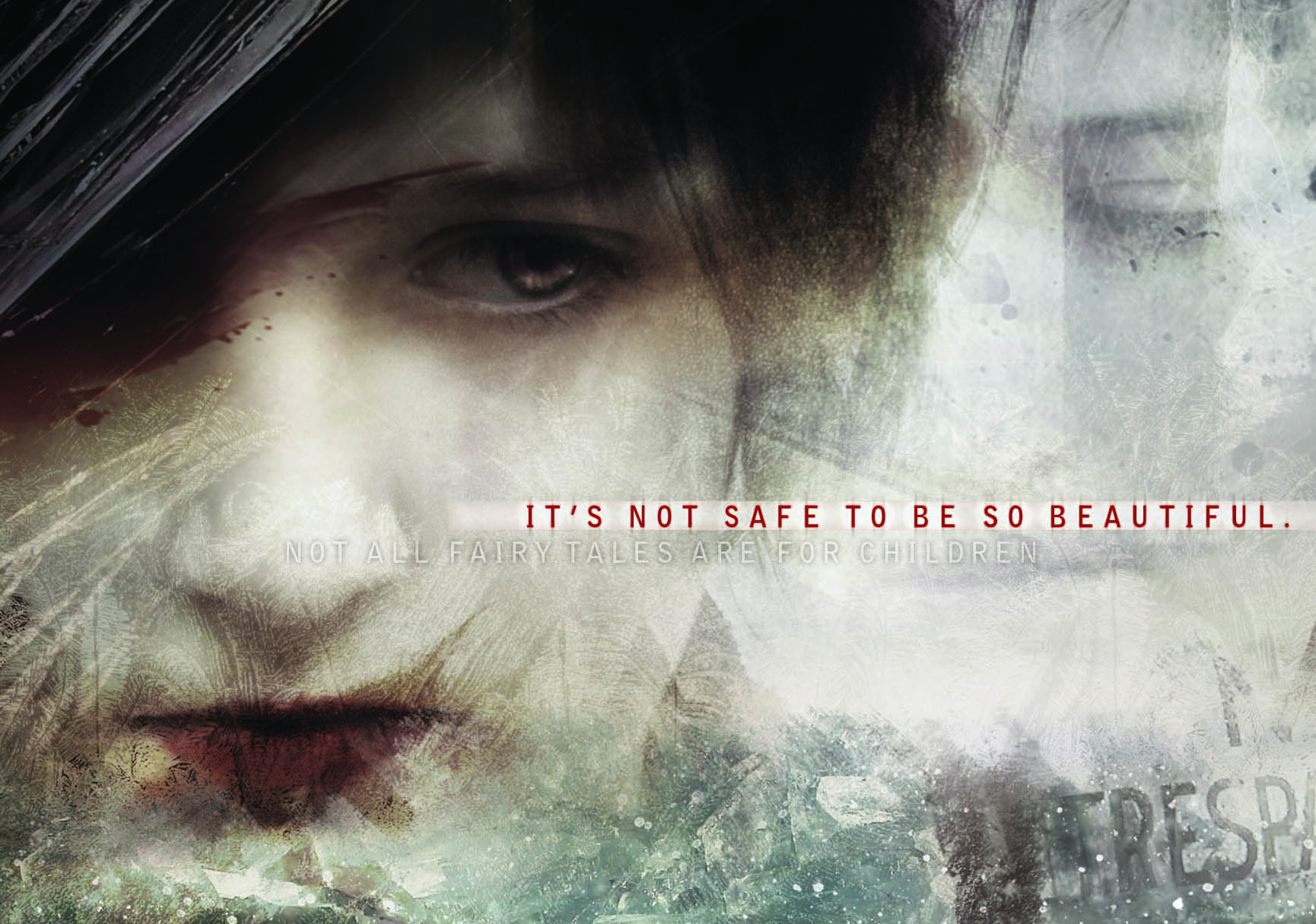
The Re-enchantment web site’s tag line, ‘Not all fairy tales are for children,’ could have been coined with these two books in mind. Both have fairy tale settings (a village in a forest, an enchanted castle) and are shot through with fairy tale motifs. Both introduce supernatural elements in the matter-of-fact manner of fairy tales. Both, in the manner of fairy tales, have spirited, curious child protagonists – or start out that way. And both definitely have an adult readership in mind, though the first doesn’t leave potential child readers in the lurch, as the second does with its explicit sexual content.

Suddenly in the Depths of the Forest has elements of ‘Hansel and Gretel’, ‘The Pied Piper of Hamelin’ and other familiar tales, integrated into a completely serious fable. In a village in the middle of a forest, there are no animals – no birds, no fish, no insects, not even any earthworms. Something terrible happened long ago, when the older villagers were young, and now the village children are faced with a near pervasive silence about the past and stern warnings about the dangers of the night and the forest. Maya and Matti, our heroes, dare to investigate, and find that the adults’ stories about a demon who lives in the forest are both true and misleading. It’s a short read, just 137 pages, and though it becomes preachy towards the end, the preachiness, against the ‘mocking and scoffing disease’ of bullying ridicule, stays true to the fairy tale mode, leaving the reader to savour the deeper themes unharassed.

Those deeper themes have to do with memory and forgetting. As Matti says:

Maybe there should be another word, a special word that includes both remembering and forgetting: sometimes, out of the blue, a mother or father in the village imitates animal or bird sounds for their child. But a minute later, they regret it and correct themselves and explain that animals are merely a fairy tale. Then they sigh because our teacher, Emanuella, confuses us so much with all those crazy animal stories out of her poor head.

This reminds me of The Silence, Ruth Wajnryb’s fascinating book about how the children of Holocaust survivors gleaned hints of their parents’ stories from just such a process of remembering and not remembering, telling and not telling. As Amos Oz is Israeli, he may have had the Holocaust in mind. Or he may have been thinking of the Naqbah. Equally, I found myself thinking how in my childhood the history of dispossession and genocide of Australian Aborigines was both common knowledge and somehow unacknowledged. These reflections and associations arise from the narrative but never disrupt its integrity as a tale about two children and a village without any animals.

Sadly the same can’t be said for the ‘meanings’ of magical events in Of Bees and Mist. I confess up front that I stopped reading soon after page 50, but it was only because I knew other people love the book that I could force myself to last that long. Meridia lives in a big old house whose magical properties – perpetual cold and gloom, a staircase that stretches and contracts arbitrarily, strangely sentient surrounding mists – are pretty well explicitly presented as symbols of her parents’ unhappy marriage, her father’s extreme authoritarian coldness and her mother’s babbling, forgetful misery. Other magical details, such as a woman in the marketplace who grows herbs on her body for customers to snip, seem to be there as decorative afterthoughts. I revolted at the prospect of 500 pages of this sort of thing.

Was it fantasy writer Jo Walton who, when someone asked her what the dragons in her work represented, replied that they were just dragons? I guess I’m the kind of reader who wants my zombies to be zombies. In the middle of a zombie story, I want to be worried for the hero’s brains, not – at least not at the front of my mind – ruminating on modern society’s fear of the mob or feeling for the author’s deeply unhappy childhood.

Not all fairy tales are for children. Some aren’t for me.

Re-enchantment is live

Re-enchantment, an interactive website exploring the history and meanings of seven of the best known fairy tales that has been a very long time coming, was launched yesterday and is now live on the ABC, at http://re-enchantment.abc.net.au/re-enchantment.html. I’ve had a quick look at the finished product, and though I have seen various beta versions, I was blown away. It’s gorgeous to look at, and the content is intriguing. Even the mechanics – working out which sparkly or moving images to click on and seeing where they take you – are great, allowing staid old folk like me a chance to share the thrill we’ve witnessed over young gamers’ shoulders. Some bits are slow to load on my computer, but that’s a minor irritation.

I’ve just programmed my TV to record the interstitial shorts being shown on the ABC over the next couple of weeks. In case you want to keep an eye out for them as well, and bearing in mind that the ABC may vary its schedule in response to teh next natural or political disaster, they’re:

Episode 1: Ever After (ABC1 Sunday 6 March, 4.30 pm)

Fairy tales, sometimes called wonder tales, have existed for thousands of years before they appeared as children’s stories. Why have they continued to appeal to adults across continents and across cultures?

Episode 2: If the Shoe Fits (ABC1 Sunday 6 March, 10.30 pm)

Cinderella is one of most popular fairy tales. Why has it survived for over a thousand years?

Episode 3: Wicked Stepmothers (ABC1 Friday 11 March, 10.55 pm)

Fairy tales are full of evil stepmothers and wicked witches. Why have these negative portrayals of women survived?

Episode 4: Princess Culture  (ABC1 Sunday 13 March,  2.55 pm)

Are fairy tales responsible for our fantasies about princes and princesses?

Episode 5: Into the Woods (ABC1 Sunday 13 March, 10.30 pm)

Why is it that so many fairy tales take us into the forest?

Episode 6: Dark Emotions (ABC1 Friday 18 March, 10.55 pm)

Is it the dark side of fairy tales that makes them so valuable psychologically?

Episode 7: Beastly Husbands (ABC1 Sunday 20 March, 4.55 pm)

Animal bridegroom stories where a woman marries an animal husband exist in most cultures. Why have these stories been so popular?

Episode 8: The Forbidden Room (ABC1 Sunday 20 March, 10.30 pm)

The mystery beyond the door is a very familiar motif to modern audiences. What is the meaning of the forbidden room?

Episode 9: Fairy Tale Sex (ABC1 Friday 25 March, 10.55 pm)

Romance, princes and princesses are all associated with fairy stories, but what do they say about sex?

Episode 10: Re-imaginings (ABC1 Sunday 27 March, 10.30 pm)

Fairy stories aren’t relics of the past. They are constantly being re-interpreted in new ways by visual artists and writers.

Judith Beveridge’s Wolf Notes

Judith Beveridge, Wolf Notes (Giramondo 2007, 2010)

On a Sydney Writers’ Festival panel some years ago Inga Clendinnen indulged in a flight of metaphor, saying that the writer of a personal essay takes the reader by the hand and says, ‘Come walk with me,’ while a novelist invites a reader to play Catch-me-if-you-can. The novelist who chaired the panel commented afterwards that though he adores Inga (as who doesn’t?), he was a little offended. At the risk of offending poets everywhere then, I’d like to suggest that the author of a book of poems is saying, ‘Come in, make yourself at home, stay a while.’

That is to say, I have to live with a book of poetry for a while before I feel that I’ve actually read it. At this stage of my relationship with Wolf Notes, I can say confidently that there’s lots of good stuff in it, but I’d have read it again, dip into it, and do some digging before I could say anything useful about it. (I’ve just read Martin Duwell’s latest entry on his Australian Poetry Review site, and I tell you I’m in awe.)

For an example of why I’m not competent to say much about this book, I have no idea why the first of its three parts is called ‘Peregrine’: it begins with character sketches of people you might see in an Asian city or countryside – a saffron picker, a pedlar, a bone artisan –, and goes on to a miscellany of other subjects – a contemplative walk beside a lake, a suicide, a boy killed by leeches, a mother wrestling with inexplicable sadness, a crew of three on a fishing boat, and so on. Does the title suggest that the poet is a pilgrim? A falcon? I draw a blank.

In a different way, it seems that to appreciate the middle section, ‘Between the Palace and the Bodhi Tree’, described in an introductory note as ‘an imaginative depiction of the time Siddhattha spent wandering in the forests and towns before achieving enlightenment’, I would have to learn something about Buddhism and the story of the Buddha. I found many of these poems beautiful, especially the ones filled with observations of the natural world, but I have very little clue where they stand in relation to Buddhism: are they devout meditations or relatively unengaged textual games? I think the former, but don’t know enough to be sure. (The third section, ‘Signatures’, presents no general problem – it’s a number of monologues, easily understood to be their speakers’ signatures.)

So far I’m just a visitor to this book, then, but it offers enough observation, drama, wit and seriousness to make me want to spend more time here. One pleasurable thing is the way the moon appears again and again, especially in the middle section. If I quote a number of its appearances, you’ll get some idea of Judith Beveridge’s voice, at least when she’s channelling Siddhattha:

From ‘The Rains’:

————— I look at the moon
primed and narrow as the sting
of a scorpion’s tail.

From ‘Quarry’:

I watched the moon gather shine
like limestone in a mason’s hands.

From ‘Circles’, after describing vultures in picking at a dead ox:

I saw the moon, a desecrated bone
upon which those birds
might drip some blood.

From ‘New Season’:

——————————— the sky’s
depth, where the moon pares itself down
into the smile of an obedient wife

From ‘The Krait’:

I was scared. I didn’t notice the moon,
a fang poised above my slightest act.

From ‘Doubt’:

Today I hear only wind smuggled in.
The moon bears down with its gift-less smile.

From ‘Death‘ (possibly the most immediately accessible poem in the book, it’s the fourth or fifth one down at that link):

Even the moon can’t keep itself clean:
soap soiled by a dung-collector’s hands.

From ‘Ficus Religiosa’:

I vow with all beings
to sit until the moon, a bowl,
is almed only by the Good.

Same moon, same poet, different poems, different feel. I won’t be shaking this book’s dust from the soles of my sandals for a while yet.

Audrey Niffenegger’s Night Bookmobile

It’s tempting to say that Audrey Niffenegger creates comics for people who don’t like comics. It’s probably more accurate to say that she creates the kind of comics that appeal to people who like, say, Emma Magenta’s work, or Kate Williamson’s, which are, after all, comics as much as Watchmen or Sin City. (I’ve read both Emma Magenta and Kate Williamson thanks to the Book Club, which is also where I got The Night Bookmobile.)

The Night Bookmobile is more like other comics than The Three Incestuous Sisters, the only other of Niffenegger’s books I’ve read, in which the text played very poor second fiddle to the images. This is much more integrated. A young woman called Alexandra (get it?) discovers a fantastical night bookmobile that contains every book she has ever read. Over the years she encounters the bookmobile and its kindly, melancholy driver a few more times, and each time its collection has grown to incorporate what she has read in the meantime. It’s like a dream incarnation of a LibraryThing account. Alexandra becomes a librarian and longs to work in the bookmobile. Two pages of skippable text at the end explain how to interpret the story, and tell us that its the first instalment of a much larger work, The Library.

I was charmed, and not just charmed, but unsettled by the book’s dark and mercifully unexplained elements. There’s something half in love with death about Niffenegger.

As it happens, Perry Middlemiss’s site, Rhymes Rudely Strung, which publishes an Australian poem a day, turned up today with this, first published in The Bulletin in 1917, but taking Niffenegger’s sex-death-books connection and running with it:

Books
by Zora Cross

Oh bury me in books when I am dead,
Fair quarto leaves of ivory and gold,
And silk octavos bound in brown and red,
That tales of love and chivalry unfold.

Heap me in volumes of fine vellum wrought,
Creamed with the close content of silent speech.
Wrap me in sapphire tapestries of thought
From some old epic out of common reach.

I would my shroud were verse-embroidered too –
Your verse for preference, in starry stitch,
And powdered o’er with rhymes that poets woo,
Breathing dream-lyrics in moon-measures rich.

Night holds me with a horror of the grave
That knows not poetry, nor song, nor you;
Nor leaves of love that down the ages wave
Romance and fire in burnished cloths of blue.

Oh bury me in books, and I’ll not mind
The cold, slow worms that coil around my head;
Since my lone soul may turn the page and find
The lines you wrote to me, when I am dead.

Jonathan Franzen’s Freedom

Jonathan Franzen, Freedom: a novel (Fourth Estate 2010)

There’s no doubt this is a terrific book. It tells the story of one US family through the Bush–Clinton–Bush–Obama years, taking in the bigger picture (the Iraq invasion, environmental despoliation, global warming, technological change …), while giving us sharply realised characters whose lives illuminate the times without ever feeling as if they’re determined by the author’s agenda. The words free, freedom, liberty and so on ring like chimes through the pages suggesting without being glib that a freedom that involves loss of connection – to other people, to the natural world, to one’s own best self – is not worth having. I love the way characters are astonished to find themselves reproducing patterns of behaviour they have hated in their parents, and the way character after character struggles for integrity in a deeply compromised and compromising society.  A sequence in the last seven pages touched some deep place in me that made the whole book sing.

But I was a resistant reader until those last pages. Partly this was a matter of timing – two things had set me up to fight the book every inch of the way.

First: I began reading it with those shocking VIDA pie charts about gender and literary publishing fresh in my mind, knowing that Freedom had been published amid a hype-storm unthinkable for a grown up novel written by a woman. As a result the book had an invisible frame around it announcing it as a privileged book by a privileged author about privileged characters, to read which was an endorsement of white English-speaking middle-class male privilege. This frame was gilded by the experience of reading in public. I regularly read while walking, while waiting in queues, on the bus, a practice that occasionally provokes comment, but only with this book have perfect strangers asked me how I’m enjoying it, and then say what they’ve heard – this happened twice.

The whole book can be read as a criticism of that very privilege, though I only noticed the word once. After I had written the first draught of the previous paragraph I encountered the only non-White characters in the book (apart from a beautiful and talented young woman of Indian heritage, who does have a major role), in this sentence, at a funeral towards the end:

It was only when the service finished that Patty saw the assortment of underprivileged people filling the rear pews, more than a hundred in all, most of them black or Hispanic or otherwise ethnic, in every shape and size, wearing suits and dresses that seemed pretty clearly the best they owned, and sitting with the patient dignity of people who had more regular experience with funerals than she did.

So privilege is explicitly acknowledged, but the people who don’t share it are more or less interchangeable. I’m not saying every book has to have a politically correct diversity in its cast of characters, but in this case I found the lack of it painful and it put me in a fighting mood.

Second: when I was about a hundred pages in, a guest on the Book Show used Freedom as an example of a book that uses electronic social media well, and went on to describe a major turning point of the plot. As a result, for the next 300 pages I noticed the little moments and comments that were building towards that point, so that I registered them as parts of a justifying mechanism rather than as elements of story. Maybe Franzen did his foreshadowing clumsily and mechanically, but it’s more likely that I was reading with a peculiar – spoiled – alertness. (Thanks, Ramona!)

Goodbye Arthur Boothroyd

I posted about Arthur Boothroyd’s hundredth birthday last October. A lifelong friend of Arthur’s who lives in Switzerland just broke the news to me in a comment on that blog entry that Arthur has died. It happened on 10 February, and the funeral was last Tuesday, 15 February. I’m very sorry to have missed it. He was a gracious presence in Annandale, and created a good bit of the visual environment for generations of Australians.

In October I spent some hours in the State Library trying to get hold of some images of his work, and gave up in despair of ever mastering the necessary technology. This time, Google gave me this, from March 1950:

Described like this:

Wall conversation

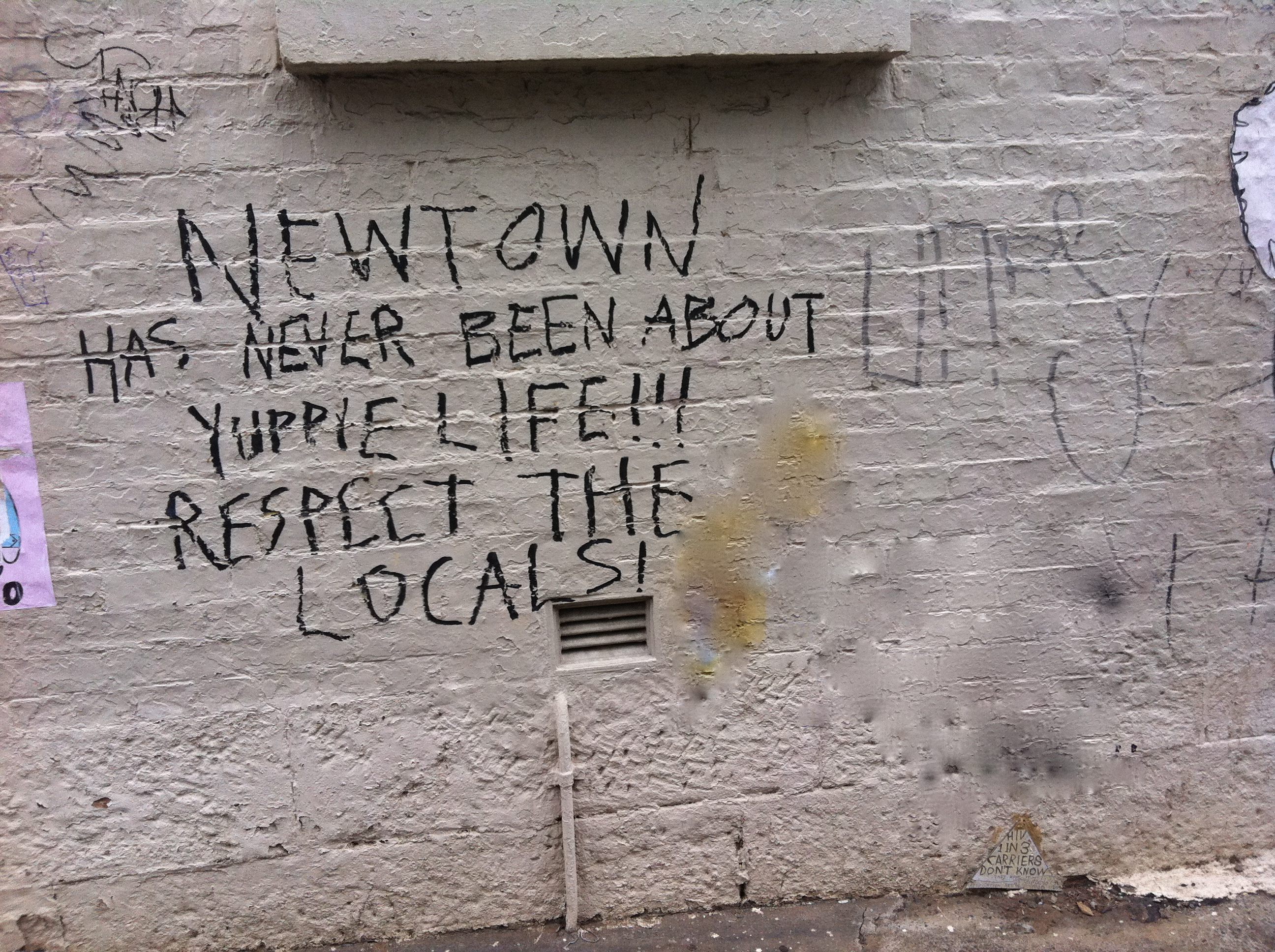
Here’s a nice non-facebook wall conversation from a neighbouring suburb. If I had Photoshop I would restore YUPPIE in the first image to YOUR, which is what was there the first time I saw this wall.

Someone who felt this message was intended for them struck back:

Then yesterday a third and perhaps even a fourth, dauber chimed in: