The Book Group and That Deadman Dance

Kim Scott, That Deadman Dance (Picador 2010)
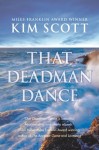
Having enjoyed the movie Red Dog in spite of its near erasure of Aboriginal people from the Pilbara, I was glad to turn to the Book Group’s pick of the month for a bit of counterpoint. Sadly, I turned to it too late to finish it before the group met over soup, bread and cheese on 17 August. So here we are, reversing the usual order of my Book Group posts: first the meeting and then the book.

The meeting:
We had a good turn-up, and more than half had read the whole book. All but one of us were big fans, and the dissenter – who was about a third of the way through – was prepared to keep an open mind. I’d read only 110 pages or so myself, but at that point was finding it exhilarating. Discussion was animated, emphatic, mostly good humoured.  I won’t try to summarise beyond saying that there was a shared sense that the novel made us see the British settlement of Western Australia with fresh eyes. Also the whaling industry, but I hadn’t read to that point, so tried not to listen. I had read the short chapter where a convict who has been speared by Noongars in payback for wrongs done by someone else – though smarting with the injustice, he understands that it’s necessary for the whites to accept the payback without further retaliation if there is to be peace in the small settlement. In terms of the plot, he feels like a powder keg waiting to explode, but I love Kim Scott’s open hearted portrayal of him as a complex individual (as opposed, say, to the equivalent lower-class ‘bad whites’ of Kate Grenville’s The Secret River). No one would engage with me on this line of discussion because they didn’t want to give the plot away – true gentlemen every one.

The subject of Red Dog was raised, and those who’d seen it were even less impressed than I was, regarding the praise lavished on it by Margaret, David and Julie as symptomatic of misguided and misleading advocacy for the local product. We had brief but sharp differences of opinion about The Slap (Christos Tsiolkas) and The Riders (Tim Winton), and some disparagement of The Unknown Terrorist (Richard Flanagan) and the literal minded TV adaptation of Cloud Street (Winton again).

I came away looking forward to the rest of the book.

After the meeting:
I took nearly two more weeks to finish, but that’s no reflection on the book. (See previous post for partial explanation of my reduced reading time.) While I was reading it I  heard on a podcast of the Book Show that Melbourne University currently doesn’t offer a course in Australian literature – one enterprising student has organised monthly lectures by poets and others who are willing to talk for free (apparently without input of any kind from the academic staff!). One justification for this state of affairs is that students in general think Aus Lit is boring, conservative and ‘white’, so the course wouldn’t be popular enough to justify itself. I guess this is what happens when the profit motive holds sway in education. But, stepping down from my media-generated-outrage soapbox, I’d have to concede that That Deadman Dance does make some other much-praised Aust fic look fairly timid and vanilla. It tackles the same general area as Inga Clendinnen’s Dancing with Strangers: the first, hopeful contact between Aboriginal Australians and white invaders and the seeds of the subsequent tragic genocidal history. Where  Clendinnen wrote history, excavating the journals of early settlers in Sydney to reconstruct a hypothetical account from the point of view of the Indigenous Australians, Kim Scott tells what his narrator calls a ‘simple story of Bobby and his few friends’ about the settlement in south west Western Australia, confidently taking us into the minds of black and white, young and old, male and female. I’d be surprised if he hadn’t read the Clendinnen book, but it’s very much its own work: joyful, funny, superhumanly broad in its sympathies, challenging, vivid and in the end heartbreaking.

The central story tells of Wabalanginy/Bobby, a  Noongar man born after the arrival of  whites, who finds friendship among the new arrivals, studies them, at times acts as an intermediary, is virtually adopted into a white family but remains firmly connected with his Noongar community. He’s a brilliant character – admired as a clever mimic by the whites and held in awe for his artistry in song and dance by the Noongars. His engagement with both cultures is enacted beautifully: a number of times we’re taken inside his way of perceiving and responding to the world in wonderfully lyrical writing.

At one stage, the desecration of a grave is described as ‘deliberate and careless all at once’, a phrase that resonates like a gong through the last, darkening chapters, when the logic of capitalism and colonialism asserts itself, and we gradually lose any sense of the inner lives of the settlers as they become more completely incomprehensible to Bobby and appear to forget the almost reasonable relationships of the recent past: deliberate and careless, intentional and oblivious.

Maybe one day even the hallowed halls of Melbourne University will encourage its students to read this, and other books that will help them wrap their imaginations around the history they inherit.

I once more smell the dew and rain …

… and relish blogging.

Three main things have kept me away from the blog for such a long time, all of them involving earning of money and all of them now done with and money all but in the bank. All of them were interesting, but I’m only going to talk about one: I was a collector for the Census.

The Census Collector’s Sacred Oath of Confidentiality guarantees that I won’t subject you to any gossip of even the most abstract kind, but I can tell you that it was a very interesting and – actually – heartening experience. I was variously hailed as ‘the Census man’, mostly greeted warmly both when dropping off material and when picking them up. The vast majority of the people I had dealings with were either pleased or uncomplainingly willing to be part of the Census: ‘I want them to know I was here.’ Once or twice I thought I was being fobbed off when someone told me to come back ‘on the weekend’ or said they ‘should be able to get it done by Monday’ (this was on a Thursday), but each time I was smilingly proved wrong.

I started out feeling like an intruder in people’s lives: ‘Here are your forms. How many males and how many females will be here next Tuesday night? Just you and your partner? So that would be one of each, or … ?’ I progressed to a sense of myself as a personification of our interconnectedness: ‘Here’s your chance to contribute .’ And then towards the end as I was going back for the fourth or fifth time and finding no one home or forms not yet completed (‘Sorry, mate, we’ve been busy/haven’t got around to it/lost the form’), I realised I was the little man from the government.

I was offered one cup of tea, told two life stories, given three helpful suggestions for improving the census (all involving the need for more questions), reproached once for not knowing the completed form had been left under the mat, attacked by no savage dogs. I walked in on one tragedy, in a  household that gave me a form with good grace. I left my phone number when I didn’t make contact, and had half a dozen calls or text messages that all made life easier. It was a sustained reminder that we are a cooperative species, that Australians, at least on my four blocks, are clear that at least some government agencies are to be trusted.

I’ve handed over my record book and passed in my ID card. There are no longer stacks of blank and filled forms taking up shelf space in the spare bedroom. I’m back to being a private citizen. The pay isn’t great, but I recommend the experience. Keep your eyes peeled for the job ads in 2016.

Pathetic blogger

Pathetic, that’s me. But just to keep some kind of action happening on these pages, here’s a snap from my local supermarket which is a bit of an object lesson in the importance of line breaks.

I really thought they were offering a new kind of schnitzel made of calves’ hearts (urk!) until I saw the similarly worded ad for beef schnitzel with the line break after ‘beef’.

That’s all for now.

By Swapna Dutta

My friend Swapna Dutta is a writer, translator and editor, mainly of children’s literature, who lives in Bangalore, in southern India. The School Magazine published some of her stories when I was editor, and she and I have kept in touch over the intervening years. Swapna mentioned in a recent email that she had translated a children’s book, The Arakiel Diamond, from Bengali into English, and asked if I’d like a copy. Of course I was interested, and a couple of days later it arrived in my letter box, with three other books. It’s been a treat and an education to read all four.


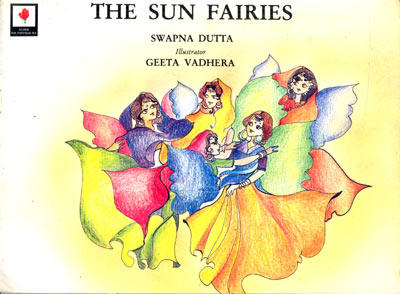
Swapna Dutta and Geeta Vadhera, The Sun Fairies (National Book Trust, India 1994, 2001)

The Sun Fairies is a tiny picture book that plays around with science and fantasy. That is to say, it’s a fanciful account of the origin of clouds – some fairies who live in the sun build castles in the sky so it won’t be so bare and empty – that ends up being a decorative but accurate account of how the water cycle works: the cloud castles are made from water, air and dust, and when they get too heavy they fall to the earth as water. The fairies have discovered ‘a never-ending game’. The illustrations, by Geeta Vadhera, are fabulous. I see from the Internet that Ms Vadhera has gone on to international renown. This may be her only children’s book.


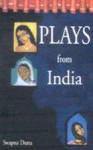
Swapna Dutta, Plays from India, illustrated by Baraan Ijlal (Rupa & Co 2003)

In some ways each of the other books is a work of translation. In Plays from India three episodes from Indian history are shaped into dramas suitable for performance by school students. In my ignorance I don’t know whether the stories would be familiar to most Indian students, so I can’t tell whether the history or the theatre is the main point. I was interested in both.


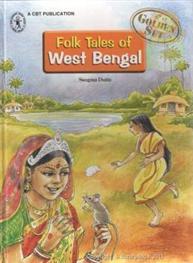
Swapna Dutta, Folk Tales of West Bengal , illustrated by Neeta Gangopadhya (Children’s Book Trust 2009)

Folk Tales of West Bengal retells sixteen tales. Swapna has an article at papertigers from which I learned that what the Grimms were for Germany, and Moe & Asbjørnsen for Norway, the imposingly named Dakshinaranjan Mitra-Mazumdar was for what is now Bangladesh and West Bengal. At least some of the tales here were collected by him in the first decades of last century. Unsurprisingly to anyone who has entered the woods of Re-enchantment, there’s a lot in these stories that’s familiar to a reader brought up on European-origin fairy stories: kings and princesses, talking animals, metamorphoses, riddles, lost and found children, supernatural beings who reward the humble and punish the greedy. There’s also a lot that’s different: the heroine of the first story, for instance, is not a seventh child but a seventh wife. This blending of familiar and unfamiliar makes for a delightful read.


Sucitrā Bhaṭṭācārya, The Arakiel Diamond, translated by Swapna Dutta and illustrated by Agantuk (Ponytale Books 2011)

The Arakiel Diamond is the only book in my swag that is not Swapna’s original work. It’s a detective story for young readers, one of a series featuring a Bengali housewife and her niece. A wealthy man dies. His most precious possession, the eponymous diamond, has gone missing, and almost everyone in his household – and there are many – has had motive and opportunity to steal it. The plot has exactly the twists you’d expect, but the detectives’ relationship and the details of their domestic life are well captured, and I learned a lot about the Armenian community in Calcutta, in a way that reminds me of grown-up detective writers (Sarah Paretsky comes to mind) who take us to a new subculture in each novel.


The four books had me reflecting on multiculturalism in children’s literature. We make fun of the way US children’s publishers, apparently believing that their intended readers would shrink from anything not immediately recognisable as of the US, re-edit books from elsewhere in the English-speaking world to remove unsightly exotica. They don’t just want a world where British characters spend dollars and cents, or Australians walk on a pavement, weird as such a world might be. I remember hearing of a New Zealand novel whose publisher suggested the book’s Maori issues might be more accessible to US children if the setting was changed to California – that author held firm and the book still found readers, even got made into a movie.

I wish now to acknowledge that I’m a bit of a kettle to the US publishers’ pot. Though I enjoyed the slight cultural disorientation I felt as I read these books, I caught myself thinking young readers would be put off by it. To make the books accessible to Australian 11-year olds, the unexamined internal argument went, you’d have to do something about lakh and crore, lunghi, salwar shameez and rakhi, not to mention the nitty-gritties of the game of chess or a casual use of thrice in conversation. On reflection, I think that argument profoundly misunderstands how young people read. The only thing that universally distinguishes young from adult readers is that the young ones are younger. One result of this is that they know they don’t know everything about the world, and mostly when they read there are words they don’t recognise but have to guess from the context. (I loved and understood pulverise and invulnerable in Superman comics long before I could define them.) So you might not know what a lunghi is, but the context tells you it’s an article of clothing, and there’s even an illustration to help. Likewise, lakh and crore are obviously big numbers, and that’s all you need to know. As I remember back to my own childhood reading, I think such things would have added spice to the book: if I was young now, I might even have fun googling them. As for nitty-gritties and thrice, I do think we can trust young readers to recognise when a word or a turn of phrase belongs to a different place. (Both my sons say zed in spite of seeing quite a lot of Sesame Street when young.)

Still here!

I’m shocked, shocked at how long it is since I last posted. That’s what a bit of paid work and visitors from out of town will do to a blogger’s practice. I’ve signed a confidentiality agreement about at least part of the paid work, but I can blab about the visitors.

Will Owen and his partner Harvey live in North Carolina and are enthusiastic collectors of Aboriginal art. I met Will almost exactly seven years ago when he emailed me after reading my blog post about an exhibition of art from Aurukun, from which he and Harvey had purchased a piece, and we’ve met a number of times in the non-Web world since. Will’s blog, Aboriginal Art and Culture: an American eye, is fabulously erudite, funny, insightful, and broad-ranging. Will in person is all of that and much more ( for example, he can quote slabs of Ezra Pound and knows a lot about Finnegan’s Wake). He and Harvey are in Australia just now, and were in Sydney for nearly a week, flying out this morning. The Art Student and I managed to see quite a bit of them, and it would be hard to imagine two more delightful visitors.

Will gave a brilliant talk about his and Harvey’s collection at the Art Student’s TAFE. We ate at Revolver. We went to Bangarra’s Belonging at the Opera House (Will has already posted a characteristically thoughtful review) and Roxanne McDonald in Windmill Baby at the Belvoir. We ate Italian in Newtown and Lebanese in Surry Hills. We accompanied them to Danks Street where Christopher Hodges of Utopia Gallery took us to the back room and showed us (well, showed Harvey and Will, with the Art Student and I as open-mouthed collateral beneficiaries) more than a score of brilliant work from Papunya Tula artists, rolling the canvases out on the floor. Last night we dragged them off to see Red Dog, a genial outing, though reviews might have warned us that if it’s not a children’s film it could easily pass for one.

After the cold, wet, dull and unprofitable weather of recent weeks, Sydney managed four or five days a deep blue skies and T-shirt weather for their visit (thanks for that, Hughie!). Today it’s grey again.

Sappho & Penguin play rough

Two literary events with the Art Student in the last week: Robert Adamson and Devin Johnston at Sappho’s on Tuesday night, and Tom Cho and others at Penguin Plays Rough on Saturday.

I’ve been to one previous poetry reading at Sappho’s, in May this year. On that occasion Rhyll McMaster and the open-mikers read from just inside the shop, to an audience spread comfortably on the verandah and courtyard in the balmy evening, enjoying warm drinks and tapas. Tuesday night was a bit different, bitterly cold (by Sydney standards) with rain pelting down. We arrived early enough to claim the sole remaining indoor table, opting for dryness and comparative comfort behind the microphone rather than huddling in the chilly and dripping plastic-roofed and -sided balcony with good sight lines. The courtyard was completely out of the question. When the Talent arrived, they were given tables in the semi-exposed area, tables that we had rejected because they were awash.

It speaks volumes for the pulling power of these poets that the space, though small, was crowded. Adamson and Johnston were an excellent double bill, lots of river water and birds from two continents. The two stand-out poems for me were Johnston’s ‘Marco Polo‘ (the link, which needs Flash, has DJ reading this poem and two others) and Adamson’s ‘The Kingfisher’s Soul‘ (this also needs Flash), which he told us he’d written in response to his wife asking why he never wrote any love poems: it is indeed an achingly personal love poem.

Adamson, Johnston and their small entourage departed – presumably to a warmer, drier, better fed place – before the open mic, along with enough others to create the impression that all who were left were the open mikers and their pals: ‘And now, ladies and gentlemen, the Dregs of the Evening’. But we soldiered on, reading one poem each. There was a long piece in terza rima that I couldn’t quite hear, a pantoum, a sharp witty observation on cockatoos, a tribute to Francis Webb, and to conclude the evening next month’s featured poet Eileen Chong gave us Mary Wollstoncraft addressing her unborn daughter, praying that one day her fingers would close around a pen. And somewhere in there I read a sonnet about snoring. To polite applause. Come to think of it, even the most excellent poems of the evening received only polite applause. Given the weather, that was about all that could be expected.

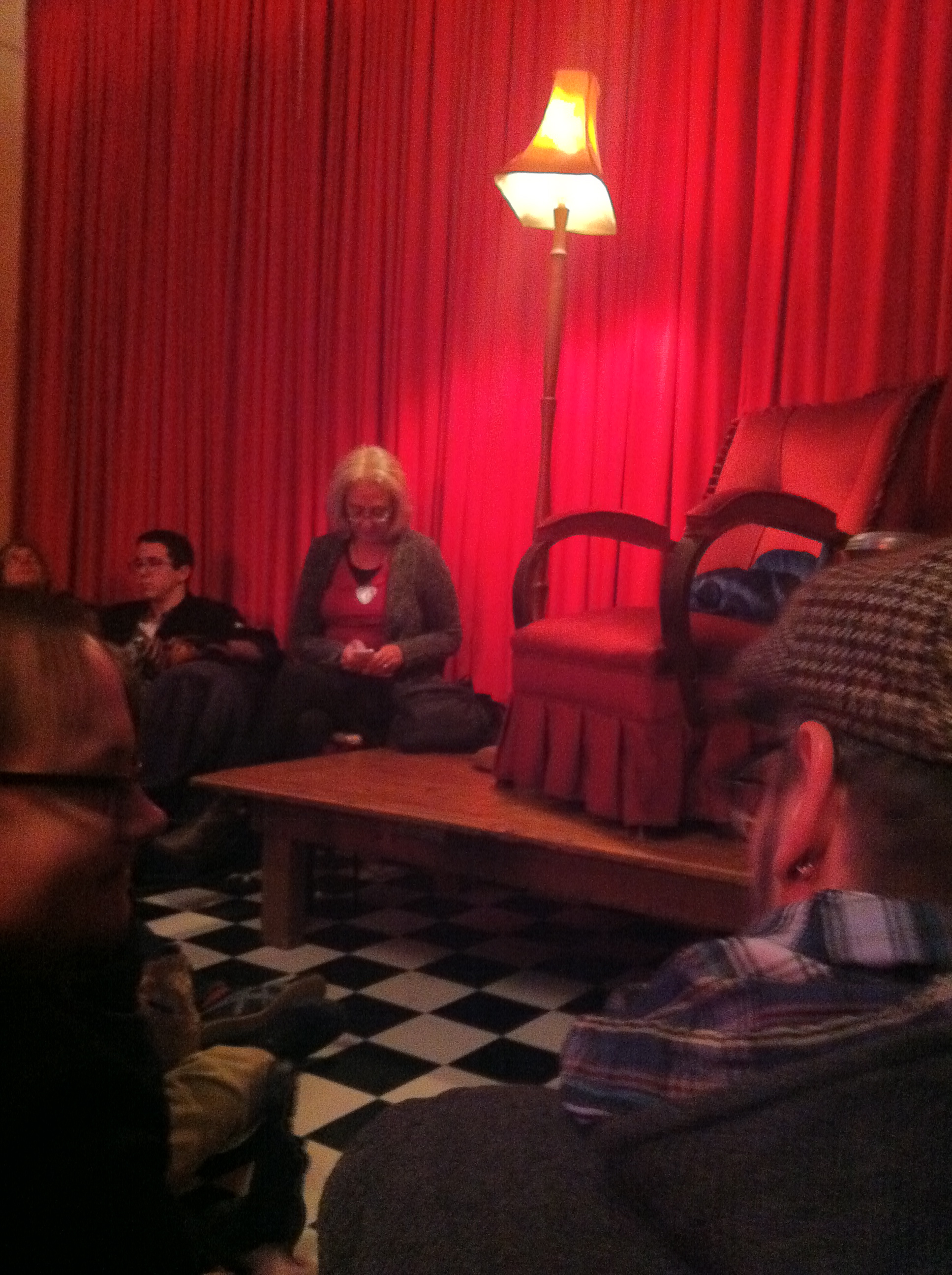
Penguin Plays Rough had a very different feel. It was my second time there as well, but my first at the new venue. The front section of an old warehouse has been curtained off from what I assume is the living space further back. The heavy red curtains lend a suitably theatrical atmosphere to the chequered lino floor, cosily ill-assorted couches and armchairs around the walls, and wooden podium with iconic red chair and standard lamp. By the time we arrived all but one of the sears were taken, and no mercy was shown to our elder status. We found a place on the lino. (At the first break in proceedings when we stood up to stretch our legs, I was shocked to discover a pack of young people moving in to claim the space we were relinquishing – behind us, in the tiny space between the front door and the first heavy curtain, they had been standing three deep, envying us our vantage point.)

We were physically uncomfortable, but we were warm, and we were part of a cheerful crowd. Many people were drinking mulled wine. Those in the know – and they seemed to be many – had brought their own mugs. Pip Smith, who edited and published The Penguin Plays Rough Book Of Short Stories, was a brilliant MC, using words like ‘awesome’ and generally exuding a mi casa es su casa aura. With one possible exception (he said humbly), the readings were terrific. The advertised readers were Emma Dallas (a character sketch of an inner west personality), Ryan O’Neil (a piece about depression that would have been scary if it wasn’t so brilliantly playful), Sam Twyford-Moore (a tale of travel, crosscultural romance and writerly rivalry), Jess Bellamy (letters to celebrities whose dysfunction feeds the tabloids, which became retrospectively more substantial with news of Amy Winehouse’s death yesterday), and the star of the evening Tom Cho. Tom read from ‘The Attributes of God’, a story that will be in a book he describes as being about the meaning of life. I wouldn’t have minded the physical discomfort of the evening anyway, but hearing this story would have been worth even more suffering. ‘God is love’ has taken on new meaning for me. He ended with a YouTube clip of otters that, far from being gratuitously cute, was a perfect accompaniment to his story.

Penguin Plays Rough doesn’t have an open mic. They do have ‘wild cards’: anyone can sign up at the door to read, and a selection of those who sign up are interspersed between the advertised readers. On Saturday we had an essay on relationships between the genders with a focus on schoolyard handball, a piece that Pip Smith described as a theatre review written by James Joyce … and me.

Yes, I put my name in the ring again, which I wouldn’t have done if I’d realised that PPR is actually a short story event and I only had a couple of sonnets and a dog poem in my pocket, and even more definitely not if I’d known I was going to be at the end of the evening – after Tom Cho and the otters. Astonishingly, the whole audience stayed put and even seemed to enjoy what I had to offer.

These are the first two times I’ve ventured to read in public. It’s not so bad.

Added later: I forgot to mention that I met Adrian Wiggins there, the mover behind the Sydney Poetry web site. He has uploaded some wonderfully atmospheric photos to facebook. Mercifully he had to leave before Tom Cho’s and my moments in the chair, so we don’t appear, except in the background of one of the shots.

Byron Bay

See if this doesn’t make you want to have a holiday in Byron Bay, especially if you’re in wet wet cold cold Sydney just now:


Asia Literary Review 19 & 20

Stephen McCarty (editor), Asia Literary Review Nº 19 ([northern] Spring 2011) and 20 (Summer 2011)

[Note added in 2021: the links in this blog post are all broken, except for those in journal title above, and the cover images, which still work for subscribers to the Asia Literary Journal.]

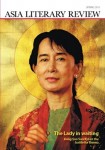
The cover image of Aung San Suu Kyi and the accompanying line ‘The Lady in Waiting’ announce that Asia Literary Review No 19 has a focus on Burma. The halo behind her head may seem to suggest a cheerful postmodern irony, but none of the irony, and very little cheerfulness, penetrates beyond the cover. The only appearance of Aung San Suu Kyi is an interview, effectively an extended sidebar to ‘The Generals’ Celestial Mandate‘, a grim account by Bertil Lintner of the world’s oldest continuous military dictatorship. The lady in waiting’s statement that there is great hope because so many young people are joining the democratic movement is like a tiny ember glowing in the horrendous darkness of state murder, incarceration, torture, and corruption. The Burma theme is continued in a number of pieces. Jack Picone’s ‘Planet Pariah‘ is a photo essay on life on the Thai-Burma border, where refugees, mostly Karen, live perilous and sometimes heroic lives. Incidentally, it brought home to me what an inspired piece of television SBS’s Go Back to Where You Came From was – having seen the reality TV version of refugees struggling to survive in a country that hasn’t signed on to the UN Convention, I found it easier to absorb information presented here in a more traditional mode. ‘Surveillance‘, a short story by Devan Schwartz in which the protagonist is broken in as an agent of the military, reads as a compassionate commentary on the former Burmese intelligence agent currently in the news in Australia (‘Maybe they kill 100 or 150 because I order them to do that. It’s not their fault, my fault. If they didn’t kill, they get killed too‘). There are poems by a political prisoner known only as Jimmy and by Ma Thida, a writer now practising medicine in Rangoon who has previously spent six years in prison.

Things don’t get any more frivolous when the journal moves away from Burma. In the photo essay ‘Qi Lihe’, Stephen J. B. Kelly explores the plight of impoverished Muslims driven from the increasingly arid countryside of northwest China to a scarcely less bleak life on the outskirts of Lanzhou. John Evans’s ‘Blood Money‘ is an ebullient but desperate tale about professional kick-boxers in Korea. In Meira Chand’s story ‘The Return‘ a young man comes home in disgrace from employment in Hong Kong that had been his family’s hope of financial salvation. These pieces contain a lot that’s rich, but it’s a grim world they inhabit.

Hsu-ming Teo’s ‘Fables of a Fractured City‘ departs from the pervasive grimness. The city of the title is, delightfully, Sydney, ‘the most Asian of Australian cities’. The fractures of the title are the four points of the compass, but also the disjunction between mainstream and Asian perceptions of the city: is the south to be represented by Cronulla, notorious for the 2005 riots, or by the fabulously multicultural ‘temple-land’ of the south-west?

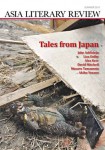
Just as I’d finally got around to reading issue 19, issue 20 arrived in my letterbox. Having made the former wait, the least I could do was move the latter to the top of my teetering bedside pile. The image of a broken Godzilla toy lying amid debris with the line ‘Tales from Japan’ gives an accurate account of its content. All but roughly 20 of roughly 200 pages are related in some way to Japan.

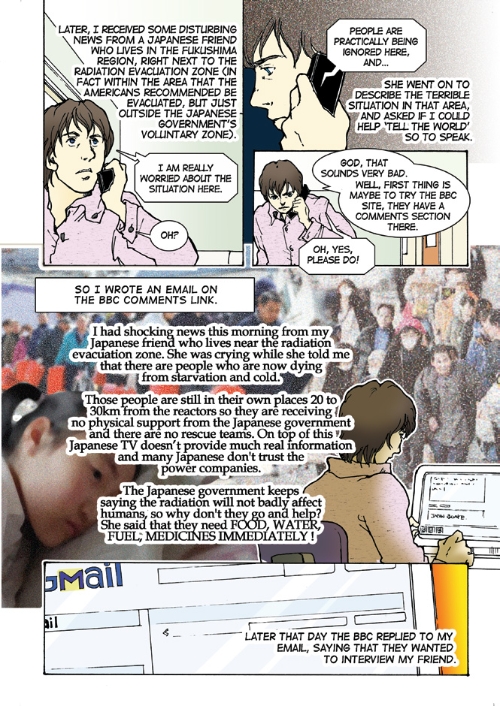
Perhaps the most interesting items are those that deal with the March earthquake, tsunami and nuclear threat. Jake Adelstein’s ‘The First Responders‘ is a fascinating account of the role the yakuza played in the immediate aftermath of the disaster, and the history behind their surprising (to me) civic responsibility. While government agencies were locked in bureaucratic straitjackets the criminal organisations moved swiftly and efficiently to bring aid and maintain order in shelters where there were reports of violence and sexual assault (a yakuza organisation sent 960 ‘peace-keeping’ members across the nation, while the National Police Agency managed 30 officers). Masaru Tamamoto analyses the government’s failure to respond flexibly and effectively in ‘Conformity, Deference, Risk Aversion: Parsing Japan’s CDR Complex)’. In ‘Reaction to Disaster‘, a manga-like comic by Sean Michael Wilson and Michiru Morikawa, a British resident of Southern Japan tells his story.

There are two short stories set in the aftermath of  the earthquake – by authors described at the back of the book as a ‘Singapore-born American novelist’ and a US expat who has ‘lived most of his life in Japan and Thailand’. I felt uneasy about them, as if it might be too early for fiction-writers to exploit these terrible events without disrespect being part of the package.

Other stories and poems move away from the recent news: a crosscultural relationship blooms and dies beneath the cherry blossoms and the fires of Obon; the great poet Basho has an inconclusive encounter with a young woman, also as the cherry blossoms fall; a man is slated for ‘voluntary’ euthanasia in a dystopian future; a depressed and overworked nashi farmer falls in love with a bird.

As this is an English-language journal, it’s probably not surprising that very few of the writers are Japanese – just Masaru Tamamoto, the poet Akiko Yosano (1878–1942), whose ‘Four Poems from the Kanto Earthquake of 1923‘ are perhaps the high point of the journal, and the poet Gina Barnard, who may not be the only mixed heritage Japanese writer here, but she is the only one who makes it her subject, which she does powerfully. Most of the other writers are from elsewhere in Asia or are North American or British writers who are living in Japan or have lived there. (Featured artists and photographers, on the other hand, are mostly Japanese, not the least of them being manga artist Michiru Morikawa.) The best known presence in the journal is novelist David Mitchell, author of Cloud Atlas, who is interviewed by James Kidd. The interview addresses possible unease about this preponderance of outside voices:

Having set many of his stories in Asia, from Japan to Korea, China to Mongolia, Mitchell is understandably sensitive to charges of Orientalism. I ask whether he has ever had any reservations, political or aesthetic, about writing in English about Asian culture. ‘I worry now,’ he replies. ‘At the beginning of my career I was too young and ignorant. I read Said’s Orientalism in my early 30s. I remember thinking, “Jesus, this guy would hate me and my books.” But still.’
Today, however, he improvises a response to Said’s hypothetical objections by posing a succession of counter-questions about his ‘right’ to imagine cultures other than his own. ‘Why do you have to be Asian to write about Japan? Why can’t I have a protagonist who’s my age but Japanese? Isn’t there a reverse racism if I say, “I’m white, therefore I have no business writing about non-white people”? By the same rather crap logic, no novelist from India or Pakistan or Africa or even South America has any business writing about the British – an untenable argument leading to a mutually uncomprehending world, right?’

It’s an issue that Asia Literary Review can be seen to grapple with constantly. With the temporary demise of Heat, though, it stands out as a publication in our region that has a deep platform of cultural diversity. I feel my horizons expanding with every page.

Another corner shop

Having lived through the excitement of the coming of Revolver to Annandale Street a couple of years back, this blog is having flashbacks as another corner shop is in the process of being transformed just down the road. When we moved here five months or so ago, the shop on the corner of Edgeware Road and Alice Street was boarded up. We heard rumours that it was to be a coffee shop, but the For Sale sign with its annotation Offer Under Consideration made the rumours seem insubstantial. In recent weeks, all that has changed.

It’s still a construction site and the old milk bar signage is still there, but things are happening. Unlike Revolver, which stayed nameless almost until the opening day, this establishment has announced its new identity: The Wolf & Honeybee Cafe Gallery. Unlike Rod and Chie of Revolver, who kept the neighbours informed on progress with a series of charming bulletins on  the old shop’s boarded up windows, the Wolf & Honeybee’s Conal is silent on the street but has a stylish web presence: a web site, an Eatability listing (which is where I got Conal’s name), and a facebook presence that includes photos of the site being cleaned up and, Art Student take note, intimations that they will soon be calling for submissions of artwork. Unlike the northern end of Annandale, this area is well endowed with coffee places: there’s Petty Cash, the Bourke Street Bakery in Mitchell Street, Kellerman’s at the pool, the Bell Jar on Alice Street and any number of chains in the Metro around the corner. Still, it seems there’s always room for more. I’m looking forward to the opening, which they hope will be at the end of the month.

The book group go to Bleak House

Charles Dickens, Bleak House (1852, Project Gutenberg version, prepared by Donald Lainsman with revision and corrections by Thomas Berger and Joseph E Loewenstein)

Unless you count comics or movie and TV adaptations, just about anything by Dickens is likely to win me a game of Humiliation (rules at the link). When someone suggested him for our next Book Group title I was happy, and even happier when we settled on Bleak House: Neil Gaiman has been going on about it on his blog recently, and my friend Cassandra Golds says it is a huge presence in two of her recent novels.

Before the meeting:
This is the first book I’ve read on iPhone and iPad, and it was a good experience. The iPad is more satisfyingly book sized, but I was surprised at how much I enjoyed the sense of continual progress that comes with the iPhone. One of the book’s 8041 screens had to be ‘turned’ every couple of seconds – so many words, but in such tiny portions!

I was probably out of harmony with the spirit of the book, not so much because of the electronic devices as because I read it in just a few weeks. It was originally published as a serial over 20 months: if you read one of its 67 chapters a week you would have kept pace. I doubt if anyone much reads at such a leisurely pace any more, and we’re probably the poorer for it. Anyhow, it’s a truly wonderful book which I recommend for when you’re in the mood for sustained, leisurely reading.

I’m confident I have nothing at all original to say about the book itself, so I’ll presume on a little of your time by ruminating on translation issues. Every now and then someone writes an article saying that each generation needs its own translation of [insert name of classic work here]. The idea is that we need to have ancient Latin or Renaissance Spanish served up in contemporary language. By this logic, Italian or Spanish readers need a fresh translation of Dickens every 50 years or so. If so, doesn’t it follow that we need an updating in English just as regularly? After all, the language has changed in the last 150 years, and early 21st century English speakers have a very different, and more diverse, take on the world than their mid-19th century equivalents. Where Dickens could assume that literate English speakers shared a vast set of references – the Hebrew and Christian Bibles, Shakespeare and classical mythology come to mind, and there’s plenty of each in Bleak House – we can no longer do that. Just for the heck of it, I thought I’d see how a hypothetical translator might tackle the opening:

London. Michaelmas term lately over, and the Lord Chancellor sitting in Lincoln’s Inn Hall. Implacable November weather. As much mud in the streets as if the waters had but newly retired from the face of the earth, and it would not be wonderful to meet a Megalosaurus, forty feet long or so, waddling like an elephantine lizard up Holborn Hill.

I thought ‘translating’ this would be a straightforward bit of fun, but by the second word I was in trouble. When I was at university we had three terms, Lent, Trinity and Michaelmas, but surely Dickens isn’t talking about university here? Did the English courts have terms? (Do they still?) What is Lincoln’s Inn Hall, and who is the Lord Chancellor again? And so on. None of this worried me at all when I read the book, but a translator might feel obliged to do something like:

London. The year coming to an end, and the nation’s most eminent judge, the Lord Chancellor, hearing cases in Lincoln’s Inn Hall. Implacable November weather. As much mud in the streets as if the Flood had just withdrawn from the face of the earth, and it would not be surprising to meet a Megalosaurus, forty feet long or so, waddling up Holborn Hill.

There, now that’s more accessible, isn’t it? (No need to gloss the Megalosaurus for 21st century readers, I thought, but the edgy play on biblical and palaeontological versions of prehistory does need clarifying.) It’s not quite Dickens, but then what translation is? Interestingly enough, even being facetious I couldn’t bear to touch what comes next:

Smoke lowering down from chimney-pots, making a soft black drizzle, with flakes of soot in it as big as full-grown snowflakes – gone into mourning, one might imagine, for the death of the sun. Dogs, undistinguishable in mire. Horses, scarcely better; splashed to their very blinkers. Foot passengers, jostling one another’s umbrellas in a general infection of ill temper, and losing their foot-hold at street-corners, where tens of thousands of other foot passengers have been slipping and sliding since the day broke (if this day ever broke), adding new deposits to the crust upon crust of mud, sticking at those points tenaciously to the pavement, and accumulating at compound interest.

In short, I found the novel irresistible, especially for the way it wallows in language. And Cassandra is right – it’s full of echoes of Clair de Lune and The Museum of Mary Child.

After the meeting:
It’s winter in Sydney, and half of us were away, either home sick or visiting warmer climes. Of the five who showed, three had read the whole book, one was a hundred or so pages from the end, and the last confessed up front that he’d picked up a copy in a bookshop, and then thought, ‘Nah!’, though it turned out he had read it 20 or so years ago.

It was a good book to discuss. We talked about Mr Guppy’s withdrawal of his proposal, the death of Little Jo, the use of catchphrases (‘Discipline must be maintained!’), the pleasure of reading bits aloud. Someone knew that the appalling Mrs Jellyby was based on Caroline Chisolm, and the execrable Skimpole on an actual person. We wondered about the politics, the anti-Jewish nastiness (‘Smallweed is a Jew’), the depiction of industrialisation. Someone had thought about this book in comparison to the other Great Works we’ve read, Anna Karenina and The Tree of Man, and found it suffered from the comparison. I don’t know what I think of that. I know I enjoyed it at least as much as the Tolstoy and quite a lot more than the White, but I suppose enjoyment isn’t everything.

I haven’t been deliberately secretive about this blog and its reports on the group, but nor have I deliberately drawn people’s attention to it. If anyone from the group does drop in, welcome! Please add a comment.