Election clerihews

First, as a reminder of past glories, here’s a version of a clerihew I wrote in November 2007:

Kevin Michael Rudd
may turn out to be a dud
but at least we’ll no longer be showered
with the duplicitous spittle of Howard.

The present Labor Prime Minister (long may she reign) presents a considerably greater challenge to the aspiring clerihewer, I don’t want to wait until election night, so here you are, the best I’ve been able to manage:

Julia Eileen Gillard
could star in a remake of Willard,
not as a rat or their misfit trainer
but the love-interest trying for something saner

And this:

Anthony John Abbott
has a habit
when playing for high stakes
of saying whatever it takes.

Go on, do better.

The floods

Pakistan is being devastated by the worst floods in its history. At least 1600 people have been killed, and about 15 million directly affected. The images on the television news are scarifying. This massive disaster doesn’t rate a mention before page 11 of today’s Sydney Morning Herald. I couldn’t see anything in the Herald about how to help.Where are the fund raisers? Where’s the emergency number we can phone to donate? We rallied to the aid of the United States, for goodness sake, the richest nation on earth, after the comparatively minor floods in New Orleans! Are we so distracted by the most dispiriting Australian election campaign in living memory, or is it that the people affected this time are largely Muslim?

UNICEF may not be getting much airplay, but they are on the job:

UNICEF is urgently calling for US$10.3 million to support initial relief efforts in the region to provide emergency healthcare, water and sanitation and child protection to those who need it most.

You can donate online to UNICEF Australia’s Pakistan Flood Children’s Appeal or call 1300 884 233.

Later: I hadn’t donated when Shaista’s comment arrived. She changed my mind about UNICEF, as she’s probably right that they have to go through the unreliable channel of the  Pakistani government. Instead I donated to Oxfam Australia’s Pakistan Floods Appeal, We donate to Oxfam regularly and I’ve got confidence in them as an aid and community development organisation.

Words words words

Ammon Shea, Reading the OED: One man, one year, 21,730 pages (Viking 2008)

Ammon Shea set himself the task of reading the entire Oxford English Dictionary – those thousands of pages mentioned in the subtitle – over a year, and writing a book about it. He spent between eight and ten hours a day for most days of a year in the basement of a library on the actual reading, ruining his eyesight, not doing his health much good, wreaking havoc with his social life. I hope for his sake the resulting book earned out its advance, but I’m sorry to report that I just didn’t find it very interesting. Perhaps inevitably, the actual story of the reading lacks drama, especially as Shea conscientiously avoids distractions, including anything other than dictionaries that might cast light on his reading. The interspersed short essays on things dictionary-related have their nuggets of shiny information, but are generally Lexis Ultra Lite.

What might have been the book’s sustaining backbone is the annotated listing of words that took Shea’s fancy. But the vast bulk of his chosen words are of the polysyllabic latinate or hellenic variety – mataeotechny, materteral, matrisate, matutinal, mediocrist, microphily, micturient, to cite all but one of the words on a spread opened at random. Such words have a scholarly aroma to them, which doesn’t make them uninteresting (though matutinal and micturient are pretty pedestrian), but it does make them same-ish, and many of them show the workings of their construction. The remaining word on that spread is mawworm, meaning ‘a hypocrite with pretensions of sanctity’, and it too smells of the midnight oil: it’s a literary invention (a dead eponym from a forgotten 1768 play by the largely forgotten Sir Isaac Bickerstaffe). If the words themselves are mostly less than enthralling, the comments tend to forgettable persiflage, often of an unpleasantly misanthropic hue. Mediocrist, defined (by Shea) as ‘A person of mediocre talents’, gets this: ‘Nobody wants to be mediocre, but someone has to be. In fact, by definition, most people are.’ H. L. Mencken he ain’t. As the book progresses, in fact, the misanthropy comes to seem less like failed wit and more like confession of a deep malaise in the writer. There’s definitely a sour taste to comments such as this on xenium (‘a gift given to a guest’): ‘Unless you are one of those unbalanced individuals who actually enjoys company, I would recommend giving a xenium such as a pair of used socks, something that says, “Here is a gift – please go away.”‘

Given that one of the appeals of the OED is that it meticulously notes the point at which each word entered the language and the way its meaning changes and develops, it is particularly disappointing that Reading the OED mostly refrains from giving us that sort of information, even giving Shea’s own definitions rather than those of the dictionary. All the same, I was still in there trying to enjoy the book until I reached the chapter on N , which begins, ‘One of the things that has been painfully apparent as I read through the enormity of the English language is just how very little I know of it.’ He’d read the OED but doesn’t know the meaning of enormity. I wish I could believe the irony of that sentence was deliberate. I did finish the book, but with little pleasure.

By sheer chance I started on this book just after reading ‘Infinite Anthology‘, the 2010 British Poetry Society’s annual lecture delivered by Les Murray in May and reprinted in the August Monthly (reprinted, I note grumpily, without any apparent editing to acknowledge that Monthly readers are by and large Australian, as distinct from the lecture’s original audience). Like Ammon Shea, Les Murray describe himself as a collector of words, but when Les talks about words, you can hear his passion for language as a window opening onto truths about class, regionality, history … the whole of humanity. His pleasure in any given word is bound up with where it comes from, what it’s used for, who used it. He’s not impressed by latinate constructions – give me his doosra, camel toe and deadly (meaning ‘excellent’) any day in preference to quisquilious, quomodocunquize or supervacaneous.

One word – petrichor – is mentioned by both writers. Murray’s lecture opened with a list of sixteen words he has submitted to the Macquarie Dictionary over the last couple of years. The list ends:

Petrichor – aggregate of natural oils and terpenes on dry ground; gives off an exhilarating loamy smell when wetted by rain. Said to trigger reproductive cycle in aquatic creatures, fish etc. Discovered by Drs Joy Beard and RG Thomas at the Australian National University in 1964.

Evidently the OED beat the Macquarie to the punch on this one. Shea’s entry, longer and more personal than most, reads:

Petrichor (n.) The pleasant loamy smell of rain on the ground, especially after a long dry spell.
Petrichor
is a fairly recent word, having been coined by Isabel Joy Bear and R. G. Thomas for an article they wrote in 1964. I first came across this some six or seven years ago, thought to myself, ‘What a lovely word,’ and then promptly forgot what it was. I have spent far too much time since then wondering vainly what it was. When I found it there, buried in the midst of P, it was as if a kink in my lower back that had been plaguing me for years suddenly went away.
also see: impluvious

For Shea, petrichor is memorable because it is ‘lovely’, whatever its meaning. For Murray, it’s a word – that is, to call it lovely without reference to its meaning would be absurd. Shea is fairly slapdash in his definition, and goes on to talk about himself; Murray is more precise, and gives us the part of the world the word illuminates, throwing in a pinch of national pride and a dollop of ‘look-it-up’ non-condescension (definitions of terpenes abound elsewhere, after all). It’s worth mentioning that Shea got the second scientist’s name right – it’s Bear, not Beard. On the other hand it seems that Dr Bear is generally known as Joy rather than Isabel Joy, so Murray gets a point for that. Les Murray’s error indicates, it seems to me, that he is writing, not from a written source, but from the extraordinary reservoir of knowledge he holds in his head. (It may also indicate that his editor at The Monthly was less on the ball than the people at Viking.)

Back to Shea: he concludes his introductory section, ‘I have read the OED so that you don’t have to.’ Well, heroic his reading may have been, but that sentence is salesman’s bulldust.

Bony Emily?

Adrian Hyland, Diamond Dove (©2006, Text Publishing 2010)

Detective Napoleon Bonaparte, known as ‘Bony’, had one white and one Aboriginal parent. He appeared in most of the 29 novels written by Arthur Upfield between 1922 and 1996 (the last being finished by other people and published two years after Upfield’s death). Upfield was a bushman himself, who knew what he was talking about when he described life in the outback, and the books’ respectful approach to Aboriginal lore probably played a role over the years in softening mainstream Australian culture’s dismissive racism. My cane-farmer father was a fan. I have read only one of the novels, and that was many years ago, but its title alone – The Bone is Pointed – indicates how the books have dated, how their inevitable racism now stands out and may well overshadow their virtues. If I remember correctly, Aboriginal culture was essentialised (part of Bony’s nature, in tension with his white nature) and generalised (no distinctions are made among the many different Aboriginal cultures and languages).

Adrian Hyand’s Emily Tempest books, of which Diamond Dove (Moonlight Downs in the US and Outback Bastard in Germany) is the first, have a similar set-up. Emily, the university educated daughter of a traditional Aboriginal woman and a white man, belongs like Bony in both worlds and in neither. But we’re definitely in the 21st century: Emily’s mother comes from a particular people, the fictional Wantiya mob, and Emily herself grew up as a kind of foster daughter to the similarly fictional Warlpuju mob; there are Native Title land claims, unscrupulous miners, post-Papunya-Tula art, and complex sexual scenarios.

This is genre fiction. Where else would you find a passage like this:

A maniac, it seemed then, was the only logical solution,and a convenient maniac was what we had in the turbulent, rolling-eyed Blakie. Everything pointed to the crazy bastard. it had to be him.
Why, then, was I beginning to feel the first little pricks of doubt?

The only possible answer to that question is, ‘Because you’re in a detective story, Emily.’ That is to say, we’re not being asked to take this book seriously as a work of social or political analysis. It’s meant to be fun, and it is. Emily herself is gutsy, witty in a hardboiled way, the most engaging detective hero I’ve encountered in a long time.

Talking on The Book Show recently on the occasion of her 90th birthday, P D James reflected on the murder mystery novel:

The classical detective story is … popular in times of anxiety, times of strife, times of war and dangers of war, times of depression. That’s when its comfort is so necessary because at these times one can feel that there are problems facing communities, facing countries, facing the world generally, which really are insoluble, however much money and however much effort you pour into them. Here you have a form of popular fiction with a puzzle at its heart and by the end of the book it will be solved, not by divine intervention or good luck but by a human being, by courage and perseverance and intelligence. So it rather confirms our belief, which I still think we have, that we live in a rational and moral universe.

These remarks could hardly be more apposite. Adrian Hyland has given us a classic detective story set in the midst of the strife, anxiety and apparent insolubility of the continuing dispossession and disadvantage of Australian Aboriginal people. He lets aspects of that dire situation be seen, but offers us the comfort of a puzzle, which is solved, exactly as the Dame says, by courage and perseverance and intelligence. Hyland thanks ‘the Indigenous people of Central Australia’ in the acknowledgements, but makes it clear that his Aboriginal characters belong to a fictional language group and live in fictional country. He doesn’t claim to have anyone’s permission to tell his stories, but then Emily is is not an insider to Warlpuju culture, so there are no secrets being revealed. Hyland is a middle-aged white man who writes in the voice of a young Aboriginal woman. I know I’m another middle-aged white man, so my opinion may need to be taken with a dose of salt, but I think he’s done brilliantly.

A second Emily Tempest novel, Gunshot Road, was published earlier this year. My recommender of detective books says it’s even better.

The Monthly

When I collected my subscription copy of The Monthly from the letter-box yesterday, I had an irrational impulse to drop it in the bin on the way back into the house. Yet again the cover features a photo portrait of a public figure – a politician like the majority of the other cover photos. Here are the last 12 months’ covers:

August 2009: Nick Cave (not a politician, but a media personality, which is the other frequently occurring category of citizen)
September 2009: A photo of the fence at Christmas Island, one of two covers that’s not a portrait
October 2009: Julia Gillard
November 2009: James Murdoch
December 2009–January 2010: Nicole Kidman
February 2010: Tony Abbott
March 2010: Germaine Greer
April 2010: A couple of cherries – the only cover of the twelve to display something like metaphor
May 2010: Tony Abbott again (on a bike this time)
June 2010: Barack Obama (at least he’s not an Australian politician, but it is his third appearance on the cover in 18 months )
July 2010: Bob Brown
August 2010: Julia Gillard again, this time with make-up

If you can recycle your cover ideas so blithely, I can do some recycling of my own, was my unbidden thought.

As it turns out, I’m glad I restrained the impulse to recycle, because in particular of Mark Aarons’ piece which explains in words I can understand how the current approach to polling and policy-making in the ALP is different (and more cynical and strikingly less successful) than in the past, and for David Malouf’s wonderful essay, ‘States of the Nation’, on our Federation. I love this paragraph:

Federation may have established the nation and bonded the people of the various states into one, but nations and peoples, unless they arise naturally, the one out of the other, rather than by referendum or by edict, are likely to be doubtful entities, and the relationship between them will be open to almost continuous question. Of course when they arise too naturally – that is, when they claim to belong to nature rather than human choice – they are dangerous.

How good it is that David Malouf’s sharp, engaged, generous mind is gracing The Monthly‘s pages – and grace is something that Malouf has in spades. What a relief that Louis Nowra’s grumpy ad-mulierem pieces are not to be the dominant voice.

Tobacco and greed

I’ve just sent an email to info@australianretailers.com.au with the subject heading ‘Your ad in today’s Sydney Morning Herald’:

I would appreciate a full listing of the stores you claim to represent so that I can ask the ones I shop at whether they have contributed to the ad in any way, and whether they support its blatantly putting a priority on profits from the sale of tobacco products rather than the health of children. I will then decide whether to continue to shop there.

Thank you

In case you missed it, the full-page ad in question claims not to be questioning the harmful effects of cigarette smoking, but to see the government proposal to mandate plain packaging for cigarettes as ‘the last straw’ in excessive regulation. If you have the stomach for it, you can download the ad open letter as a PDF.

I’ll keep you posted.

The Tree of Man revisited with the Book Group

Patrick White, The Tree of Man (1955, Vintage 1994)

Before the group meeting:
My mother’s letters in the 1970s would occasionally report on her reading. She once transcribed a paragraph from Salman Rushdie’s Midnight’s Children because it seemed to describe the noses of our family. The other day when I read the first page of the Drought chapter of The Tree of Man, I wondered if she’d thought, as I do, that this description of Stan Parker evokes aspects of my father (allowing for the fact that Dad grew sugarcane rather than running a dairy, and was never ‘broad’):

He was respected. He was inseparable from the district, he had become a place name. His herd was small, but of good quality for the herd of a man in a small way, neither rich nor ambitious, but reliable, the cans would always reach the butter factory to the minute, without fail. He went to church too, singing the straight psalms and rounder hymns, in praise of that God which obviously did exist. Stan Parker had been told for so long that he believed, of course he did believe. He sang that praise doggedly, in a voice you would have expected of him, approaching the music honestly, without embellishing it. Standing in the pew, singing. the back of his neck was by this time quite wrinkled, and the sinews were too obvious in the flesh. But he was a broad and upright man.

I’ll never know if she made that kind of connection, but she mentioned the book in passing in a comment on Cancer Ward:

It seems queer but I think Patrick White writes much like [Solzhenitsyn], so simply. I’ve read only one of his, The Tree of Man, & really enjoyed it.

Not bad, eh? She made no claim to literary sophistication, but she picked White’s affinity with the Russians. And she found his prose simple!

The prose is simple, but it’s not easy. It’s also impossible to read fast, lacking what A D Hope believed a novelist needs: ‘a plain style, a clear easy stride, a good open texture of language to carry him [sic] to the end of his path’. But it’s certainly not ‘pretentious and illiterate verbal sludge’, as Hope famously described it. It does constantly pull you up and make you look at a particular word or image – or, if you don’t stop, leave you with an uneasy feeling that you’ve missed something. The point of view frequently moves around within a single short sentence, or rather within a grouping of words between consecutive full stops, since White is a great user of what are sometimes known in the editing trade as frags. Even the very first sentence, innocuous enough at first glance (‘A cart drove between the two big stringybarks and stopped’), has the reader slightly wrong-footed with its abrupt rhythm, its lack of a human, or even animal, subject, its slightly skewed use of articles (‘the cart drove between two big stringybarks’ would be more natural, but of course it would mean something quite different).

The book’s peculiarities, and its arrogance, intimidated me in first year university in 1967. But not this time. True, I came close to genuflecting at the first four chapters, which tell of the primal encounter of ‘the man’, ‘the woman’ and the bush. I wondered if I would be able to keep up with the intensity of the prose for the whole 480 pages. But once the narrative emerged into something resembling a social world, I was less enthralled. In fact I became increasingly irritated. I just don’t believe in the nastiness of most of the characters. I can’t stand the snobbishness of the narrative voice. The drunken Irish shenanigans (read domestic violence, despair, wretched poverty and, towards the end, dubious religion) of the O’Dowds fail to amuse me. The pretentions of the nouveaux riches Armstrongs are awkwardly unconvincing, as is almost everything about the younger Parkers. The book seems to assume that some people, inarticulate or otherwise, have an honest capacity for rich inner lives, while others (most?) don’t, and must settle at best for synthetic souls with occasional exalted glimpses. For all the towering strengths of the book – and they certainly aren’t limited to the first chapters – I became increasingly obsessed with calculating what fraction of the pages I had yet to read.

Perhaps the most striking disappointment is the vast, gaping silence about Aboriginal Australians. When Stan’s cart stops between the stringybarks in that first sentence, it’s definitely in terra nullius. ‘Blacks’ are mentioned twice, once when young Ray refers to their arcane knowledge of how to survive in the desert, and again in the closing pages when the missionary mentions sex with black women as a sign of his youthful depravity. The phrase ‘dream time’ occurs twice. The first time, Stan and Amy have come to an ‘uneasy dream-time’. Since that probably signifies that neither of them was fully awake in relation to the other, the Aboriginal reference may be coincidental, but in the second, near the beginning of the fourth and final part, Stan looks back on his first days at the farm as ‘the dream time’. Here the phrase does refer to a time of creation, of beginnings, and it must disturbingly invoke for any Australian reader now, and surely for some in the 1950s, this continent’s history of genocide, dispossession and cultural appropriation. Invoke without acknowledging. The Irish are despised. The working class barely exist. Aboriginal people have been erased and over-written.

Then, here’s Stan, further down the first page of the Drought chapter:

There were certain corners of his property that he could not bring himself to visit, almost as if he would have discovered something he did not wish to see. […] Once he had been looking at a crop of remarkably fine sorghum that was almost ready to bring in, when he remembered that same stretch of land after he had cleared it as a young man, and on it the white chips lying that his axe had carved out of the trees, and some trees and young saplings still standing and glistening there, waiting for the axe. So that he forgot his present crop and went away disturbed, and thinking.

In a book that makes much of ‘things that are too terrible and wonderful to speak of’ is it too much to imagine that in this moment the thing Stan does not wish to see is the silenced Aboriginal history? That the dispossession on which Stan’s settlement of the land is built is almost forcing its way into the narrative? Surely it’s not just my idiosyncrasy that those white chips of wood remind me of the bones in the red earth of a massacre site in a William Yang photograph?

There may well be hundreds of learned articles about this disturbed silence, but that’s my two bob’s worth.

After the group meeting:
Tonight we met in a pub in Paddington, rather than in someone’s home. All but one of us turned up, and almost half had read all or most of he book. We had an animated discussion. Only one of us really loved the book. One, who may not have read it, considered it to be dated imperialism. The two of us who read the Vintage edition agreed that the cover was absurdly inappropriate (a horse? northern hemisphere trees?) No one shared my unease about the absence of Aboriginal characters: the consensus seemed to be that the original inhabitants of the Parkers’ land had been dispossessed long before Stan and Amy arrived, and that my reading of the white chips passage was drawing a long bow. As someone said, what’s the point of a bow that’s not long? And I still think that the general silence enacts a kind of genocide.

Whatever, unlike Anna Karenina, The Tree of Man couldn’t hold its own against the need to discuss Other Things – the sins of the ALP and the worse sins of the Coalition, our various adventures in work and education, travel and the weather. As always it was a fun evening.

A mighty wind

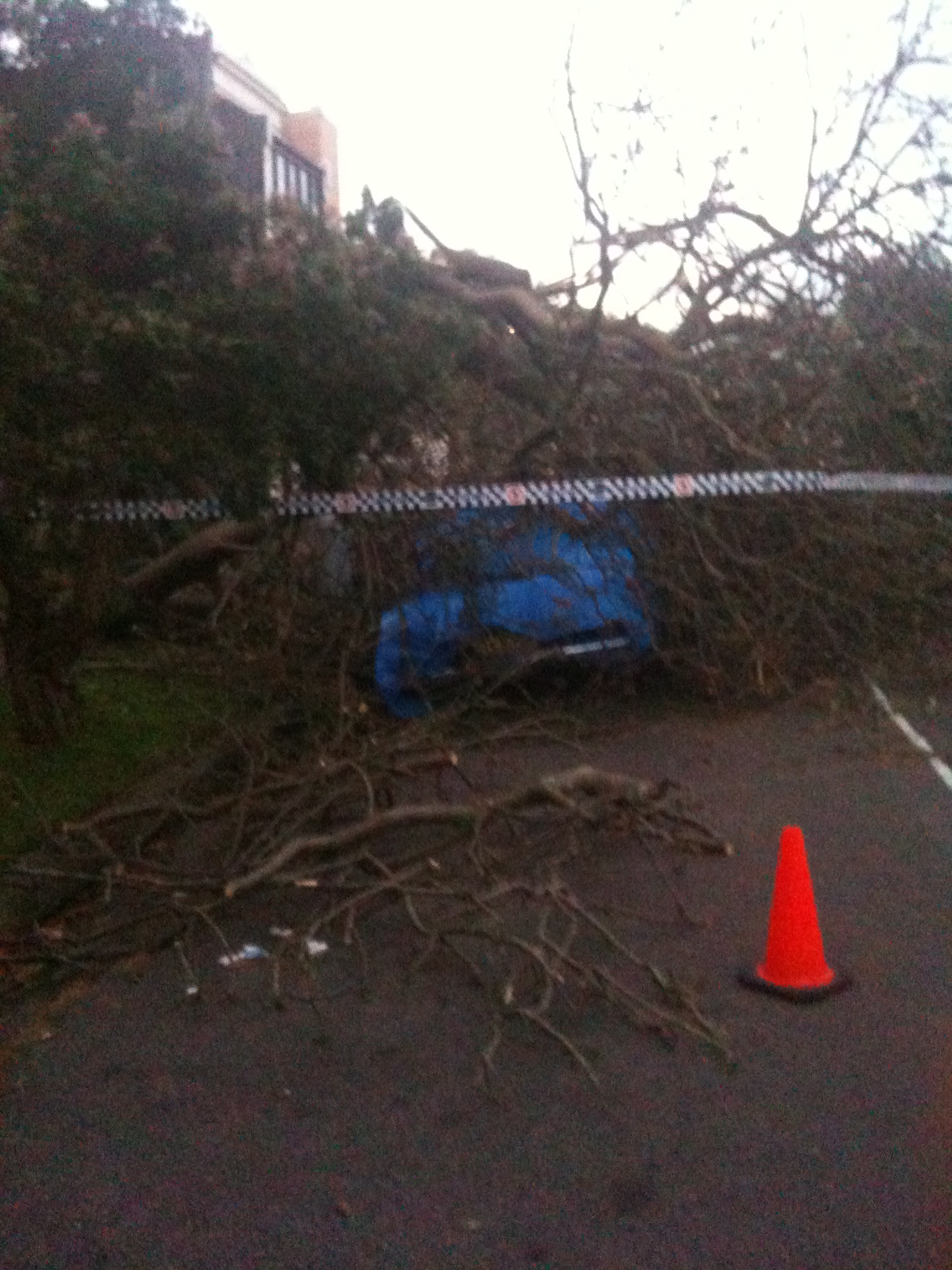
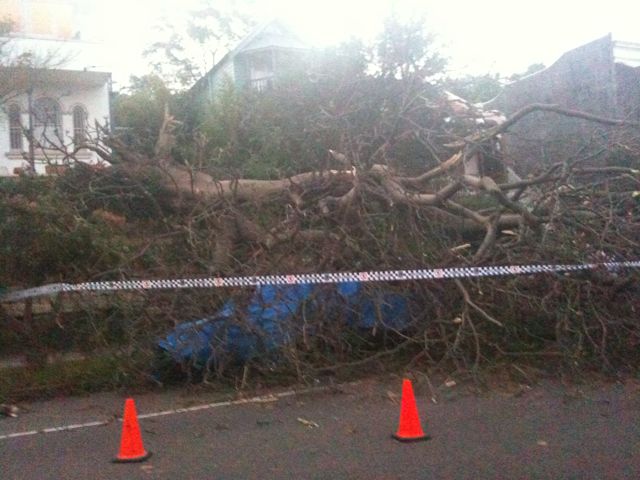
This morning people in my house said to each other, ‘How about that wind?’  Not all the people, mind you: even though I had a disrupted night because of a heavy cold, I didn’t hear a thing. So I was impressed when taking the dog for her afternoon walk  to encounter this proof that the wind had indeed been violent:

Apart from the blue car with the good fortune to be covered by a tarpaulin (whose tarnished bumper bar suggests that the owner might have preferred the insurance bonanza of serious damage), there’s a bright red BMW under those branches, which seems to have escaped with just a few serious dents.

I wasn’t the only one who whipped a phone out in the brief time I was there. Given the state of the light at the time, I’m impressed by how much I managed to capture.

Tomorrow night, after Book Group meets, I’ll  post about The Tree of Man.

Joanna Russ’s Adventures of Alyx

Joanna Russ, The Adventures of Alyx (1976, Baen 1986)

I believe Joanna Russ carried the flag for uncompromising feminism in the science fiction/fantasy community in the 1970s. Apparently she invited James Tiptree Jr out of a fanzine symposium on women in science fiction because as a man Tiptree had no business speaking on the subject (for those who came in late, Tiptree was really Alice Sheldon lurking behind a male persona, and she responded graciously, in role, to the disinvitation). So it’s no surprise that Alyx in these stories is a strong female character. There are three short stories featuring Alyx, little more than active character sketches really, and a much longer narrative, then a final short story that, as far as I can tell, doesn’t have anything to do with Alyx.

Alyx the adventuress from ancient Tyre is a marvellous character, so the sketches – in which Alyx respectively helps a young noblewoman escape a potentially lethal marriage, escapes her own marriage to take up with a pirate, and deals with a gross man who claims to have created the world – hold up well. The first two happen entirely in a version of earthly antiquity. So does the third, though the nasty patriarchal figure has the language and paraphernalia of a time traveller rather than those of a demigod. In the fourth and longest piece, ‘Picnic in Paradise’, Alyx is transported by the Polysyllabic Agency for Temporal Gobbledygook (or something like that) to a future where her skills – and her lack of knowledge of technology – equip her perfectly to shepherd a group of tourists out of a war zone. In this piece the book well and truly transcends the ‘of historical interest’ niche. It’s funny, touching, and sexy in an over the top way. It points vicious satire  at the Prozac generation before the name. Then, just as one is thinking of Alyx as a kind of moral touchstone, one who keeps her head when all around are losing theirs, a role model even, she confounds all expectations by going so far off the rails it’s hard to understand how the story manages to keep us sympathising with her. She’s a real hero, and the story brilliantly refuses to be neat.

Then the last, short story, as far as I can tell, is not an Alyx story at all. A teenage girl in rural USA in 1925 is visited by a strange woman who turns out to be a descendant from the distant future. The young heroine (and we with her) understands only a fraction of what her strange visitor is up to. She helps her to kill another visitor from the future, but we’re left with only glimpses the relationship between the two visitors. And there’s more. It’s a tantalising narrative in which all the huge world-changing events happen offstage and/or in a language we don’t understand. Yet it’s also a satisfying coming of age story. After all, what teenager understands the world s/he finds him/herself part of.

I don’t have fond memories of Joanna Russ’s The Female Man, which I read (in 1970 something) as an undisciplined scream of rage. This book suggests strongly that I may have got it wrong.

If you want a proper, informed, intelligent discussion, I recommend you have a look at Niall Harrison’s review at Torque Control.

Sam vs Goliath

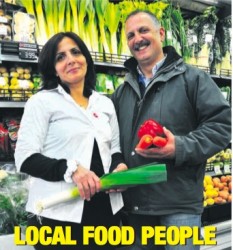
Photo of Katia and Sam Abouchrouche by Edwin Monk, lifted from The Inner West Independent, August 2010.

It’s a wonder I haven’t blogged about Sam’s shop before now. It’s a family business in Booth Street Annandale that’s been there for almost as long as we’ve been living in this suburb. It’s not our closest shop, but we prefer the extra walk (or, let’s be honest, drive) not only because the shop can be counted on to have good quality vegetables and a huge range of everything, but also for the old-fashioned sense of community and even the occasional free Lebanese lesson. There’s Sam, his wife Kathy and their three sons, though the youngest is too young to work in the shop and the eldest has recently gone to work as a lawyer. The shop, which became an IGA and doubled in size a couple of years ago, is in the news recently as Woolworths are proposing to open a store in our suburb.

The August issue of The Independent Weekly has the story (the whole issue is downloadable as a PDF):

Associate Professor Frank Zumbo,who has studied competition  law for over 20 years, was critical of the proposal. ‘The one thing that emerges from that research over the years is that where you’ve got sectors dominated by a very small number of large and powerful companies, you find that they act as a “cosy club”,’ he said. ‘Where there is just a Coles and Woolworths, the prices there are higher than in those markets where there are strong independents – the evidence is clear from ACCC research.’

Mr Zumbo said there was a danger that if Woolworths opened in Annandale, they could engage in two major forms of price discrimination. ‘One is ‘predatory pricing’, where they can sell below cost, for extended periods of  time, to drive out the local small businesses,’ he said. ‘Once that happens, prices will go up at that Woolworths. The other thing they could  do is engage in “geographic price discrimination”, where the prices at the [Annandale] Woolworths might be lower than other Woolworths stores for a period of time, and once the local competition is gone,  those prices will go back up.

‘[Their aim] is simply to saturate the area to suffocate the local businesses. Woolworths, for example, has five supermarkets already in place within a radius of five kilometres [of the proposed Annandale site]. To put another one is designed to remove what remaining oxygen there is from the independents.’

The Independent is nothing if not balanced, and gives the other side of the argument. A Woolworths spokesperson is quoted as denying predatory pricing practices, and the article continues:

‘Speaking generally, Woolworths brings many benefits to communities,’ said Woolworths Community  Relations Manager, Simon Berger. ‘We deliver convenience, range and value for local customers, which encourages more people to do their shopping locally, reduces the number of people shopping outside the local area, and generates opportunities for neighbouring small businesses.’

Well, maybe. But we saw Glebe Point Road turn into something very different when the Broadway Shopping Centre opened. And soon after Franklins and then Coles opened in Leichhardt, which is a lot further away than this new development, we saw three butcher’s shops wither and die in our locality.

Sam and Kathy have their moment in the Independent‘s coverage as well:

Like any good independent  retailer, Sam knows his customers personally. ‘I just want to be delivering what I can for my customers – the more you can deliver the more they appreciate,’ he says.

Surely, though, there comes a point when one must ask whether the ridiculous hours and stress are worth it. ‘It’s not easy,’ Katia concedes, ‘but I love what I’m doing. I love my customers – you see families grow, and share their problems. It’s a real community feel. You get used to working – it’s not easy for me to let it go.’

Go Sam! Go Kathy!

Added on 23 July: It took some finding, but if you’re interested you can fill out the snap poll being conducted by our state member, Verity Firth