LoSoRhyMo 13: A bus stop sonnet

I’m currently reading Sri Lankan Catholic theologian Tissa Balasuriya’s Mary and Human Liberation and will no doubt blog about it in the next few days. But I’ve got to write a sonnet today, and a striking conjunction of my reading with what was happening around me seemed a good subject.

Sonnet 13: Bus stop incident
Tertullian, father of the church,
said,’Woman, you’re the devil’s gate,’
thereby leaving in the lurch
these young ones with whom I wait
near A’dale North Hotel. They toss
their shampooed manes of subtle gloss
and tug (here I avert my eyes)
on skirts that barely reach their thighs,
a generation’s uniform.
One’s loud, annoying, on her phone.
A gust of wind, a change of tone.
She cries like one caught in a storm
but cheerful as a lion cub:
‘Oh Jesus, I’ve just flashed the pub!’

LoSoRhyMo 12: Announcement

I started this month of sonnets with the announcement that we’d sold our house. Read on.

Sonnet 12: Announcement
We’ve bought a house, we sign today,
pay ten percent of far too much
(but we’re in love, so that’s OK).
It’s done up with a loving touch,
it’s near a park  and faces north,
near shops, trains, buses and so forth.
We’re downing size, yes, less is more,
from Three One Seven to Thirty-Four.
Bring us garlands, bring us flowers.
Blow the whistle: end of innings.
Sing a song of new beginnings.
Four signatures, the house is ours.
Soon we fly the empty nest.
We’ve found our home for all the rest.

After a year …

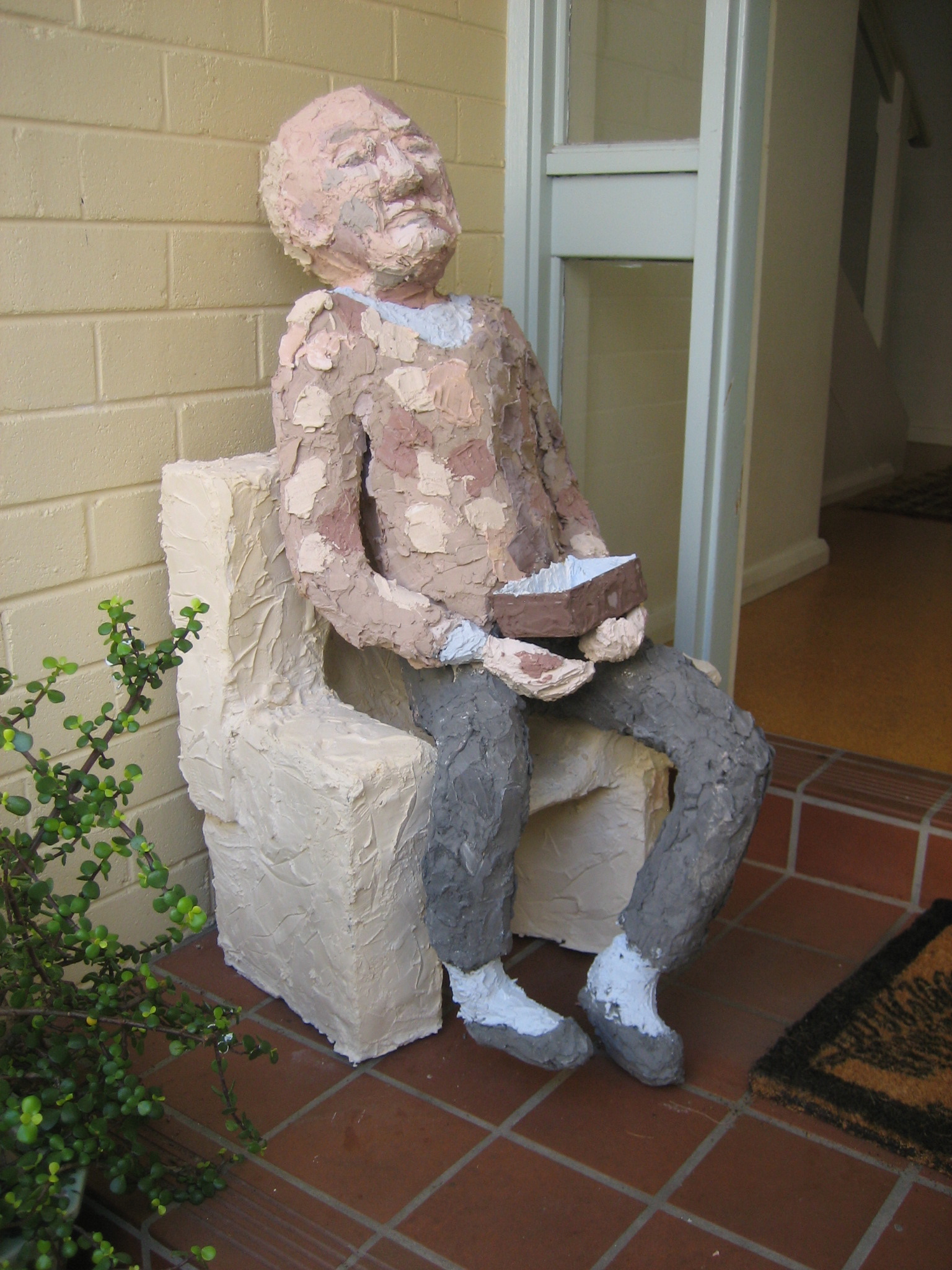
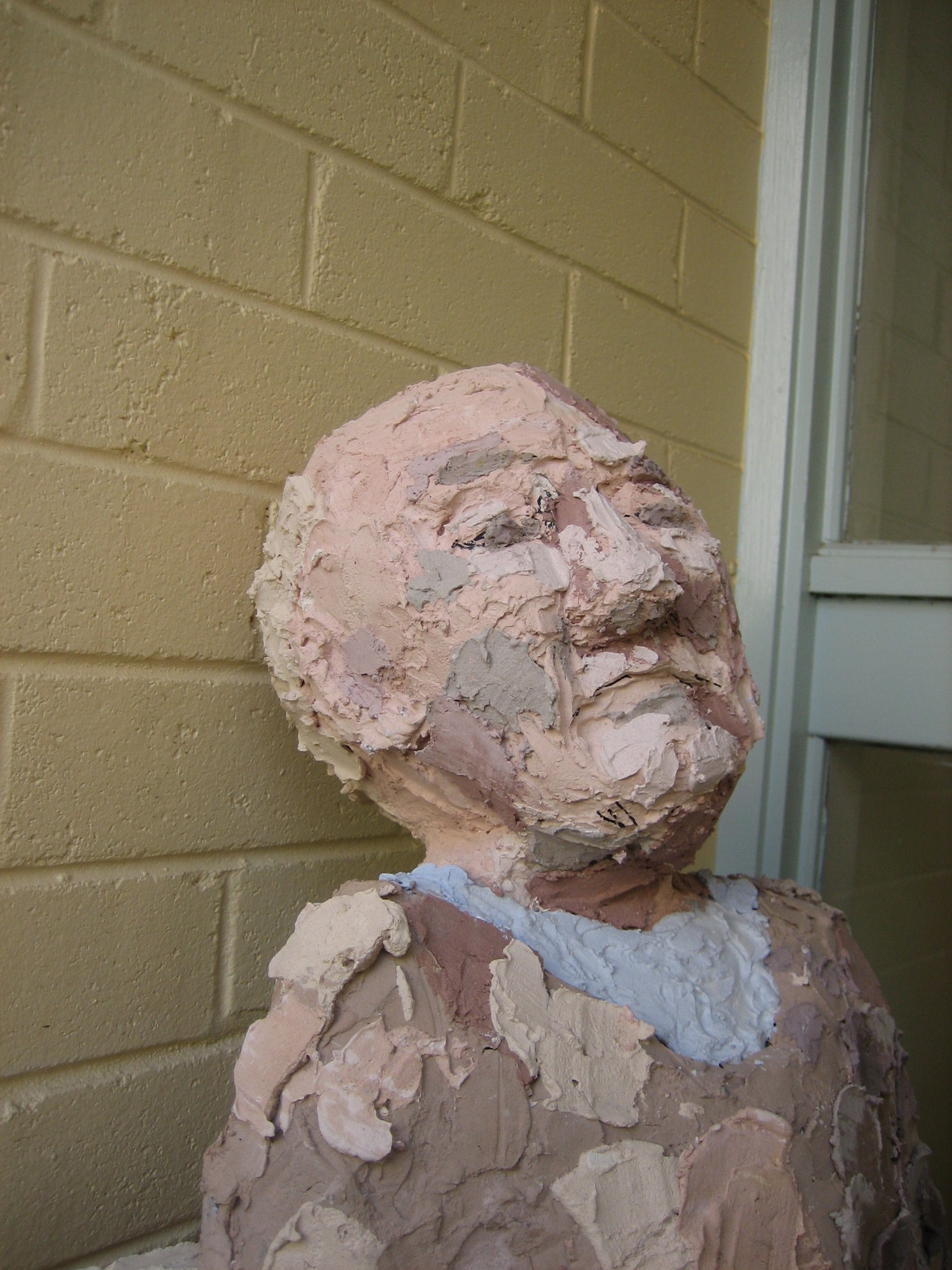
After a year as an Art Student, the woman who wishes her older son would make cheerful movies has created these, among other things:

It's a little startling to come upon this plaster chap at the front door ...


... called 'Locked In', and modelled on a resident in Mollie's dementia ward ...


... and a little disturbing to have this Penny-as-Frida on the bedroom wall.

LoSoRhyMo 11: My mistress eyes like all the sun

A word of explanation: on the Book Show last week, John Tranter described the process of writing Starlight, his most recent book. He fed Baudelaire’s Les fleurs du mal into a computer’s translating program, and took the resulting gibberish as the first draft of a hundred sonnets. Rather than invite comparison by doing anything with Baudelaire, I took an English sonnet, and got Google to translate it from English to Russian to Catalan to Malay to Basque, etc, through about 15 languages, then back at last into English. Astonishingly, some whole phrases endured, but it would be fair enough to say I arrived at gibberish. Then I tortured that into scannable rhyme (though not reason).

Sonnet 11: Sorry, Bill!
My mistress eyes, like all, the sun,
likes the red coral on his lips.
The snow is white. Why same breast (one)?
You have the power, you have black pips.
I’ve seen pink damask, red and white,
but not the roses in her cheeks,
some perfumes, yes, and oh all right,
instead of true love, what she seeks.
I liked to hear his voice, but know
The Sound of Music was more fun.
I will not see a goddess, no!
Lady, in fields the string has run.
At that time, Lord, I was strange love.
Compare! Reject! It’s false. Now shove!

Trivial Pursuit

The new Quarterly Essay, Trivial Pursuit by George Megalogenis, has this quote in bold type on the back cover:

Rudd, Gillard and Abbott sought power in 2010 on the same dangerous premise, that no sacrifice is required to secure our future. Government on this basis is never worth it because the promise of painless change can never be kept. The voters knew it, which is why they spared themselves the inevitable let-down by hanging the parliament.

Um, George, that’s not how this kind of democracy works. The ‘voters’ didn’t get together to thrash out the issues and arrive at a consensus, or even a majority vote, to hang the parliament. No one decided to hang the parliament. A certain number of voters decided they wanted their local representative to come from one side of politics. Another certain number decided they preferred the other side. And again a number of voters decided to call down a plague on both their houses. The aggregate entity known as ‘the voters’ doesn’t have motives, or make decisions. It’s like fate, or the hidden hand of the market, or God. Its ways are not human ways.

Given that the essay was capable of such theologising, I decided not to read it.

Stand Up Virgin Soldiers and LoSoRhyMo 10

Leslie Thomas, Stand Up Virgin Soldiers (1975, Arrow Books 2005)

This is the third novel in Leslie Thomas’s Virgin Soldiers trilogy – drawing on his National Service experience as a non-combatant stationed in Singapore in the 1950s. The original Virgin Soldiers, published in 1966 (here’s my blog post) and made into a film three years later, was pretty much a novel equivalent of much verse produced by soldiers in the trenches – it had the smell of reality about it, but didn’t press too seriously at the experience of being soldier. The emphasis was on the young soldiers’ camaraderie and relatively innocent sexual adventures. The casual sexism, racism and homophobia, though not necessarily endorsed, went largely unchallenged, and there was just enough war stuff to remind the reader of the underlying reality. Times had changed by 1975 when this book was published: the US–Vietnam War was dragging to an end, on television M*A*S*H was in its third and fourth seasons, and feminist voices were being heard. In Australia, Eric Bogle’s ‘And The Band Played Waltzing Matilda’ had been around for four years, though John Schumann and Redgum’s ‘God help me / I was only nineteen’ was still 10 years away. The book, while still mainly featuring jolly japes among the non-combatants, takes a darker turn than its predecessors: we see glimpses of what lies behind the Chinese prostitute’s cheerful façade; a character who shares many qualities with The Hurt Locker‘s protagonist is seen as anything but a hero; the muted homophobic humour is repudiated in a climactic scene, and so on.

The Arrow paperback I read was published in 2005. Perhaps a clue to the book’s longevity lies in the marginal notes in my copy, which was once held by the Oxfordshire Library Service in England. When a character reflects on the awkwardness of the rifles issued to British soldiers, the annotator writes, in pencil so light as to be barely legible, ‘Must have the Nº 4. Nº 5 much better (shorter)’. Later, in a combat scene, the same hand writes, ‘Ah, a Nº 5.’ It seems that at least one reader was led to the book by the nostalgic pleasures offered by its non-soapboxing rootedness in experience.

The Art Student asked, over-casually, ‘How come you’re reading something called Stand Up Virgin Soldiers?’ There were any number of possible answers, all of them true, but what kept me reading was also a kind of nostalgia. When I was the age of the book’s main characters I was in training in a Catholic religious order: we had crosscut saws where they had rifles, and prayed to the Virgin Mary where they vied for the favours of nurses and/or prostitutes, but there are whole pages here that could be describing interactions among us novices. The way the authority figures are caricatured reminds me vividly of the merciless way our wags would impersonate the Brother Master and especially the Brother Bursar.  The narrator even refers at least once to ‘the monastic life of the barrack room’.  I could elaborate, but it’s LoSoRhyMo, so here goes:

Sonnet 10: They were only nineteen
God help all nineteen year old men
in dorms and barracks and the cells
of gaols and monasteries, and then
help all the rest whose heavens or hells
have called or driven them to places
where they have just each other’s faces –
no sister, grannie, auntie, mother,
no uncle, father, just each other.
The quartermaster’s store has rats,
they sing to keep their spirits high
and laugh because they don’t dare cry.
Rats as big as pussy cats.
Their eyes are dim they cannot see
with luck they’ll soon be sixty-three.

Just in case I’m talking a secret language here, I might quote the chorus of ‘The Quartermaster’s Store’, sung on many a bus trip:

My eyes are dim I cannot see
I did not bring my specs with me
I did no-ot bring, my-y specs … with … me.

LoSoRhyMo 9: On walking out of a play

The Art Student, my companion in discourtesy in walking out of the Wharf Theatre on Wednesday night, said this would be a good subject for a sonnet:

Sonnet 9: This is just to say
We walked out of your play last night
from front row seats. We’d hung in there
for five whole scenes. The script was tight,
each actor sound, the set though spare
was spot on, and the vocal coach
had nailed the accents – no reproach
on that score. All these things were fine
but almost from the opening line
I couldn’t, couldn’t feel a thing.
I’d pay to watch two monkeys fart
if done with two boards and a heart.
Last night had timing, lines that sing
and sting. It’s heart that wasn’t there.
Sometimes a pause is just dead air.

Marilynne Robinson’s Home at the Book Group

Marilynne Robinson, Home (Farrar, Straus & Giroux 2008)

This will be quick as my blogging time this month is mostly taken up with writing what poet and commenter John Malone has called, at least by implication, unremarkable sonnets.

In Marilynne Robinson’s novel, Jack, the black sheep of a midwestern Presbyterian pastor’s family comes home for a couple of months, rebuilds some kind of relationship with his youngest sister, now 38 and home to lick her wounds after being exploited by a cad, and fails to reconcile with his ageing father. Perhaps unexpectedly, it was a great success at the book group. Most of us loved it, and those who didn’t were still interested. Over excellent quiches and salad, followed by ice creams on sticks that our host had bought for his grandchildren, we had some of the most animated discussion we’ve had since I joined the group. Several of us are planning to read or reread the companion novel Gilead.

I was just a little smug to be able to report that I’d picked up early on the clues that Jack’s great, lost love might be Black. My recent reading of W E B Du Bois’ Souls of Black Folk meant that I got the hint when Glory asked Jack what he was reading :

‘W.E.B. DuBois,’ he said. ‘Have you heard of him?’
‘Well, yes. I’ve heard of him. I thought he was a Communist.’
He laughed. ‘Isn’t everybody? I mean, if you believe the newspapers?’ He said, ‘Now I suppose you’ll think I’m up here reading propaganda.’

LoSoRhyMo 8: Sydney suburbs – a sonnet

Inspired by Carol Ruff’s ‘Love in cLOVElly’:

Sonnet 8: What’s in a suburb name?
Clovelly has love, Chippendale’s hip.
In Normanhurst you’ll find a man.
A gal in Wingala can’t give you the slip.
Botany’s always good for a tan
on Erskineville skin. In Killara get ill
and then get iller on Miller’s Point hill.
Oh, rest in Forest Lodge, my friend.
In Asquith quit when near the end.
We each hold a suburb dear to the heart –
perhaps it’s for Kensington you want to sing,
feel awe in Dawe’s Point or wear Kuringgai’s ring,
you’re marked by Haymarket or hard for Leichhardt.
Wherever I am on air, sea or land,
I’m connected by Ann&ale’s ampersand.

LoSoRhyMo 7: After reading Seamus Heaney’s Human Chain

Seamus Heaney, Human Chain (Faber & Faber 2010)

Blogging about Human Chain as part of my LoSoRhyMo sonneteering is lighting a penny candle to a star, and not just because none of its poems are sonnets. I  don’t have any pretensions to writing even a pastiche of Seamus Heaney. But a quota is a quota, so I’ll just say the book is something to immerse oneself in, and get on with it. I hope this makes some kind of sense.


Sonnet 7: Northern Ireland / Far North Queensland
Ask me to translate Seamus Heaney
(Derry, seggins, Upper Broagh),
I’ll try lantana, Mirriwinni,
Waugh’s Pocket – my dad’s puzzling laugh
when someone spelled that ‘whore’ – but stet
Church Latin, soil and honest sweat,
Virgil, cards: Bill Markwell, joker,
feared dona f’rentes Greeks at poker.
Wraiths of our fathers thirsting still,
voiceless now Kramastos, Markwell.
Like torches shining down a dark well
may poems give them drink until
they come back to the light of day,
beloved, but not all the way.