Skrzynecki’s Immigrant Chronicle

Peter Skrzynecki, Immigrant Chronicle (UQP 1975, 2002)

This book boasts back-cover blurbs from an extraordinary bunch of Big Names: Kenneth Slessor, Randolph Stow, Rosemary Dobson. But it’s probably the least famous of the blurbers who nails the reason it has stayed in print for 35 years when, say, David Malouf’s or Les Murray’s first volumes are long out of print and fetching vast sums on e-Bay: Stephen Magee announces that ‘Immigrant Chronicles can fairly be claimed to be the best poetical treatment of the immigrant experience, in Australia, since the nineteenth century’. Ah, poetical treatment of a significant historical subject – perfect for study in high school.  And indeed, the book has been set in the Higher School Certificate. This is how Peter Skrzynecki, acknowledging reality, welcomes visitors to his web site:

On this site you will find information about my life which may help you understand some of my poems – especially those set down for study on the New South Wales HSC syllabus.

None of this should have anything to do with my reading the book, but the copy I bought bears the scars of having been ‘studied’, and they exerted a disproportionate influence on me:
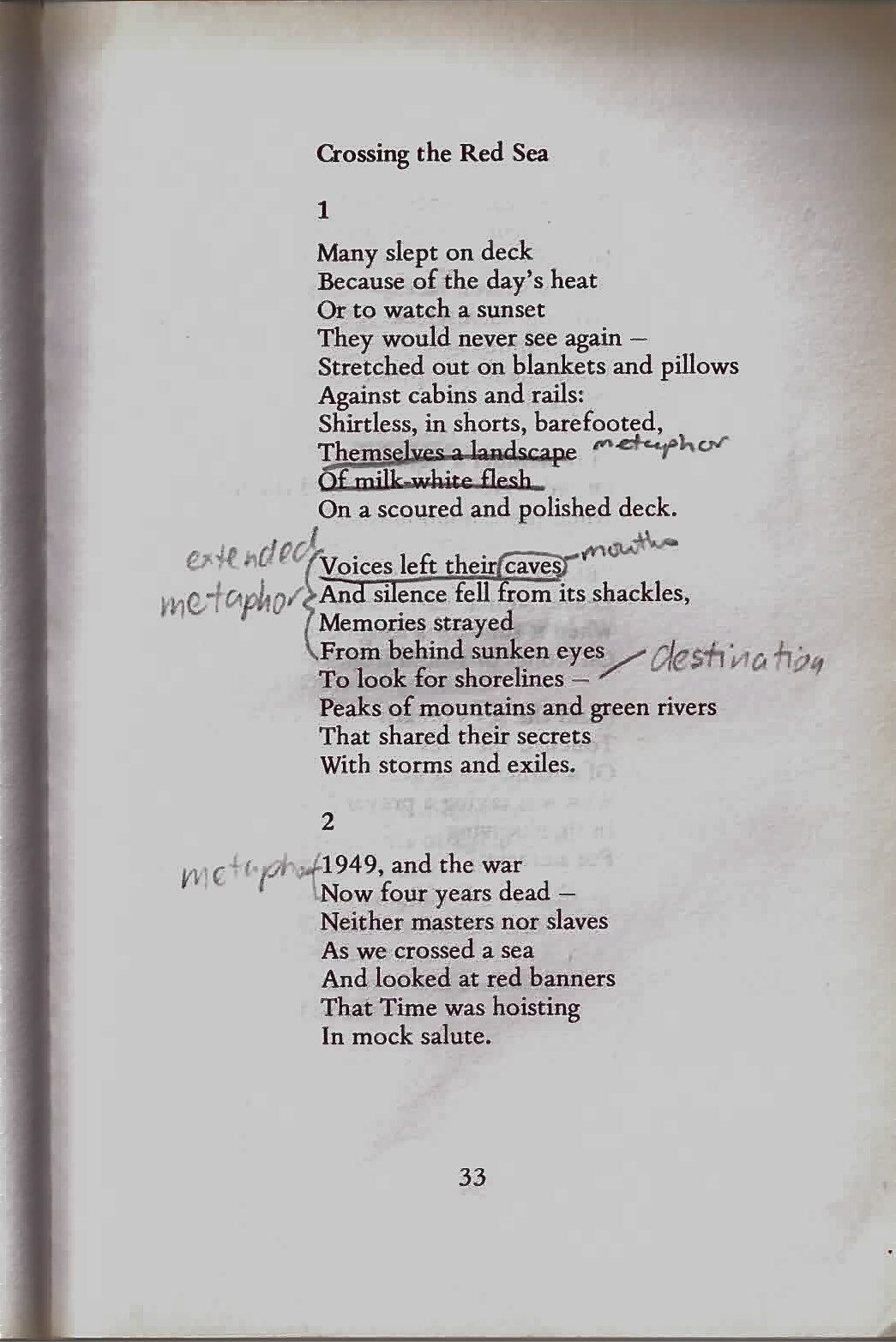
This unhappy student’s search for metaphors succeeds in making the writing look awfully prosaic: for jus one example, if there’s a metaphor in ‘the war / Now four years dead’, it’s been dead a good bit longer than the war has. Yet the poem ‘Crossing the Red Sea’ (of which the above is the first of four pages) is a moving attempt to imagine the post-war emigrant experience.

The book isn’t a verse novel. There are poems about pelicans, a snake, Michael Dransfield, a death mask and so on. But it does encompass a narrative arc that justifies the Chronicle in the title. Apart from ‘Crossing the Red Sea’, there’s the much anthologised ‘Migrant Hostel: Parkes 1949–51‘ (if you click on the link, try to avoid the class notes at the end), and perhaps a dozen more, including some raw and melodramatic poems that seem to be about Skrzynecki’s mother’s experience of the ‘mental health’ system (though he explains on his web site that they are not to be taken as factual in every detail) and a number about becoming a father. A good part of the interest is documentary – that is, the poems are interesting because they inform us about ‘the immigrant experience’, or more accurately an immigrant experience.

Skrzynecki’s novel Boys of Summer was launched at Gleebooks last week – it deals with growing up Polish in Sydney suburbs in the 1950s. So he is still mining the same rich vein. But whereas now, according to the Gleebooks description, there’s a nostalgic flavour to the work, Immigrant Chronicle was written by the 20-something Skrzynecki, and there’s a pervasive, complex sense of the past’s insistent presence, memorably caught in the last lines of the final poem, ‘Post Card’ (which is also representative of what to me seems a peculiar flatness of the poetry). The speaker is looking at a ‘post card sent by a friend’ from Warsaw, his father’s lost home:

I stare
At the photograph
And refuse to answer
The voices
Of red gables
And a cloudless sky.

On the river’s bank
A lone tree
Whispers:
‘We will meet
Before you die.’

A great idea from the Netherlands

Richard Tulloch has given his blog a small roadside rest to tell us about a brilliant bookish idea from the Netherlands:

Each year the Netherlands Book Week committee publishes a novella commissioned from a Dutch author. This little book is then given away by bookstores to customers who purchase books to a certain modest value. Good value for them and the publishers and authors because it stimulates book buying and reading.

Then on the Sunday of Book Week itself, copies of this Boekenweekgeschenk (Book Week Present) become valid train tickets. Anyone clutching a copy of the book can travel free all day on the trains to anywhere in the country. The idea is that readers will meet up with other train travellers on a Book Week pass and run an informal book club session during their journey.

The possibilities are endless! What say the winner of the Miles Franklin was commissioned to write a novella that then became a universal public transport ticket on, say, Henry Lawson’s birthday? And given that Henry Lawson was born on 14 June, why not have a public holiday on the nearest Monday so people can use their book–ticket to best effect?

The Man Who Invented History

Justin Marozzi, The Man Who Invented History: Travels with Herodotus (John Murray 2009)

In the movie The English Patient, the Kristin Scott Thomas character tells a story from Herodotus over the campfire, which apparently resulted in a spike in sales of The Persian Wars. The product-placement dimension of that moment was lost on me. I’d read some Livy at school, and quietly assumed that all ancient historians were alike, concerned with wars and not much else, and generally to be avoided. It would have taken more than an erotically charged Herodotean moment in a movie to shake that assumption. Justin Marozzi has done what Kristin Scott-Thomas failed to do. He’s an English travel writer–historian (with his own web site), at pains to make us know he’s not an academic – more like a Herodotus fanboy. His message in short is something like: Herodotus invented the West, Thucydides sux, and Plutarch double sux. (Those last two aren’t direct quotes – he’s much more grown-up than that.)

Marozzi sets out in this book to follow in Herodotus’s footsteps, visiting places he visited, or at least claimed to visit, quoting good bits from his Histories and reflecting on the enduring relevance of some of his themes. He visits Turkey (Herodotus’ birthplace Halicarnassus, now Bodrum), Iraq (where Marozzi spent a year ‘setting up a nationwide civil affairs program’, whatever that is, but manages to take us with him on a private guided visit to the mostly inaccessible museum in Babylon), Egypt and of course Greece. He finds value in Herodotus’ genial appreciation of cultural diversity and mockery of cultural arrogance (it seems that ‘Everyone thinks his own society’s customs are best’ was a refrain in Herodotus; it certainly is in Marozzi, with many confirming examples). He finds in George Bush’s Iraq and elsewhere validating echoes of Herodotus’ belief that hubris leads to nemesis and his repeated observation that those in power ignore at their peril those who counsel caution. He enjoys and emulates Herodotus’ propensity for sexual titillation, though here he seems to be trying a little too hard to establish his non-academic bona fides, and comes off as a happily married man hoping to pass as a bit of a lad. Above all, he conveys a sense of Herodotus as an excellent travelling companion, a great listener, an accomplished entertainer (apparently he wrote his books to be read aloud, and Marozzi imagines a number of reading–performances for us), a tireless gatherer of information, a cheerful embellisher, and one who got it right more often than he has been given credit for. Maozzi has put Herodotus on my To Be Read list.

My timing in reading this could hardly have been better because of its resonances with other recent reading. Marozzi spends a whole chapter in Siwa, the setting of Sunset Oasis, and includes some photographs. It’s unlikely he had read the novel, but Bahaa Taher, its author, is named in his acknowledgements. He doesn’t mention the theory, a major plot point in the novel, that Alexander the Great may be buried in Siwa, but he does spend quite some time on matters mentioned by neither Herodotus nor Taher: the oasis’s tradition of homosexuality and the prevalence of magic there, in spite of the current Muslim establishment’s disapproval of both. But it’s clearly the same place, and the counterpoint of fiction and travel-writing is fun.

Though Marozzi makes no direct reference to Palestine, one chapter in particular plays well with Footnotes on Gaza. The latter is history painfully gathered from eyewitnesses and survivors of brutal events, a necessary and important counter to the bland evasions of the official story, as recorded by the powerful. But Justin Marozzi’s account of  Southeast European Joint History Project (JHP) reminds us of the dangers of history that perpetuates a people’s view of themselves as victims, a danger that Joe Sacco’s book certainly risks. In a visit to Thessaloniki, not part of Herodotus’ world, but justifying its place in this book because of the light it casts on the nature of history, Marozzi interviews Nenad Sabek, chain-smoking director of the NGO that produces the history. The state of history-teaching in the Balkans as surveyed ten years ago makes Australia’s History Wars look like a game in a kindergarten sandpit. Sebek tells Marozzi, and us, that the school history syllabus

is where you instil into the young a sense of victim mentality, a feeling that everyone around them is their adversary and that’s how it’s always been. … I believe history is one of the fields  where if you teach it badly you produce serious damage way ahead in the future. If you tell a ten-year-old his country has always been beaten up by its neighbour throughout its history, and then years later it’s war, he’s wearing uniform and he’s got a gun in his hands and his leaders are saying, ‘They’re still slaughtering us,’ this is what he believes and he goes on a rampage.

The JHP has produced a set of history textbooks that offer a multi-faceted account of the seven centuries from the emergence of the Ottoman Empire to the Second World War that aims to supplement (rather than replace, which would be politically impossible) the lethal nationalistic-victim texts currently in use. It sounds like a project that could, even should, be emulated in any number of hotspots – Tel Aviv, Ramallah, Belfast, Canberra …

Dorothea, Andrew and Mollie

Dorothea Mackellar and Andrew McLean, My Country (Omnibus 2010)

I’ve always vaguely resented this poem. ‘I love a sunburnt country, a land of sweeping plains’, it seemed to my young self, consigned the lush east coast of North Queensland to some non-Australian limbo. So I was happy to learn that Dorothea Mackellar wrote it as an exercise in reverse cultural cringe while living in England, that there was an opening verse that went on about ‘field and coppice’. I was delighted in a schadenfreude kind of way years ago when I came across a letter from Dame Mary Gilmore in the School Magazine files replying to a request for permission to reprint the poem: the Dame explained loftily that it was unlikely that she had written a poem with such hackneyed images and dreary rhythms. I passed that splendid letter on to the Department of education’s Historian, and hope it is preserved under glass somewhere, but it was unfair. It turns out the poem was just waiting for Andrew McLean to illustrate it.

Penny bought our copy at the Orange Grove Markets this morning to read to Mollie. When I joined them after walking the dog, Penny asked me to have a turn at reading it – I don’t know how many times they had already been through it. Mollie was attentive all the way through, and as far as we could tell enjoyed the book.  So did I. It has to be one of the best presentations of a poem. Ever.  Andrew McLean’s landscapes are superb: the soft English countryside, the drought stricken farmland, the flood plain, the ringbarked gum trees ‘tragic to the moon’, the lush rainforest (yes, it’s there – just not in the only stanza that is usually quoted). The Grand Dame may have been right about the imagery and the rhythms, but there’s something wonderfully complex in the profession of love for an environment so full of challenge and suffering.

Steven Vella at NG Galleries

It seems decades ago, and it probably is, that my eldest niece was living in Sydney with a number of creative young men. The Art Student and I have just come in from the opening of an exhibition of splendid art created by one of them. Steven Vella’s Garden of Natural Wonders [Do click on the link and scroll along for some of the pieces] is the kind of exhibition that has you looking constantly from the artworks to the catalogue sheet, not to see what the piece is called, though some of the names are revelatory, but to see what materials it’s made from. It’s a gleaner’s equivalent of the treasury of a renaissance church, with bean pods, palm inflorescence, feathers, banksia seed in place of precious stones and metals. The religious dimension of that comparison isn’t too wide of the mark – there’s at least one cross, a couple of stupas, and a wall of ceremonial staffs that remind me of the theatricality of Mediterranean Catholicism. Steven’s North Queensland provenance and his Maltese heritage are both strongly present. But then the room is dominated by ‘Medusa’, which if not for its gorgeous flowing lines could be a homage to the Flying Spaghetti Monster:

But you know, my favourite piece is probably ‘Aunt Bibi’s Salad Bowl’, one of the smaller works, which assembles durian skins and a vintage teak bowl, among other things, to create a weird, spiky, domestic icon. Sadly I can’t find a photo, so if you want to see it you’ll have to go there yourself.

The NG Art Gallery is in Little Queen Street, Chippendale, just around the corner from the White Rabbit Gallery, and the exhibition will be there until 8 May.

Sacco’s Footnotes on Gaza

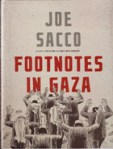
Joe Sacco, Footnotes in Gaza: A Graphic Novel (Metropolitan Books 2009)

As serendipity – or fortuity – would have it, this weekend’s Spectrum supplement to the Sydney Morning Herald announces on its cover that ‘The funny pages get serious’. Inside, in an article meant to provide context for Josh Neufeld’s AD: New Orleans After the Deluge,  Samantha Selinger-Morris tells us:

Long regarded as a guilty pleasure, or suitable for delivering nothing but caped crusaders and candy-coated fantasy, comic books – or graphic novels, as titles with literary ambitions are known – have lately become the go-to genre for meditative and often harrowing storytelling.

‘Regarded by whom,’ one might ask, not without grumpiness, ‘and how recent is lately?’ All these decades after Art Spiegelman’s Maus, Will Eisner’s Contract with God trilogy, Frank Miller’s dark reinvention of Batman, Neil Gaiman’s vast and complex Sandman, yet another feature writer discovers that comics have ‘lately’ become interesting.

Oh well … in Herodotus’ time writing in prose was considered infra dig, and it took more than just a couple of decades for those attitudes to change.

Footnotes in Gaza is a harrowing read. There are no caped crusaders in sight, nothing is candy coated, and the few jokes function not so much to amuse as to reassure that the characters are capable of humour. Joe Sacco has, I gather, pretty much created the genre of comics journalism (of which Neufeld’s AD looks like a rare specimen created by someone else). He is best known for Palestine (1993/2001), which was published with an introduction by Edward Said and is held in high regard by them that know about these things. For obvious reasons I initially hesitated to read Footnotes in Gaza without having read Palestine, but it turns out the title doesn’t mean to imply that this book is a footnote to his earlier one. The footnotes in question are the deaths that are  relegated to footnotes in the historical account, only to fall off the bottom of the page altogether at some stage.

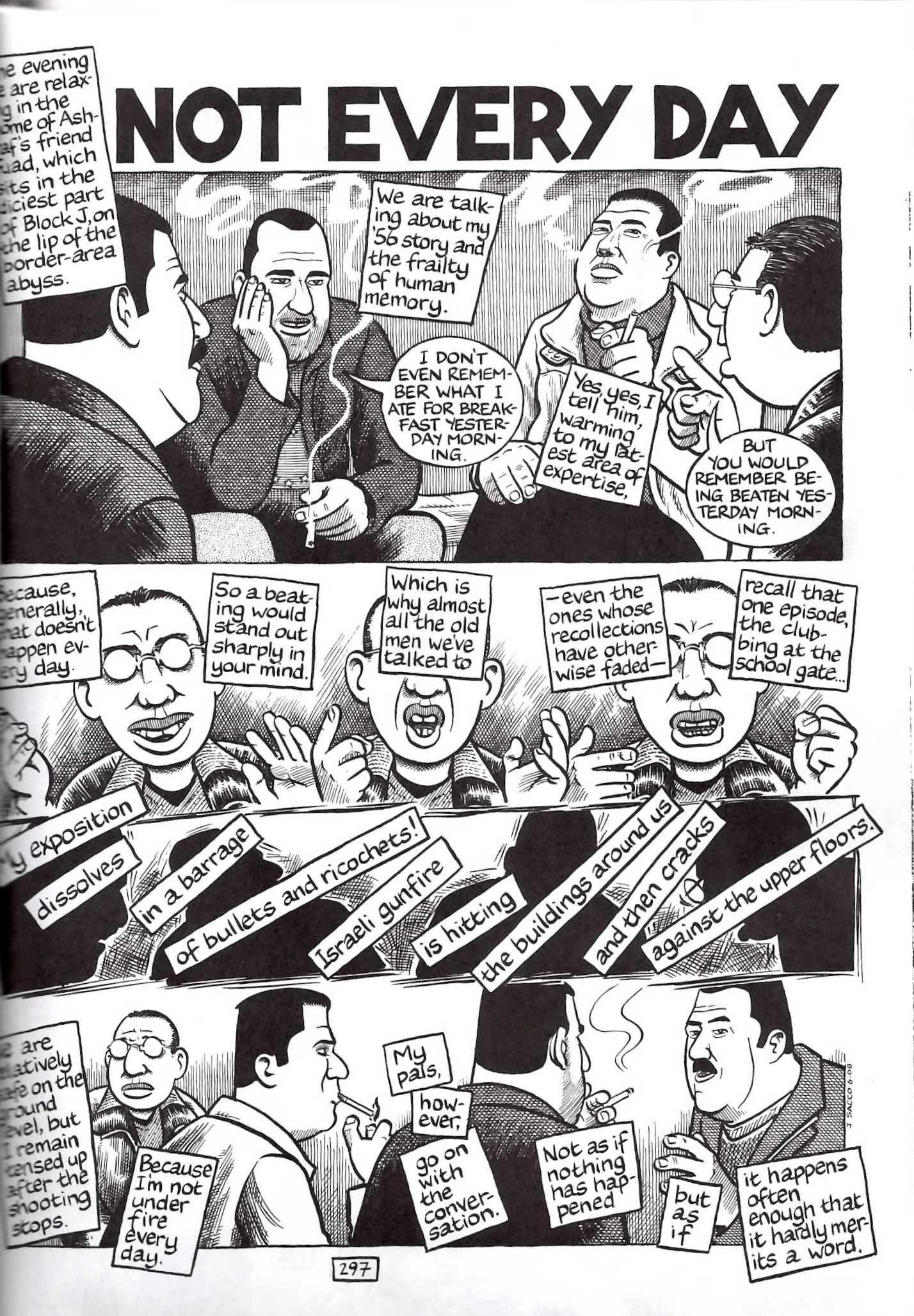
Sacco visited the Gaza Strip from November 2002 to March 2003 to record the stories of eyewitnesses to two massacres that occurred in 1956. The book intertwines the  story of his investigations with the story he uncovers. Again and again, he is asked why he is interested in events of 1956, when the trouble is continuous, the present is just as bad: Israeli bulldozers are destroying people’s homes, walking the streets at night invites tracer fire from an Israeli watch tower, there are endless delays at checkpoints … The impact of this continuity on his investigation is put succinctly in this page (I apologise for the chopped off bits – I couldn’t get it all in without doing severe damage to the book):

Transcript in case you can’t read it or deduce the missing bits:

Not every Day

One evening we were relaxing in the home of Asraf’s friend Fuad, which sits in the diciest part of Block J, on the lip of the border-area abyss.
We were talking about my ’56 story and the frailty of human memory.
[Fuad(?):] I don’t even remember what I ate for breakfast yesterday morning.
Yes, yes, I tell him, warming to my latest area of expertise.
[Joe: ]But you would remember being beaten yesterday morning.

[Joe:] Because, generally, that doesn’t happen every day.
So a beating would stand out sharply in your mind.
Which is why almost all the old men we’ve talked to
– even the ones whose recollections have otherwise faded –
recall that one episode, the clubbing at the school gate.

My exposition dissolves in a barrage of bullets and ricochets! Israeli gunfire is hitting the buildings around us and then cracks against the upper floors.

We are relatively safe on the ground level, but I remain tensed up after the shooting stops.
Because I’m not under fire every day.
My pals, however, go on with the conversation.
Not as if nothing has happened
but as if
it happens often enough that it hardly merits a word.

Sacco displays journalistic scrupulosity in identifying his sources and scrutinising their reliability. The comic-book presentation allows variants to be acknowledged and presented alongside one another with minimal fuss or distraction. It also allows both stories – of 1956 and 2002–3 – to be told with harrowing immediacy. If anyone is tempted to think of the Israeli–Palestinian conflict as somehow involving roughly equal parties, I strongly recommend this book. The Palestinians aren’t presented as saintly victims: the scenes of quiet celebration after a successful suicide bombing or at US casualties in Iraq are very unsettling. Many if not most of the people Sacco interviews, however, want to distance themselves from Palestinian militants, and the Israeli defence force point of view is given in a note at the back. I noticed that while the authorial captions unfailingly refer to ‘Israelis’, the Palestinian characters refer to their tormentors as ‘Jews’. Sacco distances himself from the antisemitism of his subjects, silently and without moralising. I could only wish that some of the Israeli voices, and voices from the Jewish diaspora, that have spoken out consistently against the Occupation might have found their way into these pages, but perhaps that’s asking for a different book.

Sunset Oasis

Bahaa Taher, Sunset Oasis (2007. Translation by Humphrey Davies, McClelland and Stewart  2009)

This won the inaugural International Prize for Arabic Fiction in 2008. If successive winners are as good as this, then it’s a prize to watch. Set in the late nineteenth century, mostly in the Egyptian oasis of Siwa, the narrative centres on Mahmoud Abd el Zahir, who is sent to the oasis as government representative, and his Irish wife, Catherine, who accompanies him on this dangerous assignment (previous government representatives have been murdered by the oasis-dwellers) because of Siwa’s historical connection with Alexander the Great – she dreams of discovering his tomb there. There’s a vivid sense of the time and place, of the complex politics of an Egypt recently occupied by the British, now in effect passing on the mistreatment to the ethnic minority in the oasis, of the challenges of intercultural relationships, of Egypt’s multi-layered past. Catherine and others are fascinated by antiquity, Mahmoud struggles to come to terms with his own experience in recent upheavals, the people of the oasis have their own internecine history. In the oasis, Easterners and Westerners have a long history of self-perpetuating warfare, and various ones of their leaders are convinced that peace can come only when one side of the struggle or the other is completely wiped out. It’s hard not to read this as a sly reference to our current global clash between Easterners and Westerners.

The book is beautifully written, and constantly fresh and surprising. It’s narrative switches effortlessly between Mahmoud, Catherine and a number of other characters including, brilliantly, Alexander the Great. I was initially disappointed by the ending (it’s all right, no spoilers), but on reflection I realised that it opened the narrative out to great depths of meaning.

After all my recent whingeing about reading works in translation, I’m glad to report that Sunset Oasis reads beautifully in English. So much so, I needed to remind myself regularly that it was originally written in Arabic. I found a wonderful interview with Humphrey Davies, the translator, at The Quarterly Conversation, which ends:

The first draft of a book is very heavy lifting. It hurts my eyes in particular; it’s a real strain on my eyes. At the end of the day, I’m pretty gobsmacked. The most pleasurable part is when the first draft comes back from the editor with questions, and then you can see the shape of it. You can start fine tuning and tweaking and coming up with nice little things.

So there you go. This translator gets to have an editor go over his first draft in detail, and is then paid good money to refine the work. This reader considers that extra money well spent – and, take note publishers, that opinion may well translate into sales. Both Bahaa Taher and Humphrey Davies are on my list of people to trust.

I’m posting in a bit of a rush, because this book was a Book Club borrow, and the meeting where I’m to return it is due to happen in about  15 minutes. So here you are, just ahead of the deadline. [I’m returning three books. The other two I couldn’t get past 100 pages. So it’s not only a joy but a relief to have enjoyed this so much.]

Les Murray, Prone to be Tall

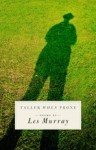
Les Murray, Taller When Prone (Black Inc 2010)

A new book by Les Murray is an event, and I didn’t hesitate to use my birthday voucher to buy this. And I wasn’t disappointed. The book has already been reviewed well by people more articulate and perceptive than I am. Clive James in The Monthly, for instance, may be a little OTT in suggesting the Nobel for Literature and characterising the intemperate and possibly libellous ‘The 41st Year of 1968’ as ‘a sharp rebuke to ageing hippies who imagine themselves to be in sympathy with Gaia’, but he generally does a nice job of illuminating the poetry.

I was struck many years ago by something Francis Webb – who like Les Murray experienced severe depression – wrote about poetry:

I do value in poetry that heightening or ameliorating sense of companionship in human experience. What do we seek of the trusted companion? His honesty, and that half-loaf of comfort. Poetry, as in Dante, can teach; but that is not its primary function. And pure, honest companionship may implicitly carry  comfort within itself, neutralising the often frightening sense of solitude in our affairs.

Much as I admire and enjoy Murray’s poetry, I don’t get much sense of companionship from it.  I don’t have anything against the man – after all he published a poem of mine in Quadrant. And I’m a fan – I’ve been buying his books for decades. I’ve just seen a copy of The Weatherboard Cathedral going for more than $500 at Biblioz.com, but I’m not even slightly tempted to part with mine. But I do have a creeping sense that his poetry doesn’t much like me. I don’t mean just the splenetic outbursts like ‘The 41st Year’ (which, though its explicit targets are amalgamated Hippies and Greenies and New-Classies, none of which I quite am, I manage to take personally). Nor do I mean only the obscure pieces – Robert Gray says in The Australian that about a third of this book leaves him not having the faintest idea what it is about, and not ‘cajoled by the expression into wanting to find out’. I have a sense that the poetry generally doesn’t seem to want to communicate, to expect a relationship with the reader: it’s as if it’s reporting brilliantly on the world sharply seen and heard and thought about, on understandings (and positions and judgements) reached, even on emotions felt, and all it expects of me is that I look on,  admiring its brilliance. To vary the metaphor, the poems are like grenades lobbed over a wall – they may explode in verbal fireworks, release lyrical aromas, or scatter the shrapnel of opinion, but the wall stays there, solid and opaque between us and the thrower.

Or maybe that’s all rubbish. One of the many poems I liked here is ‘The Filo Soles’:

When tar roads came
in the barefoot age
crossing them was hell
with the sun at full rage.
Kids learned to dip
their feet in the black
and quench with dust,
dip again, and back
in the dust, to form
a dark layered crust
and carry quick soles
over the worst
annealing their leather
though many splash scornfully
across, to flayed ground.

When I wrote just now that I liked this poem, I thought of writing instead that the poem ‘spoke to me’, but actually it didn’t, even though I lived in the barefoot age in the tropics, and know about crossing a bitumen road in the summer heat. The poem doesn’t work on me by reminding me of that experience. What I like about it is the way the title adds a clever visual element, the way the disintegration of the rhyme and metre towards the end  mimics the desperate, unprotected run as opposed to the methodical application of protection, and the way ‘flayed’ unexpectedly describes the ground rather than the young feet in the last line. There’s a lot to like. Maybe my grumbling about lack of communication is just lack of sleep. I’d be interested to hear other people’s thoughts.

Asia Literary Review 14 and 15

Chris Wood (ed), Asia Literary Review, Nº 14 and Nº 15

I subscribed to the Asia Literary Review as an act of avuncular solidarity – I wanted a hard copy of issue 14, (northern) Winter 2009, which features ‘Broken’, a story by my niece Edwina Shaw. Having now read two issues, I’m a fan.

Asia, of course, covers a vast proportion of the Earth, from the Philippines in the east to the Arabian Peninsula in the west. The Asia (not ‘Asian’) Literary Review is a vast tent open to contributions from all of it and beyond. It’s an English-language journal, founded by Nury Vittachi in 1999, and currently edited by Chris Wood. It publishes work by writers and visual artists from Asian cultures in translation and originally in English, work by expat and former expat Westerners (like my niece), not all from English-speaking countries, work by Westerners who have engaged with Asia in other ways (there’s an extract from Henning Mankell’s The Man from Beijing in Nº 14), contributions from various Asian diasporas. There are interviews, both original and transcribed from The Book Show, and a wealth of illustration.

In Issue 15, just arrived in my letterbox this week, Hanif Kureishi (one of the interviewees) is quoted on racism:

It really is about language. It’s very traumatic to exist in a world of other people’s descriptions. Your own words have no force.

If he’s right, then the sheer multiplicity of voices here must be profoundly anti-racist. In Issue 14, ‘Noe’s Jiuta-mai’, a photo-essay by Bangkok based Xavier Comas on a traditional Japanese dance form, is followed by  ‘Nova Initia’, Thomas Lee’s first person narrative about a Korean man in the US learning about his father’s past, which in turn is followed by ‘Phallacy’, a laddish sonnet by England born Daljit Nagra (How oft do mates bang on at length about / how well they’re hung …). Issue 14 interviews Gao Xingjian, three times exiled from China for his writing and now living in France:

The writer is a weak individual and cannot overcome political oppression; he can only flee, or he has to write for the government. […] Dante fled Florence because he couldn’t write. Ibsen fled Norway; it wasn’t until Norway began to recognise him that he went back.

In Issue 15, dissident writer Liao Yiwu’s memoir ‘Go South, Go Further South’ concludes:

I had survived prison, while others had died within its walls. And I had survived a devastating earthquake while so many others perished. And hundreds of people are arrested or shot crossing the border. I don’t have a single reason to complain.
I accept my fate, which is to stay, and write.

Heroism has many faces. So does Asia. You get to meet a lot of them in this journal.

And in case I haven’t said it before, Edwina’s story can hold its head up in that multifaceted and exalted company.

Pirate Jenny Maiden

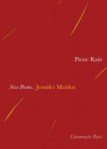
Jennifer Maiden, Pirate Rain (Giramondo 2010)

Jennifer Maiden’s poetry never fails to delight me, so a new book is a thrill. I don’t understand why she doesn’t get rockstar treatment.

Her last book, Friendly Fire, included a ‘cluster’ of poems featuring George Jeffreys and Clare Collins, characters from two of her novels (one of them ‘notoriously unpublished’). Clare had killed her two younger siblings when she was nine years old. George has been her probation officer and is now her mentor, friend and lover. As Jennifer Maiden explained in an introduction to the poems, through these characters ‘the horror-inhibited portions of [her] brain might speak’. First, in a prose piece, they were in the New York of 9/11. Then came the six poems, each of them beginning:

George Jeffreys woke up in [Kabul/Kandahar/London/ Berlin/the White House/Baghdad].
George Bush Junior was on the TV, obsessed
as usual with Baghdad.

and then going to unexpected places. In the five years since then, as seen in Pirate Rain, she has written four more ‘George Jeffreys woke up’  poems (in New Orleans, Rio, Beirut, and a Pirates’ Ship), which are collected here along with one in which ‘Clare Collins woke up in the Paris Hilton’, eight in which Eleanor Roosevelt or Hilary Clinton wakes up somewhere, and one each for Florence Nightingale’s pet owl Athena, Mother Teresa and Grahame Greene, who wake up respectively ‘on the wild cliffs of Crimea’, ‘in London, at /The Inquest for Princess Diana’ and ‘in the Saigon Caravelle/ Hotel in 2006’.

That might sound like a bit of a bore, but it’s actually quite the contrary. Those first-line awakenings are launching pads for a wide range  of poems: a couple come close to being straight action-adventure, others enter strange supernatural fantasy worlds, and always there’s a serious play with the big news of the day. (I would have liked the poems to be dated, which would have made it possible to find out easily at what stage of George W Bush’s foreign adventures the conversations in the poems were taking place. For instance, I seem to remember that the bit where George talks about torture in the Abu Ghraib prison was written before those sensational photographs were made public – and this surely affects how the poem is read.)

Maybe one day I’ll write something in which I figure out why I love Maiden’s poetry so much. Penny says it’s because her mind is like mine. I wish it were so! One thing that I can tell is that she writes about the public world, the world we see on the television, and makes sharp observations and judgements about it. Her portraits of George W Bush and Condoleezza Rice are wonderful. In this volume, there are Jim Cairns, Hillary Clinton and, most touchingly, Don Dunstan. (I want her to do Rudd, Abbott, Gillard, Obama, Kristina Keneally, … … … ) She argues about the nature of poetry, and fame, without every disappearing up her own kazoo. She reports conversations with her daughter without going cute – in fact, the poems involving those conversations generally astonish in the way they bring disparate elements together. ‘Night on water’ does this superbly. I hope it’s fair dealing to quote the whole poem:

night on water
Seeing him was like reading Shakespeare by flashes of lightning – Coleridge on Edmund Kean’s acting.

‘Mum, are you famous?’
______ with insouciant irony asks
my daughter, when one of her friends
says, ‘Is your mum famous?’
on the phone. That flirty incorruptible
compassionate eyebrow arches
at me and I answer, ‘No, just
an ageing hippie who’s had
a few books published,’ wishing that
either this or the fame thing were true,
momentarily, as she repeats my reply.
Later, she comforts as usual,
‘Don’t worry – you’ve got me,’ and I agree
‘Yes,’ as usual, feeling the old nervous
delight at that, think that if she has
as I once wrote, ‘eyes like night on water’,
there is also there the rapid glow
of fireworks on the harbour, remember
how once in a storm season when
the fences were blowing away, she
illuminated me from the bathroom window,
held onto its hinges to stop
it leaving as I gripped the fence sheets
together in the blinding, deafening rain.
Her torchlight and the lightning swung
wildly on my face and she called down,
sincerely and suddenly. ‘Mum, you
look beautiful.’______I’ve thought
ever since, this the most powerful
thing that the concept of beauty can do:
glance into the heart of you, like her,
and keep you going. __I’ve thought the
concept of fame somewhat like that, sometimes:
without too much charm,
money or position, it seems to me
a vague modicum of fame, however
mysterious it may seem to others, gives
one enough currency to survive. But
there’s still no real security, except
_____in some stunning
moment in practical tempestry when
one is seen as one would see, is read
like Shakespeare by flashes of lightning.

I didn’t fold any page-corners down in this book, because I’ll want to reread the whole thing, many time I’m sure.