Voting

In the month I was born, Harry Truman announced the doctrine that was to bear his name: ‘the policy of the United States to support free peoples who are resisting attempted subjugation by armed minorities or by outside pressures.’

In the month the Art Student was born, the trial of Ethel and Julius Rosenberg began.

The first Sydney Gay Mardi Gras was held  the month after our elder son was born.

Our second son was born a week the federal election that made Hawke Prime Minister of Australia.

Children born this month will be able to say, whoever wins, that they were born in the month of the Australian election that acted for all the world as if climate change was an issue that would be addressed (or not) elsewhere.
—-
I voted below the line for the Senate. There was only one person – as distinct from party – on the sheet that I positively wanted to vote for, namely John Faulkner. As I got further down the list I was faced with a series of delicious if inconsequential decisions: how should I order my preferences for One Nation, the Climate Change Denial Party, the Shooters Party, Family First, the Christian Democrats (aka Fred Nile and company), the Sex Party – and should I put some or all of them ahead of the Coalition? I can’t tell you what I decided because I don’t remember, but there was a certain exasperated pleasure in knowing that my vote would do no good to any of them.

Elegant graffiti

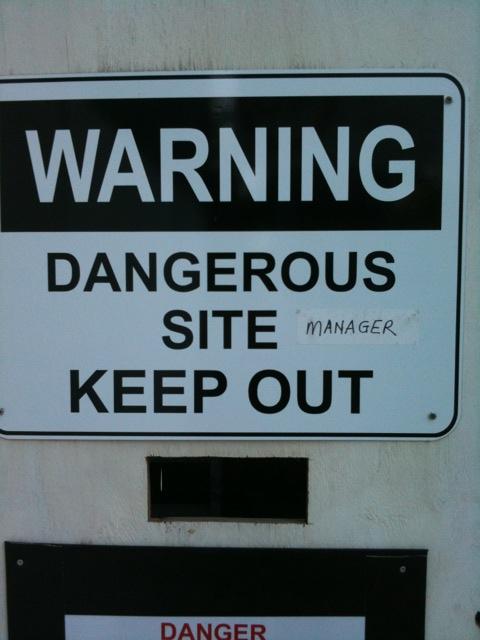
I wouldn’t have noticed this but for a young girl who read it out loud to her mother just as I was walking past. It’s on a building site just around the corner from my place.

Words words words: The Meaning of Everything

Simon Winchester, The Meaning of Everything: The Story of the Oxford English Dictionary (OUP 2003)

I first stumbled on the OED in the Fisher Library at Sydney University roughly 40 years ago. I doubt if I looked up more than two or three words in it, but I did get a whiff of what a miraculous piece of work it is, with its long columns of quotations illustrating how the meanings of every word changed and developed with the passage of time. A couple of years later I read Raymond Williams’s Keywords (a brilliant guide for anyone who wants to chart a path through the spin of political discourse), which cites the OED frequently, and which made me fall in love with the Dictionary at one remove. The Shorter Oxford on the shelf in my last office was consulted regularly, though the Macquarie and then the internet came, , for different reasons, to rival it as authorities of first resort. The thing is, the OED and the SOED are useful, but they are also fun. They’re like water: you go to them because you need them but you stay and take a dip, even immersing yourself for a while, for the sheer joy of it.

To pummel that last metaphor a little, Ammon Shea stayed in the water far too long. The book resulting from his project of reading the whole thing in a year – which I blogged about the other day – is like a report from someone who has just almost drowned. Simon Winchester gives us the view from the shore, takes us diving in occasionally, lets us swim a little, and delivers plenty of draughts of the cool, refreshing stuff itself. This is pretty much the book I had unfairly expected Shea’s to be: a colourful account of the making of the  Dictionary, with lashings of background history, philology and lexicography, a gallery of striking characters and a plethora of shiny quotes. The book captures well an image of the Victorian creators of the dictionary – editors, sub-editors, paid assistants and (in their hundreds) volunteers, summarised in an epilogue as

legions of elderly, usually bearded men, formally dressed in tweeds and gabardine, sitting at high desks, pens in hand, volumes open beside them, sheaves of paper in racks and shelves and pigeonholes behind them, a heavy, cloistered atmosphere of academic rigour and polymathic knowledge enveloping and embracing them like the very air itself.

The proposal that there should be a dictionary that aimed to include the totality of the English language was first put to a meeting of the Philological Society in London in November 1857 by the Dean of Westminster, Richard Chenevix Trench. The first edition was published, half a dozen learned and mostly eccentric editors later, in June 1928. The story of those 71 years makes up the great bulk of this book.

Simon Winchester  has an eye for the shiny piece of information that, while not strictly essential to an understanding of his subject, keeps the company amused. Sometimes he relegates a bauble to a footnote, as when, having described one Hucks Gibbs as a good shot, he adds at the bottom on the page, ‘Fairly good: he blew off his right hand in 1864, but remained keen on the sport.’ But the colour and movement mostly happens in the text itself: after all, Hucks Gibbs was important for his largely unsung role in smoothing out some nasty personality clashes that could have doomed the project. His prowess with a gun is only mentioned, one suspects, to justify the footnote. If you were a lexicographer wanting the technical inside story of this greatest of all lexicographic enterprises, such cheerful detail might be irritating. For the general educated reader such as I, they playfully echo the fascination of the Dictionary itself. (One of many moments that struck me, idiosyncratically I suppose, was on page 194, where Winchester quotes for no obvious reason the definitions of the word lap: ‘a liquid food for dogs, that part of a railway track used in common by more than one train, the front portion of the body from the waist to the knees of a person seated’. I don’t know how he restrained himself from pointing out that this illuminates Emily Dickinson’s lines about a train, ‘I like to see it lap the miles/ and lick the valleys up.’ Even though the book gives lots of evidence of his love of the language, my guess is that there are many examples of such restraint.)

Local Propaganda

Local objection to the proposed Woolworths for Annandale has taken an artistic turn. Riffing on The Independent Weekly‘s ‘Fighting the Woolly mammoth’ headline, versions of this charmingly dynamic poster have been turning up in shop windows.

A man a dog a blog: Rocky & Gawenda

Michael Gawenda, Rocky & Gawenda: The story of a man & his mutt (MUP 2009)

Rocky & Gawenda began life as a blog on the Crikey website. The transition from blog to book is a subject that niggles at the ambition bone of at least some of us bloggers and there’s much to be learned from examples like this.

Rocky & Gawenda is a no-frills conversion: a foreword by a friend and former colleague of the author is followed by the entries from the blog’s first five months – February to June 2009, to be precise – stripped of dates, comments and occasional time-sensitive bits and pieces. Then a postscript by another former colleague gives some back story. From a very quick comparison between book and blog, it seems that little has been changed in the posts themselves beyond a quick copy edit (the dog Rocky now yelps on the man Gawenda’s lap whereas on the blog he whelped, though the copy edit wasn’t all that thorough, as my very quick look showed me Rocky lying prone1 on his back more than once, ‘Giuseppe’ misspelled twice, and the blog’s image ‘Rocky pre–separation anxiety’ re-captioned ‘Post-separation anxiety Rocky’ on page 54). The book, then, is the blog repackaged with minimal fuss.

What is it like to read a blog in book form? A blog entry is a thing of the moment. It invites comment, elaboration, argument from readers. It may be passionate, incisive or profound, but it makes no claim to be the writer’s final words on a subject. There’s no overarching structure to a blog: frivolity can follow hard on the heels of passionate discourse; you can tell the same anecdote a number of times, expecting readers to have forgotten the previous tellings as surely as you have. These things feel completely natural when fed to you by RSS. Encountered in a book, especially with dates removed, they can be disorientating.

These considerations probably account for my rocky start with Rocky & Gawenda. It’s probably also true that the blogger takes a little time to hit his stride. But once Gawenda’s persona had gelled in my mind and I’d understood that the book is a captured blog – something like a mix of diary entries, short essays and memoirs –  the book was a delight.

Michael Gawenda is in the first years of retirement after a career in journalism that culminated in his being editor of the Melbourne Age. He hasn’t quite relinquished the mindset of the driven, dedicated journalist, but in his blog, and this book, he allows his mind and his typing hands to relax away from the disciplines of his trade and explore other ways of writing:

This ‘Rocky and Gawenda’ serial – for that’s how I have come to regard it – which has a beginning but, as far as I know, has no middle or end, is written with no readers in mind. After forty years in journalism, that is a relief and a liberation.

Every morning very early he sets out in his T-shirt and Essendon cap with his ‘mutt’ Rocky and walks on the beach and through the suburbs of St Kilda and Elwood. Rocky’s company allows him to live in the moment, to notice the sky, the sea, the weather, people, dogs. It also allows his mind to wander. A rumination on Kevin Rudd’s way of speaking is interrupted by Rocky chasing after some black swans. An argument about the limiting effects of identity politics is waylaid by a memory of using a heated hacksaw blade as a hair curler. A childhood reminiscence is told three times. We don’t mind. The joy of the book is in its enactment of a mind set free, a benign and fruitful version of retirement.

Michael Gawenda was born in a Displaced Persons’ camp in Austria after the Second World War and came to Australia when very young; he spent his childhood in the Jewish community of St Kilda and then in culturally diverse working-class Fitzroy, was mentored by a bundist friend of his father, aspired to a kind of Easy Rider creativity in his young adulthood, became a journalist and rose to the top of his profession, married and had two children with whom he regrets spending less time than he would wish. All of this I  have gleaned from the book – which incidentally includes a couple of affectionate blog posts from his son and daughter – so you have some small idea of the interesting and emotionally engaging ground that’s covered.

The book ends suddenly, for no apparent reason other than that the requisite number of pages had been filled. The blog, I checked, continued for another five months or so, then it too finished. The post for 17 September 2009, before proceeding to a story from a Displaced Persons’ camp,  intimated that the end of the blog was nigh, and went on:

The writing has taken me in a new and unexpected direction, where memory and imagination meet. I am not sure where this will go, this mixture of memory and imagination, where `facts’ and fictions are intertwined. The `house of facts’ as a friend described them, will remain, but within the house, my imagination will be let loose.

That sounds as if the blog/this book was a bridge. Gawenda intimates that he has wanted to write at some length about Melbourne’s postwar Jewish community. His sketches of those times – a misery-producing children’s camp, pickles and kosher sausages, argumentative old men – are perhaps the most engaging parts of this book. Perhaps that’s where the bridge has taken him.  I look forward to reading whatever lies on the far shore.

————

1 I have a theory that this misuse of ‘prone’ stems from Stokely Carmichael’s famous reflection on sexism in the Black Liberation movement. When asked what position women had in the SNCC, he reportedly said, ‘Prone,’ and the word was flipped over onto its back for a whole generation.

Election clerihews

First, as a reminder of past glories, here’s a version of a clerihew I wrote in November 2007:

Kevin Michael Rudd
may turn out to be a dud
but at least we’ll no longer be showered
with the duplicitous spittle of Howard.

The present Labor Prime Minister (long may she reign) presents a considerably greater challenge to the aspiring clerihewer, I don’t want to wait until election night, so here you are, the best I’ve been able to manage:

Julia Eileen Gillard
could star in a remake of Willard,
not as a rat or their misfit trainer
but the love-interest trying for something saner

And this:

Anthony John Abbott
has a habit
when playing for high stakes
of saying whatever it takes.

Go on, do better.

The floods

Pakistan is being devastated by the worst floods in its history. At least 1600 people have been killed, and about 15 million directly affected. The images on the television news are scarifying. This massive disaster doesn’t rate a mention before page 11 of today’s Sydney Morning Herald. I couldn’t see anything in the Herald about how to help.Where are the fund raisers? Where’s the emergency number we can phone to donate? We rallied to the aid of the United States, for goodness sake, the richest nation on earth, after the comparatively minor floods in New Orleans! Are we so distracted by the most dispiriting Australian election campaign in living memory, or is it that the people affected this time are largely Muslim?

UNICEF may not be getting much airplay, but they are on the job:

UNICEF is urgently calling for US$10.3 million to support initial relief efforts in the region to provide emergency healthcare, water and sanitation and child protection to those who need it most.

You can donate online to UNICEF Australia’s Pakistan Flood Children’s Appeal or call 1300 884 233.

Later: I hadn’t donated when Shaista’s comment arrived. She changed my mind about UNICEF, as she’s probably right that they have to go through the unreliable channel of the  Pakistani government. Instead I donated to Oxfam Australia’s Pakistan Floods Appeal, We donate to Oxfam regularly and I’ve got confidence in them as an aid and community development organisation.

Words words words

Ammon Shea, Reading the OED: One man, one year, 21,730 pages (Viking 2008)

Ammon Shea set himself the task of reading the entire Oxford English Dictionary – those thousands of pages mentioned in the subtitle – over a year, and writing a book about it. He spent between eight and ten hours a day for most days of a year in the basement of a library on the actual reading, ruining his eyesight, not doing his health much good, wreaking havoc with his social life. I hope for his sake the resulting book earned out its advance, but I’m sorry to report that I just didn’t find it very interesting. Perhaps inevitably, the actual story of the reading lacks drama, especially as Shea conscientiously avoids distractions, including anything other than dictionaries that might cast light on his reading. The interspersed short essays on things dictionary-related have their nuggets of shiny information, but are generally Lexis Ultra Lite.

What might have been the book’s sustaining backbone is the annotated listing of words that took Shea’s fancy. But the vast bulk of his chosen words are of the polysyllabic latinate or hellenic variety – mataeotechny, materteral, matrisate, matutinal, mediocrist, microphily, micturient, to cite all but one of the words on a spread opened at random. Such words have a scholarly aroma to them, which doesn’t make them uninteresting (though matutinal and micturient are pretty pedestrian), but it does make them same-ish, and many of them show the workings of their construction. The remaining word on that spread is mawworm, meaning ‘a hypocrite with pretensions of sanctity’, and it too smells of the midnight oil: it’s a literary invention (a dead eponym from a forgotten 1768 play by the largely forgotten Sir Isaac Bickerstaffe). If the words themselves are mostly less than enthralling, the comments tend to forgettable persiflage, often of an unpleasantly misanthropic hue. Mediocrist, defined (by Shea) as ‘A person of mediocre talents’, gets this: ‘Nobody wants to be mediocre, but someone has to be. In fact, by definition, most people are.’ H. L. Mencken he ain’t. As the book progresses, in fact, the misanthropy comes to seem less like failed wit and more like confession of a deep malaise in the writer. There’s definitely a sour taste to comments such as this on xenium (‘a gift given to a guest’): ‘Unless you are one of those unbalanced individuals who actually enjoys company, I would recommend giving a xenium such as a pair of used socks, something that says, “Here is a gift – please go away.”‘

Given that one of the appeals of the OED is that it meticulously notes the point at which each word entered the language and the way its meaning changes and develops, it is particularly disappointing that Reading the OED mostly refrains from giving us that sort of information, even giving Shea’s own definitions rather than those of the dictionary. All the same, I was still in there trying to enjoy the book until I reached the chapter on N , which begins, ‘One of the things that has been painfully apparent as I read through the enormity of the English language is just how very little I know of it.’ He’d read the OED but doesn’t know the meaning of enormity. I wish I could believe the irony of that sentence was deliberate. I did finish the book, but with little pleasure.

By sheer chance I started on this book just after reading ‘Infinite Anthology‘, the 2010 British Poetry Society’s annual lecture delivered by Les Murray in May and reprinted in the August Monthly (reprinted, I note grumpily, without any apparent editing to acknowledge that Monthly readers are by and large Australian, as distinct from the lecture’s original audience). Like Ammon Shea, Les Murray describe himself as a collector of words, but when Les talks about words, you can hear his passion for language as a window opening onto truths about class, regionality, history … the whole of humanity. His pleasure in any given word is bound up with where it comes from, what it’s used for, who used it. He’s not impressed by latinate constructions – give me his doosra, camel toe and deadly (meaning ‘excellent’) any day in preference to quisquilious, quomodocunquize or supervacaneous.

One word – petrichor – is mentioned by both writers. Murray’s lecture opened with a list of sixteen words he has submitted to the Macquarie Dictionary over the last couple of years. The list ends:

Petrichor – aggregate of natural oils and terpenes on dry ground; gives off an exhilarating loamy smell when wetted by rain. Said to trigger reproductive cycle in aquatic creatures, fish etc. Discovered by Drs Joy Beard and RG Thomas at the Australian National University in 1964.

Evidently the OED beat the Macquarie to the punch on this one. Shea’s entry, longer and more personal than most, reads:

Petrichor (n.) The pleasant loamy smell of rain on the ground, especially after a long dry spell.
Petrichor
is a fairly recent word, having been coined by Isabel Joy Bear and R. G. Thomas for an article they wrote in 1964. I first came across this some six or seven years ago, thought to myself, ‘What a lovely word,’ and then promptly forgot what it was. I have spent far too much time since then wondering vainly what it was. When I found it there, buried in the midst of P, it was as if a kink in my lower back that had been plaguing me for years suddenly went away.
also see: impluvious

For Shea, petrichor is memorable because it is ‘lovely’, whatever its meaning. For Murray, it’s a word – that is, to call it lovely without reference to its meaning would be absurd. Shea is fairly slapdash in his definition, and goes on to talk about himself; Murray is more precise, and gives us the part of the world the word illuminates, throwing in a pinch of national pride and a dollop of ‘look-it-up’ non-condescension (definitions of terpenes abound elsewhere, after all). It’s worth mentioning that Shea got the second scientist’s name right – it’s Bear, not Beard. On the other hand it seems that Dr Bear is generally known as Joy rather than Isabel Joy, so Murray gets a point for that. Les Murray’s error indicates, it seems to me, that he is writing, not from a written source, but from the extraordinary reservoir of knowledge he holds in his head. (It may also indicate that his editor at The Monthly was less on the ball than the people at Viking.)

Back to Shea: he concludes his introductory section, ‘I have read the OED so that you don’t have to.’ Well, heroic his reading may have been, but that sentence is salesman’s bulldust.

Bony Emily?

Adrian Hyland, Diamond Dove (©2006, Text Publishing 2010)

Detective Napoleon Bonaparte, known as ‘Bony’, had one white and one Aboriginal parent. He appeared in most of the 29 novels written by Arthur Upfield between 1922 and 1996 (the last being finished by other people and published two years after Upfield’s death). Upfield was a bushman himself, who knew what he was talking about when he described life in the outback, and the books’ respectful approach to Aboriginal lore probably played a role over the years in softening mainstream Australian culture’s dismissive racism. My cane-farmer father was a fan. I have read only one of the novels, and that was many years ago, but its title alone – The Bone is Pointed – indicates how the books have dated, how their inevitable racism now stands out and may well overshadow their virtues. If I remember correctly, Aboriginal culture was essentialised (part of Bony’s nature, in tension with his white nature) and generalised (no distinctions are made among the many different Aboriginal cultures and languages).

Adrian Hyand’s Emily Tempest books, of which Diamond Dove (Moonlight Downs in the US and Outback Bastard in Germany) is the first, have a similar set-up. Emily, the university educated daughter of a traditional Aboriginal woman and a white man, belongs like Bony in both worlds and in neither. But we’re definitely in the 21st century: Emily’s mother comes from a particular people, the fictional Wantiya mob, and Emily herself grew up as a kind of foster daughter to the similarly fictional Warlpuju mob; there are Native Title land claims, unscrupulous miners, post-Papunya-Tula art, and complex sexual scenarios.

This is genre fiction. Where else would you find a passage like this:

A maniac, it seemed then, was the only logical solution,and a convenient maniac was what we had in the turbulent, rolling-eyed Blakie. Everything pointed to the crazy bastard. it had to be him.
Why, then, was I beginning to feel the first little pricks of doubt?

The only possible answer to that question is, ‘Because you’re in a detective story, Emily.’ That is to say, we’re not being asked to take this book seriously as a work of social or political analysis. It’s meant to be fun, and it is. Emily herself is gutsy, witty in a hardboiled way, the most engaging detective hero I’ve encountered in a long time.

Talking on The Book Show recently on the occasion of her 90th birthday, P D James reflected on the murder mystery novel:

The classical detective story is … popular in times of anxiety, times of strife, times of war and dangers of war, times of depression. That’s when its comfort is so necessary because at these times one can feel that there are problems facing communities, facing countries, facing the world generally, which really are insoluble, however much money and however much effort you pour into them. Here you have a form of popular fiction with a puzzle at its heart and by the end of the book it will be solved, not by divine intervention or good luck but by a human being, by courage and perseverance and intelligence. So it rather confirms our belief, which I still think we have, that we live in a rational and moral universe.

These remarks could hardly be more apposite. Adrian Hyland has given us a classic detective story set in the midst of the strife, anxiety and apparent insolubility of the continuing dispossession and disadvantage of Australian Aboriginal people. He lets aspects of that dire situation be seen, but offers us the comfort of a puzzle, which is solved, exactly as the Dame says, by courage and perseverance and intelligence. Hyland thanks ‘the Indigenous people of Central Australia’ in the acknowledgements, but makes it clear that his Aboriginal characters belong to a fictional language group and live in fictional country. He doesn’t claim to have anyone’s permission to tell his stories, but then Emily is is not an insider to Warlpuju culture, so there are no secrets being revealed. Hyland is a middle-aged white man who writes in the voice of a young Aboriginal woman. I know I’m another middle-aged white man, so my opinion may need to be taken with a dose of salt, but I think he’s done brilliantly.

A second Emily Tempest novel, Gunshot Road, was published earlier this year. My recommender of detective books says it’s even better.

The Monthly

When I collected my subscription copy of The Monthly from the letter-box yesterday, I had an irrational impulse to drop it in the bin on the way back into the house. Yet again the cover features a photo portrait of a public figure – a politician like the majority of the other cover photos. Here are the last 12 months’ covers:

August 2009: Nick Cave (not a politician, but a media personality, which is the other frequently occurring category of citizen)
September 2009: A photo of the fence at Christmas Island, one of two covers that’s not a portrait
October 2009: Julia Gillard
November 2009: James Murdoch
December 2009–January 2010: Nicole Kidman
February 2010: Tony Abbott
March 2010: Germaine Greer
April 2010: A couple of cherries – the only cover of the twelve to display something like metaphor
May 2010: Tony Abbott again (on a bike this time)
June 2010: Barack Obama (at least he’s not an Australian politician, but it is his third appearance on the cover in 18 months )
July 2010: Bob Brown
August 2010: Julia Gillard again, this time with make-up

If you can recycle your cover ideas so blithely, I can do some recycling of my own, was my unbidden thought.

As it turns out, I’m glad I restrained the impulse to recycle, because in particular of Mark Aarons’ piece which explains in words I can understand how the current approach to polling and policy-making in the ALP is different (and more cynical and strikingly less successful) than in the past, and for David Malouf’s wonderful essay, ‘States of the Nation’, on our Federation. I love this paragraph:

Federation may have established the nation and bonded the people of the various states into one, but nations and peoples, unless they arise naturally, the one out of the other, rather than by referendum or by edict, are likely to be doubtful entities, and the relationship between them will be open to almost continuous question. Of course when they arise too naturally – that is, when they claim to belong to nature rather than human choice – they are dangerous.

How good it is that David Malouf’s sharp, engaged, generous mind is gracing The Monthly‘s pages – and grace is something that Malouf has in spades. What a relief that Louis Nowra’s grumpy ad-mulierem pieces are not to be the dominant voice.