Jason Aaron & Jason Latour’s Southern Bastards

Jason Aaron & Jason Latour, Southern Bastards: Volume 1: Here Was a Man (2014) and Volume 2: Gridiron (2015)

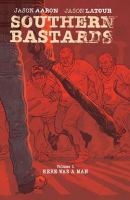
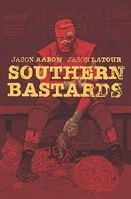
1632150166_b.jpg163215269X.jpgThe first two volumes of this Eisner winning series are a gift from a son who has been an excellent gift-giver since he was very young.

Without detract from the excellence of the gift, or indeed of the series, I have to say they’re not my cup of tea. They tell interlocking hyper-macho stories of sons dealing with violent legacies from their  fathers in a small southern US town, one a hyper-violent sheriff, the other a no less violent fringe-dwelling criminal.

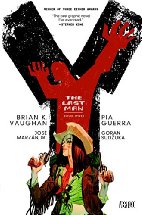
The art is powerful, but generally murky – and though there is one poorly registered image the murkiness isn’t something that can be laid at the printer’s door. In the frequent passages of violence, everything turns red, as in the covers above, a deeply unpleasant effect, and the drawing style, appropriate though it is to the subject, is crude and, well, repellent.

The first volume (issues 1–8 of the original comic) has a story line very like the movie The Judge: a son returns to Southern home after long absence and is reconciled with his father  – though in this case the father is long dead, and the reconciliation takes the form of the son becoming a spectacularly violent vigilante. The second is like the vicious underbelly of Saturday Night Lights: the murderous college football coach is held in very high esteem so long as the team keeps winning.

In forewords to the first volume, the creators (Jason Aaron writer and Jason Latour artist, I think) acknowledge their Southern roots, and their love–hate–fear relationships with the South. The hate and fear are a lot more apparent than the love. The foreword to the second volume is written by a US football player and is largely incomprehensible to me.

The final images of the second volume hold out hopes that things will be different in Volume 3. A young African-American woman soldier is returning home from Afghanistan. Does this prefigure a departure from the ugly-masculine mode of the first two volumes? Or will the violence continue, now with added boobs? I don’t plan on finding out.

Australian Poetry Journal 6:2

Michael Sharkey (editor),  Australian Poetry Journal, Volume 6, Issue 2 (2016)

APJ62.jpgThis is Michael Sharkey’s sixth and final issue as editor of Australian Poetry Journal. I’m missing him already.

The whole journal – a wonderful variety of poems, four articles, two reviews and a handful of photographs – is a pleasure.

It feels almost mean to single any poems out, but I will. In Jane Williams’s ‘Show and Tell’ a sea eagle’s appearance quells a group of tourists’ ‘compulsion to frame / the endless, abridged version of us’. Carol Jenkins’s seven-poem sequence ‘A History of Zero’ revels in the metaphorical possibilities of  paradox that the invention of the zero – of nothing – had vast consequences. Les Murray’s ‘The Scores’ is a characteristically abrasive account of Australian social history, beginning with 2001, then skipping ahead 20 years in each of the remaining five stanzas. Ron Pretty’s ‘Parks & Wildlife’ is a country pub conversation full of sly puns and genial observation. There are a couple of villanelles (and who doesn’t love a villanelle) of which Sarah Day’s ‘Sea Ice’ is seriously splendid. Jules Leigh Koch’s ‘Monastery’ describes a monastery somewhere in Asia, the kitchen full of backpackers about to head off to distant places,

while outside a monk walks along
The Path
chanting a mantra
journeying from one end if his world
to the other

As in previous issues, there are articles on small-scale publishers of poetry and translation, two each.

The presses are Ralph Wessman’s Walleah Press (article by Chris Ringrose) and Kent MacCarter’s Cordite Books (article by Greg McLaren). Reading about these enterprises, I’m impressed all over again by the generosity of spirit and financial daring of these cultural stalwarts. The big surprise for me is Ralph Wessman’s reply when asked how many copies he prints for the first run of a volume of poetry. ‘As few as necessary,’ he says, andgoes on to say that that usually  means 150 copies. That’s not much bigger than my self-published glorified Christmas cards!

The essays on translation are both excellent introductions to the poets being translated: Carol Hayes on the contemporary Japanese poets Hiromi Itō, Toshiko Hirata and Takako Arai, and Zeina Issa on on the Kurdish poet Khalid Kaki. They both quote generously from the translated poet and give fascinating insights into the specifics of translation from Japanese and Arabic respectively.

The next issue will be edited by fabulous  Aboriginal poets Aly Cobby Eckermann and Ellen van Neerven. That makes the missing of Michael Sharkey a lot easier to bear.

Membership of Australian Poetry Ltd gets you a subscription to the journal, and individual issues can be bought via the web site.

Stan Grant’s Australian Dream

Stan Grant, The Australian Dream: Blood, history and belonging (Quarterly Essay 64)

qe64.jpgThis Quarterly Essay topped the poll when Brisbane’s Avid Reader Bookshop asked customers what Malcolm Turnbull should read this summer. I hope he and every member of his cabinet do read it, including Peter Dutton, who famously shunned Kevin Rudd’s Stolen Generations apology. It might spark something in even those hearts. (You can read the bookshop’s letter accompanying the copy they sent to the Prime Minister here.)

The essay is framed as a commentary on a speech Stan Grant gave a little over a year ago, at an Intelligence Squared (IQ2) debate staged by Sydney’s Ethics Centre. The speech was unrehearsed and unscripted because, Grant says, he wanted ‘to look the audience in the eye and hold them’ when he talked about Aboriginal exclusion from ‘the Australian dream’. Surprising no one except Grant himself, it went viral. (If you’ve missed it, here’s the video).

Beginning with the text of the speech, which he tells us he hadn’t previously seen written down, Grant observes that commentators tended to focus on the parts of the speech that fit the litany-of-horrors version of Aboriginal history. He refers us to a dozen writers – historians, novelists, song writers – who have told the horror stories of continuing dispossession, exclusion and brutality, and takes as his subject the contributions that Aboriginal people have made to Australia society, the prospects for a better world. He doesn’t disown the horror stories – far from it – but he sets out to tell ‘a more complete story of the dynamism and potential of Australia and its first peoples’.

For him the most important line in the speech was the last:

And one day, I want to stand here and be able to say as proudly and sing as loudly as anyone else in the room, Australians all let us rejoice.

The essay turns on the hinge of that sentence: while acknowledging the devastation that has been wrought on Aboriginal peoples and the continuing bleakness of many Aboriginal lives, it argues that substantial change is happening and the future could be bright. It doesn’t quote William Gibson, ‘The future is already here, it’s just not evenly distributed,’ but it could have.

Grant takes issue with W E H Stanner’s view that Aboriginal culture – the Dreaming – is essentially unchanging and timeless, so cannot survive contact with the market. He backs his argument with beautifully told stories of his great-great-grandfather, great-grandfather, grandfather and father, each of whom responded to devastating invasion and continuing dispossession with creativity, resourcefulness, courage and wisdom, and each of whom made significant contribution to the broader Australian community – as workers, soldiers, teachers, family men, communicators.

Taken out of context, some passages read as shockingly Pollyanna-ish – like this, from the section titled ‘The Boys of Don Dale’:

The Indigenous experience bends and shifts with the growth of the country. In the midst of catastrophe, Aboriginal people were adapting to this utterly foreign intrusion. The survival and resilience of the descendants of the people of the Australian frontier should be seen as part of the pioneer mythology of this country. At Federation the Indigenous people were assumed to be dying out and would not be counted among the numbers of the Commonwealth. Now Australian law acknowledges native title, Indigenous people sit in our parliaments, and Indigenous art, music and dance have a unique, treasured place in our national culture. We may have rubbed uncomfortably against each other, but together we have enlarged the idea of Australia.

‘We may have rubbed uncomfortably against each other’ must be a contender for all-time world champion understatement. But Grant knows what he’s doing. He insists that the monstrous treatment of the young men in detention in the Northern Territory should not be treated as emblematic of a homogeneous Aboriginal experience. Without denying the bad stuff (‘those tyrants who reduced talk of genocide to a whisper in Europe find their equivalent in those who deny atrocity here’), he argues that to narrowly identify Aboriginality with victimhood plays into the oppression: he calls this the ‘identity trap’. He rejects ‘reliance on a narrative of historical grievance and exclusion’.

It’s a nuanced, passionate, courageous essay. Like Chimamanda Ngozi Adichie, Stan Grant writes about the danger of a single story. He would agree with Rebecca Solnit (whose Hope in the Dark I’m now reading), that despair can be unrealistic, that hope and the recognition of change are necessary and realistic.

I won’t try to summarise the argument any further, but note that Grant doesn’t present himself as a lone voice. On almost every page he is in dialogue, usually amicable and always respectful, with other Aboriginal writers as well as a number of non-Aboriginal ones. Here’s a partial list:

Aboriginal writers in order of appearance (with some links): Noel Pearson • Jack Patten • Charles Perkins • Gary Foley • Chicka Dixon • Marcia Langton • Jackie Huggins • Michael Mansell • Amy McQuire • Ellen van Neerven • Anita Heiss • Kim Scott • Alexis Wright • Bruce Pascoe • Geoffrey Gurrumul Yunupingu • Frank Yamma • Archie Roach • Gavin Andrews • William Cooper • Cecil Grant (Stan’s paternal grandfather) • academic Maria Lane • Yin Paradies • Kerryn Pholi (who publicly renounced her ‘Aboriginal identity’) • Bronwyn Carlson (The Politics of Identity) • Kevin Gilbert • Warwick Thornton • Bess Nungarrayi Price • Larissa Behrendt • Dr Sana Nakata

Writers who aren’t Aboriginal, also in order of appearance: Czesław Miłosz • W E H Stanner • Vietnamese writer Viet Thanh Nguyen • Henry Reynolds (maybe in the wrong list) • Lyndall Ryan • Rosalind Kidd • David Rieff (In Praise of Forgetting) • Charles Rowley • George Megalogenis • Robert Manne • Gaynor Macdonald • Bain Atwood • Robert Ellis • Peter Kabaila (Survival Legacies) • economist Christopher Lloyd • anthropologist Ruth Fink • political scientist Terry Moore • Tony Judt • Jacques Le Goff • Amartya Sen • Geoffrey Blainey • economist Jon Altman • Nicolas Peterson • Michel de Certeau • Julie Lahn

I look forward to reading what some of the people on those lists have to say in the correspondence section of Quarterly Essay 65.
—–
The correspondence up the back of this issue deals with Don Watson’s The Enemy Within. It went to press before the US presidential election, and bristles with assumptions that Hilary Clinton would win. It’s interesting reading all the same.
——
Added later: Lisa Hill has an excellent review at her blog ANZ LitLover’s LitBlog, which quotes liberally.

AWW 2016 challenge completed

AWW2016

This is my mandatory round-up post about the Australian Women Writers’ Challenge 2016. I undertook to read 10 books by Australian women writers. I read 14, which ranged from revelatory and richly entertaining to definitely meant for readers who aren’t me. Here they are. I’ve tried to be clever with the lay-out. My apologies if it shows up on your screen as a jumble.

Poetry:

x

Novels:

Short Fiction:

lp
Michelle Cahill
Letter to Pessoa

x

x

x

x

x

x

Memoirs:

njb&w
Lesley and Tammy Williams
Not Just Black and White

x

x

x

x

x

x

A comic (that’s a graphic novel to those who think ‘comics’ means superheroes or Disney):

alli
Lee Whitmore
Ada Louise


x

x

x

x

x

Essays:

I’m signing up for the 2017 challenge.

My general gender stats: This year I read 39 books by men and 31 by women.This includes at least five (the Y: The Last Man series) that were jointly written by a man and a woman.

Looking Gift Horses in the Mouth

Morgan Parker, Other People’s Comfort Keeps Me Up at Night (Switchback Books 2015)
Mindy Nettifee, Sleepyhead Assassins (Moon Tide Press 2006)
Mindy Nettifee, Rise of the Trust Fall (Write Bloody Publishing 2010)

These three books don’t have a lot in common besides being written by young US women and having been given to me as gifts. They do have a lot going for them, but I’m not their ideal reviewer: my experience of reading each of them wasn’t a million miles away from how I felt recently when I was almost completely unamused by a French rom com in a theatre full of laughing people. Horses for courses.

The equivalents of the laughing cinema-goers were the books’ extravagant blurb-writers.

0986187615.jpg

Other People’s Comfort Keeps Me Up at Night was a gift from a Book Group member who had just spent a couple of weeks in Brooklyn. On its back cover Eileen Myles (on whom the formidable poet character in Transparent is based) says of Morgan Parker’s poems, in part:

They make me high and think like this: Her mind and her thoughts can go anywhere in a poem. She pulls us up short, and when she says ‘the sky the sky’ I feel that expanse … I start taking notes: She is making a map of what human can be … she’s raucous and engaged … indeterminate, visceral … collisions … these are full adventures in scale. There are piles of masterpieces here.

Um, you might be less enthusiastic than Eileen Myles if you’ve never watched an episode of Real Housewives of Anywhere or followed a Miss Black America competition with or without hipster irony, and aren’t titillated by titles like ‘How to Piss in Public and Maintain Femininity’ or ‘On Children, How I Hate Them and Want to Corrupt Them, How You Know I Hate Them, and What That Could Mean’. But the book is alive and vigorous and smart, with plenty of sharp observations about sexism and racism (Morgan Parker is African American). It’s coolly literate, with reference points including Gwendolyn Brooks, Bill Murray, Roy Lichtenstein, Jay Z, and Jean-Michel Basquiat. My impression is that the poems are meant for performance rather than for the page.

I went searching for some lines to give you a taste, and wanted do do it with no expletives or references to drugs or alcohol. Not that there’s anything wrong with that, but it was interesting to notice how hard it was, and then I gave up. The shortest poem in the book, with its echo of Nina Simone, hints at an urge to break out of the dominant mode:

Young, Sassy and Black
I use these words
to distract you.

1424316928.jpg

The two Mindy Nettifee books were given to me by a niece who loved them (though evidently not enough to keep them). Sleepyhead Assassins features some of the most extreme blurbs you’re likely ever to encounter, presumably written by Nettifee’s friends before Donald Trump gave hyperbole a really bad name. Amélie Frank, for example, writes:

She’s poetry’s fierce guardian angel and every poseur’s worst nightmare. She’s goddess energy built for speed. […] Reading her work will give your soul a jump start that will smart for weeks. Prepare to have your molecules rearranged.

I don’t suppose any book could deliver on that promise, so it’s no disgrace that this one doesn’t. These poems are definitely meant for the stage rather than the page: they bristle with bravado and bravura, with striking similes and clever turns of phrase, evoking a clicking audience rather than a solitary reflective reader. The poems that most appeal to me are a little more reflective, especially the ones about Nettifee’s father, who we learn had a tragic life. In ‘The Time Machine Paradox’ she imagines travelling back in time to visit his mother:

i want to give her black stockings and rust red lipstick.
i want to loose her curls and numb her better judgment.
i want to say, Audrey, and show her how it could sound.

maybe, if she could have lived her life, just for a night,
i wouldn’t be here. my father wouldn’t suffer.
none of us would feel this way. instead i would be

just a possibility, a ghost, gathered with other ghosts
at the Armageddon lemonade stand.
i’d be the one that remembered the sugar.

That doesn’t rearranges my molecules, but it does linger after I turn the page.
0984251596.jpg

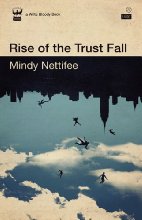
Rise of the Trust Fall comes with more sober but no less Trumpian recommendations. The LA litzine Poetic Diversity says simply:

Mindy Nettifee is destined to be the next Dorothy Parker.

Of course it’s no shame not to be Dorothy Parker. Hardly anybody ever has been. Mindy Nettifee isn’t, and I don’t think she aspires to be: too loquacious, too earnest beneath the veneer of cool, and no rhymes; nothing anything like Parker’s sublime ‘Resumé’ (do look it up).

The poetry in this book is boldly self-revealing: alcohol, recreational and prescription drugs, plenty of sex, nightmares, pop music, childhood memories, heartbreak, bodily functions, all are there along with an occasional touch of epigram (‘Every woman’s closet is a museum of her insecurities’). It’s unfailingly sharp and inventive, sometimes shocking: sure to be a hit at a Spoken Word event. For me though, reading it was more like reading a screenplay than seeing a movie.

There are moments where the words connect. For example, in ‘The Connection between God and Nature Beats Me over the Head with its Earthy Mallet’ (what is it with these long titles?) the city-dweller misses the stars. She chooses the city:

It’s a choice that makes itself for me
every time I am rescued by the warm clotted glow of art galleries;
by the imitation of Django Reinhardt that is really not that bad,
strumming rakishly out of the mood lit punk bar;
by the David Bowie juke-boxing the punchy patrons
at the cheaper bar down the street.

In the absence of starlight
you start looking for the shine in everything.

I can easily imagine Morgan Parker and Mindy Nettifee being sensational presence at Spoken Word events, each in her own way. On the page they’re both a bit too shouty and/or sweary for me. 

Ken Bolton’s London Journal London Poem

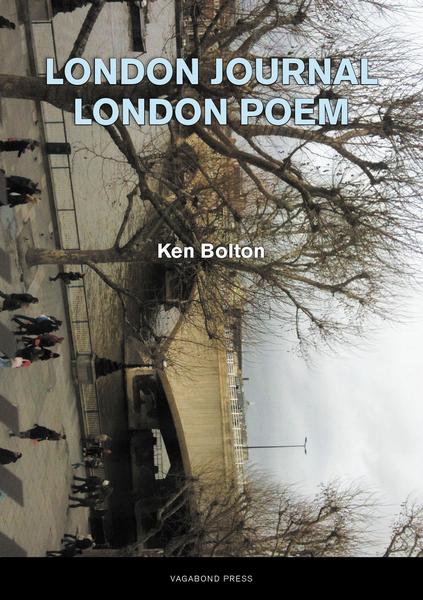
Ken Bolton, London Journal: London Poem (Vagabond  Press 2015)

ljlp.jpg

There are just two poems in this book. In the first, ‘London Postcard – A Quiet Morning at the Wapping Project’, which is 24 lines long, the speaker describes the image of a woman on a postcard advertising what may be a film, and ruminates:

'The fictive life of the tourist'? Or would
I feel this way about this image
anywhere?

The italics seem to signify that the phrase is a quote, but quote or not, it’s a nice way of naming a habit of mind common among tourists – a tendency to make up stories about things you see while passing through, or to see patterns in them. A couple of lines later the speaker rephrases that idea:

I attend to her in the idle moment.

The second poem, ‘London Journal’, begins with a reference to the first poem:

I have an intuition, that maybe that
particular poem – very short –
could serve to hang this – or anyway ‘a’ –
longer poem from. And this is by way
of being that long poem.

I’ll rush in where a proper critic might fear to tread, and say that this longer poem (more than 200 five-line stanzas) enacts touristic fictivity (if that’s a word): it attends to many details in a time that, however busy, could be described as an extended idle moment, a time spent being a tourist.

The speaker and his partner Cath are visiting her son Gabe and Gabe’s partner Stacey in London, with excursions to Berlin and Barcelona. Tourist destinations  – the Brandenburg Gate, for example, or the Miro Museum – are mentioned, but so are tiny particularities of the travelling life: an odd show on television (Pointless as it happens); the book you’re reading; a quest for a strange place someone has told you about, and the anticlimax when you finally find it (a ‘fanatics’ ping-pong club’ in East Berlin); street signs and advertisements that are unsettlingly unfamiliar; evidence of poverty and the problematic status of immigrants; restaurants and bars; encounters with locals; information about the work life of one’s host (in this case, Gabe); lots of people-watching; pieces of a giant puzzle that are fun to play with but are unlikely ever to form a unified image. There are poetry readings, and an occasional moment when Bolton’s colonial status is made clear to him – maybe. The travellers go to museums and art galleries. It doesn’t take a lot of websearching to find out that Bolton is an art historian, but one doesn’t feel obliged to understand all his ruminations on the art he sees – enough for me at least to enjoy the way his experience as tourist connects with his abiding interests.

There’s a scattering of photographs, some of them blurry, as if to emphasise that this is a journal. And a scattering  of lines refer to the process of writing the poem, wondering if it will come together – yes, it’s also a poem.

Scanning for something to quote to give you a taste, I keep coming back to this at Canary Wharf:

of power and judgement. Shopping, food, all take place
underground: no one seen outside. At lunchtime
vast crowds are disgorged below, moving at speed

to their destinations – all very much suited (men and women),
largely under 35, dressed in black for the most part: very
Brave New World, and much whiter than the general population
(only 45% of London identify as white anglosaxon).
We go with Gabe to a Jamie's Italian. Good food.

Very noisy. In the toilets I come across a middle-aged,
middle-management type, seemingly doing an Al Jolson
'Mammy' impersonation, to the hand-dryer – down on one knee,
both hands smacking his chest, then flung out – Drying
his shirt front, he tells me. I think for a moment

of joining him – 'Mammy, how I loves ya, how I loves ya!'
etcetera. I nod encouragement.

In an excellent review in Cordite Poetry Review, Cameron Lowe suggests that ‘London Journal’ is a parody of a travel poem. He may be right, but ‘parody’ suggests a kind of formal imitation and/or mockery. There’s plenty of self consciousness about form and plenty of humour – like the photograph described as ‘Stacey with the author’, which appears to include only a solitary young woman, until you see half an arm almost lost in the page’s gutter. But I had no sense of a ‘proper’ travel poem that this was referring to. It’s just good fun, and interesting, in its own right.

In his elegant speech at the launch of Puncher & Wattman’s Contemporary Australian Poetry, David Malouf observed that while the poetry scene in Australia is extraordinarily vibrant in terms of the amount and quality of poetry being published, at the same time what he calls common readers have been turning away from poetry as if it is a foreign land, possibly because poetry has been turning away from them.

I think of myself as a common reader. And I want to say to other common readers: you can pick up this book without fear of being snubbed or made to feel somehow lacking. Cameron Lowe put it very well:

The poems here – as in Bolton’s other work – appear to imply that the process of writing poetry is an everyday activity (even while on holiday).

Hannah Kent’s Burial Rites at the Book Group & November Verse 14

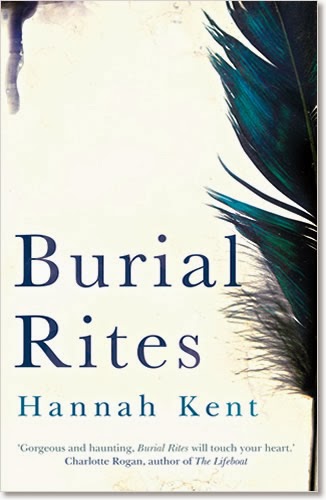
Hannah Kent, Burial Rites (Picador 2013)

burial-rites.jpg

Before the meeting: This book is based on the real story of the last woman to be executed in Iceland, an event that happened in 1830. My knowledge of Iceland, which comes mainly from photographs of stark, beautiful, treeless landscapes and Grímur Hákonarson’s movie Rams, led me to expect that any novel set there would be grim. So a novel culminating an execution could only be more so.

Grim or not, I loved it. I’ve raved about it to people met in the park, and barely restrained myself from reading bits aloud to the Emerging Artist (now known as the Heart Lady, but that’s another story).

At the beginning Agnes, convicted of brutally murdering her employer, is being transferred from one place of imprisonment to another. She is filthy, malodorous and barely able to speak. (Interestingly, her condition at the beginning of the novel bears a striking resemblance to that of the women towards the end of Charlottte Wood’s The Natural Way of Things, which I imagine was being written at the same time as this.) While awaiting execution, she is sent as a cost-saving measure to live with the family of a local official who lives near the planned place of execution.

The main narrative follows Agnes’ developing relationships with members of the host family: father, mother and two young adult daughters. At first the family are convincingly and reasonably horrified that they will have to share their house with this monster, though right from their first encounter the mother of the household is even more horrified at the way Agnes has been treated. A young trainee clergyman is assigned to attend to Agnes’ spiritual needs. Against the advice and instructions of his superiors, he refrains from preaching sternly at her and instead encourages her to talk to him. Because of the size of their dwelling and the bitter Icelandic winter, the family hear much of what passes between them, and we learn her story along with them. As you’d expect from the set-up, in the process they come to see her not as a monster but as a fellow human – more a servant than a prisoner.

All of that is beautifully done, though the story Agnes tells, a story of love betrayed, is less compelling than the circumstances of its telling. And then there is the narration told direct to the reader from Agnes’ point of view. This is where we learn Agnes’ inner story – the erotic experiences that she can’t speak of, and her emotional life. In these sections Hannah Kent’s writing, never less than elegant elsewhere, is rich and poetic without being hi-falultin, so that I for one was completely drawn in. I don’t remember ever being so caught up by a deft use of similes. Here’s a passage from fairly early on, when Agnes has begun to work again,  trusted to use a scythe:

I let my body fall into a rhythm. I sway back and forth and let gravity bring the scythe down and through the grass, until I rock steadily. Until I feel that I am not moving myself, and that the sun is driving me. Until I am a puppet of the wind, and of the scythe, and of the long, slow strokes that propel my body forward. Until I couldn’t stop if I wanted to.

It’s a good feeling, not quite being in control. Of being gently swung back and forth, until I forget what it is to be still. Like being with Natan in the first months when my heartbeat shuddered through me and I could have died, I was so happy to be desired.

The book’s power has something to do with the strong sense of a particular time and place. The world-building, to borrow a term from SF/F discourse, is extraordinarily convincing. In her acknowledgements, Hannah Kent says she set out to write a ‘dark love letter to Iceland’. She has succeeded in spades.

The meeting: As it was the last meeting of the year, we ate at the new (to most of us) Tramsheds in Glebe, and gave each other gift-wrapped books from our shelves. As always in restaurants, the background noise was a dampener in general conversation. But we all enjoyed the book. Someone compared it unfavourably to Halldór Laxness’s Independent People, saying that at times Burial Rites broke free of its early 19th Century Icelandic setting and resorted to tropes from 20th century romance fiction. Specifically, if I understood him correctly, Agnes’s internalised sense of the master–servant relationship vanished too easily and was replaced by an anachronistic expectation of romantic love and fidelity. In general we could see what he meant. Likewise, we all agreed when someone said that it was obvious what was going to happen from the very beginning: the family would soften towards Agnes, and her story as it emerged would reveal either innocence or major extenuating circumstances. Neither of these criticisms dampened the general enthusiasm for the book.

There were some mostly audible, goosebump-inducing readings of passages our Post-it warrior had marked.

Then we cheerfully turned away from the spartan, claustrophobic and bitterly cold world of the novel and enjoyed a meat-heavy meal in a flash new restaurant whose menu names the farms that provide the animals they serve up to their customers.

The verse, my last for this November: 

November Verse 14: The Book Group Chooses What to Read Next
 Ben stands and says he must be going:
 'Shall we decide the next book now?'
 'No time for all the to and fro-ing
 before you leave,' says Ian. That's how
 just seven of us made the vital
 choice of our next Book Group title.
 Not Watson's Bush, that's far too long,
 not more Houellebecq, that's just wrong.
 No to Solnits, Coetzee, Gorton.
 Steve says, 'How about Don Juan?
 I mean Quixote. That's a yarn
 I'd like to read.' That one caught on.
 And after complex back and forth
 we lit on Shakespeare's Henry Fourth.
AWW2016

Burial Rites is the fourteenth book I’ve read for the 2016 Australian Women Writers Challenge.

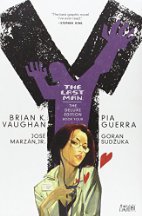
Vaughan & Guerra’s Y: The Last Man Books 3–5 and my November Verse 13

Brian K Vaughan & Pia Guerra, Y: The Last Man Book 3 (2004, 2005, this edition 2010)
—, Y: The Last Man Book 4 (2005, 2006, this edition 2010)
—, Y: The Last Man Book 5 (2006–2008, this edition 2011)

Previously in Y: Yorick, a 23 year old New Yorker escape artist, and Ampersand, a trainee-companion monkey, are the only two male mammals on earth to have survived a mysterious plague. They have teamed up with the woman known only as 355, who is a member of the Culper Ring, a mysterious organisation, and Dr Alison Mann, who has ben experimenting with clone technology and so has a good chance of ensuring a future for humankind. Dr Mann’s New York lab is blown up by Israeli operatives, and the three of them travel across the US to her West Coast lab where her back-up data is safe, encountering an assortment of female post-apocalyptic enemies and allies: the Israelis, a Russian operative, survivalists, escaped convicts making a new life, an astronaut, paranoid cowgirls. Yorick’s sister, Hero, has meanwhile joined a group of neo-Amazons who are fanatically and violently determined to erase all vestiges of the patriarchy. And Yorick has a personal mission, to meet up with his girlfriend Beth, who was in Australian when the plague hit and has since been out of contact.

1401258808.jpg

The adventure continues in Book 3 with plenty of violence, and a modicum of sex. It turns out that the Australian navy had women active in submarines where the US did not. As a result a fully armed and dangerous Collins Class sub intercepts the ship taking our little band across the Pacific. Australia also comes to the fore as we get some of Beth’s story. There’s some deeply worrisome representations of Warlpiri culture (though you have to give Brian Vaughan credit for actually naming a people rather than giving us generic mystical ‘Aborigines’ like the ones in Werner Herzog’s Green Ant Dreaming).

Goran Sudžuka joins Pia Guerra in the pencilling, and to my untrained eye the seams are invisible.

y4

In Book 4, Yorick, Dr Mann and agent 335 reach Australia, which isn’t a happy place, though there’s plenty of amusing US attempts at Australian slang, and some cheerful sex and one bit of comic full frontal male nudity (poor Yorick is drawn looking all heroic on the covers, but doesn’t fare so well in the actual stories).

We also get the back stories of a number of characters, and lectures on the status of women that in any other context might be tediously didactic, but here have a certain charm. For example, there’s a key plot point when two capuchin monkeys escape from their cages in an airport. This is how we see it:

equal pay.jpg

And the reader responds by secretly cheering for the ‘gendercide’ that is to come. Similar moments, such as a short debate about whether the mistreatment of women in the Catholic Church was perpetrated solely by men, or whether women might have been pretty bad as well, turn out to be important to the plot.

y5

Then in Book 5 it all comes together – or apart, depending on your point of view. Yorick finds Beth and their reunion turns out pretty much as the discerning reader might have expected. There’s another romance that also turns out pretty much as expected, though in a way that surprised and, yes, shocked me. In fact, the working out of all the plot strands is almost at the level of Shakespearean comedy. Of the many hypotheses that have been floated about the cause of the catastrophe, the one that is finally given may not be realistic but it fits the world of the story better than any other: at least grounds have been laid for it.

It all ends happily for the human race, though almost literally up in the air for Yorick himself.

One more note: It seems that if it is to succeed commercially, a comic series is required to have a certain amount of sex and violence. Y does that. It also manages to be witty, literate and occasionally instructive. Yorick and his sister Hero were named after Shakespearean characters by their nerdy parents. When it seems one woman is going to have to spend time in hospital, Yorick draws up a reading list for her – Margaret Atwood’s The Handmaid’s Tale is at the top of the list. It’s similarly refreshing that one of the characters becomes President in the final pages but not, it turns out, of the USA: in this US comic, other countries exist.

And let me burst into verse, for the second last time this November. Extra points for readers who spot the Bill Haley reference.

November Verse 13: On Reading Y: The Last Man
Alas poor Yorick, last man standing!
Two male mammals left alive
on earth, just him and Ampersand, an
ape, his kind-of pet. These five
thick comic books by Vaughan and Guerra,
amuse and tease, prompt pity, terror.
A single man left on the ground,
three billion women all around.
But here’s no superhero fiction,
no Bacchanal or things more blue,
no Warhol shooter’s dream come true,
no earnest SF clone prediction,
just good fun: the men are dead,
that’s sad, but what a watershed!

November Verse 12

When you’re casting about for a subject suitable for rhyme and a deadline has just whizzed past, there’s always the TV news.

November Verse 12: 
Pauline took some journos diving
with senators and camera crews.
She said the Reef will soon be thriving:
so much for the lying views
of scientists and their self-serving
leftwing UN undeserving
dupes; if you dive deep enough
you’ll see that coral’s much more tough
than warmists claim. And here’s the kicker:
the ABC led with this story
and called it news, dragged out a hoary
beige-clad chap to contradict her.
A joke? But headlining this prank
makes other ‘sceptics’ seem less rank. 

Antigone Kefala’s Fragments, and my Verse 11

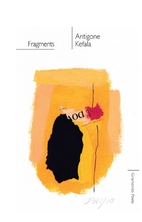
Antigone Kefala, Fragments (Giramondo 2016)

frag.jpg

The final issue of Ivor Indyk’s literary journal Heat, published an astonishing 6 years ago, included an interview of Antigone Kefala by Amanda Simons. The conversation ranges widely, from Kefala’s ‘scribbling’ in her childhood home in Romania before World War 2, over the role her mother played in her creative life, to the critical isolation that comes from being classified as an ‘ethnic’ writer. She says this about poetry:

It is a medium that has its own directions. It comes when it wants to come, doesn’t come when it doesn’t want to come. You can never force it, you have to wait for it.

Fragments is a collection of 61 poems that feel absolutely unforced in that way, almost as if each poem catches an unbidden thought, or dream, or observation, or burst of emotion, and finds a precise form of words for it. If they are fragments of some greater unity, the book is not concerned to find that unity, or to explain contexts, but invites us to focus on each fragment in its own right. Take the first poem:

The Voice
At the sound
I turned
my veins full of ice
that travelled
at high speed
releasing fire.

This return
the past attacking
unexpectedly
in the familiar streets.

The speaker hears a voice from her past. Perhaps it’s associated with a terrible memory, or it might remind her of the voice of a loved one who has died. The poem isn’t interested in the specifics, nor in what happened next. Did the speaker approach the owner of the voice, did she go about her day as if nothing had happened or was she shaken to the core? The poem doesn’t go anywhere near these questions. It focuses tightly on the moment of hearing, and renders it with wonderful precision and complexity: there are the explicit images of ice and fire, and possibly an implied reference to the kinds of warfare that turns city streets into war zones. It’s not ‘difficult’ poetry, but it rewards you for time spent in its company.

The poems, only a handful of them much longer than the first, are divided into five sections. Here’s my guess at their organising principles:

  1. a thematic introduction: poems of memory and loss, dream renderings, observations of social life, dark love poems
  2. evocations of places, mainly Australian, including a scene from the movie Wake in Fright
  3. poems of grief, loss and impending loss
  4. dreams and visions, surrealism and metaphysics
  5. social poems – quick character sketches, satirical jabs, laments, a little politics.

In the Heat interview, Antigone Kefala observes that ‘we ethnics are constantly being compared to other ethnics, but not to Australian writers’, and asks if her interviewer has ever seen a comparison between her work and that of Les Murray. Well, perhaps with that quote working at the back of my mind, I found myself making just such a comparison. Here’s her poem ‘Weapons’ – I hope it’s OK to quote it in full:

Weapons
Ruins
corpses in the sun
men moving cautiously
in the abandoned streets
close to the scarred walls.
Men on top of houses, hills,
coming from dark undergrounds,
men holding on, hugging
these metal erections
firing them
a spray of semen
rushing with velocity
to breed another race of killers.

The evocation of the battle-zone is followed by what at first looks like crude, even trite feminist anti-war rhetoric – the gun as phallic symbol – which becomes almost shockingly explicit with the ‘spray of semen’, and then is brought home in the powerful last line: this isn’t just emotive rhetoric, there’s a strong idea here.

The poem reminded me of Les Murray’s ‘I wrote a Little Haiku‘, which similarly compares bullets to semen. In Murray’s poem, the molten bullets drip from a burning farm rail, and he sees the drip as ‘the size of wasted semen / it had annulled before’. It’s the visual image that counts: one’s response is to admire the poet’s mental agility in seeing such a comparison: the notion that the bullets had ‘annulled’ real semen when they were fired in the past – that is, they had killed young men and so prevented them from fathering children – is almost a melancholy afterthought. In Kefala, the visual image matters, but the force of the poem is in its idea. We’re not invited to admire her cleverness, so much as to dwell on what she has unearthed.

Oddly, the comparisons that came to mind most strongly as I read this book are with Bob Dylan and Leonard Cohen, both of whom have grappled with ageing in their recent work – Dylan’s ‘Mississippi’ for example, or Cohen’s heartbreaking ‘I’m Leaving the Table’. Kefala too brings a ruthless eye to the experience of ageing, and at the same time, like those two writers (in other ways very different from her), conveys a deep joy in living and creating. I love the bitter-sweet final lines of the book’s last poem, ‘Metro Cellist’:

we were floating on sound.
The earth was singing,
singing in an exuberance
of youth.

AWW2016Fragments is the thirteenth book I’ve read as part of the 2016 Australian Women Writers Challenge. I am grateful to Giramondo for my free copy.
—–
As my regular readers will know, I have a self-imposed task of writing fourteen 14-line verses each November and putting them up on my blog. I was going to let this post go by to avoid putting any of my verse on the same page as Antigone Kefala’s infinitely superior work, but then I read her saying in the Heat interview that she could not write a sonnet: ‘You know how writers do exercises in terms of poetic forms; I have never been able to do that.’ Perhaps one day I’ll outgrow my attachment to the form of the Onegin stanza, but for now, here’s one more, an attempt to explain the joys of this attachment:

November Verse 11: 
A turn of phrase, a half idea:
that’s enough for my first lines.
The path ahead is far from clear
but through mind’s muddle somehow shines
an argument. Then, as I’m seeking
rhymes and scans, the sense starts leaking
into somewhere unforeseen
and who knows what line eight will mean?
Six lines to go, and now I’m counting.
So much that I wish I’d said,
not on the page, still in my head!
Its all a mess. The panic’s mounting.
With luck I end my little song
as if I meant it all along.