Tag Archives: journals

Overland 211

Jeff Sparrow (editor), Overland 211 Autumn 2013
OL211

As a happy subscriber (and not only because I won some free chocolate in last year’s subscriberthon), I’m glad to read in Jeff Sparrow’s editorial in this issue that although Overland is now a project, of which the print journal is only one part, the printed object will continue to appear regularly for the foreseeable future. I am one of the many people who, he says, ‘still like to read (in particular) long essays, literary fiction and poetry on paper, away from the distractions of their iPad’. I also enjoy the synergies that can arise within the bounds of physical covers, quite different from the boundless variety of the online world.

An example of what I mean by synergy occurs in the play of ideas and perspectives among: ‘The one day of pure form’, in which Guy Rundle argues that Anzac Day is a weird commemoration whose meaning can and does change to suit the needs of whoever happens to be in power; ‘Peregrinus Requiescat’, a short story by Warwick Newnham that, beneath a sophisticated play with form and some not always correct or correctly translated Latin, is moved by a straightforward impulse to honour a man who died in combat by marching in his place on Anzac Day; and Barry O’Donohue’s poem, ‘Vietnam ritual’, whose speaker is a Vietnam War veteran free of any commemorative or romanticising impulse. ‘The innocence of Australians’ by Ramon Glazov, a review of a collection of short stories that imagine terrorist attacks in Australia, takes on a different hue in the context of those three pieces. Glazov sees in most of the stories an inability to imagine a plausible motive for attacking Australia – because after all, so the ‘thinking’ goes, we’re innocent global citizens in the sense that what we do hardly matters, whether it’s sending a token force to kill and die in the US’s wars, or opening another coal mine. This presumed innocence isn’t the same as the ‘pure form’ that Guy Rundle sees in Anzac Day, but the two concepts talk to each other interestingly.

Synergy is there again in the way one’s mind bounces between ‘The possibility of patronage’ by Anwen Crawford, a curmudgeonly piece about the limitations of crowd-funding, pop-up galleries and other innovative ways of getting artists and money together, and ‘Paying the writers’, in which Jennifer Mills and Benjamin Laird are set up to debate responses to the trend to expect writers to accept ‘exposure’ as recompense for their work, but can’t help agreeing that some form of collective action is desirable. That bouncing affects the way one reads Alison Croggon’s characteristically elegant column ‘On Homelessness’. She doesn’t connect her two experiences of homelessness with being an artist except to imply that writing was her way of keeping her sense of self intact, but in this context one wonders if poor compensation for writing may have had something to do with the problem in the first place. And then there’s Judy Horacek’s cartoon parodying a current credit card ad: ‘A career in the arts: priceless. And for everything else, there’s dumpster diving.’

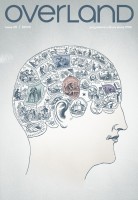
There are also stand-out stand-alones. In ‘Pump’, Stephanie Convery tells of her participation in a women’s body-building course, which manages to challenge some aspects of sexism and male domination while bowing to others: the article includes fascinating history, high comedy, memoir and challenging analysis. Apart from some Melburnian sneers at country Queensland, ‘All those women’ by Jacinda Woodhead is richly empathetic: in the context of Queensland’s dire abortion situation – abortion is a crime except under closely defined conditions; it’s hard to access, expensive and stigmatised – Woodhead presents a portrait of tiny anti-abortion, anti-war group Protect Life. While recoiling from their politics on abortion, she and pro-choice activists she interviews communicate a respect for their commitment to principles and sheer stamina. Jill Dimond’s ‘Ned Kelly’s Skull’, which justifies the phrenological cover image, includes a fascinating look at some eccentric colonials. Giovanni Tiso makes some alarming sense out of recent events in Italian politics in ‘The Net will save us’.

In the poetry section, I was relieved to see a couple of bird poems, since current Going Down Swinging submission guidelines specifically rule out ‘poems involving birds, wings, feathers or flight’ and it would be a shame if birds were to disappear from Australian poetry altogether. I’m grateful for The shearwaters by Jules Leigh Koch, ‘a long tideline / like a driftnet / to fish for stars’, and I probably would have loved ‘The swallows in Saint Peter’s Square’ by Luke Whitington for its name alone.

Not all those links will take you to a full article, at least not at the time of writing, but be patient. Overland does tend to put just about everything online in the weeks after an issue comes out. Or you could buy a hard copy and find your own synergies.
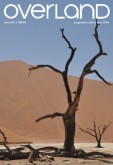
Southerly 72/3: Islands and Archipelagos

David Brooks and Elizabeth McMahon (editors), Southerly Vol 72 No 3 2012: Islands and Archipelagos

1southerly723

The title of this issue of Southerly, ‘Islands and Archipelagos’, refers to its subject matter, but it could just as easily refer to its form: a literary magazine, archipelago-like, is a gathering of diverse entities, each with its own integrity but all having something in common, whether a theme as in this case or something less tangible, like a tone, or an ethos, or a presiding personality.

I enjoyed my island hopping. My favourite moment is the bravura opening sentence of ‘Outcast of the Islands: Malinowski Amongst the Modernists’ by David Brooks :

If there could ever be such a thing as a True History of Modern Thought, at least one chapter would have to trace that set of strange, 
neglected, yet teasingly-almost-direct lines between a heterogeneous
 crew of squatters, graziers, country postmasters, district magistrates, missionaries, and employees of the Overland Telegraph recording details of Indigenous Australian life and culture in the mid- and late- nineteenth century and the desks of Edward Tyler at Oxford, James George Frazer at Cambridge and Emile Durkheim in Paris, and, through them, and a number of other significant late-nineteenth-century anthropologists, to the likes of T. S. Eliot, Ezra Pound, Sigmund Freud (see, for example, the first half of Totem and Taboo), Marcel Mauss (Essay on the Gift) and so many other key figures in early twentieth-century thought and aesthetics that one wonders whether the Simpson Desert or the Trobriand Islands should be given a place – a quite significant place – amongst the generating landscapes of Modernism.

Yes, that is just one sentence. The article not only delivers on the sentence’s promise but ends with a link to a provocatively titled companion piece, ‘Origins of Modernism in the Great Western Desert: An Introduction’.

Tying for second favourite moment are:

  • Michael Sharkey’s poem ‘First Eleven’, eleven stanzas consisting of phrases that evoke an Australian baby-boomer childhood, presumably to the age of 11. Much of it might be inscrutable to people of other generations and other places, but I was born in 1947, a year after Sharkey, and his deft hand worked nostalgic wonders in me, even in the minority of phrases that didn’t touch directly on my own experience:

    The Royal Visit. Easter Show.
    My sherbet packet. Liquorice stick.
    My shop-bought pie. My Iced Vo-Vo.
    My Cracker Night. My Jumping Jack.
    My father’s gas mask. Old blue tunic.
    My small sister in the clinic.
    My six-stitcher. My first duck.
    The choko vine. The dunny truck.


  • Michael Jacklin’s ‘Islands of Multilingual Literature: Community Magazines and Australia’s Many Languages’, which prises open the subject of Australian literature in languages other than English. I’ve always felt odd about the portrayal of 1950s Australia as monocultural and monolingual: Italian and other southern European languages were part of the soundscape of my 1950s north Queensland childhood; one of my best friends in primary school was Chinese; my farmer father played poker with a Greek, a Korean and a Yugoslav; in the 30s and 40s my magistrate grandfather spoke to Italians who appeared before him in their own language. This essay discusses evidence, including a journal from Brisbane in the 1930s, that there has long been lively, linguistically diverse literature in the Australian context, much of it invisible to the mainstream literary establishment.
  • a new poem by Jennifer Maiden, always a thrill. ‘Diary Poem: Uses of Ethiopia’ is in part a polemical essay, taking issue with some feminists who are ‘well in favour / of ethical security’. I’m not sure what ethical security is (Google is no help): it’s related to rigid ideological narrowness, I think, and may have elements of self-serving moralism. Feminist ‘fandom for Gillard’ is a symptom. My regular readers know that I often feel like an outsider with contemporary poetry (and by the way I think that’s more about me as a north Queensland boy than about the poetry). With this poem, I probably get the references more than most readers: not the Ethiopian art or the story of Sylvia Pankhurst, which are central to the poem and beautifully fleshed out, but the passing allusions – to Julia Gillard’s misogyny speech, and her cutting of the supporting parents’ benefit on the same day; to the earlier poem ‘A Useful Fan’, neatly encapsulated here as ‘trying to inhabit Abbott interestedly’; to a set-to on the Overland web site described as her ‘daughter the fire tiger’ (itself a reference to an earlier poem, ‘The Year of the Ox’) defending her ‘on a hostile magazine site now given / to ethical self-security’. Paradoxically, familiarity with the references predisposes me to foreground the detail of poem’s polemics (I want to argue about her view of Overland, for example, and I’m not sure about the connection she seems to be making between some feminists and abortion), rather than the poem’s central thrust, which I read as captured in the description of doves in Ethiopian art as

    aware of complex peripheries,
    well-mannered with watchfulness,
    —————————————-still.


As well as these pieces that topped my pops, there are learned essays on issues facing real islands and islanders, on Andrew McGahan, Randolph Stow, Drusilla Modjeska, and the rock band the Drones. There are short stories (especially Sandra Potter’s ‘“an empty ship in these latitudes is no joke”’, a lightly annotated list of things taken to and from Antarctica, and Terri Janke’s ‘Turtle Island’, a not-quite-ghost-story, not-quite-love-story, not-quite-war-story set in the Torres Strait in World War Two). There are other excellent poems and nearly 70 pages of reviews, plus the overflow in The Long Paddock, which includes a fine review by Sarah Holland-Batt of Ali Cobby Eckermann’s Ruby Moonlight.

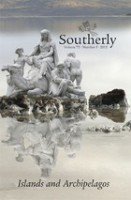
A final note: the spectacularly beautiful cover, reproduced above, is described on the contents page as Sue Kneebone’s Continental Drift, but it’s actually a detail from that work, which I recommend you have a look at on Sue Kneebone’s web site.

Overland 210

Jeff Sparrow (editor), Overland 210, Autumn 2013

210-overland Your mileage will vary, but the article in this Overland that stands out for me is Beyond denial by Philip Mirowski, Jeremy Walker and Antoinette Abboud, which argues that ‘the phenomena of science denialism, emissions trading and geoengineering are not in fact unrelated or rival panaceas but rather constitute together the full neoliberal response to global warning’. The article makes a distinction between neoclassical economics and neoliberalism, describing the latter, in what I wish was a harsh caricature, as worshippers at the shrine of an all-wise market, who hold, for example, that ‘Science is not an independent mode of truth discovery: it is a boutique knowledge format only validated by “the marketplace of ideas”‘.

The neoliberal response to the climate change challenge is, if I understand the article correctly:

  1. Deny the science so as to distract attention from the crisis and buy time for commercial interests to find a way to profit
  2. Back emissions-trading schemes in order to divert political actors from using state power to curb emissions into setting up carbon markets, which won’t ever work, because the big polluters are already finding ways to go on polluting
  3. Develop grand geoengineering schemes that will make huge profits for corporations but will not address the root problem of increasing carbon dioxide concentrations or stop ocean acidification.

The article doesn’t come up with an opposing plan, but it gives a salutary map of the terrain. I recommend the whole thing.

Elsewhere, this issue strikes a nice balance between giving pleasure and holding the reader’s feet to the fire.

First, the pleasures include:

  • interesting chat from regular columnists Alison Croggon and Rjurik Davidson  about, respectively, Tolkien and Hollywood’s version of Second World War resistance movements
  • Francesca Rendle-Short writing about writing about her late father (as she has elsewhere), including poignant moments that will strike a chord with anyone who has a close relative with advancing dementia:

    [H]is hands dance largo, float and rise and fall in a slow movement set to its own tune, an adagio. First, he clasps them in front of his chest as though in a praying gesture, a supplicant hold where the palms lie flat against one another. Then he pauses a moment to pray, to ask for God’s blessing before the fingers start to stir larghetto. They loop first this way so the fingers interlace each other; then right then left, before rising up elongated in a slow, seesaw action. A ritual dance.

  • The cartography of foxes,  a deeply satisfying and unsettling short story by Theresa Layton that augurs well for Jennifer Mills’s tenure as Fiction Editor
  • Peter Minter’s report as judge of the 2012 Overland Judith Wright Poetry Prize for New and Emerging Poets, which is almost as enjoyable as the winning poems, particularly his description of how he read and re-read the submissions in the midst of domestic life
  • The winning poems, especially the winner, Augury? by Luke Fischer
  • An essay by Californian Aaron Bady that, after going on a bit about the Great American Novel, confirmed my decision not to give any cash to the makers of Zero Dark Thirty, with an argument that chimes with my experience of The Hurt Locker. The movie succeeds as propaganda, he writes,

    because it never tries to glorify the protagonist’s obsession, never tries to rationalise it, defend it or even make it seem attractive … But it’s still the one we’re stuck with for two and a half hours … You have no choice but to identify with torturers whose motivations you understand, and with the victims of Muslim terrorists whose motives you are not allowed to be privy to.

  • Judy Horacek’s dark cartoons (I couldn’t find a link), especially one that should probably be in the ‘feet to the fire’ category, in which two people holding a ‘Save the Planet’ sign face a gang holding signs that read  ‘Save our Profits’ – she manages to be funny about discouragement.

And then there’s what Overland does so well, argument and analysis of the harsh realities of our times from a progressive point of view. Some highlights:

  • Alyena Mohummadally on being same-sex attracted, Muslim, and organised in Australia
  • Panagiotis Sotiris offering an alternative view of the Greek economic situation. His repeated calls for ‘struggle and solidarity’ as the necessary response to the fascist Golden Dawn, is little more than sloganeering shorthand, but where else can you find a clear challenge to the mainstream narrative about Greek laxity finally being brought to heel by the benign forces of the EU, the IMF etc?
  • Martin Kovan on the alarming number of ethnic Tibetans who have set themselves on fire in recent years, mostly with fatal results. The article discusses how these burnings remain largely unnoticed in the West, ‘inside the narcissism of self-interested, racially conditioned and materially anaesthetised ethical immunity’, then focuses on the English Buddhist novice who self-immolated in southern France late last year. Kovan knew the monk, and his reflections are personally charged
  • Guy Rundle, self-described default Luddite, reporting on 29c3 – the twenty-ninth Chaos Communication Congress, at which hackers confronted the rise of the total-surveillance state. He reflects on the relationship between hacktivism and the Left, in particular on what their different histories mean they can learn from each other. In doing so, he manages to end the journal on a note of restrained optimism.

I’ve included links to everything except the cartoons. Overland make its entire content available on line. It also publishes background interviews on some articles in its Editors’ Blog, which is one place on the Internet where the comments don’t make you want to run screaming from the room.

Southerly 72/2: True Crime

Melissa Jane Hardie (guest editor), David Brooks and Elizabeth McMahon (editors), Southerly Vol 72 No 2 2012: True Crime – Every Contact Leaves a Trace

Southerly 72-2 cover_Layout 1

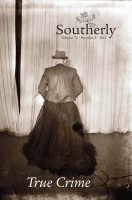
The Southerly of my youth, whatever its contents, always had the same staid, non-committal design: a single colour cover with a small blowing-wind logo the only decoration. (For non-NSW readers, the southerly is a cool and often rain-bearing wind from the south-east, famously welcome for its sudden arrival on stinking hot summer days.) Those days are long past, though the little wind is still there above the title. This issue’s cover, featuring an enigmatic photo from the NSW Police Forensic Photography Archive, is a perfect teaser for an issue built around true crime stories, more than one of them drawing on that same archive.

The archive, consisting of 130 000 photographs taken in the first half of last century, found without any accompanying documentation and now held at the Justice and Police Museum in Sydney,  is an Aladdin’s cave for researchers into Sydney’s criminal history. Peter Doyle’s ‘Detective writing: mapping the Sydney pre-War underworld’ is a fascinating dip into it, complemented with an account of a couple of relatively long-lived publications, which he describes as ‘kind of ‘ trade papers for cops, full of vivid and sometimes lurid portraits and narratives from the criminal scene. In Southerly‘s online section, The Long Paddock, Ross Gibson’s ‘Collision Course‘ plays with the narrative possibilities of a selection of images – though none of them are as queerly suggestive as the one on the cover – and refers the reader to his ongoing project with Kate Richards, Life After Wartime. Marise Williams, in ‘Women’s Work’, explores the same milieu, though without drawing on that archive: the women of her title are Kate Leigh and Tilley Devine,who ran organised crime networks in Darlinghurst in the 1920s and 1930s. It’s not just the covers that have come a long way since the staid 1960s.

My favourite single prose piece in this issue is Cassandra Atherton’s ‘Raining Blood and Money’. Classified as fiction, it’s a graphic imagining of New York’s terrible 1911 Triangle Shirtwaist fire, in which 146 people, most of them women workers, died in 18 minutes. The fire was hugely significant in the history of women and labour in the USA, and in the century since it happened it has given rise to innumerable songs, stories, monographs, rallies, and organising activities, as the links on its Wikipedia page demonstrate. Some stories need to be told and retold, and Atherton’s telling feels as fresh and visceral as if it happened yesterday.

Of course, Southerly is still a scholarly journal, so: there’s a theoretical consideration of sensationalist 19th century crime writing; the formidable thinking of Deleuze and Guattari is brought to bear on Ned Kelly’s Jerilderie letter; a Black Saturday arsonist is considered in the light of the different understandings of the notion of  ‘abjection’ in the writings of Julia Kristeva and Judith Butler; Schapelle Corby is the subject of abstruse reflections that include such highly technical language as: ‘To be where you are … requires a sense of affective difference, understood as either the Spinozan–Deleuzian mapping of co-ordinates of intensities or as the forms of projective identification required in nominating and refining the arbitrary and violent constitution of the nation-state.’ Lit crit has moved on since my day.

There’s forty pages of reviews, including Kate Middleton in elegiac mode about the late Peter Steele’s Braiding the Voices, and a swag of poetry, of which Adam Aitken’s ‘The plein-air effect (after John Clare)’, Michael Farrell’s ‘Disapproval’ and Hazel Smith’s ‘Experimentalism’ stand out for me.

A dip into the Long Paddock  came up with not only Ross Gibson’s piece, but also Melissa Jane Hardie’s review of A Tragedy in Two Acts: Marcus Einfeld & Teresa Brennan by Fiona Harari. I met Teresa Brennan once, and am glad to see that this book makes more of her than a name in a false alibi: it doesn’t mention that she was at one time a writer for Barry Humphries/Edna Everage.

Going Down Swinging 33

Going Down Swinging 33 (edited Geoff Lemon and Bhakthi Puvananthiran 2012)

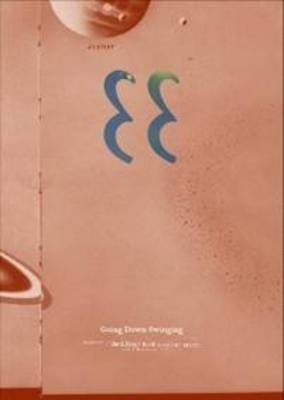
20130222-211751.jpgGeoff Lemon, co-editor, was surely tempting fate and the critics when, as soon as the 32nd issue of GDS was complete, he nicknamed the impending No 33 the Jesus Issue. Wasn’t that like predicting the journal’s death, or at least inviting a crucifixion? Well, maybe, but after all it’s Going Down Swinging we’re talking about, whose title has been cheerfully proclaiming its imminent demise from the very start. Perhaps, then, the nickname was intimating that the physical object made of ink and dead trees was about to be resurrected, transformed into an incorporeal, wholly digital being. But no, though there is The Blue Corner online and a CD comes as part of the thing itself, the fabulous design of No 33, by Elise Santangelo and Stuart Hall, draws dramatic attention to its materiality, with tabs, die-cuts, a range of stocks, and clever use of showthrough – without, I say with heartfelt appreciation, detracting from legibility.

It looks as if the only actual consequence of the nickname was a number of Jesus-related submissions, enough of which made the cut to constitute a 38-page Jesus section. Like the rest of the magazine, these are predominantly hip inner-city Melbourne, the one surprise being ‘Out of the Kitchen Since 30 AD’, Elizabeth Redman’s straightforward personal essay reclaiming Christian faith from the reactionary fundamentalism and dubious institutional politics that tends to dominate public discussion of it.

Two other pieces stood out for me as admirably plain-speaking. André Dao’s ‘Out of Our Bodies’ is a memoir about Catholicism, atheism and mortality. He could have been describing a scene from Michael Haneke’s Amour in his final image of his grandparents singing together at his grandfather’s deathbed:

… My grandfather seemed finally to hear her, and then they were both singing, falling in and out of tune. For a moment they seemed lifted out of their slumped, brittle bodies, and their wrinkled faces were crumpled in concentration and remembered pleasure.

And Fiona Wright’s short poem ‘Consider the Camel’ feels as if it should always have been there, and manages to use the word ‘platyclades’ without missing a beat.

For the rest, there’s hardly a dud in the lot of them. ‘Atlas Dharma’, a commissioned by Cate Kennedy with watercolour illustrations by Simon MacEwan, recalls and recreates a childhood fascination with the Reader’s Digest atlas. Eric Yoshiaki Dando’s The Novel Teacher has fictional (I hope) fun with creative writing courses. Una Cruickshank gives us some memorable travel writing in ‘Varanasi’. I skipped an essay that begins with a quote from Lacan and a story that starts out, ‘Long, long ago, afore a-coming of the dust, the mani-lands were a-crowdening with mani-folk’, but that tells you more about me than them.

When I mentioned an inner-Melbourne sensibility, I wasn’t implying parochialism – quite the contrary, the feel is urbane, cosmopolitan. But I was struck by the way a number of pieces from oversea, and even interstate, stood out. You’d expect that of the stories from Russia and India (one each). It was contributions from the USA that prompted me, in the absence of an ‘About the Contributors’ section, to go Googling the authors – not because of a proofreaderish irritation at US spellings, though there was that, but because the voices were noticeably different in ways that are hard to specify – louder, more confident of their own centrality, something like that. When I think of the gigantic magazine that downloads to my RSS feeder, I’d guess that most of what I read there is from the US, and increasingly I live in a global culture. Here, where the proportion is roughly reversed, I’m surprised and reassured to feel a sense that local minds are engaging in locally inflected ways with issues that range from the intensely local to the cosmic.

Asia Literary Review 25

Martin Alexander (editor) Asia Literary Review 25, [Northern] Autumn 2012

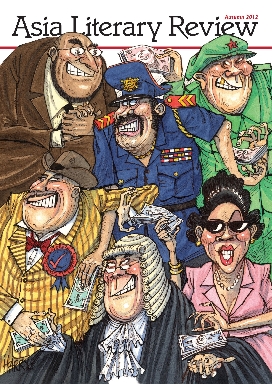
Chinese artist and filmmaker Zhang Bingjiang has an ongoing project entitled Hall of Fame: a series of portraits of officials convicted of corruption, each painted in the colours of the 100-yuan note. No mainland gallery has agreed to exhibit the paintings, of which there are so far more than 1600. Journalist Audra Ang explores the story behind food contamination scandals in China. He Jiahong, a crime novelist (whose ‘Hanging Devils’ is reviewed elsewhere in the issue) and former high-up official in a Chinese anti-corruption agency, outlines a basic, probably over-optimistic proposal for curbing corruption in the People’s Republic.

This issue of Asia Literary Review is dedicated to crime and corruption, and as those three articles indicate, it comes at the subject from many angles.

The Philippines get a double guernsey: Luis H. Francia reports on Give Up Tomorrow, a film by Marty Syjuco and Michael Collins about a blatant miscarriage of justice in which seven young men were found guilty of rape and murder in a case whose every aspect was shaky, including the identity of the victim. Carla Camille L. Mendoza reminds us with lyrical sarcasm of the spectacularly corrupt times of Imelda Marcos and her husband ‘Ferdie’.

Jang Jin-sung, a defector from North Korea, paints a grim picture of endemic corruption in his country resulting from a failed economy in an authoritarian state. Veteran journalist Farrukh Saleem describes systemic corruption in Pakistan. Mumbai resident Dilip D’Souza does the same for India, but undermines any easy self-righteous indignation by relating the large-scale political corruption to the almost universal disregard for the law by ordinary Mumbai residents: on his daily five-kilometre drive to his son’s school, ‘Nobody, and I mean nobody, stops for a red light.’

Still in India, Shashi Warrier, a thriller writer, interviews a rural worker whose brother is probably a member of a violent Maoist group. These groups are evidently a bigger threat to Indian security than the Pakistani-backed Kashmiri secessionists, and it’s clear that endemic government corruption is as effective a breeding ground for Maoists in India as it is for lethal fly-by-night food operations in China.

There’s fiction too, of which three stories stand out for me. Prosper Anyalechi’s ‘I’m Praising Him Right Now‘, translated (from Japanese? Igbo) by Dreux Richard, is a wonderfully animated story of Nigerian immigrants living by their wits on the edges of the law in Tokyo. John Burdett’s ‘A Day in the Life of Curly Jones, Lawyer‘ brings a similar relish to Western expat lawyers wheeling and dealing with dubious legality in Hong Kong. Tew Bunnag’s Eyes of Karma, which begins with a monk meditating in a Thai monastery, turns out to be non-comic version of Sister Act.

I do have a complaint: a number of the fiction pieces are excerpts from longer works, but there’s no warning of this except the end of each one. I’m a primitive reader – I read for the story. So after being left hanging once, I checked each story and skipped the ones that said they were extracts. I made an exception for the extract from Ali Baba: The Forty Thieves Reloaded by Poulomi Mukherjee and Amit Tayal, a comic book which may be worth seeking out in its entirety.

And there’s poetry. I’m not sure what to do with poems written by people with Western names lamenting how hard life is in a North Korean prison camp (without evidence, who’s to know if it’s US propaganda or someone speaking of what he knows?), or those that are hard to distinguish from touristic observations. And my familiar sense of being an outsider looking in when reading poetry is given a little boost by opaque cultural difference in a number of the poems here. I did, however, enjoy encountering all of them. I particularly liked Sivakami Velliangiri’s ‘Silent Cooking and Noisy Munching‘, which describes ‘old women with gagged mouths / cooking for the gods, in silence’, and discovers in their discipline and grace a metaphor for her art, and Changming Yuan’s ‘A Concise History of China in English‘, a witty piece made from little more than a list of Chinese words that have had vogues in the West over the centuries.

In short, a good read.

Overland 209

Jeff Sparrow (editor), Overland 209, Summer 2012

overland209There’s an interesting self-referential moment in this issue of Overland when Rjurik Davidson takes issue with the mainstream notion that writers engage ‘in an ongoing discourse among equals that takes place in the public sphere’, a notion that ‘presumes a single culture, a realm of enlightened discussion and the free play of ideas’. He argues for

a conception of the radical writer belonging to a counter-public (or more accurately, counter-hegemonic) sphere, a sphere that includes its own publications and institutions, its own periodicals and clubs and networks of power. It’s a quite different notion of the writer, one that recognises that polite liberal discourse excludes certain things from being said and that, within the public sphere, comments that strike at the heart of things and books that ask fundamental questions tend to sound shrill or unhinged.

Overland, as a periodical belonging to such a counter-hegemonic sphere, does have its unhinged-sounding moments: in this issue, ‘The pessimism of time: The paradoxes facing the Left‘ by Nina Power, calls on ‘the Left’ to abolish time, or at least to create ‘a life in which nobody seeks to make time measurable at all, for all time’. (Given that ‘Frank O’Hara’s Animals‘ by Tara Cartland, a short story further on in this issue, is a fantasy about a girl who really can make time stop, I haven’t entirely given up hope that Power’s argument is a poker-faced satire, or that its inclusion is an editorial prank, designed to make readers appreciate the sensibleness of the rest of the issue.)

Elsewhere there’s plenty of anti-hegemonic goodness that doesn’t come close to shrillness and stays on its hinges. In a characteristically elegant column, Alison Croggon skewers the commodification of writers and writing implied in the idea that a writer must be a ‘brand’. David Carlin gives a warts and all account of life in a successful anti-hegemonic theatre institution, Adelaide’s Red Shed Company. Everett True’s essay on Pussy Riot contextualises and actively embraces their music and their politics, both of which tend to be seen as shrill and unhinged in the mainstream media. Isabelle Skaburskis and Elizabeth O’Shea rely on their experience as activists to go beyond the familiar media narratives on human trafficking (sorry, no link) and the indefinite detention of asylum seekers respectively. Sophie Cunningham challenges the received version of what happened in Darwin after Cyclone Tracy, having found evidence of, among other things, including looting by NSW police (again, no link: they can’t give us everything for free). Don’t expect to see any of those articles reprinted in the mainstream media.

Among such riches, the stand-out piece for me is Lisa Farrance’s article, ‘Living the life within: The benefits of sport‘. It’s fairly common when people are bewailing the lack of funding to the arts that an arts–sport dichotomy is invoked. You know the line: more Australians visit an art gallery or take part in another cultural event on any given weekend than attend a sporting match, yet sports receive disproportionately more help from the public purse. So it’s refreshing to read an article in a literary journal that celebrates sport as a means to ‘find ourselves whole again’, to challenge sexism and the alienation we experience under capitalism, to enact progressive politics: not just exercise to keep fit, but sport to become whole. And not only that, but Ms Farrance’s exemplars of sports with radical potential are two that are easily dismissed with a shudder in ‘polite liberal discourse’: boxing and roller derby.

There’s a fiction section comprising the three winners of the inaugural Overland Victoria University Short Story Prize for New and Emerging Writers: ‘Killing Floor‘ by John Turner, ‘The day the world stayed the same‘ by Melissa Fagan and ‘Frank O’Hara’s Animals‘ by Tara Cartland. All three stories make me look forward to their authors’ continuing emergence.

And tucked away up the back on tinted paper, as if in a kind of quarantine, ten pages of poems. The little I’ve read of Michael Farrell’s work until now I’ve found shiny but inaccessible – something for hardcore poetry readers. His poem here, ‘Making Love (to a man)‘, makes me reconsider: it’s funny and sexy and warm and friendly. The same is true – with less of the ‘sexy’ – of Fiona Wright’s ‘Obit‘, whose 24 lines, like a conversation at a wake, evoke a sense of loss through cool, anecdotal reminiscence.

I know the Overland subscriberthon is over, so if you subscribe now you won’t win any prizes (like the block of chocolate and free sub I won in November), but you would get your money’s worth.

Southerly 72/1

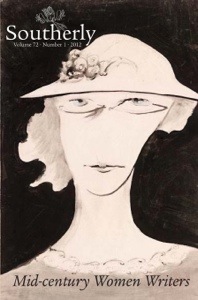
Elizabeth McMahon and David Brooks (editors), Southerly Vol 72 No 1 2012: Mid-century Women Writers

20121018-203833.jpg

Spring is here – ‘a box where sweets compacted lie’ as George Herbert called it, in a phrase that could apply just as well to this issue of Southerly. (Or to put it prosaically, this post is an annotated list.)

There’s a new Jennifer Maiden poem, ‘George Jeffreys 13: George Jeffreys woke up in Beijing’. This series of poems has had to find a new focus now that George W Bush is no longer reliably on the television obsessing about Iraq as he was for the first poems. George and his kind of girlfriend Clare seem to be travelling the world, waking up in one troubled locale after another, having adventures involving guns, fires and pirate ships as well as discussing politics, morality, philosophy etc. It’s not a verse novel, or even a discontinuous narrative really, but it is never uninteresting. In this poem George and Clare meet with a recently released Chinese dissident in the Forbidden City where they are joined by Confucius and the Duke of Zhou.

There’s Fiona Morrison’s excellent essay, ‘Leaving the Party: Dorothy Hewett, literary politics and the long 1960s’. Like many Communists, Hewett stayed in the Party after the 1956 invasion of Hungary despite serious misgivings, then left when the tanks rolled into Czechoslovakia in 1968. In effect this essay traces the movement of her mind between those two events as revealed in her writing. Strikingly though, it doesn’t refer to either Hungary or Czechoslovakia, restricting itself to literary matters. Some of the essay’s specialist scholarly language took my fancy, and revived my love of double dactyls:

Higamun hogamun,
Fíona Morrison,
writing in Southerly,
gathers no moss:
says that our Dorothy
ex-Marxist-Leninist
wrote a sustained tropo-
logics of loss.

There’s Karen Lamb’s ‘“Yrs Patrick”: Thea Astley’s brush with timely advice on “the rackety career of novel writing”’, an inside look at the relationship between Astley and other writers, with a focus on a particularly unsparing letter from Patrick White. I once heard Astley quote a dollop of writerly advice she had received from White: ‘If you’re going to write about a shit, Thea, you have to make him a really big shit.’ This article is fascinating but doesn’t include anything quite that colourful. Karen Lamb is writing a biography of Astley. Reading her account of Astley’s approach to friendship, I wondered if biographers don’t run the risk of coming to dislike their subjects through knowing too much:

Karen Lamb
surely doesn't mean to slam
Thea Astley
but she makes her seem ghastly.

I’ll refrain from doggerel for the rest of this post.

There’s the other piece I turned to the day the journal arrived in the mail, David Musgrave’s review of Geoffrey Lehmann and Robert Gray’s Australian Poetry Since 1788. In a measured and judicious manner, Musgrave joins the line of anthologists, poets and publishers who give this anthology the thumbs down. (Incidentally, I note that neither David Brooks, Southerly‘s co-editor, nor Kate Lilley, its poetry editor, got a guernsey in the anthology, but that didn’t stop them from including an elegant narrative poem by Gray elsewhere in this issue.)

Of the theme essays on mid-century women writers, other than the two I’ve already mentioned, Helen O’Reilly’s ‘“Dazzling” Dark – Lantana Lane (1959)’ and Susan Sheridan’s ‘“Cranford at Moreton Bay”: Jessica Anderson’s The Commandant‘ persuaded me to add the books they discuss to my To Be Read pile. I skimmed the essays on Christina Stead, Eve Langley and Elizabeth Harrower, and a second one on Jessica Anderson, which are intended for specialist readers. I mean no irony when I say I was grateful to read this near the start of an essay: ‘In her well-known formulation of performativity, Judith Butler argues that repetition of a discourse actually produces the phenomena that it seeks to control.’ Such sentences serve as warnings: what follows is intended not just for readers who can understand the warning sentence, but readers to whom its contents are familiar.

Off theme, there’s Ed Scheer’s ‘“Non-places for non-people”: Social sculpture in Minto’, an account of a performance art event, Big Pinko, in which two artists painted a house pink. It sounds like an interesting project, but I found article a little disturbing in the way it talked about the people of Minto. Perhaps the Judith Butler formulation is relevant: the phrase ‘non-places for non-people’ is meant to encapsulate a criticism of the dysfunctional environment in this outer western suburb, but as it is repeated in this essay it comes to read like a dismissal of the people who live there. The essay has a lot in it that’s beautiful and evocative, but in this respect it makes me appreciate all over again Michael Mohammed Ahmad at Westside’s labours to foster writers in Western Sydney.

This issue has abundant rich poetry. I love B. R. Dionysius’ ‘Ghouls’, a set of five sonnets about the Brisbane floods.

The white festiva shunted like a tinny, half-tonne maggot into
O'Hanlon Street's winter bulb cul-de-sac. The Bremer's brown
Muzzle investigated the bottom stairs of a corner house, sniffing
For the scent of past flood levels left by more malicious beasts.

Of the other poems, I particular liked ‘Rose Bay Airport, 1944’ and ‘Standing Soldiers’ by Margaret Bradstock (both after Russell Drysdale wartime paintings), ‘Holiday snap’ by Andrew Taylor, ‘Hardware 1953’ by Geoff Page, and ‘The Roadside Bramble’ by Peter Minter.

Of the fifty pages of reviews, John Kinsella on David Brooks’s The Sons of Clovis: Ern Malley, Adoré Floupette and a secret history of Australian poetry and Pam Brown on Kate Lilley’s Ladylike stood out for me, Kinsella for fascinating rumination on the nature of literary hoaxes, and Brown for her usual generous intelligence.

Southerly 71/3

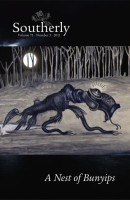
David Brooks and Elizabeth McMahon (editors), Southerly Vol 71 No 3 2011: A Nest of Bunyips

In 2001 the National Library of Australia published Bunyips: Australia’s Folklore of Fear by Robert Holden and Nicholas Holden. Robert said in his introduction that writing and editing the book had taken him ‘down many byways of history, literature, folklore, superstition and cultural studies’, and that he had gleaned insights from palaeontology, evolutionary thinking and anthropology.

The title of this issue of Southerly might lead you to expect something along the same lines. You would be misled. It does include a scattering of atmospheric drawings dating from between 1890 and 1912, citing the Holdens’ book as the immediate source, but they are the only bunyips on offer. As David Brooks says in his editorial, the issue is filled with things from the backlog ‘of pieces too good to reject but refusing any easy categorisation, and the bunyip motif derives from Michael Sharkey’s long poem, ‘Where the Bunyip Builds it Nest’, chosen more or less at random from the pile. (The poem isn’t actually about bunyips, but it is a bit of a monster: a long poem in five parts made up of lines taken from other poems from settlement until now in roughly chronological order, all carefully annotated.)

On reflection, Brooks says, bunyips – nocturnal, haunters of waterholes, ‘strange hybrids whose shrill quarrellings can sometimes be heard late into the night’ – sound like some poets. So the motif gained legitimacy: the issue contains work by 28 poets, essays on and by a half dozen more, and reviews of seven books of poetry. And the online supplement, the Long Paddock, has almost as much again, plus a substantial interview with Laurie Duggan.

The riches on offer include:

  • Jennifer Maiden’s ‘The Pearl Roundabout’, in which the re-awakened Elanor Roosevelt continues the conversations with Hillary Clinton begun in the book Pirate Rain
  • Margaret Bradstock’s pre-elegiac ‘Ask not’
  • Julie Maclean’s ‘cassowary’, a North Queensland poem that compresses an awful lot into a small space, about colonisation, tourism, art, and of course the gorgeous, dangerous cassowary
  • Peter Kirkpatrick’s delightfully old-fashioned, even archaic ‘The Angels in the House’, a meditation on inner city housing in heroic couplets
  • two poems by Craig Powell: a sonnet named from a line from Seamus Heaney, “and catch the heart off guard”, and a reinterpretation of an anecdote from Freud, ‘Fort Da’ (Craig Powell also reviews Toby Davidson’s edition of Collected Poems by Francis Webb, seizing the occasion to share some poignant memories of Webb).

Southerly is a refereed scholarly journal, and I tend to skip the scholarly articles, or at least the ones about writers I am unlikely to read, and those with Deleuze, Kristeva etc in the title. I did read Kevin Hart’s ‘Susannah Without the Cherub’, a fascinating discussion of A D Hope’s ‘The Double Looking Glass’. It may be, as Martin Johnston said, that A D Hope sent away for a Great Poet Kit, and then successfully used it to become a great poet. This essay bears out the second part of Martin’s quip.

It’s not all poetry. There are four short stories, all of which I enjoyed – Matthia Dempsey’s ‘One Week Gone’, about an old man a week after his wife’s death, is superb.

No bunyips, not really, but that’s not a terrible loss, given what’s there instead.

Asia Literary Review 24

Martin Alexander (editor) Asia Literary Review 24, [Northern] Summer 2012

[Added in 2021: Most of the links in the blog post are broken, but the title above and the image to the left will get you there. The whole issue is available online to subscribers.]

I subscribed to the Asia Literary Review in 2009 for worthy motives: they had published a short story by my niece Edwina Shaw, and I wanted to support a publication that had faith in her; it also seemed a relatively painless way to ensure some cultural diversity in my reading. I’ve kept on renewing my subscription because every issue has something to delight – from a photo essay on Karen exiles living on the Thai–Burmese border to a splendidly simple pasta sauce recipe. The current issue doesn’t disappoint.

Martin Alexander’s editorial announces that this journal is organised around the theme of identity. The contributors, he writes,

reflect, and reflect upon, the multiplicity and complexity of their identities. Each piece was composed in isolation, but when brought and bound together their explorations of identity complement one another in unanticipated and intriguing ways.

I would add: in laugh out loud ways, and weird ways, and ways that make you want to weep. Many of the pieces are about dislocation – through migration, exile or invasion. Many are about the experience of being mixed-heritage. There’s a fascinating, kaleidoscopic effect as voices from China, Tibet, Sri Lanka, Japan, India, Thailand, South Korea, Afghanistan, Kazakhstan, Malaysia, the UK, the USA and Australia, Uyghur, Hawai’ian and Burmese voices, echo one another’s motifs, answer one another’s questions and question one another’s answers.

My precious blogging time is being taken up with doggerel endeavours these days, so I’ll limit myself to mentioning, pretty much at random, just a few highlights.

Kavita Bhanot’s ‘Too Asian, Not Asian Enough‘ asks if it isn’t a new form of Orientalism for so-called British Asians to simplify their identities and perform them rather than striving to understand and reveal their own complexities. The journal’s imprint page reveals that Madhvi Ramani’s short story ‘Windows‘ is taken from an anthology edited by Kavita Bhanot with the same name as her article. Ramani’s story illustrates beautifully the kind of thing Bhanot is advocating: it starts out with Mrs Sharma, close to the stereotype of the elderly, widowed Indian living in Britain, locked out of her home, and ends in a completely unexpected place.

In Win Lyovarin’s Rainbow Days, the Bangkok Reds and Yellows demonstrations are seen, to wonderful satirical effect, from the point of view of a barely legal Burmese street merchant. This is one of a number of pieces translated into English, in this case from Thai by Marcel Barang. Kim Jae Young’s ‘Elephant‘, translated from Korean by Moon-ok Lee and Nicholas Yohan Duvernay, is another: an impoverished and desperate little community of immigrants is seen through the eyes of a young boy, son of a Nepalese man and a Korean mother who has abandoned them.

There’s an interview with Donald Keene, pre-eminent expert on Japanese literature, who in his late 80s, not long after the tsunami, earthquake and nuclear accident last year, decided to leave the United States and become a Japanese citizen.

I’ve always thought that Chinese criticism of the Party and bureaucracy was inevitably an earnest affair. Jimmy Qi’s ‘Yu Li: Confessions of an Elevator Operator‘ (translated by Harvey Thomlinson, whose Hong Kong based Make-Do Press has a novel by Jimmy Qi in the pipeline) demonstrates definitively that this just isn’t so. At one level this story is a completely serious satire, but at another it’s an immensely enjoyable piece of silliness.

I plan to keep my subscription up.