Tag Archives: Novel

Kathy O’Shaughnessy’s In Love with George Eliot

Kathy O’Shaughnessy, In Love with George Eliot (Scribe 2019)

George Eliot’s Middlemarch keeps turning up at the top of people’s lists of great English novels. I read it as part of the great cultural tsunami that engulfed me as a boy who’d landed at Sydney University in 1967, having come from North Queensland by way of a monastery, and I loved it, though I haven’t retained much more than a vague impression of the shining integrity of its main character Dorothea and her dried up stick of a husband Dr Casaubon. My first recent vicarious re-encounter was a couple of years back on Ta-Nehisi Coates’s blog (now apparently no longer available), when he took his readers through one of Eliot’s long sentences, describing its movements in language he had developed in talking about rap music. I found a nice piece by him in the Atlantic from about the same time: here. Middlemarch is on my To Be Read list, though the tiny type in the copies I’ve seen is pretty discouraging for someone with my eyesight.

When I was given In Love with George Eliot in my Book Group’s Kris Kringle, it seemed a good halfway measure: decent type size, manageable length, written this decade, and promising some kind of George Eliot experience.

The kind of George Eliot experience it offers is not easy to describe. The novel’s main narrative covers the years from Eliot’s arrival in London in 1851 to her death in 1880: the trajectory of her writing career including the agonised gestation of Middlemarch, her years living unmarried with George Henry Lewes, the ensuing scandal and shunning being overcome by her huge fame as a novelist, her late brief marriage to Johnny Cross, which caused almost as much scandal (after her flouting of convention had been accepted, she went and did the conventional thing, though to a man 20 years her junior and too soon after George’s death). In a secondary narrative, a number of EngLit scholars in contemporary London fall in and out of love, take part in mild academic intrigues, organise conferences and write papers about Eliot and her contemporaries. One of these scholars, Kate, is writing a novel about Eliot, ‘but a novel based on fact – biography, letters, diaries.’ In other words, this novel. An author’s note assures us that all the letters quoted, both George Eliot’s and others’ – are from the archives, and so is much of the dialogue.

So it’s a partial biography in which the writer has given herself permission to make stuff up to fill in the gaps. From a reader’s perspective, it’s a partial biography without a lot of paraphernalia or uninteresting detail, but also one that can’t be completely trusted; one that sticks to the known facts with no spectacular flights of fancy, no plunging headlong into the character’s imagined inner life. That is to say, this is just the thing for unscholarly readers who want to know more about George Eliot (real names Mary Ann Evans, Mrs Lewes, Mrs Cross), of whom I am one. But I’m not sure it will do much for readers who are not already interested.

In a way, the book is less about George Eliot herself than, as the title suggests, the people who were and are in love with her.

I knew about George Lewes, but only that he was her partner for many years. The book gives us much more of him: a scholar and writer himself, he was Eliot’s encourager who protected her from negative criticism, building his life around her and her work.

I knew that Eliot was successful in her lifetime. I didn’t know that she was a huge celebrity – on her trip to Venice late in life she is reluctant to leave the hotel for fear of being recognised.

I knew nothing of Edith Simcox, whose passionate love, ‘lover-wise’, for Mrs Lewes, as she wanted to be known, had her kissing her feet and laying her head in her lap. Presumably these details are taken from Simcox’s private diaries published as Autobiography of a Shirtmaker in 1998.

I didn’t know about Johnny Cross, whom Eliot married late in life and who jumped from a hotel window into a canal when visiting Venice with his wife: in the lead-up to this incident the novel shakes off the shackles of the archive a little, and those few pages are alive with Johnny’s weird, unsettled inner life.

Herbert Spencer, Henry James and other literary luminaries of the time have walk-on parts, not as lovers, but filling out the picture.

And then there are the 21st century academics, who in their own ways love her too. Perhaps, too, there’s a reflexive element to the book’s title: it was written in love.

Proust Progress Report 17: She’s still gone

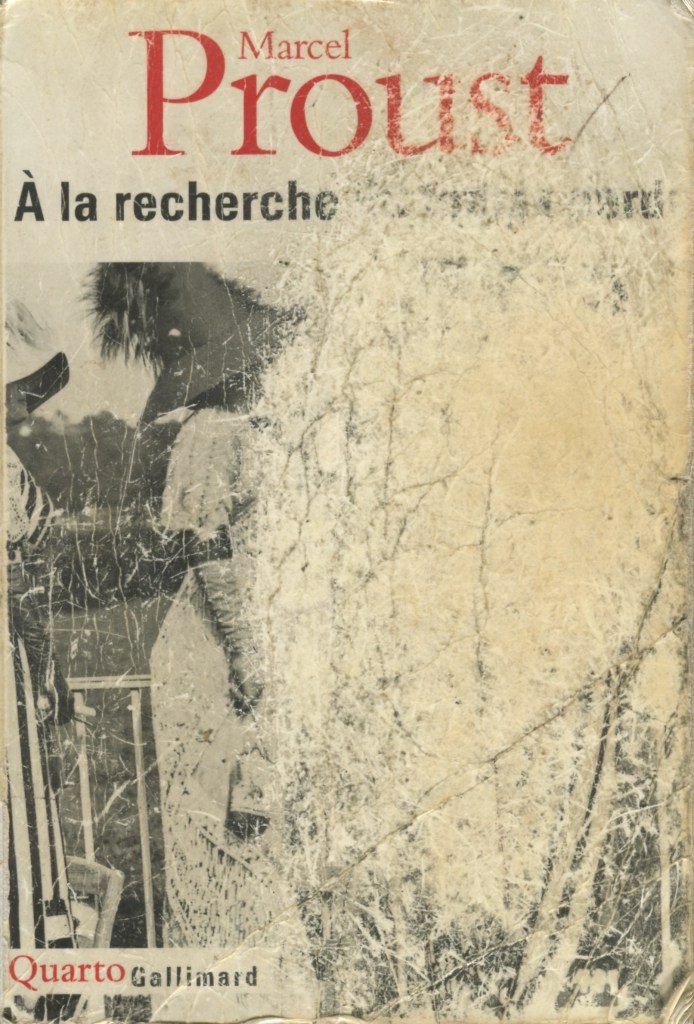
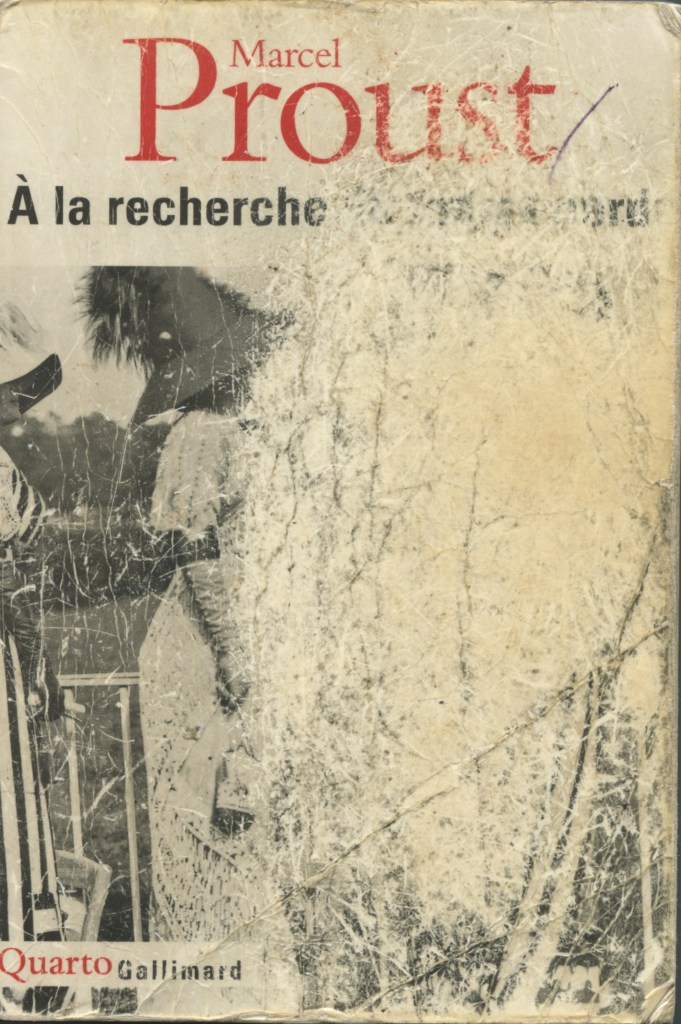
Marcel Proust, À la recherche du temps perdu (text established under the direction of Jean-Yves Tadié ©1987–1992): Book 6, Albertine disparue, the last pages of Chapter 1 to the first pages of Chapter 3 (pages 2000–2077)

I’m now well into the sixth and second-last book of À la recherche du temps perdu. This was published posthumously, and I gather that it’s the book that has generated most controversy about the correct text. Even its French title chopped and changed – evidently it was originally La fugitive, but had a name change to avoid confusion with someone else’s book of the same name. I mention this because this month I stumbled over a paragraph that’s in my book but not in C K Moncrieff’s translation or the French edition he worked from. So here’s a little tangential story.

As he struggles to come to terms with the loss of Albertine, Marcel’s grief gradually fades but his jealousy and his obsession with her amorous relations with other women persists. His investigations make it increasingly clear that these relations were not figments of his jealous imagination, and he craves to understand Albertine’s inner life in her Lesbian experiences. This narrative line is developed in painful detail, and goes to unexpectedly creepy places, including long interrogations of Andrée, who has been fancied by both Albertine and Marcel. On the way, Marcel hears of evidence from a blanchisseuse. Basic French vocab tells me that this is a washerwoman, or laundress. However, as blanchisseuses keep being mentioned as women who are available for casual sex I began to wonder if the word had a slang meaning. One online dictionary confirms my suspicion, suggesting that it has been slang for ‘prostitute’. After reading one particularly confronting passage, I went to the English translation to see if C. K. Scott Moncrieff found an equivalent euphemism.

He didn’t. His translation is ‘laundress’.

But here’s the thing. The passage that had sent me to Scott Moncrieff isn’t in his translation at all. I thought this might be a case of quiet censorship. After all, it’s not unheard of for translators to spare their readers bits they think will bore or otherwise alienate them. But then I discovered that this passage isn’t there in the only French version I could find online. So the absence wasn’t about sparing delicate English sensibilities. Maybe Proust thought better of it and took it out, only to have it reinstated by an editor/scholar 70 or so years after first publication. Or he intended to put it in, to push the envelope even further, but died before he could make his intentions clear – to have those intentions understood and implemented 70 or so years later.

In the passage in question, Marcel decides he wants to hear what Albertine would have sounded like when taking her pleasure with another woman, so he has two ‘little laundresses’ demonstrate for him. It’s a good example of Proust’s commitment to complexity, even when he’s being quite, well, pervy: while inviting us to imagine a Lesbian sex scene, he discusses the difficulty of interpreting sounds stripped of context and the impossibility of ever fully understanding another human being. Part of the passage and my attempt at a translation are at the end of his blog post.

Finally, in the last two days’ pages, Marcel has got out of his bedroom and is now in Venice with his mother, appreciating both of them, and once more going on the prowl for beautiful young women.

It’s been strange this month to settle down to a couple of pages of Proust each day, when so much other time has been spent doomscrolling, reading about world events where deep, slow, complex analysis of thoughts and feelings is almost impossible to imagine. Exasperating as Marcel’s relentless self-dissection may sometimes be, it’s immensely reassuring that this too is possible.


Here’s the passage with the ‘two little laundresses’

Dans un maison de passe j’avais fait venir deux petites blanchisseuses d’un quartier où allait souvent Albertine. Sous les caresses de l’une, l’autre commença tout d’un coup à faire entendre ce dont je ne pus distinguer d’abord ce que c’était, car on ne comprend jamais exactement la signification d’un bruit originale, expressif d’une sensation que nous n’éprouvons pas. Si on l’entend d’une pièce voisine et sans rien voir, on peut prendre pour du fou rire ce que la souffrance arrache à un malade qu’on opère sans l’avoir endormi; et quant au bruit qui sort d’une mère à qui on apprend que son enfant vient de mourir, il peut nous sembler, si nous ne savons de quoi il s’agit, aussi difficile de lui appliquer une traduction humaine, qu’au bruit qui s’échappe d’une bête, ou d’une harpe. Il faut un peu de temps pour comprendre que ces deux bruits-là expriment ce que, par analogie avec ce que nous avons nous-mêmes pu ressentir de pourtant bien différent, nous appelons souffrance, et il me fallut du temps aussi pour comprendre que ce bruit-ci exprimait ce que, par analogie également avec ce que j’avais moi-même ressenti de fort différent, j’appelai plaisir; et celui-ci devait être bien fort pour bouleverser à ce point l’être qui le ressentait et tirer de lui ce langage inconnu qui semble désigner et commenter toutes les phases du drame délicieux que vivait la petite femme et que cachait à mes yeux le rideau baissé à tout jamais pour les autres qu’elle-même sur ce qui se passe dans le mystère intime de chaque créature. Ces deux petites ne purent d’ailleurs rien me dire, elles ne savaient pas qui était Albertine.

(page 2018)

My attempt at a translation, resisting the temptation to break his long sentences up:

I had brought to a disorderly house [Scott Moncrieff’s polite term] two little laundresses from a suburb that Albertine used to frequent. Under the caresses of one, the other began to make a sound of which at first I could not make out the nature, as one never understands precisely the meaning of a new sound that expresses a sensation we don’t experience. If you hear it from a neighbouring room without seeing anything, you can hear as mad laughter that which is drawn from a patient being operated on without being put to sleep; and as for the sound that issues from a mother who is told that her child has just died, that might seem, if we don’t know what is happening, as difficult to translate into anything human as the sound that escapes an animal, or a harp. A little time is needed to grasp that those two sounds express what, by analogy with what we ourselves have felt, though quite different, we call suffering, and I also needed time to understand that this noise expressed what, similarly by analogy with what I had myself felt, though very different, I called pleasure; and the pleasure must have been very powerful to throw the person feeling it into such disarray and draw from the person this unknown language which seems to name and annotate all the stages of the delightful drama being lived by the little woman and being hidden from my eyes by the curtain lowered forever for anyone other than herself over what passes in the intimate mystery of each creature. These two little ones could tell me nothing. They didn’t know who Albertine was.

Susanna Clarke’s Piranesi

Susanna Clarke, Piranesi (Bloomsbury 2020)

I tend to think of every book I read as a stand-alone experience, but that’s almost certainly nonsense. With Piranesi I have been acutely aware that like it or not I was reading it with other books in mind. I can think of three.

First, and least significantly, there’s David Mitchell’s Utopia Avenue which I’d read immediately before beginning Piranesi (blog post to come in early February). Mitchell is quoted on the back cover of this book: ‘What a world Susanna Clarke conjures into being.’ So I was led to expect something of the interplay of different realities that I loved in Mitchell’s book.

The opening pages of Piranesi, in which the protagonist lives in a labyrinthine House that he perceives to be the whole world, sent my mind hurtling back to the short stories of Jorge Luis Borges. When I was at university in the 1970s, poet Martin Johnston was a huge Borges fan and a super spreader of enthusiasm for his short fictions. I was one of the many infected. More than one Borges story involves a labyrinth – ‘The Library of Babel‘, for example, imagines a universe consisting of a vast library of interconnected hexagonal rooms containing all the books every written. It’s as if Susanna Clarke had become fascinated by a Borgesian image, in which statues, an infinite number of them, line the walls of an infinite number of hallways, vestibules, and rooms. The protagonist-narrator, named Piranesi, though he assures us that is not his real name, writes with a kind of Borgesian abstraction – though where Borges’ narrators are conducting thought experiments (‘what if there was a library that …’), it’s clear from the start that for Piranesi there’s no scholarly or ironic distance.

Entry for the first day of the fifth month in the year the albatross came to the south western halls
When the Moon rose in the Third Northern Hall I went to the Ninth Vestibule to witness the joining of three Tides. This is something that happens only once every eight years.

It’s many years since I read any Borges, but I was immediately in familiar, though eerie, territory.

But this is a novel. One begins to want explanations. We meet a man who Piranesi thinks is the only other living human, whom he calls the Other. (Piranesi’s idiosyncratic use of initial capitals is only part of the general strangeness.) The Other has a shiny object that we suspect is a smart phone, and there are other clues that he has a life outside the House. Piranesi actually overhears a snippet of conversation that sounds to the reader as if it comes from a contemporary street on the other side of an invisible wall, but to Piranesi is meaningless and fails to inspire curiosity. A trajectory is established: Piranesi is going to find out what’s going on …

Progress is slow, and I might have lost confidence altogether if I hadn’t read Joanna Clarke’s first novel, Jonathan Strange and Mr Norrell (2004 – before I started blogging about my reading). This is a vast, slow-moving story of magic in Regency England, not big on thrills and spills, though the Battle of Waterloo, suitably magicked, features. I have a lasting impression of being immersed in a meticulously created world where magic is part of the texture of life. I would have been surprised if in Piranesi the ‘real world’ outside the House wasn’t revealed to be both recognisably mundane and weirdly fantastical.

I got what I was expecting. The explanation of the nature of the House is only slightly more complex and plausible than Dr Who’s ‘timey-wimey stuff‘, but who really ever cares about such explanations – it’s a fantasy novel, for goodness sake! The history that Piranesi gradually uncovers, on the other hand, is full of intellectual intrigue, complex relationships, and general creep-you-out-ness; and the big climax (foreshadowed in the opening lines I quoted above) kept me reading well past bedtime. (Incidentally, ‘timey-wimey stuff’ gets a mention in a document that Piranesi discovers, and which is incomprehensible to him.)

While Piranesi is looking for the truth of his history, readers (this one, anyhow) are hoping the book will unfold something of what it is about that infinite House filled with statues that captured Susanna Clarke’s imagination, and for that matter ours. I don’t want to reduce the book to an allegory: I’m happy for it to be a story about a house full of statues and nasty magic. But I did find myself brooding on echo chambers and half-overheard conversations about Baudrillard. From Wikipedia: ‘Baudrillard claims that our current society has replaced all reality and meaning with symbols and signs, and that human experience is a simulation of reality.’ With that kind of thinking in mind, Piranesi’s struggle stirs in readers’ minds our own struggles to reach past the simulacra, dogmas and fairytales have been given since childhood, to an independent relationship with the real world. At least that’s where it took me, and it was fun being taken.

Rhoda Lerman’s Book of the Night

Rhoda Lerman, The Book of the Night (©1984, Women’s Press 1986)

This book is on a list of SF/F must-reads I stumbled on some years ago, a list that has since introduced me to some wonderful novels from the dark crannies of the genre, as well as its spotlit centre-stage (some of my blog posts about them are here, here, here and here). I took The Book of the Night down from my TBR SF/F bookshelf thinking it would be a bit of light reading before I move on to Jess Hill’s See What You Made Me Do or other demanding reads. Ha! A 1984 Kirkus Review may have been a tad negative, but it captured something of the feel of the book when it called it an ‘an over-riddling allegory, steamy as a cow shed with unprocessed invention and quasi-feminist murk.’

This is a book set on the Irish island of Iona in the 10th century CE, though elsewhere in the world it’s the late 20th century: coke-bottle caps turn up in the first chapter and a tourist group comes visiting at one stage. On the island is a monastery whose monks who are caught up in that great moment when the Irish church was resisting the call to be obedient to Rome. And there is traffic between the world of the living and that of the dead. The main character, Celeste, is brought to the island as a young girl by her father who becomes increasingly lost in incoherent quasi-mystical wordplay. He sends her, disguised as a boy, to join the monastery, and through a series of misadventures, including some spectacularly metaphorical sex, she becomes – as you do – a cow.

There’s a man who by flapping his arms and farting flies out a window. Celeste’s father has unmetaphorical sex with a woman who comes to the island as a cook, and Celeste, who at that stage is believed to be a (human) male, is cast out of the monastery as the putative father. There’s a bloody battle, a walk through the underworld, an underclass who deliberately split their noses to avoid paying a nose tax. There’s more than one scene where a human man and a cow have consensual sex – told from the cow’s point of view. At least, I think that’s what’s happening among all the fiery language. Above all, there’s elaborate punning wordplay, and the whole story seems to revolve around the philosophical concept that, according to an authorial note, under certain circumstances, ‘An organism is able to reorganise itself into a higher level of order, to transcend itself.’

Take this as a confession of my thickness, but none of it made much sense to me. That didn’t stop me from enjoying the ride. The Kirkus Reviewer was wrong to describe the book as an allegory. That’s like wanting the zombies in zombie movies to mean something: maybe they do, maybe they don’t, but if you don’t respond to them viscerally as zombies, there’s no point. Rhoda Lerman may be have been exploring serious ideas, but (did I mention the farting man who flew?) she’s not po-faced about it. I did go back and skim-read the first couple of chapters again, and it turns out that this is one of those books where that’s a fruitful thing to do: what felt like gobbledygook on first reading now casts light on the confusing and tumultuous final few pages. I’m not going to read it all again, at least not right away, but I’m prepared to believe that in the midst of the exuberant, self-contradictory, sometimes chaotic eventfulness and wordiness, which are a blast in their own right, there’s something coherent going on.

As far as I can tell, this was Rhoda Lerman’s only fantasy novel. I have no idea what impact if any she had on the genre. It’s a long way from The Lord of the Rings.

Proust Progress Report 16: She’s gone

Marcel Proust, À la recherche du temps perdu (text established under the direction of Jean-Yves Tadié ©1987–1992): the beginning of Book 6, Albertine disparue (pages 1919–1999)

Albertine disparue (English titles The Fugitive and The Sweet Cheat Gone) takes up immediately after the moment at the end of Book 5 when the servant Françoise tells Marcel that Mlle Albertine has packed her bags and left. The 80 pages I’ve read this month are single-mindedly devoted to his reactions. First he tries to get her back by his usual convoluted method of dissembling his true feelings, and he almost succeeds. Then (I’ll try to avoid spoilers) it becomes clear that Albertine will definitely never return, and the narration gives us the twists and turns of his mental processes: what happens to his obsessive jealousy now that she’s gone? does he find relief from the claustrophobia he suffered when she was living with him? does he love her and need her more than he realised?

If Proust is remembered most for his treatment of memory, these pages, in which his grief-stricken mind remembers Albertine in a hundred ways, must be key. He is made up of multiple mois, each learning of her departure at his own time. Albertine has split up into multiple tiny household deities, each animating an otherwise mundane object with an emotional charge. He catches himself in myriad ways thinking of her as somehow alive and – for example – being glad to see how much he does love her. Many, if not all, of the threads of the narrative so far, help shape these moments (and such is the treatment of time, you can’t tell whether the moments are spread over weeks, months or even perhaps years). All the earlier deaths and liaisons and desires we have been told about are summoned to shed light on his present state.

Though Marcel does take action, at first to persuade Albertine to return and then to seek evidence to support or refute his obsessive suspicion that she was secretly an active lesbian, my impression is that he barely leaves his apartment in these pages or talks to anyone apart from the people he sends to negotiate and investigate.

This is all fascinating, no irony intended. The intricate dissection of the character’s mental processes is stunning. I’m probably influenced by the knowledge that these last two books were published after Proust’s death, and weren’t subjected to the same thorough revision process as the previous ones, but it does feel somewhat repetitious (as opposed to obsessive, and I know there’s a big overlap), and I hope he soon manages to move on.

I may have mentioned that, unlike Miles Franklin whose copy of À la recherche du temps perdu has notes in the margins indicating that she frequently looked up words she didn’t know, and unlike Clive James who took 15 years to read it dictionary in hand, I’m willing to read on with just a rough sense of the meaning. Typically, I’ll look up two or three in every three-page reading session. And it’s one of the pleasures of reading this book that often when I look up a word, it’s as if the meaning of a sentence or an image solidifies before my eyes. An example from this morning:

On dit quelquefois qu’il peut subsister quelque chose d’un être après la mort si cet être était un artiste et mettait un peu de soi dans son oeuvre. C’est peut-être de la même manière qu’une sorte de bouture prélevé sur un être et greffée au coeur d’un autre, continue à y poursuivre sa vie, même quand l’être d’où elle avait été détachée a péri.

This is how I read that at first:

They say that something of a person may live on after death if that person was an artist and put a little of themselves into their work. Perhaps in the same way a sort of blah-blah removed from a person and blah-blahed to the heart of another continues to carry on its life, even when the person from whom it had been detached has perished.

I got the gist. But decided out of interest to look up bouture and greffée. Bouture is a gardening term meaning ‘cutting’, from bouturer, ‘to propagate by cuttings’. I hardly needed to look up greffer, whose meaning of ‘graft’ or ‘implant’ is now clear. And the image comes viscerally alive. Or cardiacally, if that’s a word.

I doubt if I’ll manage three pages every day over Christmas and New Year, as we’ll be taking advantage of the open state borders and doing a bit of driving. But I’ll try to keep to schedule and do another progress report on 14 January. Maybe poor Marcel will have cheered up and got a hobby.

The Book Group and John Irving’s Prayer for Owen Meany

John Irving, A Prayer for Owen Meany (Bloomsbury 1989)

Before the meeting: This is an odd book. It tells the life story of Owen Meany, a young man who is tiny in stature and huge in voice like the hero of Gunther Grass’s The Tin Drum (which I haven’t read, though I’ve seen the movie). From an early age Owen has a profound belief that he is an instrument of God, and he has a vision of his own death, including the exact date and some of the circumstances. His story is told by his best friend Johnny Wheelwright, who doesn’t have a lot to distinguish him from any other child of an old New England family, except that his mother never revealed the identity of his father and she herself was killed in a bizarre Little League accident when he was eleven.

I loved the first hundred pages or so, which introduce us to the characters who inhabit the small New Hampshire town of Gravesend, and tell the story of Owen and Johnny’s childhood friendship, their shared quest to find the identity of Johnny’s father, their adolescent adventures. I was happily back to my enjoyment of The World According to Garp (1978) and The Hotel New Hampshire (1981), both of which I read when they were newly published. John Irving has an eye for the detail that brings a scene to life, and manages to keep his story slightly off-kilter without every completely descending into quirkiness. His characters are vividly realised in a few strokes, with an almost Dickensian oddness. My love waned in a very long sequence involving the staging of two theatrical pieces concurrently, a Christmas pageant and a production of A Christmas Carol. In both of them Owen is improbably compelling, at least in rehearsals, as the Christ Child and the Ghost of Christmas Yet to Come. Both predictably descend into chaos. These chapters rattle along, full of amusing and touching incidents and character development, but I was straining at the bit, wanting the story to move forward.

Then at almost exactly the midpoint of the novel, in the narrator’s present time, I was rapped over the knuckles in a moment that’s close to being explicitly meta. John (as he is now known) laments that his girl students don’t read Hardy’s novels with an eye to foreshadowing. ‘I hope you realise,’ John Irving was saying at barely one remove, ‘that all that stuff about Owen as Christ, Owen as a ghost predicting the future, Owen and a number of armless figures, Owen practising a special basketball move, all that was giving you very specific hints about where this narrative is going.’ Well, I took the hint, and from that point on I read everything as foreshadowing.

When all that carefully constructed foreshadowing came together in the final pages of the book, it was most satisfactory – or just a bit too neatly tied together, depending on your point of view. I was left uneasily cold by the religiosity of the story, which to be fair was signalled on the very first page when John-the-narrator tells us that Owen was the reason he believes in God. Owen becomes a Christ figure, but without arms, and John lives out his day as a vaguely religious, celibate man whose only purpose, apart from teaching English literature to teenage Canadian girls, is to bear witness to Owen’s story. Religion is his analgesic. ‘Don’t underestimate the church’ – he says at one point – ‘its healing power, and the comforting way it can set you apart.’ (Page 415) It’s a religious faith that depends on miracles for its existence (the kind of miracles that exist only in the pages of carefully contrived novels), and leads to a lack of engagement with the world, or with anything but the memory of his Christ-like friend. It leaves a sour taste in this reader’s mouth.

But, speaking of foreshadowing, John’s present time coincides with the Contra scandal under Reagan, and though he has been living in Canada for decades he is addicted to the US news. So much of John’s (and presumably Irving’s) commentary on Reagan’s US feels eerily prophetic of Trump and Trumpism. I recognise John’s newspaper addiction as an old-media version of my (our?) Twitter addiction. It’s not that things were the same back then, but by contrasting the Kennedy era of Johnny and Owen’s adolescence with the Reagan era of John’s middle age, the passions that burned over the US invasion of Vietnam with the apathy that greeted the Contra scandal, the novel captures a change in the US’s political culture, a change that has since deepened to an extent that would have looked wildly fantastical in the 1980s.

After the meeting: Last night was our last meeting for 2020 and our second since we all started to relax a little about Covid–19. All but two of us made it – one of the absentees had to attend a family do, and the other had been tested for the Covids with his young daughter and was staying home as a good citizen (he WhatsApped us this morning to say the result was, as expected, negative). We had what we’ve been calling a Gentlemen’s Picnic: everyone brought food. We ate well, including salmon with anchovy butter pats, barbecued sausages, charcoal chicken, several salads and three different desserts. Covid deprived us of meatballs slow cooked with figs. Our host had Gospel music playing as we arrived, which he said was the nearest he could come to the religiosity of the book, and at the end of the evening he treated us to a couple of short films he had made – potentially setting a dangerous precedent as I’m sure may of us have substantial slide shows we’d love to share.

It’s not that we didn’t talk about other things: family news, good TV and movies (a Michael Jordan film is apparently excellent, and I’m not the only one who loved Corpus Christi), a bit of reminiscence about the 18 years of book group and rumination on how it has changed this year (because of Covid and zoom? because of the level of trust that has enabled discussion to become more robust? because the person who noticed the change has been a more frequent attender this year?), Trump deprivation syndrome, and show-biz anecdotes all got an airing. But the book generated a lot of discussion.

I wasn’t an outlier, as it turned out. Someone described the book, memorably, as a shaggy dog story. A man who said he hadn’t finished it was having trouble following comments about how all the threads came together in the last scene: it turned out he’d read all but the last 10 pages or so, which just goes to show how skilfully John Irving postpones his revelations until the last possible moment. Someone said – articulating my sentiments exactly – that in the first couple of pages he breathed a sigh of relief: after reading a number of books for the group that, whatever their other virtues, were pretty rockily written, with this he knew he was in the hands of an accomplished storyteller.

Someone felt that this was a book written by someone who had a big back catalogue, who now could relax and just spin a yarn without being too serious about it, venting about current politics as the spirit moved him. Not everyone agreed. Some, me included, felt we were expected to take the religious theme seriously but found it pretty hard to do so. One said most of the religious stuff was largely incomprehensible to him. I asked if the recurring image of armlessness was purely decorative or had some thematic significance. One of our architects took offence, demanding, ‘What’s wrong with decoration?’ and describing the way those recurring images created a patterning that was pleasing in itself and helped the reader track the story. Our Book Chooser, who first read the book 30+ years ago, loved it then and loved it again this time, thought the armlessness represented Owen’s helplessness in the light of fate. This led someone to comment that though Johnny keeps his arms, he is ineffectual, spiritually armless. None of us could remember what we were told about the armless image drawn by the 17th century sagamore Watahantowet when he signed away the land to the invaders, but felt that might offer some help. I just looked it up:

Some said it was how it made the Sagamore feel to give up all that land – to have his arms cut off – and others pointed it out the earlier ‘marks’ made by Watahantowet revealed that the figure, although armless, held a feather in his mouth; this was said to indicate the sagamore’s frustration at being unable to write. But in several other versions of the totem ascribed to Watahantowet, the figure has a tomahawk in his mouth …

There’s more. The upshot is that the armlessness could signify many contradictory things. It’s a good example of how so much of the early pages of the book are full of foreshadowing, and of how hard it is to pin down the book’s actual position. Is John Wheelwright a dependable narrator? Does Johnny have a feather between his teeth, while Owen had a tomahawk? The questions aren’t resolved, and we don’t even know if they are meant to be taken seriously. We admired the first sentence of the book as an example of foreshadowing; evidently John Irving himself admired it too.

A number of chaps had done some supplementary reading. One of them had read that John Irving starts with a clear image of how a book is going to end and then makes sure everything leads to that point. This rings very true.

In order to give the appearance of completeness, I’ll finish with a quote from the one chap who hadn’t read the book at all, except for the author’s introduction in his copy. He said he concluded on the basis of that introduction that John Irving was a wanker. Not everyone agreed.

November Verse 5 and Ocean Vuong’s On Earth We’re Briefly Gorgeous

November verse 5: Letter to my Mother

Dear Mum, I won't write you a novel.
Barely fourteen rhyming lines
I'll manage. No space to unravel
the half a century that twined
our lives. Perhaps I know you better
now than when your weekly letters
filled me in on family news.
I wish that you could know me too,
that you could look down from some heaven,
hear the words I wish I'd said,
see the tears I should have shed
back then, take thanks for all you've given.
The grave is deaf and blind and still.
What we didn't say, we never will.

This is prompted by a marvellous book, a very different letter to a very different mother:

Ocean Vuong, On Earth We’re Briefly Gorgeous (Jonathan Cape 2019)

The protagonist narrator of this novel, known to his intimates as Little Dog, is a Vietnamese-American Gay man, and this is his portrait of the artist as a very young man. The text is cast as a letter addressed to his mother. He tells her the story of his childhood, including quite a bit of abuse he suffered at her hands and his understanding that that abuse was part of the aftermath of the US-Vietnam war. He tells of his relationship with his grandmother, her mother, and what he knows of her love story with a US serviceman. And he relates his teenage experiences of sex. Given the sometimes excruciating detail about young gay male sex (excruciating both physically and in its turbulent emotional ambivalence), clearly this is not a letter he really expects his mother to read.

Ocean Vuong has won big prizes for his poetry, and parts of this book read as prose poetry. I don’t mean that some parts of it defy any attempt to extract a simple prose meaning, though there are a couple of moments like that. I mean, among other things, some images, as of buffalo running over a cliff or monarch butterflies making their vast annual journeys or Tiger Woods putting in an appearance, do a lot of work. And there are rhapsodic sections that don’t bother with conventional sentence structures, but take the reader with them in not bothering. For example, there are six pages in which Little Dog, sings (that’s the only word for it) about Trevor, the first object of his troubled but reciprocated desire. Here’s a little of it:

Trevor going fifty through his daddy’s wheatfield. Who jams all his fries into a Whopper and chews with both feet on the gas. Your eyes closed, riding shotgun, the wheat a yellow confetti.

Three freckles on his nose.

Three periods to a boy-sentence.

Trevor Burger King over McDonald’s ’cause the smell of smoke on beef makes it real.

The Vietnam War, growing up Gay and Vietnamese in working-class Hartford, Connecticut, the ravages of the OxyContin epidemic, dementia: the book deals with difficult and sometimes tragic lives. But the writing is sharp and rich and, in the end, celebratory.

My favourite scene is the one where Little Dog comes out to his mother in a Dunkin’ Donuts: ‘I don’t like girls.’ The conversation that follows is not astonishingly original (‘Are you going to wear a dress now?’ ‘They’ll kill you, you know that.’ ‘When did all this start. I gave birth to a healthy, normal boy.’ But then:

When I thought it was over, that I’d done my unloading, you said, pushing your coffee aside, ‘Now I have something to tell you.’

My jaw clenched. This was not supposed to be an equal exchange, not a trade. I nodded as you spoke, feigning willingness.

‘You have an older brother.’ You swept your hair out of your eyes, unblinking. ‘But he’s dead.’

And a whole terrible part of his mother’s life is revealed to him. So I need to modify my description of the book as a portrait of the artist as a young man: it’s a portrait that includes an extraordinary openness to the generations that gave rise to the young man.

Julie Janson’s Benevolence at the Book Group

Julie Janson, Benevolence (Magabala Books 2020)

Before the Meeting: Generally, if I read a book about a marginalised group I try to read one by someone from that group soon after. Even though both Truganini (the Book Group’s last title) and The Colony (which I read just before Truganini) are committed to telling colonial history with First Nations perspectives to the fore, they are both written by white/settler women. So I was happy when this book by Julie Janson, a Burruberongal woman of the Darug Nation, was chosen for the Book Group.

Julie Janson has described the novel as ‘a First Nations response to The Secret River by Kate Grenville’:

[The Secret River] is a wonderful book, but I was challenged by the ending where all the Burruberongal Darug people died in a massacre except for one old man. I asked myself the question: if all the Darug died, who were we?

I had researched my (Aboriginal) family history along the Hawkesbury River, and the Darug interpretation of those early days of colonial invasion is entirely different.

(Link to Booktopia interview here)

Benevolence (the title is deeply ironic) tells the story of Muraging, a Burruberongal woman whose parents give her up to a missionary-run school in 1816 when she is very young, in the hope that she will gain resources there to survive in the colonised world. Renamed Mary, she learns to read, write and play the violin, and resists attempts to make her give up on her culture, language and people. She runs away with a handsome young Aboriginal man, and what follows is a picaresque account of her travels, moving back and forth between the two cultures – now living with a group of women who have lost their men to the frontier wars, now a servant to a clergyman with whom she has a consensual sexual relationship that eventually goes very sour, now wandering with her small daughter, a servant again, a disregarded listener to callous conversations about massacre and rape, a speaker of truth to power. She finds occasional kindness and mostly avoids threats of violence and sexual assault. She spends time in prison, is often hungry, loses her daughter, has a second child after having sex with a French man in return for a bag of flour. She never gives up the search for her family and a place where she can live among her people.

It’s a story of navigating the harsh conditions of colonisation. The Aboriginal people and communities that Mary encounters are not pathetic victims, and aren’t romanticised as automatically safe and nurturing, but at the end of the novel, she finds a home in a community of survivors – precarious, under threat, but solid.

Each chapter has a year in its heading title, and most begin with a brief note on what is happening in the colony: in 1826 Darling becomes Governor of the colony; in 1832 Kings School opens in Parramatta; in 1835 Governor Bourke proclaims terra nullius; also in 1835 King William IV recognises the continued rights to land for Aboriginal people in South Australia. These landmarks serve to anchor the narrative in settler history, but most bear little direct relation to Mary’s struggles.

There are many painful scenes with settlers: the unashamedly white supremacist Reverend Masters, the weak Reverend Smythe (her first child’s father), Smythe’s insufferably prim and nasty wife Susan, a military man who forces her to guide him on a punitive expedition that culminates in massacre, and others. These characters are pretty much universally portrayed as weirdly irrational, inconsistent, bullying or pusillanimous, so that their scenes – dinner parties, domestic rows, meetings with Aboriginal warriors – read like hellish phantasmagoria. I haven’t seen any of Julie Janson’s plays, but many of the scenes involving settler characters read like scripts for rough-theatre, agitprop pieces.

To give you a taste, here’s part of the scene where Susan Smythe has caught her husband Henry having sex with Mary, after Susan has set fire to their cornfield and blamed Mary, after Mary has saved Susan’s life, after Henry has told Mary many times that she must leave. Mary is listening from behind a screen:

‘Get rid of her!’ Susan is speaking with a clear high voice. Henry twitches and ruffles his black hair with nervous fingers. He sits by his writing desk and taps his quill. He laughs like men do when confronted by a wronged woman.

‘Must we discuss this now? I am penning a sonnet and working on my native language book,’ says Henry. He dips the quill in ink and examines the tip.

“Sonnet? Are you insane? I shall call the doctor to bleed and purge these dark humours,’ rages Susan.

‘We must buy more quills – make a list … She is just a black servant. Don’t be silly, Susan dearest,’ says Henry.

‘You must choose between rich cream cake and soda bread,’ says Susan.

Mary leans forward to hear his answer. She holds her breath.

‘Don’t be ridiculous, dearest. It was a mistake such as many better man than me have also on occasion made. You must forgive me. I command you to find forgiveness. I am only human,’ says Henry.

‘I have heard about such servants! The other colonial wives have spoken of these creatures!’ says Susan. ‘You are shaming me and have no respect for the sacred promise of our marriage. You are a colonial joke. Everyone is laughing at you – behind your back – at your lack of Christian fidelity or conscience as you preach your pious sermons on the Sabbath. Look at you now, damaged by a violent savage and yet you dare to defy me and you let her stay.’

(Pages 178–179)

Clearly both these people are unhinged. Yet they have life-and-death power over Mary and her daughter.

It’s exhilarating to have stories of early settlement told from a strong, unapologetic Aboriginal point of view that makes no attempt to humanise the invaders.

This is an unsettling book, not only because of its content. Very unsettling for me as a white, middle-class man who has worked for decades as a copy-editor, is a kind of knockabout quality to the text, something that I took at first to be poor proofreading but which is so pervasive that it has become a feature rather than a bug. In these sad times when publishing companies don’t generally have in-house copy editors, it’s a rare book that has no typos, but this is at a whole other level.

There are moments, like this from page 110, that are impossible to visualise:

Mary sips the tea and smiles with her hands pressed between her thighs.

There are malapropisms – some Aboriginal people are to be punished for their ‘trepidations against settler families’. A tribe in the north-east of Sydney is called the ‘Awakabal’, twice, which is surely a misspelling of ‘Awabakal’. A character is described as Bungaree’s grand-daughter and on the same page as the sister of Bungaree’s son.

I don’t think these errors are deliberate, but whether they survive to the published text through lack of resource or failure of editorial attention they amount to a kind of nose-thumbing. I think of that Audre Lorde quote: ‘The master’s tools will never dismantle the master’s house.’ Benevolence uses the colonisers’ tool, the novel, to respond to a ‘wonderful book’ that has erased a people’s survival. There’s a kind of rough justice in that tool being treated with disrespect.


After the meeting: We met in person for the first time in months. At least seven of us were there in person – even making a little physical contact. An eighth had been about to leave his home when a friend and recent contact called to say she was feeling sick, so he did the ‘abundance of caution’ thing and joined us on a screen for as much as he could stand.

It was good to eat together. It was so good to be in a room with other bodies, where cross-currents of conversation were allowed to flow (though that was hard on the virtual participant). Somehow, I think, being physically together made it easier to talk about this book – about the roughness of much of the writing, and the shameful sense most of us shared of having light shone on our ignorance about the realities of colonisation.

Others were – of course – less disturbed than I had been by the typos etcetera. I had hoped someone might have seen Julie Janson’s plays at Belvoir Street, but no one had. Someone mentioned Kim Scott’s books, That Deadman Dance and Taboo (links to my blog posts) as covering similar territory, brilliantly. A couple of guy had gone in search of historical information, and reminded the rest of us that Samuel Marsden, presumably the inspiration of the novel’s Reverend Masters, was on record as perpetrating hideous atrocities. We generally acknowledged the heartbreaking difficulty of the task Julie Janson had taken on: to draw on scholarly historical works and stories passed down by generations of survivors, to imagine herself into the life of one person in those terrible times. The general sense was that, for all its flaws, we were glad to have read the book. The Chooser, who was absent because of a non-Covid infection, was thanked in his absence.

And of course, we shared our responses to whatever the President of the United States had done (it was last night and he’s said so much since then!), to the Premier of New South Wales’s self-inflicted damage, to some recondite celebrity gossip (did you know about Bug Beats, a children’s show on Netflix, that has permission to use a whole slew of Beatles songs), to the adventures of some of our offspring, etc. We took a moment to honour the achievement of Victorians in bringing the infection numbers down. The potatoes that our host had put in the oven some time before we all arrived were ready to eat soon after we all left. He sent us a photo on WhatsApp.


Benevolence is the 17th book I’ve read for the 2020 Australian Women Writers Challenge.

Jennifer Maiden, George and Clare, the Malachite and the DIamonds

Jennifer Maiden, Play With Knives Five: George and Clare, the Malachite and the Diamonds: a novel in prose and verse (Quemar Press 2018)

George Jeffreys and Clare Collins first met in the 1980s when he was a probation officer in Western Sydney and she was a young woman nearing the end of her prison sentence for murdering three smaller children when she was nine years old. They have since featured in four novels before this one, and in more than 30 poems, going on to become lovers, work together for an NGO called Prisoners of Conscience, and most recently have a baby together.*

In this book they set off to Russia to bring home the daughter of a friend who is in thrall to a murderous international operative. The young woman is an arms dealer in her own right, and it’s not at all clear that she wants to be rescued, although she knows her life is in danger.

The book has all the ingredients of a thriller: exotic locations, hacking, deep-state conspiracy, silicon-impregnated diamonds, helicopter rides, glamorous women, worldweary men, and an urgent sense of jeopardy both for the characters and for the whole world of the novel, which is recognisably ours, as conflict rages in Syria, Julian Assange is not yet extracted from the Ecuadorian embassy, and there are wars and the prospect of war from Russia, the Ukraine, the USA, China … There’s quite a bit of sexual tension and actual sex, lots of violence, and a satisfying twist at the end, with bonus explosion.

But if you picked the novel up expecting a straightforward political thriller, you’d be disconcerted. For a start, every second chapter is in verse – verse whose long lines and conversational rhythms may at first be mistaken for prose with unexpected turns of phrase and odd line breaks, but whose precision and visual qualities are anything but prosaic.

Then there are the characters. In their previous adventures, George and Clare have accumulated relationships. We rarely see them without their months-old baby Corbyn, and many of their scenes, even the most violent, are shared with some or all of their entourage: eight-year-old Florence whom they rescued from death in Paris, Florence’s mother Sophie, George’s hacker grandson Idris, a young Russian cop named Kirill and a Saudi agent, Samir. They frequently converse with Clare’s and Quentin’s mothers back in Mt Druitt, as well as a Darug woman, Ruth, behind whom lurks the shady but benign Lithgow Coven. A dog and a cat that were rescued from far-flung places in earlier books still need to be catered for. The memory of the children Clare killed is never far from her mind. Unsurprisingly, every now and then there is a roll call: ‘Present were Clare, Corbyn and I, Idris, Sophie, Florence and Ninel’ (page 30), ‘In a cafe near 1st Tverskaya-Yamskaya Street, I was sitting with Idris, Sophie, Florence, Ninel, Kirill and a Saudi agent called Samir’ (page 106). This is not a tale of a solitary individual hero; none of the characters needs to be told that humans are social animals.

Nor is the book populated by strong, silent types. There’s constant chatter – political gossip, poetry recitals, reminiscences about adventures in previous books, snippets of interesting history, commentary on world affairs, cultural analysis, meditation on moral and ethical issues. Thrillers are often impregnated with right-wing ideology. Not the George and Clare books. I confess that reading the book three years after publication, I’m mystified by many of its contemporary references – but maybe I would have been at the time. George and Clare are extraordinarily well informed, and have inside knowledge of many points of global conflict, thanks in part to their membership of Prisoners of Conscience, and in part to their creator’s extraordinary insight into international politics.

I often feel the impulse to read the start of a novel when I’ve reached the last page. Here’s the start of George and Clare, the Malachite and the Diamonds:

Clare was standing at the window in the saffron orchid, orange orchard light of the Mt Druitt December. She was in a smock-like translucent azure kaftan, and still a bit rounded by her recent pregnancy. She looked as innocent and preoccupied as a Vermeer wife, and was holding a letter to Silkie Roberts from Silkie’s daughter Quentin. This included a new photo of Schmidt and Quentin. Clare showed it to me. Schmidt was thinner since the recent stabbing-attack on him and was grasping Quentin’s shoulder with sharp, skinny, greedy fingers.

Does that make you want to read on? It did me. And it was a fun read.


* You can read my summary of George and Clare’s appearances up to 2016 here.


George and Clare, the Malachite and the Diamonds is the 16th book I’ve read for the 2020 Australian Women Writers Challenge.

Proust Progress Report 14: de Charlus on the brink

Marcel Proust, À la recherche du temps perdu (text established under the direction of Jean-Yves Tadié ©1987–1992): Book 5, La Prisonnière pages 1724–1816

Proust is everywhere. I stumbled across him twice this month – as well as in the three pages I read each morning.

Early in the month, the Emerging Artist and I went to an actual movie theatre to see the delightfully silly multilingual whodunnit The Translators / Les traducteurs. A slim hardback with À la recherche du temps perdu blazoned on its cover plays a key role and (spoiler alert) doesn’t emerge unscathed.

More recently, I attended a zoom event commemorating the thirtieth anniversary of poet Martin Johnston’s untimely death, the launch of a new edition of his poetry, Beautiful Objects. Lex Marinos spoke movingly about his friendship with Martin, and many poets read from Martin’s poetry. A recording has been uploaded (here’s a link). Proust popped up when Kate Lilley read ‘Room 23’, which includes these lines:

Proust, I suppose, once and for all defined
the intermittencies of heart and mind
whereby the gone becomes the never wanted.

It’s a view that the poem goes on to reject, but clearly Martin, whom I revere, felt he had to argue with Proust to write decent poetry about missing his beloved. (Maybe his summary of what Proust defined is correct. I know ‘gone’ is different from ‘absent’, but so far Marcel the narrator broods obsessively about his beloved when she is absent: sometimes it seems, he only wants her when she is gone. But intermittencies is a great word for the way Marcel the narrator’s intense, sustained focus switches constantly and without warning.)

Here’s a tiny bit I loved in this month’s reading:

Celui qui veut entretenir en soi le désir de continuer à vivre et la croyance en quelque chose de plus délicieux que les choses habituelles doit se promener.

(page 1730)

In English:

Anyone who wants to sustain in themselves the desire to go on living and a belief in something more delightful than habitual things, must go for a walk.

Given that Marcel the narrator devotes much time and attention to convoluted overthinking, this dollop of wisdom shines from the page. But, as so often in Proust, that sentence takes an unexpected turn. It goes on: car les rues, les avenues, sont pleines de Déesses / ‘for the streets, the avenues are full of goddesses.’ So perhaps, one thinks, his recommendation wasn’t exercise, fresh air and attention to the environment as a counter to morbid introspection, so much as surveying the field as a counter to morbid jealousy.

So, this month’s action: Marcel is still keeping Albertine his beloved under surveillance. He gets her to agree not to go to a performance at Mme Verdurin’s because he suspects that her Lesbian friends will be there and who knows what she’ll get up to with them? He goes to the performance himself and we are immersed in the complexities of the evening: sexual politics, class politics (the aristocracy are extraordinarily rude to their bourgeois hostess), the music itself (described brilliantly, at great length), the paradox that such sublime music is brought into being by people generally judged to be morally repugnant, and so on.

After the performance, a terrible thing happens. It hasn’t quite played out at the moment where I stopped reading this morning, so I’m living in suspense. M de Charlus, who invited his prestigious but rude friends to Mme Verdurin’s for the recital, spends some time chatting with her about how successful the evening had been, completely unaware that she has taken serious offence. From her point of view he has claimed for himself the prestige that by rights belongs to her as the hostess, and treated her as a lowly functionary. As soon as he moves away, she instructs Brichot, one of her ‘little clan’, to take de Charlus outside so her husband can have a word to the baron’s beautiful young violinist protégé Charlie Morel, to warn him of ‘the abyss that he is heading for’: that is, to unleash the full force of bourgeois anti-homosexual righteousness on the relationship.

Characteristically, the narrator accompanies de Charlus and Brichot and the next few pages are taken up with their conversation, about the rooms they enter, about Marcel’s preoccupation with the notorious Lesbians, about de Charlus’ huge enthusiasm for Charlie’s performance on the violin – and the reader is filled with dread about the vicious devastation being wrought on him back in the main room. I may be slow on the uptake, but it’s only now that I realise just how much Charlie is the emotional centre of the baron’s world, and what a devastating blow in store. Having up to this point seen de Charlus as creepy, conceited, arrogant, manipulative, and even grotesque, I now do a complete about turn. I’m putty in Proust’s hands.