Tag Archives: poetry

Gwen Harwood

Gwen Harwood, Selected Poems (Angus & Robertson 1975)

1gh Gwen Harwood is a Big Name in Australian poetry, but one whose poems have mostly been unread by me. In the early 1960s she had a pair of sonnets published in the Bulletin of which the first letter of each line spelled out so-l-o-n-g-b-u-l-l-e-t-i-n and  f-u-c-k-a-l-l-e-d-i-t-o-r-s. That’s about all I could have told you about her until Julie Chevalier’s ‘Corner of Glebe Point Road and Broadway’ sent me to her ‘Suburban Sonnet’, a powerful housewife’s lament that made me want more.

I picked this book up from the second-hand poetry shelf in Sappho’s in Glebe on one of my irregular visits soon after (and inadvertently paid a roughly new-book price for it; it’s inscribed by the author to a composer – I googled the name – who evidently didn’t reciprocate her ‘affection and admiration’ sufficiently to keep the gift). This isn’t where I’d have started if I was being systematic, because even though she was in her mid 50s in 1974, it was early in her publishing career. But it’s what turned up.

The book was in Angus & Robertson’s ‘Poetry Classics’ series, which is a bit rich given that the ink was barely dry on Gwen Harwood’s first book (Poems, published 1963). My reading may have been influenced by this presentation, but it felt to me that a lot of the poetry laboured to live up to a kind of poetic dignity. (If you clicked on the link to the scandalous Bulletin sonnets, you’ll see that even when taking the mickey she stuck to strict rhymes and laboured over her enjambments.) Many of the poems deal with the art and, especially, music, and there’s often a sense that the Australian social world is at odds with creativity – not so much cultural cringe as anti-Philistine rage, and the formality of the verse is perhaps a defensive structure. Still, it feels like museum art.

Which makes ‘Suburban Sonnet’ and ‘In the Park’, both harsh observations on the toll taken on a woman’s life by the social conditions of child-rearing, all the more breathtaking.

All the same, it was mainly poems towards the end of the book that I warmed to, that is, poems written closer to the mid-1970s publication: ‘Iris’, in which the Harwoods, ‘(husband and wife so long we have forgotten / all singularity)’, sail for the first time in a boat they have built and the poet tacks and veers among questions of identity and meaning; ‘At Mornington’, which I guess is a love poem, certainly a defiance-of-death poem; ‘David’s Harp’, a tale of lost young love; ‘Barn Owl’, which, well, it’s just a good poem.

Here’s a stanza from ‘In the Middle of Life’ that a) I like, and b) demonstrates nicely Harwood’s attachment to strict form and magisterial tone, and her ability to pull it off:

We need our enemies to teach us
what friends in kindness never show.
Where magnanimity can’t reach us
the darts of hatred lodge and glow,
lighting our follies and pretensions,
our self-esteem’s absurd dimensions.

I’ll read more of Gwen Harwood. I’m glad to have started at last.

awwbadge_2013 This is the ninth book I’ve read as part of the Australian Women Writers Challenge 2013.
Jennifer Compton, Parker & Quink

Jennifer Compton, Parker & Quink (Ginninderra Press 2004)

1pq

Jennifer Compton was in her mid 20s when she burst onto the Australian theatre scene with her play No Man’s Land, which shared the 1974 Newcastle Playwriting Competition prize with John Romeril’s The Floating World (distinguished company!), was produced by Ken Horler at the Nimrod Theatre in Belvoir Street and, redubbed Crossfire to avoid confusion with Harold Pinter’s play of the same name, was published by Currency Press.

Parker & Quink came 30 years, 3 plays and at least 3 books of poetry later, and has been followed by other plays, other books of poetry. I came upon it by chance, as one still can in bricks-and-mortar bookshops. Time passes, we grow older, times change: that’s a recurring preoccupation of these poems, from the three-line title poem to the 18 stanzas of ‘During the Power Cut I Read, by Candlelight, “Ballade” by Kenneth Koch’.

Parker & Quink: the young might stare at these words blankly, but for us sexagenarians they have unmistakeable nostalgic power to evoke the sensual feel of a fountain pen, the aroma of quality ink, the dubious joys of blotting and smudging, perhaps even the quiet pleasure of receiving one’s first Parker pen as a reward for doing well in a school exam. The title poem, just three lines, draws on those associations, but its tone is more bemused than nostalgic:

Parker & Quink
To write your email address
with a fountain pen filled with ink
like lighting a candle on the moon.

The past isn’t just another country, it’s a whole other celestial body, with unbelievably limited, even ineffective communication technology. Yet to my way of thinking a lot of the poetry in the rest of he book uses just that technology: the kind that needs the reader to come and sit with it for a while, rather than providing instant hits, instant links. The second poem, ‘Imposing the Chat’, starts out with a chat room report of attending a gallery opening where (the capitals are hers)

ALL THE ARTWORKS HAD BEEN MADE BY
THE PARENTS OF MURDERED CHILDREN

I don’t understand chat room jargon, but I think the speaker is thrown out of the room, presumably because her subject is unacceptable. She is left to write in a form where ‘the words do not evaporate out of the top of the page’, where she can’t just shout in performative horror but goes on to grapple with the complex and disturbing experience of attending that opening, talking with some of those parents, remembering at least one of the murders and driving home wordlessly with her husband to look in at last on her sleeping children. As the first line of the poem puts it, ‘It should be hard to write.’ Sometimes candles and moonlight, however ineffective, are what’s called for.

That’s the first two poems. After them, the book touches on many subjects, speaks in many voices, reflects many moods. There are memories of a New Zealand childhood, private acknowledgement from an eminent theatre critic (though we’re left not knowing if this was real or imagined), a touch of Bildungsroman, the imitation of Kenneth Koch I mentioned earlier (a kind of compressed, fragmentary, cryptic autobiography), dreams, dramatic monologues, and perhaps my favourite, an imitation bird call whose title is, perhaps accidentally, three words from James McAuley’s ‘Magpie‘:

Every Morning, Waking
Out in the zero velvet of the night
swinging deep into left field
the first interrogatory of the aubade.

A startle of – Where was I? What!
Then the anxious, enquiring flex,
– And am I still a magpie? Yes!
awwbadge_2013

This is the seventh book I’ve read as part of the Australian Women Writers Challenge 2013. I undertook to read six and review four, and I’ve now read seven and reviewed six, so I guess I’ve met the challenge, but as a matter of interest and google fu I’ll keep adding a note when I read an AWW title.
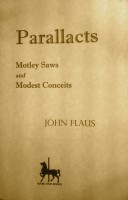
John Flaus’s Parallacts

John Flaus, Parallacts: Motley Saws and Modest Conceits (Mark Time Books 2012)

parallacts I was extremely lucky in the timing of my university studies. I started at Sydney Uni in 1967 when, because of an overhaul of the New South Wales school system, only a very small cohort had graduated from high school the year before. I was two years out of school myself, and for the next four years, I rubbed shoulders with a wonderful bunch of irregulars, especially the group doing Eng Lit Hons. Among them was a burly guy in his mid thirties who enlivened our seminars on pre-Shakespearean English drama with references to John Ford’s Westerns and wrote learned essays on film for the student newspaper, sometimes as Sean Borelich, borelich being Middle English for hairy, in honour of his impressive salt and pepper beard.

That was John Flaus. He could be relied on for an interesting opinion of any new film released downtown – memorably, Rosemary’s Baby was ‘a turd of a movie, a beautifully polished turd, but still a turd’. At SU Film Group screenings and occasional events at the Filmmakers’ Co-op, then in a space above a restaurant in Dixon Street, he educated us in the movies (which weren’t included in any university courses in that time and place). I learned from him that Hollywood produced art: it was OK to love the films of Roger Corman (which I already did) and Budd Boetticher (which he introduced me to). During one informal seminar–screening of Raoul Walsh’s Roaring Twenties, he rewound the film at one point so we could watch again Marlene Dietrich’s marvellous first, slow-blinking appearance. This was before the existence of VCRs or rewind buttons and just magical for the likes of me. John back then was a passionate advocate for film, autodidact, fanboy, nerd, polymath, teacher.

Since then, though he has generally flown under the mainstream media’s radar, his distinctive voice has been heard widely in the land as a critic and promoter of excellence in film. In the 1970s he embarked on an acting career. As far as I know his first reel outings were as himself in Dave Jones’s little-seen wonder Yackety Yack in 1974, and then a main role in John Ruane’s 1976 short film Queensland. My most recent sighting was as one of the chorus of codgers in the pub in Jack Irish on ABC TV.

All that is by way of explaining my delight when I stumbled this slim volume on the poetry shelves at Sappho’s bookshop, and for that matter my delight in reading it. It contains 120 couplets, each fitting the formal requirements announced in the first two:

THE PARALLACT (1)
Where differing perspectives contend;
Two lines, each of nine voiced syllables.

THE PARALLACT (2)
With the option of one ‘free syllable.
A discipline of my own devising.

Within this tight form, he fits all manner of things: philosophical, satirical or just plain smart-alecky observations, evocations of the turning points of movies and classic stories (Biblical, Greek, Norse, Japanese …), overheard snippets, jokes, paradoxes. The word ‘discipline’ is key. There is so much that could be said on the subject of each of these couplets, but the speaker – naturally discursive – ties himself down to just 18 or 19 syllables. You need background knowledge to appreciate quite a few of them, such as this:

JEPHTHAH’S BARGAIN
He comes victorious, true to vow;
She goes to greet him, dancing, joyful.

But in these cases, including about 20 referring to movies, he generally adds a note so the reader can chase up the reference (in the case of ‘Jephthah’s Bargain’, the note says, ‘See: Judges 11′).

Here are a few more:

BROTHERHOOD OF THE BLUE SINGLET
Sunburned, sweaty and staunch, yet denied
Our rightful place in the nation’s pride.

OCKER NUANCE
‘Where yous goin’?’ – I’m not joining you;
‘Where yez goin’?’ – I’d like to come too.

IRELAND’S REVENGE
They stole our land, laid waste our culture.
We occupied their literature.

I don’t suppose Flaus has considered starting up a blog where he posts regular parallactic film reviews and other observations. If he did, I’d subscribe. And one last thing:

ON PARALLACTS
Knowing no limits to questing thought,
he brings home the bacon, takes the pith.

Malouf Adamson Aitken Harrison: Rare Objects

Adam Aitken, November Already (Vagabond Press Rare Objects Series No 86, 2013)
Martin Harrison, Living Things: Five Poems (Vagabond Press Rare Objects Series No 87, 2013)
David Malouf, Sky News (Vagabond Press Rare Objects Series No 88, 2013)
Robert Adamson, Empty Your Eyes (Vagabond Press Rare Objects Series No 89, 2013)

I bought this quartet of chapbooks at the Sydney Writers’ Festival, where all four poets read brilliantly. At $15 each, this is poetry at just over a dollar a page, which isn’t a lot of bang for your buck if you measure it by the yard, but – speaking as someone who has ploughed through a number of Collected volumes in the hope of getting a feel for their authors’ work – I’d say these tiny, beautifully presented books are great value for money. The poems have room to breathe. [The list above is in order of publication, my random comments below are in order of my reading.]

1sn

It’s common wisdom that learning poetry by heart is a good thing, because – besides being able to surprise and delight your friends – it’s a way of making the poetry your own, inscribing it on yourself (as Dan Beachy-Quick said memorably, here). Reading David Malouf’s Sky News, I realised that, memorised or not, I haven’t really read a poem until I’ve heard it in my own voice, at least internally. I’ve loved hearing David read his poetry ever since he made sunlight glint off milk churns and today blaze from a lapel in his 70s imitations of Horace. But there’s a different pleasure in taking the poems into oneself.

The poems in Sky News are like piano pieces: there’s a right hand with lots of trills and arpeggios, images and alliterative wordplay, and a slower, deeper, meditative left hand. As I got to know each poem, I found myself looking for my own balance between the two, between being charmed by the right hand, as in this evocation of a quiet night in ‘At Clerici’:

Crickets strike up
a riff on the razzle-dazzle
of starlight, then stop.

and being moved by the left hand, which doesn’t lend itself to quotation because it’s often there by implication or comes into the foreground only in the final moments of a poem.

In ‘A Parting Word’, a rendering of Heinrich Heine’s ‘Der Scheidende’, Malouf the translator engages in a similar balancing act. I can’t read German, but compared to what looks like a close translation of the original, it’s evident that Malouf’s poem is a lot livelier: ‘Estorben ist in meiner Brust /
Jedwede weltlich eitle Lust’ (‘It has died in me, as it must, / Every idle, earthly lust’) becomes the playfully alliterative ‘All’s dashed in me, all’s dished and done’, and this playfulness keeps up all the way to the final lines, where ‘Der Schattenfürst in der Unterwelt’ (‘The shadow prince in the Underworld’) becomes

__________________First
in rank of the resident zombies. Top
dog in this dog-house, Hades.

In Heine’s poem, the speaker moves from a cheerless contemplation of his approaching death to a grim acknowledgement that the most vulgar of the living are better off than the noblest dead, so in the end by implication what does art matter? In Malouf’s, the mood is less gloomy – it’s still a poem about age and mortality, but the scales tip towards a celebration of life – it’s not that art is futile, but life is the thing.

1eye

The current submission guidelines for Going Down Swinging warn prospective contributors not to send ‘poems involving birds, wings, feathers or flight’. Luckily for Robert Adamson and his readers this prohibition doesn’t prevail everywhere. Henry Thoreau said an abode without birds was like meat without seasoning – Adamson without birds is unimaginable. From traffic casualties in the prose poem / flash fiction ‘A Proper Burial’ to birds that ‘call and call the light’ in ‘Michael Dransfield in Tasmania’, there are plenty of birds in Empty Your Eyes. Poets are here in plenty too: Adamson’s compadres like Dransfield and Charles Buckmaster, but also an assortment of Catholic convert poets – James McAuley, Pierre Reverdy and Francis Thompson (the only poet my mother ever quoted – ‘I fled him down the labyrinthine ways / Of my own mind; … and under running laughter’). Adamson’s poetry is steeped in the Hawkesbury River, in the world of poetry and poets, and increasingly in a kind of questing mysticism:

------------------I read
'The Hound of Heaven'
by a river in new South Wales:

There was a black chuckle
before the 'running laughter' –
Attention shifts, revelation grips.
1na

Perhaps even more than Adamson’s, Adam Aitken’s cool, postmodern, intercultural poems abound in allusions – not in an arrogant bugger-off-if-you-haven’t-read-Rimbaud way, but more in a let’s-have-some-dislocating-and-provocative-fun way. I went googling quite a bit as I read November Already: John Clare (hardly an esoteric reference, but I hadn’t read anything by him), Rimbaud (I couldn’t find the arachnid referred to in ‘Rimbaud’s Spider’, so I don’t know what I’m missing, but enjoyed the poem anyhow), Ezra Pound (who wrote a travel diary, A Walking Tour in Southern France), Raymond Roussel (I found a note on Adam’s blog that helped hugely in reading the poem ‘Rousselesque’).

There’s a lot of France in these poems: Paris and the tiny village of Mareuil, the Resistance and the Revolution, Roman relics and Australian expats. From what I’ve read of Aitken’s work, I have a sense that he generally writes as if he’s not quite at home, always with a dislocated, interrogative feel. So when a poem about a deserted railway line is entitled ‘On the Chemin du Fer’, it doesn’t read as a mistyping of chemin de fer, but as a marker of the speaker’s outsider status. In the poem, this outsider is on a disused length of railway surrounded by blossoming almond trees, ‘tougher, more industrial’ than cherry blossom, and in these beautifully evoked surroundings, before evoking the Terror by a mention of Saint-Just, asks:

Was that old man "Europe"
so often so hard, so cruel
a one-stop shop
for the soul?

Likewise, I think of Aitken as an urban poet, so when he misspells ‘chicken coop’, it doesn’t read as a mistake, deliberate or otherwise, but as the equivalent of a visitor from the city wearing shiny shoes in a cow paddock, adding to the edgy feel of the poem.

1lt

Martin Harrison’s poems, by contrast, feel completely at home in their mostly Australian landscapes. This may be especially true of the first poem in Living Things: Five Poems, ‘Wallabies’, a long, breathless (and sparsely punctuated) celebration of western New South Wales landscapes:

nothing is dead here the spaces between them are
inhabited leaves twigs debris fallen white-anted trunks

slopes rocks grass parrots galahs floating down
in pink streamers again the grey lack of edge

around sprays cream waterfalls of turpentines flowering
in high irrigated air-blue reaches she-oaks aspirant

with their million fingers and amber seed-flowers
spotted gums mottled as grandmothers but with contrasts

of grey brown white and silver as if dressed for a ball

He does more than describe natural phenomena, of course. A recurring theme here is ‘how events change time’s flow beneath perception’: a ‘small thump from somewhere’ (‘White-Tailed Deer’), thrips that are ‘quite possibly meaningless, quite possibly / microbes of non-significance’ (‘Cloud’), a frog you can hear ‘miles away, / long before you thought you could’ (‘The Frog’). Even the eponymous wallabies would be easy to miss if you didn’t read carefully. Some lines from ‘Blue Wren Poem’ suggest something of what’s going on:

____-_____________________Such

detail can be lost – bobbins, birds, refuge, storm –
when innocence starts holding out against the tide,
when radiance blurs the future.

Michael Brennan of Vagabond Press says this series will come to an end at 100 titles. That means there are 11 to go, and the distinctive design, with pasted-on cover art by Kay Orchison, will sadly be no more.

Julie Chevalier’s Linen Tough as History

Julie Chevalier, Linen Tough as History (Puncher & Wattmann 2012)

1lthI just couldn’t get on this book’s wavelength. I appreciate the cleverness of many of the poems, but very few of them speak to me personally. I’m glad I read it to the end, because the poems I most respond to occurred in the final section: ‘crease’, about enduring tensions between mother and daughter; ‘fifteen kinds of infidelity’, which is what it says on the tin; ‘the moon and the stars were our chandelier’, which lives up to its excellent title.

A number of the poems are self-described ‘responses’ to other poems or works of art. ‘Corner of Glebe Point Road and Broadway’ and ‘the day we almost hung’, for example, play with Gwen Harwood’s ‘Suburban Sonnet’ and Frank O’Hara’s ‘The Day Lady Died’ respectively, each line (with one exception in each case) ending with the same word as that line in the earlier poem. It’s clever, and fun, but the effect each time was to send me back to the earlier poem, in whose light the present poem seemed a pallid, arbitrary thing. Similarly, when I read the poems responding to work by Ron Muecke, Diane Arbus, Cy Twombly, Hans Bellmer and Giorgio Morandi, I went to those works, either in memory or by Google, and felt no particular urge to come back. Maybe that’s a problem inherent to ekphrastic poetry, or – more likely – there’s something I’m not getting.

awwbadge_2013 This is the sixth book I’ve read as part of the Australian Women Writers Challenge 2013, but I won’t add this post to the website, as it’s not really a review – more a note that I’ve read the book.

Julie Chevalier: her Darger: his girls

Julie Chevalier, Darger: his girls (Puncher & Wattmann 2012)

1dhgThe Art Student, who professes to hate poetry, recently went to a talk by Julie Chevalier about this book, and was so fascinated by the subject of Henry Darger she bought me a copy.

Darger is a fascinating man. He has a Wikipedia page. There’s a movie. John Ashbery wrote a long poem inspired by his work. Very briefly, he was a reclusive eccentric who lived in poverty and imagined a vast epic in which little girls take on armies and interplanetary beings. Shortly before his death his landlord discovered the bulky volumes of handwritten manuscript, along with the copious illustrations, and recognised a work of weird genius.

This book is an impassioned introduction to his story, or rather Julie Chevalier’s poetic record of her encounter with him. A six page introduction tells Darger’s story, defends him against hypotheses that he was a potential or actual child murderer, and argues that it’s incorrect to think of him as an Outsider Artist. The introduction is exactly the kind of courtesy I often yearn for in poetry books – but paradoxically the prosaic information was so interesting that I sometimes had trouble telling what the poetry was doing beyond reiterating it. Paradoxically again, the single poem that I found most satisfying is ‘an unusual child’, a prose poem made up entirely of phrases taken from Darger’s writing. It’s full of cliché, but generates an enormous emotional, quasi-erotic force:

she seemed for a moment to remind him of his own guardian angel in disguise _ she was smiling up again into his face _ hardened with the desperate struggle he was just then having with himself __ you resemble a guardian angel to me _ when I should be grown _ a man should protect a child _ how come you protect me _ the truth surging over him like the waves of a stormy sea _ breaking down the breakwater upon which he was seeking refuge _ a force mightier than his own will _ a voice in his soul crying out the truth _ that above all else he wanted to reach out his arms to the glorious creature

and so on.

awwbadge_2013 This is the fifth book I’ve read as part of the Australian Women Writers Challenge 2013.
Pam Brown’s Home by Dark

Pam Brown, Home by Dark (Shearsman 2013)

1848612885The launch of this book last weekend (link is to a facebook photo gallery) was a convivial affair in an Erskineville pub. Unusually for a literary event, the football played silently on a large colour TV screen throughout, and a warm buzz of conversation echoed from the bar in the next room. Later, I saw myself in one of the facebook photos with a hand cupped behind one ear and a pained expression on my face. The pained look was, of course, nothing to do with the poetry or the company but was the result of my straining against the combined effect of Pam Brown’s quiet delivery, my deafness and the ambient noise.

On the day, Pam commented that the setting was appropriate, given the digressions and distractions of the poetry. As I was reading the book during the week, an alternative metaphor, even a fullblown analogy, occurred to me. For quietness, there’s the poems’ elliptical, almost throwaway quality – no assertive rhyme schemes, often no clear prose syntax, mostly no through narrative line; for deafness, there’s my ignorance of contemporary poetry – of the twenty or so poets mentioned in the acknowledgements or in the poems themselves, the only one I can honestly say I’ve read is Keats*, and L-A-N-G-U-A-G-E poetry and Oulipo (also mentioned) are pretty much closed books to me; for noises off, there’s PB’s daunting reputation as a poet’s poet, possibly even an academic poets’ poet – she’s the kind of person whose cover blurbs speak of precarity and sprezzatura. I realised I was approaching the page with a painful intensity, a virtual hand cupped behind my inner ear.

Well, of course scowling and squinting and feeling stupid is no way to read poetry. So I stopped it – the scowling etc – and read on regardless, going with the flow. And had a much better time. Of course, there are some poems I just didn’t get. There are some I kind of got but didn’t care about. And then there’s a lot that’s funny, thoughtful, sad, memorable … revisitable. I even read bits out to the Art Student, self proclaimed hater of poetry, and she wanted to steal them.

I think what appeals to me most is the sense in a lot of this poetry that it more or less fell out of Pam Brown’s head straight onto the page. (I know that’s an illusion, because I accidentally found an earlier version of one poem online, and got to see some of the careful reworking that went into creating that casual, uncrafted feel.) A number of the poems read as observations made while travelling – whether around town or across the planet, they display the same apparent randomness, the same self-deprecating wit, the same eye for the telling detail, the same play of mind.

From ‘Worldless’:

at the bus stop
_____long haired boys –
regenerate fashion,
_____retro,
fashions
_____arrive & go by
_______really quickly –
I had to live through
_________the entire decades!

______(peeved)

From ‘Leaving the World’ (I had to look up Jean Tinguely, but I’m glad I did):

along the LA freeway
black derricks
trundle up and down
like
Jean Tinguely sculptures
only__ominous
& witless
in a waterless world

The line that the Art Student wants to steal, the opening of ‘Haywire Here’:

who prepared this future?

and later in the same poem some lines where I enjoyed making my own sense (that may be quite different from Pam Brown’s):

and the barmaid’s
__never heard of sarsaparilla

(worse for me
_______& you)

Sarsaparilla was the favourite softdrink of my childhood, but it can be hard to find these days, so a barmaid who has never heard of it is a young woman with no sense of history. Worse, for us literary types, she hasn’t heard of Patrick White’s Season at Sarsaparilla, so we’re left feeling doubly invisible. Heh!

I recently came across a quote from 1935 letter by Wallace Stephens (of whose poetry I’ve read almost none and understood less): ‘As soon as people are perfectly sure of a poem they are just as likely as not to have no further interest in it; it loses whatever potency it had.’ And just before that, ‘As a rule, people very much prefer to take the solemn views of poetry.’ I think deciding not to scowl as I was reading this book was going against the preference for the solemn, and opening up to the potency of things I can’t be perfectly sure of.

awwbadge_2013 This is the fourth book I’ve read as part of the Australian Women Writers Challenge 2013.

* I did recognise a couple of lines from Bob Dylan, though he wasn’t acknowledged.

On the air again

My poem ‘Pronunciation Lesson’ was broadcast on Saturday in the repeat of ABC’s Poetica’s episode Hearing. You can listen online.

Toby Davidson’s Beast Language

Toby Davidson, Beast Language (Five Islands Press 2012)

Beast Language

In a recent post on the Southerly blog, Judith Beveridge quotes the Irish poet Michael Longley: ‘The poet makes the most complex and concentrated response that can be made with words to the total experience of living.’ That struck me as a reasonable description of what the poems in this book aspire to. She also writes, turning the spotlight away from the book and onto the reader:

What every poet wants I suppose are readers who are not necessarily other poets, who are not critics, who are not scholars, who are not dabblers, but people who are able to immerse themselves in reading so earnestly, so longingly that their experience of books is one of the best parts of their experience of life.

Well, I’m not necessarily another poet, a critic or a scholar, but as my regular readers would agree I’m prone to dabbling. I do know about earnest, longing immersion in the experience of reading: that’s how I used to read everything – Enid Blyton’s Finder-Outers in bed by light from the next room at 10, Agatha Christie when I was supposed to be studying for the Queensland Scholarship exam at 13, The Brothers Karamazov to challenge my faith as a pious Catholic 17 year old, Francis Webb as I was losing religion in my mid 20s. I could go on.

I still read a lot, but for whatever reason I’m less willing to commit myself these days. A writer – poet or otherwise – has to earn my earnest attention, and I’m more likely to approach a new writer with wariness than with longing. Something has to snag me before I can become, fitfully and imperfectly, that ideal reader.

As a dabbler, I enjoyed Beast Language. The language is alive and challengingly sharp, there’s plenty of wit and complex wordplay, and some brilliant images. Some elements, though, threatened to keep me at dabbler level: a lot of allusions (inevitably) left me mystified; some poems are compressed to the point of compaction; and I often found myself skimming without understanding (though not without enjoyment), starting with the very first poem, ‘Indian Ocean Dedication’, which begins ‘She has the genius of an ear / splitting hairs with either mind’ (I’m a lazy reader, but my couple of attempts at unpacking that have come up with nothing).

On the other hand, there’s a lot that makes me want to spend time with these poems. 1: I was predisposed to like them because Toby Davidson has done such a lovely job of editing Francis Webb’s Collected Poems and putting a spotlight on Webb more generally. 2: There’s a pervasive, attractive sense of seriousness, and of playfulness. 3. Where the poetry does communicate to me, I’m engaged. The second poem, ‘Genesis 1.2’, undoes the negative influence of the first with a sweet evocation of the effect of a cool breeze in a beach suburb. ‘Three Months Old’ inevitably invites comparison with Francis Webb’s ‘Five Days Old’, but shrugs it off: this is its own poem, a different person facing in his own way the experience of looking into a baby’s face: ‘Your eyes open mine like a sun strikes a planet / as planet eyes sun, our replete double-bond.’ And there’s much more.

So, the book is divided into three sections, ‘Juvenescence’, ‘Reproduction’ and ‘Hibernation’ – dealing roughly with childhood and youth, sex and art, and illness and death respectively. Starting with a child’s birthday party, an Australia Day punch-up, a zucchini, computer games, and especially, fabulously, car trips, the poems take us to unexpected, horizon-expanding places.

‘On Being a Toby’ is a poem I like a lot. Though it’s not particularly difficult, it’s a good example of the kinds of difficulty and pleasures I have found in this poetry. Here’s the whole poem, which I’ll assume is OK with Five Islands Press.

On Being a Toby

Triangular hat, jug of ale and a dog,
little brown mouse of children's tv,
Hamlet's cri de coeur incarnate;
all of my life it will be
---------------------me or not me.

What's in a name? Put that to a stem cell
conjugating the infinitive root;
not yet splitting, earthing, bonding
micro-pilgrims to our next
---------------------gnarled suit.

Cut to lump we live with what we have,
no one asks any more. Bearers of the question
of my name have twisted from the rack
and melted through the chimes of passing
---------------------to a lower floor.

In what's name? Ask hats, jugs, dogs,
mice, princes, star-crossed lovers and stem cells.
Ask them what it is to be
and they will say don't play the Dane
---------------------but understudy artfully:

for just as poems are understudies to Poems
your name is the understudy to a Name.

The first stanza starts out playing with associations on the poet’s name and progresses to wordplay referring to Hamlet that I’m embarrassed to say I initially found inscrutable, but I won’t insult you by spelling it out.

In the second stanza the plot thickens. It’s the kind of thing it’s easy to glide over when in dabbling mode. But when I reach it I’m feeling pleased with myself for having got the ‘to be or not to be’ reference, so I’m willing to do a bit of wrestling. Having invoked Hamlet‘s most famous line the poem now quotes the most famous line from Romeo and Juliet. (If you didn’t know anything about Shakespeare, this transition would still work, of course, but would give less pleasure.) Toby’s answer to the question couldn’t be further from Romeo’s. A name, he suggests, has something in common with a stem cell, whose development is described in a kind of metaphor mash-up of linguistics and embryology: stem cells act like etymological roots, and they develop as verbs are conjugated; cells and infinitives split, and the infinitive, now that it’s been mentioned, suggests something of the mystery of coming into being, from the infinite to the particular. A name is an abstract thing, all potential, as a stem cell is unspecialised, until complexity and experience give some shape, a gnarledness. (Skip that ‘suit’ for now. It stands out oddly, but sometimes skipping isn’t laziness, but negative capability.)

The next stanza isn’t easy either. Cut to lump? At first, looking for complication, I thought this might allude to the oafish character in She Stoops to Conquer. But no, Google tells me his name is Tony, not Toby, Lumpkin. I decided to read the phrase as a direction to the reader: cut from the image of delicate micro-pilgrims to the lumpish complete human. And of course there’s a hint of ‘Like it or lump it’. With ‘Bearers of the question / of my name’ we realise that the whole poem depends on getting the Hamlet reference. If you missed it back there, this phrase is pretty much a handful of nonsense. But what is this rack of which it speaks? The torture of indecision? And if so, what are the chimes? (Dylan’s ‘Chimes of Freedom’? Nah.) I take ‘a lower floor’ as my key: the poem has leapt to a department store (a leap, I now realise, that was foreshadowed by that ‘suit’ earlier), where some suits have twisted from their clothing rack and taken the lift (which chimes on arrival) downwards. I first read this as suggesting a descent into hell – suicide or failure to function, perhaps – but I think that’s a dead end: the lower floor is closer to the ground, so their movement is a continuation of the ‘earthing’ movement of the ‘micro-pilgrims’, from abstraction to the particular. (I wonder momentarily if ‘Cut to lump’ is a tailoring term, which would make the transition from microbiology to department store less abrupt, but as far as I know it’s not.)

‘In what’s name?’ At this point, extraneous information comes into play in my reading. I know that Toby Davidson has a book coming out this year entitled Born of Fire, Possessed by Darkness: Mysticism and Australian Poetry. So maybe we’re moving into mystical territory. The question seems to assume some deeper reality, perhaps a Platonic realm. But whereas the earlier question was to be asked of a stem cell, this one is to be put to the whole array of things, people and imagined entities evoked in the poem so far (including Romeo and Juliet but not off-the-rack suits). And they all line up behind Uncle Monty in Withnail and I (no I didn’t have the reference in my head, but the phrase ‘play the Dane’ rang a bell, and I found this online):

It is the most shattering experience of a young man’s life, when one morning he awakes and quite reasonably says to himself, ‘I will never play the Dane.’ When that moment comes, one’s ambition ceases.

Just as the poem gives a different answer to Romeo’s question, this means something different from Uncle Monty: as I read it, the ‘hats, dogs, jugs’, fictional creations and scientific knowledge, all are invitations to engage with the world – ‘don’t play the Dane’ means something like ‘don’t get lost in metaphysical introspection’.

And then the last two lines reassert the metaphysical world view that the chorus of hats etc has just rejected. I don’t actually know what’s being said here beyond a general sense that the lines are urging an attractive modesty, and I realise that that’s quite enough for me. When I was studying George Herbert in an earlier life, I was shocked by a distinguished scholar’s reading of ‘The Flower‘ that silently ignored that wonderful poem’s last stanza, in which the poet addresses God – clearly unnecessary to the scholar’s humanist sensibility. Maybe I’m doing that to this poem, but, well, at least I’m not being silent about it.

I ought to point out, as an afterthought, that one of my favourite lines in the whole book could be read as expressing a spiritual / mystical / transcendental yearning, but whether it does or not it embodies a similar, though definitely less cheerful reconciliation to the actual world as ‘On Being a Toby’. After describing a drunken punch-up on Australia Day, the poem ‘Skyshow’ ends:

__________To summarise: we are a noble people, unable to bear
ourselves without booze, if we can’t blow things up we just fight
for the hell of it, our national day is a crucible of destruction,
and I want to go home, I just want to go home, but this is where I live.

So there you are. I’ve barely given any kind of sense of the book as a whole, but that’s all my blogging time used up.

(I ought to mention that Five Islands Press gave me a free copy of this book. I would have bought one anyhow.)

Marrickville’s phantom mattress poet(s)

Old mattresses are notoriously hard to recycle – the charities won’t take them because it’s illegal to resell them, and who wants to inherit someone else’s lumpy, stained discarded bedding? Recently a number of these items have been turning up on Marrickville kerbs, bearing inscriptions. Here’s one that I’ve had the presence of mind to preserve for posterity, or at least for the internet. Appropriately enough, it’s leaning against the Shepherd Street fence of Marrickville Public School:

Mattress1

In case you can’t see the image, the words on the mattress are:

1 owner
54 cycles
6 lovers
and a baby boy

As I was taking the photo, a young man stopped and said, ‘There’s only one possible response: If you were single I’d take you home with me.’