We’ve come late to The Bear on TV. I think we turned it on for a moment a couple of years ago, saw a lot of people shouting at each other and decided to give it a miss. But now we’ve just finished watching season 2 and are hooked.
Among its many joys is Jamie Lee Curtis as Donna, the main character’s off-the-rails mother. In the final episode of season 2, she has been invited to the ‘family and friends night’ of the new restaurant. Nerves are already stretched, and the prospect of Donna arriving drunk and ultra-disorderly adds an extra layer of dread.
I’m not giving anything away when I say that this extremely volatile character gave me the first line of today’s verse. I’ve wrenched the line from Donna’s context and let it play out in mine.
Verse 13:I don’t know how to say I’m sorry
I don’t know how to say I’m sorry. The words come easy, and too much. I'm sorry if I made you worry when you kicked away my crutch and sent me sprawling.1 In the water I said sorry to the copper – sorry that my wet arrest made extra work.2 You may have guessed nuns taught me acts of pure contrition 3 back when I was barely six and what goes in at that age sticks. To not say sorry meant perdition. I often play the sorry card, but say it from the heart? That’s hard.
Then, I ducked the daunting task of writing a stanza beginning with ‘Water lapping on their doorsteps’, a line taken from Senator Mehreen Faruqi’s description of the drastic situation of Pacific Island nations. But the challenge refused to lie down and die, so here goes. It might be worth reminding you that Imhotep was a kind of deity of ancient Egypt who may have been believed to help control the flooding of the Nile; and that the Golden Soul is a ship that left Newcastle on the weekend bound for Japan with a load of coal. You probably don’t know that Mary McKillop, now a canonised saint, once placed a statue of Saint Joseph on the doorstep of her nuns’ residence, and floodwaters stopped just short of the statue.
Verse 12: Water lapping on their doorsteps

Water lapping on their doorsteps,
not a miracle in sight.
No hope will come from Nile's Imhotep,
none from praying day and night
to effigies of saints and fairies,
Hare Krishnas or Hail Marys,
even chanting 'No more coal'.
Great ships like the Golden Soul
still sail, indifferent as weather.
Science says we know what to do,
but who's in charge? Yes, you know who!
Still, let's paddle hell for leather,
do wise things and crazy stunts,
everything, everywhere all at once.
With any luck I’ll be back to domesticity tomorrow. Maybe something about our new EV?
John Levy has commented generously a couple of times on this blog (here’s a link). When he emailed to ask if I’d like a copy of his recent book, with no expectation to blog about it, of course I said yes, provided I could send him one of mine. So we swapped books: I sent him two, he sent me three, an unequal exchange in more ways than the obvious. He has responded to my efforts with what I now know to be his characteristic generosity. And now I am blogging about his, motivated by joy, not obligation.
John’s books arrived when I was sitting down to lunch with the Emerging Artist and our grandchildren. I flipped 54 Poems open to the first page, and read out the prose poem ‘Kyoto’:
Kyoto

I'm at a temple. A young monk in black robes walks by, looks at me,
stops. He points to my long hair. Brown. Then to my goatee. Red. He
touches my armpit and looks puzzled. I point to my hair. He points to
my crotch. I point to my hair. He invites me in for green tea.
The children liked it, probably because of the crotch reference. The Emerging Artist liked it, possibly because of the colour play. I liked it for both those reasons, and also for the comedy about communication and connection that don’t need words.
These three books reminded me that poetry can be a lot of fun. It can deal with death and loss, all manner of elevated cultural matters, or issues encountered when working in a Public Defender’s office, and still be fun. It can talk to goats and spiders and be silly about words, while still being serious. It can be warm without being goopy, and self-referential without being wanky.
Naturally, I went Googling. Among other things, I found John being interviewed on the website of Touch the Donkey, a small quarterly poetry journal published by above/ground press, publishers of one of these chapbooks. In that interview, he describes his approach:
I begin writing a poem (or prose poem) without knowing what I am going to say after the first few words that I thought of to begin with. Sometimes … I begin with a friend in mind and want to write something for the friend although I usually haven’t figured out anything beyond wanting to write something to that friend.
It’s poetry impro.
No doubt these poems have been polished and revised, but they retain the feeling of immediacy, of the poet’s mind chasing associations like a distractable child in a toy shop, and then they resolve themselves as if by magic.
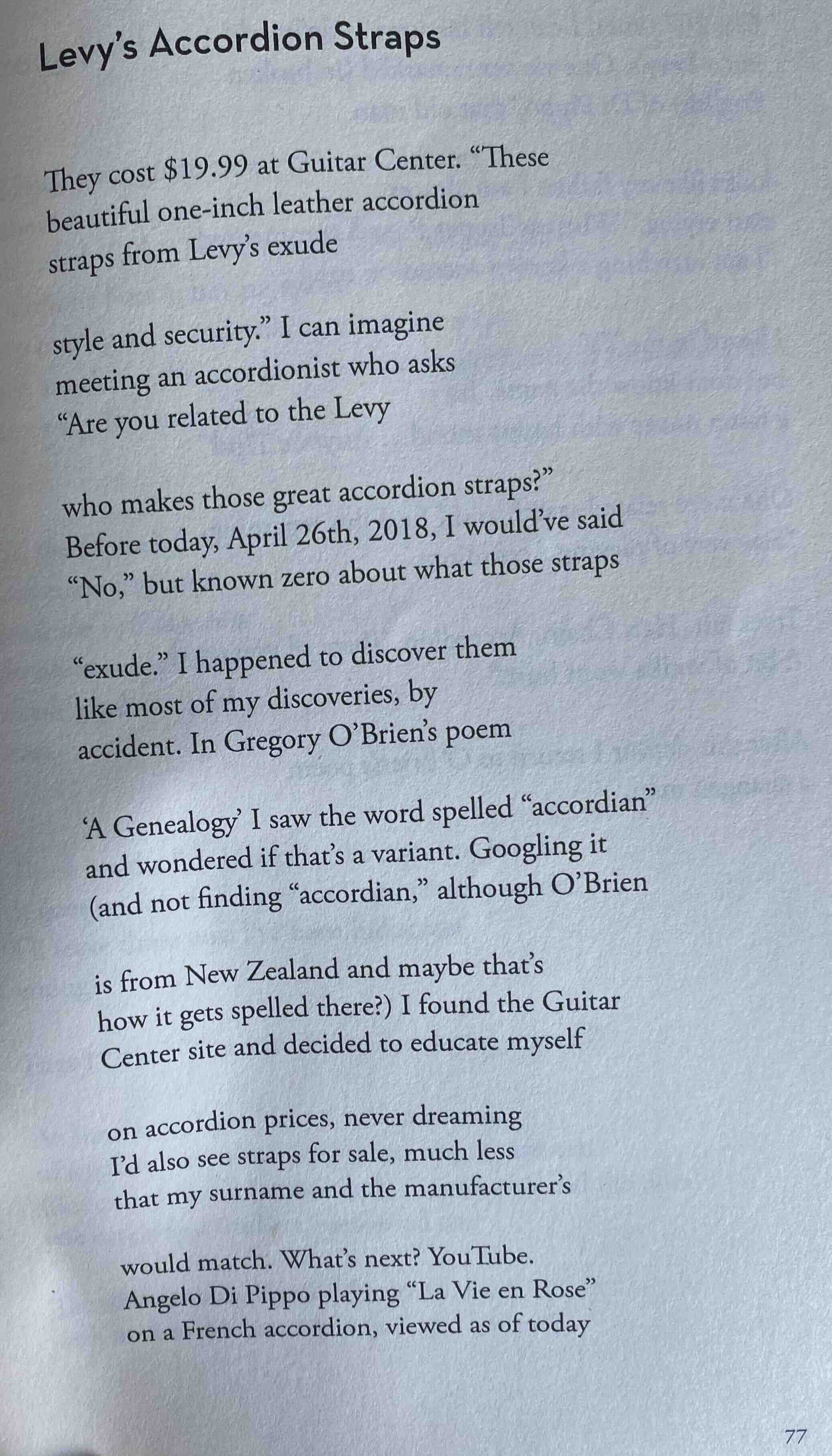
I’ll stick to ‘Levy’sAccordion Straps’ on page 77–78*. I apologise for the quality of these images:
You could call this a rabbit-hole poem. It doesn’t start in exactly the way Levy describes in the interview above, but it’s in the same paddock. It’s a comic version of close reading: he takes a single word from Gregory O’Brien’s poem ‘A Genealogy’ (of which we know nothing else), and sees where it takes him. Maybe it’s the obsessive copy editor in me, but I love it that the poem starts from what turns out to be a misspelling. We tend to think of USA-ers as culturally arrogant, but Levy here has the humility to check the ‘variant’, and then stays open to the possibility that they do things differently in New Zealand. (There’s an Easter egg in line 24: Levy slips in a typo of his own, adding a space in Angelo Dipippo’s surname.)
As the poem progresses in an apparently random manner, it turns out that it features quite a bit of English as spoken/written by people not from the USA. There’s quiet humour, but not, I think, mockery. The last line made me laugh out loud. Instead of seeing the ‘detour’ as taking him away for a moment from O’Brien’s poem, he sees it as having changed the kind of attention he brings to it.
And now, because it’s November, here’s an hommage (with an advance note – Mruphy’s [sic] Law decrees, ‘If you write anything criticising editing or proofreading, there will be a fault of some kind in what you have written’):
Verse 10: Dear John

YouTube. Angelo Di Pippo
plays, you said, 'La vie en rose'.
I can’t find him (you’ve got a typo
in his surname, Mruphy knows).
I do find other Piaf splendours –
Galliano working wonders.
Music takes me in its arms,
an infant whose late night alarms
are soothed by father’s tender crooning.
Jean, who says she’s ninety-one,
comments that life then was fun.
I googled “Levy’s straps” this morning,
found them, surfed around some more,
found fancy watch straps made by Shaw.
I finished this blog post on Awabakal country, near what is now one of the biggest coal ports in the world. I acknowledge Elders past, present and emerging for their continuing custodianship of this land.
* My blogging practice, especially with books of poetry, is to focus on the page that coincides with my age, currently 77.
Last week I went to a meeting where two members of Standing Together spoke. Standing Together is a grassroots movement of Jews and Palestinians in Israel working for peace, equality, and social and climate justice (website here).
At the meeting, organised by the recently formed Sydney Friends of Standing together, Shahd Bishara and Nadav Shofet gave personal accounts of their involvement in the movement. Shahd Bishara, a Palestinian Israeli medical practitioner, said, among other things:
The liberation of Palestine is inextricably intertwined with the security of Israelis. Two peoples both live in the land that both call our homeland. We need to fight for freedom of Palestinians and the safety of the Israeli Jews.
Nadav Shofet, an Israeli Jew, spoke of the absence of an alternative narrative to the genocidal one of perpetual war put forward by the Israeli right. Standing Together aims to fill that vacuum with a narrative that includes hope.
There’s much more to say. Standing Together has been attacked from the right in the USA and Europe, and from the left in Australia. My comments section isn’t open for that debate. The ABC covered the visit here.
Without wanting to in any way trivialise the struggle that was the subject of the meeting, I kept my ears open for an iambic tetrameter that could kick off an Onegin stanza. I got one. Nadav was referring to the narrative vacuum when he used the phrase, ‘In this environment of silence’. I have taken it somewhere else.
(The Emerging Artist says I should give links to W. B. Yeats, ‘Long-Legged Fly’ and Hopkins, ‘The Habit of Perfection’. Sadly I don’t remember the name of the Italian poet who inspired my last line.)
Verse 8: In this environment of silence

In this environment of silence
minds can move like Yeats’s fly
upon the stream, or can with violence
leave democracy to die.
Silence sings if it’s elected.
Silenced hearts by fear inflected
can’t or will not have their say –
stony, look the other way.
Silence thrives when life's unruly –
words as weapons, words as toys,
words as endless streaming noise
leave no room for words that truly
come from hearts that seek to heal
whose uvulas are made of steel.
David Malouf once said that the most interesting thing in the world is a three-year-old child. Today’s opening line is from any one of a hundred monologues performed recently by my four-year-old grandson.
Verse 5: BYD and all electric
'BYD and all electric,
blue triangle, no exhaust.'
This boy can read, he's not dyslectic,
logos now, words in due course.
Lexus, Mitsubishi, Honda,
Volvo, Kia, Tesla, Skoda,
Ford, Mercedes: through each sign
the world yields meaning to his mind.
For some, the first code's saints and angels:
Anthony for lost and found,
Christopher when outward bound.
Others fret at kinship tangles:
who is in, who's out, and why.
Above us all, the deep, clear sky.
Michel de Montaigne, The Complete Essays (Penguin Classics 1991, translated by M. A. Screech) – part way through Book 2, essay 40, ‘On the resemblance of children to their fathers’ to part way through Book 3, essay 5, ‘On Some lines from Virgil’
Montaigne’s essays become even more interesting as he ages. By Book 3, he writes about his chronic pain from ‘the stone’ and, especially in the innocuously titled ‘On some lines from Virgil’, he does some spectacular writing about sexual politics.
I expect that whole books have been written about Montaigne and sex. I won’t try to untangle any of it here. I’ll just quote the paragraph from today’s reading that has given my poem its opening line. (For those who came in late, this November I’m writing at least 14 fourteen line poems, the first line of each coming from something I’ve heard or read that day.) The paragraph will give you just a glimpse of the complexity of Montaigne’s thought:
We do not weigh the vices fairly in our estimation. Both men and women are capable of hundreds of kinds of corrupt activities more damaging than lasciviousness and more disnatured. But we make things into vices and weigh them not according to their nature but our self-interest: that is why they take on so many unfair forms. The ferocity of men’s decrees about lasciviousness makes the devotion of women to it more vicious and ferocious than its characteristics warrant, and engages it in consequences which are worse than their cause.
I think he’s saying that making sexual behaviour a major criterion for a woman’s reputation is wrong; men make the rules that condemn women’s ‘immorality’; and the punishments are much worse than the so-called crimes. Further on in the essay he says that social expectations on women to be chaste are an intolerable burden.
I don’t know if he is putting a proto-feminist case, or arguing deviously that women should be more sexually available to men. Or both. Either way, it’s fascinating to have a voice from a very different epoch wrestling with questions that aren’t exactly resolved today.
But before I leave Montaigne for my own versification, I can’t resist quoting the final paragraph from Book 2, which follows some strong opinions about the medical profession, and rings out like a beacon of rationality for our times:
I do not loathe ideas which go against my own. I am so far from shying away when others’ judgements clash with mine … that, on the contrary, just as the most general style followed by Nature is variety – even more in minds than in bodies, since minds are of a more malleable substance capable of accepting more forms – I find it much rarer to see our humours and purposes coincide. In the whole world there has never been two identical opinions, any more than two identical hairs or seeds. Their most universal characteristic is diversity.
Yay Montaigne!
But on with my verse, which takes the phrase somewhere else altogether – and you can probably see the point when news from the USA knocked the poem off its tracks:
November verse 4: We do not weigh the vices fairly
We do not weigh the vices fairly,
thumb the scales to suit our whim:
I exaggerate, quite rarely –
you tell fibs – but look at him!
His lies destroy the trust that binds us,
lead us where no truth can find us.
Crowds have wisdom, mobs can rule,
electorates can play the fool.
He's murderous and self-regarding,
incoherent, vile, inane.
He once could boast a showman's brain,
but principles are for discarding.
Lord of Misrule, theatre's Vice:
How could you choose him once, then twice?
This blog post was written on Gadigal-Wangal land, where the tiny lizards are enjoying the beginning of hot weather, and jacarandas are the land’s most spectacular guests. I acknowledge the Elders past, present and emerging of Gadigal and Wangal of the Eora Nation.
Today’s opening line is from the early pages of Yael van der Wouden’s novel, The Safekeep, which I’ve just read and will blog about after our Book Club meeting next month.
Verse 3:The cauliflower browned and rotting The cauliflower browned and rotting says it's time to clean the fridge. The cheese is mouldy, milk is clotting, Friday's curry's on the edge. Outside it's the same sad story: jacaranda's purple glory withers, falls and clogs the drain, the sky’s deep blue has turned to rain, my feet hurt when I go out walking, I may soon replace a knee, beauty fades and pleasures flee. Yet here I am, still happy gawking. Now,halfway down Dulwich Street, the mulberries are very sweet.
Some of this is nicked from the superb 19th century song, ‘Housewife’s Lament’ by Sara A Price. If you don’t know that song, I recommend that you click on this link.
This is my 15th year of challenging myself to write fourteen 14-line poems in November. You can browse past efforts here, or you could even buy one of the five little books I’ve made out of them – here. Pretty much all the poems are in the form of the Onegin stanza, so called because it was used by Alexandr Pushkin in his epic poem Eugene Onegin, which you can read in translation at this link.
This year, to make it more interesting (for me, and hopefully for my readers), I’ve added an extra constraint. The first line of the poem has to be exact words I read or overhear as I go about my day.
This morning, listening the Waleed Aly, Scott Stephens and Stan Grant on ABC’s The Minefield, I remembered to keep my ears peeled for an appropriate line, and got one almost immediately. (It’s mere coincidence that my first verse last year was also in response to the Minefield, and Stan Grant gets a mention in the comments on that post.)
Verse 1:
The presence of a word like evil,
words like vampire, demon, troll
on streets here on All Hallows' Eve'll
titillate a sinless soul.
Bloodied bones and headless torsos,
manic laughter from the shadows,
devils, succubi, afreets:
prelude to a bag of sweets.

Then we sleep, or read the papers.
Nightmares happen, fright gets real.
Hamas,Bibi, fossil fuels,
plastic, wannabe dictators,
all that’s precious bought and sold:
words to make your blood run cold.
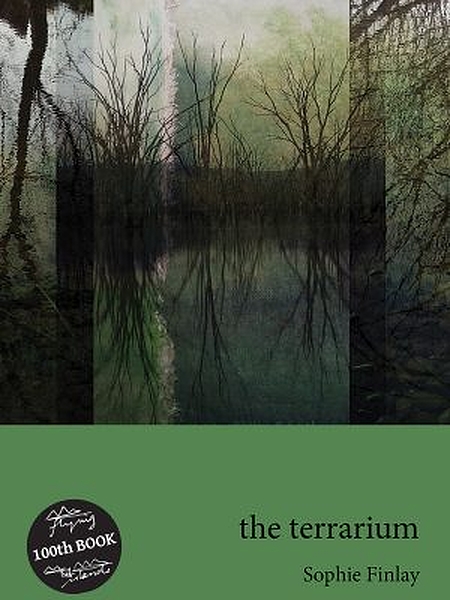
Sophie Finlay, The Terrarium (Flying Island Books 2024)
Sophie Finlay won the Flyng Islands Manuscript Prize for Emerging Poets 2022. A visual artist as well as a poet, she designed the book, and both the cover image and the photographs and delicate drawings scattered throughout are hers. It’s a beautiful, pocket-sized object.
The poems cohere around a main theme, summed up nicely in the final words of Darwin’s On the Origin of Species, which serve as a kind of epigraph:
whilst this planet has gone cycling on according to the fixed law of gravity, from so simple a beginning endless forms most beautiful and most wonderful have been, and are being, evolved.
As I understand it, the central idea of the book is to imagine the earth as a gigantic terrarium, in which one can observe the wonders of living things, often with scientific labels attached (poem titles include ‘Zooxanthellae’, ‘Morphologies of Ice’, ‘Glossopteris’ and ‘Noctilucent’), reaching back to the very beginnings of life, but including accidental personal matters such as a fear of snakes and a trip to Antarctica.
Interspersed among the other poems are six ‘extinction’ poems. Each of the first five of these comes with an indication of date: from the End-Ordovician extinction 455-430 mya (million years ago) to the Cretaceous-Paleogene (K-Pg) extinction 65 mya. The fifth, which is also the book’s final poem, refers to the Anthropocene extinction, no date necessary. These numbered poems aren’t section headings: in the midst of much else, they sound an ominous background drumbeat. Individual poems pay attention to detail but, just like in the real world, there’s a deep current that cannot be ignored.
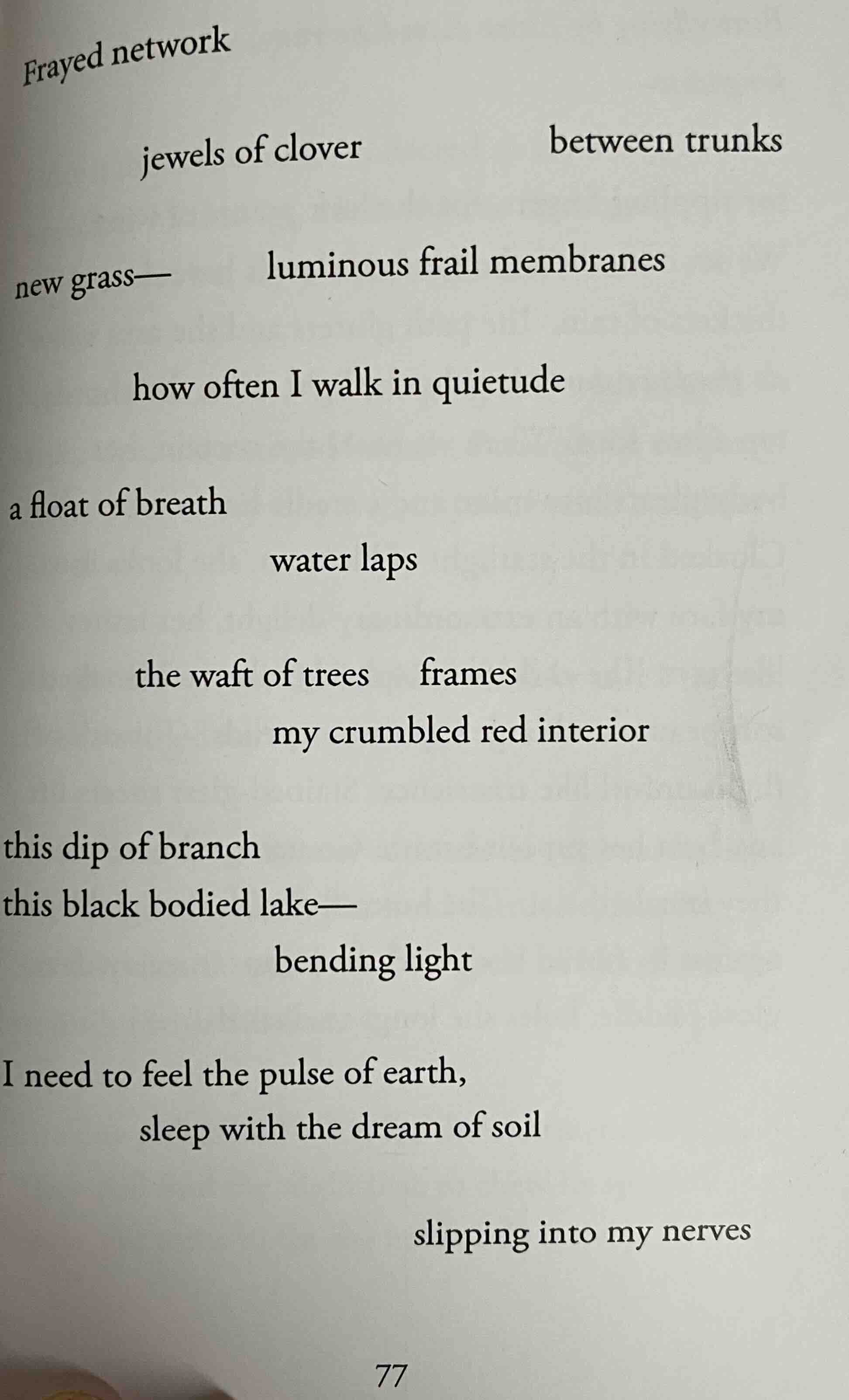
‘Frayed network’ on Page 77* is a moment when the ominousness is mostly at bay, there is no scientific nomenclature, and attention is on the present moment in the natural world.
This poem might be a nice entry point for readers who are intimidated or bewildered by contemporary poetry. It’s definitely one that could have prompted the question a friend of mine asked at a Sydney Writers’ Festival session, ‘Why have modern poets given up rhyme and metre?’. The words are spread out all over the page, I imagine my friend complaining, the punctuation is mostly no help, and where are the verbs?
But slow down, spend a little time, and I think even my indignant friend might find pleasure here.
The poem takes its readers on a walk among trees beside a lake. Line by line, the speaker notes details from the environment: the jewel-like clover, the luminous frail membranes (what a lovely phrase!) of new grass, the sounds of lapping water and the feel of a breeze. There’s a hint that this is a new beginning: at the end of a drought, perhaps or in the aftermath of a bushfire. When else would you think of grass as frail? These details are just there, each its own thing, with no attempt to tie them into a pattern or narrative with a formal rhyme scheme or metre, or sentence structure, or even an orderly presentation on the page. There’s a lot of white space, a visual equivalent of silence.
It’s a mindful kind of walking, just noticing, not trying to make meaning or extract usefulness.
Then, interspersed among the images there are three sentences, each of them about the speaker:
How often I walk in quietude
At the third line, the poem’s speaker and her situation is made explicit. ‘Quietude’ is a formal word for a state of tranquility, suggesting quietness and solitude.
The second formal sentence occurs at lines six and seven. Its subject isn’t clear. Something, probably the totality of all the things that have been noticed – the clover, tree-trunks, new grass, breeze, sound of water lapping and trees –
___________------_____ frames
____________ my crumbled red interior
This is the only ‘difficult’ line in the poem, and also (no pun intended) its heart, in two senses. First, straightforwardly, it’s roughly the middle line of the poem. Second, more interestingly, it moves momentarily from the external environment to the inner life. The red interior suggests the colour of blood and internal organs, perhaps especially the heart. But ‘crumbled’? It does suggest some kind of diseased state, though I don’t know of one that would merit that adjective – some kind of clotting, perhaps, but that would be stretching it. I’m happy to let the word remain suggestive rather than carrying a definite meaning. A heart that isn’t so much broken, perhaps, as dried out and eroded by sorrow.
The next lines take us back to details of the environment: a lake seen through the branches of a tree, or perhaps a branch dipping into the lake, and a nod towards the many lighting effects that a lake can produce: reflection, diffraction, blackness and lightness at the same time.
In the final three lines, the third subject–verb–object sentence, the poem’s speaker is front and centre:
I need to feel the pulse of earth
_______ sleep with the dream of soil

___________------_______ slipping into my nerves
She is reaching for a connection with the land, to have it come alive in her dreams, to heal her crumbling elements. She needs to be, literally, grounded, with a hint, perhaps, in the word ‘dream’, of Indigenous concepts.
Which brings me to the title. There are two possible frayed networks here. Nerves are spoken of as frayed, and as networks. There is also the intricate ecological network of bush beside a lake, and to describe that network as frayed may be to pick up the hint of recent disaster in the frail membranes of grass. More generally, in our times it’s pretty well impossible to think of the natural environment without the effects of climate change coming to mind: all ecological systems are currently under stress. Yet, the poem affirms, the nervous system of a human can the ecological system of the bush can connect – need to connect.
I wrote this blog post in Gadigal Wangal country, where seasonal flowering is happening earlier with each passing year. I acknowledge Elders past, present and emerging for their continuing custodianship of this land, over which their sovereignty has never been ceded.
* My blogging practice, especially with books of poetry, is to focus on the page that coincides with my age, currently 77.
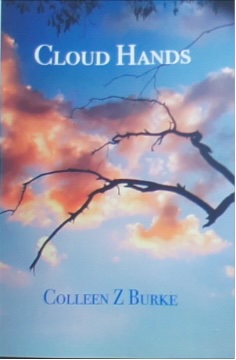
Cloud Hands is Colleen Z Burke’s thirteenth book of poetry.
As in those of its forerunners that I’ve read, its typical poem is a short, impressionistic snapshot of landscape, or especially skyscape, mostly in the inner-west Sydney suburb of Newtown. As snapshots, these poems are mostly embedded in a specific moment, a specific circumstance, so we often get a sense of the life of the person taking the shot, and of the broader context.
There are also memories of a working-class childhood. ‘Each Way’, about gambling as part of the family’s way of life, begins, ‘Minor crime was woven / into our lives just like / the salty tang of the sea.’ (I can relate: my own family of origin wasn’t working class, but my farmer father, like Colleen Burke’s, was a patron of illegal SP bookies.)
There are a three poems (‘Illusion’, ‘A nefarious enterprise’ and ‘A magnet’) recalling youthful romance. Colleen’s partner was Declan Affley, the folksinger who accompanies Mick Jagger’s terrible rendition of ‘A Wild Colonial Boy’ in Tony Richardson’s 1970 movie Ned Kelly. Though it is many decades since he left us, he is still a vibrant presence in these poems.
There are people-watching poems, incidents from inner-suburban life, comments on the news, snippets of science and social history. Covid and the bushfires of 2019–2020 loom large. Climate change and environmental degradation threaten to sour the joys of the natural environment.
This is a collection that bears witness to a persistent practice of paying attention – to the world, to history, to life.
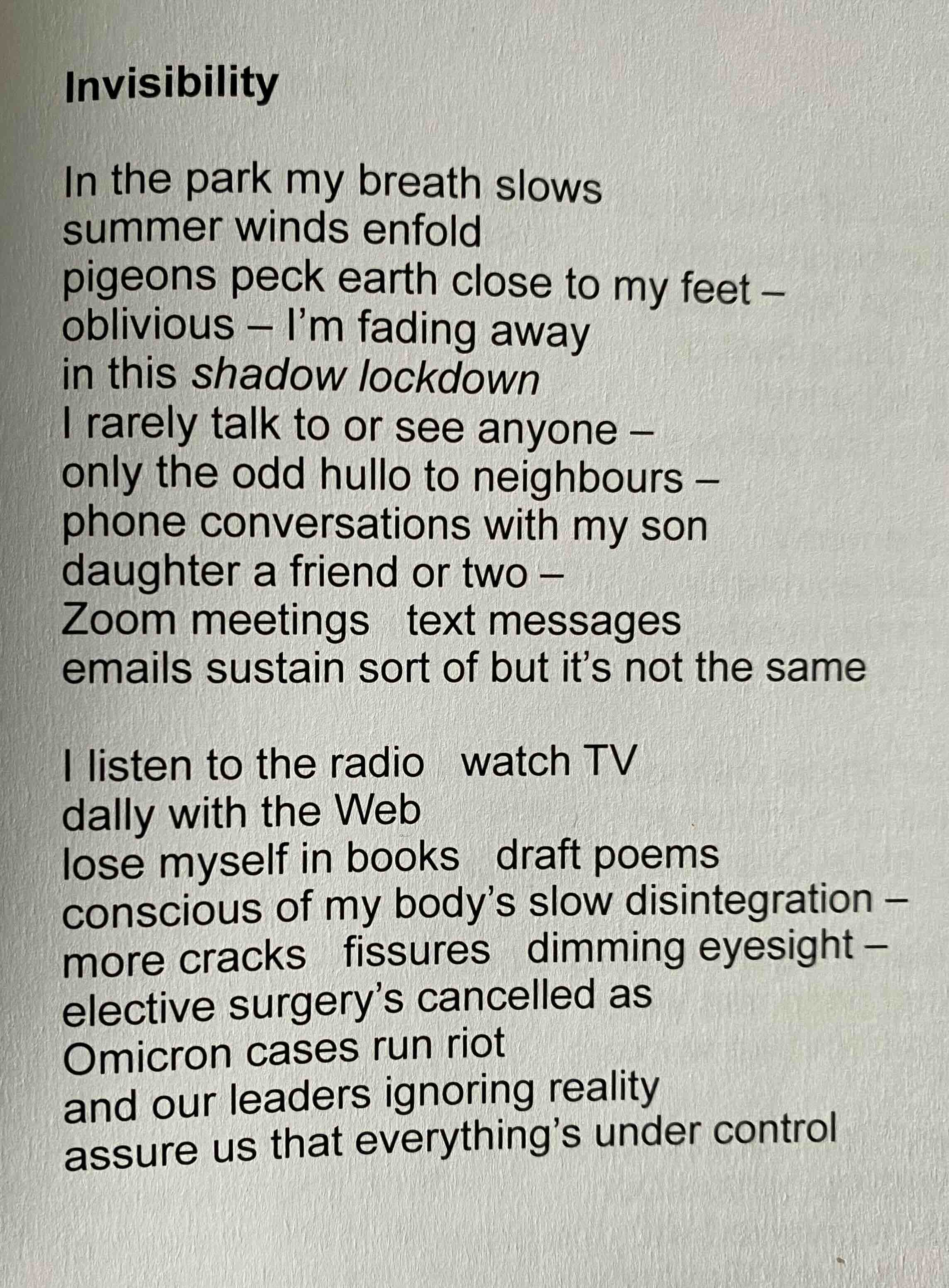
Page 77* is ‘Invisibility’:
Yes, page 77 of the last book I read had a pigeon poem too. But here the pigeons are oblivious rather than chatty, and the despair in the poem is not worn lightly.
This poem is a great example of the value of slow reading. At first quick reading, it’s a straightforward cry of the heart from the dark days of January 2022, when the Omicron variant of Covid was on the rampage in Sydney. In case you need reminding, there were no official restrictions on movement at that time, but Australia had moved from having a remarkably low level of serious illness and death from Covid to having among the highest. The assistance to individuals and businesses from the Federal government had largely dried up, and the Prime Minister of the time was trumpeting a business-as-usual message. Here’s a link to Mike Secombe on that nightmare in The Saturday Paper.
So this poem is, perhaps, an unremarkable record of how one woman suffered in that time: she has minimal contact with other people, she fills her time with solitary activities, and her age-related health issues go unattended to. Like most of us, she finds fault with the Morrison government’s handling of the situation.
That’s all there. But, interestingly, after I started writing this blog post I had a number of conversations that kept sending me back to the poem. One person spoke about a gobsmacking experience using the (I think) Apple Vision Pro goggles – it was as if he was in the room with a musician, could almost touch her. Someone else is reading Naomi Klein’s Doppleganger, and described her account of people involved in the riots of 6 January losing track of the difference between the gaming world and the actual world where there are consequences. Burke’s ‘sort of but it’s not the same’ stops feeling like a banal statement of the obvious and takes on a profound resonance. The poem expresses one woman’s feelings in a specified circumstance, but it sends ripples out well beyond it.
The other thing I noticed as I sat with the poem, or had it sit with me, is the part played by the pigeons. The poem begins, like many of Burke’s poems, with a moment of relaxation in the park – the breeze, pigeons, the earth, her breath slowing down. Then, with the word ‘oblivious’, it turns to the poet’s inner turmoil. The pigeons might have provided a calming anchor, their obliviousness an invitation to pay attention to the present moment. But it was not to be. Skip to the final lines, and the notion of obliviousness returns to round out the poem with ‘our leaders / ignoring reality’. The poem’s speaker is invisible to the pigeons who are engrossed in pecking the earth. She is also invisible to the political leaders who deny that the coronavirus is out of control. The tension between the pigeons’ focus on reality and the political leaders’ wilful ignoring of it is what holds the poem most satisfyingly together.
You can read my blog posts on some of Colleen Z Burke’s previous books here, here, here and here, and on her memoir The Waves Turnhere.
I wrote this blog post in Gadigal Wangal country, where I believe Colleen Z Burke also lives. I acknowledge Elders past, present and emerging for their continuing custodianship of this land, over which their sovereignty has never been ceded.
* My blogging practice, especially with books of poetry, is to focus on the page that coincides with my age, currently 77.








 Me fail? I fly!