Tag Archives: poetry

Jennifer Maiden’s China Shelf, page 47

Jennifer Maiden, The China Shelf: New Poems (Quemar Press 2024)
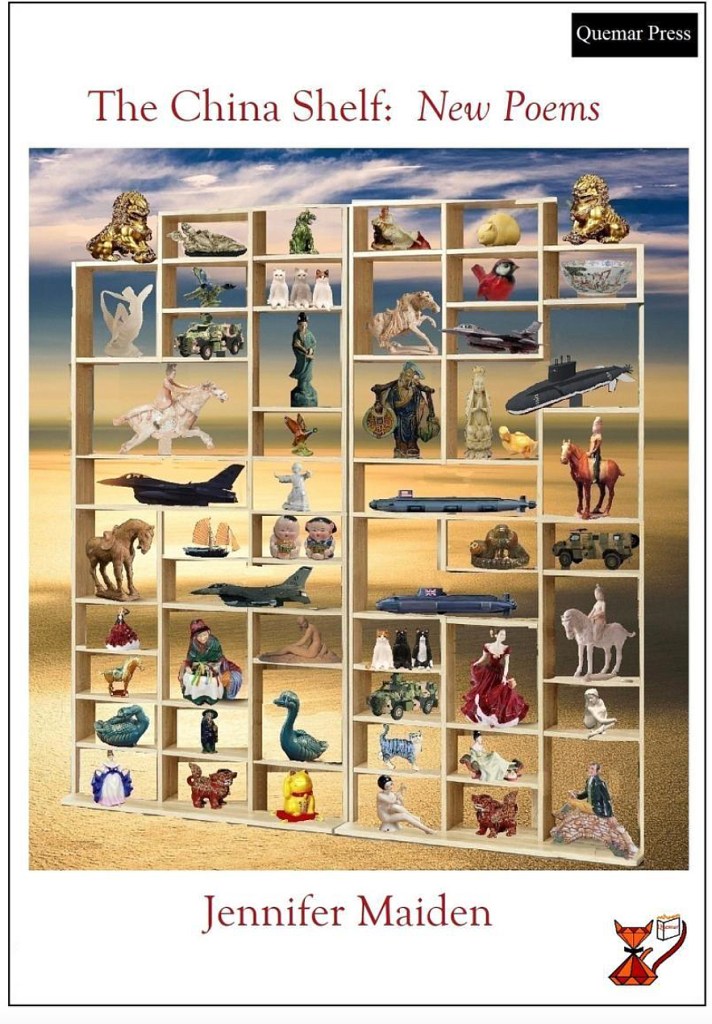
Jennifer Maiden and her daughter Katharine Margot Toohey, publisher of Quemar Press, have been doing a literary highwire act for years: a cover image of a future book and its general theme are announced early in the year, sample poems uploaded as they are written, and then the book appears at the beginning of January the next year. They did it again in 2023.

Beginning early last year, Quemar Press uploaded an image of the cover of The China Shelf and 11 ‘sample poems’. Each of the poems was freshly written when uploaded, and very much of its moment: July’s poem referred to talk of Julian Assange at an Ausmin Conference (press report here, poem here); August’s to the US’s alleged demand that Imran Khan be removed as PM of Pakistan (press report here, poem here); and so on. We were seeing the project being created in real time – its contents determined by world events, and the collection as a whole relating thematically to Jennifer Maiden’s china shelf with its figurines that range from cute ceramic cats to model nuclear submarines. Now we have the book itself.

The poems in The China Shelf continue in the mode Jennifer Maiden has made her own: conversational, with unobtrusively musical half-rhymes; featuring fictional or historical characters freshly woken up (most of them familiar from earlier Maiden collections); taking issue with political leaders, mostly from the Labor or Democratic Party side of politics; taking controversial stands on many issues, including sympathy for Putin in his invasion of Ukraine (though there’s not so much that in this collection); making surprising connections between people and events; reflecting on her creative process and arguing with critics and publishers; sometimes gossipy, with flashes of glorious lyricism. You can read the samples at this link.

There’s no page 76 (the page I usually blog about, because it’s my age). My fallback position is page 47 (my birth year). Because the poem that begins there is three pages long, I’m bending my rule to talk about pages 47–49. I apologise in advance if the discussion is a bit laboured – the poem is not.

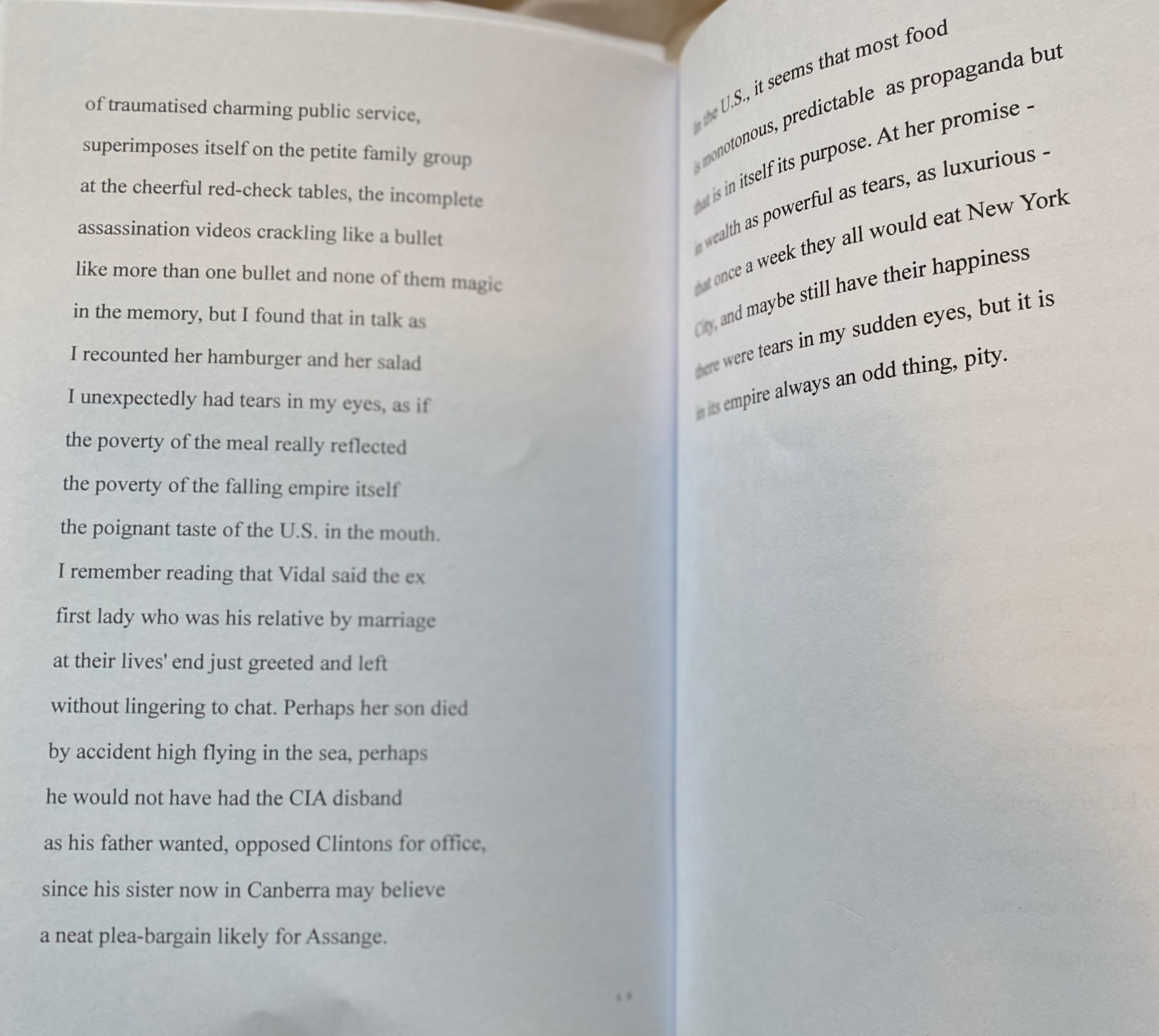
First, here are phone photos, which with any luck will look OK on your device. Click to enlarge.
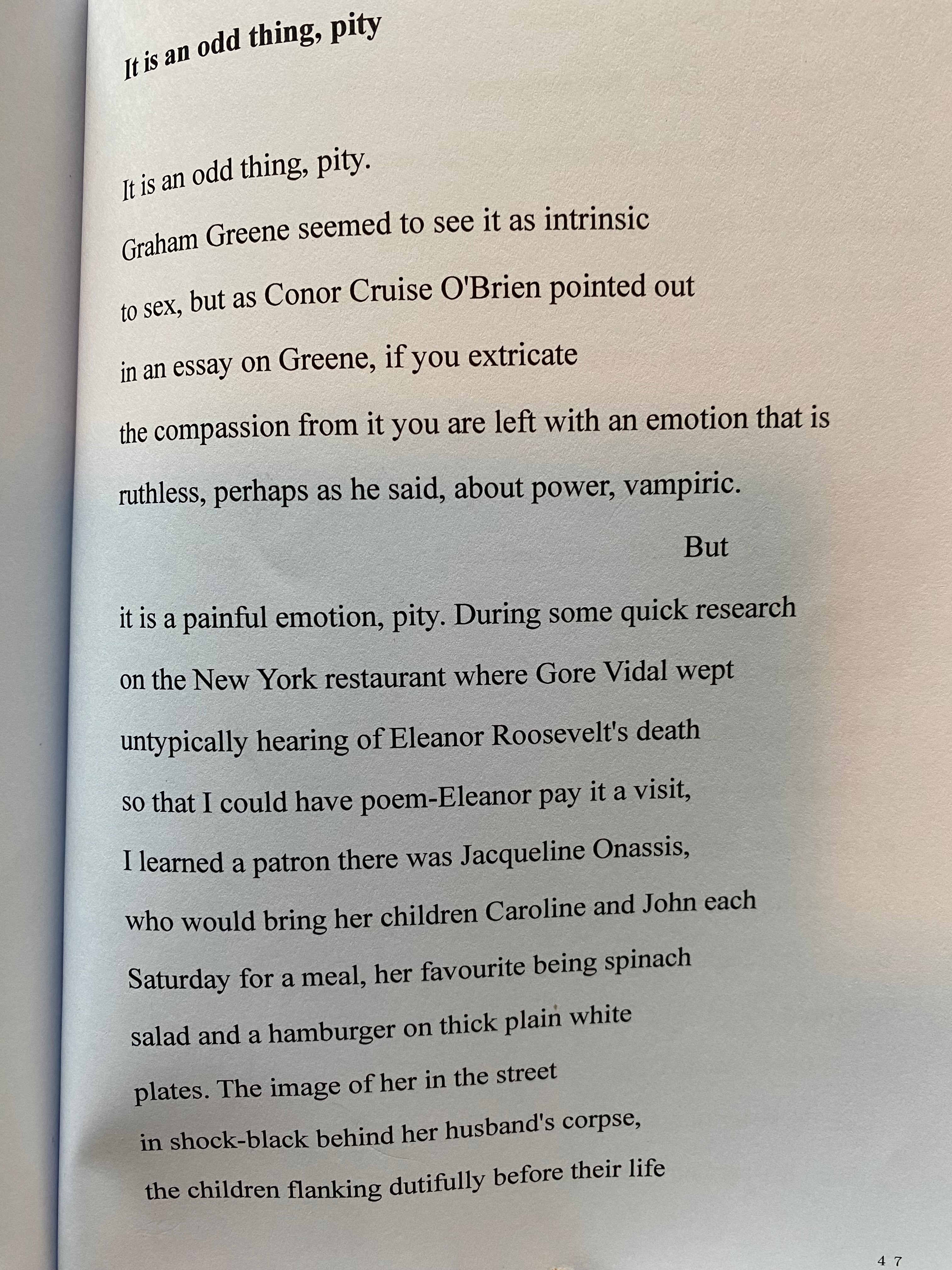
I probably wouldn’t have chosen ‘It is an odd thing, pity’ to discuss – it doesn’t feature the china shelf, or begin with a character waking up, or reflect on the Australian poetry scene – but it turns out that serendipity is a wonderful thing, and the poem rewards a closer look.

A Study Notes synopsis might go something like this: The poet, while researching a restaurant that is the setting for another poem, discovers that Jackie Onassis took her two children there regularly for hamburgers and salad. She surprises herself by shedding a tear when telling someone about these modest family meals. The poem probes the meaning of those tears.

If you wanted a straightforward enactment of the Study Notes synopsis, you’d be annoyed by the amount of extra clutter in the poem. But (of course) that clutter is what makes the poem interesting.

It starts with a move characteristic of Maiden, an invocation of another writer, in this case Graham Greene, and Conor Cruise O’Brien commenting on him:

It is an odd thing, pity

It is an odd thing, pity.
Graham Greene seemed to see it as intrinsic
to sex, but as Conor Cruise O'Brien pointed out
in an essay on Greene, if you extricate
the compassion from it you are left with an emotion that is
ruthless, perhaps as he said, about power, vampiric.

It’s a long time since I’ve read any Graham Greene, and I have only a vague idea who Conor Cruise O’Brien is. (Change the names, and I could write that sentence about many Maiden poems – not a criticism of her, but an acknowledgement of my own ignorance.) I did a quick internet search, mainly hoping to read a less cryptic version of what Greene and O’Brien said. The search was fruitless, so I’m left where I might have been content to be anyway, finding my own way with the poem.

it turns out that the poem doesn’t need a reader to grasp the paradox of pity as a ruthless emotion, understand the distinction between compassion and pity, or know anything specific about Graham Greene and sex. Greene and O’Brien now depart and are heard no more. The poem has invoked them as a way of announcing that pity is seen as problematic more widely than in this poem. The lines are a kind of paradoxical preface that one expects the rest of the poem to elucidate, or perhaps bounce off.

And bounce it does, with the word ‘But’ on the extreme right on the next line:

______________ __________________________But
it is a painful emotion, pity.

Echoing the opening line, this takes control back from Greene and O’Brien, not so much disagreeing with their thesis as adding another dimension. Pity is not just an objective ‘thing’ to be discussed, but an ’emotion’ to be felt. It might be odd from a philosophical distance, but as lived experience, it’s painful.

Now the narrative proper begins:

it is a painful emotion, pity. During some quick research
on the New York restaurant where Gore Vidal wept
untypically hearing of Eleanor Roosevelt's death
so that I could have poem-Eleanor pay it a visit,
I learned a patron there was Jacqueline Onassis,
who would bring her children Caroline and John each
Saturday for a meal, her favourite being spinach
salad and a hamburger on thick plain white
plates.

That’s all one sentence. There’s no rhyme scheme in this poem, but it’s interesting to notice the music in these lines, helped among other things by the recurring ch sound at the end of lines: ‘research’, ‘each’, ‘spinach’.

The poem has arrived at its central image: Jacqueline Onassis and her children eating a modest meal. As I imagine you know, Jacqueline Onassis, wife of business magnate Aristotle Onassis, was formerly Jackie Kennedy, wife of President John F. Kennedy, who was assassinated in 1963.

The restaurant, as you probably don’t know, is Mortimer’s, a fashionable burger joint (the subject of a memoir, Mortimer’s: Moments in Time by Robin Baker Leacock (2022)). The poem referred to, ‘Eleanor Roosevelt Woke Up in a New York Burger Bar’, appears earlier in the book and is included in the Quemar Press sampler. Gore Vidal makes regular appearances in Maiden’s poems, mainly because Julian Assange was carrying a book by him when forcibly removed from the Ecuadorian embassy in 2019. Maiden’s poems often refer to each other in this way, and the detail of Gore Vidal weeping ‘untypically’ may be a product of another feature of her poetry: the recurring characters (poem-Eleanor is one, poem-Gore is another) tend to take on a life of their own, and here Gore Vidal insists on being more than a passing name-drop. His tears are the first of three lots in the poem.

Picturing Jacqueline Onassis with her children, Maiden’s mind goes to the assassination and the famous footage of Kennedy’s funeral:

plates. The image of her in the street 
in shock-black behind her husband's corpse,
the children flanking dutifully before their life
of traumatised charming public service,
superimposes itself on the petite family group
at the cheerful red-check tables, the incomplete
assassination videos crackling like a bullet
like more than one bullet and none of them magic
in the memory,

‘Shock-black’ demonstrates just how much work a single adjective can do, conjuring up the mood of that famous footage. But it’s now 60 years after the event, and the passage of time adds further superimpositions. The children’s futures are summed up elegantly as lives ‘of traumatised charming public service’. The controversy and conspiracy theories surrounding the assassination (was there more than one shooter? was it a CIA plot?) are thriftily evoked: the videos are incomplete and there may be more than one bullet. (There’s no magic bullet to cure the ills of that moment.)

Now comes another ‘but’, which pulls attention back to the immediate emotional impact, not of the funeral scene, but of the image of the meal:

in the memory, but I found that in talk as 
I recounted her hamburger and her salad
I unexpectedly had tears in my eyes,

Earlier, Gore Vidal wept ‘untypically’. Now the poet’s speaker does so ‘unexpectedly’. Gore, waspish observer of the social scene and sharp political commentator, has a moment of straightforward grief. Maiden, intent on creating complex poem-versions of public figures alive, dead and fictional, has a simple emotional response. You or I might have left it at that – it may be unexpected, but surely it’s not weird to be moved by the image of a recent widow and her orphaned children having a quiet meal: ‘It is a painful emotion, pity.’ But things are rarely simple in a Jennifer Maiden poem, and this one twists off in an unexpected direction:

I unexpectedly had tears in my eyes, as if 
the poverty of the meal really reflected
the poverty of the falling empire itself
the poignant taste of the U.S. in the mouth.

Rather than reflecting, as a lesser poet might have done, that even in the midst of international political events the suffering of a small family can evoke our empathy, Maiden takes a different tack: even a simple empathetic response can be understood in terms of major political movements. The humble meal, it suggests, reflects something about the humbling of US imperialism.

Not everyone will grasp how US imperialism can be seen as ‘falling’. If anything some would say it’s on the verge of exploding and bringing the rest of us down with it, terrifying rather than poignant. But for the poem ‘the poverty of the falling empire’ is a given, not a point of view to be argued for or needing the reader’s agreement.

We now move on to what lay in the future for that ‘petite family’. Gore Vidal is back, this time as a witness:

I remember reading that Vidal said the ex 
first lady who was his relative by marriage
at their lives' end just greeted and left
without lingering to chat. Perhaps her son died
by accident high flying in the sea, perhaps
he would not have had the CIA disband
as his father wanted, opposed Clintons for office,
since his sister now in Canberra may believe
a neat plea-bargain likely for Assange.

The mother became unsociable. The son died in an air crash – with two perhapses reminding us that conspiracy theories also hovered around his death. The daughter is now the US ambassador to Australia. Julian Assange has appeared in many Jennifer Maiden poems, and Caroline’s probable support for ‘a neat plea-bargain’ makes her one of the good guys in Maiden-land.

I don’t understand the ‘since’ in the second-last line there. Again, it feels as if a more detailed argument is being gestured at, but not something to be gone into here – this poem has other fish to fry.

The final lines return to the burger joint:

In the U.S., it seems that most food
is monotonous, predictable as propaganda but
that is in itself its purpose.

In real life, food is probably no more monotonous in the U.S. than anywhere else, but we’re talking about a burger joint – specifically, comfort food in a high-profile burger joint. A crude paraphrase of these lines might be: Propaganda is the McDonalds of the soul. The purpose of monotonous, predictable food is the same as that of comforting, reassuring propaganda: to dull the senses, lower expectations, create a compliant population.

that is in itself its purpose. At her promise – 
in wealth as powerful as tears, as luxurious –
that once a week they all would eat New York
City, and maybe still have their happiness
there were tears in my sudden eyes, but it is
in its empire always an odd thing, pity

Without the ‘clutter’ (that is, without the things that make the poem interesting), this could be paraphrased: ‘It was her promise of this weekly routine meal together, which might enable the three of them to be happy in spite of Kennedy’s death, that brought tears to my eyes.’ That is, the poem’s speaker, aware of the terrible ordeal that this family has gone through and of so much that is yet to come, sees this attempt at reassurance as pitiable.

The line that gives me pause is ‘in wealth as powerful as tears, as luxurious’. The line’s music works beautifully, ‘luxurious’ rhyming with ‘purpose’ and promise’ in the previous line, ‘powerful’ also resonating with ‘promise’, and ‘tears’ and luxurious’ resounding with a kind of end alliteration. Its meaning is not immediately clear. On the one hand, perhaps Onassis’ wealth, power and luxury are enough to outweigh her pain. On the other hand, her promise is made from a position of privilege that makes any tears she sheds a luxury. (I don’t want to make too much of ‘eat New York / City’ as suggesting that the Kennedy’s, specifically these three, were great devourers, as it is may be a typo – though even as a typo it would be a kind of Freudian slip.) In the poem, however, the person who sheds tears isn’t Onassis, but the poem’s speaker, demonstrating that whatever you/she might think about people of power, wealth and privilege, you can surprise yourself by the feeling a straightforward sympathy for them.

The final line brings us back to the start. Yes, pity is complex, but unless I’ve completely missed the point, this particular example is not sexy, ruthless of vampiric. We may even surprise ourselves by weeping tears of pity for those whom we might see as possessing those qualities. I love the phrase ‘in its empire’: pity, which I take to be the way we as humans spontaneous care about each other, has its own empire, which does not bow to any ideology.
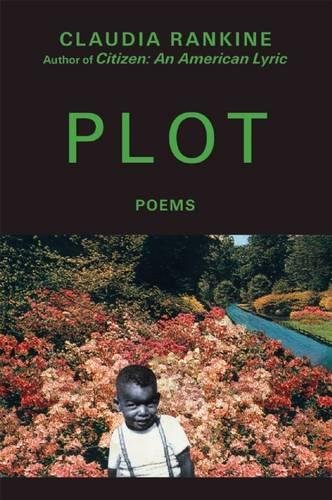
Claudia Rankine’s Plot, page 76

Claudia Rankine, Plot (Grove Press 2001)

Claudia Rankine’s two most recent books, Citizen: An American Lyric (2014) and Just Us: An American Conversation (2021) – links are to my reviews – issued brilliant, multi-faceted, take-no-prisoners challenges to anti-Black racism in the USA, shedding light and warmth on the issue well beyond American borders, and enthusing readers, me included, well beyond the borders of Contemporary Poetry land.

When a friend lent me Plot as part of a Covid care package (the Covid turned out to be a non-event, thanks for asking – vaccines and antivirals work wonders), I looked forward to more of the same. That is to say, I came to this slim volume of poetry, published more than a decade before Citizen, with completely inappropriate expectations.

The first page of verse gives fair warning. It consists of just four lines:

Submerged deeper than appetite

she bit into a freakish anatomy. the hard plastic of filiation.
a fetus dream. once severed. reattached. the baby femur
not fork-tender though flesh. the baby face now anchored.

OK, this book is going to expect the reader to work. A string of phrases separated by full stops without any opening capitals and only one conventional sentence. There seems to be something about biting onto the flesh of a foetus. It’s a dream, and maybe the dislocated syntax represents the fragmentary nature of the dream. But why ‘freakish’? What is ‘deeper than appetite’? What has been severed and reattached, and how? My phone dictionary wasn’t a lot of help with ‘filiation’ – the most relevant implied definition is ‘the process of attachment’ – but why plastic? And so on.

These four lines announce the book’s central theme of pregnancy, and they foreshadow that for much of it a good part of the reader’s pleasure is in being lost in a cloud of probabilities, not quite knowing what the endlessly suggestive words mean.

There is a story. Liv, an artist, is pregnant and ambivalent about it. The foetus has a name, Ersatz. The father’s name is Erland. The book’s most accessible moments are in occasional snatches of dialogue between the adults – in which Erland usually fails to grasp Liv’s emotional tumult. Most of the rest enacts that tumult: ‘dreams, memories, and meditations expanding and exploding the emotive capabilities of language and form’ (that’s from the back cover).

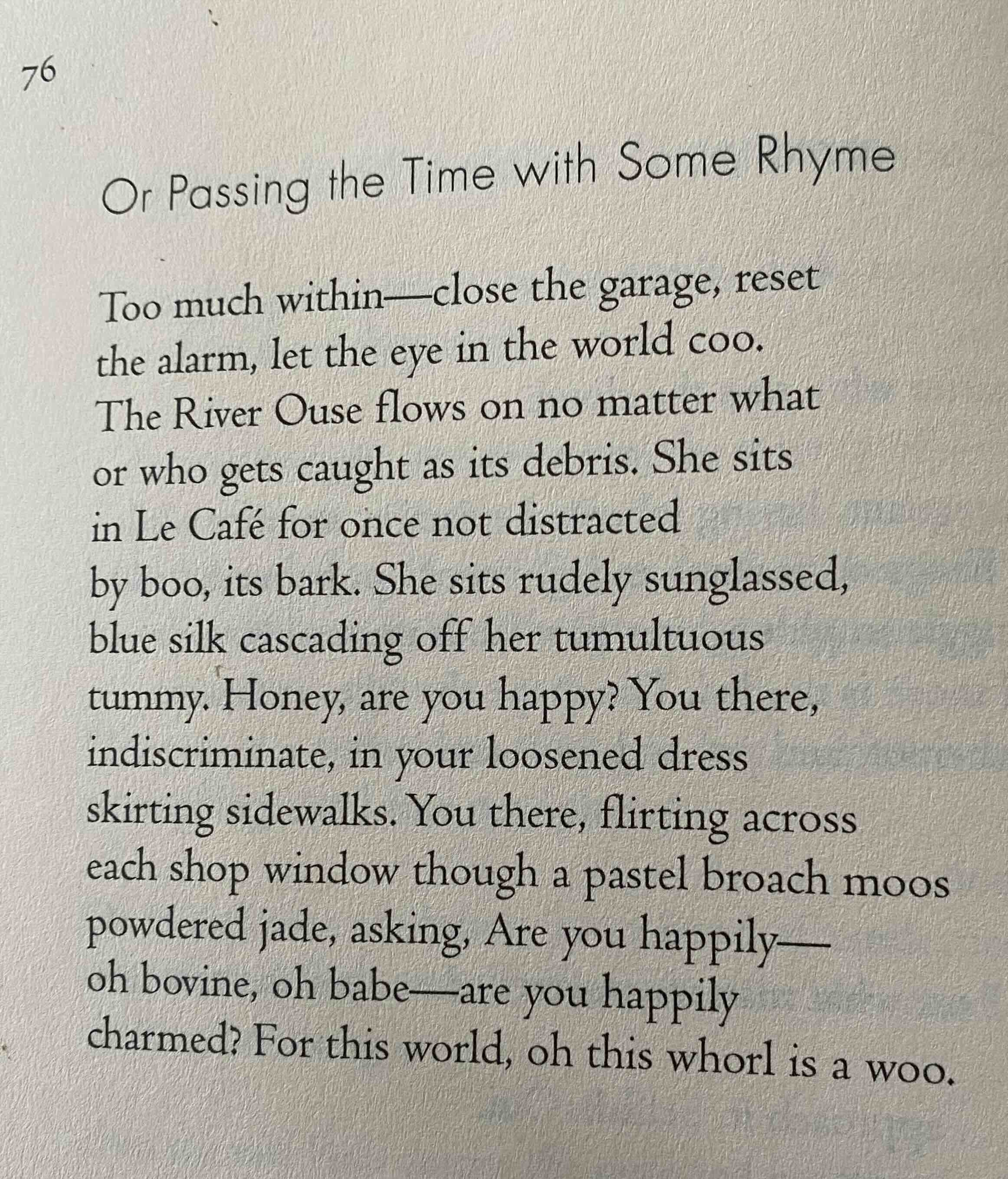
My blog practice is to write about page 76. In the kind of coincidence that I’ve almost come to expect, the only poem from this book that I could find online was the one on that page, ‘Or Passing the Time with Some Rhyme’, quoted in a review by Kate Kellaway in the Guardian. Kellaway doesn’t say a lot about this poem, but her review sheds excellent light on the book as a whole: for example, she describes many of the poems as ‘painterly’, and reminds us that Liv and Erland are the first names of the actors in Igmar Bergman’s monumental movie Scenes from a Marriage.

Page 76 (right click to enlarge):

There are lots of possibilities, but here goes with my reading.

This poem is something of a turning point in the book, as signalled by the ‘Or’ in its title (not ‘On’ as a careless reading might see). We can keep going as we have been, the title says, or we can take a different route. Let’s loosen up and just pass the time. Instead of more of the serious, introspective prose poems, let’s have some fun with rhyme.

Or Passing the Time with Some Rhyme

The body of the poem fills that promise, though perhaps not obviously.

To understand the first four lines, you need to know that in an earlier sequence, Liv has worked on a painting entitled Beached Debris referring to Virginia Woolf’s death in the River Ouse. Her brooding on Woolf’s suicide reflects her dark emotions about her pregnancy.

Too much within – close the garage, reset
the alarm, let the eye in the world coo.
The River Ouse flows on no matter what
or who gets caught in its debris.

The voice here is not, as mostly so far, giving us Liv’s inner workings. It’s more like a bossy friend: ‘Too much introspection, snap out of it.’ Maybe Liv has been painting in the garage. It’s time to close it, reset the burglar alarm and leave the house. Undo the fixation with Virginia Woolf’s death and notice the wider world, the river that still flows on no matter what tragedies it has seen.

The next lines are no longer addressed to Liv, but show her from the outside for the first time in the book. She’s looking cool, even arrogant, and splendidly, exuberantly pregnant:

or who gets caught in its debris. She sits
in Le Café for once not distracted
by boo, its bark. She sits rudely sunglassed,
blue silk cascading off her tumultuous
tummy.

This is a good time to notice that the poem is a sonnet, the only one in the book, and as far as I can tell the only poem in a traditional form. (Back to the ‘Or’ in the title: we could keep on with prose poems or we could have a crack at a sonnet.) It doesn’t have an obvious rhyme scheme (I’ll come back to that), but it does have the classic sonnet turn, right here in line eight where it’s supposed to be. The poem now addresses Liv again:

tummy. Honey, are you happy? 

You can read this a number of ways. It could be a straightforwardly sympathetic request for information. It could be a niggle: you look OK, ‘for once not distracted’, but are you actually happy? Or, and this is the reading that carries most weight for me, it could be registering unexpected good news: ‘Honey, after all this misery, are you actually happy?’

The remaining six lines (the sestet of the sonnet) have a cinematic feel. Liv is on the move, and the questioner repeats the question (this is very Boomer of me, but I think of Lynn Redgrave in the opening scenes of Georgy Girl, with Judith Durham on the soundtrack asking her questions in song). The tone still arguably ambiguous, but now with the possibility of enchantment much stronger:

tummy. Honey, are you happy? You there,
indiscriminate, in your loosened dress
skirting sidewalks. You there, flirting across
each shop window though a pastel broach moos
powdered jade, asking, Are you happily –
oh bovine, oh babe – are you happily
charmed? For this world, oh this whorl is a woo.

In ‘oh bovine, oh babe’, one of the words commonly used to disparage pregnant women is being reclaimed – someone might see her as cow like, but she is indiscriminately flirty, window shopping, and to all appearance happily charmed. It’s still a question, but surely now leaning towards a positive answer.

But what about rhyme? And also, what about those words that don’t make obvious sense that I’ve blithely glossed over until now?

After spending some time with this poem I realise that I have to let go of my habitual prosaic way of reading, and almost sing this, accentuating the vowels, starting with the title:

Or Passing the TIME with Some RHYME

When I do that, something wonderful happens. The sound patterning, especially the internal rhyming, is at the heart of how the poem works. Just look at all those oo words: Too, coo, Ouse, who, boo, rudely, blue, you (several times), loosened, moos, woo. There’s more to the soundscape than this (‘tumultuous tummy’, for example, and heaps of alliteration in the sestet), but once you’re alert to how the poem sounds, those odd words – coo, boo, moo and woo – make sense. It’s easy enough to find a paraphrasable meaning for them: ‘let the eye in the world coo’ equals ‘let the world look on you with the indulgence of a lover who bills and coos’; ‘not distracted / by boo, its bark’ equals ‘not having one’s attention dominated by this thing that is scary like a ghost or a savage dog’; ‘this world is a woo’ equals ‘this world is waiting to be loved by you, is wooing you’. It almost feels as if the notion of bovineness is introduced so the brooch (I think ‘broach’ must be a typo) in the shop window could moo. The literal meaning matters, but maybe what matters even mnore is the way the words just sing on the page. The final phrase, ‘oh this world is a woo’, becomes a fabulous, semi-nonsensical affirmation of life as joyful.

PS: Now have another look at the four lines I quoted at the start of this blog post. Read it emphasising the sounds, especially all those Fs. Quibbling at it for clear meaning seems much less valid all of a sudden. The pleasure is real.

Ken Bolton Starting at Basheer’s

Ken Bolton, Starting at Basheer’s (Vagabond Press 2018)

I’ve come late to Ken Bolton’s work. He has been a presence on the Australian literary scene for half a century. His Wikipedia entry lists 20 books under the heading ‘Poetry: Collections and Chapbooks’, beginning with Four Poems in 1977, with a print run of just 300 copies. He has published more than one small magazine, operated a small press and written art criticism as well as poetry.

Before Starting at Basheer’s, I’d read only one book by him, London Journal London Poem (2015). That book consists mainly of one long poem in which the poet and his partner Cath (writer Cath Keneally IRL) visit their son Gabe and his partner Stace in London. When Gabe appears in Starting at Basheer’s, he is in London while the poet is mostly at home in Adelaide, working, people-watching in cafes, or staying up late at night. The poems have what looks like an easy spontaneity, so they are something like what New York School poet Frank O’Hara describes as ‘I do this I do that’ poems. (This isn’t just me showing off what I learned in the ModPo course I did last year. O’Hara crops up a number of times in this book; if you’re interested you can read a little about him and ‘I do this I do that’ here and here.)

On first reading, I just loved this book. It felt as if I was invited to share relaxed moments with someone who just happens to have a lot in common with me demographically. We’re both middle-class white Australian men in long-term relationships with women, with sons we admire and love. We were born two years apart, and may even have been at Sydney University at the same time. Friends are occasionally mentioned by first name only, and sometimes I know who they are (‘Pam’, for example, is the poet Pam Brown, ‘Laurie’ is Laurie Duggan, and ‘John’ is probably the late John Forbes). Further readings left me feeling less of an insider, but enjoying the poetry no less. Bolton knows a lot about poetry and art and movies, and wears his knowledge so lightly that you don’t notice that you’re learning things or being challenged until you hang around a bit. It’s his erudition that has stood out more on subsequent readings.

It’s always handy when a poet give us a phrase describing what they’re up to. Bolton does that a couple of time in this book. ‘Up Late (August Mute)’ on page 103 has these lines:

_________But I am
'up-at-night',
again

___ ... proving I'm here, alive
taking stock of things
registering the moment:

me, the hum from the
fluoro light, the mess

– relative – I keep
this room in

‘POEM (“I reach”)’ ends:

And I write a poem today myself:
not very good, of that I'm sure –
but it marks the moment.

These poems are generally about registering or marking the moment, including whatever is going through his mind and the incidentals of his surroundings. There’s often a spontaneous, unrevised feel (the poem may not be ‘very good’), but I can promise you it’s not easy to get that casual feel and still be readable, let alone as enjoyable as these poems are.

Sticking to my practice of writing about page 76, here it is (click to make large and legible):

Read out of context, the page amounts to an almost self-contained piece of chat about an old movie. In context, it’s a lot more interesting than that.

It’s part of a long poem (131 lines), ‘Dear Gabe,’ (the comma is part of the title), one of two poems framed as letters to Gabe in London. The poem has the informal feel of a tossed-off letter: the syntax and spelling can be loose, and even the line breaks feel relaxed. It’s written the day after a phone conversation, and Bolton, or the speaker of the poem, visualises where Gabe was calling from, using his recent photo of Gabe and his partner Stacey. He paints a picture of the family home where he was during the call, and then:

It would be good to have you back home –
or to be over there with you is the
alternative.

Which leads to the possibility of meeting up in Rome for a couple of weeks. Turn over to page 76, and the mention of that possibility has sent the poem/letter ricocheting in a different direction. It’s not exactly a digression, because the whole thing is a post-phone-call rumination with no main thesis or agenda or narrative thread (‘I think this I think that’, if you like):

Two Weeks in Another Town was a not very good novel 
& a bad & unintentionally funny
film: an American in Europe, up against all its
shocking amorality, venality & corruption:
Kirk Douglas playing a guy brought in to
save a falling director, get the movie back in production,
on budget, & quickly in the can.

You don’t need to have read Two Weeks in Another Town (Irwin Shaw 1960) or seen Vincente Minelli’s 1962 movie to understand and enjoy these lines, but as a dedicated blogger, I rented the movie from a streaming service. (I’m not dedicated enough to read the novel, sorry!).

That plot summary is as good as you’re likely to find.

on budget, & quickly in the can. Italy. You can 
imagine. Well, you can't. I can.

Of course, the reason for the plot summary is that the letter-writer doesn’t expect his son to have seen the movie, and in these lines he realises that he is speaking across the generations. He may also be realising that he has been to Italy and Gabe hasn’t.

imagine. Well, you can't. I can. The world is 
spared, today, much exposure to Kirk
at full throttle. It was possibly an attempt
to make something like La Dolce Vita, but
understandable-for-Americans, & with a 'clear
moral point of view' – as they used to say,
the duller critics.

That’s funny and spot-on. ‘Kirk / at full throttle’ made me particularly glad I’d seen the movie: near the end, Kirk Douglas’s character, eyes bulging, drives a car at breakneck speed through the Italian countryside scaring the living daylights out of the woman in the passenger seat, all somehow establishing that he’s not crazy. Ken is right to assume that Gabe and I (and probably you) don’t need to have the reference to Fellini’s La Dolce Vita spelled out for us. I don’t know if I’ve actually seen that whole movie, made two years before Two Weeks, but Fellini’s general use of carnivalesque images contrasts marvellously with the weird, frozen faces of the ‘decadent’ Romans in the final scenes of the Kirk Douglas movie.

the duller critics. America has slipped a bit 
in the innocence ratings. But Italy ... Berlusconi
might have stepped right out of Kirk Douglas's
nightmare.

Well, yes. There’s no date on this poem, but if it was written after Trump’s (first?) election, ‘slipped a bit’ is a delicious understatement. The Berlusconi reference could have been made anywhere over a stretch of decades. The date really is immaterial: the same observations could have been made any time in the last 20 (even 40?) years.

Back to the proposal to meet up:

___________ That said, Shall we go?

(It may be that we won't. The duller critics
are back! One of the dullest now runs things
in the Australia Council – so, no money for me
in the foreseeable future. No travel. No Italy.)

A bit of literary gossip that would surely delight those in the know, but sadly no names. I went so far as to look up recent heads of the Australia Council (which became Creative Australia last year), but I have no way of telling who the dullest of critics is/was. A footnote identifying him or her might have gratified a lust for scandal, but wouldn’t have made a difference to the poetry, which is after all what I’m reading for. (Relaxed though their style may be, these poems don’t hesitate to pick a fight. There are other similarly non-specific snippets of gossip – notably the mention of legal issues with Les Murray’s estate in ‘In Two Parts, a Letter’, the other letter to Gabe which also, incidentally, includes insightful chat about a film, in that case Les enfants du paradis.)

Then the poem turns again:

There is no news: I mean, you're up-to-date –
nothing to tell of news from here.

It’s a letter, you’re supposed to give some news. But this is a letter following so soon after a phone call, so nothing new to say. All the same, the writer is called on to say something about himself:

nothing to tell of news from here. It seems so ridiculous 
to be my age, that, tho I feel okay, one can't
help thinking about it. I would certainly like
to see you more

It’s as if the whole poem has been circling around something, and now hits it with the word ‘it’, only to recoil immediately. The speaker, with no matter-of-fact news to give, almost accidentally mentions a persistent preoccupation. I love the elegant way the verse communicates that though he ‘can’t help thinking about it’, he has trouble talking about it. He prefaces the reference by describing it as ridiculous, he says he feels okay (clearly intended to be the opposite of ‘it’), he uses the pronoun ‘I’ everywhere else, but here uses ‘one’. Nor can he explicitly say what ‘it’ is.

(Lest you think an explanation is to come on page 77 – nah! Those lines spell out how much he’d love to see his son, and the poem ends with a description of the circumstances in which he’s writing – alone late at night, with jazz playing – and what he imagines is happening at Gabe’s end:

And school kids soon will start walking up Jermyn Street
& young mums will appear & you will play guitar a bit,
& then get to work

Note the absence of a full stop. This correspondence will continue.)

So what is ‘it’ that can barely be mentioned and must not be named? There’s no mystery really. All that has gone before – the cross-generational movie talk, the reference to duller critics of the past who are back again, the changing status of the USA, and earlier reflections on the way the family house has changed over the years, all this has been quietly and persistently marking the passage of time. It would probably be going too far to say that ‘it’ equals death. But I do read it as referring to mortality. He’s not saying, ‘I’ll be dead soon, so I’d like to see you.’ In fact, he’s carefully not saying that: ‘I feel okay … I would certainly like to see you more.’ He quickly moves back to the question of catching up with each other, but the glimpse into the abyss, however brief and hedged about, remains, and the poem has done its work.

These lines from another poem – ‘Poem (“this notebook’s”)’ (page 118) – are relevant:

something serious
or something that 'becomes serious' –
that old trick. Is there
a name for that sudden
pounce or 'descent'
into gravity?

Maybe what I’ve just been describing is exactly such a sudden pounce or descent, and a release or ascent that is just as sudden.

The book is full of such unspectacular, but deeply human moments.

Kim Cheng Boey’s Singer

Kim Cheng Boey, The Singer (Cordite Press 2022)

There’s so much to love in this book.

I was inclined to love it sight unseen. I’ve been delighted by Kim Cheng Boey’s readings in past years when the Sydney Writers’ Festival had room for local poets. He co-edited (with Michelle Cahill and Adam Aitken) the excellent 2013 anthology, Contemporary Asian Australian Poets. He has written insightful reviews of one of my favourite poets, Eileen Chong, and had a walk-on role in one of her poems. This is the first of his books that I have read.

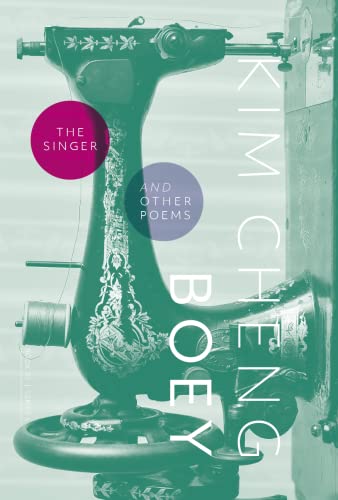
When I got my copy direct from Cordite Press – I tried at least three bookshops – I loved it for the cover alone. You expect the title The Singer to refer to the poet, perhaps in an attention-seeking way, but then you tilt the book and see the cover image clearly: it’s a Singer sewing machine. (My mother didn’t call her labour-saving devices the washing machine, the vacuum cleaner or the sewing machine, but the Hoover, the Electrolux and the Singer.) It’s a brilliant title: yes, poetry is like song, but it’s also craft.

And page by page, I kept on falling in love. There’s a Preface in which Kim Cheng writes of the different ‘weight’ of his poetry-making over time:

When I was younger, poetry carried me posthaste, high on the fuel of experience and freshness of thought, from initial impulse to final form. In middle age the roles are reversed – I am the mule, the porter, learning the weight and heft of the poem so I can carry it long-distance – over months and often years.

‘Perhaps,’ he continues, ‘the change occurred the moment I became a migrant.’ He migrated to Australia from his native Singapore in his early 30s, in 1997. Since then he has continued to take part in Singapore’s literary and cultural life as well as that of his adopted home. The book’s three parts can be read as tracing this geographical movement over time. The first, ‘Little India Dreaming’, has five long prose poems full of the smells and sights and sounds of a remembered Singapore childhood, including the title poem. Here’s a small extract to give you a feel for it:

You almost pray to the Singer, its dark cast-iron hull, to 
carry your mother's song. You pray for the treadle to 
stir, for the finished dress to be unstitched, its seams 
unpicked so the dress can materialise again from the 
chalk outline. You take the birthday outfit out of the 
wardrobe of forgetting and become the five-year-old 
wearing your mother's love.

The second section, ‘The Middle Distance’, is introduced with a quote from Louis Mac Neice, ‘This middle stretch / Of life is bad for poets.’ Each of its five poems is set in places other than Asia or Australia., and it’s tempting to see an unsettled, midlife quality to them.

The seven poems of the third section, ‘Sydney Dreaming’ – to simplify appallingly – lay claim to Australia as a place that can be called home.

My arbitrary blogging practice of looking at page 76 has once again given me a gift. That page occurs near the end of the book, in ‘Sydney Dreaming’, the title poem of the third section.

I love this poem (I know I’m using that word a lot, but it can’t be helped). In it the speaker walks around inner suburbs of Sydney, haunted by the tales and memories of other cities and ghosts of Sydney past. If it was terrible, banal rubbish, I might still have loved it because I have walked every step that the poem follows. I too lament the disappearance of second-hand book shops in Pitt Street. I know the painted up man with the didgeridoo in the Central tunnel, as well as the old Chinese man ‘scraping a dirge on his erdu’. Chinatown, Broadway, Glebe Point Road, Gleebooks, all lovingly named and recognisable. Then Darlinghurst Road, the wall, the Holocaust Museum, Macleay Street. The poem made me want to go for a long walk.

And it’s a terrific poem. Here are a couple of stanzas from page 76 – the walk down to Woolloomooloo from Kings Cross:

You follow the bend and the view opens to the ivory cusps 
of the Opera House and the dark arch of the bridge over the silver-glazed
azure scroll of the harbour, the sky burnished gold in the last exhalations of the sun.

Soon the flying fox formations will rise from hangars of Moreton Bay figs
in the Botanic Garden, and weave arabesques around the halo 
of the spanning arches of the Coathanger. You remember seeing this even
before you arrived, memory in the image, image in memory,

the sky and the harbour dyed incarnadine in the first postcard 
you ever received from a childhood friend settled in a new life

Notice that it’s in the second person: ‘You follow the bend.’ The poem’s speaker isn’t just telling the reader about a walk he has taken, he is inviting us to walk with him – which is especially effective for readers who have in fact walked in those places. The long lines have a leisurely, strolling feel: no hurry, no need to reach any rhyming points or keep to any metric timetable. The conversational tone and language creates a companionable feel.

Then the register shifts, as the poem enters its final movement.

You follow the bend and the language opens to ‘ivory cusps’ and ‘silver-glazed azure’ and ‘burnished gold’ and ‘exhalations of the sun’. That’s such a Sydney moment – any Sydneysider arriving at Circular Quay train station will have had their phone-absorption interrupted by the exclamations of tourists seeing the Bridge–Harbour–Opera House scene for the first time. Rounding that bend in Woolloomooloo has a similar breathtaking effect, and the language responds.

Then two things happen. First, the speaker asserts that he belongs here by looking forward in time: he knows that the flying foxes will soon fill the sky and enjoys anticipating the spectacle (still with the elevated language, ‘arabesques’ and ‘spanning arches’). Second, he knows that he hasn’t always belonged, and memory asserts itself. He had seen this sight in a postcard long before seeing the actual thing. I’m reminded of those passages in Proust about how the reality inevitably falls short of the anticipated image. That’s not how it is here, but there’s a strange unreality nonetheless – ‘memory in the image, image in memory’ – the present moment is a palimpsest. The whole poem revolves around that interplay of past, present, anticipated future and imagination. The whole walk is experienced as a palimpsest.

I’m restraining myself from quoting the lines that come next, because it’s getting close to the poem’s stunning conclusion, and even with poetry spoilers are an issue. Enough to say that the Bridge is transformed effortlessly from that spectacular postcard image to a terrific metaphor for the poet’s status in the midst of an ever-changing life of exile, belonging, and longing.

As a footnote: the title ‘Sydney Dreaming’ might be a worry. I don’t read it as claiming any of the First Nations meaning of the word ‘Dreaming’. In the course of his walk, the poet-flâneur passes a number of First Nations people: the man in the Central tunnel, and a real or imagined group of dancers in Woolloomooloo. The latter are mentioned after the speaker has been lost ‘in a dream of home, almost’: his dream is definitely lower case, and carefully distinct from that other, deeper, ancestral Dreaming.

The Singer won the Kenneth Slessor Prize for Poetry earlier this year (click here for the judges’ comments). Maybe it’s so hard to find in the bookshops because it sells out as soon as it hits the shelves. I hope so. Anyhow, especially but not only if you live in Sydney or are part of a Chinese diaspora, see if you can get hold of it. Did I mention that I love it?

Winter reads 9: Richard James Allen’s Text Messages from the Universe

This is my ninth and last post on books I took with me on my escape from Sydney’s winter, focusing as usual on page 76. I’ve been home for a while, but it takes a while for the blog to catch up with life.

Richard James Allen, Text Messages from the Universe (Flying Island Books 2023)

Like the other titles in Flying Island’s ‘minor works / Pocket Poets’ series, Text Messages from the Universe is a physically tiny book – just 152 x 102 mm. But it’s part of a broader multi-media project.

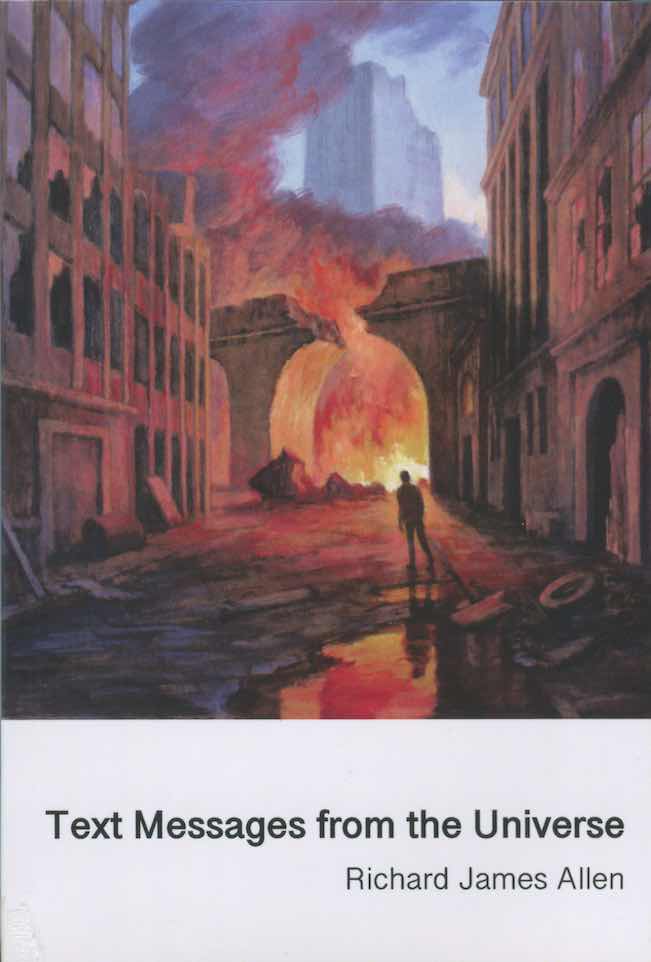
There’s a movie of the same name directed by Richard James Allen, which is the source of the lavish images of dancing figures that accompany the text (or perhaps, depending on how you see things, that are accompanied by the text). The front cover is from a painting created for the book by 2023 Archibald finalist Michelle Hiscock. The text itself, a single prose poem, is the final work in the multi-volume The Way Out At Last Cycle, which has been three decades in the making (Hale & Ironmonger published The Way Out At Last and other poems in 1985).

The poem is inspired by the Tibetan Book of the Dead. The first, shorter section is addressed to a person who dies in a car accident. In the second section, made up of 49 short parts, the person is lost in a state between death and rebirth, the bardo, in a cycle of dreaming and waking, bewildered, disoriented and panicking. The poetry takes on a weirdly insubstantial quality that is beautifully enhanced by the billowing drapery of the dancers on every page. I haven’t read the Tibetan Book of the Dead – that part of 1960s enthusiasm passed me by – so I don’t know if the poem follows it with any precision, but there’s a wonderful sense of being carried along on a current leading to detached oblivion and then, perhaps, to a new beginning.

No spoiler intended, but the text messages of the title are revealed towards the end of the poem, in part 46: ‘This is your last moment,’ closely followed by, ‘This is your first moment.’ Part 47 adds this gloss:

As for the rest, Your text messages from the universe 
seem to be happy to take any form and any language 
they please.

Some of them aren't even text messages, just 
whispers inside your head.

Speaking as someone who is currently reading Saint Augustine’s Confessions, I’d add they may also come in the form of a child chanting on the other side of a wall.

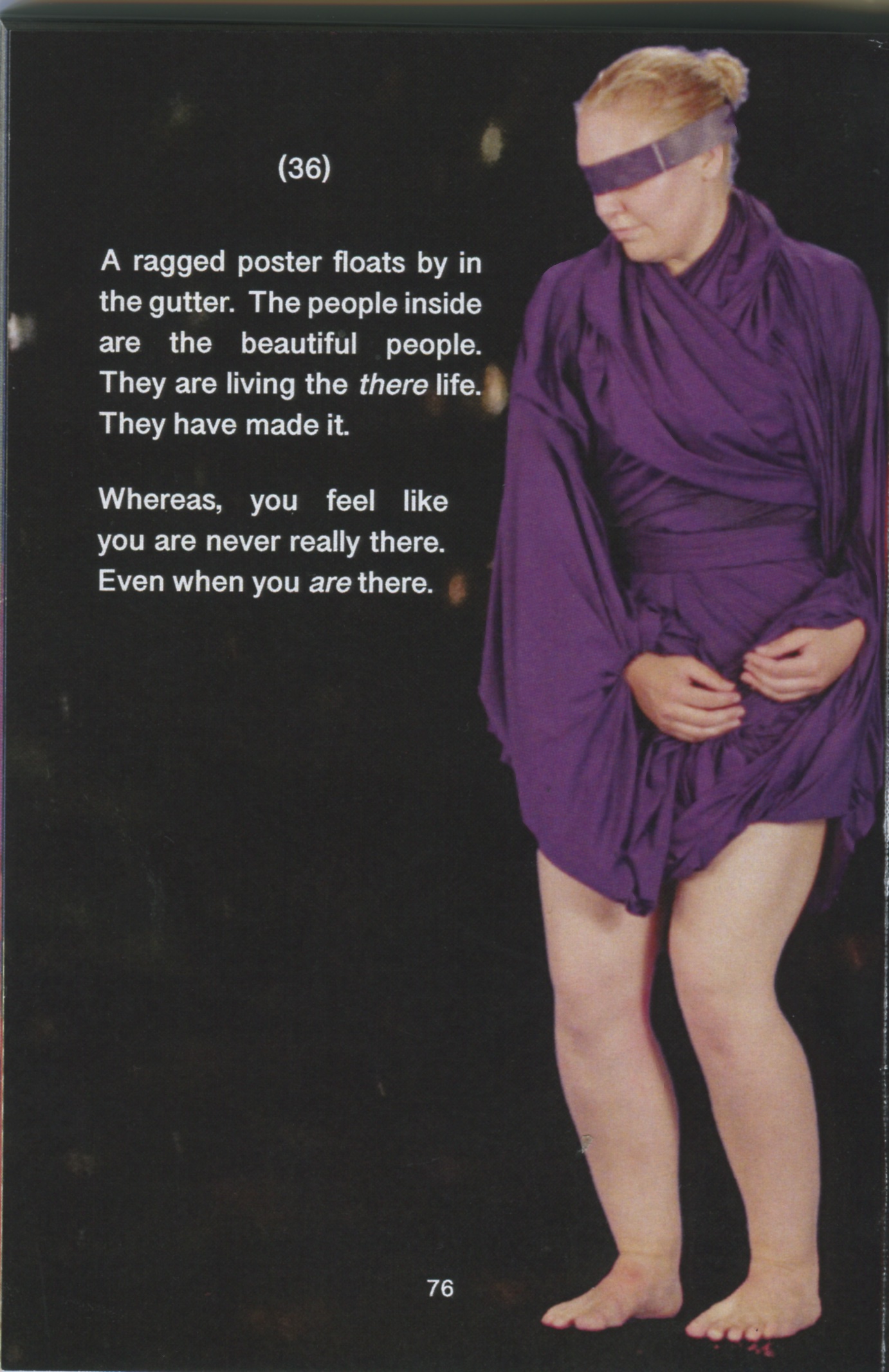
Even while I’m enjoying the poem’s journey in an invented universe (apologies to any of my readers for whom the bardo is as real as purgatory is to some Catholics), my tendency as a reader is to cast around for the kind of actual experience that the invention draws on and possibly illuminates. The short poem on page 76, section 36, rewards this tendency:

(36)
A ragged poster floats by in 
the gutter. The people inside 
are the beautiful people.
They are living the there life.
They have made it.

Whereas, you feel like 
you are never really there.
Even when you are there.

Incidentally, this is the only image in the book where the dancer is less than elegant, where the fabric is not floating in an ethereal breeze. It signals that, as so often happens, page 76 is a kind of turning point, in this case a low point.

The text offers one of the poem’s many noir-ish images – one of many alleys, gutters and empty lots. The poster is a piece of detritus from the life left behind. In the dream world of the poem, it asserts the substantiality of that life, its thereness. These lines reward my penchant for literalness by drawing on a moment of a kind I imagine we’ve all had: you see a poster for some event and reflect fleetingly that the life represented in the poster is unreal – either that, or it’s part of a reality that you have no part of. This is the moment in the bardo when the newly-dead person is closest to nothingness: it’s the rubbish poster that’s real.

In the years that this poem was fermenting, the bardo attracted the attention of a number of other creators. I’m aware of George Saunders’s multivocal novel Lincoln in the Bardo (2017), which I haven’t read, and Laurie Anderson’s movie Heart of a Dog (2015), for which I just couldn’t stay awake. I had no trouble staying awake on the journey with Text Messages from the Universe.


I’m grateful to Flying Islands Books for my copy of Text Messages from the Universe.

Winter reads 8: Sophia Wilson’s Sea Skins

This is my eight post on books I took with me on my brief escape from Sydney’s winter, focusing as usual on page 76. (I’ve actually been home for a while, but the blog is still catching up.)

Sophia Wilson, Sea Skins (Flying Island Books 2023)

Sophia Wilson was joint winner of the inaugural Flying Islands Manuscript Prize for Emerging Poets in 2022. Originally from Australia, she now lives in Aotearoa New Zealand.

The poems in this collection reflect her attachment to both countries: there are poems based in her Australian childhood, and a number about the fraught history of colonisation in Aotearoa, as well as evocations of its land. There are also poems that bear witness to her experience as health professional (one poem mentions ‘the unbearable silence of asystole’), translator (most notably in ‘En Cas d’Urgence’, which switches among English, German, French, Spanish, Greek and Chinese), and manager of a wildlife refuge. That is to say they deal with an astonishing range of subjects.

If I had to generalise, I’d say the book’s central concern is the assertion of the human as part of nature as opposed to abstraction and mechanisation. But as soon as I’d written that sentence I read four short poems that only fit this description with quite a bit of mental contortion.

As with a lot of contemporary poetry, a key feature is a compression of meaning, which means that precise meaning is often elusive.

The poem on page 74 comes with a dedication: ‘for Valeria’. It’s an elegy for a friend who has died:

Nello Specchio d'Acqua
You were a glass blower, un soffiatore di vetro 
hands of silica and carmine
You lifted a globe, il tuo capolavoro
Within it two dancers cast crumbs to pigeons
A window opened to the sea

You were the blind man crossing a piazza
I was your white-tipped cane
On the bridge, at the centre, above the grey 
you were the singer, the song

I was the street sweeper, gathering dust
You were a magician, un pagliaccio intossicato 
dancing across the square

I was the guide in a maddened crowd
You were a tramp passing by - 
a mirage in a watery mirror
adrift on swelling tides

You were wasted, skeletal -
maligno il cancro, il tuo fiore in gola
You were sinking foundations, eroded façade
a stone lion slipped beneath tidelines

The sea swallowed our steps - 
you were swallowed in steps
invaded through doors, the walls of your neck 
your mouth's floor – la tua lingua

They gave you a tube for a windpipe

I measure the loss of you in tides
You were scattered at the rate of tsunami

There was a glass blower, un sofiatore di vetro 
who lifted a globe, il suo capolavoro 
I was a street sweeper, treading water

You came dancing across the square

(for Valeria)

This is a lovely evocation of a lost friend, with references to their experiences together that are cryptic, but not so cryptic as to be frustrating. The friend was clearly Italian, a glass blower, who died of cancer of the throat. The scattering of Italian phrases is a way of honouring the friend’s cultural heritage. (A number of poems in the collection do this with Mãori words, wth a similar effect of honouring difference.)

A specchio d’acqua is usually translated as a calm expanse of water. As specchio means ‘mirror’, the emphasis is on the surface reflection rather than other watery qualities – so the phrase could also be translated as ‘watery mirror’ (as in stanza four). Most of the other Italian phrases are pretty much explained in the text: capolavoro is ‘masterpiece’; un pagliaccio intossicato is ‘a drunken clown’.

The first stanza introduces the friend as an artist, and focuses on a glass globe created by her, a glass globe containing two dancing figures.

The next three stanzas riff on that image, describing the poet’s relationship to the artist in terms of two figures in a setting that suggests Venice: the big square, a group of tourists, a bridge, water. The poet was mundane, ‘gathering dust’; the friend magical, a drunken clown, a mirage, a singer, an exotic beggar. It’s not all one-way – the ‘I’ is a white-tipped cane for the friend as blind man, perhaps implying that she brought some groundedness.

Then the poem turns abruptly to the friend’s final days, wasted and skeletal. Interestingly the key information is left untranslated: maligno il cancro, il tuo fiore in gola, ‘malignant the cancer, your flower in the throat’. It’s as if the poet can’t bear to say the words in her own language. In what follows, the images of Venice are no longer of romantic waterways, bridges and tourist-filled squares, but ‘sinking foundations, eroded façade’ and the threat of rising sea levels. The cancer invades the friend’s body like floodwaters, in steps at first – and then, in the third-last stanza, leaving all thought of Venice behind, with the overwhelming force of a tsunami.

The single-line stanza, ‘They gave you a tube for a windpipe,’ interrupts the metaphorical elaboration with a moment of brutal literalness. There’s no need to name death itself: this tube says it all.

The last two stanzas turn again. The first of them reprises the poem’s opening movement, condensing it into three lines, but now the friend is no longer addressed directly. She can only be spoke of in the third person – ‘There was a glass blower’. The poet now recalls herself, not as gathering bust but as treading water ,an alrernative way of saying the same thing, that paves the way beautifully for the final line.

And the final twist: the friend can be spoken to again – and the vital image of her as she first appeared reasserts itself: ‘You came dancing across the square.’

I so get this! A friend of mine died recently. There was a wonderful farewell gathering where her many achievements were celebrated, and her qualities as a friend eloquently evoked. I can’t think of her without a terrible sense of loss, but at the same time my mind keeps returning to an occasion when, a fifty-something woman exultant at having won a game of canasta, she leapt onto the card table to do a wild, stomping victory dance.


I’m grateful to Flying Islands Books for my copy of Sea Skins.

Winter reads 7: Two bilingual poetry books

This is my seventh post on books I took with me on my escape from Sydney’s winter, focusing as usual on page 76 (or page 47 when there is no 76): two very different bilingual books from Flying Island.

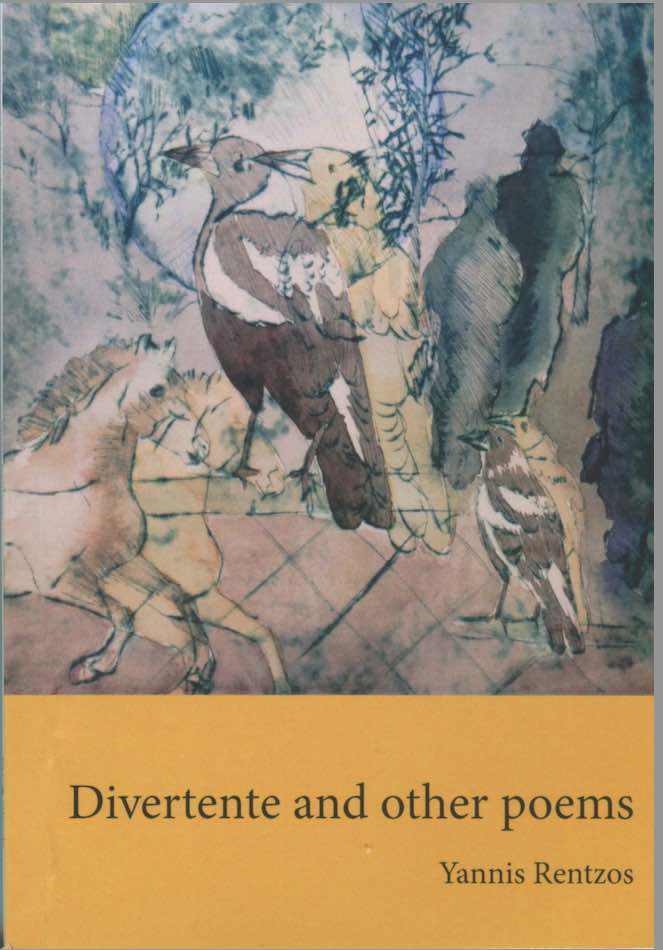
Yannis Rentzos, Divertente and other poems, translated by Anna Couani (Flying Island Books 2023)

Yannis Rentzos was born in Crete and has been living in Australia since 2006. His poems bear witness to his European roots as well as his antipodean present. The poetry is elliptical. I kept feeling that if I had been able to read the original Greek I would understand them better – not necessarily the evasive meaning, but perhaps something in the sound that is inevitably lost in translation.

For example, I particularly liked the poem ‘I know you are coming’, which seems to be about the death of a man, perhaps the poet’s father, whom he has ambivalent feelings about. Here are a couple of lines that suggest with wonderful economy that the man has spent time in prison, hint at violence, but remain opaque – in this way they are typical of much of the poetry:

In your first years on the outside
a plate, a glass

A suit hung unworn.
The cops knew, they turned a blind eye

Were the plate and glass smashed, as suggested by mentions of violence in surrounding stanzas? Why was the suit unworn? Did the cops turn a blind eye to the broken stuff, or to the unworn suit? If the latter, does that mean the suit was stolen? So many unanswered questions. But the plate, the glass, the suit are there in the poem and in the man’s past, radiating meaning – it’s just that we readers don’t know what that meaning is.

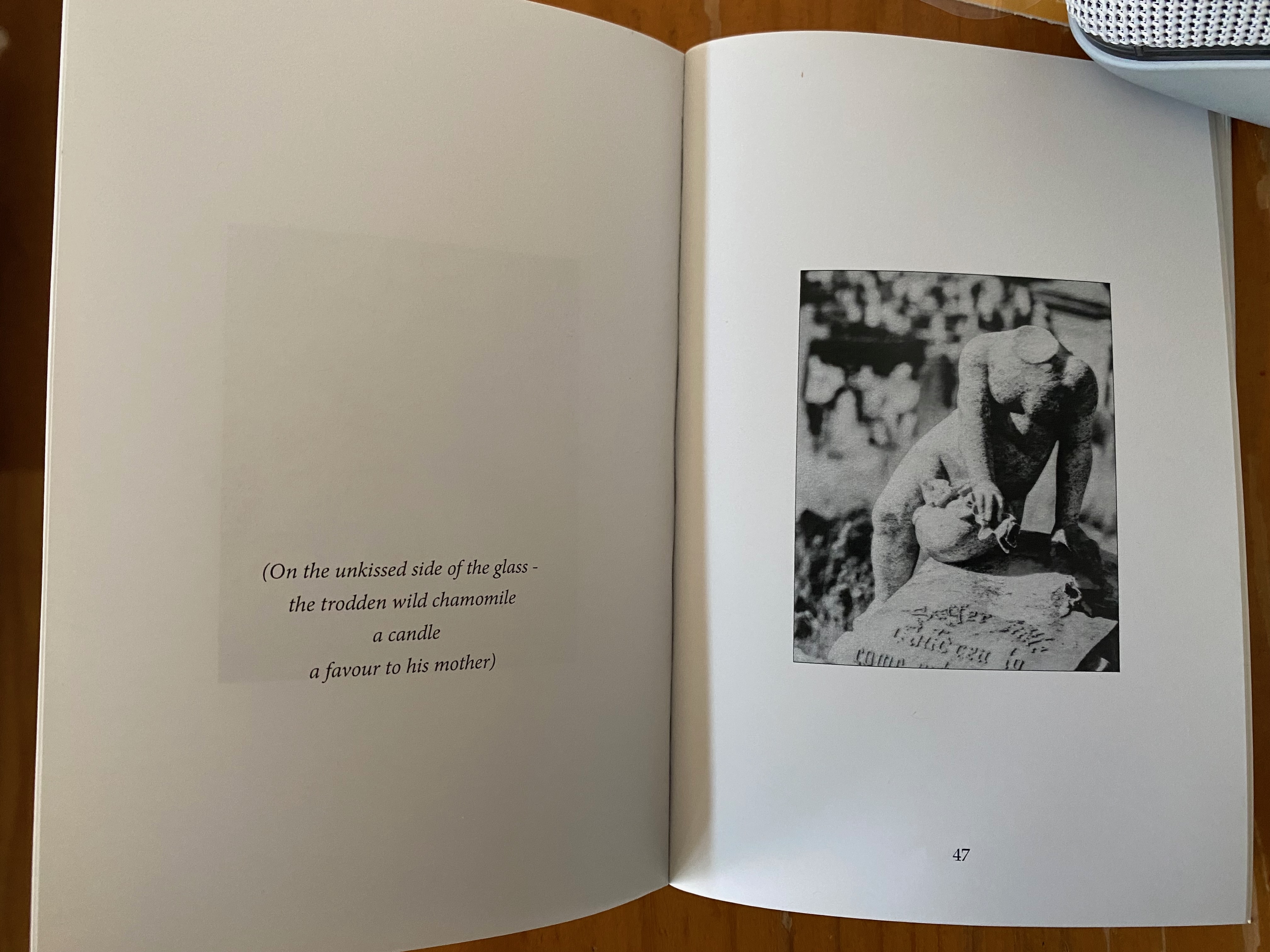
The final third or so of the book is devoted to a single sequence titled ‘Walk in Waverley’. Instead of Greek text on each right-hand page, there is a photo. In effect it’s a poetic-photo-essay on Sydney’s wonderful Waverley Cemetery.

Page 47 is on the second spread of the sequence, the first that includes text:

This gives you some idea of the way text and image relate to each other throughout. They don’t illustrate each other explicitly, but as the text – mostly a single line per page after this – evokes thoughts of death and transience, the images suggest a walk among the graves, disturbing the crows that live there. On this page, the text –

(On the unkissed side of the glass - 
the trodden wild chamomile 
a candle
a favour to his mother)

– is a preamble to the walk that takes up the next ten spreads. It suggests a different style of grave from the one pictured – one with a glass-enclosed shrine. The man referred to in the fourth line maybe the person taking the walk through among the graves, starting at his mother’s grave. Perhaps these lines are a kind of dedication: ‘favour’ here meaning not so much as kindness as a token of affection or remembrance. You’ll notice that I say ‘perhaps’: nothing in this books is absolutely explicit.


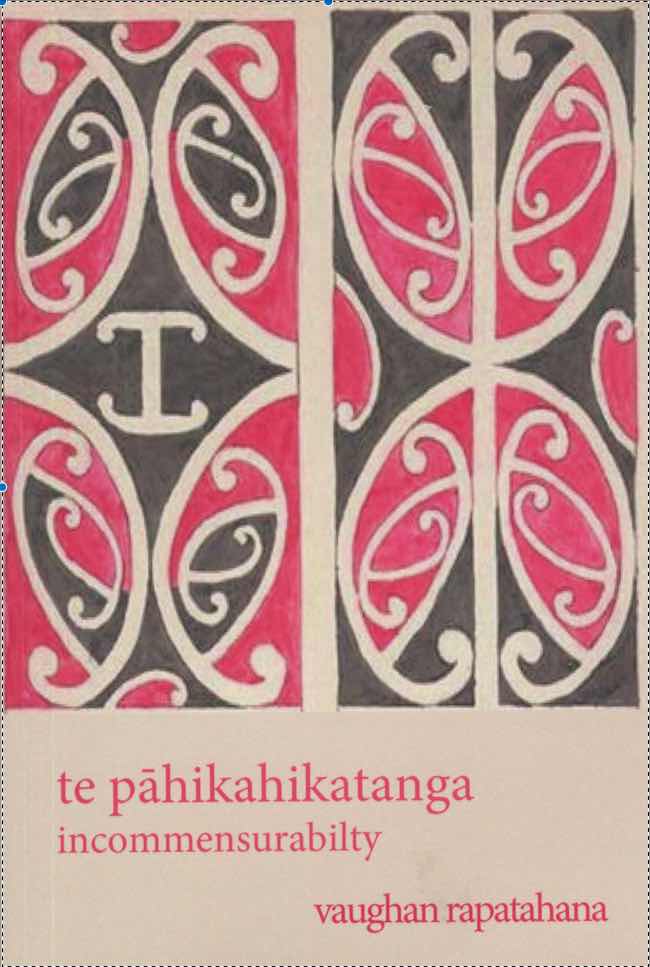
Vaughan Rapatahana, te pāhikahikatanga/ incommensurabilty (Flying Island Books 2023)

According to his author’s biog, Vaughan Rapatahana is one of the few World authors who consistently write in and are published in te reo Māori (the Māori language).

As well as a rich collection of poems rooted in Māori experience, this book includes a powerful essay on how important it is for Māori and other colonised peoples to learn and use their mother tongues.

The English language is one that historically and contemporaneously is all-too-often a deleterious influence on the languages of other cultures, in that its agents superimpose English with its inherent ‘cultural baggage’, on them. … The solution? To write in one’s indigenous language as much as practicable and to hope, to expect, that readers and listeners aspire to learn it too.

(Page 124–125)

Elsewhere:

I now write in my first language, the Māori language. Why? Because I want to fully express everything in my mind, in my heart, in my soul.
I cannot express myself fully in another language. For example, the English language is crammed full of the subject matter and cultural customs of the lands of Britain. The words of that tongue are inappropriate.

(Page 9)

The book is not just a bilingual book of poetry; it’s also a book about bilingualism. The incommensurability of its title refers to the impossibility of a ‘perfect’ translation. Anyone for whom the issues of translation matter will be interested. Likewise anyone interested in the long work of undoing the damage done by colonisation – to colonisers as well as colonised.

As a native speaker of the colonising language (with Irish and Scots Gaelic lost several generations ago), I’m reluctant to quote a whole poem, but here are a couple of lines from the English of ‘it is time for a big change’ on page 76:

there are many youths suiciding,
________________________-__ too many Māori youths
there are many women as victims of domestic violence
___________________________ too many Māori women
there is the ongoing issue of racism also,
__________________________ remember Christchurch.

And the original te reo Māori:

ko nui ngā rangatahi e mate whakamomori;
___________ he nui rawa atu ngā rangatahi Mãori
ko nui ngā wāhine ki ngā patunga o te whakarekereke ā-whare;
___________ he nui rawa atu ngā wāhine Māori
ko te take moroki o aukati iwi hoki;
___________  e mahara Õtautahi.

You don’t have to know much Māori language to immediately see some things lost in translation: in Māori, the lines mostly rhyme; in Māori, the second and fourth lines can end with the word ‘Māori’, whereas in English, the word is in a less emphatic position; and where the English translation has ‘Christchurch’, the Māori original has ‘Õtautahi’. The first and second of these differences are about the music of the poem. The third is a small illustration of the principles I quoted earlier: the English name inevitably carries connotations of England, of the Englsh Christian tradition; the Māori name makes it that much easier to remember that the victims of that mass shooting were Muslim.


I’m grateful to Flying Islands Books for my copies of Divertente and other poems and te pāhikahikatanga/ incommensurabilty.

Winter reads 4: Jill McKeowen’s Sunday morning, here

This is my fourth post on books I’ve brought with me on my escape from Sydney’s winter, focusing as usual on page 76.

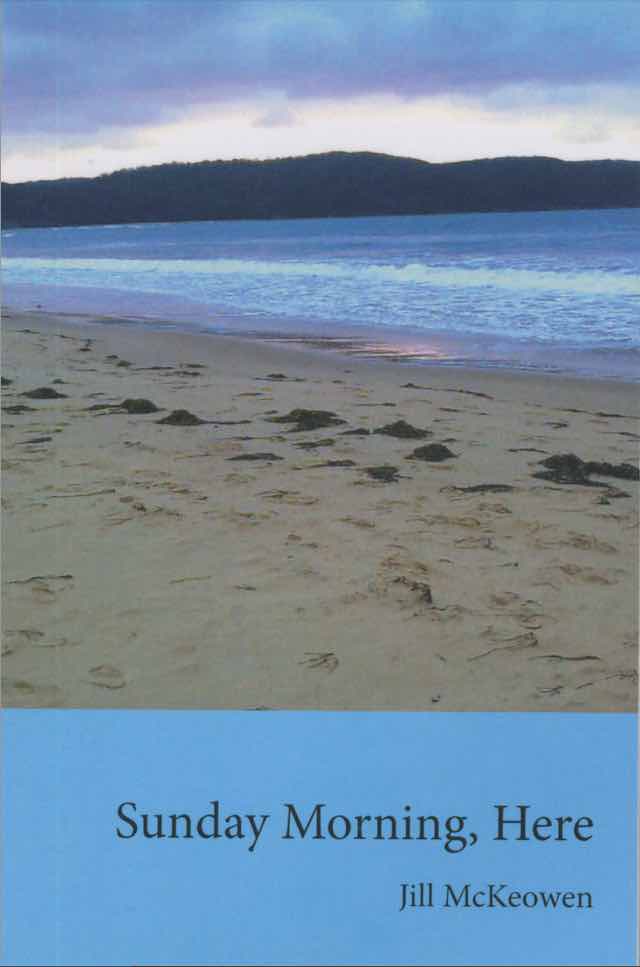
Jill McKeowen, Sunday Morning, Here (Flying Island Books 2023)

Sunday Morning, Here is another book in Flying Island’s hand-sized poetry series. Jill McKeowen’s bio tells us that, among many other things, she has been a regular reader at Newcastle Poetry in the Pub, and that this slim volume is her first book of poetry. I hope there will be many more.

It’s the kind of book that opens a window into the poet’s life: daily observations of life around her home on NSW’s mid-north coast, and on her travels up the coast and across the continent; some splendid poems about cockatoos; a whole section dealing with her father’s death and its aftermath; a section on her childhood family, then and now. Some poems suggest a disciplined practice of writing for an hour each morning. The poems are warm and genial, sometimes playing with form (there’s a nifty and heartfelt homage to Elisabeth Bishop’s The Art of Losing).

The title poem, ‘Sunday Morning, Here’, is partly a response to a Wallace Stevens poem, ‘Sunday Morning’, signalling that McKeowen expects to be read in conversation with other poets. Its first line, ‘Here there’s no complacency, but ease’, echoes the first word of the Stevens poem (‘Complacencies’), at the same time highlighting a recurring theme: the poet’s life is in the main comfortable and pleasant, but it includes an awareness of privilege: ease, but not complacency.

Serendipitously, the poem on page 76, ‘It’s still dark’, embodies many of these general characteristics.

It's Still Dark
I nudge the doona back, unwrap 
my sleep to the cold, and drift 
consoled in fleecy gown, pocket 
feet into slippers, feel
my way on hushed carpet, spark 
the gas heater to flame, flick 
the bathroom into light, give 
thanks for this convenience;

I fill the kettle from the tap, 
strike a match to more gas, 
slice ginger into boiled water, 
put my night-dried dishes away, 
sip the tea by fire glow, 
watch the rising-falling breath 
of curled cat, and write 
a reckless page of adjectives.

A woman wakes by the road 
close to a border town, her body 
warmth still wrapped around 
her sleeping child,
unseen
by armed militia.
She must look for water
while the dawn is pinned with stars.

Serendipitously, as I’m typing this I have on the table beside me a glass of ginger tea made from slices of ginger. I don’t wear slippers, my holiday rental has tiled floors, there is no cat, but the sense of simple luxury conveyed in the first two stanzas communicates beautifully. The four beat lines move smoothy, and the relaxed suggestions of rhyme (pocket/drift, spark/flick) and alliteration (water/away) hold the lines together, contributing to the sense of ease.

But not complacency.

The flow is disrupted in the second-last line of the second stanza, after the ultimate image of laziness – the ‘curled cat’ – comes a midline break in the sense, the first in the poem, and the line ends on just three beats, so that ‘write’ takes on a different, less indolent feel. Things are still easy but there’s a sense of purpose. Then ‘reckless’ confirms the change in mood. What is this reckless undertaking? It’s a writing exercise, perhaps a warm-up for something more challenging. Elsewhere in the book there’s a suggestion that McKeowen has a regular practice of writing in this way.

The third stanza takes the poem somewhere else altogether. It’s as if the act of putting words on paper ‘recklessly’ her mind is dragged from its early-morning drowsiness to awareness that her ease and comfort are an extraordinary privilege. The image of the woman who does not share her privilege bursts into the poem in lines of uneven length, with line breaks that do violence to natural phrasing (body / warmth, unseen / by armed militia). The other woman too has to find water, but in radically different, more precarious circumstances. We don’t need specifics of what country she is from: there are plenty to choose from.

I’m sure someone has said that good literature doesn’t provide solutions to problems, but helps to understand them. That’s certainly true of this poem. It gives us an unsettled and unsettling juxtaposition of two early-morning awakenings. A lesser poet might have gone on to spell out how the juxtaposition affected her – inspiring feelings of helpless guilt, say, or a decision to increase her regular donation to UNICEF. But that would have let the reader off the hook.

What we are left with is the final image of the dawn ‘pinned with stars’. As in those classical Chinese poems where the moon can be seen by the exiled poet and also by those who are far away, both women in this poem can see the stars. It’s a reminder of their shared humanity, and of ours.


I’m grateful to Flying Islands Books for my copy of Sunday Morning, Here.

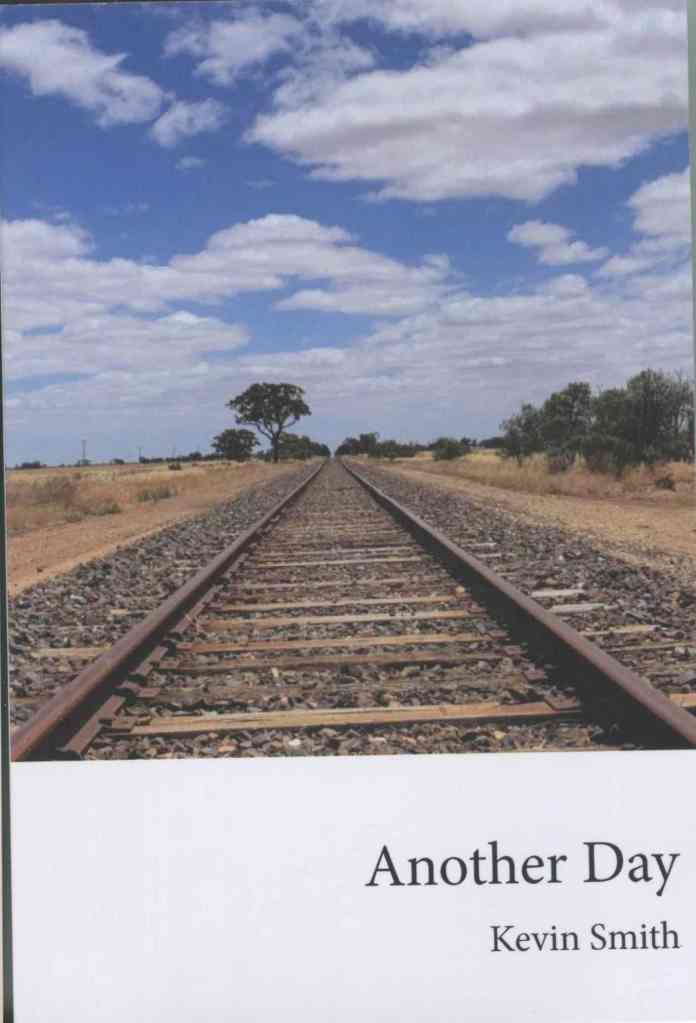
Winter reads 6: Kevin Smith’s Another Day

This is my sixth post on books I took with me on my escape from Sydney’s winter, focusing as usual on page 76.

Kevin Smith, Another Day (Flying Islands Books 2023)

It was exquisitely bad timing that I read Another Day concurrently with Nicholson Baker’s novel The Anthologist. Baker’s protagonist Paul Chowder detests enjambment, even in such hallowed places as the opening lines of Keats’s ‘Ode to a Nightingale’, and Kevin Smith’s poems fairly bristle with enjambments.

But the poetry got me over that hump fairly easily.

It’s a collection of 38 poems, many of which have been long- or short-listed for literary prizes in Australia and elsewhere. There are enjoyable travel poems and people-watching moments; sex, birth, fatherhood and grandfatherhood. If I had to pick one poem that put unexpected words to experience similar to my own it would be ‘At Once Father and Son’, in which the poet speaks to his son who has just become a father himself. These lines also, incidentally, illustrate the poet’s attachment to enjambment:

And when I watch you look
___into his face – your own face –
full of wonder that you

and he were meant to be –
___so it was I used to think
that this would never end.

But time – travelling on 
___a one-way ticket –
won't return. And so we've drifted.

You've grown into a man 
___as I had done – as surely
as your son will do. And my hands,

empty of you all these years,
___tell my time has passed,
my station done.

One striking thing about the collection as a whole is the powerful poems about the cancer treatment and eventual death of a loved one. These are scattered through the book, with the disconcerting effect that these terrible things are somehow just part of life – just another day, perhaps – until they come to a grim conclusion in the final pages

Page 76 is parts 3 and 4 of the book’s only prose poem, ‘More Soft Than Water’. It’s a narrative – a short short story. In the first two parts the narrator recalls how as a young man he accompanied his sisters on their volunteer nights at an unidentified institution. A baby girl is placed in his arms, with skin ‘more soft than water’.

3.
Each week, I came back to her and walked the 
corridors again. Through a window, she caught
the light at play among the eucalyptus leaves 
brought to life by a breeze; her eyes fixed on 
them as I cradled her in my arms. Then some-
one told me she was dying. Her mother had to 
let her go, they said, or her husband would have 
left her too. So she became a ward of state. Some 
weeks later, I stood outside the facility door and, 
despite the cold, I could not make myself go in.
On the way home my sisters fixed their eyes on 
the road.

So much in so few words! According to the ‘About the author’ at the back of the book, Kevin Smith ‘has worked primarily in drama and theatre, as actor and writer’. I think a reader might have deduced that from these lines. The narrative beats are so clear: his slow bonding with the baby in the first two sentences. The seven-word bombshell. A quick backflash in the next two sentences, then the main action of the poem: the young narrator’s failure. And his sisters’ implied condemnation of his cowardice.

All the narrator’s emotion is conveyed by action and objects. We see the baby’s face as she watches the leaves. The bald statement of her expected death is left without commentary. There’s no judgement on mother’s past decision. We’re left to make our own interpretation of the narrator’s inability to enter the facility and of his sisters’ fixed gaze. This is letting the actions tell the story; it also creates a sense that the emotion of the moment is still too painful, possibly too shameful, to name.

4
For a long time I wondered if you'd died, and 
when. Sometimes I imagine I'm still standing at 
the door – the wind like a knife in my back – as 
I remember how comfortably you fitted into my 
arms. Once, you looked at me, and galaxies of 
stars kindled in the darker regions of my heart.

In the end, the poem isn’t concerned with a possible moral reading of the incident, but with an opportunity missed. There are probably hundreds of poems about what happens when you look into the eyes of a small baby. I think of Francis Webb’s sublime ‘Five Days Old’, though the echo here of these lines doesn’t mean Kevin Smith was necessarily thinking of them:

The tiny, not the immense
Will teach our groping eyes
So the absorbed skies
Bleed stars of innocence

The poem is full of regret, but also gratitude. If that young man had moved away from the wind’s knife, perhaps the baby’s look would have kindled more than stars.

You can find out more about Kevin Smith at his website, https://www.kevinsmithpoetry.com/.


I’m grateful to Flying Islands Books for my copy of Another Day.

Winter reads 2: D G Lloyd’s alive in Dubbo

This is my second post on books I’ve brought with me on my escape from Sydney’s winter, focusing as usual on page 76.

D G Lloyd was born in Dubbo in the late 70s. After spending some time in coastal cities as a young adult, he lives in Dubbo once again. This book is a celebration, of sorts, of his hometown.

It opens with an epigraph from one of Dubbo’s most notorious daughters, Kate Leigh, who is described politely by the Australian Dictionary of Biography as ‘a crime entrepreneur’. The epigraph reads, ominously, ‘Better dead than alive in Dubbo.’

Roughly speaking there are three kinds of poems in the book: incidents from childhood or more recent times, impressionistic images of places, and character sketches. There’s poverty and various kinds of desperation, churches and a brothel, heroin and alcohol, First Nations and settlers (I read D G Lloyd as non-Indigenous), locusts and PTSD. A portrait of the town emerges that’s unlikely to attract tourists, but it rings true – as if the poet has set out regularly with a verbal equivalent of a sketch book and come back with its pages full.

Page 76 chimes beautifully with the epigraph, being the book’s only poem dedicated to the dead:

Old Dubbo Cemetery
Uncared for, a grassy verge and 
artificial roses decorating headstones 
fallen in;
corroded shards and etchings, tilted obelisks,
a cobweb and an orb-weaver in between

the dirt and the gravel, 
oleanders,
a baby's grave marked by a small iron cross; 
the stone angel. Eyeless.
Sullen lips speckled with mould, petals 
drifting from outstretched fingers onto brown earth.

A council worker stands behind hakea wattle 
scraping his boot against the water meter. Cicadas 
chant (endless);
one of the monuments is missing an arm.
A blue-tongued lizard lies motionless beneath, 
bathing in sunlight
against a tawny, heart-shaped tombstone.

The conjures up an image of the cemetery, without editorialising or sentiment. Like most of the book, it feels artless: no rhyme to speak of, no metrical effects, no striking metaphors. Yet it holds the attention – I’ve now read it a dozen times and I’m not tired of it.

Here’s what I’ve noticed. There’s no full verb in the first two stanzas, but a past participle on almost every line: Uncared for, fallen in, corroded, tilted, marked, speckled, outstretched. All movement is in the past. What life there is, in grass, orb-weaver, oleanders and mould, doesn’t disrupt the lifelessness. The first of the two present participles in these stanzas – decorating – is as static as the headstones it refers to. At last in the eleventh line, there’s some movement with a second present participle – drifting.

As if the spell has been broken, the third stanza is full of life and action: a council worker scrapes his boots, a wattle grows, cicadas chant, a blue-tongued lizard sunbathes. The water meter, by implication, ticks. That the cicadas’ chant is endless suggests that in some way life goes on and will keep going on. One of the statues now has a full verb – ‘is missing’ – so even there there’s a hint of agency.

The final image of the lizard, the sunlight and the tombstone is already full of life, when the description of the tombstone as tawny, heart-shaped takes it to another level. The unexpected ‘tawny’ describes the the tombstone as a rich brown, weathered colour rather than the dull grey that dominates most cemeteries, but the vital associations from its usual use – of wild animals and birds, or port wine – hover around it.

Finally, the stone is heart-shaped. It would be pushing it to see a reference to the famous last line of Philip Larkin’s ‘An Arundel Tomb‘, ‘What will survive of us is love,’ but that is presumably the hope that led to the tombstone being shaped that way. Here the love has not survived, but its emblem, the’ tawny heart-shaped tombstone’, is part of the life that continues.


I’m grateful to Flying Islands Books for my copy of Alive in Dubbo.