Tag Archives: poetry

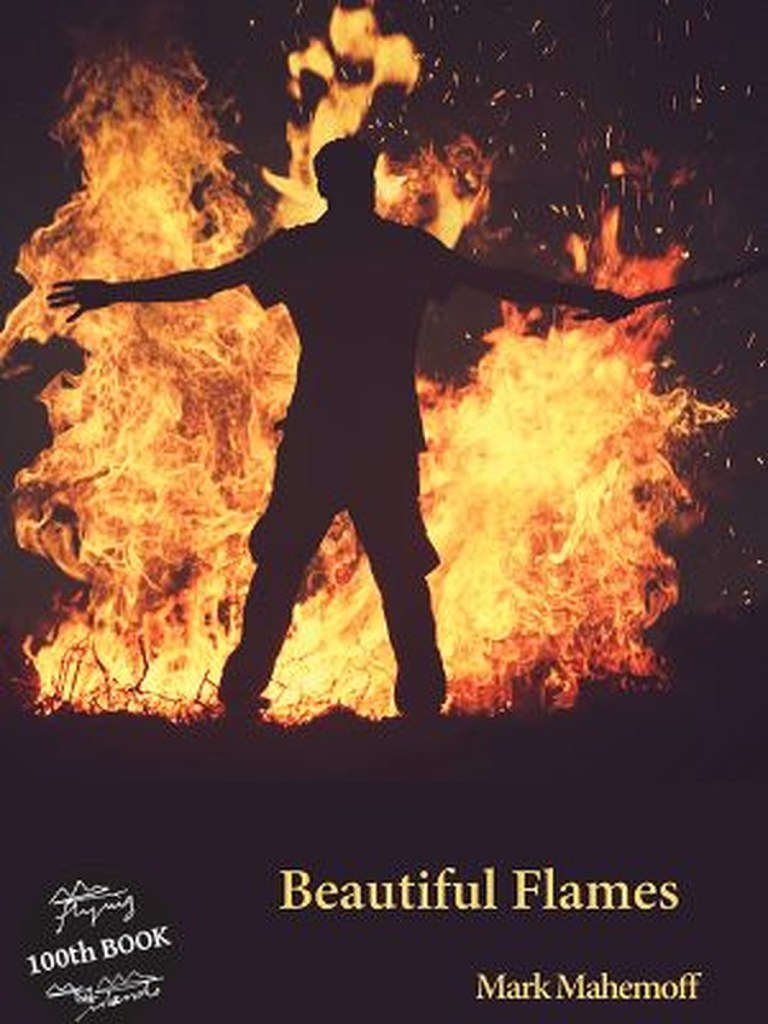
Mark Mahemoff’s Beautiful Flames

Mark Mahemoff, Beautiful Flames (Flying Island Books 2024)

This is another pocket-sized book I took with me on my recent trip to North Queensland. It’s Mark Mahemoff’s sixth book, a modest, user-friendly poetry collection in four sections.

The first section, ‘Chronicles’, mostly includes brief stories taken from life – family events, losses, a school reunion, the process of leaving home. From ‘Leaving’ (page 20):

Because childhood is a country
no one escapes unscathed
we haul it like a suitcase
stuffed full of unwashed clothes.

The second section, ‘Observations’ is what it says on the lid, observations on life’s passing parade. The titles of its poems generally tell you what to expect: ‘Kookaburras’, ‘Night Train’, ‘A Mediation’, ‘Bar Sport’, ‘Professional Development’.

The main pleasure of these first two sections is like what can get from a photograph of something ordinary – not claiming that it’s anything other than ordinary, but inviting us to pay attention to it for a moment. I generally try not to quote the final lines of poems – it’s too much like revealing the punchline of a joke – but the last stanza of ‘Nasturtiums’ (page 53) is too good an example of what I mean. Having described the large patch of these flowers on a lawn ‘somewhere in Haberfield’, and wondered whether they count as ‘weeds, food or flours’, the poem concludes:

But just devour them with your eyes
and you'll find that's enough
when you're walking beside someone
or alone
in sunlight.

That might seem banal but there’s some subtle, even self-effacing complexity. Mahemoff isn’t just talking about his own walk, but gently and elliptically inviting us to go on a walk of our own, to see for ourselves, and the last two line breaks create an unsettling effect. (What if it’s an overcast day, will it be enough then? If not, is it because the flowers look drab without the sun on them? Or is the sunlight a kind of companion?) The poem isn’t tied off in a neat bow.

The third section, ‘Travelogue’, comprises six poems in the form of notes from visits to, respectively, Western Australia, New Zealand, Melbourne, two unnamed places (one of which has a river and the other cactus plants), and Texas. The last-mentioned (‘Dallas in January’, page 84) forms a nice companion piece to Andrew O’Hagan’s essay ‘The American Dream of Lee Harvey Oswald’ in The Atlantic Ocean, which I read a couple of weeks ago: O’Hagan and Mahemoff describe the same museum, and have similar responses.

Page 77* contains two of the nine short poems that make up ‘New Zealand Snaps’.

The first is ‘Lower Shotover’:

Lower Shotover
Cool in the shade.
Singeing in the sun.
'The ozone layer is thinner here,'
she said.
You watch washing flap
while jets cruise past mountains.
How does one manage
this surfeit of beauty?
A bee falters
from flower to flower.

I had to look Lower Shotover up, but even without seeing images online (here are some if you’re interested), I knew from the poem the kind of place it is. And that’s without any of the kind of writing you might find in a tourist brochure or a poem that trusted its readers less.

It’s a thing in some contemporary poetry to plonk one thing down after another – an image, a quote, an aphorism – and call on readers to make their own connections. The poem becomes a collaboration between writer and reader. ‘Lower Shotover’ does a version of that, giving us a two-line observation about the temperature, a snippet of dialogue, images of washing on a line and jets in the sky, an abstract question, an image of a bee. We’re not left entirely to our own devices. We know from the title that the disparate items all refer to a place, but it’s up to us, for example, to imagine who speaks the third line (I think it’s the host at a tourism spot, but you might think it’s a visiting climate scientist), or whose washing flaps in the fifth line. But what is definitely there is the way the poem moves from bodily sensations in the first lines, to human connection in the third and fourth, to attention first to things seen and heard in close-up and then things seen and heard heard far-off . Only then, in the seventh and eight lines, is there an oblique reference to the reason the poem exists: the beauty of the place. But instead of trying to describe the beauty, the poem in effect confesses itself inadequate to the task. The image of the bee in the last two lines brings a nice meta touch – the poem itself has been faltering from one thing to another.

The second poem, unlike most of the poems in this book has a strict form. Each of its stanzas consists of 17 syllables – 5 in the first and third lines and 7 in the middle line. Yes, they are haiku, as we have come to understand that form in the English-speaking world.

Fox Glacier
Mountains demand awe.
We whisper in their presence,
take snapshots, and leave.

It rains ceaselessly.
A single set of headlights
burns through the distance.

Haiku, like sonnets, have a turn. In these examples, the turn has a visual quality: in the first, our gaze rotates (literally turns!) from the mountains to the tourists; in the second, there’s a change of focus from wide to narrow. I’m not sure that the rules of haiku, strictly speaking, allow words like ‘I’ and ‘we’, but the point of this ‘we’ here is that the human presence is tiny, and temporary, barely there at all.

Having written that, I have just read in Mark Mahemoff’s bio at the back of the book that his poetry

is chiefly concerned with framing, reimagining and memorialising commonplace moments, primarily in an urban setting.

Which makes me notice one more thing about these haiku: the Fox Glacier is about as far from an ‘urban setting’ as you can get, yet both haiku have industrial elements – snapshots and headlights – that make their (momentarily puny) demands on our attention.


I finished writing this blog post on Gadigal Wangal country, where I’ve noticed leaf-curling spiders waiting patiently in their rain-spangled webs. I acknowledge Elders past, present and emerging for their continuing custodianship of this land.


* My blogging practice is to focus on the page of a book that coincides with my age, currently 77.

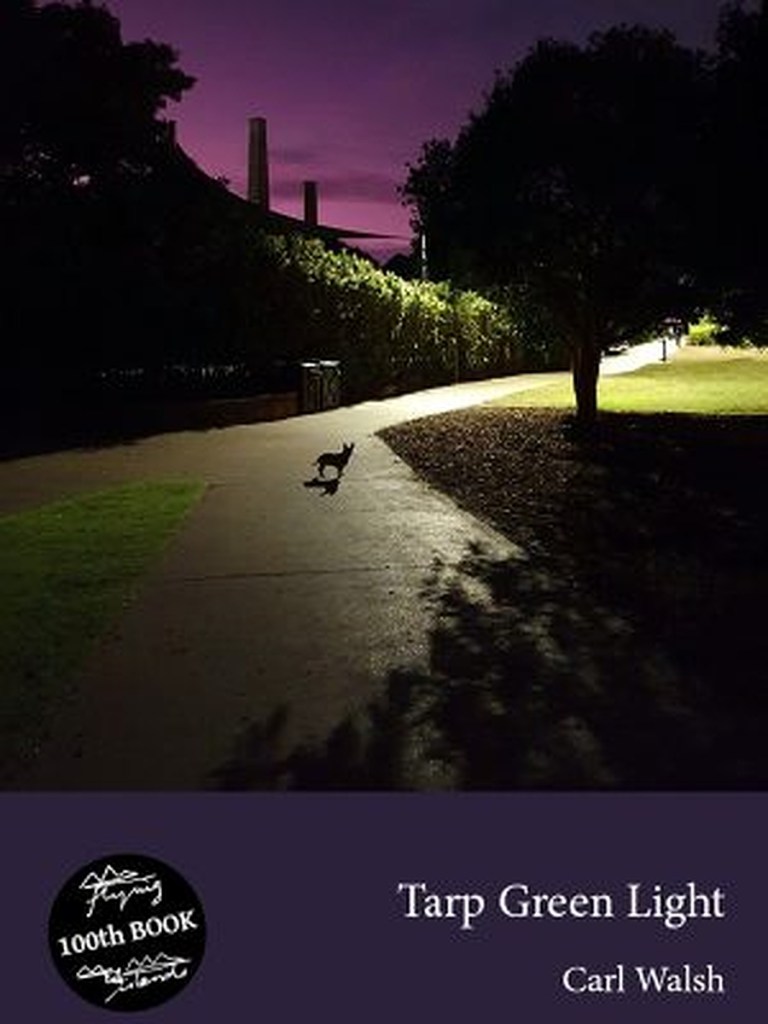
Carl Walsh’s Tarp Green Light, page 77

Carl Walsh, Tarp Green Light (Flying Island Books 2023)

Of recent years the emerging Artist and I have travelled north for a couple of weeks each winter. In last year’s fortnight on Yunbenun (Magnetic Island) I read and subsequently blogged about nine books, eight of which were in Flying Island’s Pocket Poets series.

This year we have come further north, and I’ve read a lot less. Tarp Green Light is the first of four Pocket Poets I’ve read.

The Note on the Author tells us:

Originally a tradie, Carl snuck into uni in his mid-twenties, after two years volunteering in PNG. He’s almost always written poetry – some poems in this book had their genesis in notebooks while backpacking in 1997.

Those backpacking notebooks have borne wonderful fruit. There are fine poems on other subjects – Linnaean categories, the Old Norse alphabet (I think), childhood memories, family history, and more. But it’s the poems that evoke particular places that create the strongest impression. The places include Papua New Guinea, Ireland, rural Australia, a number of European countries, and Japan.

The book’s title comes from one of the PNG poems, ‘Sepik Wara’. The poem is hard to quote from, as it’s laid out with text on either side of a broad winding river of white space, but here’s an attempt:

_________________________ _____________ we eye
rush of black clouds____________ __ _ pooling
in the sky; unfold ______________plastic tarps
to array over_______________________ our heads
as rain sheets________________ down we breathe
the close_______________ air and laugh at each
other__________________ in the tarp green light

At least one poem, ‘Idiot Fruit’, visits the Daintree, where I have recently spent a day:

Is it cassowary plums that lay 
as blue/grey eggs on the ground?

My blogging practice is to focus on page 77 (at least until I turn 78). In books like this, the practice saves me the impossible task of choosing one poem to represent them all. ‘Niseko miso’, on this book’s page 77, is one of the very few prose poems in the book, but in other ways is a fine example of how Carl Walsh can evoke a place::

Niseko miso
The cloudiness of my miso is reflected in
afternoon sky with dark seaweed stretches of
kombu cloud and strips of white tofu. But this sky
is perforated with peaks. Active in their inactivity
– three thousand years just a nap. How old I
am in their years? My head hurts at the maths.
Perhaps I should get Isabelle to calculate it? Some
are wild for ten thousand years. Even resting,
prone to throwing unexpected parties. I glance
at Mt Yōtei, its dark bulk everywhere. Hope it's
content with its sleeping. That Kagu-tsuchi-no-
kami
, the fire-spirit, is happy. I stir my miso – and
the clouds burst with rain.

Like many travel poems, this becomes more enjoyable when you know something about the places it names. A quick bit of browsing told me that Niseko is a ski resort area in Hokkaido; kombu is the kind of seaweed you might find floating in a bowl of miso soup; Mt Yōtei is a volcano, one of the hundred famous mountains of Japan, and popular for backcountry skiing expeditions; and Kagu-tsuchi-no-kami is, as the poem implies, a fire spirit whose rages are to be feared. Mt Yōtei last erupted about 3000 years ago but it is still active.

The poem deftly conjures up a situation: the speaker is drinking miso soup one afternoon in the foothills of Mt Yōtei, probably at a resort of some kind (his mind goes to wild parties as a synonym for volcanic eruption). He may be alone while drinking soup and composing the poem, but he has a female companion, Isabelle, who is probably travelling with him, certainly within easy communication distance.

The speaker idly/playfully notices a similarity between the appearance of the sky and that of his soup: clouds and seaweed allow sky and soup to be synonyms for each other.

Then there’s a but, a word I’m coming to love in poetry as signifying a turn of some kind. Here the speaker notices the major flaw in his synonym: the soup has no equivalent to the mountain peaks that pierce the clouds. The mountains dominate the rest of the poem, prompting thoughts about geological time. The tone is still playful – volcanic activity is described as wild partying, prolonged or brief and unexpected – but there are quiet hints of awe in the presence of the sublime.

In the two sentences before the last one, another dimension of the place of the poem comes into play. These mountains have had stories told about them for millennia. The speaker acknowledges this, by naming the fire spirit Kagu-tsuchi-no-kami, at the same time expressing anxiety about a potential eruption. (Maybe it’s just me but that seems to be a very Australian response, given how very extinct our volcanoes seem to be.)

Then in the last sentence, the poem comes down to earth, and attention returns to the soup and the clouds. There’s a hint of sympathetic magic – did stirring the soup make the rain come? – but the main effect is to pull back from vast, fearsome, mythological thoughts to the present moment, the place where the poem started.


I read this book near the mountains of Yidinji land and finished writing the blog post on Gadigal–Wangal land, where the sky is brilliant blue and the wind is chill. I acknowledge the Elders past and present of both peoples.

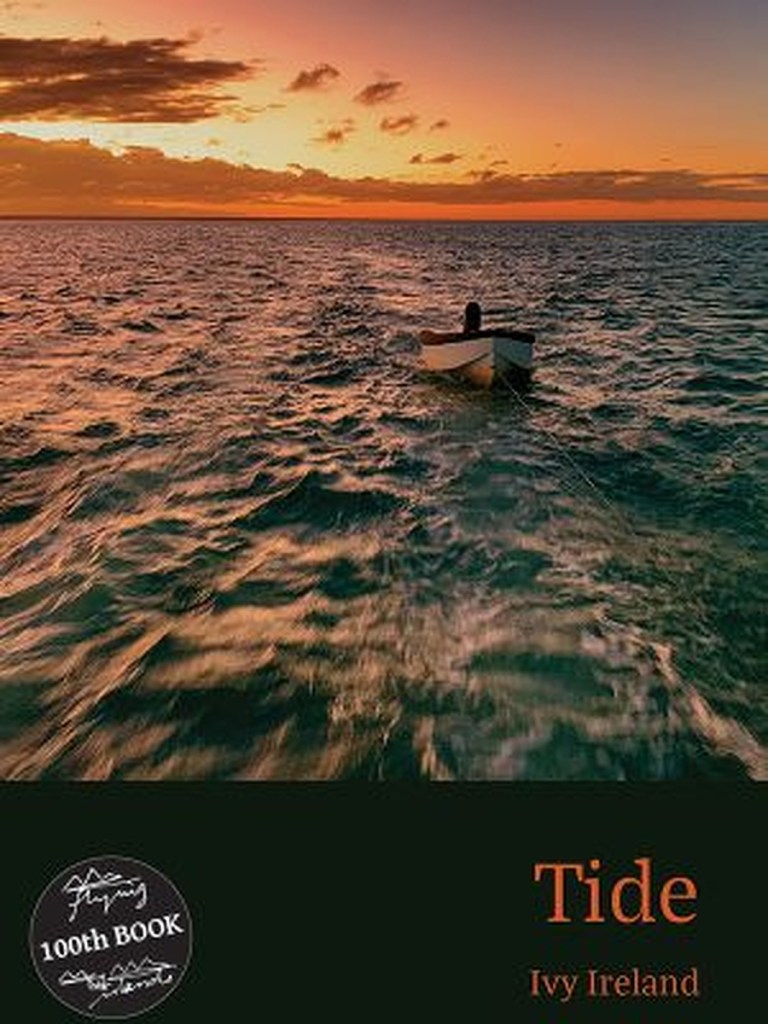
Ivy Ireland’s Tide

Ivy Ireland, Tide (Flying Island Books 2024)

Tide may seem like a quietly generic title for a book, especially one that has a number of poems about the sea, but a laconic note on sources suggests a dark subtext:

The title of this book, Tide, and the title of the poem, ‘A Shallow Boat’, are both taken from Alfred, Lord Tennyson’s poem ‘The Lady of Shalott’ (1832) with the necessary reverence.

I decided to read the Tennyson poem. I’m pretty sure I hadn’t read it before, but many of its lines (‘the mirror cracked from side to side’, ‘The curse is come upon me’) were familiar, probably from young Dorothy Hewett’s romanticism as recorded in her autobiography, Wild Card. Certainly Ivy Ireland’s compressed, science-related poems, with close observations of the real world, are not at all like Tennyson’s flowery, relentlessly rhyming lines. The word ‘tide’ occurs only once:

For ere she reach'd upon the tide
The first house by the water-side,
Singing in her song she died,
The Lady of Shalott.

The note on sources, then, leads one to expect something death-related: the tide is metaphorical, bearing us inexorably away. The book only partly meets that expectation. There’s a lot of life here, and not much death.

The book is divided into four sections of unequal length named for tidal phases: ‘Ebb’, ‘Low’, ‘Flood’, and ‘High’. If I had to pick favourites, I’d say I enjoyed the poems in ‘Low’ most: in ‘Lake Poet’, in the context of the climate emergency (not explicitly named, but definitely there in my mind) the lake is less a thing of sublime beauty than a place that will hold the poet to account, as opposed to the city, where ‘nobody has to answer for anything; in ‘Cane Toad’, the poet and her young daughter encounter some teenagers on Valentine’s Day:

She asks me,
of all people,
if they are going to marry,
those beatified ones,
out decking each other in posies
in the quiet toilet paper aisle.

‘Killing Plovers’ is a yarn about family life that takes on a fable-like quality about humans’ relations to other animals; ‘The Birth of the Universe’ is a wonderful poem about a) the Big Bang and b) giving birth.

The section ‘Flood’ comprises six prose poems, including ‘I Am John Is Dead’, long enough to be called a short story, about a young woman’s encounter with a New Age guru in the outback, which accurately describes itself as ‘like a Jim Jarmusch film’.

Page 47* is the title page for the book’s final section, ‘High’. The section includes just one poem, ‘A Shallow Boat’, in which the narrator with one other person goes sailing off the Queensland coast. Since the note on sources mentions this poem, I looked at the Tennyson poem again, and found:

In the stormy east-wind straining,
The pale yellow woods were waning,
The broad stream in his banks complaining,
Heavily the low sky raining
Over tower'd Camelot;
Outside the isle a shallow boat
Beneath a willow lay afloat,
Below the carven stern she wrote,
The Lady of Shalott.

This is the boat on which the Lady of Shalott floated to her doom.

Happily, the speaker of Ivy Ireland’s sailing excursion survives, having had a very nice time, even if it is sometimes scary and perhaps humiliating as she feels her incompetence.

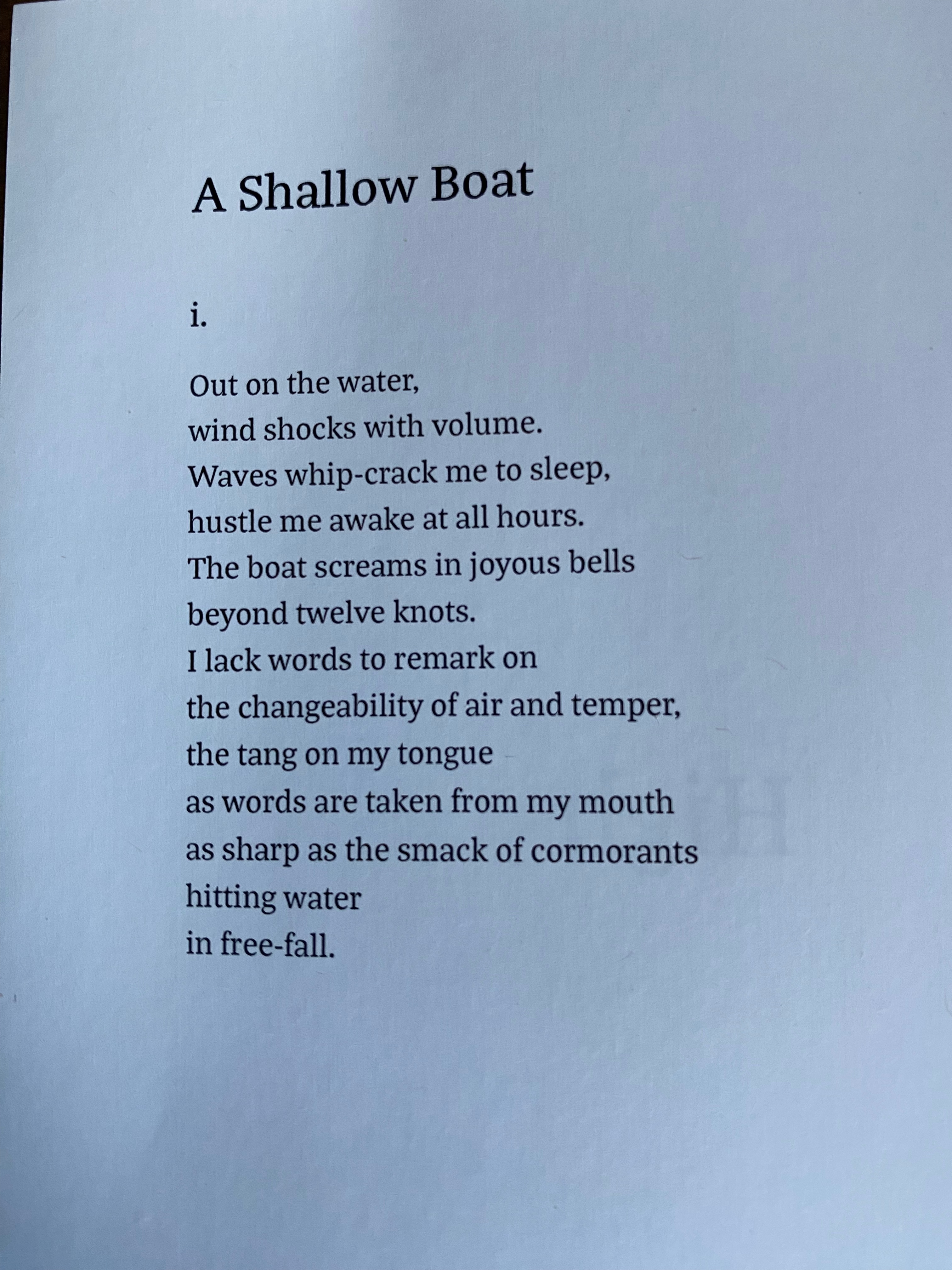
Here’s the first of the poem’s 12 parts, from page 48:

A Shallow Boat

1.

Out on the water,
wind shocks with volume.
Waves whip-crack me to sleep,
hustle me awake at all hours.
The boat screams in joyous bells
beyond twelve knots.
I lack words to remark on
the changeability of air and temper,
the tang on my tongue
as words are taken from my mouth
as sharp as the smack of cormorants
hitting water
in free-fall.

All I really want to say about this is that I love it. I have no desire to go sailing. I breathe a guilty sigh of relief when I realise that the Emerging Artist gets seasick very easily, so is unlikely to be urging me to do it. But I love it as evoked in this poem.

The poem is almost a sonnet. The first six lines describe the wind, the waves, the sounds of the boat. Then there’s a turn, and in the next five lines the poet tries and fails to articulate a response. Then there’s a three-line equivalent to a sonnet’s final couplet – rather than a witty encapsulation of what has gone before, here it’s the cormorants, ostensibly a metaphor for the poet’s speechlessness but actually just there, smacking the water.

Every verb, every adjective, every noun is carrying its share of the meaning-load, and the sound design is wonderful. The echoing Ws bind the lines together, with a little respite for Ts (‘temper’, ‘tang’, ‘tongue’, ‘taken’, and then ‘cormorants’) in lines 8 to 11. Back to W and then the Fs in the last line introduce a new, final sound.

The Tennysonian hints of doom may be realised in later parts of the poem, as in these chillingly succinct lines from part viii:

There's a point 
where climate emergency,
once witnessed,
ticks over from
possible to inevitable;
anything else is inconceivable.

But that’s context rather than substance. The joy in this poem, as in the whole book, is in celebrating engagement with the natural world, vulnerable, dangerous, fragile, awesome, beautiful, breathtaking (sometimes literally). From section ix:

Orange shifts over the horizon, and here we are: 
alive, while countless others are not.
Who am I to deserve daybreak. This happening here,
sea eagle fishing beside the boat,
sea turtle snorting to the surface. What's it for,
to be so honoured.

I wrote this blog post on land of the Gadigal and Wangal clans of the Eora Nation. I’m posting it on a day that has shifted from bright blue sky to heavy downpour within hours. From my window I can see wet gum leaves reflecting the afternoon sunlight as they have been witnessed by First nations peoples here for tens of thousands of years.


* My blogging practice for some time has been to focus arbitrarily on the page of a book that coincides with my age. A focus on just one page seems to me to be almost necessary with books of poetry, where the parts are so often greater than the whole. As Tide has fewer than 77 pages, so I’m focusing instead on my birth year, ’47.

Chris Mansell’s Foxline

Chris Mansell, Foxline (Flying Island 2021)

Chris Mansell is an Australian poet with an impressive list of books and awards to her name. She has also played a significant role in fostering and publishing other poets. Here’s a link to her website. Foxline is part of Flying Island’s Pocket Poets Series, small enough to fit into a shirt pocket, but offering a substantial reading experience.

The book’s last page has a note describing its genesis:

I came across a fenceline of foxes scalped and strung by their hind legs on the boundary fence of a farm. There were about two hundred dead and even dead they were beautiful. … I imagined the farmer, perhaps less articulate than the fox. I imagined him walking the paddocks in stolid opposition to the creatures that were taking his sheep.
It is real and it is also traditional. It is in his blood as it is in the blood of the fox to hunt and feed their young.

Each of the book’s 30 poems is spoken by the farmer or a fox. In most of the fox poems the speaker is a female fox; occasionally we hear from a young male, and even once or twice a flying fox. Both Fox and Man (they are capitalised in the marginal notes) are interested in more than each other, but mainly the poems deal with their relationship: their antagonism, their attempts to understand each other, and their recognition of what they have in common. They even manage to learn from each other.

In one poem (‘Dark Solo’) a young male fox becomes the fox in Ted Hughes’s poem ‘The Thought-Fox’. But the literary work I was most strongly reminded of is Roald Dahl’s The Marvellous Mister Fox. In some ways Mansell’s book could be read as an adult response to Dahl’s. Here there is no easy resolution to the conflict between Man and Fox and, contrary to what you might expect from Mansell’s account of the book’s origins, both characters elicit our sympathy.

Before I talk about page 77*, I want to name my favourite stanza in the book. It’s the beginning of ‘Surprise’, one of the Man’s poems, and is a haiku-like stanza (or more accurately senryu-like, as haiku aren’t supposed to mention people):

we are always surprised
here every winter
we are amazed it's cold

The poem goes on to arrive, elegantly, at how we are ‘astounded / by death especially’. I love the way the poem makes poetry from an often-heard New-South-Wales joke, then takes it somewhere unexpected but completely right.

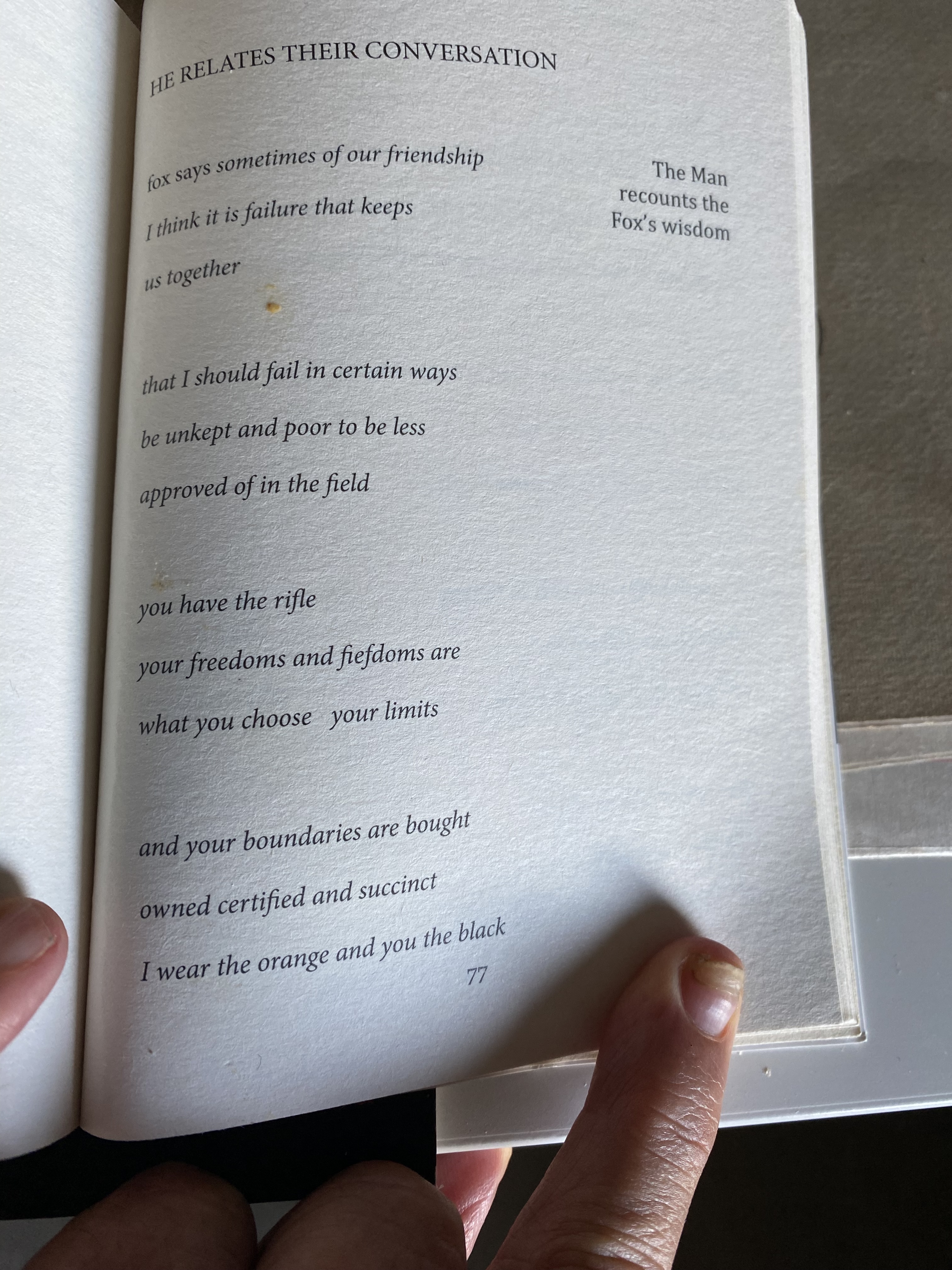
Page 77 is the beginning of the poem, ‘He relates their conversation’.

HE RELATES THEIR CONVERSATION

Like every poem in the book, this one has a note in the margin telling us who is speaking and offering a brief summary, the way some 18th century novels do, as if acknowledging that the semi-articulate protagonists don’t always make themselves clear:

The Man 
recounts the 
Fox's wisdom

The italics on this page signify that though the Man is speaking, he is relating the Fox’s words. The Fox’s ‘wisdom’ is paradoxical:

fox says sometimes of our friendship
I think it is failure that keeps
us together

In what way are they together? And whose failure does she mean? An obvious meaning is that ‘together’ really means ‘both alive in the same locality’, and the failure is that of the Man – he has failed in his quest to kill the fox. But the word ‘friendship’ in the first line suggests that something else is going on. Its cryptic possibilities provide the impetus to read on.

that I should fail in certain ways 
be unkept and poor to be less
approved of in the field

Before she gets to ‘friendship’, the Fox expands on what she means by ‘failure’. She is the one who must fail. To understand ‘in certain ways’ we don’t need to think beyond the Fox’s activity as sheep-killer. If she succeeds in killing or even damaging the Man’s livestock that’s the end of any fellow-feeling. ‘Unkept’ is an example of the way the Fox’s language is interestingly off-kilter throughout the book. It’s not quite ‘unkempt’ though it possibly includes that. It suggests the opposite of ‘well-kept’ as in well-fed. The fox needs to be bad at her job – ‘less / approved of’ in the field’ by other foxes, perhaps.

you have the rifle 
your freedoms and fiefdoms are
what you choose_ your limits

and your boundaries are bought 
owned certified and succinct

(The double space in the third line here acts as a break in the meaning – a full stop.) But yes, the Man must also fail in his quest to eliminate the fox. He has the means, but he can choose to act freely or according to an imposed order. ‘Freedoms and fiefdoms’ is a wonderfully evocative phrase: is this farmer a free operative or is he pretty much a serf in the current economic order? It’s his choice. the limits and boundaries are those of the farm, but they are also limitations and constrictions on himself that he has bought into.

I wear the orange and you the black

On first reading, I had no idea what this meant. Now that I’ve pondered the previous lines, its meaning leaps out at me. The Fox is making an analogy to sporting teams – Australian cricketers wear the baggy greens, Indians the bleed blues. The Fox and the Man belong on different teams.

I won’t go on in detail about the remaining page and a bit. In short, the man now speaks in his own voice, expressing a wish to become the Fox, and they recognise the similarity between the rifle and the fox’s ‘whitesharp teeth’. According to an explanatory side note:

They know 
they have a
tense
commonality

‘Tense commonality’ is an excellent human-prose translation of the Fox’s term ‘friendship’.


* My blogging practice is to focus arbitrarily on the page of a book that coincides with my age. This page often reveals interesting things about the book as a whole.

Robbie Coburn’s Ghost Poetry

Robbie Coburn, Ghost Poetry (Upswell Press 2024)

Ghost Poetry‘s back cover blurb includes a discreet trigger warning:

Always vulnerable, and often confronting and harrowing, Ghost Poetry is a beautifully crafted and important work that will scar the reader.

I agree that these poems are beautifully crafted and confronting, but I wouldn’t say I was actually scarred by them. They do deal with tough subjects – self harm, addiction, the mental health system, suicidal ideation, miscarriage, abortion, rape and more. But there are also horses, a love-poetry thread, and always the sense that the poetry is doing much more than giving vent to pain and suffering, and not at all playing for shocks.

Some of the poems are presented as accounts of dreams, of nightmares really, and many others have a dreamlike quality. Perhaps more accurately, in many of the poems the border between waking and dreaming is blurred so that the emotional intensity and weird logic of nightmare suffuses the daylight world. Sometimes the speaker seems to be a ghost.

A partial list of the titles in ‘Blood Ritual’, the first of the book’s three sections, gives an idea of what I mean: ‘Dream of Human Sacrifice’, ‘Oblivion’, ‘Dream of Scarification’, ‘Cutter’, ‘Dream of Suicide’, ‘Bloodletting’, ‘Dream of Abortion’, ‘I Dreamed I Saw You on a Bridge’, ‘Asylum’. I’m not being entirely flippant when I say it was a relief to read the opening lines of ‘Poetry’, the final poem in the section:

I am tired of these poems;

you can only write your own death
so many times before
you begin to plan for its arrival.

The second section, ‘Wreck’, is filled with horses, and love poems. Again, there is a lot of pain, but also moments of delight as in ‘Foals’, where the poem’s speaker addresses a loved one. You don’t need to have been around newborn foals or calves to be moved by the poem’s final lines, though you may need to have been in love:

as I followed you
your gumboots making a space
for our feet in the wet grass

like two newborn foals
teaching one another
how to walk.

If I had to name a single subject (always a bit of a mug’s game) of the third section, ‘Straw Horses’, I’d say it was love for someone in pain:

I want to touch your tortured bones 
as if my hands were gauze.

But my practice of looking at page 77 demonstrates that it’s not just the loved one who is in pain. ‘Love Poem to a Razorblade’ is not the only one that deals with flesh being cut, in other poems mostly by knives, in dreams, and the flesh not necessarily that of the speaker. Here the subject is definitely self-harm:

It’s a hard poem to write about. As I was drafting this blog post, an article by Rose Cartwright in the Guardian Online threw me a lifeline. It included this:

‘What happened here?’ a colleague asked innocently on set, pointing to the scars on my arm.
‘I used to cut myself,’ I said. I didn’t tell her how recently.
She glanced around. No one nearby to rescue us. ‘Really?’
‘Really,’ I said with a reassuring smile.
There was an awkward silence, which I didn’t fill, since the explanation I would have once filled it with – ‘I was mentally ill’ – no longer felt right.

I was the poster girl for OCD, Guardian 13 April 2024

This poem sets out to bridge that awkward silence. You will read it differently depending on the experience you bring to it. For myself, I’ve never had a compulsion to self-harm, at least not of the cutting kind, and my relevant experience is limited to conversations with parents of young ‘cutters’. One of the main things I’ve gleaned is that communication is problematic: the young person can’t talk about what’s happening and/or the person wanting to help can’t bear to hear what they’re trying to say. That difficulty is at the heart of this poem.

I don’t know if Robbie Coburn is writing from his own lived experience, or as an extraordinary act of empathetic imagination. Either way, the poem calls on the reader to attend to a voice that is rarely heard.

Love Poem to a Razorblade

Anyone who has ever been addicted to anything harmful – cigarettes, ultra-processed foods, chocolate – recognises the paradox. If, as a person with high blood pressure, I were to write ‘Love Poem to a Fried Dim Sim’, the tone would be different: despite the best efforts of nutritionists, a fried dim sim habit is only mildly stigmatised, certainly not seen as ‘mental illness’. But the paradox is similar. The behaviour is doing me no good, but I am drawn to it. It’s not too much of a stretch to call that love.

The first lines are full of possibilities:

As a child I knew
I could keep you hidden.

I turned away from the past
and saw your mouth open
and cover me.

First there’s secretiveness. This isn’t about guilt. It’s not ‘should’, but ‘could’ – there’s a kind of power there. But the question hovers: ‘Hidden from whom?’ From someone who would punish or shame the young one, probably. The next line provokes an allied question, ‘What happened in the past that I had to turn away from it?’ As I read it, the speaker had an (unspecified) unbearable experience as a child and, unable to turn to a human for comfort, somehow turned to the razor blade, to self harm.

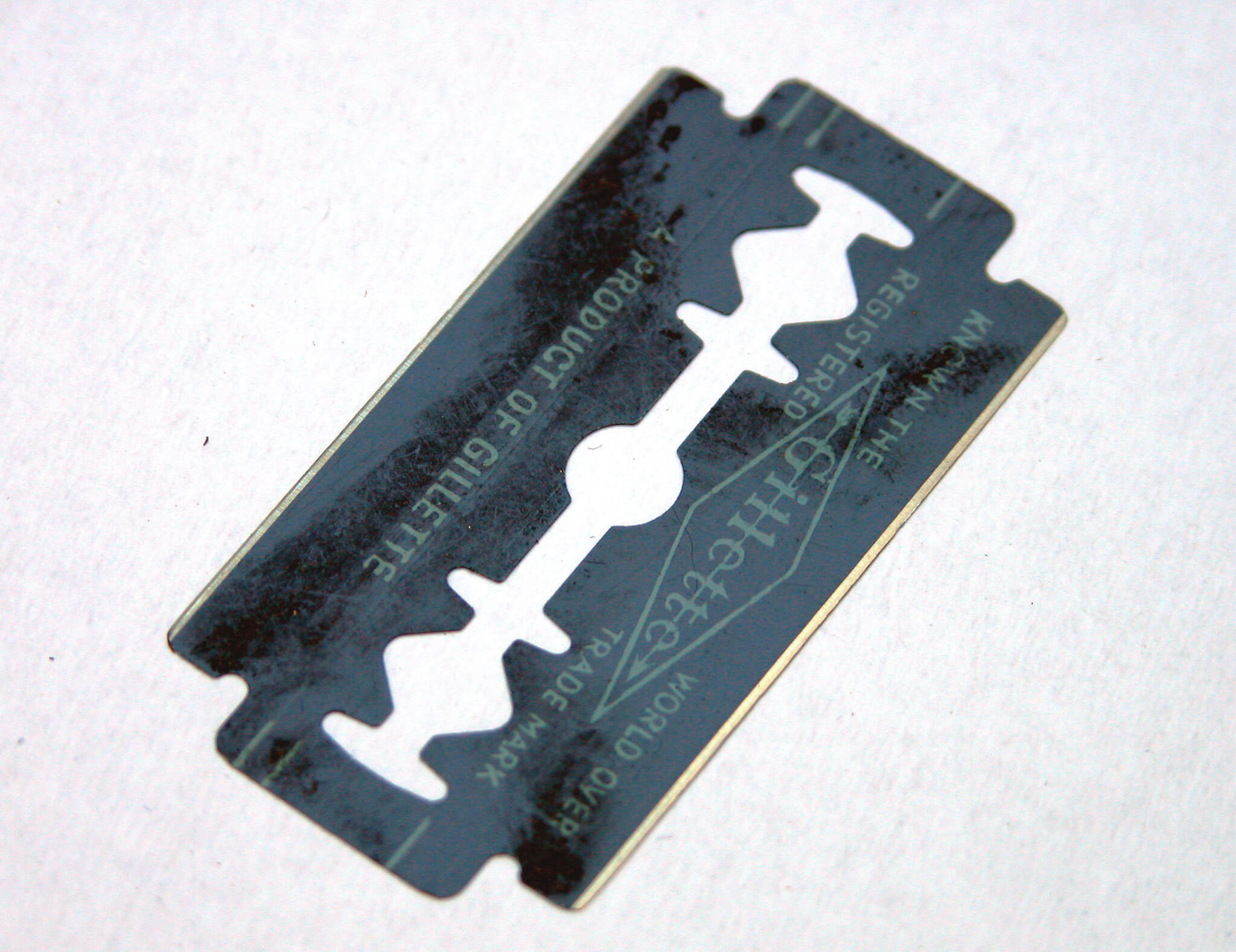
I struggle to visualise a contemporary razor blade with an open mouth, but those from my childhood, and I’m guessing from the much younger Robbie Coburn’s, could be flexed so that the opening along the middle would open out. All the same, it’s impossible to visualise this ‘mouth’ covering someone. The lines are after an emotional truth rather than a visual image – the possibilities of the blade enclosed the young person in a protective cover against whatever he was turning away from.

you told me love wasn't a word 
to be spoken
but a scar cut into the surface
of the body.

anybody you love in this world
will mark you.

A human comforter would have said something (‘It’s all right, ‘You’re OK,’ ‘This will pass’ …). The razor blade’s ‘mouth’ had no words, its message is conveyed, recorded, imprinted, by action.

But there’s more to these lines than that. They don’t dwell on the act of cutting – the welling blood, the pain, etc – which happens in the moment, like a word. The message is in the aftermath, the enduring scar, in the surface of the body but also in the mind, an expectation that love will involve damage. But not necessarily damage! In another context that last couplet could have a completely benign meaning: isn’t it true, and interesting, that if you love somebody they have an effect on you, leave a mark on you? Here, though, ‘mark’ carries a strong negative meaning.

I believed you;
each promise immovable,
every moment between us
carved into permanence.

The message from the razor blade is that those effects and marks are solid, scarlike, immovable, permanent. If there’s grief or humiliation in a relationship, you will remain grief-stricken or humiliated forever. As it was in the beginning is now and ever shall be. It’s not just self-harm that lodges such messages in the mind, of course. Don’t we all have moments in our childhood that have created templates for how we expect the world to always be?

even when you were taken 
you have never left me –

It’s childhood experience that has been described so far. ‘When you were taken’ implies an intervention that stopped the self-harm, possibly at an early age. But the effect of those moments persists.

the blood was ours, 
every night we were alone,
silently holding you in secret.

In this last triplet, having reflected on the long term effects of cutting, the speaker can at last look at the moment itself. Only now, can he name the blood, and evoke the (creepy) romance of the moment. I think of the song from Calamity Jane, ‘Once I had a secret love‘, and though I can’t articulate it I know that I’ve been taken somewhere.

While writing this, I have had to walk away from the computer every now and then and breathe for a while. You can feel the poet’s steely will as he holds his mind to this subject, honouring its complexity.

It’s a gruelling book, but rewarding.


I am grateful to Robbie Coburn for my copy of Ghost Poetry.

Romaine Moreton, Post Me to the Prime Minister, page 77

Romaine Moreton, Post Me to the Prime Minister (jukurrpa books, 2004)

Romaine Moreton is Goenpul Yagera of Minjerribah (aka Stradbroke Island) and Bundjulung of northern New South Wales. She is a poet, spoken word performer, philosopher and filmmaker. A brief showreel from the transmedia work One Billion Beats (2016), which she co-wrote and co-directed with Alanna Valentine, gives a powerful glimpse of her stage and screen presence, as well as her incisive writing (link here). Also on Vimeo is a profound lecture she gave about that work (link here), which discusses the colonial gaze and dissects colonial cinematic representations of Indigenous people.

Post Me to the Prime Minister, a collection of poems published in 2004, 12 years before that formidable work, also deals with issues faced by First Nations people. As I was reading it, I kept wishing I could see Romaine Moreton perform them. I’ve just been told that she opened for Sweet Honey in the Rock at the Sydney Opera House on one of their visits to Australia, which makes complete sense. The short film she made with Erica Glynn, A Walk with Words: The Poetry of Romaine Moreton (2024), ends with her performing the book’s final poem, ‘I will surprise you by my will’ (you can rent or purchase the whole film at this link). The poem is in the film’s trailer:

we are here and we are many,
and we shall surprise you by our will,
we wll rise from this place where you expect
to keep us down,
and we shall surprise you by our will.

There are so many riches in this collection, but I’ll stick to my arbitrary practice of singling out page 77. It’s the second page of a long poem, ‘Once upon a patriarchy’. Here’s a pic of pages 76 and 77:

The book’s title comes from the poem’s opening lines:

truth be known,
you would very much prefer it
if I were male

oh yes you would wrap me in glad tidings
and post me to the prime minister and say
how proud we are

___ our son

Things have moved a long way since the moment in the 1972 movie Ningla A-Na when Indigenous women argued vehemently that sexism was a white women’s issue, that Indigenous women needed to support Indigenous men and not challenge their sexist behaviour. More than 30 years later, this poem’s speaker doesn’t have to be defensive about the ‘colonial gaze’; it’s not written with a non-Indigenous reader foremost in mind. The strength of First Nations communities no longer depends on papering over the cracks of lateral oppression.

It’s not easy to tell who ‘you’ is in this poem. At first it may be the speaker’s parents, or perhaps a part of the First Nations population that has a parent-like relationship to her. But it shifts, and by the start of page 77 it is a First Nations man, ‘our son‘, who is being addressed. He’s a man who wishes ‘to walk as the colonial / hallowed one’. I don’t think it’s too fanciful to see him as similar to the would-be assimilationist Tomahawk in Alexis Wright’s great novel Praiseworthy (2023), or perhaps as a member of Chelsea Watego’s ’emerging tribe’ of self-appointed leaders (see the essay ‘ambiguously Indigenous’ in Another Day in the Colony, also published in 2023).

for while you vie 
for the passenger seat
the cattle truck is loaded for market
you have left me golden hallowed son

dragging
in
the never-never

This is beautifully complicated. There’s sibling rivalry – ‘golden hallowed son’ is a variant on ‘golden-haired boy’, the favoured sibling, favoured partly because he’s male. But it’s not just that. He has decided to be part of the action, be up front in the cattle truck, join in the extractive farming of the land. He’s not in the driver’s seat, not in charge of his own destiny, but has attached himself to the power. To reinforce the farm metaphor, the poem brings in the Australian colonial ‘classic’, Mrs Aeneas (Jeannie) Gunn’s We of the Never Never (1908). I haven’t read that book, but I’m pretty sure its account of Mangarayi and Yungman who were displaced by the Elsey cattle station, and worked on it, fits the tone of these lines – a place to be left dragging.

The next lines continue to reproach, and to remind the ‘son’ of the loyalty shown by Black women. (See the scene in Ningla A-Na mentioned above.)

and while I never ever forget you 
you gladly allow me – the black female
to rot

like the wife of Lot
though I have never
turned
I captured you to my breast 
always remembered
what is best

for my people
for my people

Whatever else is going on with the ‘son’ his maleness is key, as is the speaker’s femaleness. The reference to Lot’s wife (who looked back at the destruction of Sodom and Gomorrah in Genesis 19 and was turned into a pillar of salt as punishment) broadens the picture: women have always been punished. In this case, though, there’s not even the pretext of he having done something wrong.

If you weren’t noticing the music of the poem previously, you can’t help but hear it here. These lines, with the rhyming of ‘rot’ and ‘Lot’, introduce a new rhythm that builds, with the rhyme of ‘breast’ and rest’, to the lovely repetition of ‘for my people’. When performing some of her poems, Romaine Moreton moves from spoken word to song. These lines cry out for that treatment.

One of my favourite words in poetry is ‘but’. And here it comes:

but you
golden hallowed blackened son
more despised there is none

The ‘son’ is not just ‘golden hallowed’, but ‘golden hallowed blackened’: sitting in the passenger’s seat doesn’t make him immune from racism. ‘Blackened’ is an interesting word here: it signifies First Nations identity, but also colonial attitudes. He may think of himself as the golden son, but his Black identity will be imposed on him and he will be seen accordingly through a colonial lens: ‘none more despised’. That’s something that the man on the receiving end of racism would readily agree to. And then the killer lines:

except one

which is me

That’s not the end of the poem, it does move on interestingly, but it’s all I’m looking at here.

Steve Armstrong, What’s Left

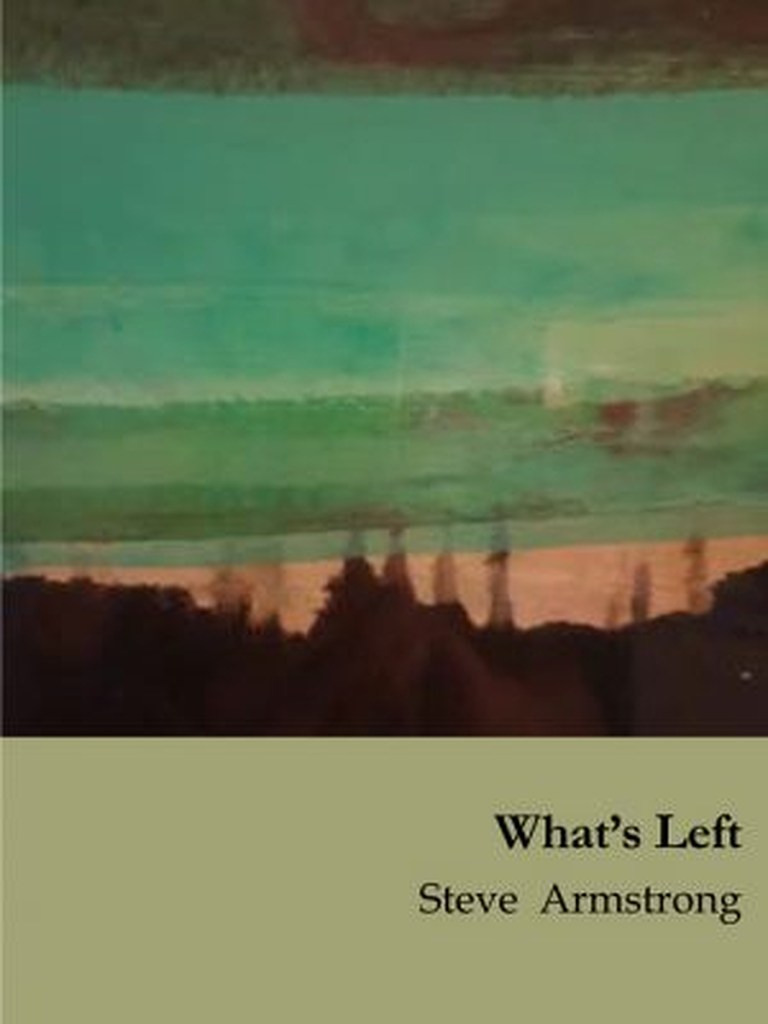
Steve Armstrong, What’s Left (Flying Island Poets 2021)

The Flying Islands Pocket Poets Series books are close to irresistible. They’re beautifully designed and small enough to fit in a shirt pocket, but much more substantial in their content than their size might suggest. The RRP has been kept at $10 since the series began in 2010, and it’s possible to become a Friend for an annual fee of $100 to receive roughly 12 books each year.

I recently became a Friend, and received What’s Left, published in 2021, along with the swag of 2024 titles.

Steve Armstrong is a Newcastle poet. I like Mark Tredinnick’s description of him as a poet of ‘landscape, desire, memory, love, lust and loss’. Mark Tredinnick may be the Mark to whom the poem ‘This Morning’ (page 58) is dedicated – a poem that has the brilliant opening lines:

_____________ my sorrows pause
for a pair of black cockatoos in flight.

It’s probably pushing it to take those lines as encapsulating the book’s themes: but there are plenty of sorrows, and plenty of attentiveness to the natural world. The sorrows include regret, or at least ambivalence at having wielded axes and chain-saws. I enjoyed a lot in these poems, but probably most of all the way they communicate complexity. Sometimes they do this with a comic edge, as in ‘A Visit ot the Turkey Farm’ (page 33), in which the poem’s speaker buys two boxes of frozen turkey necks, takes them home and chops them up, in his kitchen, with an axe. If there’s a perfectly rational explanation for all this, the poem doesn’t bother with it. I don’t usually quote the final lines of poems, but this is irresistible:

To swing an axe in the kitchen feels

a little like reaching back for my hunter-
gatherer roots, and it's undeniable, there's

something of a serial killer about me too.

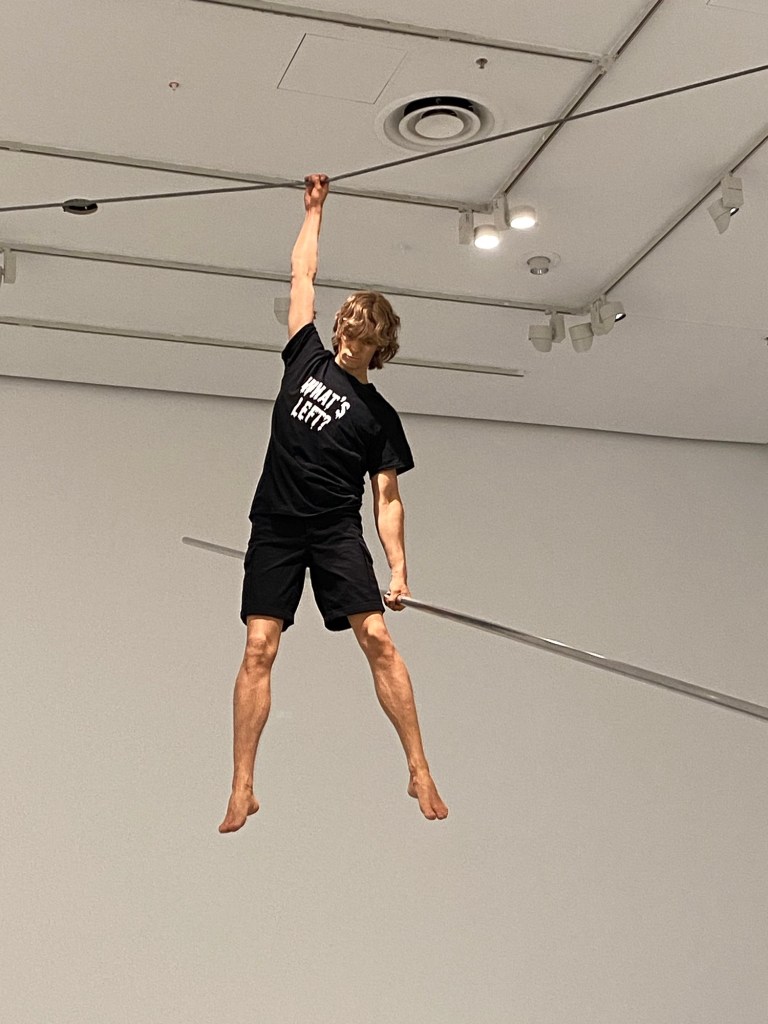
The book’s title is rich with possibility. I happened to visit the Melbourne Triennial when I had read to page 50 or so, and can’t resist including here a snap of the life-sized figure hanging from the ceiling of the National Gallery of Victoria entitled What’s Left.

Elmgreen & Dragset,
What’s left, fig. 2
at the Melbourne Triennial

Judging by the couple of poems about children and grandchildren, Steve Armstrong isn’t as young and buff as this figure, and though the climate crisis looms in these pages, the the tone is perhaps more elegiac than panicky. The title poem, ‘What’s Left’ (page 10) offers the image of light falling on what’s left of red in a rusted iron roof: ‘light / falls for the broken’ in that poem and perhaps in the collection as a whole.

If you get a chance to read ‘Thirteen Ways to Know my Grandfather’, grab it. It won the 2019 local prize in the prestigiousNewcastle Poetry Prize and was included in NPP’s 2019 anthology Soft Serve. This is no cuddly grandpa, but a man who tyrannised his children (‘my mother learned to redact’) and grandchildren, including possibly some sexual abuse. The poem doesn’t rest in victimhood or resentment, but embraces complexity, not only in the grandfather’s wartime experience as explanation of his ‘thousand yard stare’, but also in an understanding of what he needed from his grandchildren:

he relied on us to be swift of mind.
_____________________________ We were the morning sun
glancing off the many faces of a still, dark mountain;
our percipience bound by what we could bear.

Since 2021, Steve Armstrong has had another book of poetry published: One River (Puncher & Wattmann 2023) is a series of haibun written in response to walking the Hunter River and its tributaries.

Jennifer Maiden’s China Shelf, page 47

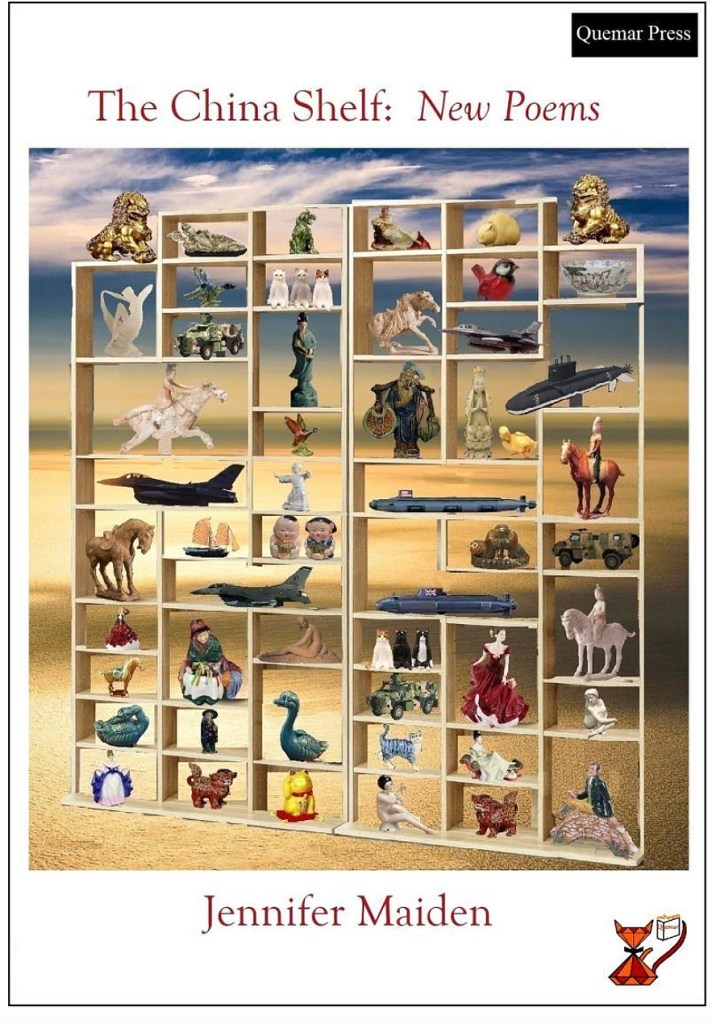
Jennifer Maiden, The China Shelf: New Poems (Quemar Press 2024)

Jennifer Maiden and her daughter Katharine Margot Toohey, publisher of Quemar Press, have been doing a literary highwire act for years: a cover image of a future book and its general theme are announced early in the year, sample poems uploaded as they are written, and then the book appears at the beginning of January the next year. They did it again in 2023.

Beginning early last year, Quemar Press uploaded an image of the cover of The China Shelf and 11 ‘sample poems’. Each of the poems was freshly written when uploaded, and very much of its moment: July’s poem referred to talk of Julian Assange at an Ausmin Conference (press report here, poem here); August’s to the US’s alleged demand that Imran Khan be removed as PM of Pakistan (press report here, poem here); and so on. We were seeing the project being created in real time – its contents determined by world events, and the collection as a whole relating thematically to Jennifer Maiden’s china shelf with its figurines that range from cute ceramic cats to model nuclear submarines. Now we have the book itself.

The poems in The China Shelf continue in the mode Jennifer Maiden has made her own: conversational, with unobtrusively musical half-rhymes; featuring fictional or historical characters freshly woken up (most of them familiar from earlier Maiden collections); taking issue with political leaders, mostly from the Labor or Democratic Party side of politics; taking controversial stands on many issues, including sympathy for Putin in his invasion of Ukraine (though there’s not so much that in this collection); making surprising connections between people and events; reflecting on her creative process and arguing with critics and publishers; sometimes gossipy, with flashes of glorious lyricism. You can read the samples at this link.

There’s no page 76 (the page I usually blog about, because it’s my age). My fallback position is page 47 (my birth year). Because the poem that begins there is three pages long, I’m bending my rule to talk about pages 47–49. I apologise in advance if the discussion is a bit laboured – the poem is not.

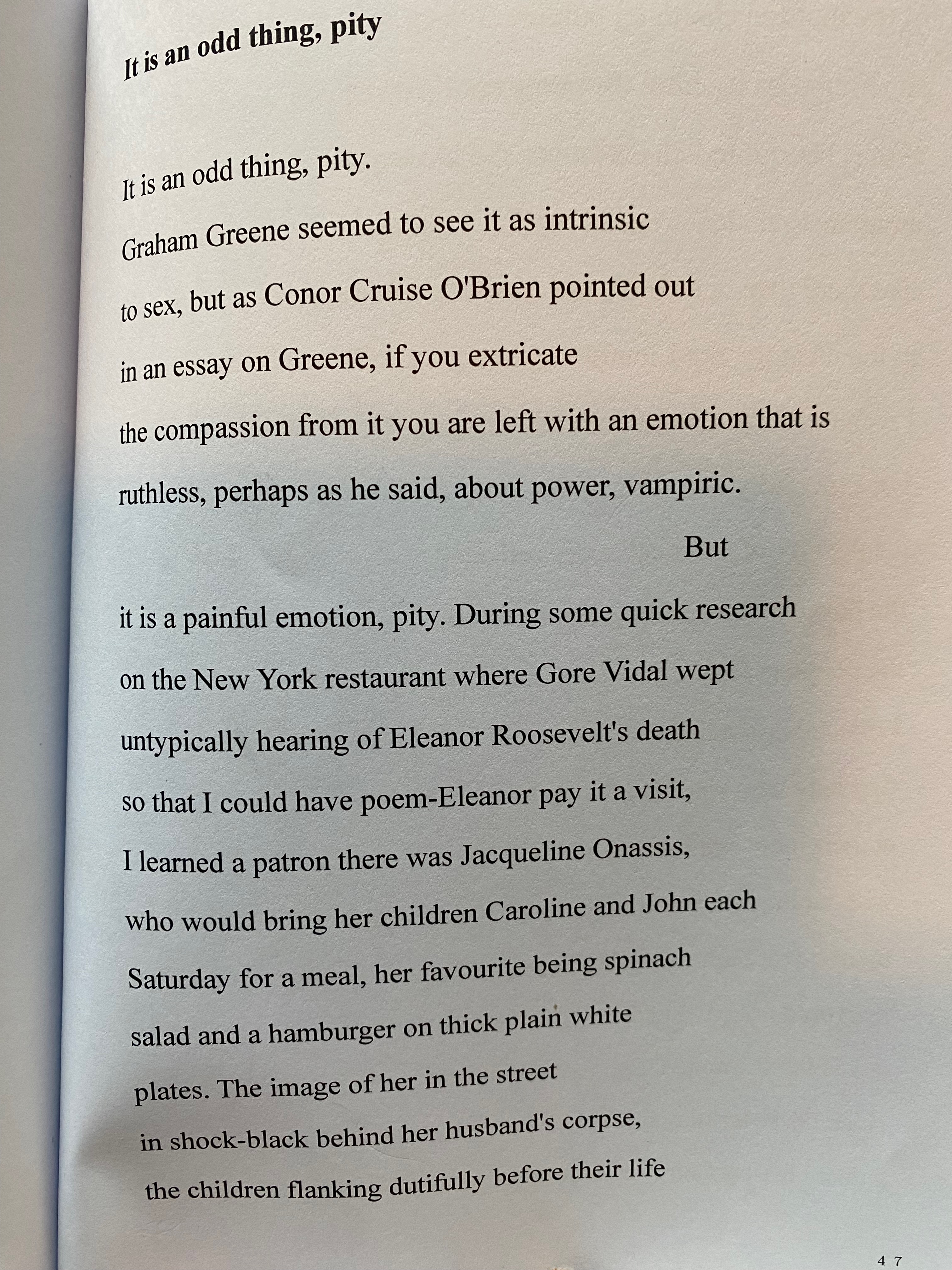
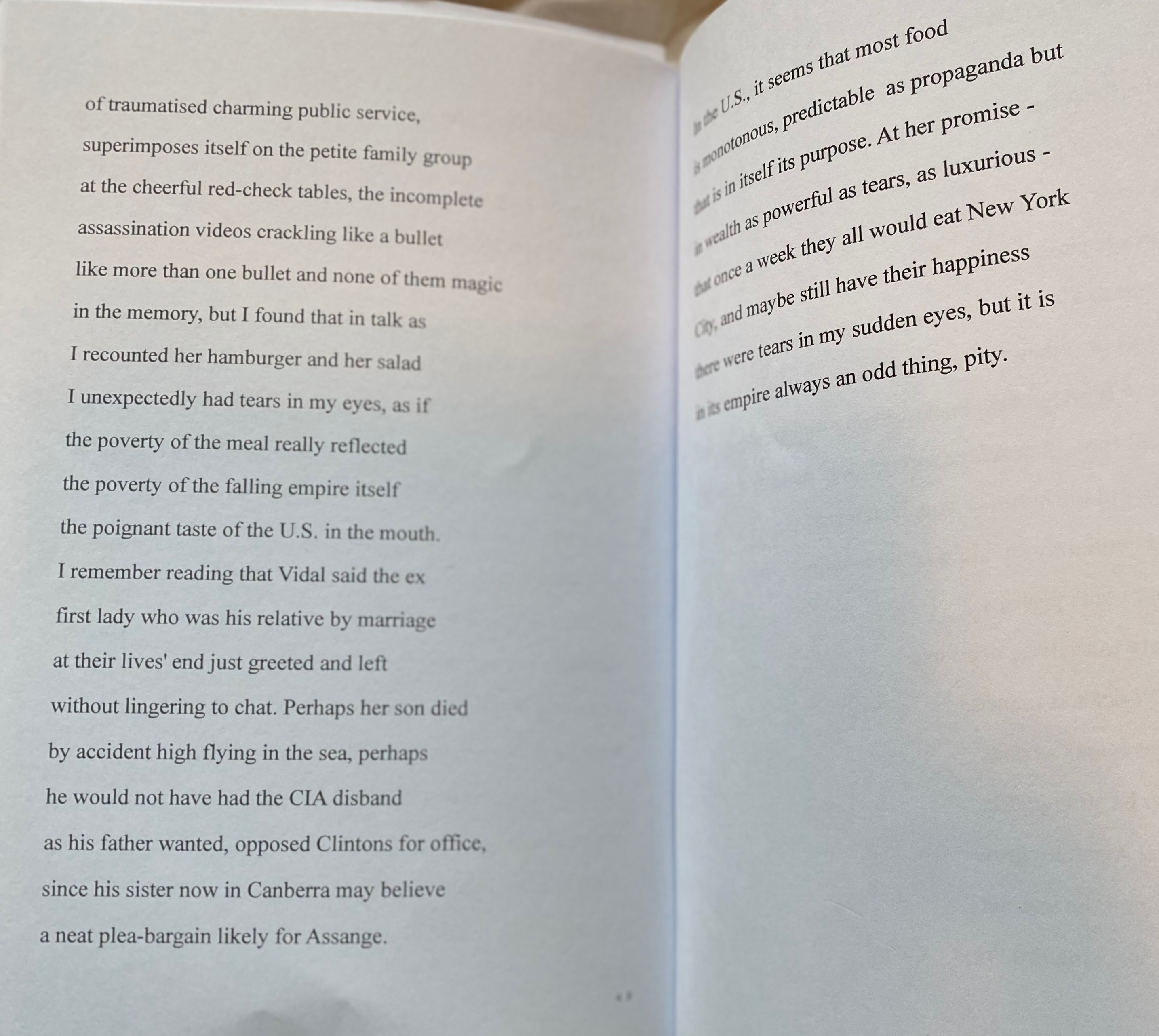
First, here are phone photos, which with any luck will look OK on your device. Click to enlarge.

I probably wouldn’t have chosen ‘It is an odd thing, pity’ to discuss – it doesn’t feature the china shelf, or begin with a character waking up, or reflect on the Australian poetry scene – but it turns out that serendipity is a wonderful thing, and the poem rewards a closer look.

A Study Notes synopsis might go something like this: The poet, while researching a restaurant that is the setting for another poem, discovers that Jackie Onassis took her two children there regularly for hamburgers and salad. She surprises herself by shedding a tear when telling someone about these modest family meals. The poem probes the meaning of those tears.

If you wanted a straightforward enactment of the Study Notes synopsis, you’d be annoyed by the amount of extra clutter in the poem. But (of course) that clutter is what makes the poem interesting.

It starts with a move characteristic of Maiden, an invocation of another writer, in this case Graham Greene, and Conor Cruise O’Brien commenting on him:

It is an odd thing, pity

It is an odd thing, pity.
Graham Greene seemed to see it as intrinsic
to sex, but as Conor Cruise O'Brien pointed out
in an essay on Greene, if you extricate
the compassion from it you are left with an emotion that is
ruthless, perhaps as he said, about power, vampiric.

It’s a long time since I’ve read any Graham Greene, and I have only a vague idea who Conor Cruise O’Brien is. (Change the names, and I could write that sentence about many Maiden poems – not a criticism of her, but an acknowledgement of my own ignorance.) I did a quick internet search, mainly hoping to read a less cryptic version of what Greene and O’Brien said. The search was fruitless, so I’m left where I might have been content to be anyway, finding my own way with the poem.

it turns out that the poem doesn’t need a reader to grasp the paradox of pity as a ruthless emotion, understand the distinction between compassion and pity, or know anything specific about Graham Greene and sex. Greene and O’Brien now depart and are heard no more. The poem has invoked them as a way of announcing that pity is seen as problematic more widely than in this poem. The lines are a kind of paradoxical preface that one expects the rest of the poem to elucidate, or perhaps bounce off.

And bounce it does, with the word ‘But’ on the extreme right on the next line:

______________ __________________________But
it is a painful emotion, pity.

Echoing the opening line, this takes control back from Greene and O’Brien, not so much disagreeing with their thesis as adding another dimension. Pity is not just an objective ‘thing’ to be discussed, but an ’emotion’ to be felt. It might be odd from a philosophical distance, but as lived experience, it’s painful.

Now the narrative proper begins:

it is a painful emotion, pity. During some quick research
on the New York restaurant where Gore Vidal wept
untypically hearing of Eleanor Roosevelt's death
so that I could have poem-Eleanor pay it a visit,
I learned a patron there was Jacqueline Onassis,
who would bring her children Caroline and John each
Saturday for a meal, her favourite being spinach
salad and a hamburger on thick plain white
plates.

That’s all one sentence. There’s no rhyme scheme in this poem, but it’s interesting to notice the music in these lines, helped among other things by the recurring ch sound at the end of lines: ‘research’, ‘each’, ‘spinach’.

The poem has arrived at its central image: Jacqueline Onassis and her children eating a modest meal. As I imagine you know, Jacqueline Onassis, wife of business magnate Aristotle Onassis, was formerly Jackie Kennedy, wife of President John F. Kennedy, who was assassinated in 1963.

The restaurant, as you probably don’t know, is Mortimer’s, a fashionable burger joint (the subject of a memoir, Mortimer’s: Moments in Time by Robin Baker Leacock (2022)). The poem referred to, ‘Eleanor Roosevelt Woke Up in a New York Burger Bar’, appears earlier in the book and is included in the Quemar Press sampler. Gore Vidal makes regular appearances in Maiden’s poems, mainly because Julian Assange was carrying a book by him when forcibly removed from the Ecuadorian embassy in 2019. Maiden’s poems often refer to each other in this way, and the detail of Gore Vidal weeping ‘untypically’ may be a product of another feature of her poetry: the recurring characters (poem-Eleanor is one, poem-Gore is another) tend to take on a life of their own, and here Gore Vidal insists on being more than a passing name-drop. His tears are the first of three lots in the poem.

Picturing Jacqueline Onassis with her children, Maiden’s mind goes to the assassination and the famous footage of Kennedy’s funeral:

plates. The image of her in the street 
in shock-black behind her husband's corpse,
the children flanking dutifully before their life
of traumatised charming public service,
superimposes itself on the petite family group
at the cheerful red-check tables, the incomplete
assassination videos crackling like a bullet
like more than one bullet and none of them magic
in the memory,

‘Shock-black’ demonstrates just how much work a single adjective can do, conjuring up the mood of that famous footage. But it’s now 60 years after the event, and the passage of time adds further superimpositions. The children’s futures are summed up elegantly as lives ‘of traumatised charming public service’. The controversy and conspiracy theories surrounding the assassination (was there more than one shooter? was it a CIA plot?) are thriftily evoked: the videos are incomplete and there may be more than one bullet. (There’s no magic bullet to cure the ills of that moment.)

Now comes another ‘but’, which pulls attention back to the immediate emotional impact, not of the funeral scene, but of the image of the meal:

in the memory, but I found that in talk as 
I recounted her hamburger and her salad
I unexpectedly had tears in my eyes,

Earlier, Gore Vidal wept ‘untypically’. Now the poet’s speaker does so ‘unexpectedly’. Gore, waspish observer of the social scene and sharp political commentator, has a moment of straightforward grief. Maiden, intent on creating complex poem-versions of public figures alive, dead and fictional, has a simple emotional response. You or I might have left it at that – it may be unexpected, but surely it’s not weird to be moved by the image of a recent widow and her orphaned children having a quiet meal: ‘It is a painful emotion, pity.’ But things are rarely simple in a Jennifer Maiden poem, and this one twists off in an unexpected direction:

I unexpectedly had tears in my eyes, as if 
the poverty of the meal really reflected
the poverty of the falling empire itself
the poignant taste of the U.S. in the mouth.

Rather than reflecting, as a lesser poet might have done, that even in the midst of international political events the suffering of a small family can evoke our empathy, Maiden takes a different tack: even a simple empathetic response can be understood in terms of major political movements. The humble meal, it suggests, reflects something about the humbling of US imperialism.

Not everyone will grasp how US imperialism can be seen as ‘falling’. If anything some would say it’s on the verge of exploding and bringing the rest of us down with it, terrifying rather than poignant. But for the poem ‘the poverty of the falling empire’ is a given, not a point of view to be argued for or needing the reader’s agreement.

We now move on to what lay in the future for that ‘petite family’. Gore Vidal is back, this time as a witness:

I remember reading that Vidal said the ex 
first lady who was his relative by marriage
at their lives' end just greeted and left
without lingering to chat. Perhaps her son died
by accident high flying in the sea, perhaps
he would not have had the CIA disband
as his father wanted, opposed Clintons for office,
since his sister now in Canberra may believe
a neat plea-bargain likely for Assange.

The mother became unsociable. The son died in an air crash – with two perhapses reminding us that conspiracy theories also hovered around his death. The daughter is now the US ambassador to Australia. Julian Assange has appeared in many Jennifer Maiden poems, and Caroline’s probable support for ‘a neat plea-bargain’ makes her one of the good guys in Maiden-land.

I don’t understand the ‘since’ in the second-last line there. Again, it feels as if a more detailed argument is being gestured at, but not something to be gone into here – this poem has other fish to fry.

The final lines return to the burger joint:

In the U.S., it seems that most food
is monotonous, predictable as propaganda but
that is in itself its purpose.

In real life, food is probably no more monotonous in the U.S. than anywhere else, but we’re talking about a burger joint – specifically, comfort food in a high-profile burger joint. A crude paraphrase of these lines might be: Propaganda is the McDonalds of the soul. The purpose of monotonous, predictable food is the same as that of comforting, reassuring propaganda: to dull the senses, lower expectations, create a compliant population.

that is in itself its purpose. At her promise – 
in wealth as powerful as tears, as luxurious –
that once a week they all would eat New York
City, and maybe still have their happiness
there were tears in my sudden eyes, but it is
in its empire always an odd thing, pity

Without the ‘clutter’ (that is, without the things that make the poem interesting), this could be paraphrased: ‘It was her promise of this weekly routine meal together, which might enable the three of them to be happy in spite of Kennedy’s death, that brought tears to my eyes.’ That is, the poem’s speaker, aware of the terrible ordeal that this family has gone through and of so much that is yet to come, sees this attempt at reassurance as pitiable.

The line that gives me pause is ‘in wealth as powerful as tears, as luxurious’. The line’s music works beautifully, ‘luxurious’ rhyming with ‘purpose’ and promise’ in the previous line, ‘powerful’ also resonating with ‘promise’, and ‘tears’ and luxurious’ resounding with a kind of end alliteration. Its meaning is not immediately clear. On the one hand, perhaps Onassis’ wealth, power and luxury are enough to outweigh her pain. On the other hand, her promise is made from a position of privilege that makes any tears she sheds a luxury. (I don’t want to make too much of ‘eat New York / City’ as suggesting that the Kennedy’s, specifically these three, were great devourers, as it is may be a typo – though even as a typo it would be a kind of Freudian slip.) In the poem, however, the person who sheds tears isn’t Onassis, but the poem’s speaker, demonstrating that whatever you/she might think about people of power, wealth and privilege, you can surprise yourself by the feeling a straightforward sympathy for them.

The final line brings us back to the start. Yes, pity is complex, but unless I’ve completely missed the point, this particular example is not sexy, ruthless of vampiric. We may even surprise ourselves by weeping tears of pity for those whom we might see as possessing those qualities. I love the phrase ‘in its empire’: pity, which I take to be the way we as humans spontaneous care about each other, has its own empire, which does not bow to any ideology.

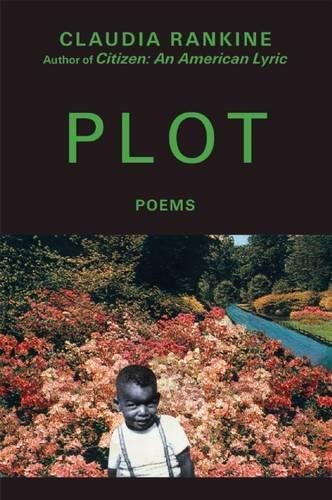
Claudia Rankine’s Plot, page 76

Claudia Rankine, Plot (Grove Press 2001)

Claudia Rankine’s two most recent books, Citizen: An American Lyric (2014) and Just Us: An American Conversation (2021) – links are to my reviews – issued brilliant, multi-faceted, take-no-prisoners challenges to anti-Black racism in the USA, shedding light and warmth on the issue well beyond American borders, and enthusing readers, me included, well beyond the borders of Contemporary Poetry land.

When a friend lent me Plot as part of a Covid care package (the Covid turned out to be a non-event, thanks for asking – vaccines and antivirals work wonders), I looked forward to more of the same. That is to say, I came to this slim volume of poetry, published more than a decade before Citizen, with completely inappropriate expectations.

The first page of verse gives fair warning. It consists of just four lines:

Submerged deeper than appetite

she bit into a freakish anatomy. the hard plastic of filiation.
a fetus dream. once severed. reattached. the baby femur
not fork-tender though flesh. the baby face now anchored.

OK, this book is going to expect the reader to work. A string of phrases separated by full stops without any opening capitals and only one conventional sentence. There seems to be something about biting onto the flesh of a foetus. It’s a dream, and maybe the dislocated syntax represents the fragmentary nature of the dream. But why ‘freakish’? What is ‘deeper than appetite’? What has been severed and reattached, and how? My phone dictionary wasn’t a lot of help with ‘filiation’ – the most relevant implied definition is ‘the process of attachment’ – but why plastic? And so on.

These four lines announce the book’s central theme of pregnancy, and they foreshadow that for much of it a good part of the reader’s pleasure is in being lost in a cloud of probabilities, not quite knowing what the endlessly suggestive words mean.

There is a story. Liv, an artist, is pregnant and ambivalent about it. The foetus has a name, Ersatz. The father’s name is Erland. The book’s most accessible moments are in occasional snatches of dialogue between the adults – in which Erland usually fails to grasp Liv’s emotional tumult. Most of the rest enacts that tumult: ‘dreams, memories, and meditations expanding and exploding the emotive capabilities of language and form’ (that’s from the back cover).

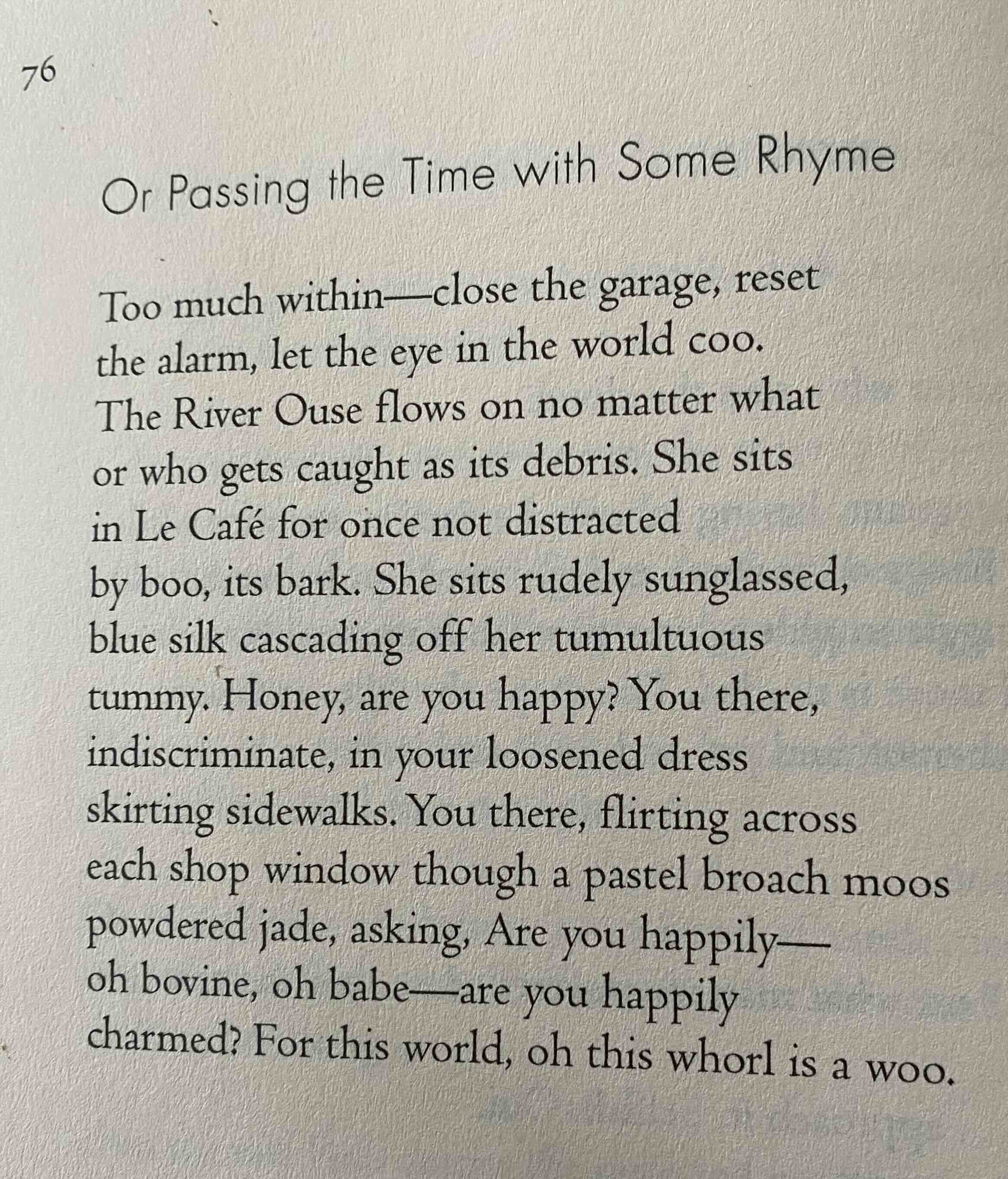
My blog practice is to write about page 76. In the kind of coincidence that I’ve almost come to expect, the only poem from this book that I could find online was the one on that page, ‘Or Passing the Time with Some Rhyme’, quoted in a review by Kate Kellaway in the Guardian. Kellaway doesn’t say a lot about this poem, but her review sheds excellent light on the book as a whole: for example, she describes many of the poems as ‘painterly’, and reminds us that Liv and Erland are the first names of the actors in Igmar Bergman’s monumental movie Scenes from a Marriage.

Page 76 (right click to enlarge):

There are lots of possibilities, but here goes with my reading.

This poem is something of a turning point in the book, as signalled by the ‘Or’ in its title (not ‘On’ as a careless reading might see). We can keep going as we have been, the title says, or we can take a different route. Let’s loosen up and just pass the time. Instead of more of the serious, introspective prose poems, let’s have some fun with rhyme.

Or Passing the Time with Some Rhyme

The body of the poem fills that promise, though perhaps not obviously.

To understand the first four lines, you need to know that in an earlier sequence, Liv has worked on a painting entitled Beached Debris referring to Virginia Woolf’s death in the River Ouse. Her brooding on Woolf’s suicide reflects her dark emotions about her pregnancy.

Too much within – close the garage, reset
the alarm, let the eye in the world coo.
The River Ouse flows on no matter what
or who gets caught in its debris.

The voice here is not, as mostly so far, giving us Liv’s inner workings. It’s more like a bossy friend: ‘Too much introspection, snap out of it.’ Maybe Liv has been painting in the garage. It’s time to close it, reset the burglar alarm and leave the house. Undo the fixation with Virginia Woolf’s death and notice the wider world, the river that still flows on no matter what tragedies it has seen.

The next lines are no longer addressed to Liv, but show her from the outside for the first time in the book. She’s looking cool, even arrogant, and splendidly, exuberantly pregnant:

or who gets caught in its debris. She sits
in Le Café for once not distracted
by boo, its bark. She sits rudely sunglassed,
blue silk cascading off her tumultuous
tummy.

This is a good time to notice that the poem is a sonnet, the only one in the book, and as far as I can tell the only poem in a traditional form. (Back to the ‘Or’ in the title: we could keep on with prose poems or we could have a crack at a sonnet.) It doesn’t have an obvious rhyme scheme (I’ll come back to that), but it does have the classic sonnet turn, right here in line eight where it’s supposed to be. The poem now addresses Liv again:

tummy. Honey, are you happy? 

You can read this a number of ways. It could be a straightforwardly sympathetic request for information. It could be a niggle: you look OK, ‘for once not distracted’, but are you actually happy? Or, and this is the reading that carries most weight for me, it could be registering unexpected good news: ‘Honey, after all this misery, are you actually happy?’

The remaining six lines (the sestet of the sonnet) have a cinematic feel. Liv is on the move, and the questioner repeats the question (this is very Boomer of me, but I think of Lynn Redgrave in the opening scenes of Georgy Girl, with Judith Durham on the soundtrack asking her questions in song). The tone still arguably ambiguous, but now with the possibility of enchantment much stronger:

tummy. Honey, are you happy? You there,
indiscriminate, in your loosened dress
skirting sidewalks. You there, flirting across
each shop window though a pastel broach moos
powdered jade, asking, Are you happily –
oh bovine, oh babe – are you happily
charmed? For this world, oh this whorl is a woo.

In ‘oh bovine, oh babe’, one of the words commonly used to disparage pregnant women is being reclaimed – someone might see her as cow like, but she is indiscriminately flirty, window shopping, and to all appearance happily charmed. It’s still a question, but surely now leaning towards a positive answer.

But what about rhyme? And also, what about those words that don’t make obvious sense that I’ve blithely glossed over until now?

After spending some time with this poem I realise that I have to let go of my habitual prosaic way of reading, and almost sing this, accentuating the vowels, starting with the title:

Or Passing the TIME with Some RHYME

When I do that, something wonderful happens. The sound patterning, especially the internal rhyming, is at the heart of how the poem works. Just look at all those oo words: Too, coo, Ouse, who, boo, rudely, blue, you (several times), loosened, moos, woo. There’s more to the soundscape than this (‘tumultuous tummy’, for example, and heaps of alliteration in the sestet), but once you’re alert to how the poem sounds, those odd words – coo, boo, moo and woo – make sense. It’s easy enough to find a paraphrasable meaning for them: ‘let the eye in the world coo’ equals ‘let the world look on you with the indulgence of a lover who bills and coos’; ‘not distracted / by boo, its bark’ equals ‘not having one’s attention dominated by this thing that is scary like a ghost or a savage dog’; ‘this world is a woo’ equals ‘this world is waiting to be loved by you, is wooing you’. It almost feels as if the notion of bovineness is introduced so the brooch (I think ‘broach’ must be a typo) in the shop window could moo. The literal meaning matters, but maybe what matters even mnore is the way the words just sing on the page. The final phrase, ‘oh this world is a woo’, becomes a fabulous, semi-nonsensical affirmation of life as joyful.

PS: Now have another look at the four lines I quoted at the start of this blog post. Read it emphasising the sounds, especially all those Fs. Quibbling at it for clear meaning seems much less valid all of a sudden. The pleasure is real.

Ken Bolton Starting at Basheer’s

Ken Bolton, Starting at Basheer’s (Vagabond Press 2018)

I’ve come late to Ken Bolton’s work. He has been a presence on the Australian literary scene for half a century. His Wikipedia entry lists 20 books under the heading ‘Poetry: Collections and Chapbooks’, beginning with Four Poems in 1977, with a print run of just 300 copies. He has published more than one small magazine, operated a small press and written art criticism as well as poetry.

Before Starting at Basheer’s, I’d read only one book by him, London Journal London Poem (2015). That book consists mainly of one long poem in which the poet and his partner Cath (writer Cath Keneally IRL) visit their son Gabe and his partner Stace in London. When Gabe appears in Starting at Basheer’s, he is in London while the poet is mostly at home in Adelaide, working, people-watching in cafes, or staying up late at night. The poems have what looks like an easy spontaneity, so they are something like what New York School poet Frank O’Hara describes as ‘I do this I do that’ poems. (This isn’t just me showing off what I learned in the ModPo course I did last year. O’Hara crops up a number of times in this book; if you’re interested you can read a little about him and ‘I do this I do that’ here and here.)

On first reading, I just loved this book. It felt as if I was invited to share relaxed moments with someone who just happens to have a lot in common with me demographically. We’re both middle-class white Australian men in long-term relationships with women, with sons we admire and love. We were born two years apart, and may even have been at Sydney University at the same time. Friends are occasionally mentioned by first name only, and sometimes I know who they are (‘Pam’, for example, is the poet Pam Brown, ‘Laurie’ is Laurie Duggan, and ‘John’ is probably the late John Forbes). Further readings left me feeling less of an insider, but enjoying the poetry no less. Bolton knows a lot about poetry and art and movies, and wears his knowledge so lightly that you don’t notice that you’re learning things or being challenged until you hang around a bit. It’s his erudition that has stood out more on subsequent readings.

It’s always handy when a poet give us a phrase describing what they’re up to. Bolton does that a couple of time in this book. ‘Up Late (August Mute)’ on page 103 has these lines:

_________But I am
'up-at-night',
again

___ ... proving I'm here, alive
taking stock of things
registering the moment:

me, the hum from the
fluoro light, the mess

– relative – I keep
this room in

‘POEM (“I reach”)’ ends:

And I write a poem today myself:
not very good, of that I'm sure –
but it marks the moment.

These poems are generally about registering or marking the moment, including whatever is going through his mind and the incidentals of his surroundings. There’s often a spontaneous, unrevised feel (the poem may not be ‘very good’), but I can promise you it’s not easy to get that casual feel and still be readable, let alone as enjoyable as these poems are.

Sticking to my practice of writing about page 76, here it is (click to make large and legible):

Read out of context, the page amounts to an almost self-contained piece of chat about an old movie. In context, it’s a lot more interesting than that.

It’s part of a long poem (131 lines), ‘Dear Gabe,’ (the comma is part of the title), one of two poems framed as letters to Gabe in London. The poem has the informal feel of a tossed-off letter: the syntax and spelling can be loose, and even the line breaks feel relaxed. It’s written the day after a phone conversation, and Bolton, or the speaker of the poem, visualises where Gabe was calling from, using his recent photo of Gabe and his partner Stacey. He paints a picture of the family home where he was during the call, and then:

It would be good to have you back home –
or to be over there with you is the
alternative.

Which leads to the possibility of meeting up in Rome for a couple of weeks. Turn over to page 76, and the mention of that possibility has sent the poem/letter ricocheting in a different direction. It’s not exactly a digression, because the whole thing is a post-phone-call rumination with no main thesis or agenda or narrative thread (‘I think this I think that’, if you like):

Two Weeks in Another Town was a not very good novel 
& a bad & unintentionally funny
film: an American in Europe, up against all its
shocking amorality, venality & corruption:
Kirk Douglas playing a guy brought in to
save a falling director, get the movie back in production,
on budget, & quickly in the can.

You don’t need to have read Two Weeks in Another Town (Irwin Shaw 1960) or seen Vincente Minelli’s 1962 movie to understand and enjoy these lines, but as a dedicated blogger, I rented the movie from a streaming service. (I’m not dedicated enough to read the novel, sorry!).

That plot summary is as good as you’re likely to find.

on budget, & quickly in the can. Italy. You can 
imagine. Well, you can't. I can.

Of course, the reason for the plot summary is that the letter-writer doesn’t expect his son to have seen the movie, and in these lines he realises that he is speaking across the generations. He may also be realising that he has been to Italy and Gabe hasn’t.

imagine. Well, you can't. I can. The world is 
spared, today, much exposure to Kirk
at full throttle. It was possibly an attempt
to make something like La Dolce Vita, but
understandable-for-Americans, & with a 'clear
moral point of view' – as they used to say,
the duller critics.

That’s funny and spot-on. ‘Kirk / at full throttle’ made me particularly glad I’d seen the movie: near the end, Kirk Douglas’s character, eyes bulging, drives a car at breakneck speed through the Italian countryside scaring the living daylights out of the woman in the passenger seat, all somehow establishing that he’s not crazy. Ken is right to assume that Gabe and I (and probably you) don’t need to have the reference to Fellini’s La Dolce Vita spelled out for us. I don’t know if I’ve actually seen that whole movie, made two years before Two Weeks, but Fellini’s general use of carnivalesque images contrasts marvellously with the weird, frozen faces of the ‘decadent’ Romans in the final scenes of the Kirk Douglas movie.

the duller critics. America has slipped a bit 
in the innocence ratings. But Italy ... Berlusconi
might have stepped right out of Kirk Douglas's
nightmare.

Well, yes. There’s no date on this poem, but if it was written after Trump’s (first?) election, ‘slipped a bit’ is a delicious understatement. The Berlusconi reference could have been made anywhere over a stretch of decades. The date really is immaterial: the same observations could have been made any time in the last 20 (even 40?) years.

Back to the proposal to meet up:

___________ That said, Shall we go?

(It may be that we won't. The duller critics
are back! One of the dullest now runs things
in the Australia Council – so, no money for me
in the foreseeable future. No travel. No Italy.)

A bit of literary gossip that would surely delight those in the know, but sadly no names. I went so far as to look up recent heads of the Australia Council (which became Creative Australia last year), but I have no way of telling who the dullest of critics is/was. A footnote identifying him or her might have gratified a lust for scandal, but wouldn’t have made a difference to the poetry, which is after all what I’m reading for. (Relaxed though their style may be, these poems don’t hesitate to pick a fight. There are other similarly non-specific snippets of gossip – notably the mention of legal issues with Les Murray’s estate in ‘In Two Parts, a Letter’, the other letter to Gabe which also, incidentally, includes insightful chat about a film, in that case Les enfants du paradis.)

Then the poem turns again:

There is no news: I mean, you're up-to-date –
nothing to tell of news from here.

It’s a letter, you’re supposed to give some news. But this is a letter following so soon after a phone call, so nothing new to say. All the same, the writer is called on to say something about himself:

nothing to tell of news from here. It seems so ridiculous 
to be my age, that, tho I feel okay, one can't
help thinking about it. I would certainly like
to see you more

It’s as if the whole poem has been circling around something, and now hits it with the word ‘it’, only to recoil immediately. The speaker, with no matter-of-fact news to give, almost accidentally mentions a persistent preoccupation. I love the elegant way the verse communicates that though he ‘can’t help thinking about it’, he has trouble talking about it. He prefaces the reference by describing it as ridiculous, he says he feels okay (clearly intended to be the opposite of ‘it’), he uses the pronoun ‘I’ everywhere else, but here uses ‘one’. Nor can he explicitly say what ‘it’ is.

(Lest you think an explanation is to come on page 77 – nah! Those lines spell out how much he’d love to see his son, and the poem ends with a description of the circumstances in which he’s writing – alone late at night, with jazz playing – and what he imagines is happening at Gabe’s end:

And school kids soon will start walking up Jermyn Street
& young mums will appear & you will play guitar a bit,
& then get to work

Note the absence of a full stop. This correspondence will continue.)

So what is ‘it’ that can barely be mentioned and must not be named? There’s no mystery really. All that has gone before – the cross-generational movie talk, the reference to duller critics of the past who are back again, the changing status of the USA, and earlier reflections on the way the family house has changed over the years, all this has been quietly and persistently marking the passage of time. It would probably be going too far to say that ‘it’ equals death. But I do read it as referring to mortality. He’s not saying, ‘I’ll be dead soon, so I’d like to see you.’ In fact, he’s carefully not saying that: ‘I feel okay … I would certainly like to see you more.’ He quickly moves back to the question of catching up with each other, but the glimpse into the abyss, however brief and hedged about, remains, and the poem has done its work.

These lines from another poem – ‘Poem (“this notebook’s”)’ (page 118) – are relevant:

something serious
or something that 'becomes serious' –
that old trick. Is there
a name for that sudden
pounce or 'descent'
into gravity?

Maybe what I’ve just been describing is exactly such a sudden pounce or descent, and a release or ascent that is just as sudden.

The book is full of such unspectacular, but deeply human moments.