Tag Archives: poetry

Kit Kelen’s Bung Mazes

Kit Kelen, Rompitaj Labirintoj / Bung Mazes (Australian Esperanto Association 2022)
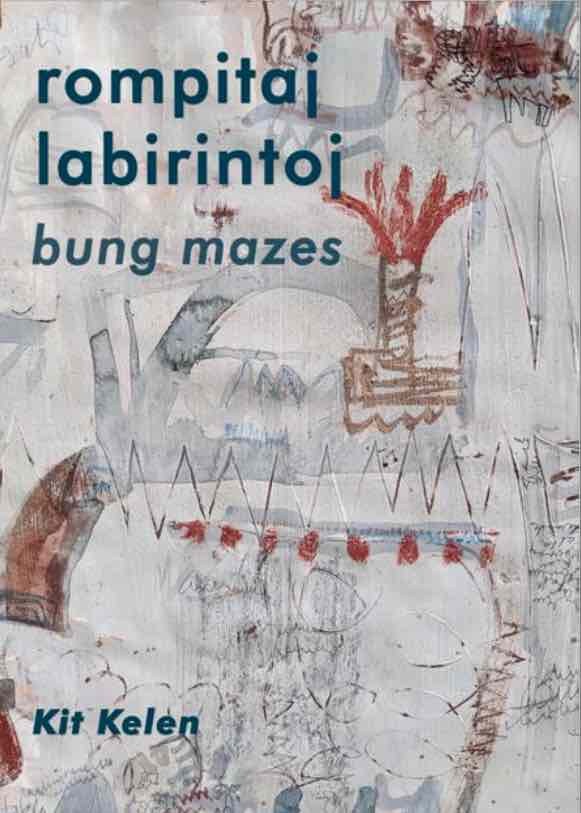
It was my great pleasure to launch the English part of this bilingual book today. The Esperanto part was launched by Jonathan Cooper from the Australian Esperanto Associaton, in an afternoon that also featured Kit Kelen’s’s exhibition of palimpsest works on paper with the same title, plus music, at the Shop gallery in Glebe, all MCd by Richard James Allen. There was music, and a conversation between Kit and Magdalena Ball. Here’s a version of my launch speech.

Rompitaj Labirintoj / Bung Mazes is not the first bilingual poetry book Kit Kelen has been involved in, not even the first bilingual book of his own poetry. But it marks his debut as translator of his own work, both from English into Esperanto and in the other direction as well.

Mostly, unless you’re appropriately bilingual, you can ignore the language that’s not your own when you read a bilingual book. This one isn’t like that. The Esperanto isn’t an added extra. To read the book thoughtfully is to engage with Esperanto, maybe learn a word or two, discover some of its history, and glean some understanding of its underlying philosophy.

It’s easy to see why Esperanto is a good fit for Kit’s poetry. Esperanto, as I understand it, is all about opening channels of communication where none might otherwise have existed. Kit’s work shows a deep commitment to being open to other cultures, other languages, and to other minds. for example, when he asked me to give this talk, he didn’t say, ‘I hope you like the book,’ but ‘I’m interested to hear what you think of it.’

The English versions of many of poems in this book predate Kit’s interest in Esperanto. They cover a wide range of subjects, from the plight of refugees and the climate emergency, to simple celebrations of the natural world and poems about poetry itself. But there’s no great discontinuity between them and the poems dealing explicitly with Esperanto.

One example of these older poems is ‘here’s the story to save the world’, which includes these lines:

what is it keeps us alive?
keep talking
I want to know how the story ends
keep talking
I’ll listen

You can draw a straight line from that to ‘Hitching my wagon to a green star’, a statement of allegiance to Esperanto, which has the lines, ‘we come here for a conversation / while we wait for states to wither away’.

There are poems about learning the language. ‘thank you poem for Trevor Steele’ is explicit:

these lines here are just to say –

thanks for the grammar
I know it must be very annoying –

all the stupid mistakes I make

but how can there be so many accusatives?

Or there’s this from ‘being a humble beginner’:

often I slip
sometimes I slip off the tongue together

This is the poem that most makes me wish I could read Esperanto. What’s the Esperanto equivalent of the mistake ‘slip off the tongue together’? ‘tute glitas de mia lango’ doesn’t tell me anything. It makes me wonder how many references there are that Esperantists get but just sail past me.

Beyond this interest in learning the language, the book engages with its underlying philosophy.  ‘being a humble beginner’ again:

but I’m here for the conversation
I believe that is an art
like leaving the world better than found –
another impossible thing

L L Zamenhof, the language’s creator, is quoted in one of the book’s two epigraphs:

Rompu, rompu la murojn inter la popoloj!

Translation hardly seems necessary, but Google translates it as:

Break, break the walls between the peoples!

‘Bialystok dreaming’ tells how Zamenhof first thought of inventing a neutral second language in Russia in the late 19th century. ‘Suprasegmentals’ makes fun of Chomsky’s declaration that Esperanto is not a language. ‘samideanoj!’ spells out the vision with characteristic Kelenian paradox. It begins:

today we are building a dead language
syllable by syllable, from scratch

it is a tiny country
all between
and never was at all

Esperanto, to paraphrase, has no currency except the people who speak it. Incidentally, this poem stands out for two reasons: the title, meaning ‘like-minded people’ isn’t translated, and the first one-word line  – ‘kamaradoj’ – doesn’t appear in the English. The book is aware of its dual readership.

The poems about Esperanto don’t pull back from its utopian aspirations. In fact they endorse them, but there’s a feeling of astonishment, perhaps even with an edge of amusement, at the vastness of those aspirations. The poems are completely serious, but not self-important.

The two poems that for me are the guts of the book, are ‘shelter’ and ‘bung mazes’. The book has been described as ‘an abstract treatment of the situation of asylum seekers’. The poems celebrating our common humanity, and Esperanto as a way to sharing it, the poems about openness to the natural world and the value of conversation, create a version of the world in which the current treatment of asylum seekers is a cruel absurdity. In ‘shelter’ and ‘bung mazes’, the point is made explicitly.

The title poem ‘Bung Mazes’, begins with a line from the public debate about asylum seekers, ‘everyone knows there is no queue’, and goes on in fifteen short poems to create a kind of maze of its own. I found it the most difficult poem in the book. Sentences don’t finish, images rub up against each other, it’s hard – even maybe impossible – to grasp how some lines hang together. For example:

where you see desert’s edge
a labyrinth in canvas shook

lent to, how it blows off
who’s after you? can it be imagined?

their weapons and the names they call
crime of a clock, dreamt that too

There’s the image of a refugee camp, and a general anxiety is evoked, but it’s hard to pin down a clear meaning. If there is a meaning there, it’s just beyond my grasp (whose weapons? what clock committed what crime? who dreamt what?)

Generally if a poem grabs me, but I don’t understand why, I’ll sit with it, and let it brew in my mind. Sometimes a meaning becomes apparent in the brewing process. In this case, it’s not a meaning, but the effect created by the poem’s elusiveness. In effect the poem, made up largely of unparsable moments like this, gives me a faint inkling of the emotional impact of being lost in the dangerous maze of asylum seeking.

 ‘Shelter’ includes lines that cry out to be quoted:

now they are changing all the world’s weather
island here, river there, tents blow away
tanks shift borders out of the way

big bird flies where it will, drops its droppings

fire now flood now famine war
we were forced to flee

then where to shelter?
in the cave in my head?
but you’ll never get in
there’s never been a queue

there’s a maze
of rules and rights
of yours, not mine
and my turn
never comes

and later:

for the sixty million wandering
this world is a maze gone bung

Sixty million is the UNHCR’s 2015 estimate of the number of people displaced worldwide by wars, conflict, and persecution.

So this is a book about intensely serious subjects.

My mind goes to something Kit wrote almost 10 years ago. Speaking of the problematic nature of writing in the pastoral mode as a settler Australian, he said: ‘The challenge is to have fun while you problematise (otherwise please don’t write a poem).’

This book is fun. Even at its most serious, it avoids ponderousness. It delights in paradox, puns and syntactical playfulness. It always treats the English language – I can’t speak of the Esperanto – as an endlessly enjoyable and challenging playground (‘bung mazes’ is an example; it rejects the obvious English for Rompitaj Labirintoj, that is to say, Broken Labyrinths, in favour of something much less respectful). The poems are full of music, as I hope the bits I’ve read demonstrate.

In this context, fun can be many things. Take the short poem ‘parable’ for example. I loved it at first reading because I felt it brought a much needed lightness of touch to the climate emergency, a step back from the details of rising temperatures, collapsing ice sheets, greenwashing by corporations and governments, and so on. I read it as a kind of wistful fantasy. Then, while I was preparing for this talk, I read it to a friend who’s a climate activist, and it made us both cry – I think because it manages to strike a note of forgiveness along with terrible grief. Here it is. I don’t expect it to make you or me cry today, but just listen to it:

parable

we came from the ice
and out of the trees
and wanted the whole world warmer

we lit fires
and at timber
we were the axe
we were the flame

as if winter were our own forever

we only wanted the whole world warmer

o fearful the dark
but we brought the firelight

the others we’ve eaten by now

we burnt till all of the forest was gone

we came to the clock
that’s where we are now

hard to hear anything
everyone’s in charge
we all follow orders

it’s hard to see how this will pan out
but I predict, in time to come
at the Court of All Spirits
our defence will simply be

we came from the dark
we came from the ice
we wanted the whole world warmer

[It didn’t make me cry when I read it out, and I don’t think anyone else shed a tear either.]

Anyhow:

It’s my honour and privilege to commend this book to you. Buy a copy, and, as the poem ‘keep this book’ says with only a hint of over-selling:

walk with it
sleep with it
read it out loud
quote it at will

I declare Rompitaj Labirintoj / Bung Mazes, the English half, launched.

And here’s a pic of me talking, with Kit’s art in the background and Kit wearing a hat in the corner

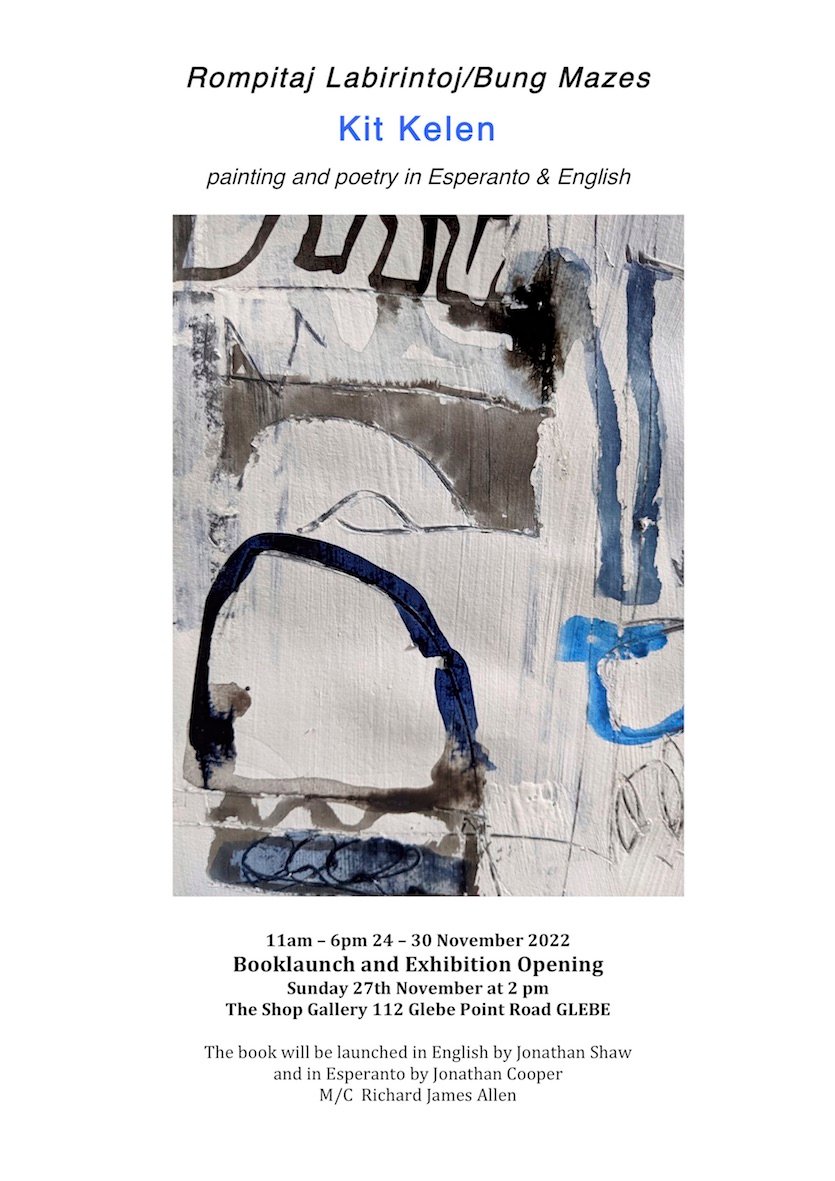
Photo by Penny Ryan

A Launch

If you’re in Sydney this coming Sunday – 27 November – you might like to drop in on this exhibition opening and book launch at the Shop Gallery in Glebe at 2 pm. The book is Rompitaj Labirintoj / Bung Mazes, poems in English and Esperanto by Kit Kelen (about whom I have blogged a couple of times).

I have the honour of being the English-language launcher, and will do my best to say something coherent. A different Jonathan wll do the honours in Esperanto. I’m pretty sure there will be music and nibbles.

The book, which I’m loving, is available for purchase at Booktopia.

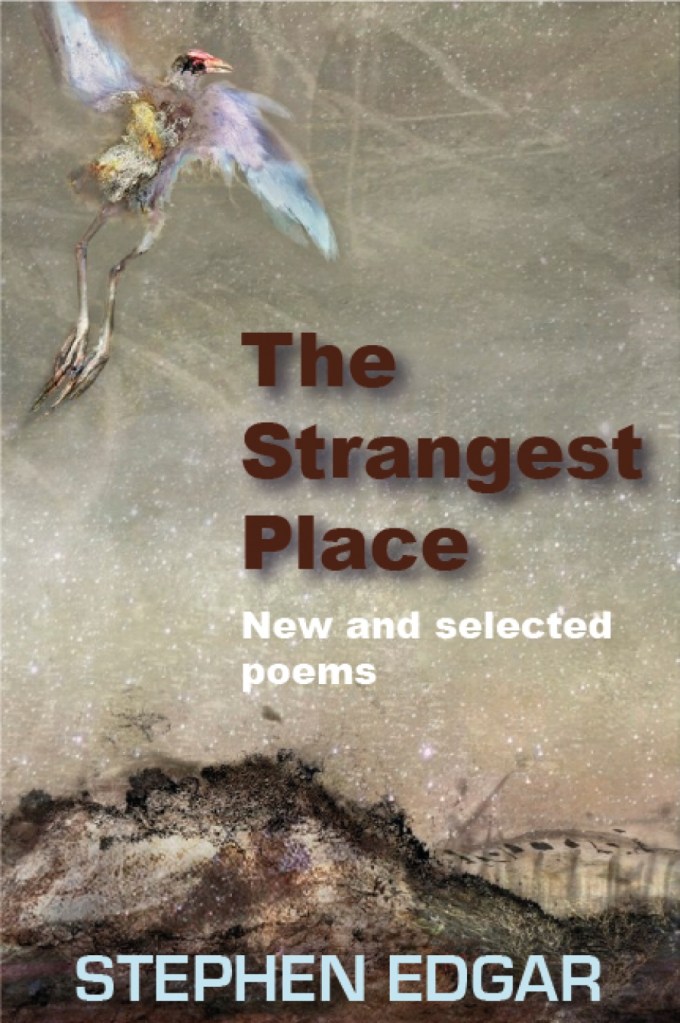
Stephen Edgar’s Strangest Place

Stephen Edgar, The Strangest Place: New and Selected Poems (Black Pepper 2020)

This is a daunting book. It opens with 76 pages of new poems in a section titled ‘Background Noise’, enough for a respectable book on its own. But Stephen Edgar has had poetry published since 1976, so it was time for a retrospective, and more than 200 pages follow, a selection from his ten previous books. It’s a lot to take in if, like me, you’re new to his work.

Here’s part of what Clive James had to say about him:

Stephen Edgar stands out among recent Australian poets for the perfection of his craft, a limitless wealth of cultural reference, and an unmatched ability to make science a living subject for lyrical verse … The quickest way of summing up my appreciation of his mastery would be to say that if he were a jazz musician, he would be the kind who, when playing after hours, leads all the others to pack up their instruments and listen. 

From clivejames.com

James doesn’t mention Edgar’s commitment to rhyme (a commitment James shared). A typical poem in this book has a complex rhyme scheme with a strict metric count, a form that as far as I know is often invented by Edgar for the occasion. The poems adhere to these forms rigorously, rarely even using a half-rhyme or adding an extra syllable. This extraordinary, and deeply unfashionable formal constraint is a wonder to behold. James’s comparison to a jazz musician seems at first blush paradoxical or even perverse, but it makes sense if you think of the poem’s form as the basic melody, the regular rhythm, around which the syntax, ideas and images play wildly.

For me, it’s not jazz that comes to mind, but sculpture. Thoughts or observations on things mundane or evanescent, tiny or immense, uncanny or terrifying are worked into solid, well-defined shapes. There’s no chance that the reader will mistake the result for simple expression of emotion or anything other than an artifice, one charged with the tension between the fixed form and the mercurial play of mind. The range of subjects includes a Sydney summer day that ends with a Southerly Buster (‘Coming Up for Air’); a group of naked children walking on Hampstead Heath (‘Hampstead Incident’); a performer who builds a structure of feathers (‘Feather Weight’); a slo-mo film of mating finches (‘Song and Dance’); a woman plagued by voices (‘Voices Off’); the death of our planet (‘Shadow Line’); a glimpsed insect (‘Dragonfly’).

If the poems are sculptures, they are both sculptured shapes on the page, and sculptures in sound: these poems cry out to be read aloud.

After I’d written this far I read Martin Duwell’s excellent review of The Strangest Place at this link. Rather than write more about the poetry in general, I recommend that review.

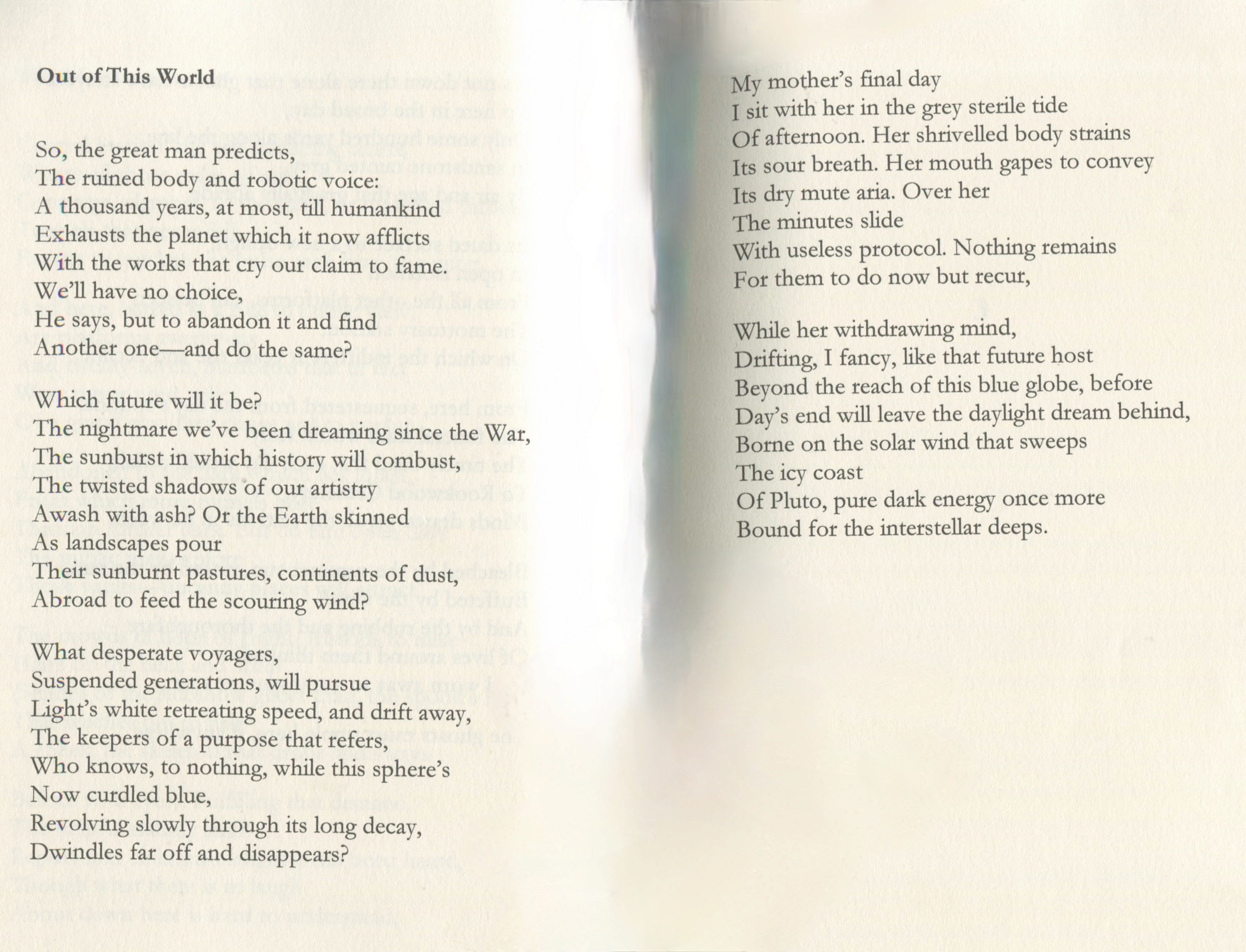
To pick one poem, here’s ‘Out of This World’ (pages 50-51). You can click on the image to open it in a new tab at a more readable size:

See what I mean about strict formal qualities? Each of these stanzas has eight lines. Most of the lines are iambic pentameters (that is, they have five two-syllable feet each); the lines that differ – the first, sixth and eighth line of each stanza – have three, two and four feet respectively. The rhyme scheme is abcadbcd; it may help understand the play of rhyme if it’s written abca-dbcd.

Each of the first three stanzas is a step in an argument: a) a prediction and a proposal; b) detail on the prediction; c) detail on the proposal. The fourth stanza ricochets unexpectedly, and the fifth arrives at an unexpected resolution.

So, the great man predicts,
The ruined body and robotic voice:
A thousand years, at most, till humankind
Exhausts the planet which it now afflicts
With the works that cry our claim to fame.
We'll have no choice,
He says, but to abandon it and find
Another one – and do the same?

The first two lines are mildly riddling: ‘the great man’ is of course Stephen Hawking. Shortly before he died in 2018, he predicted that our universe would eventually fade to darkness as the stars run out of energy, and he proposed that scientists might be able to find alternate universes. This stanza manages to evoke Hawking’s physical presence, put a version of his prediction and proposal into smooth verse (see above for what Clive James said about Edgar and science), and then challenge the proposal with a question that throws forward to the second stanza. It’s worth noting that, at least according to the report I linked to above, Hawking was talking about the end of the universe, whereas Edgar scales it back to the more imminent end of the planet, thereby introducing a moral element – the end of the planet is caused by the ‘works’ of humankind, whereas the end of the universe is due to inexorable processes. I guess that’s what my mother used to call poetic licence.

Which future will it be?
The nightmare we've been dreaming since the War,
The sunburst in which history will combust,
The twisted shadows of our artistry
Awash with ash? Or the Earth skinned
As landscapes pour
Their sunburnt pastures, continents of dust,
Abroad to feed the scouring wind?

The opening question may seem to be posing a choice, but it’s not so. This is not a poem for activists, nor is it an update of Robert Frost’s ‘Fire and Ice‘. The poem assumes that the prediction is correct, and catastrophe is assured; neither resistance nor preference comes into the question. There are two scenarios, nuclear holocaust and climate disaster, both of which have become more compelling in the actual world since the poem was published. Just as with Hawking in the first stanza, they are evoked by striking images rather than simply named. The effect is partly to draw attention to the poem as artifice, but also to invite an imaginative engagement with the predicted catastrophe(s).

What desperate voyagers,
Suspended generations, will pursue
Light's white retreating speed, and drift away,
The keepers of a purpose that refers,
Who knows, to nothing, while this sphere's
Now curdled blue,
Revolving slowly through its long decay,
Dwindles far off and disappears?

This stanza, step three, spells out Hawking’s proposal, again taking a familiar concept – this time a science fiction trope – and working it into the fore-ordained stanza shape. ‘Suspended generations’ neatly evokes those stories of spaceships full of people in suspended animation; ‘curdled blue’ draws great power from the way it evokes popular lyricism about earth as a beautiful blue planet. Unlike Hawking, the poem is pessimistic about the fate of the ‘voyagers’ – their purpose may lead to nothing. For all the strength of these images, and those of the preceding stanza, the poem is still fairly cerebral. And then, whiplash:

My mother's final day.
I sit with her in the grey sterile tide
Of afternoon. Her shrivelled body strains
Its sour breath. Her mouth gapes to convey
Its dry mute aria. Over her
The minutes slide
With useless protocol. Nothing remains
For them to do now but recur,

The focus shifts abruptly from the global to the intimate. The general ‘we’ in the first stanzas shrinks to ‘I’ and ‘her’. Where the strict adherence to form had a distancing effect in the previous stanzas, here not so much. There the effect is a kind of classicism – ‘what oft was thought but ne’er so well expressed.’ Here, powerful emotion is recollected, if not in tranquillity, then some time after the event. ‘Her mouth gapes to convey / Its dry mute aria’ brings the terrible scene vividly alive.

Much of the power of poetry can lie in what isn’t said. In this case, the gap between the third and fourth stanzas cries out for attention. I can’t be the only one who, having just read an evocation of the end of the Earth, comes to the line ‘My mother’s final day’ and thinks of Mother Earth. Probably more idiosyncratically, I thought of A D Hope’s 1958 poem, ‘On an Early Photograph of My Mother‘, in which the mother is Earth, and the vaporising effect of nuclear war is imagined. I’m not saying that Edgar had Hope’s poem in mind, but in my admittedly patchy knowledge of Australian poetry, Hope is the poet Edgar most resembles, mainly for his adherence to rhyming forms, but also for his interest in matters scientific and his occasional venture into the erotic (Hope’s ventures there were more than occasional).

Back to the poem. It resists the gravitational pull of the mother / Earth metaphor. Instead, her ‘withdrawing mind’ is likened to the desperate voyagers of the third stanza, and to the possible nothing at the end of their voyage:

While her withdrawing mind,
Drifting, I fancy, like that future host
Beyond the reach of this blue globe, before
Day's end will leave the daylight dream behind,
Borne on the solar wind that sweeps
The icy coast
Of Pluto, pure dark energy once more
Bound for the interstellar deeps.

The two parts of the poem are brought together, and though it might be tempting to see one of them as a metaphor for the other, it’s not that simple. Abstract emotion about the end of the world and immediate personal grief each has its own powerful validity, and they illuminate each other. Climate grief becomes intensely personal; personal loss becomes cosmic. Much of the stanza refers equally to the dying woman and the survivors of earth’s destruction: ‘daylight’s dream’ means both an individual life (Isn’t there a mystical tradition somewhere that says our life is but a dream, and reality lies elsewhere? If not, there’s certainly a children’s song) and the aeons in the human race has lived by the light and energy of the sun. ‘The icy coast / Of Pluto’ refers to both the planet, beyond which the survivors must go, and the underworld of the ancient Romans beyond the shores (coast at a stretch) of Acheron. ‘I fancy’ in the second line, while working nicely into the alliteration that is so striking in this stanza, declares that the poem is an artifice, but that in no way detracts from the pathos of the final lines.

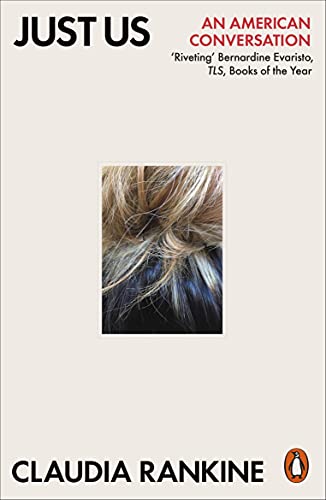
Claudia Rankine’s Just Us

Claudia Rankine, Just Us: An American Conversation (Penguin 2021)

This is a wonderful book.

Note to Australian (and possibly other non-US) readers: Don’t be put off by the book’s self-description as ‘an American conversation’. It is deeply, intimately USian, but Claudia Rankine’s mind is to be learned from and loved by anyone with a heartbeat. The book’s central question is how people can reach for each other in human ways given the horrors of racism that divide us – and racism isn’t a uniquely US phenomenon.

Note to white readers, especially white male readers: Though these essays are mostly about racism as enacted and mistaken for reality, don’t read them in the spirit of self-lacerating virtue or grudging worthiness. They are exhilarating, challenging, inviting, occasionally funny. Almost every essay is written as part of a conversation. People quoted in the essays (including white men and white women) are given right of reply, adding unexpected perspectives and enriching the conversation wonderfully.

The title is a pun. The first of the book’s two epigraphs is a line from Richard Prior’s stand-up comedy:

You go down there looking for justice, that’s what you find, just us.

In its original context, which you can see on YouTube, the line could be paraphrased: you look for justice in the criminal justice system but all you find is the targeting of Black people. Rankine’s use implies an additional possible reading: If you want justice, you have to find a way to make us all part of one ‘us’.

The book’s 19 essays and two poems are mostly printed only on the right-hand page of each spread. The left-hand page is sometimes blank, but mostly carries ‘notes and sources’, or images, or fact-checks. When a piece of police brutality is discussed on the recto, the verso might show how it was captured on camera. A general assertion on the right is backed up by statistics on the left. And so on. It’s an inspired design concept.

The opening essay starts with the author preparing to teach a class on whiteness at Yale University. After discussing some of what she asks of her students, the essay takes an interesting turn:

I wondered what it would mean to ask random white men how they understood their privilege. I imagined myself – a middle-aged black woman – walking up to strangers to do so. Would they react as the police captain in Plainfield, Indiana, did when his female colleague told him during a diversity training session that he benefited from ‘white male privilege’? He became angry and accused her of using a racialised slur against him. (She was placed on paid administrative leave and a reprimand was placed in her file.) Would I, too, be accused? Would I hear myself asking about white male privilege and then watch white man after white man walk away as if I were mute? Would they think I worked for Trevor Noah, Stephen Colbert, or Chelsea Handler and just forgot my camera crew? The running comment in our current political climate is that we all need to converse with people we don’t normally speak to, and though my husband is white, I found myself falling into easy banter with all kinds of strangers except white men. They rarely sought me out to shoot the breeze, and I did not seek them out. Maybe it was time to engage.

(‘liminal spaces 1’, page 19)

So we follow her as she shies away from the challenge a number of times, before finally hitting paydirt. On the way, she slips in a quick introduction to Peggy McIntosh’s popularising of the term ‘white privilege’, noting in passing that she would have preferred ‘white living’ because ‘”privilege” suggested white dominance was tied to economics’. She seamlessly invokes other scholarly and non-scholarly writing (including some excruciating Twitter threads). We hardly notice that we’re being educated as the suspense builds, and as a white male reader I found I had a lot invested in the project as well.

That essay sets the tone. Rankine is after conversation, not confrontation. She aims not to provoke defensiveness or denial but to learn something.

The subject matter of the following essays include revelatory moments in ‘diversity training’ workshops, including the one referred to in the quote above; her marriage; a meditation on Woman with Arm Outstretched, an art photograph by Paul Graham; white supremacist assumptions in the education system, specifically at her daughter’s school; the way different white and black people remember a cross-burning incident in her college days; a dinner party where she gets to be the ‘angry Black woman’ for insisting on the primacy of racism as a factor in Trump’s election; how racism plays out against Latinx and Asian people; and a brilliant discussion prompted by the moment at an all-Black dinner party when a professor asks her what to tell her black female students who bleach their hair blond. The essay on hair has the distinction of being the only essay/conversation where the right-of-reply takes the wind out of Rankine’s sails, when one of the young women under discussion gets to speak.

This book is evidently the third in a trilogy of sorts. Where this book is mainly essays, the earlier two are a mix of poetry and videos, sharing the subtitle An American Lyric. I haven’t seen Don’t Let Me Be Lonely (2004), but I was completely enthralled by Citizen (2014, my blog post here), so I came to Just Us with high expectations. I was not disappointed. The book opens the world up to great possibilities.

To give Rankine the last word, here’s part of the left-hand-page commentary on the final spread:

A friend finished reading the final pages of Just Us and said flatly, there’s no strategy here. No? I asked. Her impatience had to do with a desire for a certain type of action. How to tell her, response is my strategy. …
For some of us, and I include myself here, remaining in the quotidian of disturbance is our way of staying honest until another strategy offers a new pathway, an as-yet-unimagined pathway that allows existing structures to stop replicating. Until then, to forfeit the ability to attempt again, to converse again, to speak with, to question, and to listen to, is to be complicit with the violence of an unchanging structure contending with the aliveness and constant movement of all of us.

And here are the final lines on the right-hand page:

What I know is that an inchoate desire for a future other than the one that seems to be forming our days brings me to a seat around any table to lean forward, to hear, to respond, to await response from any other.

Tell me something, one thing, the thing, tell me that thing.

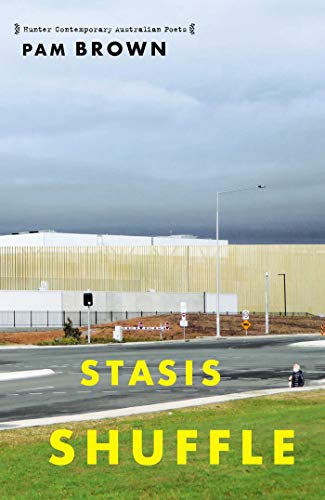
Pam Brown’s Stasis Shuffle

Pam Brown, Stasis Shuffle (Hunter Publishers 2021)

I had written quite a long draft about this book, and was despondent because it wasn’t going anywhere. Then I read this from one of its poems, ‘(all you can tweet)’:

life's more fun
---____---when you
---------don't know
what the hell
-you're doing

Sometimes it feels that way in Pam Brown’s poems – but not in a bad sense. I’m pretty sure she mostly has no idea where a poem is going to go when she starts it. But I took those lines as an instruction to myself: have fun with the poetry and stop wrestling with the task of describing it.

There’s a lot of fun to be had.

First, let me talk a little about the book’s naming conventions. The title of each of the book’s three sections, and every poem’s title is enclosed in brackets: so the first section title is ‘(one idea on each dragée)’, and I’ve already mentioned ‘(all you can tweet)’.

I don’t want to spoil your own fun in working these things out, but this is what I make of the brackets. I read them as signalling that there’s an arbitrariness to where one poem ends and the next begins. Not that they flow into one another so much as that each poem is made up of fragments which can take it on unexpected sidetracks, recursions, associative leaps, even just distractions, developing its field of meaning on the way. The book’s first poem, ‘(best before)’, describes itself as ‘slowly accreting’. It’s a process could go on indefinitely – but you have to stop sometime, imposing a metaphorical closing bracket.

The idea of a dragée is important. A note at the back of the book informs us that a dragée ‘is a bite-sized form of confectionery with a hard outer shell’ – often used for purposes other than consumption. The note mentions Mentos®. I went exploring and found that Mentos® dragées, which you and I would probably call lollies, sometimes come decorated with ’ementicons’. The accompanying slogan is ‘1 emoticon on each dragée’. (Click here for a short and mildly tedious video on the subject, and here for a slew of images). As I read it, PB has hijacked the phrase to describe her own poems, which are to be enjoyed like collections of small sweets, one more-or-less stand-alone chunk at a time, with a lone asterisk dividing the chunks from one another.

This isn’t a cheerful book. It starts out with a poem called ‘(best before)’ that is full of images of the end of usefulness, hospitalisation, the possible imminence of death, the absence of loved ones, a rodent, a general blanketing melancholia and lack of forward impetus. And it goes on from there.

But the gloom and melancholy don’t define it. At the launch of one of her books, Pam Brown’s reading was rendered almost inaudible by the football-watching cheers elsewhere in the launch venue. She commented that this was fitting for her poetry – it’s poetry that is full of distraction. It has mountain-goat agility, leaping from image to image, thought to thought, recollection to observation to self-questioning to mildly silly puns. To use a different image, it has bower-bird curiosity, picking up bright objects from the environment or from other people’s poetry and repurposing them.

It’s rich with references, some of which are partly explained in the notes up the back (like the Mentos®). Some of them can be googled, and I’ve learned about some odd corners of the universe by doing so. For example, ‘(best before)’ sent me off to discover the detail of the story of Robert Johnson at the crossroads). Others, if you don’t recognise them, you’ll just have to accept your non-knowingness. I’m a bit frustrated not to know who the title character from ‘(mme nhu)’ is, especially as she turns up in at least one other poem – I assume she’s not the first lady of Vietnam from the early 60s. But it doesn’t detract from my enjoyment of ‘(dingaling byways)’ that I can’t find anything online about the film named in these lines:

was
the limited theatre of thunder
---------the worst super8 film
--------------------------ever?------

I want to give you some examples of the lines that made me keep reading, and then rereading.

In ‘(best before)’, just as the poem is under way, the the poet’s critic-on-the-shoulder breaks in to question if it’s getting anywhere, and that interruption generates a lovely epic metaphor, which is then shrugged off:

the
it's-interesting
bla-bla

question is –

--is your slowly accreting poem
morphing into a larger cloud yet –

-a major poem
----ghosting in to sydney
--past the heads,
making its way to ashfield

--------darker & darker
birds swirling around in it -
------leaves
---------rubbish & debris
full of menace & meaning?

(what to answer –
----nup
-----or
-----I wish?)

---------*

A rare moment of autobiography in ‘(weevils)’:

you guess
----your gripes
are class-riddled –
-------------the déclassé
---------your cultural pretension

in the army
----where you're mostly from
rank masked class

This, from ‘(best before)’, captures a lot of Inner-West Sydney experience. It strikes a special chord for me – the landing planes fly even lower over my flat:

across the wetland
-a shirry whine

-------------big plane
gearing up for take off

warm winter night
all wrong

----you're not there
& that can be
------sad--- kind of

the roar of landing
--sounds like both
a blanket
---------& a shroud

Here’s a nice example of the bower-bird impulse, some gossip from the stars, in ‘(dingaling byways)’:

---------gina lollobrigida
----==----kept her films
------------in the fridge

solomon & sheba
next to dog food
beat the devil
with wilting celery

I hope the melancholy has lifted in the years since these poems were written. Failing that, I hope that this indispensable poet can continue to beat the devil, even if she feels she’s doing it with wilting celery.

Ouyang Yu’s Terminally Poetic

Ouyang Yu, Terminally Poetic (Ginninderra Press 2022)

Every now and then someone on my Twitter feed shares an angry response to a rejection letter from a literary magazine. These responses generally assert that the rejecting editor is too stupid, racist, sexist, transphobic or something of the sort to have recognised the brilliance of the rejected work. In my time as editor of a children’s literary magazine, such responses were rare, but they certainly never made us think we might have been mistaken.

Here’s one editor’s take on such responses:

Much of Ouyang Yu’s Terminally Poetic could be read as making poetry out of that kind of letter. The persona in these poems rails against poets who are famous (Les Murray is singled out a couple of times), against the useless sadness of ancient Chinese poets, against editors who say they want to publish work that will sell, against editors who ask that a submission be accompanied by a stamped self-addressed envelope, against editors who are white or coloured, against the notion of revising poems, against literary prizes, against the dominance of white people in the Australian literary scene, against the intrinsic mediocrity of Australian poetry, against people who don’t pay him enough attention, against himself.

The poems were written over three decades. A couple of them self-identify as written in 2000; one calls for Australia to emulate the 2000 coup in Fiji; one (‘Temporarily Untitled’) starts with a bald account of a murder-suicide by a poet, who a little googling identifies as Chinese poet Gu Cheng in 1993, making it perhaps the earliest poem in the collection. It begins:

the news came that the poet died
he had killed his wife and hang himself on a tree outside the house

on an island not far from auckland
called something i can't remember at all

because it is difficult to pronounce

The offhand disrespect of these lines is all too typical of the book (the unconventional/incorrect ‘hang’ is less so). It may be a sign of youthful harshness, but as the poems are presented in alphabetical order of title – from ‘About poetry’ to ‘Written by one who doesn’t know how to write poetry’ – there’s no telling if there is any mellowing with age.

This is an unpleasant book. It means to be. It’s also an insider’s book. Even though the speaker of the poems positions himself as an outsider, his attention rarely moves out of the world of literature and publishing. It won the Judith Wright Calanthe Award for a Poetry Collection in the 2021 Queensland Literary Awards. I couldn’t find the judges’ comments online, and I’m curious about their choice.

When I blog about poetry collections it’s my practice to single out one poem for a closer look. Here’s one of the few poems in this book that isn’t about the poetry world:

(Maybe this appeals to me because I cherish childhood memories of coming home from a movie and peeing in the yard in the moonlight with my father and brothers while my mother and sisters took turns at the toilet inside.)

The heart of the poem is the moment when the speaker is taken by surprise by the moonlight and the edible-looking streetlights. I know hardly anything about classical Chinese poetry, but I understand that there are many poems about the moon and moonlight, including the one at this link by the great Li Bai. I can’t help but read Ouyang Yu’s poem in the context of that tradition.

But before we get to the moonlight, there’s ‘a long dream of dreaming of toilets’ in ‘the unconscious hours of the night’. It’s not just sleep, but unconsciousness. It’s not just a dream, but a dream of dreaming. He’s deep in the dream, dead to the world as we say. The syntax of what follows is muddled: read literally, the speaker is ‘turned away by closed doors or crowds of pissers’ after he gets up to relieve himself. This captures so well the muddled state of waking from a deep dream, especially perhaps a dream of pissing, the way the dream pulls you back to itself.

In the two middle stanzas, the speaker goes to the real toilet, and he momentarily forgets bodily functions because the moonlight is there. And then there are the streetlights, like juicy oranges, and the stirrings of some unnamed, hunger-like desire. In these stanzas he comes fully awake to the world in the silence of the night.

In Li Bai’s poem the speaker looks down to see the moonlight like frost on the ground, looks up at the moon, looks down again. This poem has a similar movement: the speaker looks down, metaphorically, at his bodily need; looks up at the moonlight and the streetlights; then looks down again, to pee (this poem definitely assumes a male body). Then there’s a moment’s reflection. Li Bai thinks of his homeland, evoking the yearning of nostalgia. In Ouyang Yu’s poem, ‘shiveringly’ refers to the cool of the night, but it also suggests an emotional moment. The final line, banal and bathetic at first glance, is just surprising enough to give the reader pause: what does it mean to wonder about life without toilets? I take it to be an oblique way (a very oblique way) of giving thanks for a tiny moment of appreciation of the beauty of the world, perhaps even of transcendence.

I haven’t read any other of Ouyang Yu’s many books of poetry. I hope they are full of such moments.


I am grateful to Ouyang Yu and Ginninderra Press for my copy of Terminally Poetic.

Two Flying Island pocket poets

The Flying Islands Poetry Community has been publishing pocket-sized poetry books (14 x 11 cm) for more than 10 years. According to its website:

The Flying Island Pocket Poets series originated as a simultaneous entity in Markwell, NSW and Macao, China, through the work of Professor Christopher (Kit) Kelen. Running since 2010 (in association with the Macao-based community publisher, ASM), Flying Islands has published more than eighty volumes, with authors from all over the world, but more from Australia and China than from anywhere else.

We can subscribe from within Australia for $120 to receive a year’s publications (details here). From the beginning of the series, the RRP for individual copies has been kept to A$10. But that’s not all. To quote the website again:

These books that magically appear out of pockets are part of a gift and exchange art-economy. They are our currency! 

Those aren’t just empty words. It was through versions of the gift and exchange art-economy that I found out about the Pocket Poets series, and came to possess, and read, two of these niftily designed books.


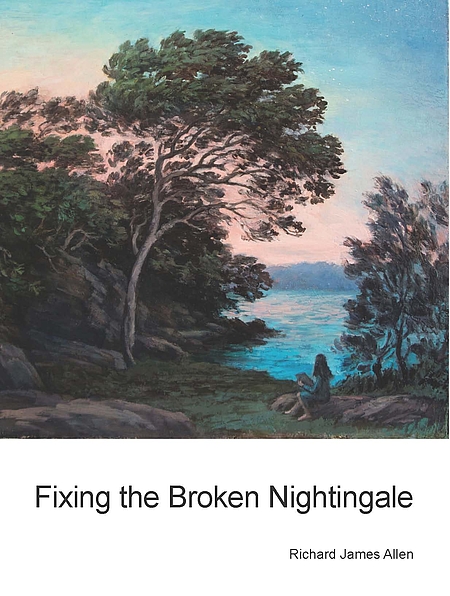
Richard James Allen, Fixing the Broken Nightingale (Flying Island Books 2013)

At a poetry reading in Sydney a couple of years ago, Richard James Allen read his poem ‘It’s Saturday night in almost any city in the world and’, and offered a prize for whoever could guess the city in which he wrote it. The audience called out the names of almost every city in the world, but I was the one who finally shouted, ‘Florence!’ and won the prize, Fixing the Broken Nightingale, which did seem to magically appear out of a pocket.

There’s a rich variety of poems in the book, ranging from straightforward love poems to poems that turn back on themselves like Escher drawings. There’s whimsy and melancholy, moments of ontological despair and intimations of mortality. The most striking poem is ’13 Acts of Unfulfilled Love’, which has some extraordinarily explicit sexual images, to arrive at this, in ‘ACT TWELVE‘:

These are my real thoughts,
not my dirty thoughts.
______________________ ____________This is my real love,
_________________________ ____________not my dirty love.
I am trying to live a real life,
not a dirty life.
_________________________And I'd like you there with me,
_____________________________in this soiled, holy world.

Kit Kelen, A Pocket Kit 2 (Flying Island Books 2015)

When I bought a copy of Kit Kelen’s Book of Mother at its launch in Sydney, neither of us had correct money. This little book materialised as if by magic to be my change.

It’s very different from Book of Mother and from other books of Kelen’s that I’ve read (blog posts here, here, here and here). As the title suggests, it’s a kind of sampling of his work, rather than a collection organised around a central subject or theme. A first Pocket Kit was published in 2011.

This is mostly a cheerful book. There are poems celebrating elements of Australian culture, like ‘Blokes’ (‘They know it’s bad luck to speak / when gesturing would do the trick’) and ‘shed’ (‘the peasant is the king here / where monarchs tinker with old crowns / no need for revolution’). The same ironic celebratory tone comes to bear on Macau where Kelen was a professor when this book was published, on his Hungarian heritage, on the prospect of having children, on the yellow umbrellas of Hong Kong in 2014.

My favourite in the book is ‘to tend’. If I remember correctly, Kelen like me had a Catholic childhood. This poem delicately addresses the question of what to do about the gap created when you stop believing. It starts:

to tend the gods as given, as found
new habits of homage are required

in word untamed, in sight unframed
paths to follow are so chosen,
by you, for you, willing, blind

go to the makers
not to the mockers
take the trouble to tell them apart

And ends:

go to the makers
never the mockers

tend to the habits of homage
you've found

Even though Kelen can begin a poem called ‘ancestor worship’ with ‘people smelt bad in the old times / they had bad teeth, they were stupid’ and can continue in that vein for 20 lines, he is certainly one of the makers, not one of the mockers.

Les Murray’s Continuous Creation

Les Murray, Continuous Creation: Last Poems (Black Inc 2022)

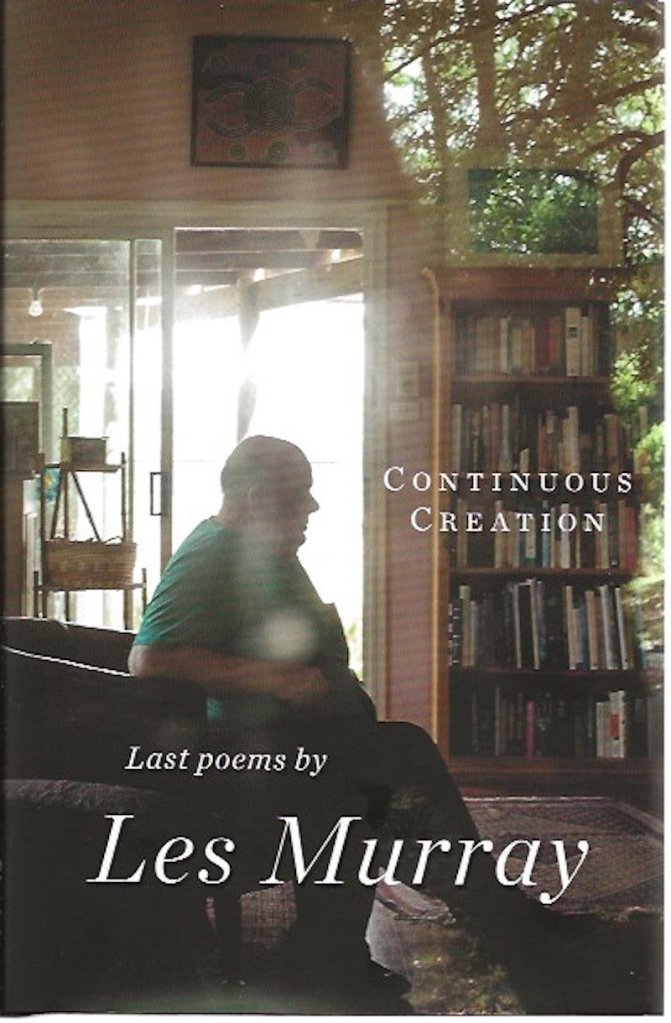
This beautifully designed book is a fitting way to honour the 2019 passing of a poet who loomed large in the Australian cultural landscape. The cover photograph is an inspired choice. Les Murray, seen in profile and lit from behind as if about to disappear from view, is alert and seems to be preparing to stand up. We see him through glass, so that the bookshelves, family photographs and artworks in the room blend with the bright green reflections of the outside world. Scholarship, engagement with the non-human natural world, his particular breathiness are all suggested. The photograph was taken by Murdoch press journalist Amos Aikman, while the book is published by Black Inc: Murray’s affiliation with political reaction hasn’t stopped the left-of-centre literary establishment from honouring him with this publication.

The poems are preceded by a Note on the Text by Jamie Grant: some time before he died, Murray told Grant that he had about two thirds of a book ready to go. After his death (longer than it would have been in the absence of a pandemic), Grant visited Murray’s home to find a folder of poems that had been typed by Murray’s wife Valerie, and a box filled with a jumble of handwritten poems, some of them in many versions. The contents of that folder and box, with some judicious choosing among versions in the latter, have become the contents of this book.

I’ve loved some of Murray’s poems since first hearing him read them in (I think) the early 1970s – ‘A Perfectly Ordinary Rainbow’, ‘The Buladelah-Taree Holiday Song Cycle’, the one about blowing up trees as young men, or the one about eating curry somewhere in Britain. I’m also a bit of a hater, starting with the ‘humorous’ homophobic quatrain he regularly read along with the ‘Rainbow’. I found much to love and hate in this book as well, though ‘love’ and ‘hate’ may be too strong in both cases. There’s nothing as brilliant as his most brilliant poems, and nothing as terrible as his most anti-modern barbs.

There are aphorisms (including the title poem), odd moments of Australian history and autobiography, pronouncements on culture and politics, descriptions of natural phenomena and works of art – all conveyed with Murray’s characteristic love of wordplay, often with elements of puzzle, and his terrific ability to make us see things. ‘A Friendship’ stands out as a straightforwardly affectionate elegy for Bob Ellis.

Here’s ‘Dateline’, one of the poems from the jumble in the box. (As always, I’m assuming permission to show the poem here, even in this poor quality phone photo, and will happily remove it if the copyright owners ask me to):

The first three stanzas include examples of Murray’s gift for visual metaphor. At different stages and from different points of view, the floodwaters are like old-time washerwomen, like a mirror, like windribbed parchment. Reading these, we know that the poet has looked with fresh eyes, and invite us to do likewise.

The opening stanza is strongly visual: trees and shrubs are dumped in the creek and swirled around like laundry, letting wrack dribble downstream like dirty suds. But the words bring more than the visual. Washerwomen, especially ‘old-time’ washerwomen, belong in Dickens or Wind in the Willows (Toad disguising himself is probably the first time I heard the word). That and the verb ‘souse’ identify the poem as ‘literary’, in the English tradition. This is worth saying because Murray has been called ‘the last of the Jindyworobaks’, meaning that he sets out to write in continuity with First Nations song and story. The label is at best only partly correct. (Incidentally, I expect if he’d had a chance to revise the poem further, Murray might have changed the second line to ‘floodwaters are sousing trees and shrubs’ so that the ‘their’ in line 4 would work syntactically.)

Paradoxically perhaps, the second stanza brings us closer to the action by pulling back from description. Watching the floods, who could avoid remembering the drought? Then, another visual effect: the rain isn’t just ‘refilling the land’ (what a lovely phrase). It sits on the roads, reflecting the sky.

Human effort gets its pages turned

This is the poem’s key line. In the short term, it means that effort earlier put towards dealing with drought must now be directed towards flood mitigation, relief and recovery: the humans aren’t the ones who determine where their effort needs to go. Before any wider implication can be absorbed, the stanza moves on to the striking image of towns blanked (not blanketed) in water. I’m pretty sure ‘windribbed’ is one of Murray’s inventions – beautifully capturing a metaphorical link between agitated floodwaters and ribbed fabric, which is then further complicated by calling it parchment.

Murray’s fascination with linguistics now swings into action:

We are hearing Tornado and Tsunami

at home, words unknown in teapot times.
Downpour and Inferno are states
that people drive between

‘Teapot times’: in the olden days when people around here (‘at home’) drank tea rather than coffee, and brewed it in pots, before teabags became all but universal. Back then, people in Murray country didn’t use words like ‘tornado’ or ‘tsunami’; now they are part of the language, and have assumed enough presence to require initial capital letters. The language has changed. And so has the reality: ‘Downpour’ and ‘Inferno’ may not be new words in quite the same way, but they too have taken on initial caps – they have grown from occasional events to states.

I read the reference to senators as one of Murray’s kneejerks attacks on politicians: the floods mean people lose their whitegoods, and somehow, by Murray’s anti-politician logic, they cast aside their political representatives as well.

The next lines are the reason I chose this poem to talk about:

Global warming's chiller winters
rule both hemispheres. Arizona snow golf,
Siberian wheat, English vineyards
stricken by blizzard in their chardonnay.

I may be confusing Murray with Clive James here, but I’m pretty sure both of them have been climate change deniers. Murray has certainly echoed some right-wing talking points about environmental issues. It may be of course that the oxymoronic ‘global warming’s chiller winters’ is meant to sound a note of scepticism, but that’s not how I read it. By the logic of this poem, we move from a page being turned on human effort, to new language being needed for new circumstances, to the naming of a general cause. Climate change is real, it rules the planet. The floodwaters in Murray country are part of the same general phenomenon as weather events in the US, Asia and Europe. Human effort is getting its pages turned in a big way: humans may see themselves as dominating the planet, but ultimately we are not calling the shots.

It’s hard not to read the final word of this stanza as carrying the ‘anti-elitist’ tone of much right-wing rhetoric: you know, the inner city types who drink their lattes and sip their chardonnays. Is there a slight hint that the arrogant are getting their comeuppance in these events? If so, does the opening image of the floodwater as washerwomen take on a deeper resonance? Is global warming a case of abused and despised nature rising up against human entitlement and privilege? And where does that leave the poet, that he can say ‘their’ rather than ‘our’?

If that was the end of the poem, it would be a satisfyingly unsettling whole, implicating the poem’s speaker in the current global disaster, while holding up to the light one of the ways we avoid facing the reality.

I’m not convinced that the last six lines, which fall after the page is turned, are part of the same poem. But it certainly reads as if Jamie Grant and the editors thought so. In that case, the poem veers off in a new direction, justified perhaps by the title ‘Dateline’: this is the kind of piling together of disparate issues that happens in a news bulletin. Climate warming is the main story, but meanwhile class discrimination continues, in sports and the arts, something curious happens in the Sahara, and there’s a snippet of good news involving a baby (something cute to end the bulletin with), even if it is against the background of that AIDS epidemic. And if the last couplet isn’t an alternative, preferable version of the preceding one, which would have been my editorial guess, it reiterates the exotic and good news – this time perhaps, thanks to the repetition, conveying a glimmer of hope.

Kit Kelen’s Poor Man’s Coat

Kit Kelen, Poor Man’s Coat: Hardanger Poems (UWAP 2018)

As I think about this book of poetry, the word ‘immersive’ comes to mind.

‘Hardanger’ in the subtitle is not an uncompromisingly hostile state of mind but a place, the Hardanger Fjord in Norway, where Kit Kelen evidently spent some time and, it seems, let the place generate poems in him.

These lines appear on the book’s title page:

the forest is the poor man's coat
keeps off the worst wind's bite

step in – let other worlds elapse
follow the trail of light

They offer an explanation and an invitation. The first line explains the title in what sounds like a folk saying, which in another context could be a lament for the poor man’s exposure to the elements, but here asserts that forest provides protection. We are invited to step into the book, as into a forest, for an alternative to whatever other worlds we inhabit. The book is offered to us as respite. That’s where my sense of immersion comes in: poem after poem offer glimpses of restorative calm, mostly in the Norwegian landscape. It’s the closest thing I’ve found in a book to walking in the bush.

Not that it’s all cosy, and far from humourless. As in ‘sweet’ (page 100):

sit zazen
and you'll draw mosquitoes
from the thinnest air

There are poems about death as well as poems describing the view of the fjord from a mountain top; poems of autumn and winter as well as summer; a lot of rain. The poet spends time in the small town of Ålvik, visits museums in larger centres, and riffs on the gravestones in a local cemetery. There’s often a sense of language not being quite up to capturing the experience of being in nature: sentences trail off, though we usually more or less know how they would have ended; or they miss their opening words. It often feels easy, throwaway, as if the poem just happened, the thought or feeling or spectacle effortlessly caught on the wing. But, of course, that’s the apparent ease of a virtuoso.

Though these are overwhelmingly poems that respond to a place, I found myself brooding on the small section of ekphrastic poems – that is, poems responding to paintings. They raise the interesting question: can you really appreciate such a poem if you haven’t seen the painting it refers to? Like the poems of place, there are three elements present when you read the poem: the words on the page, you the reader, the place or work or even referred to – and the ghost of the poet who put the words together. With poems of place, at least the ones in this book, you don’t need to have been there to appreciate the poem. (Just like you don’t need to have been in love to enjoy Robert Burns’s ‘A Red, Red Rose’.). Take the poem ‘the fjord like laid paper’, whose title doubles as its first line, which begins:

the fjord like laid paper

a ship rules a line
the only thing straight
in all the world turning

If you’ve stood and looked out at the fjord on such a calm day, you will read that differently from someone – like me – who has never been to Norway. For me, it primarily conjures up an image; for you, perhaps, the main thing is the simile/metaphor. Either way, the effect of the poem is to bring a vivid image of the fjord to mind, and I don’t feel any need to fly to Norway in order to understand the poem. (I do feel an impulse to go and see the places for myself, but that’s a different matter.)

When the subject s a painting, though, it’s a bit different. Take ‘Cowshed Courting’ (page 148), which refers to a 1904 painting by Nikolai Astrup that hangs in the Bergen Museum:

If you read this without seeing the painting, you’re left pretty much groping in the dark. I’m grateful that Kelen has named the painting in his title rather than calling the poem something like ‘After Astrup’, and I’m grateful for the internet, because it was no trouble at all to find an image of the painting online.

The opening lines have typical Kit-Kelen syntax:

fin de siècle light they caught then
we still breathe – it's unnatural

A conventional phrasing might be, ‘They caught a fin de siècle light then, which we still breathe, even though it’s unnatural.’ But the syntax serves a purpose: it reflects the process of seeing the painting. You begin with a general impression to do with the quality of the light, which makes you realise that this painting belongs to a particular era (fin de siècle, the end of the 19th century); next you have a sense of the painters of that time – no more specific than ‘they’, because after all this isn’t an art history essay; but having seen it as belonging to its own time, you realise that this painterly light still feels to us as familiar as the air we breathe – familiar but all the same artificial / ‘unnatural’.

The artifice has a purpose, as the viewer’s eye finds the figures on the left, and the brightest spot of colour in the image:

the colour's captured
a passion in the cowshed
rose cheeks and have you in my arms
deep pockets of brandy for inspiration

From the woman’s cheeks, the eyes travel over the figures. The poet projects himself into the image, identifying with the male figure and reading the bottles in his pocket as ‘inspiration’. (A different viewer might see those bottles in a less benign light, but that’s not this poem, or at least not foregrounded here.)

Then we’re taken on a tour:

never mind the pong
someone's peeping from the loft

A vague look to the right of the courting couple – yes, we notice that there are steaming heaps of cow poo all over the floor of the shed. Then we travel clockwise up to the top of the frame, and oh, there’s a creepy voyeur – a peeping tom – unnoticed until now. If the poem was a sonnet, this would be the volta, the turn. A poet less sure of his effects might have inserted a line space here, to mark the discord. But we move on without comment:

no glass but spring shines through the window
past which dung's piled – verdure and ordure

Only now do we come to the geometric focus of the painting, the window through which we can see a dung heap and beyond it some vague greenery. This is the source of that light we first noticed, and there’s an ambivalence to it: dung and greenery, ponginess and light. The assonance (if that’s the word) of ‘verdure and ordure’ reminds us that these things are intimately connected.

Our eyes travel down to rest on the middle of the image – the row of cows’ rear ends, and the unswept floor.

hear it ringing from the rear of each
and the floor steams unswept

Astrup doesn’t show the cows decorating the floor (surely ‘ringing’ is the politest term ever used for the sound of cows shitting), but Kelen gives us an aural equivalent what he shows, just as the earlier ‘pong’ has given us an olfactory one.

In the last line, our eyes travel back to the figures:

days are barefoot now

There’s a sense of completion as the poem finishes its circuit of the painting, from the woman’s cheek to her feet. With characteristic apparent ease, it has introduced a number of pairings: the pong and the ringing; the passion and the peeping; the verdure and ordure; the man fortified with brandy and the woman barefoot and vulnerable; then and now. That last pairing has a lovely complexity to it: in the opening lines, ‘then’ is the time of Astrup and ‘still’ is our time; ‘now’ in the emphatic position as the poem’s last word may refer to the changing seasons implied by the mention of spring in line 9, or it may again be contrasting the time of the painting with modern times when courting doesn’t have to happen in secret in cowsheds, but the whole day – the world outside the window – can be barefoot, open to intimacy.

The poem has made me look closely at the painting, and I may well read it differently from Kelen. In fact, by naming the peeper and then moving on quickly, the poem almost invites an argument. But in Kelen’s reading, or at least in my reading of Kelen’s reading, the painting, and so the poem, celebrate the way love can thrive in unlikely circumstances, and not be tarnished by prurient attention to it. The peeping tom is noticed and then ignored. The dung helps the greenery to grow. The poem gives shelter from ‘winter’s worst bite’. I don’t know that I could have understood any of that from the poem without reading it with the image open beside it.

Having written all that, I really should show you the image as well:

Kit Kelen’s Book of Mother

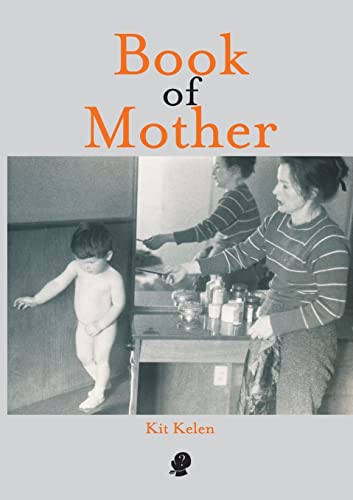
Kit Kelen, Book of Mother (Puncher and Wattmann 2022)

Dementia is becoming a major theme of story-telling in the 21st century. I can think of four excellent movies without even trying, the most recent being Everybody’s Oma, which I’ve seen at the Sydney Film Festival since reading Book of Mother. In poetry, Hawaiian poet Susan M Schultz’s Dementia Blog (2008), among other things, vividly evokes the social life of a dementia ward.

The Book of Mother is a substantial addition to this writing. The back cover blurb describes it well – it reads, in part:

This book is an intimate encounter with dementia as lived experience. Words are an important way into the world and when we begin to lose them we find ourselves with fewer tools and fewer familiar signs to go by. Phrases lost and tip-of-the-tongue half-forgettings – loose threads like these belong to the everyday business of knowing who we are. They are also the nuts and bolts of Kit Kelen’s poetry. A long play record of memory and its tricks, one comes to and from Book of Mother with always some questions about who is talking to whom, about when we are where, about whether we wake or dream.

There are a number of poems about lost keys – emblematic of dementia’s multitude of minor frustrations, for both sufferer and carers/relatives – whose titles are almost enough: ‘the keys are gone again’, ‘no one else has put them anywhere mum’, ‘you have hidden them’.

At least three poems had me in tears. ‘everything will be taken from us’ is a lament that speaks to the grief that accompanies the gradual loss of a loved one to dementia. ‘she’, the longest poem in the book, celebrates the poet’s mother as an individual and as an archetype of all mothers. It begins:

she

who had supernatural powers
who knew what Christmas wanted
what naughtiness was and was not

she who said wait till your father gets home
she who was a step before
could spell every word there was
and we could add things up together

vale mum’, the final poem, is an elegy that includes this wonderful image:

like lost at the Easter show
and a voice comes over the air
says this is how it is from now
your mother – all mother – is gone

For me, the power of the book comes from the cumulative effect of poems where the language feels as if it’s falling apart, in counterpoint to a number of poems in which a very young person’s language is coming together. That is, along with poems that document his mother’s decline, Kelen gives us poems about his own dawning grasp of the world through language as a small child closely connected to his mother. That may sound like an imposed schematic, but it reads as organic: being confronted with the present situation, the mind naturally goes to the past. As a reader, I found the transition between the two kinds of poem disorientating in a way that adds charge to both.

I love this book. If I was to recommend a single poem, it would be ‘everything will be taken from us’. Sadly, it’s too long for me to quote here with a good conscience, and I can’t find it online, but if you happen on the book in a bricks-and-mortar bookshop, turn to page 75, and read this one, aloud if possible. It won’t take long, and it may inspire you to buy the whole book.

Meanwhile, here’s ‘in a waiting room’, a short poem that may give you a sense of the book’s shape-shiftiness:

This poem may take a little puzzling before it yields itself to the reader, but it’s not at heart a puzzle to be solved.

The title and first four lines are clear enough.

to make you happy
for your own good
because we love you
because I can't explain

We are in a waiting room, where someone is responding to a question, something like, ‘Why have you brought me here?’ Read in the context of this book, the lines could be spoken by the carer for a person with dementia or to a child. That is, it could be a poem about the poet’s mother, or one about a childhood memory. Or, perhaps more interestingly, it could be both. Either way, the lines give four different answers to the same question – the questioner, whether it’s a child who is unsatisfied with each successive answer, or the adult with dementia who doesn’t remember the previous answer, keeps on asking.

The next line maintains the ambiguity:

won't remember your hand was held

Anyone who has lived with or cared for someone with dementia will recognise the experience this neatly evokes. No matter how many visitors they’ve had, no matter how much hand-holding, they will still say none ever comes to see them, no one ever holds their hand. But equally the owner of the hand could be a child – in this book, the poet himself in memory – whose adult memory doesn’t include a hand being held. The omission of a pronoun at the start of the line is worth noting. Even though syntactically the line can’t be read other than, ‘[You] won’t remember’, by not giving us the ‘You’, the poem increases the shifting-sands feel.

Though I generally treasure clarity in writing, and see ambiguity as something to be avoided, it’s the double possibilities in these lines that I love. It could be either thing, which means that the two things are similar, which – in this context – suggests that when you relate to a person with dementia, your own hold on reality can begin to shift, or memories may surface of times when you were similarly dependent, confused or failing to understand. The poem takes the reader gently into that border state.

Then, there’s this:

in yellow light
dinosaurs confer
smoke clouds them
or at cards

After a moment’s pause (or, to be truthful, a couple of days), I read this as a description of the waiting room. Perhaps it’s wallpaper, or a painting – of dinosaurs in a cloud of cigarette smoke, playing cards? A google of “dinosaurs playing poker” comes up with plenty of images. It’s not hard to imagine one in a doctor’s waiting room. To repeat myself, though, the pleasure here isn’t in having solved a puzzle or deciphered a cryptic set of words to settle on a clear meaning. It’s in the state of mind before the image is understood. I suppose it’s analogous to the couple of minutes when you savour a weird dream before understanding that it’s just a rehash of something banal that happened the day before. More to the point, it’s like when you have a memory in the form of a striking image, and it takes a while to make sense of it by remembering its context.

here elephants trumpet about
giraffe pokes in a head

The weirdness continues. Perhaps it’s another painting on the wall. This could be a waiting room for either a child or a person with dementia. If a child, these are the details of the waiting room that stand out as interesting, and return as memories when you’re an adult poet. If a person with dementia, they are the disturbing and disorientating features of the environment.

stood by the fire
too close
to beginning

The first two lines here give the reason the person (whose hand may or not have been held) is in the waiting room. They have stood too close to a fire. Then the phrase ‘too close’ does double work, introducing the third line: he stood too close to the fire, and he was also too close to his own beginning, that is to say, too young. And with that line, the poem’s main ambiguity is resolved. This is a childhood memory.

peg in the board where everyone fits
that was my Day at the Zoo

Oh, the elephants and giraffe weren’t in a painting after all. They were part of a board game, Day at the Zoo. This last couplet has an air of finality, like the ending of a child’s composition. Almost smugly, the mystery of the images is cleared up. The memory is reclaimed in full. The ‘your’ becomes ‘my’. Read in the context of the whole book, there’s also a sense of relief: in this case, the weirdness, the things that aren’t understood, have been resolved.

Then you turn to the next poem, ‘forget a thing and it’s gone’, and we’re back to dealing with dementia.

In an earlier version of this blog, I tried to capture things that happened with language with Mollie, who was living with us and with dementia. This extraordinary book does that with wonderful compassion and love, as well as wit, precision and, I guess the word is delight.