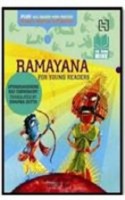
Upendrakishore Ray Chowdhury, Ramayana for Young Readers (translated by Swapna Dutta, The Book Mine, Hachette India 2013)
tl;dr: If you’re as ignorant of Indian culture as I am, this book will go a long way to filling gaps. You can buy an ebook from Hachette UK for less than $20 Australian.
The Ramayana, one of the two great epics of Hinduism, dates from well before the common era and its images and characters permeate Indian and related art. Most moderately literate westerners are at least vaguely aware of it, and have surely encountered art derived from it: monkeys battling demons in the Balinese Kecak dance; images or reliefs of Rama and Sita, possibly with a golden deer; paintings and statues of Hanuman the monkey god carrying a mountain; Javanese shadow puppets; chants of ‘Hare Rama’ in western city streets. But few of us have read even a fraction of its 24 thousand verses. This little book, just 165 small pages plus some child-friendly notes, is of course no substitute for reading the original Valmiki Ramayan, but it does tell pretty much the whole story, and enables us to put those fragments in context.
The Chheleder Ramayan, the Bengali book of which this is a translation, has its own distinctive history. Its author, Upendrakishore Ray Chowdhury (1863–1915), was a famous Bengali polymath, friend of the even more famous Rabindranath Tagore and grandfather of filmmaker Satyajit Ray. He had a personal mission to make literary works available for young people, and retold not only the Ramayana but also the other great epic, the Mahabharata. He’s not the only one to have retold these works. Indeed, the translator Swapna Dutta lists several Ramayanas that she has read. But his retelling holds a special place as a project to make the story available to early 20th century Bengali-reading children. This translation makes his Ramayana available in English for the first time.
Like all epics, it contains an awful lot of fighting, so much so that at times it reads like the script for a computer game. In the great climactic battle between the monkey army and the demons, you can almost see the game move up a level, as the lower ranking warriors are all killed or worn out and the next rank come to the fore with increasingly powerful weapons, until at the end it is the two mighty figures of Rama and Ravana facing off with nuclear-level arsenals. I have no idea how this plays out in the original, or how gripping it would be for a young western reader with no prior knowledge of the characters or the different supernatural beings, but even though I was never in doubt who would prevail, I stayed engaged.
This Rama is not a god, but an extraordinary man. His great prowess as a warrior is overshadowed by his superhuman sweetness. The story is set in motion when one of his father’s wives, incited to jealousy by an Iago-like maid, tricks King Dashratha into denying Rama his birthright as heir to the throne and sending him into exile. While Rama’s mother, the people of the kingdom, and Rama’s brothers, including the brother who is to be king instead of him, urge him to resist this manifestly unjust treatment, he refuses and accepts his father’s decrees with extraordinary persistence. He is a model of kindness, forgiveness, trusting openness.
The story stands by itself, but it’s all the richer for the many echoes (or are they foreshadowings?) of episodes from other great tales like The Iliad, tales of Greek, Roman and Norse gods,or the biblical the story of David.
My copy came free from Hachette India, and Swapna Dutta is a friend of mine from my days as editor of a children’s magazine. Swapna and her publisher have given me a great gift. There’s a preview on Google Books, and you can buy an ebook or a hard copy from Hachette UK.
Many good things happened in my life this year. Possibly the biggest was that Ngurrumbang, the short film whose screenplay I co-wrote with my elder son, was screened at three festivals in Australia and one in Europe, with Flickerfest still to come. But here are three relatively lazy looks at the year that’s just finishing.
One: The first sentence (or sometimes the first two sentences) of the first blog post for each month:
January: Whatever the ghost of Rembrandt might think about the state of Dutch art in the early 21st century the arrival of Florentijn Hofman’s magnum opus in Darling Harbour today was a hit, even after the seeming endless and mostly lame concert and tumbling act that preceded it.
February: I heard Paul Ham speak about this book [Hiroshima Nagasaki] at Gleebooks early last year.
March: Geoff Lemon, co-editor, was surely tempting fate and the critics when, as soon as the 32nd issue of Going Down Swinging was complete, he nicknamed the impending Nº 33 the Jesus Issue.
April: I recently heard a distinguished novelist claim that she grew up believing New South Wales was mostly settled peacefully and that damage to the original inhabitants was largely unintended, caused by infectious diseases and the like.
May: The launch of this book [Pam Brown’s Home by Dark] last weekend was a convivial affair in an Erskineville pub.
July: I was extremely lucky in the timing of my university studies. I started at Sydney Uni in 1967 when, because of an overhaul of the New South Wales school system, only a very small cohort had graduated from high school the year before.
August: After Karl Ove Knausgaard’s mountains of mundane detail, we wanted our next book to be one that spins a great yarn.
September: It’s about two and a half years since we moved home. About a year ago, the grass tree (Xanthorrhoea) that had stood outside our kitchen window in the old house was ailing in its new location – most of its fronds were brown or browning.
October: This book [Contemporary Asian Australian Poets edited by Adam Aitken, Kim Cheng Boey & Michelle Cahill] seems to be part of a current efflorescence of attention to Asian Australian writing, and of Australian attention to Asian writing.
November: It’s November, and once again, while all over the world people with stamina take on NaNoWriMo, I’m setting myself the modest goal of 14 sonnets in the month – LoSoRhyMo (Local Sonnet Rhyming Month).
December: As Vagabond Press’s beautifully crafted Rare Objects series of chapbooks approaches its hundredth and final title, Jennifer Maiden makes her debut at Nº 95.
Two: Top Ten Movies (in no particular order)
Me
The Art Student
Philomena (Stephen Frears)
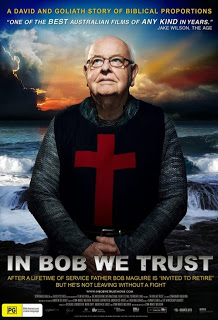
In Bob We Trust (Lynn-Maree Milburn)
Blue Jasmine (Woody Allen)
Stories We Tell (Sarah Polley)
The Rocket (Kim Mordaunt)
A Gun in Each Hand (Cesc Gay)
Twenty Feet from Stardom (Morgan Neville)
The Past (Asghar Farhadi)
What Maisie Knew (Scott McGehee and David Siegel)
The Attack (Ziad Doueiri)
No (Pablo Larrain)
Barbara (Christian Petzold)
A Late Quartet (Yaron Zilberman)
Three: Notes on the year’s reading
Rather than single out some books as the best, let’s see how I went in reading diversely.
I’ve listed 63 books in my ‘Reading and Watching’ column. I didn’t finish at least five of them and quite a few were journals, not books at all. It looks as if I read 53 books as such.
31 were by men, 22 by women
6 were translations – two from Norwegian, one each from Bengali, Russian, German and Catalan
32 were Australian
24 were poetry books, including substantial anthologies as well as tiny chapbooks
7 were Book Group books
not necessarily the best, but 3 books that enriched my sense of what Australia is were Heather Goodall’s Invasion to Embassy, Noel Beddoe’s The Yalda Crossing and Contemporary Asian Australian Poets, the anthology edited by Adam Aitken, Kim Cheng Boey & Michelle Cahill
the Art Student’s pick from her year’s reading were Michael Chabon’s Telegraph Avenue, Eleanor Caton’s The Luminaries and her crime fiction discovery, Martin Walker’s Bruno xx series.
When we googled “My Struggle” at the Book Group last month, the top result was Hitler’s Mein Kampf. We were mildly amused by what we took to be a google oddity. But the Norwegian title of Karl Ove Knausgaard’s six-volume novel is Min Kamp – a similarity that could hardly be accidental. At the Sydney Writers’ Festival, the man himself told us that the sixth and final volume is a 400 page essay about Adolf Hitler. One has to wonder: if A Death in the Family is point A, how does he get from point A to point Way Off the Chart?
But since only two of the books are available in English so far, that’s a question for later.
Before the meeting: I finished reading A Death in the Family a couple of weeks ago, just after hearing Karl Ove speak at the SWF. I would have moved straight on to the second volume, A Man in Love, if I hadn’t had other more pressing demands on my imaginative faculties. The appeal, for me, is to do with shoe leather.
In the movie business shoe leather is the term for precious screen time wasted on actors walking from place to place. Knausgaard has elevated its written equivalent to a high art. It seems no one ever just gets in a car and drives somewhere: they always turn on the indicator, check the rear-vision mirror and pull out into the traffic, then follow a series of carefully named streets until they arrive at their destination. When a character cleans a book case, it goes like this:
I sprayed the glass door of the bookcase, crumpled up the newspaper and rubbed it over the runny liquid a few times until the glass was dry and shiny. Looked around for more to do while I had the spray in my hand, but saw nothing apart from the windows, which I had determined to save until later. Instead, I went on with the bookcase, tidied everything, starting with its contents.
That man be unremarkable, but so much of the book is taken up with similar attention to detail that how a reader responds to it will have a huge influence on their response to the book as a whole. Early on, there’s a passage about growing up that helps explain what’s happening, as I understand it:
As your perspective of the world increases not only is the pain it inflicts on you less but also its meaning. Understanding the world requires you to keep a certain distance from it. Things that are too small to see with the naked eye, such as molecules and atoms, we magnify. Things that are too large, such as cloud formations, river deltas, constellations, we reduce. At length we bring it within the scope of our senses and we stabilise it with fixer. When it has been fixed we call it knowledge. Throughout our childhood and teenage years we strive to attain the correct distance from objects and phenomena. We read, we learn, we experience, we make adjustments. Then one day we reach the point where all the necessary distances have been set, all the necessary systems have been put in place. That is when time begins to pick up speed. It no longer meets any obstacles, everything is set, time races through our lives, the days pass by in a flash and before we know what is happening we are forty, fifty, sixty.
I read the narrative’s wealth of undifferentiated detail as an attempt to reverse that process: to give priority to specific observations and experiences over any abstraction, to go for immediately apprehended ‘meaning’ over calm, generalisable ‘knowledge’, to avoid our habitual exclusion of some things from consideration. As well as the tiny acts, the brand names, the hyper-specifics, we are given the narrator’s play of mind, apparently unfiltered – memories and meditations that are jogged by the brand names on cleaning products, say, his adolescent worries about the shape of his penis when erect, or the strange feeling he had as a boy about the gravel on the floor of the family garage. And, because nothing is being left out, he tells us things that are just not talked about: how he shakes his little girl when she irritates him, the extraordinarily squalid circumstances of his father’s death, his grandmother’s incontinence. These last things don’t feel deliberately shocking – more like the inevitable result of a decision made at the beginning to put everything in.
Karl Ove has said that the overwhelming emotion he had while writing the novel was shame. He couldn’t believe anyone would read it, and now he is embarrassed to realise that roughly half a million people know all about his failures as a parent and his sexual inadequacies (those are yet to come, perhaps in the second book).
After the meeting: This book provoked as much sustained conversation as any we’ve discussed in the group. One man who spent his childhood in Britain was most deeply struck by the way the weather was evoked: the grimness of the winter and the way spring came as a great relief. This struck a chord with others who had lived in northern Europe for any length of time. Another man, following his daughter’s lead, had been watching a lot of Simon Amstell‘s recent melancholy stand-up and found a striking resonance with this book. Another man was struck by the book’s failure to make him empathise with the narrator – at one stage he thought it might all be total fiction, that Knausgaard the author might be no more Karl Ove the character than Mark Haddon is Christopher in The Curious Incident of the Dog in the Night-time – and in that case it’s a brilliant creation. I don’t know that anyone liked it as much as I did.
As always, the conversation ranged widely, from the sexist bile being showered on Julia Gillard to details of our lives, all to the tune of excellent pasta, grilled zucchini and fennel and tomato salad.
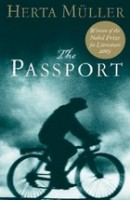
Herta Müller, The Passport (1986, translation by Martin Chalmers 1989, Serpent’s Tail 2009)
I got hold of this book via BookMooch soon after Herta Müller was awarded the Nobel Prize for Literature in 2009. Possibly because the press response wasn’t exactly encouraging (which of course it won’t be until a US writer wins), the book sat on my bedroom bookshelf for four years as a shining testament to pious intentions. I finally picked it up now because I’d read two books in translation, and decided to make it three of a kind.
It’s a very short book, just 92 pages, and it’s made up of short sentences. Here’s a random paragraph:
The skinner had given the stuffed animals to the town museum as a gift. He didn’t receive any money for them. Two men came. Their car stood in front of the skinner’s house for a whole day. It was white and closed like a room.
Sentence after sentence. Page after page. It proceeds in that staccato way. It doesn’t quite say what it’s saying. People do things, and say things, and see things. There are snippets of folklore, a bawdy song, symbolic objects, similes and metaphors as odd as the white room in that quote. You have to fill in the gaps, decode the descriptions. Only a handful of characters have names, the rest being known only by their professions or relationships. It took me until page 42 to realise I was in the middle of a narrative that I hadn’t been following. I started over. I’m glad I did.
It’s a terrible tale of the German-speaking minority in a village in Ceauçescu’s Romania. Uneducated, superstitious, despised by the Romanian majority, they live lives of quiet desperation and degradation. The village miller sets out to secure from the corrupt system a passport that will enable him, his wife and daughter to leave for West Germany.
I hated a lot of this as I was reading it: I just wanted to be told the story, to have a spade called a spade, rather than a headache being called a grain of sand moving around behind the forehead (at least, I assume that was a headache). But there is something mesmeric about it. I’m amazed that now I intend to immerse myself in that world again – not immediately, but when enough time has passed that I will be revisiting it rather than extending the current visit.
A couple of scrappy notes about the translation:
The English title draws attention to the plot, such as it is. The original German, taken from something the miller says at his lowest point, translates as ‘A man is nothing but a pheasant in the world’, and signals the sometimes enigmatic narrative mode.
There is a three-word glossary up the back. I could have done instead with a brief note at the start informing us that the original was written in German, that the action takes place in Romania (something that I’m guessing is obvious in the original but doesn’t become evident in the translation until we’re well under way), that most (all?) of the characters are German-speakers – in other words, filling us in on some things that are almost inevitably lost in translation.
There are one or two places where I completely didn’t know what was being described, and would love to know if it was because of the translation or the original. In particular, there’s a scene in which a woman is pleasuring herself or discovering she has some terrible disease – I’ll refrain from going into detail of the description here, but my confusion is genuine, and her husband’s comment, ‘So that’s how it is with your bladder, my lady,’ doesn’t make any sense either way. Perhaps this is the kind of thing that people mean when they say Herta Müller writes surrealism.
I suspect that this book is another that was a nightmare to translate, and it’s wonderful what a distinctive voice comes through in the telling.
PS: When I had uploaded all that I went to LibraryThing to post a version of it as a review there. And behold there was a very interesting post by Meisterpfriem, who had loved the book in German and been surprised at its lukewarm reception in Engish translation. I recommend it.
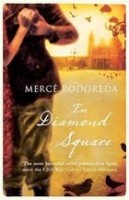
Mercè Rodoreda, In Diamond Square (1962, Translation by Peter Bush, Virago 2013)
Before the meeting: I came to this book with inaccurate expectations. Gabriel Garcia Marquez describes it on the cover as ‘the most beautiful novel published in Spain since the Civil War’, which I misread, lazily, as ‘about the Spanish Civil War’. True, the action of the novel spans the years of the Civil War, which is a major element in the story, but it would be quite a stretch to say the novel is about the war. The novel tells the story of Natalia, a naive, uneducated young woman from Gracia, then a poor area of Barcelona rather than what the internet now calls ‘one of the city’s hippest areas’. She marries a volatile young man whose entrepreneurial ambition fills their apartment, bizarrely and malodorously, with pigeons. The Civil War disrupts their family life when her husband and their male friends joins the militia – we see none of the combat, and none of the reasons for the war are discussed or explained, but we stay within Natalia’s narrow horizons, following her through wretchedness, deprivation, despair and unexpected happiness (though, to save spoilers, not necessarily in that order).
It’s a gripping story, with some brilliant images, but the thing that struck me most strongly was the language. Natalia is the narrator, and her voice is what makes the novel what it is. She begins:
Julie came to the cake-shop just to tell me they would be raffling coffee pots before they got to the lucky posy; she’d seen them and they were lovely, an orange split in two, showing its pips, painted on a white background. I didn’t feel like going to the dance or even going out, after I’d spent the whole day selling cakes and my fingertips ached from tying all those gilded raffia knots and handles. And because I knew Julie could manage on as little as three hours’ sleep and didn’t mind whether she slept or not.
She begins as she plans to go on, with leaps in logic (from the coffee-pot design to the question of whether she will go out or not, omitting to mention that Julie had come to take her there), syntax that doesn’t quite cohere (‘And because’ – huh?), attention to details that lead nowhere (‘an orange split in two’ etc), lack of orientation (who is Julie?), unexplained cultural references (are we supposed to know what ‘the posy’ is?), and so on. Then it took me a moment to figure out that the third they was a different they from the first two, that Julie is talking about the coffee pots, not the people who were raffling them, and because that tiny awkwardness feels like the kind of thing that happens in translation, I lost confidence as a reader , and as I read on I couldn’t tell how much of the narrative voice was Natalia’s and how much was the sound of Peter Bush wrangling the transition from Catalan into English. I wasn’t necessarily critical of the translation: perhaps this is one of those books that defies translation – as I imagine Malcolm Knox’s The Life to be. (A literal translation of DK’s ‘Well yeah … but no’ would probably leave Catalan readers floundering, but how else do you translate it?)
I read on, enjoying the book, but my unease about the translation persisted, and about a hundred pages from the end I turned to the Internet for help. I don’t know what I expected, but I found an excellent article from the British journal The Translator, ‘Language and Characterization in Mercè Rodoreda’s La Plaça del Diamant‘ by Helena Miguélez Carballeira, which discusses the language of the book in the context of two previous translations. According to Ms Carballeira, Natalia’s discourse is what the boffins call escriptura parlada – spoken writing. Mercè Rodoreda sets out to ‘trace the discursive peculiarities’ of the uneducated Catalan working-class. Her speech is also full of features that mark it as peculiar to Barcelona, and is full of the euphemism, attention to detail and diminutives that mark stereotypically feminine speech. More than that, Carballeira argues (and I’m persuaded) that
Natàlia is a woman who feels uneasy with the very act of speaking. … The characteristics of [her] conversational, unmediated speech as a discursive device in the novel are rather predictable: there is an extensive use of idioms and colloquialisms, interjections and onomatopoeias. This yields a constant, highly idiomatic, non-straightforward use of language.
That is to say, Natalia is at least as big a headache for a translator as Knox’s DK.
A gauge of the difficulty of the task is the differences between translations. Carballeira discusses a number of fascinating examples. Here’s just one, quoted in a discussion of Natalia’s use of euphemism:
The original Catalan (1962):
I mentre em dedicava a la gran revolució amb els coloms va venir el que va venir, com una cosa que havia de ser molt curta.
From Eda O’Shiel’s The Pigeon Girl (1967):
And while I devoted my energies to the grand revolt against the pigeons, there took place what had to take place, and it seemed as if it would be over quickly.
From David H Rosenthal’s The Time of the Doves (1986):
And while I was working on the great revolution with the doves the war started and everyone thought it was going to be over quickly.
From Peter Bush’s In Diamond Square (2013):
And while I was waging my big revolution against the pigeons, what was brewing came, that they said would be a two-day wonder.
Having read this article when I was struggling, part way through the book, I had a much better time with the rest. Some of Peter Bush’s decisions had confused me. For example, he names Natalia’s husband Joe, possibly as what Carballeira calls a domesticating strategy, but when I read that his name is Quimet in the original I realised that the discord between his English name and his Catalan context had niggled away at the edge of my mind, creating a sense of unreality like the one in some CGI movies, where figures don’t quite seem to touch the ground. And another example: Joe/Quimet refuses to call Natalia by her name but calls her Pidgie, without explanation of where the name comes from – to my ear that sounded a bit like Piggsy, and so vaguely insulting, and it was a long way into the story that I realised it was short for Pigeon, and that Joe/Quimet was obsessed with those birds; in the original he calls her Columeta, which my computer translates from the Catalan as, you guessed it, Pigeon. Maybe to a British ear ‘Pidgie’ sounds more affectionate than ‘Pigeon’, but ‘Pigeon’ would have worked fine for me.
This experience makes me suspect that if I’m going to read books in translation a little bit of research will make the whole experience go better. As it happens I’ve been to Barcelona, so quite a few of the local references – Tibidabo, Parc Güell, etc – made immediate sense to me. If I hadn’t been there, I doubt if I would have bothered to get out a map, but it wouldn’t have been a bad idea. (I do think I was right, though, not to read the author’s spoilerish 1982 ‘Prologue’ until after I’d read the book.)
The meeting: We were astonishingly unanimous in our responses to the book. We’d all enjoyed it; we’d all been at least mildly disconcerted by the language, though when someone read a short passage aloud, its ‘written speech’ qualities were obvious; we’d all engaged with Natalia and formed strong opinions about Joe/Quimet; and I think we’d all had our heartstrings / tear ducts activated. There was an attempt to get someone to read the last couple of pages, which are full of sweet, kind-of-sexual tenderness, but no one was up for the challenge. We enjoyed the book so much we contemplated staying with Catalonia for our next meeting, and reading The Sun Also Rises, Homage to Catalonia and perhaps something by Colm Toibín. (We decided against it, and will be heading off to Norway instead with Karl Ove Knausgaard.)
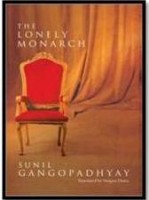
Sunil Gangopadhyay, The Lonely Monarch (2005, translated from Bengali by Swapna Dutta, Hachette India 2013)
My high school French and Latin teacher, Brother Gerard, taught us a healthy respect for the art of translation. When he wrote ‘Excellent attempt’ in the margin of one of my exercises, he explained that it was high praise, that all anyone could aspire to was an attempt at translation – the thing itself must remain forever elusive: if you stay too close to the original, your translation won’t sound like natural English, and if you produce something that feels natural in English you will have lost the feel of the original. Kumārajīva (343–430 CE), one of the sub-continent’s great translators of Buddhist texts from Sanskrit to Chinese, said that translation was like ‘chewing rice for others, which would not only lose its original taste, but also make people feel like vomiting’. (Translations of his statement differ.) So translators are heroic people who serve the common good, building bridges between cultures that might otherwise remain dangerously ignorant of each other, but they do so knowing that page after page, book after book, they must fail.
I don’t know any Bengali at all, so I can’t comment on the accuracy of Swapna Dutta’s translation of Sunil Gangopadhyay‘s Nihsanga Samrat. But it gave me that delicious sense of access to a place that would have remained closed to me without her labours. The eponymous lonely monarch is Sisirkumar Bhaduri (1889–1959), a pioneer of Bengali theatre, or at least a fictional stand-in for him, as this is a fictional rendition of the real Sisirkumar’s life. His theatrical project was to Bengal roughly what Louis Esson’s Pioneer Players were to Australia, not quite a national theatre but a profound influence on audiences’ tastes, though the comparison underplays the significance of Sisirkumar. The theatre as he found it was ruled by Western conventions, women actors were generally prostitutes, the emphasis was on spectacle. He and his colleagues reached for a theatre that incorporated traditional jatra forms; his partner Kankabati was an educated woman who became even more acclaimed as an actor than he was; his plays were often adaptations from serious novels.
Calcutta (as it is called here) had a thriving theatre scene in the 1920s and 30s, rich with artistic ambition, greed, brilliant collaboration, vicious competition, surprising acts of generosity, sweet loyalty, despair, alcoholism, romance … Sisir, as he was known to his friends, was at the heart of it as an actor–producer. In a postscript to her translator’s note, Swapna Dutta gives brief introductions to twenty characters who were important personalities of the time ‘whom people outside Bengal might not know’: poets, artists, playwrights, scholars, political figures. Without this help, the sense of a flourishing cultural scene would still have been vividly realised, but for foreign readers like me the names would have passed in a blur (actually, they still mostly did, but now I knew the nature of the blur!). Some names didn’t need a note: the great Rabindranath Tagore is partly a kind of tutelary deity whose approval is beyond price for the younger generation, and partly the esteemed elder whose mould they need to break; Sunil Gangopadhyay himself makes a brief appearance as a young man among Sisir’s admirers; and Satyajit Ray, Bengali director of many great films including Pather Panchali, has a moment towards the end of the book.
Sisirkumar takes a troupe of actors to New York in 1930. The trip has its disastrous moments, but it starts with a rapturous welcome. A young Indian man living in New York explains:
Ordinary Americans hardly ever come across Indians. Most of them are under the impression that Indian women are either kept under lock and key or burnt as a sati; that young children who enter the river are devoured by crocodiles; that the roads in India are packed with sadhus and yogis, tigers and snakes. They are clueless about our art, culture, literature or music.
Although there’s no whiff of an instructional intention in this book, I’m at least a little less clueless for having read and enjoyed it.
(Sisirkumar Bhaduri does have a Wikipedia entry, but it doesn’t say very much, and IMDb lists the eight films that he directed and acted in, which were very much a sideshow to his career in the live theatre.)
Full disclosure: Swapna Dutta is a friend of mine, though we’ve never met in person. She contributed a number of elegant stories to The School Magazine when I was editor, including retellings from Hindu and Buddhist classics as well as original stories, and we have stayed in touch by email since. Hachette India sent me a complimentary copy of this book.
My friend Swapna Dutta is a writer, translator and editor, mainly of children’s literature, who lives in Bangalore, in southern India. The School Magazine published some of her stories when I was editor, and she and I have kept in touch over the intervening years. Swapna mentioned in a recent email that she had translated a children’s book, The Arakiel Diamond, from Bengali into English, and asked if I’d like a copy. Of course I was interested, and a couple of days later it arrived in my letter box, with three other books. It’s been a treat and an education to read all four.
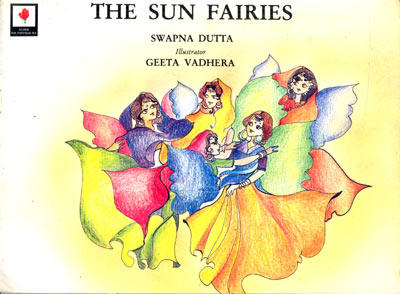
Swapna Dutta and Geeta Vadhera, The Sun Fairies (National Book Trust, India 1994, 2001)
The Sun Fairies is a tiny picture book that plays around with science and fantasy. That is to say, it’s a fanciful account of the origin of clouds – some fairies who live in the sun build castles in the sky so it won’t be so bare and empty – that ends up being a decorative but accurate account of how the water cycle works: the cloud castles are made from water, air and dust, and when they get too heavy they fall to the earth as water. The fairies have discovered ‘a never-ending game’. The illustrations, by Geeta Vadhera, are fabulous. I see from the Internet that Ms Vadhera has gone on to international renown. This may be her only children’s book.
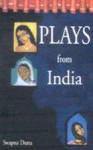
Swapna Dutta, Plays from India, illustrated by Baraan Ijlal (Rupa & Co 2003)
In some ways each of the other books is a work of translation. In Plays from India three episodes from Indian history are shaped into dramas suitable for performance by school students. In my ignorance I don’t know whether the stories would be familiar to most Indian students, so I can’t tell whether the history or the theatre is the main point. I was interested in both.
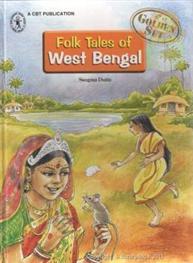
Swapna Dutta, Folk Tales of West Bengal , illustrated by Neeta Gangopadhya (Children’s Book Trust 2009)
Folk Tales of West Bengal retells sixteen tales. Swapna has an article at papertigers from which I learned that what the Grimms were for Germany, and Moe & Asbjørnsen for Norway, the imposingly named Dakshinaranjan Mitra-Mazumdar was for what is now Bangladesh and West Bengal. At least some of the tales here were collected by him in the first decades of last century. Unsurprisingly to anyone who has entered the woods of Re-enchantment, there’s a lot in these stories that’s familiar to a reader brought up on European-origin fairy stories: kings and princesses, talking animals, metamorphoses, riddles, lost and found children, supernatural beings who reward the humble and punish the greedy. There’s also a lot that’s different: the heroine of the first story, for instance, is not a seventh child but a seventh wife. This blending of familiar and unfamiliar makes for a delightful read.
Sucitrā Bhaṭṭācārya, The Arakiel Diamond, translated by Swapna Dutta and illustrated by Agantuk (Ponytale Books 2011)
The Arakiel Diamond is the only book in my swag that is not Swapna’s original work. It’s a detective story for young readers, one of a series featuring a Bengali housewife and her niece. A wealthy man dies. His most precious possession, the eponymous diamond, has gone missing, and almost everyone in his household – and there are many – has had motive and opportunity to steal it. The plot has exactly the twists you’d expect, but the detectives’ relationship and the details of their domestic life are well captured, and I learned a lot about the Armenian community in Calcutta, in a way that reminds me of grown-up detective writers (Sarah Paretsky comes to mind) who take us to a new subculture in each novel.
The four books had me reflecting on multiculturalism in children’s literature. We make fun of the way US children’s publishers, apparently believing that their intended readers would shrink from anything not immediately recognisable as of the US, re-edit books from elsewhere in the English-speaking world to remove unsightly exotica. They don’t just want a world where British characters spend dollars and cents, or Australians walk on a pavement, weird as such a world might be. I remember hearing of a New Zealand novel whose publisher suggested the book’s Maori issues might be more accessible to US children if the setting was changed to California – that author held firm and the book still found readers, even got made into a movie.
I wish now to acknowledge that I’m a bit of a kettle to the US publishers’ pot. Though I enjoyed the slight cultural disorientation I felt as I read these books, I caught myself thinking young readers would be put off by it. To make the books accessible to Australian 11-year olds, the unexamined internal argument went, you’d have to do something about lakh and crore, lunghi, salwar shameez and rakhi, not to mention the nitty-gritties of the game of chess or a casual use of thrice in conversation. On reflection, I think that argument profoundly misunderstands how young people read. The only thing that universally distinguishes young from adult readers is that the young ones are younger. One result of this is that they know they don’t know everything about the world, and mostly when they read there are words they don’t recognise but have to guess from the context. (I loved and understood pulverise and invulnerable in Superman comics long before I could define them.) So you might not know what a lunghi is, but the context tells you it’s an article of clothing, and there’s even an illustration to help. Likewise, lakh and crore are obviously big numbers, and that’s all you need to know. As I remember back to my own childhood reading, I think such things would have added spice to the book: if I was young now, I might even have fun googling them. As for nitty-gritties and thrice, I do think we can trust young readers to recognise when a word or a turn of phrase belongs to a different place. (Both my sons say zed in spite of seeing quite a lot of Sesame Street when young.)
Charles Dickens, Bleak House (1852, Project Gutenberg version, prepared by Donald Lainsman with revision and corrections by Thomas Berger and Joseph E Loewenstein)
Unless you count comics or movie and TV adaptations, just about anything by Dickens is likely to win me a game of Humiliation (rules at the link). When someone suggested him for our next Book Group title I was happy, and even happier when we settled on Bleak House: Neil Gaiman has been going on about it on his blog recently, and my friend Cassandra Golds says it is a huge presence in two of her recent novels.
Before the meeting:
This is the first book I’ve read on iPhone and iPad, and it was a good experience. The iPad is more satisfyingly book sized, but I was surprised at how much I enjoyed the sense of continual progress that comes with the iPhone. One of the book’s 8041 screens had to be ‘turned’ every couple of seconds – so many words, but in such tiny portions!
I was probably out of harmony with the spirit of the book, not so much because of the electronic devices as because I read it in just a few weeks. It was originally published as a serial over 20 months: if you read one of its 67 chapters a week you would have kept pace. I doubt if anyone much reads at such a leisurely pace any more, and we’re probably the poorer for it. Anyhow, it’s a truly wonderful book which I recommend for when you’re in the mood for sustained, leisurely reading.
I’m confident I have nothing at all original to say about the book itself, so I’ll presume on a little of your time by ruminating on translation issues. Every now and then someone writes an article saying that each generation needs its own translation of [insert name of classic work here]. The idea is that we need to have ancient Latin or Renaissance Spanish served up in contemporary language. By this logic, Italian or Spanish readers need a fresh translation of Dickens every 50 years or so. If so, doesn’t it follow that we need an updating in English just as regularly? After all, the language has changed in the last 150 years, and early 21st century English speakers have a very different, and more diverse, take on the world than their mid-19th century equivalents. Where Dickens could assume that literate English speakers shared a vast set of references – the Hebrew and Christian Bibles, Shakespeare and classical mythology come to mind, and there’s plenty of each in Bleak House – we can no longer do that. Just for the heck of it, I thought I’d see how a hypothetical translator might tackle the opening:
London. Michaelmas term lately over, and the Lord Chancellor sitting in Lincoln’s Inn Hall. Implacable November weather. As much mud in the streets as if the waters had but newly retired from the face of the earth, and it would not be wonderful to meet a Megalosaurus, forty feet long or so, waddling like an elephantine lizard up Holborn Hill.
I thought ‘translating’ this would be a straightforward bit of fun, but by the second word I was in trouble. When I was at university we had three terms, Lent, Trinity and Michaelmas, but surely Dickens isn’t talking about university here? Did the English courts have terms? (Do they still?) What is Lincoln’s Inn Hall, and who is the Lord Chancellor again? And so on. None of this worried me at all when I read the book, but a translator might feel obliged to do something like:
London. The year coming to an end, and the nation’s most eminent judge, the Lord Chancellor, hearing cases in Lincoln’s Inn Hall. Implacable November weather. As much mud in the streets as if the Flood had just withdrawn from the face of the earth, and it would not be surprising to meet a Megalosaurus, forty feet long or so, waddling up Holborn Hill.
There, now that’s more accessible, isn’t it? (No need to gloss the Megalosaurus for 21st century readers, I thought, but the edgy play on biblical and palaeontological versions of prehistory does need clarifying.) It’s not quite Dickens, but then what translation is? Interestingly enough, even being facetious I couldn’t bear to touch what comes next:
Smoke lowering down from chimney-pots, making a soft black drizzle, with flakes of soot in it as big as full-grown snowflakes – gone into mourning, one might imagine, for the death of the sun. Dogs, undistinguishable in mire. Horses, scarcely better; splashed to their very blinkers. Foot passengers, jostling one another’s umbrellas in a general infection of ill temper, and losing their foot-hold at street-corners, where tens of thousands of other foot passengers have been slipping and sliding since the day broke (if this day ever broke), adding new deposits to the crust upon crust of mud, sticking at those points tenaciously to the pavement, and accumulating at compound interest.
In short, I found the novel irresistible, especially for the way it wallows in language. And Cassandra is right – it’s full of echoes of Clair de Lune and The Museum of Mary Child.
After the meeting:
It’s winter in Sydney, and half of us were away, either home sick or visiting warmer climes. Of the five who showed, three had read the whole book, one was a hundred or so pages from the end, and the last confessed up front that he’d picked up a copy in a bookshop, and then thought, ‘Nah!’, though it turned out he had read it 20 or so years ago.
It was a good book to discuss. We talked about Mr Guppy’s withdrawal of his proposal, the death of Little Jo, the use of catchphrases (‘Discipline must be maintained!’), the pleasure of reading bits aloud. Someone knew that the appalling Mrs Jellyby was based on Caroline Chisolm, and the execrable Skimpole on an actual person. We wondered about the politics, the anti-Jewish nastiness (‘Smallweed is a Jew’), the depiction of industrialisation. Someone had thought about this book in comparison to the other Great Works we’ve read, Anna Karenina and The Tree of Man, and found it suffered from the comparison. I don’t know what I think of that. I know I enjoyed it at least as much as the Tolstoy and quite a lot more than the White, but I suppose enjoyment isn’t everything.
I haven’t been deliberately secretive about this blog and its reports on the group, but nor have I deliberately drawn people’s attention to it. If anyone from the group does drop in, welcome! Please add a comment.
Bahaa Taher, Sunset Oasis (2007. Translation by Humphrey Davies, McClelland and Stewart 2009)
This won the inaugural International Prize for Arabic Fiction in 2008. If successive winners are as good as this, then it’s a prize to watch. Set in the late nineteenth century, mostly in the Egyptian oasis of Siwa, the narrative centres on Mahmoud Abd el Zahir, who is sent to the oasis as government representative, and his Irish wife, Catherine, who accompanies him on this dangerous assignment (previous government representatives have been murdered by the oasis-dwellers) because of Siwa’s historical connection with Alexander the Great – she dreams of discovering his tomb there. There’s a vivid sense of the time and place, of the complex politics of an Egypt recently occupied by the British, now in effect passing on the mistreatment to the ethnic minority in the oasis, of the challenges of intercultural relationships, of Egypt’s multi-layered past. Catherine and others are fascinated by antiquity, Mahmoud struggles to come to terms with his own experience in recent upheavals, the people of the oasis have their own internecine history. In the oasis, Easterners and Westerners have a long history of self-perpetuating warfare, and various ones of their leaders are convinced that peace can come only when one side of the struggle or the other is completely wiped out. It’s hard not to read this as a sly reference to our current global clash between Easterners and Westerners.
The book is beautifully written, and constantly fresh and surprising. It’s narrative switches effortlessly between Mahmoud, Catherine and a number of other characters including, brilliantly, Alexander the Great. I was initially disappointed by the ending (it’s all right, no spoilers), but on reflection I realised that it opened the narrative out to great depths of meaning.
After all my recent whingeing about reading works in translation, I’m glad to report that Sunset Oasis reads beautifully in English. So much so, I needed to remind myself regularly that it was originally written in Arabic. I found a wonderful interview with Humphrey Davies, the translator, at The Quarterly Conversation, which ends:
The first draft of a book is very heavy lifting. It hurts my eyes in particular; it’s a real strain on my eyes. At the end of the day, I’m pretty gobsmacked. The most pleasurable part is when the first draft comes back from the editor with questions, and then you can see the shape of it. You can start fine tuning and tweaking and coming up with nice little things.
So there you go. This translator gets to have an editor go over his first draft in detail, and is then paid good money to refine the work. This reader considers that extra money well spent – and, take note publishers, that opinion may well translate into sales. Both Bahaa Taher and Humphrey Davies are on my list of people to trust.
I’m posting in a bit of a rush, because this book was a Book Club borrow, and the meeting where I’m to return it is due to happen in about 15 minutes. So here you are, just ahead of the deadline. [I’m returning three books. The other two I couldn’t get past 100 pages. So it’s not only a joy but a relief to have enjoyed this so much.]

 tl;dr: If you’re as ignorant of Indian culture as I am, this book will go a long way to filling gaps. You can buy an ebook from Hachette UK for less than $20 Australian.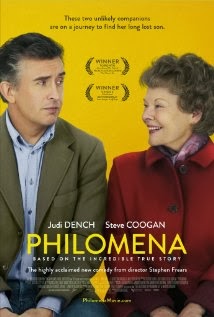






 Me fail? I fly!