Tag Archives: translation

The Confessions of Saint Augustine, first report

Saint Augustine, Confessions (approx 400 CE, translated by R S Pine-Coffin 1961, Penguin Classics edition): pages 1–110, from beginning to end of Book V

If St Augustine invented the literary form of autobiography, he did it by accident. The impression I have so far is that in Confessions he is telling the story of his life as a teaching device. The message seems to be that humans depend on the mercy of God for everything, from mother’s milk to the ability to read. Secondary to that, humans are born sinful. So far at least, quite a lot of his ink is spilled in arguing with the Manichees, and a lot of that argument is pretty opaque to the casual reader, by which I mean me.

Still, it’s quite a thing to spend 10 minutes or so each morning in contact with a mind that was alive nearly two millennia ago. Two moments grabbed me in the very early chapters.

In writing about his early schooling, even while saying he was a wicked child (for wanting to play rather than study!), he argues against against harsh physical punishment as a teaching tool. After saying he hates Greek but likes Latin, he explains that he learned Latin from his mother and nurses, and Greek from his stern school teachers. He generalises:

This clearly shows that we learn better in a free spirit of curiosity than under fear and compulsion.
hinc satis elucet maiorem habere vim ad discenda ista liberam curiositatem quam meticulosam necessitatem.

(1:14)

A little further on, after arguing that the innocence of childhood is a myth, he comes face to face with Jesus’ apparently contradictory view in Matthew’s Gospel, and offers this bit of ingenious argumentation:

It was, then, simply because they are small that you used children to symbolise humility when, as our King, you commended it by saying that the kingdom of heaven belongs to such as these.
humilitatis ergo signum in statura pueritiae, rex noster, probasti, cum aisti: talium est regnum caelorum

(1:19)

If I’m just going to quote the bits that stood out for me from amid the theologising, I can’t go past this wonderful paragraph about friendship:

We could talk and laugh together and exchange small acts of kindness. We could join in the pleasure that books can give. We could be grave or gay together. If we sometimes disagreed, it was without spite, as a man night differ with himself, and the rare occasions of dispute were the very spice to season our usual accord. Each of us had something to learn from the others and something to teach in return. If any were away, we missed them with regret and gladly welcomed them when they came home. Such things as these are heartfelt tokens of affection between friends. They are signs to be read on the face and in the eyes, spoken by the tongue and displayed in countless acts of kindness. They can kindle a blaze to melt our hearts and weld them into one.

(3:2)

I had expected confessions to loose living. So far, the main wickedness he confesses to is his adherence to the Manichean heresy. He does mentions a de facto wife, but when he goes from Carthage to Rome, he doesn’t tell us if she comes with him.

This morning, his career as a teacher of literature has led him to Milan, where he is deeply impressed by the lectures of (Saint) Ambrose. He finally makes a break from the Manichees. He’s impressed by ‘the academics’, but doesn’t throw in his lot with them. Nor does he embrace the Catholic Church (which is R S Pine-Coffin’s translation of catholica ecclesia, and fair enough, though the capital letters may be a bit misleading), but he becomes a catechumen, which I understand to mean he sees himself as under instruction.

To be continued.

Zheng Xiaoqiong’s In the Roar of the Machine: page 76

Zheng Xiaoqiong, In the Roar of the Machine, translated by Eleanor Goodman (Giramondo 2022)

True to the promise implied in its name, the Giramondo Publishing Company invites its readers to travel widely. In the Roar of the Machine takes us into the world of migrant workers in China – that is, the mostly rural poor who have moved to large industrial centres to live and work creating what has been called an enormous floating workforce that, to quote Eleanor Goodman’s introduction, ‘comprises one of the largest human migrations in recorded history’.

Zheng Xiaoqiong, born in 1980 in Sichuan province in western China, moved when she was about twenty to an industrial city in Guangdong province on the south-east coast where she has been a factory worker ever since. Partly for her own mental health, partly to bear witness, she wrote poetry about her experiences, and soon gained a degree of fame – though in China as in most of the world, fame for a poet is a relatively modest affair. She has published a number of books of poetry and essays, and won prestigious literary prizes.

Eleanor Goodman is a poet in her own right and has translated a lot of contemporary Chinese poetry. including Iron Moon: An Anthology of Chinese Workers Poetry (2017), which has been described as ‘a fervent testimony to the horrific, hidden histories of the 21st century’s working-class’. That description could equally apply to In the Roar of the Machines. (You can read a fascinating interview with Eleanor Goodman on the Poetry International website, at this link.)

Two things I think I know about classic Chinese poetry: it often works through a series of images, and it often deals with exile. Both those things are true of this book. In many of the poems, the alienating effect of factory work is conveyed in an accumulation of images. In these lines, chosen more or less at random, from ‘Industrial Zone’, the harsh lights of the factory are contrasted with the moonlight of the mid-autumn festival, and the phrase ‘disk of emptiness’ carries a huge weight of nostalgia for home, family, community:

The fluorescent lights are lit, the buildings are lit, the machines are lit 
exhaustion is lit, the blueprints are lit ...
this is a night on an endless work week, this is the night of the mid-autumn festival
the moon lights up a disk of emptiness

I often struggle with poems in translation from Chinese. Almost every poem in this book grabbed me and held me hard.

There are four sections, each comprising poems from one of Zheng’s books: ‘Huangmaling’ (2006), ‘Poems Scattered on Machines’ (2009), ‘Woman worker’ (2012) and ‘Rose Courtyard’ (2016). A ‘Finale’ contains a single longer poem, ‘In the Hardware Factory’.

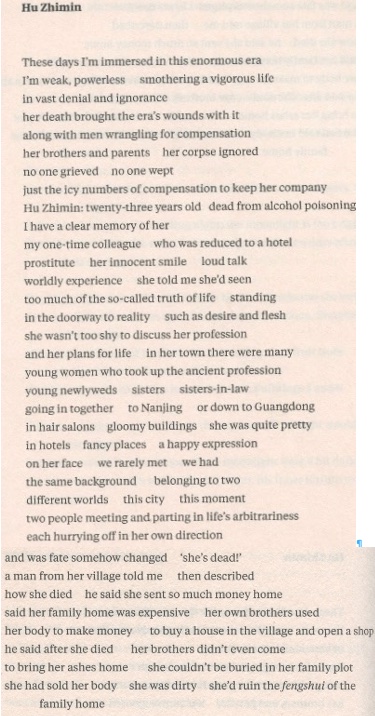
The third section, ‘Woman Worker’, is a collection of passionately feminist poems. The poem on page 76 is ‘Hu Zhimin’ (胡志敏), one of its portraits of individual women. (Right click on the image to embiggen.)

It might be worth noting that the poem becomes a lot easier to follow once you realise that, instead of conventional punctuation marks, it signals breaks in meaning or pauses for breath by longer spaces between words and by line breaks.

Hu Zhimin
These days I'm immersed in this enormous era
I'm weak, powerless __ smothering a vigorous life 
in vast denial and ignorance

This sets the tone, leading us to expect a story that will expand on what it is about the ‘enormous era’ that makes the poet weak and powerless. We’re invited to expect her ‘vast denial and ignorance’ to be contradicted in what follows.

It’s nerdy of me, but because every translation is at best an attempt (or so my high-school Latin teacher used to say), I like to compare different translations. I found Zhou Xiaojing’s version of this poem on the Poetry International website (link here). I won’t do an extended comparison of the two – except to say that I think Goodman’s generally has a better feel for what works in English – but here’s Zhou’s version of the opening lines:

These years I am immersed in an immense era
feeling weak and frail     allowing youthful life to be
covered by gloomy negations and ignorance

I prefer Goodman’s first line and a half, as Zhou’s ‘immersed’ / ‘immense’ echo falls pretty flat. But I stumbled over Goodman’s ‘vigorous’ – how can a life be both vigorous and smothered? – and I had trouble with the literal meaning that the poet was smothering her own life. Zhou’s ‘youthful’ resolves my momentary confusion, and the poet is no longer actively stifling herself but allowing herself to be covered/smothered by external forces. Of course, ‘vast denial’ beats ‘gloomy negations’ hands down, though they do mean different things, and ‘gloomy negations’ may be more accurate.

I’m guessing that anyone who understands Chinese would know from the poem’s title that it is about a particular woman. She now makes her entrance:

her death brought the era's wounds with it 
along with men wrangling for compensation 
her brothers and parents _ her corpse ignored 
no one grieved _ no one wept
just the icy numbers of compensation to keep her company
Hu Zhimin: twenty-three years old _ dead from alcohol poisoning

That’s the skeleton of the story, arriving at last at the woman’s name. But what are these ‘icy numbers of compensation’ that displace grieving and weeping? Having raised that question, the poem holds off answering it until the final lines. For now, it continues its broad movement from the general to the specific:

I have a clear memory of her
my one-time colleague _ who was reduced to a hotel
prostitute _ her innocent smile _ loud talk
worldly experience _ she told me she'd seen
too much of the so-called truth of life _ standing
in the doorway to reality _ such as desire and flesh
she wasn't too shy to discuss her profession
and her plans for life _ in her town there were many
young women who took up the ancient profession
young newlyweds _ sisters _ sisters-in-law
going in together _ to Nanjing _ or down to Guangdong
in hair salons _ gloomy buildings _ she was quite pretty
in hotels _ fancy places _ a happy expression
on her face

So much is conveyed in by piling on these images. This is personal: Hu Zhimin had worked in the factory with Zheng. We have glimpses of her at work as a sex worker: ‘innocent smile’, ‘quite pretty’, ‘a happy expression on her face’. There’s a hint of shame in ‘she was reduced’, but at the same time, Hu Zhimin didn’t try to hide what she was doing and the poem opens out to show us the ‘many young women’ have taken the same course. Their reasons for doing so aren’t named, and I suppose the poem allows the reading that these women took up sex work as an embrace of ‘desire and flesh’ or as a way of earning an income like any other, but I think it’s implied that harsh economic reality was their motivation, and there was an element of degradation in the work.

Then, back to the personal connection:

on her face _ we rarely met _ we had
the same background _ belonging to two
different worlds _ this city _ this moment
two people meeting and parting in life's arbitrariness
each hurrying off in her own direction

Both women came from small towns and migrated to ‘this city’ at ‘this moment’, but one of them left factory work for sex work, the other found a way to poetry. It’s a ‘there but for fortune’ moment.

I found the next words problematic:

and was fate somehow changed

Zhou Xiaojing’s translation came in handy for me:

not knowing what fate would bring

In Goodman’s translation, the line could be a question – did some mysterious force change their respective fates – but it’s hard to tell what’s actually being said. Zhou’s version is clearer: we are still with the two young women at the moment of parting ways, each ‘hurrying off in her own direction’ (or in Zhou, ‘each going her own way in a hurry’), and these words throw forward to the announcement at the end of the line, ‘she’s dead!’ Maybe Goodman’s opaqueness is more accurate than Zhou’s clarity, but I’m happy with the clearer version.

and was fate somehow changed _ 'she's dead!'
a man from her village told me _ then described
how she died _ he said she sent so much money home
said her family home was expensive _ her own brothers used 
her body to make money _ to buy a house in the village and open a shop 
he said after she died _ her brothers didn't even come
to bring her ashes home _ she couldn't be buried in her family plot 
she had sold her body _ she was dirty _ she'd ruin the fengshui of the family home 

That’s the real tragedy. There’s no need to repeat that she died young of alcohol poisoning. Now we learn that her sex work was a means to create prosperity for her family back in the village. Though here it names only her brothers, we remember that the opening lines names the parents as well. They ‘used / her body to make money.’ But now that same body is treated as unclean, and left without the proper treatment of the dead.

We’re left with the image of a family home carefully ordered to be in harmony with the universe, but we know that this order has been achieved by the cruel exploitation of a family member that led to her early death. We’re thrown back to the opening line, ‘These days I’m immersed in this enormous era’. Hu Zhimin’s story sends ripples outward: the family home’s fengshui is corrupted by their callousness, the prosperity of China as a whole is built on suffering like hers, and – wider still – capitalism as a system destroys lives.

All that, and yet there’s an immediacy to the poem – we feel the pain of the poet’s loss and her indignation on her friend’s behalf.

Beginning the Confessions of Saint Augustine

I’ve become attached to the practice of reading a few pages of a classic text first thing in the morning. À la recherche du temps perdu kept me busy for nearly two years. The Iliad and The Prelude followed. Then Middlemarch, which I finished a couple of weeks ago. Now that I’ve stopped missing Dorothea, Will, Celia, Lydgate and even Rosamond, it’s time to move on to my next morning project.

Over the protests of the Emerging Artist, who has barely tolerated my occasional morning chat about Middlemarch (I say occasional; she says far too frequent), I’ve decided to tackle St Augustine’s Confessions next. I hereby resolve to keep any enthusiasms to myself, or at least not inflict them on my nearest and dearest.

This is a book that has been around in my life for a very long time, but it hasn’t occurred to me until now to actually read it. Good Counsel College in Innisfail – which I attended aged 9 to 13 – had the Latin motto, Tolle lege, which translates as ‘Take up and read’. Regardless of what personal meaning it might have had to students – it has pretty much become my life’s motto – we were told that the phrase came from a moment in the life of Saint Augustine: when he was living a dissolute life in the fleshpots of Egypt he heard an angelic voice telling him to pick up and read a book he saw lying on a window ledge. The book was a Christian Bible, and the text that he read in obedience to the voice turned his life around. I guess I’m about to find out if that story comes from the Confessions, and if it does, how much of my childhood recollection is true to what the man himself wrote.

I’ve garnered other bits of information about Augustine and this book over the years. That’s one of the things that makes a book a classic: you don’t have to have read it to know a thing or two about it.

I feel as if I’ve always known that Augustine lived a debauched pagan life while his Christian mother wept and prayed for his conversion. His prayer is famous: ‘Lord, make me virtuous, but not yet.’

At one stage of my life his injunction, ‘Ama et fac quod vis’ (‘Love and do what you will’) was a welcome antidote to the rule-bound Catholicism of my childhood.

Augustine invented the concept of original sin, the blight of many young Catholic lives – though James Carroll, in Constantine’s Sword, an excellent book about anti-semitiism in the Catholic Church, argues that for Augustine the concept was about embracing human imperfection rather than condemning us as innately evil.

I’e bought a copy of the Penguin Classics edition, translated in 1961 by the wonderfully-named R S Pine-Coffin, and I’ve found a Latin text on line in case I decide to be linguistically adventurous. I’ll report back in a month …

Annie Ernaux’s Years

Annie Ernaux, The Years (Fitzcarraldo Editions 2022, from Les Années 2008, translated by Alison L Straya 2017)

Annie Ernaux won the Nobel Prize in Literature last year, which probably accounts for my long wait for this book at the library. It was worth the wait.

It’s a memoir, covering roughly the first 60 years of the author’s life, from listening to adults telling heroic stories of the Resistance in the late 1940s to presiding over family gatherings at the turn of the century full of lively exchanges in which ‘there was no patience for stories’.

It’s not like any other memoir I’ve read. Ernaux describes how she imagined it, referring to her past self as ‘she’:

This will not be a work of remembrance in the usual sense, aimed at putting a life into story, creating an explanation of self. She will go within herself only to retrieve the world, the memory and imagination of its bygone days, grasp the changes in ideas, beliefs and sensibility, the transformation of people and the subject that she has seen … To hunt down sensations that are already there, as yet unnamed, such as the one that is making her write.

(Pages 222–223)

Earlier (on page 162), she says she wants to assemble the multiple images of herself that she holds in memory, and thread them together with the story of her existence – ‘an existence that is singular but also merged with the movements of a generation’.

So it’s the story of the changing attitudes and sensibilities of a generation (the broader ‘they’ and the more specific ‘we’), and of an individual member of that generation (‘she’), embedded in an impressionistic account of France’s political, social and cultural history over half a century.

Algeria gains independence but anti-Algerian racism persists. 1968 happens, and leaves a deep mark on Ernaux’s generation, including those like her who weren’t actually throwing cobblestones. Catholicism vanishes ‘unceremoniously’ and consumer capitalism invades all aspects of life. There’s AIDS, wars and climate change.

The early sexual experiences of Ernaux’s later memoir A Girl’s Story (the link takes you to my blog post) take up a couple of paragraphs. ‘She’ marries, divorces, becomes a grandmother, teaches, retires, ruminates on the approach of death, and writes.

As I read this book, I often just let a series of specifically French references wash over me – resigned to never knowing everything. An Australian The Years might mention Gough Whitlam pouring sand into Vincent Lingiari’s hands, Jack Thompson’s nude centrefold for the first edition of Cleo, or Auntie Jack threatening to rip your bloody arms off: immediately recognisable to some readers, mystifying to others, and opening a whole new vista to the latter if they go exploring.

My practice of looking at a single page is a good fit for this book – the writing is so compressed that practically every page cries out for detailed explication.

Page 76 focuses on the general scene, talking about ‘we’ and ‘they’, as opposed to the passages that begin with a photograph of ‘a woman’ – always Ernaux – and talk about ‘she’. (It’s a book where you watch the pronouns.)

It’s 1962, near the end of the Algerian liberation struggle. Page 75 has described an incident in October 1961, when Algerian demonstrators were attacked by police, and a hundred of them thrown into the Seine, largely ignored by the press. Page 76 begins:

Try as we might, we would see no resemblance between October’s heinous attack on Algerians by Gaullist police and the attack on anti-OAS militants the following February. The nine dead crushed against the railings of the Charonne Métro station bore no comparison with the uncounted dead of the Seine.

As with many passages, I’m happy to guess at the general drift, but since I’m blogging about it, I’ll delve a little.

The OAS (Organisation Armée Secrète / Secret Armed Organisation) was a violent rightwing organisation opposed to Algerian independence. A demonstration against them was organised in February 1962 by leftist groups including the Communist party. The nine victims of police violence at the Charonne Métro station received a lot of publicity and the event came to be seen as a defining moment in the struggle. Ernaux reflects that ‘we’ – her generation, and I would add most people since – give value to the things the press highlights and have trouble giving full value to the sometimes much greater things it ignores. The narrative doesn’t pause to sermonise on the underlying racism.

Nobody asked whether the Évian Accords were a victory or a defeat. They brought relief and the beginning of forgetting. We did not concern ourselves with what would happen next for the Pieds-Noir and the Harkis in Algeria, or the Algerians in France. We hoped to go to Spain the following summer – a real bargain, according to everyone who’d been there.

You probably guess, correctly, that the Évian Accords were the treaties that brought an end to the Algerian war (Wikipedia entry here). The Pieds-Noir were the Algeria-born whites who opposed independence; the Harkis were Algerians who supported French forces (shades of the people abandoned when the USA and Australia quit Afghanistan). ‘We’ don’t include those people, and though our sympathies are with the freedom fighters we’re more interested in our next holiday abroad (again, a familiar syndrome).

The next paragraph shifts smoothly from ‘we’ to ‘people’ and then ‘they’. Though it’s not a hard border, Ernaux is no longer talking specifically about her own cohort, but about French people generally. It’s a characteristically brilliant summary of the mood of a time, beginning:

People were accustomed to violence and separation in the world. East/West. Krushchev the muzhik/ Kennedy the leading man, Peppone/ Don Camillo, JEC/UEC, L’Humanité/L’Aurore, Franco/Tito, Cathos/Commies.

Peppone and Don Camillo are a Communist mayor and a priest who clash in a series of popular books (Wikipedia entry here). JEC is Jeunesse étudiante chrétienne / Christian Student Youth); the UEC is Union des étudiants communistes / Union of Communist Students). L’Humanité was the Communist newspaper; L’Aurore was a centrist mainstream newspaper. All these dualities can be reduced to the almost affectionate diminutives ‘Cathos/Commies’.

The paragraph continues, now definitely in ‘they’ territory, a clear distance between Ernaux’s student grouping and the attitudes described:

Under cover from the Cold War, they felt calm. Outside of union speeches with their codified violence, they did not complain, having made up their minds to be kept by the state, listen to Jean Nochet moralise on the radio each night, and not see the strikes amount to anything. When they voted yes in the October referendum, it was less from a desire to elect the president of the Republic through universal suffrage than from a secret wish to keep de Gaulle president for life, if not until the end of time.

I suppose every French person would know that Jean Nochet was a vehemently anti-Communist broadcaster and that the referendum of 1962 meant that the French presidential election moved from a US style electoral college to direct popular vote. The motive attributed to the electorate reflects De Gaulle’s changing status in Ernaux’s mind over the years.

And then, a characteristic change of focal length, this time from national politics to Ernaux’s own group, with just a whiff of a suggestion that the students at that time didn’t pay much attention to politics (which was to change six years and a few pages later):

Meanwhile, we studied for our BAs while listening to the transistor. We went to see Cleo from 3 to 7, Last Year at Marienbad, Bergman, Buñuel and Italian films.

As I write this blog post, I recognise a way the book touched me personally. My oldest brother was pretty much the same age as Ernaux. Like her he moved from home in a small town to go to university in a large centre. This list of movies reminds me of the enthusiasms he brought home on uni holidays. He certainly talked about Last Year at Marienbad. I don’t remember if Agnès Varda featured. It was probably in 1962 when he took me on an excursion from boarding school to see my first subtitled movie, Bergman’s The Seventh Seal.

Though the book might not be for everyone, it’s a richly instructive evocation of an era, and at the same time I’m pretty sure most readers would find something in it that speaks directly to their own experience.

Annie Ernaux’s girl’s story

Annie Ernaux, A Girl’s Story, translated by Alison L Straya (Seven Stories Press 2020, from Mémoire de fille, Gallimard 2016)

There’s an AI app that‘a in the news just now. I asked it to write a review of Annie Ernaux’s A Girl’s Story/Mémoire de fille. Here are some excerpts from what the app came up with:

“A Girl’s Story” by Annie Ernaux is a highly acclaimed and celebrated memoir that tells the story of the author’s childhood and youth. …

The book is written in a simple, straightforward style that is both raw and emotionally charged. …

She vividly describes the sights, sounds, and smells of her childhood, and her descriptions are so vivid that the reader feels as though they are right there alongside her. At the same time, the author’s reflections on her life and experiences are both deeply personal and universally relatable, making the book accessible to a wide range of readers.

Lazy students be warned: almost every word in those paragraphs is misleading. The AI clearly hasn’t read the book.

The book does NOT tell the story of the author’s childhood and youth.

It scrutinises barely two years of the author’s life, when as an 18-year old in 1958 she left her parents’ custodianship for the first time, had her first sexual experiences, developed an eating disorder, read a lot (including Simone de Beauvoir’s The Second Sex), attended a prestigious college, decided against entering the teaching profession, worked as an au pair in London, and began her career as a writer.

The book is NOT written in a simple, straightforward style.

Take the opening sentences:

There are beings who are overwhelmed by the reality of others, their way of speaking, of crossing their legs, of lighting a cigarette. They become mired in the presence of others. One day, or rather one night, they are swept away inside the desire and the will of a single Other.

The science-fictional feel of ‘There are beings’ probably isn’t there in the original French, where it’s not unusual for elevated prose to refer to people as êtres (literally ‘beings’). But even without that bit of translationese, you’d hardly call these sentences simple or straightforward. In fact, they almost stand as a warning: if you want a simple, straightforward story, go somewhere else. The hint (‘or rather one night’) that the story is going to involve sex is neither simple nor straightforward, but at least it promises spiciness.

The style is NOT raw and emotionally charged.

The style is intensely intellectual, as is only right for a text that is concerned with the process of remembering. Memories are often there as single images, without a clear sense of how they connect with each other. Where memory fails, the narrator quotes from ancient letters and diary entries, or simply speculates about what ‘the girl of S’ (as she is called from the start) must have been feeling. From the older person’s perspective, the sexual experiences are terrible, but as far as the narrator can tell (remember?) ‘the girl’ didn’t see them that way. See the opening lines quoted above: it’s a story of a young woman who loses and regains her sense of herself. One strand of the book is a troubling inquiry into the nature of consent.

The reader does NOT feel as though they are right there alongside her.

Annie Ernaux considers that she is no longer the person who had those experiences as an eighteen-year-old. It took me several pages to be sure that ‘the girl of S’ is not someone other than the author. If we are ‘right there alongside’ anyone it’s the 70-something writer who sets out to ‘explore the gulf between the stupefying reality of things that happen, at the moment they happen, and, years later, the strange unreality in which the things that happened are enveloped’. At least that’s how she describes her initial intention. The book is more complex, recursive and elusive than that.

She vividly describes the sights, sounds, and smells of her childhood

No. Just no!

The author’s reflections on her life and experiences MAY BE deeply personal and universally relatable, but not in the way the AI implies.

This calls for discussion of an actual piece of writing. I’ll pick the moment (on pages 74–75) when the girl, still in the last year of high school and working as a counsellor at a children’s camp, has had two sexual encounters with H (the ‘single Other’ of the book’s first paragraph, which I quoted earlier). After the second time, of which the narrator says she remembers very little but which certainly wasn’t pleasurable for the girl, H promises to come to her room and say goodbye the next morning, the last day of camp. The girl knows that he is engaged to someone else, but nevertheless spends a sleepless night imagining that ‘H is her lover, truly and for all eternity’. When he doesn’t come at dawn, she goes to knock on his door. Though he can see his back through the keyhole, he ignores her. This is definitely a ‘deeply personal’ moment, but the narrator isn’t interested in capturing its emotional intensity. She writes:

Even if it had crossed her mind (and I think it probably did) that by promising to come and say goodbye, he was simply trying to shake her off, no objective sign of reality – the fiancée, the unkept promise, the lack of a meeting arranged for later in Rouen – can possibly compete with the novel that wrote itself in a single night, in the spirit of Lamartine’s The Lake, or Musset’s Nights, or the happy ending of the film The Proud and the Beautiful, with Gérard Philipe and Michèle Morgan running toward each other, or the songs (that Esperanto of love) I can list without a second thought.

She goes on to list five songs, all of which are as unknown to me as the novels and movie. I googled one, Dalida’s ‘Histoire d’un amour’, and it’s as romantic as you’d expect – on YouTube here. You don’t need to be familiar with the references to see that the narrator is considering the girl from an ironic distance. She isn’t mocking. Her project is more intellectually rigorous than that, and much more interesting: she wants to understand how ‘the girl’ really experienced the moment, at the same time as knowing that complete understanding is impossible.

After listing the songs, Ernaux does two things. First, she asserts that this kind of self story-telling is common:

At this very moment, out in the streets, the open spaces, on the metro, in lecture halls, and inside millions of heads, millions of novels are being written chapter by chapter, erased and revised, and all of them die as a result of becoming, or not becoming, reality.

This reminds me of the way Proust’s narrator in In Search of Lost Time writes at length about how he imagined what places were like based on their names, only to be almost always disappointed by the reality. Annie Ernaux explicitly suggests that this is a universal thing. So maybe it’s ‘relatable’ after all.

(By describing this fantasising as novel-writing, Ernaux seems to be suggesting that her writing life began that night, a whole other dimension of the memoir.)

The second thing she does is to leap forward in time:

When, in the subway or the RER, I hear the first notes of Dalida’s ‘Histoire d’un amour’, sometimes sung in Spanish, within a second I am emptied of myself, hollowed out. I used to believe (Proust had a comparable experience) that for three minutes, I truly became the girl of S. But it is not she who suddenly revives but the reality of her dream, the powerful reality of her dream, spread throughout the universe by the words sung by Dalida and Darío Moreno, and covered up again, buried by the shame of having had that dream.

(The RER is the rapid transit system serving Paris and its suburbs.)

This paragraph could be seen as encapsulating the book as a whole. Annie Ernaux the narrator grapples throughout with the nature of memory. Here, she realises that in the intervening years, in non-rigorous mode, she has believed herself to be reliving that moment, becoming once again her eighteen-year-old self and losing all sense of who she is in the present. But with her rigorous mind at work, she realises that what is being revived is the dream, the pattern of thinking and feeling that came into play at that moment. Any mockery that may have been implied in the ironic distance of the previous paragraphs is identified as coming from shame.

It’s no accident that Proust is mentioned here. His ghost hovers over the whole enterprise. At one level, his huge novel tells his alter ego’s life story, while A Girl’s Story tells the much smaller story of a teenage girl’s first more or less traumatic sexual experience. (Proust’s narrator’s first sexual experience is of the don’t-blink-or-you’ll-miss-it variety.) At another level, they are both philosophical inquiries into the nature of memory and desire. Ernaux’s book doesn’t have the queerness or the comedy of Proust’s, but it is just as serious, just as challenging, and has the added passion of feminist horror.

Alejandro Zambra’s Chilean Poet and the book group

Aalejandro Zandro, Chilean Poet: A novel, translated by Megan McDowell (Granta 2022)

Before the meeting: I enjoyed this novel enormously. I expect people who know Chile, and especially the Chilean poetry scene, would enjoy it even more.

In the freezing Chilean winter of 1991, teenagers Carla and Gonzalo curl up night after night under a magnificent red poncho watching television in her mother’s house and manage to do ‘everything except for the famous, the sacred, the much feared and longed-for penetration’. Just as the nights are beginning to warm up and remove the excuse for the poncho, they get an opportunity, but the famous etc event turns out to be less than absolutely pleasurable, at least for Carla.

The story goes on from there. In my innocence, I was surprised by the turns of events, so I won’t go into detail, except to say that Gonzalo as a teenager is an aspiring poet, and we get to read one of the atrocious sonnets he writes for Carla; and some years later Gonzalo becomes stepfather to Carla’s son Vicente.

The second half of the book begins with an echo of the opening of the first half. Vicente, now a teenage aspiring poet (probably more promising than Gonzalo), is in explicit sexual action with Pru, an older woman visiting Chile from the USA, using alarmingly explicit English he has picked up from porn.

It may be a spoiler, but I’ll risk it: the relationship between the two poets Gonzalo and Vicente is the heart of the book and its narrative spring. Carla and Pru, and Vicente’s natural father León, are vivid secondary characters. Chile, in particular Santiago, and most specifically the Chilean poetry community, provide the charming, engrossing, at times hilarious, always lively milieu.

Pru is visiting Santiago on her first major journalistic assignment. Her editor wants a ‘human interest’ story about stray dogs, but she persuades him to let her explore the poetry scene, and Alejandro Zambra has a lot of fun describing her interviews with poets.

I have no idea if poets and poetry have the prominent role in Chilean life that these poets claim. One of them says that for Chileans the Nobel Prize in Literature is as significant as the World Cup, and it’s a matter of huge pride that Chilean poets have won it twice: Gabriela Mistral (1945) and Pablo Neruda (1971). Not that any of the living poets care too much for Neruda or Mistral – the living are much more interesting and important, and their mutual competition, championing and denigration make Australia’s so-called poetry wars look … well, I was going to say tame, but really it makes them look normal.

I’ve read two other novels with poet protagonists recently: Edwina Preston’s Bad Art Mother and Niall Williams’s A History of the Rain. Unlike the former, we believe that the characters in Chilean Poet actually write poetry of varying quality; unlike the latter, these poets are part of a thriving scene rather than slightly deranged, isolated mystics. One of the joys of the book is the way their alertness to language features strongly in all their relationships. The account of Vicente’s wooing of Pru, for example, is full of the joys and perils of communicating across a language barrier.

There’s a terrific scene in the first part, when Gonzalo is a hands-on father to Vicente. He breaks one of Clara’s rules by allowing Vicente to sit in the front seat of the car – and accidentally reveals his crime to her. She explodes, using the word betrayal, which sets him off:

‘I’m so sorry for taking care of Vicente every single day,’ said Gonzalo.
‘It’s times like these it’s clear you’re not his father,’ retorted Carla.
Gonzalo looked at her with astonishment and contempt. He grabbed his hair with his left hand, and with his right he tore up an abundant clump of grass.
‘I’m a much better father than that lame-ass, ugly, mediocre motherfucking pusillanimous sack of balls who stuck his dick in you.’

(Page 75)

Rather than continue with the fight, the narrative stops there, and the poet-mind kicks in. Gonzalo spends two pages mentally critiquing his own sentence. It ‘felt a bit ungrammatical and was a pretty stupid outburst, but …’ He ponders the accuracy of ‘ugly’, acknowledges that pusillanimous doesn’t apply, and wonders if he used that word ‘for the mere pleasure of saying a word that León would have to look up in a dictionary’. He quite likes sack of balls because it’s not only hurtful but original. And before pouring himself a double whisky and stomping off to his writing-room he indulges in this final piece of poetic analysis:

The truly damning part was definitely that grand finale, who stuck his dick in you, which brought jealousy to the forefront and insinuated that Carla was some kind of whore. Still, the accusation held a trace of childishness, as if Gonzalo had only just found out how babies are made.

(Page 76)

Megan McDowell’s translation is terrific. At many moments, the narrative turns on the use of language, as in the passage I’ve just discussed. At a key moment, when Vicente is quite young, he and Gonzalo discuss the Spanish word for ‘stepfather’ – padrastro. Gonzalo is reluctant to take it on because astro at the end of a word has negative connotations. McDowell does a brilliant job of putting this into English as a completely plausible conversation for a poet to have with a young boy, and manages not to feel as if she is winking at English readers over the characters’ heads.

The meeting: After an hour of convivial catch-up and organising of food, we settled down to the book. Unusually, the Chooser explained how he had made his choice: he started out thinking of something by Annie Ernaux, in deference to the Nobel Prize committee, but as none of her books were easily available he sought advice at from his local bookseller, who suggested this – which turned out, he said, to be a perfect summer read. One chap who usually doesn’t say much, and usually speaks softly, immediately grabbed the floor and disagreed vehemently: not an ideal summer read at all; for that he’d recommend Richard Osman’s Thursday Murder Club series; this author was too intent on displaying his knowledge of poetry and poets to keep his narrative alive and engaging.

And it was on!

No one, it turned out, had done the work of checking which poets in the book are real and which imagined. A number of us, including a late-comer who had missed the opening salvo, just loved the bit where Pru interviews a range of poets and leaves the main narrative on hold. There’s a disorderly poet’s party that got a lot of love.

The bits that might have been irritating, where the author breaks the fourth wall to comment on his decisions, were pretty universally enjoyed. We were sorry to see the end of Pru, the gringa journalist over whose shoulder we get to know the poetry scene. One chap felt that Carla, Vicente’s mother, was a bit two-dimensional. No one contradicted him, but no one seemed to mind terribly. One man said he’d read the book very soon after last meeting and could barely remember it, which he took to mean it is pretty forgettable – though he did remember that it lacked any strong sense of place. Not everyone agreed – perhaps not the physical place, but we felt that there was a strong feel for the cultural milieu, and the food.

One man brought a bottle of pisco and made pisco sours (of which many are drunk in the book), plus a sour-without-pisco for the non-drinker. He also brought a selection of holiday photos from Santiago and Valparaiso, including one of Pablo Neruda’s home, now a museum.

Favourite passages about poetry were read and enjoyed all over again, including one in which a poet says he doesn’t know whether what he writes is any good, but he writes because of what it achieves for his own mind. (That definitely rang a bell for me and my own adventures in rhyme).

As usual, the conversation dissipated, though this time it stayed roughly on topic: there were anecdotes about meeting famous poets and other famous people (including two stories about David Malouf that cemented his status in my mind as a spectacularly kind person), ruminations on the comparative respect in which poets are held in Chile and Australia, an invitation for personal reflections about step-parent experiences that went unaccepted because none of us had been there, stories of young men getting excited when they realised they were talking to an older man who reads books, some excellent ribaldry. Unrelated: George Pell’s faulty theology, Lydia Thorpe’s stand in relation to the Voice, the complexity of some post-Holocaust Jewish family histories.

Towards the end of the evening, the man who had set the ball rolling with vehement negativity announced with equal vehemence that he realised he had actually enjoyed the book. We took this as vindication of the group as a way of taking the solitary act of reading into a shared experience.

After the meeting: Someone mentioned having seen a YouTube conversation with Alejandro Zambra and Megan McDowell. I dutifully watched it during my grandson’s afternoon sleep the next day. It’s full of good things about the translator–novelist relationship – if you watch it and are strapped for time, you could start at the 10 minute mark and skip all the charming introductory stuff. I particularly love their discussion (from 13’00” to 19’05”) of the Spanish word for ‘stepfather’, padrastro, including Zambra’s comment that as a poet Gonzalo is fighting with that word. Poets are always fighting with words, intensely, he says, ‘which is beautiful’.

Summer reads 7: Gabriel Zaid’s So Many Books

Gabriel Zaid, So Many Books, translated by Natasha Wimmer (Sort Of Books, 2004)

I took a number of physically small books away on our summer break, and have blogged about them as ‘Summer reads’. I was only dimly aware that they were all gifts – either from friends who thought I’d enjoy them or from publishers who hoped I’d blog about enjoying them.

So Many Books was the former kind of gift, and has its own opinion on books as gifts. An early chapter says that they ‘threaten the recipient with the task of responding to the questions “Have you read it yet? What did you think of it?”‘ and goes on:

In fact, the most uncommercial slogan in the world might be: ‘Give a book! It’s like giving an obligation.’

(‘An Embarrassment of Books’, page 13)

The obligation in this case was entirely enjoyable.

Gabriel Zaid is a Mexican poet and essayist. His Wikipedia entry lists a formidable number of essays on a broad range of topics. This little hardback, of the kind that sits on the front counter of a bookshop, is a series of short essays that revolve around the vast number of books published each year: the impossibility of any one person reading more than a tiny fraction of them; the way books, compared to movies or TV shows, are inexpensive to produce in small numbers so don’t have to be best-sellers to be viable; the relationship between ‘culture’ and ‘commerce’; the nature of reading; the way many people, especially academics and aspiring poets, want their writing to be published but tend not to read other people’s; why economies of scale apply to motor vehicles but not to books; and more.

So Many Books (which my fingers keep wanting to call Too Many Books, not necessarily what Zaid means) was published in Spanish as Los demasiados libros in 1996, and in Natasha Wimmer’s gorgeously smooth translation in 2003, before Amazon had completely dominated the book market, and before e-books and self-publishing really took off, so some of it is well out of date. But an update would require some tinkering at the edges of Zaid’s arguments rather than wholesale rethinking.

Regular readers of this blog will be able to tell that the book touches subjects close to my heart. Here’s Zaid on careful rewriting and copy-editing:

[A writer who] is a doctor, a lawyer, or an executive … can’t devote himself to rewriting a paragraph over and over, although the additional work might save his readers time. It is absurd for the writer to devote two hours to saving his reader a minute if the text is a note to his secretary. But if it is a book with twelve thousand readers, each minute represents a social benefit of two hundred hours in exchange for two, and the reward is one hundred times the cost. …

Of course, the cost of reading would be much reduced if authors and publishers respected readers’ time more, and if texts that had little to say, or were badly written or poorly edited, were never published.

(‘The Cost of Reading’, p 88–89)

Here he is being completely wrong about reading very slowly (see my series of blog posts on A la recherche du temps perdu, The Prelude, the Iliad, and now Middlemarch):

Is anything more certain to make a book completely unintelligible than reading it slowly enough? It’s like examining a mural from two centimetres away and scanning it at a rate of ten square centimetres every third day for a year, like a short-sighted slug. This doesn’t allow for the integration of the whole, for taking in the mural at a glance.

(‘Some Questions About the Circulation of Books’, p 72)

On bookshops:

To be angry because a book isn’t where you want it to be is to be angry at the randomness of fate.

(‘Constellations of Books’, p 110)

Early in my blogging life I wrestled with the word fortuitous in a number of posts. I’m pleased to report that Gabriel Zaid uses it in a way I find completely unproblematic:

In a good bookshop, supply and demand are fortuitous, but not chaotic: they have a physiognomy, a recognisable identity, like constellations. The probability of finding a particular book increases in relation to the clarity of the shop’s focus, the diligence and shrewdness of the bookseller, and the size of the business.

And from page 75, the opening of ‘The End of the Book’:

No experts in technological forecasting are predicting the end of fire or the wheel or the alphabet, inventions that are thousands of years old but have never been surpassed, despite being the products of underdeveloped peoples. And yet there are prophets who proclaim the death of the book. This prophecy is understood as an apocalyptic judgment: the overabundance of books oppresses humanity and in the end will provoke divine wrath. But as a technological judgment, it doesn’t withstand the slightest scrutiny.

The essays are witty, instructive, thought-provoking, satirical and totally readable. If you stumble on them, possibly in someone else’s to-be-read pile or a street library, I encourage you to dip in.

And that’s a wrap for my Summer Reads.

Summer reads 2: The Gleaner Song Lin

Song Lin, The Gleaner Song, translated by Dong Li (Giramondo 2021)

Song Lin (宋琳) was a campus poet in Beijing in the 1980s, and was active in the 1989 protests in Tiananmen Square, for which he was imprisoned for a year. On his release he married a French woman, and in 1991 went to live in Paris. After spending time in France, Singapore and Argentina, he returned to China in 2003, and now lives in Yunnan province. He has published many books of poetry and prose, including two bilingual French-Chinese volumes, and currently edits the poetry journal Jintian (Today), which ran for nine issues in the late 1970s before being censored, and was revived in 1999.

The Gleaner Song had its beginnings when Song Lin was on a long walk in the countryside of upstate New York with the young Chinese-born poet-translator Dong Li. Describing that walk in his introduction, Dong Li writes:

I saw his eyes light up as a deer leapt from the wild into a wide-open field. As the evening hues shifted farther into the forest, his line of sight followed the deer until it vanished into the night. We talked about the deer, and later he asked me to translate a poem that he had written to record the occasion.

That translation was to become the final poem in this book. It’s preceded by poems spanning four decades and as many continents, incorporating classic Chinese forms and elements of western modernism. Mostly I found it a difficult book, but in interesting ways.

To talk about the difficulty, and why it’s worth dealing with, I want to have a closer look at one poem, ‘Notes from South Xinjiang’. You can read the whole poem, without my commentary, on the Cordite Poetry Review website, where it was published in February 2022.

The rest of this blog post gets a bit detailed. A short version: the poem is a number of brief observations and reflections during a visit to South Xinjiang, the southern part of the Xinjiang Uyghur Autonomous Region in northwest China, much of which is taken up by the Taklamakan Desert, and most of whose population are Uyghur. It is a prose poem made up of 23 short numbered paragraphs. On a first reading, probably in bed at night, I enjoyed the sense of a mind at play in a new place, but I knew there was a lot I hadn’t understood. Here is what I found when I reread the poem with the internet open beside me:

Notes from South Xinjiang

1. The reckless god reads the braille of the desert.

The poem announces at the start that its subject is a desert. The gist of this first paragraph is clear enough: the shapes made by the wind on desert sands can look like braille, but it would be reckless to read a meaning into them – which by implication is what the poet, godlike, may be about to attempt. But is ‘the reckless god’ someone from ancient Chinese tradition, and would I read the poem differently if I knew? That question remains unanswered.

2. One night in Kupa, I received a telegram from Mars: there were traces of water.

I looked up ‘Kupa’ and found a river in Croatia. But there is a town called Kuqa (or Kuche) on the edge of the Taklamakan Desert, so I’m pretty sure that’s where the poet was. Wikipedia gives a long list of variants but ‘Kupa’ is not one of them. Who can blame a copy editor for not picking up what is almost certainly a transcription error, but mistakes like this add a layer of difficulty for the uninformed reader. So the poet is on the edge of the desert which he imagines as Mars-like. There may even be a suggestion that Mars has water where this desert does not. Certainly in photographs it looks vast and dry.

3. Dead rivers look like twisted mummies in the gallery of the sky.

I parse this to mean the dead rivers as seen from the sky – that is, in the gallery of images held in the sky rather than a gallery of images of the sky, which was my first reading. A map of the region shows a network of rivers, with a note to say they are ‘usually’ dry.

Why mummies? It’s not an obvious visual likeness, but it turns out that 4000-year-old mummies have been found in this area. This is the poem’s first oblique reference to the region’s ancient history

4. Language, dust of dust, flies on the long, long road.

I don’t know if the ambiguity of ‘flies’ – is language as insignificant as insects or does it fly away? – is something that happened in the translation, but either way it works well: human activity, especially language, is dwarfed by the desert. This paragraph introduces human activity more explicitly, and specifically the idea of the road, which is taken up the next five paragraphs.

5. An oar stands before the boat-shaped coffin. Sailors of the desert sea, tell me, what kind of sail do you dream of?
6. Business caravans head east, and west. The sun bakes eyebrows, beards, and crusty flatbreads.
7. Go. Once you lie down, you run the risk of being air-dried.
8. From one invisible border to another, I count those disappeared countries.
9. A silkworm once dreamed of Rome; or rather, Rome once dreamed of a silkworm.

These six paragraphs reflect on past human travel in the desert. Paragraph 5: the mummies from 4000 years ago had boat-shaped coffins. Paragraphs 6 and 7 refer to conditions endured by caravans of any era. Paragraph 8: perhaps the poet knows what those disappeared countries are, where those borders were – I don’t, but neither of us needs to know that for the line to work. Paragraph 9 is a lovely evocation of the history of the Silk Roads which passed through this region, skirting the desert (according to this map).

10. Breeze in the dense forest, homonym of silk and porcelain.

This paragraph is an example of what must be a nightmare for translators. It makes no sense as a stand-alone sentence in English. Really, all one can take from it is that some words in a Chinese language sound the same as others. Maybe in the original it’s an elegant pun, or a cute but inconsequential observation. As I can’t read or speak Chinese, I have no way of knowing, and I can’t see how a translator could do other than what Dong Li has done here: translation is impossible. (In other poems, Dong Li explains linguistic play in a footnote, but that’s a bit like explaining the mechanics of a joke – it still doesn’t make you laugh.)

From here on the poem bristles with specific historical and cultural references. It’s as if the poet is wandering abut the region, making random, elegant notes about things he sees. He also, incidentally, challenges the ignorant reader to do a bit of work. Or from another perspective, he points to a number of doors that open on vistas of new knowledge.

11. The Han princess Liu Xijun – Sappho of Wusun country – was married to a vast and endless homesickness.

Song Lin gives his western readers a small hand by comparing Liu Xijun to Sappho, the earliest woman poet in the western tradition. Liu Xijun wrote one of the earliest poems in Chinese written by a woman. Wusun country, as far as I can tell, was a little to the north of South Xinjiang, but near enough. Liu Xijun’s poem includes the lines, ‘Living here, I long for my land, and my heart aches / Wishing I could be a yellow swan, and return to my old home.’

Having paid homage to traditional Han culture, the poem now moves on to religion:

12. Under the statue of Kumarajiva, I thought: perhaps his intelligible translation saved Buddhism.
13. On their pilgrimage to Chang'an, the three Buddhist masters walked in the opposite direction to the three wise men.

Kumarajiva’s statue is in Kuqa. He was a Buddhist monk of the 4th and 5th centuries of the current era, who translated many Buddhist texts from Sanskrit to Chinese. His translations are still in use today.

Chang’an is the ancient name for Xi’an: I don’t know the story of the three Buddhist masters who – I’m guessing – travelled through South Xinjiang. The reference to the three wise men is another example of Song Lin’s cross-cultural awareness. I read him as suggesting an equivalence between the foundation of Christianity and the bringing of Buddhism to China.

14. If Emperor Wu of the Han dynasty knew that the Ferghana horse was a horse with a disease, would the history of Ferghana be re-written?

At about 100 CE, China imported huge numbers of horses from Ferghana in central Asia, roughly contemporary Uzbekistan, coerced by an army sent there by Emperor Wu. The horses remained popular for the next thousand years. They were said to sweat blood, which – according to Wikipedia – modern authorities believe was caused by the activity of parasites.

15. The donors depicted on the murals have thin eyebrows.
16. Stupa - navigation system of the desert.
17. What a pity! Gan Ying saw the sea but did not know which one he saw.

Paragraphs 15 and 16 are mercifully straightforward, though I don’t know if thin eyebrows have particular meaning in Chinese iconography.

Gan Yin was a diplomat who travelled west in 97 CE in search of Rome, but only got as far the ‘the western sea’, which – according to Wikipedia – could have been the Mediterranean Sea, the Black Sea or the Persian Gulf.

18. Petals of the mandala – one five-baht coin after another.
19. The auricle of the crescent rises on the ruins where Xuanzang preached.

Paragraph 18 doesn’t need any extra research.

Xuanzang was a key Buddhist teacher of the 7th century CE. The ancient novel that was the basis of television’s Monkey Magic was a fictionalised version of his journeys. He visited Kuche (now Kuqa) in 630 CE. The crescent of Islam, compared here to an ear, has risen where once actual ears heard him preach.

20. In the dark labyrinth of the karez, flowing water looks for bright vineyards.

This is a beautifully concise evocation of the Turfan Karez System, which consists of 5000 kilometres of wells and underwater channels around Turpan, on the edge of the Taklamakan desert. It’s tentatively listed as a World Heritage site.

21. Migration – from Sanskrit to Charian, Uighur to Chinese; over battlefields and millennia of forgetting, Maitrisimit flies into my vision like a phoenix.

Oh dear, I couldn’t find ‘Charian’ online, but Tocharian languages were spoken in South Xinjiang from 400 to 1200 CE. The paragraph should begin ‘Migration – from Sanskrrit to Tocharian’. (Does this mean no one actually managed to read the poem thoroughly when the book was in production?) So the migration described follows the flow of languages that have succeeded each other over the millennia.

According to Wikipedia, ‘Maitrisimit’, full name ‘Maitrisimit nom bitig’ is an Old Uyghur translation of the Tocharian text of a Buddhist drama, which itself (departing from Wikipedia here) is probably from a Sanskrit original. The way the text survives the extinction of language after language is captured in the image of the phoenix (not necessarily a reference to western mythologies, as China too has a phoenix).

This is the poem’s first mention of the Uyghurs, and possibly suggests – ‘Uighur to Chinese’ – that their culture is in the process of being wiped out. Given the necessarily oblique way Chinese poetry has addressed political matters over the last half century, it’s perhaps not too much of a stretch to see this as a disguised protest.

22. Another Uighur muqam: alas the musailaisi wine, the ice-cold beauty, come quickly and rub out my burning desire for you!

The poet has visited the statue of Kumarajiva, some murals, a statue of a Ferghana horse, and so on. Now he relaxes at a musical performance, a Uyghur muqam, drinking musailaisi, traditional Uyghur wine. I’m pretty sure his address to the wine echoes centuries of conventional drinking songs and poems. If there is a protest at the treatment of the Uyghurs, it is thoroughly disguised, but still visible to reader who want to see it.

23. In Kashgar, Shen Wei said to me: there are people wherever poplars grow.

As you’d expect, Kashgar is another city in South Xinjiang. Shin Wei is a poet, younger than Song Lin, who lives in South Xinjiang. So the poem ends on a note of collegiality among poets (an almost Jennifer-Maidenish note). I have no idea what Shen Wei’s remark means. In English the sound play between ‘people’ and ‘poplars’ creates a kind of resonance, and the original Chinese may have a similar play, but that’s a guess.

In the end, I have to resign myself to the reality that not everything in a poem can be translated, and be grateful for as much as does make it across the barriers of language and culture.


I am grateful to the Giiramondo Publishing Company for my copy of The Gleaner Song.

Summer reads 1: Mario Vargas Llosa in praise of reading and fiction

Mario Vargas Llosa, In Praise of Reading and Fiction: The Nobel Lecture, translated by Edith Grossman (Farrrar Straus & Giroux 2011)

I’m away from home for a couple of weeks over the summer, and I’ve packed a swag of physically small books from my overloaded to-be-read shelf. Some of these have already turned out to be unreadable. I’ll donate them to a Street Library without further comment. Others bring much pleasure, even delight.

I don’t have a lot to say about this beautiful little front-counter book. It’s Mario Vargas LLosa’s lecture accepting the 2010 Nobel Prize for Literature, translated into honey-smooth English by Edith Grossman. It was probably a gift close to its date of publication.

Vargas Llosa speaks of his early love of reading, of his identification with his native Peru even though he had lived most of his life elsewhere, of his early Marxism and his reasons for abandoning it, and above all of the importance of story-telling and the reading of fiction. What Roger Ebert said about movies, that they are a machine that generates empathy, Varga’s Llosa says here, beautifully and at more length, about novels. There’s a lot that’s quotable. Here’s one moment where he acknowledges some self-doubt:

At times I wondered whether writing was not a solipsistic luxury in countries like mine, where there were so few readers, so many people who were poor and illiterate, so much injustice, and where culture was a privilege of the few. These doubts, however, never stifled my calling, and I always kept writing even during those periods when earning a living absorbed most of my time. I believe I did the right thing, since if, for literature to flourish, it was first necessary for a society to achieve high culture, freedom, prosperity, and justice, it never would have existed. But thanks to literature, to the consciousness it shapes, to the desires and longings it inspires, and to our disenchantment with reality when we return from the journey to a beautiful fantasy, civilisation is now less cruel than when storytellers began to humanise life with their fables.

(Page 7)

I love that, and think on aggregate it’s true, but I do wonder about the consciousness shaped by writers like the man who produced phenomenally popular The Da Vinci Code or the woman who wrote Atlas Shrugged. I suppose Mario Vargas Llosa would say those books aren’t literature. But then wasn’t one of the ‘monsters of Serbia’ a Shakespeare scholar? Still, a Nobel lecture isn’t the place for such quibbles, and those of us who are addicted to reading can think with some justification that it’s a good thing. Perhaps the lecture is an example of what he means: a beautiful fantasy of a world where reading makes the world more human.

Still on my shelf at home is another gift, a collection of 20 earlier Nobel lectures, which includes a number of writers whose work I know: Harold Pinter, Toni Morrison, Nadine Gordimer, Dario Fo (who once called my older son a bambino terribile), Seamus Heaney, Wole Soyinka … I guess I’ll dip into it when I need a shot of hope.

The Iliad: Progress report 10

Homer, The Iliad (translated by Robert Fagles, ©1990, Penguin 1998)
Book 23 line 768 to Book 24 line 944 (the end)

It’s taken me nearly 10 months to read The Iliad, two pages most mornings, and it’s been a huge pleasure.

In the final pages, Hector’s body is reclaimed and given a proper funeral. The way it is reclaimed is incredibly moving. The Trojan king, Priam, goes into the Greek camp at night, alone except for one companion and the god Hermes to protect him. He pleads with Achilles to release his son’s body, begging him to think how his own father would feel in a similar situation. Achilles, the embodiment of unstoppable destructive force, begins to weep and soon the two of them are sobbing together, weeping for the parents who have lost sons including Achilles’ own father in the near future, and for the loss of beloved comrades. Then Achilles retells the story of Niobe weeping for her murdered children: in his version instead of turning immediately to stone and becoming a waterfall, she takes time off from weeping to eat a hearty meal, and that is what he and Priam now do. He tucks Priam in for the night, safe from being accidentally spotted by other Greeks.

That passage itself is enough to explain why the Iliad has such status. After all the violence of the previous thousands of lines, these two implacable enemies share a moment of common humanity. I could feel my mind – and heart – expanding as I read it.

Pretty soon after that, Hector’s funeral rites take place and the story is over. The story is over, but not the war. It’s very clear that in another day, the Greeks will resume hostilities. Troy will fall. The women will be captured. Babies will be thrown over the battlements. Achilles will be killed. It’s a standard thing that epic poems begin in medias res – in the middle of things. This one ends there too.

I’m having a breather before starting my next slow-read project. I’m thinking maybe Middlemarch.