Monthly Archives: Nov 2013

Sonnet 5: An exhibition

The opening on Wednesday night was fun, and the exhibition will be open for business at 51 Darling Street Balmain until 24 November, 11 to 6 Thursday to Sunday.

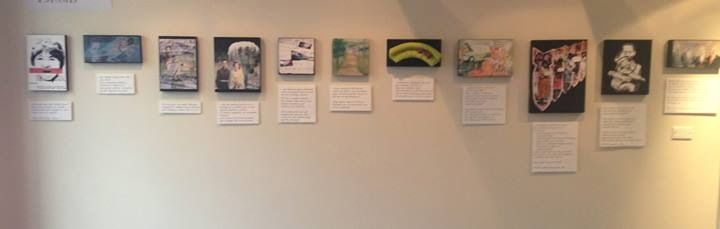
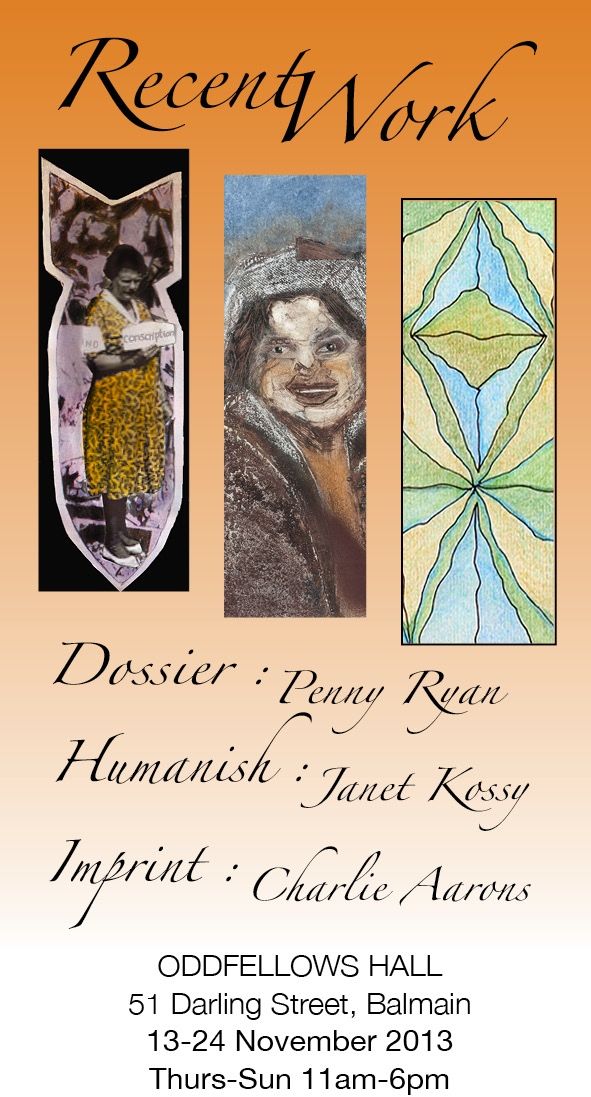
For those who came in late, the exhibition features work by three emerging older women artists: a narrative series by Penny Ryan about her mother and ASIO; exuberant work – mainly prints – by Janet Kossy that makes me think of Weimar art, only joyful; and delicate drawings by Charlie Aarons that reference Morandi‘s still lifes and traditional Kiribati designs.

Some men grow alarmingly sleazy moustaches in November. I do rhyme:

Sonnet 5: An exhibition
John Berger said, ‘Original paintings
are still and silent in a sense
that information [to explain things]
never is.’ Here’s my five cents:
that’s also true of prints and drawings,
whose lines are movement lashed to moorings.
Now frozen, mute, hung on the wall
of Darling Street’s Oddfellows Hall
are rage, desire, despair, compassion,
a mother’s joy, a daughter’s pain,
a moment freed from rat-race strain,
three days to hang, lifetimes to fashion.
We stroll around, we come, we go:
it’s just a little pop-up show.

IMG_0143

Photo by Penny Ryan

Sonnet 4: On Being Kept Awake by David Denholm

I’m falling behind on my sonnet quota – partly because I’ve had other things preoccupying me, but also because every time I sit down to write a paragraph from the David Denholm book comes into my head insisting that it be the subject. I’ll add the paragraph below, but first here is my Onegin stanza response to it (with a little input from Gitta Sereny’s The German Trauma, about which I expect to blog in good time.).

Sonnet 4: On being kept awake by David Denholm
Before we sang our soil as golden
before the settlers’ toil made wealth
long before the FJ Holden
this land was taken, not by stealth,
but violence and then watchful waiting,
armed and calm, anticipating,
one with musket, one with spear,
each the other’s direst fear.
We can’t claim Bach and not own Hitler,
a German lawyer said postwar:
we’re made of all that’s gone before.
The death toll here may have been littler
(I’ll write this, though my rhyme is weak)
If Anzac’s us, so’s Myall Creek.

From David Denholm, The Colonial Australians (Penguin 1979) page 40:

… the normal condition of inland life was an armed, watchful, wary, nervous calm. White and black spent months, even years simply watching one another, waiting for someone like Vincent James Dowling on the Paroo in Queensland in 1861 to drink at a lonely waterhole without first reconnoitring the vicinity, or like Paddy Finucane in 1853 to leave his musket in the hut while attending to a sick sheep, or like the Pinjarup in Western Australia in 1834 to camp the tribe down at night on a site familiar to white men. The victim had to deliver himself up. That is the whole point of the horror.

Come one, come all!

The Art Student has an event this Wednesday evening and you are warmly invited. I know, it’s not smart to invite the Internet to anything, but I keep a close watch on my stats, and in this case the part of the Internet living within visiting distance who will read this amounts to maybe 25 people. So come one, come all!

It’s a small exhibition of recent work by three friends. The Art Student is presenting a sequence of 14 small pieces inspired by her mother’s ASIO files. The opening is this Wednesday 13 November 6–8 pm at the Oddfellows Hall, 51 Darling Street, Balmain.

invite ARK


David Denholm’s Colonial Australians and 14 rhyming lines

David Denholm, The Colonial Australians (Penguin Books 1979)

ImageDavid Denholm (1924–1997) wrote fiction as David Forrest. One of the ‘living Australian authors’ profiled in John Hetherington’s 1962 collection, Forty-Two Faces, he is remembered mostly for two novels and a number of short stories. Under his own name, he had a second career as a historian, which, though productive in other ways, produced just this one book and a pamphlet on land use in New South Wales.

It’s a strange book, not – as the title might suggest – a survey of the population of the Australian colonies, but a series of enquiries into what Denholm describes as ‘odd trifles’ to see what general light they might shed on the those people. Many of the trifling questions are conveniently summarised in the Introduction:

How long would it have taken to reload a musket? What on earth possessed surveyors to divide up much of Australia with little regard for the shape of the land and its resources? Why does this brick wall not look like that brick wall? In a land of cheap horses, why did not everybody ride a horse? Why do some Presbyterian churches have steeples? Why is the Monaro in ‘Banjo’ Paterson’s ballads not the real Monaro? Why did some people stack their plates while others had them taken away one at a time?

He does indeed go on in great detail about how to load a musket, about three different bricklaying patterns, and about surveying practices, in each case using them as evidence for persuasive argument against received versions of our history. He also paints an idiosyncratic version of the kind of religion (ie, of Christianity) that dominated the first century and a half of settlement, what he calls determinism as opposed to free-will based orthodoxy – it’s idiosyncratic but rings true and has quite a bit of explanatory power when applied to the Pell and Jensen phenomena. He turns a bit of a blowtorch on romantic versions of ‘the bush’ and writes interestingly about what happened to the idea of a gentry – ‘an historically based manner in which power was projected upon society’ by a class of people possessed of wealth, education and leisure (hint: it was destroyed but lives on).

The chapter ‘Men Bearing Arms’ – about the ‘mutual impotence’ of Aboriginal Australians and their invaders, whose slow loading muskets were  far from making them invulnerable – is a revelation, especially in its discussion of the extent of ‘fraternisation and appeasement’ between the two populations, so that all too often brutal murders and massacres had an element of personal betrayal.

But it’s November, so I have to lapse into rhyme:

Sonnet 3: On reading David Denholm’s The Colonial Australians
How can we know what really happened
a week ago, two hundred years?
Vile things are misnamed on the map, and
victors’ tales besiege our ears.
Historians must play detective,
sniff ash trays, challenge the selective
versions, shift perspectives, ask
what hid behind the public mask.
We want to honour our ancestors:
with courage, ingenuity and toil
they named the land and turned the soil.
But there’s another truth that festers:
a brutal war of conquest here,
sword and musket, club and spear.

Sonnet 2: At the check-out

OK, I’m getting into the swing of 14 lines every couple of days. Here’s my second attempt for the month:

Sonnet 2: At the check-out
I know she has to smile and greet me.
I’ve seen the instructions on her till.
Still, rather that than have her beat me,
cheat me, treat me like a dill.
We meet each other almost daily,
greet each other almost gaily.
Who cares if warmth comes à la carte
from a Woolworths-managed heart?
I trailed along with Mummy shopping
in another world: ‘Hello,
Mr See Yick. How’s your toe?’
‘Oh Mrs Shaw, you’ve seen me hopping …’
Some days would not be nice, they knew,
but with some help they’d see them through.

Sonnet month again

It’s November, and once again, while all over the world people with stamina take on NaNoWriMo, I’m setting myself the modest goal of 14 sonnets in the month – LoSoRhyMo (Local Sonnet Rhyming Month). Actually, I’ve discovered that the 14-line form I’m enaoured of, the Onegin Stanza, isn’t a sonnet properly speaking, but I’ll keep the name for the project rather than opting for the even less euphonious LoSoOnStaMo. It’s my blog and words will mean whatever I want them to mean.

To kick off the month, here are some hasty lines about The Butler, Lee (‘Precious’) Daniels’ movie featuring Forest Whitaker (brilliant), Oprah Winfrey (also brilliant) and half a dozen big names in cameos (I especially liked Alan Rickman as Ronald Reagan):

Sonnet 1: A night at the movies
A tiny audience saw The Butler
screened at the Chauvel last night:
a history lesson – I’ve had subtler –
meant for us, as we are white.
Rape, murder, and a double lynching
in living memory, with no flinching
from those in power, and then the fights:
bombs, burning crosses – civil rights,
Panthers, afros, ‘Nam. The lazy
eye of Forest Whitaker, who serves
eight presidents deadpan, observes
with anguish. Though Miss Daisy
would have liked him, here’s the thing:
he wasn’t dissed by Doctor King.