Category Archives: Page 7x/47/7

Jess Hill’s Losing It

Jess Hill, Losing It: Can We Stop Violence Against Women and Children? (Quarterly Essay 97)
– plus correspondence from Quarterly Essay 98
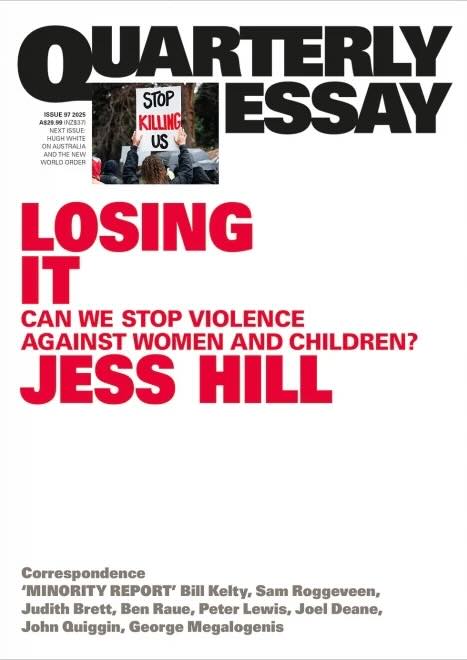
I came to this Quarterly Essay with a heavy heart, but I’m very glad to have read it, to know that there are people who are tackling a huge evil with intelligence, courage and compassion.

In the final chapter of her groundbreaking 2019 book, See What You Made Me Do (link is to my blog post), Jess Hill wrote:

The mission to transform attitudes to gender inequality and violence is laudable, and will no doubt produce important cultural changes. But as a primary strategy for reducing domestic abuse, it is horribly inadequate. 

Losing It enlarges on that argument. Hill is all in favour of transforming attitudes to gender equality, but argues that an almost exclusive focus on giving that strategy leads to neglect of other significant factors and of strategies other than education and awareness-raising. In Nordic countries, where by most measures gender equality is more established than elsewhere in Europe, there is more violence against women. This is known as the Nordic paradox.

Hill gets into the nitty-gritty of Australian campaigns, and argues that they have stuck to an original plan in spite of evidence that it isn’t working. Although Australia is to be commended for leading the world in funding and developing primary prevention, we are not world leaders in actually preventing violence. The people responsible for developing strategies, she argues, are caught in rigid groupthink.

Advertising campaigns that intentionally or otherwise shame perpetrators can actually increase violence, because a lot of violence has shame somewhere at its root.

School education session on consent and gender equality are up against the enormous influence of internet personalities like Andrew Tate, and beyond them of ‘co-ordinated, strategic and incredibly well-funded’ organisations with anti-rights agendas around the world. Sexual violence is being reported by ever younger male perpetrators. On page 40, Jess Hill quotes Deanne Carson, an ‘external educator’ who teaches the Respectful Relationships program in Victorian schools:

Every single classroom I go into, I have children who have been raped. I have children who have sexualy abused other children.

Regulation of alcohol and gambling is needed; likewise more nuanced understanding of what is happening in the lives and minds of men who perpetrate violence. More attention is needed to the situation of child victim-survivors, especially when they are not accompanied by a victim-survivor mother. Something with the benign name of ‘alternative care accommodation’ can be a horror show.

There’s a ‘fifty-year-old turf war’ between the adherents to the ‘feminist’ model and the ‘psychopathological’ model. The quote marks are important: not all feminists and not all psychologists are in the trenches, but non-warriors tend to be sidelined in the policy debates. Hill argues for a ‘properly negotiated peace’ between the sides:

Australia’s prevention strategy should be alive to how gendered violence is driven by power imbalances – from gender inequality to homophobia, racism, economic inequality and ageism – as well as by suffocatingly narrow models for masculinity. But it must also strive to stop violence passing from one generation to the next, which requires a much stronger focus on preventing child mistreatment, helping children and victimised parents recover, placing more limits on harmful industries, helping men who are willing to do the work to heal, and keeping women and kids safe from the men who won’t. It’s only by integrating both viewpoints – feminism and psychopathology – that we can start to truly comprehend the phenomenon of men’s violence against women and children and find effective ways to stop it (pages 73-74).

Page 78* is in the six-page section ‘State of Neglect’, which discusses our collective failure to provide systems that would keep children safe, including people who get into violent intimate relationships in their teens.
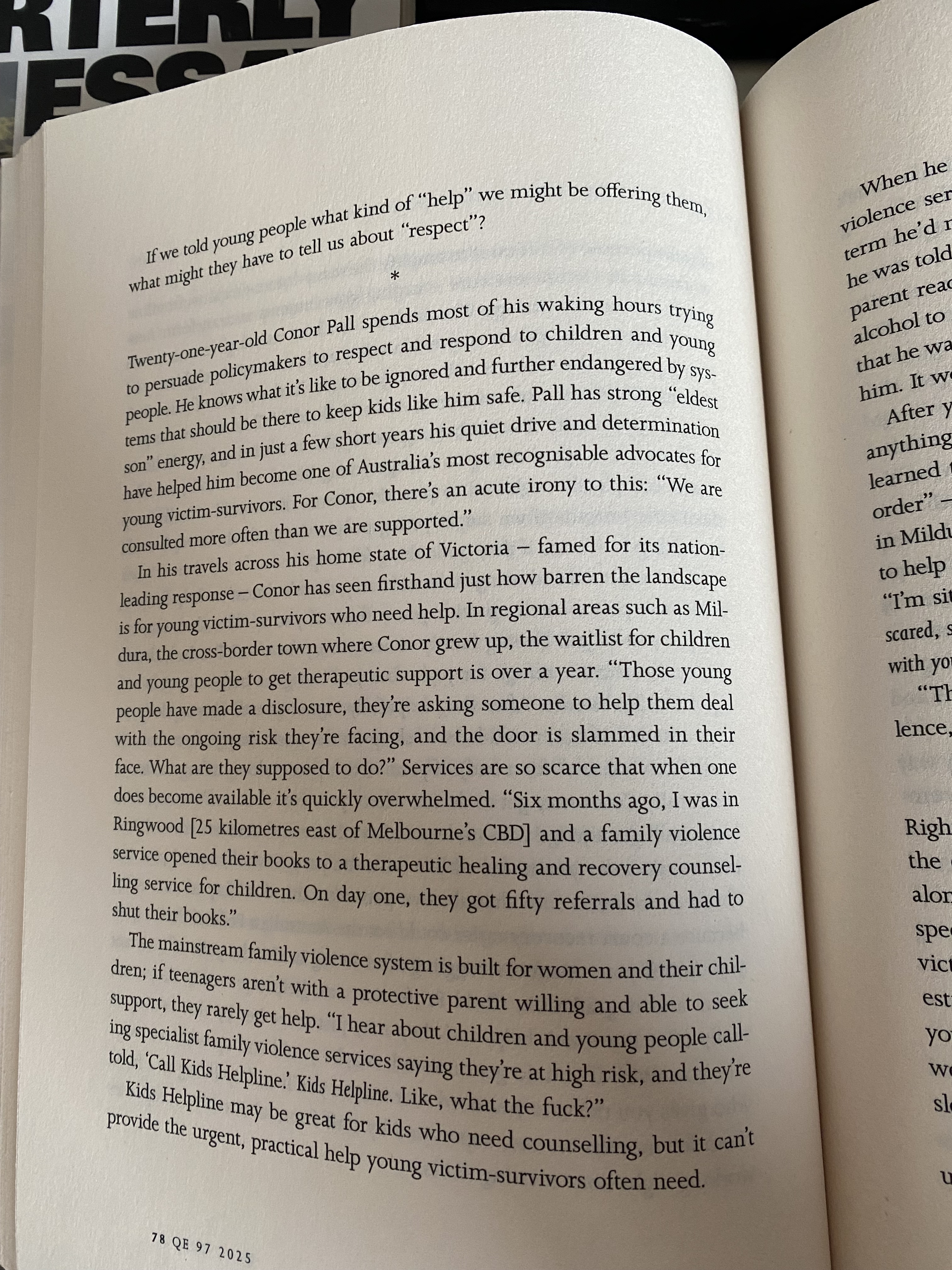
The previous page has given a list of appalling options. This page begins with a barb at ‘respect education’:

If we told young people what kind of ‘help’ we might be offering them, what might they have to tell us about ‘respect’?

The rest of the page is an excellent example of what Jess Hill has described, also on the previous page, as the purpose of the essay: ‘to amplify the many voices … urging governments to transform Australia’s prevention strategy.’

Twenty-one-year-old Conor Pall spends most of his waking hours trying to persuade policymakers to respect and respond to children and young people. He knows what it’s like to be ignored and further endangered by systems that should be there to keep kids like him safe. Pall has strong ‘eldest son’ energy, and in just a few short years his quiet drive and determination have helped him become one of Australia’s most recognisable advocates for young victim-survivors. For Conor, there’s an acute irony to this: ‘We are consulted more often than we are supported.’
….. The mainstream family violence system is built for women and their children; if teenagers aren’t with a protective parent willing and able to seek support, they rarely get help. ‘I hear about children and young people calling specialist family violence services saying they’re at high risk, and they’re told, “Call Kids Helpline.” Kids Helpline. Like, what the fuck?’
Kids Helpline may be great for kids who need counselling, but it can’t provide the urgent, practical help young victim-survivors often need.

Voice amplified, even before the brief description on the next page of Conor’s own experience ‘surviving after surviving’.


The correspondence in Quarterly Essay 98, Hard New World by Hugh White, is what you would expect, given the existence of a turf war. Some of the leading figures in the main government programs respond with understandable ire, saying the essay ‘lacks any nuanced discussion of the kinds of intersectional solutions needed’ and insisting that current strategies are based on sound research and wide consultation (Patty Kinnersly, CEO of the primary prevention organisation Our Watch); that it’s divisive, makes sweeping public critique of the workers in the field, is misleading and harmful (Helen Keleher, lead researcher and writer of the framework Hill criticises). I am absolutely in no position to judge the rightness and wrongness of the various arguments, but I do note that there’s a moment when Keleher accuses Hill of using ‘a recurring straw-man fallacy to position feminism as an obstacle to the prevention of violence against women’, which is itself a total straw man, as Hill doesn’t make that argument at all.

Of the other correspondents, the most horizon-broadening is a brief, revelatory essay on ‘how family violence is facilitated within Australia’s migrant and ethnically diverse communities’ by Manjula Datta O’Conor, a founding director of the AustralAsian Centre for Human Rights and Health and author of Daughters of Durga: Dowries, Gender Violence and Family in Australia. I’ll give her the last word here:

If we are to reduce the rates of family and domestic violence, we must look unflinchingly at all contributing factors. Mental health is one of them. That means rethinking how we design perpetrator intervention programs. It means integrating mental health support, not as an excuse but as a method of accountability.


I wrote this blog post on the still-beautiful land of Gadigal and Wangal of the Eora Nation. I acknowledge their Elders past and present.


My blogging practice is focus arbitrarily on the page of a book that coincides with my age, currently 78. It’s like a lucky-dip sampling of the book.
Emily Maguire’s Rapture

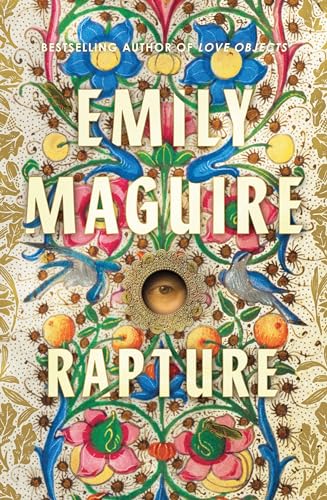
Emily Maguire, Rapture (Allen & Unwin 2024)

Rapture is a historical fiction set in the 9th century of the current era. An English former priest living in Germany teaches his motherless daughter to read and encourages her to think for herself. After his death, with the connivance of Randulf, a worldly a young monk who fancies her, she dresses in men’s clothing and joins the Benedictine order.

If you’ve heard almost anything about this book, you already know where the story leads. It must have received the least spoiler-careful reception of any novel. Ever.

Though I may be being over careful, you won’t get the Big Spoiler from me. I’ll just say that as one who was raised in pre–Vatican Two Catholicism, I found the subject irresistible, and the telling wonderful.

You can read excellent reviews by Heather Nielson in the Australian Book Review (link here, spoiler already in the url), Ann Skea in the Newtown Review of Books (link here), and in the blogosphere, intelligent as always, at Reading Matters, ANZ LitLovers, Theresa Smith Writes and This Reading Life. I’m keeping to my resolve and sticking with page 78*.

As it happens, possibly because of shortsightedness, it took me three attempts to land on page 78.

First I looked at page 76, where Randulf and Agnes get their story straight: Randulf has discovered a beggar-boy who was proficient in Latin and theology and will propose that he be accepted to train as a monk in his abbey. If accepted, Randulf says, there will be no trouble with the story. Among monks, he says, ‘It is not done to exchange histories or probe for intimacies.’

Realising I had the wrong page I turned, inadvertently, to page 80, where Agnes hears Randulf pissing and ‘hot panic grips her’ – but he reassures her that the monks wash rarely, sleep fully clothed, and have latrines where privacy ensures they never glimpse even an ankle of another: ‘Your modesty would not be better preserved were you empress of the realm.’

Page 78, when I finally got there, wasn’t less pointed.

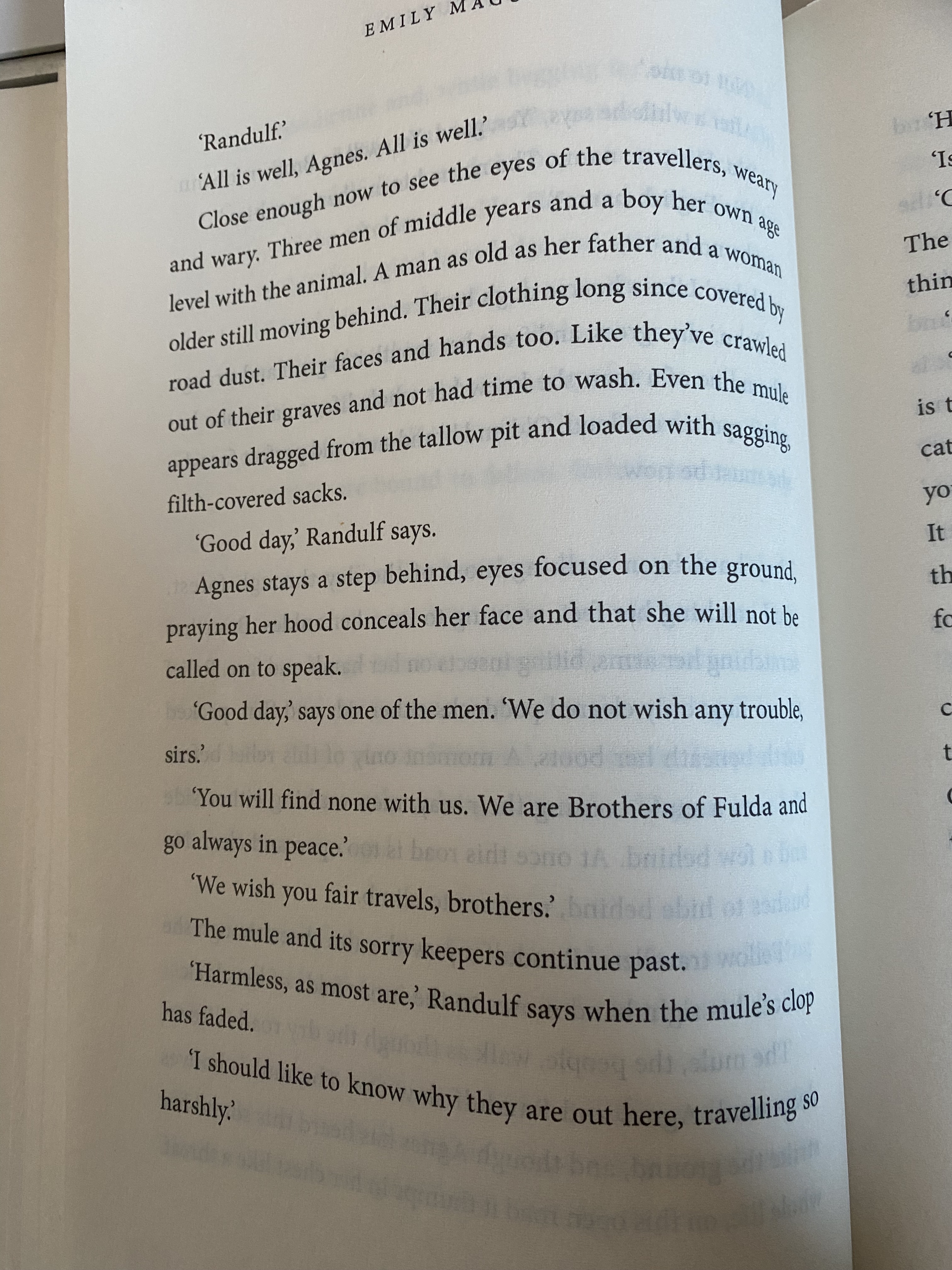
Agnes, disguised as a boy but not yet a monk, is travelling with Randulf to the Princely Abbey of Fulda (a real place, you can see a photo of the building, now a cathedral, at this link). They see some people with a mule coming their way on the open road. ‘Fellow travellers,’ Randulf says cheerfully, but his hand moves towards his concealed dagger. Agnes is terrified:

It’s an unexceptional encounter, a non-event. But it speaks to character and to the texture of the world Emily Maguire has created, and it foreshadows later events.

‘Randulf.’
‘All is well, Agnes. All is well.’

The relationship between these two characters is one of the joys of the book. Agnes is still a teenager. Randulf is older, but still a young man. He has won her trust and confidence by his genuine appreciation of her as a thinking person when he came to visit her father. They have had one sexual encounter – not exactly rape, but not a good experience for her, and in her piety and her abhorrence of childbirth she has made it clear that it is never to happen again. (Spoiler: it does, only better!) These two lines of dialogue evoke their current relationship: she looks to him for protection; as a man of he world he can reassure her.

Close enough now to see the eyes of the travellers, weary and wary. Three men of middle years and a boy her own age level with the animal. A man as old as her father and a woman older still moving behind. Their clothing long since covered by road dust. Their faces and hands too. Like they’ve crawled out of their graves and not had time to wash. Even the mule appears dragged from the tallow pit and loaded with sagging, filth-covered sacks.

There’s a Candide element to Agnes’ story. She has had a protected life, and is about to enter a differently protected life in the monastery. This is her first glimpse of the hardship endured by people who do not enjoy the protection of the Church or a prince. On the next page Randulf explains that it is not lack of godliness that makes life hard for people from further north, but economics – the further from big churches people live the greater their poverty, as they share less in the wealth accumulated by the Church.

‘Good day,’ Randulf says.
Agnes stays a step behind, eyes focused on the ground, praying her hood conceals her face and that she will not be called on to speak.
‘Good day,’ says one of the men. ‘We do not wish any trouble, sirs.’
‘You will find none with us. We are Brothers of Fulda and go always in peace.’
‘We wish you fair travels, brothers.’

This is wonderful use of dialogue to evoke the dangers of that world. We also see that at this stage Agnes is not confident in her disguise. With the passage of time, though she identifies completely as female (this is not a novel about gender fluidity) she becomes more confident that her disguise will work (until, not a spoiler, it doesn’t!).

‘Harmless, as most are,’ Randulf says when the mule’s clop has faded.

This is an adept piece of foreshadowing. The pair are to go on another journey years later when Agnes is fully Brother John. Again Randulf will be protective, but plague and war have made the environment infinitely more dangerous and hostile. The horror-movie quality to some of the description on page 78 – ‘crawled out of their graves’ and ‘dragged from the tallow pit’ – prepares the reader at a subliminal level for a pivotal moment on that later journey where Randulf and Agnes are horrified by a spectacle that is described only in a couple of disjointed phrases many pages later, but which the reader pretty much has to imagine.

That’s just one page: sadly it doesn’t contain any of the steamy sex, or the equally enthralling theological argumentation. It conveys only a little of the constant dread that hangs over Agnes/John, which for me is the most powerful element of the book. She is doomed, but not before some magnificent achievements and for me the way she meets her doom is both devastating and narratively satisfying.


I wrote this blog post on land of Gadigal and Wangal of the Eora Nation, where a kookaburra flew right in front of me as I was walking this morning. I acknowledge the Elders past and present of this beautiful country, never ceded.


My blogging practice is to focus on the page that coincides with my age, currently 78.

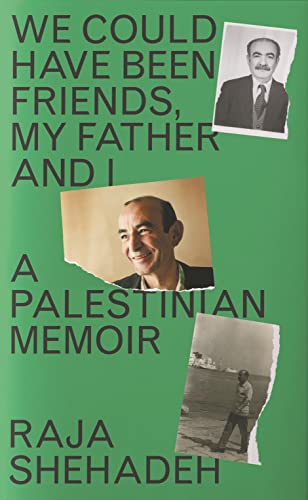
Raja Shehadeh, We Could Have Been Friends, My Father and I

Raja Shehadeh, We Could Have Been Friends, My Father and I: A Palestinian Memoir (Profile Books 2022)

When a young man at the Sydney Writers’ Festival recommended this book to me, I said, ‘What a great title!’ He didn’t miss a beat: ‘Yeah, a great dust jacket too.’ You’ve got to love the sarcastic young.

Superficial old man I may be, but the promise of the its title is what led me to this book rather than one of Raja Shehadeh’s other recent books, such as What Does Israel Fear from Palestine? (2024) or his Orwell Prize winning Palestinian Walks: Notes on a Vanishing Landscape (2008) – both with excellent titles. Since reading Annie Ernaux’s book about her father, A Man’s Place / La place (my blog post here), I’ve been hungry for more books in which the writer sets out to understand their father. This promised to be that. I was not disappointed, and I also received a masterly lesson in the history of Palestine since the nakbah in 1948.

In 1984, Raja was 33 years old and working in the legal practice of his father, Aziz Shehadeh, on the West Bank. When he saw a map that he realised was a blueprint for an Israeli occupation, he wanted to challenge Israel’s plan through the courts. His father gave advice and put his name to brief that Raja prepared, but when the PLO failed to support it he didn’t share his son’s surprise and distress. Raja asked, ‘Had he given up on using the law to resist Israel’s occupation?’

The next year, aged 73, Aziz was murdered. (The case has never been resolved. Apparently the Israeli police knew who the murderer was but didn’t want to charge him.) For maybe 20 years, filing cabinets crammed with his papers remained unopened until Raja decided to have a proper look, and found a wealth of well-ordered material which may have been the preliminary work for a memoir. This book is the narrative Raja constructed from those papers.

Aziz Shehadeh was a prominent lawyer in Jaffa, Tel Aviv, who lost everything in 1948. At first he thought he and his family would be able to return home after a couple of months when things calmed down. It was not to be.

What followed was a long, intense engagement in political debate with other Palestinians and endless attempts, some successful, to mount legal challenges to Israel’s actions. And with it all the terrible sense of betrayal by other Arab nations. As Raja said at the Sydney Writers’ Festival, he had known the broad outline of his father’s activism, but only on reading the papers did he understood his suffering.

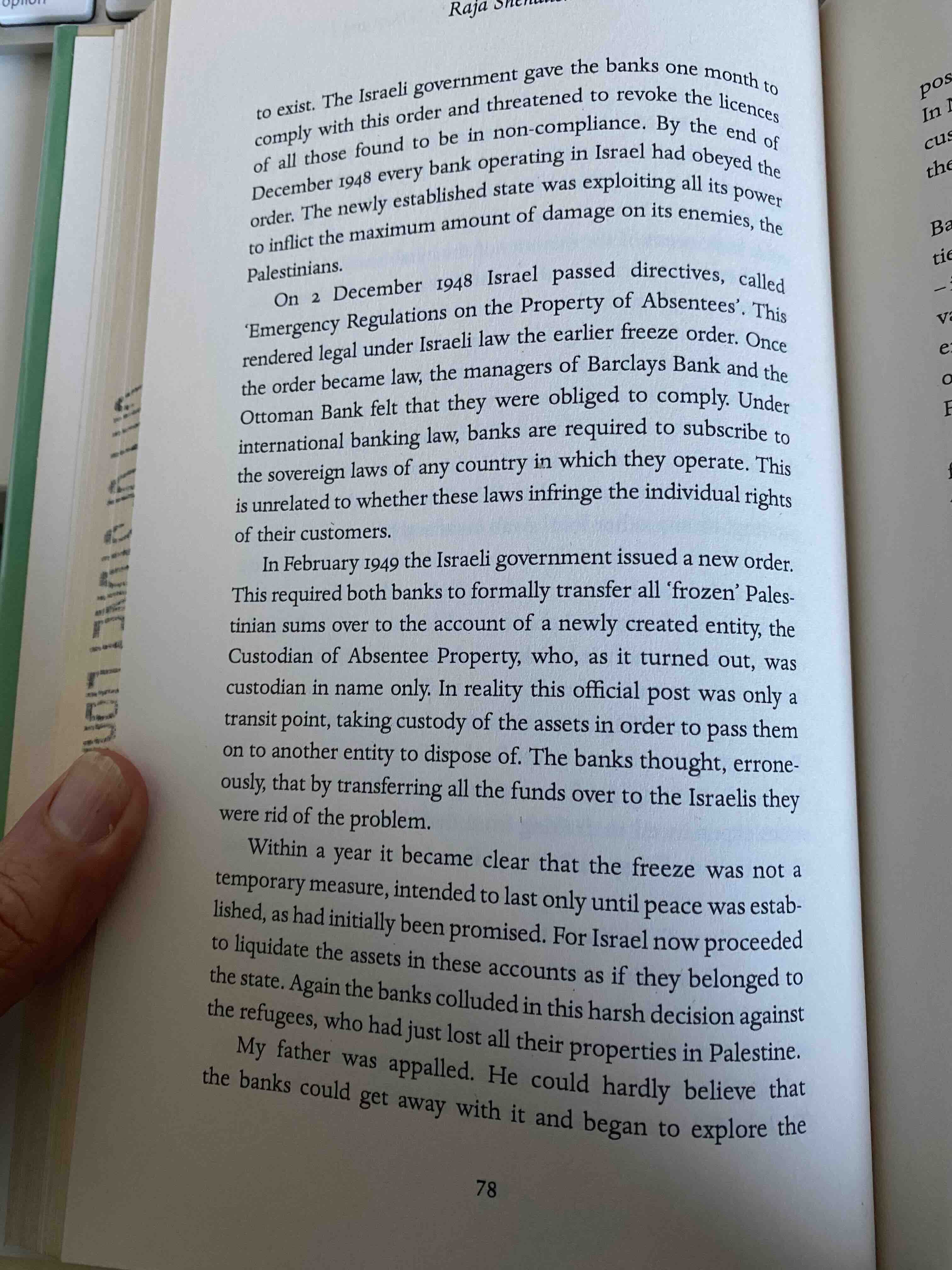
Page 78* is part of the story of one of Aziz’s great successes, what he called the ‘frozen money case’, an episode that illustrates the way Britain, Israel and the Arab states in effect combined forces against Palestinians.

When the British Mandate ended in 1948, the British Treasury declared that the Palestinian pound was no longer legal tender. This meant that for the thousands of Palestinians who had fled to other countries, any bank accounts in Palestinian currency were useless. Arab banks and the Bank of England denied all responsibility, and the fate of those accounts was left to the new state of Israel.

Israel ordered every commercial bank operating in its territory to ‘freeze the accounts of all their Arab customers and to stop all transactions on all Arab accounts’. Shehadeh points out that they refrained from calling them Palestinian accounts: ‘To them Palestine was no more and the Palestinians had ceased to exist.’

By the end of December 1948 every bank operating in Israel had obeyed the order. The newly established state was exploiting all its power to inflict the maximum amount of damage on its enemies, the Palestinians.

On this page, in measured, objective prose, Shehadeh outlines the ruthlessness of the new Israeli government. First, in December 1948, there were directives called Emergency Regulations on the Property of Absentees, with which both active banks, one British and the other Arab, felt obliged to comply. In February 1949 the Israeli government required the banks to transfer the affected funds to a new entity called the Custodian of Absentee Property. The banks could wipe their hands of the issue.

Within a year it became clear that the freeze was not a temporary measure, intended to last only until peace was established, as had initially been promised. For Israel now proceeded to liquidate the assets in these accounts as if they belonged to the state. Again the banks colluded in this harsh decision against the refugees, who had just lost all their properties in Palestine.
My father was appalled. He could hardly believe that the banks could get away with it and began to explore the possibility of a legal challenge.

The pages that follow tell of a protracted legal battle, which Aziz eventually won, alleviating the suffering of thousands of Palestinian refugees. One significant win along the way.

Aziz was at odds with the PLO. He argued that the refugees should accept that they would never be able to return to their homes. He campaigned for the notion of two states – a Palestinian state and an Israeli state – side by side. His personal story is intimately bound up with the story of the Palestinians, and it is one of many stories of sustained, systematic, heroic resistance.

Edward Said famously wrote that Palestinians have been denied permission to narrate. This book, like others by Raja Shehadeh and a score of other writers, defies that prohibition. I’ve read very little of that writing, but there are a couple of books I can recommend if you’re interested (links to my blog pasts): Drinking the Sea at Gaza (1999) by Israeli journalist Amira Hass; 19 Varieties of Gazelle (2002), a collection of poems by Palestinian-American Naomi Shihab Nye published in response to the rise of anti-Arab sentiment in the USA after September 2001; Palestine (2003) and Footnotes in Gaza (2009), groundbreaking comics journalism by USer Joe Sacco.


I wrote this blog post on land of Gadigal and Wangal of the Eora Nation, whose occupation since 1788 has never been legally resolved. I acknowledge the Elders past and present of this country.


My blogging practice is focus arbitrarily on the page of a book that coincides with my age, currently 78.

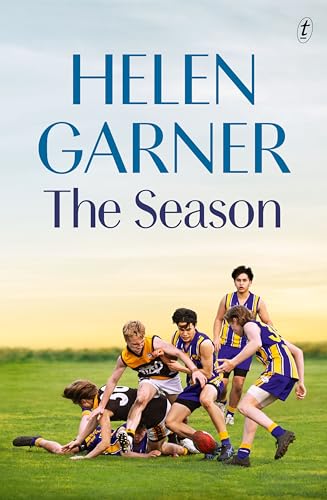
Helen Garner’s Season at the Book Group

Helen Garner, The Season (Text Publishing 2024)

Before the Book Group Meeting:

While she was writing The Season, Helen Garner described it to friends as ‘a nana’s book about footy’. Her youngest grandson Amby was fifteen, on the cusp of manhood. Being witness to his football games and training sessions was, among other things, a way of enriching and maybe holding onto that precious relationship.

I came to the book with a lot of baggage. For a start I didn’t have a benign experience of fifteen-year-old boys when I was one. My boarding school’s focus on football made skinny, physically inept, nerdy Jonathan something of an outcast, and fifteen year old boys, however sweet they may look to a nana’s eyes, can be brutal to the designated outcasts. (Full disclosure: because the school also prized academic achievement, which I was quite good at, I wasn’t the worst abused.)

What’s more, Aussie Rules is pretty much a closed book to me. I don’t know a mark from a behind, let alone a torp, and nana Helen, who says she knows very little about the sport, is sufficiently steeped in AFL culture to feel no need to explain such terms. My whole family watched my big brother play League on Saturdays, my father yelling at the ref in cheerfully confected outrage. And the footballs I myself played at school, badly, were League, Union and soccer. We referred to AFL, then Victorian Rules, as aerial pingpong.

So, even though I’m a member of the vast Helen Garner fan club, I would happily have skipped The Season.

But what the Book Group wants …

I can’t say it completely won me over, but it’s beautifully written. While Garner’s intense desire to know her grandson – ‘what’s in his head, what drives him’ – is the heart of the book, it broadens out to look at aspects of masculinity, and aspects of being an old woman, and aspects of the role of football in Melbourne social life, in an engagingly impressionistic way. I doubt if any other book uses words like ‘sweet’, ‘delicate’, ‘graceful’ or ‘beautiful’ about men young and old with as much frequency. In the opening pages, she writes about becoming an engaged grandmother to two boys:

Never having raised a son, I now began to learn about boys and men from a fresh angle, to see their delicacy, their fragility, what they’re obliged to do to themselves in order to live in this world, the codes of behaviour they’ve had to develop in order to discipline and sublimate their drive to violence

In a recent Big Ideas podcast, Tim Etchells from the British theatre group Forced Entertainment talked about learning by finding rather than by searching. He could have had this book in mind. Garner depicts herself as going to training sessions and games and seeing what happens – no agenda, no conclusions, just acute, self-aware, finely articulated observation. Maybe this is why she kept her first husband’s family name: she garners.

The book moves through footy season from February to August. On page 78*, it’s May, and Garner has had Covid. Watching a lot of football on TV, she has surmised that Virgil and Homer would recognise the ‘hulking airborne men’ she sees in those games. After two weeks ‘reading, dozing, reading again, forgetting everything I’ve read’, she opens a newspaper to the sports pages, where she sees a photo of Buddy Franklin, a Sydney Swans player she describes as ‘a hero of the game, a dancing god of the game in his last season’, whom a Collingwood crowd has booed:

Franklin is thirty-six, battle-hardened. His face, in this photo, is calm, composed; but it is also as soft as a boy’s. It’s a wounded face, with that wiped look of someone who’s copped a ringing slap across the cheek: all his expression lines are gone. In my fortnight of isolation I must have lost a couple of skins: I shock myself by bursting into tears.

I found the photo at this link, or maybe it’s this one. To look at them and read Garner’s description of them is to recognise what a fine writer she is. Even when putting herself front and centre, bursting into tears, she communicates elegantly about the observed world.

The next sentence is a rare moment in this book when Garner allows an explicit moral judgement into the text. Elsewhere, when she narrates the attitudes of Amby and other men to physical injury – they almost seem to relish it – she maintains a kind of awed incomprehension. Even here, she doesn’t voice her own opinion, but goes into journalist mode for a moment and quotes someone else.

The Guardian doesn’t hold back: ‘It’s about the internalised hatred that men – who are the dominant force in shaping and sustaining AFL culture – have for themselves and each other. The Great Southern and Ponsford Stands merely provide a haven for the boozed up, brittle and broken to project their own self-hatred and insecurities on to others.’

I don’t read this as Garner using ‘the Guardian‘ as a mouthpiece for her own opinion. It’s as if some judgement is needed once the booing has been mentioned, but to make a moral judgement would be to disrupt her role as witness seeking understanding. All the same, she does let the harsh judgement stand, more endorsed than rejected, and returns to her primary focus.

Thursday, on the way to training.
‘I still haven’t heard about the game I missed.’
‘Okay. Because of the pain all down my leg I told Archie I wouldn’t be able to go hard, so he kept me on full-back and full-forward. It was horrible. I was so cold. I only touched the ball twice. I was on this huuuuuge guy.’
‘But you kicked a goal, didn’t you?’
‘Yes, but I didn’t get any of my anger out. And the goal wasn’t very … nice.
‘You mean it wasn’t sort of heroic?’
‘No.’
‘But nevertheless it was a goal?’
He shrugs and runs off.

The book is full of these wonderful nanna–grandson chats. Throughout, there’s a tension between Helen the invisible old woman who comes to training sessions or chats with other parents during matches, and Hel the grandmother who is almost a confidante. He puts his big arm around her, rebuffs her attempts to fuss over his injuries, lets her tease him about his mullet, is oblivious to her shock when she realises her grandson has turned into a six-foot man, ‘his surfer’s legs covered in golden hair’.

OK, so maybe those front-row forwards who threw their weight around back when I was 15 were also just boys, far from their mums and dads and nanas, and only smaller, vulnerable boys to get their anger out on. The book has enough AFL in it to have made me want to give up on it a number of times, but I stayed to have my perspective shifted by Helen Garner, a meticulous, wide-eyed, sometimes self-mocking, always loving witness.


After the meeting: This is an all male book group. We kicked off our discussion of the book with a round of ‘position statements’ vis à vis sport in general and AFL in particular. From my point of view this round and the conversation that grew from it was at least as interesting as the book.

I was pretty much the only one who both loathed sport at school and was ignorant about AFL. There was only one total AFL tragic – all but two of us grew up with different codes. For most of us, team sport had played an overwhelmingly positive role. One had played second row forward in the same scrum as a future prime minister. Another is directly related to ‘Rugby League royalty’. One, who came to Sydney from a country town as a young man to go to university, found refuge in the football team, and felt it pretty much saved his life. For another, from an non–English speaking background, the different codes signified different relationships to mainstream Australia – and as a young person he had avoided soccer, which his father loved, so as not to be seen as an outsider. There was much more.

When we came to the book, it’s probably fair to say we all enjoyed it, but there were lots of reservations. ‘She doesn’t get football,’ one man said a number of times. Someone explained to me (and by implication to Helen) that the full-on bodily contact of football isn’t violence. Mostly it doesn’t hurt unless, paradoxically, you don’t fully commit, and any injury is incidental. There was general scepticism about the book’s underlying assumption that men have an ‘underlying drive to violence’ which team sports exist to address – there was quite a bit of chat about women’s sport, some but not all of it on this point. We all, especially the grandfathers among us, admired and envied the relationship between ‘Hel’ and Amby – the relative openness of communication, his physical ease, her tact.

Someone said the book read like a diary – proposing no particular thesis and coming to no conclusion. Only one of us had read Helen Garner’s diaries (Yellow Notebook, One Day I’ll Remember This and How to End a Story), and said they were wonderful. Alas, he confessed at the end of the meeting that he’d only read 10 pages of The Season, so he couldn’t compare it with the more substantial work.

This post may be too much about me and too little about the book, but I came away from the discussion feeling that just as writing the book gave Helen Garner gained some access to arcane rituals and tenets of sporty masculinity, so did I in our conversation, from a different outsider perspective. Long live the Book Group.


The Book Group met on Gadigal land and I wrote this blog post on land of Gadigal and Wangal of the Eora Nation, where we’re fast approaching the shortest day of the year. I acknowledge the Elders past and present of this country, never ceded and welcome any First Nations readers of this blog. The sport of AFL, like much that is distinctive in Australian settler culture, owes much to First Nations influence: some historians believe that it owed a lot to marn grook, a game played by First Nations people.


My blogging practice is focus arbitrarily on the page of a book that coincides with my age, currently page 78.

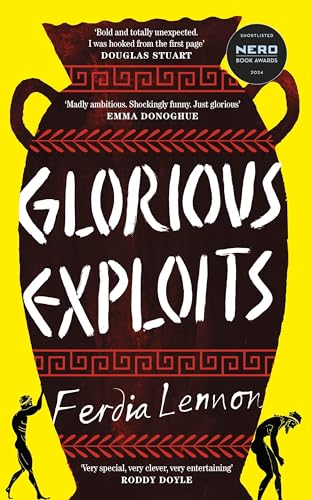
Ferdia Lennon’s Glorious Exploits at the Book Club

Ferdia Lennon, Glorious Exploits (Fig Tree 2024)

Before the Book Club meeting: I’ve recently been reading a lot by Irish writers who travel beyond their native shores. What Happened to Nina? by Dervla McTiernan is set in Vermont. The Narrow Land of Christine Dwyer Hickey’s novel is Cape Cod, Massachusetts in the 1950s. Sean Whiteside’s eminently readable translation made Wolfram Eilenbecker’s The Visionaries available to English readers from 1930s Germany. Now Ferdia Lennon’s Glorious Exploits goes even further afield in space and time. It’s set in Sicily in the fifth century BCE, during the Peloponnesian War.

Athens has invaded Sicily and been soundly defeated. A large number of Athenians are imprisoned in a quarry outside the city of Syracuse (this really happened). Some of the prisoners are given slightly better conditions if they can quote lines from Euripides (this also really happened). Two unemployed potters, Lampo and Gelon, stage a double bill of two Euripides tragedies, Medea and The Trojan Women, performed in the quarry by Athenian prisoners (this is made up). The Syracusans, including Lampo the natrrator, have Irish accents (why not?).

The novel, Ferdia Lennon’s first, has been a big success. You can read the Observer review here, and Kirkus Reviews here. Apart from saying that I enjoyed it, laughed out loud a number of times, was shocked at the shocking moments and came to like and care about the characters, I’ll stick to page 78*, whose action is neither at the quarry with the Athenian actor-prisoners, nor at the pub with the Syracusans, but at the docks.

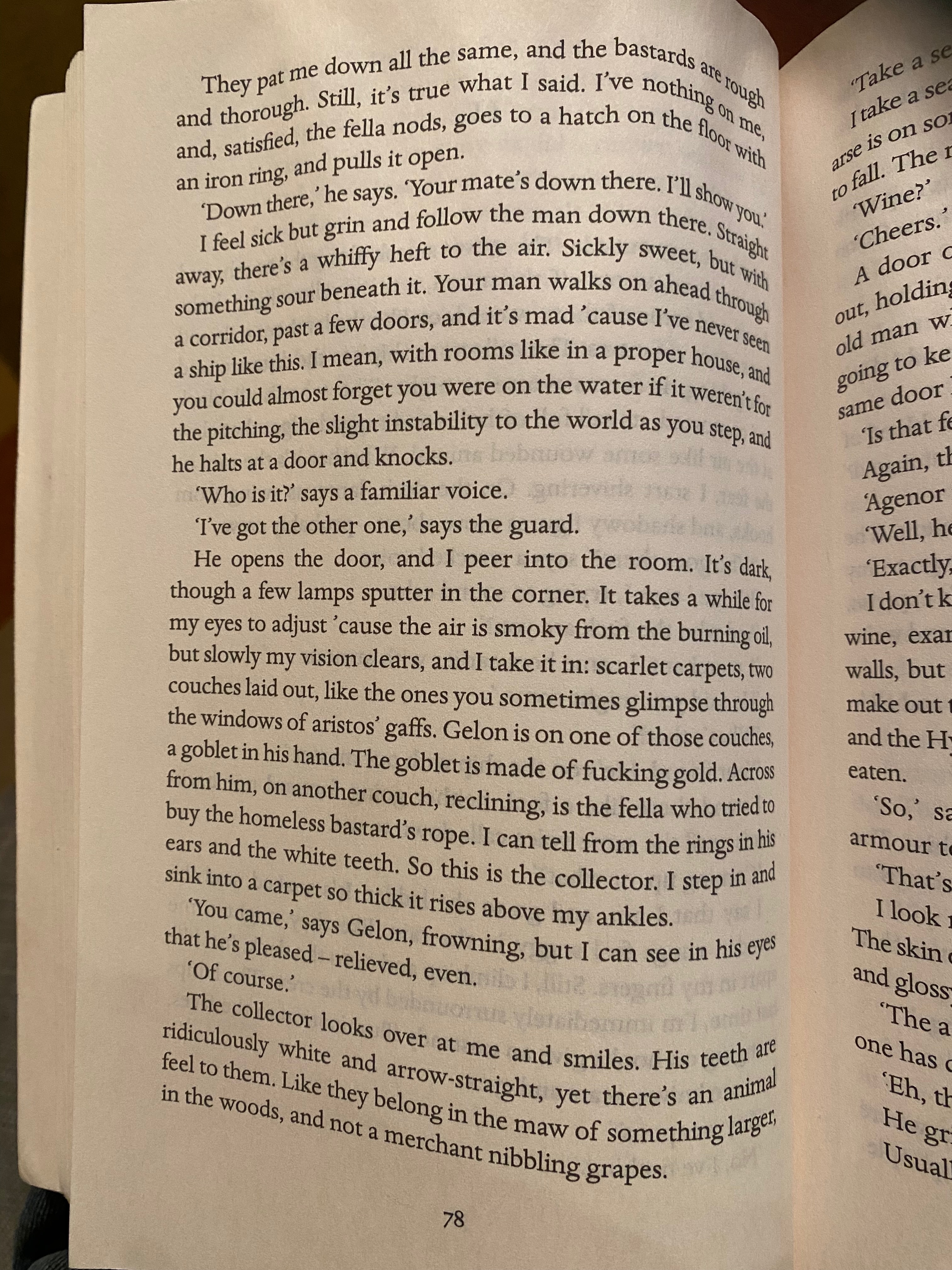
On this page Lampo meets the collector, a man of great wealth that is almost certainly ill-gotten. Gelon has gone alone to the collector’s ship to negotiate a deal on a pile of armour stripped from Athenian corpses. At the start of page 78 Lampo has told the collector’s piratical crew that he’s there to see his friend, and that he’s unarmed.

They pat me down all the same, and the bastards are rough and thorough. Still, it’s true what I said. I’ve got nothing on me, and, satisfied, the fella nods, goes to a hatch on the floor with an iron ring, and pulls it open.
‘Down there,’ he says. ‘Your mate’s down there. I’ll show you.’
Straight away, there’s a whiffy heft to the air. Sickly sweet, but with something sour beneath it. Your man walks on ahead.

There’s no attempt at faux-antique or heroic-Greek prose here. It’s straight into the ‘bastards’, ‘fellas’, ‘mates’ and ‘your mans’ of contemporary Irish vernacular. And, as everywhere in this novel, there’s a lot to smell. I don’t know if a specific source of the smell is being suggested, but there’s a clear metaphor: the collector, as we are about to see, is urbane and courteous, but with something ominous beneath the urbanity. At the end of the page, his teeth provide another metaphor:

The collector looks over at me and smiles. His teeth are ridiculously white and arrow-straight, yet there’s an animal feel to them. Like they belong in the maw of something larger in the woods, and not a merchant nibbling grapes.

If I’d set out to write a plot summary, I might easily not have mentioned the collector. He has a function in the plot – I don’t think it’s a spoiler to say that he provides financial backing for the production, and later a potential means of escape for some characters. But there are at least two other things to notice.

First, he has a sadistic, ghoulish quality. There’s the bloodstained armour he’s buying from our heroes. Then on this page Lampo recognises him as ‘the fella who tried to buy the homeless bastard’s rope’ – referring back to a homeless man’s story of a threadbare length of rope he treasures as his only memento of childhood, which he refuses to sell it a vast sum to a stranger we now know to be the collector. (The rope later turns up on the collector’s wall, leaving the reader to deduce that it was taken from its owner by force.) So his involvement highlights the macabre dimension of Gelon and Lampo’s project. Gelon’s desire to stage plays by the great Euripides is surely a good thing, fuelled by his passionate love of high Greek culture, and the potters and their performers develop relationships of mutual respect and even affection. Their art gives them respite from the horrors of their situation. But for the other Athenian prisoners that situation is unchanged, and even for the performers there is only the briefest respite.

There’s another thing. The collector’s name is later revealed to be Tuireann, a name he shares with a figure from Celtic mythology. At a literal level this might suggest that he has come to Sicily from far-off Ireland. But I think it’s a little authorial joke. If the language of the book is Irish, why not give one of the characters an Irish name?

I had to do a web search on “Tuireann” to get that joke (if it is one). It’s the kind of book where there are plenty of things to look up if the spirit moves you. The Peloponnesian War and the two plays by Euripides are the big ones. Did it add to my enjoyment that I saw an amateur production of The Trojan Women in Darlinghurst four decades ago? Probably. Would I have felt the lack if I hadn’t? I doubt it.


After the meeting: We discussed this book alongside Han Kang’s We Do Not Part and apart from the person who had read only 10 percent of it, we all enjoyed it a lot more. The ten-percenter said she had stopped reading because of time constraints, but I wouldn’t be surprised if some readers put the book aside after the terrible brutality that comes in the first couple of pages.

One of us had been to Syracuse and visited the quarry, though the guide didn’t talk about the imprisoned Athenians. None of us had felt the need to read up on Ancient History – the book doesn’t depend on specialist background knowledge. Two of us had heard Ferdia Lennon speak at the Sydney Writers’ Festival, so could add a little bit of news about him and what went into the making of the book.

I can’t talk about the way the book ends, but it’s probably OK to say that it’s with a kind of coda. When someone said she loved the ending, two of us thought she meant the bitter-sweet, though mostly bitter, conclusion of the main narrative. Once we were reminded of the actual final moments of the book, we agreed. The other person who had got that far disagreed. She thought it was unnecessary and a bit of a stretch. ‘The whole book is a stretch’, three of us replied in unison.


The Book Club met in Gadigal land, close to the great harbour Warrane. I wrote this blog post beneath a cloudless sky on land of Gadigal and Wangal of the Eora nation. I acknowledge their Elders past present and emerging, and gratefully acknowledge their care for this land for millennia. I welcome any First Nations readers of this blog.


* My blogging practice is focus arbitrarily on the page of a book that coincides with my age, currently page 78.

Journal Catch-up 30: Meanjin Summer 2024

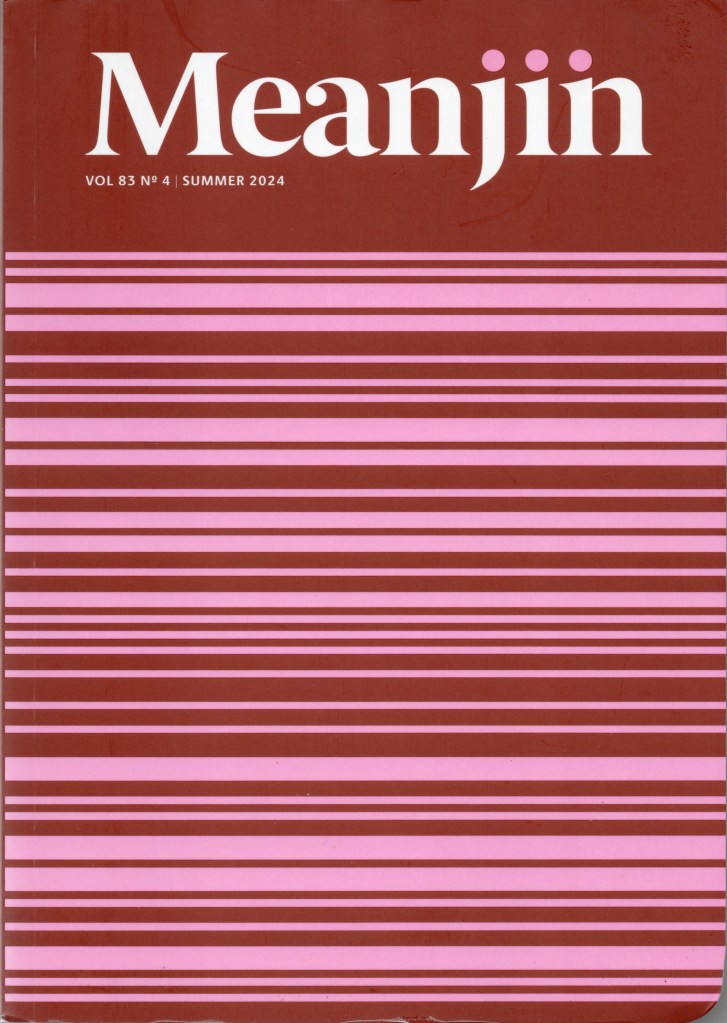
Esther Anatolitis (editor), Meanjin Vol 83 Nº 4 (Summer 2024)
(links are to the Meanjin website: some but not all of them are available to non-subscribers)

I’m usually at least three months behind in my journal reading, so I don’t expect the journals to comment on the day’s headlines. So it was nice serendipity, on the day I read a piece in the Guardian about bulldozers moving in on a tent city in Moreton Bay Council Area, to read ‘The tent village at Musgrave Park‘ by Lillian O’Neill, which addresses a similar fleeting community in south-east Queensland with curiosity, empathy and (this is Meanjin after all) erudition.

Other essays have a more general but no less pointed timeliness:

Meanjin has a number of regular features:

  • Even before the contents page, there’s ‘The Meanjin Paper’, an essay by a First Nations writer: it this issue it’s ‘Sing for the Black: From Act to Treaty‘, in which singer-songwriter Joe Geia talks bout his art, particularly his show From Rations to Wages to Treaty
  • Australia in three books‘: Shakira Hussein discusses three books about Meanjin/Brisbane – by David Malouf, Melissa Lukashenko and Ellen van Neerven
  • Interview: ‘All colour and light’, an interview with Gerald Murnane, eccentric and elusive as ever
  • ‘The Year In…’ This issue has ‘… Poetry‘, not a survey, but discussion of a very few favourites by Graham Akhurst & Shastra Deo.

There are short fictions, memoir, book reviews and poetry. To name just one of each:

  • Your heart sir‘ by Grace Yee is in the poetry section, but to my taste it’s the best short story in the journal, about the sudden death of an old man and the dementia of his widow
  • Seven Snakes‘ by Carrie Tiffany isn’t in the memoir section, but it is a kind of memoir, in which the author, a park ranger, tells of seven encounters with snakes and one, more toxic, with a male manager.
  • How Novel is the Novel Prize?‘ by Maks Sipowicz, a review of It Lasts Forever and Then It’s Over by Anne de Marcken and Tell by Jonathan Buckley, joint winners of the 2022 Novel Prize, includes reflections on the function of prizes and awards in the literary ecosystem – and wonders if perhaps the prize should have gone to books of less obvious appeal
  • @ClanC #overflow‘, a lovely parody of Banjo Paterson written by Ian Simmons, whose bio says he ‘has been writing bad teenage poetry for almost five decades’, introduces some much-appreciated levity.

There’s much more in the journal’s 191 pages. I’ll give the last word to Maks Sipowicz. He was referring to literary prizes. I think the words apply just as well to literary journals:

As readers, we can only collectively benefit from the spotlight falling onto more challenging texts


I wrote this blog post on the cloud-covered, windy land of Gadigal and Wangal of the Eora nation. I acknowledge their Elders past present and emerging, and gratefully acknowledge their care for this land for millennia. I welcome any First Nations readers of this blog.

Dombóvár, the anthology

Hunter Writers’Centre, Dombóvár: Newcastle Poetry Prize Anthology 2024 (Hunter Writers’ Centre 2024)

On its web page, the Newcastle Poetry Prize describes itself as the most prestigious poetry competition in Australia. Few people would disagree.

The Hunter Writers’ Centre has coordinated the prize since 2002, and it publishes an anthology every year that includes the prize winning poem, the runners up, a number of subsidiary prize winners and a selection of other submissions.

As the 2024 judges Caitlin Maling and Peter Boyle, each with their own impressive list of prizes, point out, a distinctive feature of the prize is that poems up to 200 lines are accepted. And most of the poems in this anthology are of substantial length – the shortest is 27 lines. The anthology is a rare opportunity to read a selection of longer poems from a wide range of Australian poets.

As my regular readers know, I read quite a lot of poetry, if not enough to call myself a critic. I was happy to read poems here by people whose work I respond to:

  • Mark Tredinnick, whose ‘A Godwit Sonnet Cycle’ won the Hunter Writers’ Centre Member Award
  • B. R. Dionysius, whose three-line stanzas in ‘Fishbone Ferns’ give us scenes from life on the Darling Downs – ‘it can be quite WW1 out on the downs, bodies / hung up on barbed wire, left to rot as a sign to / others – don’t try it, don’t cross into no man’s.’
  • Brendan Ryan, with another of his wonderful cow poems, ‘The snaking accuracy of cow trails’
  • Kathryn Lomer, with ‘Hyaenia song’, a narrative poem set in Ethiopia.

And there’s the immediate reason that I bought a copy, Christopher (Kit) Kelen’s ‘Dombóvár’, which won the prize and gave its name to the anthology. I don’t envy the judges their task, but they’ve chosen well with ‘Dombóvár’, which evokes the small Hungarian town that Kit Kelen’s family come from (at least that’s how I read the poem).

I can’t do better than quote the judges (a PDF of their report is available at this link, and is worth reading in full):

‘Dombóvár’ skilfully integrates thoughtful reflection on important issues, humour, inventiveness and an engaging partly colloquial tone. This evocation of small town rural Hungary carries echoes of the moral ambiguities and violence of settler societies like Australia. Throughout the poem there is the suggestion of a larger, potentially national, narrative, but the reader is left to work through the weave themselves … With great skill the poem breaks standard idioms and expected word choices to produce a clipped, very tight effect that intensifies the reader’s experience. ‘Dombóvár’ uses the form of a poem sequence to powerful effect, shaping a masterful poem that can be read on multiple levels.

this is the land of forgive ourselves
for all we've done, will do

There’s lots more in the anthology. To be true to my page 78* practice, I’ll mention ‘The Keeper of the Field’ by Mal McKimmie (pages 74–80). It’s one of several sonnet sequences in the anthology, and a quick web search informs me that it’s far from being the only one written by Mal McKimmie.

The sequence is prefaced by a quote from the Bhagavad Gita, and I’m guessing that the ideas it explores are related to Hinduism: the field is (crudely speaking) the mind, and it is populated by sheep (ideas? poems?). The sonnets circle around the notion of an empty field – mind empty of thought, perhaps. In the two sonnets on page 78, the sequence moves forward to the notion that all fields (all minds?) are connected – we are not the isolated individuals that we think we are in the West. That might sound abstract and difficult, but the poems are remarkably lucid. Here, ripped from its context, is one of the two on page 78 to give you a taste:

Did I say this field has a fence? Well, it 
doesn't anymore. It seems the fence came
down, was taken down, or disappeared
with the sheep, as if they were interdependent
(I faintly recall a lyric passing
through here, singing something along these lines).
Given the absence of a fence, where is
the distinction between this field and another?
Do I tend a disappearing border?

Leaves of grass, field to field, lean in sympathy,
mirror each other; flowers too; even
weeds copy their kin; creepers creep towards
each other; and roots, well, roots have always known:
nothing is alone, nothing under the sun.

if the poem is exploring ideas from Hinduism, it manages to remind us that the quintessential North American poet Walt Whitman was in similar territory – his poem ‘Song of Myself’ includes lines like ‘For every atom belonging to me as good belongs to you.’ And recent science about tree roots supplies the poem with a beautiful metaphor for interconnectedness.

Claire G. Coleman’s Enclave

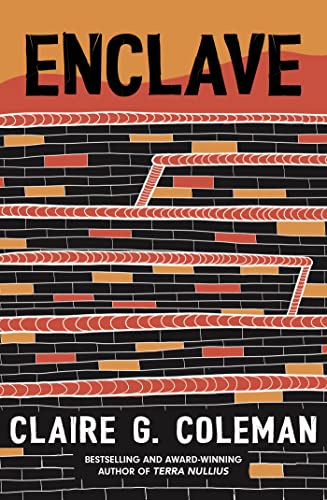
Claire G. Coleman, Enclave (Hachette Australia 2023)

This is the first book I’ve read by Noongar writer Claire G. Coleman. Her first novel, Terra Nullius, won prestigious prizes and her poetry and essays appear regularly in journals I read. (If you want to plough through my earlier posts to see what I’ve managed to say about those earlier encounters, here’s a link.) So I was happy when I got hold of a copy of Enclave, her third novel. I enjoy science fiction, so the fact that it’s a dystopian genre novel was an extra cause for joyful anticipation.

The book delivered on both fronts – filling the spot in my heart reserved for intelligent speculative fiction, and expanding my acquaintance with Claire G. Coleman’s writing. If you want to read a proper review, I recommend Magdalena Ball at Compulsive Reader (here’s a link), Maggie Nolan on The Conversation (link), Bill Holloway at The Australian Legend (link)or all three.I’ll stick to my resolve of focusing on page 78*. As often happens, this arbitrarily chosen page reveals a lot about the book, and hints at a lot more.

We are at about the one-quarter point of the narrative. Christine is the protagonist, a young white woman from an affluent family living in the walled city of Safetytown. Her father has bought her a new apartment as a reward for her success at university, and on this page her parents are taking her to ‘the homemaker centre’ to buy furniture, along with her younger brother, Brandon.

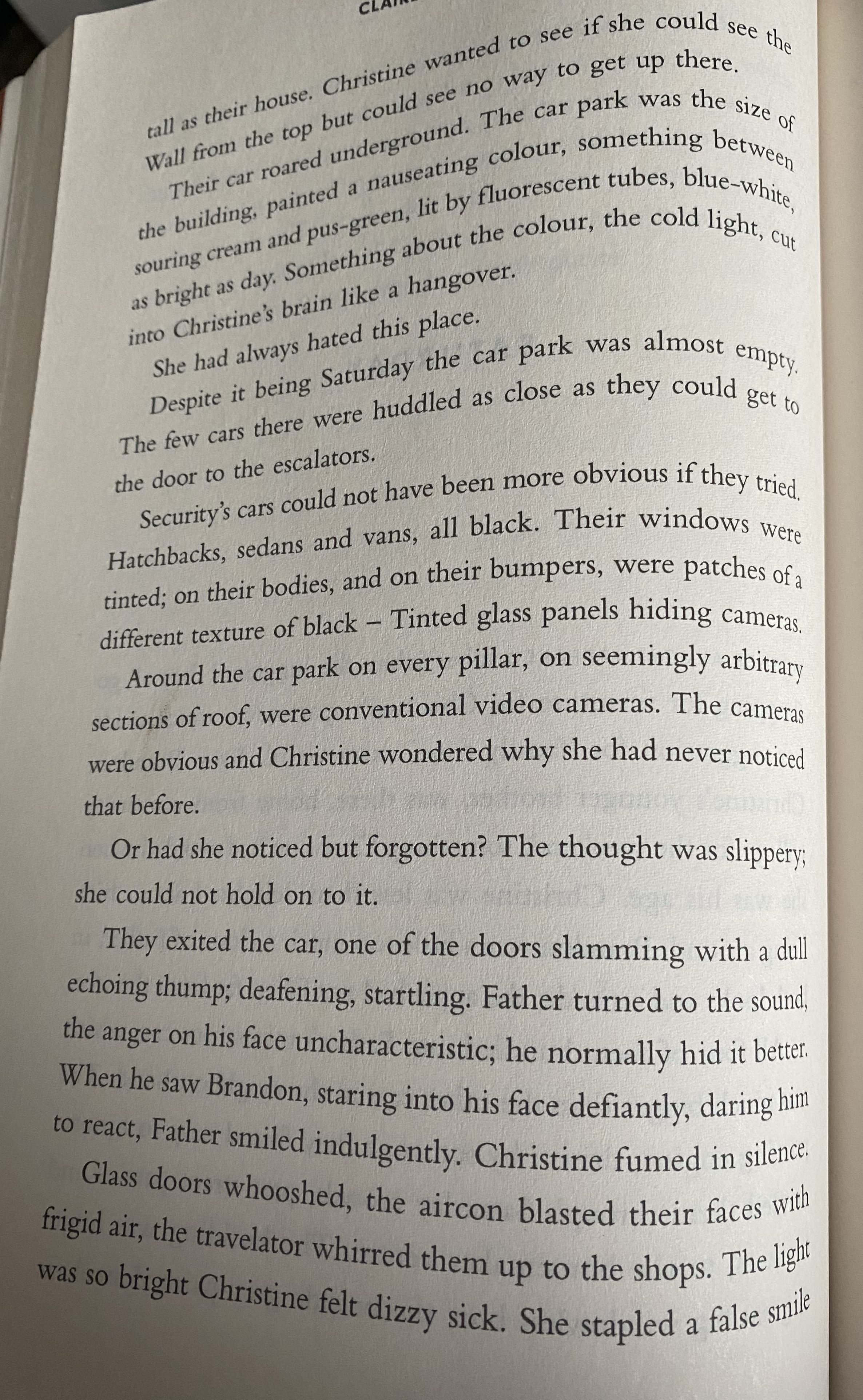
The building was huge. A great big windowless box, the outside grey-painted steel, as tall as their house. Christine wanted to see if she could see the Wall from the top but could see no way to get up there.
Their car roared underground. The car park was the size of the building, painted a nauseating colour, something between souring cream and pus-green, lit by fluorescent tubes, blue-white, as bright as day. Something about the colour, the cold light, cut into Christine’s brain like a hangover.
She had always hated this place.

The citizens of Safetytown are constantly being told how fortunate they are, how safe. Yet the adjectives here tell a different story: ‘windowless’, ‘grey-painted’, ‘nauseating’, souring’, ‘pus-green’. Even more significant is the ever-present Wall. It’s a powerful image, inevitably reminding us of Trump, Berlin and Israel–Palestine. Christine has always been told that beyond it is nothing but predatory violence, misery and chaos. In the otherwise sharply visual elements of this page, it is present to Christine as an object of curiosity even though it’s out of sight. She is beginning to suspect that she has been lied to: she is clear that she has always hated the homemaker centre, but a deeper discontent is brewing.

The next paragraph goes further into the reasons for her discontent:

Security’s cars could not have been more obvious if they tried. Hatchbacks, sedans and vans, all black. Their windows were tinted; on their bodies, and on their bumpers, were patches of a different texture of black – tinted glass panels hiding cameras.
Around the car park on every pillar, on seemingly arbitrary sections of roof, were conventional video cameras. The cameras were obvious and Christine wondered why she had never noticed that before.
Or had she noticed but forgotten? The thought was slippery; she could not hold on to it.

This first part of the novel is about Christine’s awakening. Here she’s noticing things she has never noticed before, in particular the ominously ubiquitous surveillance and enforcement. Not on this page, but part of the same process, she has noticed that one of the anonymous brown ‘servants’ is extraordinarily beautiful. These uniformed servants, all people of colour, are bussed in each day from beyond the wall and then out again in the evening. They ensure that the citizens don’t have to lift a finger to tend to the necessities of life. No one asks how they live on the other side, and in the early chapters they might as well be invisible, but like the women in the movie Conclave they are very present to the reader. Christine’s attraction to the woman servant is so outside the realm of what is considered possible that, like her ‘slippery’ thought about the cameras, it only fitfully enters her consciousness.

They exited the car, one of the doors slamming with a dull echoing thump; deafening, startling. Father turned to the sound, the anger on his face uncharacteristic; he normally hid it better. When he saw Brandon, staring into his face defiantly, daring him to react, Father smiled indulgently. Christine fumed in silence.

So much of what is to unfold is hinted at here. The benevolent father bestowing a brand new flat and furnishings on his daughter is suddenly enraged: not that he’s usually calm, but that he normally hides his rage. When he sees that it’s his son who has made the noise, he is pacified. It will come as no surprise, a few pages later, when the rage is unleashed against his daughter, while the son remains firmly in favour.

So Safetytown is authoritarian, sexist and – we know from earlier and will soon learn – intensely racist and homophobic. Christine is noticing at least some of it, and fuming.

The overall shape of the narrative is strongly implied on this page. Christine will incur her father’s wrath. Somehow she will find herself on the other side of the wall. Will she finally discover she has been lied to all her life? (Anyone who’s read any dystopian fiction would be astonished if the answer to that was no.) Will she escape or be exiled to the other side of the Wall? (See previous parenthesis.) Will she find a better world out there? (Likewise, you’d be pretty astonished at a no answer.) Will she find happiness with the beautiful brown servant woman, and will that woman have a name? (See previous parenthesis.) Will she play a role in bring Safetytown down? (One would certainly hope so, but that would mean she’d have to make giant strides out of her complacent self-absorption.) Perhaps most importantly for the success of the novel: are there any surprises? (No spoiler alert, but yes.) Does it get preposterous? (Yes – in many ways, but mainly in a delightful sequence that could only have been imagined by someone who lives in Naarm/Melbourne and loves it with a passion.)

Bill Holloway at The Australian Legend enjoyed this book less than Claire G. Coleman’s two previous novels, Terra Nullius (Hachette Australia 2017) and The Old Lie (Hachette Australia 2019). I take that as encouragement to go looking for them.


I wrote this blog post on land of Gadigal and Wangal of the Eora Nation. I acknowledge the Elders past and present of this country, never ceded.


It’s my current age.

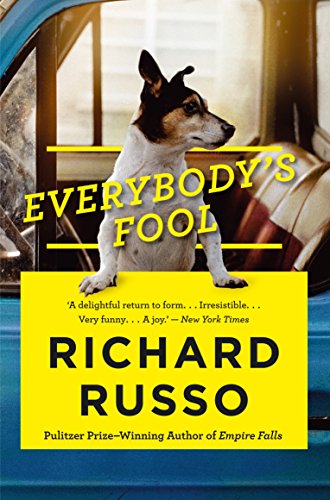
Richard Russo’s Everybody’s Fool at the Book Club

Richard Russo, Everybody’s Fool (Allen & Unwin 2017)

Before the meeting: This is the second book in Richard Russo’s trilogy set in the dead-end town of North Bath in rural New York: it was preceded by Nobody’s Fool (1993) and followed by Somebody’s Fool (2023). I read it as a stand-alone. At about page 80 I went to Wikipedia for a synopsis of Nobody’s Fool, and really I needn’t have. (I also watched a trailer for Robert Benton’s 1994 movie, which was probably a mistake, as the image of Paul Newman as the character Sully was seriously different from the one I’d built up for myself, even allowing for the fact that Sully has aged 20 years since the first book.)

All the same, even for those who haven’t read about the characters’ earlier lives, it’s clear that they are living in various aftermaths. It begins with a burial and returns to the cemetery again and again. One man has been given a year to live, another is stuck in grief for his wife who died in the act of leaving him, a third has been released from jail and proclaims unconvincingly that he has turned over a new leaf. One couple remain affectionate though their affair is long since over, another deal with a long history of mental illness. Friendships endure in spite of mutual irritation, enmities are maintained in spite of deep-seated fellow-feeling. It’s complex, sometimes laugh-out-loud funny, sometimes wretchedly painful, abounding in situational ironies. There are two violent deaths that we don’t witness, and one shockingly violent scene that we do. There are two villains, three if you count the out-of-town dealer in snakes and drugs. There’s a disgustingly incontinent dog. A couple of characters from the first book make cameo appearances, for no obvious reason apart from letting longterm readers know what they’re up to.

Class is ever-present. Most of the book’s characters know they have been excluded from the good things of life. They’re rough with each other, but there’s also kindness and integrity and a strong sense of belonging. At one point Sully, who has the strongest claim to be the main character, reflects that he has made sure ‘that his destination at the end of the day was a barstool among men who had chosen to be faithful to what they took to be their own natures, when instead they might have been faithful to their families or to convention or even to their own early promise’ (page 448). It’s an attitude that elsewhere might be called quiet despair, but here it includes an assertion of connection.

I enjoyed it a lot. It deals with serious themes, but it’s a lot of fun in all sorts of ways.

On page 78*, nobody is being nice to anyone, but nobody’s going anywhere. The scene is Harriet’s diner, one of the three eating and drinking establishments in the town. The characters are Ruth, owner of Harriet’s; her daughter Janey who has just come in complaining about a scene in her bathroom; Carl, a failing developer whose post-prostate-surgery incontinence (which everyone knows about) is responsibe for the bathroom scene; Roy, Janey’s violent ex-husband, fresh out of jail and claiming to have turned over a new leaf, who has just left; and Sully, one-time lover of Ruth, who now hangs around every day to be generally helpful and has just picked a fight with Roy. Ruth is speaking to Janey:

‘Sorry about the bathroom,’ she said, ‘but Carl had an accident.’ She emphasised the name ever so slightly. Remember? she seemed to be saying. What I told you about Carl?
‘Oh, right.’ Janey shrugged. ‘I guess that makes it okay.’
‘That was my thought,’ Ruth said. ‘I’m glad you agree.’
Janey rolled her eyes to show that she most certainly did not agree but wasn’t going to go to the mat over it, either. ‘Was that my idiot ex-husband’s voice I heard earlier?’ Ruth apparently took this to be a rhetorical question, because she didn’t bother answering. ‘He’s taking that restraining order real serious.’
… ‘He hasn’t caused any trouble so far, or even tried to,’ Ruth said, glancing at Sully. ‘Unlike some people.’
‘That’s the thing about Roy,’ Janey said, putting her now-empty mug into a plastic busing tub. ‘He won’t, until he does. But when he does, it’ll be my jaw that gets broke, like always.’
‘He breaks your jaw because you’re always mouthing off.’
‘No, he breaks it because he enjoys breaking it.’
‘Like you enjoy mouthing off,’ Ruth said as Janey brushed past her.
‘Well, jeez,’ Janey mused, pausing in the doorway to her apartment. ‘Let’s think a minute. Where the fuck do I get that from?’

I could probably have picked any page in the book and found similarly alive dialogue, and a similar complexity of relationships. Notice that Sully doesn’t say a word. Ruth’s glance in his direction comes from a woman you don’t want to cross. Likewise, we know that Janey is right about her ‘idiot ex-husband’, but Ruth isn’t gong to back down meekly. It’s no spoiler to say that Ruth’s attributing Roy’s violence to Janey’s mouthiness is rich with narrative irony: what she says in the heat of mother-daughter irritation is a standard blame-shifting rationale used by perpetrators of family violence. That irony goes deep in the light of events yet to come, but my lips are sealed.

After the meeting: We read this along with Christine Dwyer Hicks’s The Narrow Land (yesterday’s blog post here).

They’re very different books, and though I tried in my post on The Narrow Land to note things they had in common, no one else was much interested in such attempts. I’d say that a couple of us enjoyed this book much more than the other, but others not so much. One got to about 20 percent (this is how Kindle readers talk) and then went no further, another read about four percent. The first, probably being polite to those of us who enjoyed it, said that while she could see that the writing was very good, she had no desire to spend any more time in the depressing world of the novel.

Two of us talked about the human warmth and humour. I fond myself laughing helplessly as I recounted one of the more macabre episodes. Others remained stony-faced. The other person who found the book funny said it was like Carl Hiaasen’s work (‘Without alligators,’ I agreed). She also made a cogent argument for the book’s acknowledgement of class in a way that isn’t common in novels from the USA. Similarly civil but unconvinced response.

When I said I could imagine a movie adaptation directed by the Cohen brothers that seemed to bridge the chasm a little.

As I’m about to hit ‘Publish’, I realise that nowhere in my ‘Before the meeting’ section did I mention the wonderful comedic energy of the writing: the book opens with a bravura description of the North Bar cemetery; the town doesn’t have alligators, but it is terrorised by a king cobra; there are terrible smells; a building collapses like something out of a Buster Keaton movie. All of this seems to have passed most of the other club members by. Maybe you have to have to temporarily suspend solemn empathy as well as disbelief.


The Book Club on the land of the Bidjigal and Gadigal clans of the Eora nation, overlooking the ocean. I wrote the blog post on Wangal and Gadigal land as rain poured down. I gratefully acknowledge the Elders past and present who have cared for this beautiful country for millennia.


My blogging practice is focus arbitrarily on the page of a book that coincides with my age, currently 78.

The Book Club at Christine Dwyer Hickey’s Narrow Land

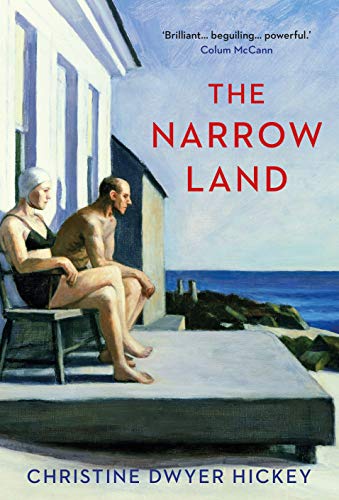
Christine Dwyer Hickey, The Narrow Land (Atlantic 2019)

The cover of The Narrow Land features Edward Hopper’s painting Sea Watchers (1952). The back cover tells us the book is about a ten-year-old boy who forms an unlikely friendship with ‘the artists Jo and Edward Hopper’. But nowhere in the narrative itself are we told the names of the two artists, even though many of the man’s paintings are lovingly described and even a reader as ignorant about US art as I am could recognise some of them (admittedly with help from Duck Duck Go) as Hoppers. Nor is there an afterword or acknowledgement to clarify the story’s relationship to historical fact.

I don’t know what to make of that, since it looks as if a significant dimension of the book is a fictional depiction of Hopper’s practice and the Hopper marriage. In particular, to judge from Josephine Hopper’s Wikipedia entry, it’s likely that the narrative draws on her copious journals recording her bitterness and their stormy quarrels. The character’s journals are mentioned, but Josephine Hopper’s are not.

The Hoppers-not-Hoppers, she in her sixties and he quite a bit older, have a terrible relationship. They are at their Cape Cod house for the summer in the early 1950s. He is stuck, searching for inspiration. She lives in his shadow, resents his failure to support her work, nags at him to get on with his own, is hyper-alert to possibilities that he will be attracted to other women, and relentlessly picks fights with him. He is relentless right back at her. They’re not people you want to be around.

Ten-year-old Michael comes into their lives. He is a German war orphan, possibly Jewish, brought to the US and adopted by a working-class couple in New York, spending the summer with a benefactor who is the artists’ neighbour.

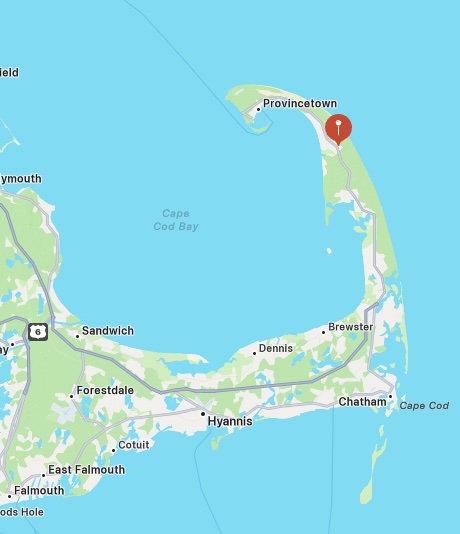
Relationships develop among these characters, including Michael’s complex host family. The narrow land of the title refers literally to Cape Cod, as in this map. It also refers, I think, to the narrowness of a non-combatant USer’s world-view: Michael’s hosts are unable to imagine the magnitude of what he has endured (which he experiences now as nightmarish flashes of memory). The narrowness is also there in the constrictions that society places on the artist, and the claustrophobia that ‘Mrs Aitch’ rails against in her marriage. Perhaps it refers also to the limits imposed on people’s lives in the wake of the Second World War – partners, parents and siblings are still being mourned, and returned soldiers wander through the narrative like wraiths.

For the most part, this isn’t a pleasant read. I found Mrs Aitch especially painful – like Pansy in Mike Leigh’s Hard Truths, her bitterness is unremitting, but she lacks Pansy’s biting wit. Unlike Pansy though, she finds temporary relief in connection with children – Michael and his obnoxious host Richie – where we get to see her in a more positive light. Also unlike Pansy, she has a moment when her intolerant discontent saves the day.

Having just described Richie as obnoxious, I feel obliged to say that even though almost all of the characters are unlikeable, most of them have moments when we see an underlying pain. We come to see Richie in particular as tragic.

Page 78* turns out to be a good example of my pervasive frustration. It’s near the start of the novel’s second section, titled ‘Venus’, in which we realise that ‘he’ – Hopper-not-Hopper – is searching for a woman he glimpsed the previous summer, as he feels that she will inspire him now. (Spoilerish note: he does find her, but it doesn’t work.) On this page he remembers the day that he found her:

She was standing in the doorway of a house, a man standing on the threshold, maybe leaving or maybe hoping to get inside.
He’d driven by and pulled in further along the street. Then he walked back past the house. There had been a bush by the gate, tangled and dried up from the heat, a lawn, yellowed by neglect and the ravages of a long summer.

There’s a description of her clothes and a snippet of overheard conversation, then:

He had walked on for a couple of minutes. then crossed the road to return on the opposite side, his head tilted as if he were searching for the number of a door. As he came closer to the house, he saw her lift her hands and put them under her hair, which was a whiter shade of blonde. Then she flipped it all up, holding it for a few seconds to the back of her head. He could see the damp patches of sweat stamped into her armpits and the outline of her long neck, the soft curve where it joined her shoulders. She dropped her hair and her face lifted upwards. The blue blouse. The light on her face. He couldn’t figure out if it was pouring into her or pouring out of her. He thought she looked sanctified. Then he thought she looked the opposite.

He rushes home and drags out his easel:

He laid it down: the street, the house, the figure of the girl in the doorway, the figure of the man alongside it with one foot on the step, the lawn, the gate, the tangled bush.

This is emphatically an account of a particular artist’s creative process. It’s as if the novelist sets out to imagine for us how Edward Hopper created one of his paintings, but then – for legal reasons, perhaps, or from simple respect for the unknowability of the real man – pulls back from acknowledging that that’s what she’s doing. The understated eroticism here plays nicely into the portrait of the artist’s marriage: his wife (never named) realises that she is not the model for the woman in the painting, and is furious.

On the way to the meeting: We read The Narrow Land along with Richard Russo’s Everybody’s Fool. Just before the meeting I’m noting some things the books have in common:

  • they both have dogs that make a mess of cars – the disgustingly incontinent Rub in Everybody’s Fool, and Buster in this book who leaves a car ‘looking like a feathered nest’
  • characters read books: Sully in Everybody’s Fool remembers as a boy reading the beginning of a book we recognise as David Copperfield (Dickens), and discarding it; Michael in this book reads The Red Pony (Steinbeck) and Tom Sawyer (Twain) and takes them in his stride
  • Class looms large: when Michael’s working-class foster parents turn up we suddenly feel grounded in honest relationships; when Sully’s son turns up in the other book, we’re away with the abstractions of middle-class life.

After the meeting: The books had to compete with the pope’s funeral on the TV, but we still had an interesting conversation.

I think we were all a bit perplexed by A Narrow Land – not quite sure where its focus is. The person who had first proposed it, an artist herself, kicked the conversation off by saying that she was disappointed the book had so little to say about Hopper’s process, and in a way we circled around that central absence for the rest of our conversation.

One other person shared my unease about the relationship between the fictional characters and the historical persons. Others had no problem with it, and I still find it hard to say precisely what my problem is. Our host produced a hefty volume of Hopper’s work and we tried to pin down the paintings he works on in the book. No one claimed to have enjoyed the book unreservedly, though I think we all found some joy, or at least pleasure, in it. No one was much interested in trying to compare the two books.


We met on the land of the Bidjigal and Gadigal clans of the Eora nation, overlooking the ocean. I wrote the blog post on Wangal and Gadigal land. I gratefully acknowledge the Elders past and present who have cared for this beautiful country for millennia.