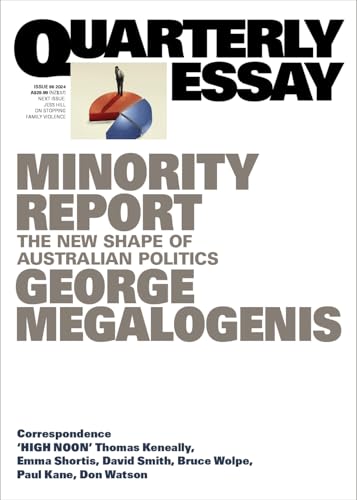
George Megalogenis takes Australia’s federal polling statistics and renders them into readable, even enjoyable prose. In this Quarterly Essay, he reads the data from elections since John Howard’s time up to the present moment, and attempts to make sense of the current political landscape.
The global financial crisis, the coming of the teals, Covid, the defeat of the Voice referendum, the genocide in Gaza, housing, the climate emergency, the hollowing out of the ABC: all are grist to the mill of this nuanced inside-baseball analysis.
The essay and the correspondence in Quarterly Essay 97 probably make a significant contribution to our general understanding of Australian electoral politics. But as I was reading it, I couldn’t help but be aware that it was written at the end of 2024, and if a week is a long time in politics, then the four months that have passed between then and now amount to an epoch. Even the correspondence was written before Donald J. Trump’s ‘Independence Day’. Who knows if, as Megalogenis projects, there will be a hung parliament in May? And if there is, who knows if he is right that it ‘offers perhaps our last best chance to restore purpose to our politics – and policymaking’?
Still, I admire and enjoy Magalogenis’ ability to communicate complex matter in a readable way. Page 47, which begins a section on the level of trust in government, includes an example:
In the wake of the 2010 federal election, I pinpointed the 2001 campaign as the turning point to a more trivial politics. John Howard responded to warnings of electoral doom with a panic of handouts in the first half of that year. … None of the bribes offered to voters in this period came with offsetting savings for the budget. They left a maze of entitlements and distorted market signals which stored up problems for the future, most notably in the housing sector, where prices boomed beyond the reach of the middle class, and in public infrastructure, which could not keep up with population growth. Labor’s unforced policy errors on climate change and the mining tax in 2010 felt like the culmination of a decade-long trend which reduced the relationship between government and citizen to the question: how can I buy your support?
That general trend to trivialisation was interrupted first by the global financial crisis which, Megalogenis argues, created ‘a bubble of trust in our leaders and institutions, which burst once the existential threat passed’, triggering what he calls a ‘new super-cycle in our politics – pro-incumbent in the crisis and anti-incumbent in the recovery’.
There’s pleasure in discerning patterns of this sort. There may also be some usefulness.
In the correspondence, the stand-out for me is Judith Brett. She observes that the major political parties have been hollowed out, as their membership has declined and they have become ‘professional electoral machines’. When memberships were much larger, debate, negotiation and compromise took place within the parties. These debates connected with the lived experience, interests and prejudice of a range of electors. And when the legislation reached the parliament it was assured safe passage by the government’s majority:
What is happening, I think, is that the debate, negotiation and consensus-building is shifting from inside the parties back to the parliament, where they were for most of the nineteenth and early twentieth centuries … The conflicts of interest will be more publicly visible than they are when the resolution takes place inside the parties. This will be a magnet for media speculation and give the impression of dysfunction, but in my opinion it is no cause for alarm. The public will have a clearer view of the interests and arguments at play, and the government will have to negotiate. But it does not mean the end of effective legislation.
We’ll see.
I wrote this blog post on land of Gadigal and Wangal of the Eora Nation, where the day started out with rich blue sky, turned to heavy rain, fined up, and as I press ‘Publish’ is beginning to rain once more.. I acknowledge the Elders past and present who have cared for this land for millennia.
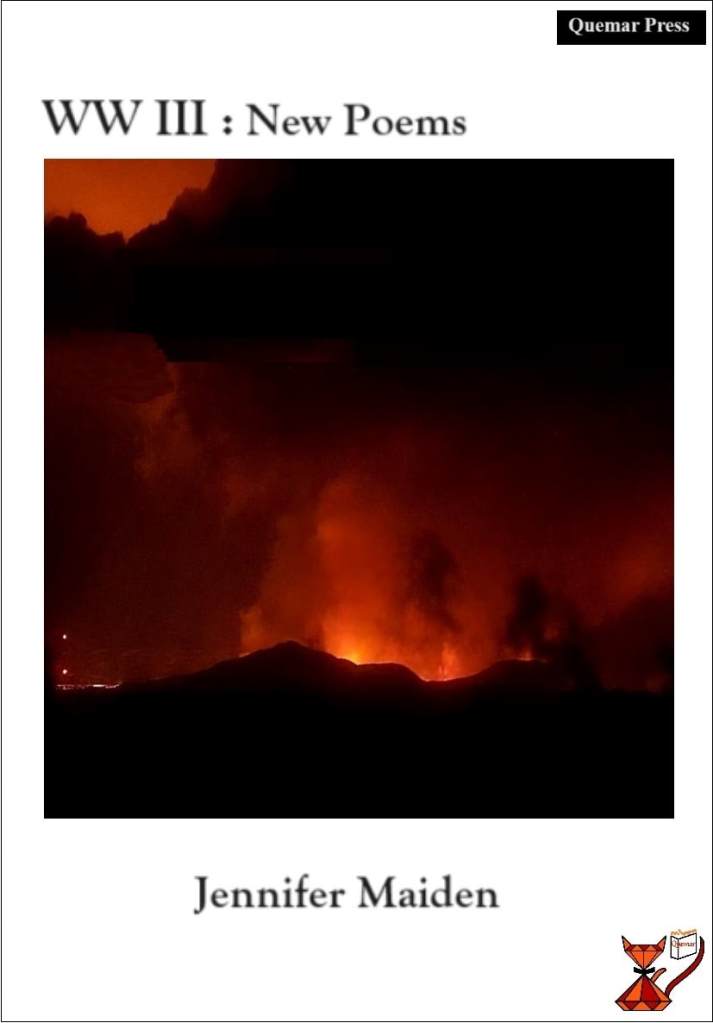
You don’t go to Jennifer Maiden’s poetry for a comfort read. For almost a decade now she has announced the title and theme of a forthcoming book early each year, and uploaded sample poems as they were written over the following months, generally relating to violence, political hypocrisy, and villainy from the headlines. The book has appeared, as promised, early the next January. It’s as if a fragmentary epic poem of our times is unfolding in real time.
WW III: New Poems is the latest instalment. As the title suggests, violent conflict, especially in the Ukraine and Gaza, features prominently, behind it the looming threat of global war. For a proper review, I recommend Geoff Page in the ABRat this link. This blog post isn’t so much a review as a disjointed reflection on just page 47*.
Before going there, a personal note. My blog post about Maiden’s previous book – The China Shelf: New Poems (Quemar Press 2024) – focused on the poem, ‘It’s an odd thing, pity’, and included this:
Not everyone will grasp how US imperialism can be seen as ‘falling’. If anything, some would say it’s on the verge of exploding and bringing the rest of us down with it, terrifying rather than poignant.
The title poem of WW III includes this:
Reviewing The China Shelf, a kind critic worried
that my reference to the falling Empire could
lessen the idea that it wasn't just falling
but exploding, and possibly dragging
its allies hellward with it, but he was only
considering one poem and of course the book
and others before it always took
often a stance of sharper warning
I may have got it wrong, but at least I’m kind, and as a humble blogger I’m flattered to be called a critic.
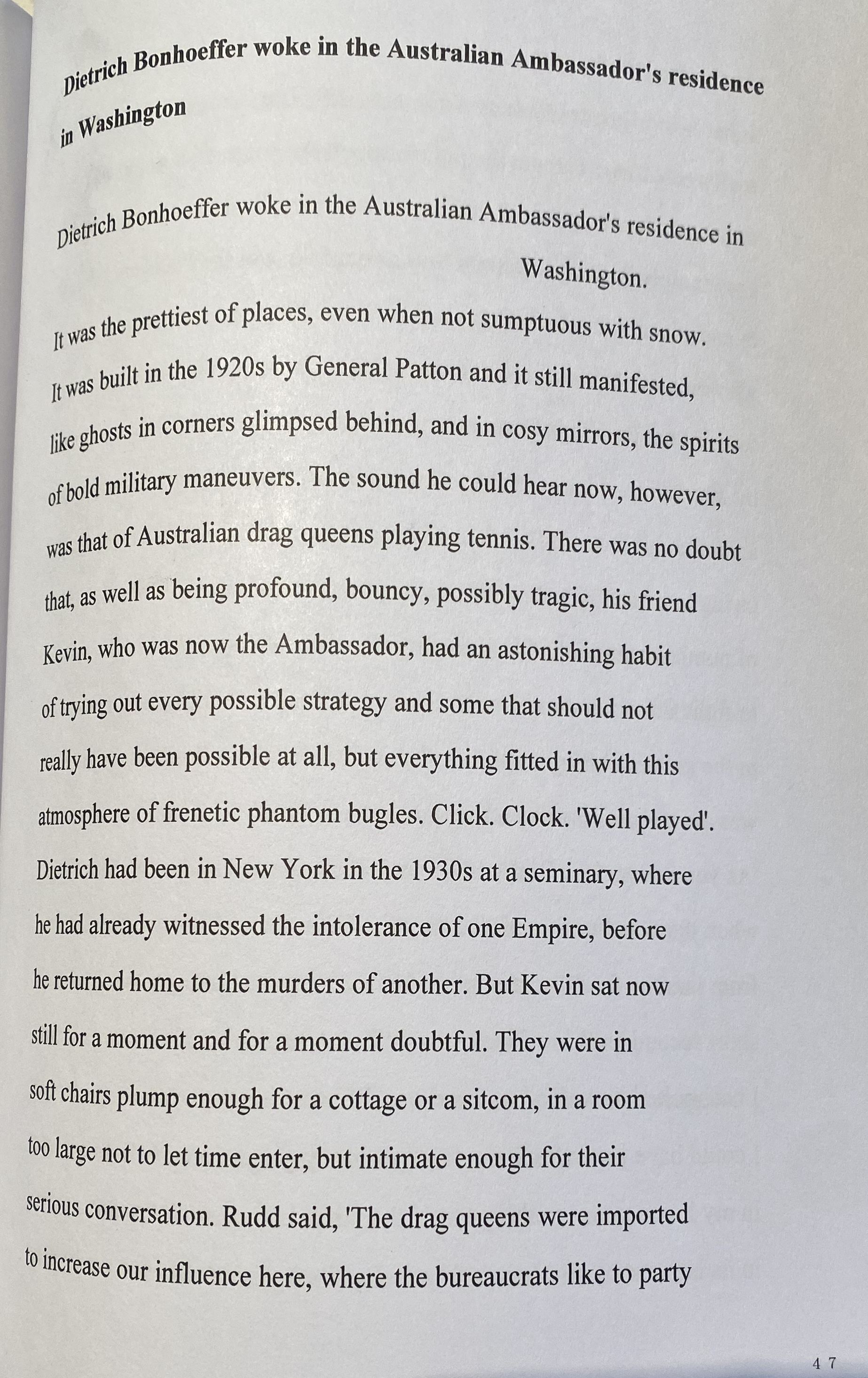
Page 47 of WW III is the first 19 lines of ‘Dietrich Bonhoeffer woke up in the Australian Ambassador’s residence in Washington’.
This page sets the scene for a much longer poem. The ‘serious conversation’, foreshadowed in the second-last line, could be summarised as, ‘Dietrich Bonhoeffer tells Kevin Rudd that it’s not wise to set Australia up to be the US’s proxy in a future war with China.’ The poem could be summarised abstractly: ‘With Dietrich Bonhoeffer as mouthpiece, Jennifer Maiden repeats her warning that the USA is not to be trusted as an ally to Australia.’ Luckily, as with any poem worth its salt, that summary tells you almost nothing and is pretty misleading. You can buy the book to read the whole poem, or you can hear Jennifer Maiden performing it at this link.
The poem belongs to Maiden’s personal tradition of poems where a famous person, historical or fictional, ‘wakes up’ to interact with a living person. In 2009 her fictional character George Jeffreys woke up in a number of global hotspots to see George W Bush on television. Kevin Rudd is one of a number of Australian politicians who have figured since then in delicious conversations: Tony Abbott with Queen Victoria, Julia Gillard with Aneurin Bevan, Malcolm Turnbull with Jessica Fletcher from Murder She Wrote, Tanya Plibersek with Jane Austen. (Beyond these shores, pairings have included Mother Teresa and Diana Spencer, Gore Vidal and Julian Assange, Eleanor Roosevelt and Hillary Clinton.) Usually the pairings are based on something the politician has said or written. In Kevin Rudd’s 2006 essay, ‘Faith in Politics’, published in The Monthly (link here, if you want to refresh your memory), he named Bonhoeffer as an inspiration. The pair made their maiden Maiden appearance in Drones and Phantoms (2014).
It’s interesting to notice just how much information is either given or assumed in these lines. It wouldn’t be a crime to read without googling. As Magdalena Ball said in her review of The China Shelf (link here), ‘You don’t have to have the kind of encyclopaedic knowledge of Australian history and command of current affairs that Jennifer Maiden does to read her books.’ But it helps, and there’s always the invitation to learn more.
First, Dietrich Bonhoeffer. I’ve vaguely heard of him as a pastor who spoke out against the Nazis and was murdered by them. So I know he brings a kind of moral integrity to the conversation. The poem give me a little more:
Dietrich had been in New York in the 1930s at a seminary, where
he had already witnessed the intolerance of one Empire, before
he returned home to the murders of another.
I might not have gone googling if I wasn’t blogging about the poem, but I did, and found that while studying theology in New York in 1930, Bonhoeffer engaged with African-American churches, and became strongly anti-racist. I don’t know that he used the term ‘empire’ about either the USA or Nazi Germany, but it wouldn’t be a poem without that kind of editorialising.
Second, Kevin Rudd. You’d probably know that he was the Australian Ambassador to the USA, but for those who know him there’s a deft evocation of his persona: ‘profound, bouncy, possibly tragic’. (Further on in the conversation, Kevin asks a question ‘and answered himself, as was his custom’.)
Third, the setting. Here’s a pic from the building’s facebook page – ‘the prettiest of places’. Who knew it was associated with the notoriously belligerent US general George Patton? (For readers of my generation no explanation needed: George C Scott in the movie Patton leaps to mind.) According to my googling, Patton rented the house rather than built it, but the association is still there.
DJ Kity Glitter with Rudd. Photo from Sydney Morning Herald 5 June 2023
Fourth, the headlines. Kevin Rudd did host a party featuring drag queens at the ambassador’s residence in June 2023. As far as I can tell, the tennis party was a different occasion, but who’s to say there wasn’t tennis at the Pride party as well? The fabulous image of drag queens playing tennis is an example of a news items seized on for poetic purposes, in this case with what looks like glee.
Given recent events in the USA, the mention of drag queens suggests that the poem will be about culture wars. But it’s actually a piece of misdirection. Over the page, the poem’s real subject is revealed, when Kevin asks:
____________________________________ But I suppose
really you are here about the police force?
And the poem’s key news item is identified: a hot-mic moment in August 2024 in which a US official, talking to Prime Minister Anthony Albanese,
_________________________ named Rudd as the schemer
who dissuaded America from proposing their own police
force in the Pacific in favour of one organised and paid for
by Australia.
All this information, of course, doesn’t lie inert on the page, but is woven into engaging poetry. For instance, one of Maiden’s themes is the way the US, behind its benign façade, is a ruthless military power. The residence, with its link to Patton, could have been built to her specifications. The prettiness and cosiness of the residence is haunted by bold military maneuvers (note the US spelling), yet the sensuous reality is also there:
still for a moment and for a moment doubtful. They were in
soft chairs plump enough for a cottage or a sitcom, in a room
too large not to let time enter, but intimate enough for their
serious conversation.
We are given enough of Kevin and Dietrich’s histories and personal quirks for them to be more than simply avatars for positions or points of view (like, say, the characters in Plato’s dialogues). On the other hand, neither on the page nor when performing the poem, does Maiden make any attempt to give them different voices. (Maiden-Trump has none of real-life-Trump’s incoherence.) They are not fully-rounded dramatic characters (it’s not a sitcom) but they have enough independent reality that you feel the poet herself is curious to hear what they have to say in their ‘serious conversation’. I think that’s why this long run of imaginary conversations doesn’t feel tired or repetitive – they are still part of a process of discovery. (There’s an underlying question that this poem goes on to address: What are we to make of Kevin Rudd’s current incarnation as Ambassador? What’s happened to his irritability, his love of China, his social awkwardness, any bitterness about being ousted by Julia Gillard? It doesn’t address Trump’s hostility to him … that would be a different poem.)
It’s easy to be caught up in Maiden’s subject matter. Her poems can be contentious – over the page, Kevin says, as if it’s plain fact, ‘the Americans replaced me with Gillard’, and even on this page there may be an implied equivalence between Nazi Germany and 1930s USA. (If ever there was a poet who didn’t expect her readers to agree with her sentiments a hundred percent, it is Jennifer Maiden.) But this is poetry, and what is said isn’t necessarily more important than the way it is said.
Weaving isn’t a bad metaphor for how these lines progress. The reader’s attention moves back and forth like the shuttle on a loom: the residence with and without snow, General Patton then and now, corners and mirrors, military manoeuvres and drag queens, Kevin’s contrasting qualities, a room large but intimate, the shift from drag queens to the Pacific police force. Maybe it’s not so much a shuttle as a tennis ball. ‘Click. Clock.’
The way the poem sounds is interesting. Some of Maiden’s poems have sustained rhymes that you barely notice on first reading. That’s not so in this one, but especially in the opening lines there’s a lot of alliteration, especially of sibilants (‘prettiest of places’, ‘still manifested, / like ghosts in corners’, ‘every possible strategy and some that should not’). The long lines often break in mid sentence, even mid phrase (‘his friend / Kevin’, ‘should not / really have been’, ‘where / he had already witnessed’, ‘before / he returned’, ‘they were in / soft chairs’, ‘their / serious conversation’). To my ear, these result in a kind of clutter, a feature rather than a bug, that adds an odd urgency to the voice, an urgency that’s all too fitting in poems that predict war.
Since WW III: New Poems was published, Dietrich and Kevin have had a further conversation in the Residence. Click on this link to the Quemar Press website and search for “Rare Earths”.
I wrote this blog post on land of Gadigal and Wangal of the Eora Nation. I acknowledge the Elders past and present of this country, never ceded.
* My blogging practice is focus arbitrarily on the page of a book that coincides with my age, currently page 78. As WW III: New Poems only has 76 pages, I’m reverting to the year of my birth, ’47.
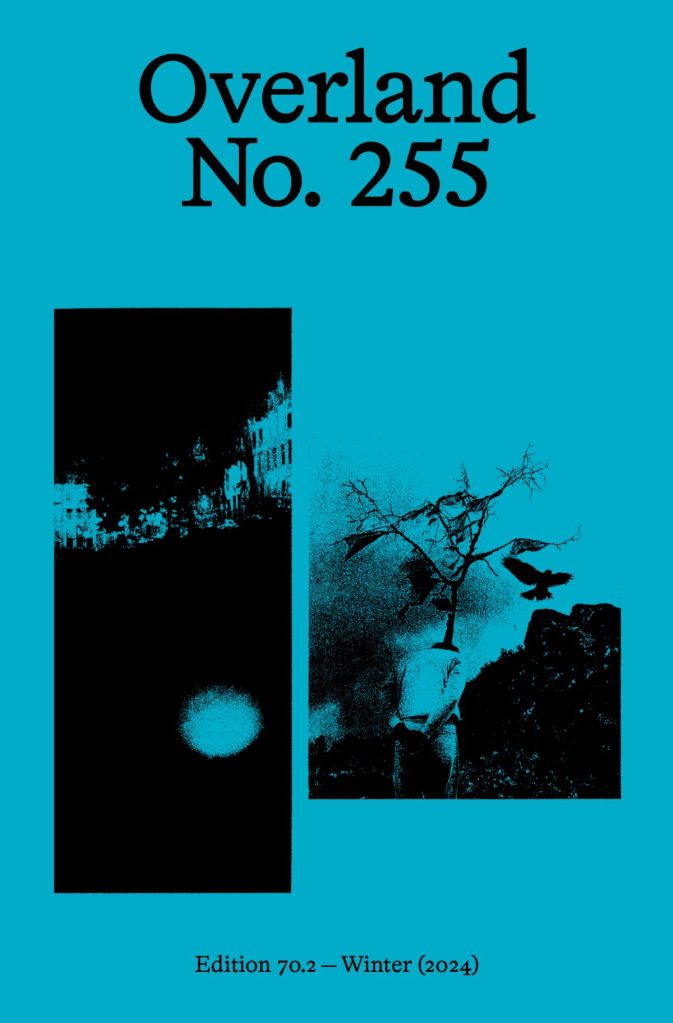
Evelyn Araluen and Jonathan Dunk (editors), Overland Nº 255 (Winter 2024) (Links are to the online versions unless otherwise indicated.)
I sometime approach literary journals as if shouldering a grim obligation – doing my bit in the cultural ecology. (Added later: The morning after I uploaded this post, I read in a letter from Esther Anatolitis, editor of Meanjin, that my subscription ‘supports the ecosystem of Australian writing: that fragile yet incredibly powerful space where the finest new work is written’. Great minds draw on the same tropes.) The austere retro design of this Overland, one of four to mark a 70th anniversary, didn’t do much to dispel the grimness. Nor did the editorial, which underlines the darkness of our times. But then …
The first thirty pages or so are taken up with ‘Writing from the South: an interview with Kim Scott’. It’s leisurely, full of unfinished sentences and swirling crosscurrents of thought and information – there’s no apparent attempt to tidy up the spoken conversation, and as a result you (or at least I) get to feel you’re in the room with the the living, breathing, thinking author of, among other things, That Deadman Dance, Taboo (links to my blog posts) and (what I haven’t read but now really want to) Benang. He’s in conversation with Samuel J. Cox.
I’ll mention two other non-fiction pieces: ‘The Australian media’s problem with Palestine’ by Juliet Fox, which tells about decades of government suppression of Palestinian voices on a Melbourne community radio station; and ‘“Arts funding is fucked”: Overland 1973–1975’, a plus-ça-change piece by Overland‘s digital archivist Sam Ryan about the politics of funding to the arts in Australia 50-odd years ago.
As always, there’s poetry, ranging in this issue from probably-very-good-if-you’re-motivated-to-spend-a-lot-of-time-with-it-but-today-I’m-not to a beautifully executed punch to the guts. The latter is ‘The Killer in Me’ by Ann-Marie Blanchard, in which the speaker personifies her uterus after a miscarriage. Somewhere between the two extremes is the dauntingly titled ‘Poem in asymmetric transparency’ by Shari Kocher, a meditation on a Margaret Preston painting:
Three lotus lookalikes floating in solar darkness.
As it happens, page 78* occurs in the piece of fiction that speaks most to me, Jordan Smith’s ‘Something Is Rotten’, in which a technological solution to the climate emergency goes terribly wrong, seen from the point of view of young lawyers who thought their normal work was high-pressure. At page 78, the catastrophe is beginning to unfold, though the characters stay with their usual preoccupations. Paul, one of the barristers, looks out of his high-rise window at the ‘sat-drones’ doing hi-tech stuff to the upper atmosphere:
‘Fuck knows what they’re doing but it does look good.’ The sat-drones twinkled as, one by one, they flew up then plunged down, like waves running up and down a skipping rope. The colour of each oscillated between a crystal blue and a sharp, metallic crimson. Rob felt a bit dizzy. He and Sarine looked at each other.
As required by a tight deadline, Rob puts the dizziness aside, takes ‘a few painkillers’ and gets back to work.
His phone buzzed incessantly.
Sydney 6G Friday, 6 June 11:43 Notification centre News alert: PM urges calm after atmospheric pressure dr… (10+)
Rob cleared notifications and switched on do not disturb.
The reader feel the disaster happening while the character sticks to the his mundane urgencies. It’s deft storytelling. Like the poems I’ve mentioned it’s marked as ‘Online soon’ on the Overland website, and may be available by the time you read this.
I don’t usually google authors, but I did look up Jordan Smith. He’s a barrister who has an Honours degree in nuclear physics, so I guess he knows what he’s taking about on both sides of the equation.
I haven’t exactly dispelled the notion of grimness I invoked in my first sentence – colonisation, genocide, miscarriage, climate catastrophe aren’t cheery subjects. But taken along with the evocative decorations from past issues (Richard Tipping in the 1970s, Rod Shaw and John Copeland in the 1990s) there’s something exhilarating about the way Overland has survived so much change in the world and in itself, still giving a platform to new voices, still saying things that aren’t easy to hear elsewhere.
I wrote this blog post on the land of the Wangal and Gadigal clans of the Eora nation. I gratefully acknowledge the Elders past and present who have cared for this beautiful country for millennia, and lived through extraordinary changes in the land and climate over that time.
* My blogging practice is focus arbitrarily on the page of a book that coincides with my age. This is first time I’ve looked at page 78.
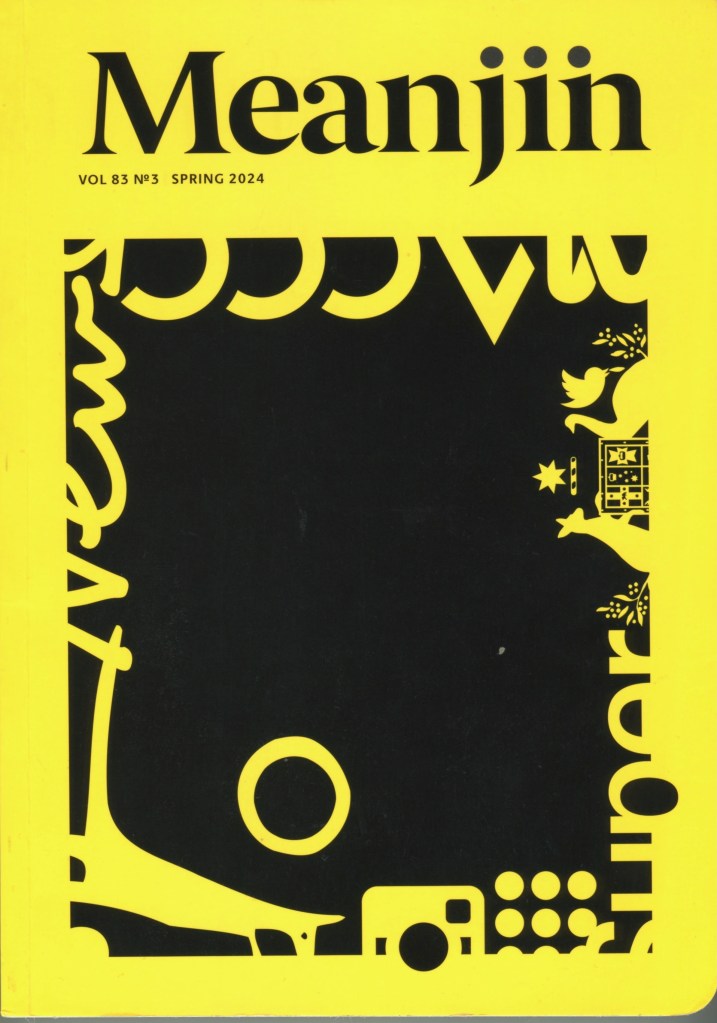
Esther Anatolitis (ediitor), Meanjin Vol 83 Nº 3 (Spring 2024) (links are to the Meanjin website: some but not all of them are available to non-subscribers)
This Meanjin was published before King Charles visited Australia last year. This means Jenny Hocking’s blistering essay, ‘Remnants of Empire: Racism, Power and Royal Privilege‘, appeared well before Lidia Thorpe’s headline-grabbing outburst. The article, which amply fulfils the promise of its title, made me feel much more sympathy for the outburst.
There’s a lot else in this issue to delight and enlighten. Some pieces that I think of as necessary. Apart from Jenny Hocking’s, three that stand out are:
‘Well, It’s Beautiful Country, Really –‘ by Mike Ross. Each issue of Meanjin these days begins with a ‘Meanjin Paper’ – an essay by a First Nations person. In this one Mike Ross, an Olkola man who has been at the vanguard of land rights for the people of Cape York for three decades, talks about finding meaning in Country, about constantly learning
‘Lucky for Some‘ by Frank Bongiorno on the 60th anniversary of publication of Donald Horne’s The Lucky Country, which I read in tandem with Nick Bryant’s recent piece on the same subject in the Guardian
‘Jews, Antisemitism and Power in Australia‘ by Max Kaiser, which parses the way accusations of antisemitism have been used to silence important points of view. This article may have been published six months ago, but it feels hyper-relevant today as actual vicious antisemitism and and dubious accusations of antisemitism are ramping up.
There are pirces that may not be necessary, but they’re fun and educative all the same:
an interview with poet Ellen van Neerven (which I enjoyed even though it focuses on a book of theirs I haven’t read)
a scathing annotation of the Australian Constitution from First Nations writer Claire G. Coleman
There is some excellent fiction, including these two:
‘The Feeling Bones‘ by Lucy Nelson, which tells a family’s story in terms of their bone ailments; and incidentally informs me that ‘sits bones’, a term for the backside I had only heard used by my Pilates instructor, actually comes from the world of dance.
‘The Other Doctor‘, in which James Salvius Cheng finds a way to talk about the exhausting business of being a medical practitioner without coming across as a whinger.
A trio of memoirs call out to each other about disability, religion and sexuality:
Love Is Worship by Adrian Mouhajer, about finding peace in a Muslim family as a queer person
Crocodile by Ella Ferris, brilliant, complex piece of writing which includes experiences of Aboriginality and disability
There are some excellent poems. The ones I warm to most (not necessarily the ‘best’) are:
‘Mothertongues’ by Grace Chan, which begins ‘My son is starting to speak / in English’ and later, as she tries to teach him some Chinese, ‘our tongues stumble / in synchrony’
‘The Women’s Shelter’, a rhyming sonnet by Claire Watson, in which a woman creates a knotted rag rug from strips of old bedsheets
There are things that aren’t my cup of tea: a smart-alecky essay on satire, an incomprehensible poem, some ‘experiments’, a review or two that convinced me not to read the books under consideration. But I can imagine each of those finding readers who will delight in them
I wrote this blog post on the land of Gadigal and Wangal of the Eora nation. I acknowledge their Elders past present and emerging, and gratefully acknowledge their care for this land for millennia, as once agin the sun is rising later in the mornings, and spiders are making their presence known in the bushes.
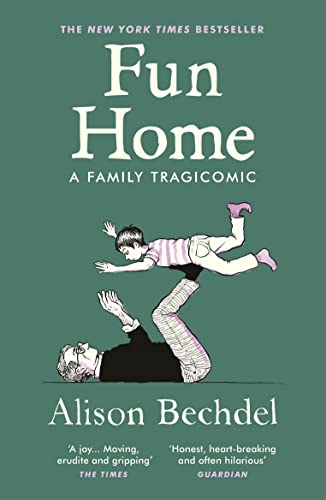
A Lesbian friend of mine was surprised, even shocked, when I told her I hadn’t read Alison Bechdel’s Fun Home. I got the impression that she revised her opinion of my literacy on the spot.
Well, now I’ve read it and can hold my head high again.
Alison Bechdel is probably best known for the Bechdel test, which serves as a rough guide to a movie’s level of misogyny or otherwise: does it have more than one named female character? do they have a conversation about something other than a man? According to Wikipedia, Bechdel modestly attributes the invention of the test to a friend and ultimately to Virginia Woolf. But it still bears her name.
She is also celebrated as a creator of comics, in particular her long-running series Dykes to Watch Out for. The strip ran for 25 years, from 1983 to 2008, with a brief revival on Trump’s first election. Fun Home, published in 2006, brought her a wider readership. The book was a New York Times bestseller. It has been adapted into an audio-book and an award-winning stage musical, with a movie reportedly on the way. It has been included on college reading lists and Wikipedia currently lists eight attempts at having it banned in the USA. When I bought my copy the shop assistant enthused that she had studied it at university, but then read it again later for pleasure.
It’s a memoir. At first, it seems like a familiar tale of living with a tyrannical father who is emotionally distant and given to violent rages. But it develops into something much more complex and interesting. Towards the end of the first chapter, Alison and her brother are at Sunday Mass with their parents, and a caption reads: ‘He appeared to be an ideal husband and father.’ This is an ordinary observation about middle class families putting on a front for public display, but then there’s a second caption: ‘But would an ideal husband and father have sex with teenage boys?’ And that question hangs there unexplained for many pages, as the narrative takes us back to the family’s early life, the father’s part-time work as a mortician (which is where the book’s title comes from – it was the Bechdel children’s nickname for the undertaker’s business), and Alison’s own portrait of the artist as a young woman.
So the narrative moves back and forth, entwining the narrator’s own story as a nerdy young person with OCD who comes out as a Lesbian, with the unfolding story of her father’s sexuality, and the way it all plays out in the family. Key moments are hinted at, passed over as offstage events, and then revisited in detail much later, so that there’s a constant sense of something not yet revealed.
It’s a bookish family, and a bookish book, shot though with literary references. The story of Daedalus and Icarus forms a major thread, beginning with a father-and-daughter game of ‘airplane’ as seen on the cover – ‘In the circus acrobatics where one person lies on the floor balancing another are called ‘Icarian games’.– and leading in the final pages to a revisionist interpretation of the myth, applied to this story. Camus gets a look-in, and so do Proust, Oscar Wilde, F. Scott Fitzgerald, Wallace Stevens, J. D. Salinger, A Chorus Line, Henry James, Shakespeare of course, and more – none of them incidental to the plot.
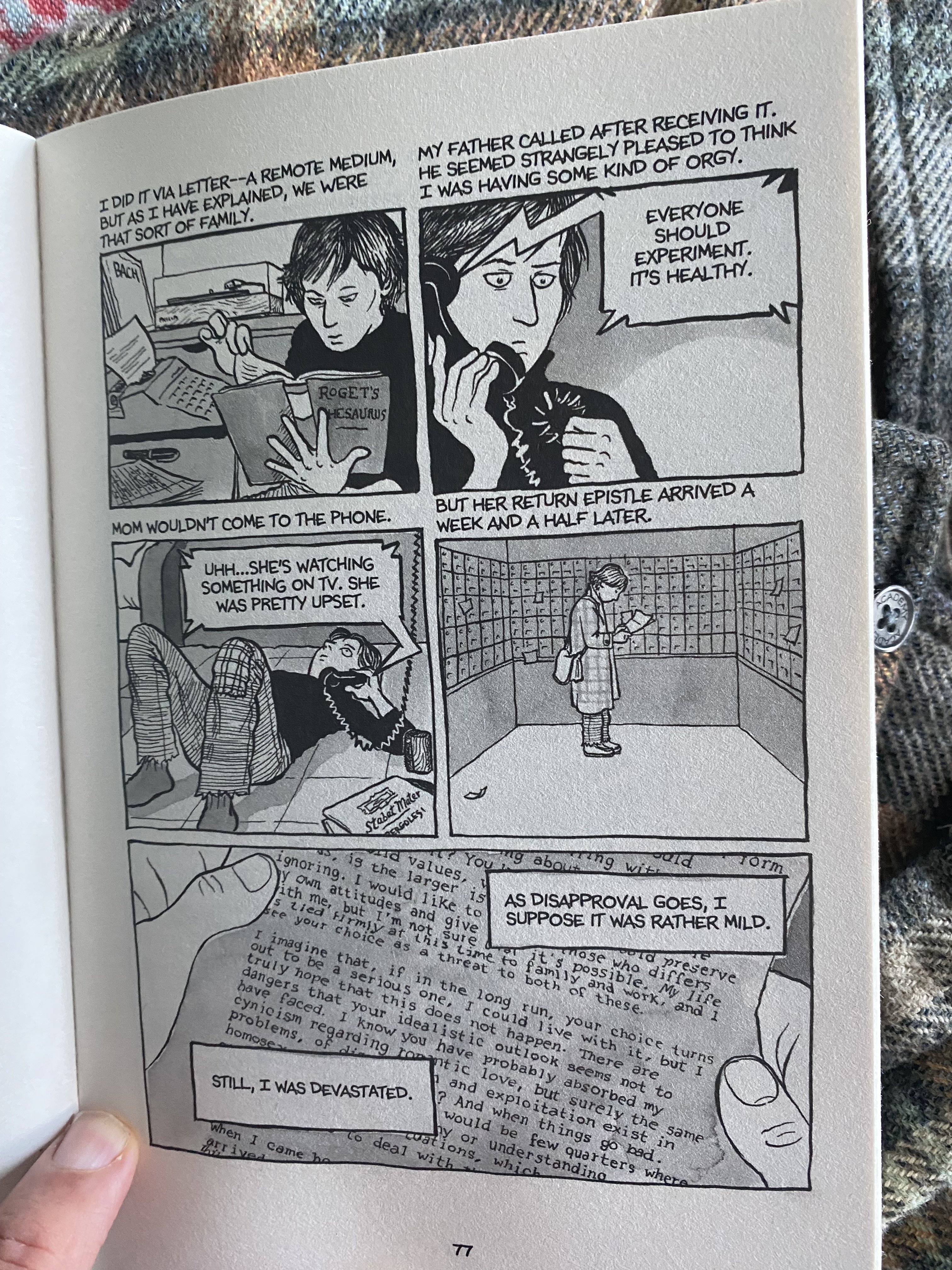
Page 77* may give you an idea of the art and the narrative style. Alison is nineteen, at college, and has just realised she is a Lesbian. The realisation has come about ‘in a manner consistent with [her] bookish upbringing. A revelation not of the flesh, but of the mind.’ There are a couple of pages that could be used as a reading list for a young person making a similar realisation; she attends a meeting of a Gay Union ‘in petrified silence’, and in the resulting exhilaration decides to come out to her parents:
If you enlarge this image you see how beautifully words and images are integrated. The captions offer a commentary on the action: ‘We were that sort of family,’ ‘He seemed strangely pleased,’ ‘I was devastated’. The page is a good example of Bechdel’s skill with dialogue: the father’s words on the phone convey his awkwardness quite independently of the caption’s commentary. The images are more than illustration – the technical term for this kind of story telling is ‘sequential art’, a different beast from ‘illustrated story’. We see how 19-year-old Alison lives: her clothes, the music she listens to, that she has to go to a post office box to receive mail, that her coming-out letter is typed, and composed with the assistance of a thesaurus. As often in this book, the images themselves include text: not just the names of books and records, but a glimpse of the mother’s letter, implying a documentary dimension to the narrative.
On the next page, there’s a fine example of the way the story is given to us bit by bit, layer by layer. We see Alison’s diary entry about her mother’s letter, which quotes part of the letter we are not shown here, hinting at the revelations yet to come about the father’s sexuality.
Like Art Spigelman’s Maus, Joe Sacco’s Palestine or Marjane Satrapi’s Persepolis, this is a comic that people who don’t read comics would do well to spend a little time with. It might not make comic-readers out of them, but it may give them the same kind of pleasure as a good movie or novel.
I wrote this blog post on land of the Gadigal and Wangal clans of the Eora Nation, where a flock of corellas, which I think are visiting from inland country, have been making a lot of noise. I pay my respects to Elders past and present, and to any First Nations readers of this blog.
* My blogging practice is focus arbitrarily on the page of a book that coincides with my age, currently page 77.
Before the meeting: About five decades ago I had to write an Eng Lit essay on Gerard Manly Hopkins’s sonnet ‘Spelt from Sybil’s Leaves’. It’s a poem that cries out to be read aloud, and on a weekend away at a beach house with friends, I found an out-of-the-way spot where I could perform the poem over and over for my own ears. It turned out that my secluded corner was actually an amplifying booth, and my sonorous renditions were heard by everyone in the house. Someone finally came and pleaded with me to stop. Embarrassment aside, I still love the poem.
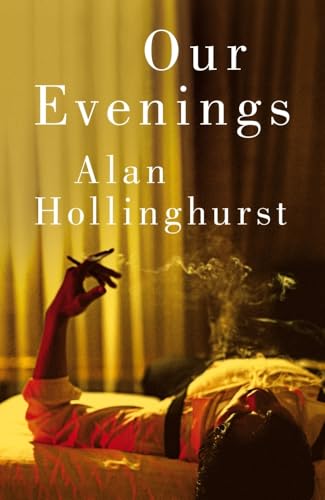
So I took it as a personal gift to me when the poem is being recited, unannounced and unexplained, at the start of Chapter 15 of Our Evenings:
‘Earnest,’ I said, ‘earthless … equal … attuneable …’ Stella peered at me, tongue on lip, daring me. ‘… vaulty …’ she said. … vaulty, voluminous … stupendous Evening strains to be time’s vast –’ (now we chanted it together) ‘womb-of-all – home-of-all – hearse-of-all NIGHT!’ ‘I bet you can’t go on.’
If I hadn’t been loving the book before then, I would have been hooked.
As it happens, I was enjoying the book. The hero-narrator David Win, son of an English mother and a Burmese father he has never known, was given a scholarship to attend a prestigious boarding school, and at the start of Chapter 15 he’s studying at Oxford. The novel traces his development into a successful actor, his crushes, affairs and finally marriage with men, and his arrival at a reasonably contented late middle age (as we in our late 70s refer to the 60s).
The phrase that gives the novel its title occurs when David is in his last year at the boarding school. He is taken under the wing of Mr Hudson, his English teacher. They listen to classical music together late in the evening. These quiet times have an intimate, erotic charge, but though other boys leap to crude conclusions, ‘nothing ever “happened”, as they say’. Among the pieces they listen to is the first movement of Janáček’s ‘On an Overgrown Path’, which has its own title, ‘Our Evenings’. (You can hear it played by Rudolf Firkusny in 1986 at this link.)
The piece seemed simple and songlike, but the modulations in it made you wonder, and an agitated figure broke in higher up and then, like the scratch on the record, disappeared and left you with the song in a further change of mood, which didn’t quite replace the first one but seemed to cast the shadow of experience over it – what, I couldn’t say, but I felt it. I had no idea what we were listening to or how long it was going on – there was a very quiet passage when the agitated figure came back, but subdued and dreamlike, a trance of sadness and beauty, and soon after that the piece ended without any fuss. I glanced at Mr Hudson, but he was staring at the fire too, and then he jumped up and said, ‘Shall we hear it again?’
Apart from being an instance of the way other works – plays, poems, pieces of music – move the narrative along, this passage is a nice example of the way David as narrator shows rather than tells. ‘I couldn’t say, but I felt it.’ He never says in so many words that he has a crush on Mr Hudson, or that he believes it to be reciprocated, but in little moments like this – in Mr Hudson jumping up and suggesting a replay – readers can draw their own conclusions.
The description of Janáček’s music could be applied to the novel itself: ‘subdued and dreamlike, a trance of sadness and beauty’ occasionally interrupted by an ‘agitated figure’. The prose is elegant and unruffled, and most of the terrible things that happen – AIDS, Brexit, Covid – are offstage. David as boy, adolescent and man is unfailingly polite and helpful – we are usually left to imagine what feelings he is covering up, even perhaps from himself. He regularly encounters ‘agitated figures’ in the form of racism, but mostly it’s of the raised eyebrow or muttered phrase, micro-aggressive variety. An African-heritage lover says, ‘You’re not even Black!’ Likewise the homophobia he encounters is subtle – when he comes out to his mother and her female friend, their response is more or less, ‘Well, that’s been obvious for a long time!’ Class plays a role – David’s patrons, whom he loves to the end – are like Proust’s aristocrats in their unfailing graciousness and generosity, and the sense that nothing really touches them. The mystery of his father remains a mystery, though late in life he receives some vague information. As in real life, many mysteries remain mysterious.
I suppose sex itself might count as an ‘agitated figure’. There’s quite a lot of it but, though it’s not coy, very little is explicit. I remember only two moments when sexual body parts are named, one involving a kind rejection, the other the beginning of a solid relationship. Neither is the slightest bit prurient.
The last 10 pages depart from the mainly ‘subdued and dreamlike’ narrative in a way that came as a surprise to me, and casts a brilliant light back over the preceding pages.
After the meeting: At the Book Club, we usually have two books under discussion at each meeting. This time, there was just the one, but everyone had to report on the book they’d scored in our Kris Kringle at last meeting. So our discussion, which followed and preceded convivial conversation about other things, began with enticing rundowns of books by Bernhard Schlink, Jock Serong, Robbie Arnott and Niamh Mulvey, and an unenticing rundown of one other.
Of Our Evenings, we had a very interesting discussion. I probably liked the book most, but no one hated it. The only strong difference was about the last ten pages, which I felt gave shape and significance to the whole thing and most others experienced as a lame and unnecessary framing device. It would be too spoilerish to present the arguments here. I’ll just state the obvious: they’re entitled to their opinions, but they’re wrong.
One person had an interesting take on the title. It captured the way the book, for her, is like a series of conversations you might have in a quiet evening at home: meandering, pleasant, amiable recollections and reflections, without drama or much significance. (If that’s so, I hope I said at the time, there’s always an awareness of terrible things happening in the outside world, of which many of the tiny things that come up in those conversations are micro-effects.)
David Win as narrator and hero provoked interesting conversation, which I’ll try to summarise. He is an outsider because of racism, class and sexuality, not necessarily in that order. As an outsider, his main way of being in the world is to aim to fill other people’s expectations – to act out the scripts he is given. It’s not insignificant that he’s an actor. He rarely takes the initiative, and there’s a way he doesn’t seem to know who he is. Not just as narrator, but also as character, he doesn’t have access to his own inner life. The narrative restraint about sex, which is not so in Hollinghurst’s other books that people had read, may be part of this. I read out the only passage in the book that mentions hard-ons, and people laughed (but not at all derisively). It’s as if in this book explicit sex is a relief from always having to decode what is being communicated in tight-lipped upper-class British dialogue (see Mr Hudson’s ‘Shall we hear it again?’ above).
We discussed other characters that I didn’t mention in the first part of this blog, especially a Boris Johnsonesque blustering bully, .
Less centrally, some took an almost anthropological interest in the portrayal of Gay male relationships – and it’s true that Hollinghurst gives meticulous detail on how people make their desires known. One person felt that (minor spoiler alert) having the David’s mother become a Lesbian was just laying on the Gayness too thick. Another, on the contrary, was impressed and delighted by the nuanced portrayal of middle-class, middle-aged, post-heterosexual-marriage Lesbianism.
We didn’t discuss the Hopkins poem, the Janáček music, or the plays – notably by Racine and Ben Jonson – that turn up in the narration.
Mint-flavoured Turkish delight was on offer. Only two of us tried it. I was the only one to finish my piece. I don’t recommend it. I do recommend the book.
Our Book Club met on unceded land of the Gadigal and Wangal clans of the Eora Nation. I acknowledge the Elders past and present. I hope that our conversation was in some way in continuity with yarns that have been happening on this land for tens of thousands of years.
Before the meeting: As I was reading the first couple of chapters of this book, I had ringing in my ears something that a Book Group member had said about a different book, perhaps one of Niall Williams’s earlier novels, A History of the Rain or This Is Happiness: ‘It’s a beautifully written Irish novel, but I’m not sure the world needs yet another beautifully written Irish novel.’
The first chapters, in fact almost the first half of the book, are brilliant descriptions of life in 1962 in the fictional West Ireland village of Faha, the village we know from those previous books. The rain is still incessant and the village still slowly sinking into the river. The heart broken in This Is Happiness is still broken. Life is still dominated by the Catholic Church. Gossip is still the lifeblood of the community. Most houses now have electricity.
The first chapter begins with a wonderful setpiece, a parish Mass where the beloved parish priest stalls mid-sermon in the first major sign of dementia. Things are seen from the point of view of Jack Troy, the village’s general practitioner whose face and manner give away nothing of his inner feelings as his role in the community means he must always be available, including to people who will never ask for a doctor’s attention on their own behalf. After Sunday Mass he is regularly approached by people who indicate with a nod and a wink that his services are needed at such and such a house.
The second chapter revolves around another magnificent setpiece: the Christmas fair in which farmers bring their cattle to town to sell, and hawkers and traders come from elsewhere. Here, twelve-year-old Jude Quinlan, son of a drunkard farmer, carries the narrative burden.
Through both of these chapters, we are teased by hints that something big is going to happen. It’s as if the narrator is saying to his readers, ‘Yes yes, I know you’re here for a story, but first let me tell you about the place it happened in and the people who live there.’ At the end of the second chapter, more than a third of the way into the narrative, there’s this:
But it was here, at the back wall of the church in the village of Faha, on the night of the Christmas Fair 1962, that Jude Quinlan found the child.
Ah! The titular child has arrived! Then the third chapter continues to tease us. It takes us back a couple of days in the life of Ronnie Troy, Jack’s long-suffering dutiful daughter. After 16 pages in which we come to know and (speaking at least for myself) love her, she responds to a late-night knock on the door and at last the story begins.
Given that it happens so late in the book, I’m reluctant to say much more about it, except that though my Group member may be right that the world doesn’t need another book like this, I certainly do. Maybe it’s because I spent my 1950s childhood as part of the Irish diaspora in north Queensland, and I respond with little gasps of recognition to little throwaway lines about the Sacred Heart, the ‘Hail Holy Queen’, the smiling pope, or to the way the priest says Mass with his back to the church while the congregation’s more or less devout members goes about their own business. That is to say, maybe there’s a hefty dose of nostalgia in my response to the book. But if so, that nostalgia serves a serious purpose.
This is a time and place when the Church dominated Irish society. It was the time of the Magdalen laundries, covered-up clerical sexual abuse of children, pitiless laws against abortion and condemnation of most forms of birth control. None of this is foregrounded in the book, but oppressive Church–State authority looms large, mostly unspoken, over the second half of the book. On the one hand, a handful of people sinking to their knees to say the Rosary can be an exhilarating manifestation of something fine beyond words (though Niall Williams finds the words); on the other a priest with a form letter mouths deadly phrases like ‘For his own good’ and ‘Preserving his dignity’.
Just as much as, say, Sebastian Barry’s Old God’s Time or Claire Keegan’s Small Things Like These, this book is about decent humanity – individuals and communities – resisting the monolithic, repressive authority of Church and State. Like them, it revels in musical language. More than them it’s funny. I did cry, twice, but I laughed a lot.
Page 77* includes a micro example of the resistance. In the absence of a fairground, Faha’s monthly fair is a chaotic mess, and the church gates, ‘with their splayed look of welcome in the centre of the village’, are a main centre of trade. The curate, Father Coffey, representing the Church’s authority, asks the farmers not to stand their cattle there:
As it happened, the curate’s appeal fell on deaf ears, but he took some satisfaction when he was able to negotiate a treaty whereby Mick Lynch promised a rope corridor to let the daily Mass-goers through. As a goodwill gesture, Lynch said, the farmers would take their dung with them when they left, which Father Coffey reported back to the Canon, unaware it was a joke until the older priest put the hand across his laugh to stop his teeth flying.
With such jokes, in which the older priest colludes, the people of Faha keep the authority of the Church in its place.
Most of page 77 is taken up wth one of Niall Williams’s bravura character sketches:
Mick Lynch had the walk of a man who owned his own bull. Short and broad, he carried a blackthorn, wore a frieze coat and low hat with red feather in the band. That hat never came off his head outside of church. He wore it at the counter in Ryan’s, in the spartan confines of his iron bed, and when he went to wring the necks of geese. From victories in cards or trade, Lynch took a deal of pleasure. With a contrary nature, his cheeks were where the most of his hair grew, furred sideburns made key-shaped by the shaving of his chin which gave him a jailor’s look. Lynch had the reputation of being what Faha called a right cool man, a designation that pre-dated refrigeration, meant he could not be hurried or ruffled, and once, when asked by a dealer, ‘What are you looking for in a horse, boss?’ had delivered the incontestable answer, ‘Leg in each corner.’ He had not married. For women he hadn’t the handbook, he said, and children nothing but hosts to headlice and worms.
Remember, nothing has really happened in this book so far. That is, we’re a quarter of the way into it but we haven’t yet had what the movies call the inciting incident. But the narrator refuses to be hurried. There is too much to enjoy at any moment in the life of Faha, so though this is Mick Lynch’s only appearance, we’re going to take a moment, just for the fun of it, to savour him. I especially like that ‘outside of church’: whatever else he may be or do, it wouldn’t occur to Mick Lynch to defy the custom of men going bare-headed in church.
After the meeting: Unusually, this book was the subject of quite a lot of WhatsApp discussion before the meeting, mainly from people who couldn’t make it on the night. A number of us had wept, prompting one to ask whether we were ‘silly old men getting emotional about a baby and family relationships’. He who had made the remark about beautifully written Irish novels confounded my expectations by loving tis one, and wrote a thoughtful email on the theme of ‘the soul’. Another sounded a mildly dissenting note, having read only 80 percent and found it slow going; he reacted against the religion’s hold on people, and used the word ‘silly’ about a main character’s attempt to take charge of the situation (all of which are completely reasonable responses). Yet another quoted a number of favourite passages, and said he loved the way Catholicism co-existed with pishogues, which he noted was an excellent new word to him (as it is to me – definition at this link if you’re interested).
On the night there were just five of us. Among other things, we ate baked potatoes. Almost as soon as we arrived, those of us with Catholic backgrounds – a slim majority – were reminiscing about, of all things, our Confirmations. Not directly on topic, but certainly book-adjacent. We had an animated discussion. More than one said that the book took its own sweet time to get to the point – one said he almost stopped reading, but others (me included) thought it was a feature rather than a bug. Someone quoted a passage to the effect that Irish story-telling never goes in a straight line.
Someone said, on WhatsApp and then again on the night, that the book was an Irish Catholic equivalent to Marilynne Robinson’s Home. I don’t quite see that, though it’s an interesting thought. I had a go at articulating some of what I see the book as saying about Catholicism in Ireland then and now – which I won’t go into here because it would be spoilerish.
Interestingly, no one thought to say out loud that this is a Christmas story, even a kind of second-coming story. And, though someone had looked up Niall Williams on the internet, no one wondered aloud if he became a grandfather somewhere on the way to writing this book.
As for the rest of the conversation, I can’t do better than quote (with permission) from one chap’s report on WhatsApp. Conversation ranged, he wrote:
from John Cage and the Necks to motor bike accidents, playing golf, Parkinson’s disease and then the realities of being Bilbo Baggins.
I wrote this blog post on land of the Gadigal and Wangal clans of the Eora Nation. I was born in MaMu country, though as a small child I was confused about whether I lived there or in ‘Erin’s green valleys’. I acknowledge the Elders past and present of both countries, never ceded.
* My blogging practice is focus arbitrarily on the page of a book that coincides with my age, currently page 77.
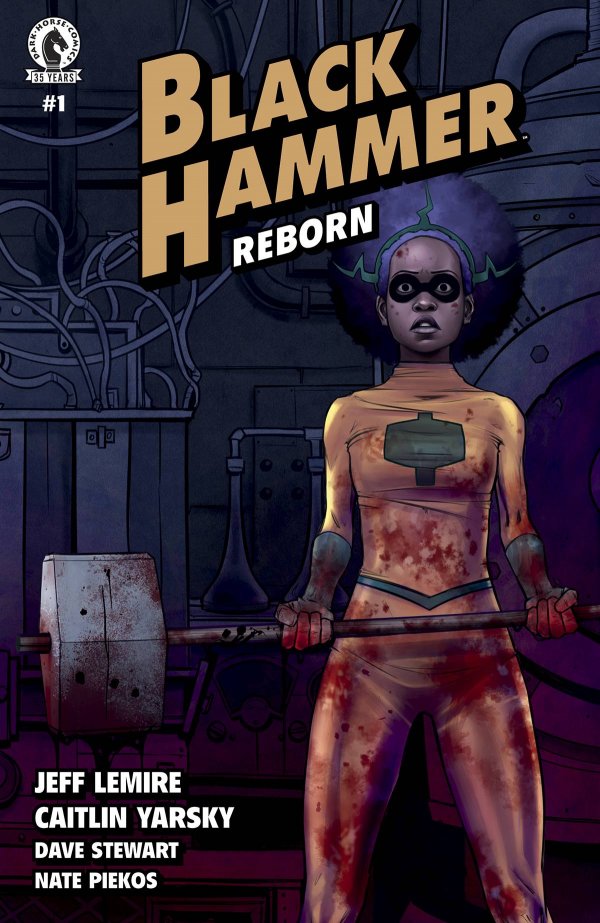
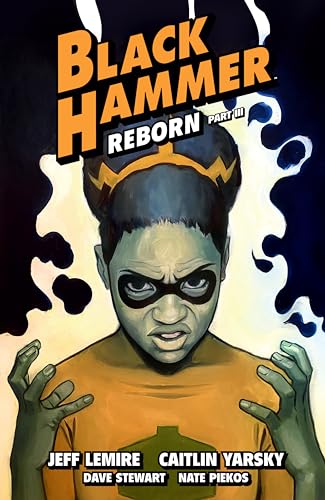
Jeff Lemire (writer), Caitlin Yarsky (art), Dave Stewart (colorist) and Nate Piekos (letterer), Black Hammer Volume 5: Reborn Part I (Dark Horse Books 2022) Jeff Lemire (writer), Caitlin Yarsky (art), Dave Stewart (colorist) and Nate Piekos (letterer), Black Hammer Volume 7: Reborn Part III (Dark Horse Books 2022)
When I wrote about Black Hammer Volume 4 (at this link) I thought it was the end of the story, but no, two year later in real life and TWENTY YEARS LATER in comics caption, along comes Volume 5, or RebornPart I (monthly comics #1-4), closely followed by Volume 6 and 7, Reborn Parts II and III (monthly comics #5–8 and #9–12 respectively). Not only is superhero Black Hammer reborn, as his daughter Lucy reluctantly resumes the identity, but there is a new, female artist. Caitlin Yarsky’s distinctive artwork is every bit as dramatic as Dean Ormston’s in the earlier volumes, though I think the domestic elements of the story have taken on more weight
I was given Volume 7 as a Christmas gift. I hunted for the two earlier ones, but found only Volume 5. I’m resigned to never reading the middle of this trilogy, but I did enjoy the parts of the ride that I took part in, and Volume 7 does start with a recap of sorts.
Anti-God was defeated in the earlier books, and now he’s coming back, and multiple universes are about to be collide and be destroyed. In earlier books, the superannuated superheroes were put out to pasture in a kind of simulacrum of rustic bliss. Many of them turn up in this one, older, possibly wiser, or maybe something else. In the dizzying interplay of universes, the dead live again, the good become evil, the evil good – and some heartbreaking decisions have to be made. There are plenty of what you expect from a superhero comic: THWAKs, SHRIPs and THOOMs and svelte female bodies (always, mercifully, clothed), there’s also a lot of complex, even bewildering time shifts. The emotional heart of the story is Lucy having to choose between being a good mother and saving the universe. (A bit like E. M. Foster’s famous line in ‘Two Cheers for Democracy’: ‘If I had to choose between betraying my country and betraying my friend I hope I should have the guts to betray my country.’) Oh, she also has to resolve her daddy issues in a multiverse kind of way.
This is probably not the end of this Black Hammer series. The caption on the last page of Volume 7 reads, ‘The cataclysm has begun.’
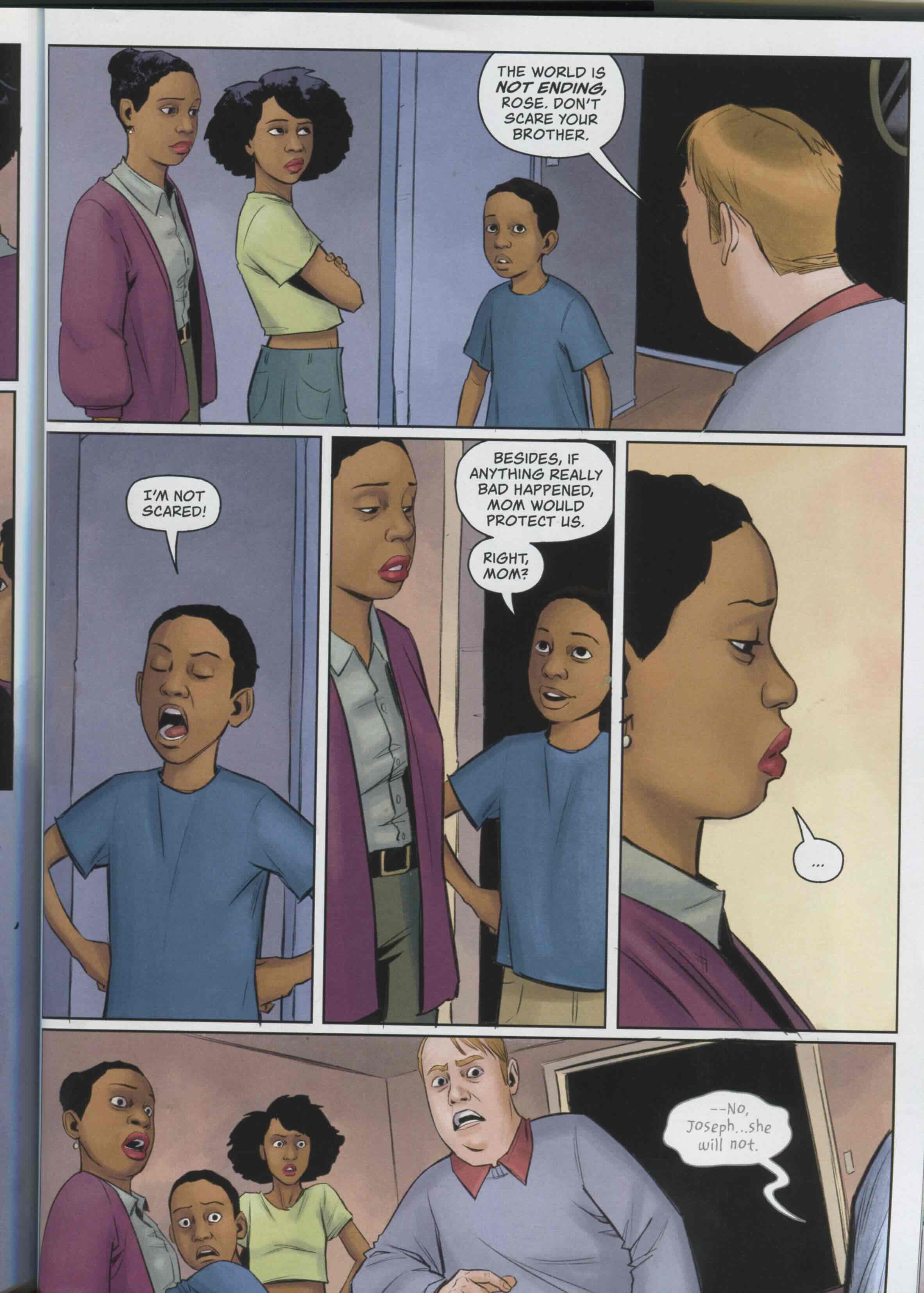
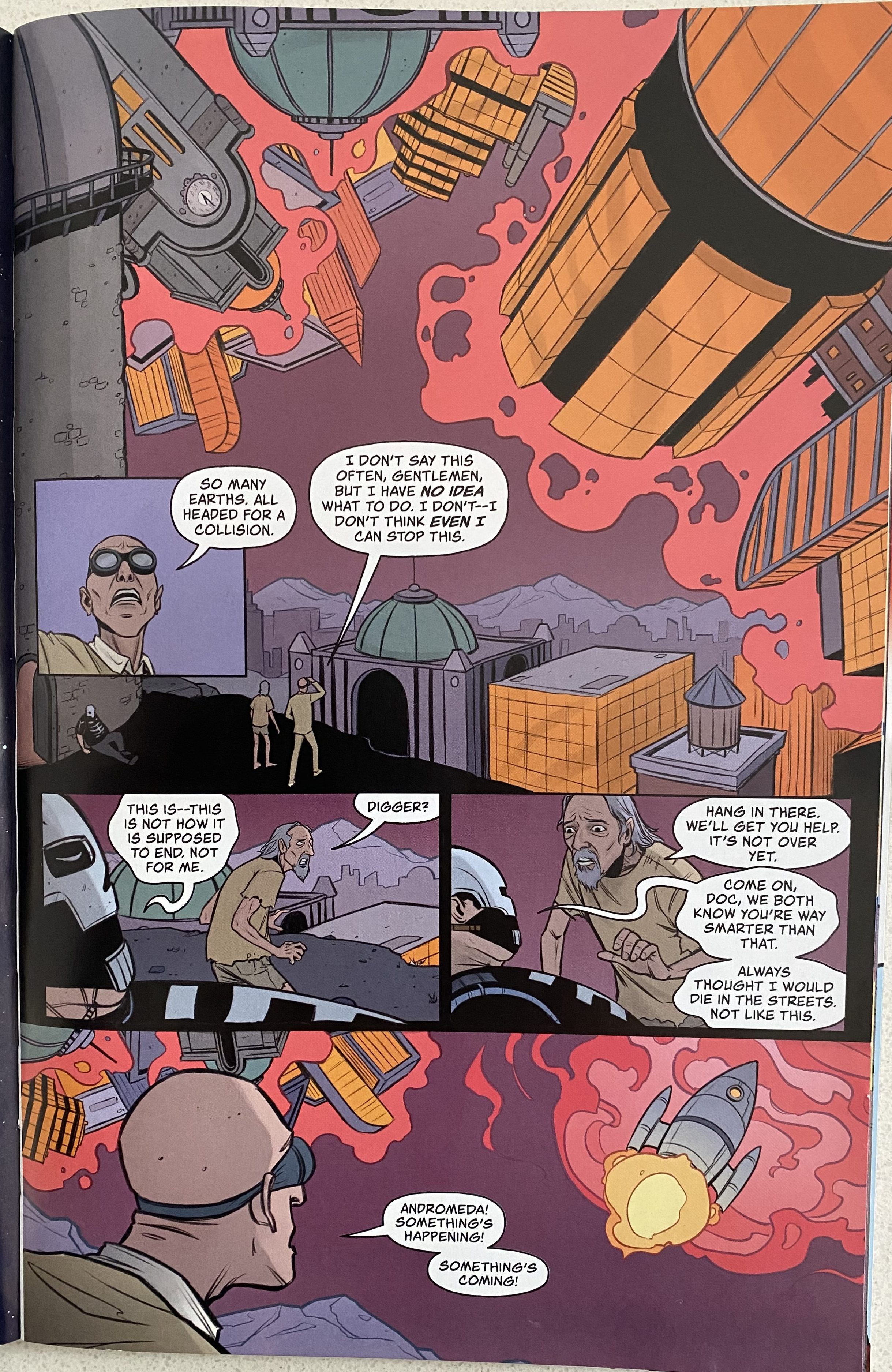
The two pages 77* illustrate the books’ range of art and narrative style.
In Volume 5, there’s a more or less domestic scene, in characteristic muted tones.
‘Mom’ here is Black Hammer in her mundane identity. The pudgy middle-aged man, the children’s father, was once an aspiring super-villain. His superpower was pretty pathetic and when Black Hammer vanquished him she also won his heart. In a note, Caitlin Yarsky says his his ‘suburban dad look’ was partly inspired by the late Philip Seymour Hoffman. Lucy’s reluctance to rise to her son’s challenge is a micro version of her central dilemma.
Readers of previous volumes immediately recognise the quavery font in the final panel’s speech bubble: it’s the voice of Colonel Weird, whose entanglement in a time warp means that he lives in the ‘Para-Zone’ were he experiences all times at once. When he says something about the future, we know it’s true. This little speech bubble carries a huge narrative force, as the other characters’ response indicates.
Volume 7’s page 77 may not feature any SCRACKs or KRA-KoooOOMs (these come a couple of pages later), but it’s part of the luridly coloured epic story.
Yes, it’s lurid, but it is crystal clear.
Those upside-down buildings in the top part of the page are parts of other universes heading for this one. A convergence will spell major disaster. Digger is another former supervillain, now Black Hammer’s major ally. He is wounded and probably dying. The Doc is one of the completely good guys – at least this version of him is. The man with the goggles … no, it’s all too complex for a quick summary. And that approaching rocket ship is about to introduce a whole new level of complexity, as Colonel Weird makes another appearance, this time accompanied by multiple even weirder versions of himself.
I guess I’ll keep an eye out for Volume 8 – maybe it will hit the shops in time for my March birthday.
I wrote this blog post on land of the Gadigal and Wangal clans of the Eora Nation. I pay my respects to Elders past and present. After days of heavy rain, the heat is beating down, and the lizards are loving it.
* My blogging practice is focus arbitrarily on the page of a book that coincides with my age, which is currently 77.
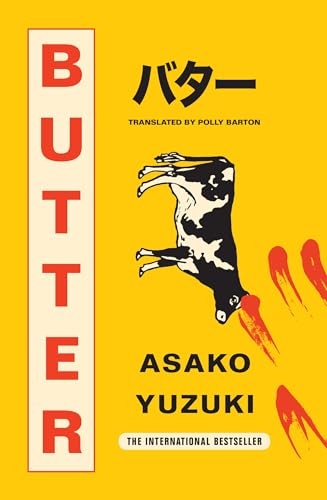
This was my end-of-year gift from the Book Club. It is probably an excellent book about misogyny in Japanese culture, with sharp satiric assaults on attitudes to food, with extra piquancy derived from its claim to be based on a true-crime story. It was evidently a huge success in Japanese and this English translation by Polly Barton has been reviewed enthusiastically.
The protagonist, Kira, is an ambitious young woman journalist working on a sensationalist magazine. In searching for a career-defining scoop she becomes enthralled by Manako Kajii, a woman who defies the social norms of slender femininity and is currently in prison for having killed a number of elderly men, after winning their hearts by cooking luxurious food for them. Manako introduces Kira, who until now has survived on a spartan, negligent diet, to the joy of butter – cooking with it and eating the results.
My guess is that the key to enjoying the book is to read it fast, and I’m a slow reader. The themes are real and interesting: feminism versus feminine wiles; social norms versus desire; career ambition versus enjoyment of life. But I struggled with it, and gave up soon after my obligatory 77 pages.
It may well be that Polly Barton has reproduced the feel of the original Japanese, but the best way I can describe my response to the book’s language is to say that it reads like the kind of English you find in school students’ translations. The information is all there, but in the process of capturing it, the student forgets to pay attention to the natural rhythms and sequencing of English prose. That’s fine if you’re a teacher correcting someone’s homework, but if you’re reading a novel, it keeps yanking you out of the story.
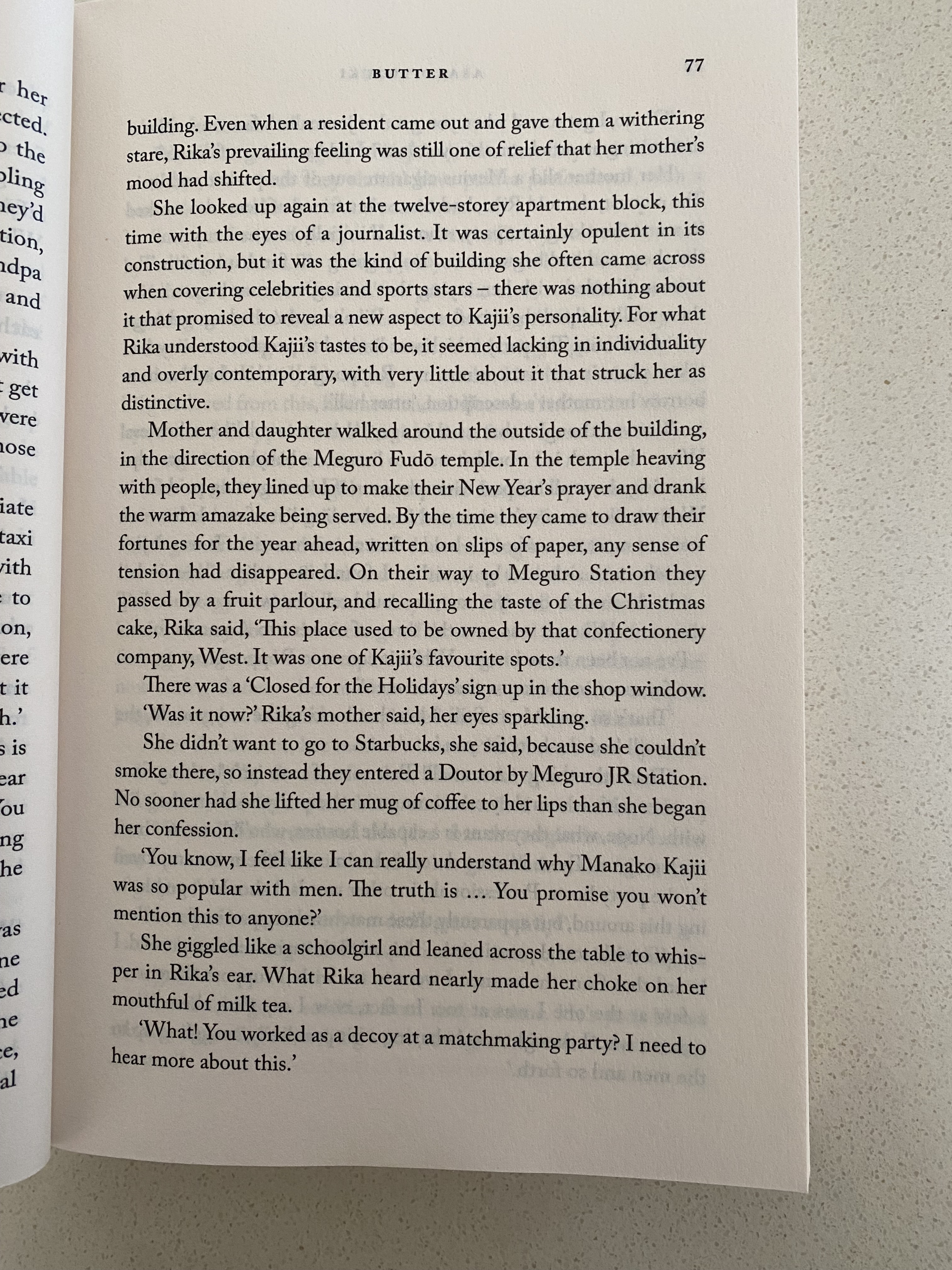
I don’t want to spoil anyone’s enjoyment, but I’ll try to articulate why I find the book such a slog. Page 77* isn’t particularly egregious, but it offers a number of examples. Rika is on an outing with her mother, partly to cheer her up, and partly with the undeclared intention of having a look at Kajii’s apartment. Rika’s mother becomes high-spirited as they inspect the building that has been ‘making a splash in the news’.
I’ll just talk about the beginning and ending of the page, but you can enlarge the image to read it in full:
The first sentence:
Even when a resident came out and gave them a withering stare, Rika’s prevailing feeling was still one of relief that her mother’s mood had shifted.
There’s nothing glaringly wrong with that, but a close look reveals a number of tiny problems contributing to the cumulative awkwardness.
To my ear, the phrase ‘even when’ suggests an extreme event of some kind, and it takes a microsecond to realise that this is something quite undramatic: a resident comes out of the building and gives the pair a withering look. For another microsecond, I wonder why the resident would pay them any attention at all. They’re just two women in a public street. And it’s not just a look, but a stare! How does Rika know that this more or less abstract person is a resident? Moving on, the awkward phrase ‘prevailing feeling’ suggests, if anything, that Rika is experiencing complex emotions, but that suggestion goes nowhere. ‘One of relief’ is clutter – why not just ‘relief’?
One last thing: the word ‘still’, which if you read this sentence without context is completely innocuous. But it’s another example of a micro-interruption to the narrative flow. This is the first time we’ve been told that Rika is feeling relieved. The reader (or at least this one) has to do a quick calculation: oh yes, Rika’s mother’s mood has lifted so of course it was implied that Rika felt relief, so now we’re being told that that relief has survived. This is a recurrent quirk: we’re told that something has happened, rather than seeing it happen.
I can enjoy a text that demands work of me, but these extra little bits of readerly labour bring no joy.
I won’t take you laboriously through the whole page, though I can’t resist mentioning the phrase, ‘In the temple heaving with people’. The meaning is clear, but it doesn’t quite feel like English.
At the end of the page, Rika and her mother are having a coffee (in a Doutor, which Rika’s mother prefers to Starbucks because Starbucks doesn’t allow smoking – in the kind of culture-specific moment that I confess to enjoying).
No sooner had she lifted her mug of coffee to her lips than she began her confession. ‘You know, I feel like I can really understand why Manako Kajii was so popular with men. The truth is … You promise you won’t mention this to anyone?’ She giggled like a schoolgirl and leaned across the table to whisper in Rika’s ear. What Rika heard nearly made her choke on her mouthful of milk tea. ‘What! You worked as a decoy at a matchmaking party? I need to hear more about this.’
Again, these are tiny things, but they accumulate. ‘No sooner than’ is just slightly wrong: can you begin to talk at the moment you lift a mug of coffee to your lips? Specifying a mouthful of tea is unnecessary and creates another of those micro-pauses: I suppose it’s technically possible to choke on a mouthful of liquid, but the term ‘mouthful’ suggests that it’s still in the mouth and more likely to cause spluttering. Having the reader learn what the mother says only when Rika repeats it is an unnecessary and (to me) annoying complication.
Your mileage may vary, and I hope it does. If you want a completely different take on the book, I recommend Theresa Smith Writes.
I wrote this blog post on land of the Gadigal and Wangal clans of the Eora Nation. I happily acknowledge their Elders past and present for caring for this land for many thousands of years.
* My blogging practice is to focus arbitrarily on the page of a book that coincides with my age, currently 77.
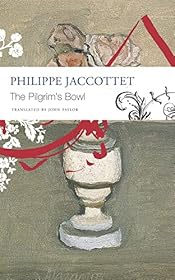
Philippe Jaccottet. The Pilgrim’s Bowl (2001, translated by John Taylor 2015, Seagull Books 2022)
This is a short book by a poet who is completely new to me about an artist whose work I have never seen. It was a Christmas present, a book I wouldn’t have dreamed of buying for myself. I enjoyed it a lot.
Philipe Jaccottet (1925–2021) was a Swiss poet who wrote in French, one of only fifteen writers to be included in the canon-defining Bibliothèque de la Pléiade while still alive. His English-language Wikipedia page is extremely sparse, but French-language Wikipedia is a different thing altogether. His expansive page there includes this (as rendered by Google Translate):
Jaccottet writes that the poet is no longer ‘the Sun […] nor a son of the Sun; nor even a Torchbearer or a Lighthouse’ (he therefore rejects the image of the ‘poet-prophet’): the task of this ‘anonymous one […] dressed like any other anxious man’ is to try to ‘paint’ the world ‘so wonderfully’ that his work would be able to distract Man from his fear of death.
In The Pilgrim’s Bowl, Jaccottet turns his attention to the work of Italian painter and printmaker, Giorgio Morandi.
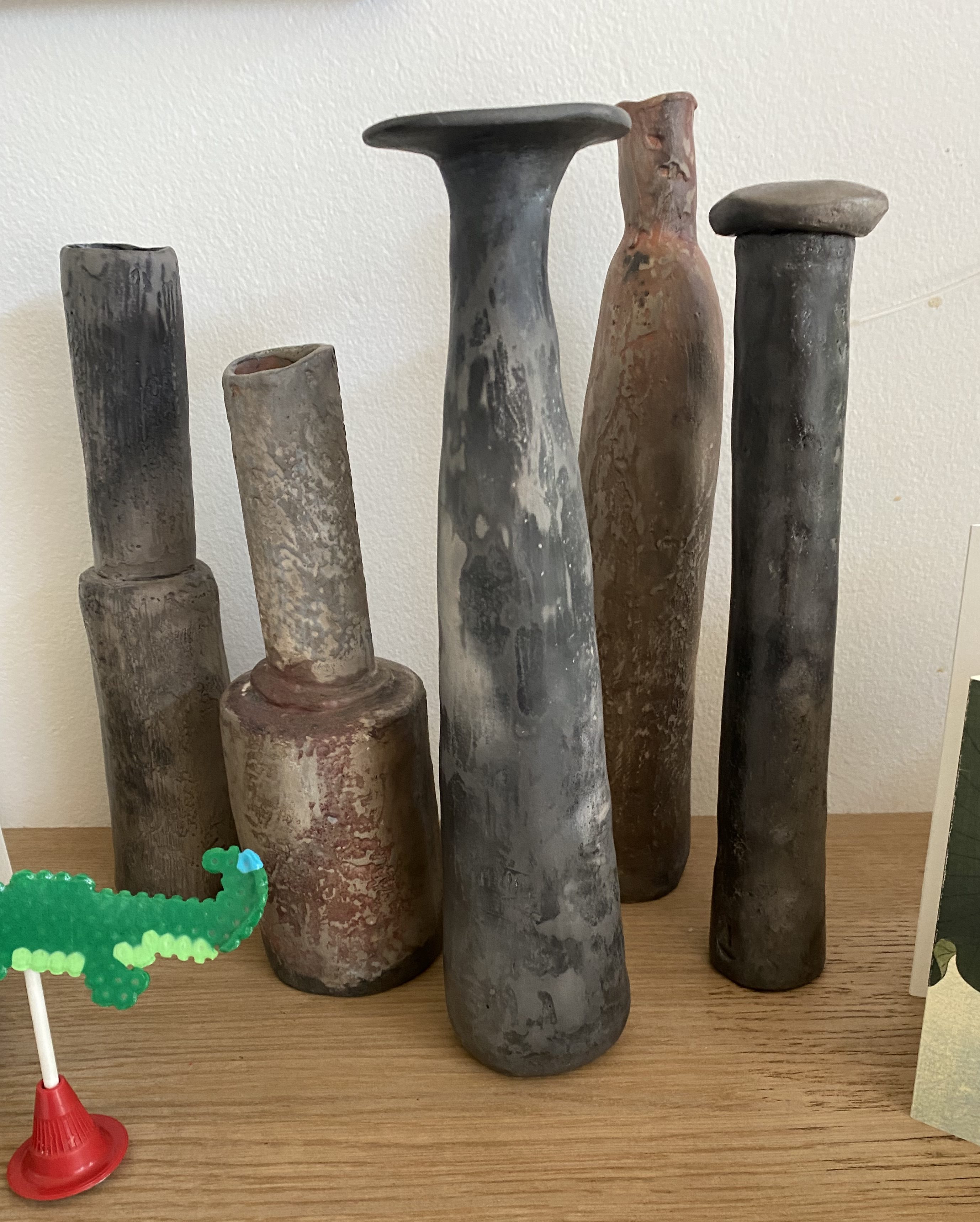
Though I’ve never seen an original work by Morandi (1890–1964, Wikipedia page here), I know a little more about him than about Jaccottet. The Emerging Artist did a beautiful drawing when at Art School that was copied, she told me, from one of his paintings, and the great cartoonist Jenny Coopes, taking up ceramics late in life, created a set of Morandesque objects which we now own. (For the benefit of readers who don’t know Morandi’s work: this photo does not capture anything of its austere, dreamlike simplicity.)
After reading this 66-page book with its dozen images, I feel that I know – and like, and admire – both these people much better. Jaccottet does not present as an art critic. He is not out to describe Morandi’s paintings, but to explore what he calls the enigma of the powerful emotion they create in him. This is from page 3:
It is not surprising to be stirred by the view of a mountain, the ocean, a sunset, a big city; or by the imminence of a war, the nearness of a face, the death of a close friend. And therefore, consequently, by their representation in a painting, poem or narrative. But with this artist: those inevitable three or four bottles, vases, boxes and bowls – what apparent insignificance, what ludicrousness or nearly so (and all the more so when the world seems about to collapse or explode)! And how can you dare claim that such a painting speaks a more convincing language to you than most contemporary works of art?
He approaches the enigma from different angles, ‘as naively as possible’. Which means he goes down tangent after tangent, and somehow enriches our sense of Morandi’s work.
Noting that Pascal and Leopardi were Morandi’s favourite authors, he spends fascinating pages discussing them. He riffs on snippets of Morandi’s biography. He catches fleeting associations – remembering that Morandi would let dust settle on his paintings, he thinks of the ‘sandman’ and then of the Sleeping Beauty, which gives him a way of talking about ‘the unchanging light bathing Morandi’s paintings’:
It never sparkles or glares, never flashes or breaks through clouds, even if it is clear as the dawn, with subtle rose and grey hues, this light is always strangely tranquil.
There is much more about that light.
He quotes from Dante and Plato. Acknowledging that he may be a little over the top, he compares Morandi’s still lifes with Vermeer’s paintings of young women and even with classic Madonnas.
Page 47* is the first half of the book’s most tangential tangent. Page 46 ends with this beautifully distilled paragraph:
The more Morandi’s art progresses in terms of deprivation and concentration, the more the objects in his still lifes take on, against a background of dust, ash or sand, the appearance and the dignity of monuments.
Then, abruptly, a parenthesis takes up the next two pages, beginning:
One night not long ago, I remembered a stopover in Ouazazarte, Morocco – rose-coloured sands and yellow sands, windy gusts blowing distant sand up into flags, and those fortress-like buildings shimmering in the excessive light without being mirages, yet barely distinct from the ground on which they had been built – why was this brief glimpse-like vision one morning so poignant?
I don’t know how to summarise this work. You have to be there. Let me just say that when I do get to see a painting by Morandi, I will come to it with eyes, heart and mind prepared.
I wrote this blog post on Wadawurrung land, overlooking the Painkalac River. I acknowledge their Elders past and present.
* My blogging practice is to focus on the page of a book that coincides with my age, currently. As The Pilgrim’s Bowl has fewer than 77 pages, I’m focusing instead on my birth year, ’47.





 Me fail? I fly!