Category Archives: Page 7x/47/7

Brubaker and Phillips’s Night Fever

Ed Brubaker, Night Fever (art by Sean Phillips, colors by Jacob Phillips, Image 2023)
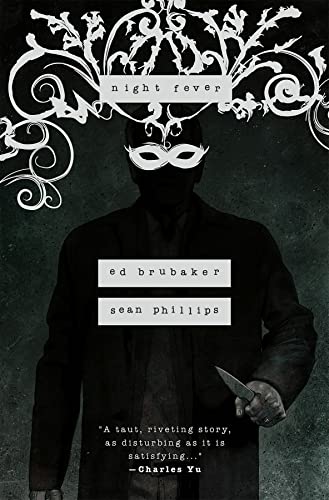
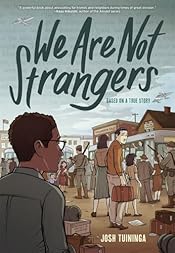
I’m steadily making my way through the pile of books I was given as Christmas presents. As always the pile includes some excellent comics. We Are Not Strangers is one (blog post here). Night Fever, which could hardly be more different, is another.

Ed Brubaker and Sean Phillips are a prolific team of comics makers. I’ve read their work in a number of genres – Hollywood noir, fantasy spy stories, and horror, though none of them is necessarily constrained to just one genre. Unlike most of their comics, Night Fever is a stand-alone story rather than part of a series. It shares the physical and moral darkness of their other work.

The narrator-protagonist, Jonathan Webb, is a sales rep for a US publishing company who once dreamed of being a writer. In Europe for a book fair, filled with a sense of failure, he crashes a decadent upper-class party, an orgy like the one in Stanley Kubrick’s Eyes Wide Shut, by pretending to be someone whose name he spotted on the guest list.

As every genre reader knows, it’s dangerous to borrow someone else’s identity, especially if they have access to a boundary-pushing party attended by the super rich. Sure enough, Jonathan is caught up in all manner of terrible things: alcohol, drugs and debauchery as you’d expect, but then there’s larceny, murder and an exploding police car. As one caption puts it, ‘Crime is the biggest high in the world.’

But crime doesn’t pay. Or does it? Will he ever find his way back to mundane life, his loving wife and their two sons? And if he does, will he be content? Or will he be haunted by this week when he threw off the shackles of decency? And who is the stranger Rainer who leads him deeper and deeper into the darkness?

Page 77* give you a taste of the art work, including the dark palette. It’s also an example of the genre-blending quality of Brubaker and Phillips’s work. Jonathan has visited a bar where he’s been warned, too late, not to drink anything because, ‘They put a lot of stuff in the cocktails here.’ There follow a number of pages where black space represents things he doesn’t remember of the night, and the rest is full of jumbled images of debauchery and violence. This page is a moment of calm, in which the owner of a voice that has been speaking to him from the shadows is revealed:
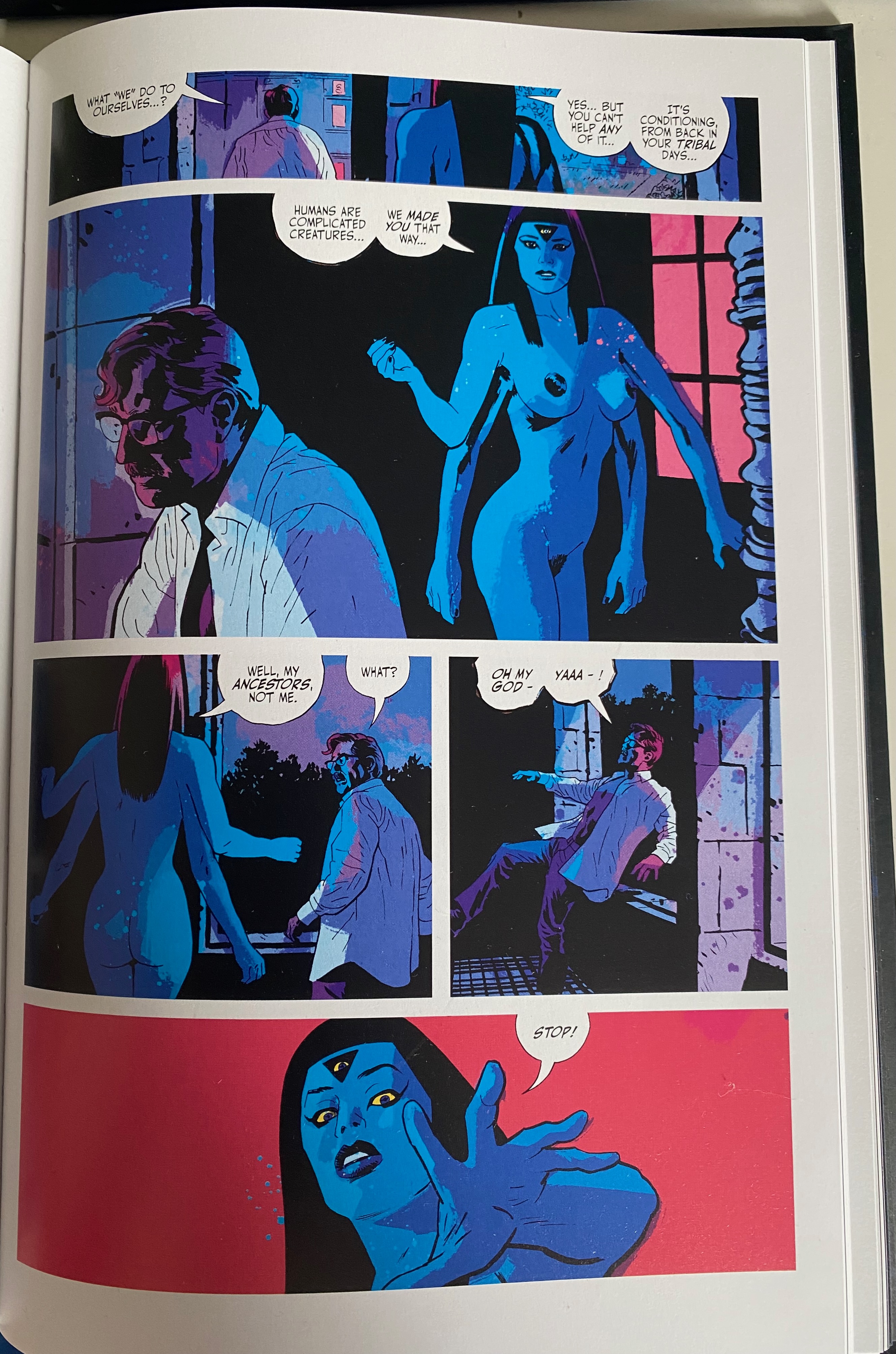
Ah, you might think, this is where the story gets really weird. The next thing Jonathan remembers is being back at a party. Maybe she saved him, maybe he landed on something soft, maybe it was a drugged hallucination. It wouldn’t surprise me to learn that at this stage, Dave Brubaker himself wasn’t sure which way the story was heading. Another blue, four-armed person turns up a couple of pages later, and someone tells Jonathan that the aliens ‘have been coming more often lately … getting ready for the end’.

This page is also a good example of the objectifying treatment of women’s bodies that is my main dislike of comics like this. Thankfully this is the only naked woman in the book. I guess if you have scruples about pervy comic-book misogyny, you can always slip in a naked woman by giving her a second pair of arms and making her a godlike alien. (A full-frontal naked man turns up later, but he’s dead and not the least bit sexy.)

To quote my gift-giving son about another Brubaker-Phillips book, ‘It’s popcorn.’ It’s quality popcorn.


The first horror story I ever heard was told me by a Bundjalung woman – and it was much scarier than anything in Night Fever. I wrote this blog post on land of the Gadigal and Wangal people. I acknowledge their Elders past and present who have told stories here and cared for this land for millennia.
Michael Crane’s Urban / Landscape / Ordinary Lives

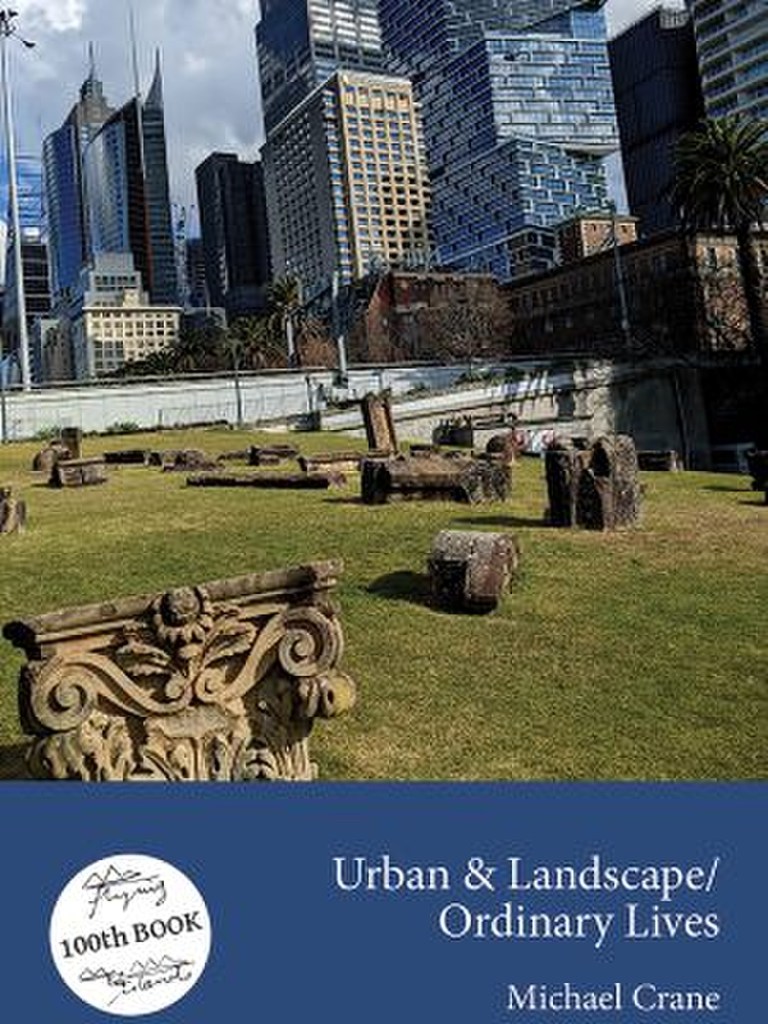
Michael Crane, Urban & Landscape / Ordinary Lives (Flying Island Books 2024)

Michael Crane organised Australia’s first poetry slam in 1991, and has been a significant figure in Melbourne’s spoken word scene ever since – or at least until his Wikipedia entry was updated, which may have been more than a decade ago until I added this book.

So this is a book of poems by a spoken word practitioner. That is, they are mainly poems for the stage rather than the page.

There are three sections: ‘Urban’, ‘Landscape’ and ‘Ordinary People’.

The first is mostly snapshots of life in inner-city Melbourne, with a couple of Brisbane scenes thrown in. The ones I like best are list poems. Take ‘The Emerald Hill Library Story Time’, for example, which lists many aspects of Clarendon Street that make it a tough place to live, and ends with the tenderness of storytime for children at the library; or ‘Hi Rise’, made up of fifteen couplets, each describingsomeone we take to be a resident of the building:

Marlene ran a tight ship
as her cat, Teddy, rubbed its tail between her legs.

Many visitors arrive unannounced,
cheating the security system.

Harry lives with his father
who he must treat like his child to manage him.

‘Landscape’ mostly moves out to the country, though in its final poem, ‘Life in the Big Smoke’, a poet from the country (a version of Michael Crane in his post-Wikipedia days?) visits the city, has a number of (non-)encounters and goes back ‘to where he came from’. This poem is enriched by being read in this context: its string of encounters echo similar ones on the first section, but the emotional impact is the opposite. In particular, it pairs nicely with ‘White noise of an urban landscape’, which begins, ‘The country life was not for him.’

The third section, ‘Ordinary Lives’ begins with ‘Introduction’, which lays out the section’s rationale, including this:

I find most people more interesting than me, but my job
is to document their success and failures, the moment of glory or
the times when they are alone without love.

The poems in this, as in all three sections, are mostly direct, straightforward, unassuming. They tend to name things without analysis or commentary. On the page they tend to be flat, but my sense is that they would come alive with the gesture, tone of voice and facial expression of spoken-word performance. They’re also mostly on the depressive side – fewer moments of glory, more times alone without love.

My arbitrary blogging practice, especially with books of poetry, is to focus on the page that corresponds to my age, which is currently 77. Page 77 of this book features one of the ‘Ordinary People’ poems, ‘On a plane to Cuba’:

This seems straightforward on a quick read, but there’s something unsettlingly off kilter about it – which may be another way of saying it couldn’t have been written by AI.

After I wrote that last sentence, I decided to test my assertion, and asked Chat GPT to write a poem about a woman who is about to leave her sleeping husband and go to Cuba. I’ve given the result at the bottom of this post, so as not to confuse it with real poetry*.

ChatGPT was worryingly proficient. But what it produced demonstrates that a mechanical aggregator just can’t do what a human poet can. The AI product has sharp images of the room, gives reasons for the woman’s choice of Cuba, and even has a last line that works, but none of it is surprising.

Michael Crane’s poem, on the other hand, pretends to be offering us clichés, but undermines them all the way. In the first ten lines, even as the poem evokes the woman’s yearning for elsewhere, it subtly, almost invisibly, distances itself from her. Does anyone in touch with reality think of Paris, City of Lights, as dimly lit? And though I’ve been in London when it snowed, surely ‘snow-covered footpaths’ is an idiosyncratic way of evoking that city. Her version of Cuba is similarly idiosyncratic. The ‘almost naked dancing women’ are a cliche from Rio rather than Havana. She seems to be vague about Cuban history. What is the ‘long war’? Maybe she’s thinking of Fidel wearing military fatigues? And, in the most telling split between the woman’s perspective and the poem’s, why does she find memories of war attractive?

In lines 13 to 15, the woman’s situation becomes clear:

She is going to catch a flight to Cuba 
as soon as she leaves the snoring man
who kidnapped her youth, ransomed her beauty.

Perhaps the woman’s idea of a ‘long war’ has come from the implied long time that she has been unhappily married. The definitive final line is hinted at here.

The poem continues to tread a fine balance between sympathy and – what is it? – scepticism. She takes no responsibility for whatever has one wrong with the relationship: there’s no indication that the man has been abusive – just that she took up with him when young and beautiful, and now feels the loss of those qualities (and we understand that she means he held her beauty to ransom rather than, what the words literally mean, that he paid a price to set it free). The feeling of loss is real, but we (or is it just me?) can’t help suspecting that she lacks insight.

Crucially, it’s her dreams that she packs along with supremely impractical clothing, and the last line strikes a superbly ambivalent note: all through the poem she has been dreaming of Cuba, and she heads off to ‘the songs of endless summer nights’, but really it might as well be dim Paris or snowy London, because what matters is

days filled with the absence of him.

It’s not ‘She’s Leaving Home‘, with it’s brilliant empathy for both sides of the departure, but then what is?


I finished writing this blog post on land of Gadigal and Wangal of the Eora Nation, as the sun was breaking through clouds after a day of heavy rain. I acknowledge the Elders past and present who have cared for this land for millennia.

*ChatGPT’s poem:

She watches him sleep, his chest rising and falling,
the steady rhythm of a man who never saw her breaking.
The sheets tangled around him,
a quiet fortress she once called home.
But now it feels like a cage.

Her bags are packed, a quiet rebellion in the corner.
Cuba waits—its colors, its heat,
its freedom, a place where she can feel her pulse again.
She runs her fingers over the window sill,
tracing the outlines of a life she no longer wants.

She should wake him, say goodbye,
but the words are too heavy,
the goodbyes too worn.
Instead, she steps lightly,
a ghost slipping past the threshold.

She breathes in the cool air of the morning,
the world opening wide in front of her.
And with every step,
she leaves behind the woman she used to be.

Josh Tuininga’s We Are Not Strangers

Josh Tuininga, We Are Not Strangers (Abrams Comicarts 2023)

In December 1941, about 127,000 Japanese Americans lived in the continental USA. After the attack on Pearl Harbor and the declaration of war on Japan, about 120,000 of them, of whom about two-thirds were U.S. citizens,  were forcibly relocated and incarcerated in concentration camps.

This is not a secret history. In The Karate Kid, the young boy comes across references to the deaths of Mr Miyagi’s wife and child in a camp. Star Trek actor George Takei famously spent a number of years in one of the camps as a child, as told in the documentary To Be Takei (2014) and in They Called Us Enemy, a comic he co-wrote that was published in 2019. David Guterson’s novel Snow Falling on Cedars (1994) and the Scott Hicks film made from it refer to the incarcerations. (There are more examples on Wikipedia – I’ve just mentioned the ones that ring a bell for me.) Various presidents have expressed regret over the episode.

Josh Tuiininga’s comic comes at the subject as it played out in Seattle, from the point of view of Sephardic Jews. It begins in December 1987, with the funeral of Marco, the narrator’s grandfather. The funeral proceeds according to Sephardic tradition, but a lot of people turn up that the narrator has never seen before. Curious, he asks them how they knew his grandfather so well, and the story emerges.

During World War Two, as the Sephardic Jews of Seattle were watching the horrific events unfolding in Germany, they were suddenly confronted by a terrible injustice closer to home, as Japanese friends and neighbours were rounded up, their businesses forcibly closed, and their lives disrupted.

Page 77* marks a turning point. Marco and his family have just heard a radio announcement that ‘the Japanese population in America are potentially dangerous’ and are to be relocated or suffer criminal penalties:

In the first image on this spread, the woman walking away with a dismissive gesture is Marco’s mother, who has successfully escaped Germany and been smuggled into the USA by way of Canada. Her gesture signifies contempt for the edict, which she has just said is like what happened to Jews under the Nazis (not a view the comic necessarily endorses, but it shows the basis for solidarity between Jews and Japanese).

The left-hand page appears to portray Marco and his family as helpless bystanders. Evidently the Japanese American Citizens League recommended compliance for pretty much the reasons that Marco gives here: to resist would be to undermine the war effort. But the wordless right-hand page suggests something else. It is followed by two more wordless pages, a full page drawing of Marco at his desk beneath a clock showing one-thirty, and then a single drawing of a lit window in a dark suburban scape. We don’t now what these images mean precisely, but they remain as a question as the rest of the story unfolds: there’s a Passover sermon at the Synagogue; one of the Japanese children has her white friends turn against her; the Central District of Seattle is filled with remnants of Japanese presence; there are glimpses of life in the camps, and on their closure signs of persistent anti-Japanese sentiment are everywhere.

But it turns out that what Marco was doing in his study that night was working out how he could safeguard his friends’ homes and businesses. When they return home, he gives them envelopes full of rent money, deeds and all that is needed to help restore their lives. And he has done it for as many families as he could manage. Only at his funeral do his own family find out what he has done.

‘Why did he keep it a secret?’ the narrator asks, and over a series of images that show Marco with family and his Japanese fishing friend in 1945, 1953, 1968, 1979 and then (his empty chair at the family table) 1987, the captions read:

Maybe he thought he would get into trouble.
Perhaps he wished he could have done more.
Or, maybe …
… he just wanted to forget all about it …
… and spend his time on more important things.

That last line is a caption between two images, one of Marco as an old man at a family meal, the other (echoing images from early in the book) of him and his Japanese friend fishing together and laughing.

It’s a powerful story, elegantly told in a palettte of mainly warm browns and pale blues. Though a note at the beginning assures us that this is a work of fiction, it also says the story is based on ‘the oral histories of many’.

It’s pure coincidence that I have read this so soon after Yael van der Wouden’s novel The Safekeep. That novel hinges on the loss of property and livelihood by Jews in the Netherlands under the Nazis – so that those who did return from camps found their houses occupied and their personal items now used by strangers. That almost certainly happened to many Japanese-Americans, but this story demonstrates how it could have been different, and that in at least some cases it was different.


It would have been impossible for me to read this book without thinking of North Queensland. My grandfather was a police magistrate. The family story is that because he had learned Italian he was brought back from his posting in Brisbane to supervise the internment of Italians during World War Two. That internment was on a smaller scale – 5000 men were taken from their families to internment camps in New South Wales and South Australia, and at least twice as many were put to work in remote areas building roads and rail, and working in mines. Many were naturalised Australian citizens.For the most part, only the adult men were taken away: the results were devastating for Italian farmers, and families were disrupted.

The ABC ran a story in 2020 marking the 75th anniversary of the end of the War (link here). The excellent Babinda museum tells one man’s story – a man who, characteristically, downplays the difficulties he faced. The official archival records of the internments have been made public for some decades now, but as far as I have been able to tell the many stories – from Innisfail, Ingham, Garradunga, Daradgee, Boogan – have yet to be told.


I wrote this blog post on land of Gadigal and Wangal of the Eora Nation, peoples whose own stories of mistreatment in times of war have yet to be fully told. I acknowledge the Elders past and present who have cared for this land for millennia.
The Book Group and Samantha Harvey’s Orbital

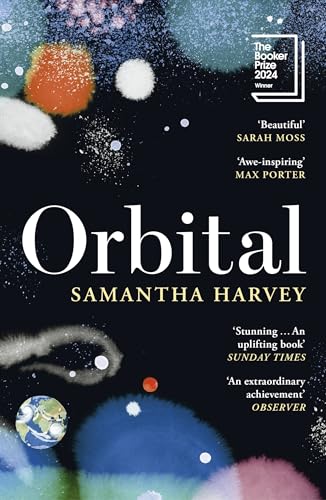
Samantha Harvey, Orbital (2023)

Before the meeting: We picked this book as our next title the day before it won the Booker Prize. Smart us!

Four men and two women on a space station orbit the Earth sixteen times in twenty-four hours. They eat, they monitor experiments with plants and mice, they do strenuous exercise to counteract the bodily effects of living in low-gravity, they maintain their environment and monitor their own vital signs, they report back to ground control, they exchange messages and images with their loved ones at home, they occasionally have weirdly unreal conversations with complete strangers on Earth, and they look out with wonder at the planet below them and at the vastness of space.

That’s the plot.

A writer less sure of herself might have developed a plot where the relationships among the travellers create conflict or titillation. There would be plenty of possibilities in the crew consisting of two Russian men, an Irish woman, a Japanese woman, a Christian man from the USA, and a Latino man with connections in the Philippines. But the subject of this novel is the humans’ relationship to the planet, and beyond that to the universe, from a perspective that makes the conflicts that dominate human life in general seem absurd.

At the front of the book there’s a diagram showing the pathway of the spacecraft’s orbit over the day. The craft flies / falls in a straight line, but the rotation of the planet beneath it means that it crisscrosses the land and ocean below. I kept flipping back to the diagram as chapter by chapter, one for each of the sixteen Earth orbits in the day, describes in lyrical language what can be seen below.

This book is ideal for my blogging practice of singling out a particular page, currently page 77, because though there is a narrative of sorts it’s not the kind that means one has to be wary about spoilers. Part of what makes this book a worthy winner of the Booker is its brilliance at the sentence level.

Page 77 is in the chapter ‘Orbit 8, ascending’. Though the craft is over the south-west of the USA, the narrative departs, as it does occasionally, from what lies below to describe what is happening on the other side of the planet:

Over there, in tomorrow, the typhoon summons winds of a hundred and eighty miles per hour. It’s rampaging through the Mariana Islands. The sea levels off the islands’ coasts have already risen with the expansion of the warmer water, and now, where the winds push the sea toward the westward edges of its basin, the sea rises more and a five-metre storm surge engulfs the inlands of Tinian and Saipan. It’s as though the islands are hit with cluster bombs – windows blown out, walls buckling, furniture flying, trees splicing.

There follows a little more description of the typhoon from a meteorological perspective. Its growth is the book’s one central narrative thread. In later chapters, the crew see it as spectacle – contrasted with the terrifying reality on land, especially as it affects a poor family who once offered hospitality to one of them.

But for now, the daily routine asserts itself:

The crew go on with the last of their tasks. Anton eats an energy bar to fight off late afternoon drowsiness. Shaun removes the four fasteners on the bracket of the smoke detector that needs replacing. Chie inspects the bacteria filters. Their path now ups and overs and exits America where the Atlantic is ancient, the placid silver-grey of a dug-up brooch. Calm suffuses this hemisphere. And with no ceremony they complete another lap of the lonely planet. They top out some three hundred miles off the Irish coast.

And then there’s this:

ln passing through the lab, Nell looks out and sees the promise of Europe on the watery horizon. She feels somehow speechless. Speechless at the fact of her loved ones being down there on that stately and resplendent sphere, as if she’s just discovered they’ve been living all along in the palace of a king or queen. People live there, she thinks. I live there. This seems improbable to her today.

This intermingling of more or less objective observations of the Earth as seen from orbit, the daily routines of life in the space station, moments of lyrical reflection is maintained, with miraculous poise, through the whole book.

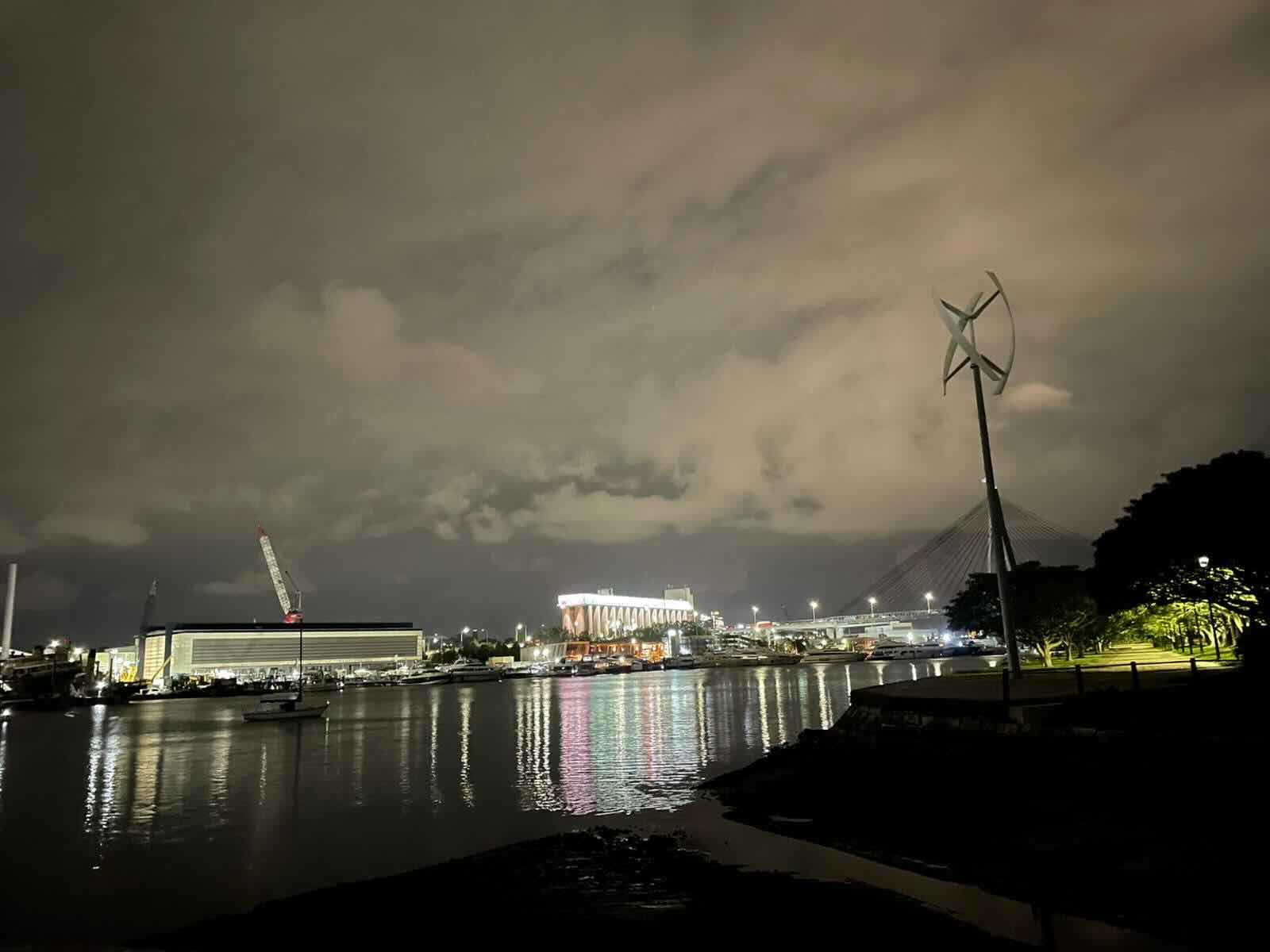
The meeting: We’ve been calling our bring-a-plate meetings gentlemen’s picnics. This one was an actual picnic, in Bicentennial Park on the shores of Blackwattle Bay, Gadigal land. Pavlova, quiche, dumplings, barbecued sausages eaten to a backdrop of birdsong and practising dragon boats beneath a three-quarter moon. We were interrupted briefly by what seemed to be a gay bashing – eight men of certain ages tried to look imposing as we lumbered towards the scene, but it seemed to vanish before we reached it. We conferred with a couple of men who were dossing down in the Esther Abrahams pavilion, and with a cluster of hefty teenage boys, and decided there was nothing further any of us could do.

It was our final meeting for the year, so we swapped gift-wrapped books (I scored a Zadie Smith) and most of us read a poem: David Malouf, Robert Frost, me and John Levy (it was unclear whether I’d broken a rule by reading one of my own, but it was excused because my poem was there to illuminate John’s), Brecht, James Baldwin.

In the middle of this mostly joyous occasion, we managed to talk about the book. The first thing said could have been a paraphrase of my fourth paragraph above: what a relief that Samantha Harvey didn’t go down the track of having big conflicts among the crew. My sense is that everyone enjoyed the book a lot.

We reminded each other of ‘good bits’: the lab mice learning to live in low gravity, the tear drop that has to be caught and disposed of because free-floating liquid can’t be tolerated, the nose pressed against a stomach as two characters squeeze past each other … Someone mentioned what should have been obvious: though the crew sees sixteen sunrises, they all happen on the same day – I took that in my stride while reading the book, but when it’s put like that it leaves me gasping.

One person found a lot of the book tedious and repetitive, but later, driving in the car, he realised that the repetition was partly the point, these people were caught in a continuous loop.

The closest we came to disagreement was when someone said the absence of ordinary, everyday irritations and conflicts among the crew strained his credulity. In real life, people living together in such close quarters would inevitably grate on each other at best. Two arguments were offered to counter this view. First, on the level of verisimilitude, the crew are disciplined – they can live with an itch in a space suit for hours without scratching, surely they can put personal irritations aside. Second, yes it’s unrealistic, but to pay attention to such matters would have cluttered the book or even taken it to a different, less interesting place. (One of us has spent some months in a hut in the Antarctic, so could vouch for the likelihood of conflict – though he was the one who argued most strongly that these are disciplined space travellers.)

It was a terrific end to another Book Group year.

Photo by Steve Kennedy, used with permission

Andrew Burke’s Historic Present

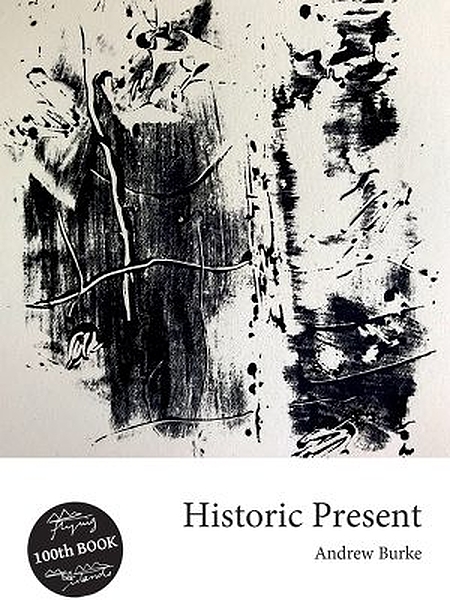
Andrew Burke, Historic Present (Flying Island Pocket Poets 2023)

The ‘About the author’ paragraph at the back of this book begins ‘Andrew Burke was an Australian author’ – and you realise that the Acknowledgements two pages earlier were written very soon before the writer’s death in his 79th year (as confirmed by his Wikipedia entry), and that one of the last things Andrew Burke wrote was this tiny love note:

The many moods of this collection were suffered in partnership with my wife, Jeanette – so thanks for discussions over blueberries and porridge.

The preceding ninety pages of poetry do reflect and capture many moods, and it’s not hard to imagine the man who wrote them enjoying a quiet chat over blueberries and porridge – not just with his wife but with a community of poets living and dead. Many of those poets find their ways into the verse, either by name or by quotation, very occasionally in a way that made me go googling, but mostly as a way of invoking a community, of readers as well as writers of poetry.

There are poems of travel and childhood memory, poems marking the death of a friend, poems that seem above all to be recording a passing moment. They don’t strive for effect or makes a song and dance of their emotional content or insights, but quietly do their work and are gone.

‘Testicular Check-up’, for example, begins:

I fell in love with my balls
all over again when
they were endangered. 

(You’ve got to love those line breaks!) What follows is a good humoured conversation with the ‘lady’ scanning his testicles. He doesn’t spell out the emotional content of the moment. Enough to say that amid the chat and the matter-of-fact handling, first of his penis then of each testicle, he feigns comfort and indifference, the repetition of the word ‘feigning’ lying like a blanket over what is left unsaid.

Page 77* falls in the middle of the book’s longest poem, ‘Lone Patrol: Darlington 1991’. Again looking to Wikipedia, I find that Darlington is a small community some distance east of Perth frequented by artists. The speaker of this poem is living in someone else’s cottage, perhaps an Airbnb (or the 1991 equivalent) or a writerly retreat, or just to take a break from a difficult time on his life. He chats with a visitor, attends an AA meeting, writes, listens to Jack Kerouac, reflects on his life, enjoys the surroundings.

The poem is in 23 sections, and reads like notes on his time in the cottage. These lines, from page 78, referring to work he is doing on another poem, shed light on the nature of this poem:

'Triplog' poem edited
___________ down to 15 pages
but what to do
with such an
________idiosyncratic poem ...

‘Log’ isn’t a bad description of the current poem – ‘staylog’ perhaps, part journal, part jottings of observations and reflection. And it’s not hard to imagine that it has been edited down from copious daily notes to its 14 pages. I usually look for an overarching narrative in long poems, but here I couldn’t see anything other than a string of moments – and I’m happy with that.

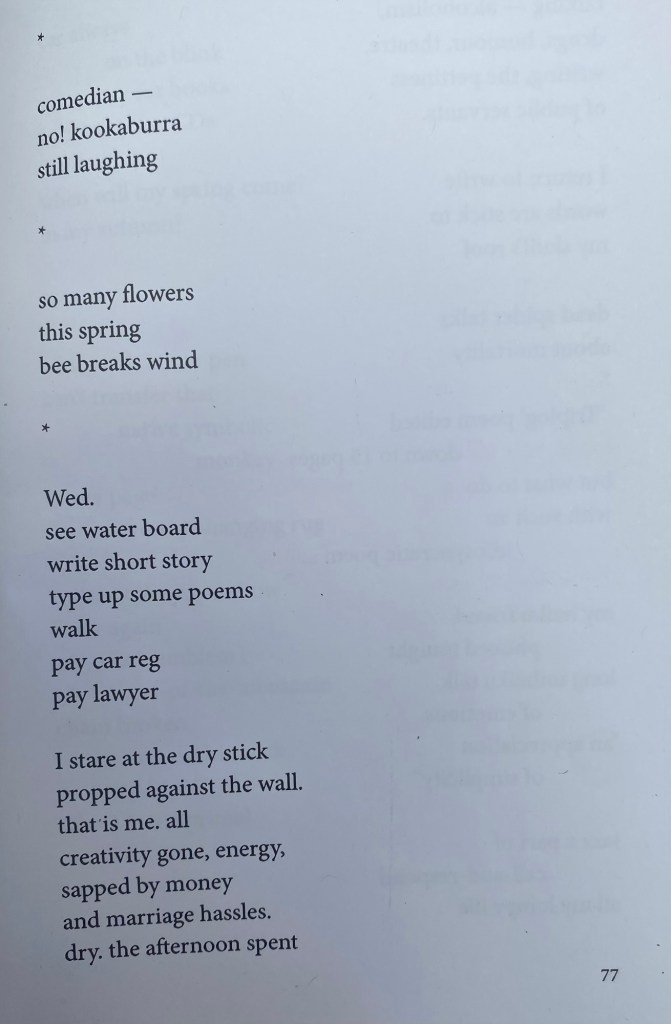
Page 77:

The first two sections are short haiku- or senryu-like poems.

The first, as I read it, juxtaposes the speaker’s grim mood (‘Comedian – / no!’) with the cheerfulness of the natural world, represented by kookaburra’s laughter. Whether the laughter is derisory (the kookaburra is laughing at the poem’s speaker) or simply indifferent (the kookaburra is just laughing without reference to him) is left open.

The second is less successful. I googled ‘Do bees fart?’ Apparently it’s an age-old question, and they sort of do but not really. My sense is that the poem doesn’t care about that. It catches itself in a cliche celebration of flowers in the spring, and throws in a bit of vulgarity to shake the image up. (It does make me want to echo the earlier lines: ‘Comedian – no!’, but in a friendly way.) You might enjoy the way ‘break wind’ has a second, more literal meaning – the bee interrupts the flow of the breeze. If so I’m happy for you.

The third section starts out as a prosaic to do list, then in the second stanza that prosaicness finds what in my distant university days was called an ‘objective correlative’ – an embodiment of the underlying emotion:

I stare at the dry stick
propped against the wall

The narrative behind the matter-of-fact notes ‘pay car reg / pay lawyer’ comes more fully into view – there may be a divorce in the mix:

_________ all
creativity gone, energy,
sapped by money
and marriage hassles.
dry.

The section goes on, to describe an afternoon of talking, and then of trying to write. It ends, taking the image of the dry stick one step further:

dead spider talks
about mortality

Unlike the kookaburra, the dead spider (on a windowsill?) reminds him of his mortality; or perhaps he himself, dead-spider-like, can’t write of anything but death.

The poem is a staylog, and also a pretty matter-of-fact account of what a more egotistical person might have called a Dark Night of the Soul. In 1991, the poet was approaching 50. Perhaps the matter-of-factness was there at the time, or perhaps the poem got to its present form much more recently, and the matter-of-factness comes from the thirty-plus intervening years.

It’s a bitter-sweet thing to meet a poet only after he has died. But it is sweet.


I wrote this blog post on Gade / Wane. I acknowledge the Gadigal and Wangal elders past present and emerging, and gratefully acknowledge their care for this land for millennia.


* My blogging practice is to focus on page 77 (at least until I turn 78). In books like this, the practice saves me the impossible task of choosing one poem to represent them all.

Three books by John Levy, and November verse 10

John Levy, 54 Poems: Selected and New (Shearsman Press 2023)
––, To Assemble an Absence (above/ground press 2024)
––, Guest Book for People in My Dreams (Proper Tales Press 2024)

John Levy has commented generously a couple of times on this blog (here’s a link). When he emailed to ask if I’d like a copy of his recent book, with no expectation to blog about it, of course I said yes, provided I could send him one of mine. So we swapped books: I sent him two, he sent me three, an unequal exchange in more ways than the obvious. He has responded to my efforts with what I now know to be his characteristic generosity. And now I am blogging about his, motivated by joy, not obligation.

John’s books arrived when I was sitting down to lunch with the Emerging Artist and our grandchildren. I flipped 54 Poems open to the first page, and read out the prose poem ‘Kyoto’:

Kyoto

I'm at a temple. A young monk in black robes walks by, looks at me,
stops. He points to my long hair. Brown. Then to my goatee. Red. He
touches my armpit and looks puzzled. I point to my hair. He points to
my crotch. I point to my hair. He invites me in for green tea.

The children liked it, probably because of the crotch reference. The Emerging Artist liked it, possibly because of the colour play. I liked it for both those reasons, and also for the comedy about communication and connection that don’t need words.

These three books reminded me that poetry can be a lot of fun. It can deal with death and loss, all manner of elevated cultural matters, or issues encountered when working in a Public Defender’s office, and still be fun. It can talk to goats and spiders and be silly about words, while still being serious. It can be warm without being goopy, and self-referential without being wanky.

Naturally, I went Googling. Among other things, I found John being interviewed on the website of Touch the Donkey, a small quarterly poetry journal published by above/ground press, publishers of one of these chapbooks. In that interview, he describes his approach:

I begin writing a poem (or prose poem) without knowing what I am going to say after the first few words that I thought of to begin with. Sometimes … I begin with a friend in mind and want to write something for the friend although I usually haven’t figured out anything beyond wanting to write something to that friend.

It’s poetry impro.

No doubt these poems have been polished and revised, but they retain the feeling of immediacy, of the poet’s mind chasing associations like a distractable child in a toy shop, and then they resolve themselves as if by magic.

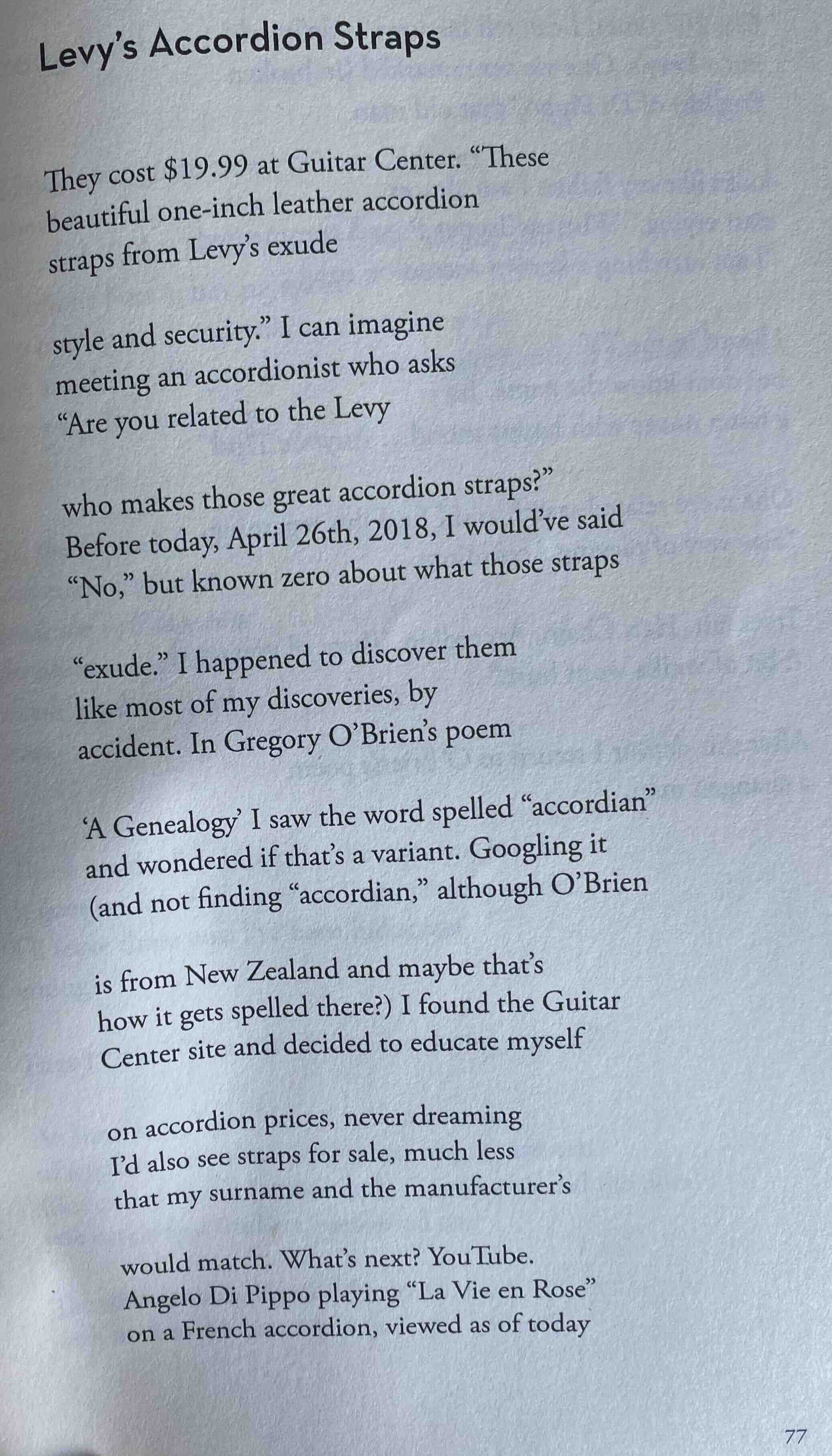
I’ll stick to ‘Levy’sAccordion Straps’ on page 77–78*. I apologise for the quality of these images:

You could call this a rabbit-hole poem. It doesn’t start in exactly the way Levy describes in the interview above, but it’s in the same paddock. It’s a comic version of close reading: he takes a single word from Gregory O’Brien’s poem ‘A Genealogy’ (of which we know nothing else), and sees where it takes him. Maybe it’s the obsessive copy editor in me, but I love it that the poem starts from what turns out to be a misspelling. We tend to think of USA-ers as culturally arrogant, but Levy here has the humility to check the ‘variant’, and then stays open to the possibility that they do things differently in New Zealand. (There’s an Easter egg in line 24: Levy slips in a typo of his own, adding a space in Angelo Dipippo’s surname.)

As the poem progresses in an apparently random manner, it turns out that it features quite a bit of English as spoken/written by people not from the USA. There’s quiet humour, but not, I think, mockery. The last line made me laugh out loud. Instead of seeing the ‘detour’ as taking him away for a moment from O’Brien’s poem, he sees it as having changed the kind of attention he brings to it.

And now, because it’s November, here’s an hommage (with an advance note – Mruphy’s [sic] Law decrees, ‘If you write anything criticising editing or proofreading, there will be a fault of some kind in what you have written’):

Verse 10: Dear John

YouTube. Angelo Di Pippo
plays, you said, 'La vie en rose'.
I can’t find him (you’ve got a typo
in his surname, Mruphy knows).
I do find other Piaf splendours –
Galliano working wonders.
Music takes me in its arms,
an infant whose late night alarms
are soothed by father’s tender crooning.
Jean, who says she’s ninety-one,
comments that life then was fun.
I googled “Levy’s straps” this morning,
found them, surfed around some more,
found fancy watch straps made by Shaw.

I finished this blog post on Awabakal country, near what is now one of the biggest coal ports in the world. I acknowledge Elders past, present and emerging for their continuing custodianship of this land.


My blogging practice, especially with books of poetry, is to focus on the page that coincides with my age, currently 77.

Journal Catch-up 26: Meanjin Winter 2024, and November verse 6

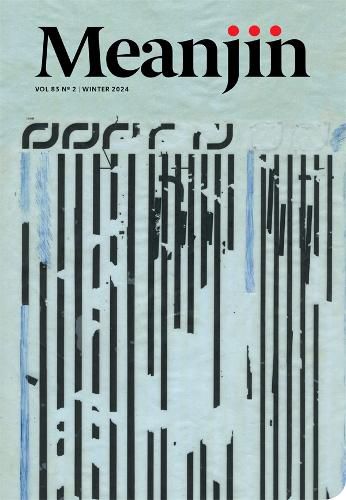
Esther Anatolitis (ediitor), Meanjin Vol 83 Nº 2 (Winter 2024)
(links are to the Meanjin website: some but not all of them are available to non-subscribers)

This Meanjin is incredibly rich and varied. I’ve carried it in my backpack for weeks, mostly reading a single article or story at a time when on public transport, in waiting rooms or queues, or occasionally – as in the days before podcasts – while walking. I have learned about:

Click on any link in that list, and you may find something instructive, challenging, entertaining or all three.

As the child of a farmer in North Queensland, where Mamu land has never been ceded and sugarcane monoculture has not been kind to the land, I was particularly moved by Katherine Wilson’s brief memoir about regenerative farming and collaboration with traditional owners, ‘Our Bog Paddock’s Understory‘.

I also want to mention ‘We, small heroes‘ by Micaela Sahhar, a short reflection on what it means in the current era that Palestinian culture has hospitality as a core value.

Of the four excellent pieces of fiction, Katerina Gibson’s ‘Something Dormant‘ stands out as a complex story of young, unrequited love remembered, with an environmental twist.

One of the joys of this Meanjin is the way its nine poems are spread throughout, so each one comes as a pleasant surprise among the prose. Having just this morning read an editorial on ‘eco-poetry’ in the Guardian (poetry ‘cannot ignore global heating’), I’ll single out Caitlin Maling’s ‘Ordinary Disaster‘, a chillingly affectless account of a mass dying of fish among coral in Western Australia.

It’s my blogging custom to focus on page 77. In November, I try to include a verse stanza in each blog post. Page 77 in this issue is part of a fascinating interview with architecture critic Naomi Stead (link here). The phrase that gives me my opening line comes from this paragraph:

I don’t want to be the schoolmarm, but if people understand more about the built environment – how it’s procured, how it comes into being, how it’s not an accident, how there’s almost nothing in our cities that is not deliberately designed – then they can begin to see the role that they themselves could play. I mean we should expect more, we should demand more of our cities and buildings and built environment, but we can only do that with a degree of knowledge and education about how this came to be, and what could be.

Rather than enlarge on Professor Stead’s point, my little verse follows where the phrase takes it. That and the plane that flew over our flat as I typed the first full stop.

November verse 6: We should demand more of our cities
We should demand more of our cities.
Not more aircraft overhead.
No more oh-dears, what-a-pities –
Packer's Pecker, Jeff's Shed.
Perhaps less civil inattention,
less of what's too gross to mention,
neighbours partying till four,
Mormons knocking on the door.

Demand more? Let me try. O Sydney,
Demand more? Let me try.
O Sydney,
give me silence, show me stars,
let me breathe air free from tars.
So many things I'd have you give me.
Make your waters clear again,
and some day soon please change your name

I wrote this blog post on Gade / Wane, not far from Warrane, which some people want to give its name to the whole of Sydney. I acknowledge the Gadigal and Wangal Elders past present and emerging, and gratrefully acknowldge their care for this land for millennia.
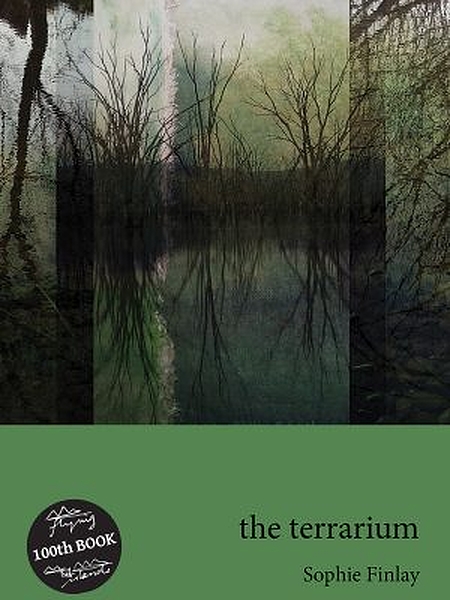
Sophie Finlay’s Terrarium

Sophie Finlay, The Terrarium (Flying Island Books 2024)

Sophie Finlay won the Flyng Islands Manuscript Prize for Emerging Poets 2022. A visual artist as well as a poet, she designed the book, and both the cover image and the photographs and delicate drawings scattered throughout are hers. It’s a beautiful, pocket-sized object.

The poems cohere around a main theme, summed up nicely in the final words of Darwin’s On the Origin of Species, which serve as a kind of epigraph:

whilst this planet has gone cycling on according to the fixed law of gravity, from so simple a beginning endless forms most beautiful and most wonderful have been, and are being, evolved.

As I understand it, the central idea of the book is to imagine the earth as a gigantic terrarium, in which one can observe the wonders of living things, often with scientific labels attached (poem titles include ‘Zooxanthellae’, ‘Morphologies of Ice’, ‘Glossopteris’ and ‘Noctilucent’), reaching back to the very beginnings of life, but including accidental personal matters such as a fear of snakes and a trip to Antarctica.

Interspersed among the other poems are six ‘extinction’ poems. Each of the first five of these comes with an indication of date: from the End-Ordovician extinction 455-430 mya (million years ago) to the Cretaceous-Paleogene (K-Pg) extinction 65 mya. The fifth, which is also the book’s final poem, refers to the Anthropocene extinction, no date necessary. These numbered poems aren’t section headings: in the midst of much else, they sound an ominous background drumbeat. Individual poems pay attention to detail but, just like in the real world, there’s a deep current that cannot be ignored.

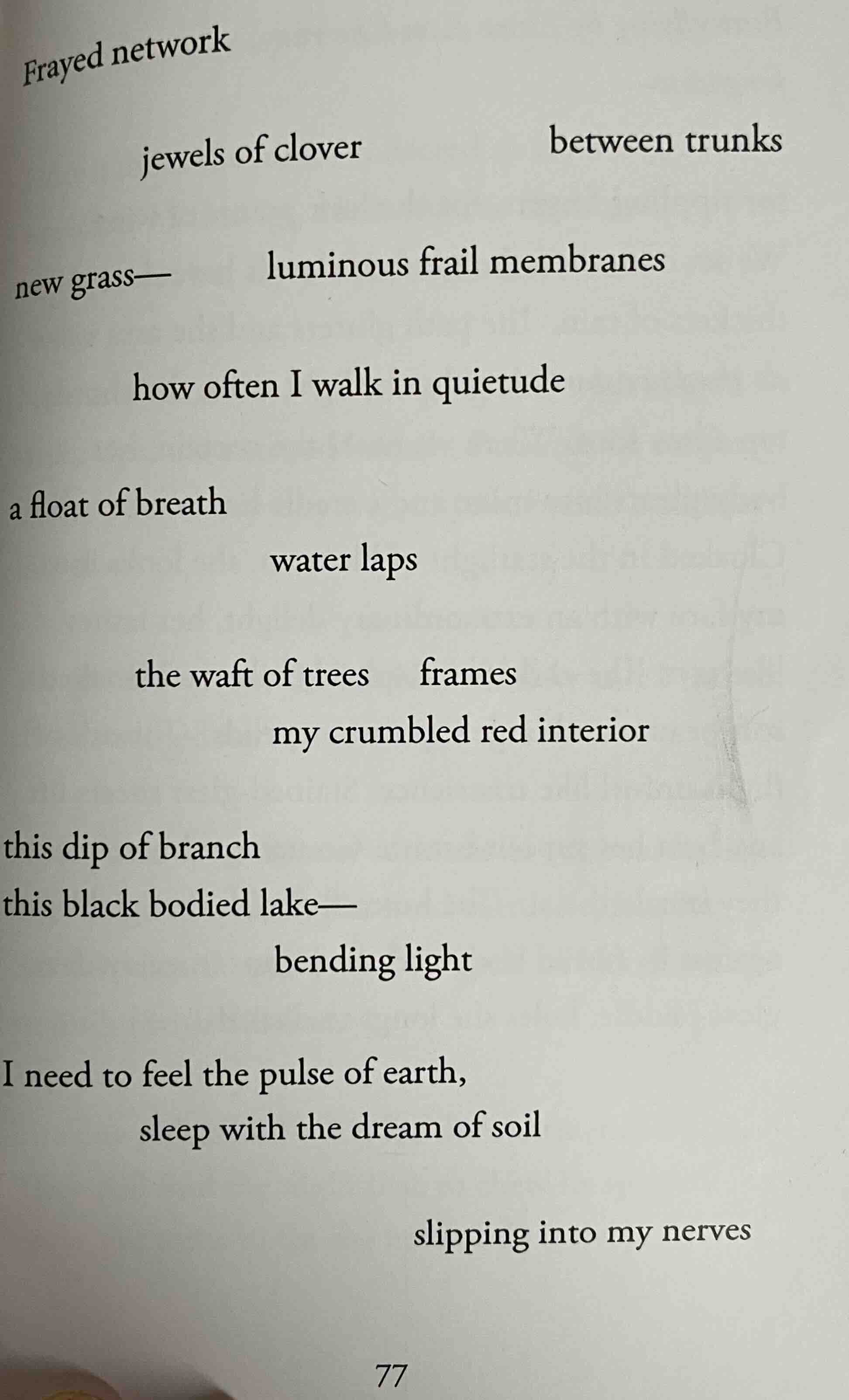
‘Frayed network’ on Page 77* is a moment when the ominousness is mostly at bay, there is no scientific nomenclature, and attention is on the present moment in the natural world.

This poem might be a nice entry point for readers who are intimidated or bewildered by contemporary poetry. It’s definitely one that could have prompted the question a friend of mine asked at a Sydney Writers’ Festival session, ‘Why have modern poets given up rhyme and metre?’. The words are spread out all over the page, I imagine my friend complaining, the punctuation is mostly no help, and where are the verbs?

But slow down, spend a little time, and I think even my indignant friend might find pleasure here.

The poem takes its readers on a walk among trees beside a lake. Line by line, the speaker notes details from the environment: the jewel-like clover, the luminous frail membranes (what a lovely phrase!) of new grass, the sounds of lapping water and the feel of a breeze. There’s a hint that this is a new beginning: at the end of a drought, perhaps or in the aftermath of a bushfire. When else would you think of grass as frail? These details are just there, each its own thing, with no attempt to tie them into a pattern or narrative with a formal rhyme scheme or metre, or sentence structure, or even an orderly presentation on the page. There’s a lot of white space, a visual equivalent of silence.

It’s a mindful kind of walking, just noticing, not trying to make meaning or extract usefulness.

Then, interspersed among the images there are three sentences, each of them about the speaker:

How often I walk in quietude

At the third line, the poem’s speaker and her situation is made explicit. ‘Quietude’ is a formal word for a state of tranquility, suggesting quietness and solitude.

The second formal sentence occurs at lines six and seven. Its subject isn’t clear. Something, probably the totality of all the things that have been noticed – the clover, tree-trunks, new grass, breeze, sound of water lapping and trees –

___________------_____ frames
____________ my crumbled red interior

This is the only ‘difficult’ line in the poem, and also (no pun intended) its heart, in two senses. First, straightforwardly, it’s roughly the middle line of the poem. Second, more interestingly, it moves momentarily from the external environment to the inner life. The red interior suggests the colour of blood and internal organs, perhaps especially the heart. But ‘crumbled’? It does suggest some kind of diseased state, though I don’t know of one that would merit that adjective – some kind of clotting, perhaps, but that would be stretching it. I’m happy to let the word remain suggestive rather than carrying a definite meaning. A heart that isn’t so much broken, perhaps, as dried out and eroded by sorrow.

The next lines take us back to details of the environment: a lake seen through the branches of a tree, or perhaps a branch dipping into the lake, and a nod towards the many lighting effects that a lake can produce: reflection, diffraction, blackness and lightness at the same time.

In the final three lines, the third subject–verb–object sentence, the poem’s speaker is front and centre:

I need to feel the pulse of earth
_______ sleep with the dream of soil

___________------_______ slipping into my nerves

She is reaching for a connection with the land, to have it come alive in her dreams, to heal her crumbling elements. She needs to be, literally, grounded, with a hint, perhaps, in the word ‘dream’, of Indigenous concepts.

Which brings me to the title. There are two possible frayed networks here. Nerves are spoken of as frayed, and as networks. There is also the intricate ecological network of bush beside a lake, and to describe that network as frayed may be to pick up the hint of recent disaster in the frail membranes of grass. More generally, in our times it’s pretty well impossible to think of the natural environment without the effects of climate change coming to mind: all ecological systems are currently under stress. Yet, the poem affirms, the nervous system of a human can the ecological system of the bush can connect – need to connect.


I wrote this blog post in Gadigal Wangal country, where seasonal flowering is happening earlier with each passing year. I acknowledge Elders past, present and emerging for their continuing custodianship of this land, over which their sovereignty has never been ceded.


My blogging practice, especially with books of poetry, is to focus on the page that coincides with my age, currently 77.

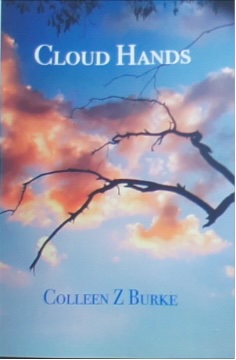
Colleen Z Burke’s Cloud Hands

Colleen Z Burke, Cloud Hands (Feakle Press 2024)

Cloud Hands is Colleen Z Burke’s thirteenth book of poetry.

As in those of its forerunners that I’ve read, its typical poem is a short, impressionistic snapshot of landscape, or especially skyscape, mostly in the inner-west Sydney suburb of Newtown. As snapshots, these poems are mostly embedded in a specific moment, a specific circumstance, so we often get a sense of the life of the person taking the shot, and of the broader context.

There are also memories of a working-class childhood. ‘Each Way’, about gambling as part of the family’s way of life, begins, ‘Minor crime was woven / into our lives just like / the salty tang of the sea.’ (I can relate: my own family of origin wasn’t working class, but my farmer father, like Colleen Burke’s, was a patron of illegal SP bookies.)

There are a three poems (‘Illusion’, ‘A nefarious enterprise’ and ‘A magnet’) recalling youthful romance. Colleen’s partner was Declan Affley, the folksinger who accompanies Mick Jagger’s terrible rendition of ‘A Wild Colonial Boy’ in Tony Richardson’s 1970 movie Ned Kelly. Though it is many decades since he left us, he is still a vibrant presence in these poems.

There are people-watching poems, incidents from inner-suburban life, comments on the news, snippets of science and social history. Covid and the bushfires of 2019–2020 loom large. Climate change and environmental degradation threaten to sour the joys of the natural environment.

This is a collection that bears witness to a persistent practice of paying attention – to the world, to history, to life.

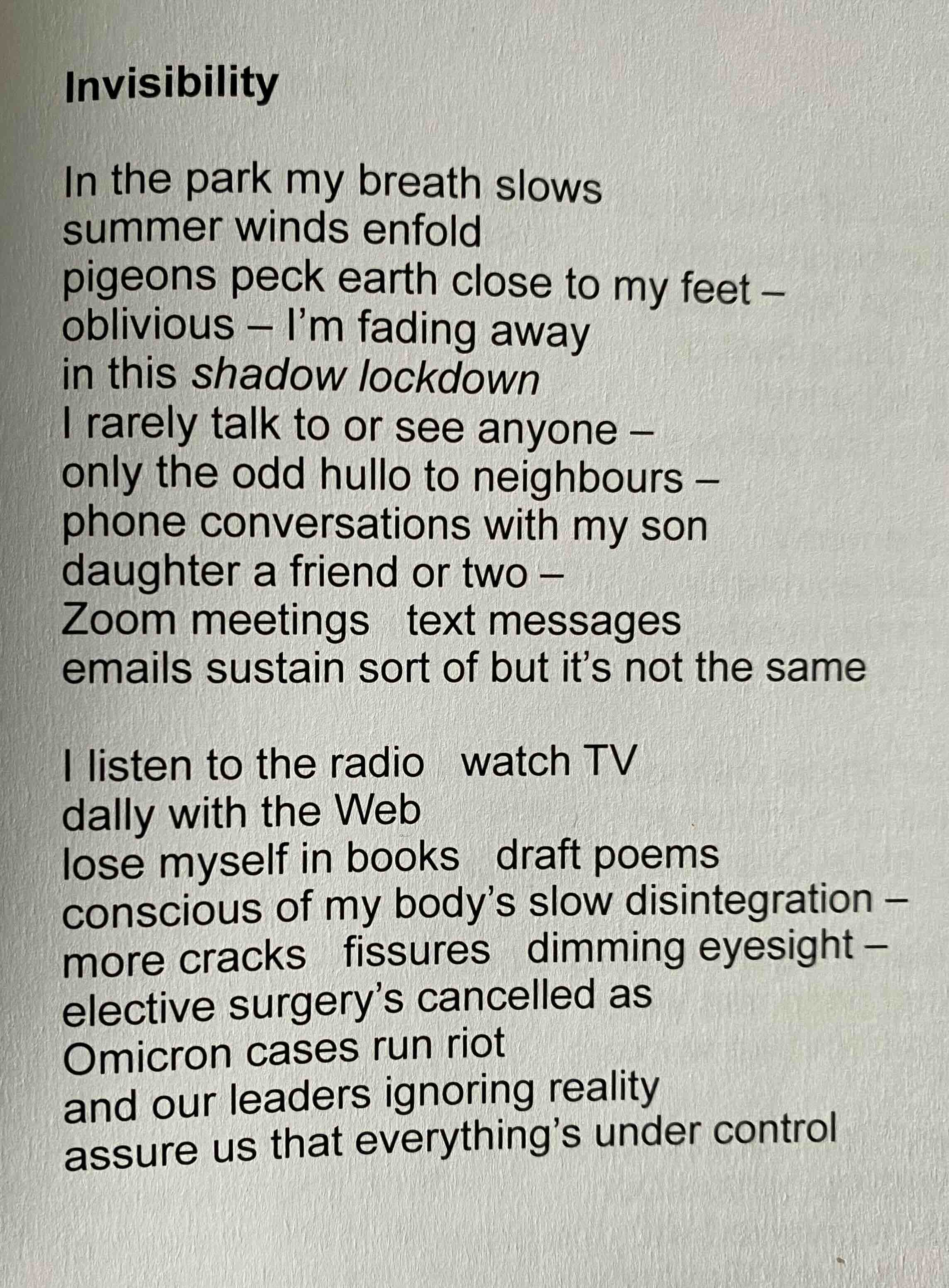
Page 77* is ‘Invisibility’:

Yes, page 77 of the last book I read had a pigeon poem too. But here the pigeons are oblivious rather than chatty, and the despair in the poem is not worn lightly.

This poem is a great example of the value of slow reading. At first quick reading, it’s a straightforward cry of the heart from the dark days of January 2022, when the Omicron variant of Covid was on the rampage in Sydney. In case you need reminding, there were no official restrictions on movement at that time, but Australia had moved from having a remarkably low level of serious illness and death from Covid to having among the highest. The assistance to individuals and businesses from the Federal government had largely dried up, and the Prime Minister of the time was trumpeting a business-as-usual message. Here’s a link to Mike Secombe on that nightmare in The Saturday Paper.

So this poem is, perhaps, an unremarkable record of how one woman suffered in that time: she has minimal contact with other people, she fills her time with solitary activities, and her age-related health issues go unattended to. Like most of us, she finds fault with the Morrison government’s handling of the situation.

That’s all there. But, interestingly, after I started writing this blog post I had a number of conversations that kept sending me back to the poem. One person spoke about a gobsmacking experience using the (I think) Apple Vision Pro goggles – it was as if he was in the room with a musician, could almost touch her. Someone else is reading Naomi Klein’s Doppleganger, and described her account of people involved in the riots of 6 January losing track of the difference between the gaming world and the actual world where there are consequences. Burke’s ‘sort of but it’s not the same’ stops feeling like a banal statement of the obvious and takes on a profound resonance. The poem expresses one woman’s feelings in a specified circumstance, but it sends ripples out well beyond it.

The other thing I noticed as I sat with the poem, or had it sit with me, is the part played by the pigeons. The poem begins, like many of Burke’s poems, with a moment of relaxation in the park – the breeze, pigeons, the earth, her breath slowing down. Then, with the word ‘oblivious’, it turns to the poet’s inner turmoil. The pigeons might have provided a calming anchor, their obliviousness an invitation to pay attention to the present moment. But it was not to be. Skip to the final lines, and the notion of obliviousness returns to round out the poem with ‘our leaders / ignoring reality’. The poem’s speaker is invisible to the pigeons who are engrossed in pecking the earth. She is also invisible to the political leaders who deny that the coronavirus is out of control. The tension between the pigeons’ focus on reality and the political leaders’ wilful ignoring of it is what holds the poem most satisfyingly together.

You can read my blog posts on some of Colleen Z Burke’s previous books here, here, here and here, and on her memoir The Waves Turn here.


I wrote this blog post in Gadigal Wangal country, where I believe Colleen Z Burke also lives. I acknowledge Elders past, present and emerging for their continuing custodianship of this land, over which their sovereignty has never been ceded.


My blogging practice, especially with books of poetry, is to focus on the page that coincides with my age, currently 77.

Ken Bolton’s Whistled Bit of Bop

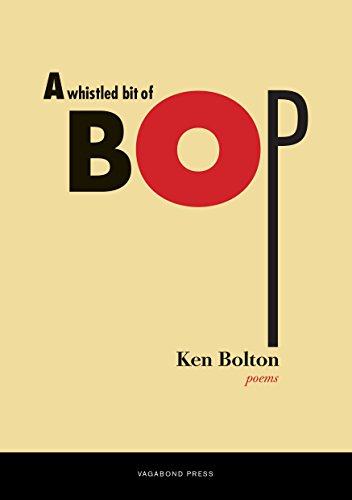
Ken Bolton, A Whistled Bit of Bop (Vagabond Press )

I recently heard a British podcaster describe Louis MacNeice as ‘a highbrow ordinary bloke.’ The implied combination of approachability and erudition struck me as a spot-on description of Ken Bolton in these poems.

As the book’s biographical note tells us, Bolton is a prolific art critic and journal editor as well as a poet. As if to emphasise his intimidating high-browness, the back cover blurb speaks of poetic abstraction and lists members of a ‘pantheon’ who appear in the poems: a timid reader who wasn’t sure who Ashbery or Berrigan are (note the use of second names only – the highbrow equivalent of Cruise and Nicholson), or had never heard of F T Prince or Peter Schjeldahl, might quail.

It’s true that the poems fairly bristle with erudite references. But when one turns to the endnotes for help, here’s part of what they say the second poem in the book, ‘Europe’:

As with many of these poems there are references to art – to Winckelmann, Mengs, Jacques-Louis David – but as the joke is that they are so little thought of now it would be perverse to explain them here.

I stopped worrying about my ignorance, and started getting the joke.

In these poems, an ordinary bloke hangs out in cafes people-watching, or stays up late writing to his adult son on the other side of the planet, broods about friends alive and dead, meditates on art and poetry, and (so it generally feels) somehow lets the flow of his mind find its way onto the page. It’s a lively, questioning, self-conscious and sometimes self-mocking mind. You really don’t need to know who Winkelmann is to have fun reading ‘Europe’. Probably it’s more fun for better educated readers, but that’s not a reason to be intimidated.

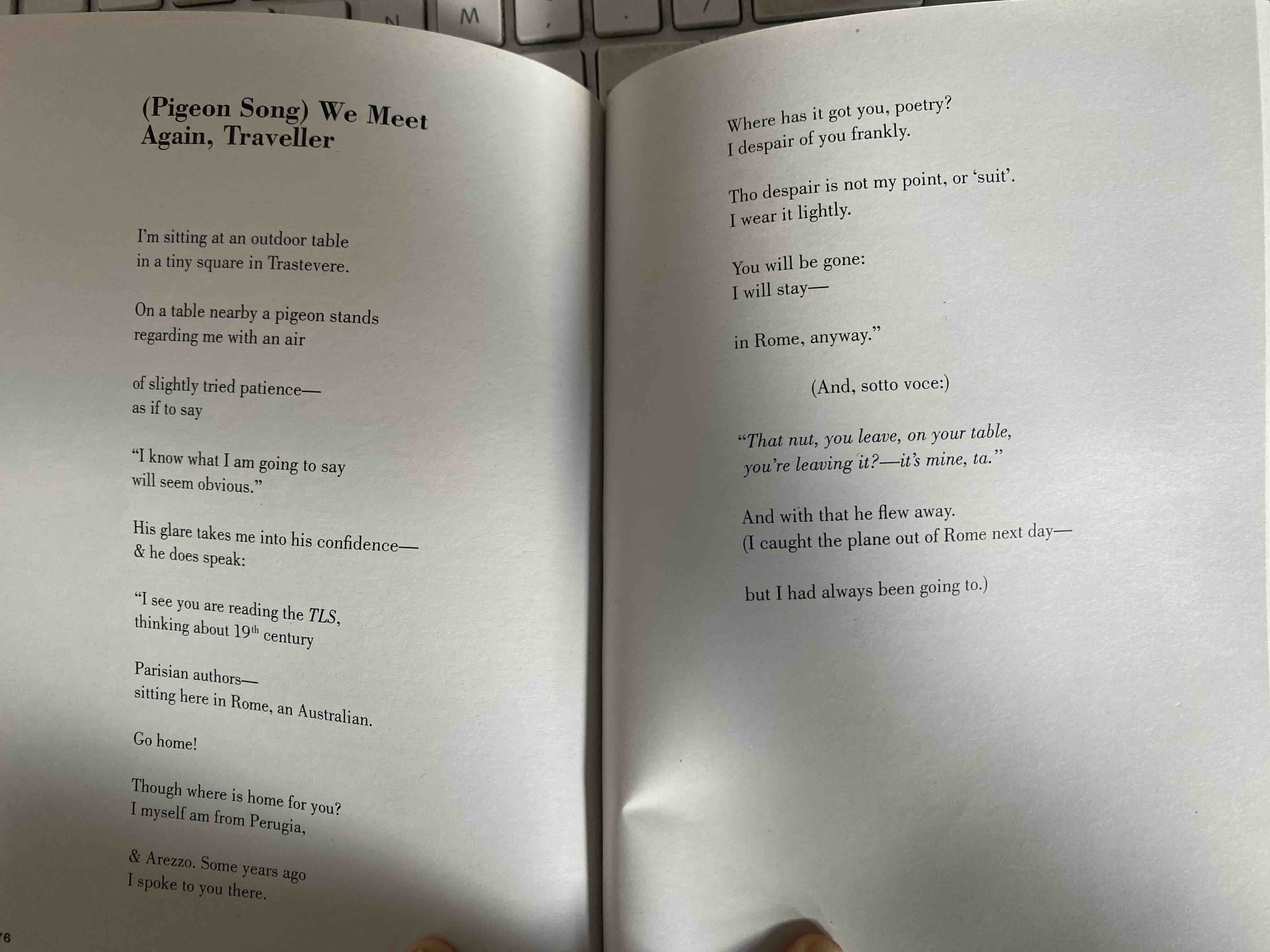
I loved the whole book, but I’ll keep to page 77*. It’s the right-hand side of the spread containing ‘(Pigeon Song) We Meet Again, Traveller’ which, by sheer good blogging fortune, is the shortest poem in the book. Click to enlarge this image:

Not strictly part of the poem, there’s an endnote:

Pigeon Song: a white pigeon with reddish brown flecks on it & around one eye. Strangely the bird had no accent, & spoke in English.

It’s a quietly comic poem in which an Italian pigeon questions an Australian poet about his life choices, after which both pigeon and poet do what they would have done if the conversation hadn’t happened. I hope I won’t make it any less enjoyable by doing a little ‘slow-reading’. With a lovely light touch, it airs some serious issues.

First the title. Its complexity is explained by yet another endnote: the words in brackets, ‘Pigeon Poem’, were a working title, and ‘We Meet Again, Traveller’ is the title finally settled on. Showing his working in this and other ways is one of the things I love about Bolton’s poetry: he lets the reader in on his process. Apart from the title, there’s not a lot of that in ‘We Meet Again, Traveller’. The comic endnote makes up for that absence a little: it implies that the fantasy is based in a real-life moment, and suggests that Bolton may have considered having the pigeon speaking in Italian or with an accent, but – happily – rejected both options.

The action of the poem takes place, typically, in an intellectual ambience. Bolton is sitting at a cafe table in Trastevere, a cool part of Rome that’s home to four or five academic institutions, where sitting at a table reading a literary journal wouldn’t stand out. (As even middlebrow ordinary blokes know, the TLS is the Times Literary Supplement.)

But there’s nothing rarefied or highbrow about the pigeon. Who among us, sitting alone at an outdoor table, hasn’t felt judged by a beady-eyed pigeon (or ibis if you live in Sydney)? This particular judgmental pigeon voices something of the complex unease of being a settler Australian poet, deeply meshed in European culture with an unresolved relationship to the actual land where one lives:

I see you are reading the TLS,
thinking about 19th Century

Parisian authors –
sitting here in Rome, an Australian.

Go home!

London, Paris, Rome, Australia, past and present: it’s complex. I’m reminded irresistibly of a music hall ditty I loved as a child (and which, as a complete irrelevance, I once heard the late Dorothy Hewett sing):

Why does a red cow give white milk
when it always eats green grass?
That's the burning question.
Let's have your suggestion.
You don't know, I don't know, don't you feel an ass?
Why does a red cow give white milk
when it always eats green grass?

The pigeon then asks a key question with characteristic Boltonian (Boltonic?) lightness of touch.:

Though where is home for you?

If you are so immersed in European culture, is your home in a physical location or in a less tangible ‘place’? As in the music hall song, the burning question goes unanswered.

The pigeon knows where its home is, though it too has travelled. Then:

and Arezzo. Some years ago
I spoke to you there.

This may be referring to an earlier Bolton pigeon-poem that I haven’t read, or to a time when he visited Perugia in real life, perhaps to study at the Università per Stranieri. (Decades before Duolingo, Perugia was often mentioned among Australians of a certain age and education as a place to go to learn Italian.) The content of that earlier conversation, whether the subject of an earlier poem or not, was evidently the Bolton’s poetic aspirations:

Where has it got you, poetry?
I despair of you, frankly

But then, having dipped by pigeon-proxy into the well of settler-anxiety, self-doubt and possible despair, the poem returns to lightness. (I’ll just note in passing that I don’t understand the word ‘suit’, or why it’s in inverted commas – any help welcomed in the comments.) The pigeon, dropping its role as cultural challenger, asks the question that’s actually on any judgemental-looking pigeon’s mind. And both pigeon and poet fly away, as they were both going to anyway.

The poem consists of eighteen stanzas, most of them couplets. I can’t say much more than that about the form, except it’s good to notice the use of rhyme in the last third of the poem: stay, away, sotto voce, away, day. Reading those lines aloud, the rhyme creates a sense of relief that the awkward conversation is over: things flow easily. The pigeon’s sotto voce couplet about the nut and the final line both depart from the rhyming flow, suggesting that bird and poet both now exit the staged conversation.


I wrote this blog post in Gadigal Wangal country, where it is my great joy to live, as a settler Australian who tries to remain aware of unceded Indigenous sovereignty. I acknowledge Elders past, present and emerging for their continuing custodianship of this land.


My blogging practice, especially with books of poetry, is to focus on the page that coincides with my age, currently 77.