Category Archives: Books

John Freely’s Istanbul

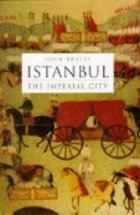
John Freely, Istanbul: Imperial City ( 1996, Penguin 1998)

20120617-184203.jpgOn a friend’s recommendation, I borrowed this from the library as preparation for our trip to Turkey. As it became clear I wasn’t going to finish it in time, I also bought an eBook, which I finished on the plane. I’m jabbing this entry on the iPad keyboard in the air.

The book is a bit of a hybrid – a biography of the city from 658 BCE to 1995, and a guide to the monuments and relics of that long history. It doesn’t aim to make sense of the history so much as to help reader–travellers understand what they are seeing. Istanbul is not the capital of modern Turkey, but it was an imperial capital for many centuries, so perhaps it’s inevitable that the book’s backbone is a chronology of a series of rulers – of Greek and then Roman antiquity, Christian Nova Roma / Constantinople, the Ottoman Empire and finally the Turkish Republic. We are told the name of each new Augustus/Sultan, how many relatives he killed on his way to power or after getting there (one new Sultan killed a record nineteen younger brothers), his age, and what monuments he left. Court intrigue, exile, mutilation, assassination and heroic exploits in war may make for high drama in close up, but in a narrative that covers more than 1500 years in 300 or so pages, they become a bit of a slog. Freely does his best to keep it lively. The quotes from contemporaries over the ages bring welcome insight into the look and feel of Byzantium/Constantinople/Istanbul at a given time, in particular the substantial passages from the fabulous seventeenth century writer Evliya Çelebi are just fabulous.

I’m glad to have read it and I’ve probably retained enough to enrich my impending visit, but I found myself constantly asking why – why did the populace sometimes support an invading leader, and why did they often turn against him soon after his coronation, how come a section of the army could just decide to make their leader the emperor, and so on. I would have appreciated a little discussion of, say, the relationship between secular and religious authorities in both Christian and Muslim empires, or the status of women, or the lives of everyday people. Without such discussion, a lot was left mysterious.There are plenty of events that raise questions about these issues. For example, though Turkey had its first woman prime minister when the book was being written, the Byzantine Empire had more than one Augusta and some women seem to have wielded enormous powered behind the Ottoman throne.

So I’m not sure I’d recommend the book but I wouldn’t recommend against it. Now our German pilot is telling us to prepare for landing, so I’ll stop poking at keys and switch off my electronic equipment.

Ross Gibson’s Seven Versions

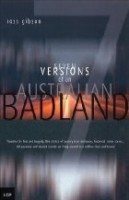
Ross Gibson, Seven Versions of an Australian Badland (UQP 2002)

I finished reading this book a while ago but it’s taken me until now to write about because I took it very personally.

It’s a meditation on the so-called horror stretch, country north of Rockhampton in central Queensland that has a reputation as the setting for terrible events. Starting with a number of roadside murders in the second half of last century that made headlines all over Australia, Gibson explores the cultural factors, the ‘structure of feeling’, underlying the general fascination with those crimes. A ‘badland’ such as this, he says, is a way of localising and mythologising issues that are unresolved in the society in general. This description may lead you to expect something that reads like a bad translation from the French, with lots of stuff being inscribed on the landscape, and references to impenetrable theory. But no, it’s an engaging read, and becomes positively compelling as it moves back in time to the terrible first contact between Aboriginal people and settlers, forward again to the ordeals of Melanesian indentured workers in the sugar paddocks, and forward yet again to the White Australia Policy’s denial of the extraordinary diversity of the region.

‘Sooner or later,’ Gibson writes, ‘any society that would like to know itself as “post-colonial” must confront an inevitable question: how to live with collective memories of theft and murder. Sooner or later, therefore, acknowledgement and grieving must commence before healing can ensue.’ This must also be true of the individuals who are part of that society, and my sense is that for all the impressive scholarship and historical research that went into it, this project is at heart personal, a way of making personal acknowledgement and beginning the necessary grieving. At least, coming though I do from Innisfail, hundreds of miles north of the horror strip (and yes, I knew of it by that name in my childhood), that’s how I read it.

Things may have changed, but when I was at school, history happened mostly in England (and elsewhere in Europe for Catholic Church history), and what we were taught of Australian history happened in Sydney or Melbourne, or occasionally the other capital cities. The only North Queensland figures I remember being mentioned – and that was at home rather than school – were the explorer Edmund Kennedy, speared by ‘natives’ in 1848, and his faithful Aboriginal companion Jackey Jackey (whose real name, Galmahra, was never alluded to). The specific history of the arrival of non-Aboriginal settlers in the north was never even hinted at. As in the ‘horror stretch’, I’ve learned, this history involved mass murder by Native Police under white officers. Ross Gibson brings that history home, and has a good deal to say about our collective silence about it. Even at the time of widespread killing of Aboriginal people in the mid 19th century, he says, the officers

jinked a two-step of violent action and circumspect remembrance. They wrapped their deeds in dissembling verbiage and eventually they became their own twisted idioms, developing a ‘pathological’ disconnection between doing and declaring, a disconnection which gave them no way to see the world clearly.

That ‘circumspect remembrance’ is something that has lived on in the north ever since, as ‘white people simultaneously knew and refused to know the violence behind their everyday lives’.

Now here’s why I took this all personally: in an entry in this blog a few years back I said I didn’t know much about first contact between the Mamu people and the first settlers of the Innisfail region, and I gave a link to Innisfail’s web site. When I clicked on that link I found this:

The first incursion came in 1872. Survivors of the shipwreck Maria arrived on the coast near the Johnstone River. Some of the Indigenous people helped; others they opposed. Sub-Inspector Robert Johnstone’s search party came to rescue survivors and punish Aboriginal people who had abused them, and ventured up river from what are now Flying Fish and Coquette Points. Johnstone wrote glowing reports of the area, and with vigilante Native Troopers attacked the Mamu people with rifle fire as he escorted the explorer Dalrymple, charting the watercourse and having it named after himself.

When European cedar cutters and Chinese gold seekers arrived later in the 1870s and early in the 1880s, the Mamu fought them and inflicted serious casualties. Again the Europeans sent in the Native Police. Superior firepower broke up the Indigenous communities and dispersed or integrated the remaining original landowners.

The evidence is that I had read that and could still say I didn’t know what happened, yet its meaning couldn’t be clearer. Words like ‘punish’ and ‘dispersed’ are transparent euphemisms: the high moral ground assumed by one and the almost kindly feel of the other could mislead only the ignorant or, it pains me to say, allow the wilfully obtuse to ward off the obvious. It’s impossible to stay obtuse after reading this book. And a further confession: I must have blithely assumed that if Native Troopers and Native Police were involved things couldn’t have been too bad. Gibson puts that assumption to rest with his account of the way armed young Aboriginal men, uprooted from their own communities and freed of cultural restraints, were directed to kill and maraud. He lays bare the mechanism by which Indigenous people, under tight white control, performed the genocidal work of dispossession, leaving the settlers – good Catholics in the case of the first farmers of the Innisfail Estate – to move in with an illusion of clean hands, deploring the violence of the unruly ones who had made their settlement possible.

Gibson’s discussion of the Melanesians who worked on the sugar farms is also compelling. I recommend the whole book.

Martha Ansara’s Shadowcatchers

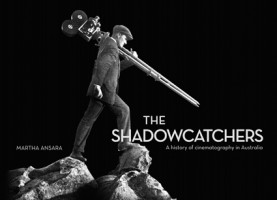
Martha Ansara, The Shadowcatchers (Australian Cinematographers Society 2012)

This book’s subtitle – ‘A history of cinematography in Australia’ – might lead you to expect a dry narrative of technological change with perhaps some discussion of industrial issues, economics and politics thrown in. The dramatic cover image of cinematographer Lacey Percival shouldering a Model 2709 Bell & Howell camera while picking his way over rocky terrain does, however, suggest something else.

Fortunately, the image is more truthful. There is plenty of text, including ample technical information (how else would I have known that was a Model 2709 Bell and Howell?). There are essays on the history of movie making in Australia (based on extensive interviews as well as documentary records), biographies of a number of significant figures, eloquent quotes from some of the key players. But this is actually a gorgeous, exuberant picture book. In her introduction, Martha Ansara, herself no mean cinematographer, says that the photographs were generally chosen not because of the ‘importance’ of their subjects but ‘because of the expressiveness of the image itself’. If this meant that some highly acclaimed cinematographers didn’t make the cut, I guess she was prepared to live with the fallout. From my perspective, the decision has paid off brilliantly: page after page, image after image, the book is a delight.

I’d heard of Frank Hurley (the first person to film Antarctica), Damien Parer and Neil David (war cinematographers, who died on the job), John Seale and Russell Boyd (whose names keep tuning up in credits of great mainstream movies), but would have been pressed to name many more. From the dedication page, with its list of 20 Australian cameramen who ‘lost their lives catching shadows’, presumably covering conflict, the book was a revelation and an education. There’s an image from 1906 of the Salvation Army Limelight  Department Staff, complete with slouch hats. There’s a naked ABC film crew, backs discreetly to the camera, shooting on a nudist colony in 1971. Another news crew wades, water up to their armpits, through a Papua New Guinea swamp in 1974 carrying a salvaged reconnaissance camera.

Plenty of TV news is here, and some commercials, but I was most captivated by the images from film shoots – Withnail and I (DOP Peter Hannan) or Driving Miss Daisy (DOP Peter Jannes), say – where the actor in full character  exists in a parallel world with the person focused on the task of making the image work. Or the ones from movies like The Tale of Ruby Rose (DOP Steve Mason) where the landscape was such a powerful presence, and here we see the crew, or perhaps just the director and DOP, going about the business of capturing it.  The effect is not so much to demystify the magic of the movies as to extend it.

I haven’t read the whole thing yet — I bought it as a birthday present for my son, and now I’m tempted to splurge and buy a copy for myself. It’s a wonderful book, but don’t take my word for it. It has its own web site, complete with sample pages. If that doesn’t whet your appetite,  I guess you haven’t got a pulse just aren’t into the movies

Barry N. Malzberg’s Galaxies

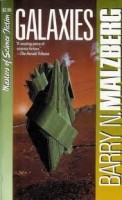
Barry N. Malzberg, Galaxies (1976, Carrol & Graf 1989)

A while back the Art Student and I went to the Gleebooks launch of a book called something like The Brain, at which the author spoke entertainingly about hypergraphia, or perhaps graphomania, which he said was a biologically-based disorder suffered by, among others, Dostoevsky, Shakespeare and Cervantes. We came away knowing little about the book, but the fantasy that a deformed hypothalamus or whatever was responsible for the creation of Raskolnikov, Hamlet and Sancho Panza has a certain lasting, sick appeal. If such a condition existed, Barry N. Malzberg would be one of the few recorded sufferers to have recovered. He wrote a phenomenal number of books in his 20s and 30s and then, apparently, pretty much stopped.

Galaxies is a multifaceted, challenging, joyous, anguished outpouring (or perhaps, though I doubt it, carefully crafted facsimile of an outpouring). It begins, ‘To define terms at the outset, this will not be a novel so much as a series of notes toward one.’ The writer, referred to throughout in the third person, is a hack writer of science fiction and other genre, as Malzberg was, and there’s plenty of complaining about the pay levels and other drawbacks of the life. In the novel, a spacecraft carrying a cargo of 515 cryogenically preserved dead people, falls into a ‘black galaxy’ and its sole crew member lives seven thousand lives, converses with a trio of mechanical Job’s comforters, and finally makes a decision. But there are also the notes, which shoot off in all directions – lampooning the conventions of science fiction, canvassing the relationship between it and literary fiction, between it and science, discussing the craft of writing, all with tremendous energy and reflexive irony.

What he has to say about science fiction may be dated. I don’t know enough to say. I imagine a knowledgeable reader would enjoy this even more than I did – certainly I got a kick out of the references I did spot. For example, talking about the kinds of fate that science fiction hacks can expect, he gives examples whom he calls A, B and C. It was fairly clear to me that the first two of those innocent sounding letters actually stood for Asimov and Ballard. Later in the same paragraph he refers to himself as M, confirming the suspicion and capping the joke.

The book is funny and serious and pained and exuberant. On almost every page there are paragraphs that cry out to be quoted. I finally weakened towards the end of the book and folded down a page on this:

Success teaches nothing; failure presents limits, gives us the tragic sense without which understanding is impossible. Successes are composed of a thousand failures like the way the photographs in newspapers reduce on inspection to myriad scattered dots, each expressionless, all comprising vision.

Robert Adamson on Francis Webb

Someone emailed me a link announcing that Robert Adamson, UTS Chair of Poetry, was giving a public lecture on Francis Webb on Thursday night. How could I not go? As far as I know, UTS – University of Technology Sydney, whose main tower is Sydney’s monument to stark practicality – doesn’t offer any poetry courses, and the prospect of Adamson, anything but stark or practical in his poetry or his person, lecturing on Webb, ditto with bells on, was irresistible.

It turned out to be a fairly intimate affair in a shiny new building across the street from the anti-poetic tower. I recognised a smattering of poets and other writers, scholars, editors and UTS lecturers. I sat at the front, and my neighbours turned out to include Juno Gemes, Adamson’s photographer wife who discreetly plied her trade, Toby Davidson, editor of the new, excellent Francis Webb: Collected Poems, and Michael Griffith, who wrote God’s Fool, the best and only booklength introduction to Webb’s life and work. I’m not suggesting it was a family affair. The room was full, but I don’t think many of us were there without a prior connection to Webb, Adamson or UTS’s Centre for New Writing.

Adamson, whose CAL-sponsored professorship is for three years, began with a disarming list of thankyous – including to poet Martin Harrison for explaining to him what a lecture was. I hope the lecture is somehow made available, as it was a very clear account of Webb’s life and work, informed by a deep engagement with the poetry and a brief but significant personal relationship with the man. He read a number of poems. I’d say he read them brilliantly but that would give the wrong impression: he read them slowly, almost stumblingly, as if he was discovering them as he read them, or even encountering the language itself for the first time, mispronouncing an occasional word (couch in couch grass to rhyme with crouch, impotent with the emphasis on the second syllable), so that the listener was drawn in as a collaborator rather than being cast as a recipient. I find it hard to imagine a better way of reading this poetry.

In the excellent Q&A, freed from his written text, Adamson loosened up and spoke more personally: of how Webb was crucial to his own development as a poet, of how James McCauley looked him in the eye and said, ‘You’re on the right track with Webb – follow him instead of these Americans, of how he and his friends turned up like rockstar fans at Angus & Robertson’s bookshop the day the first Collected Poems was published, only to be told, ‘We publish it, but that doesn’t mean we have to have in here for sale.’ He gave a very funny, and accurate, account of A. D. Hope’s article on Webb: ‘Hope was a vitalist, and suspicious of Webb’s religious dimension, but he discusses the poem Canobolas, saying, “Look, he sees the mountain as a naked woman, so he must be all right, he’s one of us.”‘

Penguin Plays Rough, the book

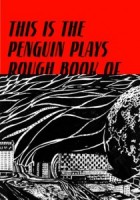
Pip Smith (editor), This Is the Penguin Plays Rough Book of Short Stories (Pip Smith, 2011)

Since 2008, first in a room in a flat above a convenience store in King Street, Newtown, and then in the front section of a warehouse in St Peters, Pip Smith and her housemates have hosted Penguin Plays Rough – a series of monthly short story readings. I’ve been twice, and each time has been a joyfully mixed bag with an appreciative mostly inner-west, mostly young crowd.

A number of pieces were written especially for the book, so it’s not so much a ‘Best Of’ as a print equivalent of the anarchic creativity of those evenings, a showcase for the PPR talent. The text doesn’t lie quietly on the page as in a well behaved book. Each story is set in a different font, ranging from 8 to 24 point. One seems to have been hand lettered on note paper and scanned in. One (which I found unreadable) is laid out as a Wikipedia entry. Each has its own illustrator, and the range of graphic styles is impressive (email addresses and web sites are listed at the back).  It’s a shining example of self-publishing.

And it’s a good read. Fidel Castro walks in its pages, along with Johnny Cash, Lot from the Book of Genesis, Emanuel Swedenborg (in his own words), Tariq Ali, Cosmo Kramer and the characters from The Wonder Years. Some startling pieces seem to run close to memoir. There are well-made stories,  a film pitch, a playlet, some cut-ups.

It’s probably a generational thing that there’s quite a bit of explicit sexuality that seems to my aged sensibility to owe quite a bit to sustained exposure to porn. Zoe Coombs Marr’s ‘Genesis’ is a kind of Biblical fanfic whose subtitle gives fair warning: ‘The story of Lot, comprising the invention of buggery; the downfall and destruction of Sodom and Gomorrah; Lot’s family’s flight to the mountains when his wife is turned into a pillar of salt; and his date-rape by his daughters in a cave’. The photographs illustrating the story are tactfully low res. If you have a low tolerance for misogynistic porn, do not read Luke Carman’s ‘All That Pap’, a memoirish piece that includes shocked adolescent exposure to some of it. It’s possibly relevant that when the Sydney Morning Herald interviewed Pip Smith (here), they found it necessary to substitute prim little dashes for some of her evidently unladylike language.

The stand-out pieces, to name just three in random order, are Pip Smith’s neat ‘Five Husbands’ (yes, she hosts a salon, edits a collection and also writes!), Amanda Maxwell’s pseudo horror story, ‘Playing Imaginary Cards with Jeremy’ and Michael Sala’s tale of love lost, financial intrigue and tourism, ‘The Catacombs’.

I’ve been discovering lately that some books I bought in the 1970s would be worth hundreds of dollars now if I had kept them in good shape. Who knows what this will fetch in 2050? Sadly, I’ve already given away the gorgeous poster it comes wrapped in.

Don Lemna Out in Left Field

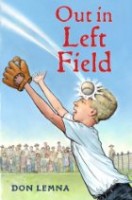
Don Lemna, Out in Left Field (Holiday House 2012)

In one of my previous lives, when I was editor of The School Magazine, we published a series of Don Lemna’s stories under the general title ‘A Canadian Childhood’. That was in the mid 1990s. It took many years of rewriting, submitting, combining into novel form, resubmitting, relocating from Canada to Montana in the USA, resubmitting, but eventually, in 2008, some of those stories came out between hard covers in Don’s first novel, When the Sergeant Came Marching Home. I may have the only copy of that book ever to come to Australia, and everyone I’ve lent it to, of whatever age, has loved it. Out in Left Field, hot off the press, features all the same characters and a reworked version of one of those School Magazine stories, and I’m reliably informed that a third book is on the way that will take the main character, Don, into adolescence.

It’s 1947 and Don – I mean the character, not the author, though there are surely a number of overlaps between the two – is 11. He and his family are still living on a farm, still scrimping and making do, still – in Don’s case – yearning for such luxuries as a bow and arrows, or skates that fit, or a new hockey stick. Don is an eternal optimist, forever hatching plans to raise money, to shore up his reputation at school, to persuade relatives to come to his rescue. His hopes are dashed, his plans go awry, he is plunged into deep misery – but never into despair. Meanwhile, his brother Pat, one of the most beguiling little brothers in literature, manages with more wisdom and less turmoil (though he is responsible for at least one major explosion).

I laughed out loud many times. Any Australian children’s booksellers happening to read this: do consider getting hold of it.

SWF 2012: The Weekend

First, a photo from Friday night. This is Tamar Chnorhokian, who read first in Moving People. That’s not a sponsor’s logo in the background, the story was set in a supermarket. You can see what I mean about the performers having nowhere to hide.

And now a sprint through my crowded weekend. My only serious queuing experience of the Festival was for the 11.30 session of What Would Edith Do? on Saturday – I got there before the previous session finished and so was comfortably towards the front of the queue. Edith Campbell Berry, the main character in Frank Moorhouse’s Dark Palace, Grand Days and Cold Light, may not have seized my imagination, perhaps because I haven’t read the first two books, but she has clearly been important to many people. I went to this hoping to find out what I’ve been missing and I got what I was after. Emily Maguire, novelist, discovered Edith in her late teenage years as a model of how it might be possible to live – rising to challenges and living nervously out of one’s depth rather than settling for the life mapped out by social expectations. She said there had been a number of times when she had actually asked herself the WWED question. Sadly, she deemed only one of them suitable for public exposure, but as it involved being invited to speak at a function in North Vietnam when she actually had no idea of the purpose of the function or who the Party functionaries thought she was, it was a perfectly satisfactory anecdote. The other panellists, journalists Annabel Crabb and Cynthia Banham, had come to the character later in life, but managed to convey the appeal. I realised that Cold Light is all aftermath: a woman who has lived daringly and intelligently, challenged convention in her private life and made a contribution on the world stage, returns to Australia in the 1950s where there is no place for such a woman and lives on scraps for the rest of her life. For those who have seen Edith riding around Geneva in a cowgirl suit or (is this really what they said?) stroking Anthony Eden’s head in her lap, the third trilogy is heartbreaking. Frank Moorhouse wasn’t there, but the best line of the session was his. He had told Annabel Crabb that one of the advantages of having spent 20 years with a single character was that she can now do her own PR and he doesn’t even have to turn up.

National Treasures was another poetry session that wasn’t quite what I had read the advertising to mean. I thought the participants – Mark Tredinnick, Vivian Smith and Judith Beveridge – were going to talk about Australian poetry they treasured, and read some to us, plus some of their own. What we got was excellent, but it wasn’t that: Judith Beveridge stayed firmly in the chair role, and the others talked of their own writing careers, and read from their work. When he was 15,  in the 1940s, Vivian S had sent off poems to The Bulletin, then pretty much the only place that published poetry in Australia. He received encouraging responses from the literary editor, Douglas Stewart, advising him to ditch the archaic poeticisms and recommending that he read contemporary poets such as T S Eliot. Decades later, Mark T was similarly advised by critic Jim Tulip, but the poets he recommended were William Carlos Williams, Robert Gray and Vivian Smith.

Tasmanian Aborigines was next, in which Lyndall Ryan talked to Ann Curthoys about her new book, a rewrite of her 1981 book on the same subject. Inevitably, the session involved a revisiting of the so-called History Wars: Keith Windschuttle had singled Professor Ryan’s 1981 book out for his accusation that lefty historians had fabricated evidence of massacre and his claim that in fact the original inhabitants of this country had just faded away when the Europeans arrived, possibly because of their inherent weaknesses. Windschuttle has been thoroughly discredited as a historian, of course, but it was interesting to hear Ryan’s take on the episode now. Asked what difference his intervention had made to our general understanding of Australian history, she said that paradoxically he had driven her and other back to interrogate their sources more thoroughly, and where in her first book she had focused on Aboriginal resistance, she had now looked at ‘settler activism’ and found that the evidence indicates that the violence of the frontier was much worse than historians had previously understood. Massacre, for instance, looms much larger in the new book than it did in the original.

Anne Curthoys was warm and personal as her interlocutor. She opened with a wonderful quote to the effect that in order to write history, one needs to have a deep commitment to the subject that relates to some great love or business in the present, and asked Lyndall Ryan what this love or business was in her case. But Professor Ryan was not to be seduced away from her calm, scholarly demeanour, and answered in terms of the breakthroughs in research since 1981. The question in my mind, which I didn’t get to ask, was along the same lines: as a white Australian, uncovering the evidence of terrible things done by your own forebears, how do you keep your composure, or if (as I think would be desirable) you lose your composure how do you keep your scholarly integrity? I guess I’ll just leave that one hanging.

Then I was back to the sun-filled Bangarra Mezzanine for Poetry Australia with Robert Gray, Rhyll McMaster, Tricia Dearborn, Geoffrey Lehmann – and the unfulfilled promise of Robert Adamson. It was a dazzling session – the sun was low over the Harbour and from where I was sitting it was impossible to look directly at whoever was at the lectern. Speaking less literally, it was okay. Each of the four poets read from their own work – some startling eroticism from Tricia Dearborn (I mean that in a good way), two poems from Rhyll McMaster that had me reaching for my pen to write down brilliant lines I knew I’d forget, in a scribble I now can’t read – her new book, Late Night Shopping, is now on my To Buy list. Geoffrey Lehmann read ‘Parenthood’, which begins ‘I have held what I hoped would become the best minds of a generation /  Over the gutter outside an Italian coffee shop watching the small / Warm urine splatter on the asphalt’, and lives up to the promise of it opening. Almost as if in direct reference to Ali Alizadeh’s scathing Overland review of the Lehmann–Gray anthology, Robert Gray read a number of John Shaw Neilson’s limericks.
In the short Q&A, someone did tactfully name the elephant in the room. A bookseller from Perth, she said that the anthology Australian Poetry Since 1788 was selling brilliantly. But, she said, she didn’t understand how a fine poet such as Fay Zwicky hadn’t made the cut. Ali Alizadeh, John Tranter, Peter Minter and other fierce critics of the anthology might have asked the same question but added a hundred names and whole classes of poetry, and gone on to challenge the inclusion of limericks. Here it was a genuine question rather than an attack. It seems to me that what was missing in the selection process was the intervention of someone who knew the field  and could veto the editors’ eccentricities. I can see why it would be hard to resist modifying the general perception of John Shaw Neilson by including a swag of limericks, or to include 14 poems by ‘Bellerive’, whose poems never even made it to the literary pages of the Bulletin of his time. But that’s when an authority figure needs to step in and rap someone over the knuckles.

Oh my paws and whiskers, across the road again to see Hilary Mantel on a huge screen in the Sydney Theatre talking about Bring Up the Bodies. What can I say? She was magnificent, and I’ve now got the book on my iPad. A friend of mine couldn’t read Wolf Hall, because he couldn’t tell who was being talked about a lot of the time – the book would say ‘he’ and expect you to know it was Thomas Cromwell. Evidently a lot of people had the same difficulty, because this new book says ‘he (Cromwell)’. As Michael Cathcart, interviewing Ms Mantell from our stage, said, you can almost hear the author saying, ‘Is that clear enough for you?’

[Added on Wednesday: The Literary Dilettante has an excellent account of this conversation here.]

Gluttons for punishment, we rushed from the theatre and drove to Marrickville for an evening of youthful cabaret/burlesque, which might have been on a different planet, but that’s another story altogether.

On Sunday, I only managed one event, The Oskar Schindler of Asia? in which Robin de Crespigny (pronounced Crepny) and former people-smuggler Ali al Jenabi conversed with ABC’s Heather Ewart (who is much smaller in person than she seems on the TV screen). This was 2012’s equivalent of last year’s conversation with David Hicks. Like Hicks, Ali al Jenabi is being treated unjustly by the Australian government. Although the title of the session is a quote from the judge who tried him for the crime of people smuggling, the government is so committed to the demonising term ‘people smuggler’ or at least so terrified of being attacked by the snarling Tony Abbott  if they are seen to be soft on such people, that al Jenabi, who seems to be a perfectly decent man who has endured terrible things, remains on a bridging visa pending deportation, even while all his family are now Australian residents.

It was a great Festival. Now I have to get back to work.

SWF 2112: Poets, Harbour, pitches and more poets

This was my first day at Walsh Bay, and in striking contrast to recent weather, the sky was cloudless and there was no wind – perfect festival weather.

The tiny harbourside room generally reserved for poets at the Festival couldn’t have been a more appropriate venue for my first event of the day, Harbours and Rivers, with Robert Adamson, Neil Astley, Martin Harrison and Jennifer Maiden. I joined the uncharacteristically long queue with minutes to spare, and only when it became clear I wasn’t going to get in I realised I was in the wrong place: this time the tiny room had been given to young writers talking about the Second Novel Effect, and the poets had been given a much bigger and incidentally much darker space. I briskly walked the length of the Wharf and arrived part way through the introductions.

The poets, refusing as poets should to be pigeonholed, paid at best slant regard to their allocated topic. Jennifer Maiden read a long new poem, ‘The Uses of Powerlessness’, which she described as a diary poem but was actually pretty much a philippic on Julia Gillard, not in the ‘X woke up in X’ form, but a straightforward furious meditation. I wrote down one of many striking lines: ‘The Labor Party, like Gillard, is an obedience addict.’ Martin Harrison and Robert Adamson both spoke of the complex interplay between observation of the natural world and self-discovery. ‘All my harbours and rivers are internal,’ the latter said, somewhat disingenuously, ‘even though I live on a river.’ Among the poems he read was the sublime ‘Kingfisher’s Soul’, an intensely personal love poem that grows richer with each hearing. Neil Astley, advertised as editor of English publishing house Bloodaxe Books, turns out to be a poet as well. He was in Darwin for Cyclone Tracy, about which he read two striking poems followed by an excerpt from a novel that engages with an English countryside.

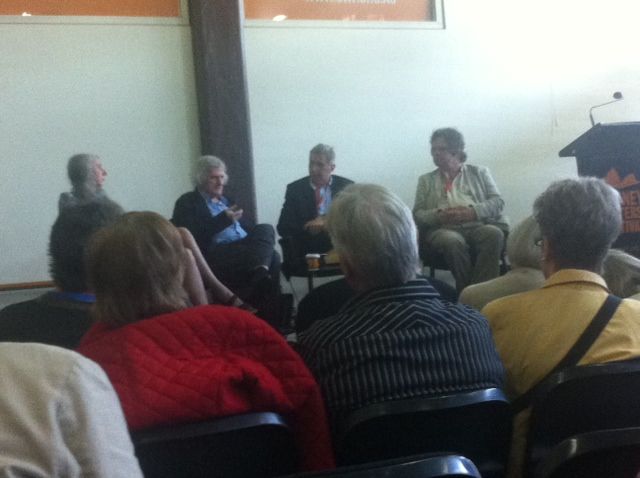
Jennifer Maiden, Robert Adamson, Martin Harrison and Neil Astley not far from the Harbour

In short, it was very good. Afterwards I ventured to introduce myself to Jennifer Maiden, but I was probably working so hard at no being too fanboyish for the conversation to have made much sense.

After a brief interval I went to the Club Stage for So You Think You Can Write, my first time to this a regular Festival event in which random audience members get to pitch a project to a panel of publishers.

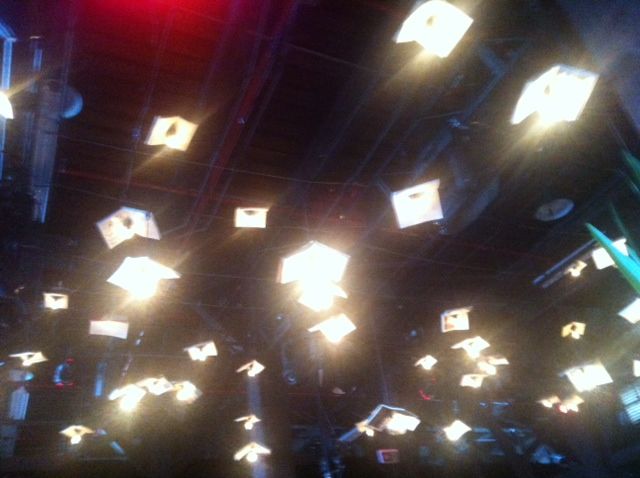
The specially decorative lights for the Club Stage area – each bulb has an open book for a shade.

I don’t know that anyone who was at all savvy about publishing would participate in this, unless for the sheer fun of it. And it was mostly fun. A 15 year old boy pitched a detective story set among the Egyptian pyramids. There was an earnest tract for children aiming to foster leadership skills and an understanding of democracy. One or two pitches were for books that could have been anything, so broad were the descriptions. One woman had already had an iBook version of her project downloaded thousands of times. The winner – of nothing apart from the glory – was a psychological detective story in which the character realises a day of her life has gone missing and then is shown photos of herself taken on the missing day. The thing that won the audience and panel’s approval was that the photos were improbably and bizarrely orgiastic, involving vegetables and cigars in unspecified lewd ways. It may not be Scandi-Crime, but this audience loved it. You read about it here first.

And then off to the poets’ lightfilled room. Gig Ryan and Kate Lilley, feminist-identifying experimental poets, drew an overflow crowd, including Adamson, Harrison and Astley from this morning, plus John Tranter, Ivor Indyk, Toby Fitch and many faces familiar from the Sappho open mike nights. Each of the poets introduced the other. They read from recently published books and, on being requested by an audience member to  compose a poem together on the spot, they parlayed the request down to each of them reading a poem by the other – with interesting results.

I confess that I went to this session expecting to suffer. I’ve read very little of either of them and my experience has been that if I don’t know a poet’s work I have trouble hearing it when read to me. (A possible contrary experience was hearing Jennifer Maiden this morning, but I am familiar with her voice and preoccupations, so had a head start.) Gig Ryan reads quickly, and her language is very compressed: I had difficulty distinguishing the words, let alone grasping the connections between them. Kate Lilley has a gratifyingly expressive delivery, and the woman beside me kindly allowed me to look over her shoulder and read along as the poems were read. But I was still pretty completely mystified. Both women talked about how people in their lives met their work with blank expressions, so I didn’t feel too stupid, or at least not alone in my stupidity.

One of Kate Lilley’s poems, ‘Maisily’, consists of a string of about a hundred adverbs. This was the first time she’d read it aloud and it was quite a feat – all those lys. It seemed like pointless nonsense to me. Then she explained that it was made up of all the adjectives used by Henry James in What Maisie Knew. That made it seem like hi-falutin pointless nonsense to me. Then I remembered that it was part of an elegiac sequence about the poet’s relationship with her mother, and it no longer seemed so pointless – maybe I was finding an emotional subtext because that’s the kind of reader I am, but I did find one, like a deeply submerged nostalgia for childhood when the adult world was as inscrutable as to little Maisie in James’s novel. I wonder how it wold go if read, not as a near tongue twister, but with the rhythm of a tolling bell.

As if the poets had read my thoughts, their conversation turned to the business of reading poetry aloud. Lilley said she knew and loved her poetry long before she heard her read, but when she did hear her read it was a revelation. Maybe my difficulty is as much to do with my increasing deafness as with unfamiliarity with the poetry.

So the poetry was difficult, but the session was excellent. Both were very funny about the business of being poets, and how they see each other’s poetry. Even when they drew our attention to the complete absence of critical articles on Gig Ryan’s work, even though she is generally acknowledged as an important Australian poet, and surmised that this absence may well be because she is a woman, somehow that seemed richly comic.

On the way home in the bus, I ran into an old friend who had been to a panel with Peter Hartcher, George Megalogenis and a third journalist talking about Australia’s parlous economic situation. I felt I had been very frivolous, but I was glad of it.

SWF 2112: Mark Tredinnick Throwing Soft Bombs

The State Library again, this time for a morning poetry workshop with Mark Tredinnick. I did a community college creative writing workshop with Mark a couple of years ago, soon after which I had my first poem accepted for publication. Since then Mark has published The Blue Plateau and won some prizes, including the prestigious 2011 Montreal Poetry Prize. I liked the blurb’s idea of ‘learn[ing] some old ideas and new tricks to turn [my] poems into soft bombs’, though I wasn’t sure what that meant.

There were 16 of us. Mark’s distinctively resonant voice had taken on a richer tone thanks to a head cold, but he soldiered on. One of the six male participants excused himself, explaining that he had recently had a lung removed and didn’t want to risk catching whatever Mark had, but the rest of us presumably had less at stake and were willing to risk it.

It was fun. He took us, instructively, through a series of drafts of a short poem, and handed out several sheets of poems, reflections on poems, aphorisms about poetry. He covered a white board with suggestive phrases – ‘self:Self’, ‘enormous moments’, ‘politics of poetry’, and so on. He talked and answered questions without an obvious structure, and after some time passed we realised he had covered all the phrases on the white board. Then we did an exercise, and each of us read out what we had written, or one we’d prepared earlier. Mark commented, always generously and appreciatively, and did what he called some editing on the run.

Linda Gregg’s poem, ‘Adult‘ provided the ‘prompt’ (evidently a technical term in writing workshops) in its opening phrase: ‘I’ve come back’. This is what I wrote:

I’ve come back to this room
he fills with viral baritone
words – his own, his teachers’,
ours. Teresa sees language as God’s
best gift, but worries sometimes
she mistakes gift for giver.

He rightly said I needed to think whether this would lead anywhere or whether it was just a clever thought in a writing class.

That’s all. I’m writing this on my iPad in the reading room of the Mitchell Library. Now I’m off to catch a bus home. Oh, the thrill of almost live blogging!