Category Archives: Books

Stephen Greenblatt’s Swerve

Stephen Greenblatt, The Swerve: How the world became modern (Norton 2011)

This book tells of the rediscovery in 1417 of a copy of Lucretius’ poem De rerum natura (Of the nature of Things) as a key moment in the transformation of European culture – in the Renaissance. The preface begins promisingly with a moving account of the author’s own first encounter with the poem as an impressionable young man, but my antennae started twitching when, describing the contents of the poem, it said:

All things … have evolved over vast stretches of time. The evolution is random, though in the case of living organisms it involves a principle of natural selection. That is, species that are suited to survive and to reproduce successfully endure, at least for a time; those that are not so well suited die off quickly.

Hmm, I’ll bet London to a brick that the phrase ‘natural selection’ wasn’t around long before Darwin: even Alfred Russel Wallace, co-discoverer of the mechanism, didn’t use the term. And that paragraph manages to suggest the very Darwinian ‘survival of the fittest’. It looks awfully as if Mr Greenblatt is a bit over-keen to claim modernity for the poem, and to read the past through an excluding modern lens. A passing reference two pages later to ‘Robert Burton’s encyclopaedic account of mental illness’ (melancholy=mental illness? Really?) confirmed my distrust.

Sure enough, the book’s thesis, that the discovery of De rerum natura changed everything, comes across as a marketing hook rather than a serious argument. But then if you’re writing about something as dry as an ancient Roman philosophical poem, the temptation to play up any conflict or drama (mediaeval monks stupid and repressed / Renaissance humanists bold and clever) and to gloss over inconvenient complexities must be so great as to seem a necessity. In a deeply unsympathetic account of the early development of Christian theology, for example, Greenblatt comes close to saying the theology was formulated as a way of fighting off challenges from Epicureanism in general and Lucretius’s poem in particular, an implausibly narrow claim I would have thought. For the mediaeval Christian church, he tells us in other examples, curiosity was a mortal sin, and the silence during monastic meals was imposed for the purpose of preventing discussion. These assertions probably aren’t flat-out wrong, but it took five seconds with Google to find Thomas Aquinas going on about ‘the vice of curiosity’ in a nuanced way that makes it clear that the phrase has been taken out of context, and I’d like to see a debate about mediaeval monasteries and literacy between Greenblatt and Thomas Cahill, author of How the Irish Saved Civilization.

The book tells a good story. It gives a lively, heart-rending account of the destruction of the vast body of written work built up during Greek and Roman antiquity, and brings home with great force the way it was sheer chance that De rerum natura and many other works survived and were recovered – sheer chance plus the prepared mind of book-hunter Poggio Bracciolini, who knew what he’d found when he saw it on the shelves of a monastery somewhere in Germany. Poggio was fairly famous in his own time as a humanist writer and discoverer of ancient texts. Greenblatt has done us a service in giving us a lively portrait of him.

I’d just written that last paragraph when a link turned up in my Feedly reader to a review by Morgan Meis in n+1. As opposed to this blog post, it’s a proper review which gives a good account of The Swerve‘s argument and then gets stuck into its slipperiness from a better informed position than mine. I recommend the review as a whole, but here’s a quote for those who won’t click through to it:

The end of all Lucretius’s observation and wonder is to reach ataraxia, the point at which we look with indifference at the natural world. We realize we have no control over it and that it doesn’t matter what happens to us anyway. […]

A tremendous amount of desire is expressed in The Swerve. It is the desire, first and foremost, to present the modern age as a definitive solution to the human problem. Greenblatt wants Lucretius to be telling us it is OK to love the world and to be engaged with one another in the pursuit of pleasure and the avoidance of pain. There is immense joy to be found in that pursuit, Greenblatt thinks, and it is one that human beings have foolishly denied themselves again and again. Greenblatt finds great satisfaction in the fact that a two thousand-year-old poem expresses, in his view, this exact desire. Coming back to Lucretius is thus coming back to ourselves.

But Greenblatt can only make this argument by ignoring ataraxia, the whole point and purpose of Epicurean philosophy.

In other words, someone who knows quite a bit more about the subject than I do has confirmed my sense that the book should be treated warily. Greenblatt is a scholar writing for the masses, and he simplifies, which sometimes leads to distortion. He’s a secularist Jew writing in a US where self-righteous fundamentalist Christians are increasingly prominent in public life, and he goes in to bat for a different point of view, which sometimes leads to significant omissions and distortion. He’s witty, has an eye for the telling anecdote, paints a convincing picture of  life among the humanists employed in the courts of the more or less corrupt popes of the late 14th and early 15th centuries, reminds us that the renaissance didn’t just happen but had to be fought for, and above all whets the appetite for reading Lucretius (whose name, I now remember, was often on the lips of my high school Latin teacher).

Added much later: There’s a heartfelt smackdown of this book by Jim Hinch in the Los Angeles Review of Books of 1 December 2012.
The Book Group and Edmund de Waal’s Hare with Amber Eyes

Edmund de Waal, The Hare with Amber Eyes: A Hidden Inheritance (©2010, Vintage 2011)

The Art Student read this a while back, and did a real-life approximation of live-tweeting it to me. That, plus hearing Edmund de Waal on a couple of podcasts, meant I felt no real need to read it for myself. When the Book Group chose it as our next title, though, I was happy enough, and took a paperback in my luggage to Turkey. Even when it went missing when left in a hotel holding room, I remained undeterred, but didn’t get a replacement copy until we were back in Sydney, and was only a third of the way into it when the Group met.

The meeting:
The Hare with Amber Eyes is the story of a collection of 264 netsuke (small Japanese carvings) that had been in the author’s family for 130 or so years – and it’s a partial history of the family itself, the Ephrussis, wealthy Jewish bankers of Paris and Vienna. At the meeting, I was still mixing with the Impressionists in Paris with the Dreyfuss affair looming, while the rest of the chaps had already dealt with the Nazis in Austria, moved on to post Hiroshima Japan and followed the netsuke to their current resting place. No one was particularly careful about spoilers, and I got the impression that the Parisian section, which I was enjoying, was comparatively forgettable.

In general our wives and female partners had been more taken with the book than we were, but along with our usual conversation about recent trips, family weddings, changes of employment, Abbotophobia and so on, we had some animated book talk.  Were the netsuke just a device to hang a family history on? Is the project overwhelmed by the seriousness of the Nazi episode, so that we lose interest in the netsuke? Is the final third of the book a bit rushed as if, one chap said, the author’s wife said, ‘OK, Edmund, that’s enough. Time to wrap it up’? I was curious to know if the potter’s sensibility – the alertness to the feel and heft of things – that is such a strong feature of the first third persists all the way (and got a definite no).

At least two people said that the family story, especially the part to do with the Nazis, was uncannily close to their own, or their partner’s, including the survival of some small object as a link with the past, and details like the image of entwined initials in architectural ornamentation. I recognise from my own experience some of the thrill of finding records of one’s forebears in contemporary sources, though in comparison to de Waal’s great-great-uncle being a model for Proust’s Swann or appearing in Renoir’s Luncheon of the Boating Party, a paragraph in the weekly Queenslander in 1881 (the same year as the Renoir painting) praising my great grandfather’s turnip crop is pretty tame.

A number of the finishers commented on the devastating reversals of fortune suffered by the family – a dramatic reminder that the comfortable middle-class Australian assumption that we determine our own lives is a delusion.

After the meeting:
The ‘spoilers’ didn’t spoil anything for me. On the contrary, they gave me some propositions to test against my own reading. For instance, the netsuke didn’t fade from my mind during the account of the Anschluss (the German annexation of Austria in 1938): all through the Nazi juggernaut, the tiny but momentous betrayals, the opportunism of non-Jewish neighbours, scholars, curators and art collectors, the cruel humiliations and the resonant use of the single word ‘Dachau’, the author’s silence about the tiny, much-loved netsuke worked for me like a solemn background hum or a detail, relatively insignificant in itself, that acted as a point of reference within the horrific bigger picture – a little like the red dress in Spielberg’s Schindler’s List. De Waal tells us that when he was researching the Nazi part of the story he didn’t weep until he saw the documents where his grandparents’ first names had been overstamped with the generic names given to all Jews by the Nazis. I didn’t weep until the netsuke reappeared. I certainly didn’t agree they were purely a literary device.

Anything after the graphic horrors of the Anschluss was going to seem anticlimactic, but I didn’t find the final third rushed. The book follows the netsuke from the aftermath of the war against the Nazis to the aftermath of the bombing of Tokyo. De Waal’s great-uncle Iggy, now the custodian of the netsuke, is neither part of the occupying army nor one of the derided visitors in search of ‘authentic’ keepsakes. He goes to Japan partly to take the netsuke home and lives there the rest of his life with his Japanese partner. It is here that de Waal first sees them and hears the family story about them. It is here that the book – at last – tells us a little of their history before they were bought by Charles Ephrussi, connoisseur, during the 19th century Parisian craze for all things Japanese. And even though they have been named and described repeatedly throughout the book, it is in this final section that they become most palpable though, frustratingly, never pictured. (I recommend the illustrated edition to anyone who hasn’t yet read the book. It costs a bit more but this is a text that cries out for illustrations, and not just of the netsuke.)

I still think the Paris section, with its glimpses of the art scene as a scarily familiar terrain of jealousies, dependencies, malice, fickleness and anti-Semitism along with all its brilliance, is among the book’s most interesting.

Incidentally, I happened to be reading the Anschluss section the evening I went to see The Dark Knight Rises: it made the comic-book seduction of Gotham City’s poor by Bane’s rhetoric seem shockingly plausible.

Irfan Orga’s Portrait of his Turkish Family

Irfan Orga, Portrait of a Turkish Family (©1950, Eland & Galeri Kayseri 2004)

This was my letting-go-of-Turkey read. We bought it at Galeri Kayseri English Bookshop right next door to the McDonalds within shouting distance of the Blue Mosque and Aya Sofya. Evidently the Galeri Kayseri had decided it was ideal for tourists wanting to read an Istanbul story, as there were big piles of it near the counter. They were right.

It’s a memoir. Irfan Orga was born in 1908 into a wealthy family in Istanbul, then the capital of the Ottoman Empire. His mother, a great beauty who had married at 13, hardly ever went out into the world, and when she did she went veiled and chaperoned. His grandmother was the dominant personality of the household, and of the whole neighbourhood – an early chapter gives a richly comic account of five year old Irfan accompanying her on a trip to the Turkish baths.  The family lived a blissfully entitled life within sight and sound of the Sea of Marmora (as he spells it) until the First World War, when Irfan’s father, previously a successful businessman, was conscripted and killed. That, plus a fire that destroyed the family house and all their savings, completely overturned the family’s fortunes, and what follows is a chronicle of terrible poverty and struggle. Nobody and no relationship emerges from the years of struggle unscathed, and the final scenes between Irfan and his mother are devastating.

Meanwhile, Turkey itself was going through major upheaval: poverty was widespread, the Ottoman empire was defeated and in disarray, and by 1923 Kemal Atatürk had led the revolutionary forces to establish the Turkish Republic. The fez was banned and the introduced hat, seen by many as offensively Christian, led to violence in the streets. (Incidentally, I was in Turkey in the summer and don’t remember seeing a single Turkish man wearing a western hat, which makes me wonder about the success of Atatürk’s cultural change.) When Irfan’s mother went out alone and unveiled, boys threw stones at her in the street. One day, in Ottoman Turkey, school students were beaten for arriving late at prayers; a few days later, in the secular Turkish Republic, the few who remained devout were likely to be beaten because prayers made them late for class.

The story of this family is heartbreaking, and though there is much hilarity and some high melodrama, the general trend is towards devastation and disintegration. Not that there’s any nostalgia for the days of the Ottomans, but the human cost of the radical changes – political, cultural and economic – that happened in Turkey between 1914 and 1940 is made painfully real. An afterword by the author’s son, Artes Orga, in 1988 makes it clear that the pain continued for the rest of his life. (He formed a liaison with a non-Turkish woman, whom he eventually married, and as this was somehow illegal he lived in exile, raising his son in a kind of cocoon of Turkishness in London. This book was a big hit, but he never really prospered or found contentment.)

I find it hard to think how a book could be better at giving a reader a way of getting behind the cheerful tourist façade of the old city of Istanbul. Reading it, you become aware of the ghosts of women behind the latticed windows of those old wooden houses latticework, hiding from the gaze of the street. You get that the muezzin calls were once the unamplified sound of human voices. You realise that today’s sleek, crowded trams are luxurious compared to the rattling, swaying ones of yore. And you realise that the prosperity of modern Turkey, and for that matter the modernity of Turkey, didn’t fall as a gift from the sky.

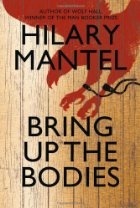
Hilary Mantel brings up the bodies

Hilary Mantel, Bring up the Bodies (Fourth Estate 2112)

20120704-175516.jpg I’m probably the only person of my generation whose grasp of what it was like to live in the courts of the Tudors comes mainly from an article written for The School Magazine by award winning children’s novelist and occasional commenter on this blog, Cassandra Golds. ‘The Princess in the Tower’ focused on Elizabeth, imprisoned during the reign of her half sister Mary, but there’s a memorable paragraph . It likens the court to a jungle where elegant people circled each other like wild beasts, seeking the advantage. Sadly, I’m writing this far from home, so can’t give you a quote. (Cassandra, if you read this, maybe you could add one in the comments section?) [Added later: Cassandra has commented with the passage which is even more apposite than I had remembered. Thanks, Cassandra.]

Even more than Wolf Hall, to which it’s a sequel, Bring up the Bodies validates that image in its portrayal of the court of Henry VIII. But at its heart there’s Thomas Cromwell, no wild beast but a methodical tactician, serving the king and good of the kingdom, receiving insults with apparent stolidity but forgetting nothing, keeping his own counsel, taming some beasts and destroying others.

I was reading this in a cafe in Goreme in Cappadocia, when an Australian woman (the cafe offered a decent flat white, much sought after by Australian coffee drinkers) called from several tables away.

Australian flat-white-drinking woman: ‘How are you finding that? I loved Wolf Hall but I found that one a bit hard to get into.’
Me: I’m loving it. I think it’s miraculous the way she gets right inside the minds of people from that time.
Australian flat-white-drinking woman’s grey-haired male companion: it’s all in the mind.
Me: Um, yes.
AFWDWGHMC: It’s past lives.
Me: Oh, you think Hilary Mantel was there in a past life.
AFWDWGHMC: Not just her, everybody.
Me: Well, that’s a conversation stopper if ever I heard one. (I didn’t say that, I just wish I had.)
AFWDWGH: She’s written another book, you know, a nonfiction book called Anne Boleyn, Witch.

So there you are. If anything was going to make me believe in past lives, it might well be this book. And if Hilary Mantel has written that nonfiction book, I wish she had spent the time on the next novel about Cromwell. It’s not that I want to see him get his comeuppance, as of course he will. I just want more of him. And I worry about his sweet, naive son Gregory.

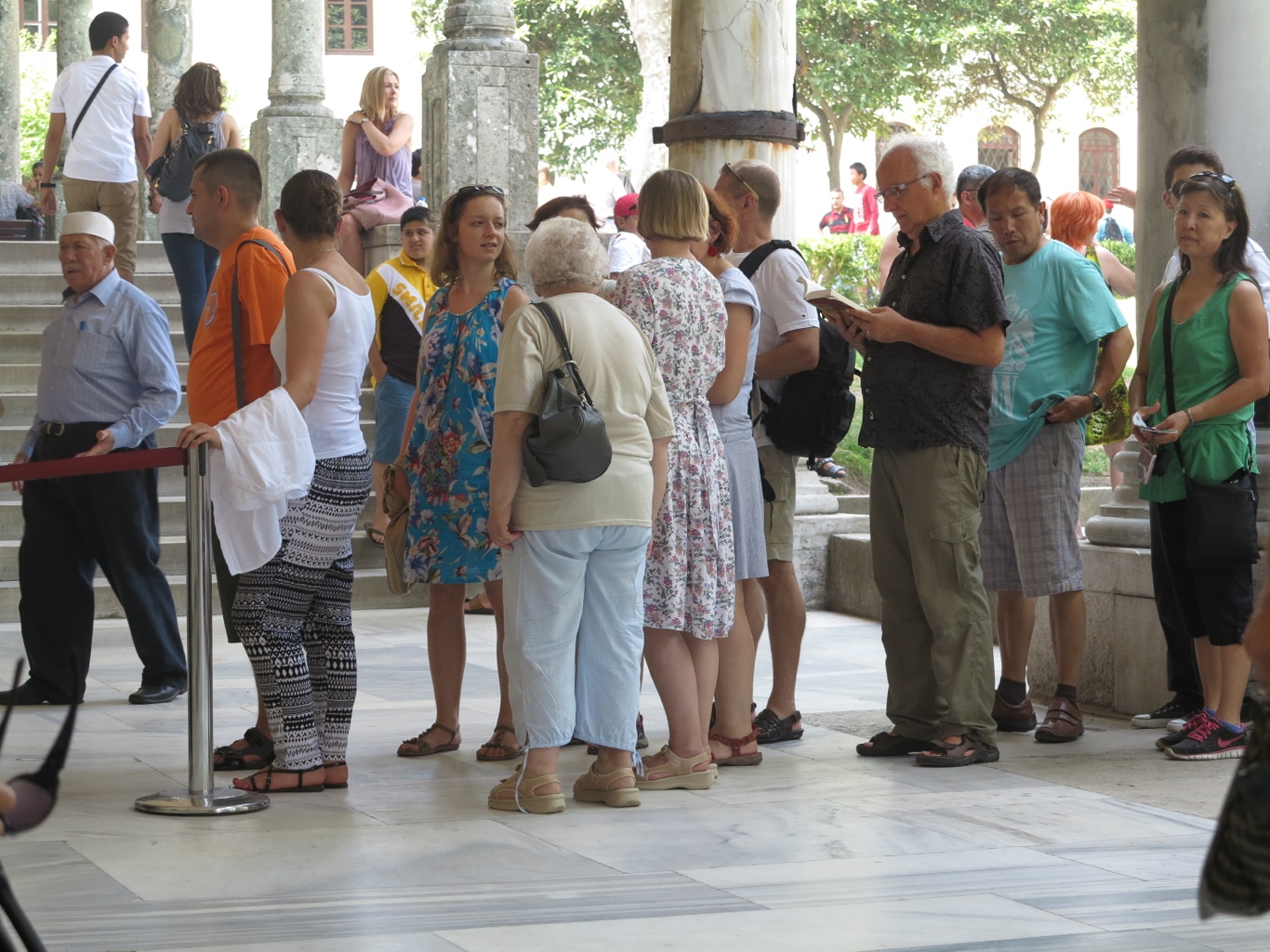
PS: I read this in Turkey, among relics of rulers at least as much at the mercy of their whims as Henry Tudor. I wonder how English history might have gone if Henry could have had a harem. Surely if he had four wives at a time the need to have a son might have been less desperate. Mostly I didn’t take the book on outings, preferring to take thinner volumes. But here I am, reading it in the queue to see the treasures in Topkapi Palace.

20120715-133643.jpg

Tricia Dearborn’s Frankenstein’s Bathtub

Tricia Dearborn, Frankenstein’s Bathtub (Interactive Press 2001)

I read this book in Istanbul, mainly in brief snatches while waiting in queues or similarly engaged. To lift a phrase from one of its poems, (‘this book will change your life’) you could say it was ‘the necessary unwelcome weight in [my] backpack’, though as it’s a very slim volume it was hardly unwelcome.

As one of the striking features of Istanbul in this hot summer is the length to which some tourists go to conceal the female body, I was delighted by the sweet, witty female sensuality in the poems of the book’s first section, ‘Body Parts’. When I say sweet, I invite you to think of mangoes rather than sugar cubes or apple tea – ‘slicing slivers of yielding flesh / that fill my mouth with / lusciousness / and after-tang’, which of course is about actual mangoes. I would have liked ‘the white dress’, from a later section, anywhere, but its tale of childhood rebellion gained an extra poignancy from the proximity of so many young women sweltering obediently beneath layers of black cloth:

the white dress

I knelt with your sewing scissors
beside the towering wardrobe

carefully I snipped holes in
your authority

I would see my life
through those holes

creating them I rained to the red rug
triangles of fine corduroy

I would not wear that dress

There are poems about growing up female, having a female body, female friendships, mother–daughter relationships. And quite a bit that doesn’t fit easily into that field. The titles of the book’s other sections give an idea of its range:

laboratory days, which includes the magnificently named ‘the biosynthesis of 3-nitropdropanoic acid in penicillium atrovenetum’

the leaping spark, about books and sex

short-circuit, which includes ‘the white dress’ and other poems about childhood, reproduction, same-sex attraction and violence against women (yes, I’m not sure what the common thread is there either!)

the uncertain human, containing the title poem and eight other short, strong poems, in which again the body asserts itself:

I think, therefore I am
said Descartes, but

while he thrice denied
the body, his neurones

pulsed with electric
solutions
(from 'proof')

home, dealing with cockroaches, visitors, travel

I respond to these poems as if meeting an old friend for the first time. I have met Tricia Dearborn once or twice, but that’s not what I mean. I think it’s the way the poems refer back, fairly obliquely, to a Catholic childhood, and turn their back on it, joyfully asserting the materiality of humanness.

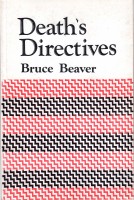
Death’s Directives to Bruce Beaver

Bruce Beaver, Death’s Directives (Prism Books 1978)

I love Bruce Beaver’s poetry, though I usually feel that I don’t really get it, and I hadn’t read this book, so I was delighted to find it on Sappho’s second-hand poetry shelves when I went in search of slim volumes to pack for Turkey. I read most of it on our overnight cruise from Kas, feeling just a bit self conscious about reading poetry, let alone poetry with such a grim title, in those hedonistic circumstances. But I’ve done odder things (embarrassingly, this morning I caught myself noting the typos in a menu in Turkish, a language I don’t know at all), and my life doesn’t seem to be any worse for it.

There are 20 poems in the book, ranging from 40 lines to about four time that long. In all of them the poet has some kind of dialogue with death. Death may be a personification of his sense of his own mortality, or of mortality in general, or something less easily defined, like an acceptance of things as they are. There is painful introspection, exploration of the poet’s less than admirable past, reflections on his experiences with sex and religion, meditations on art and ethics, one splendid love poem, three elegies of sorts (for Mao Zse Dong and the poets Neftali Reyes and Anne Sexton). As I’d expected, I was carried along and sometimes carried away by the way he imbues conversational language with a particular, personal music, and am aware that my enjoyment would be greater if I was better read. I’ve never heard of Neftali Reyes, and have read about two poems by Anne Sexton. I got a lot of pleasure from some references like the echo of Yeats’s ‘This is no country for old men. /The young in one another’s arms’ etc in the first poem’s

In another month it will be on
again, the girls will stop hugging their cold
tits, and the boys denim flies
will be bulging, the little kids
here and everywhere else
on the continent will be rolling
around in clover grass and on
the warming asphalt. Dogs, cats
and birds will go madder than usual
about their courting. Everything
and everyone will come alive

and I know there was much more to be had.

The youngest woman in our group asked on the boat to read some of the book. I recommended X and XI, about his mother and the love of his life respectively. She read them slowly, thoughtfully, exclaimed over the way her education had put her off poetry by wringing every drop of meaning out of it, read a phrase or two out loud. I don’t know if her life was any richer for her encounter with Bruce, but mine was. By my own encounter too. I’ll quote you two bits from XI. First a chatty abstraction:

And the best times together come back at moments
that catch me up in the embrace of a rare
music that at the time of making we must have
overlooked and failed to overhear
because of the noise of our hearts and our spontaneous cries.

And then the end of the poem, that gives an example of what he may have meant:

There was a tree, there was a road,
there was a woman with me. And for once
there was forever in an instant
so that I picked a fallen leaf from out
the scruffy grass, a skeletal leaf
and she said, how beautiful,
and made even death appear to smile.

Faruk Akbas’ Fethiye

Faruk Akbas (photographer) and John Laughland, Fethiye: Faces and Places (Fujifilm Türkiye 2004)

20120629-124500.jpg I was waiting for my solitary lunch in a gozleme place at the foot of the hill of Kayaköy, when the smiling proprietor–waiter placed a dog-eared copy of this book on the table. I guess it’s aimed at the tourist market but it’s a superior specimen of the genre: fabulous photos of faces, beaches, markets, poppy fields (for the pharmaceutical market), hang gliders, abandoned stone houses, food … and a text that has occasional unevenness of tone, but brims with an English expat’s affection and respect for his adopted home. It’s one of those books that helps you see the world. I particularly liked the poem about the forced emigration, in which an old person remembers the cries of the thousands of cats the villagers were forced to abandon.

I expect, sadly, that few of my readers will actually clap eyes on this book. However, for some graphic details of the Kayaköy story you could do better than have a look at Anthony’s comment on this blog a couple of days ago.

Colleen Burke’s Wildlife in Newtown

Colleen Burke, Wildlife in Newtown (Feakle Press,1994)

Poetry is good to travel with. Slim volumes are attractive when you’re packing light, and short poems are well suited to the short grabs of time for reading, in between gawking, eating, finding toilets, blogging and all that. Apart from such practicalities there’s this little syllogism: a) Whenever I travel I have intense dreams about home; b) poetry has been described as a waking dream; c) it makes sense to take poems about home when travelling. So of course I brought this book whose title promises poetry about places a couple of blocks from my home.

True to that promise, the book’s sense of place is very strong, in poems celebrating working class, culturally diverse Newtown, acknowledging its Dharug past and present, and repeatedly evoking Newtown houses, Camperdown Park and the historic cemetery adjoining it. The latter is the subject of elegant photographs scattered through the book, which I’m guessing were taken by the author. It’s evident that Colleen walked through that park on the way to and from work, that she often spent time in the cemetery. If that small part of the world were to be allocated a Poet Laureate, she’d be hard to beat.

The book has a number of interweaving strands: the walks home from work, often involving sunsets: relatively impersonal narratives about the history and make-up of the suburb; conversations with the poet’s children; the cemetery poems, some of which are about the history, some intensely personal; a very few strong poems that directly address the death of the poet’s partner. All the poems are short. If I was at home, I’d find the lovely line about Colleen Burke’s lyrics in Jennifer Maiden’s 1999 collection, Mines, but as I’m gallivanting in Turkey with fitful Internet access, I’ll just recommend that you look it up.

I hope Colleen won’t mind if I quote a poem that, while not necessarily my favourite, struck a chord because I was away from home – in Turkey, not India – when I read it.

And so I was there
for Kerry
‘And so I was there –
a recognition. My
heart full to bursting.
There’s something in the smell of
heat, dust, exhaust fumes,
oxen, tea, animal piss,
garam masala and ghee.
There’s something about women
in saris, beggars of all ages
and people living on the
cramped narrow streets –
an atmosphere of the
Arabian nights that
intoxicates and frees you –
like a window opening.’

ii
I read your letter
in the crumbling
graveyard sheltered
from the August winds
by the empty sandstone
church. Spring
murmured in the winter
soil, a whisper of wattle
in the air. I was close
to you in the gnarled
shadows and slender vines
of sunlight. Close to
the bare bones bound
down by the long dark
roots of the Moreton
Bay fig tree.

iii
‘In the small crowded
Kali temple people
sang, danced and gave
us flowers. Held our hands.
And so I was there’

Place calls out to place calls out to place.

Full disclosure: I published one or two of these poems in The School Magazine in my past life, and may have rejected one or two others; Colleen Burke taught a creative writing class to my mother-in-law, which was a significant event in her pre-dementia life; more than 20 years ago I heard Colleen read poems about her bereavement and her children that still move me, though I remember only a phrase or two.

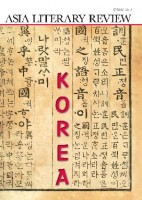
Asia Literary Review 23

Martin Alexander (Editor), Asia Literary Review 23, [Northern] Spring 2012

Issue 18 of Asia Literary Review has a sense of occasion about it. Like some previous issues, this one is devoted to a single nation. But a collection of English language pieces on China or Japan can confidently assume its readers will have heard of The Wind-up Bird Chronicle or those poets who are in trouble, even if they haven’t read any of them. This one, on Korea, can expect to be giving many readers their first real look at a national literature. All the more so as both North and South Korea are represented. The sense of occasion is marked by an appearance by the journal’s publisher, Ilyas Khan, who contributes a note on his personal connection with Korea and his appreciation of the Korean people.

If the state of the short story is any indication of the vigour of a literary culture (a big if, I know, but think of Australia in the 1890s), then South Korean writing is thriving. All four short stories here are grippingly weird: in Kim Young-ha’s ‘Ice Cream’ (translated by Dana Zur) a suburban couple phone to complain when a packet of their favourite ice cream tastes of petrol, with unsettling results; Park Mingyu’s ‘Is That So? I’m a Giraffe’ (translated by Sora Kim-Russell) takes the situation where commuters are pushed into the underground trains of Seoul and turns the surrealism up to full volume; in Jeon Sung Tae’s ‘The Korean Soldier’ (translated by Jae Won Chung) the hero, who seems to be the author’s alter ego, has a thoroughly civilian and richly comic adventure in Mongolia; ‘Black-and-White Photographer’ by Han Yujoo (translated by Janet Hong) is a chilling tale on what Martin Alexander’s editorial tells us is a recurring theme, the lost child. The lost child turns up again in the other piece of fiction from South Korea, an extract from What You Never Know by Jeong I-hyeon (translated by Chi-Young Kim), which I’m guessing is a gripping novel – at least I was left frustrated when the extract stopped and nothing was resolved.

Of the South Korean non-fiction, the stand-outs for me are the excerpts from Liu Jiaju’s memoir, ‘My Experiences in the Korean War’ (translated by Martin Merz), and Michael Breen’s ‘Image and Identity’ (crosscultural reflections of an Englishman who has been living in Korea for thirty years).

Two North Koreans speak directly in these pages. The first, Jang Gil-su, does so in a pencil drawing he did when hiding in his mid-teens on the way to successfully escaping to the South. The drawing shows a man being executed by a uniformed figure with a rifle. The caption informs us that everyone is expected to attend executions in North Korea, ‘including children’. The other, the poet–defector Jang Jin-sung, is represented by five poems (translated by Shirley Lee) as stark as the drawing that precedes them. I don’t generally ‘get’ poetry in translation, but these speak to me very strongly. According to the editorial, Jang Jin-sung will be representing Korea at the Cultural Olympiads, which must be happening round about now.

Of the pieces about North Korea, I felt most enlightened by ‘Pyongyang: City of Privilege and Pretence’ in which journalist Sue Lloyd-Roberts ranges far and wide trying to make sense of the outpouring of grief at Kim Jong Il’s death, and Daniel Levitsky’s ‘North Korea’s Revolutionary Cinema’, which lays out a part of the jigsaw explaining how people can accept the regime. Possibly the scariest piece in the whole issue is the photo essay ‘Holiday Tours to the DPRK’ by Simon Cockerell, an Englishman who has been taking tourists into North Korea every month for the last ten years. His text is as carefully noncommittal as the faces in his photos, and any irony in his final sentence is totally deniable: ‘A week at a beach resort may be temporarily refreshing but the same amount of time in the DPRK provides an experience that will last for a lifetime.’

I’m writing this on the iPad in Kayaköy, near the Turkish Mediterranean, and creating links to all these articles is more complex than I’m prepared to do while at this particular beach resort (about which I’ll write something tomorrow – it’s seven Ks from the beach, and not exactly a resort). But I’ve listed the translators because everything here read beautifully in English and at the same time retained its sense of having come from elsewhere. Many of the pieces I’ve mentioned are up on the Asia Literary Review site, where there’s an online supplement of material that wouldn’t fit in the magazine, which is well worth a look.

I’ve read most of this issue in Turkey, quite a bit on public transport. One friendly Turkish man picked it up, skimmed the pages, and asked, ‘Where are you from?’, clearly failing to fit me to his mental image of a Korean. The Art Student kindly gave permission to use this photo:

20120628-130109.jpg

Georgette Heyer’s Corinthian

Georgette Heyer, The Corinthian (©1940, Bantam 1967 – retail price 75c, but I got it kind-of-free via BookMooch)

A number of Georgette Heyer’s Regency romances did the rounds of my family when I was 12 or 13 years old. In particular, I remember the bursts of laughter coming from first my mother, then my farmer father, my apprentice mechanic brother, and probably at least one of my younger sisters as each in turn read Friday’s Child. Any writing that can do that isn’t too shabby. When a writer friend recently told me of her not-so-secret addiction to these books, and that her much-read favourite was The Corinthian, I decided to ignore the imperatives of cool and the protestations of my traveling companion, and read it on the plane.

It’s a hoot. It has a lot in common with what I remember of Friday’s Child: a gutsy, childlike heroine, a foppish but morally sound older man who progresses from amused exasperation with her to falling in love, a sweetly benign fantasy of the aristocratic life. Plus, in this one, there’s cross-dressing comedy that’s a lot more Twelfth Night than Pink Flamingoes but still manages to hint that the eponymous Corinthian (evidently a synonym for dandy) might not be completely heterosexual. Ms Heyer’s has fun with thieves’ jargon, fun with stock figures including the pater iratus, the ingenue, the dandy, country magistrate. The Jewish stereotyping she has been criticised for isn’t in evidence here, and while I can see that the outrageous depiction of class might make the book distasteful, I found it hard to take such playful exuberance in anything other than the spirit it’s intended.

I realised on this reading that Georgette Heyer’s books introduced me to the comedy of wit, so that when my university studies led me to Etherage and Congreve, Meredith and Wilde, this boy from the Catholic wilds of north Queensland already had a toe in the door.