Category Archives: Books

Thrill Seekers live

The Art Student and I are in Brisbane, wagging it from our Sydney lives to cheer for my niece Edwina Shaw whose book Thrill Seekers had its Australian launch at The Avid Reader last night.

I’ve blogged about the book before. It’s published by Ransom in the UK as part of their Cutting Edge series for reluctant teenage readers, and it’s pretty strong stuff. The promo on YouTube gives you some idea of its credentials to be part of something called Cutting Edge – lots of booze, drugs, sex, risk taking and rock and roll. Its final image of a wide-eyed, possibly terrified boy gives a glimpse of the book’s heart:

Though the book is grim and cutting edge, the launch was cheerful. A huge crowd crammed into Avid’s courtyard in the warm Brisbane evening (unlike Sydney, Brisbane has been having a summer) to be greeted by a slide show of Edwina and friends being young in the 80s. Jeff Cheverton, CEO of Queensland Alliance for Mental Health, kicked things off with a short talk in which he wondered aloud if Douggie, the boy in the book who is diagnosed with schizophrenia, might have had a less cruel experience if he and his friends had had a language for what was happening, and if there had been places then as there are now (though he seemed to say only two in Queensland) where young people who are losing it could go for support without being taken into the embrace of the medical model. Or words in that general direction – I didn’t take notes and I have a sieve for a memory.

Venero Armanno gave an elegant launch speech. He was at pains to say that while a great strength of the book is that it draws on the writer’s experience, it would be a mistake to see it as biographical, and especially so to see the alcoholic mother of the novel’s dangerously acting-out teenagers as in any way representing the author’s mother. The possibility of readers’ leaping to such an assumption has caused a lot of grief during the book’s long gestation, so the clarification was welcome. All the same, in other places the line between history and fiction are a little blurred. The book is dedicated to Edwina’s younger brother, whose life had a lot in common with that of the tragic fictional Dougie, and it’s his photo that ends the YouTub promo. I asked the elegant young man and successful artist sitting in front of me if he was a model for any of the characters. ‘Oh yes, he said, ‘I’m the one from a sugar farm who used to kill cane toads with his bare hands.’

Edwina spoke, and read a short passage, of which the emotionally charged last line caught her off guard, and she had to struggle to finish. Which must say something about the power of the book: she must have read that passage a hundred times in the writing-rewriting-rewriting-editing-proofreading process, but it still has that power for her.

And then she signed and signed and signed.
20120309-200156.jpg
Because Ransom is a tiny publishing house, Edwina is handling the Australian marketing and distribution herself. Her website gives regular updates on where it’s available.

Reading Annie Dillard

Annie Dillard, The Writing Life (1989, Harper Perennial 1990)

I started reading this three or four years ago, but the opening sentences put me right off:

When you write you lay out a line of words. The line of words is a miner’s pick, a woodcarver’s gouge, a miner’s probe. You wield it, and it digs a path you follow.

When I picked it up again – because it’s short and I was reading a big and sometimes tedious book I didn’t want to carry around with me, because it was by a woman and the VIDA figures are always at the back of my mind, because I’d started a little project to which the idea of the line of words as a tool couldn’t have been more apposite – I had trouble remembering why those lines that so threw me.

It’s a wonderful book, perfect for reading in small doses, not because it’s difficult but because so much of it cries out to be meditated on. I read it on the walk to the swimming pool (four minutes) and to the local shops (three minutes).

Annie Dillard writes about her life as a writer – the materiality of it, and a stunning range of metaphors for the process of writing: inchworms climbing blades of grass, aeroplane acrobats, a typewriter erupting like a volcano (this one had a whole short chapter to itself), a man rowing against a powerful current but getting to his destination eventually because the tide changes. There’s a pungent exposition of the role of scheduling, and a lot of whingeing raised to the level of the sublime. It’s not a how-to book, but it is deeply encouraging, even for people like me who are unlikely ever write a book.

Frank Moorhouse’s Cold Light

Frank Moorhouse, Cold Light (Vintage 2011)

This book came highly recommended by what seemed like the whole world, and I can see what people admire, even enjoy about it.

It’s a rare thing, a novel whose main character lives consciously and deliberately as part of the great historical narrative of her time. Edith Campbell Berry engages with ideas, faces political realities, and tries to wield influence for the good. In the first chapters she has returned to Australia in the early 1950s. She has a hand in the design of Canberra – in fact, her intervention seems to be crucial to the decision to go ahead with Walter and Marion Griffin’s plan for a lake. Through her brother and his partner she is a close-up witness to the Communist Party’s response to Bob Menzies’ failed attempt to ban it, and then to Khrushchev’s revelations about Stalin and the invasion of Hungary. She dines at Menzies’ table, and chats with Whitlam soon after his election in 1972. She works with the International Atomic Energy Agency and is again close to the action when secrets about the English atomic tests in Western Australia leak out. At her death she is a special envoy in the Middle East for the Whitlam government.

Edith is no cardboard cutout. Through all these years, she has to contend with assumptions that women’s place is not among those wielding power. Failing to gain official positions, she bluffs her way past public service obstacles and procedures, works her connections, takes advantage of gossip that she is some kind of spy. Her sexual experiences, and sexual might-have-beens, are unconventional and complex. Possibly the most attractive thing about the writing is the sense that Frank Moorhouse is discovering things about her as the novel progresses. Ambrose, Edith’s husband at the start of the book and the love of her life, is a cross-dresser, and I couldn’t resist the notion that this is a metaphor for the way the author slips into Edith’s skin and clothes – including on occasion her underclothes. Be that as it may, there’s a strong sense of Edith as someone Frank admires and loves, someone who exists independently of him. I didn’t need to be told that there was a real woman somewhere in the background (as Frank told Stephen McCarty at Ubud and on Slow TV a while back – it’s towards the end of the clip). It does feel at the end of the book that one has read the story of a life lived for its own sake and not to enact a writer’s world view. That’s really something.

But, you know, I can’t say I enjoyed the book. It’s the third volume of a trilogy and maybe I should have read the other two books first. As it was, there seemed to be an inordinate amount of recapping, an awful lot of ‘As you know, Bob’. I expect that if I’d read the other books, these would have been less irritating, and I might have had greater tolerance for Edith’s frequent ruminations because of a clearer sense of them perhaps as charting her mental journey. She ruminates on her ideal capital city, on the nature of love, on the lessons to be learned from the League of Nations. I’ve got nothing against rumination, but I couldn’t find anything wise, witty or provocative in Edith’s – I don’t think I’ve ever been so bored in a book that I still wanted to keep reading.

And then there was the sense that Moorhouse had done a huge amount of research and couldn’t bear to let some of it go even though it didn’t quite serve the story. I can enjoy info dumps: my love of Neal Stephenson is partly due to the way he drops in great wads of information, and if Barbara Hambly’s Free Man of Color groans under the weight of her research into the New Orleans society of its time, it is the groaning of a table laden for a feast. But for whatever reason – perhaps because Moorhouse often presents his information as a character’s reveries or as even less plausible conversations – I wondered if the Readers Digest Condensed Version might be a better book. There’s an extremely poignant moment a bit past the novel’s midpoint, where Edith and Ambrose have parted, perhaps forever. And just as she – and the reader – have a moment to absorb the full import of the event, along comes this conversation with her driver:

‘How long will it take the Major to reach London?’ he asked, making conversation.
‘About fifty hours, plus the time from Canberra to Sydney.’
‘Many stops?’
‘Darwin – Singapore – Calcutta– Karachi – Cairo – Rome. I’d rather not talk, Theo.’
‘Of course, ma’am.’

Your mileage may differ, and I hope it does, but for me that was a case Frank the Irritating Researcher interrupting Frank the Passionate Story-teller. When Edith returned to her reverie, the moment for this reader had been lost.

I didn’t hate the book. I did learn from it. I do admire it. I’m glad I read it. It was a slog.

Daytripper, the comic

Fàbio Moon & Gabriel Bà, Daytripper (Vertigo, 2011)

20120224-180529.jpgThis is the last of the comics I was given at Christmas. It’s another beautifully compressed gem I’ve read in counterpoint to Frank Moorhouse’s slow Cold Light. Its hero is a newspaper obituary writer, and – skip the rest of this paragraph if you hate spoilers – each of the 10 original comics collated here tells a different story of his death, each occurring at a different age, and each ending with a paragraph or two from his obit.

Bà and Moon are described in the blurbs as twin brothers from Brazil, and though I couldn’t find an acknowledgement that the book was first published in Portuguese, it is set in Brazil, and it has a Latin-American magic realist feel to it – not fantasy as such but a way of seeing the actual world as magical. The art is beautiful without pretending to be other than comic-book art. The cumulative effect of the narrative(s) is a profound meditation on the fragility of life – or not so much the fragility as the conditionality: we all knowingly or unknowingly have frequent brushes with death, so the life we have now is something of a miracle.

The book isn’t perfect. In the final section, these two young men try for a vision of acceptance of death by an old man, and (in my not-yet-as-old-as-the-protagonist opinion) manage only a romantic empty gesture. So according to Randall Jarrell’s definition of a novel as ‘a prose narrative of some length that has something wrong with it’, this is a graphic novel. It’s an excellent one.

Fàbio Moon & Gabriel Bà have a blog in English.

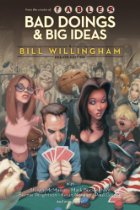
Bill Willingham’s Bad Doings and Big Ideas

Bill Willingham (writer and artist), and Mark Buckingham, Zander Cannon, Duncan Fegredo, Peter Gross, Paul Guinan, Nico Henrichon, Adam Hughes, Phil Jimenez, Michael Wm Kaluta, Jason Little, Marc Laming, Shawn McManus, Linda Medley, Albert Monteys, Kevin Nowlan, David Peterson, Paul Pope, Eric Powell, Ron Randall, John Stokes, Jill Thompson, Daniel Torres, Bernie Wrightson (artists), John Costanza and Todd Klein (letterers), Bad Doings and Big Ideas: A Bill Willingham Deluxe Edition (Vertigo 2011)

As I continue on my intermittent re-entry into the world of comics, which I abandoned at roughly 12 and came back to in my late 50s, it’s the non-fiction that I respond to most, and after that – oddly, since I don’t care for it in non-graphic narratives or movies – it’s fantasy-horror. Or maybe it’s not so odd, as it was Neil Gaiman’s epic Sandman that re-piqued my interest.

This hefty hardback full of horror was a Christmas gift, and one that gave me a lot of pleasure. Bill Willingham, I gather from his entertaining interstitials here, is a writer and artist best known for a series of comics called Fables. This is not that. It’s a collection of Other Stuff, including a number of adventures of minor characters from the Sandman universe. I don’t know what the uninitiated would make of these, with their injokes and unexplained walk-ons, but the stories stand up by themselves, especially the 60 or so pages of Thessaly the witch (the second half of which I read in its own book, also a gift, a while back).

The opening story, Proposition Player, is the longest (130+ pages) and most interesting. Willingham tells us it was the first thing he wrote for Vertigo, having been an artist with them for some time. It must have been quite a debut: the hero starts out working for a casino and ends up through a series of poor choices and successful gambles as the most powerful God (capital intended) in the cosmos. The gambles are much grander than Pascal’s bet, and I wonder if the story’s cheerful blasphemy does more damage to the cultural authority of established religion than the humourless argumentation of, say, Richard Dawkins.

I’m currently leading a double life as a reader. In one life, I’m reading a number of huge books, and in the other a whole lot of smaller ones as counterpoint. When I was reading Reamde, which is great fun but far too big to lump around in a shoulder bag, I read poetry books and literary journals, physically but not intellectually light. Now I’m a third of the way through Frank Moorhouse’s Cold Light, not as physically weighty as Readme, but quite a slog – the slogginess doesn’t make me want to give up on the book, but it does make me cry out for something lively to relieve the pain. Bad Doings and Big Ideas was perfect for the part. And I have a couple more Christmas present comics that are also looking good.

Kate vs Inga – it’s still going on

Kate Grenville was interviewed on the most recent Guardian Books Podcast, a good choice of guest as the subject was historical fiction, and her last three books – The Secret River, The Lieutenant and Sarah Thornhill –  have been tales of the early years of the colony of New South Wales.

It must be irritating to Ms Grenville that every time a journalist talks to her about her colonial novels, they raise the matter of the ‘attacks’ on The Secret River by ‘historians’. And that’s what happens in this podcast. Asked about the response to The Secret River, KG says in part:

We all kind of knew that things had happened, but people of my generation were brought up with this illusion that, you know, the reason there were no Aboriginal people left in many parts of Australia was that they all got measles, and had no resistance to it. We all kind of knew that this was wrong and The Secret River gave people a way of starting to think about it, I think. And because it’s fiction, it wasn’t too confronting. With fiction you can always reassure yourself that after all this is just made up. …
A couple of historians, with The Secret River, were cranky that I was writing something that they felt was their territory. You know, this is hard stuff to think about. Here we are as white Australians living incredibly privileged lives and we’re doing it on the back of 2oo years of oppression and misery and murder, basically. To actually look that fact in the face is extremely confronting, very difficult. So I think when those historians really diverted the debate away from what I’d been writing the books about, which is the massacre and what  the beneficiaries of it do with that knowledge, I think they felt that this was a chance to divert the debate into something more comfortable – which is the debate of is it history, is it fiction, how far should novelists go in writing historical fiction.

OK, the only reason for a novelist to appear on the Guardian podcast is to promote her own work, and the dismissal of any number of other novelists who have tackled the subject (Thea Astley comes immediately to mind, and surely there are others) can be forgiven as loose talk. It’s absolutely true that the subject of ‘massacre and what  the beneficiaries of it do with that knowledge’ is difficult and confronting and, I would add, of high priority (though it’s an open question whether the book actually goes to the question of the beneficiaries). It may even be that the criticisms of The Secret River had the effect of diverting attention from that question. But really ….

The only historian I’ve read on this subject is Inga Clendinnen, who made some astringent and, yes, cranky remarks about The Secret River in her Quarterly Essay, Who Owns the Past? But her gist, as I remember it, was that on many points the novel distorts the history – for instance, by moving a key incident from the first years of the colony to a couple of decades later – and in general it lacks any sense of actual engagement with the times she was writing about. Clendinnen herself could hardly be described as ‘heavy duty’ in the sense of inaccessible. And it would be hard to read her writing about the early colony as comfortable.

Evidently Kate Grenville is still smarting from the criticism, but this is fighting dirty. Inga Clendinnen is not Keith Windschuttle, yet anyone learning about her criticisms from this podcast would assume she was near allied.

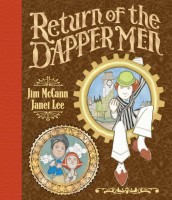
Jim McCann and Janet Lee’s Return of the Dapper Men

Jim McCann and Janet Lee, Return of the Dapper Men (Archaia Entertainment 2010)

This is a kind of steampunk fairy tale graphic novel, self-consciously beautiful to the extent that it includes an appendix explaining its decoupage technique. I found it visually boring if not outright repulsive, and was left cold by the story, which involves a city, or perhaps a whole world, where time has stopped but starts again when hundreds of identical ‘dapper men’ float down from the sky, a mute mechanical angel that somehow brings harmony, an elliptical message about destiny, and strangely empty allusions (the city is Anorev, Verona in reverse, but why?).

It was a generous and thoughtful Christmas present, but I guess I’m just not part of the target audience.

Ampersand 4

Alice Gage (editor), Ampersand Magazine 4: From the Heart of the Forest to the Edge of the Road (Art & Australia 2011)

20120211-182652.jpgI’d seen earlier issues of Ampersand in coffee shops around Newtown and assumed it was a kind of zine with advertising – you know, quirky, poorly crafted stories about queerness, spiky incoherent poems and blurry photos, interspersed with slick promos for hip merchandise. A quick, lazy flip through one copy while waiting for a hot chocolate wasn’t enough to make me rethink,

Then the Art Student gave me this issue for Christmas, and I discovered I WAS WRONG. True, there are a couple of rap-influenced poems, and an over the top postmodernish necrophiliac horror story. But from the opening fold-out photograph, ‘Black Friday’ by John O’Neil, with John Forbes’s ‘Going North’ luxuriating in white space on the back, to the charming appendix noting things that happened when the magazine was in production, this is a delight.

I don’t have to describe the physical magazine because there’s a video of an elegant pair of hands flicking through it here. (Go on, have a look. It only takes about 90 seconds.)

Tommy Murphy (Holding the Man and Gwen in Purgatory playwright) writes about his father’s dementia. Bob Brown (the senator, not an obscure namesake) writes about Oura Oura, his shack retreat in rural Tasmania. Three pages of comics by Leigh Rigozzi tell sweet quotidian anecdotes about life in Newtown (I don’t know if that’s exactly a correct use of quotidian, but it’s a Harvey Pekar term, and seems to fit). Fabian Muir visits people living in the Chernobyl exclusion zone (and makes me wish he and Merilyn Fairskye had been in touch: his article and Plant Life, her recent exhibition of photographs from Chernobyl speak volumes of each other).

There are a couple of wonderful young fogey articles, one inveighing against proposed changes to Fisher Library at Sydney University, to make it more efficient by getting rid of half the books, an auto da fé on an unprecedented scale being conducted in secret, the other lamenting the passing of toll booth operators. An iconoclastic piece on iconoclasm argues that the restoration of works of art that have been vandalised sometimes does more damage than the vandalism. There are pages and pages of high quality colour reproductions of art by Tracy Moffatt and a clutch of Western Desert artists, among others.

I wish I’d read this magazine three months ago, because then I would have made sure to go to the Carriageworks for My Darling Patricia’s Posts in a Paddock, a theatre piece built around murder by Jimmy Governor of ancestors of one of the company: the piece about it here is a brilliant example of Indigenous and non-Indigenous collaboration, infinitely more interesting than February’s I Am Eora at the same venue.

And as a final note: accustomed as I am to thinking of Melbourne as the place where solid new literary ventures come into being, I was pleased to see that this is a Sydney publication. I Googled the editor, Alice Gage, and discovered that though she is indeed a Sydneysider, she produced the first issue of Ampersand while in Melbourne. Her reflections on the difference in the milieux are worth reading,

I’m posting this the day before the launch of Ampersand 5: Eleventh Hour (the link is to that issue’s YouTube teaser).

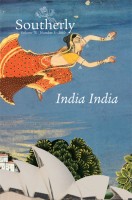
Southerly 70/3

David Brooks & Elizabeth McMahon (editors), Santosh K. Sareen & G. J. V. Prasad (guest editors), India India: Southerly 70/3

Southerly is a venerable institution – the Journal of the English Association, Sydney, it has been going for 70 years (which isn’t long compared to children’s literary journals such the School Magazine or its New Zealand equivalent, but impressive among little magazines for grownups). This issue has a central focus on Indian–Australian literary relations, but I bought it for Jennifer Maiden’s poem, ‘The Year of the Ox’, which doesn’t relate to that focus.

‘The Year of the Ox’ is to an end-of-year family letter what many of Jennifer Maiden’s poems are to diary entries, that is to say, same same but different. It brings us up to date on characters who have been inhabiting her poetry for some time: herself and her daughter, current political leaders (Obama, Clinton, Gillard), iconic figures of the recent and not so recent past (Diana Spencer, Mother Teresa, Florence Nightingale, Queen Victoria, Eleanor Roosevelt) and her fictions George Jeffreys and Clare Collins. It’s a long and complex poem, but from one point of view, it brings us up to date on the doings of this mental family during 2009, the Chinese Year of the Ox, and into 2010, Year of the Tiger, all the while ringing the changes on the images and connotations of ox and tiger. I love the way the poem swings with apparent nonchalance from observations on her own close relationship, the political scene and the nature of poetry, to – what to call them? – Platonic dialogues between icons, to vividly realised domestic scenes from a virtual novel, and all the while there’s a sense of poet-as-ox pulling a plough through the furrows of a mind alert to the world.

There are other excellent poems: by Ali Alizadeh (whose ‘Election Announced’ chillingly mentions someone as ‘the theocrat / a retributivist in speedos’), Judith Beveridge (whose two poems are actually India-related, thanks to her interest in Buddhist lore), Richard Deutsch, Craig Powell and a list of other Australians, and by a handful of Indian poets. I couldn’t get into any of the short stories, with the exception of Sarah Klenbort’s ‘The Chinese Circus Comes to Cessnock’, in which three fruit-picking backpackers encounter the complexities of Australia’s policies about Asian immigration.

Southerly comes from academe, and there a number of academic pieces, in particular surveys of the India-Australia literary connection and studies of particular texts. I intended to read the journal from start to finish, but decided to skip the scholarly bits when I read on page 20 that one novelist’s work ‘might be taken as a case study of Deleuzean deterritorialised nomadology […] Derridean self-critique in which text and meta-text mutually […]’. Too much like hard work! I skipped pieces by Indian critics on Mollie Skinner, Hazel Edwards, and a number of Aboriginal subjects with words like subjectivity, constructing and historiography in their titles. But I was wooed back by Mark Macleod’s ‘Reading my first time in India: the ACLALS Conference 1977’. Once you get past the daunting title, this is a fabulous piece of travel writing structured around two literary conferences. It sheds light all over the place, and abounds with striking images and telling anecdotes.

The other stand-out piece was by Patrick Bryson, a white Australian married to an Indian woman and living in rural India. His ‘The Men Who Stare at Bogans’ explores the Indian press’s coverage of the anti-Indian racism in Australia, and moves on to a brilliant essay on the treatment of ‘tribals’ in India.

As I was writing this, the next issue of the Asia Literary Review arrived in the mail. It’s an English language journal reflecting writing in and about Asia. This Southerly does a nice job of reminding us of one of our strong Asian relationships.

4W twenty-two

David Gilbey (editor), 4w twenty-two New Writing (2011)

fourW is an anthology produced regularly by the Booranga Writers’ Centre, home of Wagga Wagga Writers Writers. The 22nd issue, the first I’ve read, is extraordinarily eclectic: in small part a showcase for local Wagga Wagga writers, it extends to work from Japan (a Noh play, some fine short poems) and elsewhere far beyond these shores, established writers rubbing shoulders with those still wet from the cocoon, the academic with the demotic, and a world of diversity in between: short stories with the ghosts of O Henry, Raymond Carver, Henry Lawson and maybe Tropfest hovering over their shoulders, a touch of magic realism, some ‘ladies who lunch’ pieces (is that a genre?), cryptic and narrative and lyric and satirical poetry. It was perfect to carry in my bag while I was immersed at home in the completely unportable Reamde.

My crabby editorial soul snarked into life once or twice, most strikingly at this: ‘Her mother … insisted she keep her hair long and plaited to trick the suitors into seeing her as young, virile and obedient.’ Um, note to author: I may be missing something, but I think you meant nubile.