Category Archives: Books

Obligatory seasonal post

I jumped the gun with my Tim Minchin post, and now I’m left feeling that if I don’t say something here about the last couple of days my silence will be eloquent with a meaning I have no intention of conveying. So here you go, my seasonal post.

A number of people whom I respect and like have taken up anti-Christmas positions. It’s not just that they hate Christmas. They believe that the only people who should celebrate it are practising Christians, that the rest of us are just being suckered in by capitalism to perform environmentally, socially, politically and/or spiritually repugnant acts, that we’re also playing into a sidelining, or worse, of people who come from non-Christian religious and cultural traditions.

I respectfully take a different view. (So do my Jewish next door neighbours, but that’s another story.) It’s not just that Christmas is (in this hemisphere) a summer solstice festival, or – like the current incarnation of Australia Day – that any public holiday is cause for celebration. Christmas, in my atheistic mind, is specifically about something real and humanly central.

When walking the dog on Friday morning, I tried to think why it mattered to me. I decided, with striking lack of originality, that at the heart of Christmas is an image of a newborn child, the idea that the birth of a child is a cosmic event. That’s something that has meaning for me. I remember in the middle of all the intense emotion around my own first son’s birth having a sense of having engaged with a deep mystery, and the phrase in my head that expressed it, ‘Unto us a child is born.’ That is to say, all the singing and talking and reading about the Manger etc in my childhood had been laying down templates, had been a kind of preparation for parenthood.

If your birthday is the day when you are celebrated just for having been born, Christmas is the day when we, or at least I, do that for all of us. It’s a time for celebrating the fact that we were all babies once, for acknowledging our shared humanity (‘goodwill to all’), our connection with each other – friends and family, mainly, but also strangers walking their dogs and, for people more civic minded than I am, the homeless and potential recipients of  Oxfam goats.

That’s it. Happy Christmas!

My ruminations did move on, to wondering if this emphasis on the child is particular to the Christian tradition. It occurred to me that Eid l-’Aḍḥā, described by one of the participants in Bankstown Pressure Cooks as being about ‘the sacrifice of the sheep’, is connected. There’s no cute baby, but the event being celebrated is the angel’s intervention in Ibrahim/Abraham’s sacrifice of  his son (Isaac in the Hebrew Bible, Ishmael in the Holy Koran), and directing him to sacrifice a sheep instead. I think of this story as a record of the moment in the history of the Semitic peoples when human sacrifice came to an end. Obviously I don’t have any of the insider’s grasp of the emotional meaning of the Eid, but it seems a fair enough speculation that it too is about a joyful honouring of the human.

Belatedly, Happy Eid!

Any thoughts on other traditions, anyone?
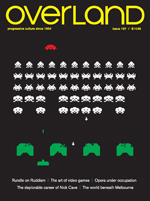
Recent journals (2) – Overland 197

Jeff Sparrow (ed), Overland issue 197 (OL Society December 2009)

overland 197I initially intended to write a single post about the three journals that arrived in my letterbox this month, but after rabbiting on about Heat at such length I decided I’d better split them up.

In a world where passionate anti-Communist Robert Manne  has been described as a preeminent lefty, there’s clearly a crying need for Overland, whose Communist Party origins flutter from its masthead in the slogan, ‘Progressive Culture since 1954’ (and smirk on the back cover in a quote from The Australian describing it as ‘loopy-Left’). Even before the recent online Subscriberthon I’d been thinking of subscribing – I loved (and blogged about) the biography of Guido Baracchi, Communism: a Love Story, written by current editor, Jeff Sparrow, and I have been a freeloader (ie, online reader) for some time.

After the mainly elevated austerity of Heat, Overland‘s direct speech is refreshing. You won’t find essays here that begin as dauntingly as ‘It was while reading Jean-Paul Sartre’s monumental study of Flaubert, The Family Idiot, that I fell into an “epileptiform” state’ or ‘I have long associated landscape with passion and solace, and with the urge to record it’. Instead, we get ‘Last Sunday I went to church to be with my father, to say goodbye,’ or ‘Sometimes in life you get lucky.’ Not that the Overland pieces lack heft. The former introduces ‘My Father’s Body‘, Francesca Rendle-Short’s moving and, for my money, profound essay on her relationship with her father who has Alzheimer’s. The latter leads in to Fiona Capp’s ‘The Lost Garden‘, an extract from her My Blood’s Country, which promises to demonstrate Judith Wright’s continuing relevance (‘These hills and valleys were – not mine, but me …’).

There is some engaging fiction, some punchy argument (a trenchant go at Nick Cave, who is a closed book to me so I don’t mind one way or the other), short reviews, engaging essays (Sophie Cunningham, just popping over from Meanjin, visits the drains of Melbourne; Thomas Rye visits an island in Arnhem Land), a swathe of poems. There’s nothing I recognise as loopy-Left, though there are two very interesting articles – one on Ruddism and the other on education as export and its relationship to border control –  written in learned-Left language that makes for hard going (‘The CFMEU and other Left trade unionists wish to increase control of the borders of their labour markets at the point of intersection with the borders of the nation, and definitions of “Australians”‘).

The whole content is available online. I’ve linked to the articles I particularly liked.
—–
I’ve been lamenting the frequent copy-edit and/or proofing mistakes in Heat for a while. I kept my carping eye peeled for Overland as well. Interestingly enough, although Overland doesn’t include a credit for a copy editor (as Heat does), it doesn’t have anything like the same incidence of irritating and sometimes perplexing mis-edits and typos. There is a spot where lay and laid are used in place of lie and lay , but as this happens consistently over a number of paragraphs I’m willing to put it down to a difference of opinion (in which, of course, they are completely wrong!) rather than sloppiness or ignorance.

Armantrout on the trot

Rae Armantrout , Up to Speed (Wesleyan University Press 2004)

As I was reading this book on the way to the Fish Markets this morning (Christmas Eve), a friend called from where she was supervising her dog in the Harbour: ‘What are you reading?’

‘Mostly incomprehensible poetry,’ I called back. ‘But she’s just described time as

a ghostly appendage
of uncertain length.'    [from 'In Time']

‘Hm,’ said my friend, ‘that’s pretty nice,’ and we returned to our dogs.

There’s not a lot more I want to say, except that there are many lovely moments in these 80 pages, and a lot of stuff that I don’t get (but I don’t necessarily need to). Possibly my favourite lines, from ‘Another Sense’:

I don't mind
learning
I'm in hell
if
I can learn it
again and again.

Recent journals (1) – Heat 21

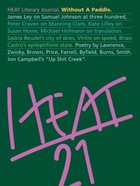
Ivor Indyk (ed), Heat 21: Without a paddle (Giramondo December 2009)

Some of the reasons why you should subscribe to Heat, or at least read it:

1. Worthiness. Your money and attention help to sustain cosmopolitan Australian literary culture.

2. Self-protection. Extracts from works in progress allow you to prejudge the finished work. I’ve decided to avoid a significant number of award winning books on the basis of such advance warnings, and I’m likely to steer clear of one or two foreshadowed in this issue. The poetry provides a similar warning function: poetry is so much a matter of taste, and journals like Heat can play the crucial role of taster. And there are the critical pieces: on the strength of Kate Lilley’s detailed exposition of Susan Howe’s The Midnight, I won’t go looking for it any time soon (far too rich and recondite for my thin blood); Peter Craven’s critical review has put me right off Brian Matthews’s biography of Manning Clark. But it hasn’t enamoured me of Peter Craven: he’s bracingly forthright in his judgements, and even when he’s completely wrong-headed he provokes interesting conversations, but he comes across as too full of himself and too pugnacious for me to actively seek him out.

3. Titillation. Then there are the poems and extracts from works in progress that have the opposite effect. Poems from, among others, Pam Brown, Ken Bolton, Chris Price make me want more.

4. Education. In this issue, Josiane Behmoiras embeds an introduction to the work of Paul Virilio, a cutting edge French thinker, in an account of her recent trip to France (complete with implied travel advisories on the stench of urine by the Seine and problems with Australian Visa cards on the Metro); where her discussion of his work descends from glorious abstraction, it seems to be arrive at important conclusions about how we should live, very close to those of Bill McKibben’s much less abstruse Deep Economy.

The four-colour section in the middle introduces us to the  painter Jon Campbell, and offers us a hand in understanding why we should be interested in his work.

5. Base pleasure. Maybe this is only for people who are or have ever been editors, but Heat can be counted on for regular hits of the sour pleasure of Other People’s Gaffes. The best one in this issue occurs in a poem: ‘a woman rides a / pink vesper that you could / park anywhere’. I’m reasonably sure the poet had a chic little Vespa scooter in mind rather than an evening star blazing to the kerb in the sky.

6. More substantial pleasure. This is of course the real reason for reading Heat at all.

Here, Jena Woodhouse interviews Michael Hofmann, poet and translator, and though her introductory paragraphs use rude words like polytropic, once we get to Hofmann himself the prose becomes a joy to read.

Luke Carman’s three prose pieces gathered under the title ‘The Easy Interactions of an Elegant Young Man’ have a wonderful, disturbingly comic cumulative effect. Part way through the second I realised I saw him read similar work at the Sydney Writer’s Festival earlier this year, and described his reading as rapidfire and surreal. It works that way on the page as well.

And then there’s James Ley’s ‘A Degree of Insanity’, a straightforward, intelligent essay on Samuel Johnson that is splendid in itself, not least because it quotes generously from Johnson’s sonorous prose. Its appearance in this journal gives added pleasure, as it seems to send ricochets out, pinging off the rest of the content. Peter Craven, for example, drops a couple of Johnson’s famous quips into his argument for no apparent reason other than to establish his own gravitas. The notion, from Johnson’s Rasselas, that ‘all power of fancy over reason is a degree of insanity’ bounces prettily off the mild derangement of Luke Carman’s pieces and some of the poetry. The excitement surrounding literary journals in eighteenth century London sparks reflections about the role of their descendants in our time, Heat among them.

Next:  Overland issue 197.

More proof that sexism is rife in the land

Even though there’s a certain amount of merriment in the media just about every time Senator Steve Fielding opens his mouth, the response to him has been positively respectful compared to what would have happened if he had been a woman.

Where’s the drag queen equivalent of Pauline Pantsdown – Steve Feeldong? Where are the catchcry equivalents of ‘Please Explain!’ – ‘My vote does count,’ say, or ‘I don’t know about that in detail’? Where’s the spoof site to match the now apparently defunct mirandadevine.com?

I’m not pleading for the poor senator to be subjected to degrading personal insult, but don’t you think it’s interesting?

I really like Christmas too

Just in case there’s anyone who reads my blog who doesn’t read Neil Gaiman’s here’s a wonderful Christmas song for you

Sadly I don’t imagine it will ever make it as a carol.

Travels in Atomic Sunshine

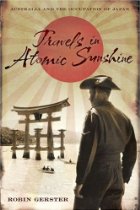
Robin Gerster, Travels in atomic sunshine: Australia and the occupation of Japan (Scribe 2008)

Thousands of Australian soldiers and their families were part of the Occupation of Japan from February 1946 until early 1952. They formed the bulk of the British Commonwealth Occupation Force, generally overlooked in the shadow of the much larger and better equipped US occupation forces. While the US occupiers, with headquarters and amenities in Tokyo, set about imposing democracy by decree and using military might to change a militaristic culture to a peaceful one, insisting on freedom of the press except for stories that might make trouble for the occupiers, the Australians – whose generals led the BCOF – were stationed near the devastation of Hiroshima and seem to have managed without any sense of themselves as Liberators. They are scarcely mentioned by any of our otherwise zealous military historians, and barely appear in the Canberra War Memorial. Sneered at by the British, discounted by the US,  at home they are ‘the forgotten Force’.

At the time, thanks to reports of atrocities in the Burma–Siam Railway  and Changi Prison as well as the bizarre White Australia Policy, anti-Japanese sentiment was fierce in Australia, and the occupationnaires were in a bind. If they enacted the home sentiment, as many did, they were likely to be brutal, even criminal, in their dealings with the already shattered population, and there are plenty of stories of rape, sexual exploitation, black marketeering (‘wogging’) and careless disregard for human life. If they were open to Japanese culture and the humanity of the people, as again many were, they were likely to be shunned as ‘Jap-lovers’: there were plenty of headlines at home to that effect, and when people returned it was to even less acknowledgement than the troops who served in Vietnam. Governments still deny that their high incidence of cancer might be connected to the time they spent at nuclear ‘Ground Zero’.

If someone wanted to make a serious war movie, they could do a lot worse than mining this book. The movie would run very little chance of feeding adrenaline addiction the way so many well-intentioned anti-war movies do. It would have trouble being read as a tale of Good vs Evil. It would leave a number of received True Stories looking decidedly tatty. After so many movies about the horrors of the Japanese prisoner of war camps, how refreshing to show those liberated Aussies as occupiers of post-War Japan – some acting out their racism-boosted vengefulness on the civilian survivors of Hiroshima, others coming to appreciate the culture  and even falling in love. The book seethes with potential story lines. Here’s the tale of  the young Australian signalman, John Henderson:

In early 1948, immigration minister Arthur Calwell had reasserted the government’s position that no Japanese woman would be permitted to enter Australia, irrespective of whether she was he wife or fiancée of an Australian serviceman … Henderson had married a young university graduate, Mary Kasahi Abe, by Shinto rites. With his wife pregnant, and worried about the legality of the Shinto ceremony, he sought to be married by the battalion chaplain, the well-known BCOF identity Padre Laing. Laing’s duty was to inform military command, and Henderson was peremptorily repatriated. The officer given the task of putting the order into effect related, 40 years later, that someone at BCOF HQ had decided to make an example of him. This was easily achieved, as he was a low-ranking, demoralised youngster of no consequence. A ‘thin, frail-looking lad’, Henderson was reduced to tears upon hearing the news. Accompanied by the padre and two MPs, he was put on the Kanimbla and locked in the brig to be returned to Australia, the father of a baby daughter whom he never got to see.

… During the debacle, and while his family was receiving abusive anonymous mail for supporting their son, the papers were full of photographs of radiantly smiling British migrant families arriving in Sydney … [Immigration minister] Arthur Calwell played to the crowd, stating that, while there were living relatives of the men who suffered at the hands of the Japanese, ‘it would be the grossest act of public indecency to permit a Japanese of either sex to pollute Australia or Australian-controlled shores’. What an irony: John Henderson had himself suffered, directly and not vicariously, from Japanese wartime brutality. He had laboured on the Burma–Thailand Railway, no less, and later in the coal mines in Japan. There, he had been befriended by a guard who handed him food, including small gifts from his sister, treats such as sweets, and rice cakes. The very reason Henderson decided to volunteer to BCOF after the war was that he wanted to meet his benefactress. He did, they became strongly attached, and they married – and now his own government had decided that her presence would ‘pollute’ Australia.

… Despite his promises, Henderson never returned to his Japanese family. He had asked a couple of his army mates remaining in Japan to keep a friendly eye on his wife in his absence; in the meantime, his parcels and letters stopped after some months. Years later, in late 1953 or early 1954, one of them returned to Kure after completing his service in Korea, and met the woman, by chance, downtown near the railway. She was with her pimp, having been reduced to prostitution, with a mixed-race child, in order to survive.

Travels in Atomic Sunshine won the 2009 NSW Premier’s History Award. It should also have a chance in the Literary Awards.

The Book Group’s Revenge of the Lawn

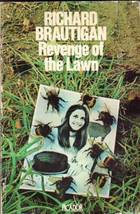
Richard Brautigan, Revenge of the Lawn (1972, Picador 1974 – with British spelling!)

BrautiganA Book Group member was given a copy of this book by his son, and thought it would be a good quick read for our December meeting, when there are so many competing demands on our time. None of the nearby libraries had copies, and I may have got the last one listed in Australia at AbeBooks. Other members of the Group made do with PDFs. So I was feeling pleased with myself when I opened my slightly stained book, formerly the possession of one Kerry Thomson. That pleasure had pretty much evaporated 50 pages later. It was only corps d’esprit that kept me going: if David and Keith had persevered with the Coetzee book in spite of finding nothing there to interest or please them, surely I could hack another hundred or so pages of underdeveloped twaddle – reminiscence, dream fragments, quirky observations – snapped up by a publisher confident it would sell on the coattails of Trout Fishing in America, published about a decade earlier. That was my state of mind after reading 12 of the book’s 62 pieces.

Things improved at about page 60. It was probably the piercing nostalgia for childhood games in ‘The Ghost Children of Tacoma’ that dispelled my irritated boredom. After that, I was drawn in mainly by pieces capturing (or perhaps re-imagining) moments from his childhood: ‘Blackberry Motorist’, in which he discovers an abandoned car under a high tangle of blackberries; ‘The Post Offices of Eastern Oregon’, a kind of Lake Wobegon horror story; ‘One Afternoon in 1939’, in which he tells a story his little daughter loves to hear, and ends beautifully, ‘I think she uses this story as a Christopher Columbus door to the discovery of her father when he was a child and her contemporary’; ‘A Complete History of German and Japan’, which would be great without the nudging of the terrible title.

After another 50 pages or so, the whimsical observations of life in San Francisco bars, buses, streets, bedrooms and bookshops became the dominant mode, and I lost interest again.

I came across a thoroughgoing web site devoted to all things Brautigan, and found a page giving the place of first publication of these stories. A good number first appeared in Rolling Stone and I’m sure they sat comfortably with the dope and psychedelia of its pages. Mostly they haven’t travelled well. And I haven’t even mentioned the casual sexism.
—–
I wrote that a couple of weeks ago when I’d just read the book. Tonight the Group met, at a very expensive Japanese restaurant, where we managed to have an interesting conversation about the book before ranging off in a hundred other directions. There was genral agreement that the quality was patchy, but my impression is that other people enjoyed the book as a whole much more than I did. One guy had read it in the 70s, so this reading was partly an exercise in nostalgia. The frequent quirky similes, which irritated me, gave delight to others. One comment was that the prose generally left a lot of room for the reader to fill out the picture, in contrast to a lot of recent writing that corrals your response leaving you nowhere to go but where the writer decides. I didn’t understand what he meant until he said that the reading made him think back to his own childhood – and I realised that for me that was a good part of the childhood stories’ the appeal: some of them, at least, triggered a mood of reminiscence, of reflection on my own childhood with a kind of openness to wonder. And of course it was worth ploughing through a fair amount of unaffecting stuff to have that.

Mungo on Kevin

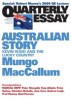
Mungo MacCallum, Australian Story: Kevin Rudd and the lucky country (Quarterly Essay issue 36, 2009)

Mungo MacCallum is now, according to the blurb of this Quarterly Essay, one of Australia’s most influential political journalists. He was probably already influential all those years ago when he was telling Nation Review readers how well Prime Minister Gough Whitlam filled a pair of swimming trunks, but now he is an elder. Mercifully, he is also still a bit of a smart Aleck.

There are no hints here about Kevin Rudd’s physical endowments – the essay’s main interest is in the nature of his appeal to voters. The essay quotes poetry, mainly bush verse, including a savage parody of ‘Clancy of the Overflow’:

He was poisoning the water when he chanced upon a slaughter
So he joined in patriotically to massacre and rape
And he sees the vision splendid of the native problem ended
and a land made safe for cattle from Tasmania to the Cape.

The essay takes the odd potshot at contrarian right-wing columnists. It produces some fabulous quotes, including for example a definition of a modern progressive as ‘a fella that stumbles forward every time somebody shoves him’. (Sadly there are no footnotes, so we often don’t know what wits are being quoted – I’m guessing Mungo himself did the Paterson parody.)

That is to say, there’s a lot to enjoy in this essay. It also has substance – of an airy sort. It deals with policy, that’s true, and Kevin Rudd’s largely successful response of the GFC, but mainly it argues that he taps into some deeply held myths about what it means to be Australian – egalitarianism, fairness, the larrikin–dutiful citizen dichotomy, that reluctant progressiveness, ‘fervent, if understated, nationalism’. ‘For all his nerdiness and prolixity,’ he concludes,

there is something very Australian about him, and the voters recognise it. In a totally unexpected way, Rudd has given them back their Lucky  Country – and this time not in a spirit of irony, but one of self-belief.

Hmmm … But I enjoyed the ride.

This issue also includes the 2009 Quarterly Essay Lecture, ‘Is Neo-Liberalism finished?’ a search for the meaning of what he calls the Great Recession by the chair of the editorial board, Robert Manne. The lecture isn’t as much fun as the title essay, covers some of the same ground, occasionally manages to be incomprehensible when explaining (yet again) how the Great Recession came about. Where MacCallum takes cheerfully bitter potshots, Manne eviscerates in earnest.

And then there’s correspondence about Noel Pearson’s Radical Hope. A number of the correspondents join in Pearson’s left-liberal bashing, and there’s a certain amount of jockeying for position from politicians and activists. Voices from the old Howard Government era talk of Pearson’s pre-eminence as an Aboriginal public voice on the national scene, without mentioning that the deliberate dismantling of ATSIC had destroyed any more organised and representative voice. Christine Nicholls, former principal of Lajamanu School in Yuendemu, is the only educationalist to write a substantial response, and she does a brilliant job of respectfully taking Pearson to task for his straw-man arguments against ideologically driven educationists. The only Aboriginal voice is that of Chris Sarra, who gently chides Pearson for dismissing elements of his own educational work without having ever visited it. Over all, the correspondence confirms that Pearson’s conversation is mainly with conservative white leaders, but it also shows him as eager to do more than simply pontificate as a lone voice.

No, really, what does fortuitous mean?

Mungo MacCallum has coined more than his share of memorable phrases. He quotes poetry and can work up an excellent bush ballad. His prose is generally witty and lucid. He’s not an academic, he’s a writer. In the current Quarterly Essay, which I’ll say more about in a day or two, he writes this:

From the start [non-Indigenous Australians] showed a preference for the young tree green of a new land over the old dead tree of Europe, which was in any case so remote as to be, for all practical purposes, irrelevant. Geoffrey Blainey’s ‘tyranny of distance’ was frequently seen not as a curse but as a blessing. Australia was fortuitously and proudly girt by sea.

I can’t make that fortuitous mean `happening by chance’, whether to one’s advantage or not. The word has clearly taken leave of its dictionary meaning. As in the example I quoted a couple of weeks ago, it seems to be a kind of intensification of fortunate, almost an equivalent of providential for those of us who no longer believe in Providence.

What do you think? Mungo, are you there?