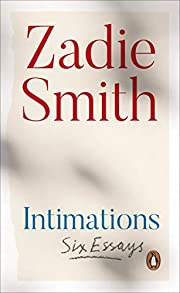
This tiny book was written in the first half of 2020, when Covid-19 was running wild in New York City, where Zadie Smith teaches creative writing. It comprises six personal essays, which their author describes in her foreword as ‘small by definition, short by necessity’. They are written in the spirit of what she learned from the stoic philosopher Marcus Aurelius: ‘Talking to yourself can be useful. And writing means being overheard.’
It’s a tiny book, but it’s not slight. As I read it, I could feel my personal understanding of the word ‘intimations’ changing to include an element of intimacy. These essays ruminate intimately on life, art and relationships in the middle of a pandemic. The first essay, ‘Peonies’, sets the tone:
Just before I left New York, I found myself in an unexpected position: clinging to the bars of the Jefferson Market Garden looking in. A moment before I’d been on the run as usual, intending to exploit two minutes of time I’d carved out of the forty-five-minute increments into which, back then, I divided my days.
She was transfixed by the sight of a bed of garish tulips, wishing they were peonies. That moment leads into reflections on the concept of a ‘natural woman’, the nature of creativity (‘Planting tulips is creative. … Writing is control’), the ‘global humbling’ that was to happen a few days later, on creativity and submission. She quotes a parable from Kierkegaard about the difference between how we actually are in the world and the stories we tell about ourselves in the world. You can make them peonies in a story, but they are still tulips in the real world. With the lightest of touches, the essay takes us into the deep challenge that April 2020 – ‘an unprecedented April’ – presents to our sense of ourselves.
The second essay ‘The American Exception’, also has a brilliantly enticing first line: ‘He speaks truth so rarely that when you hear it from his own mouth – 29 March 2020 – it has the force of revelation.’ We know exactly who she means. Paradoxically, the truth he spoke is that before that date ‘we didn’t have death’. The essay goes on to justify the paradox beautifully.
All the essays tackle big themes, and do it lightly. The longest, ‘Screengrabs (After Berger, before the virus)’ is the one where the author brings her gifts as a novelist most strongly to bear. I think the Berger in brackets is John Berger, and there may be a reference to his famous quote, in Understanding a Photograph: ‘I have decided that seeing this is worth recording.” The essay offers six portraits, mostly of people peripheral to Smith’s New York life, though one, subtitled ‘An Elder at the 98 Bus Stop’, is someone who has known her since childhood back in London. Each of the portraits has a twist at the end, as the pandemic leads the person to reveal something unexpected about themselves. After the portraits, there’s ‘Postscript: Contempt as a Virus’:
‘The virus doesn’t care about you.’ And likewise with contempt: in the eyes of contempt you don’t even truly rise to the level of the hated object – that would involve a full recognition for your existence.
The brief essay-within-an-essay ranges over racist micro-aggressions, Dominic Cummings’s cavalier violations of Covid restrictions, and, most compellingly, the look on Derek Chauvin’s face as he murdered George Floyd.
I haven’t read anything by Zadie Smith before this. I haven’t even seen White Teeth on TV. I’ve enjoyed her brother Ben Bailey Smith’s occasional stints on the Kermode and Mayo’s Film Review, but that’s as close as I’ve got. I brought this book home from the Book(-swapping) Club, and Im very glad to be introduced to this fine writer.
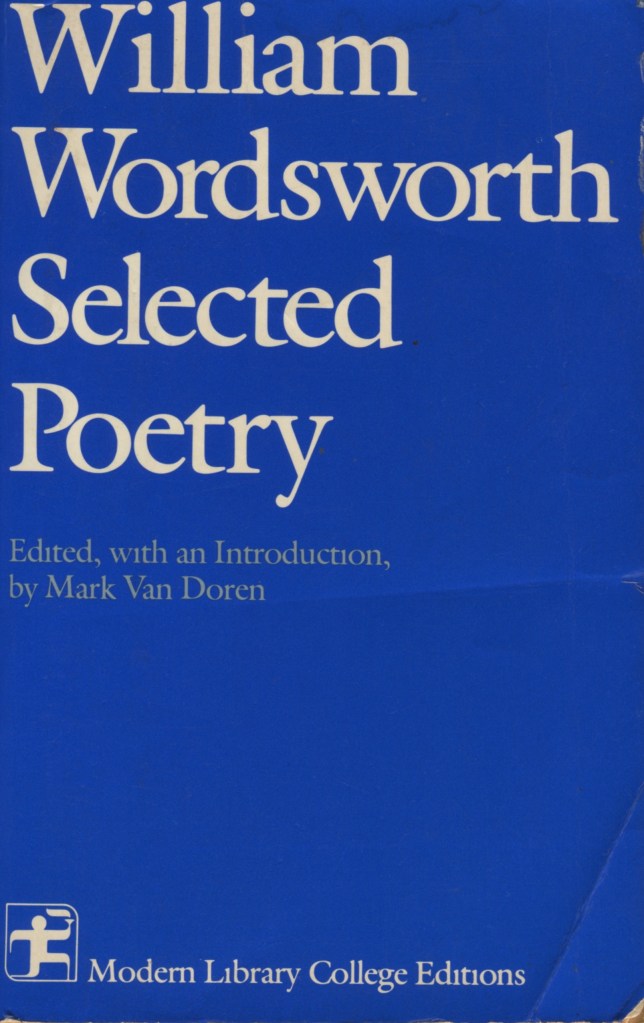
William Wordsworth, ‘The Prelude, or, Growth of a Poet’s Mind’, in William Wordsworth Selected Poetry, edited, with an Introduction, by Mark Van Doren (Modern Library College Edition 1950), Book Fourth line 339 to Book Seventh line 618.
I’ve now been reading ‘The Prelude’ for two months, 70 lines first thing in the morning every day except one, when an an early doctor’s appointment messed things up.
It has been a pleasurable enterprise – nothing like a dose of beautifully crafted language to start a day well. The first four books dealt with Wordsworth’s childhood, his school days, his time at Cambridge, and a summer vacation from Cambridge. At the end of Book Fourth, after pages about the pleasures of summer holidays, these lines struck a chord when read during our Covid lockdown:
When from our better selves we have too long
Been parted by the hurrying world, and droop,
Sick of its business, of its pleasures tired,
How gracious, how benign, is Solitude;
How potent a mere image of her sway;
Most potent when impressed upon the mind
With an appropriate human centre—hermit,
Deep in the bosom of the wilderness;
Votary (in vast cathedral, where no foot
Is treading, where no other face is seen)
Kneeling at prayers; or watchman on the top
Of lighthouse, beaten by Atlantic waves
The next three books – Fifth, Sixth and most of Seventh – are handily titled ‘Books’, ‘Cambridge and the Alps’, and ‘Residence in London’. He constantly plays off the natural and rural worlds against the urban, busy or frivolous world. There are some satirical passages, but the best bits are the ones that celebrate the beauties of the natural world or works of the imagination. When he was about 20, he took time off from Cambridge for an epic walk across France to the Alps early in the French Revolution: Book Sixth documents the joy that filled the countryside at that time, and leads to some wonderful passages about the Alps.
And now, he’s in London, enjoying the theatre, including music hall, and being less than impressed by the way language is wielded in parliament (‘Words follow words; sense seems to follow sense’), in the pulpit, and all around him (‘Lies to the ear, and lies to every sense’). But he is struck by ‘individual sights / Of courage, or integrity, or truth / Or tenderness’, and my reading this morning finished with such a sight – a working man sitting in the sun with a sickly baby on his knee:
Of those who passed, and me who looked at him,
He took no heed; but in his brawny arms
(The Artificer was to the elbow bare,
And from his work this moment had been stolen)
He held the child, and, bending over it,
As if he were afraid both of the sun
And of the air, which he had come to seek,
Eyed the poor babe with love unutterable
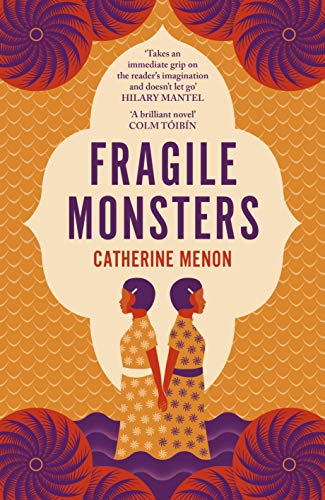
It’s 1985. Durga’s relationship comes to an end when her lover returns to his wife. She leaves her job as a maths lecturer in a Canadian university and takes her wounded heart back to her native Malaysia where she gets a job at a university in Kuala Lumpur. When the novel opens she has left KL for Diwali to visit her cantankerous grandmother in the village of Kuala Lipis where she grew up. A gift of fireworks goes badly awry, the roads are shut by floods, she stays in the village much longer than expected, and while she’s there confronts the ghosts – fragile monsters – of her past.
In alternating chapters we read the story of Mary, Durga’s grandmother: her childhood, her experience of the Japanese occupation in the 1940s, the Malayan Emergency, her relationship with her daughter Francesca, who was Durga’s mother.
The two narratives come together in the climactic final chapters. Durga makes some deeply disturbing discoveries about her family history, and the great miasma of stories that she grew up with are resolved into some kind of reality.
Throughout, there’s a contrast between Durga’s world view and her grandmother’s. Durga is thoroughly westernised, and loves the world of mathematical exactness and consistency. Her grandmother is a wild woman who tells stories that differ with each telling. Durga finds herself being drawn back into her childhood world of ghosts and half-truths.
I’m glad I read this book. The characters, especially the grandmother in the present time, feel real, and there are rich insights into Malaysian traditional culture and history. (The university in Kuala Lumpur is an offstage presence that tries to pull Durga back to westernised, mathematical reality, but without a lot of success.) But it didn’t sweep me away. It was as if I could always feel the work that was going into the writing – a symptom of this is the occasional reflection on mathematical concepts. These feel like scaffolding the helped the writer create the work, but needed either to be more fully integrated or designated as darlings to be killed.
Inspired by the success of the first two Catwings books, we bought the other two online (not from Amazon). They arrived a week apart and in the wrong order, so Ruby got the story in a nonlinear fashion, but it didn’t seem to matter. Here they are in their correct order.
Alexander is a kitten who believes in his own wonderfulness, and is tremendously brave in his home environment. He ventures out into the world where he meets with actual danger and finds himself stuck up in a tree and terrified, when along comes little black Jane-with-wings from Catwings Return to help him down.
The two kittens develop a strong bond, and (spoiler alert!), Alexander is able to help Jane face the early terrifying experience that has left her functionally mute, and having faced it regain her capacity to speak
After having this read to her once, Ruby cast her Nana and Pop as various cats and herself as Jane, and then Alexander, but mainly Jane, and a good time was had by all. The book was then read several more times. Thelma, who barely features in the narrative to my mind, is firmly entrenched as Ruby’s favourite character, possibly because she is the oldest of the Catwings siblings, the big sister, a role Ruby revels in in real life.
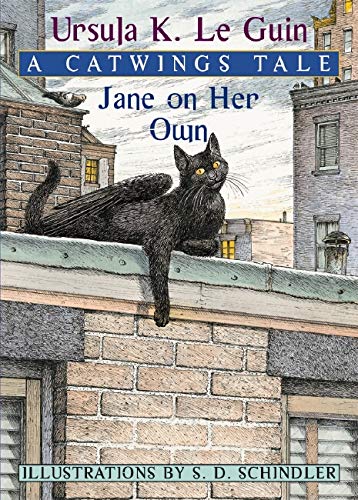
Jane takes centre stage here. Bored with the safe life on Overhill Farm, she sets out on an adventure. The others all warn her that if human beings (not ‘beans’) see a cat with wings they’ll either put her in a cage or take her to a laboratory. As it happens, Jane finds herself for a time a captive TV celebrity.
When I saw the title of this book, I thought it was going to be about the Catwings’ mother, Mrs Jane Tabby, and I’m a little ashamed that I wasn’t all that interested. Mrs Jane Tabby does make an appearance at the end, and the whole series finishes, like the first book, with human-to-cat kindness.
I hope Ruby keeps on loving these books, because at the moment I’ve got them on a par with where the Wild Things Are or The Sign on Rosie’s Door for enduring readability.
I blogged about this book some years ago, here. It was a gift from the author to Ruby, back when looking at pictures of cats was what Ruby did by way of reading.
She asks for it often just now, and a measure of her engagement with it is a question she asked last week as we were out walking: ‘Poppa, do you think Rose Quong is a beautiful name?’ Rose Quong makes a bigger impression than Nellie Melba, and she’s very interest to know if Edith Cowan had babies.
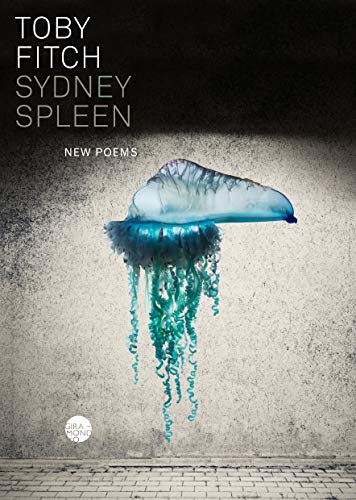
There are four poems with the title ‘Spleen’ in Charles Baudelaire’s Les fleurs du mal (1857). Toby Fitch’s Sydney Spleen is roughly structured around those poems – its first three sections begin with his version of one, and the third section finishes with his version, or perhaps his re-imagining, of the fourth.
The translations are a long way from word-for-word French-to-English transcriptions. Only the first of the four preserves Baudelaire’s conventional line-by-line layout, but even in it the Fitch version moves the action from Paris to Sydney, and in its final couplet, rather than two court cards muttering sinisterly about their defunct loves, the looming climate catastrophe disinters ‘whole centuries of fear’. On close reading, though, these versions are astonishingly true to the originals – recreations of the same mood of disgusted melancholy in a different cultural, geographical and ecological context. (I have had quite a bit of nerdy fun comparing these versions with other more conventional ones. If you’re also inclined that way, you can find Baudelaire’s first ‘Spleen’ and a handful of English translations at fleursdumal.org. The Fitch version is online here.)
In the rest of the book, poem after poem vents its spleen on this city and this country, articulating – to quote the excellent back-cover blurb – ‘the causes of our doom and gloom: corporate rapacity, climate change, disaster capitalism, the plague, neo-colonialism, fake news, fascism’. They do it with gusto, with dazzling wordplay, and with the engagement of a parent of small children and owner of an ailing small black dog.
I’m not a critic or a scholar. Mostly, I read poetry for pleasure, and even though in a number of the poems in this book I have no grasp of their organising principles or structures, there is almost always something to give pleasure. I feel a little the way I did on first hearing Bob Dylan’s ‘Sad Eyed Lady of the Lowlands’ or ‘Desolation Row’ – the words have a magic that doesn’t depend on me understanding them. For example this, from ‘New Work Metaphorics’ (page 19), which seems to be the inspiration for the book’s cover:
I've got over 73
tabs open in my hot
skull right now, one of which
on death-cult capitalism says, Thereare more important things than living and
I agree with the whole of my man-o'-war
heart still beating its stung drum.
Skeletal, diaphanous, I am
traversed by grace,
a windowpane
The image of multiple open tabs in one’s hot skull is fabulous. I don’t understand that man-o’-war image, but I love it.
There are poems that play around with the n + 7 game invented by the Oulipo poets in the 1960s – you take a passage and replace every noun with the one that comes seven after it in the dictionary. A pretty soulless activity you might think, but when you do it to a certain kind of public utterance, and tweak it a little, the results can be savage, as in this mangled mash-up of Scott Morrison’s ‘I will burn for you’ and ‘This is coal’ speeches (in ‘Captain’s Cull’):
I will burnish for you every deadbeat,
every single deadline, so you can achieve
your amnesties, your assemblies, your destinations.
That is what's at the torch of my aid.
And this is coalface. Don't be afraid. Don't
be scared. An ideological, pathological
feedback of coastline won't hurt you.
There are poems that use homophones to similar effect, like this, from ‘The Last few Budgets in a Nutshell’:
Wort I'm swaying is, Barry, the primonastery
has my combpleat confit dense. It's imply
inTrumpting bracket creep and I tink the sir plus
is a goner schtick. HoWeber the diss royalty of sum
has been outray juice.
So many levels of splenetic wonderfulness in ‘the sir plus is a goner schtick’!
There are found poems, including one that claims to have been copied verbatim from the label on a bottle of water, and others that play around with found texts. There are prose poems that may be accounts of dreams, especially a sequence titled ‘Pandemicondensation’. And there are poems that take us on a ride through conversations with the poet’s young daughters, online idiocies, dire environmental news, encounters with the police, and more, all tossed in together but somehow making a whole.
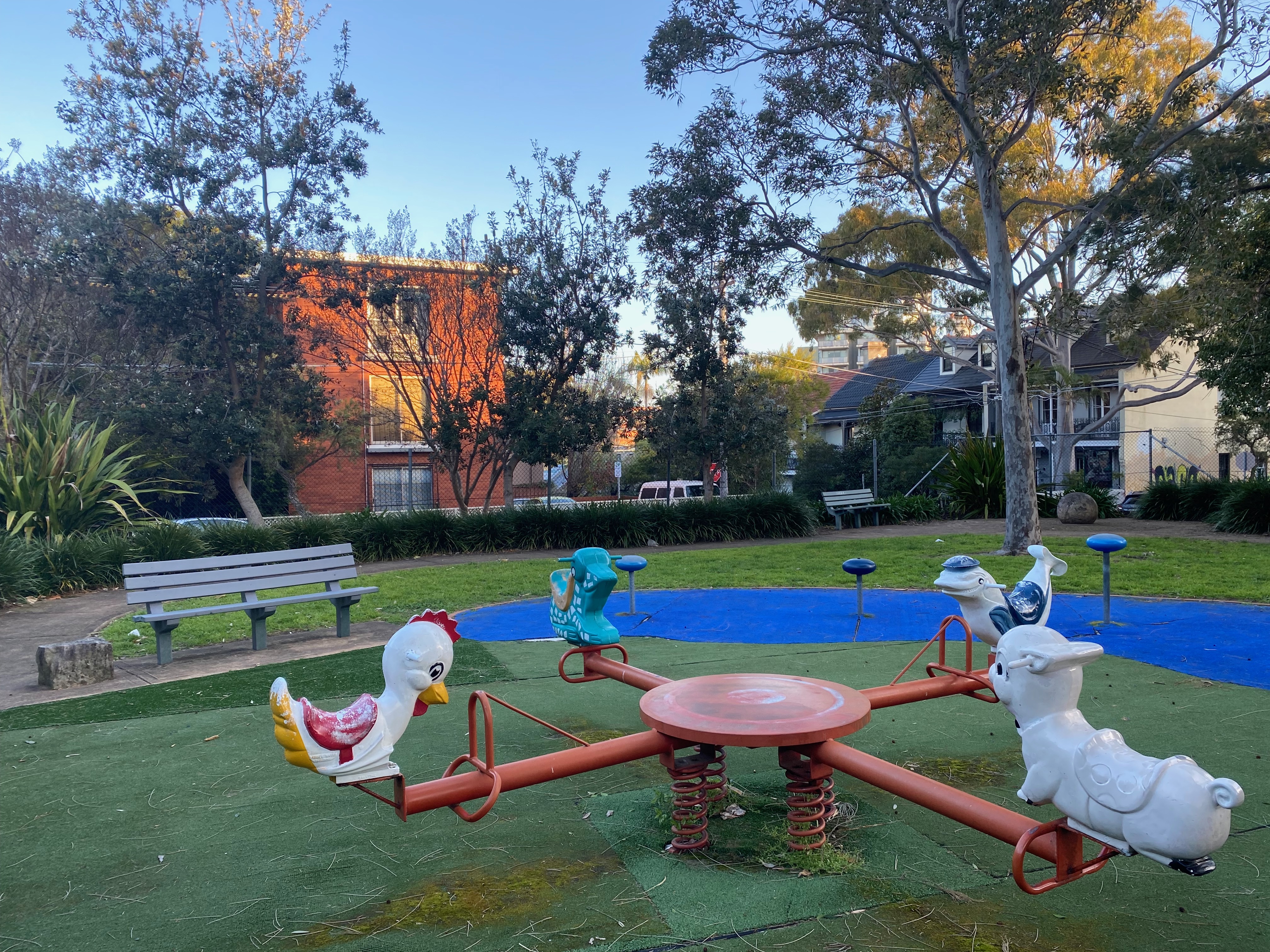
The part of the book I really love is the fourth section, a single prose poem in 25 parts called ‘Morning Walks in a Time of Plague’. It’s exactly what the title says. The poet goes for a morning walk during Covid lockdown with his partner, their two young daughters and their little black dog. In the first eight parts they go to the lovingly evoked ‘chicken park’. I’ve been to that park with a little girl more than once, and am delighted that it has been immortalised. Here it is:
In the rest of the poem, they go to Camperdown Cemetery, whose celebration in verse I’ve already blogged about (here).
Both these places come wonderfully alive in what purport to be – and I believe mostly are – straightforward accounts of daily visits to these locations. Sometimes the adults join the girls’ imaginative play, which mostly involves unicorns, or alicorns to be precise. Occasionally they yell at them. Sometimes they get lost in their phones, reading news about the pandemic or plague-related texts from Boccaccio, Defoe, Camus and contemporary scholars, the latter via Twitter. The narrator is aware that the late John Forbes lived nearby (I’m guessing it was in the sunlit brick building in the photo above), and quotes lines from his poetry. The two imaginative worlds co-exist easily with the natural world of high winds, dropping pine cones and orgiastic lorikeets. Once the poem moves to the cemetery, the context broadens out to include precolonial and colonial history, as well as a pervasive sense of mortality, and, oh, a hint of Lovecraftian horror. All this happens in unforced prose narrative, so that one barely notices the dark, melancholy undertow: the dog’s body is failing, the girls have little accidents, there are countless tales of the buried dead, they come across a dead bee, and all the time the pandemic looms just outside the poem’s frame.
It’s hard to find a short passage that conveys the pleasure that this poem gives, but here’s an attempt, from the 17th part, featuring the poet’s daughters Evie and Tilda:
Once we reach a clearing, Evie spots an alicorn flock in the
sky. They eat the belly-sized candlenut leaves we offer them.

When we reach the other swamp mahogany, in the
northwest, it's clear the lorikeets are coming and going
between the two, raucously. The tree's thick chunky brown
bark looks super tough but up close is pliant, squidgy.

Tilda needs to do a 'bush wee', which ends up going down
the backs of her legs into her gumboots.

On the way home Evie finds a feather which I decide is
from a pigeon, though she says it has too much shine.

In the back alleys we meet, perched on a back gate, a black-
and-white cat adept at keeping his distance from our loose
hands.

It is forbidden to spit on cats in plague-time, writes Camus.
See what I mean? This is funny, affectionate, and melancholy all at once. The play between adult and children is fresh and respectful. There are notes on nature and some acute social observation – the cats of Newtown are notoriously self-possessed. These paragraphs quote The Plague, feature My Little Pony figures, and arguably allude to Bluey. With apparent effortlessness, they invite us into an intimate world. The tiny hints of something being amiss, in the description of the tree’s bark and the trouble with Tilda’s wee, are unstrained, and we could almost forget there’s a pandemic on, but the cat sets off an association that reveals the pandemic is always hovering in the poet/father’s mind.
For quite a few years now I’ve enjoyed the fruits of Toby Fitch’s labours as organiser and MC of poetry readings, editor and critic. I’ve heard him read, I’ve read a number of his poems in journals, and I’ve tagged him in this blog a number of times (here’s a link). I used to see his distinctive unruly head of hair behind a stroller in the local park (not the chicken park) accompanied by the small black dog. But though he has had seven books of poetry published, Sydney Spleen is the first I’ve read. I’m very grateful to Giramondo for my review copy.
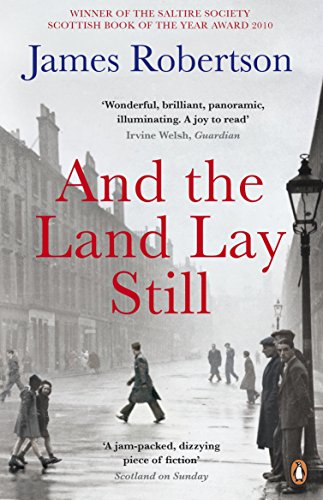
Before the meeting: The Book Group had a run of Russian novels last year. This year we’ve moved to Scotland, though as with Russia any fears of sameishness would have been misplaced: a bigger contrast between this book and Janice Galloway’s The Trick Is to Keep Breathing would be hard to imagine. Where that book is introspective, claustrophobic and grim (though some disagreed about that), this one is expansive, multifarious and in the end upbeat.
Among other things, And the land lay still is a history of Scotland in the second half of the 20th century, with a focus on the growth of Scottish nationalism leading to the yes vote for the Scottish Devolution Referendum in 1997. The book’s title comes from ‘The Summons’, a 1984 sonnet by Edwin Morgan who was to become Scotland’s first national poet in 2004: the poem marks a moment when the Scottish electorate did not vote for the – it ends, ‘a far horn grew to break that people’s sleep.’ The book relates the slow and tortuous response to that summoning horn. It traces the lives of a diverse score of characters: a Tory member of the UK Parliament, the photographer son of a photographer, a war veteran, a boring spy, a vicious thug, a woman who hosts a bohemian salon, an English nurse who moved to Scotland when she married a Scot and stayed, a rich girl who becomes addicted to a string of radical causes, an investigative journalist who gets into serious trouble and, appearing in italics between the main chapters, a wandering tramp-like figure who takes on an uncanny symbolic identity in his own mind and in the mind of the novel.
At the end of the first of the book’s six parts, just as I was settling into one story, I was shocked to realise that a whole new narrative was beginning, with new characters in a different time and place. And the sharp breaks continue with each new part, and then within the parts. Perhaps the spy’s story dragged on a bit (his name is Jimmy Bond, but he changes it to Peter to avoid bad jokes, and the dragging on is partly intentional, making the point that spies can be very boring people). The depiction of the Tory politician’s sexuality may involve a slightly blunt satirical jibe about Maggie Thatcher’s appeal. And the eventual fate of the hideously violent thug may be too kind, too neatly conveyed. But if those are faults, they’re minor ones. This is a terrific book, with some spectacularly good writing. And it’s very Scottish.
Here’s the passage where the music of Scottish language first asserts itself and where I became totally hooked. The speaker is Walter, a minor character who is a folk singer:
In thae days, if ye were a working-class boy and ye wanted a better kind o life than the one that was mapped oot for ye, there was just two ways o daein it: ye could become a professional footballer, if ye were skilled enough, or ye could become a professional boxer, if ye were hard enough. And then this third opportunity came along: ye could form a band and sing your way tae glory if ye were bonnie enough. Weel, I wasna skilled or hard or bonnie enough for any o thae things, sae I become a plumber. But then something amazing happened. I was on a job doon at Lauder, on the road tae England, and I was there for aboot a week wi a couple o other boys, up and doon the road every day, and on the last day, when we'd finished the job, we went for a few pints in a pub afore we came back up the road. And there was this auld man there, and he just started singing. There was a wee lull in the general noise, ye ken, and he started singing intae that space. The haill pub went silent as he sang, he didna hae the best voice, it was auld and quavery and a bit flat but by Christ he had us aw spellbound, we aw listened, even the guys that were wi me, on and on he went, verse efter verse efter verse, a story aboot a sister and her lover, and her brothers killing him because he wasna good enough for her, and her defiance when the faither tried tae mairry her aff tae another man. Weel I'd never heard anything like it in my life, and when he was done I went over and bought the auld fellow a drink and asked him aboot it.
After the meeting:
Sadly, we’re still meeting remotely, but we are meeting. One person couldn’t make it because he’d had his first Astra Zeneca shot in the morning and was feeling wiped out, which led to a lot of comparing of post-shot symptoms at the meeting.
Those who’d finished the book loved it. No one had stopped reading from lack of interest. Some felt that at 670 pages it was too long, but no one would say which character they would have cut. Some felt that now and then they were being treated to a lecture on Scottish history that they could have done without, that the vividly realised characters, their relationships and life stories made the detailing of broader history unnecessary. I disagreed. I loved the interplay of those elements. The English-born group member said he too loved the explicit history, as it led him to revisit his young understanding of what was going on in Scotland and see it afresh.
We spent a lot of the meeting reminding each other of the good bits. One or two chaps had to clap their hands over their ears now and then as we discussed parts they hadn’t read, but someone pointed out that Rule 738B says that books may be discussed in their entirety regardless of whether everyone in the room (or zoom) has read the whole thing.
Some responded strongly to a sweet romance (if you’ve read the book, you’ll know what I mean if I say ‘the kiss’), others to the relationship between the salt-of-the-earth father and his wrong-‘un son. Someone reminded us of the way now and then a character tells a story that stands alone as a kind of parable. We didn’t get as far as the way one such story is told early in the book as a kind of folk legend, then again as an eye-witness account, and yet again as a brief newspaper story.
There was some discussion of gender fluidity, but I can’t remember how, or even if, that related to the book.
I got some advice about a dilemma to do with lockdown hair and my barber having shut up shop, which definitely had nothing to do with the book.
It looks as if our next meeting, in six weeks time, will also be on screens.
So much to read, so little time. So many journals, so few subs, and still I can’t keep up.
Evelyn Araluen and Jonathan Dunk (editors), Overland 238 (Autumn 2020)
Published more than a year ago, this is the first issue of Overland edited by Evelyn Araluen and Jonathan Dunk. The new editors swept in not so much with a new broom as with a sandblaster. The regular columns are gone; issues are themed (though judging from a quick look ahead this change only lasted three episodes); and there’s a bold new feel to the design.
It may be part of the new approach, or perhaps it’s teething problems, but I found some of the articles in this issue hard going to the point of being unreadable. Some dispense with sentences as we have known them. Others disappear unapologetically down etymological and literary-history rabbitholes. Yet others drop unexplained references to – I assume – French theorists, with no apparent purpose other than to discourage non-insiders. I tried, I really did, and I’m pretty sure I missed out on some terrific insights, but I just couldn’t finish a number of them. And that’s before I got to John Kinsella’s sequence of poems, ‘Ode to the defenceless: from hypotaxis to parataxis‘, whose prolix obscurity lives up to the promise of its title. I’m not completely sure that some kind of complex leg-pulling isn’t involved, as in the infamous Sokal affair.
This was all the more disappointing because the journal kicks off with a genuinely interesting piece, Toby Fitch’s obituary for British revolutionary socialist poet Sean Bonney (1969–2019), ‘Our Death: Aspects of the radical in Sean Bonney’s last book of poems‘. Toby describes Bonney as having ‘a performative ethics of scathing animosity and nihilistic humour’, and gives the reader plenty of what is needed to grasp the two poems by Bonney that follow his article.
Of the other articles, I want to mention ‘Welcome to the Nakba: notes from the epicentre of an apocalypse‘ by Micaela Sahhar – nakba is Arabic for ‘catastrophe’ and usually refers to the dispossession of Palestinians in the founding of the Israeli state. Writing in the aftermath of the 2019–2020 bushfires, Sahhar offers a startling perspective on Australia’s challenges:
Dear settler-Australia, your Nakba has arrived. Don’t feel helpless, powerless, frustrated, and above all, don’t pray for a miracle. I can tell you from the other side that it will never arrive. It’s time to tackle the structures you made, the structures that will ruin us all.
Poetry and fiction are still a major presence in the new-look journal, and this issue, like its predecessors, includes the results of literary competitions.
The Neilma Sidney Short Story Prize, judged by Joshua Mostafa, Margo Lanagan and Hannah Kent, was won by ‘The Houseguest‘ by Jenah Shaw, a story that captures brilliantly the uneasy situation of a young person who has left home in the country to stay with a family in a big city.
The Judith Wright Poetry Prize had three winners, published here with notes from the judges – Michael Farrell, Toby Fitch and Ellen van Neerven, had three winners. Each of these excellent poems left me bemused more than anything else.
Then there are four short stories, which arrive like a reward for persevering: ‘Creek jumping‘ by Cade Turner-Mann, a tiny moment in a rural community that reflects and resists the impact of environmental degradation and colonisation; ‘Mermaid‘ by Gareth Hipwell, a borderline science fiction tale of eco-guilt; ‘Pinches‘ by Emily Barber, an abject tale of sexism; and ‘Urban gods‘ by Cherry Zheng, which could be a starting sketch for a dark fantasy/sci-fi television series.
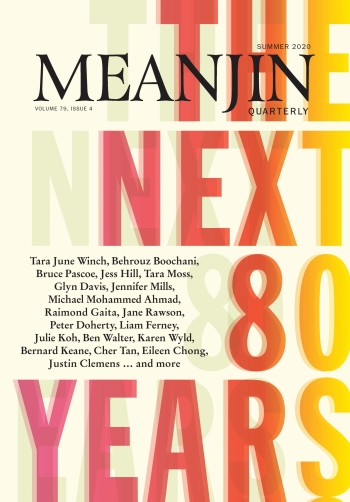
Far from being a new broom, this issue of Meanjin celebrates its continuity with the journal’s past 80 years, reproducing Clem Christensen’s first editorial and featuring short pieces from each of his ten successors in the editorial chair. A powerful narrative emerges of a publication that has managed to survive and thrive in the face of serious challenges, and that has transformed itself many times over to meet the changing times.
Then there’s a stellar line-up of writers, many of them responding to the ‘Next 80 Years’ theme.
Some I need only name for you to get a whiff of their excellence, and timeliness:
An email dialogue about time and memory between Behrouz Boochani and Tara June Winch, apparently an excerpt from an ongoing conversation between these two writers
An article from Jess Hill on police responses to domestic abuse call-outs – following up a chapter in See What You Made Me Do
A scathing piece about the tree-hating official response to the bushfires, by Bruce Pascoe
An even more scathing piece by Michael Mohammed Ahmed about White victimhood (starting with the observation that though people complain that it’s racist to name their Whiteness, it was White people who invented the term)
A wide-ranging and lucidly angry piece by Raimond Gaita on moral philosophy vs economics in the context of Covid-19.
And that’s only part of it. Of the remaining articles, the standouts for me are ‘Consider The Library’ by Justine Hyde, a wonderful account of the changing roles of public libraries in Australia and elsewhere, including their potential contributions to averting climate catastrophe; ‘More Than Opening The Door’ by Sam Van Zweden, which advocates for inclusion of people with disabilities in Australian literary life, arguing in particular that if a publication commissions a piece on, say, mental health issues from someone who is drawing on their own experience, then the publication needs to consider having a duty of care to the writer; ‘Heading to Somewhere Important’ by Martin Langford, a brief account of the changing face of Australian poetry over the last 80 years – an impossible task acquitted with grace; and Nicola Redhouse’s ‘Future Tense’, which engages with Shoshana Zuboff’s The Age of Surveillance Capitalism, in ways that are probably crucial to making that ‘intimidatingly thick opus’ as accessible and influential as we all need it to be.
Scattered like jewels through the pages are poems from David Brooks, Kim Cheng Boey, Eileen Chong, Sarah Day, Jill Jones, David McCooey, and more. If you count two pieces labelled ‘memoir’ that look back from the year 2200, there are six short stories, which project a range of pretty depressing futures. My pick of them would be Tara Moss’s The Immortality Project, where being able bodied is seen as indicating deficiency, and uploading one’s consciousness to Another Place leads to an interesting twist on the expected outcome.
Decades ago, I was a keen subscriber to Meanjin, and in my mid twenties I bought a swag of back copies (from Kylie Tennant, as it happens, whom her husband L C Rodd described to me over the phone as ‘an extinct volcano of Australian literature’). I loved my collection and browsed in it often, but sold it and let my sub lapse when space and time shrank around me with parenthood and a job that required a lot of reading. When I considered resubscribing some time ago, I was deterred by the tiny type – as noted on my blog, here. Someone gave me this issue as a Christmas present, and it seems very likely that I’ll resubscribe.
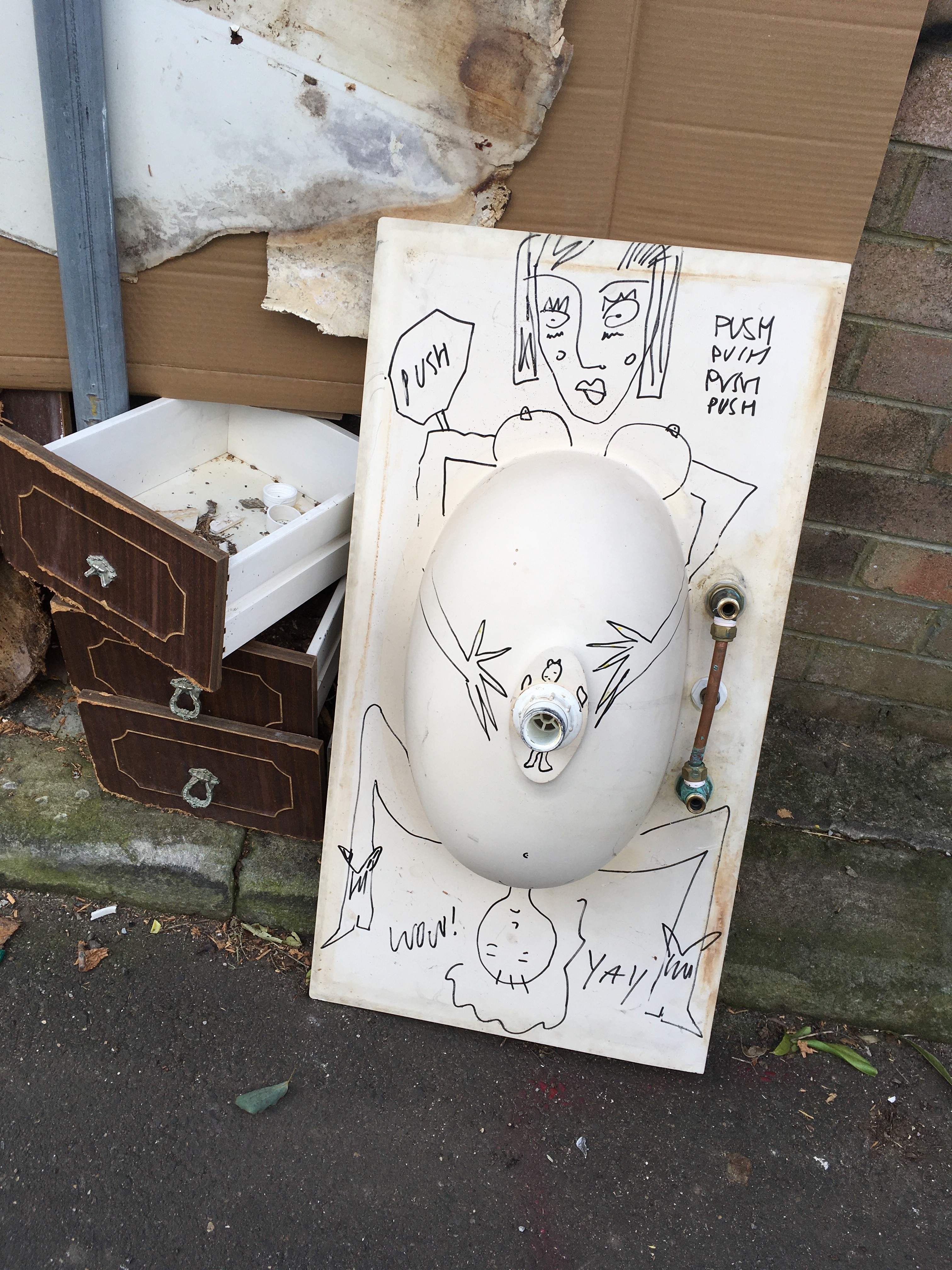
Mattresses aren’t the only discards that stir the creative impulses in the Inner west. A friend sent me this photograph, taken in a Stanmore lane. I think this work needs to be preserved for the ages.
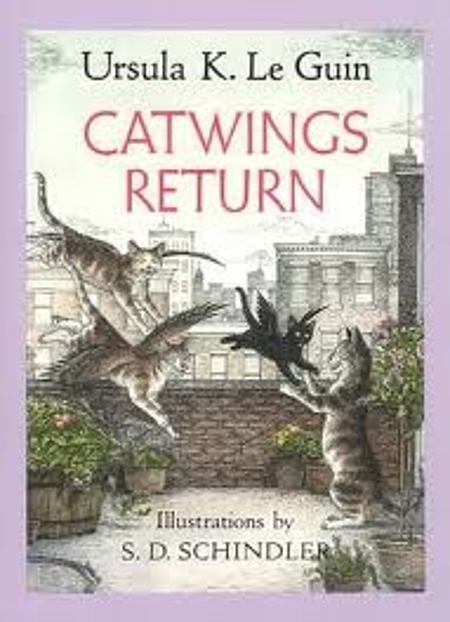
Ursula K Le Guin, Illustrated S D Schindler, Catwings (Orchard Books 1988) –––––, Catwings Return (Orchard Books 1989)
Yesterday, Ruby decided that she’d had enough of the pile of books in our living room, and raided the child-height shelf in the second bedroom. She pulled out a boxed set of Roald Dahl, but before she could get too committed to it I reached for the Catwings books. I thought they’d be ‘too old’ for a three-and-a-half-year-old, but I was delighted to be found wrong.
Mrs Jane Tabby was surprised when she gave birth to four kittens with wings, but she didn’t feel the need to find an explanation. Having dismissed the issue of ‘How come?’, the book moves on to the much more interesting question of ‘What then?’
The kittens were born under a dumpster (which I read as ‘skip’ to Ruby) in an alley, and their mother rightly fears for their safety. In addition to the dangers faced by ordinary kittens, they run the extra risk of being abducted by curious or exploitative humans and subjected to at best humiliation and at worst vivisection, though the book tactfully avoids being explicit about the latter. So their mother sends the kittens off into the world by themselves to find a safe place. After a number of adventures, involving injuries and close shaves, and hostility, especially from birds who don’t want cats invading their airspace, they are eventually coaxed into contact with two human children. The last two lines, which I won’t quote here, echoing Leontes’ wonderful line in The Winter’s Tale, ‘O, she’s warm,’ and have almost the same emotional force.
Catwings Return takes up the story just a little later. Two of the kittens – Harriet and James – decide to go back to the city to visit their mother, and there, in a row of buildings that are being demolished, they discover a tiny black kitten, who also has wings but is too young to fly. Alone, filthy, starving and terrified, it can say only two words, a desolate ‘Me’ and a spitting ‘Hate!’ Of course, the older kittens befriend the little one and all three are reunited with their mother before rejoining their siblings. But there is genius in the scenes where Harriet and James calmly, purringly surround the terrified defensive little one with love and reassurance.
The Emerging Artist and I read one book each – no mean feat for the EA, given that she had cataract surgery two days earlier. Occasionally Ruby would want to turn the page before the EA or I had finished reading it, but she never insisted when we said she needed to wait. S D Schindler’s brilliant illustrations held her attention, especially by setting the mostly impossible task of figuring out which kitten was which. But she also remained rapt for the pages without illustration. In the second book, Thelma and Roger are the two kittens who stay behind. Ruby, who had barely met Thelma in its opening pages, kept asking after her all through Harriet and James’s adventures, and was very pleased when she was found safe and happy at the end. Roger didn’t provoke similar concerns – I suspect gender bias.
We only read the books once each, but we had Catwings themed play for some time afterwards: ‘You be the black kitten and say “Hate!” and I’ll purr at you.’
And so the late great Ursula K Le Guin enters the world of another new person. How good is that?
There are three more books in the series, which I will now go in search of.
[I went searching for my other blog posts about UKLG, and found that they hadn’t been transferred from my old, pre-Wordpress blog. So I’m fixing that.]
William Wordsworth, ‘The Prelude, or, Growth of a Poet’s Mind’, in William Wordsworth Selected Poetry, edited, with an Introduction, by Mark Van Doren (Modern Library College Edition 1950), Book First to Book Fourth, line 338.
I’m a month into reading a little of ‘The Prelude’ first thing in the morning, averaging 70 lines a day, now nearing the end of the fourth of 14 ‘books’
Wordsworth began writing the poem in 1799, when he was in his late 20s, and worked on it all his life. It wasn’t published until 1850, soon after his death that year. His own account of the poem’s origins, in the preface to another of his long poems, ‘The Excursion’, includes this:
Several years ago, when the Author retired to his native mountains with the hope of being enabled to construct a literary work that might live, it was a reasonable thing that he should take a review of his own mind, and examine how far Nature and Education had qualified him for such an employment.
As subsidiary to this preparation, he undertook to record, in verse, the origin and progress of his own powers, as far as he was acquainted with them.
So ‘The Prelude’ was intended not so much to stand in its own right, or even to stand as a preparation for a truly great poem, but as subsidiary to that preparation. Which sounds a lot as if he was managing expectations.
The poem itself begins with a seductively straightforward narrative of a time away from the pressures of life in the city – the early 19th century equivalent of a cyber-break. On the first page, my attention was snagged by these lines (13-17):
The earth is all before me. With a heart
Joyous, nor scared at its own liberty,
I look about; and should the chosen guide
Be nothing better than a wandering cloud,
I cannot miss my way.
It’s hard to miss the echo of the last lines of Milton’s Paradise Lost:
The world was all before them, where to choose
Their place of rest, and Providence their guide:
They hand in hand, with wand'ring steps and slow,
Through Eden took their solitary way.
Wordsworth’s echoes imply, cheekily, that his poem aims to take up where Milton’s left off: where Adam and Eve had Providence he has liberty (and though it doesn’t rate an initial cap here, it does a few lines later); his solitude is joyously chosen where theirs was imposed as punishment; and where their wandering is sorrowful and tentative, his is leisurely and unafraid. The poem itself invites us to keep our expectations high.
After that, I haven’t been struck by any strong allusions. There are line that reminds me of the kind of balance and order that I dimly remember being characteristic of non-Romantic poets like Pope, and I can easily get fascinated by the way he pauses in midline and has the sentences flow over the line breaks.
I’m glad I’ve chosen to read just a small amount each day. Mostly I’m carried along by the narrative and his reflections, though sometimes I have to slow right down and reread some lines. I’m always left wanting more, and I never get to the stage where I’m lulled into a kind of trance by the music of the iambic pentameters, not that there’d be anything wrong with that.
Every day’s reading has been pleasurable. In what I imagine is a common experience, I find the poem stirs memories of my own childhood. Not that a North Queensland sugar farm on a hill overlooking the North Johnstone river, with Mount Bartle Frere to the north like a blue cardboard cut-out, has much in common with the humble cottages, the crags and lakes and mist of England’s Lake District. But things are stirred anyhow.
One place where our childhoods echoed each other pretty directly is where the poem celebrates indoor childhood activities. My two sisters and I used to play cards for days on end on the floor of our veranda while tropical rain pelted against the louvres. According to family lore my youngest sister learned arithmetic adding up matches in those early poker games. Here’s Wordsworth on card games:
Oh, with what echoes on the board they fell!
Ironic diamonds,—clubs, hearts, diamonds, spades,
A congregation piteously akin!
Cheap matter offered they to boyish wit,
Those sooty knaves, precipitated down
With scoffs and taunts, like Vulcan out of heaven:
The paramount ace, a moon in her eclipse,
Queens gleaming through their splendour's last decay,
And monarchs surly at the wrongs sustained
By royal visages. Meanwhile abroad
Incessant rain was falling.
So. nearing the end of Book 4, we’ve had his childhood among the beauties and occasional terrors of the Lake District (‘Fair seed-time had my soul’), in company and solitude, his time among the distractions of Cambridge (‘I was the Dreamer, they the Dream’), and his return home on vacation. There’s a wonderful description of the restorative power of a bush walk (‘and restoration came / Like an intruder knocking at the door / Of unacknowledged weariness’), and an epiphany when, returning home in the dawn light after a night of ‘dancing, gaiety, and mirth’ he is overwhelmed by the beauty of the world and: ‘I made no vows, but vows / Were then made for me’.
This morning, bringing a nice roundness to this blog post, I read another reminder that Wordsworth had the great epics somewhere in the background, a lovely example of what I dimly remember from school is called a Homeric simile. The opening ‘As one who’ signals that we’re reading a simile, but it takes 15 lines before we know that the lovingly-described process of looking over the side of a boat is being compared to the exercise of memory:
As one who hangs down-bending from the side
Of a slow-moving boat, upon the breast
Of a still water, solacing himself
With such discoveries as his eye can make
Beneath him in the bottom of the deep,
Sees many beauteous sights – weeds, fishes, flowers,
Grots, pebbles, roots of trees, and fancies more,
Yet often is perplexed and cannot part
The shadow from the substance, rocks and sky,
Mountains and clouds, reflected in the depth
Of the clear flood, from things which there abide
In their true dwelling; now is crossed by gleam
Of his own image, by a sun-beam now,
And wavering motions sent he knows not whence,
Impediments that make his task more sweet;
Such pleasant office have we long pursued
Incumbent o'er the surface of past time
With like success, nor often have appeared
Shapes fairer or less doubtfully discerned
Than these to which the Tale, indulgent Friend!
Would now direct thy notice.
‘Incumbent o’er the surface of past time’ – shades of Proust, though Proust never acknowledges how much of what he remembers is actually projection!





 Me fail? I fly!