Category Archives: Books

Ashley Kalagian Blunt, My Name is Revenge; November Verse 4

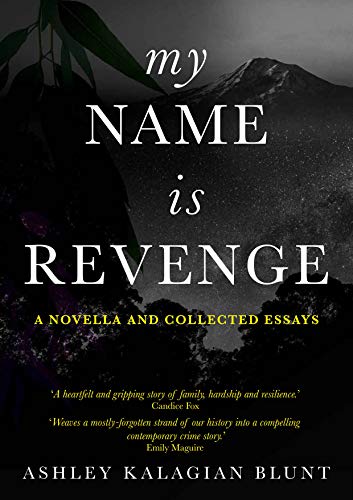
Ashley Kalagian Bunt, My Name is Revenge: A novella and collected essays (Spineless Wonders 2019)

On 17 December 1980, at 9.47 am, two men shot the Turkish consul-general to Sydney and his bodyguard near the consul’s home in Vaucluse. The assassins aimed, fired and vanished.

That’s the opening paragraph of the novella that gives this slim book its title. I had to check in Wikipedia: it turns out that that assassination is not something invented by Ashley Kalagian Blunt. Like the Armenian genocide that inspired it, it is simply not remembered by most of us. What follows that paragraph – a young man whose name, Vrezh, is Armenian for ‘revenge’ feels empowered by news of the assassination and gets involved in a further terrorist plot – is fiction, but fiction fuelled by the historical genocide, and the Turkish government’s century-long insistence that the genocide never happened.

It’s a daring choice in the current climate to write about terrorism from the point of view of a potential terrorist, who has an assassin – Soghomon Tehlirian – as a hero. It’s daring, and stunningly successful: we care about that young man and his family.

The three essays accompanying the novella address aspects of the issues it raises: ‘Writing Violence, Arousing Curiosity’ deals with the genesis of the novella itself; ‘The Crime of Crimes’ sketches the history of genocide, from well before the term was coined in the 20th century; ‘Life After Genocide’ focuses on Kalagian Blunt’s reconnection with her Armenian heritage as a young adult, and how survivors of the genocide have dealt with the history – in particular her great grandfather who as a child witnessed monstrous deeds. The grim subject matter is leavened by a selection of the author’s photographs of Armenian buildings, landscapes and people, including a stunning double spread featuring herself as a baby with her great-grandparents. It’s to the credit of Spineless Wonders that these black and white photos are reproduced with great clarity.

It’s November, and this month I tend to keep reviews to a minimum and write a stanza inspired by the book in question (I have to produce 14 14-line poems this month). But I need to say a little more before breaking into rhyme.

As a settler Australian and a gentile, I’ve felt an obligatory interest in the history of genocide. I have a number of fat books on my To Be Read shelf with titles like Blood and Soil: A World History of Genocide and Extermination from Sparta to Darfur (that one’s by Ben Kiernan 2007). I haven’t even started reading any of them. My Name is Revenge got me through the opening gate, and I recommend it to anyone who feels a similar responsibility to be informed. (It has added several new books to my virtual TBR shelf, including the discouragingly titled Genocide: A World History (Norman M Naimark 2017). Actually, I recommend the book to anyone who appreciates fine writing that comes from a passionately felt source.

Now for my little verse, which opens with Exodus 15:3:

November Verse 4: 
Kill man and woman, babe and suckling,
ox and sheep, camel, ass.

That's God to Saul. Since, we've been buckling
up for slaughter, sword to gas,
musket, spear, scimitar, machete;
harrying, dispersal, cleansing, deadly
soft words for the blood-soaked facts:
whole peoples falling to the axe.
And what comes next? Post-devastation
do gentlefolk take up the land,
priests take survivors by the hand,
declare it's all a fabrication?
The story of the human race
is sometimes awful hard to face.

My Name Is Revenge is the thirty-seventh book I’ve read as part of the 2019 Australian Women Writers Challenge. My copy is a gift from Ashley Galagian Blunt.

Journal Blitz 4

I subscribe to literary journals partly for pleasure and partly as an act of civic responsibility, and lately (only lately?) I’ve neglected to keep up with reading them. This is my fourth blog post in five months reporting on a catch-up read, starting this time with a journal I don’t actually subscribe to.


The Blak Women’s Brow Collective (Editors), Blak Brow (#40 of The Lifted Brow 2018)

Though I’ve heard plenty about the Melbourne-based The Listed Brow, this is the first issue of I’ve read – it came to me by way of the Book(-Swapping) Club.

When the editors of The Lifted Brow approached Paola Balla, whose bio describes her in part as a Wemba-Wemba and Gunditjmara woman based at the Moondani Balluk Indigenous Centre at Victoria University, she ‘saw the opportunity to work collectively and went for it’ (the quote is from the journal’s editorial). Edited by a collective of Blak women – Blak, a note on the inside cover explains, was coined by artist Destiny Deacon in 1990, and names the lived experience and identity of urban Aboriginal and Torres Strait Islander Peoples – Blak Brow has a strong collective feel, and is rich with voices speaking of the lived experience of Blakness.

There are strong individual voices: ‘Fight or Flight’, a wicked short story by Melissa Lukashenko; ‘Fern Your Own Gully’, a poem by Evelyn Araluen that savages the May Gibbsian version of the bush; ‘Because of You I Can’, a pair of short essays by poet Ellen Van Neerven and her mother Maria Van Neerven-Currie; ‘The Crucial Voices of Aboriginal Women’, an account by Celeste Liddle of the struggle to be more than a token Aboriginal presence on panel presentations.

But those are exceptions: while all of the voices here are strong and clear, most of them carry a sense of representing a constituency. The powerful first speech of Lidia Thorpe, first Aboriginal woman to be elected to a lower house seat in the Parliament of Victoria, is given in full. She captures the tone of most of the writing in Blak Brow when she says: ‘I have been inundated with messages from Aboriginal people across the country. I speak today on behalf of them.’ Even intense accounts of personal experience – ‘Binak’ and ‘A Room with a View’ – are followed by brief essays explaining that they are ‘composites’, the first ‘bringing together the real experiences of young women’ who have come under youth justice supervision in Victoria; the second, written by Vicki Roach, ‘a composite of [her] own and many other women’s lived experiences of finding housing when released from gaol’.

It’s a very rich collection of poems, song lyrics, fiction, art, journalism, scholarly writing, speeches to parliament and to a Federation of Community Legal Centres symposium, memoir, reports on art projects and academic ventures, and more. Some of it, as in the WAR response to attacks on their members, is very raw. As a middle-class white man in my early seventies, I was challenged, informed, delighted, and then challenged some more.


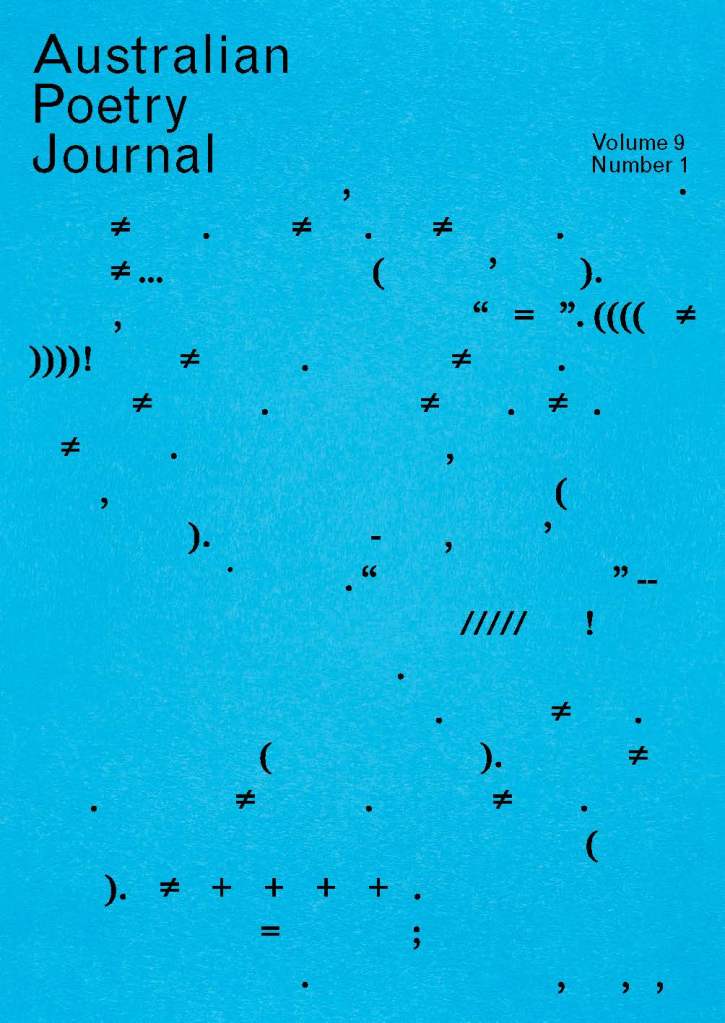
John Kinsela (guest Editor), Australian Poetry Journal 9.1: resist (2019)

This is a brilliant collection of poetry. John Kinsela, guest editor, says in his unusually long introduction:

We have a collective responsibility to live justly, and to work for mutual justice … , understanding each other, and respecting difference. Again, poetry is one of the most effective and linguistically affecting ways of achieving this. The poem as thing in itself is … a form of ‘agora’ in so many ways. Even very disparate issues of justice can find common ground.

The poems cover a huge range of ‘issues’ in a magnificent diversity of voices and poetic forms, and a strong sense emerges of ‘common ground’. As I read, I started out turning down the corners of pages I wanted to revisit and/or mention here, but soon gave up because there were too many – this blog post would have ended up as little more than a list. I’ll restrict myself to just a couple poems – passing over some wonderful poems in silence! (Oh well, almost in silence. Let me mention Evelyn Araluen’s ‘Mrs Kookaburra Addresses the Natives’, which like her ‘Fern Your Own Gully’ in Blak Brow, makes very funny and very unsettling use of language from May Gibbs’s children’s books; Eileen Chong’s ‘Rot’, on violence against women; Sarah Day’s ‘Nation’, on bullying; Dan Disney’s ‘let us rejoice’ an eerie mash-up of speeches by Scott Morrison and (I think) Hitler; Lisa Gorton’s ‘EKPHRASIS I. THE NYMPH OF FONTAINEBLEAU’, which juxtaposes an art critic’s comments on a painting with narrative about the exploitation that accompanied its creation; Jennifer Maiden’s ‘Umbrage in Vault Seven’, a current adventure of George and Clare; Jaya Savige’s ‘Spork’, on racism within a family. The list could go on.) I’m pretty sure that anyone interested in poetry or social/political issues will find something here that strikes a deep chord.

A little more detail on two moments in the collection.

The first is Toby Fitch’s ‘The Last Few Budgets in a Nutshell’. At a quick look this just looks weird. It begins:

Torquing about debt is always exshiting but
weaken nut and muscle knot becomb a carbone
cuppy of the Labna Putty.

The penny drops, and you realise that a politician’s speech (perhaps a particular one, perhaps a composite) has been tortured. There’s probably a word for this process: key words are replaced by words that sound something like them so that ‘Talking’ becomes ‘Torqueing’, ‘we cannot’ becomes ‘weaken nut’ and so on. For the reader then, there’s a double perception: we read the words on the page and hear the original. To do this and make it something more than just a bit of nonsensical clever-dickery is a challenge, and Toby Fitch pulls it off: those first lines give a whiff of the biting satire that he creates. This poem has stayed with me because its technique so beautifully captures and even generates the feeling one has when listening to political spin, and also perhaps a little because it makes me feel smart!

My second moment is call-and-response pair of poems by Kaitlen Wellington (‘It’s about time’) and Alison Whittaker (‘In response to Kaitlen Wellington’s “It’s About Time”‘) respectively. It took just a slight deviation from alphabetical order to have these poems appear consecutively (Rae White’s ‘Rainbow confetti pixels’ graciously allowed Alison Whittaker’s poem to nudge ahead of it in the queue).

‘It’s about time’ is very straightforward – the speaker goes ‘walkin old tracks’, reconnecting with traditional Indigenous knowledge, ‘lookin for some sarsparalla’:

Walkin, walkin
sticks, stones
dreamin track her, there
watch ya step.
We surrounded by the richest green,
earth's soil moist,
dry leaves scatter our path,
we are locked in our country's
secure embrace

It’s not just a bush walk, at least not what a seventy-something whitefella like thinks of as a bush walk. ‘A sea eagle is ‘lettin us know, / “It’s about time youse come walkabout here”‘. The final stanza begins:

We know what to do now:
unite, fight and teach.
Let our mob know
ain't no takin our culture away no more.

It’s a good poem. I was seduced by its idiosyncratic spelling, especially of ‘sarsparalla’, because that’s how we pronounced it in my North Queensland childhood – though we were talking about a softdrink, not a bush medicine. I could feel its seriousness, and then moved on … to Alison Whittaker’s response.

She begins with a question, ‘What does it mean to resist in this colony?’ and goes on to describe the cycle of necessary work – ‘in the courts of the public or in institutional tribunals’ – and necessary self-care. ‘I become a consistently self-optimising tool. In some ways, indistinguishable in discipline and form from that which I am resisting.’ Kaitlen Wellington’s poem brought the insight that there must be more than that cycle. She concludes: ‘What’s the point of making a nicer colony, when you can breathe sovereignty?’

This poem and this response to it offer something profound, not just for people who are the targets and survivors of colonisation and genocide, but to anyone up against any oppressive force. If you get a chance to browse this journal, do flip through to page 99 and read to the end of page 101. But don’t stop there.


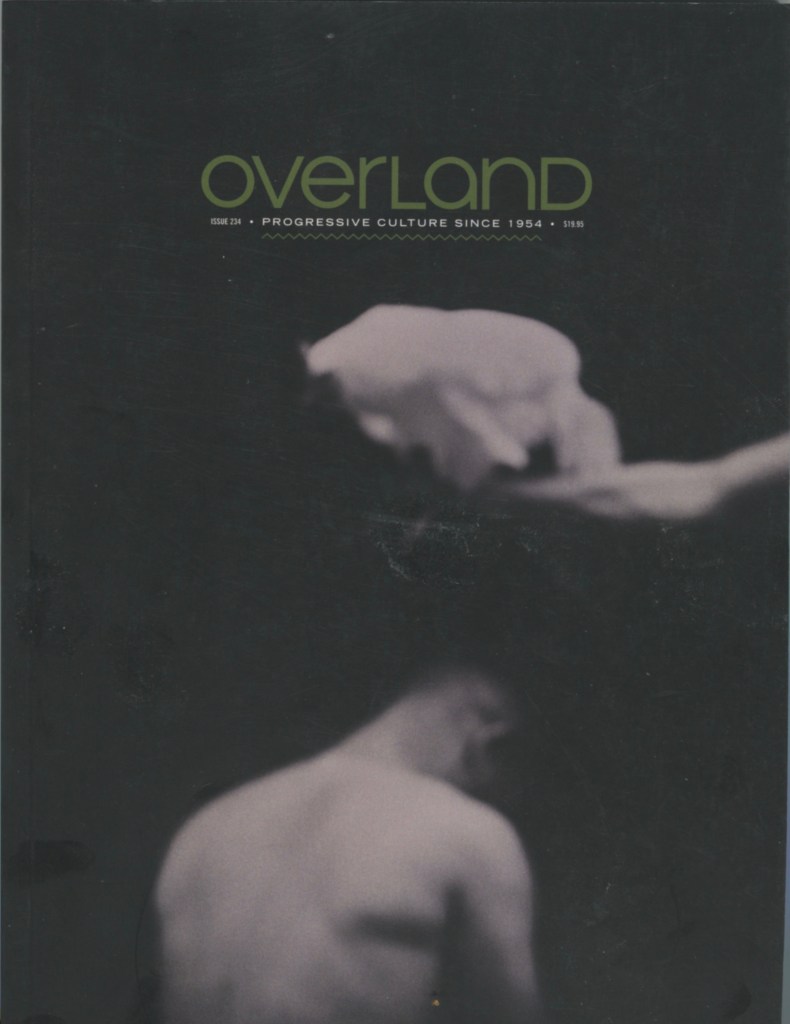
Jacinda Woodhead (editor), Overland 234 (Autumn 2019)

This issue of Overland is bookended by two excellent articles from the Wrights.

Alexis Wright, in Telling the untold stories, begins with the problem facing writers in today’s increasingly chaotic world:

The question for the writer of stories is how to fight your way through imposed boundaries of indifference, ignorance, or political interests, and to perhaps learn how to do this by not getting directly into the ring and wrestling the pig ‘because a. it is only going to get dirty, and b. you will get dirty as well’.

and she relates this to the survival of aboriginal stories through the catastrophe of colonisation. It’s a magnificent essay, an excerpt from her Stephen Murray-Smith talk given in December 2018 (available in full online here).

Fiona Wright (probably only a very distant relation) writes about Tinder in State your intentions. Sometimes intensely personal, sometimes confidently snarky, this is a beautifully executed mosaic picture of what it is to be young and happily(?) single today.

Of the regular columnists, Tony Birch’s On thinking is the stand-out. Writing partly as a tribute to Deborah Bird Rose (my review of one of her books here), who died at the end of 2018, he quotes her:

Any conversation we humans may wish to start up concerning the living world, our place in it and our responsibility toward it must bear the knowledge of the terrible harms we have done and continue to do.

and pits that against Tony Abbott’s famous remark, ‘Climate change is crap.’

There are four pieces of short fiction – In Cassilis by Louis Klee, Buried time by Mykaela Saunder, ‘Into the valley’ by Meleika Gesa-Fatafehi, and ‘The melancholy new patriot’ by Corey Wakeling – introduced by Evelyn Araluen and Jonathan Dunk, who at the time of publication hadn’t yet been announced as due to become joint editors of Overland late this year. There are just three poems, the place-getters in the Judith Wright Poetry Prize, by Julie Jedda Janson,  Joel Scott and Ross Belton.

As well as these, there are articles on Cambodia (That bird is for us by Adam Curley, which takes an episode of something called Survivor as his starting point), Kashmir (Combat breathing by Tim Robertson), burning-off as a gross and destructive distortion of Aboriginal firestick farming practices (The fire cult by Katherine Wilson), current prejudice against Chinese people (Not all yellow and white by Gabriel Ng), and an essay on swimming pools and the beach that makes an excellent companion piece to the ABC doco series The Pool (Aqua Profonda by Gavin Scott).

The cover and moody internal artwork for this issue are by photographer Hoda Afshar.


I was going to include a review of Southerly 78.2, which I’m still reading, but if you’ve read this far I think you deserve a rest, so I’ll save that for the next catch-up blitz.

Proust Progress Report 2: The end of Swann’s Way

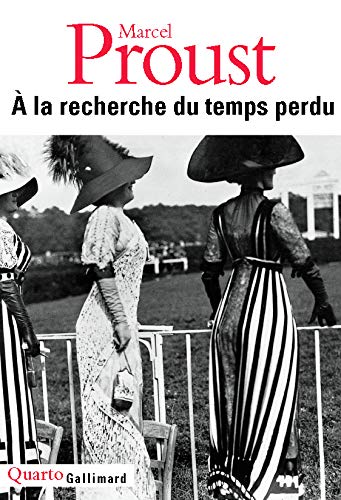
Marcel Proust, À la recherche du temps perdu (1913, text established under the direction of Jean-Yves Tadié ©1987–1992): Du côté de chez Swann, deuxième partie, ‘Un amour de Swann’, et troisième partie, ‘Noms de pays: le nom’

So, keeping up with my quota of five pages a day, I’ve now read the whole the first of the seven novels, Du côté de chez Swann / Swann’s Way, in almost exactly two months.

‘Un amour de Swann’ takes off in a completely new direction from the first partie of the novel. It’s the story of events that took place before those in the first part. The unnamed narrator isn’t born yet, and M Swann, the charming neighbour whose evening visits meant the narrator’s mother didn’t come to kiss narrator goodnight, and beside whose property the family most often walked on their way home from church, takes centre stage in a waspish comedy of manners (at least that’s the tone as I read it), in which he falls in love with the vulgar and manipulative (and, as we come to discover, free with her sexual favours) Odette de Crécy on the basis, not so much of her person as of her similarity in appearance to Jethro’s daughter Zipporah as painted by Sandro Botticelli and because he associates her with a particularly beautiful musical phrase, only to be tormented by jealousy as years pass until at last (spoiler alert!) he is miraculously freed from her spell and realises, to the reader’s great relief, that she wasn’t even his type. That sentence was my attempt to approach Proust’s structural complexity. If you got a little bit lost in the middle of it, then found your way again, you have some inkling of what I’ve been doing for an average of five pages a day for the last month.

In the third and final section, ‘Noms de pays: le nom’ (‘Country names: the name’), the narrator is back. The section begins with a long essay on how as a child he imbued the names of towns he had never visited with certain qualities, and as a result when he did actually visit the town there was always a disappointment – the town in the real world and the town in his imagination were both real, but existed in different dimensions. (That’s a crude summary of many beautifully written pages.) Then he remembers playing with a group of children in the Champs Elysées in wintertimes, when he was somewhat older than the child of the first section: here he fell in love with Gilberte Swann, glimpsed in Swann’s garden holding a hoe in the first section. On days when Gilberte won’t be coming to the place where they play, he persuades Françoise (the maid of his great-aunt in the first section, now working for his immediate family) to take him to the Bois de Boulogne. There he sees a vision of loveliness, Gilberte’s mother, Mme Swann. We know from the first section that the narrator’s parents disapprove of Mme Swann, and refuse to have anything to do with her. And, this is a real spoiler, we discover that Swann had married Odette after all.

Reading this book with rusty French feels pretty much ideal. I’m slowed down. At times I grow inpatient at the lack of incident, but there’s always the wrestle with syntax and vocabulary to keep me engaged. I can’t always tell the tone, and there are jokes that I just don’t get, like a scene where a couple of salon-goers make what I can tell is nasty wordplay on someone’s name. I get what’s happening, but have no idea of the particulars. Likewise the detailed accounts of gardens and clothing ensembles: I wouldn’t know a paletot de loutre from an ampilopsis merveilleux. Something glorious is being described, and that’s enough. Mostly I don’t look things up, but am happy to live in ignorance.

I laughed a lot – though maybe I wasn’t meant to. I gasped once or twice – and I’m pretty sure Proust meant me to. And even though I’m often not sure of exactly how a sentence works, I’m constantly in awe of the mastery of the prose. For example, here’s a sentence where the narrator is reflecting on how he sees the Bois de Boulogne differently from when he was a child. It lacks the magic it had back then. The women’s clothes aren’t as spectacular, and the men go (you can feel him shudder) bare-headed. As a child he believed in the Bois, whereas now it has no charm or importance:

Mais quand disparaît une croyance, il lui survit – et de plus en plus vivace pour masquer le manque de la puissance que nous avons perdue de donner de la réalité à des choses nouvelles – un attachement fétichiste aux anciennes qu’elle avait animées, comme si c’était en elles et non en nous que le divin résidait et si notre incrédulité actuelle avait une cause contingente, la mort des Dieux.

(page 341)

Here’s my translation, with help from C K Scott Moncrieff’s (from here), but presuming to differ from it:

But when a belief vanishes, it is survived – more and more stubbornly, so as to disguise the absence of the power, now lost to us, of imparting reality to new things – by a fetishistic attachment to the old things which our belief had once animated, as if it was in those things and not in us that the divine spark resided, and as if our present lack of belief had a contingent cause: the death of the Gods.

That’s a lot more awkward in English than in French. The English needs you to repeat the words ‘things’ and ‘belief’ and so becomes more cluttered than the French, where simple pronouns – elles and elle respectively – do the job. The English feels cluttered and clunky, whereas the French flows smoothly towards that final phrase – which made me go back and reread the sentence, and the one before it, because I was suddenly made to realise that the narrator wasn’t just talking about hats and dresses, but something reasonably profound about the difference between the creative way children see the world and jaded adult ways of seeing.

In short, then, I’m enjoying this project so far. Five pages a day is fine, but it works best if I do it in two instalments. Someone has probably written a novel called ‘In search of Time to Read Proust’.

Édouard Louis, Who Killed My Father

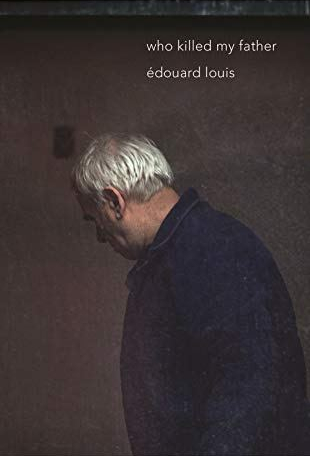
Édouard Louis, Who Killed My Father (2018, translated from French by Lorin Stein, New Directions 2019)

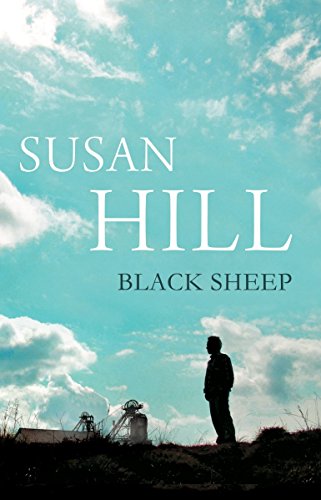
It was purely fortuitous that I read this book immediately after Susan Hill’s Black Sheep, but they make a beautiful pair. Arthur, one of the sons of the mining family in Black Sheep, disappears overnight, and only we and his youngest brother Ted know that he has escaped rather than met with disaster. Édouard Louis is a young Gay man who has escaped from the working-class conditions that have destroyed his father’s life. It’s as if it calls out to that book: ‘This is what it’s like inside your story!’

The opening sentences of Who Killed My Father – notice the absence of a question mark, also a feature of the French title Qui a tué mon père – says a lot:

When asked what the word racism means to her, the American scholar Ruth Gilmore has said that racism is the exposure of certain populations to premature death.

The same definition holds with regard to male privilege, to hatred of homosexuality or trans people, to domination by class – to social and political oppression of all kinds.

This is not an agony memoir, a whining portrait of a father who made his Gay son’s life a misery. For a start, it wields a certain amount of intellectual heft (Ruth Gilmore is not the only scholar to illuminate the narrative).

In all but the first couple of pages, Édouard Louis speaks to his father, who is still alive at the time of writing, presenting him (and, of course, us) with a mosaic of memories from which emerges a picture of how the father’s ‘male privilege’ and ‘hatred of homosexuality’ affected the son, but also the constricting and distorting effect they have had on the father:

Masculinity – don’t act like a girl, don’t be a faggot – meant that you dropped out as fast as you could to show everyone you were strong, as soon as you could to show you were rebellious, and so, as far as I can tell, constructing your masculinity meant depriving yourself of any other life, any other future, any other prospect that school might have opened up. Your manhood condemned you to poverty, to lack of money. Hatred of homosexuality = poverty.

(page 35)

It’s a passionate, painful, complex monologue, full of rage and frustration, reaching a kind of climax when the teenaged son deliberately provokes a near-murderous family row, and in the end it’s a love letter.

There’s a turn about 20 pages from the end. The father is critically injured in an industrial accident. Though he suffers severe pain from the injury, policies brought in by the governments of Chirac, Sarkozy, Hollande and Macron ensure that he doesn’t receive the help he needs but must continue in demeaning and damaging work. ‘Why do we never name these names?’ the words just about scream from the page.

The Wikipedia entry on Édouard Louis describes this book (on 9 October 2019) as a novel. I think that’s just plain wrong. I’d be astonished if the author’s father doesn’t read it and recognise every word as real – and find in it a difficult joy.

Susan Hill’s Black Sheep

Susan Hill, Black Sheep (Chatto & Windus 2013)

At the recent climate strike in Sydney, one of the student leaders was making the point that there needs to be a just transition away from fossil fuels to renewable energy sources. It needs to be acknowledged, she said, that mining isn’t just a job, it’s an identity, and people who worked in fossil fuel industries deserved to be thought about, not ruthlessly declared dispensable (as they were, she might have said, when Maggie Thatcher, whose grasp of climate science may have had some bearing on her shutting down the coal mines of Britain).

Black Sheep, which I borrowed at my Book Club (the book-swap one, not the discussion one), is a 135 page sketch of a family living tight inside that identity in pre-Thatcher Britain. Evie and John have five children, four sons and a daughter. John’s mother dies early in the novella, and his father moves into the already crowded cottage, bringing his black Bible with him. The boys are destined to join their father in the pit. The girl helps to service the men – cooking, cleaning, washing – and is expected to marry another pit-worker and repeat her mother’s life. Coal dust is everywhere.

It’s a grim life, and any thought of finding an alternative is seen as betrayal: ‘this is a pit family and you are one of it.’ Family coherence is strong, and when there is an explosion in the mine everyone in the community, including shepherds on the nearby hills, drops everything and runs toward the pit head, hoping to help. It’s powerful portrait of a family and a community caught in a destructive system, and keeping each other there.

It doesn’t end well, except possibly for the son, Arthur, who disappears overnight and is never heard from again. Two family members have hope: the daughter risks being ostracised by marrying a man who, though he works for the mining company, doesn’t go down the pit; and Ted, the youngest son, dreams of a different life and finds it working as a shepherd, though he too risks being ostracised. Both escape attempts fail. Both Ted and Rose are drawn back into the bosom of the family. It’s a fable about the deep injuries of class and the effects of ruthless capitalism, when even the virtues of working people contribute to their destruction.

Ruby Reads (16): Other books by …

There are many joys in being a grandfather. The discovery of new books for the very young is one of them. Here are some recent ones.

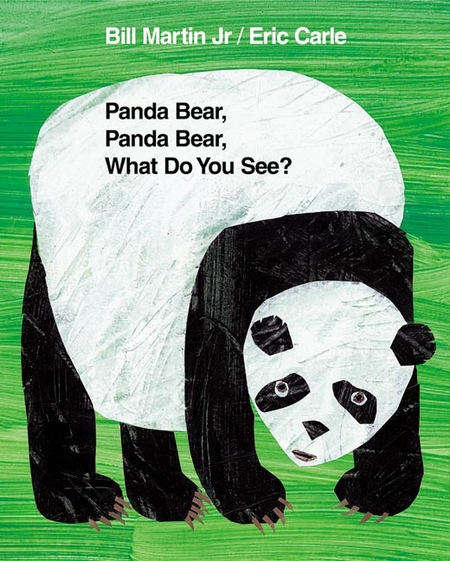
Bill Martin Jr & Eric Carle, Panda Bear, Panda Bear, What Do You See? (Henry Holt & Co 2006)

This was read to us by the marvellous Lisa during Rhyme Time at Leichhardt Library. It’s a sequel to Bill Martin Jr and Eric Carle’s Brown Bear, Brown Bear what Do You See?, or really a variation on it. This one isn’t an accumulation of creatures seen as in the original (and as in Mem Fox and Julie Vivas’s I went walking), but a chain, each seen creature becoming the seer in the next spread. These books make magic from extremely simple text and totally beguiling images.

Julia Donaldson & Axel Scheffler, Room on the Broom (Pan Macmillan 2016)

Julia Donaldson, especially when teamed up with illustrator Axel Scheffler, has been one of the revelations brought to me by grandfatherhood. This is a simple story of a witch who loses parts of her equipment and each time she regains one she takes on an extra passenger as well. It’s genial and bounces along with wonderful rhymes.

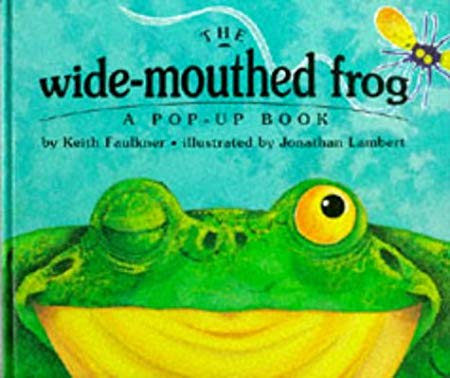
Keith Faulkner (words) and Jonathan Lambert (images), The Wide-Mouthed Frog (Madcap 1997)

I first heard this story as a joke. The wide mouthed frog wanders through his environment asking other animals what they eat. When you tell it as a joke, each time you speak one of the frog’s lines you stretch your mouth wide with two fingers. When he meets the crocodile, who says he eats wide-mouthed frogs, you purse your lips and say, ‘Ooooh.’ It works well as a picture book, too, though the punch line needs to expand: ‘You don’t see many of them around here.’ Also read to us by the fabulous Lisa.

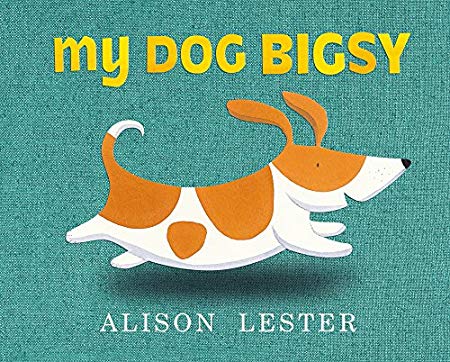
Alison Lester, My Dog Bigsy (Penguin Australia 2015)

A fabulous Alison Lester book. It belongs to the genre where a main character wanders about a farm greeting all the other animals, and does it very well. The images have interestingly textured backgrounds, which is something I haven’t seen in Alison Lester’s work before. As I’m reading so many books where farm animals are introduced to the young reader, I realise how different my granddaughter’s start to life is from mine – I spent my first 12 years living on a farm. I loved the exoticism of books where children lived in villages and could talk to someone in the house next door. She walks out the front door to cars, neighbours and the sounds of urban life – nature is at a premium, and books are a way of learning its importance.

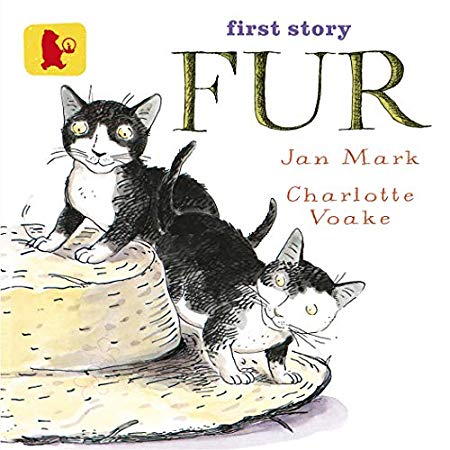
Jan Mark (words) and Charlotte Voake (images), Fur (1986,Walker Books 2014)

The late Jan Mark wrote some superb books for young readers. This is a ‘first story’ that shows she could do it for the very young as well. A cat likes to sleep in ‘my’ hat. Behold, one day half a dozen kittens have joined her in the hat. It’s more than 30 years old now, though this is a new edition. Maybe the images of kittens and broad-brimmed straw hat come from a different era, but its appeal is still strong. I picked this up off the library shelf and it elicited several exclamations of ‘More!’

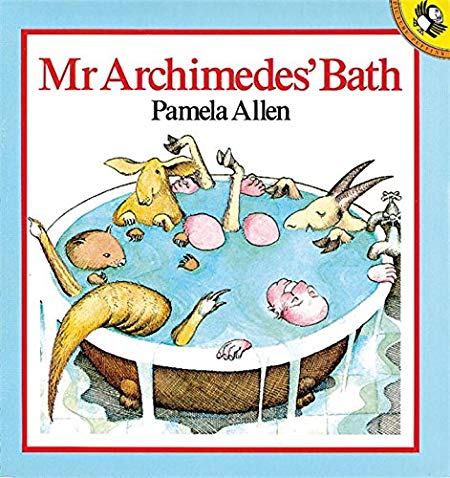
Pamela Allen, Mr Archimedes Bath (Puffin 1980)

It was a joy to rediscover this on Ruby’s shelves – a library book I think. It was Pamela Allen’s first book, and is a kind of early version of the sublime Who Sank the Boat?, with added nakedness to compensate for the slightly less elegant narrative line. Mr Archimedes and his animal friends have their baths together and want to figure out who is responsible for the water spilling. It’s fun, and possibly lays the groundwork for later learning about displacement of liquids and the actual Archimedes’ Eureka moment

My Dog Bigsy and Mr Archimedes’ Bath are the thirty-fifth and thirty-sixth books I’ve read as part of the 2019 Australian Women Writers Challenge. I’ll say it again: though Pamela Allen is a New Zealander and lives there now, she lived and worked for a long time in Australia, including when she created this book.

The Book Group with A Gentleman in Moscow

Amor Towles, A Gentleman in Moscow (2016, Windmill 2017)

Before the meeting: This is a fabulous book to read after The Disappearing Earth. Both are by USians looking to Russia, but where Julia Phillips’s novel is a contemporary thriller (kind of) set in remote Siberia, and features Indigenous people, Amor Towles’s novel is a comedy of manners (kind of) whose action takes place almost entirely within the walls of the luxurious Hotel Metropol in post-revolution Moscow. It’s probably not stretching things too far to say that, for all their difference, they are both reactions against mainstream US’s Russophobia, while neither goes so far as to assert any sympathy with Communism. They seem to confirm that the Book Group has a recurring interest in Russia and the former Soviet Bloc, coming as they do after Anna Karenina (discussed in August 2009), Chekhov’s short stories (September 2012), China Miéville’s October (September 2017), and Svetlana Alexievich’s Chernobyl Prayer (November 2017).

Count Rostov is a Former Person, that is to say a member of the pre-revolutionary aristocracy, whose life is spared because of a poem filled with pre-revolutionary zeal, and who is sentenced to live the rest of his life under house arrest in the Hotel Metropol. Rostov, whose aristocratic virtues include extraordinary social adeptness, courtesy, wit and generosity, has been a favourite guest at the hotel. When he is moved by decree from his luxurious quarters to a tiny room on the top floor, his relationships with members of the staff remain affectionate. He is befriended by a young girl (who initiates the friendship by asking him what has happened to his spectacular moustaches – which have been peremptorily scissored by a brutish apparatchik) and some decades later takes on the guardianship of her daughter, who becomes the emotional centre of his life. He is employed as head waiter in the hotel’s prestigious dining room, where his aristocratic training in tact and diplomacy serves him well. Over the decades of his house arrest, his gift for friendship wins him unexpected allies, even while his undaunted aristocratic bearing makes an enemy or two.

All this plays out against the history of Stalinism, the Second World War, the coming of Kruschev, forced collectivisation, purges, straitjacketing and worse of artists, writers and performers, the gulags, millions dying of famine, increasing wealth and eventual opening up to the West, samizdat. The Count leaves the hotel only once before the final pages; history comes to visit him, and friends fall foul of the iron hand of Stalinism. He is described as the luckiest man in Russia.

Beneath this charming fantasy, there’s a joyful assertion of the value of decency, a celebration of resilient humane virtues. I enjoyed it a lot, and laughed out loud more than once. But …

… although at no stage did I feel the urge to stand up and sing ‘The Internationale’ (to quote Mark Kermode reviewing Downton Abbey), I was uneasy about the possibility that the book plays into a quietistic approach to life, as in, ‘I can be decent, even generous, with people within my small sphere, but what can I possibly do about big issues like climate change when my sphere is so limited?’ I don’t know. Maybe this is a question for the Group – that is, if we can resist the pull to rip into Scott Morrison dealings with Trump.

At the meeting: I was surprised that this book was substantial enough to hold our attention for long, yet it provoked very interesting, wide-ranging, inclusive and at times robust conversation.

One man had read it twice, the second time when he had a visitor staying with his family to whom he read a page or so on a number of nights, which he and his audience enjoyed immensely. This man actually stayed at the Hotel Metropol some decades ago, a disclosure he managed to withhold until well into the evening, winning a round of applause for his restraint. He also challenged the idea that may have been floating in the room and/or the book that civility and grace were somehow aristocratic virtues – two of the most gracious people he had ever met were working class unionists Jack Mundey and Jack Ferguson.

I got to put my question, or call it my unease, and wasn’t dismissed out of hand. One man immediately wondered aloud if that unease wasn’t the actual intentional subject of the book. One chap described the book as a Western liberal response to the Russian Communist experiment, in which liberalism comes out as superior. Another (a recovering Trot, I think) saw it as asserting that attempts at major social change were doomed to fail because the old order just reproduces itself in new forms. Someone else heard me as using the rhetorical device of ‘What about …?’ – that is, asking how we could be giving attention to this froth and bubble when Climate Change. (I think I defended myself successfully against that charge.) If Rostov doesn’t engage with the social change activism, perhaps it’s because he’s under house arrest, and perhaps (this was a quick aside from someone) we all tend to feel we’re under house arrest.

We managed to talk about any number of subjects without leaving the book: Boris Johnson and the Etonian old boys currently running the UK (aristocratic virtues, anyone?), The Good Place (addresses the question of what it means to be good!), Poldark (which not many of have watched, but evidently it addresses contemporary issues through a story set in the past), being fathers of girls.

I love my Book Group.

Keri Glastonbury’s Newcastle Sonnets

Keri Glastonbury, Newcastle Sonnets (Giramondo 2018)

Keri Glastonbury was interviewed by Jim Kellar in the Newcastle Herald in August. There’s much talk in the interview (you can read it all here) about the Newcastle-ness of the book – the local sights, snippets of lore, the city’s history and its present. Then, as if Keri Glastonbury is worried by the non-academic tenor of the conversation, she warns, ‘I don’t want people to think it’s accessible.’ Readers, she says, ‘will be confronted with experimental poetics.’

So there you go.

I assume that most of my regular readers are, like me, not up to speed with experimental poetics. (I’m one of the few non-academics and non-poets who writes in public about contemporary Australian poetry: I’ve never been terribly afraid of looking stupid in public, and I’m deeply grateful for the tolerance and good humour of poets who have responded to my blog posts in the comments section or in person.) If you’re fully poetry-phobic, this isn’t a book for you. But if you enjoy the outsider’s pleasure of being largely mystified and then having moments of clarity and even delight, you might want to give it a go.

The poems, as it suggests on the lid, almost all refer to Newcastle (that’s upon-Hunter not upon-Tyne), to the life of an academic working at Newcastle University who is a member of the LGBQTI+ community. There’s a wealth of academic reference/injokes, gossip from the poetry world, Newcastle detail that will be obscure probably even to some Novocastrians, snippets of pop culture from the last 30 or so years, internet memes and moments (I’m guessing) from the poet’s personal life – none of it spelled out or explained, much of it in unexpected juxtapositions. I doubt if any individual – except perhaps Glastonbury herself – could read the whole thing and get all the allusions. So if one feels like an outsider, it’s not because there’s a clique of insiders somewhere but because any reader is, as it were, eavesdropping.

Here are the first eight lines of a three-sonnet poem from early in the book, ‘What Would I Say’:

Dispersing a lyric via leaf blower
& other 80s cult songs like '88 Lines About 44 Women'
– what if John Forbes had lived
to live tweet during Q&A?
It's all lost generation stuff & the malls
were unindicted co-conspirators. Who knew?
Meaghan Morris/Maitland.
Joanie loves Chachi vs Date Academics in AU.

Here’s my take these lines. Your mileage will vary:

  • Line 1: We don’t know who’s doing the ‘dispersing’. Perhaps the noise of a leaf blower disrupts the concentration needed to create or respond to a lyric – lyrical words or sentiments are like so many dead leaves to be blown away by the unremitting noise of our lives these days. (A bit like many of Donald Trump’s chats to journalists – ‘dispersing information via helicopter blades’)
  • Line 2: The ampersand throws back to the first line, suggesting that it stands for a particular kind of 80s cult song. So the song named in this line (and others like it) do that kind of dispersing. I didn’t listen to much pop music in the 80s, but I looked this up and found that it’s a jolly list of women, two lines each, probably women that the writer/singer is claiming to have had sex with. Not very lyrical, or perhaps romance on an industrial scale?
  • Lines 3 and 4: These references aren’t obscure to me, but they may be to some readers. John Forbes was about my age, a witty, some would say smart-arse, poet who died young, who appears to be remembered with affection in contemporary Australian poetry; Q&A is an irritating current affairs TV show that runs tweets across the bottom of the screen. Forbes live-tweeting is a terrific notion. The dash at the start of line 3 implies some connection with what has gone before – Forbes was writing in the 80s (and the 70s and the 90s), so perhaps he is offered as contrast to the leaf blower songs.
  • Line 5: ‘Lost generation’ usually refers to people born during World War One, but if ‘It’ at the start of the line refers back to the previous four lines – which is what the syntax suggests – maybe there’s a hint of another lost generation who came of age in the 80s (would that be Gen X? (Forbes was a Boomer) …
  • Line 5 and 6: … and somehow without anyone being aware of it the existence of shopping malls was partly responsible.
  • Line 7: I once shared a flat with Meaghan Morris, which is probably beside the point. She is a Cultural Studies scholar who hails from Maitland – ah, the Newcastle connection! Maybe she has written about the effects of malls on the 80s generation (she’s certainly written abut Centrepoint Tower, and motel signs). Maybe this line is answering the question from previous line – ‘Who knew?’
  • Line 8: Joanie Loves Chachi was a US sitcom in the early 1980s (I looked it up), a pretty unsuccessful spin-off from Happy Days (I don’t know why it wasn’t printed in italics as the names of books are later i the same poem). Date Academics sounds like a dating app, and at first I thought AU referred to the internet domain code for Australia, but if this is about the 80s, then AU is more likely to be Adelaide University and Date Academics may be a pre-internet means of hooking up. So maybe the line evokes a moment when an academic living in Adelaide had to make a choice between watching junk on TV and looking for love, again in a fairly non-romantic way.

I didn’t mean to spend so long on those lines, but I guess that gives some idea of the work I have to do to engage with these poems. Not only the work of figuring out the references (6 diverse named cultural references in 8 lines), but also trying to grasp how, or even if, the lines , images and references relate to each other. My hypothesis that the 80s are the common thread falls by the wayside in the following lines with references to books published in the 70s and the 2000s, to ‘blended learning’, surely a more recent jargon term among educators, to Sandilands (I’m assuming it’s Kyle the radio broadcaster, who’s surely a phenomenon of the 90s and later), and so on. I fall back on reading line by line, and not worrying too much about the poem as a whole. Maybe the poem, and these poems in general, work, not so much by yoking things together by violence (as Someone said of John Donne and Co) as by piling up bits of stuff from all over the place, and any apparent logical flow is a red herring.

I know this reads as if I’m complaining, and I would be, but the language feels very alive in every moment, and from the myriad details emerges a cumulative picture of a life, a sensibility, a place, a community. Occasionally there’s a brilliant image, like this from ‘City of Moi-Meme‘:

From below the bridge the neon reflections could be koi

or this from’Everybody Loves (Raymond Terrace)’:

____that James Turrell moment,
where I realise that we've been sitting in the dark
staring at a hole in the wall, productively.

Or this, from ‘Two Dog Nights’, my favourite lines from the book:

The Islington figs release the bats & the sky
blacks out like an erasure poem.

My favourite single word: ‘anthroposcenester’ from ‘Who Killed Bambi?’ (Though I would have spelled it ‘anthropocenester’.)

If you want to read a review by someone who isn’t parading their own obtuseness, I recommend ‘Anne Buchanan-Stuart reviews Newcastle Sonnets by Keri Glastonbury‘ in Plumwood Mountain.

Newcastle Sonnets is the thirty-fourth book I’ve read for the 2019 Australian Women Writers’ Challenge. I received a complimentary copy from Giramondo Publishing. I’m grateful for the opportunity to move out of my comfort zone..

Sam Shepard’s Rolling Thunder Logbook

Sam Shepard, Rolling Thunder Logbook (Penguin 1978)

Bob Dylan’s Rolling Thunder Revue – 57 concerts in 1975 and 1976 with a huge line-up of talent on and off stage – was a big deal at the time for the Dylan fandom diaspora (you can read the Wikipedian version here).

When a friend who was culling his bookshelves offered me Sam Shepard’s ‘logbook’, I was delighted. I’m a fan of both Dylan and Shepard. (Shepard’s Tooth of Crime at Sydney’s Nimrod Theatre in 1973, directed by John Bell and starring Reg Livermore is a treasured theatrical memory, as is hearing his Oh Calcutta! sketch read aloud at an anti-censorship porn fest a couple of years earlier. Imara Savage’s version of Fool for Love at Belvoir in 2010 was fabulous.) And Martin Scorsese’s ‘documentary’ Rolling Thunder Revue: A Bob Dylan Story, which I saw at this year’s Sydney Film Festival, had revived my old fannish interest .

Sam Shepard was hired to go on the tour as a screenwriter (he’d previously had something to do with the screenplay of Antonioni’s Zabriskie Point). Dylan’s plan was for a film – part Les enfants du paradis, part Tirez sur le pianiste – to be made in the course of the tour, with Shepard on board to help with the writing. It’s not a spoiler to say that that film never emerged. Dylan has the sole writing credit on the abysmal Renaldo and Clara (1978), of which I suffered through the two-hour version that reached these shores, and which bears no relation to either of those two great French movies.. But Shepard did write this wonderful fragmented account of the tour, including the frustrated attempts of the film crew to capture chaotic scenes improvised by the musicians.

There are wonderful sketches of Joan Baez, Joni Mitchell (though nothing to compare to her moment in the Scorsese movie), and Allen Ginsburg, a benign presence on the tour even though his planned recitations never made it onto the stage, and brilliant descriptions of Dylan and others in performance. Dylan’s underlying idea – forget about the film for now – was to take his music to small venues, to reconnect with his audiences. A concert would happen in a city, then the performers would be whisked away in a convoy to a small motel 60 or so miles away, where they would generally go stir crazy cut off from the rest of the world, and with more than ample supply of alcohol and other recreational drugs.

Shepard brings his playwright’s eye and ear to the locations they visit. Though the tour continued into Canada and then in its second leg to the south and south-west, Shepard and this book stay with it only in the New England leg, and then for one evening for the benefit performance in New York in aid of Rubin Carter, subject of Dylan’s song ‘Hurricane’.

It’s a quick read, with a generous supply of photographs. My favourite photo has to be the spread featuring Dylan and Muhammad Ali sitting near each other on a bench, Dylan laughing at something we can’s see and Ali contemplating something in his hand that could be an apple core. (It’s online here.)

My favourite moment in the narrative occurs when Shepard and two members of the film crew visit a Shaker village to scope it out as a possible location. Three bedraggled, anarchic and very stoned children of the seventies are made welcome by calm, disciplined dwellers in a virtuous past:

‘Well, what we’d like to do, if this meets with your approval, is to have Joan and Bob come down with just a few of the others and just sort of look the place over. Just to see if it fits into Bob’s idea of the film.’ The Shaker senior is nodding and smiling and rocking back on his heels as though inwardly laughing his ass off. ‘That’s fine with us. We’d be glad to have them.’ The woman chimes in that she’s like to fix the stars a special home-cooked Shaker meal in exchange for Joan singing a few of her songs.

A visit from Joan Baez and that weird little guy – yes please!

So much happens. Dylan’s mother joins them for a while. Shepard maintains a civil distance and doesn’t offer any physical description. He does observe that she seems to like being there, even when some of the team are behave pretty indecorously.

The book is a great supplement to the Scorsese movie. In its final section, a coda really, we are back in Sam Shepard’s world, at the Manhattan opening of his play Geography of a Horse Dreamer. Dylan attends as a guest, and, having been mostly silent or monosyllabic when not on stage, starts yelling during the climactic moments of the play. The audience, mostly critics, have been deathly silent for most of the play, come to life. ‘It’s a perfect ending,’ Shepard writes. ‘An explosion on the audience to match the one on stage. Shotgun wadding, bursting blood, and Dylan over the edge.’

Erik Jensen’s Prosperity Gospel

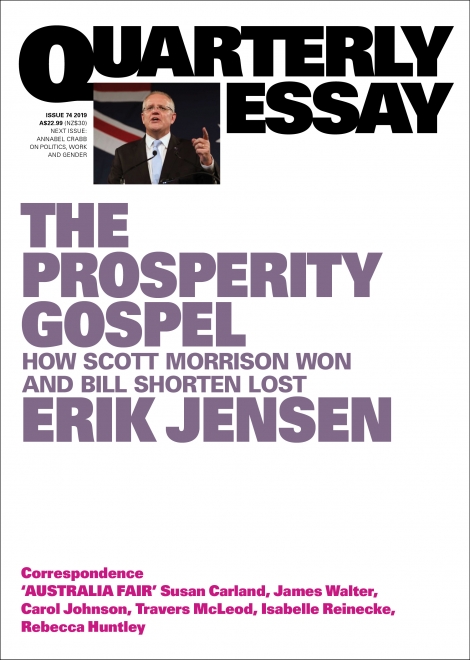
Erik Jensen, The Prosperity Gospel: How Scott Morrison Won and Bill Shorten Lost (Quarterly Essay 74), plus correspondence from QE 75

I approached this Quarterly Essay with reluctance. Did I really need another inside-baseball, after-the-event reading of the tea-leaves about the May federal election? That’s how I felt when the essay came out, and my already-faint enthusiasm has only waned since. But I did read it, three months after the event as has become my custom.

It’s mercifully short. It consists mainly of finely crafted snapshots, mainly of the party leaders in action, from both sides of the election campaign with occasional snippets of commentary, and no sustained argument as such. An essay for the distractible perhaps. Or one that met an impossible deadline, to be published within weeks of the events it deals with. That’s not to say it lacks insight (‘Bill Shorten’s gamble is that you can replace popularity with policy’). But it’s impressionistic rather than discursive, and narrative rather than analytical. It was written on the campaign trail. Bill Shorten gave a generous interview; Scott Morrison refused to be interviewed. There’s no doubt which of the two men emerges as the more likeable, but he is the one who is accorded the most devastating summing-up:

The great truth of Bill Shorten is that he doesn’t know himself. He hasn’t settled his character.

Morrison on the other hand, though his religious belief and his deep commitment to his family are noted, is described in the essay’s final words as ‘a hardman who says everything is simple and some of you will be okay’. Both those summations are beautifully concise, and they’re far from stupid, but neither is justified by the essay that precedes them.

It’s a strange essay, reading sometimes like diary notes from the campaign trail: along with the oft-seen moments like Morrison’s Easter observance, speeches are summarised, mostly without comment; we’re told what books people carry in their luggage; there’s a scattering of off-the-cuff witticisms from staffers; the behaviour of the wives of both candidates is described; sometimes unrelated passers-by are mentioned.

Much of the narrative simply sits on the page, without resonance or further implication that I could discern. An outstanding example is in the account of Morrison emerging from a Healthy Harold igloo (part of a program of health education for children):

Morrison rolls his shoulders when he stands. The tail of his tie not quite to his sternum. He has taken off his jacket: his paunch is oversatisfied and his nipples are erect

(page 48)

This reminded me of a piece by Mungo MacCallum in the Nation Review some time in the early 1970s. Describing Gough Whitlam emerging from a swimming pool, he commented that the honourable gentleman appeared to be very well endowed. That was funny in a transgressively adolescent way, and it chimed with the writer’s clear view that Gough was an attractive big man in other ways as well. Here, the point of mentioning the state of Morrison’s nipples, if there is one, seems to be to tell us that the writer was very close to the action and noticing details, however meaningless. The length of his tie doesn’t even have that, and what does the personification of Morrison’s paunch even mean?

In fact, as a guide to understanding what happened in the election, the essay is eclipsed by the 25 pages of correspondence about the previous Quarterly Essay, Rebecca Huntley’s Australia Fair (my blog post here), which offer a number of interesting and plausible hypotheses about how the progressive-leaning population described so convincingly by Huntley could have delivered the result when it acted as an electorate.

And now perhaps the existence of Jensen’s essay is justified by what turns out to be an excellent correspondence about it at the back of QE 75 (Annabel Crabb’s Men at Work, which I look forward to reading in three months’ time).

Shorten’s speech writer, James Newton, gives an unrepentant insider’s account of Shorten’s campaign, including his now-near-forgotten town hall meetings. Journalist David Marr and scholar Judith Brett offer their analyses. Barry Jones offers the perspective of a grand old man of the ALP. Elizabeth Flux tells us what she learned from being ’employed as a subeditor with a focus on Australian politics’ throughout the campaign, Kristina Keneally writes interestingly about the possible role of religious background. Patrick Mullins & Matthew Ricketson offer historians’ insights. Lawyer Russell Marks gestures towards ‘the deep structures operating through Australia’s political and electoral systems’.

These contributions mostly include evidence that they have read Jensen’s essay. Some of them actually grapple with it, as distinct from using it as a launching pad for their own commentary. Here are some quotes to balance my own underwhelmed response:

James Newton: ‘Instead of wasting words on pseudo-psephology, Erik Jensen gives us telling sketches of the two major-party leaders, their campaigns and the choices Australians faced and made.’

David Marr: ‘The drift of the press is to cut everything short. This guts argument. … The great pleasure of The Prosperity Gospel is to be immersed in the language of the campaign and reconsider the state of politics in this country knowing that what was dismissed as blather in those weeks worked so well on election day.’

Elizabeth Flux: ‘The Prosperity Gospel helped me understand why I found the election result so difficult to come to grips with. It wasn’t that “my team” didn’t win. Or that I liked Shorten more. It’s because it wasn’t a case of one side’s policies winning over the other’s. People were happy to vote for no policies at all, because we’d rather have a strong man selling nothing than a quiet one trying to make changes which he truly believed were for the better.’

Kristina Keneally actually engages critically with the essay, finding it unsatisfying in three areas: ‘First, while Jensen introduces the distinctly different religious foundations for each leader’s policy and political approach, he does not wrestle with what it means that Australia voted for one over the other. … Second, Jensen’s profiles of Morrison and Shorten are incomplete, or at least unbalanced. … Third, he could have explored the role religious affiliation and identity played in the election.’

Patrick Mullins & Matthew Ricketson wonder on paper if people will still go to this essay for insight in the future, say in the lead-up to the 2019 election. They argue (unconvincingly in my opinion) that they should.

Russell Marks laments that while the essay’s subtitle promises an explanation for the election result, ‘Jensen never really expands beyond what is mostly a literary answer.’ He goes on to speak, not quite disparagingly, of political journalists making ‘literary attempts to match leaders’ characters to the nation’s and to find in the intersections why publics endorse one leader and not another’, and then speaks quite disparagingly of ‘armchair psychoanalysis’, though he doesn’t accuse Jensen directly of that.

Tellingly, Jensen’s ‘Response to Correspondents’ ignores them all and makes some observations on what has happened in the months since the election.