Category Archives: Books

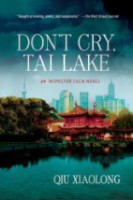
Qiu Xiaolong’s Don’t Cry, Tai Lake

Qiu Xiaolong, Don’t Cry, Tai Lake (Minotaur Books 2012)

1250021588

I’ve pretty much stopped reading detective novels. Inspector Chen, Chinese poet-detective tempted me back into the genre. There was a promise of insight into the workings of contemporary China, and Chinese poetry ancient and modern, all floating on a light whodunnit froth.

I should have known better. The whodunnit element is flimsy. The poetry feels inserted (though it’s a nice touch that Chen quotes Matthew Arnold as well as verse from ancient dynasties). And any issue of Asia Literary Review offers more insight.

I might still have enjoyed it but, perhaps because had just read Steven Pinker’s The Sense of Style, my internal blue pencil was on the alert, and this book’s copy editor let far too much go by: not anything gross, but far too much tautology of the ‘There was something eerily familiar about the peddler, Chen noticed, thinking he might have seen him somewhere’ kind, and enough examples of words that don’t mean what they’re meant to mean, as in the book’s very last sentence, ‘He wondered if he would be able to take a nap on the train, feeling the onslaught of a splitting headache.’ A decent copy editor would surely have suggested ‘onset’ because who can wonder about naps in the middle of any kind of onslaught?

I reached for a collection of essays by the impeccable David Malouf.

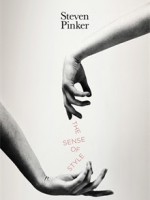
Steven Pinker’s Sense of Style

Steven Pinker, The Sense of Style (Allen Lane 2014)

IMG_1330I love a good argument about punctuation, spelling, syntax or the meaning of words. Does MS Word really allow minuscule to be spelled with two Is? How about the person who wrote to the paper complaining that septic tank should be aseptic tank or at least have an apostrophe to mark the missing letter? What is the difference between ‘my Aunt Mabel’, ‘my aunt Mabel’ and ‘my aunt, Mabel’, and are they all permissible? Steven Pinker’s The Sense of Style doesn’t tackle any of these questions, but I reckon he’d be up for the conversation.

For the record, my favourite style guide is Joseph M Williams, Style: Ten lessons in clarity and grace. Pinker doesn’t attempt that book’s succinct guidance, but he brings a cognitive scientist’s perspective to the subject, and his cool, witty, reasonable approach is a joy. Well, mostly a joy: the middle chapter, ‘The web, the Tree and the String’, explains the intricacies of English syntax in a way that verges on the tedious if you already have a grasp of the subject, and is probably impenetrable if you are looking for enlightenment. Apart from that skippable chapter, the book is rich with insight.

Pinker focuses on the ‘classic style’, in which, he says:

The writer can see something that the reader has not yet noticed and he orients the reader’s gaze so that she can see it for herself. … [P]rose is a window onto the world.

In the classic style, the writer simulates two experiences: showing the reader something and engaging in conversation with the reader. There are plenty of other legitimate styles – Pinker names contemplative, romantic, prophetic, oracular, oratorical, practical, plain, ironic and postmodern – but thankfully this book sticks with just the one, which, Pinker says, is ‘an ideal that can pull writers away from many of their worst habits’.

He identifies a number of those habits, conveniently listed as ‘metadiscourse, signposting, hedging, apologising, professional narcissism, clichés, mixed metaphors, metaconcepts, zombie nouns, and unnecessary passives’. That’s quite a list and for my money an extremely useful one. It’s characteristic of Pinker’s approach that he warns against memorising it as a list of don’ts – better, he says, to keep in mind the guiding metaphor in the quote above.

There’s a great discussion of incomprehensible prose. Rejecting the popular explanation that much academic and bureaucratic writing is deliberately impenetrable for self-protective or self-promoting reasons, he reaches for the tool known as Hanlon’s Razor: ‘Never attribute to malice that which is adequately explained by stupidity.’ (Hanlon’s Razor was new to me in that form, so I was interested to read more about it in Wikipedia, and delighted to see that Goethe wrote a version of it in 1774.)

The kind of stupidity Pinker has in mind is what economists call the Curse of Knowledge:

a difficulty of imagining what it is like for someone else not to know something that you know.

This sounds simple, yet – and here Pinker’s cognitive science background comes into play – psychologists regularly discover more or less the same thing with new names: egocentrism, hindsight bias, false consensus, illusory transparency, and so on. In the writing context, ‘It simply doesn’t occur to the writer that her readers don’t know what she knows – that they haven’t mastered the patois of her guild, can’t divine the missing steps that seem to obvious to mention, have no way to visualise a scene that to her is as clear as day.’

Pinker has a lot to say about the Curse of Knowledge, and makes some useful suggestions for how to guard against it, but in the end, sadly, there’s no silver bullet to remove the curse. But how good it is to be reminded starkly:

The form in which thoughts occurs to a writer is rarely the same as the form in which they can be absorbed by a reader.

After an excellent chapter on coherence, which I plan to reread carefully, Pinker gets to the fun bit of any book on style in a final chapter, ‘Telling Right from Wrong’. After a sweet demolition job on the pedants who write to the newspapers (of whom the ‘septic tank man,my example, not Pinker’s, is my favourite), in which he takes apart the Prescriptivist vs Descriptivist myth, he pronounces on a hundred usage issues – mostly what he gives is the current consensus among linguists, but where experts disagree he gives his own best judgement.

This chapter is a proofreader or copy editor’s delight. I’m grateful for his clarity about the subjunctive. I cheer aloud when he, a USer, curls his lip at US punctuation conventions for the end of quotations, or takes issue with rigid rules about that and which, or talks sense about among and between. I want to be in the room with him to argue about datum and data. I’m chastened by his entries on decimate and unique, and my dissatisfaction about fortuitous remains unallayed. While I don’t understand his argument about between you and I, from now on I’ll stop bridling when people say it. You’ll have your own examples.

Leila Yusaf Chung’s Chasing Shadows 

Leila Yusaf Chung, Chasing Shadows (Vintage Books Australia, 2014)

1csIn August 2001, John w Howard kept the press away from the asylum seekers who had been rescued by captain Arne Rinnan of the Norwegian ship Tampa. It was crucial to Howard’s strategy of depicting the would-be refugees as ‘illegals’ and ‘queue-jumpers’ that Australians not see them as individual men, women and children. His famous utterance, ‘We will decide who comes to this country and the circumstances in which they come,’ could not have sounded like a defiant assertion of sovereignty if its hearers knew the wretched terror and misery – not to mention courage and determination – of those who were being ‘decided’ against.

Short of meeting asylum seekers in person, and so far I haven’t bestirred myself to do that, fiction has to be a good way of engaging imaginatively with this class of people who are still being relentlessly disparaged and dehumanised in our media. I bought a copy of Leila Yusaf Chung’s novel with those considerations in mind after hearing her speak, beautifully, at the Sydney Writers Festival about the importance of women in refugee communities.

I’m happy to report that the book filled the brief I had given it. Set mainly in Israel and Lebanon from the 1940s to the 1980s, it has real people who suffer real losses, confront real mysteries, and make their ways through the violence and indifference they meet at every turn. The form of the book mirrors the complexity of Middle Eastern politics, to the extent that plot summaries either misrepresent the book or are close to impossible to unravel. A character who seems to be the main driver of the plot becomes marginal to the point that when he dies we hardly notice; sympathetic characters do terrible things, and a shift in perspective reveals what looked like – and was – abuse to be an act of love; an early scene narrated from an uncomprehending child’s point of view turns out to contain a mystery that is central to the story; there are many false starts, many shifts of location and allegiance.

The book has a Zelig quality – characters find themselves on the spot just in time to be on the wrong side of a disastrous event: a Polish Jew living in Israel converts to Islam just before the naqba, so that he and his new family are among the hundreds of thousands of Palestinians driven from their homes by the Israeli army into apparently permanent exile; a young Palestinian woman is persuaded to marry an Iranian official, only to arrive in Tehran the day of the 1979 revolution and be gaoled along with hundreds of women who don’t meet the requirements of Ayatollah Khomeini’s new regime; characters are caught up in the Lebanese civil war and the Israeli invasion of Lebanon in 1982.

Identity is fluid, and sometimes a  pragmatic choice: the Jew Lavi becomes the Muslim Abu Fadi in order to marry a young Muslim woman; his Arab daughter poses as a Christian Armenian to give her infant daughter a safe environment to grow up in; another daughter finds a source of strength in strict Islam. Nothing is simple.

I recommend the book. If you read it I’d love to hear your response in the comments.

aww-badge-2015

Chasing Shadows is the twelfth book I’ve read for the 2015 Australian Women Writers Challenge.

Of Mice and Men and the Book Group

John Steinbeck, Of Mice and Men (1937)

ommEvery now and then the Book Group reads a classic. As one of us is currently performing in the play of Of Mice and Men, it seemed like an obviously good idea to read the book and see the play together.

Before the meeting: This is one of those books that you feel you don’t actually need to read. Like the photos of Dorothea Lange and Walker Evans, it’s a solid part of our understanding of the US in the 1930s. A little skinny guy and a lumbering giant with intellectual disability team up in rural USA during the Great Depression. The big man is a gentle soul, but doesn’t know his own strength and bad things happen.

Predictably, the book turned out to offer any number of surprises. First was the lyricism of the opening. I vaguely knew that Elmore Leonard’s disparagement of ‘hooptedoodle‘, the descriptive bits that readers tend to skip, cited Steinbeck as an authority. It was a surprise, then, to meet an opening paragraph that describes a pool over which arch the ‘recumbent limbs and branches’ of sycamores, and to which water ‘has slipped twinkling over the yellow sands in the sunlight’. That ‘twinkling’ challenged my assumptions mightily.

But then the humans appear, and there’s no more twinkling or recumbent arches until the final chapter, where ‘row on row of tiny wind waves flowed up the pool’s green surface’. The return to that pool carries a huge emotional thwack. Steinbeck knew a little hooptedoodle goes a long way, but he knew how to do it well. In this case, it’s the equivalent of a theatrical backdrop.

The story unfolds in six scenes, each of which observes the classical unities of time, place and action – that is, we see only what happens in a given place, and we see everything that happens there in sequence. The settings, described briefly at the start of each scene, are: an idyllic clearing on the bank of the Salinas river on a Thursday evening; a ranch bunkhouse the next morning; the bunkhouse again that evening; the harness room, which is also the bedroom of Crooks, the stable buck, on Saturday night; the barn, Sunday afternoon; the pool again, still Sunday.

Almost everything is conveyed by dialogue and action. It’s a short book, just about 100 pages – it could have been twice as long in the hands of a writer who wanted to tell us what his characters were thinking, rather than trusting us to get it.

There’s another passage of ‘fine writing’ that stands out. Unlike the other characters – the old man Candy, Crooks, Curley – who reveal themselves by their words and actions, Slim first appears in a long descriptive passage. Here’s the end of that passage:

There was a gravity in his manner and a quiet so profound that all talk stopped when he spoke. His authority was so great that his word was taken on any subject, be it politics or love. This was Slim, the jerkline skinner. His hatchet face was ageless. He might have been thirty-five or fifty. His ear heard more than was said to him, and his slow speech had overtones not of thought, but of understanding beyond thought. His hands, large and lean, were as delicate in their action as those of a temple dancer.

This eloquent prose telegraphs Slim’s function as moral touchstone: we know that his judgement is to be trusted, that his point of view is as close as we’ll get to the author’s. Then the prose snaps back to normal, not so much undercutting the hoptedoodle as saving it from itself, when Slim speaks:

‘It’s brighter’n a bitch outside,’ he said gently. ‘Can’t hardly see nothin’ in here.’

As I was reading this book, Barack Obama made headlines for using the N word. (As someone said, he is the first US President to use that word without referring to someone he claimed to own.) Given the extreme sensitivity to that word in the US today, it’s gratifying that Steinbeck’s use of it hasn’t been bowdlerised, at least not in the edition I read. The characters’ casual use of it to refer to Crooks, the only African American character, is very uneasy-making. Then there’s a scene where the woman addresses him by the vile term, and reminds him that she could have him ‘strung up on a tree so easy it ain’t even funny’. Steinbeck and Obama would agree that racism is not just a matter of it not being polite to use some words in public.

After the meeting: We didn’t have a group meeting as such, as we spent two and a half hours at the Sport for Jove production of Steinbeck’s play, directed by Iain Sinclair, with an all-round excellent cast. All good intentions of joining our actor-member after the show evaporated at the final curtain, and we all made our way home to warm mid-week beds.

It was interesting to see the play so soon after reading the novel. Maybe Steinbeck had the play in mind when he wrote the novel, because it really did feel largely as if as if the book had been magically transmogrified into flesh and blood. Maybe George wasn’t as wiry as I’d imagined, and Curley’s wife (her lack of a name much more noticeable in the play) was less sexy; the scene in Crooks’ bunk felt truncated; the dog was cuter and more alert than the book’s smelly wreck. But these were minor variations. The novel was walking and talking in front of our eyes. But no twinkling water or recumbent sycamore branches.

Ali Cobby Eckermann’s Inside My Mother

Ali Cobby Eckermann, Inside My Mother (Giramondo 2015)

1imm

If you haven’t read anything by Ali Cobby Eckermann, you’re not keeping up. In the last five years or so, in three books of poetry, two verse novels and a memoir, she has made a huge contribution to our general understanding of what Australia is. She was taken from her Aboriginal family when she was a small child, and brought up by a white, German heritage family. Her writing is largely animated by the charge from her reunion as an adult with her mother and with  her Yankunytjatjara and Kokatha relatives and heritage.

The memoir, Too Afraid to Cry, tells her story and is on my reading list. The poetry in Inside My Mother touches on it in many ways – on her relationship with her mother, and the pain of her death soon after renewing contact; and also on her rediscovery of Aboriginal culture, as in the first poem in the book:

Bird Song
 our birds fly
 –––––on elongated wings
 ––––––––––they fly forever
 –––––––––––––––they are our Spirit

–––––––––––––––our bird song
 ––––––––––is so ancient
 –––––we gifted it
 to the church

This kind of assertion of the power of Aboriginal culture is hard to pull off without coming across as defensive or preachy, but Cobby Eckermann manages it here, and throughout the book, with grace and a faint satirical edge.

The poetry here is wonderfully varied: love lyrics, fables, autobiographical narrative, polemic, surrealism and some silly humour.

As I’ve been ruminating about this book over the last couple of weeks, my mind keeps returning to ‘Hindmarsh Island’, not because it stands out as excellent, but because it cries out to be read alongside Les Murray’s ‘Inspecting the Rivermouth’ in his most recent book, Waiting for the Past.

Les Murray’s fine poem can be read online here. It celebrates the renewal of the mouth of the Murray River, in particular the prosperity and vitality that has come to Hindmarsh Island thanks to the bridge that has recently joined it to the mainland. It has Murray’s characteristic joy in linguistic display, the wonderful image of the bridge throwing houses onto the island, and the joyful underlying pun on ‘Murray mouth’.

Then along comes Ali Cobby Eckermann’s ‘Hindmarsh Island’:

hindmarsh Island 

Cars drive over the babies!

And we realise that for all his emphasis on the importance of the past, Les Murray as a non-Indigenous poet can glide over some elements of our history. The Signal Point café is part of the thriving scene celebrated in ‘Inspecting the Rivermouth’, but from an Aboriginal perspective, we don’t have the luxury of forgetting that the bridge was built over the prolonged protests of a group of women who asserted that it meant the destruction of a significant cultural site. It’s possible that Cobby Eckermann had read the Murray poem (which was first published in Quadrant in September 2010), but I doubt if it’s a deliberate response: this is just a different take on the same phenomenon, one that demonstrates how important Aboriginal voices are if our national conversation is to have integrity.

Ali Cobby Eckermann’s previous books of poetry are Kami (a Vagabond Press Rare Objects chapbook, 2010) and little bit long time (Australian Poetry Centre’s New Poets Series, also 2010) and love dreaming and other poems (Vagabond 2012). Her two verse novels are His Father’s Eyes (OUP 2011) and Ruby Moonlight (Magabala Books 2012). Her memoir, Too Afraid to Cry, was published by Ilura Press in 2013.

aww-badge-2015

Inside My Mother is the eleventh book I’ve read for the 2015 Australian Women Writers Challenge.

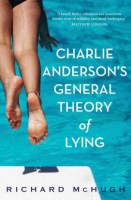
Richard McHugh’s Charlie Anderson’s General Theory of Lying at the Book Group

Richard McHugh, Charlie Anderson’s General Theory of Lying (Viking 2015)

1cagtolBefore the meeting: This book made me realise how little of my reading is just for the fun of it. It’s a comedy of manners set in the world of business consultants, bank executives and corporate CEOs after the financial crisis. The first chapter introduces Charlie Anderson, a brilliant consultant whose life is just as he’d want it: a wife who is the love of his life, three wonderful daughters, a girlfriend with no strings attached, and a belief in cheerful deceit that keeps it all working. We just know things are going to go terribly wrong. And they do.
Charlie runs foul of every one of these women, plus a couple more, to excellent comic effect. The domestic relationships are beautifully evoked: in particular, I feel as if I know each of the three daughters (and am glad I only have sons!). It’s quite an achievement that even though we are made privy to the long and not terribly profound meditations of Charlie and his wife the story zings along. None of the narrative threads lead to anything much: we never find out what happened in a crucial offstage incident; a situation that looks as if it’s going to lead to major catastrophe evaporates without explanation; some actions taken with a great sense of jeopardy have no consequences at all. Maybe the point is that self-deceivers like Charlie get off scot-free, but it felt to me that, apart from a single stinging wordless moment at the end of the chapter before the epilogue, there’s just no pay-off: like a detective story where foreshadowed crimes don’t happen, and confession to real crimes go unpunished.

It’s an enjoyable ride all the same.

The meeting: Richard McHugh  came to our meeting – he’s a friend of one of us. He arrived late, which, as someone said, gave us a chance to get all our slagging-off out of the way so we could be civil to the man himself. In the event, there wasn’t any slagging off as such, and the conversation wasn’t painfully civil. We all had a good time, including Richard. He said the three weeks doing publicity since the book was published had been hard work, and it was a pleasure to sit with a group of men who’d actually read the book, especially given that the general wisdom is that it’s mostly women who read fiction. (We were silent about the man in the room who had only reached the halfway point.) I had a list of questions, which I’ll put in white so as not to foist spoilers on you:

  1. Did Anna know about Charlie’s philandering?
  2. What actually happened at the barbecue?
  3. Why didn’t anything come of Charlie’s confession to the police?

It may be Richard’s first published novel, but he wasn’t naive enough to answer the questions outright. He replied to all of them with ‘What do you think?’, but then spoke interestingly. In particular, it turned out that one of the questions had been explicitly answered in an earlier version of the book. He told us what had  been cut, and I think we all agreed that the novel worked better with those parts removed, but we were still glad to know the answer. Our own surmises had all been less interesting.

While I still feel the lack of pay-off is a frustrating element, my sense of the ending has changed. I had bought into the central character’s smug belief that he had come though the events of the novel unscathed, seeing the faint rumblings of disquiet around the edges as relatively insignificant. Now I think of it as more like the pleasant family gathering at the end of The Sopranos, where we know that men with machine guns are going to come out of the restaurant toilet and kill them all as soon as the show is over. Charlie doesn’t get his come-uppance in the novel, but the writing is on the wall.

Michael Farrell’s Cocky’s Joy

Michael Farrell, Cocky’s Joy (Giramondo 2015)

1cj

‘Michael Farrell is the most adventurous and experimental of contemporary Australian poets,’ says the back cover of Cocky’s Joy. If that’s code for, ‘Only insiders – academics and other experimental poets – should read this book,’ it’s only partly right.

Farrell’s poetry, as well as being ‘experimental’, is also often sexy, silly, erudite,, teasingly cryptic, playful, challenging, passionate, and sometimes all of those things at once. It’s a poetry of ex-Catholic, Gay male, Melburnian postmodernism with a whiff of nostalgia for the bush. Apart from a handful of tediously schematic poems, it bristles with memorable phrases, weird surrealistic images, and intriguing wordplay.

The book’s title is rich with implication. ‘Cocky’s joy’ is Australian bush slang for golden syrup, a kind of refined molasses. In this context it invokes the classical idea of sweetness and light – delight and instruction – promising at least the sweetness, with a particular kind of Australianness. ‘Cocky’ taken alone hints at metaphors for the poet: as a farmer laying down furrows of verse, or a parrot sampling other texts. And the phrase’s punning potential suggests an interest in, ahem, male sexuality. All of those implied promises made by the title are kept. There are surreal, dreamlike excursions into Australiana, and much invocation of other writers (the titles tell part of the story: ‘The Influence of Lorca in the Outback’, ‘Bush Christie’ – as in Agatha). There’s quite a bit of reference to man parts, from the genteel ‘longing in the pants’ to much more explicit language.

There are wonderful moments, like this from ‘An Australian Comedy’:

_________________________You see the old
photographs in your lover’s face, and let go of the school
boy’s hand; you’re growing up again.

or this, uncharacteristically straightforward, from ‘Singing’:

You know one thing about a song from
The radio. You know something else when
It’s coming from your own throat – that’s
The note. A song doesn’t belong on a page
A song isn’t on it like paint.

In ‘Bush Christie’ (the title refers to Banjo Paterson’s ‘A Bush Christening‘ and to Agatha Christie), a clutch of Australian literary and historical figures from the 1800s and early 1900s assemble to hear Bennelong, playing detective, reveal the identity of a murderer. At least that’s the narrative framework. Really it’s pretty much a playground where fun can be had with the characters and with language for its own sake. If you expect straightforward narrative progression from these lines, for example,

Gilmore was preparing a jack’o lantern –
Something she’d picked up in Paraguay
She said. Probably a lie, and she had a
Strong pumpkin-cutting arm … She
Lit a candle and put it in Jack’s head.
Bennelong couldn’t eat her bread. Pat-
erson  [etc]

you’ll end up frustrated. But read them for the wordplay, and they become fun. You can’t be sure the pumpkin isn’t there mainly because it alliterates with ‘Paraguay’, and Mary Gilmore’s probable lie for the sake of the rhyme. Likewise, has ‘bread’ popped up just to rhyme with ‘said’ and ‘head’, or is there a bit of historical trivia there about Bennelong’s reaction to the colonisers’ food?  The poem is full of that kind of thing. It’s a bit like Bob Dylan’s ‘Desolation Row’ with a high level of distractability.

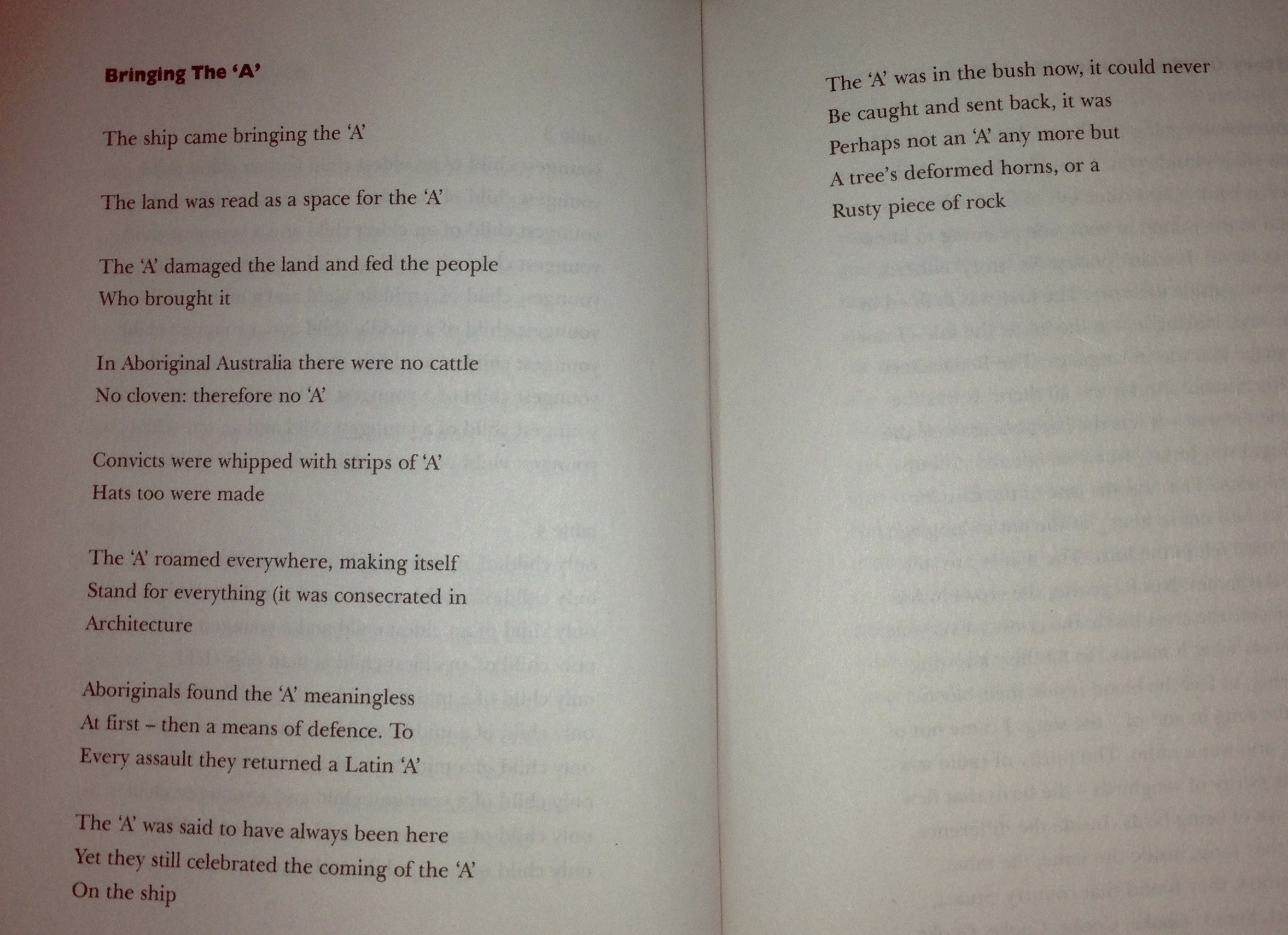
The poem that I most respond to in the book is ‘Bringing the “A”‘, which (I think) refers to the origin of the letter A as a stylised drawing of an ox. In the poem, written language and grazing stock are not so much metaphors for each other as identified as the one thing, itself emblematic of a harsh colonising society:

IMG_1299

‘The “A” roamed everywhere, making itself / Stand for everything’. So much meaning is folded into the poem’s final images: the possibility of settler culture having been somehow integrated into the landscape, but not without deforming it, and not without violence (the rust on rocks suggesting bloodshed).

In her blog, the deletions, Pam Brown quotes from Astrid Lorange’s launch speech for Cocky’s Joy:

As anyone who reads Michael will know, his poetry is … an enormously generous contribution to the diverse and intersecting communities of practice that coalesce around questions, propositions, readerships, textualities, affections, socialities, and so on. Michael’s work, which in its spirit and discipline is a constant and intense gift, is ever-labouring towards a poetry that might continue, despite it all, as a liveable form of loving.

I don’t know what most of that actually means, and I can say the same about quite a lot of the poetry. But I’m very grateful to Giramondo for sending me a review copy, and opening my mind to poetry which I might otherwise have avoided.

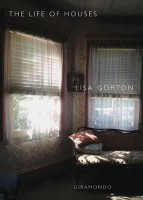
Lisa Gorton’s Life of Houses

Lisa Gorton, The Life of Houses (Giramondo 2015)

9781922146809

Lisa Gorton is a an award-winning poet. I’m using that journalist’s phrase because I haven’t read enough of her poetry to have any real sense of it. I have read some of her criticism and been intensely grateful for the insights she shares. Her first novel, Cloudland, was for young readers. The Life of Houses is her first novel for a general readership.

The action of the novel unfolds over about a week. Anna manages a Melbourne art gallery. While her husband is visiting his family in England, she sends their teenaged daughter Kit to stay with her estranged parents in a tiny seaside town a couple of hours’ train journey away. Anna has to prepare for an exhibition opening during school holidays, but her real reason for packing Kit off is so she can spend time with a lover, who is pressing her to leave her husband.

While Anna wrestles with her ambivalence about her love life, Kit encounters the miasma of unresolved emotion in her mother’s childhood home – her grandparents’ not-really-unspoken resentment of their daughter who left them with barely a backward glance, and the small-mindedness of small-town life beyond the family.

Not a lot happens. A teenage boy has died, probably by suicide, probably because he was gay, and Scott, an artist who was Anna’s childhood friend, falls under suspicion because he had spent time with the boy. There’s something needy and a bit creepy about Scott, but I don’t think it’s a spoiler to say we never learn anything about his sexuality, and that the suspicion is purely a symptom of small town thinking. He befriends Kit, and is the only person who has an inkling of what she is experiencing.

There’s another death, but external events are much less important in this novel than internal processes. Kit begins to think of her mother differently, and her sense of herself has grown. Anna’s attitude to her family softens, and her ambivalence about the lover deepens. Scott almost decides to leave the town. Everyone has a take on the building that is the family home: its history, its ghosts, who will inherit it, its emotional meanings and (in passing, but ominously) its market value. Absolutely nothing is neatly resolved.

Lisa Gorton and the editorial team at Giramondo aren’t afraid of hard-working adjectives or busy punctuation. For example:

The whole scene lay open before her: heat shimmering off scrub out where the road was, mile after mile of flat, low, secretive country. She found a sort of elation in it: a loneliness answering her mood. Sharp, scattering sounds drew her eyes to where the bird was lifting wing-beat by wing-beat up from the surface of the lake, its legs trailing in the water. She watched holding her breath; it seemed so unlikely the bird would rise.

That’s two colons and a semicolon in four sentences. More than once, a single sentence matches that. Here’s one from when Kit is listening in on a conversation between her aunt and Scott soon after she arrives in the town:

Their way of ignoring so much made Kit notice more: the creaking sound of some loose join in the decking; and that lasting roar: it was the wind, not the sea, she could hear.

The frequent use of sentence structures that call for this kind of punctuation has the effect of blocking the flow of the narrative. What is happening is almost always less important than the process of observing it. And often it feels as if things are there because they have been observed, even though they add nothing to the narrative or our understanding of character. Anyone reading to find out what happens next may be disappointed. The pleasures of this book lie elsewhere.

I received my review copy of the book from Giramondo.

aww-badge-2015

The Life of Houses is the tenth book I’ve read for the 2015 Australian Women Writers Challenge. I’ve now finished the challenge – but I don’t expect I’ll stop reading relevant books.

Lisa Gorton recently gave a fascinating interview about The Life of Houses to Fiona Gruber on the ABC’s Books and Arts.

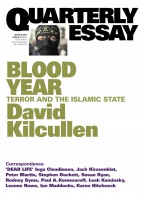
David Kilkullen’s Blood Year

David Kilkullen, Quarterly Essay 57: Blood Year: Terror and the Islamic State (Black Inc May 2015)

9781863957328

I think most people would agree that war is a major failure of human rationality. But the question of what to do once a war is under way is not so easily agreed on. When the subject of possible intervention against ISIS came up at a Sydney Writers’ Festival panel on the weekend, Nick Davies of the Guardian and Dan Mori, David Hicks’s defence lawyer, came close to calling each other stupid and arrogant respectively. This Quarterly Essay brings much more light than heat to the debate.

David Kilkullen was a senior adviser to General David Petraeus in 2007 and 2008, when he helped to design and monitor the Iraq War coalition troop ‘Surge’. This ‘insider’ status may mean that the essay will have some influence with those in power, so one doesn’t read it with the background despair one often feels when reading brilliant analyses by writers who can be dismissed as latte-sipping etceteras. His privileged insider perspective means that the essay is full of small and large revelations. For instance, he describes a meeting at which George W. Bush spoke in his familiar, ‘folksy, shallow and upbeat’ manner about how well the war in Iraq was progressing but then, once the TV cameras had left the room, ‘he began to talk to talk in a concrete, specific, realistic way’. Who knew?

The essay tells the story of the development of the Islamic State in the aftermath of the 2003 invasion of Iraq, the ‘Surge’, the botched withdrawal of coalition forces, Obama’s policy of targeted drone strikes, the failure of the Arab Spring, and the rise of ‘a host of insurgent groups’. It gives a clear account of the contending terrorist groups, explaining in simple enough terms the role of Sunni–Shi’a conflict, and the way Iranian loyalties play out in that context. It outlines the thinking behind changing US strategy over the last decade or more, noting successes, shortcomings and outright failures. It’s hard to imagine a discussion further removed from our Prime Minister’s discourse of Good Guys vs Bad Guys, ‘Death Cult Death Cult Death Cult’ (could it be that behind closed doors he too becomes concrete, specific and realistic?). Arguing that the Surge was not a failure, Kilkullen writes:

Counterinsurgency (in fact, warfare generally) is a complex discipline, like medicine or architecture. if your building fails, it doesn’t mean ‘architecture doesn’t work’ – it means you built a bad structure. If violence drops when you apply a given approach, then returns when you stop, it doesn’t mean the approach doesn’t work; it means it does work, and you shouldn’t have stopped.

Forgetting for the moment that a defining feature of warfare (including counterinsurgency) is that people kill people, which makes comparison to architecture or medicine seem grotesque, this is a fair indication of the approach the essay takes to its subject: discipline rather than rhetoric, a search for solutions rather than a replay of grievances, assessment rather than blame. Blame isn’t a concept it avoids altogether:

President Bush conflated enemies, defaulted to attacking states rather than thinking about how to deal with non-state actors, and – mother of errors – invaded Iraq, and then botched the occupation. … President Obama compounded Bush’s errors – pulling out of Iraq without putting in enough effort to cement the gains of the Surge, indulging in a dangerous addiction to drones and special ops, acting opportunistically in Libya, remaining passive in the face of massacre in Syria … Allies, too – the United Kingdom, other NATO countries, Australia – went along with whatever was asked of them, made only limited efforts to influence the strategy, and then (in many cases) ran for cover when things went wrong … This is a multi-sided, multi-national, bipartisan screw-up, for which we all bear some responsibility, and the task now is to figure out what to do next: what a viable strategy might look like.

Having outlined the history, the essay goes on to offer a definition of the threat. Acknowledging that his view is not universally accepted, Kilkullen argues that ISIS is no longer an insurgent organisation but in fact a state, just as Nazi Germany was a state, so should be met with appropriate strategies – including non-military ones, though the essay focuses on the military, that is, conventional warfare. The current prioritising of countering the threat from unorganised individuals inspired by ISIS brings ‘boomerang effects’  – such the increased erosion of our privacy, or the militarisation of police that has contributed to recent clashes in the USA – that are on the way to turning our societies into police states, a response that is far worse than what it seeks to prevent.

This is an essay that casts light in a very murky area. I’m grateful for it, and recommend it. Kilkullen quotes something attributed to Trotsky: ‘You may not be interested in war, but war is interested in you.’

Black Inc have put an extract from Blood Year up on The Monthly website.
—–
A number of people have tweeted that every Australian should read the previous Quarterly Essay, Karen Hitchcock’s essay on the treatment of elderly people, Dear Life. This issue includes 40 pages of robust correspondence about it, which should also be required reading.

It begins with word from an elderly resident of a nursing home. Given that Hitchcock’s concern is that ‘the elderly’ need to be treated with respect, it’s a healthy jolt to ageist assumptions that this elderly contributor happens to be national treasure Inga Clendinnen, and that the other self-identified octogenarian correspondent, Ian Maddocks, speaks as a palliative care provider of many decades.

Apart from one snarky piece that makes Hitchcock in her reply wonder if the writer had actually read the essay, all the correspondence is worth reading. In particular, more than one correspondent (most tellingly economist Peter Martin) takes a swipe at the recent Intergenerational Report’s shonky portrait of a future burdened by old people.

Sydney Writers’ Festival 2015: My Weekend

The weather turned on its traditional gorgeousness for the Festival’s weekend. A number of speakers drew attention to the way the sun made itself known – submitting audiences to a third degree, or blinding panellists to the obvious. There’s something exhilarating about being part of a sunlit crowd of book-lovers.

I spent Saturday with the Art Student. We did non-literary things in the morning – walked the dog, bought food, hung out the washing, then caught the train to town in time for:

1.30–2.30: Zia Haider Rahman: In the Light of What We Know
Zia Haider Rahman is a youngish Englishman of south-Asian heritage who has written what sounds like a brilliant first novel. He spoke with an Oxford drawl, which sat oddly with his account of growing up in poverty. He explained: ‘This accent is completely phony, but it’s the only one I’ve got. I spent hours listening to tapes of BBC announcers and imitating the accents because I understood very young that if you want to make your way in England, trivial things like accents matter hugely.’

Louise Adler was an excellent interlocutor, mainly because of her unabashed enthusiasm for Zia’s novel, In the Light of What We Know. There was a lot of tiptoeing around certain plot points, so I may not know what was being said in a good deal of the conversation until I’ve read the book. There was also a lot of tiptoeing around things Zia wanted to say about the British literary scene – Louise encouraged him to be explicit (‘This is Australia. We can deal with bluntness.’), but he remained vaguely and tactfully disparaging.

I said this was his first novel. But maybe not. He said that he’s been writing all his life, but not with any intention of being published. Partly this is because his ideal readers were his parents, neither of whom would ever read his books, published or not. When his father was dying he had a copy of In the Light of What We Know on his bedside table, and would touch it proudly, but he was past being able to read it. And he has written a short comic novel in the last couple of months, which can’t be published because it would bring on at least five law suits.

3–4 pm: Back to the Wild
This session had an extraordinary collection of writers: lugubrious, droll Don Watson, whose The Bush sounds like compulsory reading; measured, scholarly British falconer Helen Macdonald, whose H is for Hawk has won all sorts of awards; and Leigh Ann Henion from the USA, travel writer turned nature-evangelist whose manner ranged from rhapsodic to over the top. Richard Glover in the chair made it look easy to keep the conversation on even keel – helped by the fact that the three panellists were manifestly interested in each other. While Henion whooped it up for a sense of wonder at the awesomeness of the natural world, Macdonald spoke of her connection to a particular bird and how a scientific understanding deepened her connection to nature more broadly, and Watson was full of rich anecdotes of things he had seen in the bush.

One fabulous fact has stayed with me: according to recent research, some parrots are given names when they are chicks – that is, they are known by a distinctive pattern of clicks – and this ‘name’ stays with them all their life.

In question time, an audience member observed that we are currently approaching a possible environmental disaster, and asked if these writers’ books included calls to action. Henion said her call was to rekindle our sense of wonder. The questioner, in a slightly driven manner, said, ‘But unless we take action there won’t be any nature for us to wonder at.’ Richard Glover, bless him, pointed out that Henion was actually answering the question, and Henion made the point that to reclaim a respectful connection with the natural environment is a significant action in a time when many children in the West have never seen a horizon line, and many adults haven’t seen one for a long time: if we could ensure that our political leaders each had such a connection, things would change.

4.30–5.30: The Secret State
This was another disparate panel that worked remarkably well. Nick Davies, Guardian journalist who played a central role in bringing the Murdoch press’s crimes to light in Britain and worked with Ed Snowden’s disclosures, Michael Mori, who was David Hicks’s legal representative and whom the other speakers addressed as ‘Dan’, and George Williams, a constitutional lawyer from UNSW, were wrangled by Monica Attard, distinguished ABC journalist, in a discussion of surveillance and state secrecy.

These guys all know their onions. Surprisingly, the star of the event was George Williams. Balding, bespectacled and with a slightly pedantic manner, sitting between Mr Cool from the Guardian and Mr Fight-the-Power from the US Marines, he was the one who gave us hard facts about legislation that has been passing almost unnoticed through the Australian Parliament over the last few years, using the threat of terrorism as a pretext to extend government power and curtail people’s rights. It’s not that there’s a conspiracy, he explained: politicians on both sides dread being held accountable for some future atrocity, and so they wave through any measure that is put up by the security forces. Because the measures become law without debate, the press pays little or no attention, and so we now have laws on the books that could send someone to gaol for two years for praising Nelson Mandela in his freedom-fighting days.

Sixty percent of Australians, George told us, believe that we have a Bill of Rights (we don’t). A similar percentage said they were confident that they couldn’t be wrongfully found guilty of an offence, because they could always take the fifth: that is, most Australians form their mental models of how the law works from US TV shows.

It was a chilling panel, that came interestingly alive in a different way right at the end. Nick Davies mentioned that David Kilkullen, author of the current Quarterly Essay, was at the Festival, and said he was hoping to talk to him about ISIS. Mori’s affable poise fell away for a moment and he said, ‘He wants us to do more bombing.’  Someone from the audience shouted, ‘That’s not fair!’  And we were suddenly in a spontaneous, heated argument about whether it was arrogant for the US and its allies to move in on Iraq and Syria believing we could resolve the situation (Mori) or whether failure to intervene was immoral, and based on a mindless assumption that because it was a mistake to invade Iraq once it would be a mistake now (Davies). We were out of time, and Monica Attard, who had done a brilliant job up to that point, continued her brilliance, saying something like, ‘And that’s all we have time for.’ Applause. Animated conversations about ASIO files overheard on the exit stairs.

We went to the bookshop, to a tapas bar where we celebrated a friend’s birthday, and then home through Vivid once more.

I only went to one thing on Sunday:

10–11 am: Her Body, Her Choice?
This was my first all-woman panel – most of the panels I attended had three men and one woman, the woman being in the chair for two of them.

Once again, the title didn’t reflect the content of the panel with any precision. It was a discussion about the situation of women, mostly in the non-Western world, between Ayu Utami (from Indonesia), Leila Yusaf Chung (a Sydney woman who was born in Lebanon and is still deeply engaged with the plight of Palestinian refugees), and Xinran (a Chinese journalist who has been living in England for 18 years and writes over her personal name only, because non–Chinese speakers reliably mispronounce it).

(Digression: Jane Park from Sydney University, who chaired the event with charm and intelligence, said something at the start about all the women speaking several languages. Ayu Utami said, ‘I only speak Indonesian.’  No one commented on the fact that she said that, and went on to say a lot more, in perfect English: it’s as if, from one perspective, English is no longer a language like other languages.)

Jane Park asked if they thought of themselves as feminists – because, as she said, feminism has been critiqued as a western phenomenon. Ayu said she was a feminist before she encountered the theory: as a young girl she observed that the ‘killer teachers’ (that is, teachers who were particularly harsh) were all ‘old virgins’ – that is, unmarried women as distinct from nuns, who were in a different social category. Her realisation then that unmarried women were treated badly by the society and took it out on their students was the beginning of her lifelong commitment to women. Leila said she had been a feminist all her life. History, she said, was not only written by the victors, but almost entirely without acknowledging the central, vital contribution that women have made to every society in every era (she said this much more beautifully than I can reproduce). Xinran brought a whole different perspective: as a child of Mao’s China from an urban location she grew up with the knowledge that women hold up half the sky (rural China, she said, lags hundreds of years behind the cities in many respects, and women there are lucky to hold up any sky at all); it took her years in England to respond to small courtesies from a man to a woman as anything other than arrogant tokens of superiorities. Her feminism, she realised, had a harshness to it, that cut her off from being a woman.

There was a lot more to the panel – I hope a podcast turns up.

And that was it for me.

The Art Student went with a friend to a session in the afternoon: The Cold War on Sex. She came home enraged. Evidently a mutually respectful difference of opinion between Kooshyar Karimi, who has written about his mother’s oppressive experience of the veil in Iran, and Sahar Amer, who was defending Muslim women’s choice to wear the veil, was in effect shouted down by Dennis Altman, the participant chair, who declared that he was completely intolerant of an argument that Sahar Amer was putting. Young women from the audience called on him to let her speak. The Art Student said she would never go to another event that Altman was chairing.

My mind is still buzzing from those few days, and even though we were very restrained in Gleebooks I’ve got some tempting new books beside the bed. And sessions I missed are already turning up on the ABC Books and Arts podcast. I’m looking forward to more from the Writers Festival’s own podcast. But for now, it’s back to life as she is lived.

[Added later: Helen Macdonald gave the  Festival’s closing address. It’s available on podcast.]