Andrey Kurkov’s Grey Bees at the Book Group

Andrey Kurkov, Grey Bees (2018, translation by Boris Dralyuk, MacLehose Press 2020, 2022)

Before the meeting: I hadn’t heard of Andrey Kurkov before this book was nominated for the Book Group. He’s a Ukrainian novelist, children’s writer, essayist and broadcaster. In an interview on PBS early last year he said that, though he is ethnically Russian and writes in the Russian language, Putin’s invasion has made him ashamed to be Russian, and he is now considering writing only in Ukrainian. He finds it impossible to write fiction in the current situation, but he continues to write and broadcast about the war – his series of broadcasts for the BBC, ‘Letter from Ukraine’, is available online.

Grey Bees, originally written in Russian, was first published in 2018. Russia had annexed Crimea, and there was armed conflict with Russian separatists in two breakaway ‘people’s republics’ in the Donbas region in the eastern part of Ukraine. The novel is set in a time when the front between those forces stretched for about 450 kilometres (it’s now closer to three thousand). The area between the fronts is known as the ‘grey zone’. In his useful Preface to the 2020 English edition, the author explains:

Most of the inhabitants of the villages and towns in the grey zone left at the very start of the conflict, abandoning their flats and houses, their orchards and farms. Some fled to Russia, others moved to the peaceful part of Ukraine, and others still joined the separatists. But here and there, a few stubborn residents refused to budge. … No one knows exactly how many people remain in the grey zone, inside the war. Their only visitors are Ukrainian soldiers and militant separatists, who enter either in search of the enemy, or simply out of curiosity – to check whether anyone’s still alive. And the locals, whose chief aim is to survive, treat both sides with the highest degree of diplomacy and humble bonhomie.

(Page 12–13)

Sergey Sergeyich, the hero of Grey Bees, lives in a tiny village in the grey zone, one of two cantankerous old men who have refused to leave. The electricity has been cut off. He has to trek to the next village to buy food. He depends on a charity’s annual delivery of coal for heating through the savage winter. He is a beekeeper, whose emotional life focuses on the wellbeing of the beehives that spend the winter in his garden shed. His wife and daughter are long gone, and he has never really got along with Pashka, the other remainer.

The opening scenes reminded me of Czech comedies in the 1960s like The Firemen’s Ball. There, people’s lives were miserable under the Soviet regime and the comedy was subversive as well as desperately funny. Here the enemy is the war itself, and the quiet desperation of the characters is made tolerable to the reader by their comic focus on tiny issues – like the way the two men hide from each other whatever good food they’ve managed to get hold of (where good food can include a block of lard!), or Sergey’s decision to swap the street signs so he no longer lives in Lenin Street. There’s a touch of Waiting for Godot: how can anything happen so long as they are trapped in this place?

Then, as the days warm up and the buzzing of his bees becomes more demanding, Sergey decides to take them to a place that hasn’t been laid waste by the war, and we follow him on a journey south, to environments that are more friendly to him as well as his bees. He meets with kindness, and is kind in return. He sets out to visit a Tatar beekeeper he met at a conference years before, and arrives in a tiny village in Crimea that is occupied by the Russians. In the process of getting there he has to pass through Russian checkpoints, and he is looked at with suspicion on all sides: coming from Donbas, is he a separatist or a loyal Ukrainian? He’s attacked on suspicion of being one and harassed when he is assumed to be the other. An Orthodox man, he falls foul of the Russian authorities when he befriends a Muslim family.

Though terrible things happen, what shines through is Sergey’s unassuming human kindness. The background buzzing of the bees is warmly reassuring: they go about their work, and can be counted on to produce honey, which is universally welcomed.

Towards the end, when the Russian authorities meddle with one of the hives, Sergey has dreams that the bees of that hive have turned monstrously grey, and the allegorical role of the bees, which is a quiet undercurrent for most of the book, comes front and centre in some splendidly surrealistic passages.

To give you a taste of the writing, here’s a little from page 76, when Sergey is still in the village. Spring is on the way:

The sun had spread even more of its yellowness through the yard. The trampled snow had turned yellow, as had the fence, and the grey walls of the shed and the garage.
It wasn’t that Sergeyich didn’t like it – on the contrary. But he felt that the sun’s unexpected playfulness, as appealing as it may be, disrupted the usual order of things. And so, in his thoughts, he reproached the celestial object, as if it could, like a person, acknowledge that it had acted improperly.
The artillery was whooping somewhere far, far away. Sergeyich could only hear it if he wished to hear it. And as soon as he went back to his thoughts, turning into Michurin Lane, its whooping melted away, blending into the silence.

In his preface to the 2020 edition, Andrey Kurkov says that on his visits to the grey zone he ‘witnessed the population’s fear of war and possibly death gradually transform into apathy’. Sergey’s dislike of disruption, even by warmth and playfulness, and the way he can be deaf to the whoops of the artillery, are ways of showing that apathy. It’s a terrific achievement of this book that it brings tremendous energy and compassion to bear on the person lost in apathy, and never loses sight of his enduring humanity.

After the meeting: It turned out this was an excellent choice for the group – someone awarded the Chooser two gold koalas, which must come from a children’s show I’ve missed out on.

Conversation looped around the Russian invasion of Ukraine, to other terrible events of recent days in the local and international scenes, sometimes becoming heated, but not acrimonious, and kept coming back to the book. I think it was Kurkov’s insistence on keeping close to the humanity of his characters, especially Sergey, focusing on what could be benign between people, even while not mitigating the horrors of the war. The father of one group member was Ukrainian, but always identified as Russian. He himself has never learned either language but he could speak a little of how the book stirred memories of his father. The rest of us lacked such a direct connection, but I think the general feel was that we came away from the book with a much more solid grasp of the depth and reach of the current war, and the centuries of Ukraine–Russia relations that preceded it.

I got blank stares when I mentioned The Firemen’s Ball.

Journal Catch-up 21

Just two Heats in this catch-up.


Alexandra Christie (editor), Heat Series 3 Nº 9 (Giramondo 2023)

There are five items in this Heat, and I loved three of them. (The other two are pretty good as well.)

Bonny Cassidy’s ‘Memory Book’ is a poignant memoir of dealing with the shifting sands of her father’s dementia. ‘No one is responding in the way I thought they would.’

Ender Başkan has three poems whose energy and flow make me want to hear him perform them: ‘funk n wagnalls, collect the set’ is, among other things, a comic reflection on an immigrant family’s valuing of education; in ‘family holiday’ the poem’s speaker travels on the Spirit of Tasmania with small children; ‘erotics of bookselling’ is a fabulously unerotic string of phrases from the day of a bookshop employee.

The stand-out item is the late Antigone Kefala’s ‘Last Journals’, the third instalment in her series of journals. The first two were full-length books – Sydney Journals (2008) and Late Journals (2022, my blog post here). Unlike the entries in Late Journals, the entries here are dated, from 5 January to 19 September 2022. Antigone Kefala received the Patrick White Literary Award earlier in that September – ‘Everything comes in its own time,’ she writes, ‘but not in yours.’ She died on 3 December, less that 11 weeks after the final entry, which ends, ‘Drifting … Not an an ounce of focused energy …’

My blog custom is to single out page 76 for a closer reading. As happens surprisingly often, page 76 of this Heat is a useful lens through which to see the whole of Antigone Kefala’s piece. The page has three entries – for 3, 11 and 17 April – and they reflect a mind actively engaged with the world even while burdened with a sense that the end is near. There are acerbic comments on politics (‘Everyone knocking out Morrison … his own people, a pity they did not do it before’) and the weather (‘It will take some time to dry out, but the rain will start again soon’). She celebrates the publication of Late Journals, is visited by her publishers, and anxiously hopes for a mention in the press. She starts casting about for a new project (‘Looking about for a book to start translating something – this should give me a direction’). She mentions talking to a friend on the phone, ‘using the mobile so we could see our faces’, and comments, ‘These terrible transformations … who wants to see one’s face when talking on the phone …’

What emerges is a picture of a writer, committed to her work, immersed in a community, who faces the difficulties of ageing and the approach of death, not with calm or resignation but with something more like weary annoyance. Her entry for Monday 11 April ends:

Living is problematic, but dying is problematic too.


Alexandra Christie (editor), Heat Series 3 Nº 10 (Giramondo 2023)

This issue kicks off with ‘Life’s Work’ by Isabella Trimboli, a terrific, multi-faceted article on journals that ranges from her own practice to a five-hour cut of a movie diary. She’s specifically interested in ‘diaries from women who were not writers by vocation, that had never known true recognition, that wrote about themselves obsessively and with self-scrutiny’.

I confess that the rest of the journal didn’t sing to me.

One piece begins:

Simón entered my room and gave me a look.
Unconsciously, and then consciously, I pressed my body into a pose, breasts forward, ass to one side, and lifted the sheet, an invitation that suggested this was how I always lay before 10 a.m., like a steamed clam.

(Ellena Savage, ‘Bare Life’)

What follows isn’t terrible, but sexual intrigue in a shared house with a smattering of philosophy about Covid shutdowns isn’t my cup of tea. And I know it’s a lost cause, but that ‘ass’ – along with a ‘diaper’ elsewhere in the journal – gets my back up. It’s an Australian literary journal, do we have to use US language?

Another:

Someone did give birth to me. Why remains unclear. Maybe they wanted to be loved, or it just sort of happened.

(Harold Voetmann, ‘Common Room Rocking Horse’, translated by Johanne Sorgenti Ottosen)

Sorry, but I find that hard to take seriously, and it’s not funny.

Then there’s this:

The house had bricks the colour of runny shit and a linoleum floor that was so thin you could scrape a hole in it by pushing back your chair.

(Kat Capel, ‘Sightseeing’)

As you might almost guess, this turns out to be a story of unconventional sexual compulsions set mainly in a share house. I’m too old.

And then this:

This looking at myself, touching myself, it all started a long time ago. In nursery school, in fact, when I was five or six years old.

(Lin Bai, ‘The Light in the Mirror’, translated by Nicky Harman)

That’s the inauspicious opening of what turns out to be an extract from Lin Bai’s 1994 novel, A War of One’s Own, which, according the brief author bio (on page 76), ‘was an instant success and established her as a pioneer of women’s literature in China’. The Wikipedia entry on the novel doesn’t mention translation, so this may be the first time this writing has been translated into English. If so, hats off to Heat and Nicky Harman. But, quite apart from my distaste for extracts from longer works, I won’t pretend to have enjoyed it.

Mick Herron’s Standing by the Wall

Mick Herron, Standing by the Wall: A Slough House Interlude (Baskerville 2022)

This is one of those tiny books designed for display at the check-out of a books-and-mortar bookshop, to be bought on impulse as a small gift for, say, Mother’s Day, or for someone you know to be a fan of Mick Herron’s Slough House novels.

It probably found its way into our house as such a gift. I haven’t read any of the novels, but I love the TV series based on them (and I’m glad to learn that a third season is due to drop in December). For me, this book was a chance to get a taste of how it all works on the page. All the main characters are there: irascible and malodorous Lamb, obnoxious IT wiz Roddy, our hero River, salt-of-the-earth dry drunk Catherine and mistress of the archives Molly. Not much happens: River drops in on the station after extended leave to recover from being poisoned; Lamb has Roddy alter a photograph from the archives; Catherine has a moment of almost human conversation with Lamb, in which he says ‘I don’t do memories’; and most of the reject spies who work at Slough House go out for Christmas drinks. That’s it.

‘Ho!’

The name wasn’t so much dropped as thrown from the top of Slough House, and like a snowball finding its target struck Roddy Ho, two floors down, on the back of his neck. He looked up from his screen, senses quivering. He was needed.

The opening is horrendously over-written, and it goes on in that vein for a couple of pages. I was about to lay the book aside, giving quiet thanks for the wit and nuance of the TV series, when I realised that the over-writing was deliberate, allowing us a taste of Roddy Ho’s self-heroising perception of the world. The irony became clear, the prose settled down, and I was amused and gripped.

Page 47 (I can’t talk about page 76 because this is a very small book) features another piece of mock-heroics:

There was no one to flinch when, with surprising suddenness, Lamb swung his shoeless feet to the floor and went barrelling out of the room, entering Catherine’s office like a Viking on manoeuvres. Flakes of plaster fell from the ceiling when the door slammed against the wall; more drifted free as he pillaged desk drawers with the kind of controlled fury that this room alone, of all Slough House, generally provided sanctuary from. Most of what he found he dropped to the floor – reels of sticky labels, cellophane folders, account books, boxes of Biros, treasury tags; all this junk from another era, as if he were trashing a museum installation – littering the carpet with a mess of ancient stationery.

It comes as no surprise that all this furious pillaging turns out to be just Lamb looking for an envelope. Mick Herron is having a good time, and so is the reader.

The book is a fun chance to see the characters in action on the page. It may be laying the grounds for big events later in the series, or harking back in a way that will delight long-term readers, but whether or not it’s either of those things, it’s an enjoyable confection that entertained me on a train trip from Central to Parramatta and back.

Megan Davis’s Voice of Reason

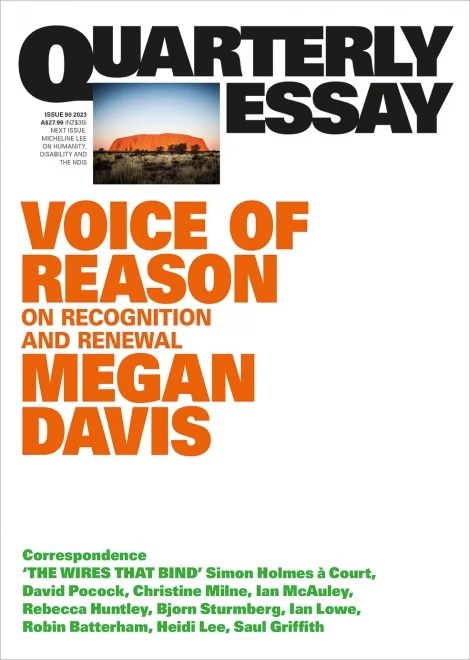
Megan Davis, Voice of Reason: On Recognition and Renewal (Quarterly Essay 90, 2023)
– plus correspondence in Quarterly Essay 91

As we approach voting day on the Indigenous Voice to Parliament, bad-faith arguments multiply and I don’t intend to add to the clamour. But I can recommend this Quarterly Essay by Megan Davis, one of the architects of the consultation process that led to the Uluṟu Statement from the Heart.

It’s short – just 66 pages. It’s personal – Ms Davis gives enough of her story that we know who she is. It’s instructive – she tells how the proposal for the Voice evolved through several official processes under several Prime Ministers. It’s respectful – it understands why some First Nations people might vote against the proposal, and argues the case with them. It has heroes and villains – John w Howard and Tony Abbott feature as wreckers; Yunupingu as a leader. It’s not into blame and rage. It has hope. And it’s utterly convincing.

If the referendum fails, as current polls suggest, this essay will bear re-reading for decades to come, though it will have to be read through tears.

You don’t have to buy a copy. At least for now you can read it on the Quarterly Essay website, beginning at this link.

My blog practice is to look a little closely at a single page. Usually it’s page 76 (my age). As there is no page 76 in this essay, here’s a little about page 47 (I was born in 1947).

In 2015, there was apparently bipartisan parliamentary support for constitutional change acknowledging that Australia was first occupied by Aboriginal and Torres Strait Islander peoples, recognising their continuing relationship to the lands and waters, and expressing respect for their ‘cultures, language and heritage’. That is to say, it looked like all systems go for symbolic recognition: nothing about non-discrimination, and no structural change. A group of 40 First Nations leaders met with Prime Minister Tony Abbott and Opposition leader Bill Shorten, and explained that such a change ‘would not be acceptable to Aboriginal and Torres Strait Islander peoples’ (the quote is from the Kirribilli statement). This meeting led to the consultation process that produced the Uluṟu Statement from the Heart and the proposal for an Indigenous Voice to Parliament. (It also proposed a Makaratta / Treaty and a truth telling process, but those aren’t on the table just yet.)

On page 47, Megan Davis hits the pause button in her recount of the history:

The thing I could not shake from my head was watching the prime minister and Opposition leader sit at the head of the table while forty people from forty communities spoke about the structural problems their communities faced. What is it like to be the leader of a nation and encounter a polity that is profoundly unhappy?
At this time, as one of the main Indigenous lawyers working on constitutional reform, I found it difficult to understand why politicians failed to hear what First Nations leaders and community members were saying. I had a textbook idea about how political and law reform work, but none of it applied to our people.
There were two challenges I saw. One is that politicians meet with Aboriginal leaders on a myriad of issues, but often First Nations do not feel heard and politicians and advisers do not listen.
The second is the impact of telling your story over and over again and not being heard – what effect does this have on health and wellbeing?

Which comes close to being the heart of the argument for a constitutionally enshrined Indigenous Voice: it’s not that First Nations people haven’t been speaking, it’s that the necessary people haven’t been listening – because, as Megan Davis argues elsewhere in the essay, they don’t have to.

That’s just a tiny part of the essay. The whole thing is worth reading.


The correspondence in QE 91 includes some big names, in particular historians Mark McKenna and Henry Reynolds, and some brilliant fleshing out of the issues by First Nations and other writers. Megan Davis acknowledges them all as ‘worthy and inclusive commentary on the essay and on this historic moment that we are barrelling towards’. She singles out the joint contribution from Sana Naka and Daniel Bray, a Torres Strait Islander woman and a man of European heritage who write about the way their family is constantly negotiating intercultural complexity. She gives them the last word in her response. Following her lead, I’ll end the blog post with the same quote from them:

Structural injustice exists because that is how our political system is structured. We are getting exactly what the system was designed to deliver. A Voice to Parliament alone cannot specifically redress every injustice, but it will connect people to power in a way that currently does not happen. Democracy demands nothing less.

The Confessions of Saint Augustine, third and final report

Saint Augustine, Confessions (approx 400 CE, translated by R S Pine-Coffin 1961, Penguin Classics edition): pages 191–347 , from Book IX chapter 6 to Book XIII chapter 38

A month ago, when Augustine finally gave himself over to God, I was half expecting the remaining third of his Confessions to be pious anticlimax. I was partly right.

There’s a moving account of the death of his mother, which makes a point of her not wishing to be buried in her homeland. I wonder if this marks a point in the history of the west when people stopped seeing themselves as inextricably bound up with their place of origin, their Country – a disjunct that in the anthropocene we may be trying to reverse.

The rest of the book is given over to philosophical and theological argument – about the virtuous life, the nature of time and memory, the nature of God and eternity, the creation of the world, the meaning of faith. I let a lot of this go through to the keeper, happy to half-understand the intricate arguments. My impression is that his overarching project is to reconcile Platonist philosophy with the Christian scriptures and the doctrines of the Church – a major contribution to the development of Western thought, but not exactly a barrel of laughs.

Some bits grabbed my attention.

There’s a long passage where Augustine goes through the five senses and talks about how to best renounce the pleasures associated with them, or at least not enjoy them for their own sake (because after all you have to eat, and you can’t help but smell nice things). It’s a pretty perverse project that cast a long shadow – my own Catholic childhood and adolescence fairly bristled with notions of self-denial and discipline of the senses, and the ‘examination of conscience’ we were taught to perform from the age of seven could have been based on Augustine. I was struck by the hard intellectual work he puts into it. As he says:

I am working hard in this field, and the field of my labours is myself. I have become to myself like land that a farmer works with difficulty and with much sweat.
Ego certe, domine, laboro hic et laboro in me ipso: factus sum mihi terra difficultatis et sudoris nimii.

(10:16, pages 222–223)

I love it that he clearly had experienced the pleasures which he was renouncing. He protests a bit too much about the awfulness of sensual pleasure, but lesser pleasures can be acknowledged. For instance:

What excuse can I make for myself when often, as I sit at home, I cannot turn my eyes from the sight of a lizard catching flies or a spider entangling them as they fly into her web? Does it make any difference that these are only small animals? It is true that the sight of them inspires me to praise you for the wonders of your creation and the order in which you have disposed all things, but I am not intent upon your praises when first I begin to watch. It is one thing to rise quickly from a fall, another not to fall at all. And my life is full of such faults.
quid cum me domi sedentem stelio muscas captans vel aranea retibus suis inruentes inplicans saepe intentum me facit? num quia parva sunt animalia, ideo non res eadem geritur? pergo inde ad laudandum te, creatorem mirificum atque ordinatorem rerum omnium, sed non inde intentus esse incipio. aliud est cito surgere, aliud est non cadere. et talibus vita mea plena est

(10:35, page 243)

It’s interesting, by the way that where the translation has ‘such faults’ at the end there, the Latin has ‘such things’, leaving the possibility open that it may not be a fault at all.

Possibly because I’m currently doing an online course in modern and contemporary American poetry (‘ModPo‘) which has a focus on close reading, I’m fascinated by Augustine’s extended discussion of the first verses of the book of Genesis. Some readings, he argues – probably against his former companions the Manichees – are just wrong. But there is room for different interpretations: the text is open, as the ModPo teachers would say, and it’s impossible for anyone to know what was in the mind of the human author (whom he takes to be Moses). There’s something wonderfully modernist about this, for example:

For my part I declare resolutely and with all my heart that if I were called upon to write a book which was to be vested with the highest authority, I should prefer to write it in such a way that a reader could find re-echoed in my words whatever truths he was able to apprehend. I would rather write in this way than impose a single true meaning so explicitly that it would exclude all others, even though they contained no falsehood that could give me offence.
ego certe, quod intrepidus de meo corde pronuntio, si ad culmen auctoritatis aliquid scriberem, sic mallem scribere, ut, quod veri quisque de his rebus capere posset, mea verba resonarent, quam ut unam veram sententiam ad hoc apertius ponerem, ut excluderem ceteras, quarum falsitas me non posset offendere.

(12:31, page 308)

Mind you, quite a lot of Augustine’s readings are so tortuously allegorical as to surpass the most fanciful offerings of today’s poetry readers. He somehow manages, for instance, to make ‘God made the birds of the air’ signify something about God allowing ideas to float in humans’ minds.

It’s a shame that towards the very end he says that, although ‘in mind and rational intelligence’ women have a nature the equal of men’s (‘in mente rationabilis intellegentiae parem naturam‘), ‘in sex’ they are physically subject to men (‘sexu tamen corporis ita masculino sexui subiceretur‘). Perhaps it was a mercy to the women of his time that he chose a life of celibacy.

But I don’t want to leave on such a sour note. Here’s a passage from Book XIII chapter 9, which illustrates both the way his reasoning works and the way he presents himself:

A body inclines by its own weight towards the place that is fitting for it. Weight does not always tend towards the lowest place, but the one which suits it best, for though a stone falls, flame rises. Each thing acts according to its weight, finding is right level. If oil is poured into water, it rises to the surface, but if water is poured on to oil, it sinks below the oil. This happens because each acts according to its weight, finding its right level. When things are displaced, they are always on the move until they come to rest where they are meant to be. In my case, love is the weight by which I act. To whatever place I go, I am drawn to it by love.

Yumna Cassab’s Australiana

Yumna Cassab, Australiana: A Novel (Ultimo Press 2022)

I came to this book with inappropriate expectations. I had just read Dean Ashenden’s Telling Tennant’s Story and Julianne Schultz’s The Idea of Australia, and the title Australiana seemed to suggest a similar attempt to speak to the state of Australian culture – possibly, given the author’s name, from a non-Anglo perspective. If those other books hadn’t been in my mind I might have expected an ironic treatment of clichés of national identity, like kangaroos, slouch hats, or Big Things.

But neither of those expectations was met. As far as I can tell there is no attempt at a grand unifying statement about Australia, and there’s no cute wildlife or cultural kitsch. Nor is the book a novel, as proclaimed in small print on the cover (but not on the title page, which makes one suspect that it was the cover designer who added the descriptor). It’s a number of short fictions.

There are five stories, all more or less presenting grim sketches of life in rural New South Wales, up Tamworth way. The first and longest, ‘The Town’, is the most interesting. It consists of roughly 30 short pieces – ranging from half a dozen lines to seven pages in length. Most pieces pick up a detail of the previous one – a character, an action, a piece of furniture – and place it in a different story, as if the writer’s attention is caught by a detail in one story and lets it lead her (and us) where it will. What emerges is not so much a mosaic of country town life as a meander through parts of it: there’s flood, fire, and drought, so maybe a hint of a grand national panorama in the background.

In the first piece, an unnamed character has his house broken into a number of times, and on the fourth time he has a weirdly amicable chat with the intruders. Subsequent pieces introduce us to the intruders, and then to other people in their lives. The pattern repeats: asomething happens, then we see it from another perspective, and what had seemed arbitrary, weird or perhaps insane, becomes comprehensible – or vice versa. The writing is spare, and trusts the reader to make the connections – even sometimes to make them up.

If you picked the book up in a bricks-and-mortar bookshop and turned to page 76 to check it out, you would be in the midst of the section ‘The Knife and the Axe’, featuring a man consumed with anxiety when his nine-year-old daughter invites a friend home from school. The friend, we know from the previous story, has set fire to his father’s fields in reaction to something his father did that enraged him:

Would you believe it? No, he did not believe it. His own daughter was nine years old and he tried to imagine her burning their home or even the fence and he couldn’t. She would never do it. She had pigtails and ribbons and went around in a dress and polished shoes. His little Mia would never do that.

He truly believed that until she brought Jayden around after school. She told her dad that Jayden was in her class and he was afraid to go home, could he stay a while, please.

That’s all we hear about the aftermath of the boy’s arson in his own home. This story stays resolutely with the point of view of the girl’s father, and becomes a tale of parental paranoia:

He hid the matches and the lighter before they entered the house and he worried about the fireplace giving Jayden ideas. So he seated then at the dining table with their backs to where the fire could have been.

Not to spoil the episode for you, but his anxiety cranks up when the children go to Mia’s bedroom and Mia asks for a candle. ‘The Knife and the Axe’ ends with a classic horror-movie cliffhanger (I should mention that the fragments in this and the other stories move in and out of a range of genres, including fairy tale and prose poem and micro fiction), as the children, armed with a knife and an axe, come towards him demanding that he give them candles:

He turned and ran for the door but he didn’t make it that far. As he fell to the ground he thought: I never imagined my life would end like this.

(Page 79)

And the next section, ‘Lost’, picks up the story from his wife’s point of view. I won’t disclose why he failed to reach the door beyond saying that the story isn’t lacking in sardonic humour.

As befits such a set of linked episodes, the final one returns to an object that was stolen in the first.

Each of the other four stories is similarly made up of short, sometimes very short sections. Three of them are grim contemporary tales, and the fourth, ‘Captain Thunderbolt’, is a mix of narrative, verse, and reflective essays inspired by the lingering presence of the titular bushranger in the New Englandregion.

I still don’t understand the book’s title. I suppose ‘Tamworthiana’ or ‘New Englandiana’ don’t have much of a ring to them.

If you don’t know … ask! (Really)

Has there ever been a more infuriatingly pro-stupid slogan than ‘If you don’t know, vote no’?

I want to shout, ‘If you don’t know, find out!’ or, ‘My mother used to say that wilful ignorance is a sin!’

I’ve just trawled through nearly 20 years of posts on this blog and see that, by good luck as much as by virtue, I’ve been doing quite a lot of finding out. I haven’t read any books specifically about the Voice referendum, though Megan Davis’s Quarterly Essay, Voice of Reason, is my next cab off the rank. Not all my learning has made it onto the blog, but here – for anyone interested – is a retrospective tour. There’s a lot, and I’m pretty sure I’ve missed some.

The Uluru Statement from the Heart needs to be first named. It’s a tremendously weighty document that’s worth reading and re-reading, then reading again.

There’s a scattering of personal reminiscence about non-book learning:

  • In The Two Mrs Williamses (10 February 2006), I describe my mother’s friendship with an Aboriginal woman as I observed it as a small child. It turns out that what I thought I remembered of the contents of their conversation can’t actually have happened, but I do recall the relaxed, respectful back and forth of their talk.
  • In March 2009, discussing my niece Paula Shaw’s book, Seven Seasons in Aurukun, I reminisced about my brief time in Willowra, a Warlpiri community in the Northern Territory, and how it unsettled my sense of what it means to be Australian: Australia is not a European country, but an Aboriginal country where a European outpost was established.
  • In I didn’t go to the Vigil today … (June 2020) I recalled the March to La Perouse in 1970 on the anniversary of Cook’s landing, and the poem read on that day by Oodgeroo Noonuccal (then known as Kath Walker)

There are moments at Sydney Writers’ Festivals:

  • In 2010 the extremely charming Boori Monty Prior struck home when he said, ‘This is the only country in the world that mines a culture and sells it off to the world but doesn’t want to know about the people who produce it.’
  • in 2016 Zelda la Grange described how working for Nelson Mandela i South Africa dissolved the bubble of white privilege that had so terribly narrowed her world; and right on topic, mother and daughter Tammy and Lesley Williams described the huge undertaking it was to reclaim wages taken from Lesley under the Queensland Act
  • in 2019, Nayka Gorrie reminded a packed Sydney Town Hall that White lies about Black truths have been repeated in curriculums, literature and political speeches until they have become generally accepted as truths
  • In 2021, Tony Birch and Evelyn Araluen talked about the way language constrains the way non-Indigenous people can see and respond to Australian realities; and there was a brilliant a panel of Nayuka Gorrie, Melissa Lucashenko and Nardi Simpson, from which my takeaway was the contrast between extraction and reciprocity as ways of relating to Country
  • Again in 2021, Bruce Pascoe and Tagalaka man Victor Steffensen spoke about the danger of losing traditional First Nations knowledge that may be crucial in the age of climate change
  • This year (2023) Alexis Wright and Nardi Simpson, in separate sessions, talked about First nations ideas of time as quite different from western ideas.

I’ve blogged about non-fiction by First Nations people:

  • In Southerly Volume 74 Nº 2 (2014), Jim Everett, a plangermairreener man of north-east Tasmania, explains why he refuses to identify as an Australian citizen
  • Lesley and Tammy Williams’ Not Just Black and White (2015) tell the story of Lesley’s exploitation under the Act in Queensland: Lesley is about my age!
  • Alexis Wright, Tracker (2017) is a multi-vocal portrait of a great man
  • In Overland 230 (2018), Tony Birch’s column sheds a powerful light on the concept of Aboriginal sovereignty. Sovereignty in general, he writes, ‘is an imposed colonial concept’. Then he cites Jack Charles with a possible understanding of what true Aboriginal sovereignty might mean: ‘He could not walk by a person in need – any person in need – as an Aboriginal man claiming the right to Country.’
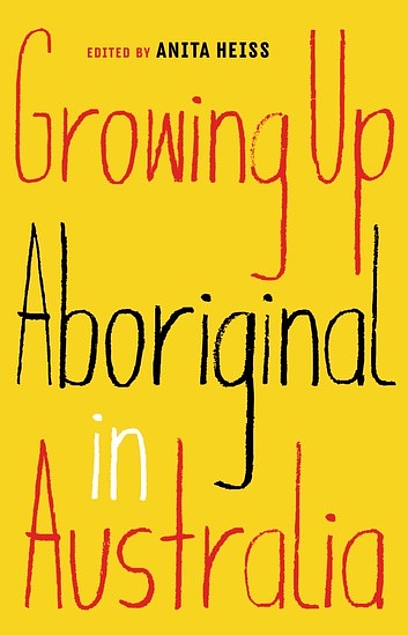
  • Growing Up Aboriginal in Australia (2018), a collection of essays edited by Anita Heiss, showcases a huge diversity of First Nations voices, experiences and stories
  • A swathe of articles in Overland Nº 240 amount to an impressionistic history of First Nations activism from the 1960s Referendum campaign and the Gurindji walk off from Wave Hill to Blak Lives Matter and Indigenous hip-hop
  • Chelsea Watego’s Another Day in the Colony is a powerful contribution to the conversation about First Nations relationship to institutional power in Australia
  • Ruby Langford Ginibi is best known for her memoir, Don’t Take Your Love to Town. The book I’ve read, Haunted by the Past (1999), could have been written to expand on the paragraph oof the Uluru Statement from the Heart’s paragraph on the incarceration of First Nations youth. I had the good fortune to share a table with this extraordinary woman at the 2005 NSW Premier’s Literary Awards (blog post here).

I’ve read a lot of history:

  • T G H Strehlow, Journey to Horseshoe Bend (1969) is a personal account of a major incident in the life of a whiteman who spent his life working with the Arrenrnte people of Central Australia – how much settler Australians don’t understand!
  • Heather Goodall’s Invasion to Embassy (1996) spells out the long, painful process of dispossession of First nations people in New South Wales, and deafness to Aboriginal arguments up to and including the Mabo and Wik judgements
  • Kay Anderson’s Race and the Crisis of Humanism (2007) brings a coldly analytic eye to 18th and 19th century humanist European writing that set out, shockingly to our ways of thinking, to define colonised peoples as less than human
  • Marilyn Lake and Henry Reynolds’ Drawing the Global Colour Line (2008) introduced me to the horror story of the racism around Australia’s foundation as a nation, and in particular the role Prime Minister Billy Hughes played in preventing the League of Nations from including a clause on racial equality in its covenant
  • Grace Karskens The Colony (2009) is a fabulously readable book that leaves its readers in no doubt that at its heart the settlement of New South Wales was a genocidal project, acknowledged as such at the time in all but the actual word (which wasn’t coined until more than 150 years later)
  • Mike Smith, The Archaeology of Australia’s Deserts (2013) is full of technical discussions of dating techniques, but it gives substance to often-repeated statements about how very long people have lived in Australia, and the conditions they dealt with
  • Tom Griffiths, The Art of Time Travel (2016) tells the fascinating story of how the mainstream understanding of Australia has been transformed over the last three quarters of a century, mainly through the acknowledgement and inclusion of First Nations voices and perspectives
  • Historian Humphrey McQueen’s essay in Overland 233 (2018) it gleefully explodes the false outrage over proposals to change the date of Australia Day
  • Cassandra Pybus Truganini (2019) had my Book Group ‘staring into the abyss of our nation’s foundation story’. I also heard it discussed in a session of the 2020 Sydney Writers’s Festival, where Jakelin Troy a Ngarigu woman from south-eastern Australia offered an approving First Nations perspective on it
  • Mark McKenna Return to Uluru (2021) is a wonderful study in how the settler versions of history can be turned upside down by evidence, and no one loses from the process
  • Dean Ashenden’s Telling Tennant’s Story (2022) is history at its passionate best, written partly in response to the Uluru Statement from the Heart.

Other non-fiction:

  • Ross Gibson Seven Versions of an Australian Badland (2002), a meditation on the so-called horror stretch, country north of Rockhampton in central Queensland that has a reputation as the setting for terrible events, forced my ears and eyes open to the horrific history of Native Police and enslavement of Melanesians in my North Queensland home. ‘Sooner or later,’ he writes, ‘any society that would like to know itself as “post-colonial” must confront an inevitable question: how to live with collective memories of theft and murder. Sooner or later, therefore, acknowledgement and grieving must commence before healing can ensue.’
  • Deborah Bird Rose’s Reports from a Wild Country (2004), includes this: ‘Reconciliation draws our attention to the war against Indigenous people, and shows us the legacy of conquest: this great divide on one side of which are the survivors of this undeclared and untreatied war, and on the other side of which are the descendants of those who waged the war … The project of reconciliation demands of us that we acknowledge the divide and the violence, but it simultaneously demands that we explore the entanglements of memory, connection, and commitment.’
  • Eve Vincent and Timothy Neale (editors), Unstable Relations (2016) is a collection of essays about the relationship between First Nations people and environmentalists, insisting on the complexity of forming alliances between the two groups. Monica Morgan, Yorta Yorta activist, is quoted: ‘However much non-Indigenous people say they are committed, in the long run they are committed to their society.’
  • Saltwater (2016) is Kathy McLennan’s memoir of her time as a lawyer for the Townsville and Districts Aboriginal and Torres Strait Islanders Corporation for Legal Aid Services. More than any other book I’ve read and discussed on this blog, It has become the subject of controversy – In an article by Russell Marks in Overland 237 (2019), and then in Chelsea Watego’s Another Day in the Colony (2021)
  • Mark McKenna, Moment of Truth (Quarterly Essay 69, 2018) is one of the first sustained responses to the Uluru Statement from the Heart that I read. It’s still worth reading
  • Jess Hill See What You Made Me Do (2019) is a brilliant book about domestic abuse. One insight in particular is relevant here. She argues, with evidence, that domestic abuse was more prevalent and tolerated to a greater extent in eighteenth- and nineteenth-century England than in pre-invasion Australia
  • An excellent summary-essay by Jeff Sparrow, ‘That’s what drives us to fight’: labour, wilderness and the environment in Australia‘, in Overland 246 (2022) is a solid account of the relationship between settlers and First Nations people in Australia with an eye to environmentalist concerns

Of course I’ve read novels:

  • Alexis Wright’s Carpentaria (2006), The Swan Book (2013) and Praiseworthy (2023) are vast, challenging works from a First Nations perspective
  • Kim Scott, That Deadman Dance (Picador 2010). I was struck by his description of the desecration a a grave as ‘deliberate and careless all at once’. (‘If you don’t know, vote no’ is surely an exhortation to be deliberately careless.) His Taboo (2017) may be less revelatory, but it’s also a brilliant novel.
  • Melissa Lucashenko, Too Much Lip (2018) is just wonderful.
  • Tara June winch, The Yield (2019) ends with an appeal to the reader to make the effort of hearing a First Nations word, and to say it
  • Julie Janson Benevolence (2020) brings a knockabout theatre quality to the early days of colonisation

And lots of poetry:

  • When I blogged about Lisa Bellear’s Aboriginal Country in 2019, I did a brief round-up of First Nations poets I had read, including Oodgeroo Noonuccal, Kevin Gilbert, Lionel Fogarty, Ali Cobby Eckermann, Samuel Wagan Watson and Evelyn Araluen. Since then I’ve read:
  • Two books by Ellen van Neerven – Comfort Food and Throat. For me, her poetry is solidly grounded in a common humanity, and then takes the reader with her to what is specific about her experience as a First Nations person
  • Australian Poetry Journal, Volume 10, Number 1: modern elegy has a whole section edited by Ellen van Neerven featuring the work of First Nations poets

Added a day later: As I expected, there were some big omissions in that list. The Emerging Artist reminded me of:

  • Kim Mahood’s Position Doubtful (2016), which, I said in my blog post, ‘will grip anyone interested in Western Desert art, or the question of how to live awarely as a non-Indigenous Australian’.
  • Archie Roach’s warm, generous autobiography, Tell Me Why (2019)

There are sure to be others. I’d welcome your additions and recommendations in the comments section.

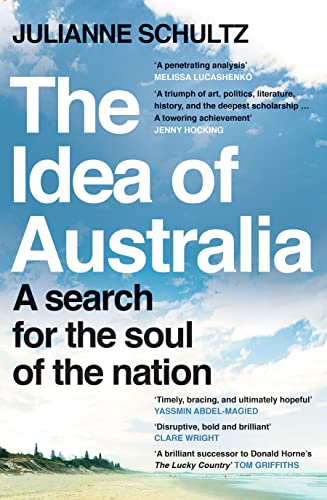
Julianne Schultz’s Idea of Australia

Julianne Schultz, The Idea of Australia: A search for the soul of the nation (Allen & Unwin 2022)

Julianne Schultz is best known as the founding editor of Griffith Review, where she made a substantial contribution to Australian literary culture over 15 years, publishing and engaging with the work of a vast array of writers (including more than one piece by my niece Edwina Shaw), facilitating a rich and complex conversation about things that matter.

The Idea of Australia was originally imagined, according to Schultz’s Acknowledgements, as a meditation, a short volume about Australia, ‘one that floated lightly over the past to make sense of the present to distil a rich, multilayered identity’. That’s not how it turned out. It’s a shaggy, baggy monster of a book, part history, part memoir, part polemic, part reportage, part Covid opus. It’s as if the process of writing that short, light mediation was disrupted by the hundreds, even thousands of voices from the Griffith Review days, each of them with a compelling case for inclusion. Add the sound journalistic and academic practices of quoting sources meticulously, and the project got right out of hand.

There are wonderful things. The twenty-page chapter on the Australian Constitution, ‘Small Brown Bird’ (as opposed to the American eagle) is a brilliant account of how the Constitution was created, and why it is so little read and so hard to change. The impact of John Howard’s time in office on the national consciousness is rendered with heartbreaking vividness in the chapter ‘Soul Destroying’. If you’re looking for a concise and engaging account of Rupert Murdoch (for whom Schultz worked for a time as a journalist) you’d have trouble finding better than the chapter ‘Power Players’. Schultz has interesting things to say about Yassmin Abdel-Magied, Kath Walker, Henry Reynolds, Bernard Smith, Alexis Wright, Mary Gilmore, Galarrwuy Yunupingu and more.

The book turns a critical eye on the idea of Australia as the land of the fair go, including well known stories of exclusion (the White Australia Policy, the dictation test, the ‘offshore solution’ and so on), and doesn’t turn away from the monstrous history of genocidal white supremacy. It is full of riches.

But too often digressions pile upon digressions; there are alarming time switches – from the early days of the Sydney colony to the late 20th century in a single sentence; the elements of memoir and family history aren’t well integrated. It looks as if the book began with the idea of Covid producing an X-ray that shows up the fault lines of our society, but that idea pretty much disappears after a couple of pages to resurface occasionally like the ghost of a discarded structure. And – this may be just me – there are some strange tics in the language: Australia is assigned the pronouns ‘she/her’; and eighty-three years, say, is regularly phrased as ‘four score years and three’. Either the copy editor was overwhelmed or her/his suggestions were overruled. The effect is weirdly alienating.

I’d be lying if I said this book is a must-read. If you know nothing about the history of Australia it is more likely to bewilder than illuminate. If you are already well-informed, depending on who you are, it will either infuriate because of its left-liberal point of view or frustrate because of the its out-of-control elements – or both.

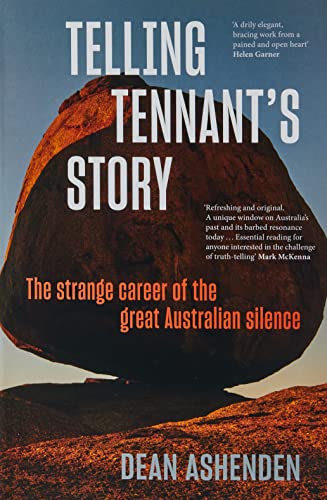
Dean Ashenden’s Telling Tennant’s Story

Dean Ashenden, Telling Tennant’s Story: The Strange Career of the Great Australian Silence (Scribe 2022)

A friend recommended Telling Tennant’s Story as his number one pick for anyone wanting to inform themselves before the Voice referendum.

My own number one pick would be Patrick Dodson’s article, ‘A firelight stick on the hill’ in the Monthly July 2023 (online here), which tells the agonising story of one representative body after another created and then destroyed, and includes this:

We are on the cusp of building a true foundation for our rich and diverse nation, upholding unity, and demonstrating respect for the First Peoples of this country while honouring our Western traditions. These aims are entirely compatible. Australia’s First Peoples are holding a firelight stick on the hill, beckoning us all to build a reconciled, healed and proud nation, where their unique position is recognised and respected.

Dean Ashenden’s book was published before the referendum was announced, but it tells the same story of First Nations voices going largely unheard for more than 200 years. In terms of the Uluru Statement from the Heart, it is about Truth rather than Voice or Treaty, but my friend’s recommendation is right on target. It’s hard to imagine anyone reading this book and then voting No.

Ashenden is a non-Indigenous historian, who spent several years as a child living in Tennant Creek in the Northern Territory. The book is framed as his quest to understand what was going on in the relationships between First Nations and settler people in the town back then. Who were those Aboriginal kids who sat at the side of the picture theatre during the Saturday matinee? Where did they come from? What was this ‘Mission’ that he heard spoken of? He ties this local quest to an account of the Great Australian Silence, anthropologist W E H Stanner’s name for the way Australian mainstream culture – politicians, journalists, historians, novelists, visual artists – ignored First Nations people for so long, relegated them, their concerns and their perspectives to the margins, and turned resolutely away from the terrible violence the settlers have inflicted on them from the earliest days of settlement.

It’s an enormous topic. The book adopts a number of strategies that ease the reader’s path.

First, there’s the personal element. Ashenden begins with his own experience in Tennant Creek, both as a child and on returning as an adult historian. We’re invited to witness him revising the version of the world he was given as a child – a process of revision that all of us settler Australians need to undertake (and incidentally, I’m looking forward to David Marr’s Killing for Country, about his forebears’ involvement in the Queensland Native Police).

Second, the book has a clear structure. Its ten chapters are divided into two parts: ‘Constructing the Silence’ and ‘The Struggle to Dismantle the Silence’. There’s a clear narrative line. Within it, after a prologue placing himself in relation to Tennant Creek, each chapter is organised around a particular year:

  1. 1860: The first contact of non-Indigenous people with the Waramungu of the area now occupied by Tennant Creek John McDouall Stuart’s passing-through was far from benign, but worse it was the harbinger of devastation and violence that was to accompany the building of the overland telegraph line 15 years later.
  2. 1901: This chapter is a nuanced account of anthropologists Frank Gillen and Baldwin Spencer, who visited Tennant Creek to ‘do’ the Waramungu in this year. Ashenden argues that their main contribution to the Great Australian Silence was to ignore the violence suffered by Aboriginal people and call attention to shiny ‘scientific’ studies of their customs and beliefs.
  3. 1933: This is the year that W H Stanner, in some ways the book’s hero, visited Tennant Creek, but the chapter deals mainly with other anthropologists, especially Adolphus Peter Elkin, who proposed the policy of assimilation that in effect meant elimination of First Nations cultures.
  4. 1958: Alongside the story of increasing disruption of the lives of Waramungu people, is the presence of Paul Hasluck in the Federal government, making assimilation official policy. Stanner attacked him with cutting irony in 1958, calling him ‘the Noble Friend of the Aborigines’.
  5. 1967: One of the many surprises of this book is that the 1967 referendum, which many saw at the time as a decisive step forward in Aboriginal affairs, rates barely a paragraph. Instead, the chapter focuses on an equal pay case, which was victorious but which led to widespread unemployment on Aboriginal workers; and Harold Holt’s establishment of the Council for Aboriginal Affairs.
  6. 1971: The first chapter of the second part begins with W H Stanner’s milestone 1968 Boyer lectures, which named the Great Australian Silence. After an excellent, critical account of the lectures, Ashenden moves on to the main subject of the chapter: the courtcase in which Yolngu elders claimed rights over land that the government was about to lease to a mining company. The case was lost, but Yolngu witness appeared alongside ‘expert anthropological opinion’ and their voices were heard. Not much later, Gough Whitlam introduced a bill that was passed by the Fraser government to become the Aboriginal Land Rights (Northern Territory) Act 1976.
  7. 1885: Tennant Creek is again front and centre, ‘on its way to becoming Australia’s most notorious dystopia’. In 1985, the Waramungu won a significant land rights claim.
  8. 1992: This was the year of the Mabo decision. The chapter focuses on the way historians and lawyers replaced anthropologists as the main allies of First Nations people. There’s a terrific account of Eddie Koiko Mabo, including his friendship with Henry Reynolds.
  9. 2000: Three years after the Bringing Them Home report on the stolen generations (whose main author Hal Wootton emerges as a model of someone who was willing to listen and learn), a court case found that a woman who had been taken from her family as a small child was not entitled to compensation. The chapter covers John Howard’s stance on Aboriginal matters and Kevin Rudd’s 2008 apology.
  10. 2005: Ashenden visits Tennant Creek again, sees ‘winners’ history’ on display everywhere, and First Nations stories now at last being told, but in a dauntingly beautiful building that is off the beaten track.

That list barely touches the surface of what the book covers. It’s a terrific read. Then there’s an Afterword, where Ashenden laments the way the heirs of John Howard’s History Wars continue to turn us away from the reality of our history, and argues eloquently for the importance of truth-telling. I’ll finish this blog post with the book’s final words

We might have got away with the silence had Aboriginal people not declined to disappear from history, as they were once expected – in both senses – to do. The past should indeed be ‘put behind us’ but it won’t be until it has been properly acknowledged, not by fessing up, or by telling just those parts of the story that suit particular purposes, but by telling our shared story as fully and truthfully as possible. How to persuade those with control over our institutions of that case? We’re on an offer to make it joint business.

(Page 244–245)

The Annual Francis Webb reading

For some years now, Toby Davidson has been organising an annual reading from the works of Australian poet Francis Webb.

This year it’s on again:

Saturday August 26
2pm-4.30pm
Chatswood Library
409 Victoria Ave
Chatswood

It’s a free event, but you can go to eventbrite to reserve a seat

To quote from the blurb for the event:

Francis Webb was among the first Australian poets to be deeply influenced by post-war American poets like Robert Lowell and Sylvia Plath. He was also the first canonical Australian poet to write at length about the experience of mental illness and institutionalisation after he was diagnosed with schizophrenia in his 30s. A quintessential ‘poet’s poet’, Webb has deeply affected generations of poets and poetry-lovers while rarely being known to the wider public. Since 2012, this annual free event has celebrated Webb’s prodigious talent and keen sense of social justice. Webb’s personal book and art collection, held at the library, will also be on display.

The blurb goes on to say that student representatives from St Pius X College and CBC Lewisham will be reading and discussing Webb’s poems. What it doesn’t say is that there will be other guest speakers and readers – of whom I am one.

In my mid 20s I was completely enamoured of Webb’s poetry, and whenever I open Toby Davidson’s edition of his Collected Poems I fall in love all over again. I’ve mentioned him a number of times on this blog. I’m thrilled to be invited to read, and I’d love to see any of my readers there.

Added later: The reading was fun. About 20 people gathered in the ‘Creators’ room of Chatswood Library, and about seven of us read. Toby Davidson chaired the event with infectious enthusiasm. He paid special tribute to Bob Adamson, who died recently, and read one of Adamson’s eight poems that refer to Francis Webb. I met a man who was a psych nurse in Parramatta when Webb was a patient there, and who painted a portrait of him that was on display in the room where we met.