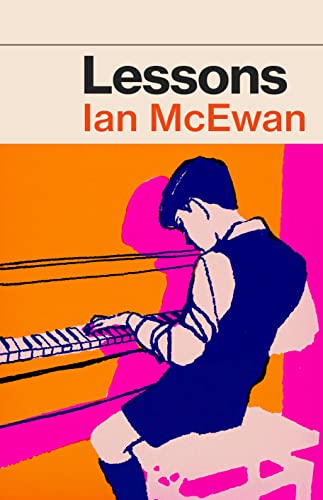
Ian McEwan’s Lessons: page 75

Ian McEwan, Lessons (Jonathan Cape 2022)

This is a tentative experiment in a different way (for me) of blogging about books: take page 75 and write whatever comes to mind about it. After my next birthday, if I keep this up, I’ll take page 76.

Page 75 of Lessons would probably have a red line drawn through it by someone writing a film script. It’s mainly a minor character’s backstory.

By this stage of the novel, the main character, Roland Baines, has been abandoned by his wife, Alissa, with no warning and no real word of explanation, leaving him to care for their infant son. He has received a couple of postcards from European addresses, the most recent saying she is about to visit her parents in Germany. Page 75 begins with his wondering why she is visiting her parents and imagining that if she tells them what she has done, ‘the row would be like no other’. McEwan delivers on this tease later when Roland hears the mother’s account of that row, which is quite different from what he imagines. Later still, that account is confirmed by Alissa herself.

The rest of the page begins the back story of Alissa’s mother, Jane: born in 1920, educated in a grammar school, and by the end of the page nursing literary ambitions working as a part-time typist at Cyril Connolly’s prestigious literary magazine Horizon (a real magazine):

She later told her son-in-law that she was seated in an invisible corner and given the dullest correspondence. She wasn’t beautiful or well connected and socially adroit like many of the young women who passed through the office. Reasonably enough, Connolly barely noticed her but occasionally she was in the presence of literary gods. She saw, or thought she saw, George Orwell, Aldous Huxley and a woman who may well have been Virginia Woolf. But, as Roland knew, Woolf had been dead for two years and Huxley was living in California.

There are many passages like this in the book: passages that fill us in on someone’s background, or summarise a novel or (in one case) a children’s picture book. As here, the writing keeps the main narrative in sight: we’re getting Jane’s story, but it’s as told to Roland, and commented on by him. There are plenty of dramatic scenes in the novel – Roland visits Berlin as the wall is coming down; he has a weird physical struggle with a conservative politician in the wilds of Scotland; in his 70s, he confronts a woman who sexually abused him as a 14 year old – but even in undramatic passages like this, there’s plenty of complexity to hold a reader’s interest. There’s also a version of one of the novel’s recurring motifs: a life lived in the shadow of fame.

The novel tells the story of Roland’s life, from early childhood in Libya, his time at boarding school where he has a deeply troubling sexual experience with his piano teacher, through years of drifting, his shortlived marriage to Alissa, single parenthood, some years of happiness in a new relationship, to old age. His early promise as a pianist is blighted by the early quasi-consensual sexual abuse: that and his abandonment by Alissa are the two intimate experiences that shape his life. The Suez crisis, the Cuban crisis, the building and fall of the Berlin wall, Brexit and Covid 19: each of these also has a direct impact. The novel is immensely satisfying as the story of an ordinary life that covers, as it happens, almost exactly the same period as my own. I feel as if I know Roland.

Rereading page 75 makes me realise that his story also functions as a conduit for other stories, mostly stories of women: his mother, the piano teacher, Alissa, Alissa’s mother Jane, Daphne who is a good friend and confidante in the early chapters and later become much more, and finally, briefly, his granddaughter Stefanie. Each of these stories can be seen as holding lessons for Roland, and for us, or at least they can be seen as posing questions: about adults’ responsibility to young people in their care, about complex issues of consent, about how to face death, about the competing demands of art and personal relationships, about ways to assess success and failure. Not that it’s didactic. When Roland reads Tomi Ungerer’s Flix to his granddaughter, he tries to make it a teaching moment by asking her if the story ‘is trying to tell us something about people’:

She looked at him blankly. ‘Don’t be silly, Opa. It’s about cats and dogs.’
He saw her point. A shame to ruin a good tale by turning it into a lesson. That could be for later.

(Page 481-482)

Lessons is a good tale, or a whole entwined mass of good tales. One of them is the tale of a man who is offered many lessons and learns some of them. If there is one overarching lesson, it’s that the more you know about someone’s life, the less easy it is to make a sharp moral judgement.

November Verse 3

Another stanza about an incident from my week.

November verse 3: Ageing

She fell again today. No broken
bones this time, but something gave.
She called my phone, all calmly spoken:
‘Help. I’m stuck. Please come and drive
me home.’ No time for noes or maybes.
Growing old is not for babies.
Parkinson’s is crueller still.
We all go when we get a call.
Friends would once go dancing, singing,
up to usher in the dawn,
greet fate with our collective scorn.
But now time’s chariot comes winging,
we know when we face the gun
it’s one for all and all for one.

November Verse 2: Swimming with a two-year-old

It looks as if this year’s November verses are going to be diary entries.

November verse 2: Swimming with a two-year-old

He pushes me, says, 'Go way, Poppa!'
If I go away he'll drown.
Still, I obey. It's only proper.
Kicking, flailing, he goes down
then back up in my arms and grinning,
safe, a little shaken – winning.
Sister swims, so he will too:
skip the learning, let's just do!
The class begins: a different story.
Ring a rosy, crocodile,
wobble wobble, throw the ball:
each game a challenge, fun or scary.
Splash! We laugh and cry. We play.
We learn, it seems, just by-the-way.

November Verse 1: On quitting Twitter

For the thirteenth year in a row, I’m setting out to write 14 fourteen-line poems in November. I intend to write mostly Onegin stanzas*, and at least some of them will relate to the news of the day. As always the aim is quantity, and quality if possible.

So here goes with Verse Nº 1, hoping I don’t lose too many readers who might otherwise have been referred here by Twitter:

On quitting Twitter
I'll miss the cats and fancy dances,
Dreyer's copy-ed decrees,
First Nations chat – what are the chances
I'll find another path to these?
I'll miss the links to weighty writing,
jokes and spleen and humble-skiting,
praise apportioned, insults hurled.
I've closed my window on that world.

Thank Musk, speech freedom absolutist.
No longer am I like a chook
transfixed by python's stony look,
a string to algorithm's lutist.
Come on out, the real world's fine.
My idle moments now are mine.

For those who don’t know:

  • Benjamin Dreyer is chief copy-editor at Random House in New York, author of Dreyer’s English: An Utterly Correct Guide to English and Style, passionate advocate of the Oxford comma and endlessly amusing tweeter
  • Indigenous X is, or was until recent attacks led them to hit pause, a rotating Twitter account founded by Luke Pearson and hosted by a different First Nations person each week

* The Onegin stanza was probably invented by Alexander Pushkin and features in his verse novel Eugene Onegin. I first encountered it, and fell into its thrall, in Vikram Seth’s verse novel The Golden Gate. It consists of 14 lines of iambic tetrameter (meaning that each line has four beats, or four feet, of two syllables each) with the rhyme scheme aBaB ccDD eFF eGG, where the lowercase letters represent rhymes where the stress falls on the second-last syllable, and the uppercase represent rhymes where the stress falls on the last syllable.

Stephen Edgar’s Strangest Place

Stephen Edgar, The Strangest Place: New and Selected Poems (Black Pepper 2020)

This is a daunting book. It opens with 76 pages of new poems in a section titled ‘Background Noise’, enough for a respectable book on its own. But Stephen Edgar has had poetry published since 1976, so it was time for a retrospective, and more than 200 pages follow, a selection from his ten previous books. It’s a lot to take in if, like me, you’re new to his work.

Here’s part of what Clive James had to say about him:

Stephen Edgar stands out among recent Australian poets for the perfection of his craft, a limitless wealth of cultural reference, and an unmatched ability to make science a living subject for lyrical verse … The quickest way of summing up my appreciation of his mastery would be to say that if he were a jazz musician, he would be the kind who, when playing after hours, leads all the others to pack up their instruments and listen. 

From clivejames.com

James doesn’t mention Edgar’s commitment to rhyme (a commitment James shared). A typical poem in this book has a complex rhyme scheme with a strict metric count, a form that as far as I know is often invented by Edgar for the occasion. The poems adhere to these forms rigorously, rarely even using a half-rhyme or adding an extra syllable. This extraordinary, and deeply unfashionable formal constraint is a wonder to behold. James’s comparison to a jazz musician seems at first blush paradoxical or even perverse, but it makes sense if you think of the poem’s form as the basic melody, the regular rhythm, around which the syntax, ideas and images play wildly.

For me, it’s not jazz that comes to mind, but sculpture. Thoughts or observations on things mundane or evanescent, tiny or immense, uncanny or terrifying are worked into solid, well-defined shapes. There’s no chance that the reader will mistake the result for simple expression of emotion or anything other than an artifice, one charged with the tension between the fixed form and the mercurial play of mind. The range of subjects includes a Sydney summer day that ends with a Southerly Buster (‘Coming Up for Air’); a group of naked children walking on Hampstead Heath (‘Hampstead Incident’); a performer who builds a structure of feathers (‘Feather Weight’); a slo-mo film of mating finches (‘Song and Dance’); a woman plagued by voices (‘Voices Off’); the death of our planet (‘Shadow Line’); a glimpsed insect (‘Dragonfly’).

If the poems are sculptures, they are both sculptured shapes on the page, and sculptures in sound: these poems cry out to be read aloud.

After I’d written this far I read Martin Duwell’s excellent review of The Strangest Place at this link. Rather than write more about the poetry in general, I recommend that review.

To pick one poem, here’s ‘Out of This World’ (pages 50-51). You can click on the image to open it in a new tab at a more readable size:

See what I mean about strict formal qualities? Each of these stanzas has eight lines. Most of the lines are iambic pentameters (that is, they have five two-syllable feet each); the lines that differ – the first, sixth and eighth line of each stanza – have three, two and four feet respectively. The rhyme scheme is abcadbcd; it may help understand the play of rhyme if it’s written abca-dbcd.

Each of the first three stanzas is a step in an argument: a) a prediction and a proposal; b) detail on the prediction; c) detail on the proposal. The fourth stanza ricochets unexpectedly, and the fifth arrives at an unexpected resolution.

So, the great man predicts,
The ruined body and robotic voice:
A thousand years, at most, till humankind
Exhausts the planet which it now afflicts
With the works that cry our claim to fame.
We'll have no choice,
He says, but to abandon it and find
Another one – and do the same?

The first two lines are mildly riddling: ‘the great man’ is of course Stephen Hawking. Shortly before he died in 2018, he predicted that our universe would eventually fade to darkness as the stars run out of energy, and he proposed that scientists might be able to find alternate universes. This stanza manages to evoke Hawking’s physical presence, put a version of his prediction and proposal into smooth verse (see above for what Clive James said about Edgar and science), and then challenge the proposal with a question that throws forward to the second stanza. It’s worth noting that, at least according to the report I linked to above, Hawking was talking about the end of the universe, whereas Edgar scales it back to the more imminent end of the planet, thereby introducing a moral element – the end of the planet is caused by the ‘works’ of humankind, whereas the end of the universe is due to inexorable processes. I guess that’s what my mother used to call poetic licence.

Which future will it be?
The nightmare we've been dreaming since the War,
The sunburst in which history will combust,
The twisted shadows of our artistry
Awash with ash? Or the Earth skinned
As landscapes pour
Their sunburnt pastures, continents of dust,
Abroad to feed the scouring wind?

The opening question may seem to be posing a choice, but it’s not so. This is not a poem for activists, nor is it an update of Robert Frost’s ‘Fire and Ice‘. The poem assumes that the prediction is correct, and catastrophe is assured; neither resistance nor preference comes into the question. There are two scenarios, nuclear holocaust and climate disaster, both of which have become more compelling in the actual world since the poem was published. Just as with Hawking in the first stanza, they are evoked by striking images rather than simply named. The effect is partly to draw attention to the poem as artifice, but also to invite an imaginative engagement with the predicted catastrophe(s).

What desperate voyagers,
Suspended generations, will pursue
Light's white retreating speed, and drift away,
The keepers of a purpose that refers,
Who knows, to nothing, while this sphere's
Now curdled blue,
Revolving slowly through its long decay,
Dwindles far off and disappears?

This stanza, step three, spells out Hawking’s proposal, again taking a familiar concept – this time a science fiction trope – and working it into the fore-ordained stanza shape. ‘Suspended generations’ neatly evokes those stories of spaceships full of people in suspended animation; ‘curdled blue’ draws great power from the way it evokes popular lyricism about earth as a beautiful blue planet. Unlike Hawking, the poem is pessimistic about the fate of the ‘voyagers’ – their purpose may lead to nothing. For all the strength of these images, and those of the preceding stanza, the poem is still fairly cerebral. And then, whiplash:

My mother's final day.
I sit with her in the grey sterile tide
Of afternoon. Her shrivelled body strains
Its sour breath. Her mouth gapes to convey
Its dry mute aria. Over her
The minutes slide
With useless protocol. Nothing remains
For them to do now but recur,

The focus shifts abruptly from the global to the intimate. The general ‘we’ in the first stanzas shrinks to ‘I’ and ‘her’. Where the strict adherence to form had a distancing effect in the previous stanzas, here not so much. There the effect is a kind of classicism – ‘what oft was thought but ne’er so well expressed.’ Here, powerful emotion is recollected, if not in tranquillity, then some time after the event. ‘Her mouth gapes to convey / Its dry mute aria’ brings the terrible scene vividly alive.

Much of the power of poetry can lie in what isn’t said. In this case, the gap between the third and fourth stanzas cries out for attention. I can’t be the only one who, having just read an evocation of the end of the Earth, comes to the line ‘My mother’s final day’ and thinks of Mother Earth. Probably more idiosyncratically, I thought of A D Hope’s 1958 poem, ‘On an Early Photograph of My Mother‘, in which the mother is Earth, and the vaporising effect of nuclear war is imagined. I’m not saying that Edgar had Hope’s poem in mind, but in my admittedly patchy knowledge of Australian poetry, Hope is the poet Edgar most resembles, mainly for his adherence to rhyming forms, but also for his interest in matters scientific and his occasional venture into the erotic (Hope’s ventures there were more than occasional).

Back to the poem. It resists the gravitational pull of the mother / Earth metaphor. Instead, her ‘withdrawing mind’ is likened to the desperate voyagers of the third stanza, and to the possible nothing at the end of their voyage:

While her withdrawing mind,
Drifting, I fancy, like that future host
Beyond the reach of this blue globe, before
Day's end will leave the daylight dream behind,
Borne on the solar wind that sweeps
The icy coast
Of Pluto, pure dark energy once more
Bound for the interstellar deeps.

The two parts of the poem are brought together, and though it might be tempting to see one of them as a metaphor for the other, it’s not that simple. Abstract emotion about the end of the world and immediate personal grief each has its own powerful validity, and they illuminate each other. Climate grief becomes intensely personal; personal loss becomes cosmic. Much of the stanza refers equally to the dying woman and the survivors of earth’s destruction: ‘daylight’s dream’ means both an individual life (Isn’t there a mystical tradition somewhere that says our life is but a dream, and reality lies elsewhere? If not, there’s certainly a children’s song) and the aeons in the human race has lived by the light and energy of the sun. ‘The icy coast / Of Pluto’ refers to both the planet, beyond which the survivors must go, and the underworld of the ancient Romans beyond the shores (coast at a stretch) of Acheron. ‘I fancy’ in the second line, while working nicely into the alliteration that is so striking in this stanza, declares that the poem is an artifice, but that in no way detracts from the pathos of the final lines.

Niall Williams’s History of the Rain and the Book Group

Niall Williams, History of the Rain (Bloomsbury 2014)

Before the meeting: I fell in love with this book at the first paragraph:

The longer my father lived in this world the more he knew there was another to come. It was not that he thought this world beyond saving, although in darkness I suppose there was some of that, but rather that he imagined there must be a finer one where God corrected His mistakes and men and women lived in the second draft of Creation and did not know despair.

That’s nineteen-year-old Ruth Swain, whose mother is a MacCarroll, writing from her sickbed in a book-filled room at the top of a house in the tiny Irish village of Faha, where it has been raining for centuries.

Ruth has inherited her father’s vast library and her head is filled with the books she has read while sick, especially the novels of Dickens. As she tells us the story of her family – her grandparents Irish and English, her mother Mary, her father Virgil and her twin brother Aeneas whom everyone calls Aeny – her prose bristles with references to those books, usually taking the intertextuality to a comic extreme by naming the book’s publisher, date of publication, and its number on her father’s shelves. Her style, as she is told by a schoolteacher who visits her, is ‘a bit Extreme’:

I am that anachronism, a book-reader, and from this my writing has developed Eccentric Superabundance of Style, Alarming Borrowings, Erratic Fluctuations, and I Must lose my tendency to Capitalisation.

Her narrative is indeed eccentric, alarming, erratic, and overflowing with Irish charm. I totally believed in her – so much so that when I reached the Acknowledgements at the end of the story and read Niall Williams speaking in his own voice it was like coming down to earth with a thud.

Ruth’s father is a poet. We don’t get to read a single line written by him, but – in striking contrast to the poet mother in Edwina Preston’s Bad Art Mother (my blog post here) – we have total confidence in his creative process. Here’s a little of the description of the moment when he first begins to create poems, when he is ‘brimming’ after the birth of his children:

There were no words at first. At first there was a kind of beat and hum that was in his blood or in the river and he discovered how somewhere in his inner ear, a pulsing of its own, a kind of pre-language that at first he wasn’t even aware he was sounding. It was release. It was where the brimming spilled, in sound. To say he hummed is not right. Because you’ll suppose a tune or tunefulness and there was none, just a dull droning inside him.

(Page 262)

As well as a multitude of writers, Ruth’s head is filled with the people of Faha, their malapropisms, their idiosyncrasies, their all-knowingness. Possibly because I spent my childhood in the Irish-Catholic diaspora of North Queensland, I didn’t recoil from what you might see as sentimentality in their portrayal, but was delighted by their comic energy. Take this, for example, from the moment when the newborn twins are being baptised in river water in the kitchen of their home:

Everyone closed in around us, everyone wanted to see. It was as if our story was already being told and was moving the hearts of Faha, making people think These two will need help, for right then there was an opening of shirt buttons, a rummaging in handbags, in wallets and coat pockets, a general flurry of rooting about, and then, as the river water was being scooped from the bucket, into our swaddling on the kitchen floor came assorted Miraculous Medals, rosary beads, Memorial cards, brown and blue and green scapulars of various antiquity (and body odour), two Padre Pios, two Pope John Pauls, one Little Flower, Saint Thérèse of Lisieux, Patron-of-the-Missions card, several (because we had been Lost & Found) Saint Anthonys, one Saint Teresa of Ávila, Patron of Headache Sufferers, and from the handbag of Margaret Crowe a sort of crouched-down Lionel Messi-looking Saint Francis of Assisi, all of them well-worn and used and in our first moments in this world falling around Aeney and I now like holy human rain.

(Page 269)

The only reference in that list I had to google is Lionel Messi. All the rest is vintage irish-Catholic. I was so enchanted I barely noticed that horrible ‘Aeney and I’ at the end.

I laughed out loud. I inflicted passages on my long-suffering partner. I cried, though not at the sad bits, which were the only place where the book’s hold on me slackened a little. No, it was when Ruth relents for a moment and lets her awkward and consistently rebuffed suitor wash her hair.

After the meeting: Our host gave us an excellent Irish stew and roast potatoes, which were supplemented by a salad, pastizzi from Newtown and various cheeses, chocolates and ice creams brought by the rest of us.

Not everyone had finished the book; one was still waiting for it to arrive at his local bookshop. Not everyone loved it as much as I did. But we had an animate discussion of the what-about-that-bit variety, and I wasn’t the only one who had been prompted to read sections aloud, as much for the reader’s pleasure as for the listener’s. We all had the impression that the listeners, in this case, enjoyed the experience.

I wasn’t the only one to have wept at the hair-washing incident.

Australian Women Writers: Lesbia Harford

This blog post was first published on the Australian Women Writers blog on 11 October 2022, at this link.

Lesbia Harford is far from forgotten or overlooked. You could even argue that, for an Australian woman poet, she has received a lot of attention. H M Green’s monumental History of Australian Literature, Volume II (1961) devoted four pages to her, but a decade later she was completely absent from Harry Heseltine’s Penguin Book of Australian Verse (1972). These days, she is dependably included in historical anthologies, and her poems turn up on sites like allpoetry.com and poemhunter.com. Yet it’s unlikely that many readers of this blog will be familiar with her work. And that’s a shame.

Lesbia Harford, nee Keogh (1891–1927) was born into a middle-class Melbourne family that fell on hard times when her alcoholic father deserted them. She suffered from a congenital heart condition that meant her health was always an issue. She was an active and much-loved part of Melbourne’s small intellectual circle. At university in 1914 she often engaged in heated debate with the young Robert Menzies. She had a passionate, life-long relationship with Kate Lush, a Philosophy lecturer at Melbourne University. She had a close friendship with Communist Guido Baracchi (the subject of Jeff Sparrow’s Communism, A Love Story), and for a time they were lovers. She was a unionist , and joined the International Workers of the World – the Wobblies. Despite her physical frailty she decided on ethical grounds to work for years as a machinist in a clothing factory. In her brief marriage to a socialist activist and artist, she endured domestic violence. She tutored students in English literature. She completed a law degree, a rare achievement for a woman at that time, intending to use it to work for social justice, but she died before she could fully qualify as a lawyer. She was an intellectual, an ex-Catholic, a factory worker, an activist, a free spirit, a lover, a tutor and a student: all of these fed her poetry.

When she died in her mid thirties, she had published very little poetry. Three collections have been published since, in 1941, 1885 and 2014, each containing more poems than the previous one, and roughly 200 more of her poems exist only in notebooks held in the Mitchell Library in Sydney. (Her novel, The Invaluable Mystery, which was published in 1987 by McPhee Gribble with a foreword by Helen Garner, must wait for another blog post.)

Harford’s increased profile is probably due in part to a general shift in the culture. For example, when a lecturer on Australian modernist painting recently failed to mention any women artists, their student audience was scathingly vocal. There are good grounds for hope that a similar response would today meet an anthologist who, like Heseltine, included Peter Hopegood (Peter who? I hear you ask) but not Lesbia Harford. The general change was made particular in Harford’s case by work done by Marjorie Pizer over many years, culminating in the publication of Poems of Lesbia Harford (Sirius Books 1985), which she edited with Drusilla Modjeska. The book includes a number of photos, and Modjeska’s introduction gives a lively account of Harford’s life and work. If you can find a copy (no easy task), I recommend it.

Over the decades since her death, Harford has been viewed through many lenses.

In 1942, an anonymous, probably male reviewer in the Sydney Morning Herald wrote what was meant to be dismissive, but these days reads like praise:

There is … an absence of what one would call poetry. Moments of perceptions are recorded in her verse, crystallisations of feeling, but rarely in ‘words that burn’. In fact, the book reads rather like a rhymed diary.

Poet from the Past‘, Sydney Morning Herald 2 May 1942, page 6

In 1961, H M Green wrote that she was ‘a pure lyrist’ and went on:

Almost half her collected poems deal with love; in a sense indeed they all do, for she differs from many other social reformers in that the motive of her enthusiasm was love, in its largest sense.

in 1985, Drusilla Modjeska wrote:

Her voice, unmistakably her own, speaks as part of the multiplicity of voices speaking about social injustice, hope for revolution and the contradictory experiences of women … The radicalism of her verse did not rely on polemic but on the power of the female voice that does not apologise.

In 2014, Les Murray, presumably without intending the compliment to be backhanded, pronounced:

I consider Ms Harford … as one of the two finest female poets so far seen in Australia.

In the same year, Jeff Sparrow echoed the anonymous 1942 reviewer’s ‘rhymed diary’ comment, but with a completely different implied judgement (one that I agree with):

She often wrote about – and occasionally to – her friends and associates, referencing both public events and personal triumphs and sorrows. Like other private documents, the poems demand to be read in context – a context that, in Harford’s case, is not always obvious, both because the biographical record remains sketchy and, perhaps more importantly, because our historical moment is so different.

Sydney Review of Books 16 September 2014

Sparrow’s comment is reinforced by the way the poems have reached us. In all three published collections, as in Harford’s notebooks, they are organised in chronological order (though the most recent and largest of them, Oliver Dennis’s 2014 edition, doesn’t give dates). So it’s tempting, often appropriate, and even necessary to read the books as elliptical autobiographies or memoirs that touch on world events as well as intimate ones. My own experience of the poems bears this out: read in isolation in anthologies or on poetry websites, they have little of the power they have when read together, in order.

Readers so far might get the impression that reading Lesbia Harford is like visiting the Poetry Museum. My aim in the rest of this blog post is to demonstrate that it’s not like that at all, by showing some small examples. Here’s the first of her poems that I read:

People sometimes tease me, saying
I have lovers many.
If I lack the one I sigh for,
What's the good of any?

I will never have a lover,
Though I am so bonny.
Love could only hurt that showed me
What I miss from Johnny.

Like many or even most of Harford’s poems, this looks and at first feels like light verse. It starts out as a jaunty, even frivolous rhyme. Then the tone deepens: the poem moves from a lively social circle, to reflecting on the relative value of good-time companionship and true love, to a rejection of the idea of having a lover at all, and then in the final lines, so calmly that it could be missed altogether, a bereavement is revealed. Read without context, it’s subtle and moving. If you read it as a poem from the home front of the First World War, it has a kind of devastating whiplash effect.

You may not read it that way, and it’s a strength of these poems that they don’t insist on a particular reading. The fairly early poem, ‘My mission in the world’ is explicit:

No marble meaning’s mine
Fixed for a school,

My singing ecstasy
Winged for the flight,
Each will hear differently
And hear aright.

That idea sounds awfully modern, even while it’s framed in pre-modern rhyming verse. Yet, even while the poems don’t insist on a single reading, they draw much of their power from their truthfulness. This tiny enigmatic offering is an example:

I have three loves who are all most dear.
Each one has cost me many a tear.
The one who is dead yet lives in me.
I were too poor had I less than three.

We don’t have to know names and dates to believe this is based in experience. It’s not naive: but while it defies what these days we would call something like monogamous heteronormativity (other poems make it clear that one of the loves is a woman), it still reads as a simple, fresh statement of an emotional reality.

There are surprisingly explicit poems about menstruation, ‘Periodicity’ I, II and III. This is the first of them:

Each month I go
Fathoms deep, ocean-whelmed, in woe.
Then agony, hopelessness roll
Wave-deep over body and soul,
Then pain's my familiar, darkness my friend,
And Time has no end.

Yet once again
I rise born anew from my pain.
Soul, body take radiant form.
Aphrodite-like out of the storm
I emerge. In their issue are blest
Those waves without rest

When I read that to my partner, she didn’t respond as if the poem was a hundred years old. She said, ‘She’s got endometriosis.’

A little poem about rowdy factory girls on the way home from work, snippets of conversation between machinists at work, a rhyme about missing a lover, a narrative of going for a swim just before dawn, a note on the weather – any one of these will draw the reader in, then turn at the last moment without breaking a sweat and leave you gasping or, sometimes, wondering if you just imagined that the poem did what you think it did.

References:

The Poems of Lesbia Harford, edited by Nettie Palmer (Angus & Robertson 1941)
Poems of Lesbia Harford, edited by Marjorie Pizer and Drusilla Modjeska (Sirius Press 1985; link is to an Open Access book at Sydney University Press)
Collected Poems: Lesbia Harford, edited by Oliver Dennis with a foreword by Les Murray (UWAP 2014)

H M Green, A History of Australian Literature: Volume II, 1923–1950 (Angus & Robertson 1961), pages 951–955
Gary Catalano, ‘Lesbia Harford’, Quadrant, December 1998, p. 53
Jeff Sparrow, Communism, a Love Story (MUP 2007), especially pages 67–93
Jeff Sparrow, ‘Render it barely: Collected Poems: Lesbia Harford‘, Sydney Review of Books,16 September 2014

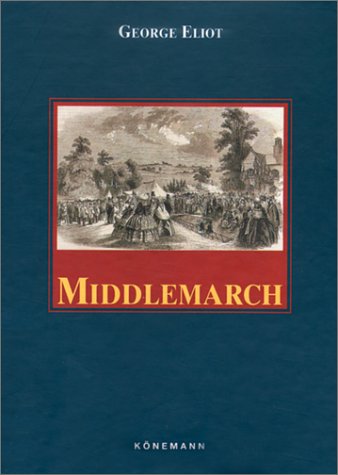
Starting Middlemarch

George Eliot, Middlemarch: A study of provincial life (George Eliot, 1871–1872; Trident Press International Classic Romance 2001)

There’s been a gap in my waking-up ritual since I finished my slow-read of the Iliad more than a fortnight ago. Maybe I should have decided to reread The Odyssey – after all, I read it in a bit of a hurry the first time. Or I could have picked one of the classics that have so far stayed unread by me – Pride and Prejudice, War and Peace, the Confessions of Saint Augustine, there are plenty to choose from. But it’s Middlemarch that has been mentioned regularly in my social media feed, more than once nominated as the best English novel ever written.

A mention that stands out is something Ta-Nehisi Coates wrote in his blog more than 10 years ago. His blog seems to have disappeared without trace so I can’t give you an exact quote, but he focused on one of George Eliot’s sentences, showing how the beats fell, how it veered off in unexpected directions, comparing it to hip-hop music that he loved. (In December 2011 The Atlantic published what may be a shorter version of that blog post, which you can read here. He had two other Middlemarch pieces in The Atlantic at about the same time, here and here.) Even though that was more than 10 years ago, it was probably Ta-Nehisi Coates who made the prospect of rereading this book attractive, if somewhat daunting.

Last year I read and blogged about Kathy O’Shaughnessy’s In Love with George Eliot (blog post here) and the comments on that blog post made rereading seem less daunting and even more attractive, and here I am.

I didn’t have a copy, so I trekked to the nearest second-hand bookshop (Goulds in King Street Newtown, if you’re interested). The one copy on their shelves was this Classic Romance edition. If romance readers can deal with such tiny type, it shouldn’t be impossible for me, but if I stumble across an edition that’s kinder to my septuagenarian eyes, I’ll switch and let you know.

I’m starting out with the aim of reading four pages a day, to finish some time next April, but if that turns out to be frustratingly slow, I’ll increase the quota. As with past slow reads, my aim is to give you a monthly progress report.

Antigone Kefala’s Late Journals

Antigone Kefala, Late Journals: Reflections 2000–2020 (Giramondo 2022)

I’ve come late to Antigone Kefala’s work, having previously read only her 2016 book of poetry, Fragments. When I blogged about that book (here), I responded to a comment Kefala had made elsewhere that she was always seen as an ‘ethnic’ writer, ‘constantly being compared to other ethnics, but not to Australian writers’, by comparing one of her poems to one of Les Murray’s. A little later I actually met her at a poetry reading. It felt a little like being presented to royalty, but she was all modest grace, called me ‘Mr Shaw’, and was amused that I had taken her challenge so literally.

Appearing six years after that encounter, Late Journals is full of that same modesty and grace. It’s a collection of fragments from a life, organised into six years divided into months. Given that the book’s subtitle tells us it covers 11 years, it’s evident that the book isn’t literally a diary, and attempts to tie entries down to specific dates will likely as not be thwarted.

For example, I flipped at random to page 62, the end of February of Journal III:

Nikos is having an exhibition in Vienna. He will send a catalogue, I was thinking of the early opening at Barry Stern’s.
In the silence of the gallery his fruit waited against a brooding metaphysical background. These magnificent shapes absolutely as if made of volumes of colour, colour with an amazing solidity, yet light, the two quinces, the cherries, the pears … The most amazing, rich, yet explosive colour.
A beautiful balanced group.
In spite of so many invitations sent out, only friends came. And no sales.

Characteristically, ‘Nikos’ is not further identified. Nor is the Viennese gallery or the date of either exhibition. A quick web search turns up Nikos Kypraios, who had exhibitions in Vienna in 2011 and 2012. His website has a page of paintings of fruit that were ‘made in 2010’. (I found a record of an exhibition at the Barry Stern Galleries in Sydney more in 1985/1986, but that’s probably not the one she means.) What matters isn’t the date and place. This isn’t a newspaper report, it’s a note about a friend’s achievement, and the editorial decision not to include the friend’s full name, here and in many other places, keeps the reader in the listener-in role. We are given a glimpse of how Kefala’s friendship circle, of how she responds to this work, and to its reception.

The warm appreciation of the paintings and the lament for their lack of local success are typical of much of these journals. This is sometimes about contemporary culture in general – as when she goes to see Fellini’s Ginger and Fred, and describes it as ‘baroque, magnificently funny and satirical, a total indictment of television and advertising, this listening to music while talking, the television sets everywhere’. Sometimes it’s specifically about non-Anglo-heritage artists, possibly most explicitly in this, from May in Journal VI:

Looking at the latest Companion to Australian Literature – we appear in a subsection called ETHNIC MINORITY WRITING. After so many years of writing here we are still totally outside the whole scene. Not only Ethnic, but Minority as well – a double blow.
The literary scene, as the sports scene and so on, seems to be dominated by a few names, as if written by adolescents who can only remember one name, more names in a scene impossible to sustain.

But that’s only one aspect of these journals. As Michelle De Kretser says in a back-cover blurb: ‘In poetry as in prose, Kefala has made the fragment her form.’ A single spread may include a character sketch of an unnamed woman (a journalist?), a description of a dance between the cat (Max) and a magpie, a quote from a New York Review of Books article, incisive praise for a new book of poetry, and a cutting comment on astrophysicists and theologians on TV.

From the accumulation of fragments, made readable by the diary-like presentation, there emerges a quiet self-portrait of a creative spirit, part of a creative community, immersed in the world of literature, music, drama, art, doing her bit to make sense of it all. A self portrait of a woman facing the vicissitudes of ageing and mortality. A generous sharing of self from someone who is immensely likeable.

Antigone Kefala was born in Romania in 1935 and after living in Greece and New Zealand migrated to Australia in 1960. Her first collection of poetry in English, The Alien, was published a little over a decade later. She has written three works of fiction, five poetry collections and two collections of journals. This book, which has been ominously described by its publisher as her final work, is the second of the journals.


I am grateful to Giramondo Publishing for my complimentary copy of Late Journals.

Journal Catch-up 15

Here I am once again with two journals, each of which has produced another issue after the one I’m writing about.


Alexandra Christie (editor), Heat Series 3 Nº 3 (Giramondo 2022)

I’ve just read a tweet quoting Helen Garner about Heat series three:

So slender and elegant, nothing wasted, nothing grandiose – and beautiful work.

Beautifully said!

The third issue is true to Heat‘s original goal to publish culturally diverse voices. It has a bit of a theme going:

  • ‘Australian Capital Territory’, a short story by Madeleine Watts, in which a man and a woman search in and around Canberra for somewhere to have sex, and finally succeed in a manner that is most satisfactory to them, the watching kangaroos and the reader. So, sex.
  • Small Talk’ by Kenneth Chong, a very different short fiction, presented as a kind of abstract memoir, about a young man of faith dealing with troubling issues. So, sex and religion
  • ‘Cain’s Feast’, a short story by Mexican writer Aniela Rodríguez, translated by Elizabeth Bryer, in which a young woman is seduced by a priest and a young man takes revenge. So, sex, religion and violence
  • Tongue Broken‘ by Kate Crowcroft, not so much an essay as a collection of disparate thing connected with the author’s research on the tongue (she has completed a PhD and has a book coming out on the subject). It does one of my least favourite things, presents a word’s etymology as if it offers a kind of magical access to the word’s inner meaning. But the rest is variously lively, unexpected and informative. Also: religion and violence
  • Five terrific poems by each of Jarad Bruinstroop and Iman Mersal, the latter translated from Arabic by Robyn Creswell. Discreet sex, but no violence.

Evelyn Araluen and Jonathan Dunk (editors), Overland 245 (Summer 2021)
(Much of the content is online at overland.org.au, and I’ve included links)

Overland is always so full of interesting things that I can’t possibly name every item. Here are some things that stand out for me in this issue

Of the articles, one or two of which are too academic for my blood, the two that stand out for me are:

  • Perpetrators‘ by Rachael Hambleton, about her complex relationship with her father, who spent much of his life in prison. The essay expands into profound reflections on grief, punishment, the prison system and intergenerational trauma.
  • What lies beyond the vortex‘ by Mauricio Rivera Ramirez, which focuses on the novel La vorágine (1924) by José Eustasio Rivera. Though the subject may seems unpromisingly niche to a general reader, it includes fascinating insights into the colonial rubber trade in Latin America.

I’m often intimidated by the poetry section in Overland, edited by the marvellous Toby Fitch. I mostly enjoy the poetry but have no idea how to talk about it. In this issue, I was delighted to find a poem by Eileen Chong, ‘Dream kitchen’ (sadly not on the Overland website at the time of writing), which narrates a dream of the poet’s grandmother’s kitchen with wonderful surrealist gusto and ends in an echo of classic Chinese poetry:

_______________________-____I knew it was only a dream,
because I was in my bed, alone. I was far from her, and home.

There are three excellent short stories:

  • The first to lose‘ by Hop Dac, a story of Vietnamese-Australian family life
  • Machine works‘ by Jordon Conway, a brilliant sketch of work, class, relationships and integrity in the context of forklifts, lathes and vehicle repair.
  • Fontanelle‘ by Sarah Walker, an excellent companion piece to ‘Machine works’, a semi-futuristic piece about the work conditions of long-distance truck-drivers.

Then, tucked away up the back, there are the 2020 Emerging Older Poets Mentorship (one poem) and the five poems shortlisted for the 2020 Oodgeroo Noonuccal Indigenous Poetry Prize, including Claire G Coleman’s witty ‘Blame Ireland’ and the prize winner, ‘Choice cuts‘ by Mykaela Saunders, a long, fiercely anguished meditation on the commodification of Indigenous culture:

–how to hold onto my integrity
when cold neoliberal logic drills into me
and the colonial vacuum sucks the marrow from me as fodder

Next time: Heat 3, Overland 246, an issue of Australian Poetry, and – if I can overcome my reluctance to read journals online – Southerly 79:3.