Tag Archives: Jennifer Maiden

Jennifer Maiden: A Rare Object

Jennifer Maiden, The Violence of Waiting (Vagabond Press Rare Objects Series No 95, 2013)

1vwAs Vagabond Press’s beautifully crafted Rare Objects series of chapbooks approaches its hundredth and final title, Jennifer Maiden makes her debut at Nº 95. There are just six poems in the book, mostly in modes established in Maiden’s recent books:

  • Nº 15 of the George Jeffreys series, which finds George and Clare Collins in a purgatorial Western Suburbs Poker Machine Palace
  • Nº 10 of the Hillary Clinton and Eleanor Roosevelt dialogues – this time with a little Lady Diana thrown in
  • A Lady Diana–Mother Teresa dialogue – this may be the second time they’ve appeared together in a Jennifer Maiden poem, the first time being shortly after they both died
  • a ‘Uses of’ diary poem, about cosiness and Sylvia Plath among other things
  • A Kevin Rudd–Dietrich Bonhoeffer dialogue
  • ‘Maps in the Mind’, a lyric that invokes successive Australian governments’ treatment of asylum seekers a little in the manner of ‘My Heart Has an Embassy’, which referred to Julian Assange

As I was starting this blog post, my Feedly reader presented me with ‘The poetic spirit of Rare Objects’, an excellent review by Jessica L Wilkinson of the four Rare Objects launched in Melbourne last weekend. Having read that review, which originated on the Overland site, I find it hard to think of anything else I want to say, so I recommend that you click on the link. For those who don’t click, here’s her final sentence, which captures the mood of the book beautifully:

This collection is quietly yet resolutely political, and leaves us considering our own strengths and vulnerabilities, and who we may imagine clinging to for guidance through tough decisions.

awwbadge_2013I nearly forgot and perhaps I should have as it’s such a small book, but this is another title in my Australian Women Writers Challenge for 2013.

Jennifer Maiden in the Age

In yesterday’s Age, and in the online version of the Sydney Morning Herald, Jennifer Maiden has a new poem, ‘The Reflection’ (scroll down quite a way at that link). In it a re-awakened Kevin Rudd and Dietrich Bonhoeffer chat on a plane as they did in the earlier poem, ‘Deep River’ (you need a sub to the Australian Book Review to make that link work).

The earlier Rudd–Bonhoeffer dialogue took place soon after Rudd’s replacement by Julia Gillard as Prime Minister, and as in many of Maiden’s poems in which politicians converse with their proclaimed models it has a sense of moral jeopardy, sympathy for the one who is in jeopardy, and a respect for the enigma of their humanity. It ends with the observation that Rudd’s ‘strangely stylised’ slang seems to say:

‘Okay:
So we’re all self-constructed out of trauma.
Standing here,
I defy you to file me away.’

In ‘The Reflection’, the sympathy and enigma have receded, and the moral jeopardy intensified. Do read it.

Southerly 73/1

David Brooks and Elizabeth McMahon (editors), Southerly Vol 73 No 1 2013: The Political Imagination

1spiRoughly two thirds of this Southerly is devoted to essays that started life as papers for ‘The Political Imagination: Contemporary Diasporic and Postcolonial Poetries’, a conference held in Melbourne in April 2012. So the political imagination under discussion is much more specific than the issue’s title suggests. It’s as if the god of the mailbox saw me tossing terms like ‘immigrant poetry’ around in my last blog post, and decided to send me some heavy-duty reading matter as a reproach for my lack of theoretical rigour (or theoretical anything, if the truth must be known). Ali Alizadeh, one of the subjects of that last post, was responsible along with Ann Vickery for editing the essays from the conference, and co-wrote one of them with Penelope Pitt-Alizadeh: and he more than adequately fits my description of him as way out of my intellectual league.

Of the theme essays, the clear stand-out is Danijela Kambaskovic’s superbly readable ‘Breaching the social contract: the migrant poet and the politics of being apolitical’. When Kambaskovic left Belgrade in the 1990s she had already published poems, translations and criticism in Serbian and was fluent and well read in English. She came to Australia, gained a PhD and eventually began to write poetry again, now in English. The essay addresses the question of her deep reluctance to write about migration, to write poetry from the migration experience. In vivid prose, she lays out her own story and that of others with similar experiences: it’s the story of someone fighting for her own mind, resisting pressure to further her career by commodifying her painful history and at the same time searching for an ethical practice:

Traumatised writers spend their lives searching for precise verbal equivalents for the dread, the horror, the identity shifts, the hatred of one’s environment, the inability to identify with the structures and institutions of society, the fear of reality, the mental dysmorphia – all non-verbal and confronting emotions made even more complex by the awareness that one has moved into a much ‘better’ society and ought to be ‘grateful’. How is it possible to write about these for an audience who may be baffled, even confronted, by the uneasy conjunction of praise and criticism of their own society, which may make the migrant writer seem negative and ungrateful, or at the very least, unnecessarily conflicted? I salute those migrant writers who can find enough clarity in their minds to write about any of those, and avoid the pitfalls. Any of my attempts that have been in any way successful have skirted on the surface of the experience.

This essay is worth the price of admission, for itself, and for the way its flesh and heart helps with the preponderantly academic tenor of the other essays.

Those essays explore similar issues. Alizadeh and Pitt-Alizadeh carefully and meticulously discuss the dangers of categorising people and/or poetry according to a single ethnic or racial identity, and give a model of how to read a poem that avoids those dangers without imposing mainstream assumptions on it. A full understanding of their model depends on the reader being familiar with Alain Badiou’s readings of Mallarmé, which sadly I am not. Adam Aitken’s demanding discussion of hybridity casts interesting light on his own poetry:

Rather than a poet who writes about travel I would like to be read as a poet who charts the changing nature of the ongoing historical meaning of the Asian-in-Australia.

Peter Minter floats an idea of imagining ‘a decolonised twenty-first century Australian poetics’ by thinking in terms of archipelagos – I think he’s saying something that’s not just interesting but exciting, but I’d have to make headway with 15 or so heavy-duty theorists he cites to understand him properly. Had I but world enough and time! There is a lovely moment where he quotes in quick succession and mutual support Les Murray, Karl Marx and the Whole Earth Catalogue.

I also enjoyed Timothy Yu’s discussion of Asian Australian poetry. As a US scholar, he was struck by the different way migrant communities talk about themselves here. Sydney comedian Michael Hing, who can trace his family’s history in Australia back some five generations, refers to himself, not as an Asian Australian (the equivalent of Asian American, the most likely term if he had been in the US) or even as a Chinese Australian, but as ‘a Chinese guy’. Yu ruminates interestingly on this difference, and gets down to specifics in considering aspects of the poetry of Ouyang Yu.

The rest of the journal is taken up with poetry, short stories and reviews, all interesting, some wonderful.

Danijela Kambaskovic stars again in the poetry section with ‘Belgrade Sunday Lunch’, a translation from her own poem in Serbian (incidentally, her article has a nice riff on what it means to translate one’s own poem as opposed to someone else’s). She has two more poems in Southerly‘s online component, The Long Paddock, just a click away.

Of the stories, I liked best Jeremy Fisher’s modest domestic scene, ‘Ready to Dance’, which has a predictable but satisfying twist, and Rachel Leary’s ‘God’s Lost Sheep’, which plays like a short grunge movie of a bus hijack.

There’s an interesting combined review by Jal Nicholl of Michael Farrell’s open sesame and Jennifer Maiden’s Liquid Nitrogen. He sees these vastly different poets as inhabiting ‘different wings of the same belated [ie, post-modernity/post-modernism] dream-house.’ And one of life’s little mysteries is solved on page 256 where Sam Franzway review’s Vikki Wakefield’s young-adult novel Friday Brown: Sam is known in these quarters as franzy, creator of the blog Writing. So now we know why he’s been neglecting his blog – he’s doing a PhD and writing scholarly reviews, thankfully without a single mention of Deleuze, Kristeva, Baudrillard or even Foucault.

Curmudgeonly footnote: I would pass in silence over the ‘back-peddling’ character in one of the stories, because there is pleasure in such misspellings. But I have to complain about a moment in Danijela Kambaskovic’s brilliant essay where she was left hanging out to dry by the editorial team. Observing that some people question whether a woman of non-English speaking background can adequately teach Shakespeare to Anglo-Saxon students, she comments in parentheses: ‘This reminds me of famous quip by George Bernard Shaw that women writers are like dogs dancing on their hind legs: the wonder is not that it is done well, but that it is done at all.’ It’s a slip that anyone could make, but surely one of the many pairs of eyes that read that paragraph on its way to press should have picked up that the famous quip was made by Samuel Johnson, and it was about a woman preaching.

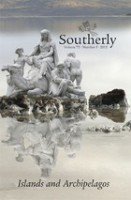
Southerly 72/3: Islands and Archipelagos

David Brooks and Elizabeth McMahon (editors), Southerly Vol 72 No 3 2012: Islands and Archipelagos

1southerly723

The title of this issue of Southerly, ‘Islands and Archipelagos’, refers to its subject matter, but it could just as easily refer to its form: a literary magazine, archipelago-like, is a gathering of diverse entities, each with its own integrity but all having something in common, whether a theme as in this case or something less tangible, like a tone, or an ethos, or a presiding personality.

I enjoyed my island hopping. My favourite moment is the bravura opening sentence of ‘Outcast of the Islands: Malinowski Amongst the Modernists’ by David Brooks :

If there could ever be such a thing as a True History of Modern Thought, at least one chapter would have to trace that set of strange, 
neglected, yet teasingly-almost-direct lines between a heterogeneous
 crew of squatters, graziers, country postmasters, district magistrates, missionaries, and employees of the Overland Telegraph recording details of Indigenous Australian life and culture in the mid- and late- nineteenth century and the desks of Edward Tyler at Oxford, James George Frazer at Cambridge and Emile Durkheim in Paris, and, through them, and a number of other significant late-nineteenth-century anthropologists, to the likes of T. S. Eliot, Ezra Pound, Sigmund Freud (see, for example, the first half of Totem and Taboo), Marcel Mauss (Essay on the Gift) and so many other key figures in early twentieth-century thought and aesthetics that one wonders whether the Simpson Desert or the Trobriand Islands should be given a place – a quite significant place – amongst the generating landscapes of Modernism.

Yes, that is just one sentence. The article not only delivers on the sentence’s promise but ends with a link to a provocatively titled companion piece, ‘Origins of Modernism in the Great Western Desert: An Introduction’.

Tying for second favourite moment are:

  • Michael Sharkey’s poem ‘First Eleven’, eleven stanzas consisting of phrases that evoke an Australian baby-boomer childhood, presumably to the age of 11. Much of it might be inscrutable to people of other generations and other places, but I was born in 1947, a year after Sharkey, and his deft hand worked nostalgic wonders in me, even in the minority of phrases that didn’t touch directly on my own experience:

    The Royal Visit. Easter Show.
    My sherbet packet. Liquorice stick.
    My shop-bought pie. My Iced Vo-Vo.
    My Cracker Night. My Jumping Jack.
    My father’s gas mask. Old blue tunic.
    My small sister in the clinic.
    My six-stitcher. My first duck.
    The choko vine. The dunny truck.


  • Michael Jacklin’s ‘Islands of Multilingual Literature: Community Magazines and Australia’s Many Languages’, which prises open the subject of Australian literature in languages other than English. I’ve always felt odd about the portrayal of 1950s Australia as monocultural and monolingual: Italian and other southern European languages were part of the soundscape of my 1950s north Queensland childhood; one of my best friends in primary school was Chinese; my farmer father played poker with a Greek, a Korean and a Yugoslav; in the 30s and 40s my magistrate grandfather spoke to Italians who appeared before him in their own language. This essay discusses evidence, including a journal from Brisbane in the 1930s, that there has long been lively, linguistically diverse literature in the Australian context, much of it invisible to the mainstream literary establishment.
  • a new poem by Jennifer Maiden, always a thrill. ‘Diary Poem: Uses of Ethiopia’ is in part a polemical essay, taking issue with some feminists who are ‘well in favour / of ethical security’. I’m not sure what ethical security is (Google is no help): it’s related to rigid ideological narrowness, I think, and may have elements of self-serving moralism. Feminist ‘fandom for Gillard’ is a symptom. My regular readers know that I often feel like an outsider with contemporary poetry (and by the way I think that’s more about me as a north Queensland boy than about the poetry). With this poem, I probably get the references more than most readers: not the Ethiopian art or the story of Sylvia Pankhurst, which are central to the poem and beautifully fleshed out, but the passing allusions – to Julia Gillard’s misogyny speech, and her cutting of the supporting parents’ benefit on the same day; to the earlier poem ‘A Useful Fan’, neatly encapsulated here as ‘trying to inhabit Abbott interestedly’; to a set-to on the Overland web site described as her ‘daughter the fire tiger’ (itself a reference to an earlier poem, ‘The Year of the Ox’) defending her ‘on a hostile magazine site now given / to ethical self-security’. Paradoxically, familiarity with the references predisposes me to foreground the detail of poem’s polemics (I want to argue about her view of Overland, for example, and I’m not sure about the connection she seems to be making between some feminists and abortion), rather than the poem’s central thrust, which I read as captured in the description of doves in Ethiopian art as

    aware of complex peripheries,
    well-mannered with watchfulness,
    —————————————-still.


As well as these pieces that topped my pops, there are learned essays on issues facing real islands and islanders, on Andrew McGahan, Randolph Stow, Drusilla Modjeska, and the rock band the Drones. There are short stories (especially Sandra Potter’s ‘“an empty ship in these latitudes is no joke”’, a lightly annotated list of things taken to and from Antarctica, and Terri Janke’s ‘Turtle Island’, a not-quite-ghost-story, not-quite-love-story, not-quite-war-story set in the Torres Strait in World War Two). There are other excellent poems and nearly 70 pages of reviews, plus the overflow in The Long Paddock, which includes a fine review by Sarah Holland-Batt of Ali Cobby Eckermann’s Ruby Moonlight.

A final note: the spectacularly beautiful cover, reproduced above, is described on the contents page as Sue Kneebone’s Continental Drift, but it’s actually a detail from that work, which I recommend you have a look at on Sue Kneebone’s web site.

The Maiden and the Griffin

Jennifer Maiden’s Liquid Nitrogen has been shortlisted for the Griffin International Poetry Prize, described on the Griffin Trust website as ‘the world’s largest prize for a first edition single collection of poetry written in English’. The judges’ citation reads in part:

An extended meditation on the uses and abuses of power, the moral gravity of Liquid Nitrogen is buoyed throughout by Maiden’s self-effacing sense of humour and her tenderness towards her grown daughter, Katharine, who stands at the heart of this collection. Epic in its scope and utterly eccentric in its approach, Liquid Nitrogen is a work of rare passion and unprecedented poetic achievement from one of Australia’s most prominent living writers, ‘alert to the point of twitching’, like the ox to whom she likens herself on page one, who nevertheless ‘still tramples through the difficult’.

For the full shortlist click here.

From Jennifer Maiden’s backlist

Jennifer Maiden, Tactics (UQP 1974)
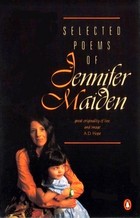
Selected Poems of Jennifer Maiden (Penguin 1990)
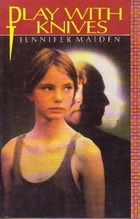
Jennifer Maiden, Play with Knives (Allen & Unwin 1990)

Friends of mine who met and married in their 40s discovered during their courtship that twenty years earlier they had moved in the same circles, shared similar enthusiasms, gone to the same demonstrations, once even posed in the same group photo, but never actually met. They speculate that if they had met back then, they might never have fallen in love, might not even have liked each other.

It can be like that with readers and writers. I may have heard Jennifer Maiden read in the early 1970s, and almost certainly read some of her poems in magazines and anthologies, but I didn’t engage with her poetry until her 1999 collection, Mines, and – as dedicated readers of this blog will have noticed – I now can’t get enough of her new work. In the last little while I’ve journeyed back in time to read three of her early books: her first poetry collection, a selection she got together after eight books, and a novel. I’ve enjoyed all three (though ‘enjoyed’ may not be quite the right word for some of the more gruesome bits), but I’m not sure I would have embraced the work of that 20- and 30-something writer when I was a 20- and 30-something reader.

IMG_0682It’s clear from Maiden’s first book, Tactics, why she was included in significant 70s anthologies like Kate Jennings’s Mother I’m Rooted (1975) and John Tranter’s The New Australian Poetry (1979), in which she was one of only two women. This early poetry is more compressed and elliptical, and in that way much more difficult, than more recent work, but it’s recognisably the same mind: grappling with issues of violence, holding a public event or abstract concept up against an intensely private perception or intimate moment, refusing easy answers. From the perspective of 2012, it’s interesting to read in the cover blurb, ‘She is interested in the Labor party, and married,’ two subjects that don’t get an obvious look-in in the poetry in 1974, but are addressed head-on by the more relaxed older woman in poem after poem (that is, if the notion of being married can be taken to include being a mother).

Reading the book at about the same time as Nigel Robert’s In Casablanca for the Waters, which hails from the same era, led to some interesting juxtapositions. Take Roberts’s ‘As Brian Bell said‘ and Maiden’s ‘Isolde and the Censor’. Both poems are about works of art that assert female sexuality, the former using what these days would be called explicit language about a Modigliano nude (the link saves me from risking my PG rating, though I should advise you there’s a typo – it should be ‘crap’ not ‘crab’), the latter describing a censor, ‘complacent Arbiter’, obliviously applauding a Wagnerian soprano who ‘carols the meltwater of her “heart”‘. Both poems, I realised, were written in the context of a struggle against repressive censorship: Maiden’s narrative celebrates euphemism as an evasive tactic, Roberts’s refusal of euphemism is a direct challenge to the censorious. I don’t think I would have understood the political seriousness of either poem if I hadn’t read them more or less together.

1spjmThe 1990 Selected Poems includes ‘The Problem of Evil’, alluded to in ‘Sphinx on Legs’ in this year’s Liquid Nitrogen. It’s a narrative but, possibly typically of its time, is not at pains to make itself understood. (I thought of Dr Jim Tulip’s saying that a certain poet’s work was like the pre–Vatican II Catholic Mass, where the priest kept his back to the audience and mumbled the ritual inaudibly in a foreign language.) It’s still worth reading even if, like me, you decide not to make the mental effort required to disentangle it. As the book progresses through the six books published between Tactics and 1990, there’s a lovely sense of the poetic voice relaxing, becoming more open.

There’s a lot to enjoy. One thing that struck me was the continuing exploration of evil, which reaches something of a climax in The Trust, a long poem in which a story-teller addresses a character in a story she is making up, a story that involves violent death and a suggestion of necrophilia (and incidentally makes it clear that the valuing of euphemism in ‘Isolde and the Censor’ doesn’t imply a rejection of blunt language). It’s not so much violence and evil that is being explored, as our fascination with it. Certainly there’s a lot in these poems that enriches my reading of more recent work: in them, violence is not only something out there, in other people, but something to be worried at in one’s own heart as well. Take these lines from ‘The Mother-in-Law of the Marquis de Sade’ (from Birthstones, 1978):

To sit people on gas-stove jets,
to plug them into light-sockets,
to prod with sparklers, stand
them barefoot in buckets of dry ice:
_____I remember I devised
all these things in the bored
South Africa of childhood,
________the shrill
Brazil that still entrances
the clean children next door

The Soweto uprising was recent when the poem was written, and Brazil was a brutal military dictatorship. The invocation of these regimes in the context of children’s cruel imagining could be read as trivialising them, but I think the poem works the other way, against the trivialising of childhood: the big public violence that fills the news and the private unspoken and unacted violent imagining are part of the same phenomenon. ‘Tiananmen Square’, one of the seven previously uncollected poems at the end of the book, prefigures the way recent poems respond sharply and personally to what Martin Duwell calls ‘media-experienced public events’: it begins, ‘I’m forty now.’ Two of these seven poems, ‘Aptly’ and ‘Chakola’, mark the debut appearance of a major character in the Maiden oeuvre, identified in the latter poem as ‘my three year daughter’.

1pkI wanted to read Play with Knives because its two main characters, George Jeffreys and Clare Collins, have reappeared many times in the last three books. Jennifer Maiden said in her recent fabulous interview with Magdalena Ball on Blog Talk Radio that it’s part of the conceit of the George Jeffreys poems that the reader knows these characters from previously, but it doesn’t really matter if she/he actually does know them. All the same, when I saw the book listed on the internet for a reasonable price I decided to buy and read.

If you avoid stories where terrible things are done to women, then stay away from this one. It’s a pretend genre piece involving a serial killer in Western Sydney, which reaches a truly nasty and unexpected climax. I say ‘pretend genre piece’ because the serial killer scenario is secondary to the story of a gossipy, slightly sleazy group of public servants and professionals involved in the release and return to civilian life of teenager Clare Forster/Collins who had killed and mutilated her three younger siblings when she was nine years old. At the heart of this story is Clare’s relationship with the narrator, probation officer George Jeffreys.

As I read the conversations between these characters, first as George is determining whether he will recommend Clare’s release, and then as he is her mentor while on parole, I was reminded of Gitta Sereny’s Cries Unheard, in which Sereny tries to get inside the mind of child murderer Mary Bell, through long and exhausting conversations with her as an adult. The Sereny book was published nine years after this one, so it’s not a source, and the books have very different angles on the subject of child murderers: Sereny asks how a child could have come to commit such an act; Maiden is interested in what life is like for the perpetrator afterwards – and what it means to be fascinated by such a person.

The broad outline of the George–Clare back-story is given in a note in Friendly Fire, and it’s true that even that much information might not be necessary for an understanding of the poems. But it’s clear to me that, having read the book with all its ethical creepiness, outright horror and high romance, I can read the poems better. It’s not as necessary as Shakespeare is to Eliot’s The Wasteland, but it helps.

End of year lists 2012

As if it isn’t enough to be shopping and wrapping and cooking and unwrapping and eating and searching for lost dogs and blocking our ears to keep out the piped carols, it’s the season for drawing up Best-Of lists.

The Art Student’s best five movies (with links to the movies’ IMDb pages):

A Separation (Asghar Farhadi 2011): ‘Definitely the best movie this year. We got to see how complex it all is for secular Muslims in Iran.’

Lore (Cate Shortland 2012): ‘Up there with A Separation. You don’t believe you can watch yet another film about Jews and Nazis, yet here it was, original and fresh. I hope it wins an Oscar. I liked Somersault too.’

The Skin I Live In (Pedro Almodóvar 2011): ‘Creepy,’ she said, ‘but good.’

This Must Be the Place (Paolo Sorrentino 2011): ‘I loved the great humour, the art, the spectacular musical event.”

The Sessions (Ben Lewin 2012): ‘I liked having nudity and sex without it being voyeuristic.’

My best five movies, chosen fairly arbitrarily (with arbitrary reason given) from a short list of 19 that included all five of the Art Student’s picks:

Liberal Arts (Josh Radnor 2012) features a main character who walks around the city reading. I identified. It also reminded me of the pleasures of Eric Rohmer movies.

Sing Me the Songs that Say I Love You: A Concert for Kate McGarrigle (Lian Lunson 2012) pips The Sapphires (Wayne Blair 2012) at the post for my musical of the year. It’s a concert movie that invites us into extraordinary intimacy with a brilliantly musical family. Martha Wainwright sings ‘First Born’, which her mother wrote for her brother, and which we played a lot when our firstborn son was being ‘the first to crawl’.

Le Havre (Aki Kaurismäki 2011) made me feel irrationally pleased with myself or recognizing the oddly deadpan directorial style from Drifting Clouds, which I saw and loved decades ago.

The Artist (Michel Hazanavicius 2011) was a moderately enjoyable film until the final moment, which resolved a plot point I had been half-awarely worrying over, and vastly expanded the movie’s meaning.

Weekend (Andrew Haigh 2011): In spite of the phenomenal consumption of alcohol and other drugs, which would normally be enough to put me right off, I loved the unsentimental, unprurient portrayal of two characters who are completely taken with each other, including sexually.

The worst movie: We both picked Sophie Lellouche’s bland, self-indulgent Paris–Manhattan. But don’t take this as a solid judgement on the film as it might have miraculously picked up after the first hour, which is all we could bear. If we had to name a movie we stayed the course for, the Art Student would pick Skyfall, which she just plain hated, and I might have to pick Bernie, because Jack Black’s creepiness and the creepiness of the subject matter were from different universes.

The Art Student’s best books (she wouldn’t be limited to five), listed here in no particular order, with links to my blog entries or the book’s LibraryThing page:

1bmMartin Gayford, A Bigger Message: Conversations with David Hockney (2011): ‘Full of surprises and delights, about the way an artist sees the world.’
090787181XIrfan Orga, Portrait of a Turkish Family (©1950, Eland & Galeri Kayseri 2004): ‘Compellingly tells of the transition from a feudal society to modernity as a result of war. Also wonderful was the insider child’s view of life under the veil.’

20120704-175516.jpgHilary Mantel, Bring Up the Bodies (2012): ‘I’m glad it won the Booker. I’m completely hooked on the story, and looking forward to the third book, although having fallen in love with Cromwell I’m not looking forward to his death.’
1920898581Heather Goodall, From Invasion to Embassy (1996): ‘A must-read for all Australians, especially those who think the dispossession of Aboriginal people all happened in the distant past.’

1ccStephen Gilchrist, editor, Crossing Cultures: The Owen and Wagner Collection of Contemporary Aboriginal Australian Art at the Hood Museum of Art (2012): ‘I’m only half way through this but it’s a great, accessible introduction to the complexity of Australian Indigenous art.’

Edwina Shaw, Thrill Seekers (2012): ‘I read this in one sitting. I couldn’t put it down even though a lot was uncomfortable.’

0007149530Richard Holmes, The Age of Wonder (2008): ‘Fascinating portraits of scientists in the late 18th century, when science and romanticism were closely joined. Particularly good on Banks and the Herschels.’

0670033804Sebastian Barry, The Long Way Home (2005) and On Canaan’s Side (2011): ‘Two completely absorbing novels. The first is probably the best novel of the First World War I’ve read, and the second extends the story to Irish immigration to the USA, and the past catching up with you, written convincingly in the voice of an 80 year old woman.’

My best books, which I’ve kept down to just five by declaring the AS’s list off limits:

20120224-180529Fàbio Moon & Gabriel Bà, Daytripper (2011): A gem of a comic book by twin brothers from Brazil, this is a string of connected short stories that celebrates a human life as a miracle of survival.

Amitav Ghosh, Sea of Poppies (2008): A story of colonial India that manages to be a gripping romance at the same time as blasting any romantic nostalgia for the Raj to oblivion.
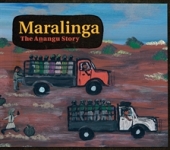
Yalata and Oak Valley Communities with Christobel Mattingley, Maralinga, the Anangu Story (2009): it was a toss-up between this and Tohby Riddle’s miraculous Unforgotten for my picture book of the year. This is a different kind of miracle from Tohby’s – it opens a space for a multitude of voices to speak about the lethal indifference to Indigenous Australians on the part of he British atomic test at Maralinga, and about the resilience of the Anangu people.

Ross Gibson, Seven Versions of an Australian Badland (2002): I choose this over Gibson’s brilliant 26 Views of the Starburst World, which was published this year, because the earlier book made me understand something of the colonisation of my North Queensland home that I had read about previously but managed not to grasp.

Jennifer Maiden, Liquid Nitrogen (2012): I read quite a bit of poetry this year. Possibly the major revelation was Byron’s Don Juan, but I haven’t finished reading that, and I might have chosen Liquid Nitrogen anyway, as I feel that Jennifer Maiden’s stories, meditations and dialogues help me to live in the modern world.

A note on the gender balance front: I would have thought my reading was fairly every spread between male and female writers, but numbers don’t cater to wishful thinking. According to my blog statistics, I read 34 books by men and 22 by women.

Jennifer Maiden’s Liquid Nitrogen

Jennifer Maiden, Liquid Nitrogen (Giramondo 2012)

In ‘The Year of the Ox’, the long poem that opens this collection, Jennifer Maiden identifies herself as an ox (her daughter, who has been appearing in her poems for at least 20 years, is a tiger):

==================I plough my furrow
heavily and fruitfully and my seldom rage
is that of the earth like an earthquake, sudden
and efficiently gutting. She is full of lovely
litheness and protection. Next year I
will still plough slowly, heavily.

She invites us to see her poems as ploughed fields, produced by steady work, but work performed with power, deliberation and passion, no hint of Vachel Lindsay’s ‘ox-like, limp and leaden-eyed‘. I wonder if it’s deliberate, though, that the poem doesn’t mention that oxen are ruminants – because while Jennifer Maiden’s poetry goes in for emeralds and sapphires and turquoise rather than lead, she certainly ruminates: in the ‘diary poems’ (there are three in this book – the term is ironical, taken from an essay by Martin Duwell [actually a review by Andrew Sant – see Katharine Margot Toohey’s comment]), and in the imaginary dialogues which often begin with one of the participants waking up (which I think of as being like the relevant synapses of the poet’s brain turning on).

A main preoccupation of these ruminations is political power. Many of Jennifer Maiden’s books have taken their titles from the jargon of warfare – Tactics (1974), The Occupying Forces (1975), The Border Loss (1979), Acoustic Shadow (1993), Mines (1999), Friendly Fire (2005). Liquid Nitrogen isn’t obviously in this tradition. The substance liquid nitrogen first appears here (in ‘George Jeffreys 11: George Jeffreys Woke Up in Langley’) as a cooling agent used to keep the CIA computers from overheating – not a weapon of war as such, but part of the machinery of repressive state power. It does turn up again in later poems and its metaphoric meaning transforms – ‘Liquid / nitrogen does not shred, it facilitates, / should not be exclusive to Satan, to Langley, is / too good’ (‘Diary Poem: The Uses of Liquid Nitrogen’). Like liquid nitrogen, Maiden’s poems provide an environment in which data can be preserved and experiments can be conducted.

So Hillary Clinton and Eleanor Roosevelt have challenging but affectionate conversations (two poems in this book); former parole officer George Jeffreys and former child murderer Clare Collins, characters from Maiden’s 1990 novel Play with Knives, continue their fictional adventures in trouble spots all over the world (four poems). Julia Gillard (in three poems) is scrutinised by the newly awakened Aneurin Bevan, for whom the actual Julia Gillard has expressed admiration. There’s also Kevin Rudd with Dietrich Bonhoeffer (one and a half poems) and Bob Carr with US Senator Robert Byrd (one poem). These poems may involve ox-like ploughing and rumination, they may be thought-experiments conducted in metaphorical liquid nitrogen. Unlike working oxen, though, they are often playful; and unlike liquid nitrogen they are suffused with warmth, and sometimes heat. I could quote lots, but here’s Dietrich Bonhoeffer on Kevin Rudd (in ‘Deep River’):

=========== He thought that he had never
actually seen anyone purse their lips as much
as Rudd did, even Germans, but the jokes
Rudd made were flirtily Teutonic, his slang
as strangely stylised as an Eden from a culture
he knew had never been, as if to say,
==========''Okay:
so we're all self-constructed out of trauma.
==========Standing here,
I defy you to file me away.'

I love the way this moves from deft observation of mannerisms to much-mocked peculiarities of speech to a completely unexpected flash of compassionate insight. That’s characteristic of these poems – ‘Diary Poem: The Uses of Powerlessness’ which rails angrily against Julia Gillard, begins with a cheerfully resigned address to the ‘Good Spirit of the Universe’ which has given Gillard as a subject, and develops as a meditation on the nature of a certain kind of political power, and in the end the scathing criticism has not been dulled, but it has been infused by a sense of Gillard as dreadfully deprived.

The book isn’t just a collection of disparate poems. Themes are developed from one poem to another. The development of the liquid nitrogen image is just one example. Relationships between the characters in the dialogue poems unfold in an almost novelistic way. In one poem, the poet writes of a weird little dog she and her daughter have seen on the TV news that she had considered giving it to George Jeffreys, then 25 pages later George and Clare adopt it in Cairo.

I should mention that Giramondo sent me a free copy, presumably because I’m a declared Jennifer Maiden fan. I’m grateful for the gift.

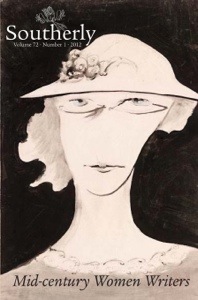
Southerly 72/1

Elizabeth McMahon and David Brooks (editors), Southerly Vol 72 No 1 2012: Mid-century Women Writers

20121018-203833.jpg

Spring is here – ‘a box where sweets compacted lie’ as George Herbert called it, in a phrase that could apply just as well to this issue of Southerly. (Or to put it prosaically, this post is an annotated list.)

There’s a new Jennifer Maiden poem, ‘George Jeffreys 13: George Jeffreys woke up in Beijing’. This series of poems has had to find a new focus now that George W Bush is no longer reliably on the television obsessing about Iraq as he was for the first poems. George and his kind of girlfriend Clare seem to be travelling the world, waking up in one troubled locale after another, having adventures involving guns, fires and pirate ships as well as discussing politics, morality, philosophy etc. It’s not a verse novel, or even a discontinuous narrative really, but it is never uninteresting. In this poem George and Clare meet with a recently released Chinese dissident in the Forbidden City where they are joined by Confucius and the Duke of Zhou.

There’s Fiona Morrison’s excellent essay, ‘Leaving the Party: Dorothy Hewett, literary politics and the long 1960s’. Like many Communists, Hewett stayed in the Party after the 1956 invasion of Hungary despite serious misgivings, then left when the tanks rolled into Czechoslovakia in 1968. In effect this essay traces the movement of her mind between those two events as revealed in her writing. Strikingly though, it doesn’t refer to either Hungary or Czechoslovakia, restricting itself to literary matters. Some of the essay’s specialist scholarly language took my fancy, and revived my love of double dactyls:

Higamun hogamun,
Fíona Morrison,
writing in Southerly,
gathers no moss:
says that our Dorothy
ex-Marxist-Leninist
wrote a sustained tropo-
logics of loss.

There’s Karen Lamb’s ‘“Yrs Patrick”: Thea Astley’s brush with timely advice on “the rackety career of novel writing”’, an inside look at the relationship between Astley and other writers, with a focus on a particularly unsparing letter from Patrick White. I once heard Astley quote a dollop of writerly advice she had received from White: ‘If you’re going to write about a shit, Thea, you have to make him a really big shit.’ This article is fascinating but doesn’t include anything quite that colourful. Karen Lamb is writing a biography of Astley. Reading her account of Astley’s approach to friendship, I wondered if biographers don’t run the risk of coming to dislike their subjects through knowing too much:

Karen Lamb
surely doesn't mean to slam
Thea Astley
but she makes her seem ghastly.

I’ll refrain from doggerel for the rest of this post.

There’s the other piece I turned to the day the journal arrived in the mail, David Musgrave’s review of Geoffrey Lehmann and Robert Gray’s Australian Poetry Since 1788. In a measured and judicious manner, Musgrave joins the line of anthologists, poets and publishers who give this anthology the thumbs down. (Incidentally, I note that neither David Brooks, Southerly‘s co-editor, nor Kate Lilley, its poetry editor, got a guernsey in the anthology, but that didn’t stop them from including an elegant narrative poem by Gray elsewhere in this issue.)

Of the theme essays on mid-century women writers, other than the two I’ve already mentioned, Helen O’Reilly’s ‘“Dazzling” Dark – Lantana Lane (1959)’ and Susan Sheridan’s ‘“Cranford at Moreton Bay”: Jessica Anderson’s The Commandant‘ persuaded me to add the books they discuss to my To Be Read pile. I skimmed the essays on Christina Stead, Eve Langley and Elizabeth Harrower, and a second one on Jessica Anderson, which are intended for specialist readers. I mean no irony when I say I was grateful to read this near the start of an essay: ‘In her well-known formulation of performativity, Judith Butler argues that repetition of a discourse actually produces the phenomena that it seeks to control.’ Such sentences serve as warnings: what follows is intended not just for readers who can understand the warning sentence, but readers to whom its contents are familiar.

Off theme, there’s Ed Scheer’s ‘“Non-places for non-people”: Social sculpture in Minto’, an account of a performance art event, Big Pinko, in which two artists painted a house pink. It sounds like an interesting project, but I found article a little disturbing in the way it talked about the people of Minto. Perhaps the Judith Butler formulation is relevant: the phrase ‘non-places for non-people’ is meant to encapsulate a criticism of the dysfunctional environment in this outer western suburb, but as it is repeated in this essay it comes to read like a dismissal of the people who live there. The essay has a lot in it that’s beautiful and evocative, but in this respect it makes me appreciate all over again Michael Mohammed Ahmad at Westside’s labours to foster writers in Western Sydney.

This issue has abundant rich poetry. I love B. R. Dionysius’ ‘Ghouls’, a set of five sonnets about the Brisbane floods.

The white festiva shunted like a tinny, half-tonne maggot into
O'Hanlon Street's winter bulb cul-de-sac. The Bremer's brown
Muzzle investigated the bottom stairs of a corner house, sniffing
For the scent of past flood levels left by more malicious beasts.

Of the other poems, I particular liked ‘Rose Bay Airport, 1944’ and ‘Standing Soldiers’ by Margaret Bradstock (both after Russell Drysdale wartime paintings), ‘Holiday snap’ by Andrew Taylor, ‘Hardware 1953’ by Geoff Page, and ‘The Roadside Bramble’ by Peter Minter.

Of the fifty pages of reviews, John Kinsella on David Brooks’s The Sons of Clovis: Ern Malley, Adoré Floupette and a secret history of Australian poetry and Pam Brown on Kate Lilley’s Ladylike stood out for me, Kinsella for fascinating rumination on the nature of literary hoaxes, and Brown for her usual generous intelligence.

Southerly 71/3

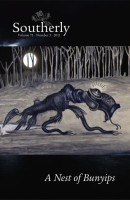
David Brooks and Elizabeth McMahon (editors), Southerly Vol 71 No 3 2011: A Nest of Bunyips

In 2001 the National Library of Australia published Bunyips: Australia’s Folklore of Fear by Robert Holden and Nicholas Holden. Robert said in his introduction that writing and editing the book had taken him ‘down many byways of history, literature, folklore, superstition and cultural studies’, and that he had gleaned insights from palaeontology, evolutionary thinking and anthropology.

The title of this issue of Southerly might lead you to expect something along the same lines. You would be misled. It does include a scattering of atmospheric drawings dating from between 1890 and 1912, citing the Holdens’ book as the immediate source, but they are the only bunyips on offer. As David Brooks says in his editorial, the issue is filled with things from the backlog ‘of pieces too good to reject but refusing any easy categorisation, and the bunyip motif derives from Michael Sharkey’s long poem, ‘Where the Bunyip Builds it Nest’, chosen more or less at random from the pile. (The poem isn’t actually about bunyips, but it is a bit of a monster: a long poem in five parts made up of lines taken from other poems from settlement until now in roughly chronological order, all carefully annotated.)

On reflection, Brooks says, bunyips – nocturnal, haunters of waterholes, ‘strange hybrids whose shrill quarrellings can sometimes be heard late into the night’ – sound like some poets. So the motif gained legitimacy: the issue contains work by 28 poets, essays on and by a half dozen more, and reviews of seven books of poetry. And the online supplement, the Long Paddock, has almost as much again, plus a substantial interview with Laurie Duggan.

The riches on offer include:

  • Jennifer Maiden’s ‘The Pearl Roundabout’, in which the re-awakened Elanor Roosevelt continues the conversations with Hillary Clinton begun in the book Pirate Rain
  • Margaret Bradstock’s pre-elegiac ‘Ask not’
  • Julie Maclean’s ‘cassowary’, a North Queensland poem that compresses an awful lot into a small space, about colonisation, tourism, art, and of course the gorgeous, dangerous cassowary
  • Peter Kirkpatrick’s delightfully old-fashioned, even archaic ‘The Angels in the House’, a meditation on inner city housing in heroic couplets
  • two poems by Craig Powell: a sonnet named from a line from Seamus Heaney, “and catch the heart off guard”, and a reinterpretation of an anecdote from Freud, ‘Fort Da’ (Craig Powell also reviews Toby Davidson’s edition of Collected Poems by Francis Webb, seizing the occasion to share some poignant memories of Webb).

Southerly is a refereed scholarly journal, and I tend to skip the scholarly articles, or at least the ones about writers I am unlikely to read, and those with Deleuze, Kristeva etc in the title. I did read Kevin Hart’s ‘Susannah Without the Cherub’, a fascinating discussion of A D Hope’s ‘The Double Looking Glass’. It may be, as Martin Johnston said, that A D Hope sent away for a Great Poet Kit, and then successfully used it to become a great poet. This essay bears out the second part of Martin’s quip.

It’s not all poetry. There are four short stories, all of which I enjoyed – Matthia Dempsey’s ‘One Week Gone’, about an old man a week after his wife’s death, is superb.

No bunyips, not really, but that’s not a terrible loss, given what’s there instead.