Tag Archives: Jennifer Maiden

Southerly 71/3

David Brooks and Elizabeth McMahon (editors), Southerly Vol 71 No 3 2011: A Nest of Bunyips

In 2001 the National Library of Australia published Bunyips: Australia’s Folklore of Fear by Robert Holden and Nicholas Holden. Robert said in his introduction that writing and editing the book had taken him ‘down many byways of history, literature, folklore, superstition and cultural studies’, and that he had gleaned insights from palaeontology, evolutionary thinking and anthropology.

The title of this issue of Southerly might lead you to expect something along the same lines. You would be misled. It does include a scattering of atmospheric drawings dating from between 1890 and 1912, citing the Holdens’ book as the immediate source, but they are the only bunyips on offer. As David Brooks says in his editorial, the issue is filled with things from the backlog ‘of pieces too good to reject but refusing any easy categorisation, and the bunyip motif derives from Michael Sharkey’s long poem, ‘Where the Bunyip Builds it Nest’, chosen more or less at random from the pile. (The poem isn’t actually about bunyips, but it is a bit of a monster: a long poem in five parts made up of lines taken from other poems from settlement until now in roughly chronological order, all carefully annotated.)

On reflection, Brooks says, bunyips – nocturnal, haunters of waterholes, ‘strange hybrids whose shrill quarrellings can sometimes be heard late into the night’ – sound like some poets. So the motif gained legitimacy: the issue contains work by 28 poets, essays on and by a half dozen more, and reviews of seven books of poetry. And the online supplement, the Long Paddock, has almost as much again, plus a substantial interview with Laurie Duggan.

The riches on offer include:

  • Jennifer Maiden’s ‘The Pearl Roundabout’, in which the re-awakened Elanor Roosevelt continues the conversations with Hillary Clinton begun in the book Pirate Rain
  • Margaret Bradstock’s pre-elegiac ‘Ask not’
  • Julie Maclean’s ‘cassowary’, a North Queensland poem that compresses an awful lot into a small space, about colonisation, tourism, art, and of course the gorgeous, dangerous cassowary
  • Peter Kirkpatrick’s delightfully old-fashioned, even archaic ‘The Angels in the House’, a meditation on inner city housing in heroic couplets
  • two poems by Craig Powell: a sonnet named from a line from Seamus Heaney, “and catch the heart off guard”, and a reinterpretation of an anecdote from Freud, ‘Fort Da’ (Craig Powell also reviews Toby Davidson’s edition of Collected Poems by Francis Webb, seizing the occasion to share some poignant memories of Webb).

Southerly is a refereed scholarly journal, and I tend to skip the scholarly articles, or at least the ones about writers I am unlikely to read, and those with Deleuze, Kristeva etc in the title. I did read Kevin Hart’s ‘Susannah Without the Cherub’, a fascinating discussion of A D Hope’s ‘The Double Looking Glass’. It may be, as Martin Johnston said, that A D Hope sent away for a Great Poet Kit, and then successfully used it to become a great poet. This essay bears out the second part of Martin’s quip.

It’s not all poetry. There are four short stories, all of which I enjoyed – Matthia Dempsey’s ‘One Week Gone’, about an old man a week after his wife’s death, is superb.

No bunyips, not really, but that’s not a terrible loss, given what’s there instead.

Jennifer Maiden in the SMH

With some notable exceptions, the Art Student hates poetry. So this conversation that happened as I was cooking breakfast on Saturday morning was a moment to be savoured.

Art Student: There’s a poem by Jennifer Maiden in the Spectrum. [That’s a supplement to the Sydney Morning Herald.]
Me: Really! Read it to me.
Art Student: You know I can’t read poetry.
Me: (wheedlingly) Go on, please …

And she did. She read ‘My heart has an Embassy’. Beautifully. Whether it was the short lines, the brevity of the poem, or the way it makes metaphor out of a situation from the headlines – Julian Assange’s seeking asylum in the Ecuadoran Embassy in London – the poem slipped effortlessly past the poetry-hating guards.

I couldn’t find ‘My heart has an Embassy’ online. Sorry!

[Added later: In a Me Fail? I Fly! exclusive, Jennifer Maiden’s daughter Katharine has posted the poem in a comment!]

Colleen Burke’s Wildlife in Newtown

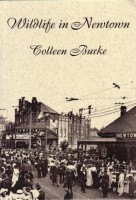
Colleen Burke, Wildlife in Newtown (Feakle Press,1994)

Poetry is good to travel with. Slim volumes are attractive when you’re packing light, and short poems are well suited to the short grabs of time for reading, in between gawking, eating, finding toilets, blogging and all that. Apart from such practicalities there’s this little syllogism: a) Whenever I travel I have intense dreams about home; b) poetry has been described as a waking dream; c) it makes sense to take poems about home when travelling. So of course I brought this book whose title promises poetry about places a couple of blocks from my home.

True to that promise, the book’s sense of place is very strong, in poems celebrating working class, culturally diverse Newtown, acknowledging its Dharug past and present, and repeatedly evoking Newtown houses, Camperdown Park and the historic cemetery adjoining it. The latter is the subject of elegant photographs scattered through the book, which I’m guessing were taken by the author. It’s evident that Colleen walked through that park on the way to and from work, that she often spent time in the cemetery. If that small part of the world were to be allocated a Poet Laureate, she’d be hard to beat.

The book has a number of interweaving strands: the walks home from work, often involving sunsets: relatively impersonal narratives about the history and make-up of the suburb; conversations with the poet’s children; the cemetery poems, some of which are about the history, some intensely personal; a very few strong poems that directly address the death of the poet’s partner. All the poems are short. If I was at home, I’d find the lovely line about Colleen Burke’s lyrics in Jennifer Maiden’s 1999 collection, Mines, but as I’m gallivanting in Turkey with fitful Internet access, I’ll just recommend that you look it up.

I hope Colleen won’t mind if I quote a poem that, while not necessarily my favourite, struck a chord because I was away from home – in Turkey, not India – when I read it.

And so I was there
for Kerry
‘And so I was there –
a recognition. My
heart full to bursting.
There’s something in the smell of
heat, dust, exhaust fumes,
oxen, tea, animal piss,
garam masala and ghee.
There’s something about women
in saris, beggars of all ages
and people living on the
cramped narrow streets –
an atmosphere of the
Arabian nights that
intoxicates and frees you –
like a window opening.’

ii
I read your letter
in the crumbling
graveyard sheltered
from the August winds
by the empty sandstone
church. Spring
murmured in the winter
soil, a whisper of wattle
in the air. I was close
to you in the gnarled
shadows and slender vines
of sunlight. Close to
the bare bones bound
down by the long dark
roots of the Moreton
Bay fig tree.

iii
‘In the small crowded
Kali temple people
sang, danced and gave
us flowers. Held our hands.
And so I was there’

Place calls out to place calls out to place.

Full disclosure: I published one or two of these poems in The School Magazine in my past life, and may have rejected one or two others; Colleen Burke taught a creative writing class to my mother-in-law, which was a significant event in her pre-dementia life; more than 20 years ago I heard Colleen read poems about her bereavement and her children that still move me, though I remember only a phrase or two.

SWF 2112: Poets, Harbour, pitches and more poets

This was my first day at Walsh Bay, and in striking contrast to recent weather, the sky was cloudless and there was no wind – perfect festival weather.

The tiny harbourside room generally reserved for poets at the Festival couldn’t have been a more appropriate venue for my first event of the day, Harbours and Rivers, with Robert Adamson, Neil Astley, Martin Harrison and Jennifer Maiden. I joined the uncharacteristically long queue with minutes to spare, and only when it became clear I wasn’t going to get in I realised I was in the wrong place: this time the tiny room had been given to young writers talking about the Second Novel Effect, and the poets had been given a much bigger and incidentally much darker space. I briskly walked the length of the Wharf and arrived part way through the introductions.

The poets, refusing as poets should to be pigeonholed, paid at best slant regard to their allocated topic. Jennifer Maiden read a long new poem, ‘The Uses of Powerlessness’, which she described as a diary poem but was actually pretty much a philippic on Julia Gillard, not in the ‘X woke up in X’ form, but a straightforward furious meditation. I wrote down one of many striking lines: ‘The Labor Party, like Gillard, is an obedience addict.’ Martin Harrison and Robert Adamson both spoke of the complex interplay between observation of the natural world and self-discovery. ‘All my harbours and rivers are internal,’ the latter said, somewhat disingenuously, ‘even though I live on a river.’ Among the poems he read was the sublime ‘Kingfisher’s Soul’, an intensely personal love poem that grows richer with each hearing. Neil Astley, advertised as editor of English publishing house Bloodaxe Books, turns out to be a poet as well. He was in Darwin for Cyclone Tracy, about which he read two striking poems followed by an excerpt from a novel that engages with an English countryside.
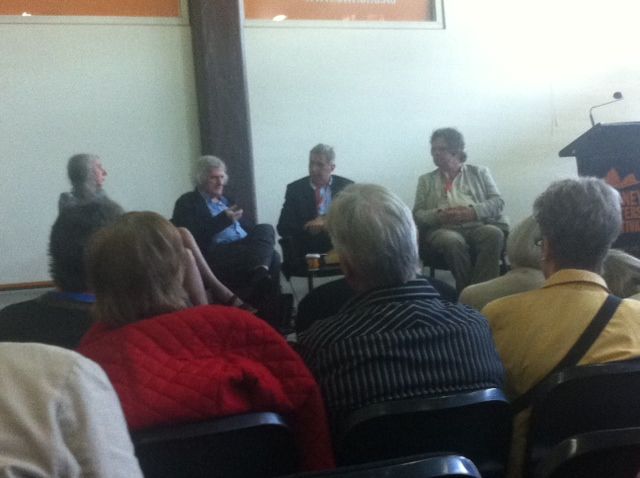
Jennifer Maiden, Robert Adamson, Martin Harrison and Neil Astley not far from the Harbour

In short, it was very good. Afterwards I ventured to introduce myself to Jennifer Maiden, but I was probably working so hard at no being too fanboyish for the conversation to have made much sense.

After a brief interval I went to the Club Stage for So You Think You Can Write, my first time to this a regular Festival event in which random audience members get to pitch a project to a panel of publishers.
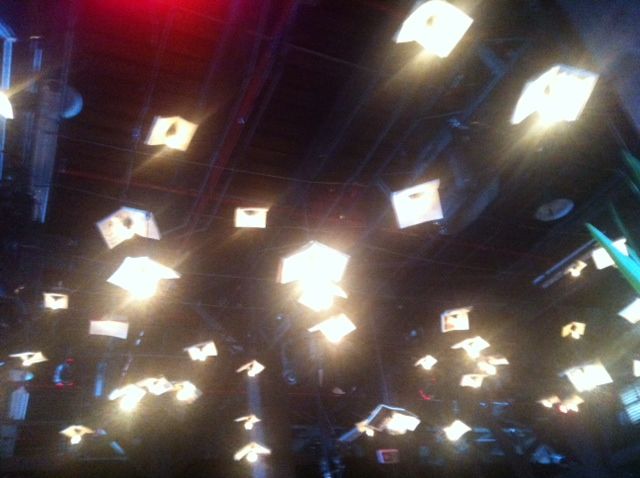
The specially decorative lights for the Club Stage area – each bulb has an open book for a shade.

I don’t know that anyone who was at all savvy about publishing would participate in this, unless for the sheer fun of it. And it was mostly fun. A 15 year old boy pitched a detective story set among the Egyptian pyramids. There was an earnest tract for children aiming to foster leadership skills and an understanding of democracy. One or two pitches were for books that could have been anything, so broad were the descriptions. One woman had already had an iBook version of her project downloaded thousands of times. The winner – of nothing apart from the glory – was a psychological detective story in which the character realises a day of her life has gone missing and then is shown photos of herself taken on the missing day. The thing that won the audience and panel’s approval was that the photos were improbably and bizarrely orgiastic, involving vegetables and cigars in unspecified lewd ways. It may not be Scandi-Crime, but this audience loved it. You read about it here first.

And then off to the poets’ lightfilled room. Gig Ryan and Kate Lilley, feminist-identifying experimental poets, drew an overflow crowd, including Adamson, Harrison and Astley from this morning, plus John Tranter, Ivor Indyk, Toby Fitch and many faces familiar from the Sappho open mike nights. Each of the poets introduced the other. They read from recently published books and, on being requested by an audience member to  compose a poem together on the spot, they parlayed the request down to each of them reading a poem by the other – with interesting results.

I confess that I went to this session expecting to suffer. I’ve read very little of either of them and my experience has been that if I don’t know a poet’s work I have trouble hearing it when read to me. (A possible contrary experience was hearing Jennifer Maiden this morning, but I am familiar with her voice and preoccupations, so had a head start.) Gig Ryan reads quickly, and her language is very compressed: I had difficulty distinguishing the words, let alone grasping the connections between them. Kate Lilley has a gratifyingly expressive delivery, and the woman beside me kindly allowed me to look over her shoulder and read along as the poems were read. But I was still pretty completely mystified. Both women talked about how people in their lives met their work with blank expressions, so I didn’t feel too stupid, or at least not alone in my stupidity.

One of Kate Lilley’s poems, ‘Maisily’, consists of a string of about a hundred adverbs. This was the first time she’d read it aloud and it was quite a feat – all those lys. It seemed like pointless nonsense to me. Then she explained that it was made up of all the adjectives used by Henry James in What Maisie Knew. That made it seem like hi-falutin pointless nonsense to me. Then I remembered that it was part of an elegiac sequence about the poet’s relationship with her mother, and it no longer seemed so pointless – maybe I was finding an emotional subtext because that’s the kind of reader I am, but I did find one, like a deeply submerged nostalgia for childhood when the adult world was as inscrutable as to little Maisie in James’s novel. I wonder how it wold go if read, not as a near tongue twister, but with the rhythm of a tolling bell.

As if the poets had read my thoughts, their conversation turned to the business of reading poetry aloud. Lilley said she knew and loved her poetry long before she heard her read, but when she did hear her read it was a revelation. Maybe my difficulty is as much to do with my increasing deafness as with unfamiliarity with the poetry.

So the poetry was difficult, but the session was excellent. Both were very funny about the business of being poets, and how they see each other’s poetry. Even when they drew our attention to the complete absence of critical articles on Gig Ryan’s work, even though she is generally acknowledged as an important Australian poet, and surmised that this absence may well be because she is a woman, somehow that seemed richly comic.

On the way home in the bus, I ran into an old friend who had been to a panel with Peter Hartcher, George Megalogenis and a third journalist talking about Australia’s parlous economic situation. I felt I had been very frivolous, but I was glad of it.

Jennifer and Julia and Nye in the Age

Having complained in this blog almost exactly two years ago that Jennifer Maiden had not turned her pen to (on?) Julia Gillard and Kevin Rudd, I ought to acknowledge when she does so.

This Saturday’s Age published ‘Poor Petal’, which also appeared in the online Sydney Morning Herald, at the end of the Bookmarks column. Like ‘A Great Education’, which was published in the Age in January 2011, it has a prefatory note: ‘When asked if there was an example who had inspired her as Dietrich Bonhoeffer had inspired Kevin Rudd, Julia Gillard replied “Nye Bevan”.’ It’s one of Jennifer Maiden’s ‘Someone Woke Up Somewhere’ poems; this time it’s Aneurin Bevan in Canberra opposite Julia Gillard in an armchair.

I recommend it to anyone who is made uneasy by Julia Gillard’s inscrutable public presence.

Jennifer Maiden on Poetica

Radio National’s Poetica was dedicated to Jennifer Maiden on Saturday (to be repeated on Thursday evening). It can be heard at this link:

Pirate Rain

Alice Parkinson and William Zappa read a number of poems from Pirate Rain lucidly (though words like insouciant and equinoctial tripped up the former’s tongue, and the line breaks do something on the page that it seems might be impossible to replicate in reading aloud), and there’s some commentary from the poet, which helps with the George Jeffreys / Clare Collins poems (which on this hearing sound to me like part of an ongoing novel). Maiden talks about the way fiction allows her to come closer to her own self than a lyrical poet–persona would.

Southerly 70/3

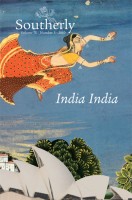
David Brooks & Elizabeth McMahon (editors), Santosh K. Sareen & G. J. V. Prasad (guest editors), India India: Southerly 70/3

Southerly is a venerable institution – the Journal of the English Association, Sydney, it has been going for 70 years (which isn’t long compared to children’s literary journals such the School Magazine or its New Zealand equivalent, but impressive among little magazines for grownups). This issue has a central focus on Indian–Australian literary relations, but I bought it for Jennifer Maiden’s poem, ‘The Year of the Ox’, which doesn’t relate to that focus.

‘The Year of the Ox’ is to an end-of-year family letter what many of Jennifer Maiden’s poems are to diary entries, that is to say, same same but different. It brings us up to date on characters who have been inhabiting her poetry for some time: herself and her daughter, current political leaders (Obama, Clinton, Gillard), iconic figures of the recent and not so recent past (Diana Spencer, Mother Teresa, Florence Nightingale, Queen Victoria, Eleanor Roosevelt) and her fictions George Jeffreys and Clare Collins. It’s a long and complex poem, but from one point of view, it brings us up to date on the doings of this mental family during 2009, the Chinese Year of the Ox, and into 2010, Year of the Tiger, all the while ringing the changes on the images and connotations of ox and tiger. I love the way the poem swings with apparent nonchalance from observations on her own close relationship, the political scene and the nature of poetry, to – what to call them? – Platonic dialogues between icons, to vividly realised domestic scenes from a virtual novel, and all the while there’s a sense of poet-as-ox pulling a plough through the furrows of a mind alert to the world.

There are other excellent poems: by Ali Alizadeh (whose ‘Election Announced’ chillingly mentions someone as ‘the theocrat / a retributivist in speedos’), Judith Beveridge (whose two poems are actually India-related, thanks to her interest in Buddhist lore), Richard Deutsch, Craig Powell and a list of other Australians, and by a handful of Indian poets. I couldn’t get into any of the short stories, with the exception of Sarah Klenbort’s ‘The Chinese Circus Comes to Cessnock’, in which three fruit-picking backpackers encounter the complexities of Australia’s policies about Asian immigration.

Southerly comes from academe, and there a number of academic pieces, in particular surveys of the India-Australia literary connection and studies of particular texts. I intended to read the journal from start to finish, but decided to skip the scholarly bits when I read on page 20 that one novelist’s work ‘might be taken as a case study of Deleuzean deterritorialised nomadology […] Derridean self-critique in which text and meta-text mutually […]’. Too much like hard work! I skipped pieces by Indian critics on Mollie Skinner, Hazel Edwards, and a number of Aboriginal subjects with words like subjectivity, constructing and historiography in their titles. But I was wooed back by Mark Macleod’s ‘Reading my first time in India: the ACLALS Conference 1977’. Once you get past the daunting title, this is a fabulous piece of travel writing structured around two literary conferences. It sheds light all over the place, and abounds with striking images and telling anecdotes.

The other stand-out piece was by Patrick Bryson, a white Australian married to an Indian woman and living in rural India. His ‘The Men Who Stare at Bogans’ explores the Indian press’s coverage of the anti-Indian racism in Australia, and moves on to a brilliant essay on the treatment of ‘tribals’ in India.

As I was writing this, the next issue of the Asia Literary Review arrived in the mail. It’s an English language journal reflecting writing in and about Asia. This Southerly does a nice job of reminding us of one of our strong Asian relationships.

Overland 205

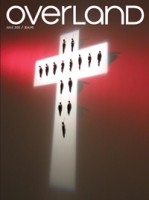
Jeff Sparrow, editor Overland 205, Summer 2011

Someone in the offline world told me recently he was reading a book called The Left Isn’t Always Right. It must be one of the least controversial book titles of all time: how could ‘the Left’ be always right when lefties are forever fiercely, even violently disagreeing with each other? I mean, hadn’t the author heard of Trotsky? This issue of Overland continues in that fine tradition (of debate, I mean, not of violence). And although recent comments on this blog have described it as increasingly right wing, I think it does a nice job of bringing to bear a perspective that challenges the view that all can be well in a capitalist society.

It kicks off with Swedish scholar Mattias Gardell’s ‘Terror in the Norwegian woods‘, which places the recent killing spree in Norway in the context of the return of fascism to Europe. He moves well beyond the easy but still telling point that when the news of the killings broke, many pundits pronounced that it was the work of Muslim terrorists, but when the identity and beliefs of the killer were discovered, the same pundits said it was clearly the work of a lone madman, and not in any way connected to their hate speech – he moves beyond that point to a chilling account of the increasingly vocal and co-ordinated anti-Muslim movement in Europe and in the US, which would be an oddity if it weren’t for their influence on political leaders.

Next, Robert Bollard’s ‘ Who was Bet B?‘, tells the story of his own discovery of Aboriginal ancestry, and explores its implications. Among other things it provides a multidimensional, nuanced context to the brutish attacks on ‘light skinned Aborigines’ we’ve been hearing a bit about recently.

Xavier Rizos’s ‘Will the market save us?‘ could well be subtitled ‘The carbon tax for dummies’, and I mean that in a good way.

Brad Nguyen’s ‘Morality begone!‘ does a neat job of exposing the inadequacy of moral outrage as a tool for understanding, especially in relation to events like the riots in London in August last year. He doesn’t argue that morality has no place, but that relationships of power needs to be taken into account. ‘We can all agree,’ he writes, ‘that events such as 9/11 are the results of acts of evil. But why shouldn’t we let ourselves locate such events within the totality of global capitalism?’ He goes on, ‘If you so much as mention [US] imperialism, you open yourself up to charges of justifying the atrocities of 9/11.’ In a fabulous twist, he invokes Jesus, with a challenging reading of the injunction to turn the other cheek. (This isn’t the journal’s only surprise for those who confuse secularism with hostility to religion: Peter Slezak’s ‘Silence resembling stupidity‘ argues forcibly that the anti-Islamic stance of the ‘new atheists’ – Hitchens, Harris, Dawkins – actually plays into the hands of  those who would wage neo-imperialist and -colonialist wars.)

There are a couple of debates – Stephanie Convery and Katrina Fox on PETA’s use of pornography in its animal rights activism, Ali Alizadeh and Robert Lukins on Australian Poetry, the new peak industry body for poetry. The poetry one, as you might expect, is the more heated (‘Robert Lukins’ is … devoid of almost any substance with which to engage,’ says Alizadeh, unfairly in my view). The animal rights one has the higher moral tone (‘Let’s get our priorities right,’ says Fox, arguing that we shouldn’t object to PETA’s obnoxiousness when other people do much worse things – I guess you can tell where I stand on that one). And there’s a profound panel discussion about language and politics in Indigenous writing, featuring John Bradley, Kim Scott and Marie Munkara.

There are stories and poems, notably an excerpt from Alexis Wright’s forthcoming novel, Eileen Chong’s ‘Mary: A Fiction‘, and Angela Smith’s ‘Jennifer Maiden woke up in The Lodge‘, which I persist in seeing as a tribute to Jennifer Maiden rather than an attack.

Notice all those links! The thing about Overland  is that most of its content is online, and the Overland blog has follow-up interviews and discussions. This interview with Robert Bollard is a fine example. Still, reading it in hard copy has its pleasures, not least of which is the sense of righteousness that comes from sending money their way.

Compare and contrast

I’m way behind in my book-blogging. Here’s a little thing that may amuse you, but you’ll have to work for it.

In April 2010, when Kevin Rudd was still Prime Minister, I posted a wistful piece of unrhymed doggerel, ‘Open Letter to Jennifer Maiden‘, in which I pleaded with JM to write about Kevin and Julia, and played around with some rhymes for Rudd and Abbott.

A month or so ago, Overland 205 included Angela Smith’s poem, ‘Jennifer Maiden woke up in The Lodge‘. Infinitely superior to my effort, it mimicked JM’s voice, and implied a similar yearning to read what she would write about the Prime Minister.

And then, in Black Inc’s Best Australian Poems 2011, edited by John Tranter, Jennifer Maiden herself answered our prayers with ‘A Great Education’, which swoops from indignation and something that could look like contempt to exactly the kind of insight you would expect from JM. I can’t give you a link to the poem. You could buy the book (I haven’t yet, I thought I might get it for Xmas so settled for reading this poem in the shop – I think this poem alone would justify the expense). Or you could:

Step 1: go to the book’s page on the Black Inc site
Step 2: click on the Google preview button
Step 3: search for “A Great Education”
Step 4: click through to the second result.

It turns out the poem was published in the Age roughly a year ago. Perhaps Angela Smith was commenting on it rather than pleading for it to happen. Either way, I doubt if you’ll see these three poems mentioned in the same breath anywhere but here.

Gallery

NSWPLA Dinner, a report from the trenchers

Last year a woman premier presented the NSW Premier’s Literary Awards at the Art Gallery. Tonight a non-Labor premier, just as rare a beast in the 10 of these dinners I’ve been to, did it at the Opera Point Marquee, … Continue reading